A Brief Presentation on Data Mining
Jason Rodrigues
Data Preprocessing
• Introduction
• Why data proprocessing?
• Data Cleaning
• Data Integration and
Transformation
• Data Reduction
• Discretization and concept
Heirarchy generation
• Takeaways
Agenda
Why Data Preprocessing?
Data in the real world is dirty

incomplete: lacking attribute values, lacking certain attributes
of interest, or containing only aggregate data

noisy: containing errors or outliers

inconsistent: containing discrepancies in codes or names
No quality data, no quality mining results!

Quality decisions must be based on quality data

Data warehouse needs consistent integration of quality data
A multi-dimensional measure of data quality

A well-accepted multi-dimensional view:

accuracy, completeness, consistency, timeliness, believability, value
added, interpretability, accessibility
Broad categories

intrinsic, contextual, representational, and accessibility
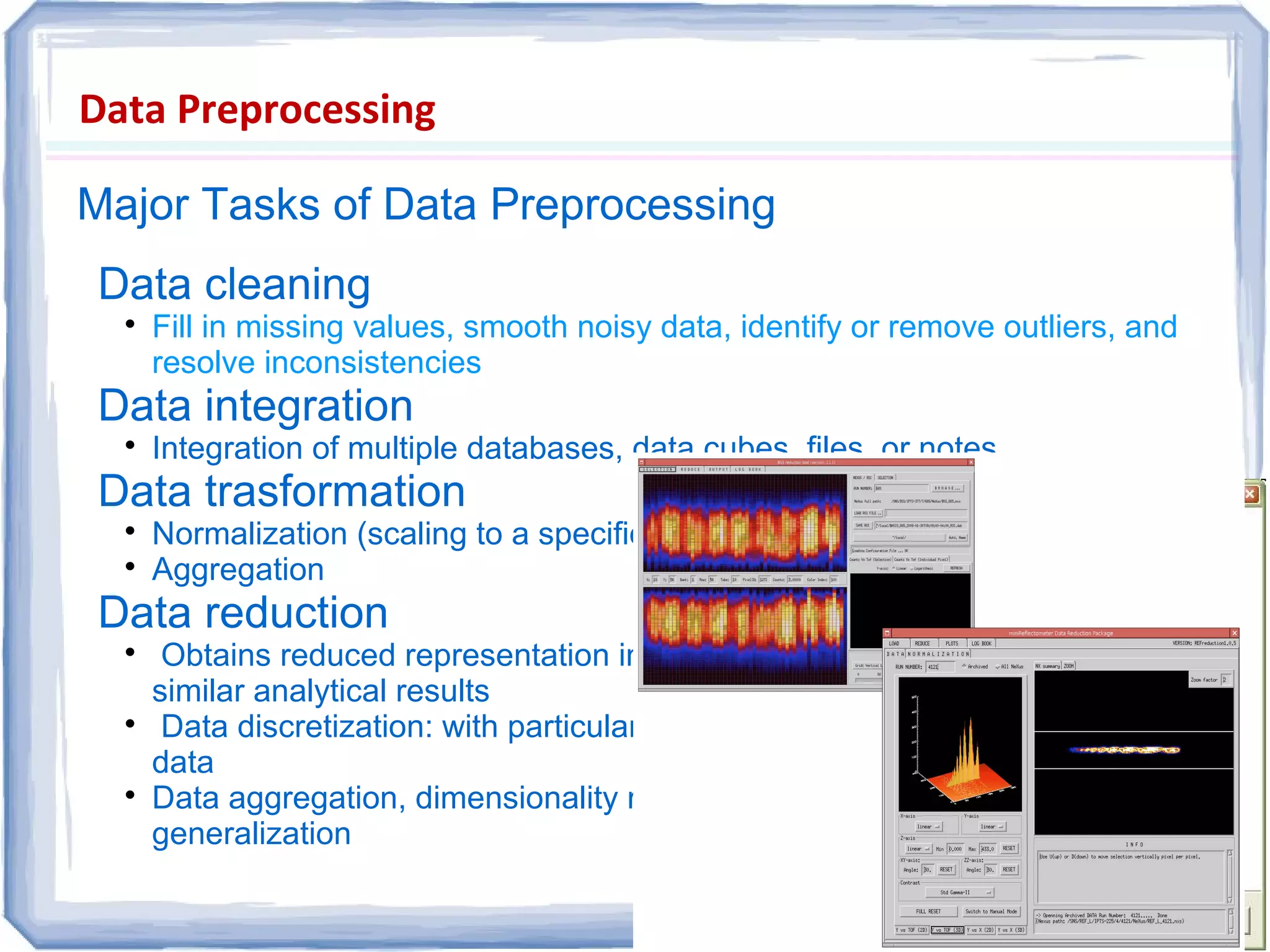
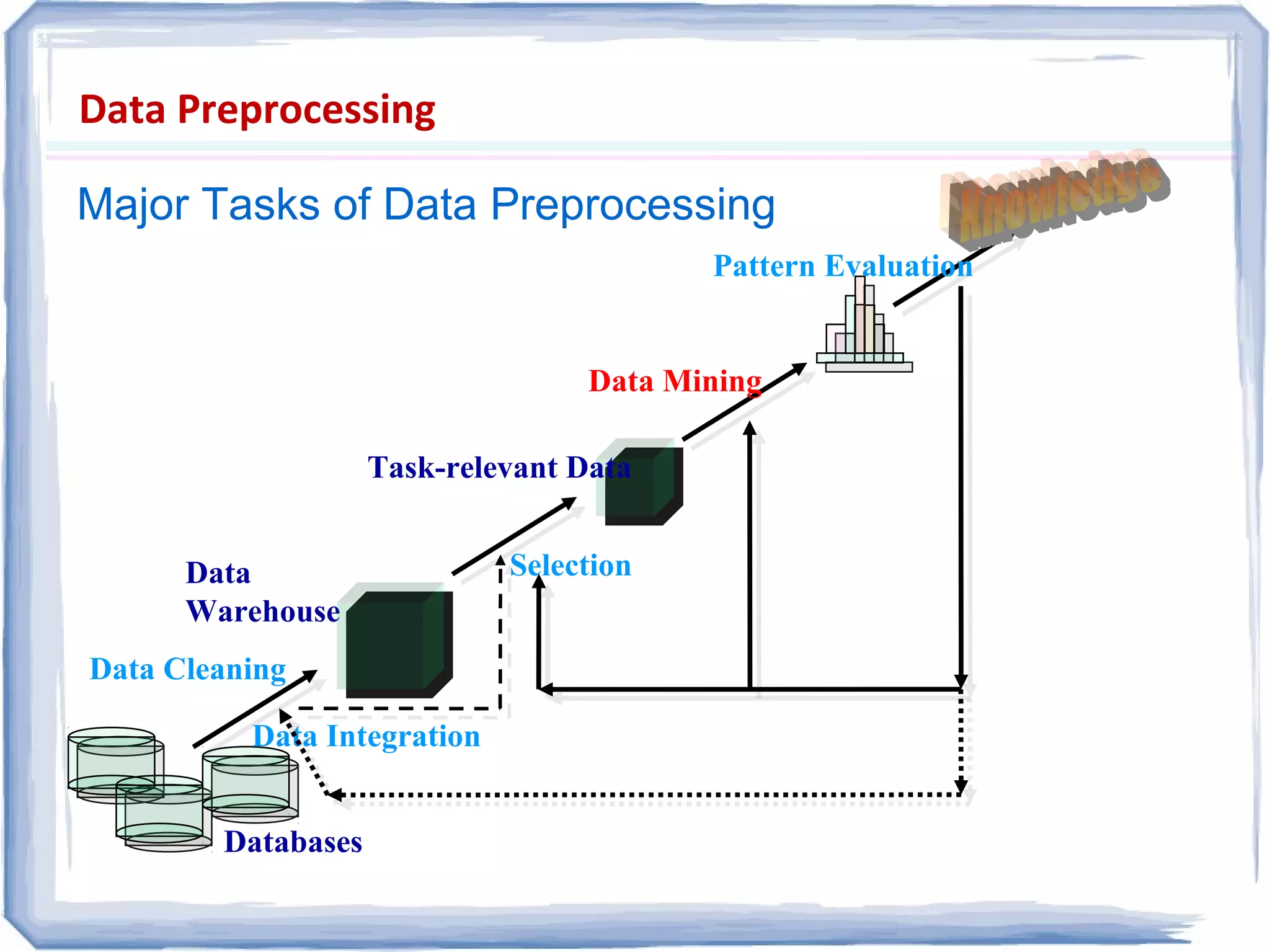
Data Preprocessing
Major Tasks of Data Preprocessing
Data cleaning

Fill in missing values, smooth noisy data, identify or remove outliers, and
resolve inconsistencies
Data integration

Integration of multiple databases, data cubes, files, or notes
Data trasformation

Normalization (scaling to a specific range)

Aggregation
Data reduction

Obtains reduced representation in volume but produces the same or
similar analytical results

Data discretization: with particular importance, especially for numerical
data

Data aggregation, dimensionality reduction, data compression,
generalization
Data Preprocessing
Major Tasks of Data Preprocessing
Data Cleaning
Data Integration
Databases
Data
Warehouse
Task-relevant Data
Selection
Data Mining
Pattern Evaluation
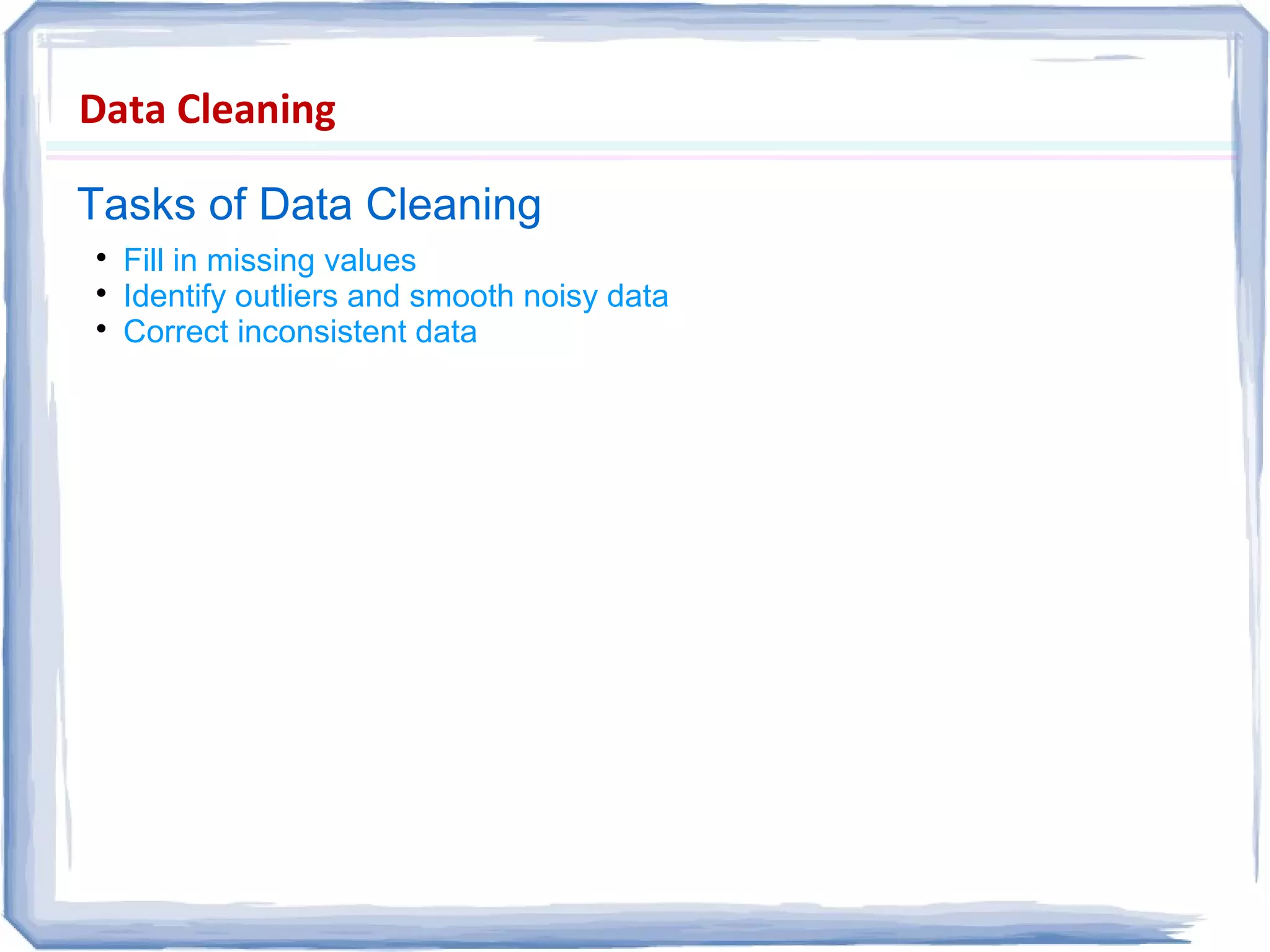
Data Cleaning
Tasks of Data Cleaning

Fill in missing values

Identify outliers and smooth noisy data

Correct inconsistent data
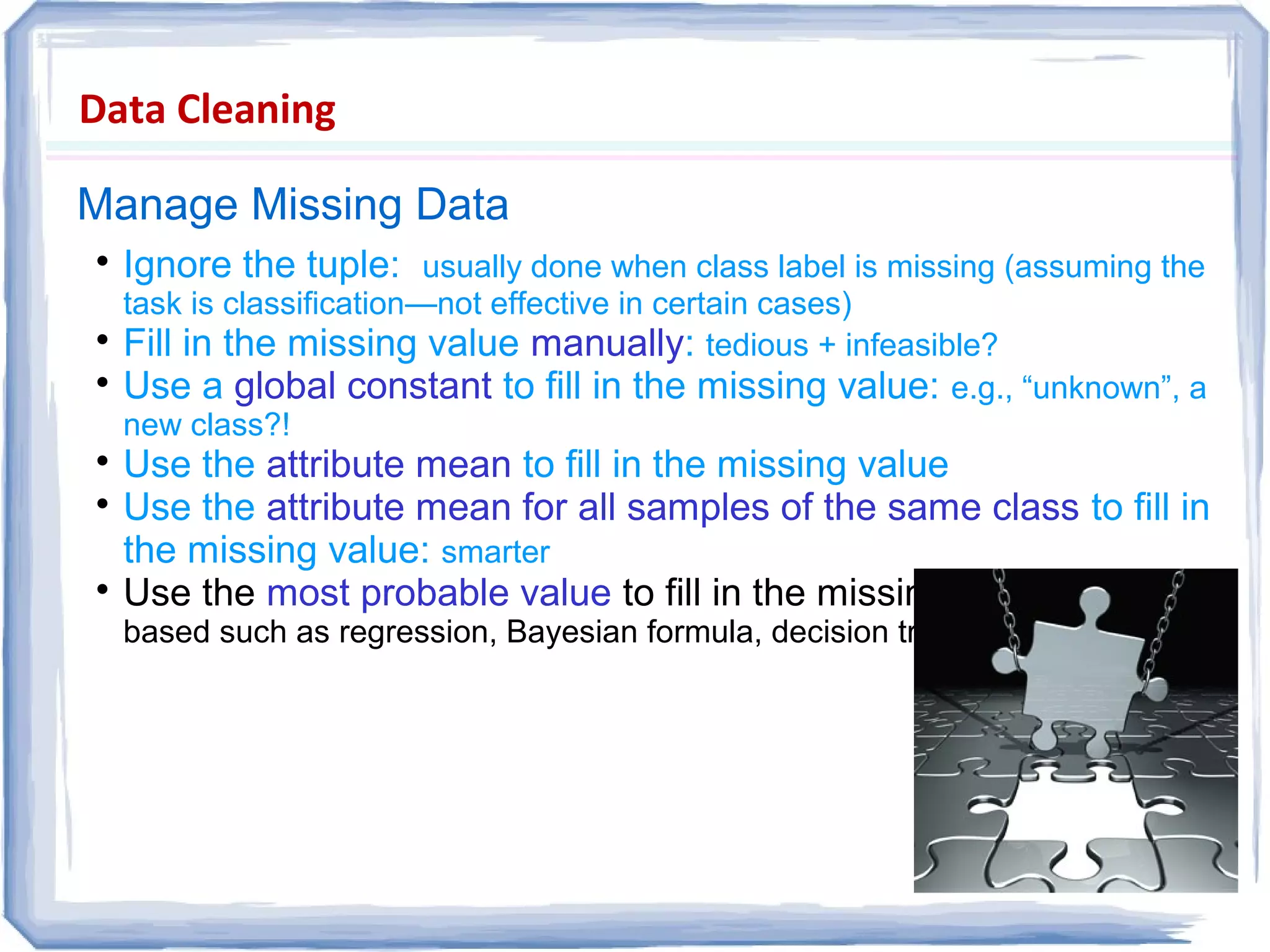
Data Cleaning
Manage Missing Data

Ignore the tuple: usually done when class label is missing (assuming the
task is classification—not effective in certain cases)

Fill in the missing value manually: tedious + infeasible?

Use a global constant to fill in the missing value: e.g., “unknown”, a
new class?!

Use the attribute mean to fill in the missing value

Use the attribute mean for all samples of the same class to fill in
the missing value: smarter

Use the most probable value to fill in the missing value: inference-
based such as regression, Bayesian formula, decision tree
Data Cleaning
Manage Noisy Data
Binning Method:

first sort data and partition into (equi-depth) bins

then one can smooth by bin means, smooth by bin median,
smooth by bin boundaries, etc
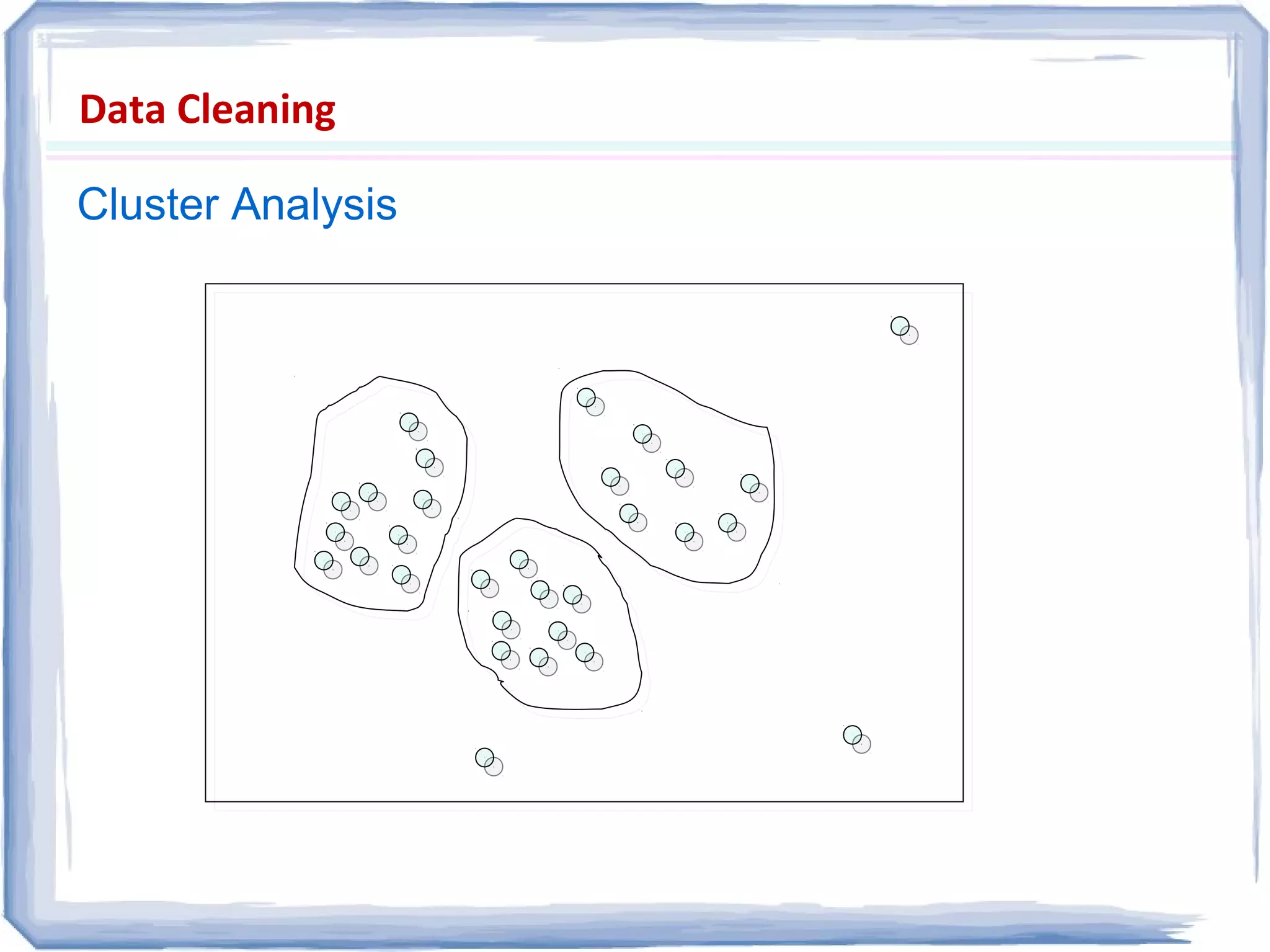
Clustering:

detect and remove outliers
Semi Automated

Computer and Manual Intervention
Regression

Use regression functions
Data Cleaning
Cluster Analysis
Data Cleaning
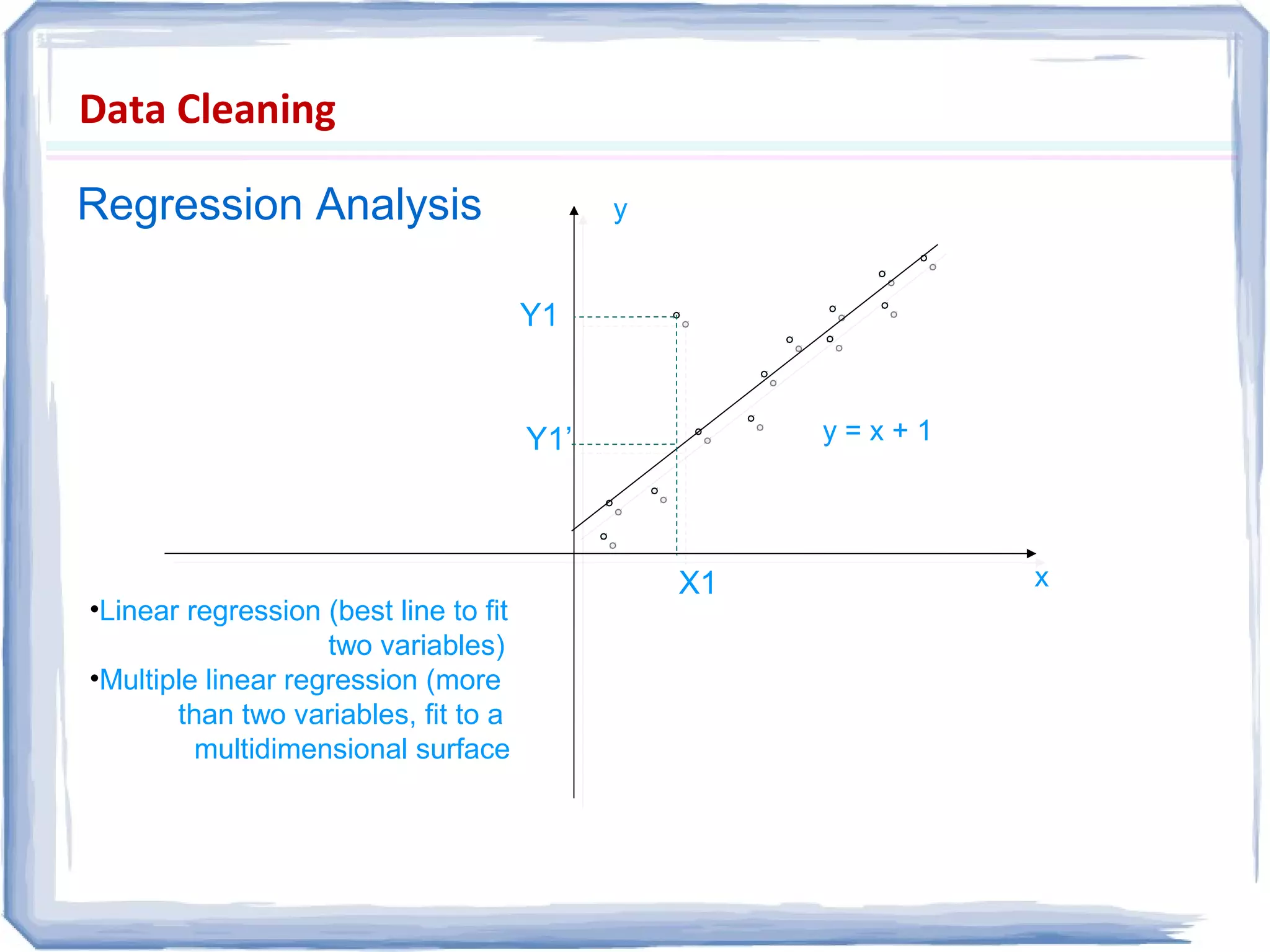
Regression Analysis
x
y
y = x + 1
X1
Y1
Y1’
•Linear regression (best line to fit
two variables)
•Multiple linear regression (more
than two variables, fit to a
multidimensional surface
Data Cleaning
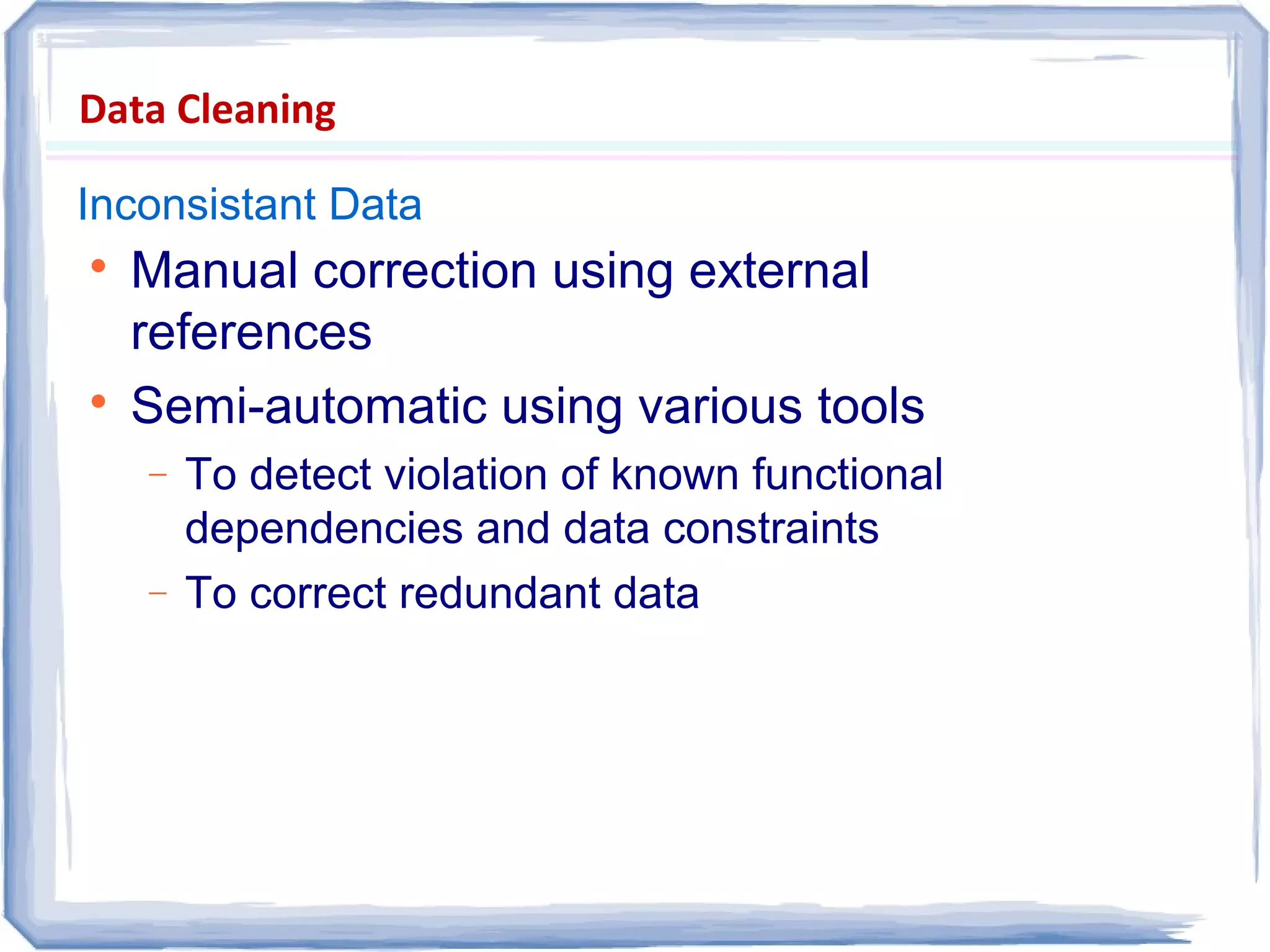
Inconsistant Data

Manual correction using external
references

Semi-automatic using various tools
− To detect violation of known functional
dependencies and data constraints
− To correct redundant data
Data integration and transformation
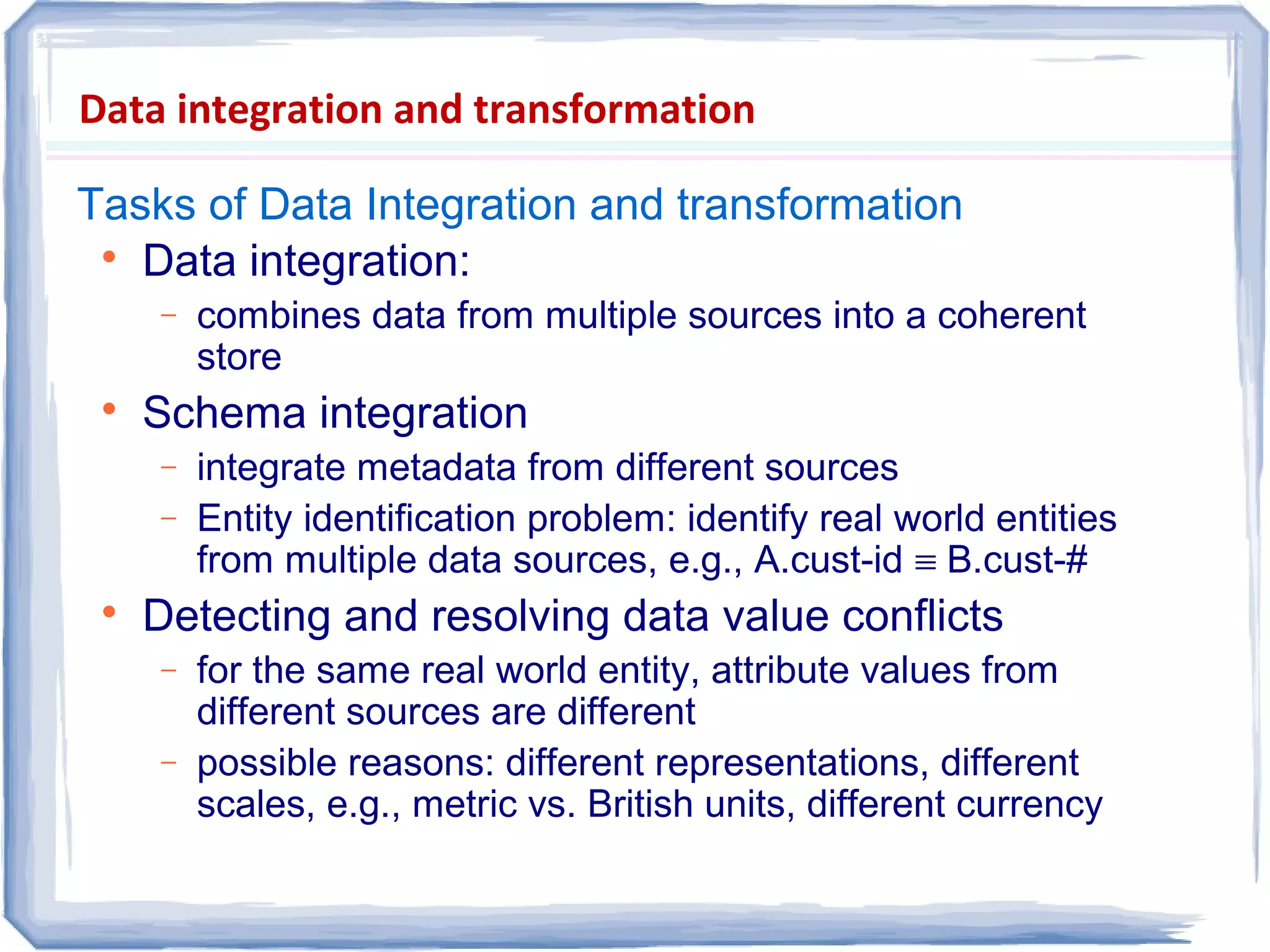
Tasks of Data Integration and transformation

Data integration:
− combines data from multiple sources into a coherent
store

Schema integration
− integrate metadata from different sources
− Entity identification problem: identify real world entities
from multiple data sources, e.g., A.cust-id ≡ B.cust-#

Detecting and resolving data value conflicts
− for the same real world entity, attribute values from
different sources are different
− possible reasons: different representations, different
scales, e.g., metric vs. British units, different currency
Manage Data Integration
Data integration and transformation

Redundant data occur often when integrating multiple DBs
− The same attribute may have different names in different databases
− One attribute may be a “derived” attribute in another table, e.g., annual
revenue

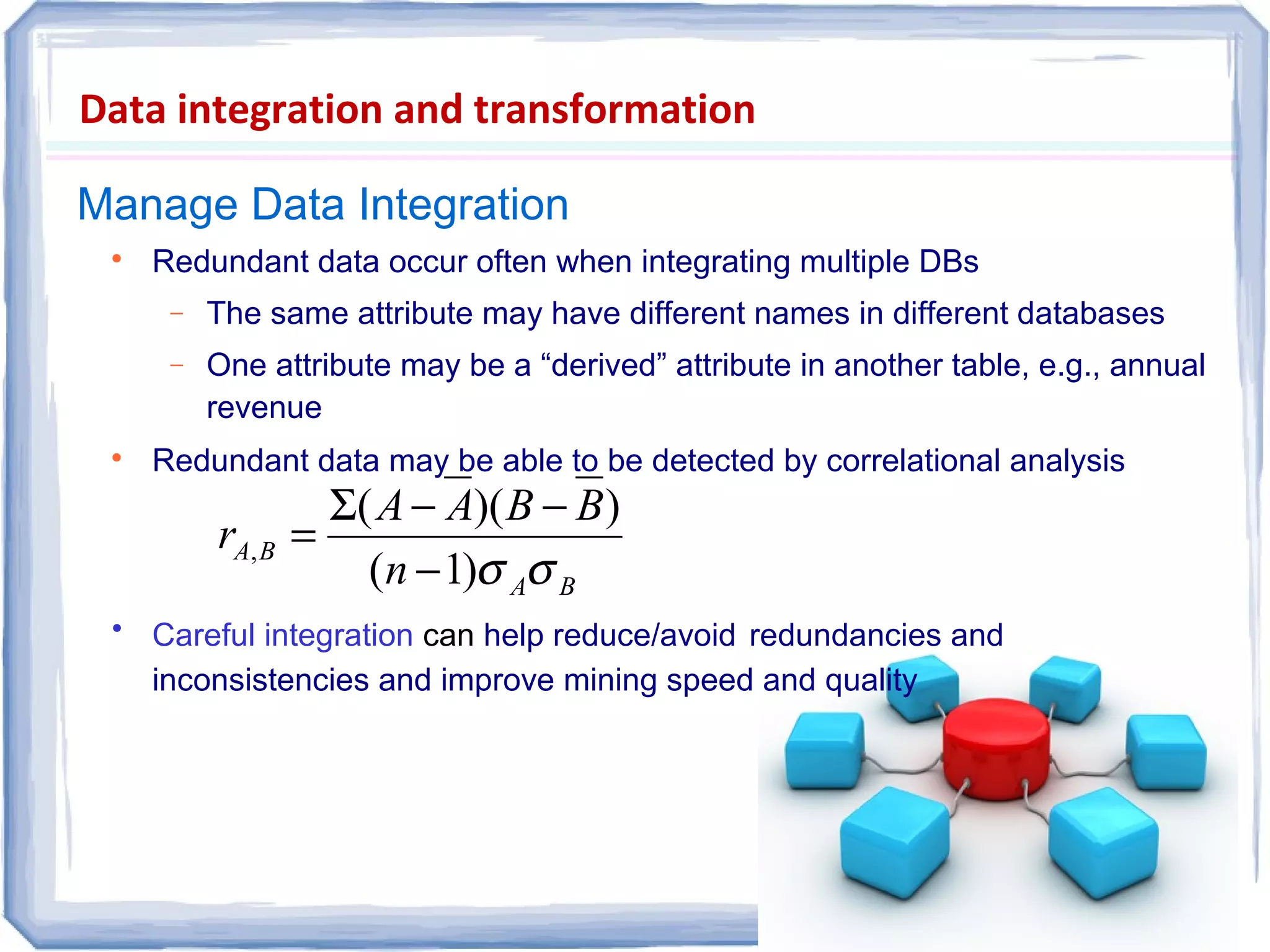
Redundant data may be able to be detected by correlational analysis
• Careful integration can help reduce/avoid redundancies and
inconsistencies and improve mining speed and quality
BA
BA
n
BBAA
r
σσ)1(
))((
,
−
−−Σ
=
Manage Data Transformation
Data integration and transformation
 Smoothing: remove noise from data (binning, clustering,
regression)
 Aggregation: summarization, data cube construction
 Generalization: concept hierarchy climbing
 Normalization: scaled to fall within a small, specified range
− min-max normalization
− z-score normalization
− normalization by decimal scaling
 Attribute/feature construction
− New attributes constructed from the given ones
Manage Data Reduction
Data reduction
Data reduction: reduced representation, while still retaining critical
information

Data cube aggregation

Dimensionality reduction

Data compression

Numerosity reduction

Discretization and concept hierarchy generation
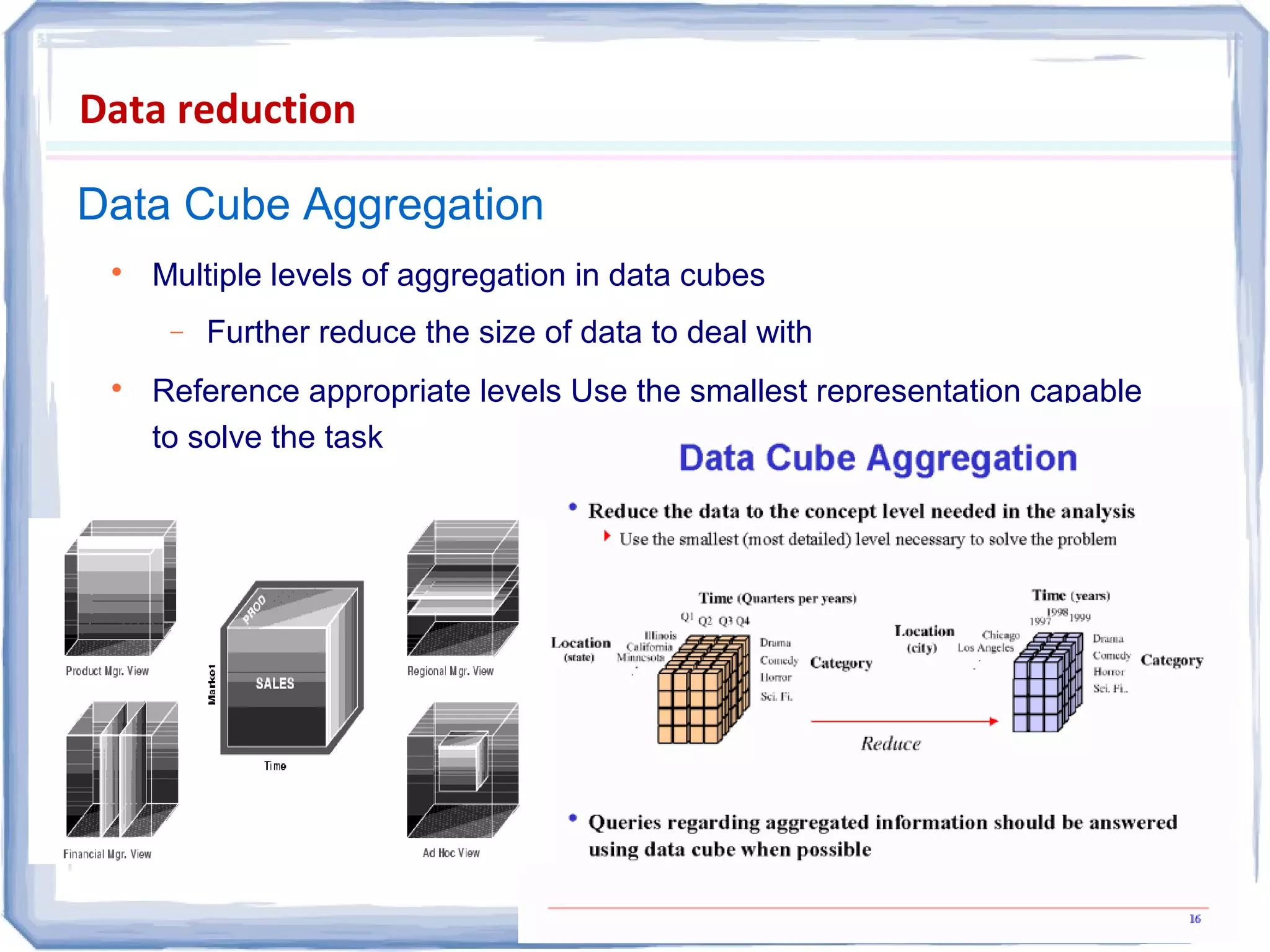
Data Cube Aggregation
Data reduction

Multiple levels of aggregation in data cubes
− Further reduce the size of data to deal with

Reference appropriate levels Use the smallest representation capable
to solve the task
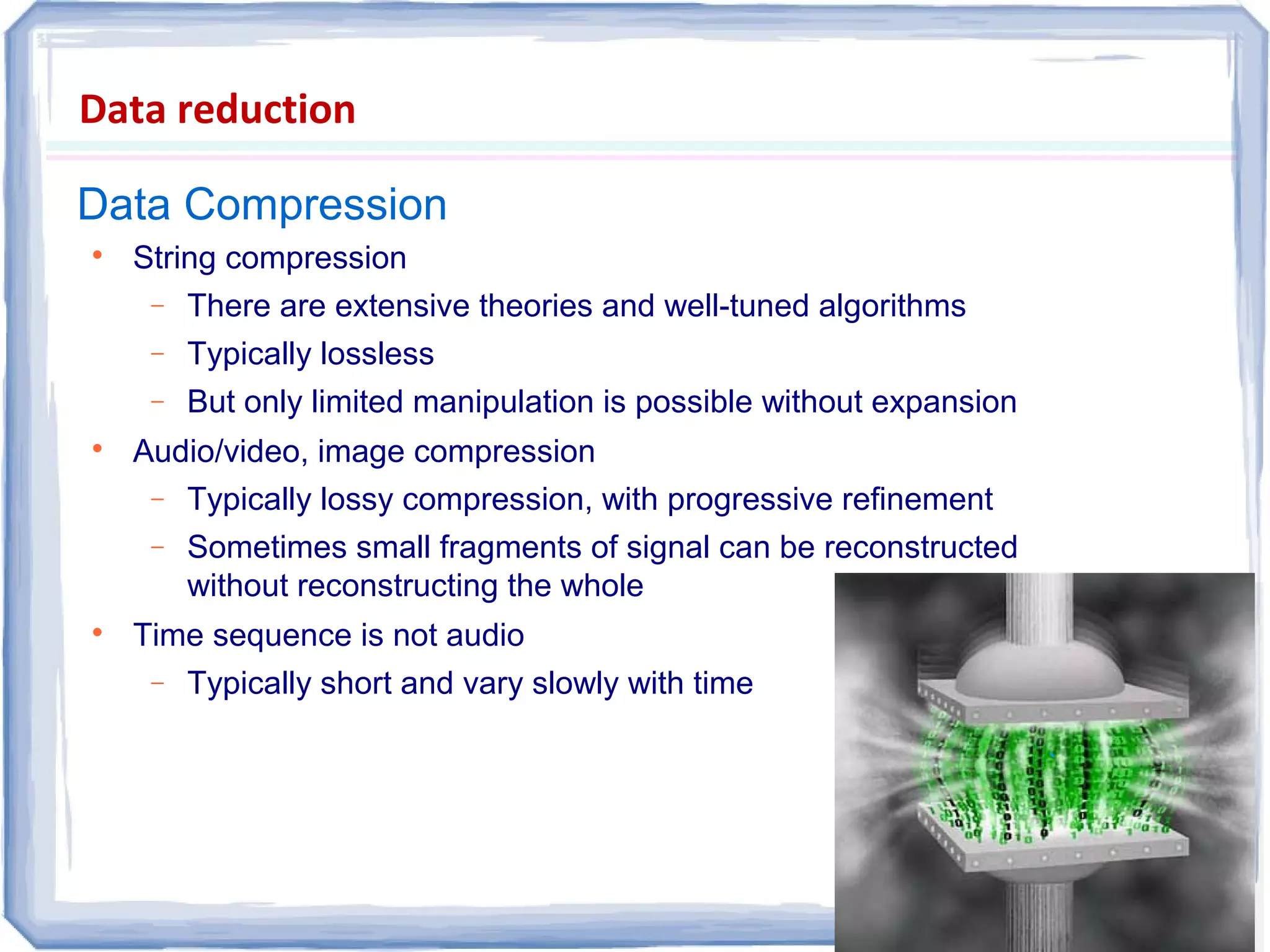
Data Compression
Data reduction

String compression
− There are extensive theories and well-tuned algorithms
− Typically lossless
− But only limited manipulation is possible without expansion

Audio/video, image compression
− Typically lossy compression, with progressive refinement
− Sometimes small fragments of signal can be reconstructed
without reconstructing the whole

Time sequence is not audio
− Typically short and vary slowly with time
``
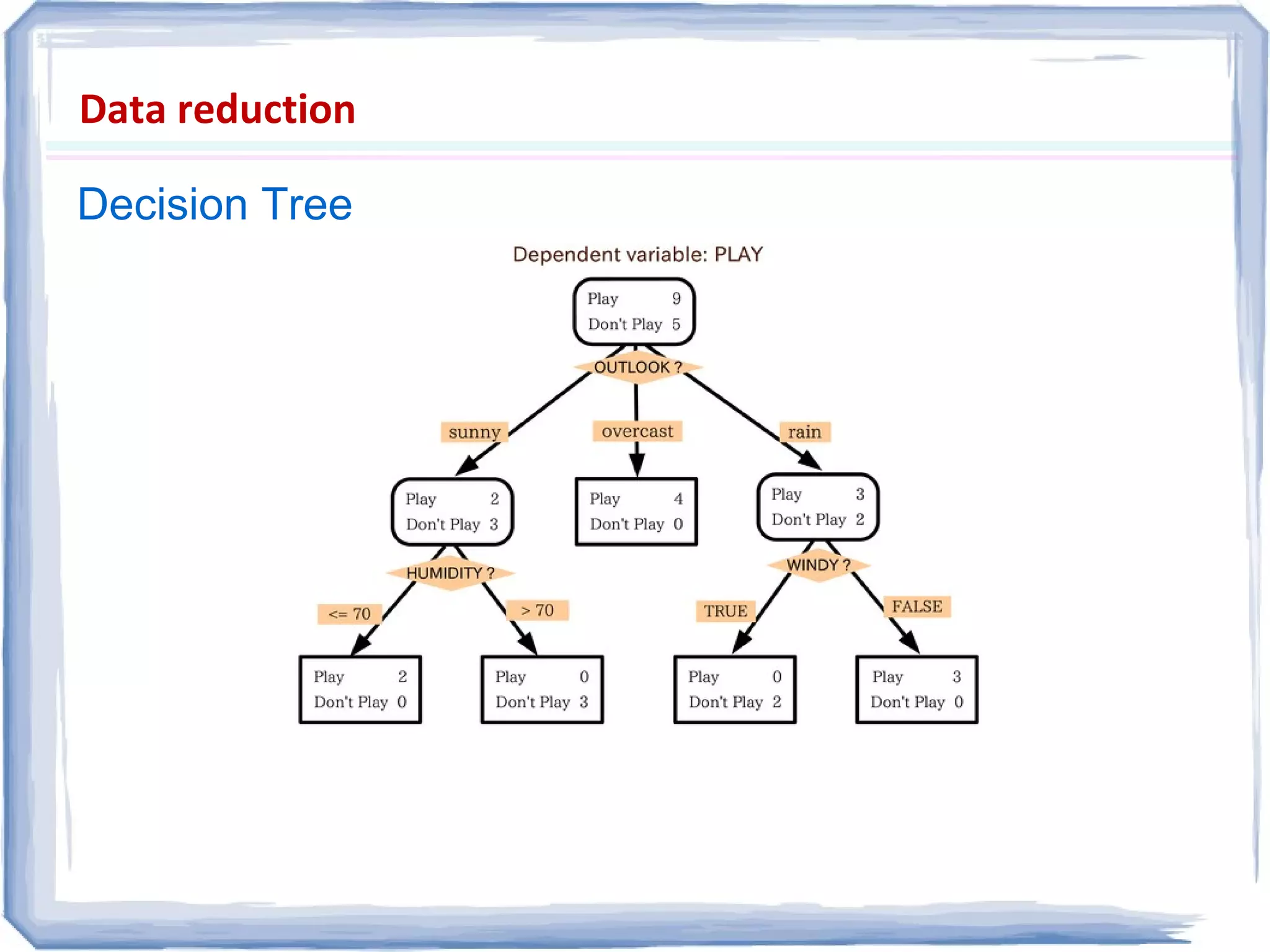
Decision Tree
Data reduction
Similarities and Dissimilarities
Proximity

Proximity is used to refer to Similarity or
Dissimilarity, since proximity between the
object is a function of proximity between
the corresponding attributes of two objects.

Similarity: Numeric measure of the degree
to which the two objects are alike.

Dissimilarity: Numeric measure of the
degree to which the two objects are
different.
Dissimilarities between Data Objects?

Similarity
− Numerical measure of how alike two data
objects are.
− Is higher when objects are more alike.
− Often falls in the range [0,1]

Dissimilarity
− Numerical measure of how different are two data
objects
− Lower when objects are more alike
− Minimum dissimilarity is often 0
− Upper limit varies

Proximity refers to a similarity or dissimilarity
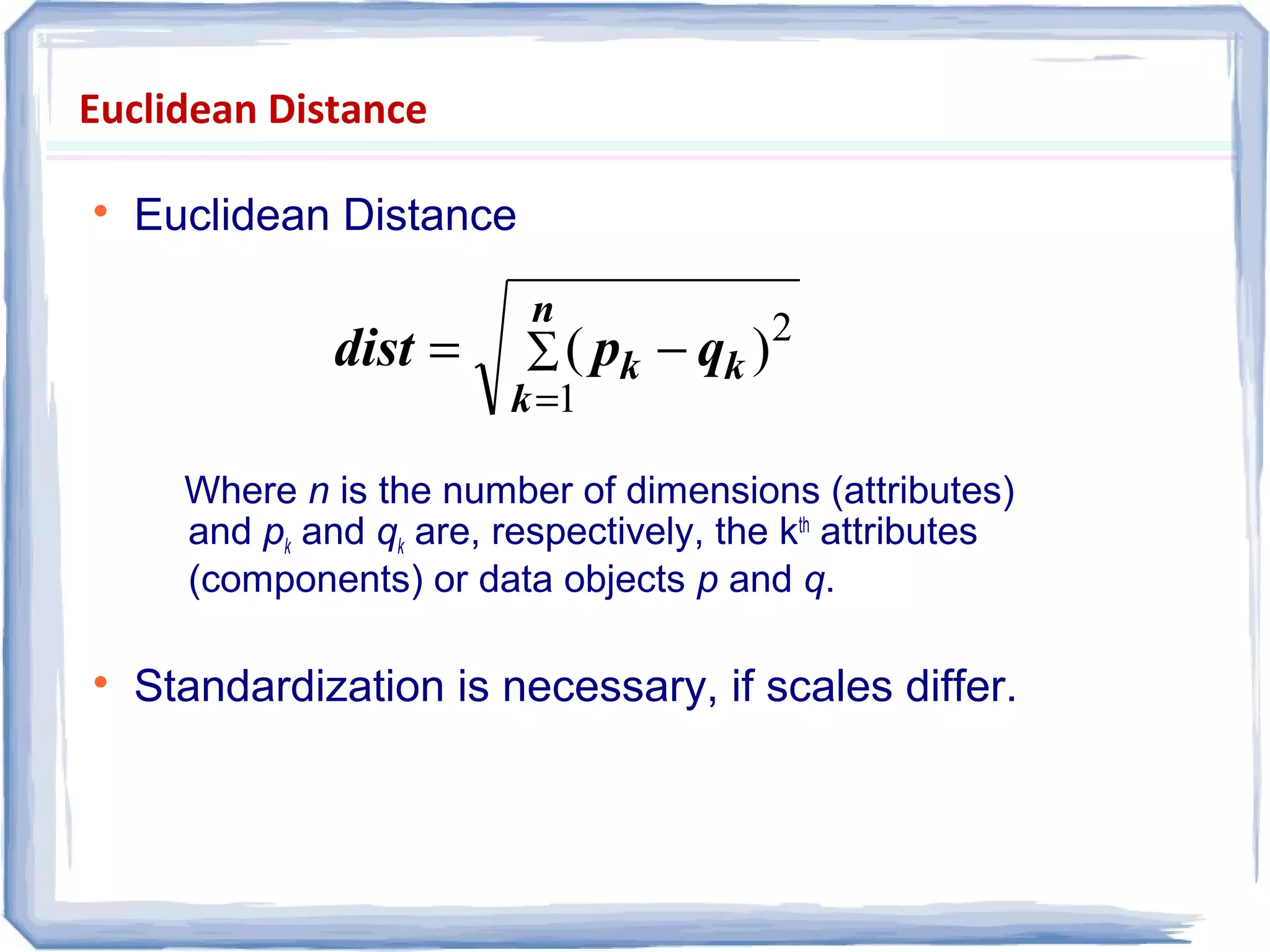
Euclidean Distance

Euclidean Distance
Where n is the number of dimensions (attributes)
and pk and qk are, respectively, the kth
attributes
(components) or data objects p and q.

Standardization is necessary, if scales differ.
∑
=
−=
n
k
kk qpdist
1
2
)(
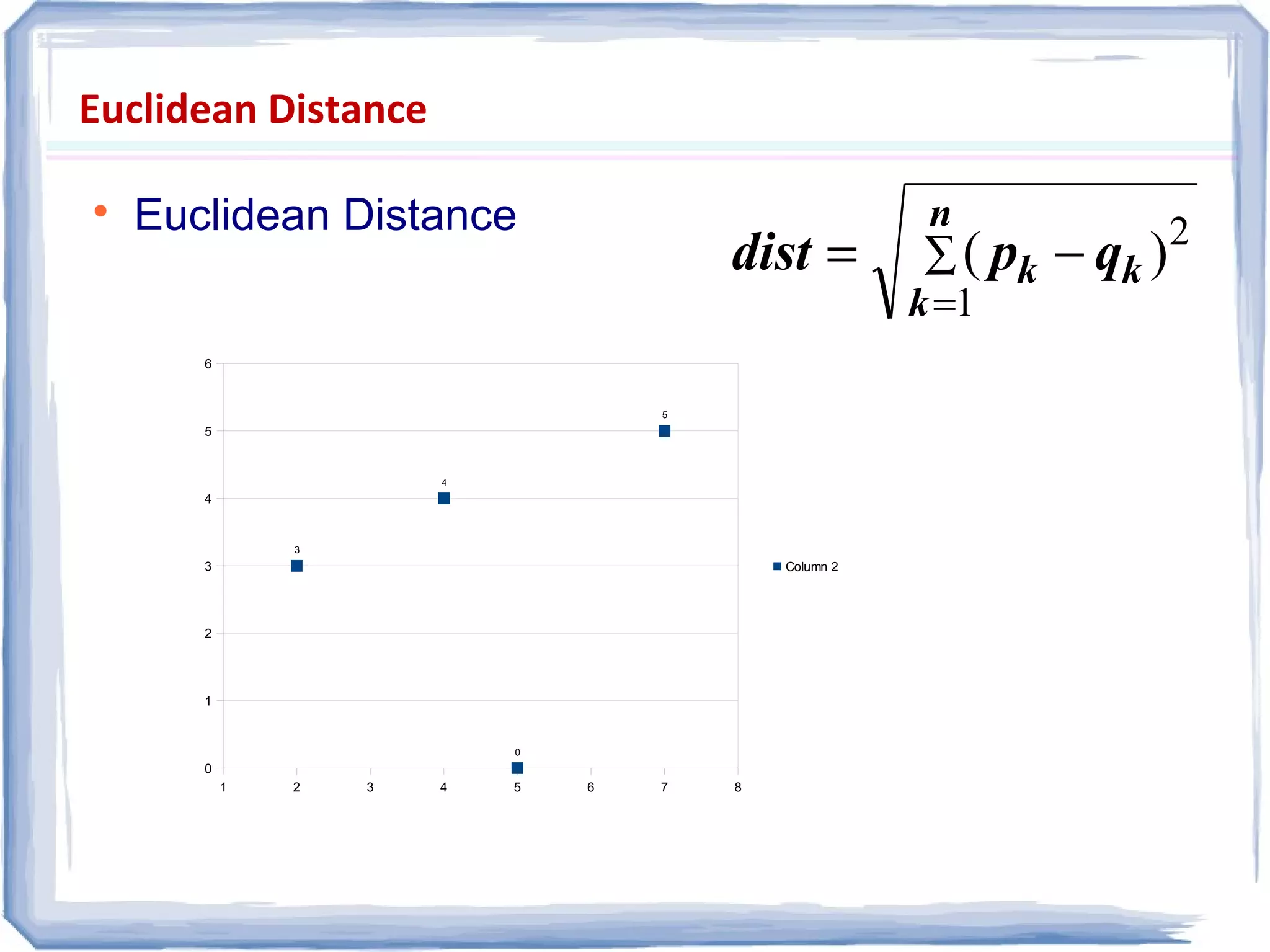
Euclidean Distance

Euclidean Distance
∑
=
−=
n
k
kk qpdist
1
2
)(
1 2 3 4 5 6 7 8
0
1
2
3
4
5
6
0
5
4
3
Column 2
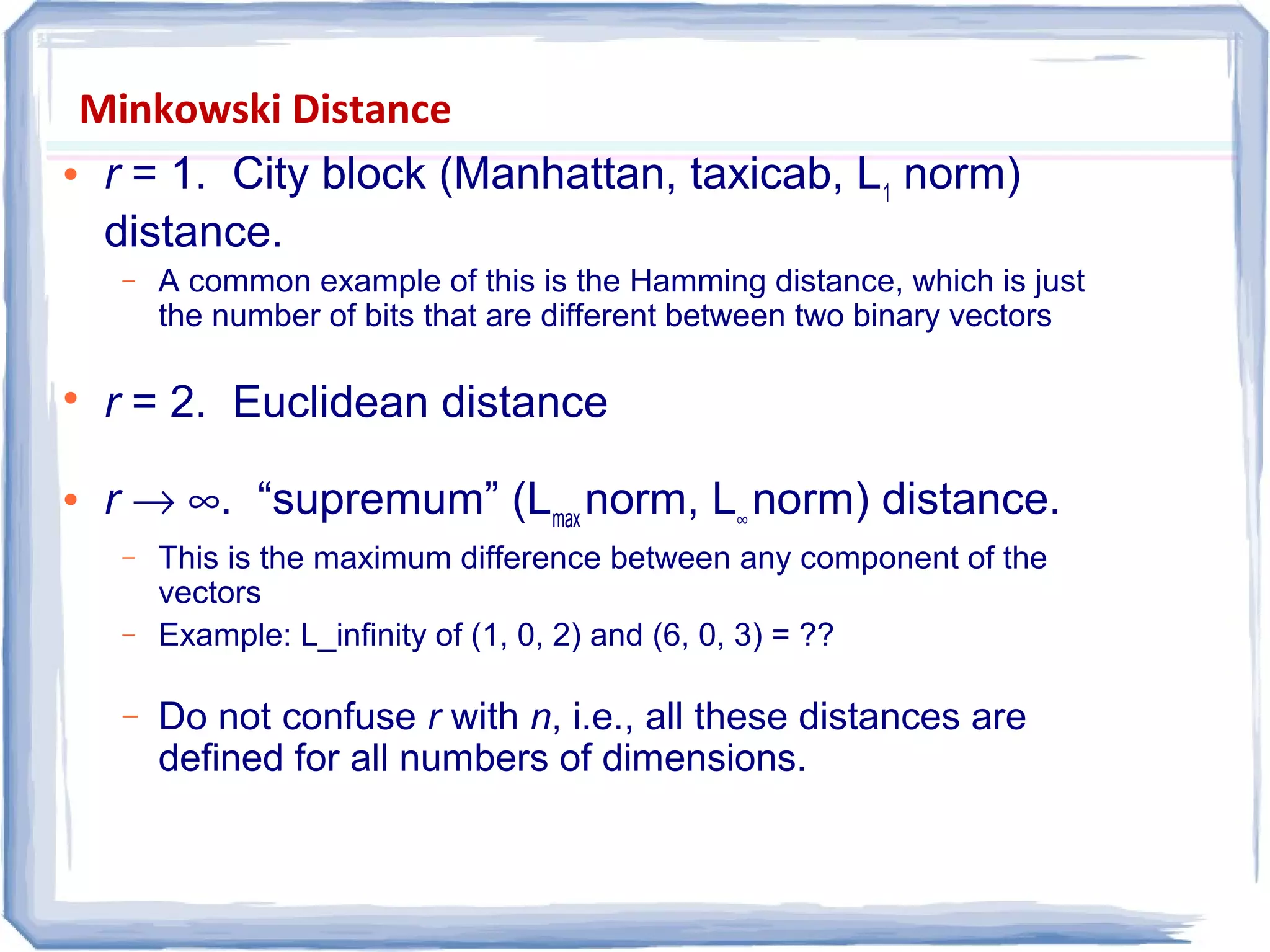
Minkowski Distance
 r = 1. City block (Manhattan, taxicab, L1
norm)
distance.
− A common example of this is the Hamming distance, which is just
the number of bits that are different between two binary vectors

r = 2. Euclidean distance
 r → ∞. “supremum” (Lmax
norm, L∞
norm) distance.
− This is the maximum difference between any component of the
vectors
− Example: L_infinity of (1, 0, 2) and (6, 0, 3) = ??
− Do not confuse r with n, i.e., all these distances are
defined for all numbers of dimensions.
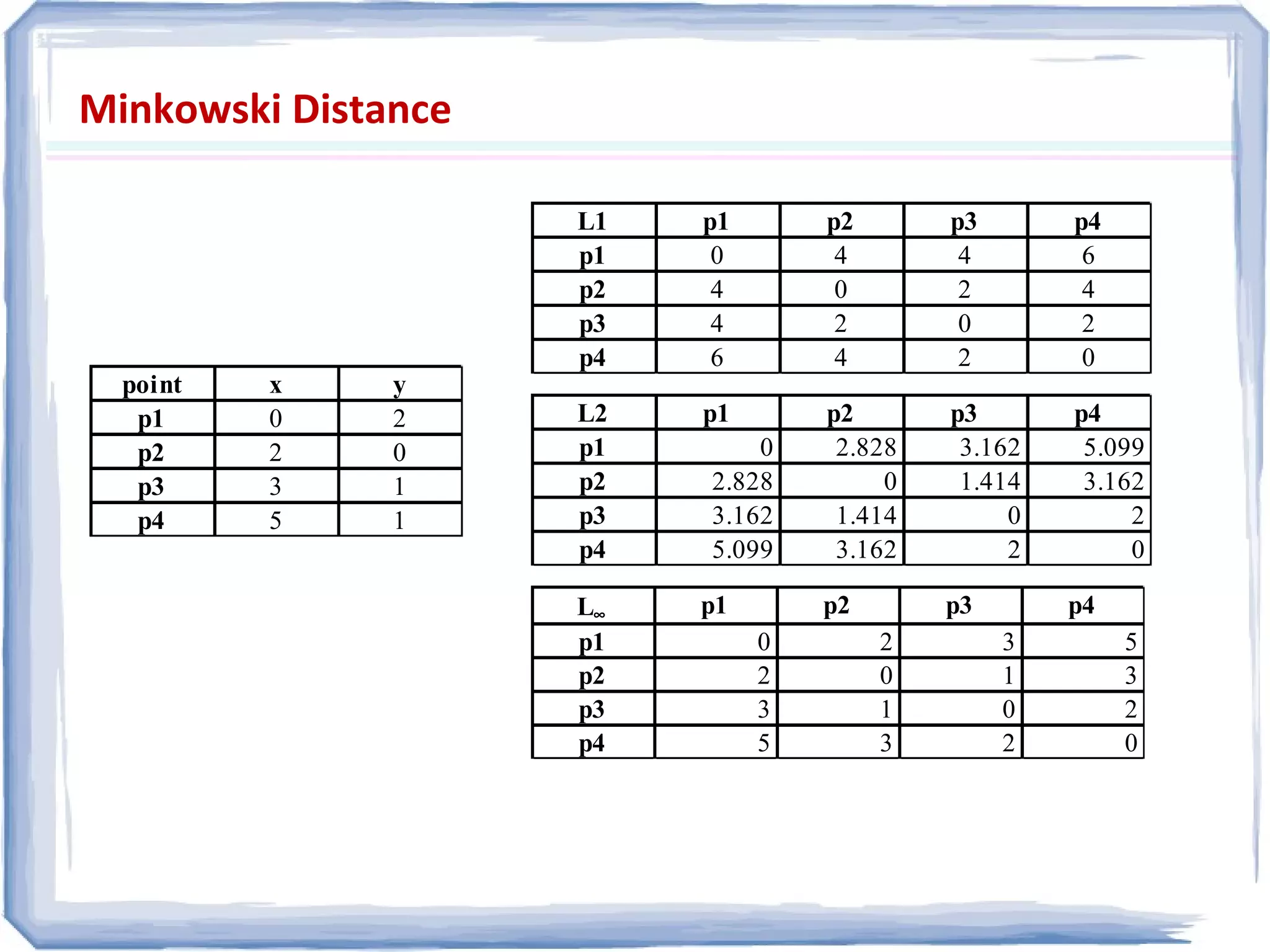
Minkowski Distance
point x y
p1 0 2
p2 2 0
p3 3 1
p4 5 1
L1 p1 p2 p3 p4
p1 0 4 4 6
p2 4 0 2 4
p3 4 2 0 2
p4 6 4 2 0
L2 p1 p2 p3 p4
p1 0 2.828 3.162 5.099
p2 2.828 0 1.414 3.162
p3 3.162 1.414 0 2
p4 5.099 3.162 2 0
L∞ p1 p2 p3 p4
p1 0 2 3 5
p2 2 0 1 3
p3 3 1 0 2
p4 5 3 2 0
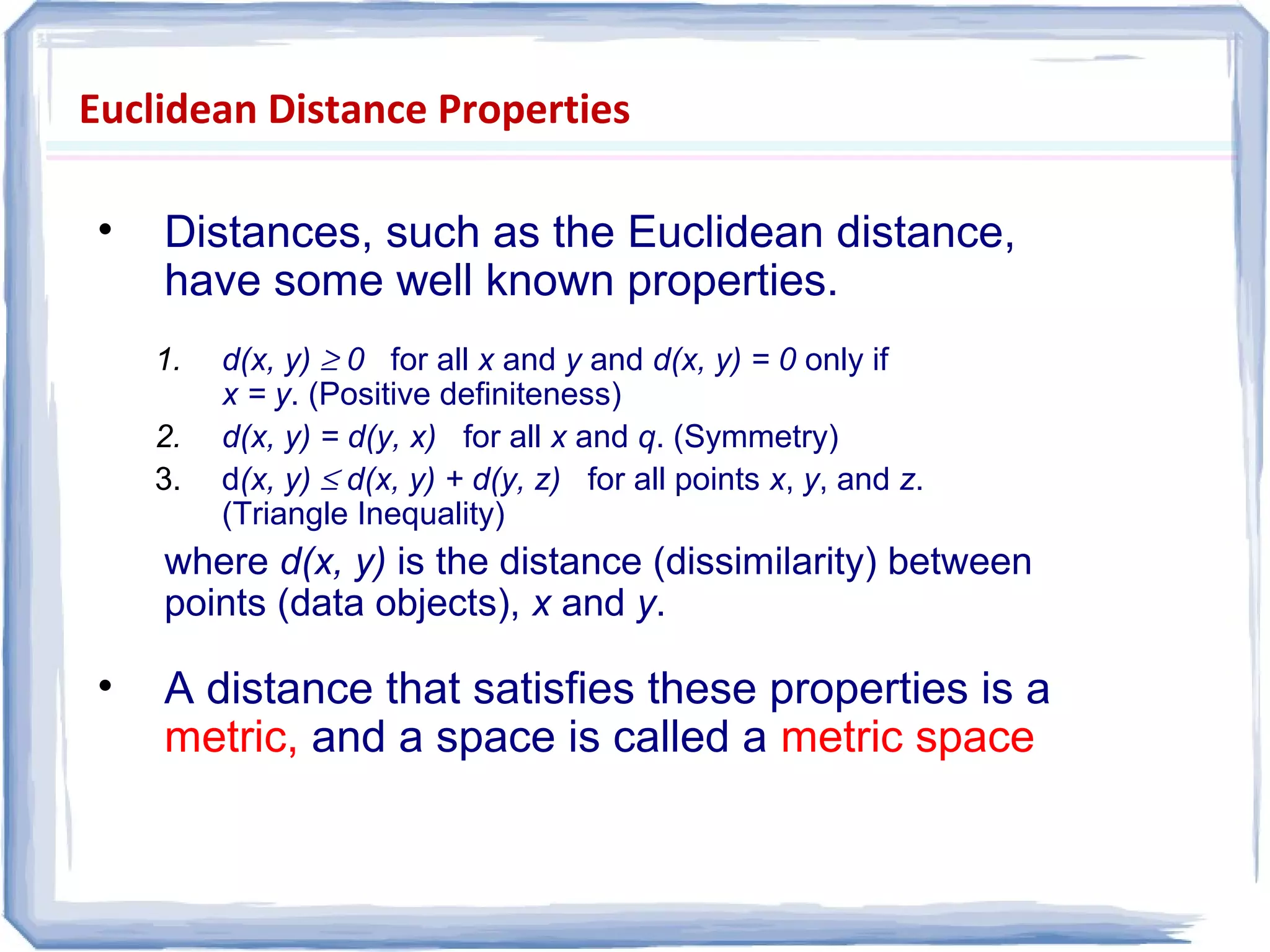
Euclidean Distance Properties
• Distances, such as the Euclidean distance,
have some well known properties.
1. d(x, y) ≥ 0 for all x and y and d(x, y) = 0 only if
x = y. (Positive definiteness)
2. d(x, y) = d(y, x) for all x and q. (Symmetry)
3. d(x, y) ≤ d(x, y) + d(y, z) for all points x, y, and z.
(Triangle Inequality)
where d(x, y) is the distance (dissimilarity) between
points (data objects), x and y.
• A distance that satisfies these properties is a
metric, and a space is called a metric space
Non Metric Dissimilarities – Set Differences

non-metric measures are often robust
(resistant to outliers, errors in objects, etc.)
− the symmetry and mainly the triangular inequality
are often violated

cannot be directly
used with MAMs
a
b
a > b + c
c
a
b
a ≠ b
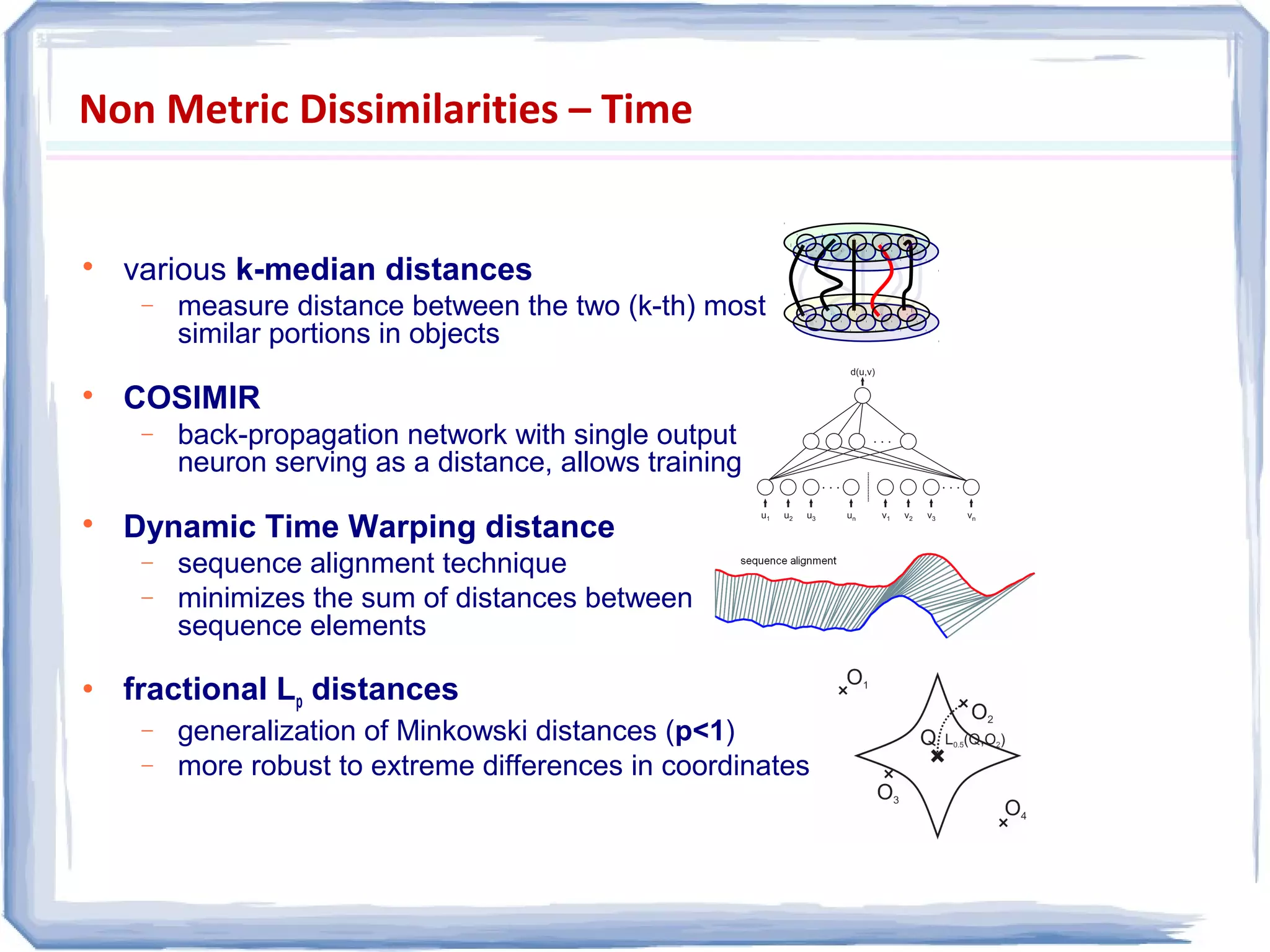
Non Metric Dissimilarities – Time

various k-median distances
− measure distance between the two (k-th) most
similar portions in objects

COSIMIR
− back-propagation network with single output
neuron serving as a distance, allows training

Dynamic Time Warping distance
− sequence alignment technique
− minimizes the sum of distances between
sequence elements
 fractional Lp distances
− generalization of Minkowski distances (p<1)
− more robust to extreme differences in coordinates
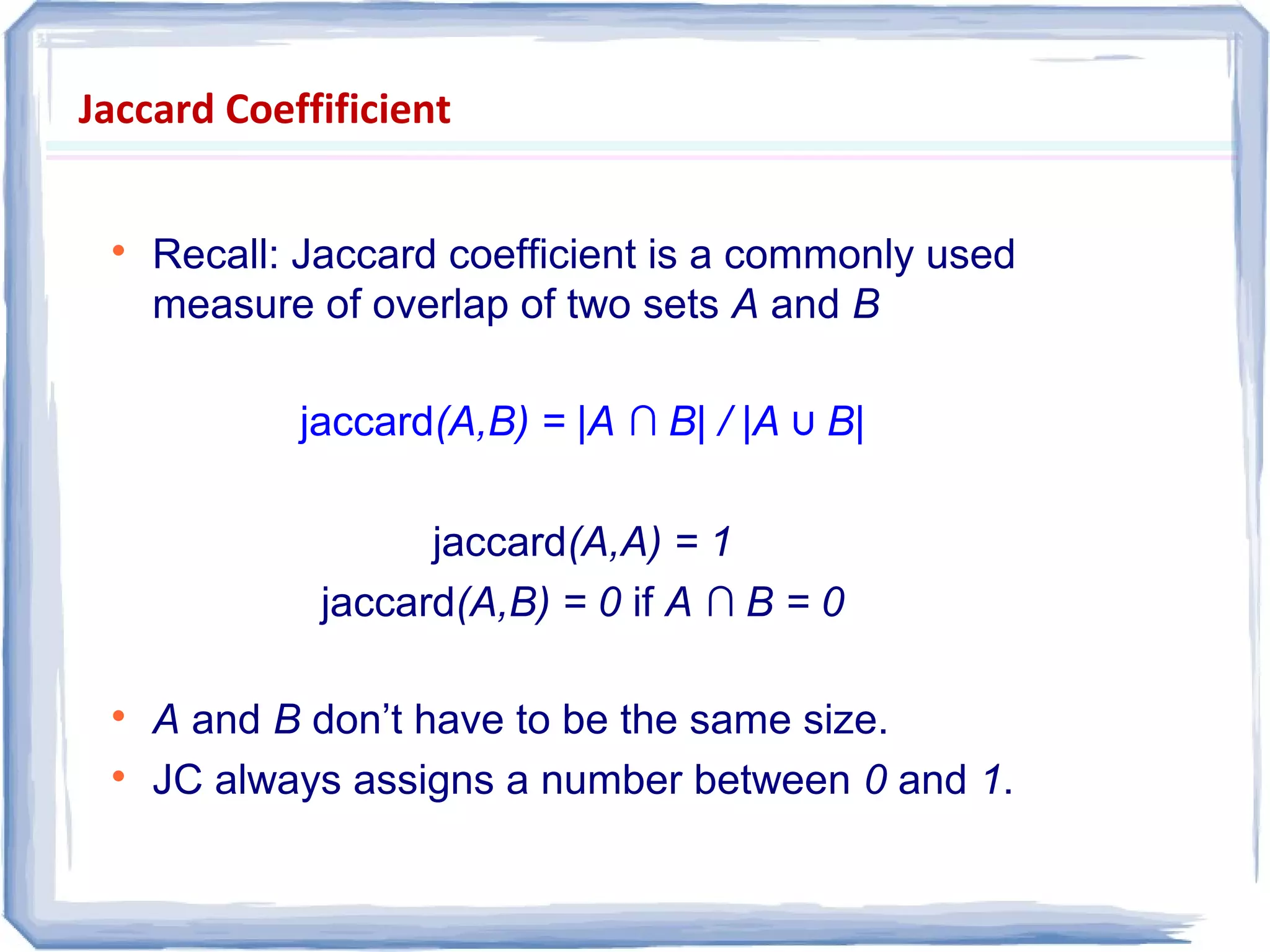
Jaccard Coeffificient

Recall: Jaccard coefficient is a commonly used
measure of overlap of two sets A and B
jaccard(A,B) = |A ∩ B| / |A ∪ B|
jaccard(A,A) = 1
jaccard(A,B) = 0 if A ∩ B = 0

A and B don’t have to be the same size.

JC always assigns a number between 0 and 1.
Takeaways
Why Data Preprocessing?
Data Cleaning
Data Integration and Transformation
Data Reduction
Discretization and concept Heirarchy
generation

Data preprocessing

  • 1.
    A Brief Presentationon Data Mining Jason Rodrigues Data Preprocessing
  • 2.
    • Introduction • Whydata proprocessing? • Data Cleaning • Data Integration and Transformation • Data Reduction • Discretization and concept Heirarchy generation • Takeaways Agenda
  • 3.
    Why Data Preprocessing? Datain the real world is dirty  incomplete: lacking attribute values, lacking certain attributes of interest, or containing only aggregate data  noisy: containing errors or outliers  inconsistent: containing discrepancies in codes or names No quality data, no quality mining results!  Quality decisions must be based on quality data  Data warehouse needs consistent integration of quality data A multi-dimensional measure of data quality  A well-accepted multi-dimensional view:  accuracy, completeness, consistency, timeliness, believability, value added, interpretability, accessibility Broad categories  intrinsic, contextual, representational, and accessibility
  • 4.
    Data Preprocessing Major Tasksof Data Preprocessing Data cleaning  Fill in missing values, smooth noisy data, identify or remove outliers, and resolve inconsistencies Data integration  Integration of multiple databases, data cubes, files, or notes Data trasformation  Normalization (scaling to a specific range)  Aggregation Data reduction  Obtains reduced representation in volume but produces the same or similar analytical results  Data discretization: with particular importance, especially for numerical data  Data aggregation, dimensionality reduction, data compression, generalization
  • 5.
    Data Preprocessing Major Tasksof Data Preprocessing Data Cleaning Data Integration Databases Data Warehouse Task-relevant Data Selection Data Mining Pattern Evaluation
  • 6.
    Data Cleaning Tasks ofData Cleaning  Fill in missing values  Identify outliers and smooth noisy data  Correct inconsistent data
  • 7.
    Data Cleaning Manage MissingData  Ignore the tuple: usually done when class label is missing (assuming the task is classification—not effective in certain cases)  Fill in the missing value manually: tedious + infeasible?  Use a global constant to fill in the missing value: e.g., “unknown”, a new class?!  Use the attribute mean to fill in the missing value  Use the attribute mean for all samples of the same class to fill in the missing value: smarter  Use the most probable value to fill in the missing value: inference- based such as regression, Bayesian formula, decision tree
  • 8.
    Data Cleaning Manage NoisyData Binning Method:  first sort data and partition into (equi-depth) bins  then one can smooth by bin means, smooth by bin median, smooth by bin boundaries, etc Clustering:  detect and remove outliers Semi Automated  Computer and Manual Intervention Regression  Use regression functions
  • 9.
  • 10.
    Data Cleaning Regression Analysis x y y= x + 1 X1 Y1 Y1’ •Linear regression (best line to fit two variables) •Multiple linear regression (more than two variables, fit to a multidimensional surface
  • 11.
    Data Cleaning Inconsistant Data  Manualcorrection using external references  Semi-automatic using various tools − To detect violation of known functional dependencies and data constraints − To correct redundant data
  • 12.
    Data integration andtransformation Tasks of Data Integration and transformation  Data integration: − combines data from multiple sources into a coherent store  Schema integration − integrate metadata from different sources − Entity identification problem: identify real world entities from multiple data sources, e.g., A.cust-id ≡ B.cust-#  Detecting and resolving data value conflicts − for the same real world entity, attribute values from different sources are different − possible reasons: different representations, different scales, e.g., metric vs. British units, different currency
  • 13.
    Manage Data Integration Dataintegration and transformation  Redundant data occur often when integrating multiple DBs − The same attribute may have different names in different databases − One attribute may be a “derived” attribute in another table, e.g., annual revenue  Redundant data may be able to be detected by correlational analysis • Careful integration can help reduce/avoid redundancies and inconsistencies and improve mining speed and quality BA BA n BBAA r σσ)1( ))(( , − −−Σ =
  • 14.
    Manage Data Transformation Dataintegration and transformation  Smoothing: remove noise from data (binning, clustering, regression)  Aggregation: summarization, data cube construction  Generalization: concept hierarchy climbing  Normalization: scaled to fall within a small, specified range − min-max normalization − z-score normalization − normalization by decimal scaling  Attribute/feature construction − New attributes constructed from the given ones
  • 15.
    Manage Data Reduction Datareduction Data reduction: reduced representation, while still retaining critical information  Data cube aggregation  Dimensionality reduction  Data compression  Numerosity reduction  Discretization and concept hierarchy generation
  • 16.
    Data Cube Aggregation Datareduction  Multiple levels of aggregation in data cubes − Further reduce the size of data to deal with  Reference appropriate levels Use the smallest representation capable to solve the task
  • 17.
    Data Compression Data reduction  Stringcompression − There are extensive theories and well-tuned algorithms − Typically lossless − But only limited manipulation is possible without expansion  Audio/video, image compression − Typically lossy compression, with progressive refinement − Sometimes small fragments of signal can be reconstructed without reconstructing the whole  Time sequence is not audio − Typically short and vary slowly with time ``
  • 18.
  • 19.
    Similarities and Dissimilarities Proximity  Proximityis used to refer to Similarity or Dissimilarity, since proximity between the object is a function of proximity between the corresponding attributes of two objects.  Similarity: Numeric measure of the degree to which the two objects are alike.  Dissimilarity: Numeric measure of the degree to which the two objects are different.
  • 20.
    Dissimilarities between DataObjects?  Similarity − Numerical measure of how alike two data objects are. − Is higher when objects are more alike. − Often falls in the range [0,1]  Dissimilarity − Numerical measure of how different are two data objects − Lower when objects are more alike − Minimum dissimilarity is often 0 − Upper limit varies  Proximity refers to a similarity or dissimilarity
  • 21.
    Euclidean Distance  Euclidean Distance Wheren is the number of dimensions (attributes) and pk and qk are, respectively, the kth attributes (components) or data objects p and q.  Standardization is necessary, if scales differ. ∑ = −= n k kk qpdist 1 2 )(
  • 22.
    Euclidean Distance  Euclidean Distance ∑ = −= n k kkqpdist 1 2 )( 1 2 3 4 5 6 7 8 0 1 2 3 4 5 6 0 5 4 3 Column 2
  • 23.
    Minkowski Distance  r= 1. City block (Manhattan, taxicab, L1 norm) distance. − A common example of this is the Hamming distance, which is just the number of bits that are different between two binary vectors  r = 2. Euclidean distance  r → ∞. “supremum” (Lmax norm, L∞ norm) distance. − This is the maximum difference between any component of the vectors − Example: L_infinity of (1, 0, 2) and (6, 0, 3) = ?? − Do not confuse r with n, i.e., all these distances are defined for all numbers of dimensions.
  • 24.
    Minkowski Distance point xy p1 0 2 p2 2 0 p3 3 1 p4 5 1 L1 p1 p2 p3 p4 p1 0 4 4 6 p2 4 0 2 4 p3 4 2 0 2 p4 6 4 2 0 L2 p1 p2 p3 p4 p1 0 2.828 3.162 5.099 p2 2.828 0 1.414 3.162 p3 3.162 1.414 0 2 p4 5.099 3.162 2 0 L∞ p1 p2 p3 p4 p1 0 2 3 5 p2 2 0 1 3 p3 3 1 0 2 p4 5 3 2 0
  • 25.
    Euclidean Distance Properties •Distances, such as the Euclidean distance, have some well known properties. 1. d(x, y) ≥ 0 for all x and y and d(x, y) = 0 only if x = y. (Positive definiteness) 2. d(x, y) = d(y, x) for all x and q. (Symmetry) 3. d(x, y) ≤ d(x, y) + d(y, z) for all points x, y, and z. (Triangle Inequality) where d(x, y) is the distance (dissimilarity) between points (data objects), x and y. • A distance that satisfies these properties is a metric, and a space is called a metric space
  • 26.
    Non Metric Dissimilarities– Set Differences  non-metric measures are often robust (resistant to outliers, errors in objects, etc.) − the symmetry and mainly the triangular inequality are often violated  cannot be directly used with MAMs a b a > b + c c a b a ≠ b
  • 27.
    Non Metric Dissimilarities– Time  various k-median distances − measure distance between the two (k-th) most similar portions in objects  COSIMIR − back-propagation network with single output neuron serving as a distance, allows training  Dynamic Time Warping distance − sequence alignment technique − minimizes the sum of distances between sequence elements  fractional Lp distances − generalization of Minkowski distances (p<1) − more robust to extreme differences in coordinates
  • 28.
    Jaccard Coeffificient  Recall: Jaccardcoefficient is a commonly used measure of overlap of two sets A and B jaccard(A,B) = |A ∩ B| / |A ∪ B| jaccard(A,A) = 1 jaccard(A,B) = 0 if A ∩ B = 0  A and B don’t have to be the same size.  JC always assigns a number between 0 and 1.
  • 29.
    Takeaways Why Data Preprocessing? DataCleaning Data Integration and Transformation Data Reduction Discretization and concept Heirarchy generation