Nursing Research
Corrie Uys 1
Centre for PostgraduateStudies
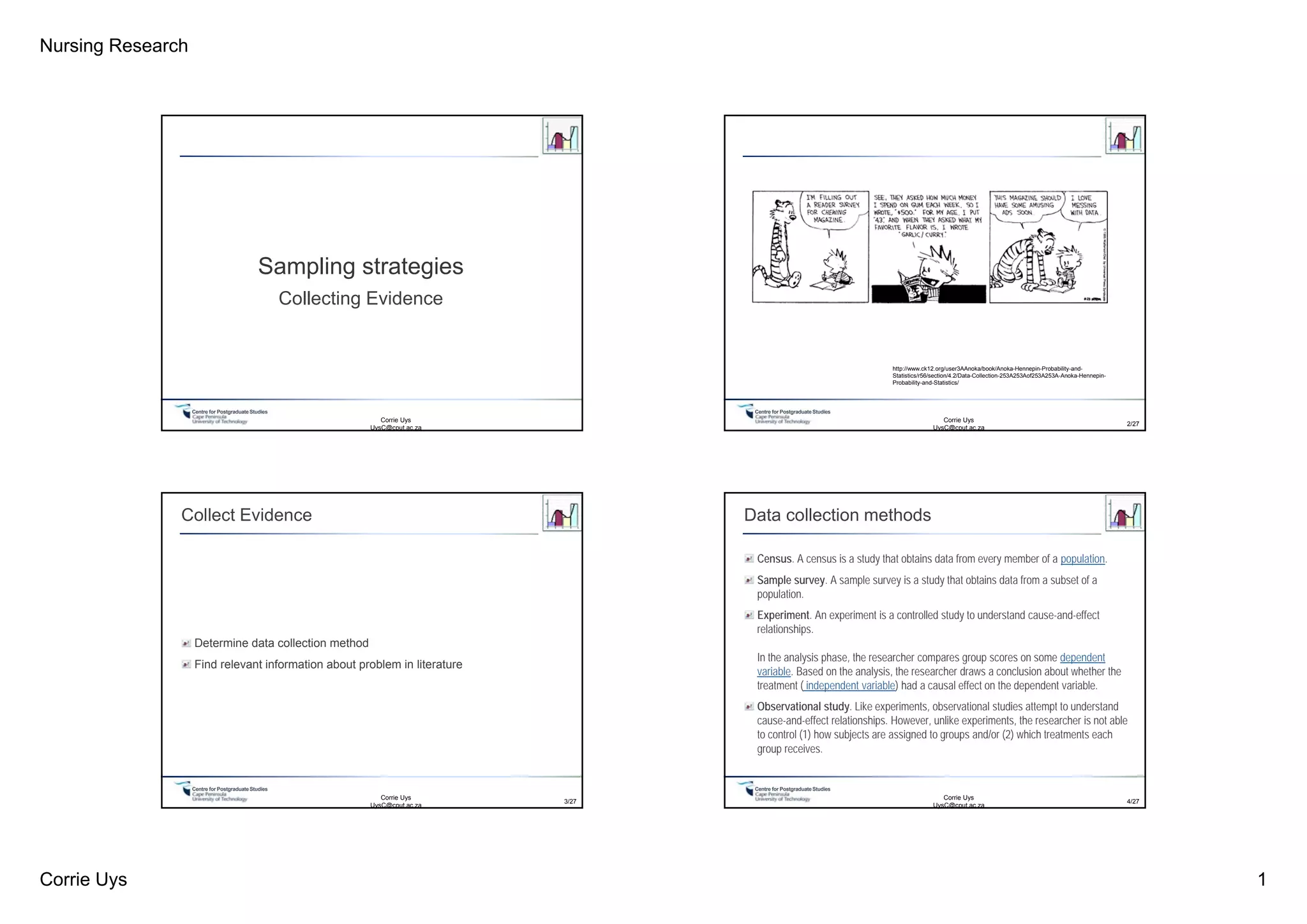
Sampling strategies
Collecting Evidence
Corrie Uys
UysC@cput.ac.za
Centre for PostgraduateStudies
Corrie Uys
UysC@cput.ac.za
2/27
http://www.ck12.org/user3AAnoka/book/Anoka-Hennepin-Probability-and-
Statistics/r56/section/4.2/Data-Collection-253A253Aof253A253A-Anoka-Hennepin-
Probability-and-Statistics/
Centre for PostgraduateStudies
Collect Evidence
Determine data collection method
Find relevant information about problem in literature
Corrie Uys
UysC@cput.ac.za
3/27
Centre for PostgraduateStudies
Data collection methods
Census. A census is a study that obtains data from every member of a population.
Sample survey. A sample survey is a study that obtains data from a subset of a
population.
Experiment. An experiment is a controlled study to understand cause-and-effect
relationships.
In the analysis phase, the researcher compares group scores on some dependent
variable. Based on the analysis, the researcher draws a conclusion about whether the
treatment ( independent variable) had a causal effect on the dependent variable.
Observational study. Like experiments, observational studies attempt to understand
cause-and-effect relationships. However, unlike experiments, the researcher is not able
to control (1) how subjects are assigned to groups and/or (2) which treatments each
group receives.
Corrie Uys
UysC@cput.ac.za
4/27
Nursing Research
Corrie Uys 2
Centre for PostgraduateStudies
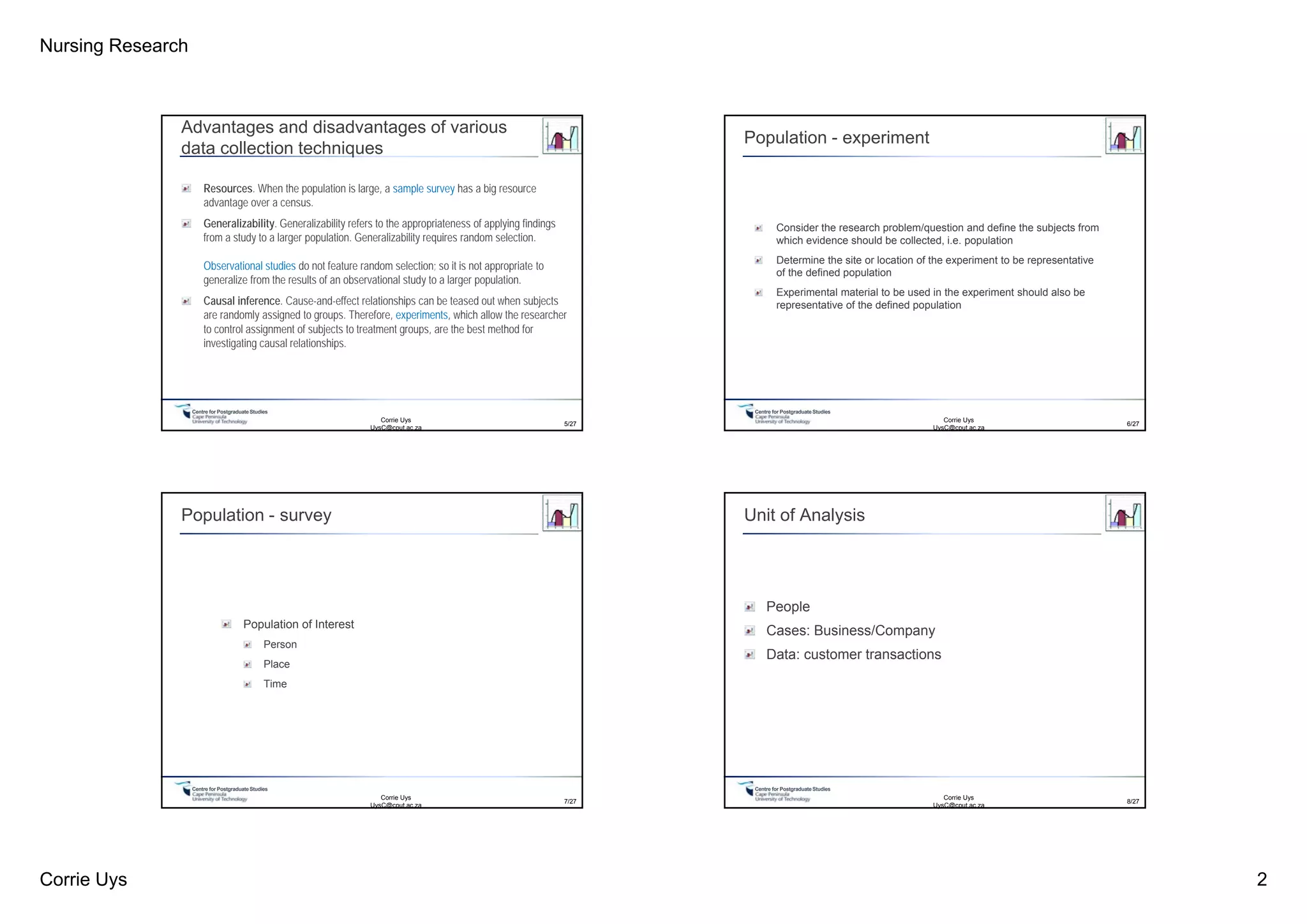
Advantages and disadvantages of various
data collection techniques
Resources. When the population is large, a sample survey has a big resource
advantage over a census.
Generalizability. Generalizability refers to the appropriateness of applying findings
from a study to a larger population. Generalizability requires random selection.
Observational studies do not feature random selection; so it is not appropriate to
generalize from the results of an observational study to a larger population.
Causal inference. Cause-and-effect relationships can be teased out when subjects
are randomly assigned to groups. Therefore, experiments, which allow the researcher
to control assignment of subjects to treatment groups, are the best method for
investigating causal relationships.
Corrie Uys
UysC@cput.ac.za
5/27
Centre for PostgraduateStudies
Population - experiment
Consider the research problem/question and define the subjects from
which evidence should be collected, i.e. population
Determine the site or location of the experiment to be representative
of the defined population
Experimental material to be used in the experiment should also be
representative of the defined population
Corrie Uys
UysC@cput.ac.za
6/27
Centre for PostgraduateStudies
Population - survey
Population of Interest
Person
Place
Time
Corrie Uys
UysC@cput.ac.za
7/27
Centre for PostgraduateStudies
Unit of Analysis
People
Cases: Business/Company
Data: customer transactions
Corrie Uys
UysC@cput.ac.za
8/27
Nursing Research
Corrie Uys 3
Centre for PostgraduateStudies
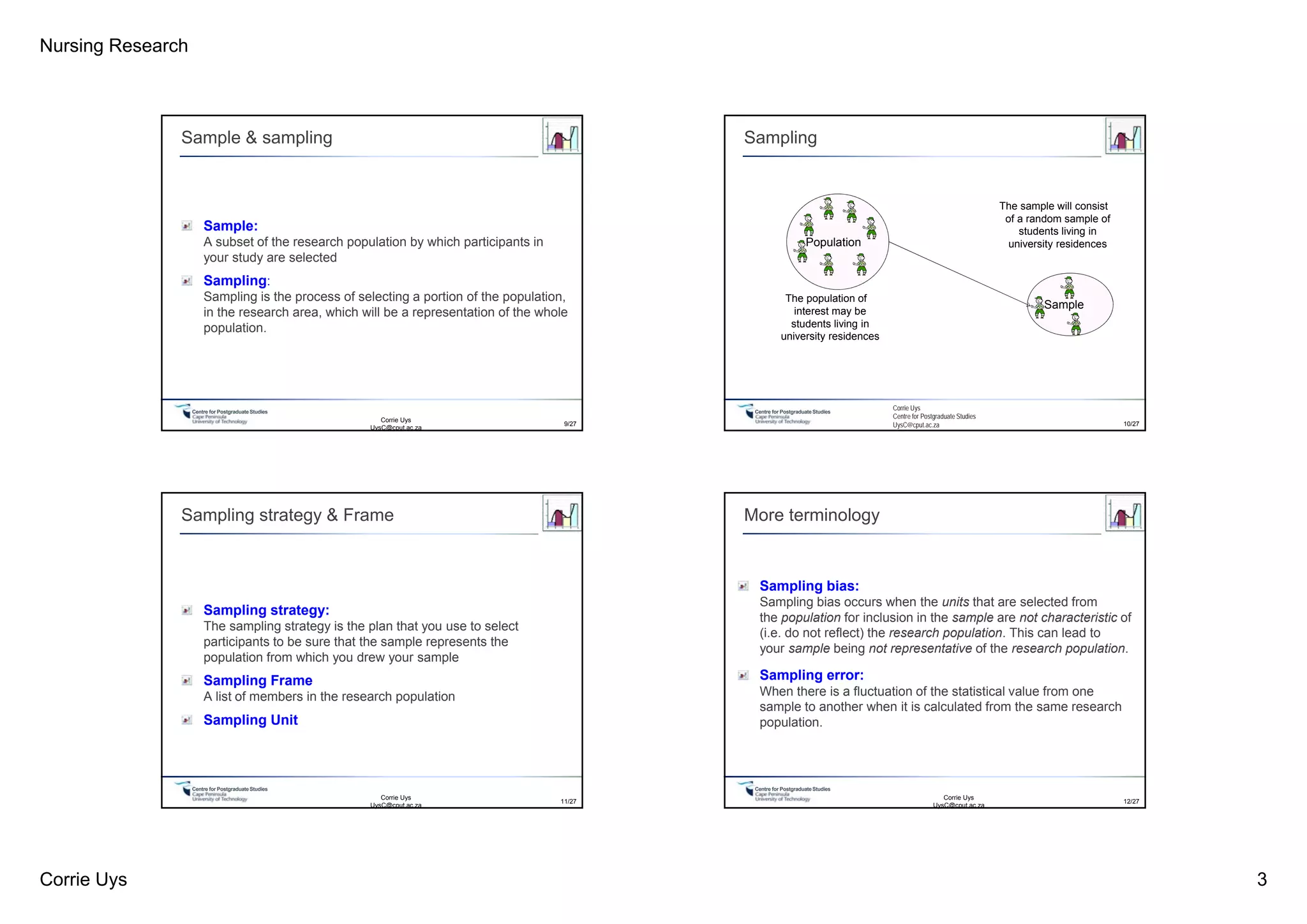
Sample & sampling
Sample:
A subset of the research population by which participants in
your study are selected
Sampling:
Sampling is the process of selecting a portion of the population,
in the research area, which will be a representation of the whole
population.
Corrie Uys
UysC@cput.ac.za
9/27
Centre for PostgraduateStudies
Sampling
The population of
interest may be
students living in
university residences
The sample will consist
of a random sample of
students living in
university residencesPopulation
Sample
Corrie Uys
Centre for Postgraduate Studies
UysC@cput.ac.za 10/27
Centre for PostgraduateStudies
Sampling strategy & Frame
Sampling strategy:
The sampling strategy is the plan that you use to select
participants to be sure that the sample represents the
population from which you drew your sample
Sampling Frame
A list of members in the research population
Sampling Unit
Corrie Uys
UysC@cput.ac.za
11/27
Centre for PostgraduateStudies
More terminology
Sampling bias:
Sampling bias occurs when the units that are selected from
the population for inclusion in the sample are not characteristic of
(i.e. do not reflect) the research population. This can lead to
your sample being not representative of the research population.
Sampling error:
When there is a fluctuation of the statistical value from one
sample to another when it is calculated from the same research
population.
Corrie Uys
UysC@cput.ac.za
12/27
Nursing Research
Corrie Uys 4
Centre for PostgraduateStudies
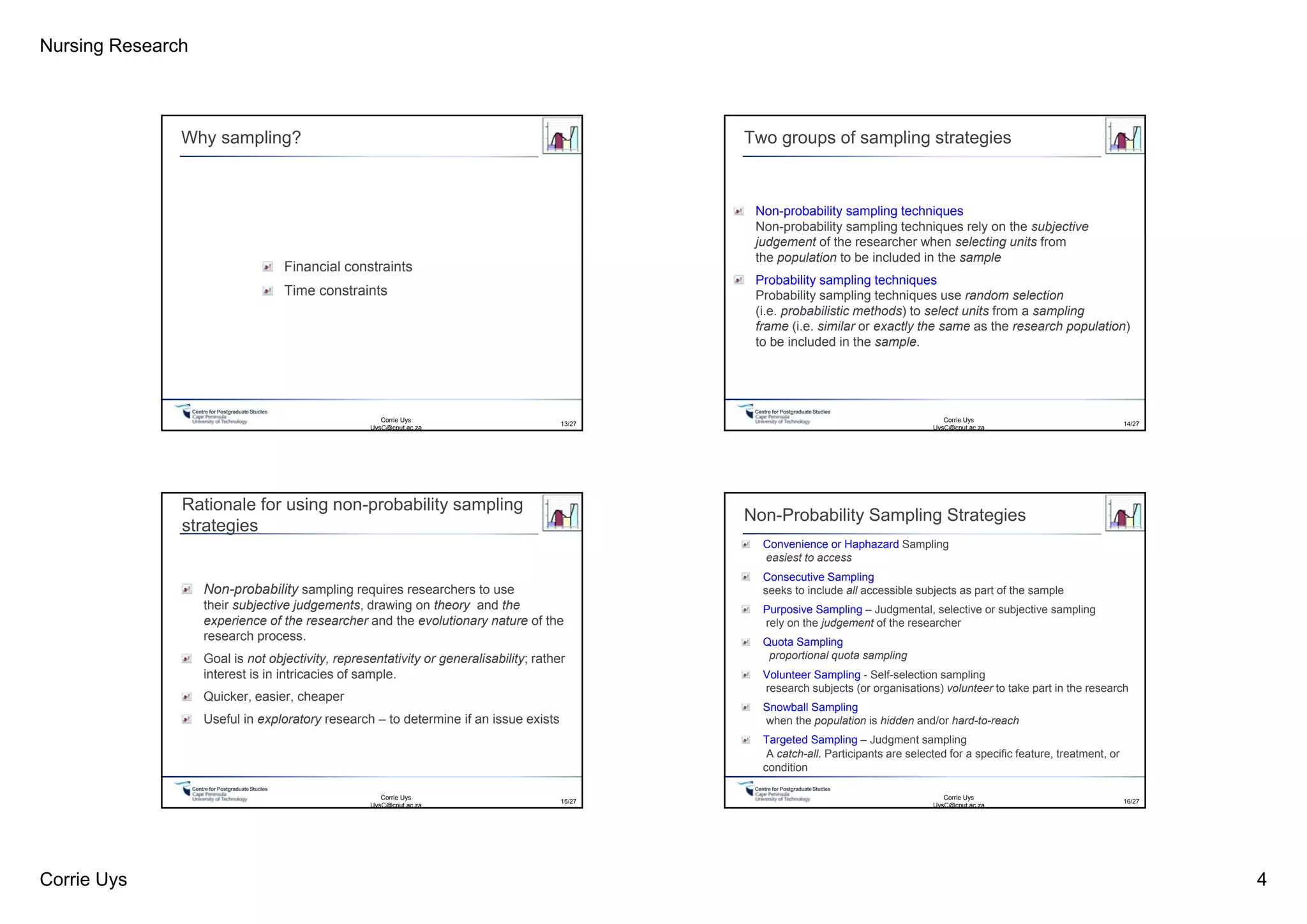
Why sampling?
Financial constraints
Time constraints
13/27
Corrie Uys
UysC@cput.ac.za
Centre for PostgraduateStudies
Two groups of sampling strategies
Non-probability sampling techniques
Non-probability sampling techniques rely on the subjective
judgement of the researcher when selecting units from
the population to be included in the sample
Probability sampling techniques
Probability sampling techniques use random selection
(i.e. probabilistic methods) to select units from a sampling
frame (i.e. similar or exactly the same as the research population)
to be included in the sample.
Corrie Uys
UysC@cput.ac.za
14/27
Centre for PostgraduateStudies
Rationale for using non-probability sampling
strategies
Non-probability sampling requires researchers to use
their subjective judgements, drawing on theory and the
experience of the researcher and the evolutionary nature of the
research process.
Goal is not objectivity, representativity or generalisability; rather
interest is in intricacies of sample.
Quicker, easier, cheaper
Useful in exploratory research – to determine if an issue exists
Corrie Uys
UysC@cput.ac.za
15/27
Centre for PostgraduateStudies
Non-Probability Sampling Strategies
Convenience or Haphazard Sampling
easiest to access
Consecutive Sampling
seeks to include all accessible subjects as part of the sample
Purposive Sampling – Judgmental, selective or subjective sampling
rely on the judgement of the researcher
Quota Sampling
proportional quota sampling
Volunteer Sampling - Self-selection sampling
research subjects (or organisations) volunteer to take part in the research
Snowball Sampling
when the population is hidden and/or hard-to-reach
Targeted Sampling – Judgment sampling
A catch-all. Participants are selected for a specific feature, treatment, or
condition
16/27
Corrie Uys
UysC@cput.ac.za
Nursing Research
Corrie Uys 5
Centre for PostgraduateStudies
Rationale for using probability sampling
strategies
To make statistical inferences
to generalise results from the sample to the research population
To achieve a representative sample
to generalise results from the sample to the research population
To minimise sampling bias
Corrie Uys
UysC@cput.ac.za
17/27
Centre for PostgraduateStudies
Probability Sampling Strategies
Simple Random Sampling(not haphazard)
There is an equal chance (probability) that each of the units could be
selected for inclusion in the sample
Stratified Random Sampling
If we are interested in particular strata (meaning groups) within
the population
Systematic Random Sampling
One typically uses random number tables to select the first unit for inclusion
in the sample, the remaining units are selected in an ordered way (e.g. every
9th student).
Cluster Random Sampling (sample size should be at least double)
Divide population into clusters; select random clusters
Multi-Stage Area Random Sampling
A complex form of cluster sampling. The sample is selected in stages, often
taking into account the hierarchical (nested) structure of the population.
18/27
Corrie Uys
UysC@cput.ac.za
Centre for PostgraduateStudies
Sample size
One day there was a fire in a wastebasket in the Dean's office and in
rushed a physicist, a chemist, and a statistician. The physicist immediately
starts to work on how much energy would have to be removed from the
fire to stop the combustion. The chemist works on which reagent would
have to be added to the fire to prevent oxidation. While they are doing this,
the statistician is setting fires to all the other wastebaskets in the office.
"What are you doing?" they demanded. "Well to solve the problem,
obviously you need a large sample size" the statistician replies.
Hugh Foley.
Corrie Uys
UysC@cput.ac.za
19/27
Centre for PostgraduateStudies
Sample size
Small populations – no need to sample
Sample size need not be a specific percentage of the study
population
Use statistical formulae – using information from researcher
Statistical significance may not be epidemiological significance
i.e. statistical significance may not be significance within the
research discipline that the quantitative study is done.
20/27
Corrie Uys
UysC@cput.ac.za
Nursing Research
Corrie Uys 6
Centre for PostgraduateStudies
Considerations in calculating sample size
Statistical power
The probability that a treatment effect will be detected if it is there. Usually
set at 0.8 (80). – pre-determined
P-level
The probability of detecting a statistically significant difference that is the
result of chance, not the result of the treatment – pre-determined
Treatment variability
Influence of treatment on measured responses.
Error variability
“Error” contributes to the variability of measured responses other than
those that result from the treatment that could alter these measured
responses / which includes the inconsistency inherent in measurements
obtained with a measurement device or technique that is not perfect
Corrie Uys
UysC@cput.ac.za
21/27
Centre for PostgraduateStudies
E.G. - Sample size calculation
To estimate a single proportion one needs to specify
Anticipated population proportion
Level of confidence – 95, 99, etc
Acceptable margin of error – desired precision
22/27
Corrie Uys
UysC@cput.ac.za
Centre for PostgraduateStudies
Sample size calculation
To test for differences between 2 population parameters, one
needs to specify
Level of significance:  = 0.05, 0.01, etc
Power of the test: 1-  = 0.8 (80)
Anticipated outcomes in the group(s) e.g. incidence or means,
standard deviations in group(s)
For estimation also specify effect size (difference worth finding)
23/27
Corrie Uys
UysC@cput.ac.za
Centre for PostgraduateStudies
Other factors
If interested in more than one outcome – calculate sample size
for rarest outcome
Sample size should be larger to allow for non-response
Larger sample sizes if not simple random sampling
Estimate the power of the study under assumptions
In case-control can have more than one control per case
24/27
Corrie Uys
UysC@cput.ac.za
Nursing Research
Corrie Uys 7
Centre for PostgraduateStudies
Corrie Uys
UysC@cput.ac.za
25/27
N S N S N S N S N S N S N S N S N S N S N S N S N S N S
10 10 160 113 310 172 460 210 610 236 760 255 910 270 1100 285 2600 335 8500 368 50000 381 170000 383 470000 384 1200000 384 1950000 384
20 19 170 118 320 175 470 212 620 237 770 257 920 271 1200 291 2700 336 9000 368 55000 381 190000 383 500000 384 1250000 384 2050000 384
30 28 180 123 330 178 480 214 630 239 780 258 930 272 1300 297 2800 338 9500 369 60000 382 210000 383 550000 384 1300000 384 2100000 384
40 36 190 127 340 181 490 216 640 240 790 259 940 273 1400 302 2900 339 10000 370 65000 382 230000 384 600000 384 1350000 384 2150000 384
50 44 200 132 350 183 500 217 650 242 800 260 950 274 1500 306 3000 341 10500 371 70000 382 250000 384 650000 384 1400000 384 2200000 384
60 52 210 136 360 186 510 219 660 243 810 261 960 275 1600 310 3500 346 11000 371 75000 382 270000 384 700000 384 1450000 384 2250000 384
70 59 220 140 370 189 520 221 670 244 820 262 970 275 1700 313 4000 351 11500 372 80000 382 290000 384 750000 384 1500000 384 2300000 384
80 66 230 144 380 191 530 223 680 246 830 263 980 276 1800 317 4500 354 12000 372 85000 382 310000 384 800000 384 1550000 384 2350000 384
90 73 240 148 390 194 540 225 690 247 840 264 990 277 1900 320 5000 357 15000 375 90000 383 330000 384 850000 384 1600000 384 2400000 384
100 80 250 152 400 196 550 226 700 248 850 265 1000 278 2000 322 5500 359 20000 377 95000 383 350000 384 900000 384 1650000 384 2450000 384
110 86 260 155 410 199 560 228 710 250 860 266 1010 278 2100 325 6000 361 25000 378 100000 383 370000 384 950000 384 1700000 384 2500000 384
120 92 270 159 420 201 570 230 720 251 870 267 1020 279 2200 327 6500 363 30000 379 105000 383 390000 384 1000000 384 1750000 384 2550000 384
130 97 280 162 430 203 580 231 730 252 880 268 1030 280 2300 329 7000 364 35000 380 110000 383 410000 384 1050000 384 1800000 384 2600000 384
140 103 290 165 440 205 590 233 740 253 890 269 1040 281 2400 331 7500 365 40000 381 130000 383 430000 384 1100000 384 1850000 384 2650000 384
150 108 300 169 450 207 600 234 750 254 900 269 1050 281 2500 333 8000 367 45000 381 150000 383 450000 384 1150000 384 1900000 384 2700000 384
precision = 0.0500
normal prob = 0.975
Infinite Population
size: n = 384.1
z = 1.960
p = 0.5
q = 0.5
Z2pq = 0.9604
Width of interval = 10.00
Centre for PostgraduateStudies
Corrie Uys
UysC@cput.ac.za
26/27
Attempting a more practical example, a professor explained the scientific
rigor and meticulous sample selection of the Nielsen television ratings
which are used to determine how multiple millions of advertising dollars
are spent. A student remained unimpressed saying, “You mean that just a
sample of a few thousand can tell us exactly what over 250 MILLION
people are doing?”
Finally, the professor, somewhat disgruntled with the scepticism, replied,
“Well, the next time you go to the campus clinic and they want to do a
blood test…tell them that’s not good enough …tell them to TAKE IT ALL!!”
Explaining sample size
Centre for PostgraduateStudies
Reference
Joubert, G. & Ehrlich, R. (eds.) 2007. Epidemiology: A research manual for
South Africa, Cape Town: Oxford University Press.
Kandace J. Landreneau, “Sampling Strategies”.
http://www.natco1.org/research/files/SamplingStrategies.pdf
27/27
Corrie Uys
UysC@cput.ac.za

Data collection techniques

  • 1.
    Nursing Research Corrie Uys1 Centre for PostgraduateStudies Sampling strategies Collecting Evidence Corrie Uys UysC@cput.ac.za Centre for PostgraduateStudies Corrie Uys UysC@cput.ac.za 2/27 http://www.ck12.org/user3AAnoka/book/Anoka-Hennepin-Probability-and- Statistics/r56/section/4.2/Data-Collection-253A253Aof253A253A-Anoka-Hennepin- Probability-and-Statistics/ Centre for PostgraduateStudies Collect Evidence Determine data collection method Find relevant information about problem in literature Corrie Uys UysC@cput.ac.za 3/27 Centre for PostgraduateStudies Data collection methods Census. A census is a study that obtains data from every member of a population. Sample survey. A sample survey is a study that obtains data from a subset of a population. Experiment. An experiment is a controlled study to understand cause-and-effect relationships. In the analysis phase, the researcher compares group scores on some dependent variable. Based on the analysis, the researcher draws a conclusion about whether the treatment ( independent variable) had a causal effect on the dependent variable. Observational study. Like experiments, observational studies attempt to understand cause-and-effect relationships. However, unlike experiments, the researcher is not able to control (1) how subjects are assigned to groups and/or (2) which treatments each group receives. Corrie Uys UysC@cput.ac.za 4/27
  • 2.
    Nursing Research Corrie Uys2 Centre for PostgraduateStudies Advantages and disadvantages of various data collection techniques Resources. When the population is large, a sample survey has a big resource advantage over a census. Generalizability. Generalizability refers to the appropriateness of applying findings from a study to a larger population. Generalizability requires random selection. Observational studies do not feature random selection; so it is not appropriate to generalize from the results of an observational study to a larger population. Causal inference. Cause-and-effect relationships can be teased out when subjects are randomly assigned to groups. Therefore, experiments, which allow the researcher to control assignment of subjects to treatment groups, are the best method for investigating causal relationships. Corrie Uys UysC@cput.ac.za 5/27 Centre for PostgraduateStudies Population - experiment Consider the research problem/question and define the subjects from which evidence should be collected, i.e. population Determine the site or location of the experiment to be representative of the defined population Experimental material to be used in the experiment should also be representative of the defined population Corrie Uys UysC@cput.ac.za 6/27 Centre for PostgraduateStudies Population - survey Population of Interest Person Place Time Corrie Uys UysC@cput.ac.za 7/27 Centre for PostgraduateStudies Unit of Analysis People Cases: Business/Company Data: customer transactions Corrie Uys UysC@cput.ac.za 8/27
  • 3.
    Nursing Research Corrie Uys3 Centre for PostgraduateStudies Sample & sampling Sample: A subset of the research population by which participants in your study are selected Sampling: Sampling is the process of selecting a portion of the population, in the research area, which will be a representation of the whole population. Corrie Uys UysC@cput.ac.za 9/27 Centre for PostgraduateStudies Sampling The population of interest may be students living in university residences The sample will consist of a random sample of students living in university residencesPopulation Sample Corrie Uys Centre for Postgraduate Studies UysC@cput.ac.za 10/27 Centre for PostgraduateStudies Sampling strategy & Frame Sampling strategy: The sampling strategy is the plan that you use to select participants to be sure that the sample represents the population from which you drew your sample Sampling Frame A list of members in the research population Sampling Unit Corrie Uys UysC@cput.ac.za 11/27 Centre for PostgraduateStudies More terminology Sampling bias: Sampling bias occurs when the units that are selected from the population for inclusion in the sample are not characteristic of (i.e. do not reflect) the research population. This can lead to your sample being not representative of the research population. Sampling error: When there is a fluctuation of the statistical value from one sample to another when it is calculated from the same research population. Corrie Uys UysC@cput.ac.za 12/27
  • 4.
    Nursing Research Corrie Uys4 Centre for PostgraduateStudies Why sampling? Financial constraints Time constraints 13/27 Corrie Uys UysC@cput.ac.za Centre for PostgraduateStudies Two groups of sampling strategies Non-probability sampling techniques Non-probability sampling techniques rely on the subjective judgement of the researcher when selecting units from the population to be included in the sample Probability sampling techniques Probability sampling techniques use random selection (i.e. probabilistic methods) to select units from a sampling frame (i.e. similar or exactly the same as the research population) to be included in the sample. Corrie Uys UysC@cput.ac.za 14/27 Centre for PostgraduateStudies Rationale for using non-probability sampling strategies Non-probability sampling requires researchers to use their subjective judgements, drawing on theory and the experience of the researcher and the evolutionary nature of the research process. Goal is not objectivity, representativity or generalisability; rather interest is in intricacies of sample. Quicker, easier, cheaper Useful in exploratory research – to determine if an issue exists Corrie Uys UysC@cput.ac.za 15/27 Centre for PostgraduateStudies Non-Probability Sampling Strategies Convenience or Haphazard Sampling easiest to access Consecutive Sampling seeks to include all accessible subjects as part of the sample Purposive Sampling – Judgmental, selective or subjective sampling rely on the judgement of the researcher Quota Sampling proportional quota sampling Volunteer Sampling - Self-selection sampling research subjects (or organisations) volunteer to take part in the research Snowball Sampling when the population is hidden and/or hard-to-reach Targeted Sampling – Judgment sampling A catch-all. Participants are selected for a specific feature, treatment, or condition 16/27 Corrie Uys UysC@cput.ac.za
  • 5.
    Nursing Research Corrie Uys5 Centre for PostgraduateStudies Rationale for using probability sampling strategies To make statistical inferences to generalise results from the sample to the research population To achieve a representative sample to generalise results from the sample to the research population To minimise sampling bias Corrie Uys UysC@cput.ac.za 17/27 Centre for PostgraduateStudies Probability Sampling Strategies Simple Random Sampling(not haphazard) There is an equal chance (probability) that each of the units could be selected for inclusion in the sample Stratified Random Sampling If we are interested in particular strata (meaning groups) within the population Systematic Random Sampling One typically uses random number tables to select the first unit for inclusion in the sample, the remaining units are selected in an ordered way (e.g. every 9th student). Cluster Random Sampling (sample size should be at least double) Divide population into clusters; select random clusters Multi-Stage Area Random Sampling A complex form of cluster sampling. The sample is selected in stages, often taking into account the hierarchical (nested) structure of the population. 18/27 Corrie Uys UysC@cput.ac.za Centre for PostgraduateStudies Sample size One day there was a fire in a wastebasket in the Dean's office and in rushed a physicist, a chemist, and a statistician. The physicist immediately starts to work on how much energy would have to be removed from the fire to stop the combustion. The chemist works on which reagent would have to be added to the fire to prevent oxidation. While they are doing this, the statistician is setting fires to all the other wastebaskets in the office. "What are you doing?" they demanded. "Well to solve the problem, obviously you need a large sample size" the statistician replies. Hugh Foley. Corrie Uys UysC@cput.ac.za 19/27 Centre for PostgraduateStudies Sample size Small populations – no need to sample Sample size need not be a specific percentage of the study population Use statistical formulae – using information from researcher Statistical significance may not be epidemiological significance i.e. statistical significance may not be significance within the research discipline that the quantitative study is done. 20/27 Corrie Uys UysC@cput.ac.za
  • 6.
    Nursing Research Corrie Uys6 Centre for PostgraduateStudies Considerations in calculating sample size Statistical power The probability that a treatment effect will be detected if it is there. Usually set at 0.8 (80). – pre-determined P-level The probability of detecting a statistically significant difference that is the result of chance, not the result of the treatment – pre-determined Treatment variability Influence of treatment on measured responses. Error variability “Error” contributes to the variability of measured responses other than those that result from the treatment that could alter these measured responses / which includes the inconsistency inherent in measurements obtained with a measurement device or technique that is not perfect Corrie Uys UysC@cput.ac.za 21/27 Centre for PostgraduateStudies E.G. - Sample size calculation To estimate a single proportion one needs to specify Anticipated population proportion Level of confidence – 95, 99, etc Acceptable margin of error – desired precision 22/27 Corrie Uys UysC@cput.ac.za Centre for PostgraduateStudies Sample size calculation To test for differences between 2 population parameters, one needs to specify Level of significance:  = 0.05, 0.01, etc Power of the test: 1-  = 0.8 (80) Anticipated outcomes in the group(s) e.g. incidence or means, standard deviations in group(s) For estimation also specify effect size (difference worth finding) 23/27 Corrie Uys UysC@cput.ac.za Centre for PostgraduateStudies Other factors If interested in more than one outcome – calculate sample size for rarest outcome Sample size should be larger to allow for non-response Larger sample sizes if not simple random sampling Estimate the power of the study under assumptions In case-control can have more than one control per case 24/27 Corrie Uys UysC@cput.ac.za
  • 7.
    Nursing Research Corrie Uys7 Centre for PostgraduateStudies Corrie Uys UysC@cput.ac.za 25/27 N S N S N S N S N S N S N S N S N S N S N S N S N S N S 10 10 160 113 310 172 460 210 610 236 760 255 910 270 1100 285 2600 335 8500 368 50000 381 170000 383 470000 384 1200000 384 1950000 384 20 19 170 118 320 175 470 212 620 237 770 257 920 271 1200 291 2700 336 9000 368 55000 381 190000 383 500000 384 1250000 384 2050000 384 30 28 180 123 330 178 480 214 630 239 780 258 930 272 1300 297 2800 338 9500 369 60000 382 210000 383 550000 384 1300000 384 2100000 384 40 36 190 127 340 181 490 216 640 240 790 259 940 273 1400 302 2900 339 10000 370 65000 382 230000 384 600000 384 1350000 384 2150000 384 50 44 200 132 350 183 500 217 650 242 800 260 950 274 1500 306 3000 341 10500 371 70000 382 250000 384 650000 384 1400000 384 2200000 384 60 52 210 136 360 186 510 219 660 243 810 261 960 275 1600 310 3500 346 11000 371 75000 382 270000 384 700000 384 1450000 384 2250000 384 70 59 220 140 370 189 520 221 670 244 820 262 970 275 1700 313 4000 351 11500 372 80000 382 290000 384 750000 384 1500000 384 2300000 384 80 66 230 144 380 191 530 223 680 246 830 263 980 276 1800 317 4500 354 12000 372 85000 382 310000 384 800000 384 1550000 384 2350000 384 90 73 240 148 390 194 540 225 690 247 840 264 990 277 1900 320 5000 357 15000 375 90000 383 330000 384 850000 384 1600000 384 2400000 384 100 80 250 152 400 196 550 226 700 248 850 265 1000 278 2000 322 5500 359 20000 377 95000 383 350000 384 900000 384 1650000 384 2450000 384 110 86 260 155 410 199 560 228 710 250 860 266 1010 278 2100 325 6000 361 25000 378 100000 383 370000 384 950000 384 1700000 384 2500000 384 120 92 270 159 420 201 570 230 720 251 870 267 1020 279 2200 327 6500 363 30000 379 105000 383 390000 384 1000000 384 1750000 384 2550000 384 130 97 280 162 430 203 580 231 730 252 880 268 1030 280 2300 329 7000 364 35000 380 110000 383 410000 384 1050000 384 1800000 384 2600000 384 140 103 290 165 440 205 590 233 740 253 890 269 1040 281 2400 331 7500 365 40000 381 130000 383 430000 384 1100000 384 1850000 384 2650000 384 150 108 300 169 450 207 600 234 750 254 900 269 1050 281 2500 333 8000 367 45000 381 150000 383 450000 384 1150000 384 1900000 384 2700000 384 precision = 0.0500 normal prob = 0.975 Infinite Population size: n = 384.1 z = 1.960 p = 0.5 q = 0.5 Z2pq = 0.9604 Width of interval = 10.00 Centre for PostgraduateStudies Corrie Uys UysC@cput.ac.za 26/27 Attempting a more practical example, a professor explained the scientific rigor and meticulous sample selection of the Nielsen television ratings which are used to determine how multiple millions of advertising dollars are spent. A student remained unimpressed saying, “You mean that just a sample of a few thousand can tell us exactly what over 250 MILLION people are doing?” Finally, the professor, somewhat disgruntled with the scepticism, replied, “Well, the next time you go to the campus clinic and they want to do a blood test…tell them that’s not good enough …tell them to TAKE IT ALL!!” Explaining sample size Centre for PostgraduateStudies Reference Joubert, G. & Ehrlich, R. (eds.) 2007. Epidemiology: A research manual for South Africa, Cape Town: Oxford University Press. Kandace J. Landreneau, “Sampling Strategies”. http://www.natco1.org/research/files/SamplingStrategies.pdf 27/27 Corrie Uys UysC@cput.ac.za