Data Acquisition System  and  Data Loggers - Swara Dave
What is Data Acquisition System ? DAQ systems capture, measure, and analyze physical phenomena from the real world. Light, temperature and pressure are examples of the different types of signals that a DAQ system can measure. Data acquisition is the process of collecting and measuring electrical signals and sending them to a computer for processing. •  Electrical signals comes from Transducers.
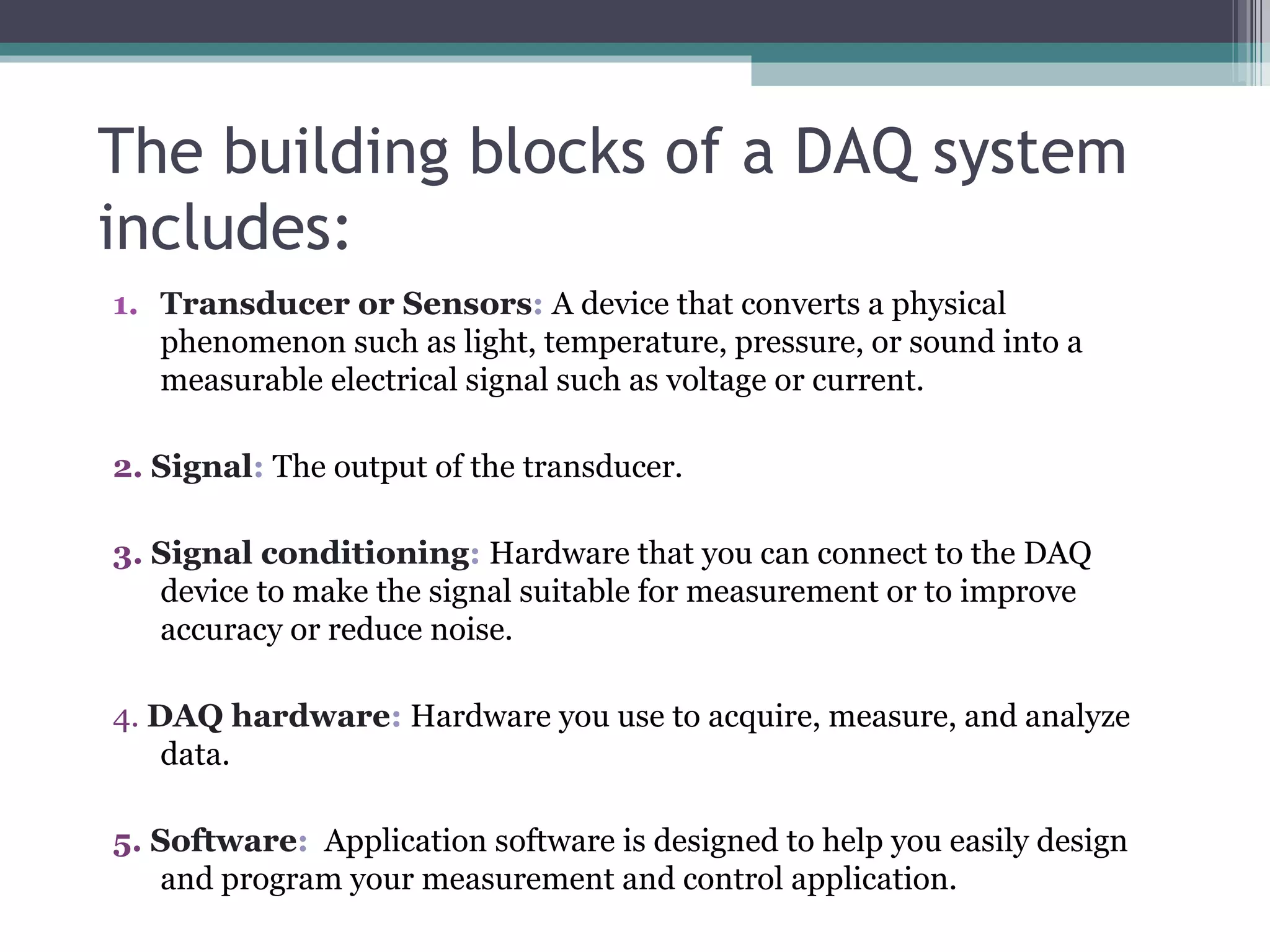
The building blocks of a DAQ system includes: Transducer or Sensors :   A device that converts a physical phenomenon such as light, temperature, pressure, or sound into a measurable electrical signal such as voltage or current. 2.   Signal :  The output of the transducer. 3.   Signal conditioning :  Hardware that you can connect to the DAQ device to make the signal suitable for measurement or to improve accuracy or reduce noise. 4.   DAQ hardware :  Hardware you use to acquire, measure, and analyze data. 5.   Software :   Application software is designed to help you easily design and program your measurement and control application.
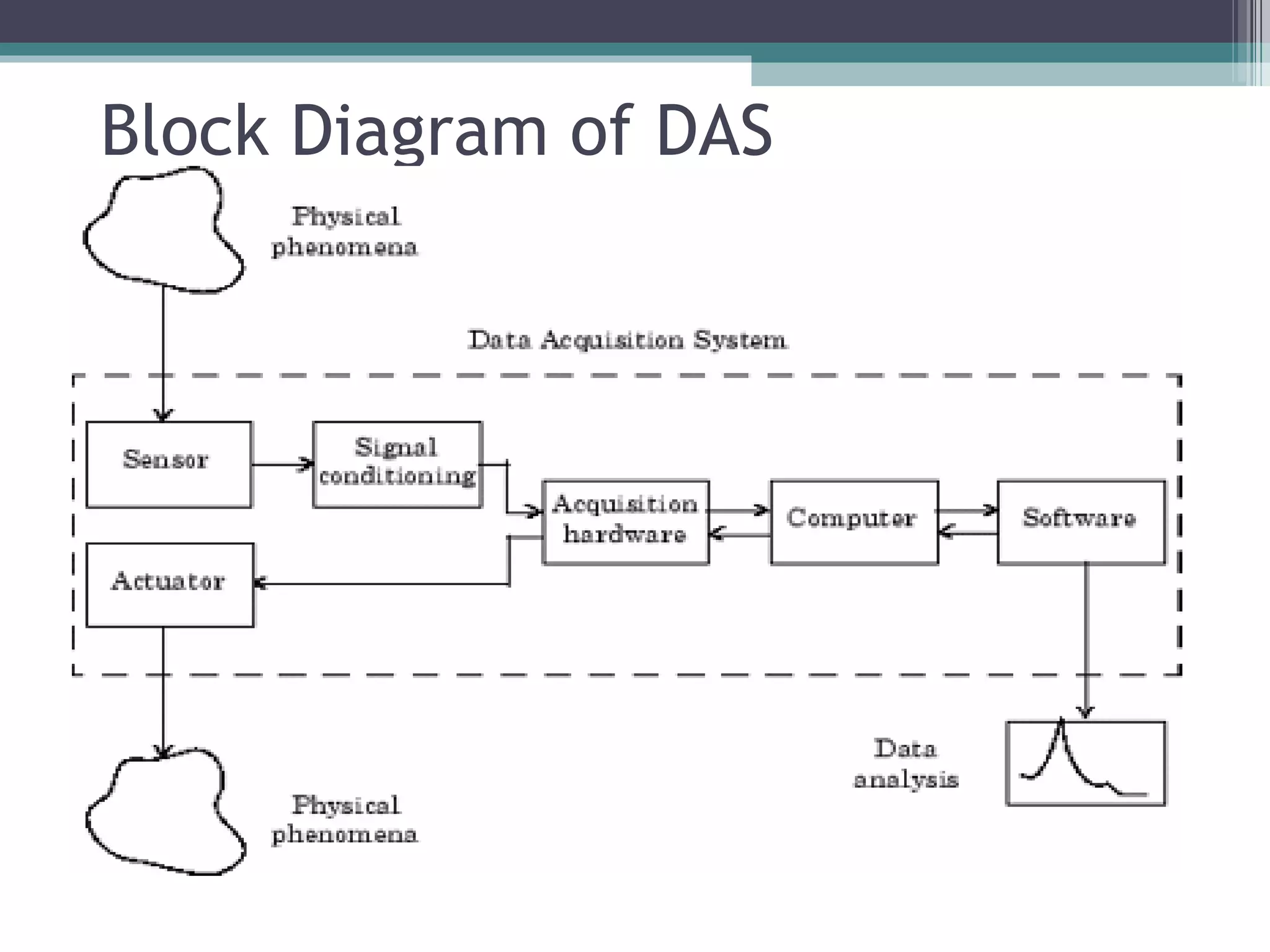
Block Diagram of DAS
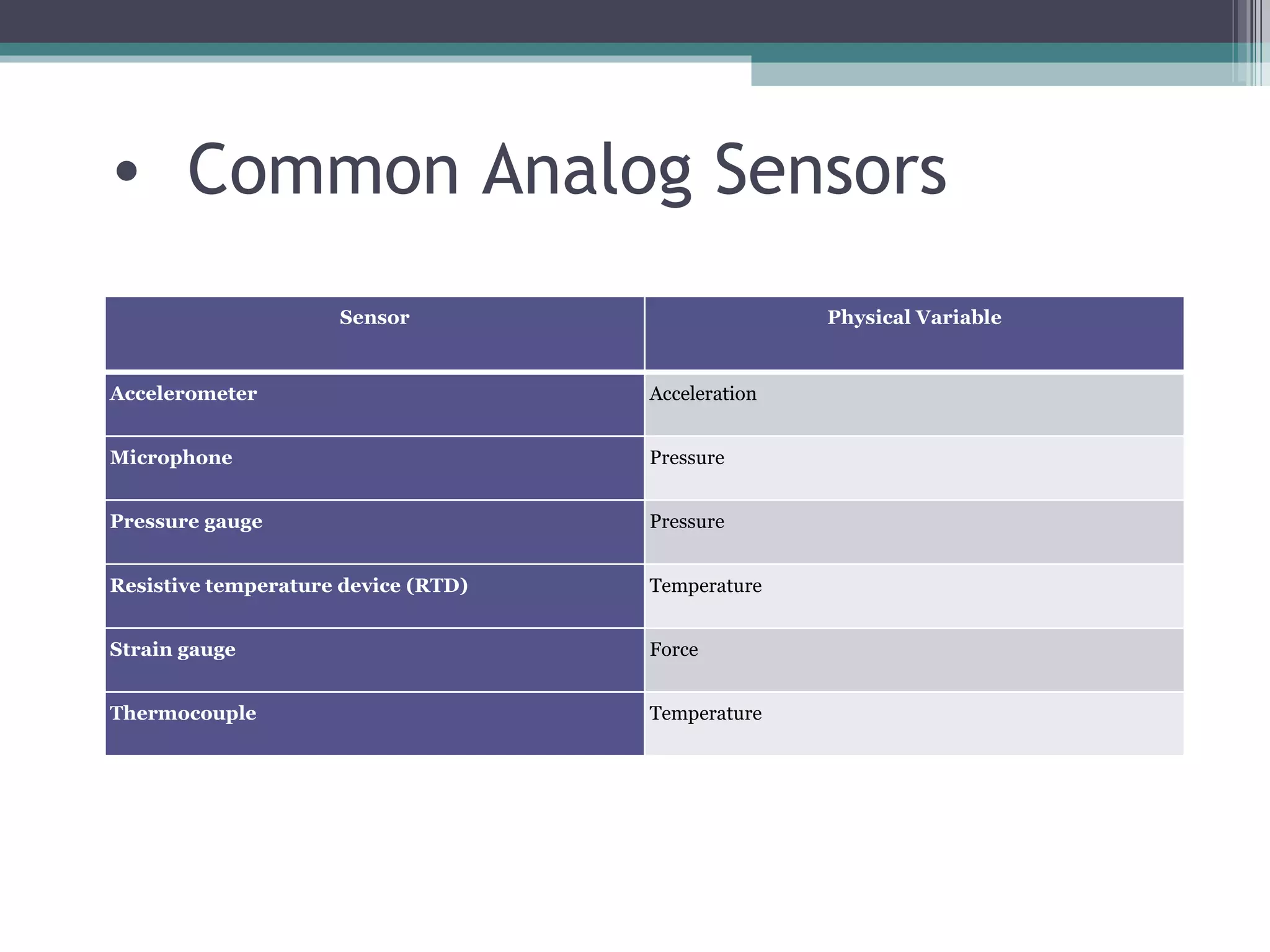
Common Analog Sensors Sensor Physical Variable Accelerometer Acceleration Microphone Pressure Pressure gauge Pressure Resistive temperature device (RTD) Temperature Strain gauge Force Thermocouple Temperature
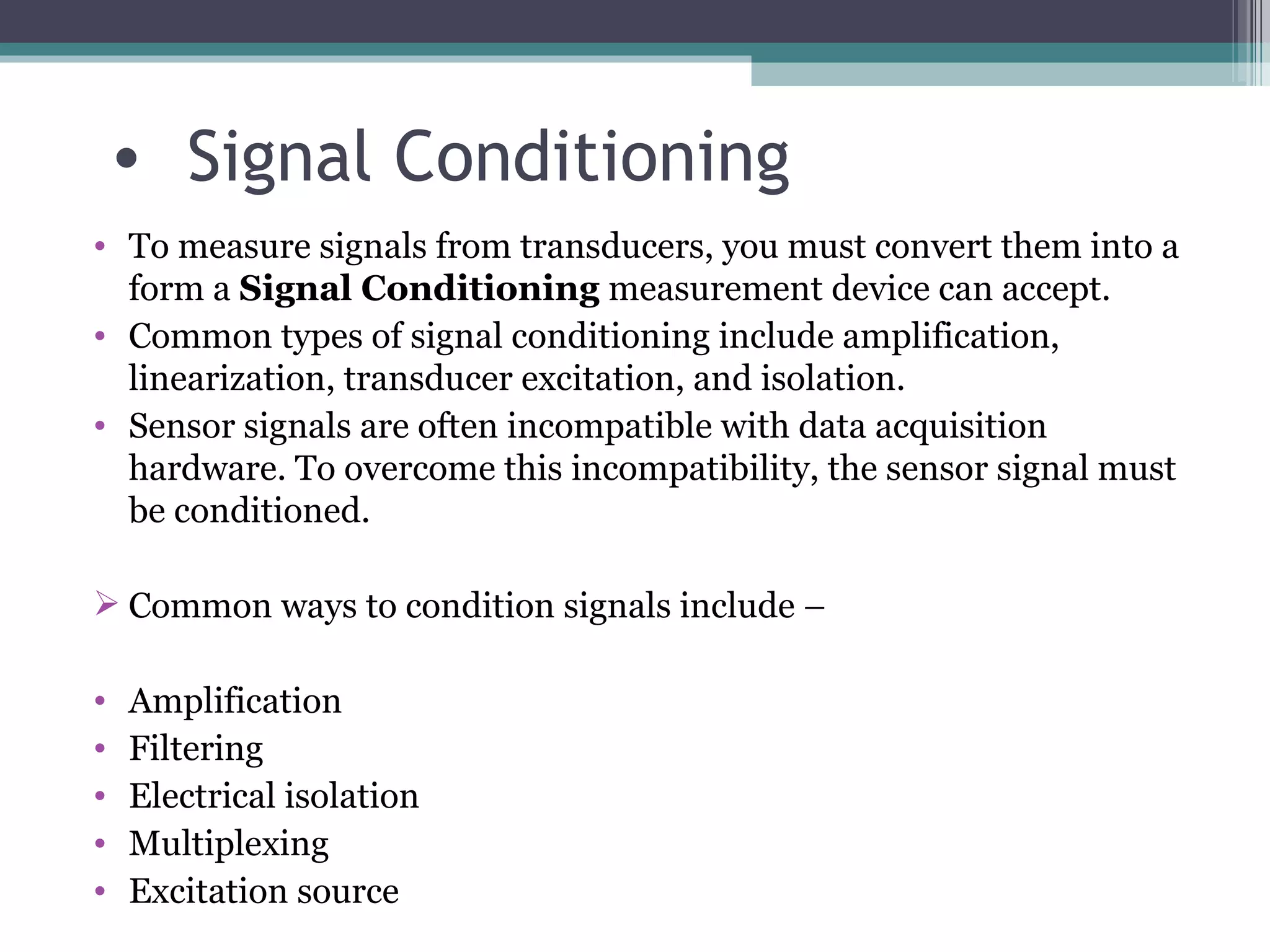
Signal Conditioning To measure signals from transducers, you must convert them into a form a  Signal Conditioning  measurement device can accept. Common types of signal conditioning include amplification, linearization, transducer excitation, and isolation. Sensor signals are often incompatible with data acquisition hardware. To overcome this incompatibility, the sensor signal must be conditioned.  Common ways to condition signals include –  Amplification Filtering Electrical isolation Multiplexing Excitation source
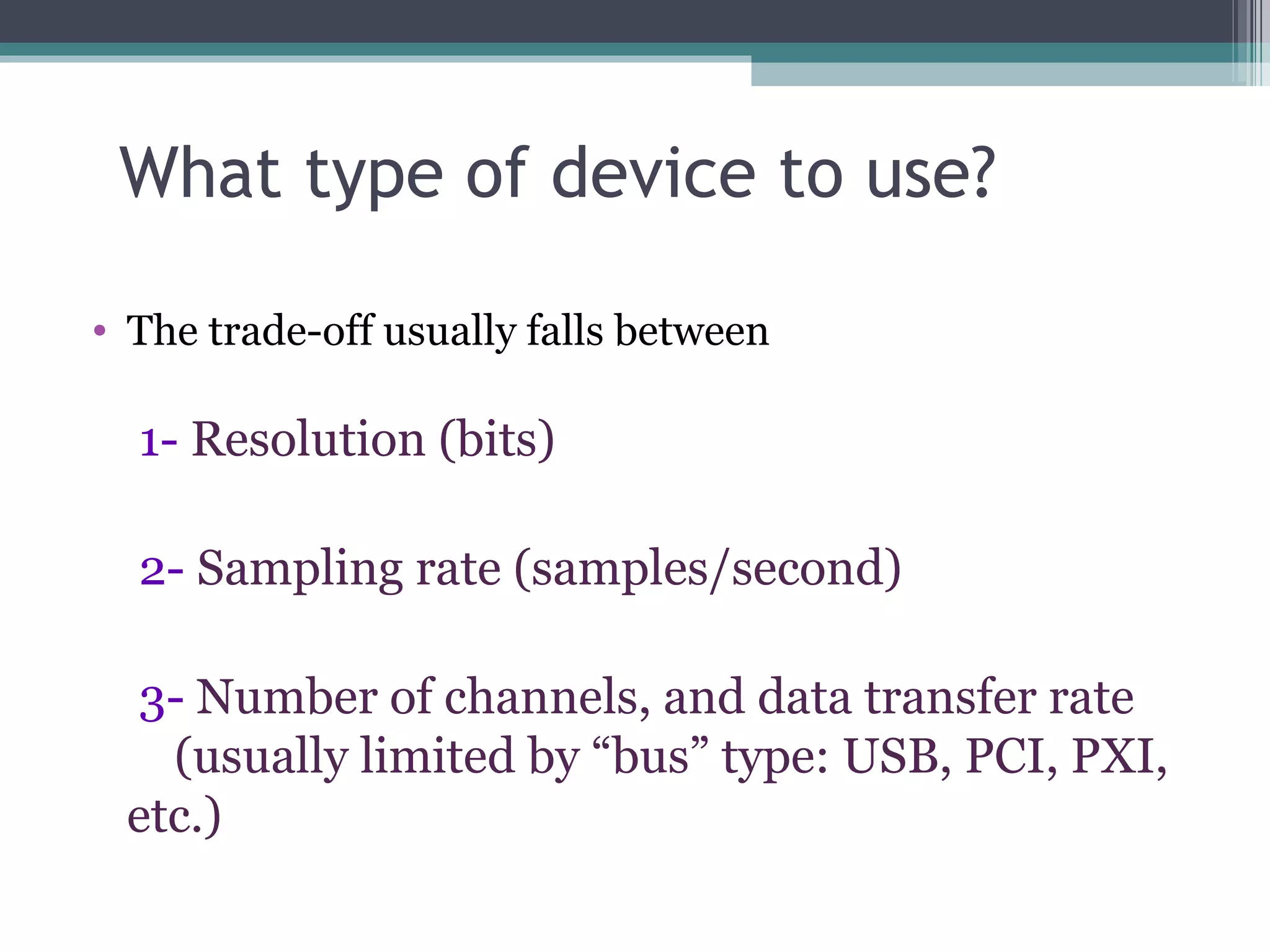
What type of device to use? The trade-off usually falls between 1-  Resolution (bits)  2-  Sampling rate (samples/second)  3-  Number of channels, and data transfer rate  (usually limited by “bus” type: USB, PCI, PXI, etc.)
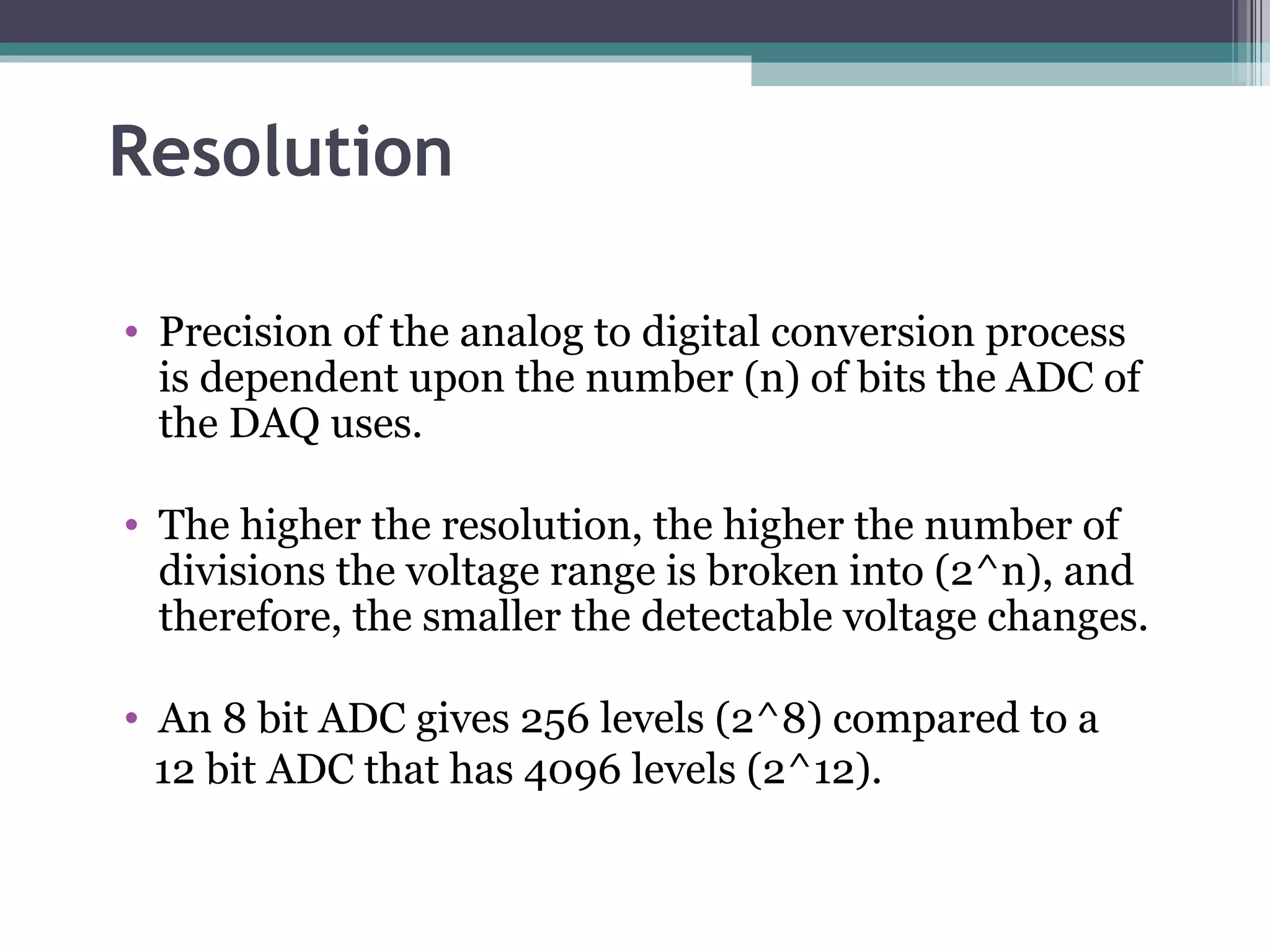
Resolution Precision of the analog to digital conversion process is dependent upon the number (n) of bits the ADC of the DAQ uses. The higher the resolution, the higher the number of divisions the voltage range is broken into (2^n), and therefore, the smaller the detectable voltage changes. An 8 bit ADC gives 256 levels (2^8) compared to a 12 bit ADC that has 4096 levels (2^12).
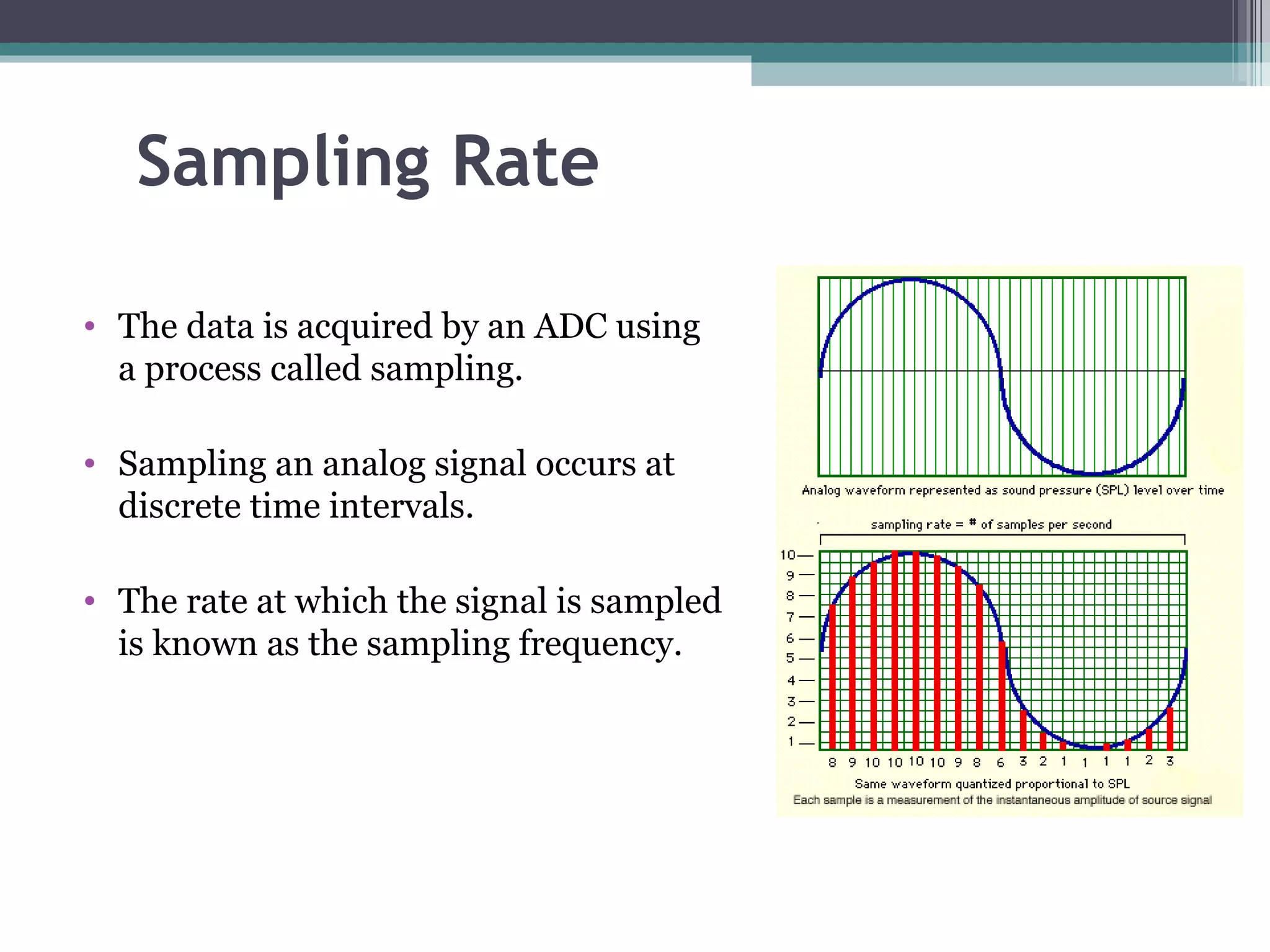
Sampling Rate The data is acquired by an ADC using a process called sampling. Sampling an analog signal occurs at discrete time intervals. The rate at which the signal is sampled is known as the sampling frequency.
The two important features of a data acquisition system : Signals are input to a sensor, conditioned, converted into bits that a computer can read, and analysed to extract meaningful information. Data from a computer is converted into an analog signal and output to an actuator .
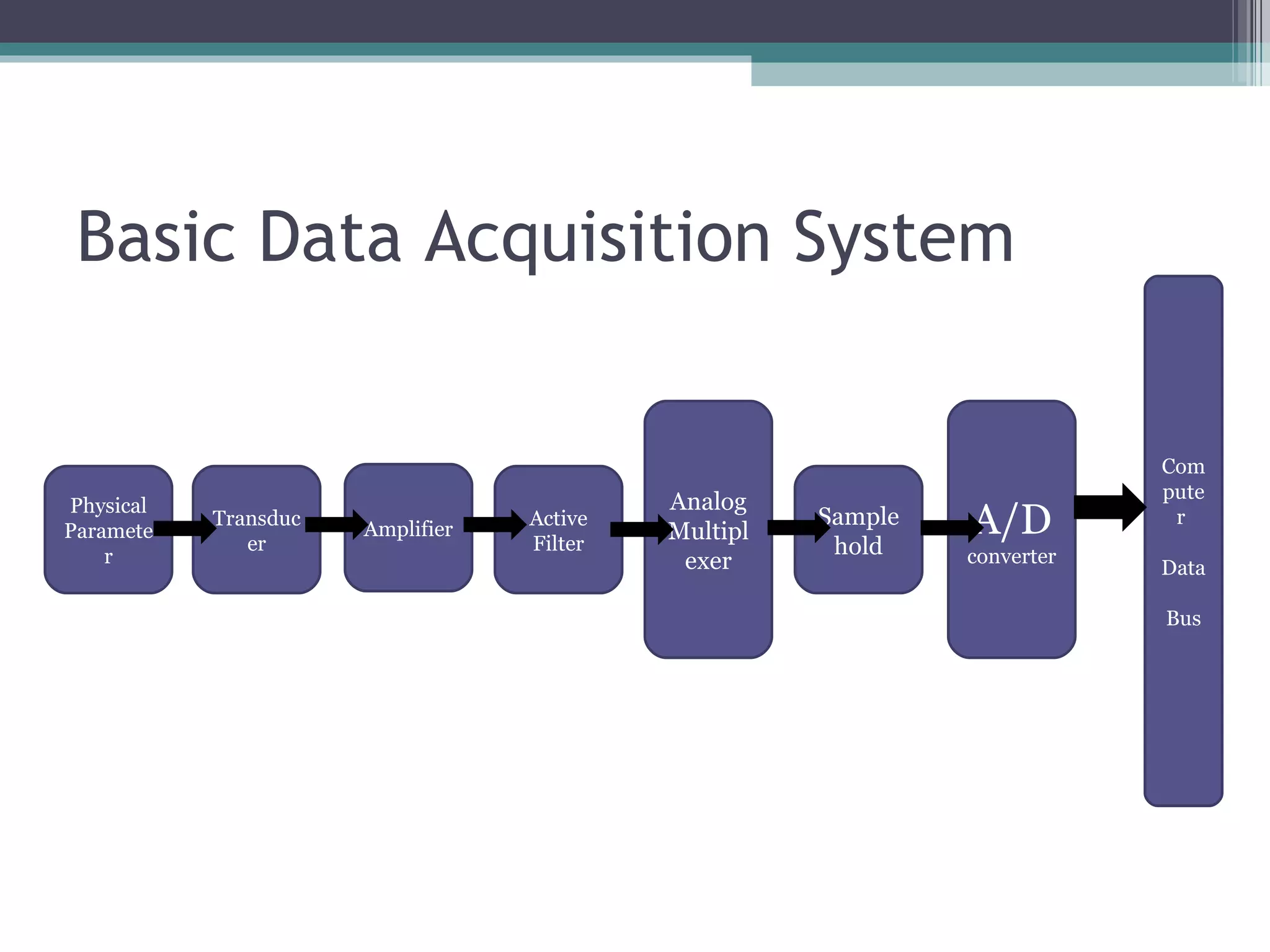
Basic Data Acquisition System Physical Parameter Transducer Active Filter Analog Multiplexer Amplifier Sample hold A/D  converter Computer  Data Bus
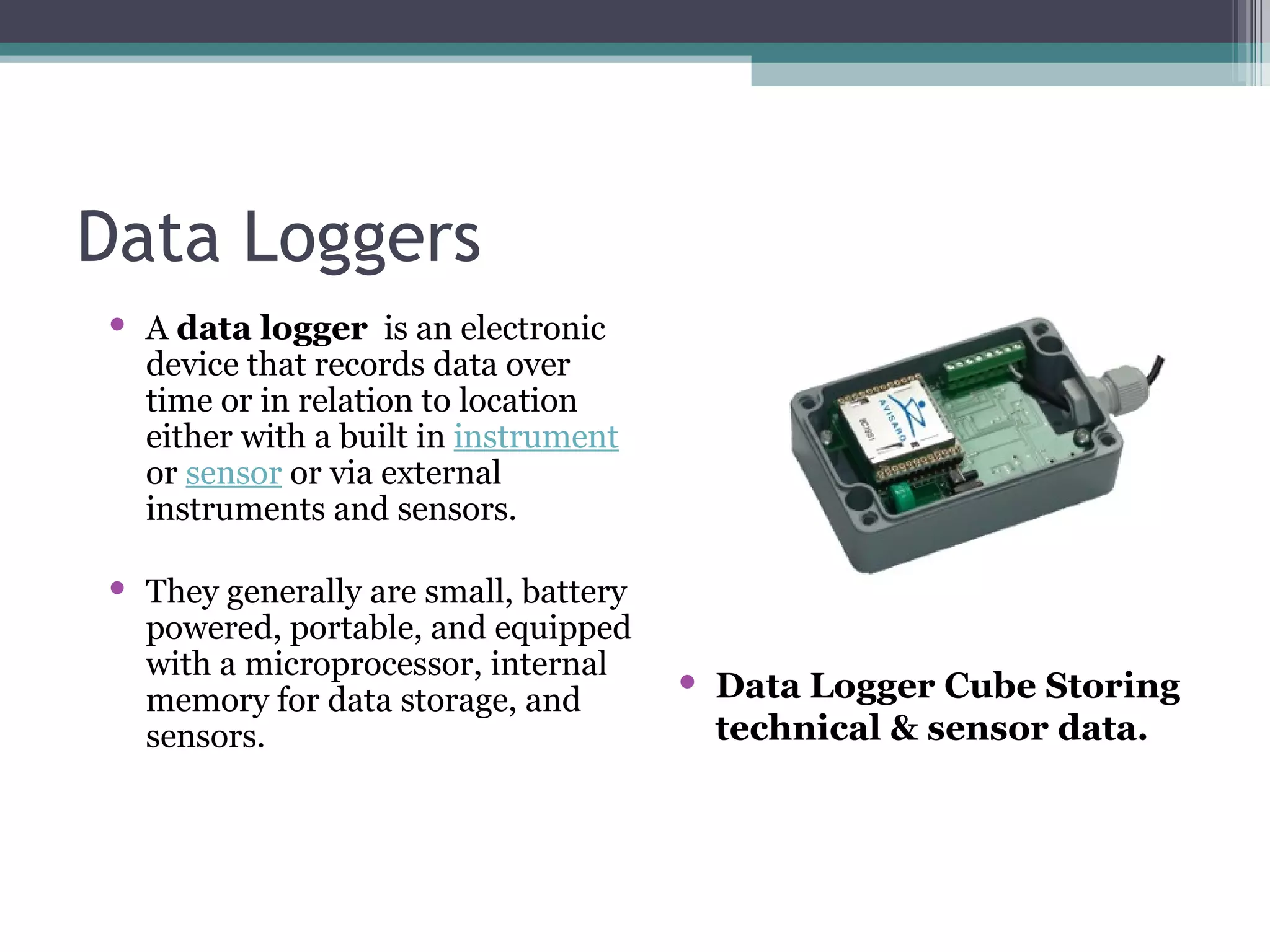
Data Loggers A  data logger   is an electronic device that records data over time or in relation to location either with a built in  instrument   or  sensor  or via external instruments and sensors.  They generally are small, battery powered, portable, and equipped with a microprocessor, internal memory for data storage, and sensors. Data Logger Cube Storing technical & sensor data.
Different types of data loggers and their operation   The differences between various data loggers are based on the way that data is recorded and stored. The basic difference between the two data logger types is that one type allows the data to be stored in a memory, to be retrieved at a later time, while the other type automatically records the data on paper, for immediate viewing and analysis. Many data loggers combine these two functions, usually unequally, with the emphasis oneither the ability to transfer the data or to provide a printout of it.
Applications Environmental monitoring Road traffic counting. Unattended soil moisture level recording. Motor Racing Temperature, Humidity and Power use for Heating and Air conditioning efficiency studies. Unattended  weather station  recording  Measure  temperatures  (humidity, etc) of perishables during shipments Tank level monitoring.
Data Recovery and Transfer Data can be recovered from data acquisition systems in various ways : Serial comms interface via direct connect, modem, cell  phone, radio, satellite PCMCIA - modem, cell phone, LAN, memory card, USB memory device Network port - Ethernet, field bus, proprietary, etc Universal Serial Bus (USB) Data can be transferred and published using : Local Ethernet network Intranet - email, web pages Internet - email, world wide web pages
Types of data acquisition systems Data acquisition systems can be of a number of forms : Pocket loggers  - small, battery powered, stand alone devices with simple functionality Intelligent data loggers  - stand alone devices with own intelligence, sophisticated data manipulation, alarms, backed up power supply, displays, etc. Accessed continuously or periodically by a PC. Plug in cards  - plugged into the ISA bus or USB port of a PC to provide basic data acquisition functionality.  The PC provides power, control, data storage, etc.
Choosing a Data Logger: When choosing a data logger the following parameters should be considered AC Voltage/Current   Light On/Off Shock/Acceleration Bridge/Strain/Load/Pressure    Motor On/Off Sound Dew point PH Pressure Temperature
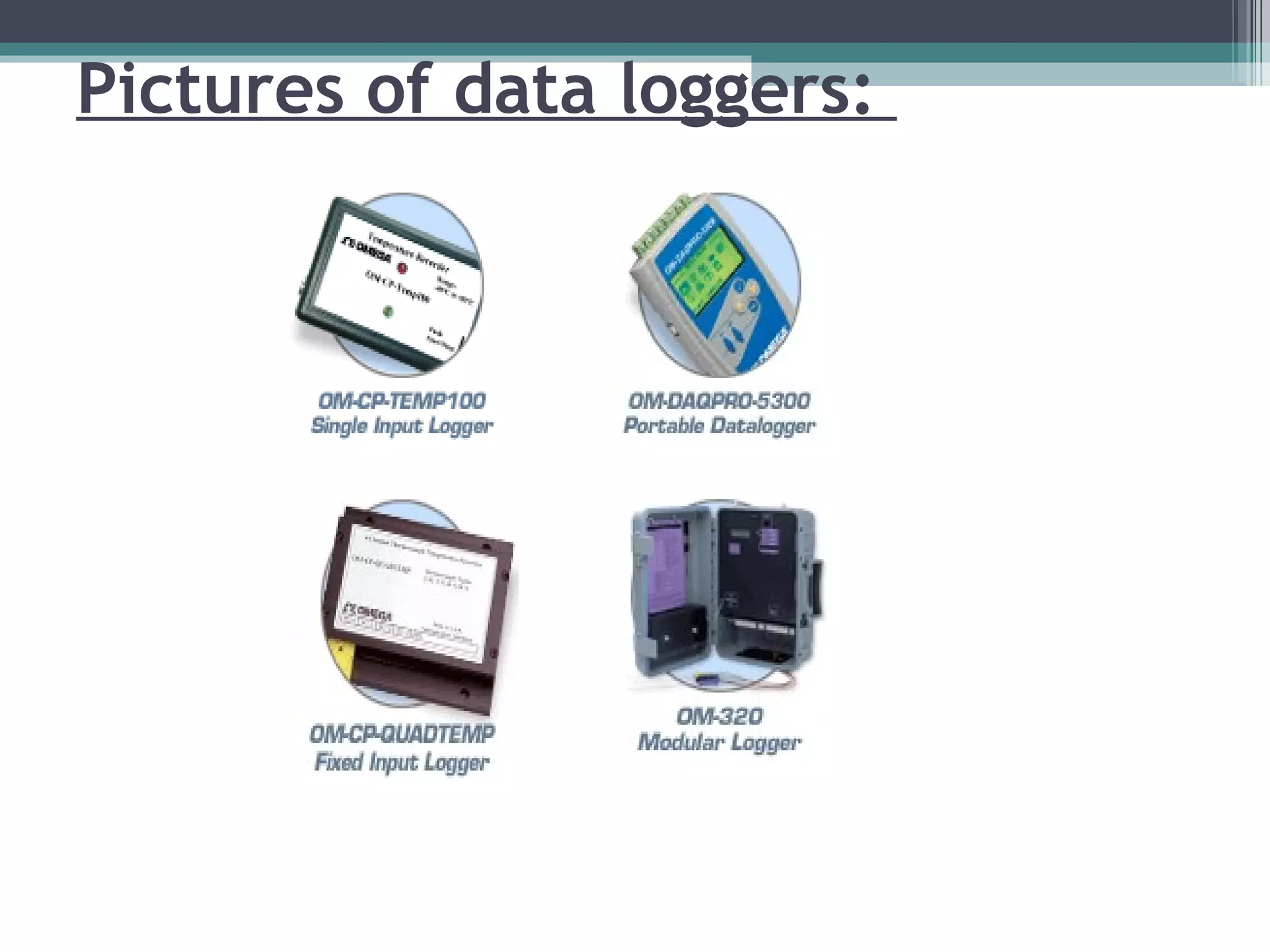
Pictures of data loggers:
Types of data loggers:  Miniature Single Input Data Loggers Miniature single input data loggers are generally low cost loggers dedicated to a specific input type. These types of data loggers are often used in the transportation industry. A typical application would be to include a temperature data logger in a shipment of food products to insure that the food temperature does not exceed acceptable limits. In addition to temperature miniature data loggers are available for a large variety of input types.
Types of data loggers:  Fixed Mount Multi-Channel Data Loggers Fixed input loggers have a fixed number of input channels which are generally dedicated for a specific type of input. OMEGA offers fixed input data loggers ranging from one to 8 channels.  Modular Data Loggers A modular data logger is configurable and expandable through the use of plug-in modules. The modules are normally field configurable and the user has the option of adding as many channels to satisfy the application requirement .
ADVANTAGES: Data logging devices can be sent to places that humans can not easily get to. e.g. to the planet Mars, in to the bottom of a volcano and on to a roof of a tall building to get to a weather station.  Graphs and tables of results can be produced automatically by the data logging software.
DISADVANTAGES: The main  disadvantage  of using a data logging system is the initial cost of purchasing the equipment. While a thermometer can be purchased for less than one pound, the price of the  components  of a data logging system to record the temperature will be considerable.
Data Acquisition VS Data Logging Data loggers typically have slower  sample  rates   than Data Acquisition System. Data loggers are implicitly stand-alone devices, while typical data acquisition system must remain tethered to a computer to acquire data. data loggers must be extremely reliable than Data Acquisition System
THANK YOU

Data Acquisition System and Data loggers

  • 1.
    Data Acquisition System and Data Loggers - Swara Dave
  • 2.
    What is DataAcquisition System ? DAQ systems capture, measure, and analyze physical phenomena from the real world. Light, temperature and pressure are examples of the different types of signals that a DAQ system can measure. Data acquisition is the process of collecting and measuring electrical signals and sending them to a computer for processing. • Electrical signals comes from Transducers.
  • 3.
    The building blocksof a DAQ system includes: Transducer or Sensors : A device that converts a physical phenomenon such as light, temperature, pressure, or sound into a measurable electrical signal such as voltage or current. 2. Signal : The output of the transducer. 3. Signal conditioning : Hardware that you can connect to the DAQ device to make the signal suitable for measurement or to improve accuracy or reduce noise. 4. DAQ hardware : Hardware you use to acquire, measure, and analyze data. 5. Software : Application software is designed to help you easily design and program your measurement and control application.
  • 4.
  • 5.
    Common Analog SensorsSensor Physical Variable Accelerometer Acceleration Microphone Pressure Pressure gauge Pressure Resistive temperature device (RTD) Temperature Strain gauge Force Thermocouple Temperature
  • 6.
    Signal Conditioning Tomeasure signals from transducers, you must convert them into a form a Signal Conditioning measurement device can accept. Common types of signal conditioning include amplification, linearization, transducer excitation, and isolation. Sensor signals are often incompatible with data acquisition hardware. To overcome this incompatibility, the sensor signal must be conditioned. Common ways to condition signals include – Amplification Filtering Electrical isolation Multiplexing Excitation source
  • 7.
    What type ofdevice to use? The trade-off usually falls between 1- Resolution (bits) 2- Sampling rate (samples/second) 3- Number of channels, and data transfer rate (usually limited by “bus” type: USB, PCI, PXI, etc.)
  • 8.
    Resolution Precision ofthe analog to digital conversion process is dependent upon the number (n) of bits the ADC of the DAQ uses. The higher the resolution, the higher the number of divisions the voltage range is broken into (2^n), and therefore, the smaller the detectable voltage changes. An 8 bit ADC gives 256 levels (2^8) compared to a 12 bit ADC that has 4096 levels (2^12).
  • 9.
    Sampling Rate Thedata is acquired by an ADC using a process called sampling. Sampling an analog signal occurs at discrete time intervals. The rate at which the signal is sampled is known as the sampling frequency.
  • 10.
    The two importantfeatures of a data acquisition system : Signals are input to a sensor, conditioned, converted into bits that a computer can read, and analysed to extract meaningful information. Data from a computer is converted into an analog signal and output to an actuator .
  • 11.
    Basic Data AcquisitionSystem Physical Parameter Transducer Active Filter Analog Multiplexer Amplifier Sample hold A/D converter Computer Data Bus
  • 12.
    Data Loggers A data logger is an electronic device that records data over time or in relation to location either with a built in instrument or sensor or via external instruments and sensors. They generally are small, battery powered, portable, and equipped with a microprocessor, internal memory for data storage, and sensors. Data Logger Cube Storing technical & sensor data.
  • 13.
    Different types ofdata loggers and their operation   The differences between various data loggers are based on the way that data is recorded and stored. The basic difference between the two data logger types is that one type allows the data to be stored in a memory, to be retrieved at a later time, while the other type automatically records the data on paper, for immediate viewing and analysis. Many data loggers combine these two functions, usually unequally, with the emphasis oneither the ability to transfer the data or to provide a printout of it.
  • 14.
    Applications Environmental monitoringRoad traffic counting. Unattended soil moisture level recording. Motor Racing Temperature, Humidity and Power use for Heating and Air conditioning efficiency studies. Unattended weather station recording Measure temperatures (humidity, etc) of perishables during shipments Tank level monitoring.
  • 15.
    Data Recovery andTransfer Data can be recovered from data acquisition systems in various ways : Serial comms interface via direct connect, modem, cell phone, radio, satellite PCMCIA - modem, cell phone, LAN, memory card, USB memory device Network port - Ethernet, field bus, proprietary, etc Universal Serial Bus (USB) Data can be transferred and published using : Local Ethernet network Intranet - email, web pages Internet - email, world wide web pages
  • 16.
    Types of dataacquisition systems Data acquisition systems can be of a number of forms : Pocket loggers - small, battery powered, stand alone devices with simple functionality Intelligent data loggers - stand alone devices with own intelligence, sophisticated data manipulation, alarms, backed up power supply, displays, etc. Accessed continuously or periodically by a PC. Plug in cards - plugged into the ISA bus or USB port of a PC to provide basic data acquisition functionality. The PC provides power, control, data storage, etc.
  • 17.
    Choosing a DataLogger: When choosing a data logger the following parameters should be considered AC Voltage/Current   Light On/Off Shock/Acceleration Bridge/Strain/Load/Pressure    Motor On/Off Sound Dew point PH Pressure Temperature
  • 18.
  • 19.
    Types of dataloggers: Miniature Single Input Data Loggers Miniature single input data loggers are generally low cost loggers dedicated to a specific input type. These types of data loggers are often used in the transportation industry. A typical application would be to include a temperature data logger in a shipment of food products to insure that the food temperature does not exceed acceptable limits. In addition to temperature miniature data loggers are available for a large variety of input types.
  • 20.
    Types of dataloggers: Fixed Mount Multi-Channel Data Loggers Fixed input loggers have a fixed number of input channels which are generally dedicated for a specific type of input. OMEGA offers fixed input data loggers ranging from one to 8 channels. Modular Data Loggers A modular data logger is configurable and expandable through the use of plug-in modules. The modules are normally field configurable and the user has the option of adding as many channels to satisfy the application requirement .
  • 21.
    ADVANTAGES: Data loggingdevices can be sent to places that humans can not easily get to. e.g. to the planet Mars, in to the bottom of a volcano and on to a roof of a tall building to get to a weather station. Graphs and tables of results can be produced automatically by the data logging software.
  • 22.
    DISADVANTAGES: The main disadvantage of using a data logging system is the initial cost of purchasing the equipment. While a thermometer can be purchased for less than one pound, the price of the components of a data logging system to record the temperature will be considerable.
  • 23.
    Data Acquisition VSData Logging Data loggers typically have slower sample rates than Data Acquisition System. Data loggers are implicitly stand-alone devices, while typical data acquisition system must remain tethered to a computer to acquire data. data loggers must be extremely reliable than Data Acquisition System
  • 24.

Editor's Notes

  • #2 dataTaker Course Notes
  • #3 dataTaker Course Notes
  • #4 dataTaker Course Notes
  • #5 dataTaker Course Notes
  • #6 dataTaker Course Notes
  • #7 dataTaker Course Notes
  • #8 dataTaker Course Notes
  • #9 dataTaker Course Notes
  • #10 dataTaker Course Notes
  • #11 dataTaker Course Notes
  • #12 dataTaker Course Notes
  • #13 dataTaker Course Notes
  • #14 dataTaker Course Notes
  • #15 dataTaker Course Notes
  • #16 dataTaker Course Notes
  • #17 dataTaker Course Notes