© 2005 Pearson Addison-Wesley. All rights reserved 3-1
Abstract Data Types
• Modularity
– Keeps the complexity of a large program
manageable by systematically controlling
the interaction of its components
– Isolates errors
© 2005 Pearson Addison-Wesley. All rights reserved 3-2
Abstract Data Types
• Modularity (Continued)
– Eliminates redundancies
– A modular program is
• Easier to write
• Easier to read
• Easier to modify
© 2005 Pearson Addison-Wesley. All rights reserved 3-3
Abstract Data Types
• Procedural abstraction
– Separates the purpose and use of a module from
its implementation
– A module’s specifications should
• Detail how the module behaves
• Identify details that can be hidden within the module
© 2005 Pearson Addison-Wesley. All rights reserved 3-4
Abstract Data Types
• Information hiding
– Hides certain implementation details within a
module
– Makes these details inaccessible from outside
the module
© 2005 Pearson Addison-Wesley. All rights reserved 3-5
Abstract Data Types
Figure 3.1
Isolated tasks: the implementation of task T does not affect task Q
© 2005 Pearson Addison-Wesley. All rights reserved 3-6
Abstract Data Types
• The isolation of modules is not total
– Functions’ specifications, or contracts, govern how they interact with each
other
Figure 3.2 A slit in the wall
© 2005 Pearson Addison-Wesley. All rights reserved 3-7
Abstract Data Types
• Typical operations on data
– Add data to a data collection
– Remove data from a data collection
– Ask questions about the data in a data
collection
© 2005 Pearson Addison-Wesley. All rights reserved 3-8
Abstract Data Types
• Data abstraction
– Asks you to think what you can do to a
collection of data independently of how you do
it
– Allows you to develop each data structure in
relative isolation from the rest of the solution
– A natural extension of procedural abstraction
© 2005 Pearson Addison-Wesley. All rights reserved 3-9
Abstract Data Types
• Abstract data type (ADT)
– An ADT is composed of
• A collection of data
• A set of operations on that data
– Specifications of an ADT indicate
• What the ADT operations do, not how to implement
them
– Implementation of an ADT
• Includes choosing a particular data structure
© 2005 Pearson Addison-Wesley. All rights reserved 3-10
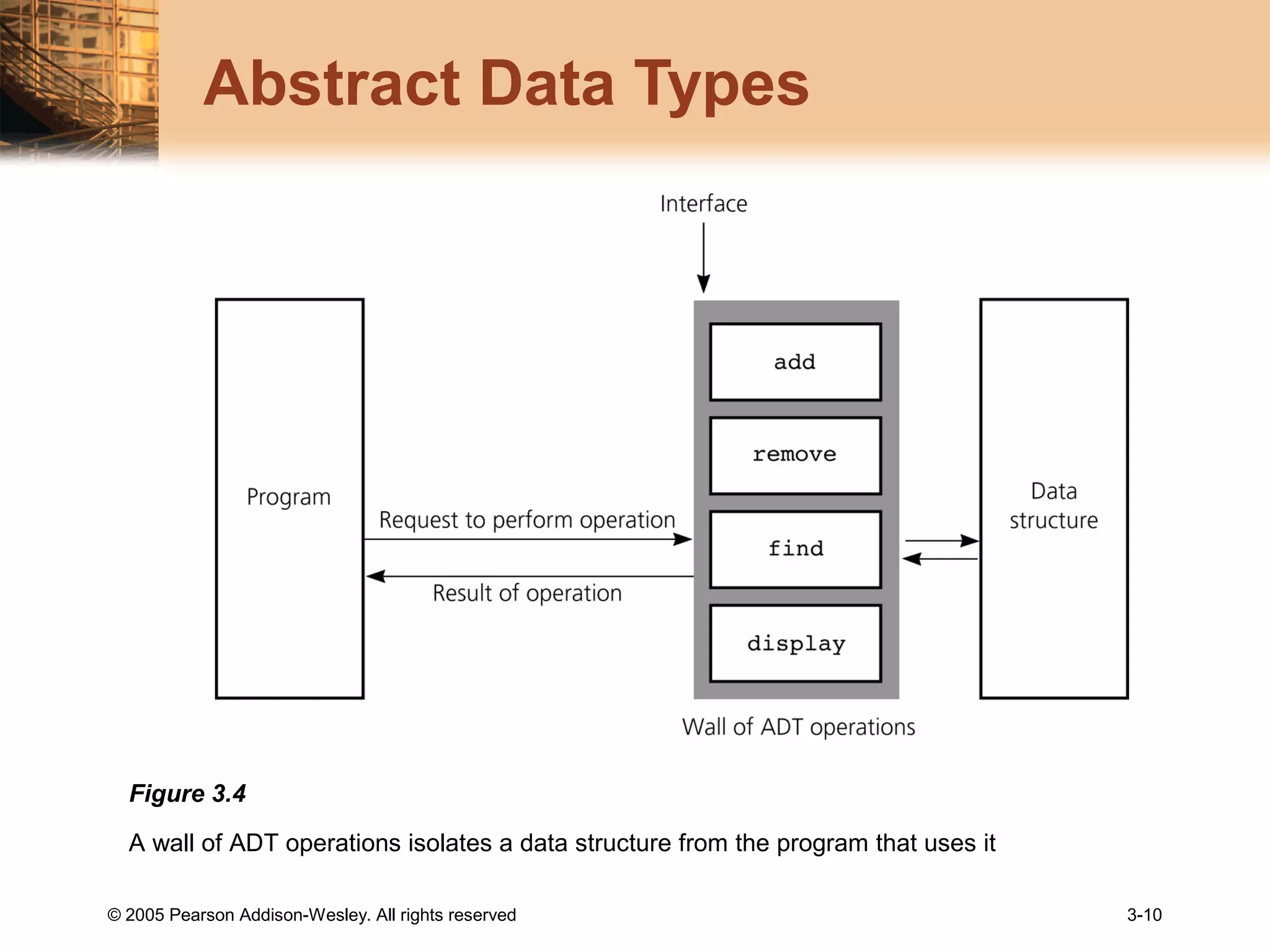
Abstract Data Types
Figure 3.4
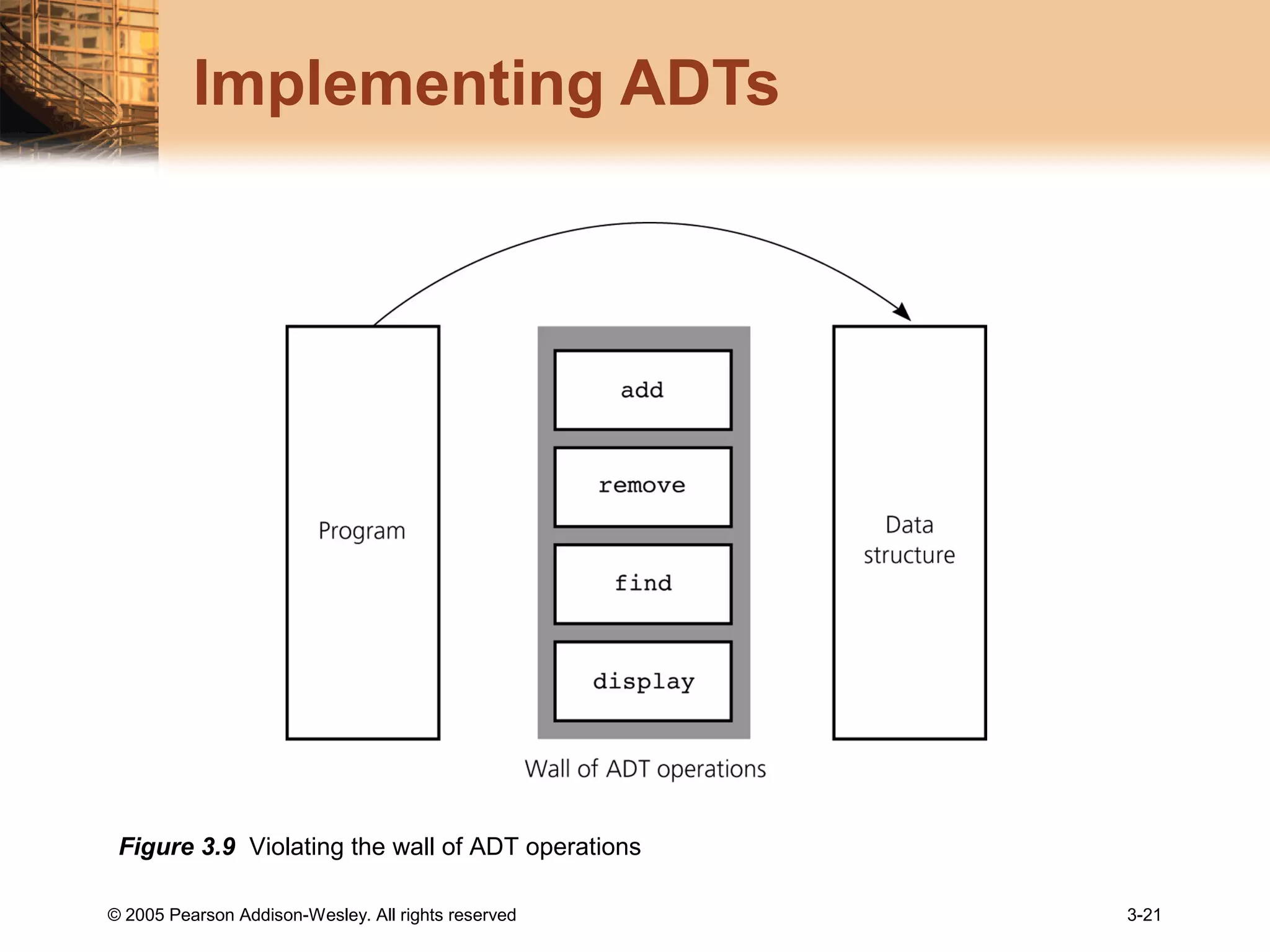
A wall of ADT operations isolates a data structure from the program that uses it
© 2005 Pearson Addison-Wesley. All rights reserved 3-11
The ADT List
• Except for the first and last items, each item
has a unique predecessor and a unique
successor
• Head or front do not have a predecessor
• Tail or end do not have a successor
© 2005 Pearson Addison-Wesley. All rights reserved 3-12
The ADT List
• Items are referenced by their position within
the list
• Specifications of the ADT operations
– Define the contract for the ADT list
– Do not specify how to store the list or how to
perform the operations
• ADT operations can be used in an
application without the knowledge of how
the operations will be implemented
© 2005 Pearson Addison-Wesley. All rights reserved 3-13
The ADT List
• ADT List operations
– Create an empty list
– Determine whether a list is empty
– Determine the number of items in a list
– Add an item at a given position in the list
– Remove the item at a given position in the list
– Remove all the items from the list
– Retrieve (get) item at a given position in the list
© 2005 Pearson Addison-Wesley. All rights reserved 3-14
The ADT List
• The ADT sorted list
– Maintains items in sorted order
– Inserts and deletes items by their values, not
their positions
© 2005 Pearson Addison-Wesley. All rights reserved 3-15
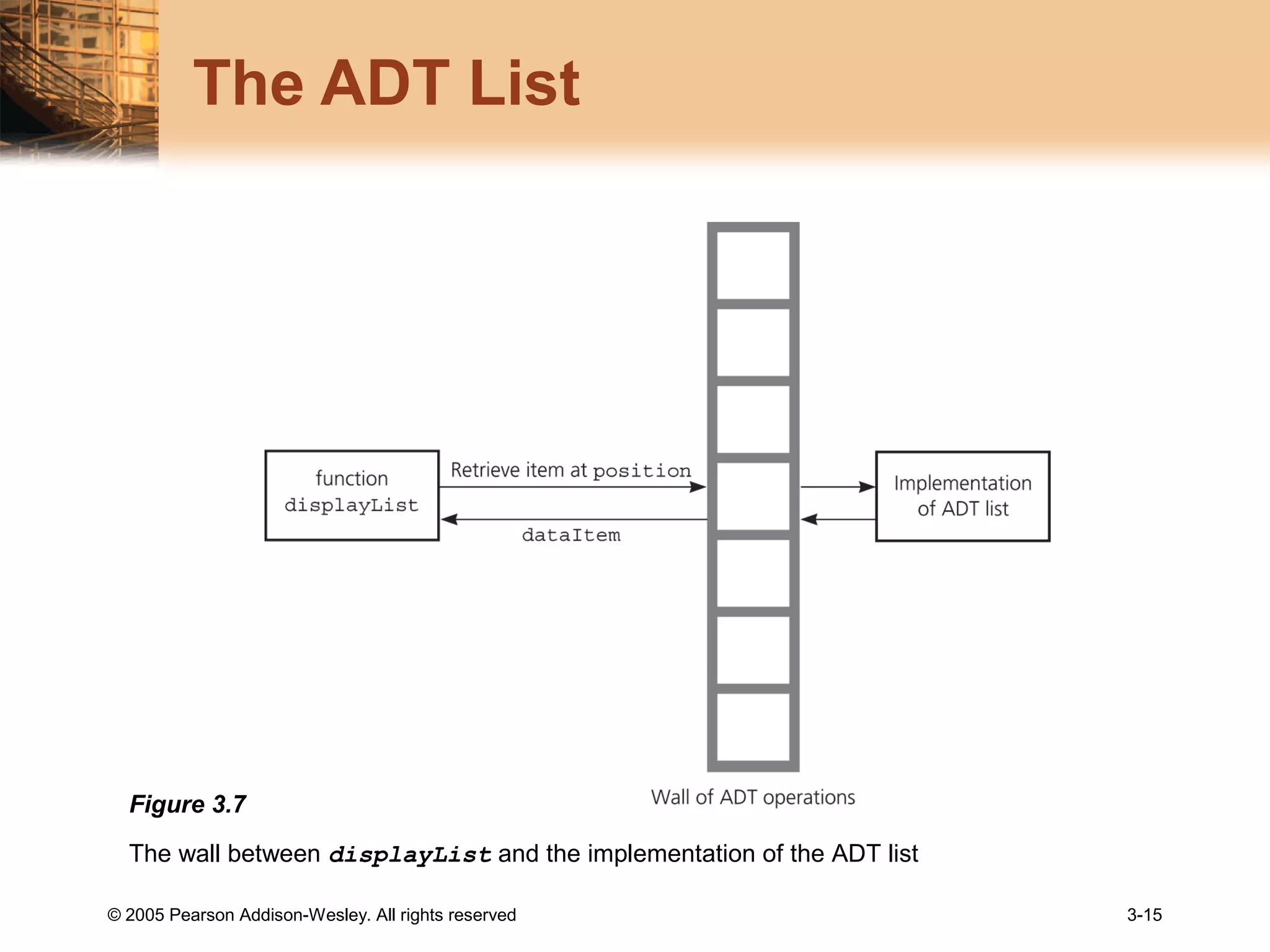
The ADT List
Figure 3.7
The wall between displayList and the implementation of the ADT list
© 2005 Pearson Addison-Wesley. All rights reserved 3-16
Designing an ADT
• The design of an ADT should evolve
naturally during the problem-solving
process
• Questions to ask when designing an ADT
– What data does a problem require?
– What operations does a problem require?
© 2005 Pearson Addison-Wesley. All rights reserved 3-17
Designing an ADT
• For complex abstract data types, the
behavior of the operations must be specified
using axioms
– Axiom: A mathematical rule
– Ex. : (aList.createList()).size() = 0
© 2005 Pearson Addison-Wesley. All rights reserved 3-18
Implementing ADTs
• Choosing the data structure to represent the
ADT’s data is a part of implementation
– Choice of a data structure depends on
• Details of the ADT’s operations
• Context in which the operations will be used
© 2005 Pearson Addison-Wesley. All rights reserved 3-19
Implementing ADTs
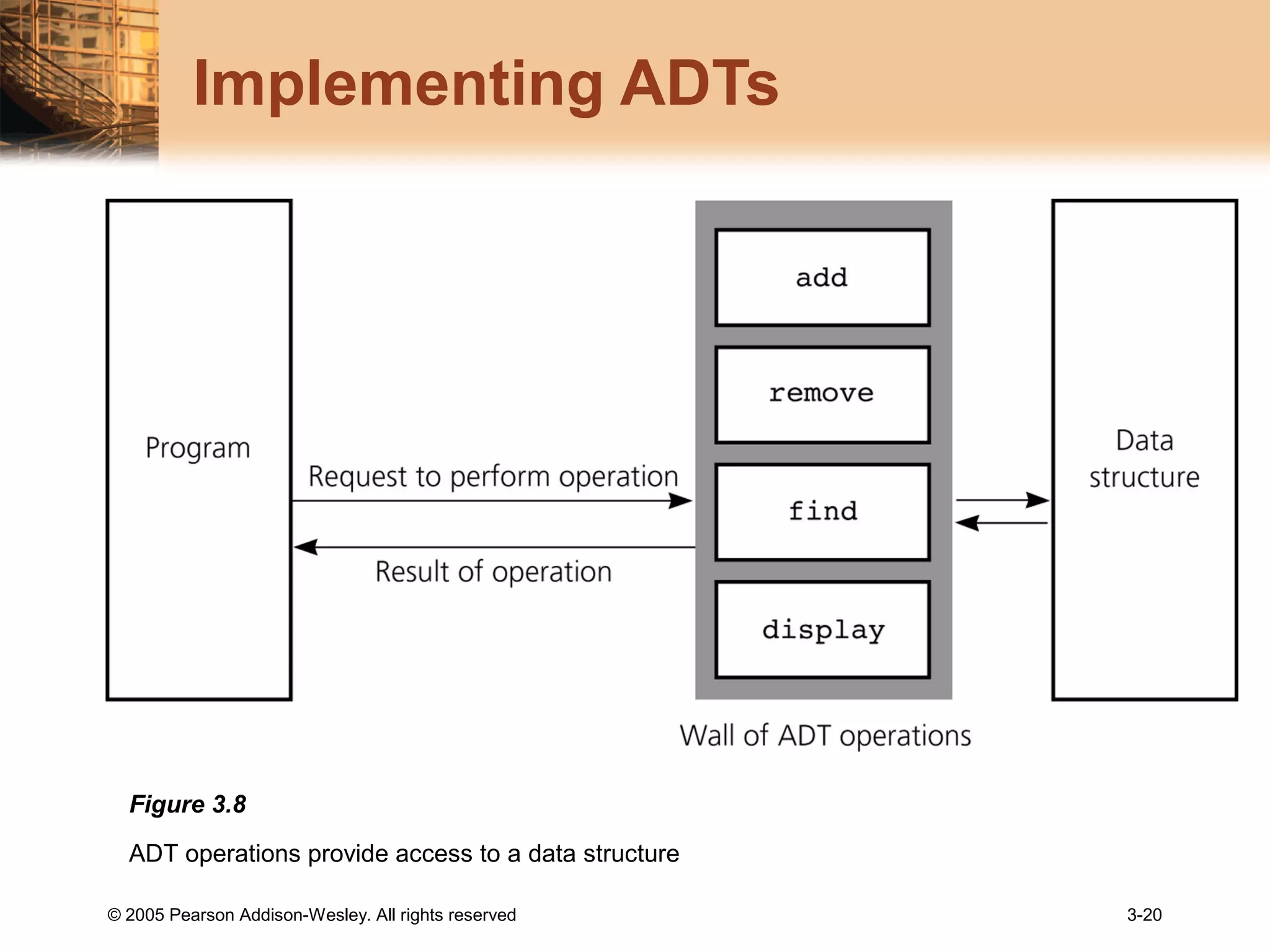
• Implementation details should be hidden
behind a wall of ADT operations
– A program would only be able to access the
data structure using the ADT operations
© 2005 Pearson Addison-Wesley. All rights reserved 3-20
Implementing ADTs
Figure 3.8
ADT operations provide access to a data structure
© 2005 Pearson Addison-Wesley. All rights reserved 3-21
Implementing ADTs
Figure 3.9 Violating the wall of ADT operations
© 2005 Pearson Addison-Wesley. All rights reserved 3-22
C++ Classes
• Encapsulation combines an ADT’s data
with its operations to form an object
– An object is an instance of a class
– A class contains data members and member
functions
• By default, all members in a class are
private
© 2005 Pearson Addison-Wesley. All rights reserved 3-23
C++ Classes
• Each class definition is placed in a header
file
– Classname.h
• The implementation of a class’s member
functions are placed in an implementation
file
– Classname.cpp
© 2005 Pearson Addison-Wesley. All rights reserved 3-24
C++ Classes
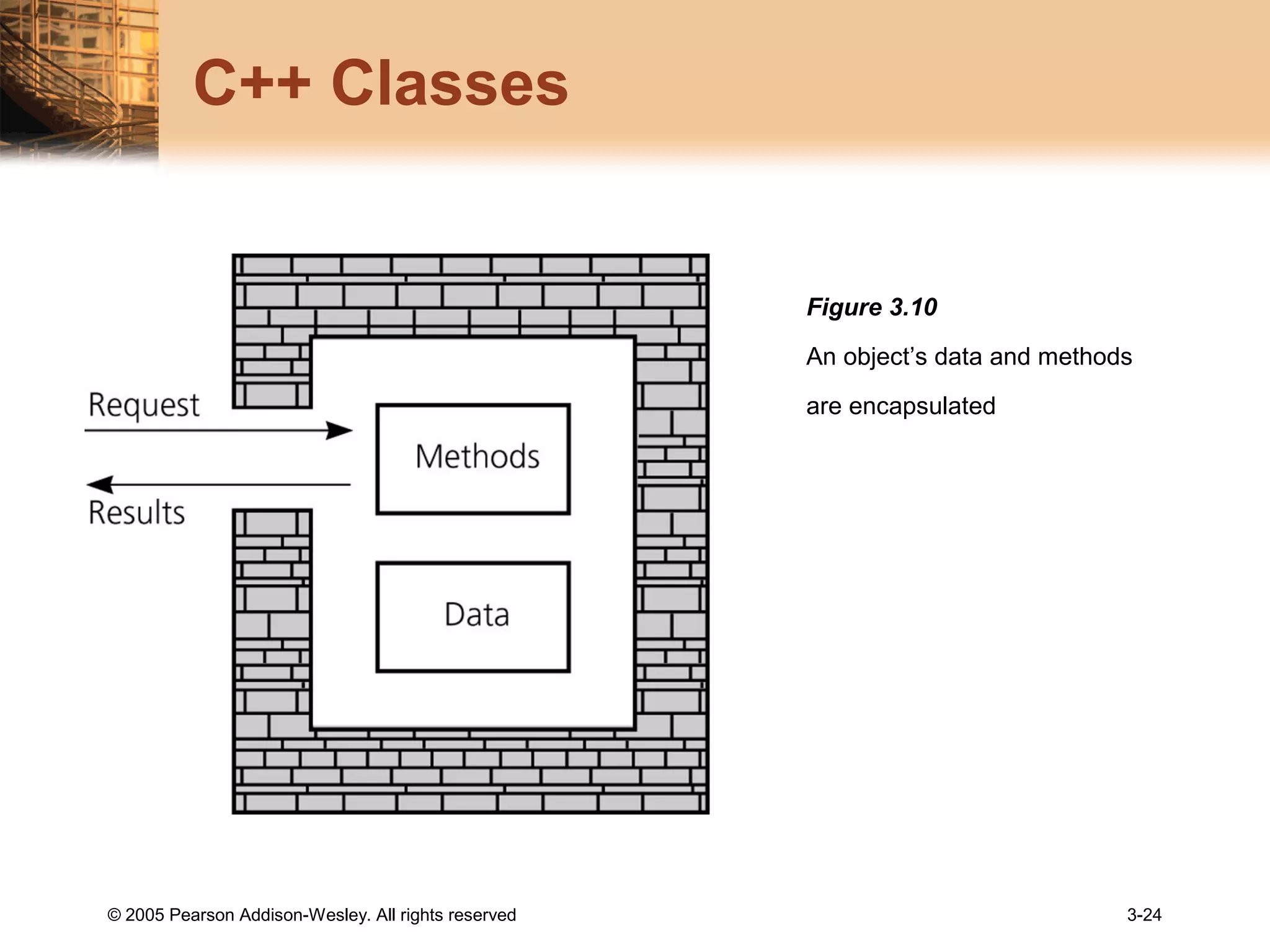
Figure 3.10
An object’s data and methods
are encapsulated
© 2005 Pearson Addison-Wesley. All rights reserved 3-25
Class Constructors and
Destructors
• Constructors
– Create and initialize new instances of a class
– Have the same name as the class
– Have no return type, not even void
© 2005 Pearson Addison-Wesley. All rights reserved 3-26
Class Constructors and
Destructors
• A class can have several constructors
– A default constructor has no arguments
– Initializers can set data members to initial
values
– The compiler will generate a default constructor
if one is omitted
© 2005 Pearson Addison-Wesley. All rights reserved 3-27
Class Constructors and
Destructors
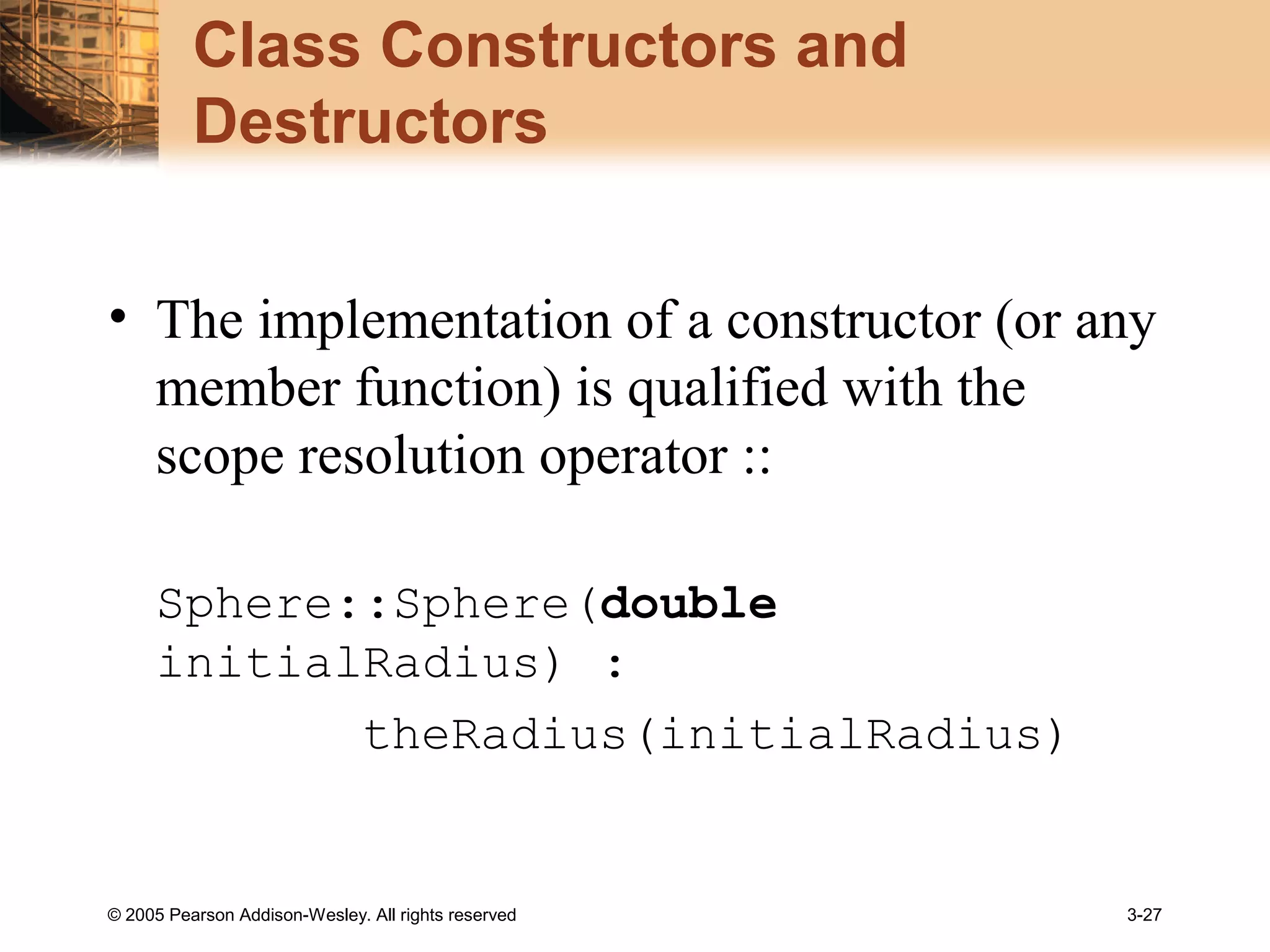
• The implementation of a constructor (or any
member function) is qualified with the
scope resolution operator ::
Sphere::Sphere(double
initialRadius) :
theRadius(initialRadius)
© 2005 Pearson Addison-Wesley. All rights reserved 3-28
Class Constructors and
Destructors
• Destructors
– Destroy an instance of an object when the
object’s lifetime ends
• Each class has one destructor
– For many classes, the destructor can be omitted
– The compiler will generate a default constructor
if one is omitted
© 2005 Pearson Addison-Wesley. All rights reserved 3-29
Inheritance in C++
• A derived class or subclass inherits any of
the publicly defined functions or data
members of a base class or superclass
© 2005 Pearson Addison-Wesley. All rights reserved 3-30
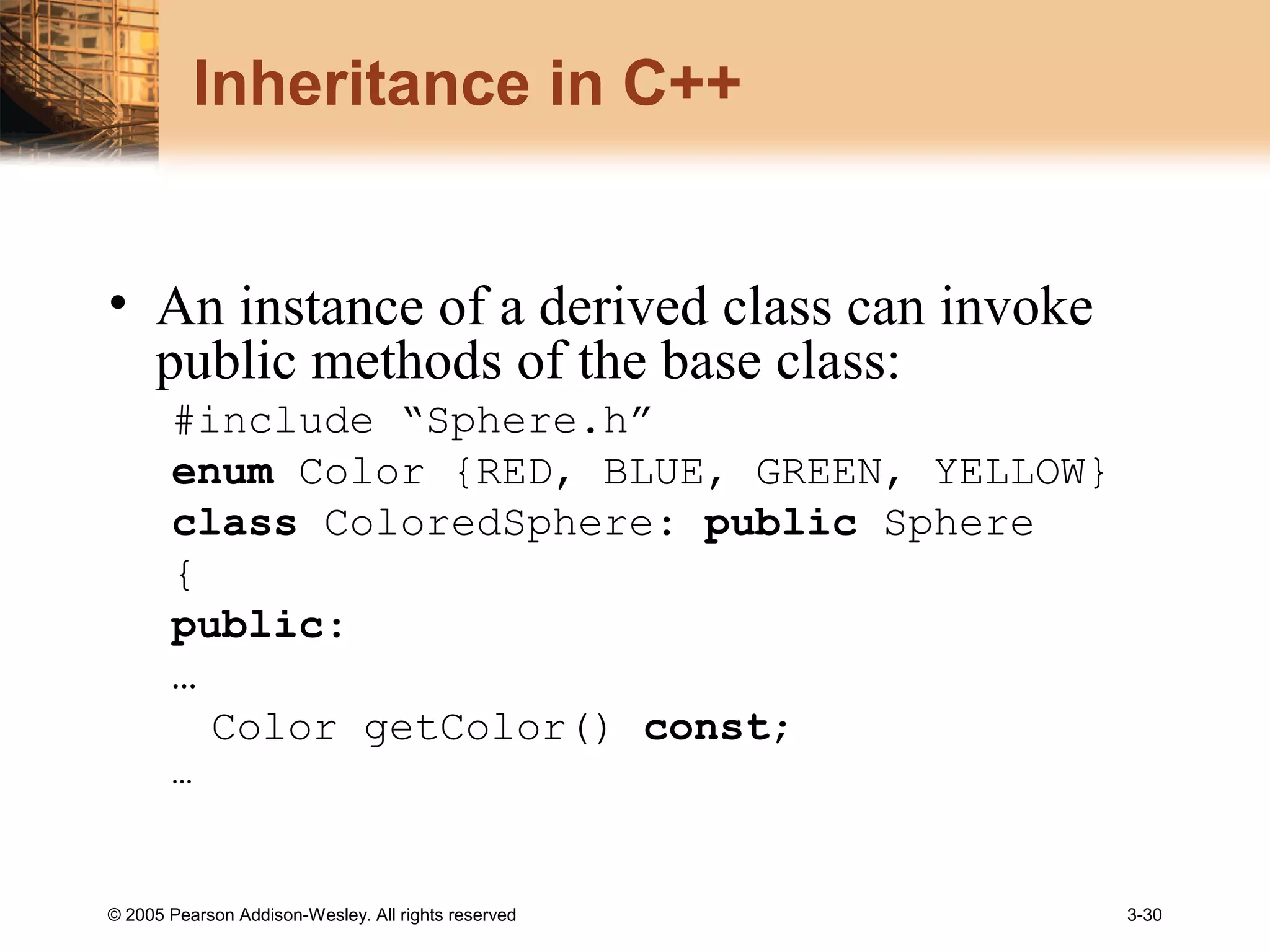
Inheritance in C++
• An instance of a derived class can invoke
public methods of the base class:
#include “Sphere.h”
enum Color {RED, BLUE, GREEN, YELLOW}
class ColoredSphere: public Sphere
{
public:
…
Color getColor() const;
…
© 2005 Pearson Addison-Wesley. All rights reserved 3-31
C++ Namespaces
• A mechanism for logically grouping
declarations and definitions into a common
declarative region
© 2005 Pearson Addison-Wesley. All rights reserved 3-32
C++ Namespaces
• The contents of the namespace can be
accessed by code inside or outside the
namespace
– Use the scope resolution operator to access
elements from outside the namespace
– Alternatively, the using declaration allows
the names of the elements to be used directly
© 2005 Pearson Addison-Wesley. All rights reserved 3-33
C++ Namespaces
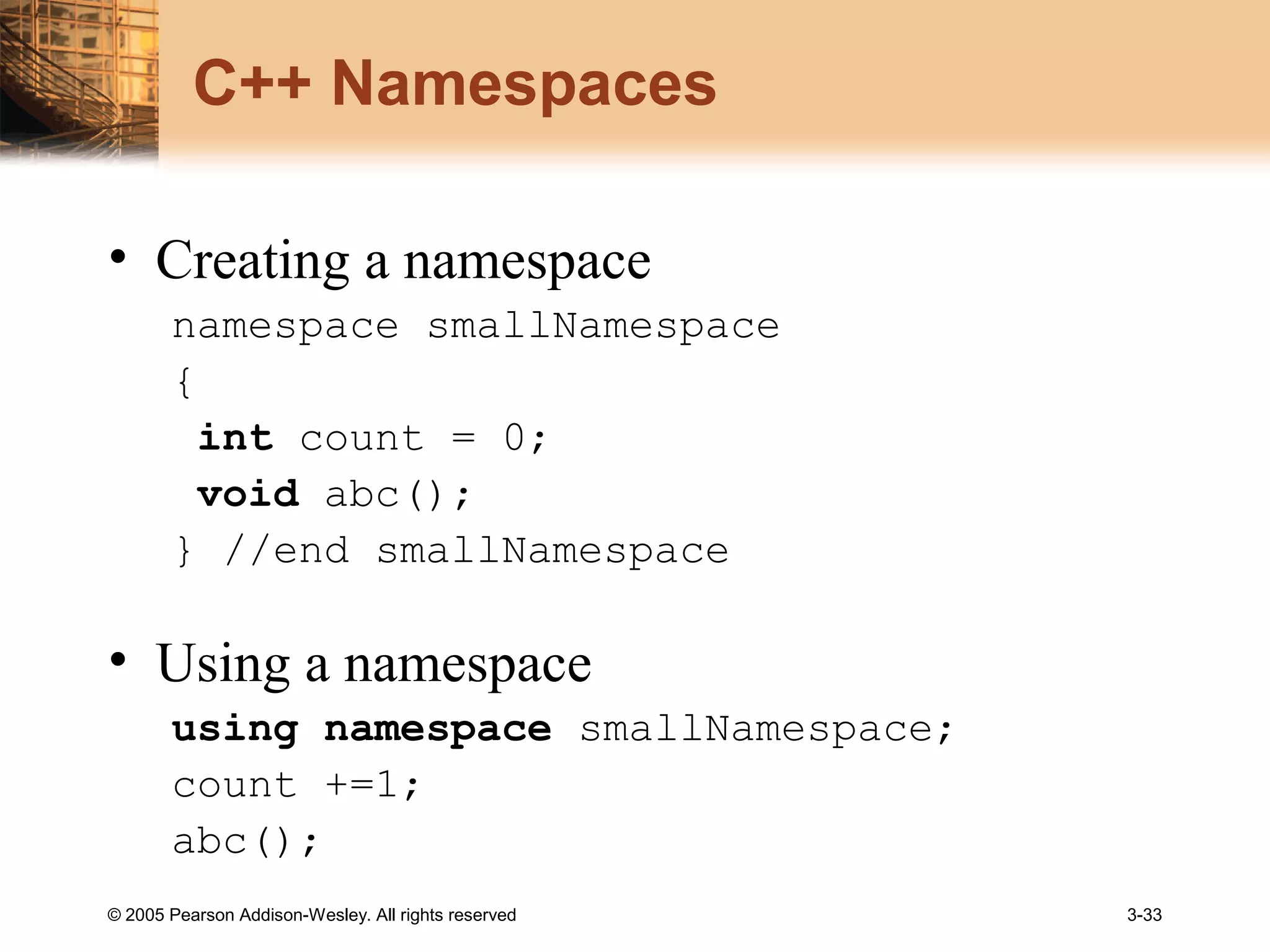
• Creating a namespace
namespace smallNamespace
{
int count = 0;
void abc();
} //end smallNamespace
• Using a namespace
using namespace smallNamespace;
count +=1;
abc();
© 2005 Pearson Addison-Wesley. All rights reserved 3-34
C++ Namespaces
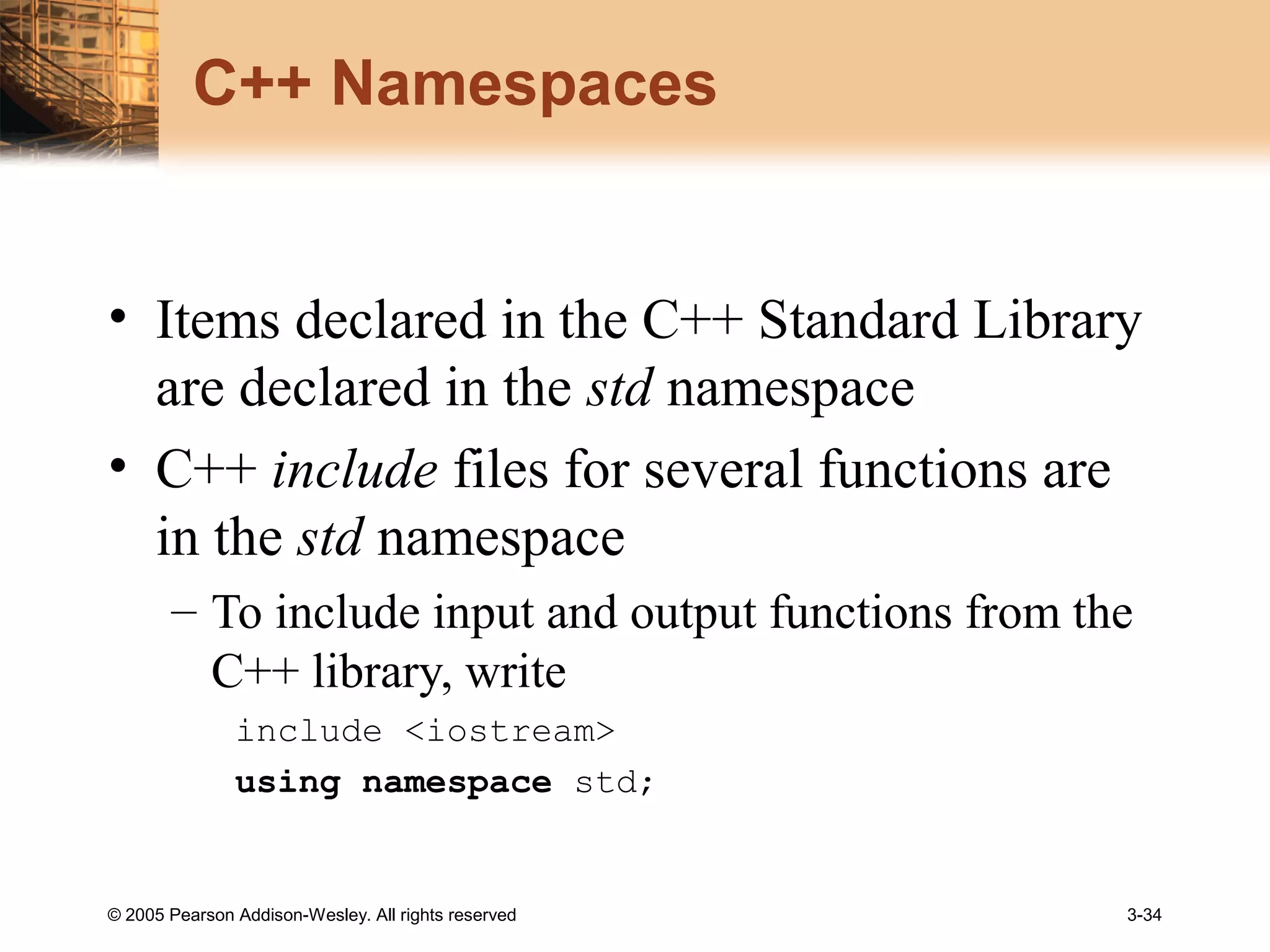
• Items declared in the C++ Standard Library
are declared in the std namespace
• C++ include files for several functions are
in the std namespace
– To include input and output functions from the
C++ library, write
include <iostream>
using namespace std;
© 2005 Pearson Addison-Wesley. All rights reserved 3-35
An Array-Based ADT List
• A list’s items are stored in an array items
• Both an array and a list identify their items
by number
© 2005 Pearson Addison-Wesley. All rights reserved 3-36
An Array-Based ADT List
• A list’s kth
item will be stored in items[k-
1]
Figure 3.11 An array-based implementation of the ADT list
© 2005 Pearson Addison-Wesley. All rights reserved 3-37
C++ Exceptions
• Exception
– A mechanism for handling an error during
execution
– A function indicates that an error has occurred
by throwing an exception
– The code that deals with the exception is said to
catch or handle it
© 2005 Pearson Addison-Wesley. All rights reserved 3-38
C++ Exceptions
• Throwing exceptions
– A throw statement is used to throw an
exception
throw ExceptionClass (stringArgument);
© 2005 Pearson Addison-Wesley. All rights reserved 3-39
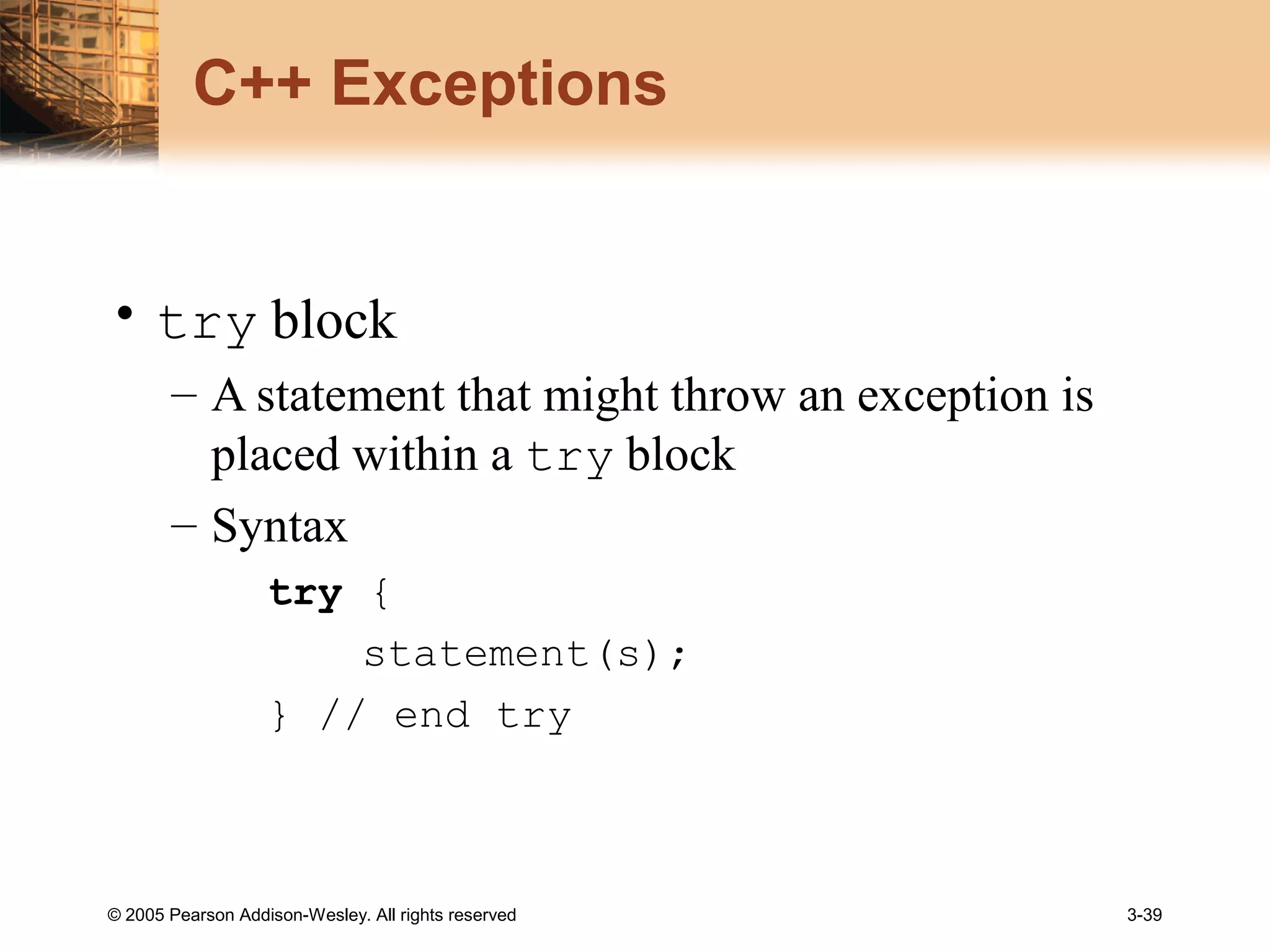
C++ Exceptions
• try block
– A statement that might throw an exception is
placed within a try block
– Syntax
try {
statement(s);
} // end try
© 2005 Pearson Addison-Wesley. All rights reserved 3-40
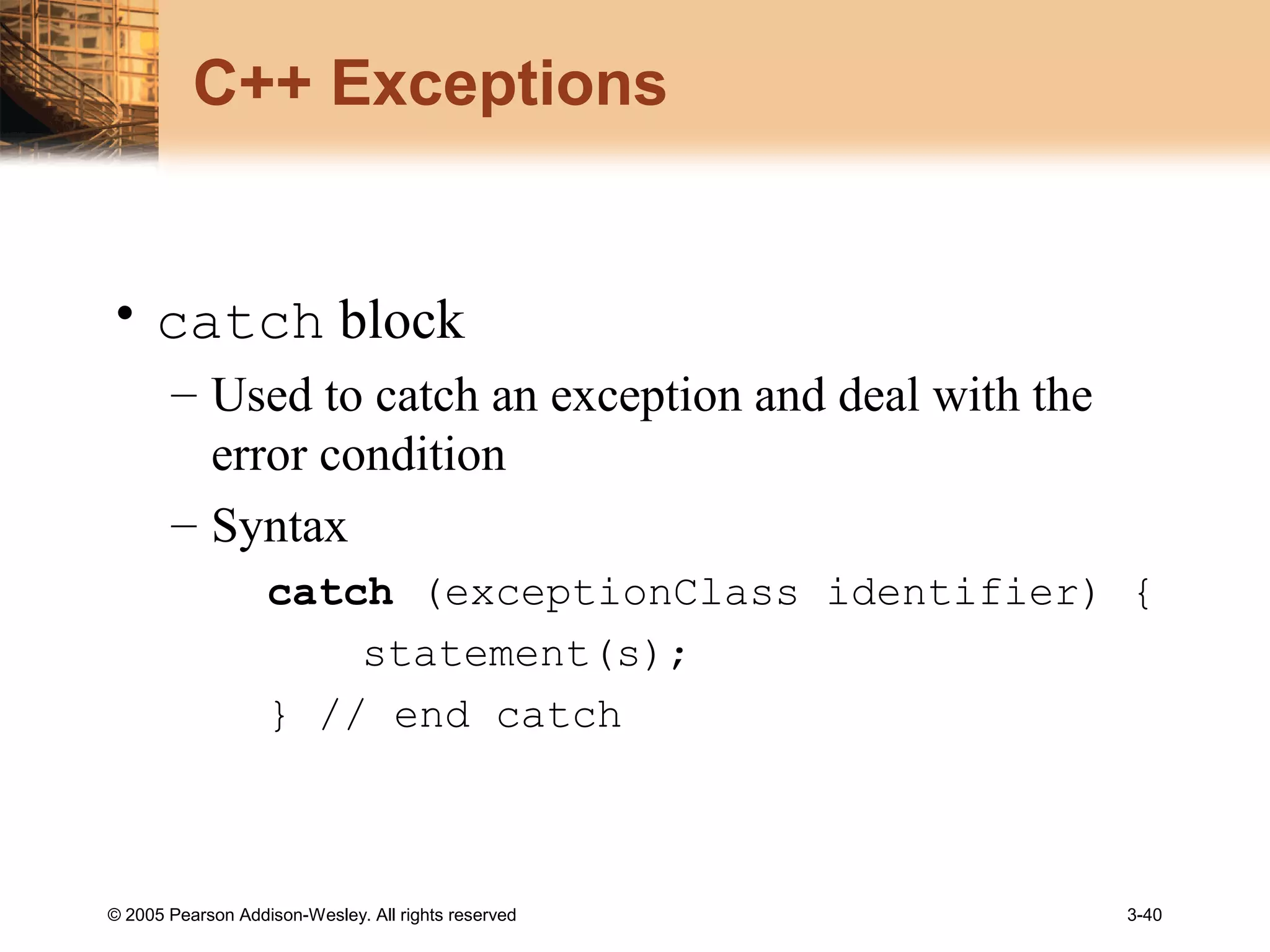
C++ Exceptions
• catch block
– Used to catch an exception and deal with the
error condition
– Syntax
catch (exceptionClass identifier) {
statement(s);
} // end catch
© 2005 Pearson Addison-Wesley. All rights reserved 3-41
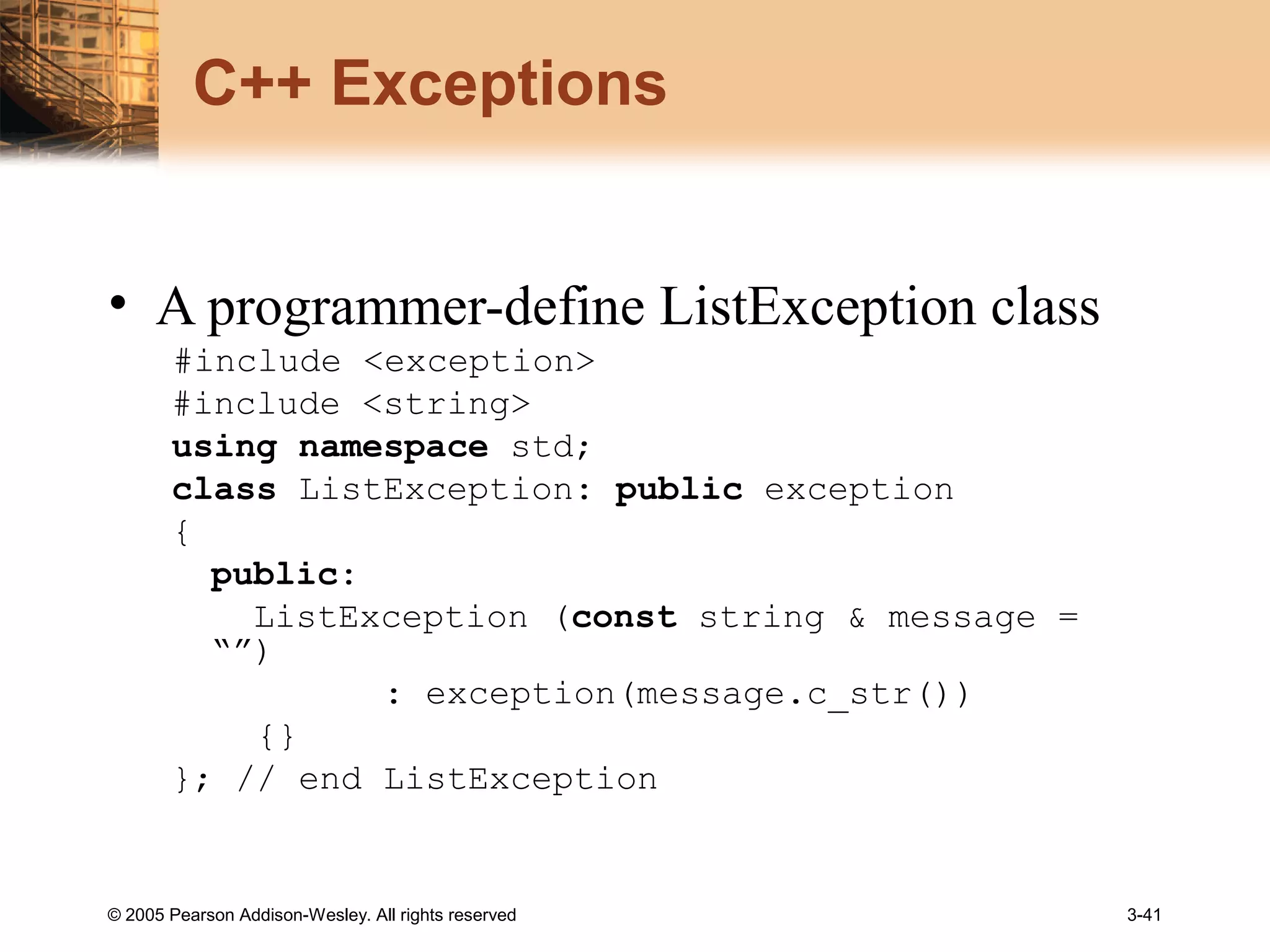
C++ Exceptions
• A programmer-define ListException class
#include <exception>
#include <string>
using namespace std;
class ListException: public exception
{
public:
ListException (const string & message =
“”)
: exception(message.c_str())
{}
}; // end ListException
© 2005 Pearson Addison-Wesley. All rights reserved 3-42
Summary
• Data abstraction controls the interaction
between a program and its data structures
• Abstract data type (ADT): a set of data-
management operations together with the
data values upon which they operate
• Mathematical study of ADTs uses axioms to
specify the behavior of ADT operations
• An ADT should be fully defined before any
implementation decisions
© 2005 Pearson Addison-Wesley. All rights reserved 3-43
Summary
• Hide an ADT’s implementation by defining
the ADT as a C++ class
• An object encapsulates both data and
operations
• A class contains at least one constructor and
a destructor
• The compiler generates default constructor
and destructor if none are provided
© 2005 Pearson Addison-Wesley. All rights reserved 3-44
Summary
• Members of a class are private by default
– Data members are typically private
– Public functions can be provided to access them
• Define and implement a class within header
and implementation files
• Namespace: a mechanism to group classes,
functions, variables, types, and constants
• Use exception handling to throw, catch, and
handle errors during program execution

Data abstraction the walls

  • 1.
    © 2005 PearsonAddison-Wesley. All rights reserved 3-1 Abstract Data Types • Modularity – Keeps the complexity of a large program manageable by systematically controlling the interaction of its components – Isolates errors
  • 2.
    © 2005 PearsonAddison-Wesley. All rights reserved 3-2 Abstract Data Types • Modularity (Continued) – Eliminates redundancies – A modular program is • Easier to write • Easier to read • Easier to modify
  • 3.
    © 2005 PearsonAddison-Wesley. All rights reserved 3-3 Abstract Data Types • Procedural abstraction – Separates the purpose and use of a module from its implementation – A module’s specifications should • Detail how the module behaves • Identify details that can be hidden within the module
  • 4.
    © 2005 PearsonAddison-Wesley. All rights reserved 3-4 Abstract Data Types • Information hiding – Hides certain implementation details within a module – Makes these details inaccessible from outside the module
  • 5.
    © 2005 PearsonAddison-Wesley. All rights reserved 3-5 Abstract Data Types Figure 3.1 Isolated tasks: the implementation of task T does not affect task Q
  • 6.
    © 2005 PearsonAddison-Wesley. All rights reserved 3-6 Abstract Data Types • The isolation of modules is not total – Functions’ specifications, or contracts, govern how they interact with each other Figure 3.2 A slit in the wall
  • 7.
    © 2005 PearsonAddison-Wesley. All rights reserved 3-7 Abstract Data Types • Typical operations on data – Add data to a data collection – Remove data from a data collection – Ask questions about the data in a data collection
  • 8.
    © 2005 PearsonAddison-Wesley. All rights reserved 3-8 Abstract Data Types • Data abstraction – Asks you to think what you can do to a collection of data independently of how you do it – Allows you to develop each data structure in relative isolation from the rest of the solution – A natural extension of procedural abstraction
  • 9.
    © 2005 PearsonAddison-Wesley. All rights reserved 3-9 Abstract Data Types • Abstract data type (ADT) – An ADT is composed of • A collection of data • A set of operations on that data – Specifications of an ADT indicate • What the ADT operations do, not how to implement them – Implementation of an ADT • Includes choosing a particular data structure
  • 10.
    © 2005 PearsonAddison-Wesley. All rights reserved 3-10 Abstract Data Types Figure 3.4 A wall of ADT operations isolates a data structure from the program that uses it
  • 11.
    © 2005 PearsonAddison-Wesley. All rights reserved 3-11 The ADT List • Except for the first and last items, each item has a unique predecessor and a unique successor • Head or front do not have a predecessor • Tail or end do not have a successor
  • 12.
    © 2005 PearsonAddison-Wesley. All rights reserved 3-12 The ADT List • Items are referenced by their position within the list • Specifications of the ADT operations – Define the contract for the ADT list – Do not specify how to store the list or how to perform the operations • ADT operations can be used in an application without the knowledge of how the operations will be implemented
  • 13.
    © 2005 PearsonAddison-Wesley. All rights reserved 3-13 The ADT List • ADT List operations – Create an empty list – Determine whether a list is empty – Determine the number of items in a list – Add an item at a given position in the list – Remove the item at a given position in the list – Remove all the items from the list – Retrieve (get) item at a given position in the list
  • 14.
    © 2005 PearsonAddison-Wesley. All rights reserved 3-14 The ADT List • The ADT sorted list – Maintains items in sorted order – Inserts and deletes items by their values, not their positions
  • 15.
    © 2005 PearsonAddison-Wesley. All rights reserved 3-15 The ADT List Figure 3.7 The wall between displayList and the implementation of the ADT list
  • 16.
    © 2005 PearsonAddison-Wesley. All rights reserved 3-16 Designing an ADT • The design of an ADT should evolve naturally during the problem-solving process • Questions to ask when designing an ADT – What data does a problem require? – What operations does a problem require?
  • 17.
    © 2005 PearsonAddison-Wesley. All rights reserved 3-17 Designing an ADT • For complex abstract data types, the behavior of the operations must be specified using axioms – Axiom: A mathematical rule – Ex. : (aList.createList()).size() = 0
  • 18.
    © 2005 PearsonAddison-Wesley. All rights reserved 3-18 Implementing ADTs • Choosing the data structure to represent the ADT’s data is a part of implementation – Choice of a data structure depends on • Details of the ADT’s operations • Context in which the operations will be used
  • 19.
    © 2005 PearsonAddison-Wesley. All rights reserved 3-19 Implementing ADTs • Implementation details should be hidden behind a wall of ADT operations – A program would only be able to access the data structure using the ADT operations
  • 20.
    © 2005 PearsonAddison-Wesley. All rights reserved 3-20 Implementing ADTs Figure 3.8 ADT operations provide access to a data structure
  • 21.
    © 2005 PearsonAddison-Wesley. All rights reserved 3-21 Implementing ADTs Figure 3.9 Violating the wall of ADT operations
  • 22.
    © 2005 PearsonAddison-Wesley. All rights reserved 3-22 C++ Classes • Encapsulation combines an ADT’s data with its operations to form an object – An object is an instance of a class – A class contains data members and member functions • By default, all members in a class are private
  • 23.
    © 2005 PearsonAddison-Wesley. All rights reserved 3-23 C++ Classes • Each class definition is placed in a header file – Classname.h • The implementation of a class’s member functions are placed in an implementation file – Classname.cpp
  • 24.
    © 2005 PearsonAddison-Wesley. All rights reserved 3-24 C++ Classes Figure 3.10 An object’s data and methods are encapsulated
  • 25.
    © 2005 PearsonAddison-Wesley. All rights reserved 3-25 Class Constructors and Destructors • Constructors – Create and initialize new instances of a class – Have the same name as the class – Have no return type, not even void
  • 26.
    © 2005 PearsonAddison-Wesley. All rights reserved 3-26 Class Constructors and Destructors • A class can have several constructors – A default constructor has no arguments – Initializers can set data members to initial values – The compiler will generate a default constructor if one is omitted
  • 27.
    © 2005 PearsonAddison-Wesley. All rights reserved 3-27 Class Constructors and Destructors • The implementation of a constructor (or any member function) is qualified with the scope resolution operator :: Sphere::Sphere(double initialRadius) : theRadius(initialRadius)
  • 28.
    © 2005 PearsonAddison-Wesley. All rights reserved 3-28 Class Constructors and Destructors • Destructors – Destroy an instance of an object when the object’s lifetime ends • Each class has one destructor – For many classes, the destructor can be omitted – The compiler will generate a default constructor if one is omitted
  • 29.
    © 2005 PearsonAddison-Wesley. All rights reserved 3-29 Inheritance in C++ • A derived class or subclass inherits any of the publicly defined functions or data members of a base class or superclass
  • 30.
    © 2005 PearsonAddison-Wesley. All rights reserved 3-30 Inheritance in C++ • An instance of a derived class can invoke public methods of the base class: #include “Sphere.h” enum Color {RED, BLUE, GREEN, YELLOW} class ColoredSphere: public Sphere { public: … Color getColor() const; …
  • 31.
    © 2005 PearsonAddison-Wesley. All rights reserved 3-31 C++ Namespaces • A mechanism for logically grouping declarations and definitions into a common declarative region
  • 32.
    © 2005 PearsonAddison-Wesley. All rights reserved 3-32 C++ Namespaces • The contents of the namespace can be accessed by code inside or outside the namespace – Use the scope resolution operator to access elements from outside the namespace – Alternatively, the using declaration allows the names of the elements to be used directly
  • 33.
    © 2005 PearsonAddison-Wesley. All rights reserved 3-33 C++ Namespaces • Creating a namespace namespace smallNamespace { int count = 0; void abc(); } //end smallNamespace • Using a namespace using namespace smallNamespace; count +=1; abc();
  • 34.
    © 2005 PearsonAddison-Wesley. All rights reserved 3-34 C++ Namespaces • Items declared in the C++ Standard Library are declared in the std namespace • C++ include files for several functions are in the std namespace – To include input and output functions from the C++ library, write include <iostream> using namespace std;
  • 35.
    © 2005 PearsonAddison-Wesley. All rights reserved 3-35 An Array-Based ADT List • A list’s items are stored in an array items • Both an array and a list identify their items by number
  • 36.
    © 2005 PearsonAddison-Wesley. All rights reserved 3-36 An Array-Based ADT List • A list’s kth item will be stored in items[k- 1] Figure 3.11 An array-based implementation of the ADT list
  • 37.
    © 2005 PearsonAddison-Wesley. All rights reserved 3-37 C++ Exceptions • Exception – A mechanism for handling an error during execution – A function indicates that an error has occurred by throwing an exception – The code that deals with the exception is said to catch or handle it
  • 38.
    © 2005 PearsonAddison-Wesley. All rights reserved 3-38 C++ Exceptions • Throwing exceptions – A throw statement is used to throw an exception throw ExceptionClass (stringArgument);
  • 39.
    © 2005 PearsonAddison-Wesley. All rights reserved 3-39 C++ Exceptions • try block – A statement that might throw an exception is placed within a try block – Syntax try { statement(s); } // end try
  • 40.
    © 2005 PearsonAddison-Wesley. All rights reserved 3-40 C++ Exceptions • catch block – Used to catch an exception and deal with the error condition – Syntax catch (exceptionClass identifier) { statement(s); } // end catch
  • 41.
    © 2005 PearsonAddison-Wesley. All rights reserved 3-41 C++ Exceptions • A programmer-define ListException class #include <exception> #include <string> using namespace std; class ListException: public exception { public: ListException (const string & message = “”) : exception(message.c_str()) {} }; // end ListException
  • 42.
    © 2005 PearsonAddison-Wesley. All rights reserved 3-42 Summary • Data abstraction controls the interaction between a program and its data structures • Abstract data type (ADT): a set of data- management operations together with the data values upon which they operate • Mathematical study of ADTs uses axioms to specify the behavior of ADT operations • An ADT should be fully defined before any implementation decisions
  • 43.
    © 2005 PearsonAddison-Wesley. All rights reserved 3-43 Summary • Hide an ADT’s implementation by defining the ADT as a C++ class • An object encapsulates both data and operations • A class contains at least one constructor and a destructor • The compiler generates default constructor and destructor if none are provided
  • 44.
    © 2005 PearsonAddison-Wesley. All rights reserved 3-44 Summary • Members of a class are private by default – Data members are typically private – Public functions can be provided to access them • Define and implement a class within header and implementation files • Namespace: a mechanism to group classes, functions, variables, types, and constants • Use exception handling to throw, catch, and handle errors during program execution