Darren Hague, SAP
June 30, 2016
SAP’s DevOps Journey:
from building an app to building a cloud
Public
© 2016 SAP SE or an SAP affiliate company. All rights reserved. 2Public
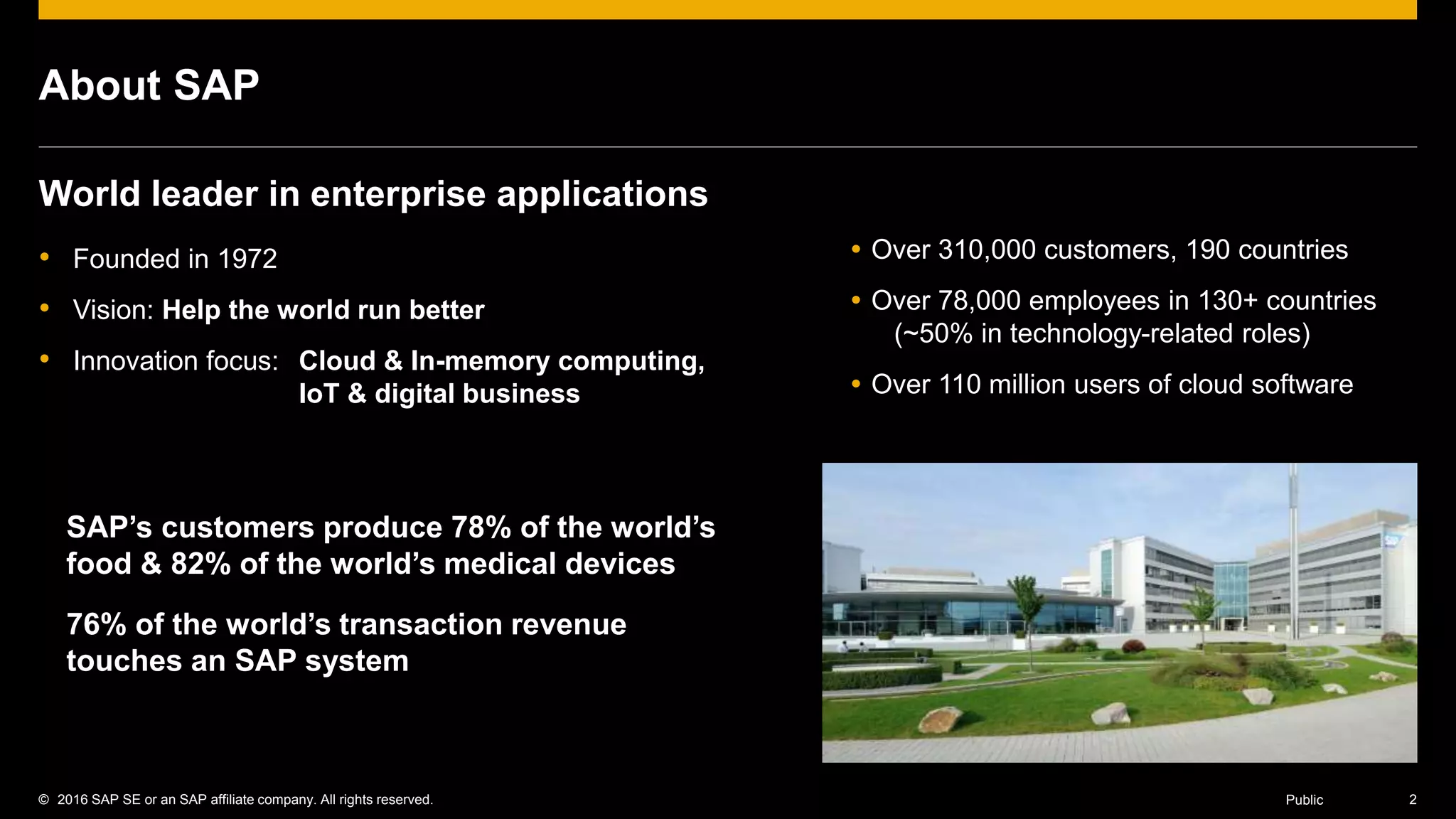
About SAP
World leader in enterprise applications
• Founded in 1972
• Vision: Help the world run better
• Innovation focus: Cloud & In-memory computing,
IoT & digital business
 Over 310,000 customers, 190 countries
 Over 78,000 employees in 130+ countries
(~50% in technology-related roles)
 Over 110 million users of cloud software
SAP’s customers produce 78% of the world’s
food & 82% of the world’s medical devices
76% of the world’s transaction revenue
touches an SAP system
© 2016 SAP SE or an SAP affiliate company. All rights reserved. 3Public
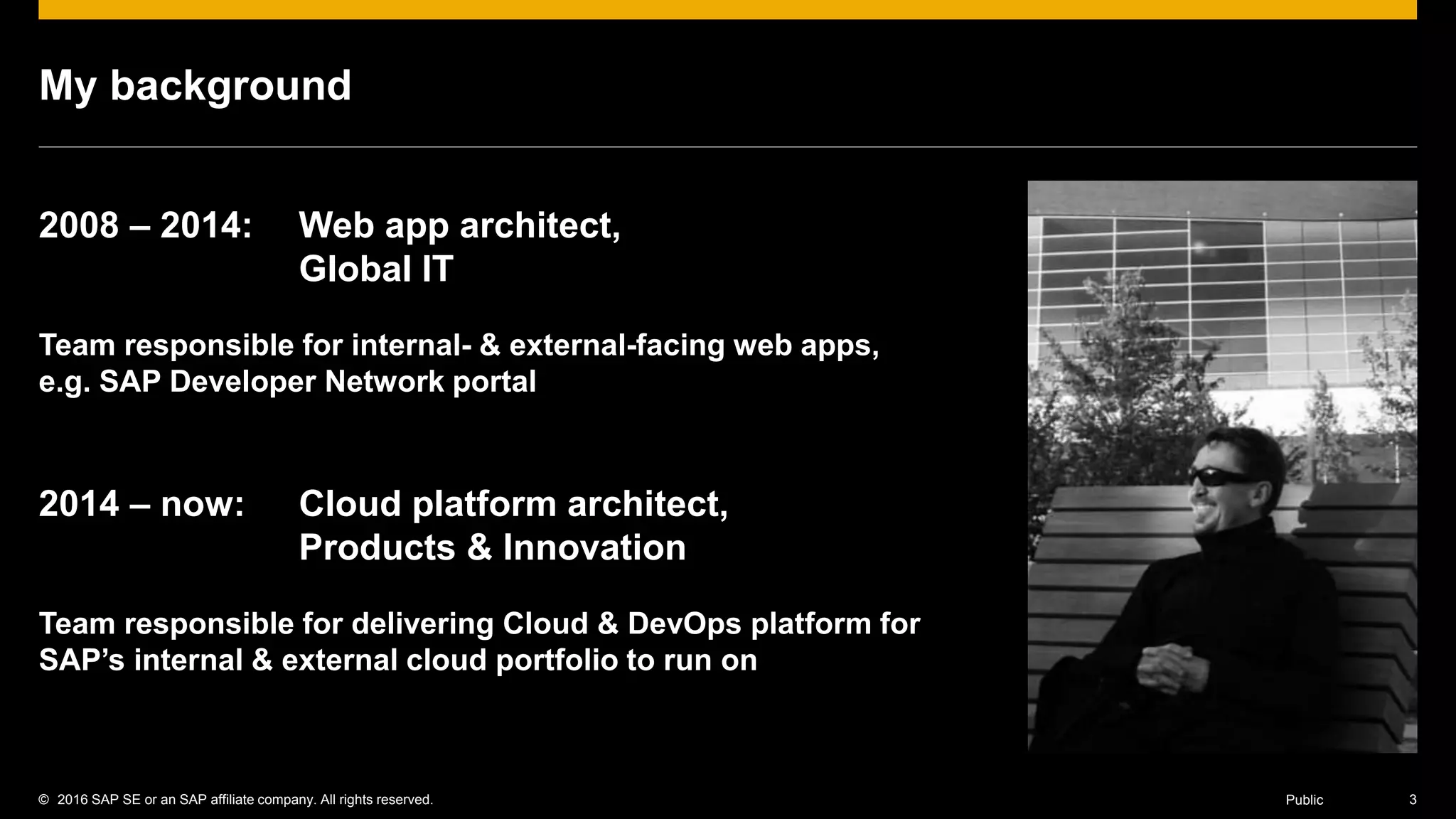
My background
2008 – 2014: Web app architect,
Global IT
Team responsible for internal- & external-facing web apps,
e.g. SAP Developer Network portal
2014 – now: Cloud platform architect,
Products & Innovation
Team responsible for delivering Cloud & DevOps platform for
SAP’s internal & external cloud portfolio to run on
Darren Hague / SAP Global IT
November 1st, 2013
Continuous Delivery at SAP:
From dinosaur to spaceship
Public
© 2016 SAP SE or an SAP affiliate company. All rights reserved. 5Public
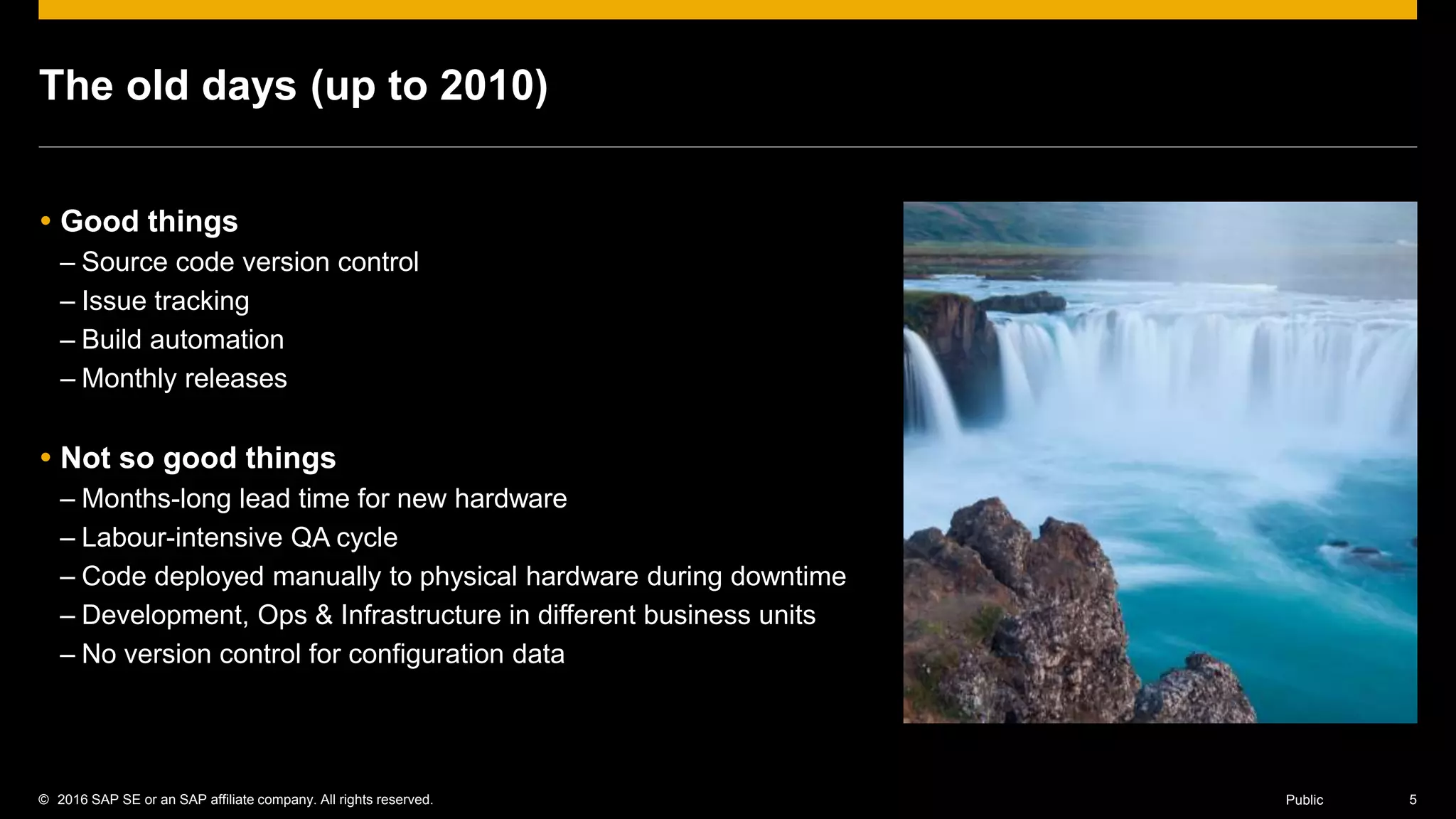
The old days (up to 2010)
 Good things
– Source code version control
– Issue tracking
– Build automation
– Monthly releases
 Not so good things
– Months-long lead time for new hardware
– Labour-intensive QA cycle
– Code deployed manually to physical hardware during downtime
– Development, Ops & Infrastructure in different business units
– No version control for configuration data
© 2016 SAP SE or an SAP affiliate company. All rights reserved. 6Public
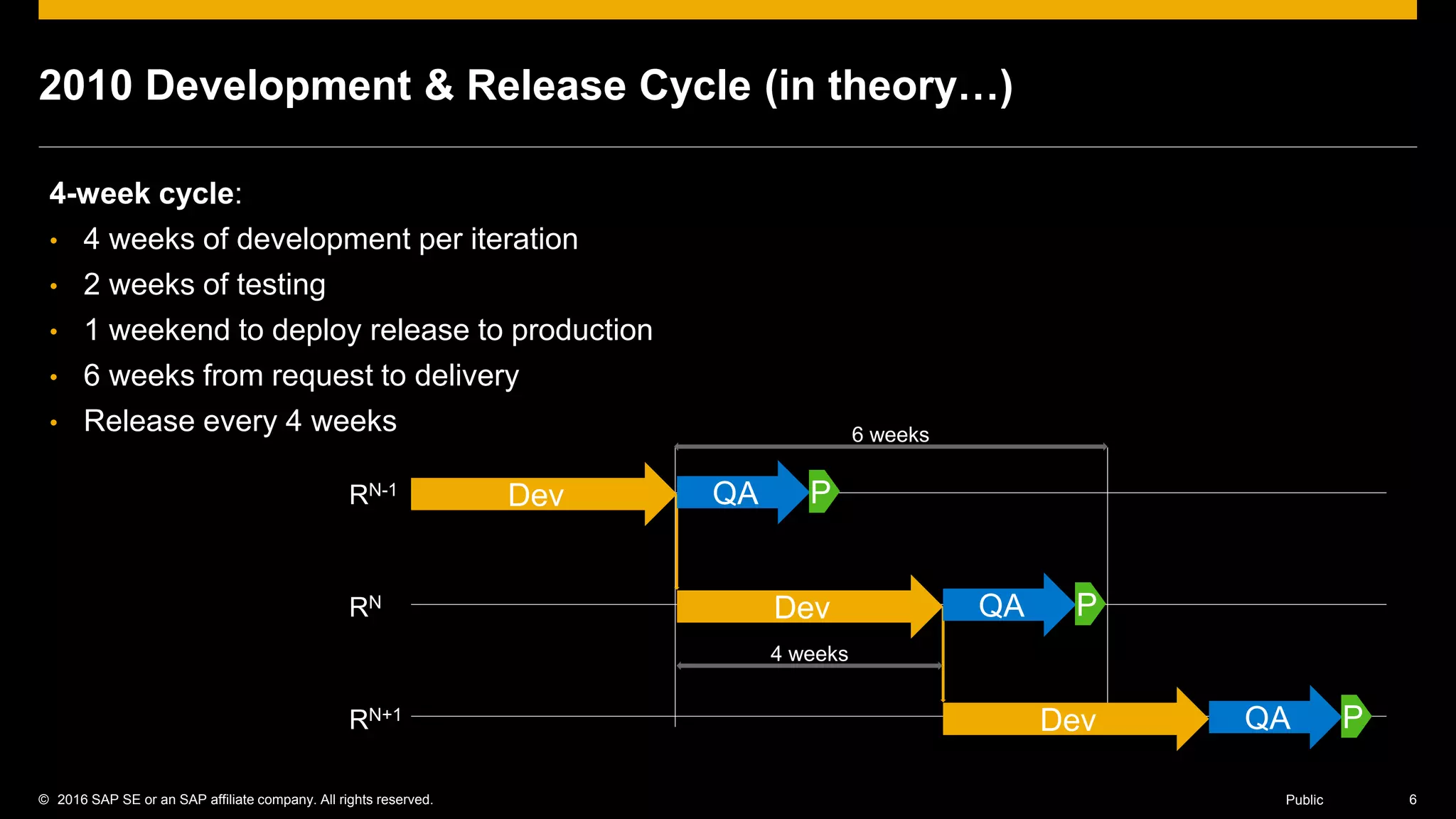
2010 Development & Release Cycle (in theory…)
4-week cycle:
• 4 weeks of development per iteration
• 2 weeks of testing
• 1 weekend to deploy release to production
• 6 weeks from request to delivery
• Release every 4 weeks
Dev QA PRN-1
Dev QA P
Dev QA P
RN
RN+1
4 weeks
6 weeks
© 2016 SAP SE or an SAP affiliate company. All rights reserved. 7Public
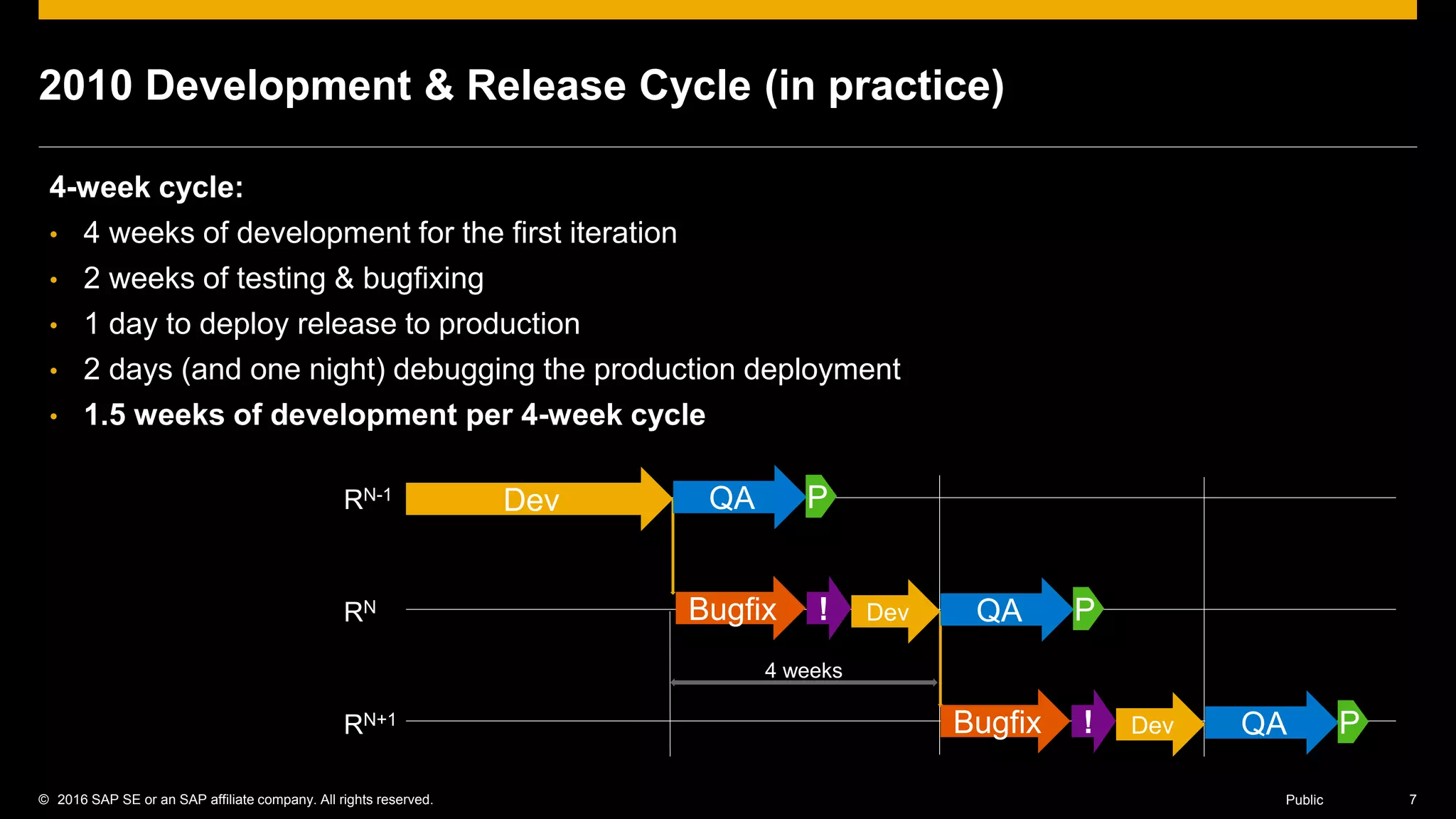
2010 Development & Release Cycle (in practice)
4-week cycle:
• 4 weeks of development for the first iteration
• 2 weeks of testing & bugfixing
• 1 day to deploy release to production
• 2 days (and one night) debugging the production deployment
• 1.5 weeks of development per 4-week cycle
Dev QA PRN-1
RN
RN+1
4 weeks
Dev QA P!Bugfix
Dev QA P!Bugfix
© 2016 SAP SE or an SAP affiliate company. All rights reserved. 8Public
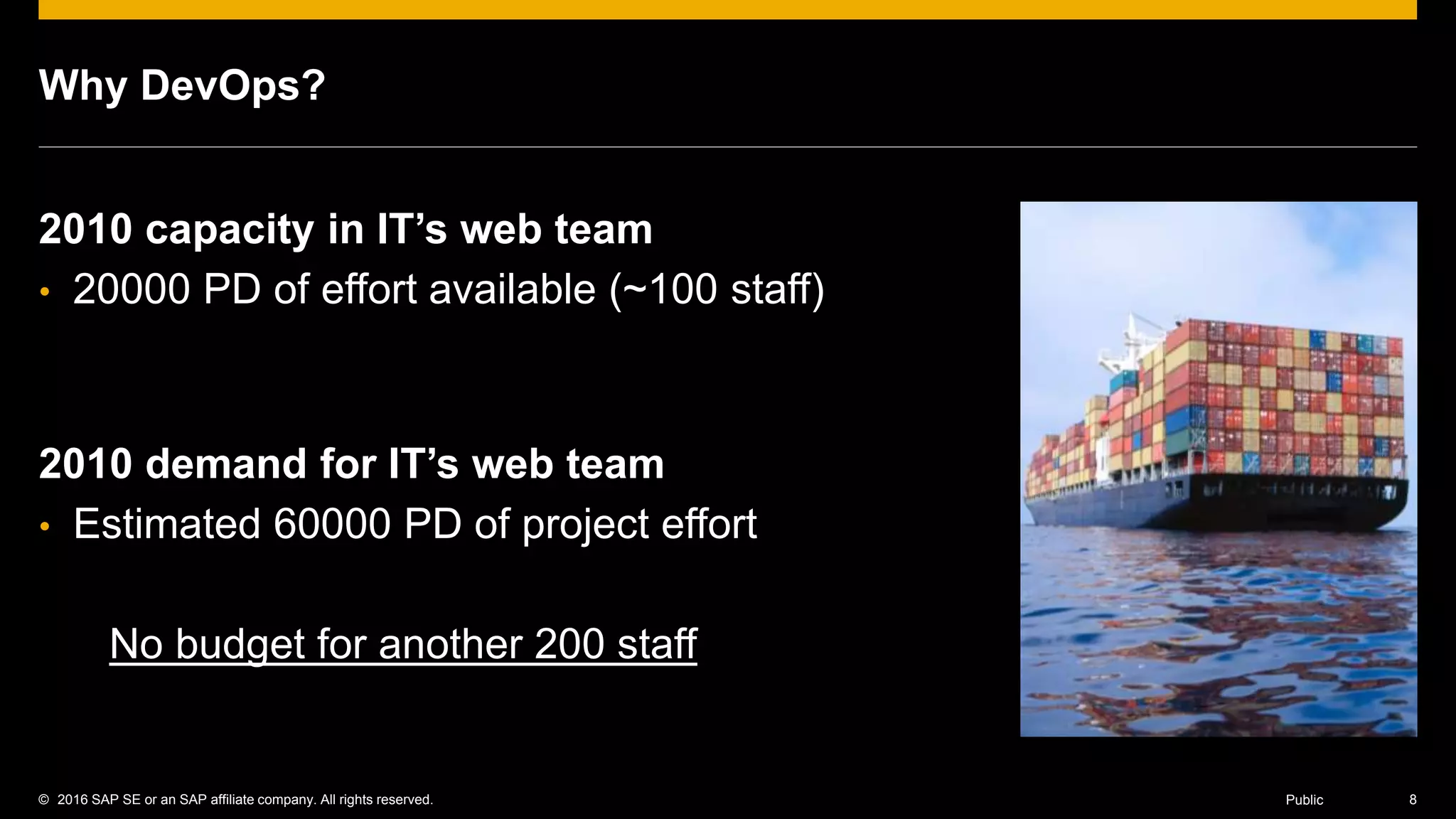
Why DevOps?
2010 capacity in IT’s web team
• 20000 PD of effort available (~100 staff)
2010 demand for IT’s web team
• Estimated 60000 PD of project effort
No budget for another 200 staff
© 2016 SAP SE or an SAP affiliate company. All rights reserved. 9Public
It’s about the people: Vision & Cultural Change
Chief Architect (my boss)
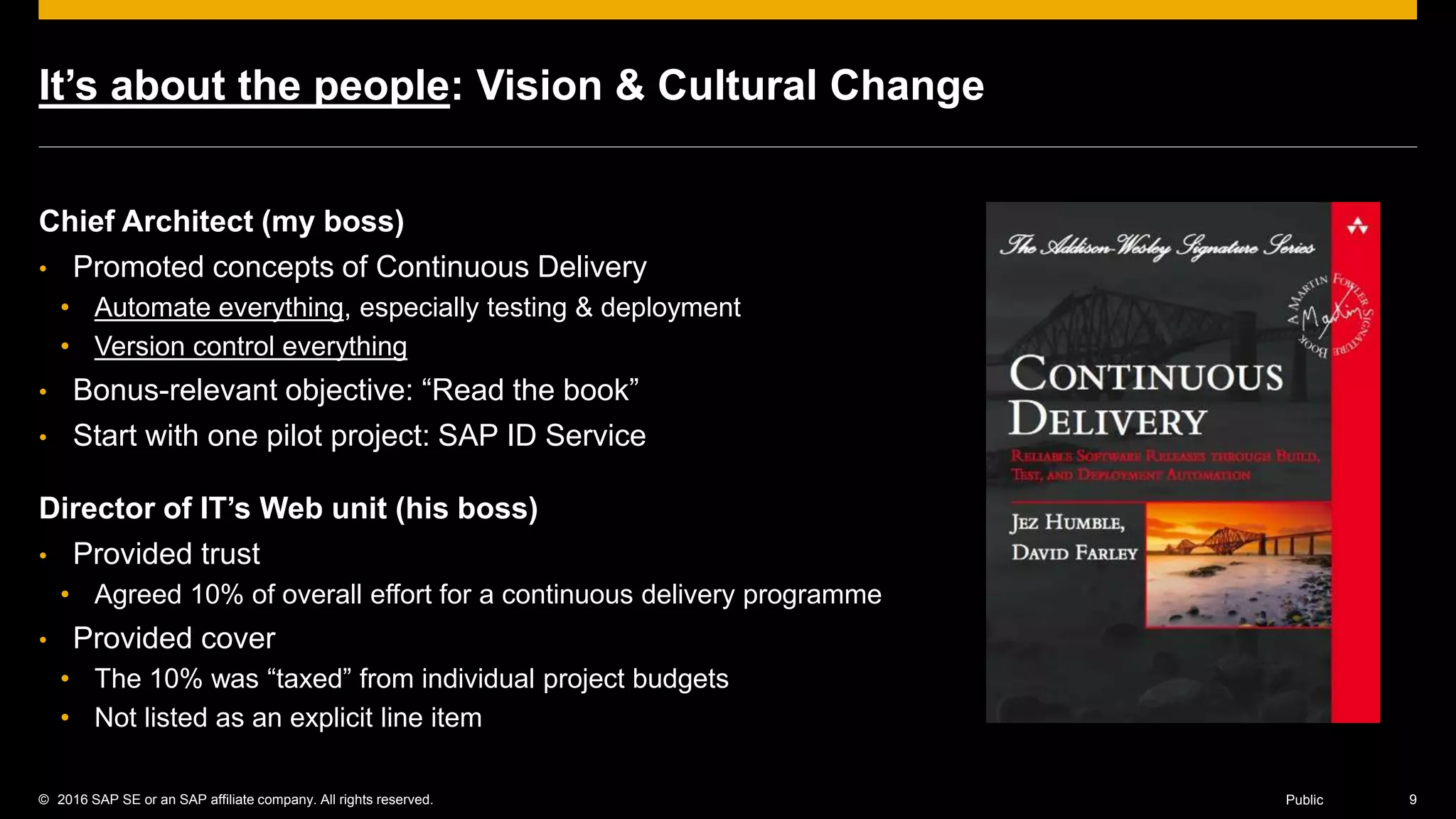
• Promoted concepts of Continuous Delivery
• Automate everything, especially testing & deployment
• Version control everything
• Bonus-relevant objective: “Read the book”
• Start with one pilot project: SAP ID Service
Director of IT’s Web unit (his boss)
• Provided trust
• Agreed 10% of overall effort for a continuous delivery programme
• Provided cover
• The 10% was “taxed” from individual project budgets
• Not listed as an explicit line item
© 2016 SAP SE or an SAP affiliate company. All rights reserved. 10Public
Pilot project: SAP ID Service
Unified SAP web experience
• Solved problem: one SAP, many sites & logins
• Single account for SAP web users
• Seamless sign-on to all SAP sites
• Social sign-on and integration with 3rd party apps
Scale & reliability (eventually, not part of MVP)
• Millions of users
• Needs to stay up, or nobody can log in to SAP sites
• SAP Cloud Identity product:
Needs to stay up, or customers can’t access their cloud
software
© 2016 SAP SE or an SAP affiliate company. All rights reserved. 11Public
It’s about the people: SAP ID Service Project Team
Cross-functional team of 12
• Product Owner
• Scrum Master
• UI / UX designers
• Java developers & architects (Dev)
• Infrastructure engineers (Ops)
• QA specialists
Geographically distributed
• Germany
• Bulgaria
• UK
• Russia
• Israel
Job 1: Test coverage
© 2016 SAP SE or an SAP affiliate company. All rights reserved. 13Public
Cucumber: Behavior-driven Testing
• Product owner works with team
• User stories from backlog are written in Gherkin:
• Written by QA & Product Owner pairing together
• Main purpose is to communicate system behaviour
@UserStory(“SAPID-1522”)
Scenario: Log on a user trying to access their profile
Given I am a registered user
When I try to access my SAP ID Service profile
Then I should see the “SAP ID Service" login overlay
When I login using my valid credentials
Then I am logged in
And the user profile page is displayed
© 2016 SAP SE or an SAP affiliate company. All rights reserved. 14Public
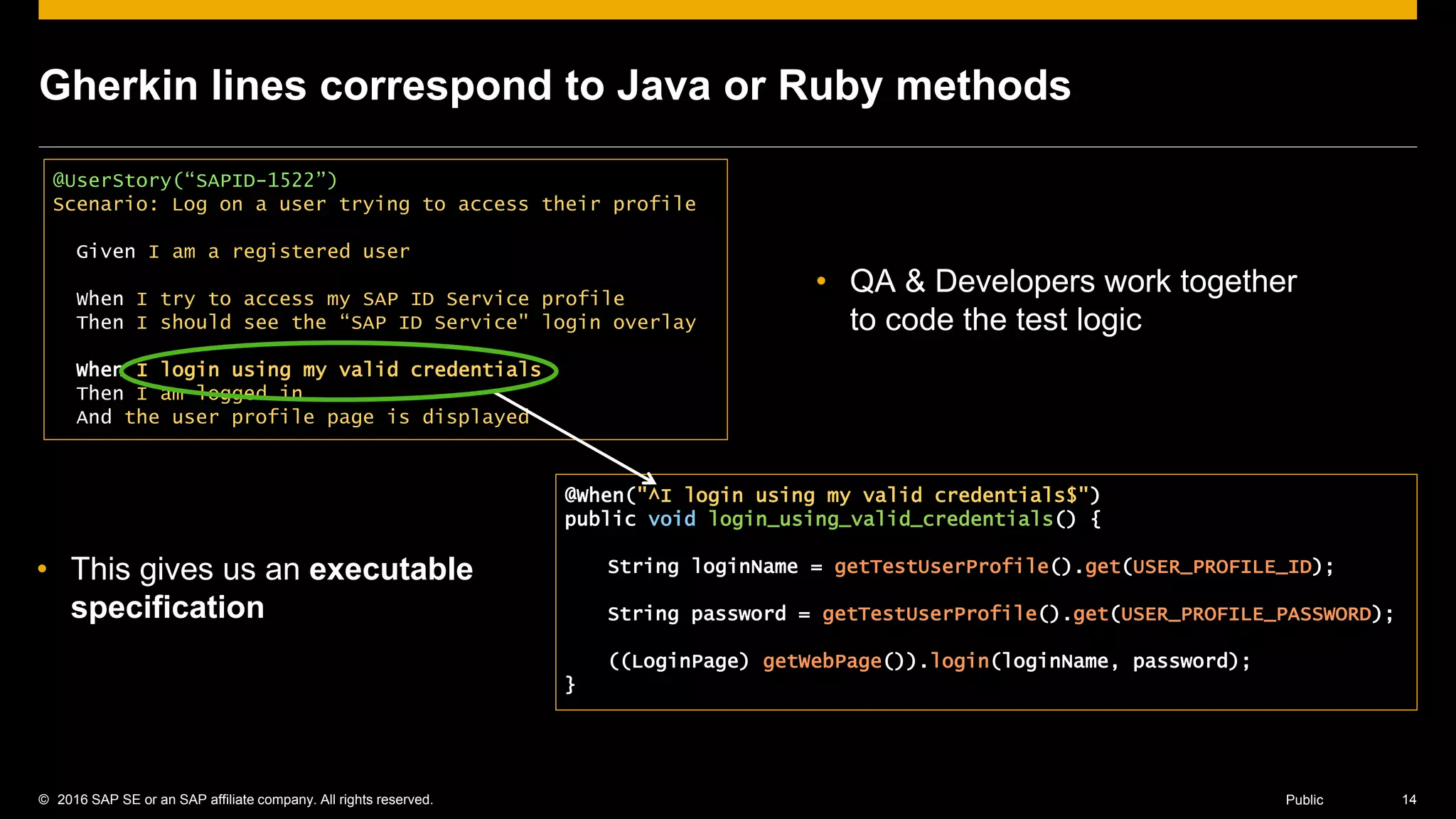
Gherkin lines correspond to Java or Ruby methods
@When("^I login using my valid credentials$")
public void login_using_valid_credentials() {
String loginName = getTestUserProfile().get(USER_PROFILE_ID);
String password = getTestUserProfile().get(USER_PROFILE_PASSWORD);
((LoginPage) getWebPage()).login(loginName, password);
}
@UserStory(“SAPID-1522”)
Scenario: Log on a user trying to access their profile
Given I am a registered user
When I try to access my SAP ID Service profile
Then I should see the “SAP ID Service" login overlay
When I login using my valid credentials
Then I am logged in
And the user profile page is displayed
• QA & Developers work together
to code the test logic
• This gives us an executable
specification
© 2016 SAP SE or an SAP affiliate company. All rights reserved. 15Public
Cycle time is critical
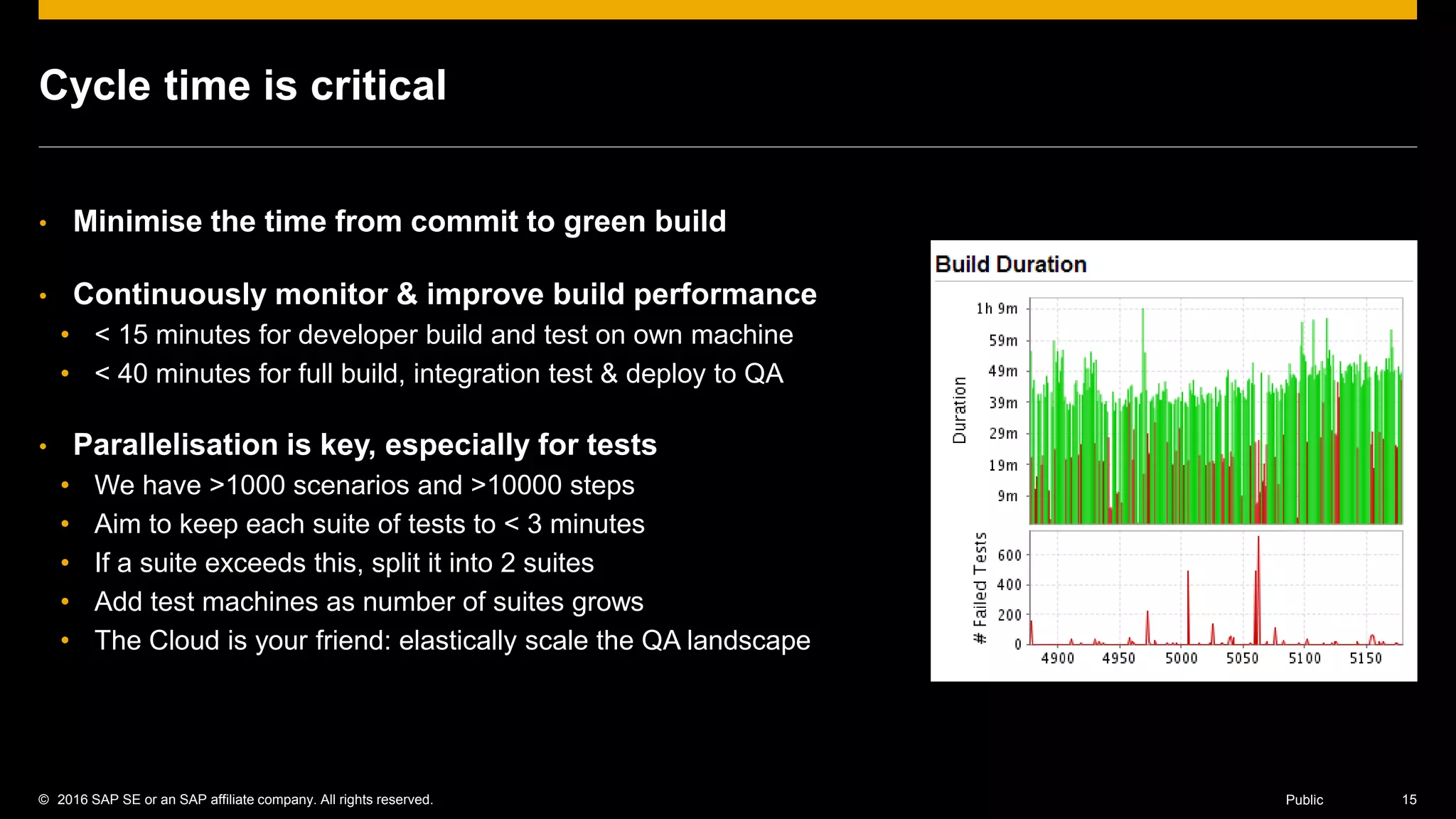
• Minimise the time from commit to green build
• Continuously monitor & improve build performance
• < 15 minutes for developer build and test on own machine
• < 40 minutes for full build, integration test & deploy to QA
• Parallelisation is key, especially for tests
• We have >1000 scenarios and >10000 steps
• Aim to keep each suite of tests to < 3 minutes
• If a suite exceeds this, split it into 2 suites
• Add test machines as number of suites grows
• The Cloud is your friend: elastically scale the QA landscape
© 2016 SAP SE or an SAP affiliate company. All rights reserved. 16Public
It’s about the people
• Challenge:
Getting developers to write lots of automated tests with no
previous culture of test-driven development
• Focus on the Happy Path – test cases that demonstrate how the
system should work
• Developers also write some low-level tests for corner cases etc.
• QA folks still do manual exploratory testing
• Found a bug? Write a test to reproduce it
• Small amounts of shouting encouragement may be involved
All tests pass = confidence to release
Job 2: Automate deployment
© 2016 SAP SE or an SAP affiliate company. All rights reserved. 18Public
Using Chef for Deployment Automation
Code deployed & configured automatically
• No manual scripts
Recipes & config data stored in version control
• Can review before deployment
Idempotence of recipes = consistency
• Run chef-client again: get the same result
Blue/Green deployment
• Deploy latest release to alternate pool of servers
Testing: Confidence to release a version
Chef: Confidence to deploy it automatically
© 2016 SAP SE or an SAP affiliate company. All rights reserved. 19Public
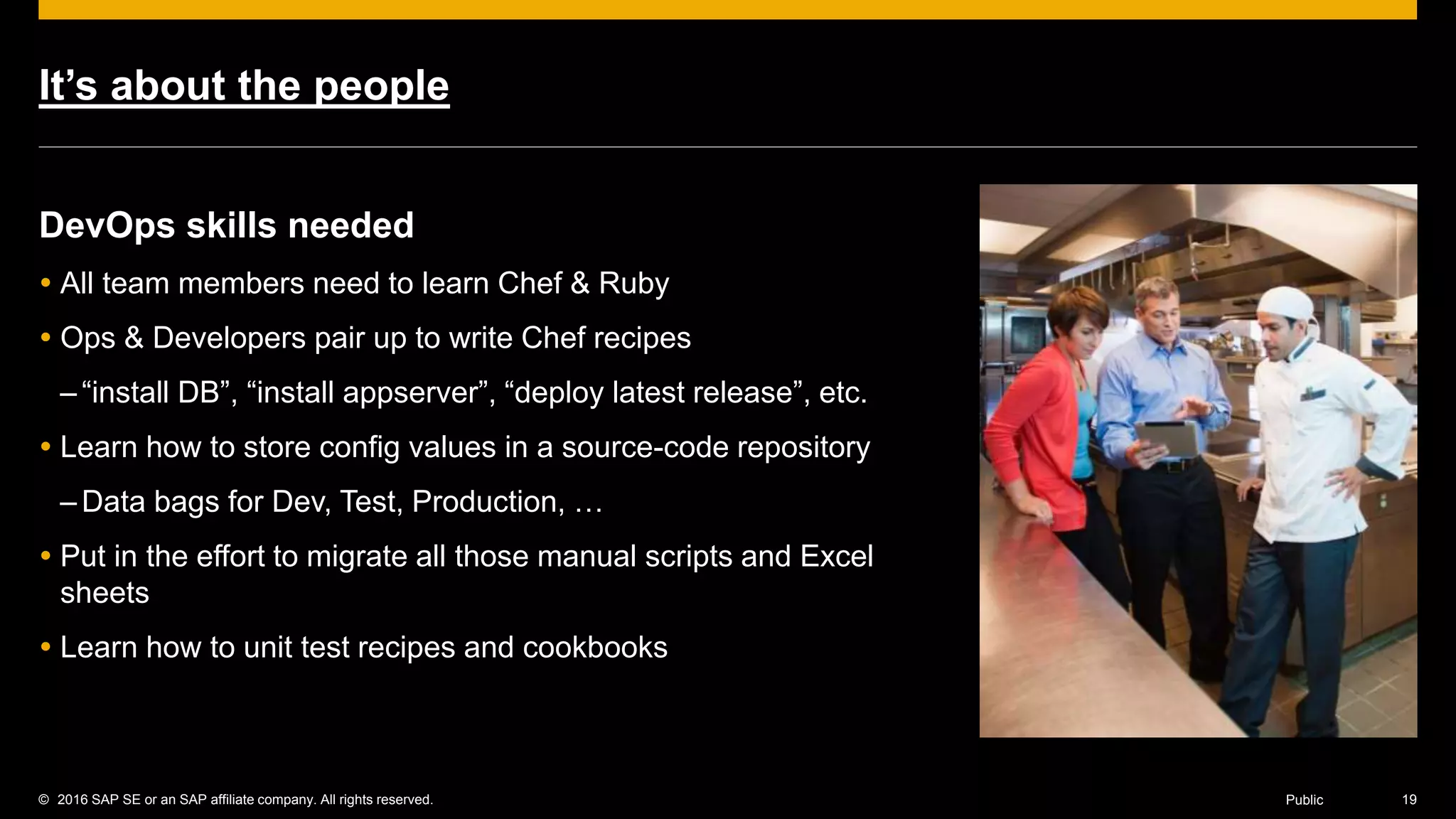
It’s about the people
DevOps skills needed
 All team members need to learn Chef & Ruby
 Ops & Developers pair up to write Chef recipes
–“install DB”, “install appserver”, “deploy latest release”, etc.
 Learn how to store config values in a source-code repository
– Data bags for Dev, Test, Production, …
 Put in the effort to migrate all those manual scripts and Excel
sheets
 Learn how to unit test recipes and cookbooks
Job 3: Keep evolving
© 2016 SAP SE or an SAP affiliate company. All rights reserved. 21Public
DevOps 2010: Cocktail – Project Scale
To get Identity Service app running we had to manually:
• Create virtual machines
• Register each VM with Chef server
• Execute chef-client
• Validate the installation
• Test behaviour with Cucumber
“Cocktail” was developed to automate all these actions
 With a pool of VMs, create a complex landscape with a few commands
 Deployment time reduced from hours to minutes
 Monthly deployment, much closer to “4 weeks development” vision
© 2016 SAP SE or an SAP affiliate company. All rights reserved. 22Public
It’s about the people: Culture of Continuous Improvement
• Proper Agile/Scrum coaching was really important
• Fundamentally different to learning by reading articles & blogs
• Learning by doing, playing, etc. is much more effective
• Coach encouraged accountability, responsibility, experimentation
• Team make-up
• Differing personalities and working styles
• May need to shuffle a few people to get the best out of everyone
• Team is always working to improve itself
• Evaluate new tools & techniques
• Encourage “spikes” to see if things work
• Retrospective at the end of each sprint
• Several improvement suggestions each time around – pick top 3
• Focus on team behaviours, not product scope
© 2016 SAP SE or an SAP affiliate company. All rights reserved. 23Public
DevOps 2011: Barkeeper – Department scale
• Allocate VMs via Cloud API
• Manage Chef servers
• Project self-service
• Web UI and REST API
• Everything under version control
• Install VMWare on bare metal, everything else is
automated
• Scheduled deployment every 2 weeks, but 2-3 times a
week not uncommon
© 2016 SAP SE or an SAP affiliate company. All rights reserved. 24Public
It’s about the people: Spread the Word
• Spread DevOps principles throughout several IT teams
• Barkeeper used for a dozen or so web apps in SAP IT
• Agile/Scrum coaching delivered throughout IT
• Ops Engineers embedded in teams became the norm
• Encourage shared ownership within teams
• Encourage teams to share what they learn
© 2016 SAP SE or an SAP affiliate company. All rights reserved. 25Public
Pivot: Create a DevOps platform for the company. Using DevOps.
© 2016 SAP SE or an SAP affiliate company. All rights reserved. 26Public
DevOps 2013: Monsoon – Company scale
The product
 Custom developed private cloud & deployment automation platform
– IaaS layer roughly equivalent to OpenStack (Nova, Cinder, Keystone,
Murano, Designate)
– Automation framework using Chef & MCollective
The platform
 Ruby on Rails components running as microservices
– VCR to help with microservices testing
 Git repos for Chef cookbooks and configuration databags
 VMWare vSphere : Hypervisor & Block Storage
 F5 BigIP Loadbalancers (providing self service ELB scenarios)
The process
 2 Week development cycle, continuous integration and testing
 Daily automated deployment
© 2016 SAP SE or an SAP affiliate company. All rights reserved. 27Public
Result: Cloud & DevOps culture throughout SAP
As of late 2015:
• 100s of internal apps and external cloud services running on the Monsoon platform:
SAP Anywhere, SAP Business One, Multiposting,
SuccessFactors, Afaria MobileSecure, SeeWhy,
Ariba TradeWorld, Hybris, FieldGlass,
SAP Cloud for Customer, SAP Cloud Identity, …
• 1000s of developers using the Monsoon platform
• 10000s of VMs
• 10000s of storage volumes
• Deployed in 6 regions & 12 availability zones
© 2016 SAP SE or an SAP affiliate company. All rights reserved. 28Public
It’s about the people: Monsoon team
The core team
 Ruby development & web design: 15-20 FTE
 Infrastructure Architecture: 2-3 FTE
 QA: 0.5 FTE
Working mode
 ChatOps via internal IRC server
 UK & Germany, mix of home & office working
 Pairing & team meetings conducted largely online
 Every 3-6 months get together & break bread
 First level support in overseas teams
– Knowledge transfer from core team
– Overnight cover for Europe
 Second level support in development team
– You build it, you run it: MOOPS (Monsoon Ops)
– One team member always on “pager duty”
– Weekly rotation
Space age
To Boldly Go…
© 2016 SAP SE or an SAP affiliate company. All rights reserved. 30Public
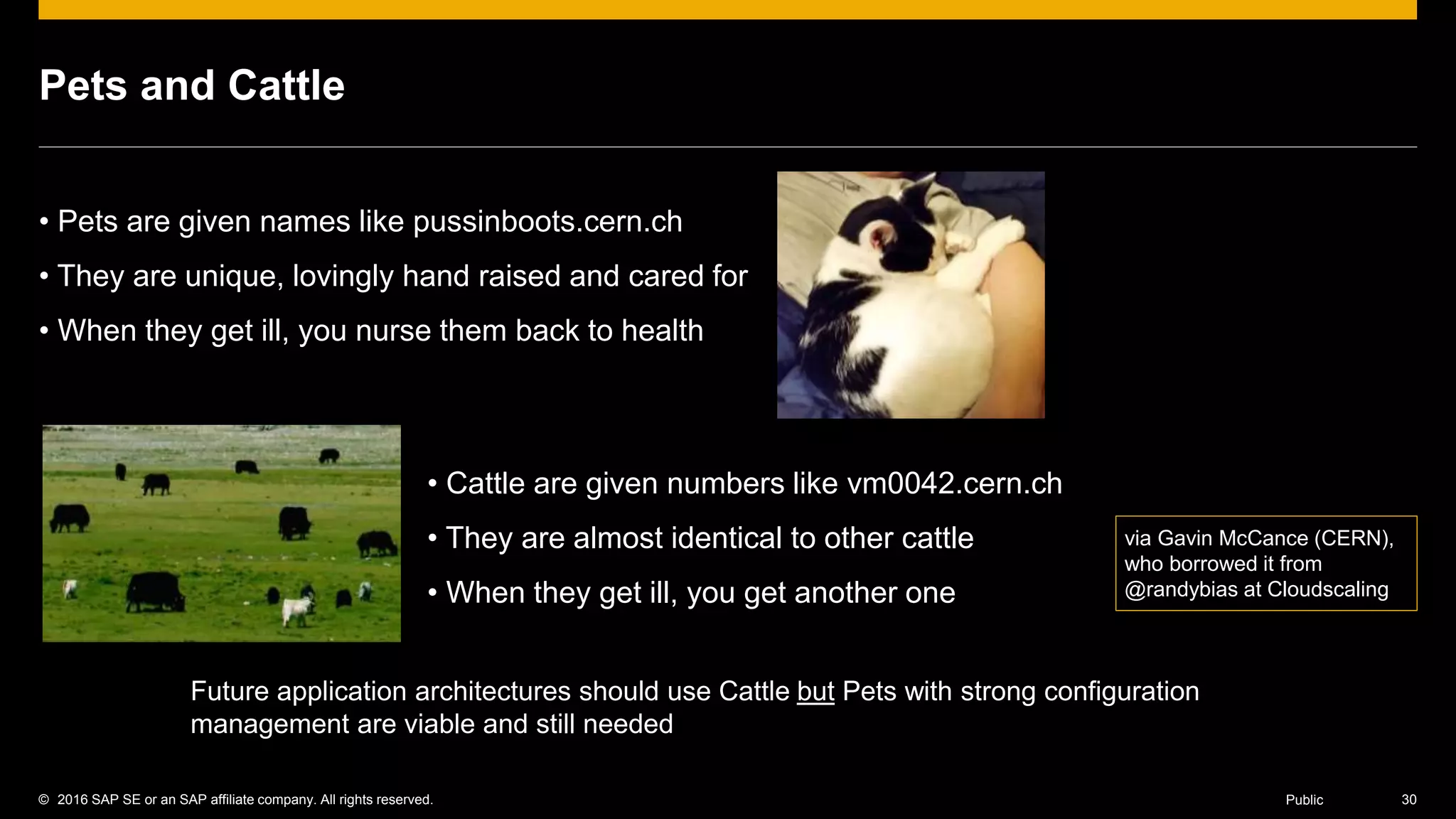
Pets and Cattle
• Pets are given names like pussinboots.cern.ch
• They are unique, lovingly hand raised and cared for
• When they get ill, you nurse them back to health
• Cattle are given numbers like vm0042.cern.ch
• They are almost identical to other cattle
• When they get ill, you get another one
Future application architectures should use Cattle but Pets with strong configuration
management are viable and still needed
via Gavin McCance (CERN),
who borrowed it from
@randybias at Cloudscaling
© 2016 SAP SE or an SAP affiliate company. All rights reserved. 31Public
Kubernetes: Production-Grade Container Orchestration
Originally from Google, now open source
From http://kubernetes.io/:
Automated container deployment, scaling, and management
 Automatic bin-packing
 Horizontal scaling
 Automated rollouts and rollbacks
 Storage orchestration
 Self-healing
 Service discovery and load balancing
 Secret and configuration management
 Batch execution
In other words: the ability to treat containers as cattle, not pets
© 2016 SAP SE or an SAP affiliate company. All rights reserved. 32Public
DevOps 2016 – Cloud Scale
The platform
 Kubernetes (with Docker) running on baremetal nodes
 Openstack in containers (based on Kolla)
 Networking hardware (via OpenStack Neutron drivers)
 Loadbalancing (via Neutron LBaaS)
 Both VMWare & KVM Hypervisors
 Storage hardware (via OpenStack Cinder & Manila)
 New automation agent (Arc)
 New dashboard for OpenStack (Elektra)
© 2016 SAP SE or an SAP affiliate company. All rights reserved. 33Public
DevOps 2016 – Cloud Scale
The product
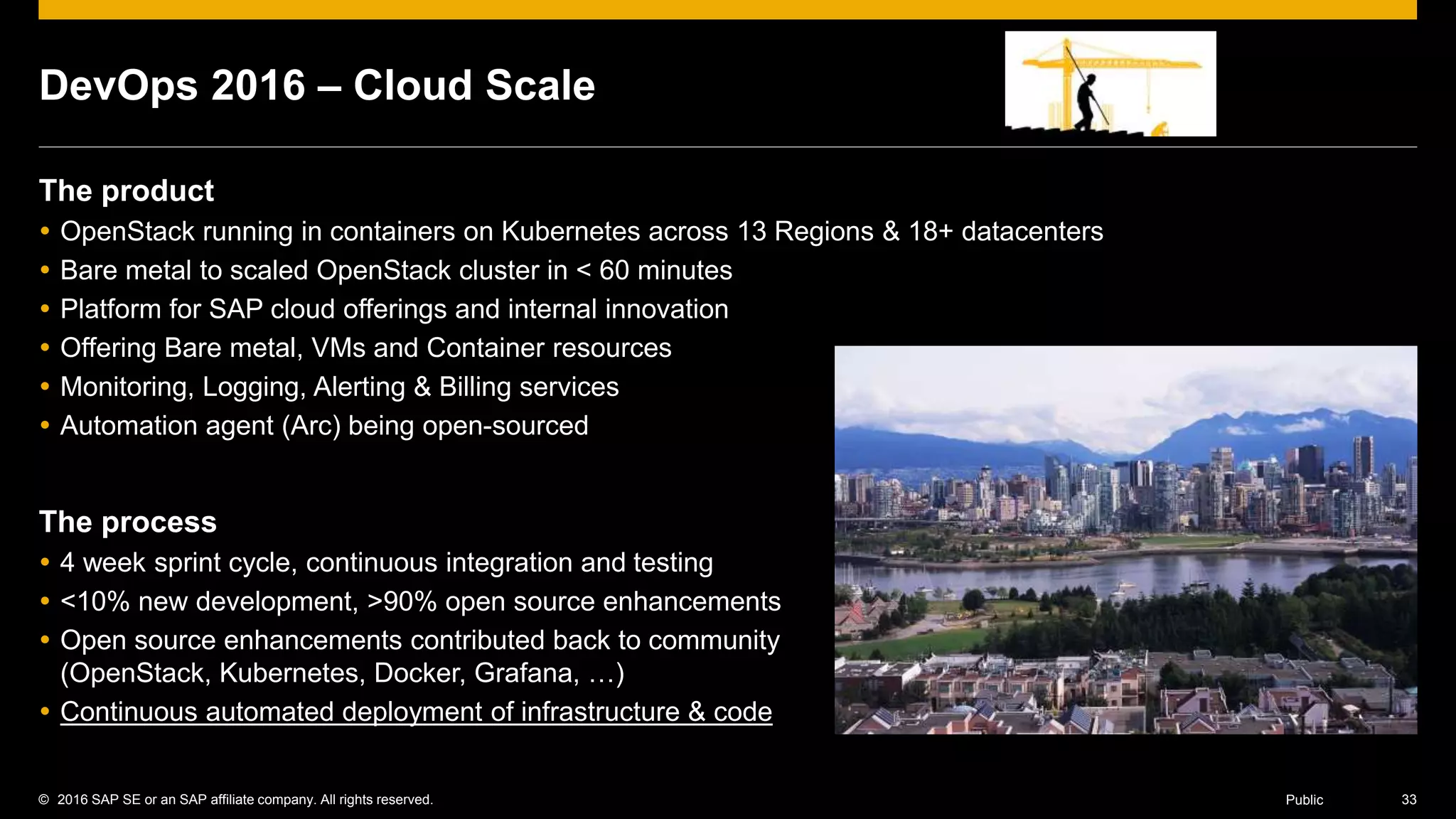
 OpenStack running in containers on Kubernetes across 13 Regions & 18+ datacenters
 Bare metal to scaled OpenStack cluster in < 60 minutes
 Platform for SAP cloud offerings and internal innovation
 Offering Bare metal, VMs and Container resources
 Monitoring, Logging, Alerting & Billing services
 Automation agent (Arc) being open-sourced
The process
 4 week sprint cycle, continuous integration and testing
 <10% new development, >90% open source enhancements
 Open source enhancements contributed back to community
(OpenStack, Kubernetes, Docker, Grafana, …)
 Continuous automated deployment of infrastructure & code
© 2016 SAP SE or an SAP affiliate company. All rights reserved. 34Public
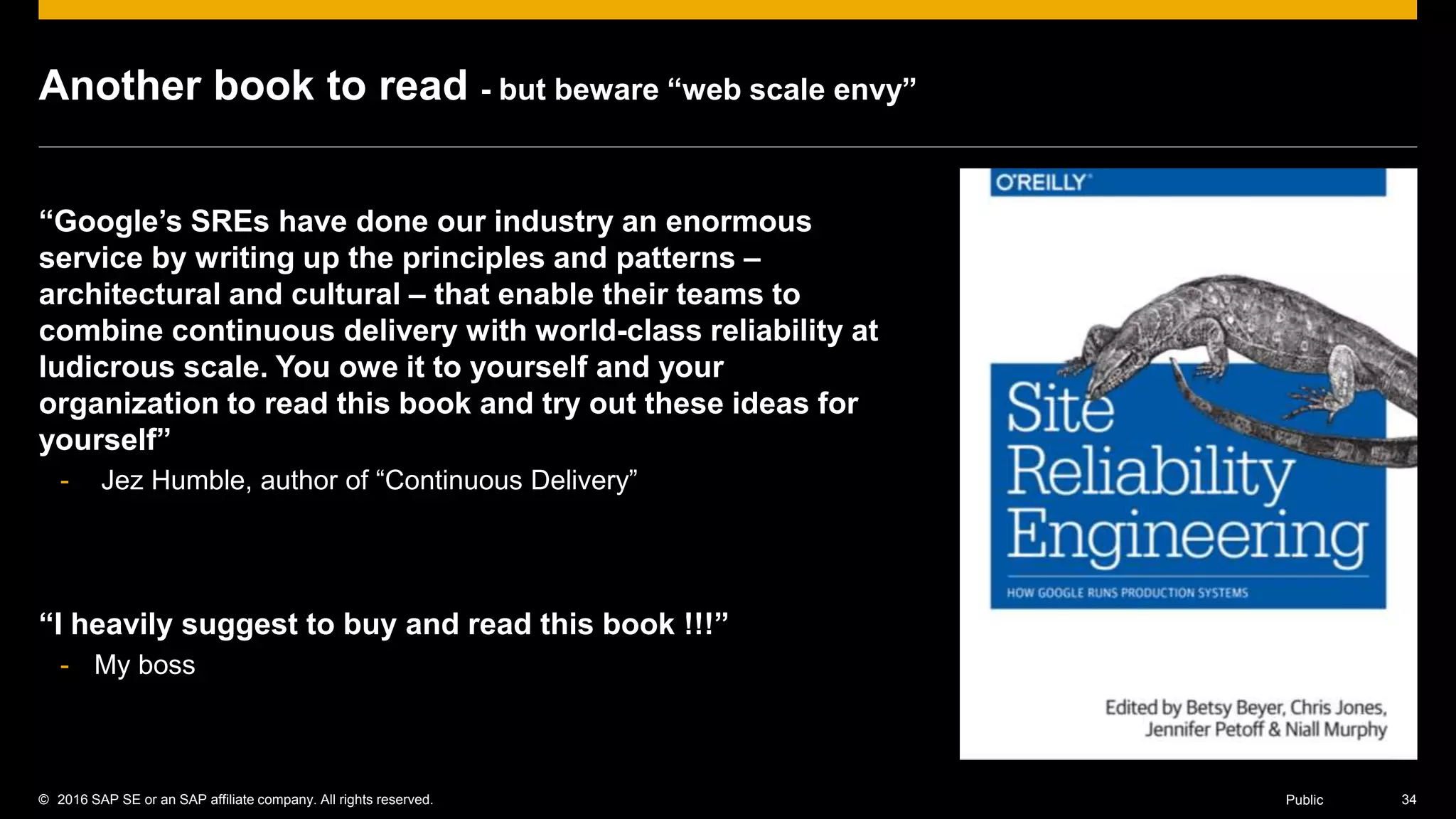
Another book to read - but beware “web scale envy”
“Google’s SREs have done our industry an enormous
service by writing up the principles and patterns –
architectural and cultural – that enable their teams to
combine continuous delivery with world-class reliability at
ludicrous scale. You owe it to yourself and your
organization to read this book and try out these ideas for
yourself”
- Jez Humble, author of “Continuous Delivery”
“I heavily suggest to buy and read this book !!!”
- My boss
© 2016 SAP SE or an SAP affiliate company. All rights reserved. 35Public
It’s about the people
The teams
 OpenStack core DevOps: 10-15 FTE
 Monitoring, Alerting & Billing: 5-10 FTE
 User-facing & automation tools: 5-10 FTE
 QA 0.5 FTE
 First level support in overseas teams
 Second level support in development teams
Managing Complexity
 2x MOOPS, plus INFRAOPS & AUTOPS
 Cognitive overload from new technologies
– Split into 3 sub-teams
– Pairing within teams
– Sharing sessions across teams
Learning from Open Source behaviours
 Use GitHub pull requests for sharing & review
 Just enough documentation, stored in GitHub repo
 Use public GitHub where possible (github.com/sapcc)
 On-premise GitHub Enterprise for private repos (e.g. config)
 Engage with & contribute to open source projects (pros & cons)
© 2016 SAP SE or an SAP affiliate company. All rights reserved. 36Public
The journey continues
Then & now:
 2010 – Pilot project, 10-15 people involved
 2016 – Global Cloud & DevOps platform, 20-30 people involved
Current challenges:
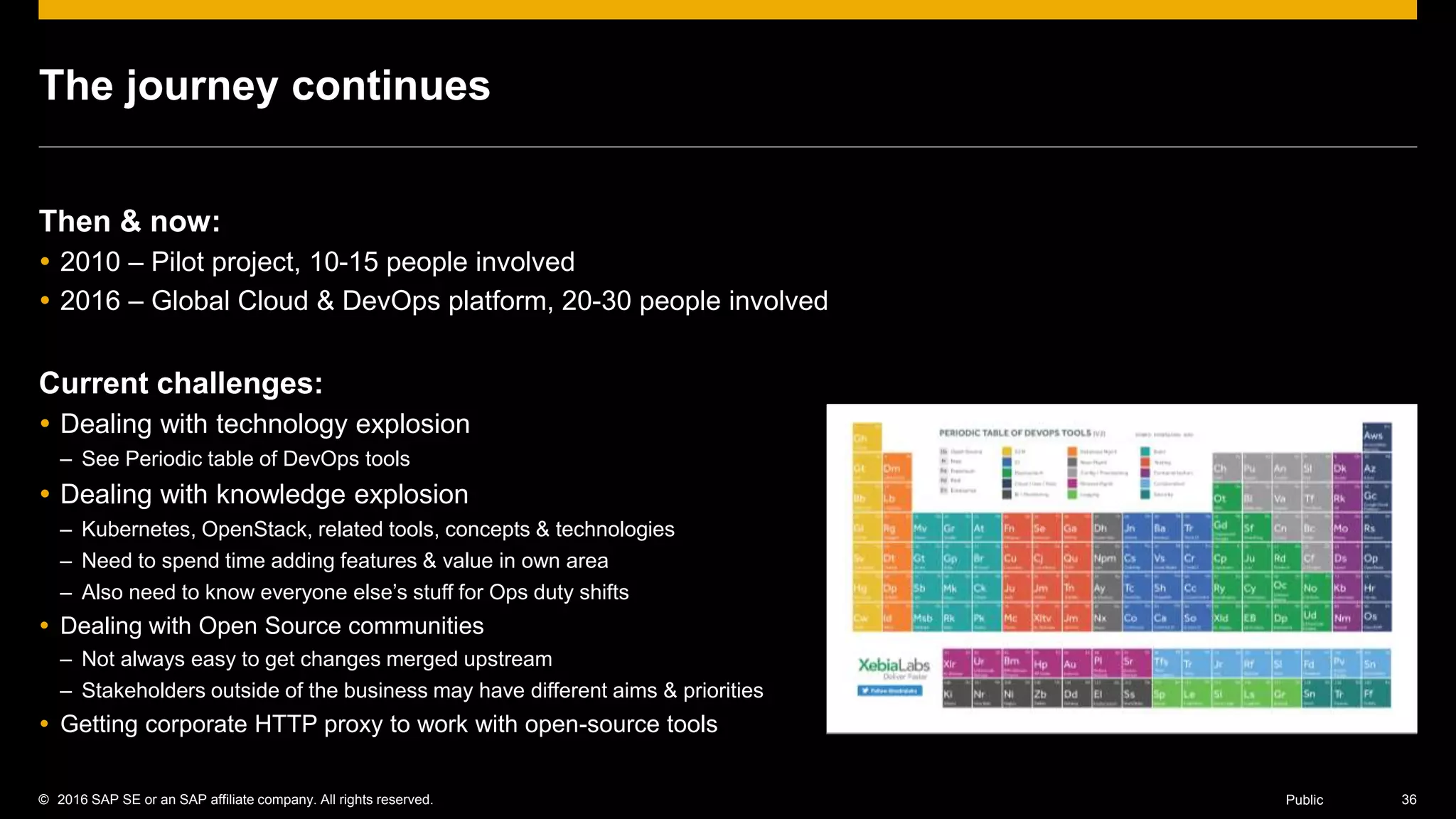
 Dealing with technology explosion
– See Periodic table of DevOps tools
 Dealing with knowledge explosion
– Kubernetes, OpenStack, related tools, concepts & technologies
– Need to spend time adding features & value in own area
– Also need to know everyone else’s stuff for Ops duty shifts
 Dealing with Open Source communities
– Not always easy to get changes merged upstream
– Stakeholders outside of the business may have different aims & priorities
 Getting corporate HTTP proxy to work with open-source tools
© 2016 SAP SE or an SAP affiliate company. All rights reserved.
Thank you
(P.S. It’s about the people)
Contact information:
Darren Hague
Cloud Infrastructure Architect
SAP UK Ltd
d.hague@sap.com
Twitter: @dhague

DOES16 London - Darren Hague - SAP’s DevOps Journey: From Building an App to Building a Cloud

  • 1.
    Darren Hague, SAP June30, 2016 SAP’s DevOps Journey: from building an app to building a cloud Public
  • 2.
    © 2016 SAPSE or an SAP affiliate company. All rights reserved. 2Public About SAP World leader in enterprise applications • Founded in 1972 • Vision: Help the world run better • Innovation focus: Cloud & In-memory computing, IoT & digital business  Over 310,000 customers, 190 countries  Over 78,000 employees in 130+ countries (~50% in technology-related roles)  Over 110 million users of cloud software SAP’s customers produce 78% of the world’s food & 82% of the world’s medical devices 76% of the world’s transaction revenue touches an SAP system
  • 3.
    © 2016 SAPSE or an SAP affiliate company. All rights reserved. 3Public My background 2008 – 2014: Web app architect, Global IT Team responsible for internal- & external-facing web apps, e.g. SAP Developer Network portal 2014 – now: Cloud platform architect, Products & Innovation Team responsible for delivering Cloud & DevOps platform for SAP’s internal & external cloud portfolio to run on
  • 4.
    Darren Hague /SAP Global IT November 1st, 2013 Continuous Delivery at SAP: From dinosaur to spaceship Public
  • 5.
    © 2016 SAPSE or an SAP affiliate company. All rights reserved. 5Public The old days (up to 2010)  Good things – Source code version control – Issue tracking – Build automation – Monthly releases  Not so good things – Months-long lead time for new hardware – Labour-intensive QA cycle – Code deployed manually to physical hardware during downtime – Development, Ops & Infrastructure in different business units – No version control for configuration data
  • 6.
    © 2016 SAPSE or an SAP affiliate company. All rights reserved. 6Public 2010 Development & Release Cycle (in theory…) 4-week cycle: • 4 weeks of development per iteration • 2 weeks of testing • 1 weekend to deploy release to production • 6 weeks from request to delivery • Release every 4 weeks Dev QA PRN-1 Dev QA P Dev QA P RN RN+1 4 weeks 6 weeks
  • 7.
    © 2016 SAPSE or an SAP affiliate company. All rights reserved. 7Public 2010 Development & Release Cycle (in practice) 4-week cycle: • 4 weeks of development for the first iteration • 2 weeks of testing & bugfixing • 1 day to deploy release to production • 2 days (and one night) debugging the production deployment • 1.5 weeks of development per 4-week cycle Dev QA PRN-1 RN RN+1 4 weeks Dev QA P!Bugfix Dev QA P!Bugfix
  • 8.
    © 2016 SAPSE or an SAP affiliate company. All rights reserved. 8Public Why DevOps? 2010 capacity in IT’s web team • 20000 PD of effort available (~100 staff) 2010 demand for IT’s web team • Estimated 60000 PD of project effort No budget for another 200 staff
  • 9.
    © 2016 SAPSE or an SAP affiliate company. All rights reserved. 9Public It’s about the people: Vision & Cultural Change Chief Architect (my boss) • Promoted concepts of Continuous Delivery • Automate everything, especially testing & deployment • Version control everything • Bonus-relevant objective: “Read the book” • Start with one pilot project: SAP ID Service Director of IT’s Web unit (his boss) • Provided trust • Agreed 10% of overall effort for a continuous delivery programme • Provided cover • The 10% was “taxed” from individual project budgets • Not listed as an explicit line item
  • 10.
    © 2016 SAPSE or an SAP affiliate company. All rights reserved. 10Public Pilot project: SAP ID Service Unified SAP web experience • Solved problem: one SAP, many sites & logins • Single account for SAP web users • Seamless sign-on to all SAP sites • Social sign-on and integration with 3rd party apps Scale & reliability (eventually, not part of MVP) • Millions of users • Needs to stay up, or nobody can log in to SAP sites • SAP Cloud Identity product: Needs to stay up, or customers can’t access their cloud software
  • 11.
    © 2016 SAPSE or an SAP affiliate company. All rights reserved. 11Public It’s about the people: SAP ID Service Project Team Cross-functional team of 12 • Product Owner • Scrum Master • UI / UX designers • Java developers & architects (Dev) • Infrastructure engineers (Ops) • QA specialists Geographically distributed • Germany • Bulgaria • UK • Russia • Israel
  • 12.
    Job 1: Testcoverage
  • 13.
    © 2016 SAPSE or an SAP affiliate company. All rights reserved. 13Public Cucumber: Behavior-driven Testing • Product owner works with team • User stories from backlog are written in Gherkin: • Written by QA & Product Owner pairing together • Main purpose is to communicate system behaviour @UserStory(“SAPID-1522”) Scenario: Log on a user trying to access their profile Given I am a registered user When I try to access my SAP ID Service profile Then I should see the “SAP ID Service" login overlay When I login using my valid credentials Then I am logged in And the user profile page is displayed
  • 14.
    © 2016 SAPSE or an SAP affiliate company. All rights reserved. 14Public Gherkin lines correspond to Java or Ruby methods @When("^I login using my valid credentials$") public void login_using_valid_credentials() { String loginName = getTestUserProfile().get(USER_PROFILE_ID); String password = getTestUserProfile().get(USER_PROFILE_PASSWORD); ((LoginPage) getWebPage()).login(loginName, password); } @UserStory(“SAPID-1522”) Scenario: Log on a user trying to access their profile Given I am a registered user When I try to access my SAP ID Service profile Then I should see the “SAP ID Service" login overlay When I login using my valid credentials Then I am logged in And the user profile page is displayed • QA & Developers work together to code the test logic • This gives us an executable specification
  • 15.
    © 2016 SAPSE or an SAP affiliate company. All rights reserved. 15Public Cycle time is critical • Minimise the time from commit to green build • Continuously monitor & improve build performance • < 15 minutes for developer build and test on own machine • < 40 minutes for full build, integration test & deploy to QA • Parallelisation is key, especially for tests • We have >1000 scenarios and >10000 steps • Aim to keep each suite of tests to < 3 minutes • If a suite exceeds this, split it into 2 suites • Add test machines as number of suites grows • The Cloud is your friend: elastically scale the QA landscape
  • 16.
    © 2016 SAPSE or an SAP affiliate company. All rights reserved. 16Public It’s about the people • Challenge: Getting developers to write lots of automated tests with no previous culture of test-driven development • Focus on the Happy Path – test cases that demonstrate how the system should work • Developers also write some low-level tests for corner cases etc. • QA folks still do manual exploratory testing • Found a bug? Write a test to reproduce it • Small amounts of shouting encouragement may be involved All tests pass = confidence to release
  • 17.
    Job 2: Automatedeployment
  • 18.
    © 2016 SAPSE or an SAP affiliate company. All rights reserved. 18Public Using Chef for Deployment Automation Code deployed & configured automatically • No manual scripts Recipes & config data stored in version control • Can review before deployment Idempotence of recipes = consistency • Run chef-client again: get the same result Blue/Green deployment • Deploy latest release to alternate pool of servers Testing: Confidence to release a version Chef: Confidence to deploy it automatically
  • 19.
    © 2016 SAPSE or an SAP affiliate company. All rights reserved. 19Public It’s about the people DevOps skills needed  All team members need to learn Chef & Ruby  Ops & Developers pair up to write Chef recipes –“install DB”, “install appserver”, “deploy latest release”, etc.  Learn how to store config values in a source-code repository – Data bags for Dev, Test, Production, …  Put in the effort to migrate all those manual scripts and Excel sheets  Learn how to unit test recipes and cookbooks
  • 20.
    Job 3: Keepevolving
  • 21.
    © 2016 SAPSE or an SAP affiliate company. All rights reserved. 21Public DevOps 2010: Cocktail – Project Scale To get Identity Service app running we had to manually: • Create virtual machines • Register each VM with Chef server • Execute chef-client • Validate the installation • Test behaviour with Cucumber “Cocktail” was developed to automate all these actions  With a pool of VMs, create a complex landscape with a few commands  Deployment time reduced from hours to minutes  Monthly deployment, much closer to “4 weeks development” vision
  • 22.
    © 2016 SAPSE or an SAP affiliate company. All rights reserved. 22Public It’s about the people: Culture of Continuous Improvement • Proper Agile/Scrum coaching was really important • Fundamentally different to learning by reading articles & blogs • Learning by doing, playing, etc. is much more effective • Coach encouraged accountability, responsibility, experimentation • Team make-up • Differing personalities and working styles • May need to shuffle a few people to get the best out of everyone • Team is always working to improve itself • Evaluate new tools & techniques • Encourage “spikes” to see if things work • Retrospective at the end of each sprint • Several improvement suggestions each time around – pick top 3 • Focus on team behaviours, not product scope
  • 23.
    © 2016 SAPSE or an SAP affiliate company. All rights reserved. 23Public DevOps 2011: Barkeeper – Department scale • Allocate VMs via Cloud API • Manage Chef servers • Project self-service • Web UI and REST API • Everything under version control • Install VMWare on bare metal, everything else is automated • Scheduled deployment every 2 weeks, but 2-3 times a week not uncommon
  • 24.
    © 2016 SAPSE or an SAP affiliate company. All rights reserved. 24Public It’s about the people: Spread the Word • Spread DevOps principles throughout several IT teams • Barkeeper used for a dozen or so web apps in SAP IT • Agile/Scrum coaching delivered throughout IT • Ops Engineers embedded in teams became the norm • Encourage shared ownership within teams • Encourage teams to share what they learn
  • 25.
    © 2016 SAPSE or an SAP affiliate company. All rights reserved. 25Public Pivot: Create a DevOps platform for the company. Using DevOps.
  • 26.
    © 2016 SAPSE or an SAP affiliate company. All rights reserved. 26Public DevOps 2013: Monsoon – Company scale The product  Custom developed private cloud & deployment automation platform – IaaS layer roughly equivalent to OpenStack (Nova, Cinder, Keystone, Murano, Designate) – Automation framework using Chef & MCollective The platform  Ruby on Rails components running as microservices – VCR to help with microservices testing  Git repos for Chef cookbooks and configuration databags  VMWare vSphere : Hypervisor & Block Storage  F5 BigIP Loadbalancers (providing self service ELB scenarios) The process  2 Week development cycle, continuous integration and testing  Daily automated deployment
  • 27.
    © 2016 SAPSE or an SAP affiliate company. All rights reserved. 27Public Result: Cloud & DevOps culture throughout SAP As of late 2015: • 100s of internal apps and external cloud services running on the Monsoon platform: SAP Anywhere, SAP Business One, Multiposting, SuccessFactors, Afaria MobileSecure, SeeWhy, Ariba TradeWorld, Hybris, FieldGlass, SAP Cloud for Customer, SAP Cloud Identity, … • 1000s of developers using the Monsoon platform • 10000s of VMs • 10000s of storage volumes • Deployed in 6 regions & 12 availability zones
  • 28.
    © 2016 SAPSE or an SAP affiliate company. All rights reserved. 28Public It’s about the people: Monsoon team The core team  Ruby development & web design: 15-20 FTE  Infrastructure Architecture: 2-3 FTE  QA: 0.5 FTE Working mode  ChatOps via internal IRC server  UK & Germany, mix of home & office working  Pairing & team meetings conducted largely online  Every 3-6 months get together & break bread  First level support in overseas teams – Knowledge transfer from core team – Overnight cover for Europe  Second level support in development team – You build it, you run it: MOOPS (Monsoon Ops) – One team member always on “pager duty” – Weekly rotation
  • 29.
  • 30.
    © 2016 SAPSE or an SAP affiliate company. All rights reserved. 30Public Pets and Cattle • Pets are given names like pussinboots.cern.ch • They are unique, lovingly hand raised and cared for • When they get ill, you nurse them back to health • Cattle are given numbers like vm0042.cern.ch • They are almost identical to other cattle • When they get ill, you get another one Future application architectures should use Cattle but Pets with strong configuration management are viable and still needed via Gavin McCance (CERN), who borrowed it from @randybias at Cloudscaling
  • 31.
    © 2016 SAPSE or an SAP affiliate company. All rights reserved. 31Public Kubernetes: Production-Grade Container Orchestration Originally from Google, now open source From http://kubernetes.io/: Automated container deployment, scaling, and management  Automatic bin-packing  Horizontal scaling  Automated rollouts and rollbacks  Storage orchestration  Self-healing  Service discovery and load balancing  Secret and configuration management  Batch execution In other words: the ability to treat containers as cattle, not pets
  • 32.
    © 2016 SAPSE or an SAP affiliate company. All rights reserved. 32Public DevOps 2016 – Cloud Scale The platform  Kubernetes (with Docker) running on baremetal nodes  Openstack in containers (based on Kolla)  Networking hardware (via OpenStack Neutron drivers)  Loadbalancing (via Neutron LBaaS)  Both VMWare & KVM Hypervisors  Storage hardware (via OpenStack Cinder & Manila)  New automation agent (Arc)  New dashboard for OpenStack (Elektra)
  • 33.
    © 2016 SAPSE or an SAP affiliate company. All rights reserved. 33Public DevOps 2016 – Cloud Scale The product  OpenStack running in containers on Kubernetes across 13 Regions & 18+ datacenters  Bare metal to scaled OpenStack cluster in < 60 minutes  Platform for SAP cloud offerings and internal innovation  Offering Bare metal, VMs and Container resources  Monitoring, Logging, Alerting & Billing services  Automation agent (Arc) being open-sourced The process  4 week sprint cycle, continuous integration and testing  <10% new development, >90% open source enhancements  Open source enhancements contributed back to community (OpenStack, Kubernetes, Docker, Grafana, …)  Continuous automated deployment of infrastructure & code
  • 34.
    © 2016 SAPSE or an SAP affiliate company. All rights reserved. 34Public Another book to read - but beware “web scale envy” “Google’s SREs have done our industry an enormous service by writing up the principles and patterns – architectural and cultural – that enable their teams to combine continuous delivery with world-class reliability at ludicrous scale. You owe it to yourself and your organization to read this book and try out these ideas for yourself” - Jez Humble, author of “Continuous Delivery” “I heavily suggest to buy and read this book !!!” - My boss
  • 35.
    © 2016 SAPSE or an SAP affiliate company. All rights reserved. 35Public It’s about the people The teams  OpenStack core DevOps: 10-15 FTE  Monitoring, Alerting & Billing: 5-10 FTE  User-facing & automation tools: 5-10 FTE  QA 0.5 FTE  First level support in overseas teams  Second level support in development teams Managing Complexity  2x MOOPS, plus INFRAOPS & AUTOPS  Cognitive overload from new technologies – Split into 3 sub-teams – Pairing within teams – Sharing sessions across teams Learning from Open Source behaviours  Use GitHub pull requests for sharing & review  Just enough documentation, stored in GitHub repo  Use public GitHub where possible (github.com/sapcc)  On-premise GitHub Enterprise for private repos (e.g. config)  Engage with & contribute to open source projects (pros & cons)
  • 36.
    © 2016 SAPSE or an SAP affiliate company. All rights reserved. 36Public The journey continues Then & now:  2010 – Pilot project, 10-15 people involved  2016 – Global Cloud & DevOps platform, 20-30 people involved Current challenges:  Dealing with technology explosion – See Periodic table of DevOps tools  Dealing with knowledge explosion – Kubernetes, OpenStack, related tools, concepts & technologies – Need to spend time adding features & value in own area – Also need to know everyone else’s stuff for Ops duty shifts  Dealing with Open Source communities – Not always easy to get changes merged upstream – Stakeholders outside of the business may have different aims & priorities  Getting corporate HTTP proxy to work with open-source tools
  • 37.
    © 2016 SAPSE or an SAP affiliate company. All rights reserved. Thank you (P.S. It’s about the people) Contact information: Darren Hague Cloud Infrastructure Architect SAP UK Ltd d.hague@sap.com Twitter: @dhague