DARK MATTER & DARK ENERGY
INTRODUCTION
 Our universe isdominatedby mysteriousandinvisible formsof matterand
energy thathave yet to be fully (orevenpartially)understood. Most of our
universeis hiddenin plain sight.
 Though wecan’tsee ortouch it, most astronomerssay the majorityof the
cosmos consistsof darkmatter anddarkenergy.
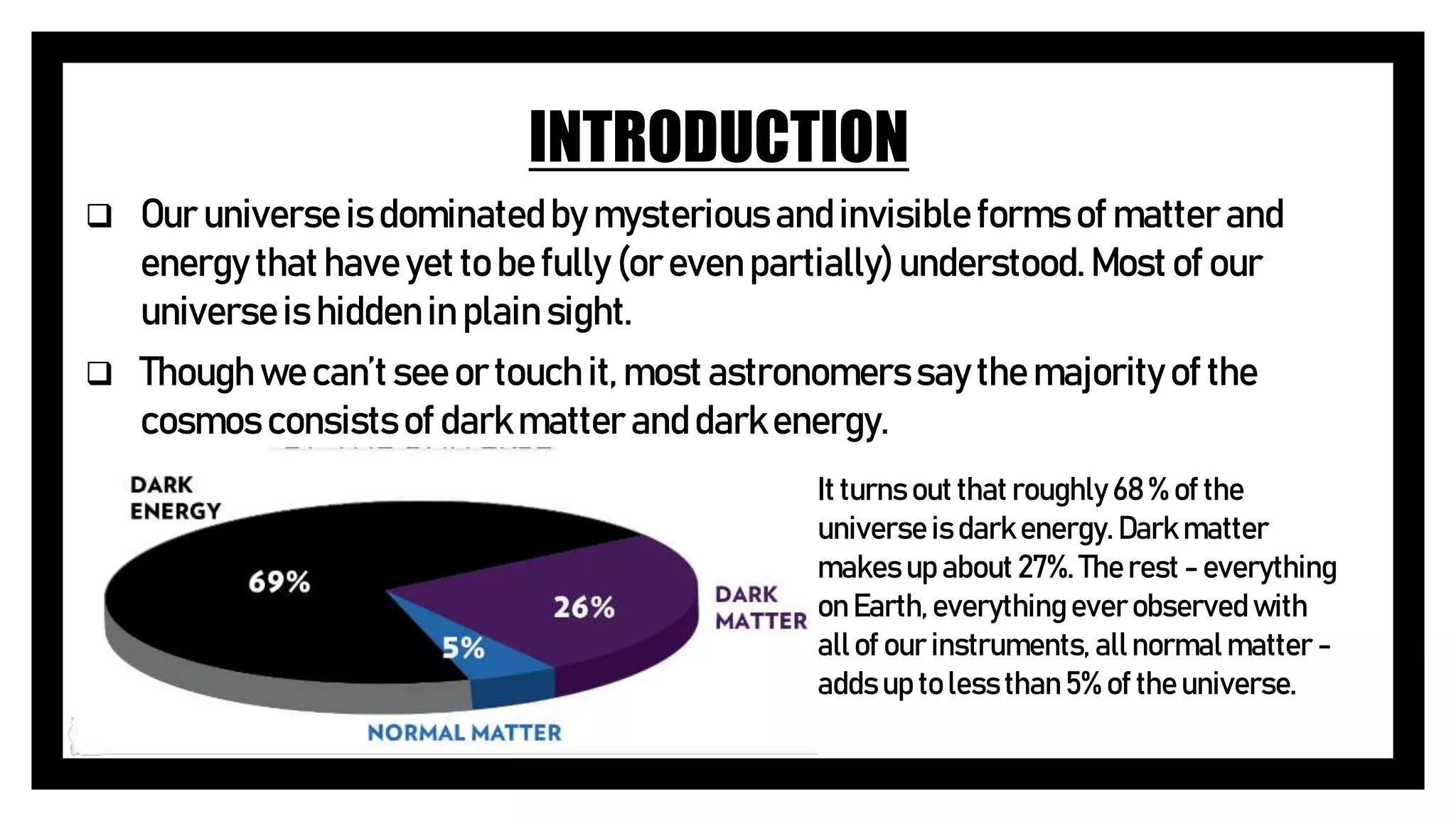
It turns out that roughly 68 % of the
universe is darkenergy. Dark matter
makes up about 27%. The rest - everything
on Earth, everything everobserved with
allof our instruments, allnormal matter -
addsup to less than 5% of the universe.
But what is this mysterious, invisible stuff that surrounds us ?!
To be honest, data about dark energy and dark matter more is unknown than known.
DARK MATTER
DISCOVERY OF DARK MATTER
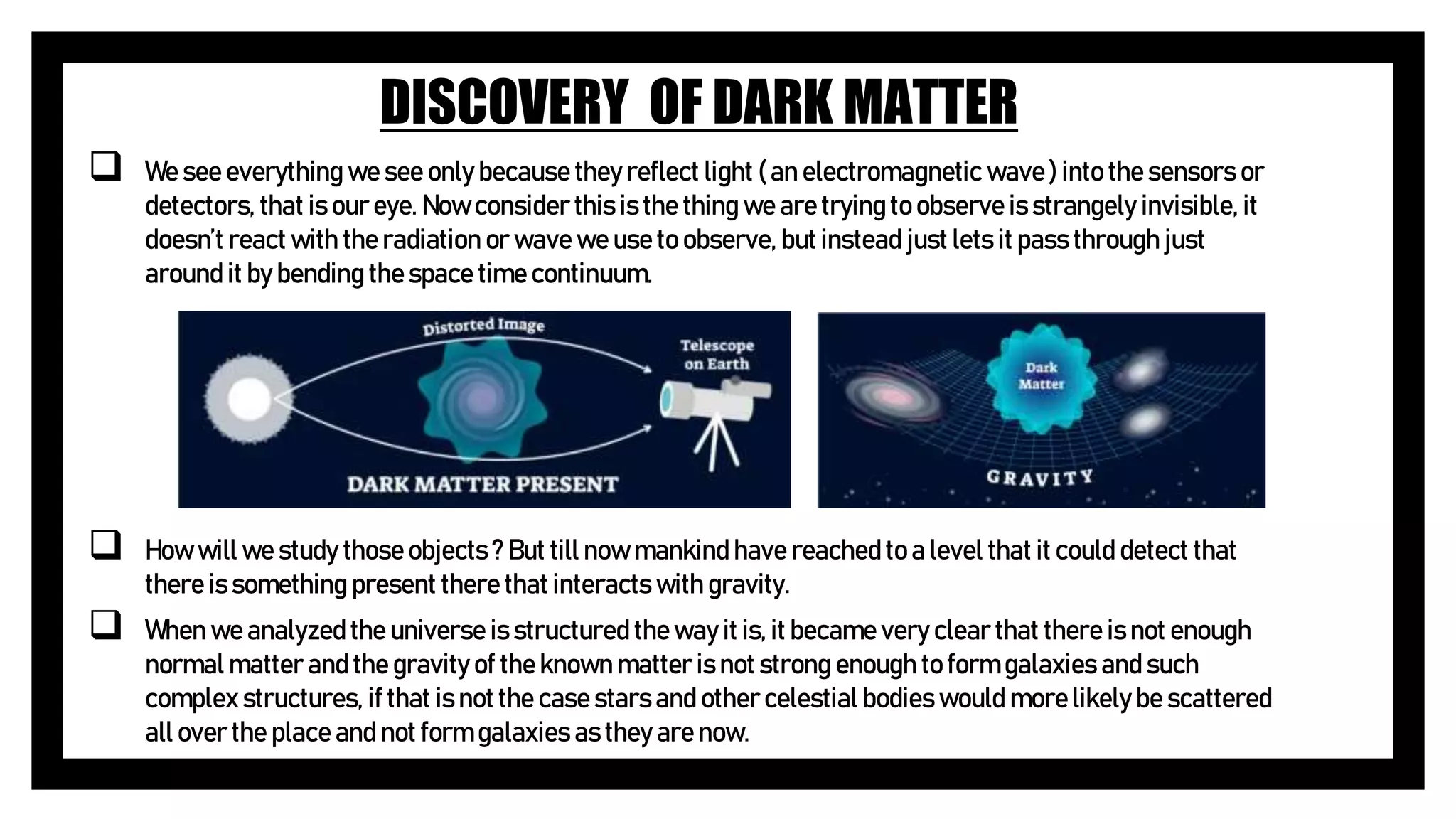
 We see everything we see only because they reflect light ( an electromagnetic wave ) into the sensors or
detectors, that is our eye. Nowconsider this is the thing we are trying to observe is strangely invisible, it
doesn’t react with the radiation or wave we use to observe, but instead just lets it pass through just
around it by bending the space time continuum.
 How will we study those objects ? But till now mankind have reached to a level that it could detect that
there is something present there that interacts with gravity.
 When we analyzed the universe is structured the way it is, it became very clear that there isnot enough
normal matter and the gravity of the known matter is not strong enough to form galaxies and such
complex structures, if that is not the case stars and other celestial bodies would morelikely be scattered
all over the place and not form galaxies as they are now.
 So we know something else is inside and around them which fills the voids in between them.
 This theory of dark matter is proposed about 90years ago in the early 1930s by a famous Dutch
astronomer Jan Oort. He was the one to notice the observation we discussed now.
 He also estimated that dark matter is about three times the normal matter we could observe. Which
was later proved to be more than 5 times.
HOW DO WE DETECT AND STUDY DARK MATTER ?
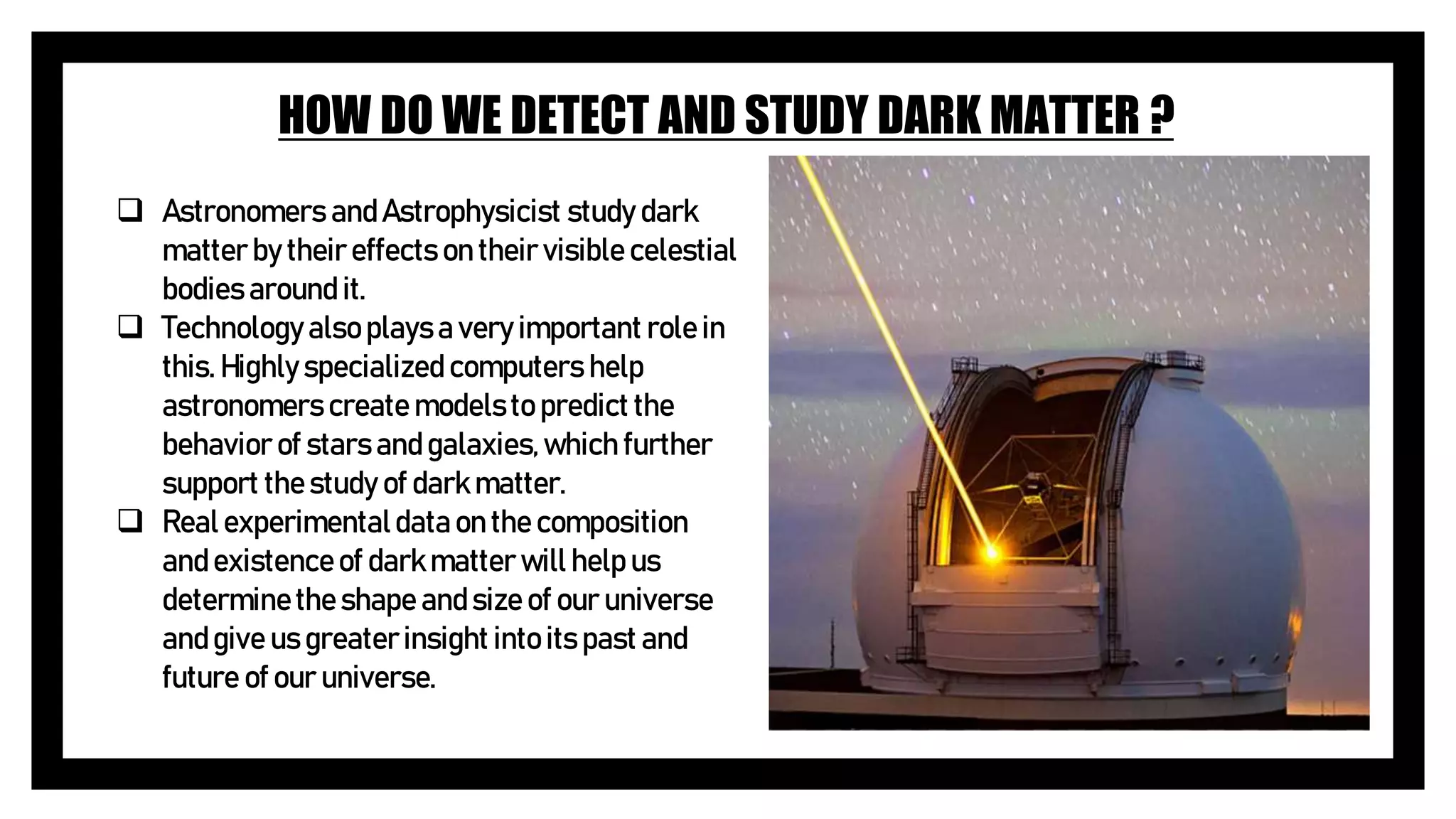
 Astronomers andAstrophysicist study dark
matter by their effects on their visible celestial
bodies around it.
 Technology also playsa very important role in
this. Highlyspecialized computers help
astronomers create modelsto predict the
behavior of stars and galaxies,which further
support the study of dark matter.
 Real experimentaldata on the composition
andexistenceof darkmatter will helpus
determinethe shape andsize of our universe
andgive us greaterinsight into its past and
future of our universe.
SUMMARY
Till this instance of time we know three thingsabout
darkmatter :
1. There is something there
2. It interacts with gravity
3. There are a lot of that
(roughly27 % of the entire universe)
To conclude, Dark matter works like anattractive force
- a kind of cosmic cement that holdsour universe
together. This is because darkmatter does interact
with gravity, but it doesn’t reflect, absorb, or emit light.
DARK ENERGY
HISTORY OF DARK ENERGY
 In the 1990’s two teamsof astronomers were using some of the most advancedandpowerful
telescopes to observe celestial bodies that are much further away from our galaxy.
 To be precise they were observing Type Ia supernova from distant galaxieswhich are
destinedto collapse at some point of time via a catastrophic wave of thermonuclear fusion
explosion.
 Whenthey compared the distance predicted by their levelof intrinsic levelof brightness
appearedon the telescopes to the distance calculated by supernova redshifts, The results
were shocking…
DISCOVERY OF DARK ENERGY
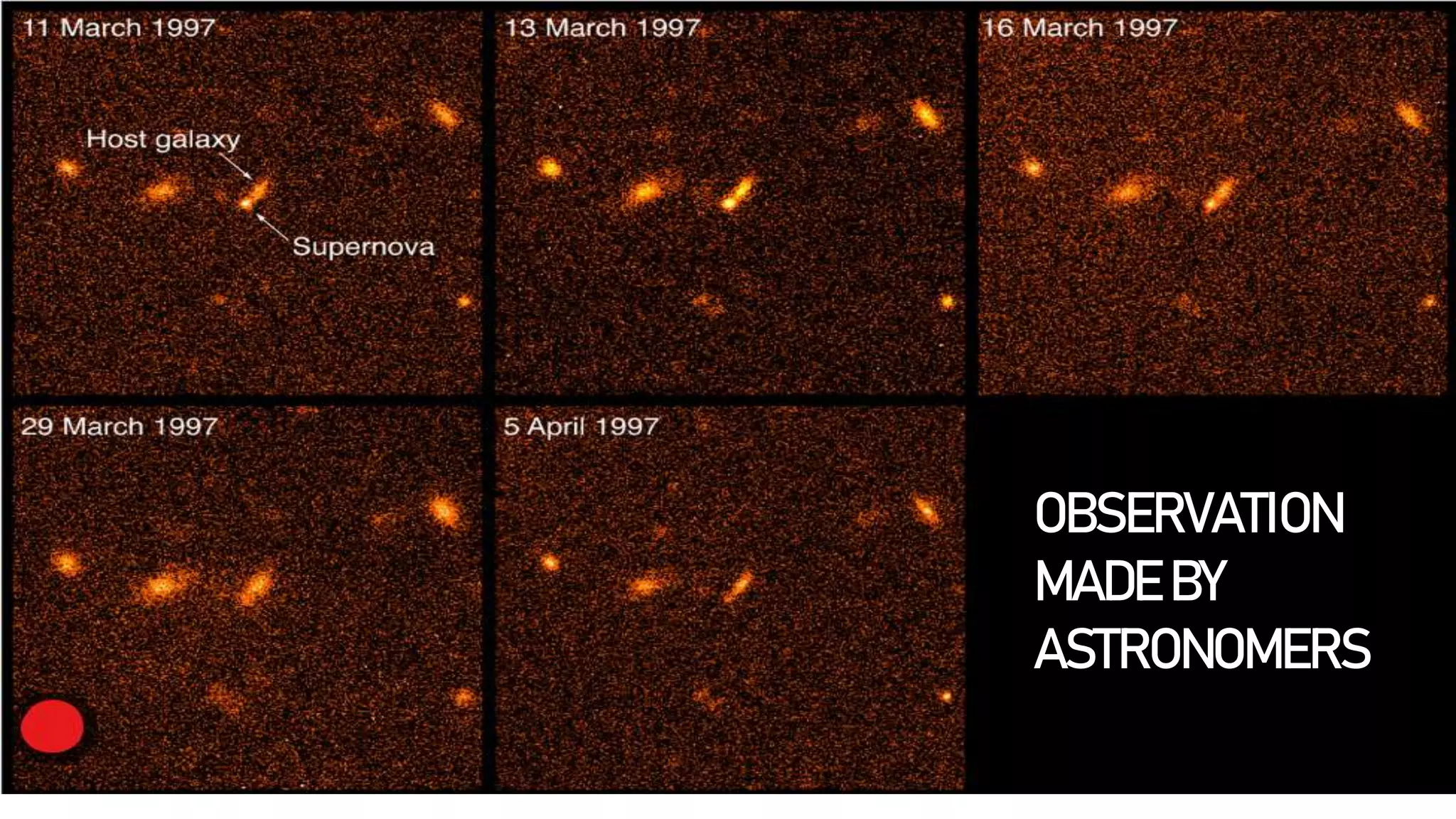
 Time and again,the supernova appeared fainterand faintermeaning the distanceto
supernova not only kept on increasing,In fact they were accelerating.
 Even when the astrophysicistsaround the world try to find possible mistakesor
reasons for this phenomenon, they were not able to explain thisphenomenon with
the existing theories and axioms.
 Finally, They arrived at a conclusion that the Universe was accelerating.This was a
gamechangerat that time becausetill then everyone believed that the galaxiesare
held together by gravity and they were slowing down the expansionof space.
 Many scientistsarrivedat a conclusionthat it is a property of space that every cubic
unit of space possess a small amount of energy called DARKENERGY.
OBSERVATION MADE BY ASTRONOMERS
OBSERVATION
MADE BY
ASTRONOMERS
SUMMARY
 Though thereis only a smallamount of energyin
a unit cube of space, but if we sum up the entire
amount of dark energyin known universe it
becomes a huge sum, roughly about 68% content
of the entire universe. It is accounted for the
acceleratedexpansion of the universe.
 Dark energyis a repulsive force - a sort of anti-
gravity that drives the universe’s ever-
acceleratingexpansion.
 Stillnow we have multipleideasand perceptionsof dark energy that are agreed
and believedupon by physicistsand astrophysicists.
CONCLUSION
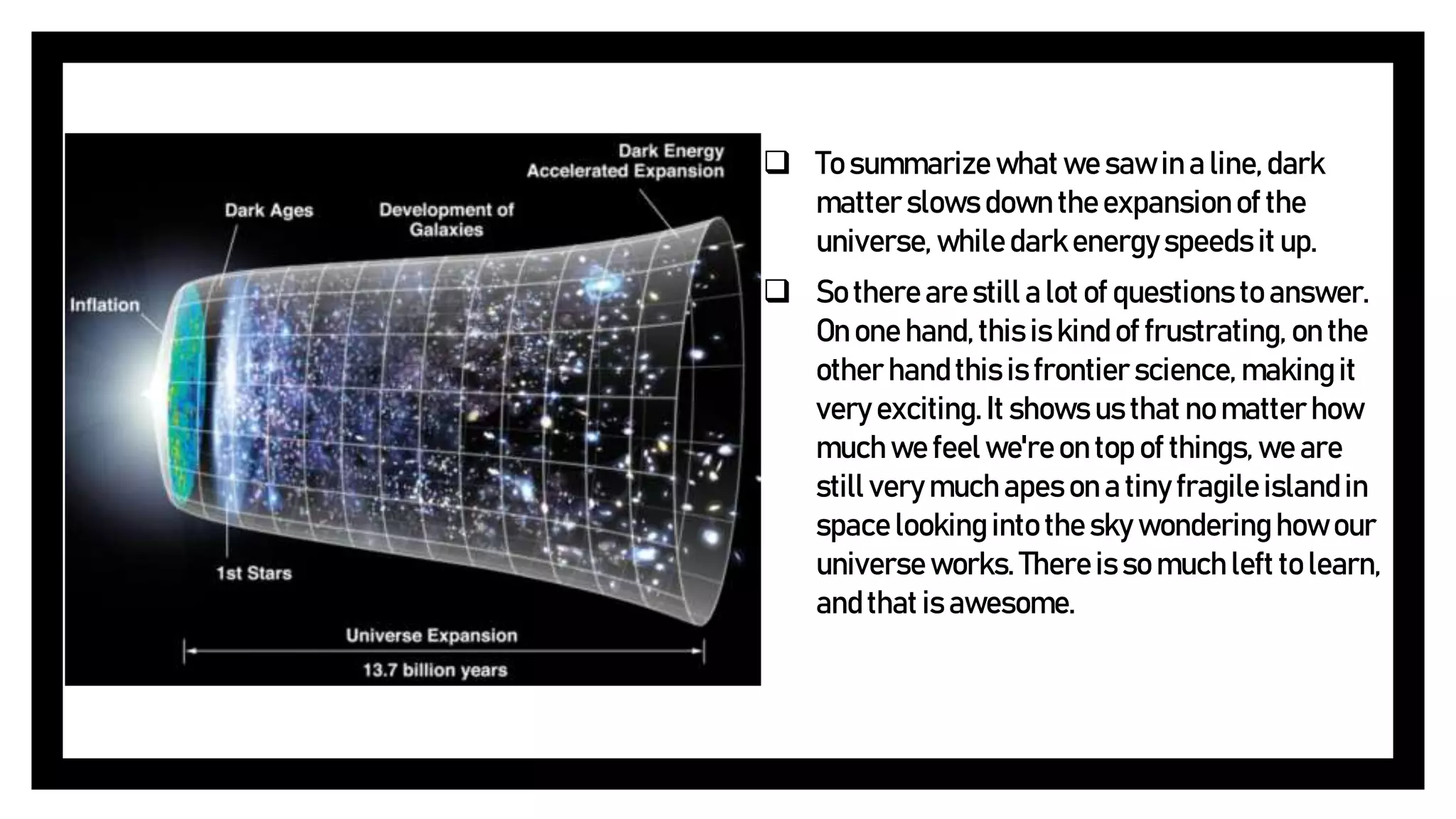
 To summarize what we saw in a line,dark
matter slows down the expansionof the
universe, while dark energyspeeds it up.
 So there are still a lot of questions to answer.
On one hand,this is kind of frustrating, on the
other handthis is frontier science, making it
very exciting. It shows us that no matter how
much we feel we're on top of things, we are
still very much apes on a tiny fragile islandin
space looking into the sky wondering how our
universe works. There is so much left to learn,
andthat is awesome.
REFERENCES
 Lectures of Kurzgesagt in a nutshell - https://www.youtube.com/watch?v=QAa2O_8wBUQ
 Lectures of Fermilab by Dr. Lincoln - https://www.youtube.com/watch?v=oPNrcKeqbBM
 Articles of Harvard University - https://www.cfa.harvard.edu/research/topic/dark-energy-and-matter
 Podcast of Joe Rogan with Brian Cox - https://www.youtube.com/watch?v=NVCiuPIeYUM
 Talks form Dr. Neil DeGrasse Tyson - https://www.youtube.com/watch?v=uBbxXNhZ78c
 TED Talk by James Gilles - https://www.youtube.com/watch?v=HneiEA1B8ks
 Blogs by NASA - https://science.nasa.gov/astrophysics/focus-areas/what-is-dark-energy
THANK YOU !

Dark Matter & Dark Energy.pptx

  • 1.
    DARK MATTER &DARK ENERGY
  • 2.
    INTRODUCTION  Our universeisdominatedby mysteriousandinvisible formsof matterand energy thathave yet to be fully (orevenpartially)understood. Most of our universeis hiddenin plain sight.  Though wecan’tsee ortouch it, most astronomerssay the majorityof the cosmos consistsof darkmatter anddarkenergy. It turns out that roughly 68 % of the universe is darkenergy. Dark matter makes up about 27%. The rest - everything on Earth, everything everobserved with allof our instruments, allnormal matter - addsup to less than 5% of the universe.
  • 3.
    But what isthis mysterious, invisible stuff that surrounds us ?! To be honest, data about dark energy and dark matter more is unknown than known.
  • 4.
  • 5.
    DISCOVERY OF DARKMATTER  We see everything we see only because they reflect light ( an electromagnetic wave ) into the sensors or detectors, that is our eye. Nowconsider this is the thing we are trying to observe is strangely invisible, it doesn’t react with the radiation or wave we use to observe, but instead just lets it pass through just around it by bending the space time continuum.  How will we study those objects ? But till now mankind have reached to a level that it could detect that there is something present there that interacts with gravity.  When we analyzed the universe is structured the way it is, it became very clear that there isnot enough normal matter and the gravity of the known matter is not strong enough to form galaxies and such complex structures, if that is not the case stars and other celestial bodies would morelikely be scattered all over the place and not form galaxies as they are now.
  • 6.
     So weknow something else is inside and around them which fills the voids in between them.  This theory of dark matter is proposed about 90years ago in the early 1930s by a famous Dutch astronomer Jan Oort. He was the one to notice the observation we discussed now.  He also estimated that dark matter is about three times the normal matter we could observe. Which was later proved to be more than 5 times.
  • 7.
    HOW DO WEDETECT AND STUDY DARK MATTER ?  Astronomers andAstrophysicist study dark matter by their effects on their visible celestial bodies around it.  Technology also playsa very important role in this. Highlyspecialized computers help astronomers create modelsto predict the behavior of stars and galaxies,which further support the study of dark matter.  Real experimentaldata on the composition andexistenceof darkmatter will helpus determinethe shape andsize of our universe andgive us greaterinsight into its past and future of our universe.
  • 8.
    SUMMARY Till this instanceof time we know three thingsabout darkmatter : 1. There is something there 2. It interacts with gravity 3. There are a lot of that (roughly27 % of the entire universe) To conclude, Dark matter works like anattractive force - a kind of cosmic cement that holdsour universe together. This is because darkmatter does interact with gravity, but it doesn’t reflect, absorb, or emit light.
  • 9.
  • 10.
    HISTORY OF DARKENERGY  In the 1990’s two teamsof astronomers were using some of the most advancedandpowerful telescopes to observe celestial bodies that are much further away from our galaxy.  To be precise they were observing Type Ia supernova from distant galaxieswhich are destinedto collapse at some point of time via a catastrophic wave of thermonuclear fusion explosion.  Whenthey compared the distance predicted by their levelof intrinsic levelof brightness appearedon the telescopes to the distance calculated by supernova redshifts, The results were shocking…
  • 11.
    DISCOVERY OF DARKENERGY  Time and again,the supernova appeared fainterand faintermeaning the distanceto supernova not only kept on increasing,In fact they were accelerating.  Even when the astrophysicistsaround the world try to find possible mistakesor reasons for this phenomenon, they were not able to explain thisphenomenon with the existing theories and axioms.  Finally, They arrived at a conclusion that the Universe was accelerating.This was a gamechangerat that time becausetill then everyone believed that the galaxiesare held together by gravity and they were slowing down the expansionof space.  Many scientistsarrivedat a conclusionthat it is a property of space that every cubic unit of space possess a small amount of energy called DARKENERGY.
  • 12.
    OBSERVATION MADE BYASTRONOMERS OBSERVATION MADE BY ASTRONOMERS
  • 13.
    SUMMARY  Though thereisonly a smallamount of energyin a unit cube of space, but if we sum up the entire amount of dark energyin known universe it becomes a huge sum, roughly about 68% content of the entire universe. It is accounted for the acceleratedexpansion of the universe.  Dark energyis a repulsive force - a sort of anti- gravity that drives the universe’s ever- acceleratingexpansion.  Stillnow we have multipleideasand perceptionsof dark energy that are agreed and believedupon by physicistsand astrophysicists.
  • 14.
  • 15.
     To summarizewhat we saw in a line,dark matter slows down the expansionof the universe, while dark energyspeeds it up.  So there are still a lot of questions to answer. On one hand,this is kind of frustrating, on the other handthis is frontier science, making it very exciting. It shows us that no matter how much we feel we're on top of things, we are still very much apes on a tiny fragile islandin space looking into the sky wondering how our universe works. There is so much left to learn, andthat is awesome.
  • 16.
    REFERENCES  Lectures ofKurzgesagt in a nutshell - https://www.youtube.com/watch?v=QAa2O_8wBUQ  Lectures of Fermilab by Dr. Lincoln - https://www.youtube.com/watch?v=oPNrcKeqbBM  Articles of Harvard University - https://www.cfa.harvard.edu/research/topic/dark-energy-and-matter  Podcast of Joe Rogan with Brian Cox - https://www.youtube.com/watch?v=NVCiuPIeYUM  Talks form Dr. Neil DeGrasse Tyson - https://www.youtube.com/watch?v=uBbxXNhZ78c  TED Talk by James Gilles - https://www.youtube.com/watch?v=HneiEA1B8ks  Blogs by NASA - https://science.nasa.gov/astrophysics/focus-areas/what-is-dark-energy
  • 17.