Daily Lesson Log for Reading and Writing Skills 11
This will guide teacher in his or her lesson for a week. This is not an intention to own the material, in short this is just adapted for education purposes only.
Daily Lesson Log for Reading and Writing Skills 11
1.
DAILY
LESSON
LOG
School NASIPIT NATIONALVOCATIONAL SCHOOL Grade Level: 11
Teacher: RHEA A. CAYABYAB Learning Area: RWS
Day Number - Date -
Section:
Day 1- March 27, 2023- STEM 11, ABM 11, SMAW-
11, COOKERY 11
Day 2-March 28, 2023-Cookery 11, EIM 11, ABM
11, SMAW 11
DAY 3-March 29, 2023 -COOKERY 11, EIM 11, ABM
11, SMAW 11
Day 4- March 30 , 2023- STEM 11,COOKERY 11,
EIM 11, SMAW 11
Quarter - Week
Number:
Quarter III-Week 7
I. OBJECTIVES
DAY 1 DAY 2 DAY 3 DAY 4 DAY 5
A. Content
Standards:
The learner realizes that information in a written text may be selected and organized to achieve a particular purpose.
B. Performance
Standards:
The learner critiques a chosen sample of each pattern of development focusing on information selection, organization and development
c. Learning
Compete
ncies
(Write the LC Code
for each.)
At the end of the lesson, the learners are expected to:
At the end of the lesson, the learners are
expected to:
1. define what is definition paragraph is
2. Determine ways of organizing a
definition paragraph
3. Write a definition paragraph
At the end of the lesson, the
learners are expected to:
1. define what is
exemplification
paragraph is
2. Determine ways of
organizing a
exemplification
paragraph
3. Write a
exemplification
paragraph
At the end of the lesson, the
learners are expected to:
1. define what is
classification paragraph is
2. Determine ways of
organizing a classification
paragraph
3. Write a classification
paragraph
At the end of
the lesson,
the learners
are expected
to:
1. define
what is
cause and
effect
paragraph
is
2. Determine
ways of
organizing a
2.
cause and
effect
paragraph
3. Writea
cause and
effect
paragraph
II. CONTENT Patterns of Development Across Disciplines:
Definition Paragraph
Patterns of Development
Across Disciplines:
Exemplification Paragraph
Patterns of Development Across
Disciplines: Classification
Paragraph
Patterns of
Development
Across
Disciplines:
Cause and
Effect
Paragraph
III. LEARNING
RESOURCES
Lists the materials to be used on different days. Varied sources of materials sustain children’s interest in the lesson and in learning. Ensure that there is
a mix of concrete and manipulative materials as well as paper-based materials. Hands-on learning promotes concept development.
A. References
1. Teacher’s
Guide Pages
2. Learner’s
Materials
Pages
3. And its
typesTextbook
Pages
B. Other Learning
Resources
IV. PROCEDURES DAY 1 DAY 2 DAY 3 DAY 4 DAY 5
Greetings
Prayer
Checking of Attendance
Reading of House Rules
Reading of Class Objectives
3.
Unlock DifficultTerms
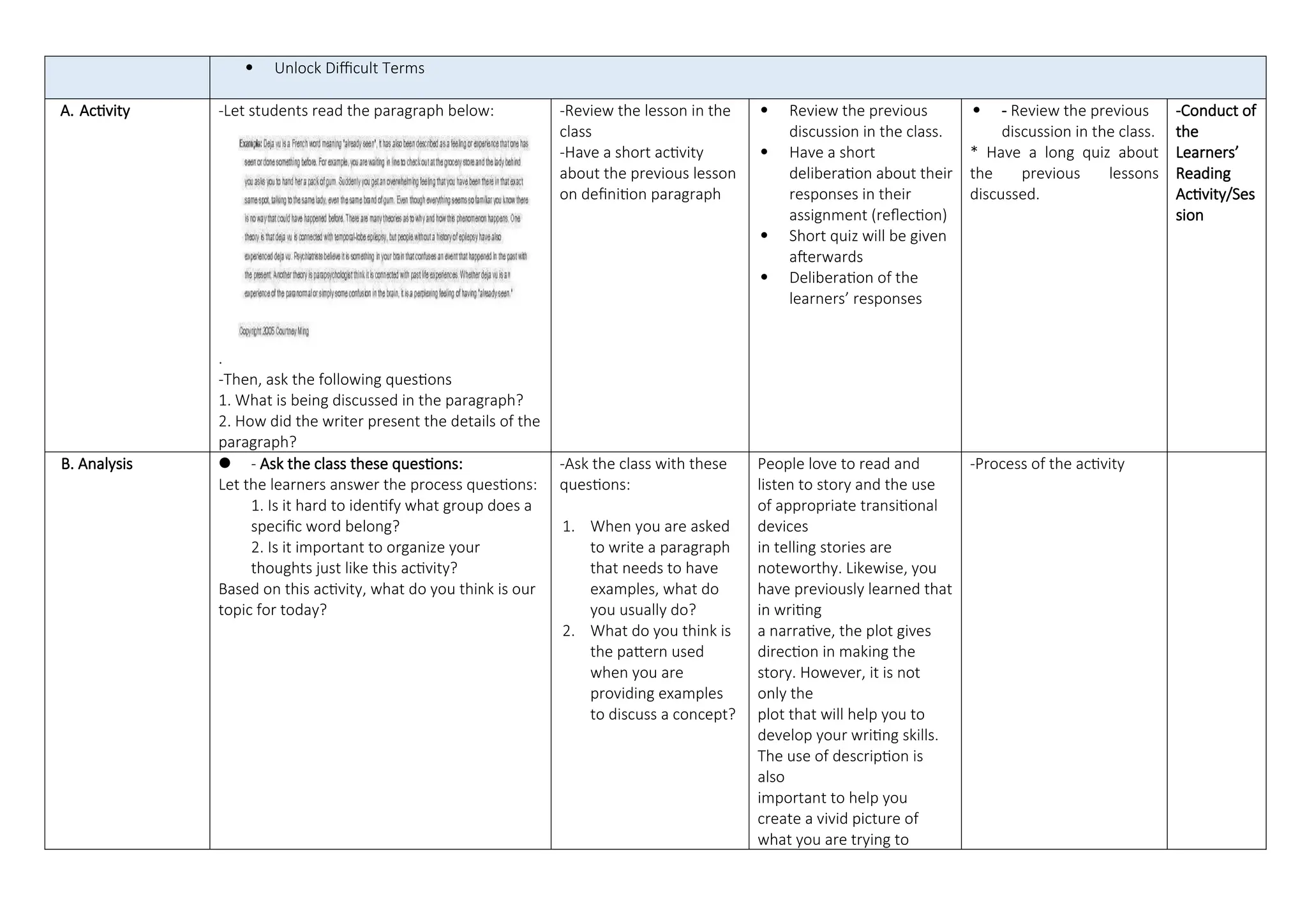
A. Activity -Let students read the paragraph below:
.
-Then, ask the following questions
1. What is being discussed in the paragraph?
2. How did the writer present the details of the
paragraph?
-Review the lesson in the
class
-Have a short activity
about the previous lesson
on definition paragraph
Review the previous
discussion in the class.
Have a short
deliberation about their
responses in their
assignment (reflection)
Short quiz will be given
afterwards
Deliberation of the
learners’ responses
- Review the previous
discussion in the class.
* Have a long quiz about
the previous lessons
discussed.
-Conduct of
the
Learners’
Reading
Activity/Ses
sion
B. Analysis - Ask the class these questions:
Let the learners answer the process questions:
1. Is it hard to identify what group does a
specific word belong?
2. Is it important to organize your
thoughts just like this activity?
Based on this activity, what do you think is our
topic for today?
-Ask the class with these
questions:
1. When you are asked
to write a paragraph
that needs to have
examples, what do
you usually do?
2. What do you think is
the pattern used
when you are
providing examples
to discuss a concept?
People love to read and
listen to story and the use
of appropriate transitional
devices
in telling stories are
noteworthy. Likewise, you
have previously learned that
in writing
a narrative, the plot gives
direction in making the
story. However, it is not
only the
plot that will help you to
develop your writing skills.
The use of description is
also
important to help you
create a vivid picture of
what you are trying to
-Process of the activity
4.
express through
written text.
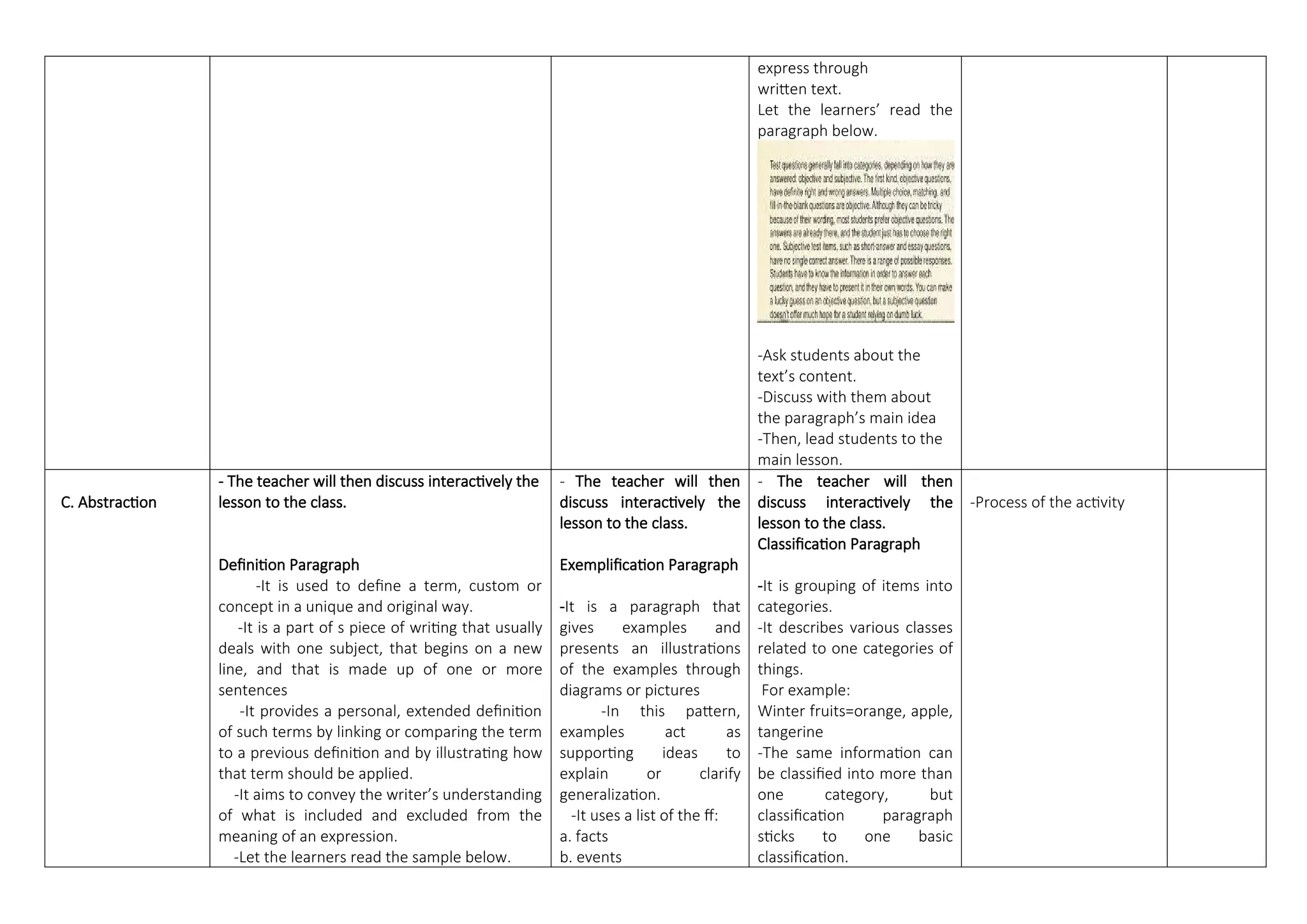
Letthe learners’ read the
paragraph below.
-Ask students about the
text’s content.
-Discuss with them about
the paragraph’s main idea
-Then, lead students to the
main lesson.
C. Abstraction
- The teacher will then discuss interactively the
lesson to the class.
Definition Paragraph
-It is used to define a term, custom or
concept in a unique and original way.
-It is a part of s piece of writing that usually
deals with one subject, that begins on a new
line, and that is made up of one or more
sentences
-It provides a personal, extended definition
of such terms by linking or comparing the term
to a previous definition and by illustrating how
that term should be applied.
-It aims to convey the writer’s understanding
of what is included and excluded from the
meaning of an expression.
-Let the learners read the sample below.
- The teacher will then
discuss interactively the
lesson to the class.
Exemplification Paragraph
-It is a paragraph that
gives examples and
presents an illustrations
of the examples through
diagrams or pictures
-In this pattern,
examples act as
supporting ideas to
explain or clarify
generalization.
-It uses a list of the ff:
a. facts
b. events
- The teacher will then
discuss interactively the
lesson to the class.
Classification Paragraph
-It is grouping of items into
categories.
-It describes various classes
related to one categories of
things.
For example:
Winter fruits=orange, apple,
tangerine
-The same information can
be classified into more than
one category, but
classification paragraph
sticks to one basic
classification.
-Process of the activity
5.
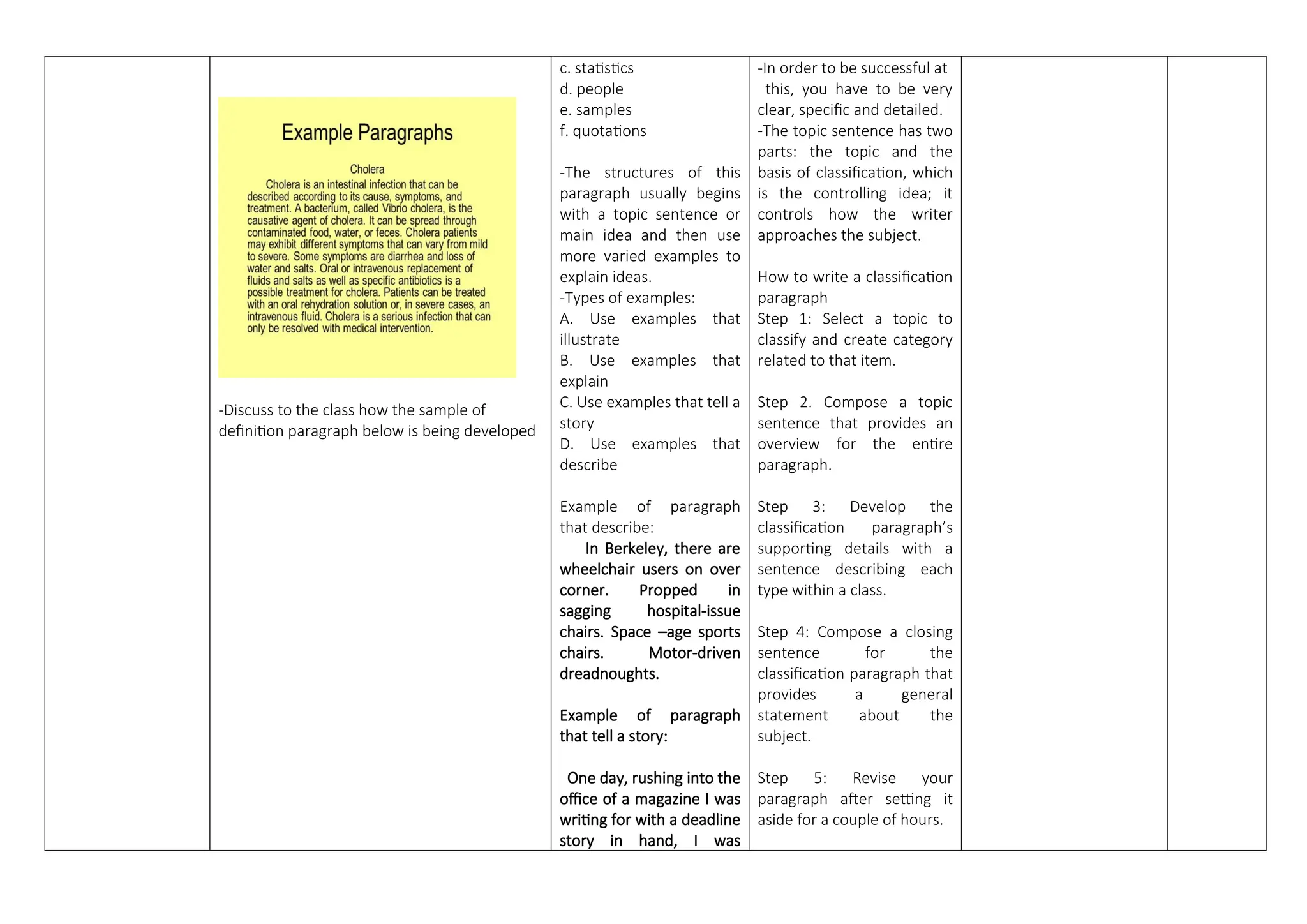
-Discuss to theclass how the sample of
definition paragraph below is being developed
c. statistics
d. people
e. samples
f. quotations
-The structures of this
paragraph usually begins
with a topic sentence or
main idea and then use
more varied examples to
explain ideas.
-Types of examples:
A. Use examples that
illustrate
B. Use examples that
explain
C. Use examples that tell a
story
D. Use examples that
describe
Example of paragraph
that describe:
In Berkeley, there are
wheelchair users on over
corner. Propped in
sagging hospital-issue
chairs. Space –age sports
chairs. Motor-driven
dreadnoughts.
Example of paragraph
that tell a story:
One day, rushing into the
office of a magazine I was
writing for with a deadline
story in hand, I was
-In order to be successful at
this, you have to be very
clear, specific and detailed.
-The topic sentence has two
parts: the topic and the
basis of classification, which
is the controlling idea; it
controls how the writer
approaches the subject.
How to write a classification
paragraph
Step 1: Select a topic to
classify and create category
related to that item.
Step 2. Compose a topic
sentence that provides an
overview for the entire
paragraph.
Step 3: Develop the
classification paragraph’s
supporting details with a
sentence describing each
type within a class.
Step 4: Compose a closing
sentence for the
classification paragraph that
provides a general
statement about the
subject.
Step 5: Revise your
paragraph after setting it
aside for a couple of hours.
6.
mistaken for aburglar.
The office manager called
security and, with an ad
hoc posse, pursued me
thorugh the labyrinthine
halls, nearly to me
editor’s door.
-Discuss to the class and
cite related and relevant
examples to make lessons
simplified and realistic.
-Have learners read and
examine the example
below:
-Discuss thoroughly the
lesson with related and
relevant examples.
D. Application
Activity: Define It!
Directions: Work with a partner. Chooses an
item from the bag. Write a topic sentence
that will identify/define this term and uses an
adjective clause.
Note: The teacher will provide the bag of
items to be chosen by each pair.
Writing Activity
Directions: Write an
exemplification paragraph
of any topic that you are
most convenient to write
with.
Activity: Discuss With Me!
Directions: Read the
paragraphs below. Then,
answer the questions that
follows:
Gym-goers can be
classified according to their
priorities at the gym
assweaty fanatics,
fashionistas, busybodies,
and fit normals. Sweaty
fanatics take gym-going to
the extreme. They hog the
machines, drip sweat
everywhere, and barely
look up if someone falls off
the treadmill beside them.
Occasionally, they will stare
at the mirror, admiring the
-Process of the activity
7.
muscle group theyare
working on. The
fashionistas also admire
their own reflections, but
they barely break a sweat.
For them, the gym is just
another excuse to buy
clothes. They wear
perfectly matched workout
clothes with color-
coordinated sport watches
and gym shoes. The third
group, the busybodies,
can’t stop talking. Whether
it’s making idle chitchat or
correcting another
exerciser’s form on a
machine, they seem unable
to shut up. Not even
headphones and one-word
answers can stop the
busybodies from babbling.
Luckily, the fit normals
keep things from getting
too far out of control. They
come to the gym to work
out, stay healthy, and go
home, but they remember
that basic good manners
apply in every setting.—
Laurie Zamot, Student
1. What is the main
idea of the essay?
2. What are the types
of gym –goers
classified in the
essay?
3. Describe each type
of gym-goers.
8.
4. Did thewriter of
the essay
consistently classify
his/her essay?
How?
-Checking of students’
responses
V. EVALUATION Directions: Turn to a partner and practice
coming up with a good topic sentence for a
definition paragraph.
1. A best friend is
________________who______
2. Steve Jobs was ____________ who
___________
3. A USB is __________ that ________.
Note:
Deliberation of students’ responses will be
conducted after the activity.
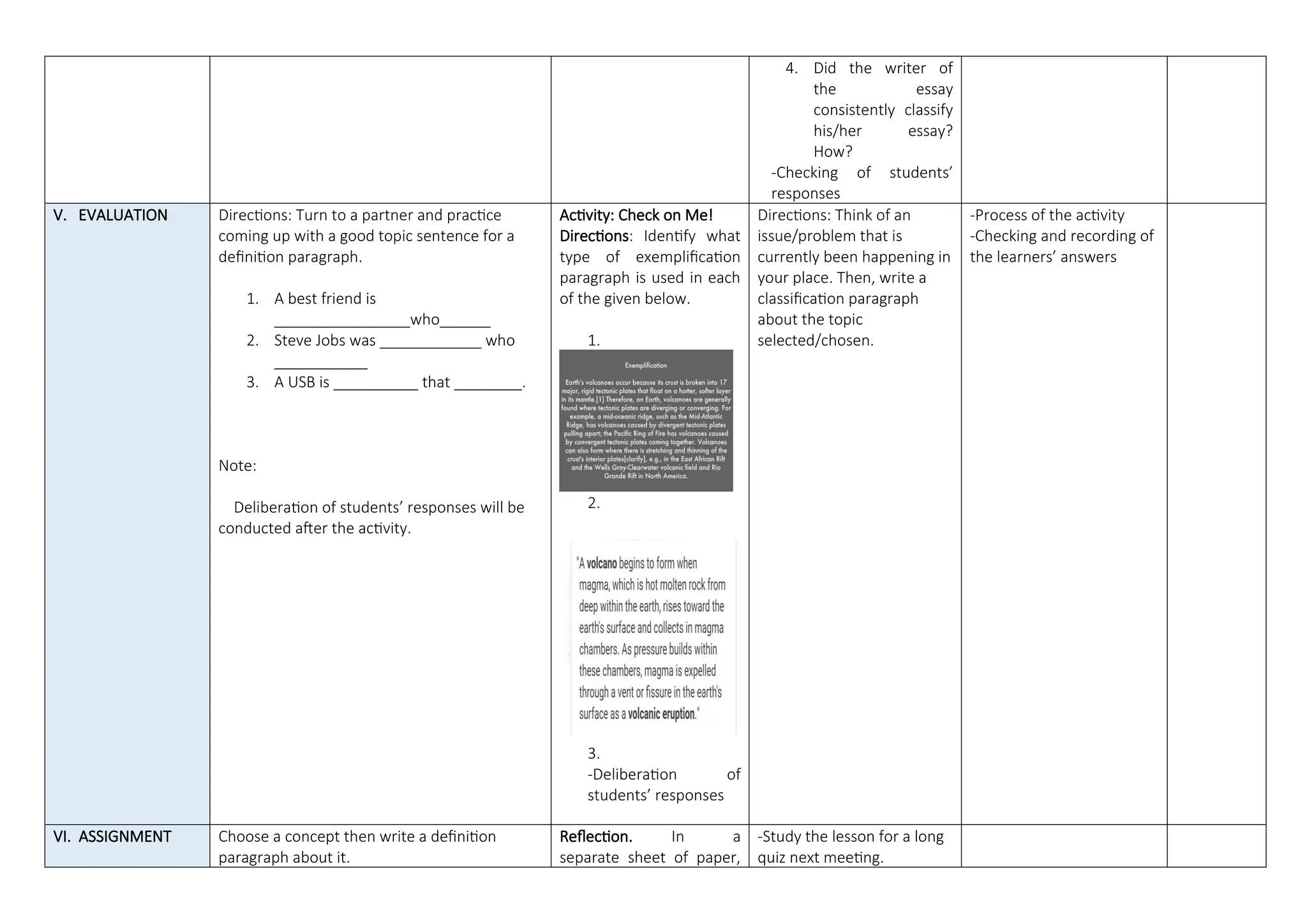
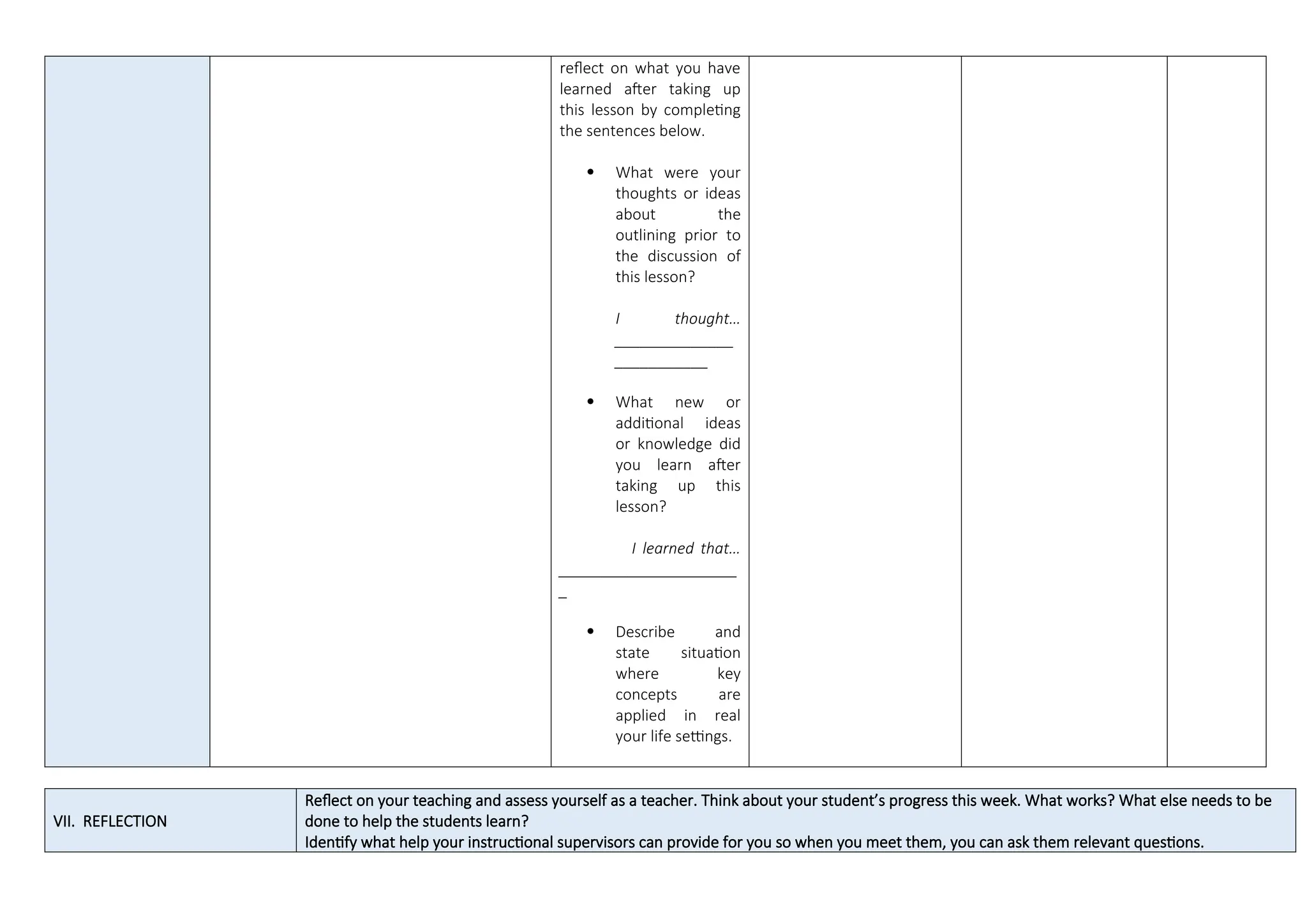
Activity: Check on Me!
Directions: Identify what
type of exemplification
paragraph is used in each
of the given below.
1.
2.
3.
-Deliberation of
students’ responses
Directions: Think of an
issue/problem that is
currently been happening in
your place. Then, write a
classification paragraph
about the topic
selected/chosen.
-Process of the activity
-Checking and recording of
the learners’ answers
VI. ASSIGNMENT Choose a concept then write a definition
paragraph about it.
Reflection. In a
separate sheet of paper,
-Study the lesson for a long
quiz next meeting.
9.
reflect on whatyou have
learned after taking up
this lesson by completing
the sentences below.
What were your
thoughts or ideas
about the
outlining prior to
the discussion of
this lesson?
I thought…
______________
___________
What new or
additional ideas
or knowledge did
you learn after
taking up this
lesson?
I learned that…
_____________________
_
Describe and
state situation
where key
concepts are
applied in real
your life settings.
VII. REFLECTION
Reflect on your teaching and assess yourself as a teacher. Think about your student’s progress this week. What works? What else needs to be
done to help the students learn?
Identify what help your instructional supervisors can provide for you so when you meet them, you can ask them relevant questions.
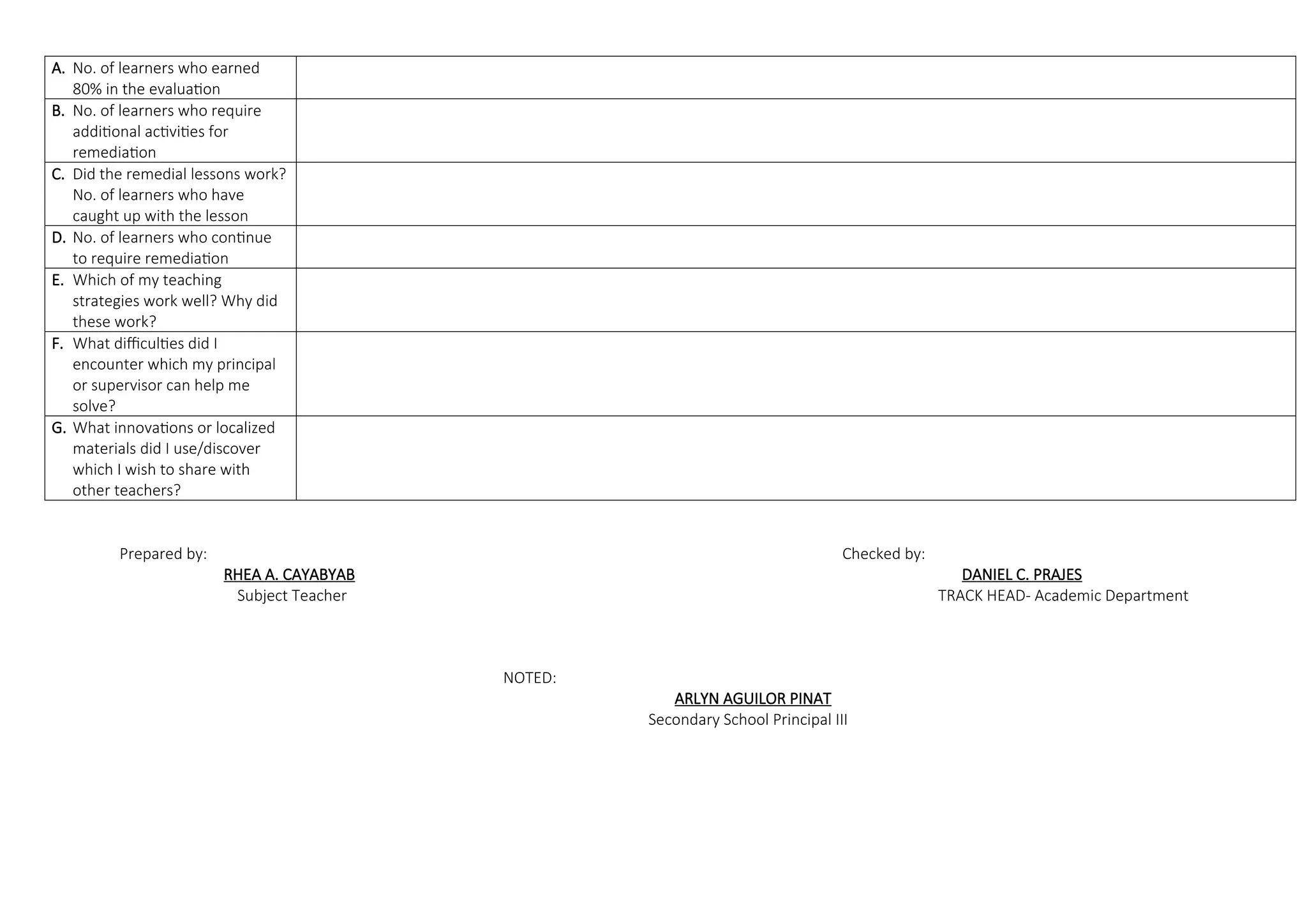
10.
A. No. oflearners who earned
80% in the evaluation
B. No. of learners who require
additional activities for
remediation
C. Did the remedial lessons work?
No. of learners who have
caught up with the lesson
D. No. of learners who continue
to require remediation
E. Which of my teaching
strategies work well? Why did
these work?
F. What difficulties did I
encounter which my principal
or supervisor can help me
solve?
G. What innovations or localized
materials did I use/discover
which I wish to share with
other teachers?
Prepared by: Checked by:
RHEA A. CAYABYAB DANIEL C. PRAJES
Subject Teacher TRACK HEAD- Academic Department
NOTED:
ARLYN AGUILOR PINAT
Secondary School Principal III