“Alexa, get me the articles”:
user experience and voice
interfaces in academia
Kelly Dagan
Research, Instruction, & User Experience Librarian
Amherst College
Twitter: @K4Dag
What
we’ll
cover
▫ types of voice interfaces
▫ themes affecting voice
search & academic
discovery
▫ user hopes &
expectations
▫ some UX requirements
2
Quick definitions
3
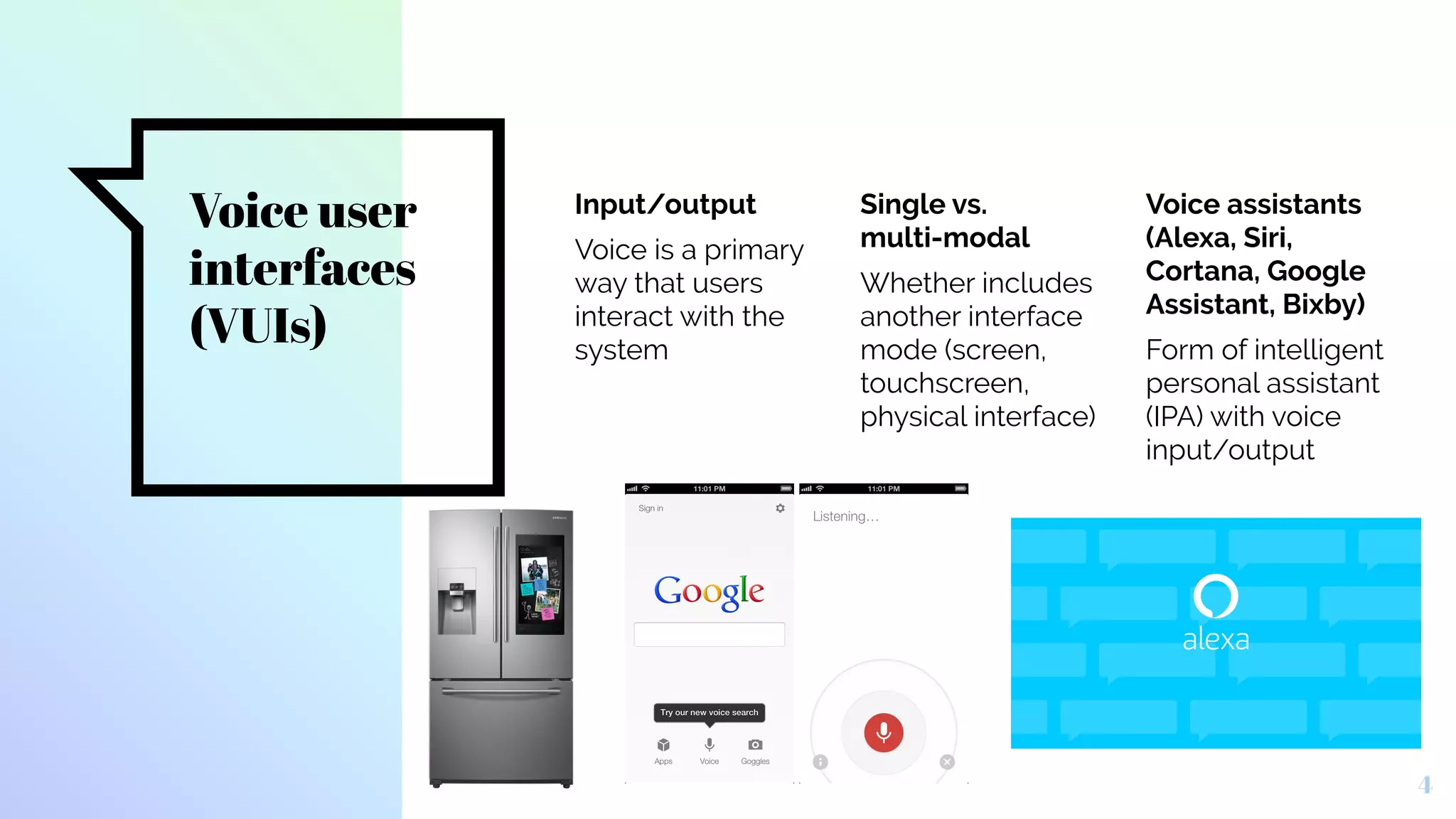
Voice user
interfaces
(VUIs)
Input/output
Voice is a primary
way that users
interact with the
system
Single vs.
multi-modal
Whether includes
another interface
mode (screen,
touchscreen,
physical interface)
Voice assistants
(Alexa, Siri,
Cortana, Google
Assistant, Bixby)
Form of intelligent
personal assistant
(IPA) with voice
input/output
4
“(Voice) is eating
the world.”
5
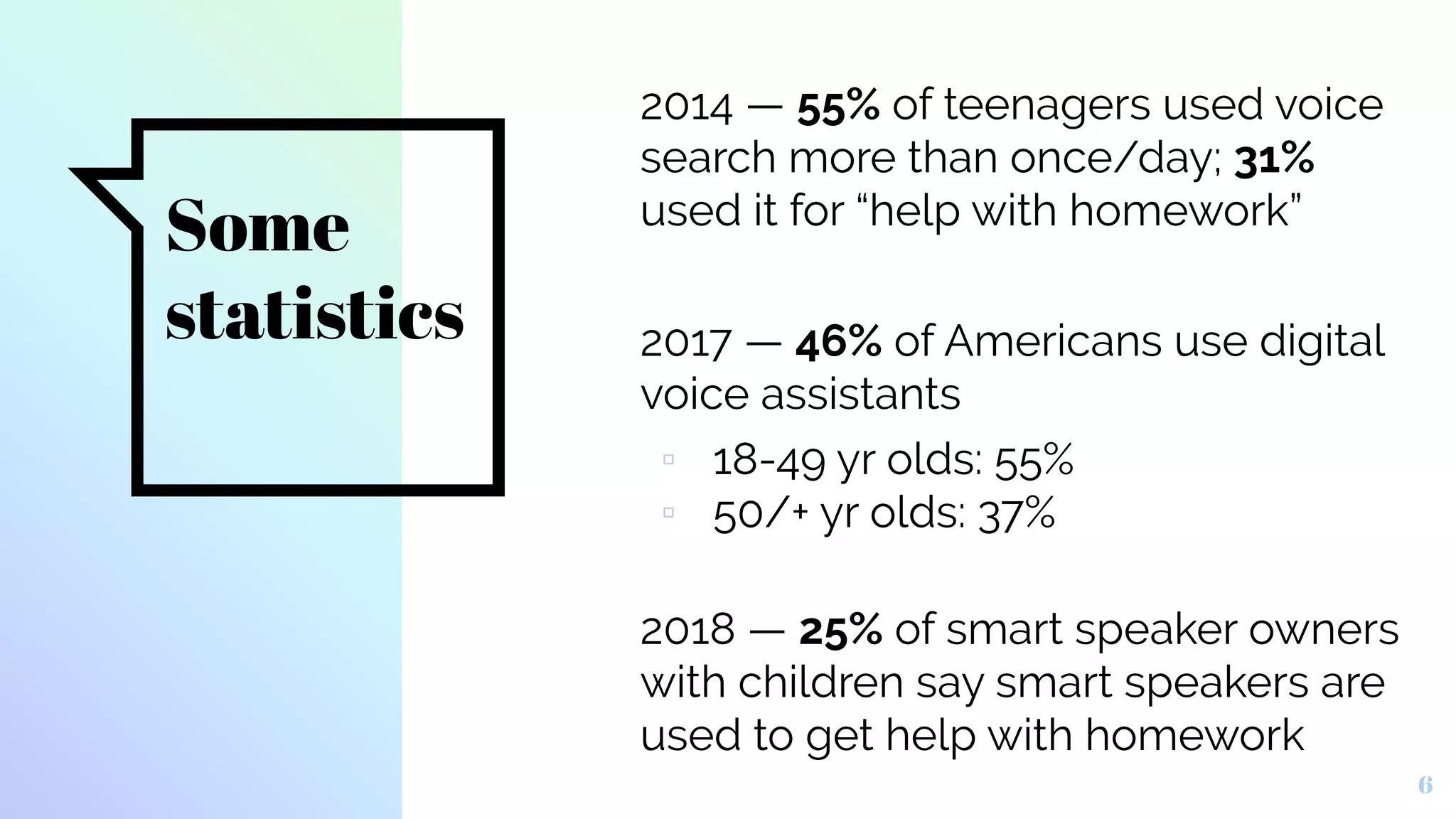
Some
statistics
2014 — 55% of teenagers used voice
search more than once/day; 31%
used it for “help with homework”
2017 — 46% of Americans use digital
voice assistants
▫ 18-49 yr olds: 55%
▫ 50/+ yr olds: 37%
2018 — 25% of smart speaker owners
with children say smart speakers are
used to get help with homework
6
How fast really?
7
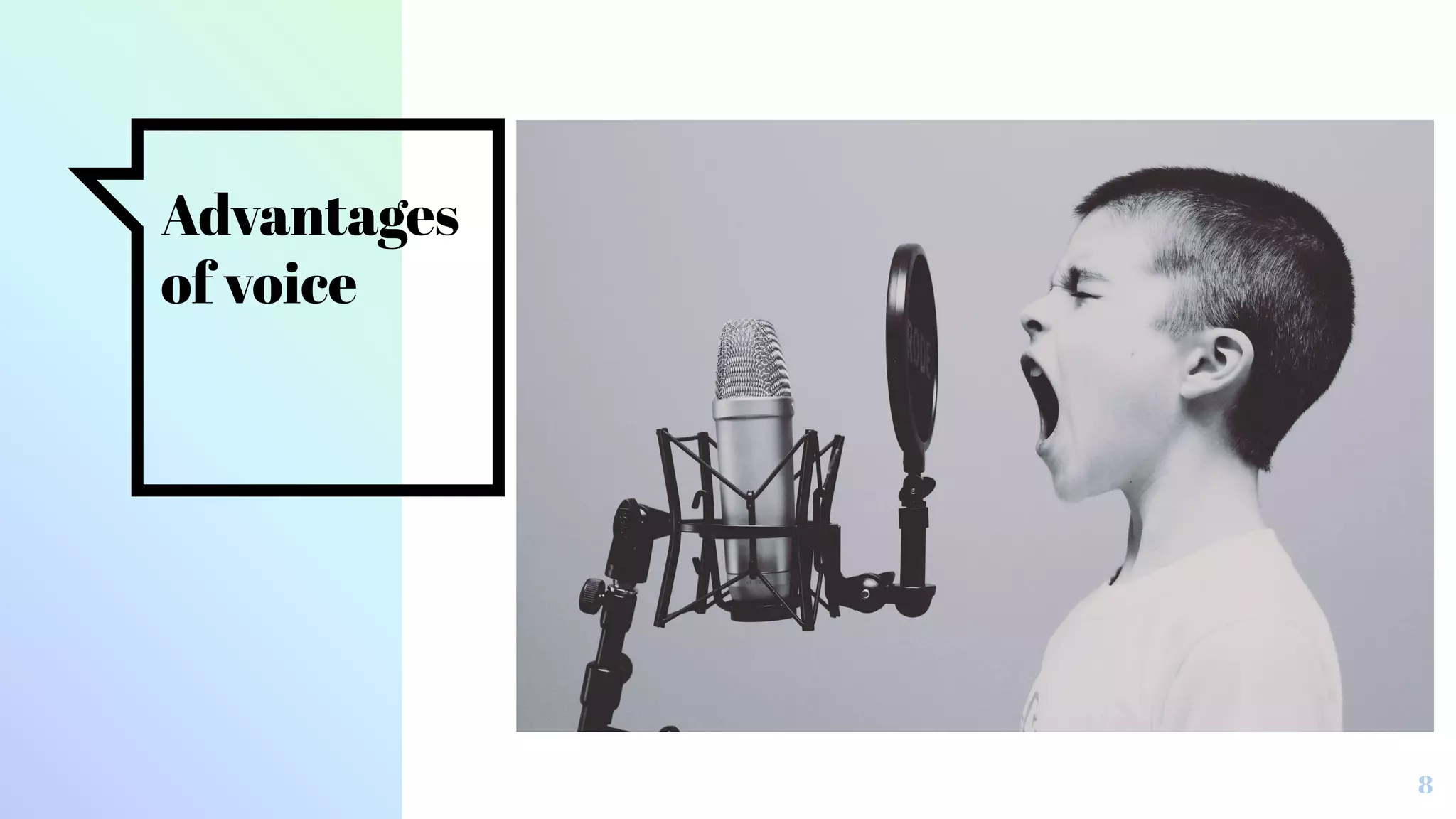
Advantages
of voice
8
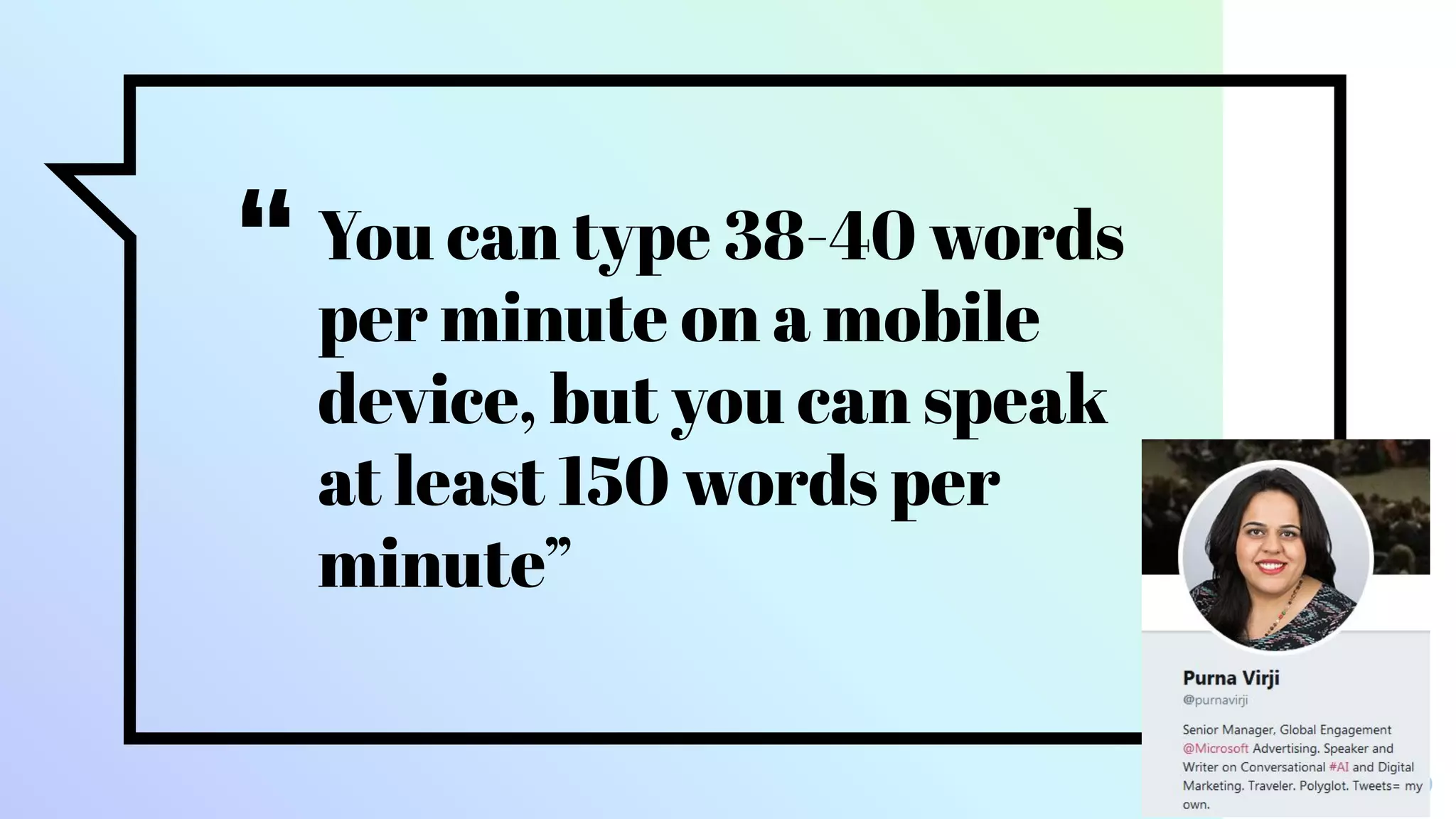
“You can type 38-40 words
per minute on a mobile
device, but you can speak
at least 150 words per
minute”
9
10
11
12
13
“Information:
always on, on
the go.”
14
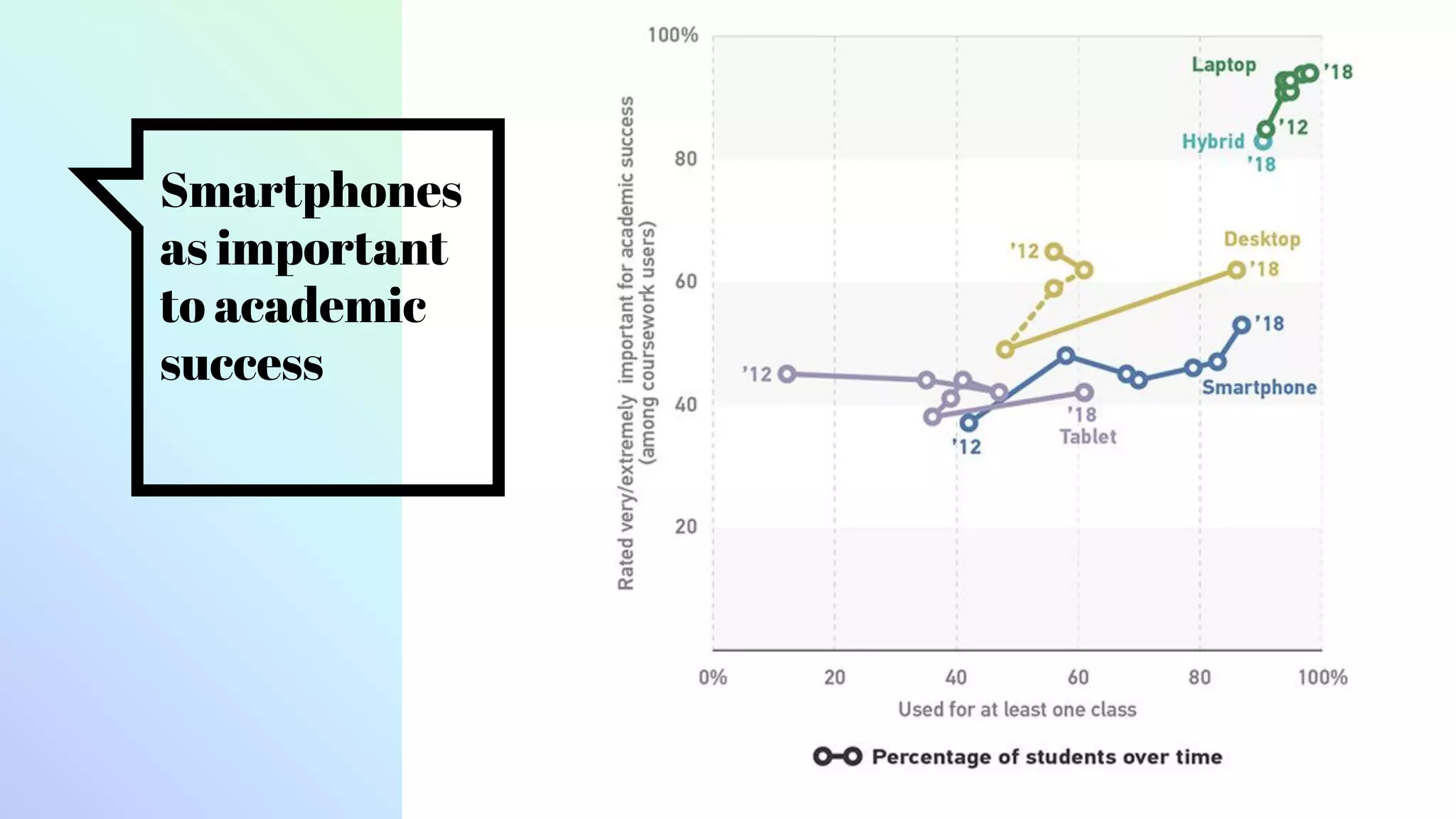
Smartphones
as important
to academic
success
15
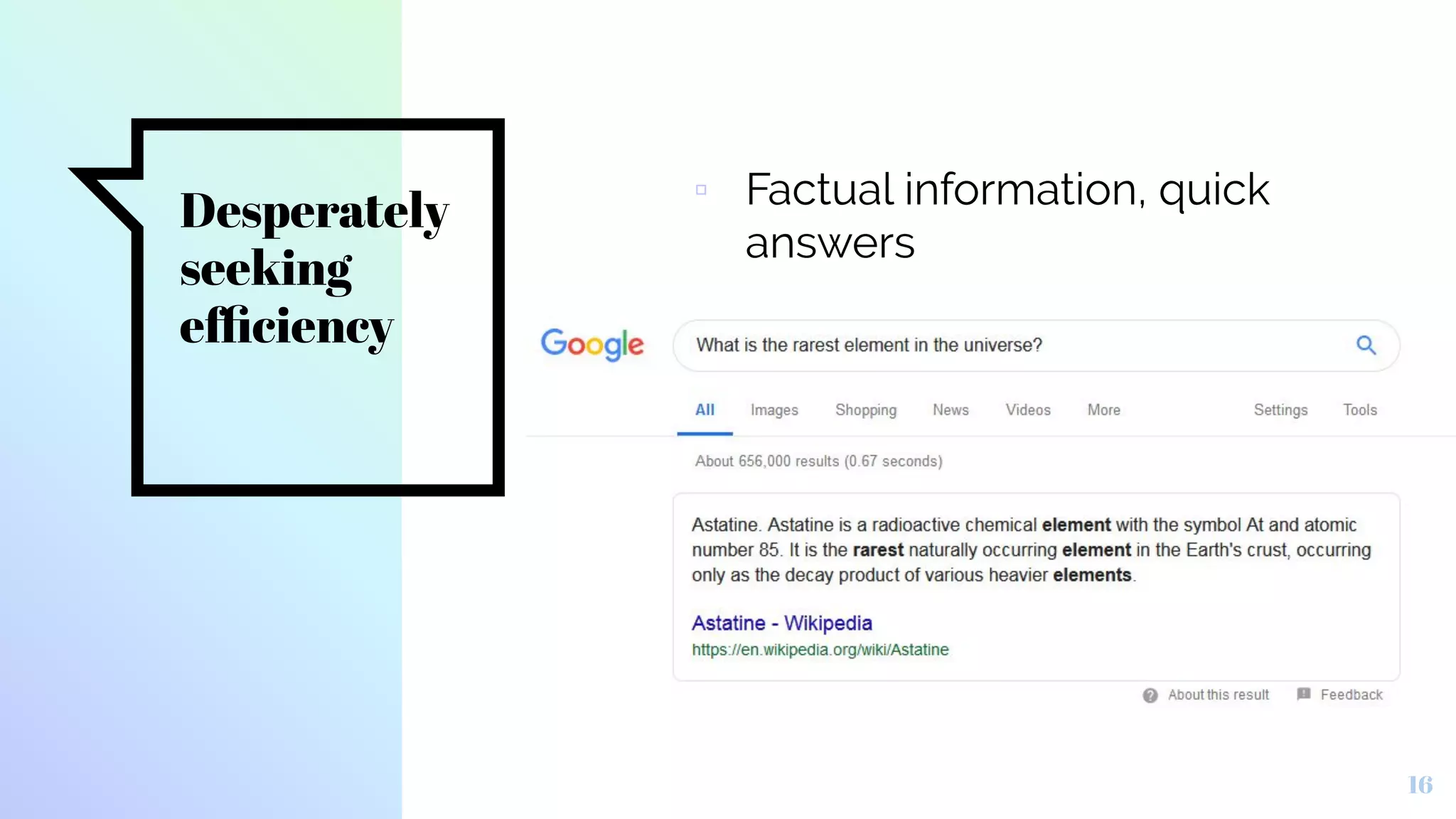
Desperately
seeking
efficiency
▫ Factual information, quick
answers
16
17
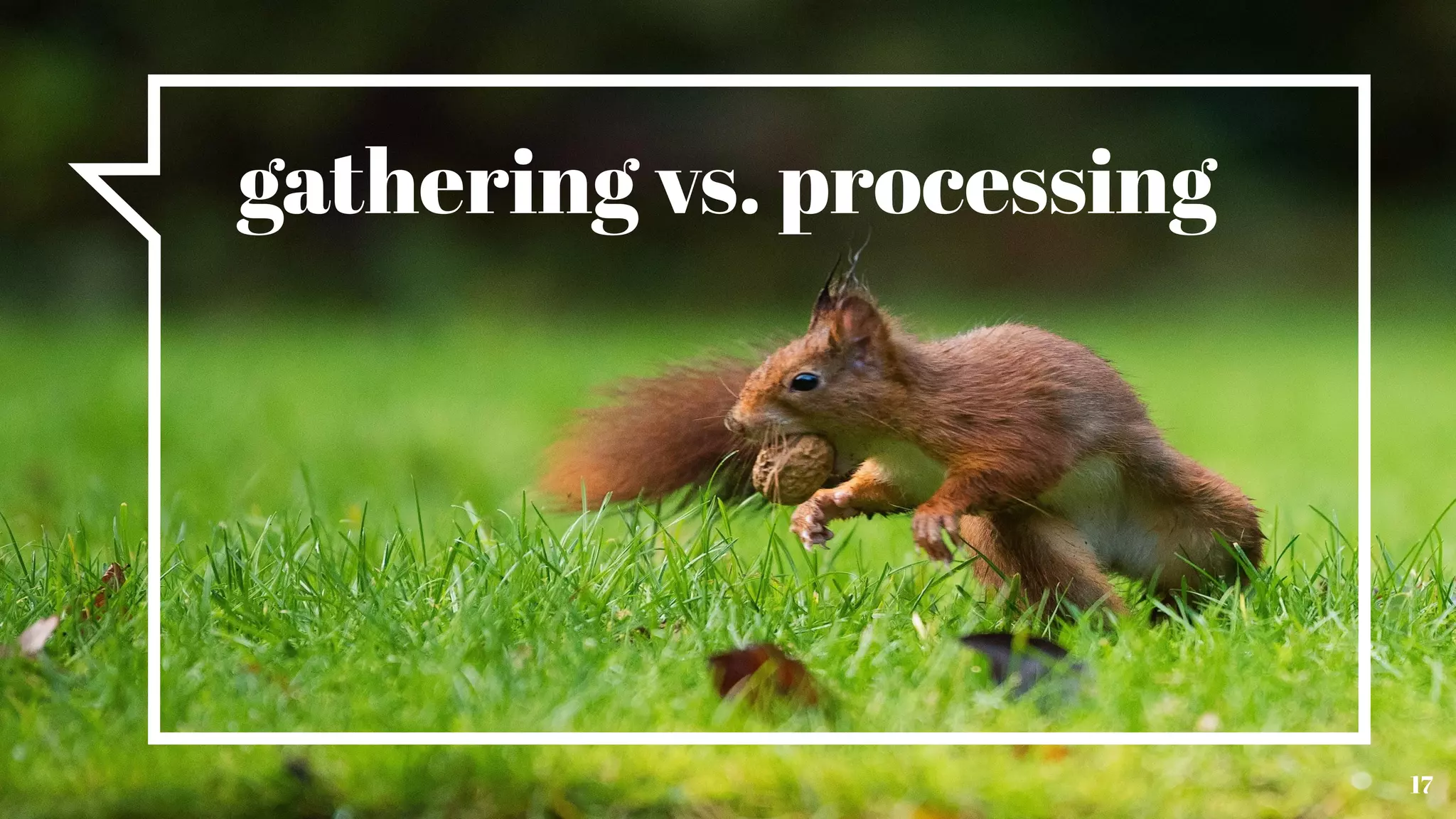
gathering vs. processing
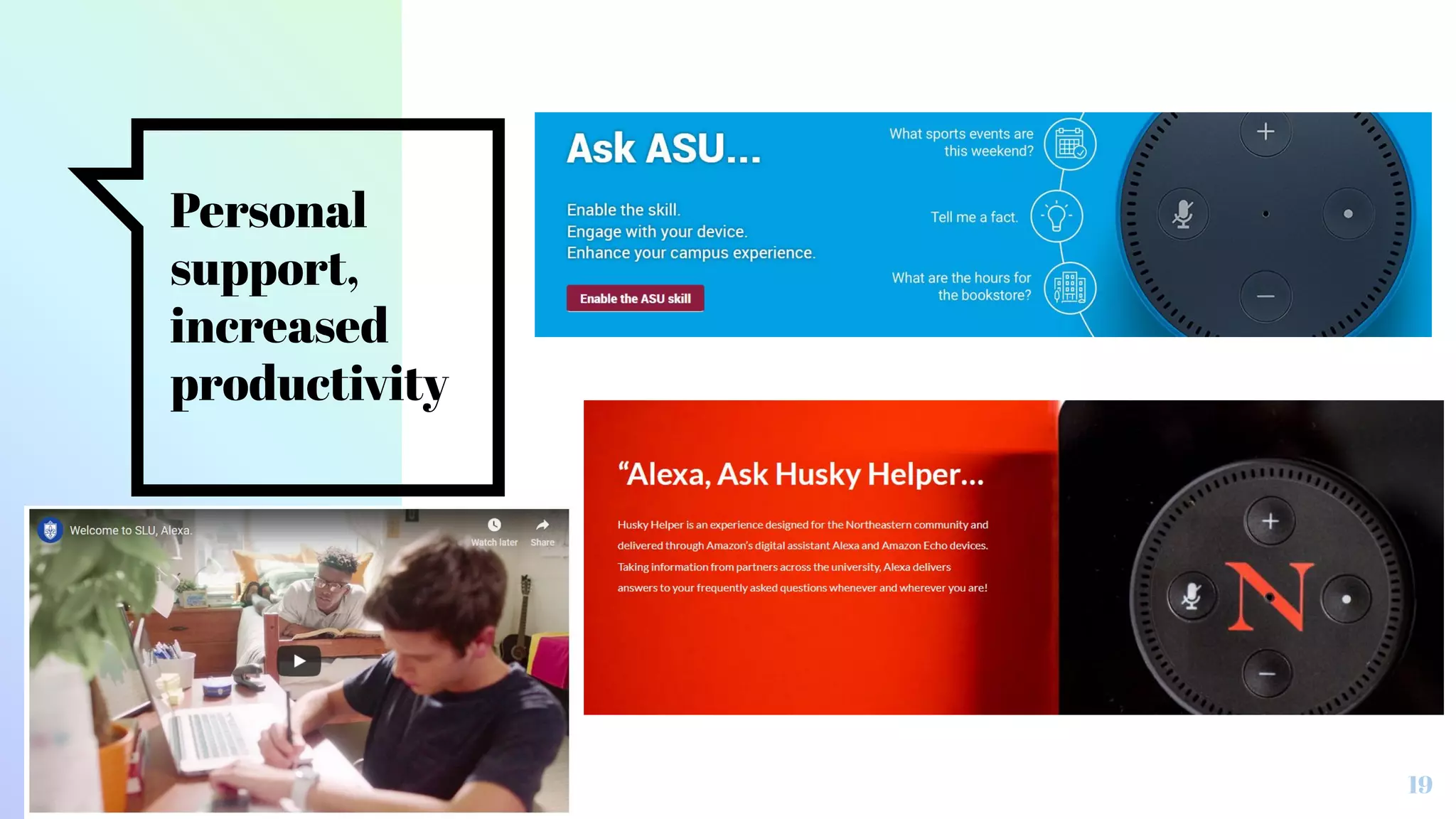
“The University
for You.”
18
Personal
support,
increased
productivity
19
User
hopes
(maybe
expectations?)
20
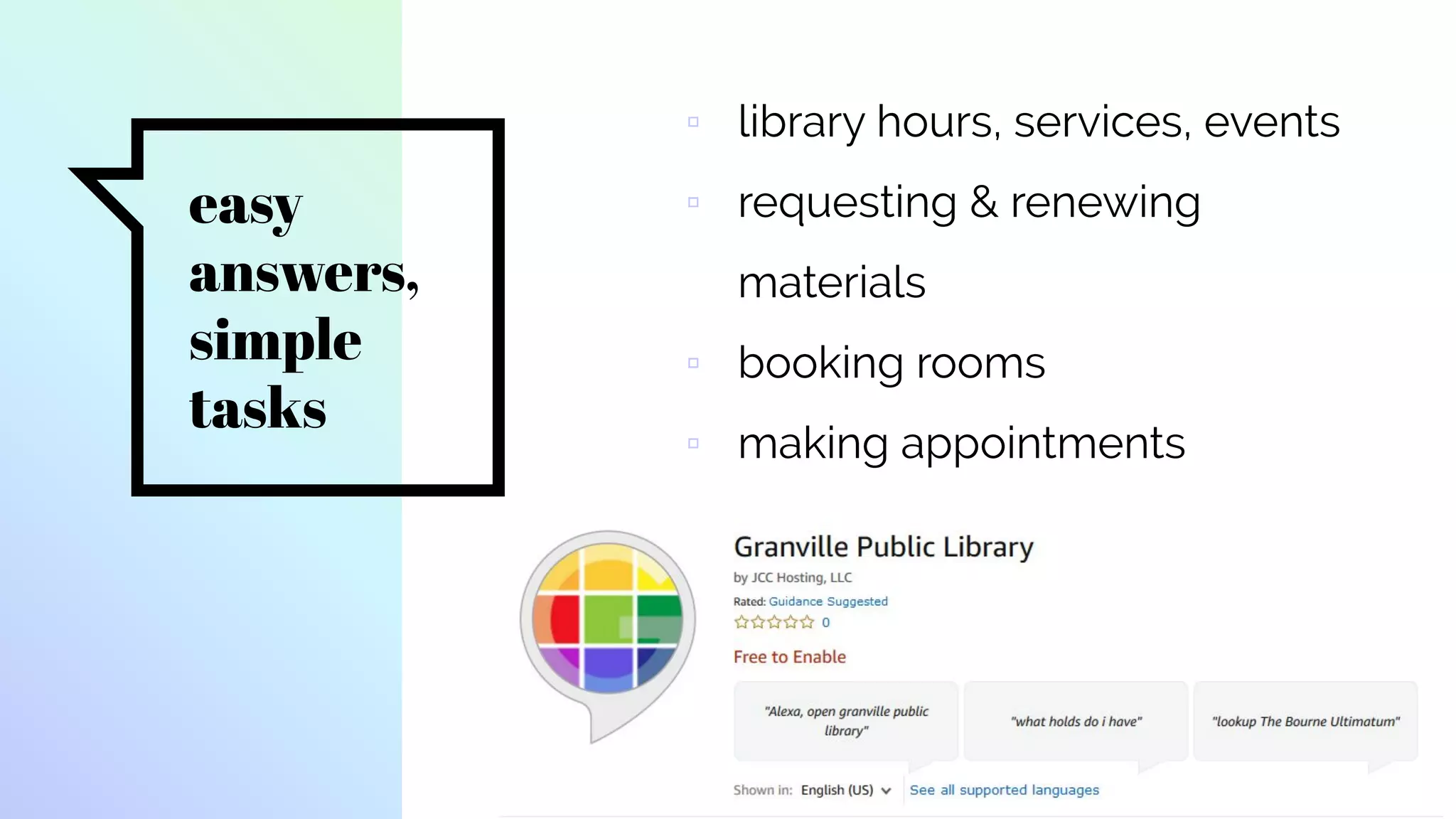
easy
answers,
simple
tasks
▫ library hours, services, events
▫ requesting & renewing
materials
▫ booking rooms
▫ making appointments
research
helper
▫ getting overviews
▫ gathering sources
▫ keeping up to date
▫ “Like having a research
assistant in my phone”
▫ “dream information machine”
Requirements
for UX
23
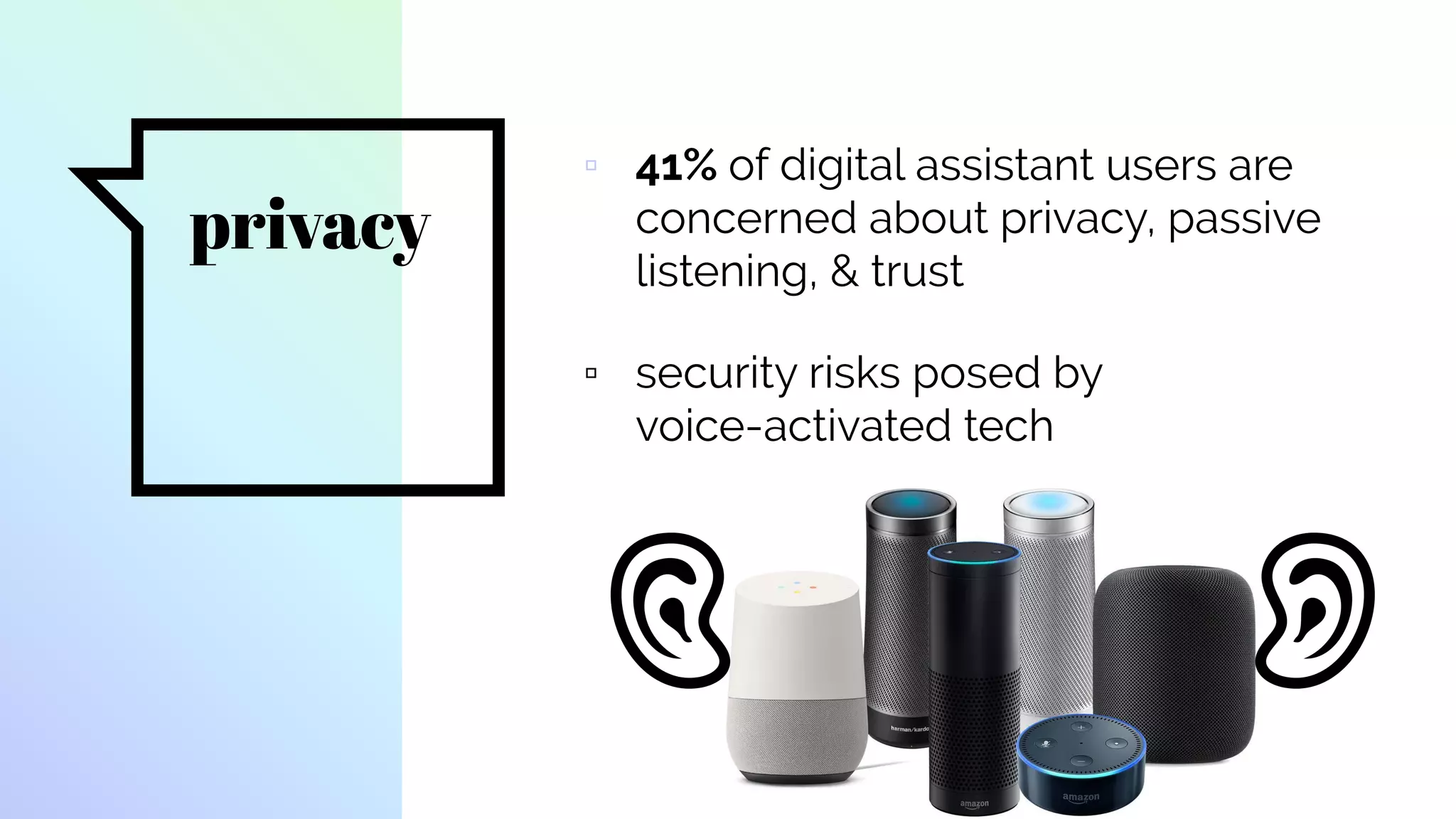
privacy
▫ 41% of digital assistant users are
concerned about privacy, passive
listening, & trust
▫ security risks posed by
voice-activated tech
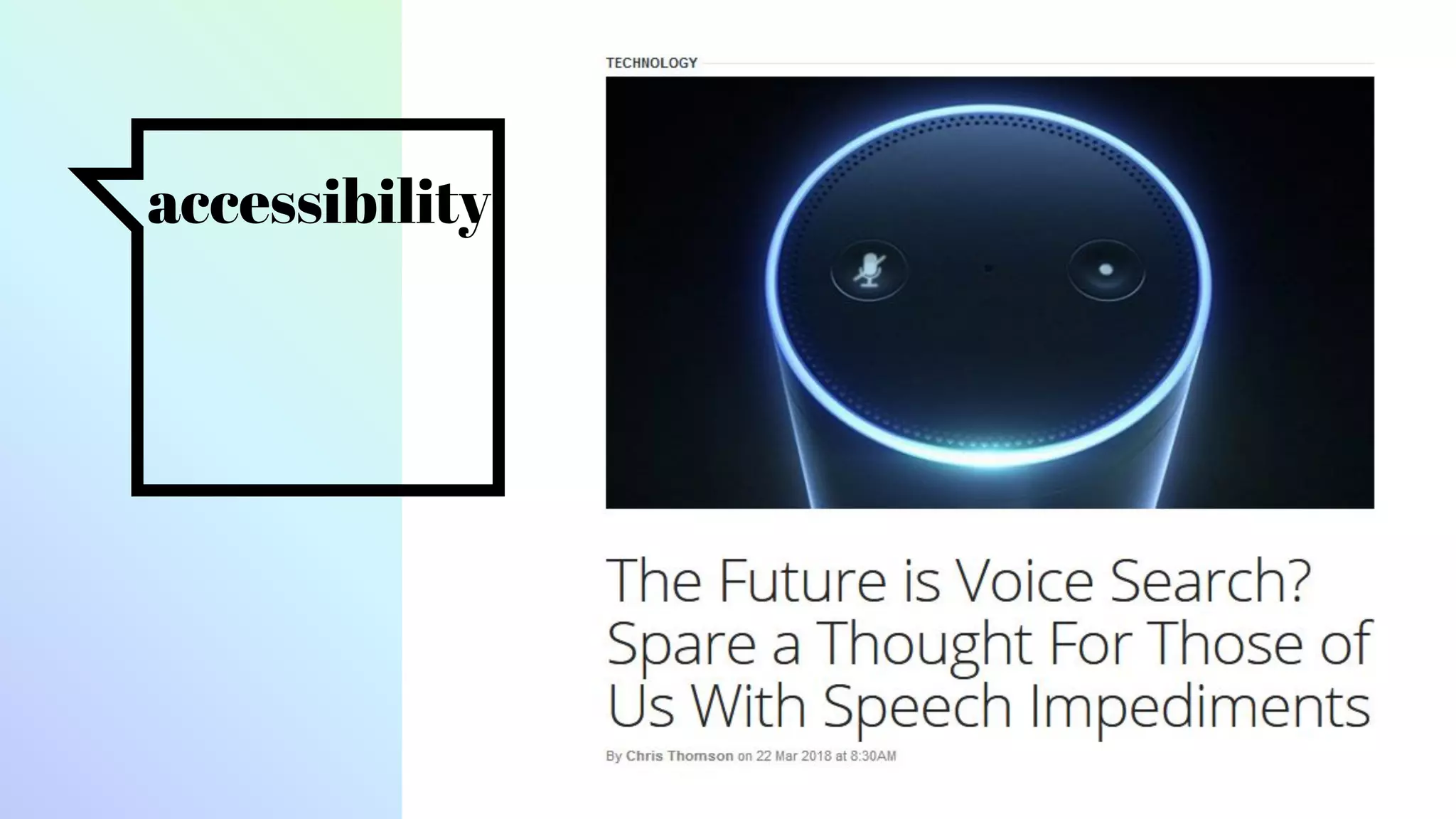
accessibility
transparency
/user control
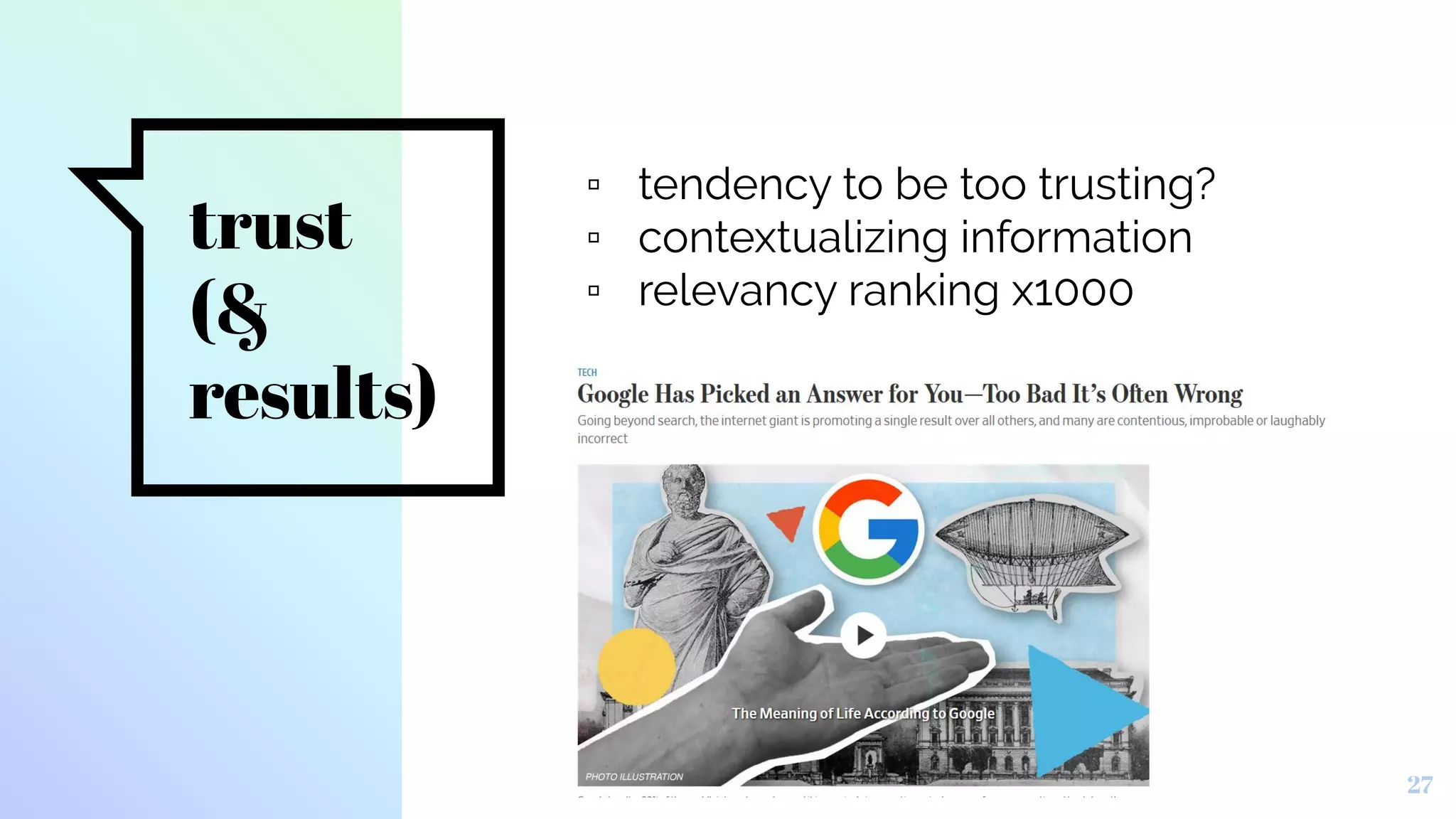
trust
(&
results)
27
▫ tendency to be too trusting?
▫ contextualizing information
▫ relevancy ranking x1000
meeting
expectations
28
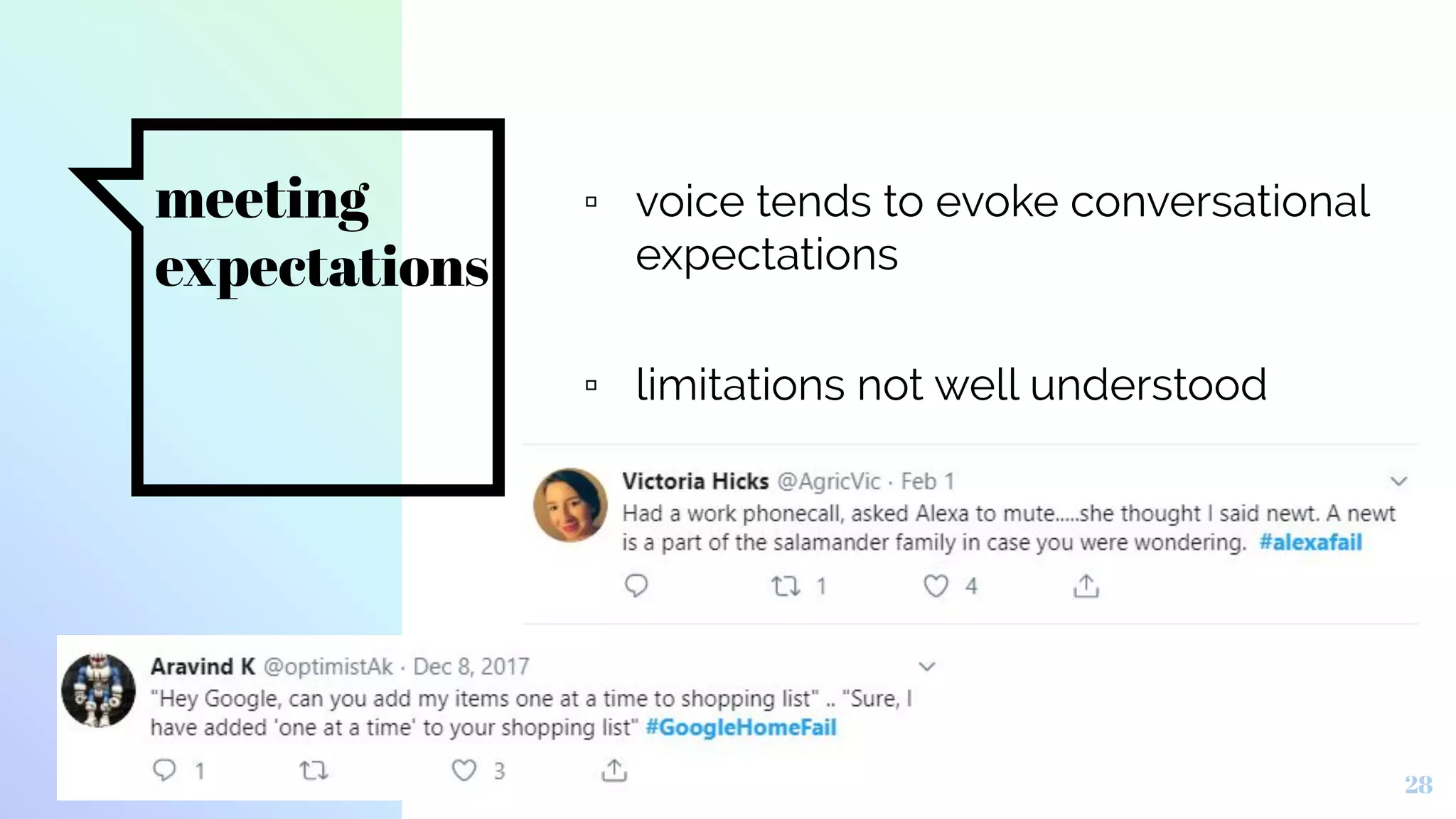
▫ voice tends to evoke conversational
expectations
▫ limitations not well understood
the future
is...
29
Thanks!
Questions?
You can find me at @K4Dag
and kdagan@amherst.edu
30
Credits
Special thanks to all the
people who made and
released these awesome
resources for free:
▫ Presentation template by SlidesCarnival
Image credits:
▫ Ice cream photo by Brooke Lark on Unsplash
▫ Tortoise photo by Nick Abrams on Unsplash
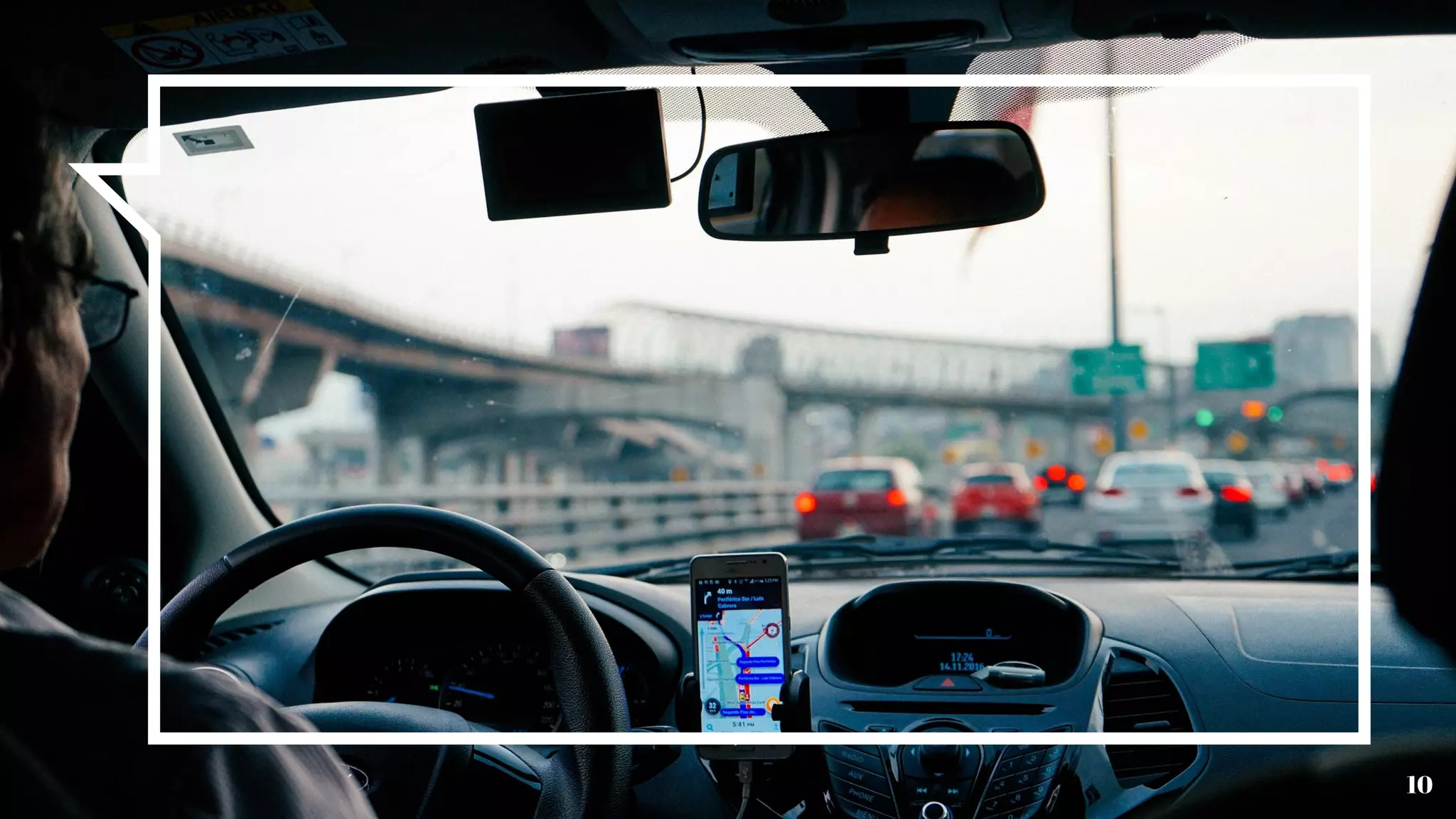
▫ Driving photo by Dan Gold on Unsplash
▫ Robot photo by DJ Johnson on Unsplash
▫ Magic photo by Artem Maltsev on Unsplash
▫ Squirrel photo by Vincent van Zalinge on Unsplash
▫ “Drink coffee: do stupid things faster with more
energy,” Ben Sutherland, Flickr, Attribution-ShareAlike
2.0 Generic (CC BY-SA 2.0) https://www.flickr.com/
photos/bensutherland/6996342959
▫ Box photo by Christian Fregnan on Unsplash
▫ 31
References
▫ Buvat, J., Jacobs, K., Sengupta, A., Taylor, M., Khadikar, A. (2018). Conversational
commerce: Why consumers are embracing voice assistants in their lives.
Capgemini Digital Transformation Institute. Retrieved from
https://www.capgemini.com/consulting/wp-content/uploads/sites/30/2018/01/conve
rsational_commerce_research_report.pdf
▫ Druga, S., Williams, R., Breazeal, C., & Resnick, M. (2017). Hey Google is it OK if I
eat you? Proceedings of the 2017 Conference on Interaction Design and Children.
595-600
▫ Enis, M. (2018). Voice activated: Smart speakers are becoming part of U.S.
households, and there’s a lot that the public needs to know, with libraries well
positioned to help. Library Journal, (6), 28.
▫ Engleson, S. (2017). The future of voice: from smartphones to smart speakers to
smart homes. ComScore.
▫ Galanek, J. D., Gierdowski, D.C., & Brooks, D.C. (2018). ECAR Study of
Undergraduate Students and Information Technology, 2018. Research report.
Louisville, CO: ECAR, October 2018.
▫ Falciani-White, N. (2017). Information behaviors of elite scholars in the context of
academic practice. Journal of Documentation, 73(5), 953–973.
https://doi.org/10.1108/JD-02-2017-0028
▫ Google Data, U.S., Google App, Android, May 2016. Retrieved from
https://www.thinkwithgoogle.com/data/google-app-voice-search/
▫ Hinchliffe, L. J., Griffey, J., King, E., Schofield, M. (2017). Is the Researcher
Human? Is the Librarian? Bots, Conversational User Interfaces, and Virtual
Research Assistants. CNI Spring 2017 Membership Meeting. Retrieved from
https://www.cni.org/topics/information-access-retrieval/is-the-researcher-human-is-
the-librarian-bots-conversational-user-interfaces-and-virtual-research-assistants 32
(more)
References
▫ Huffman, S. (2014, October 14). OMG! Mobile voice survey reveals teens love
to talk. Google Official Blog. Retrieved from:
https://googleblog.blogspot.com/2014/10/omg-mobile-voice-survey-reveals-tee
ns.html
▫ Kleinberg, S. (2018). 5 ways voice assistance is shaping consumer behavior.
Think with Google. Retrieved from https://www.thinkwithgoogle.com
▫ /consumer-insights/voice-assistance-consumer-experience/
▫ Lei X, Tu G-H, Liu AX, et al. (2017). The insecurity of home digital voice
assistants - Amazon Alexa as a case study. Available at
https://arxiv.org/abs/1712.03327
▫ Mander, J., and Buckle, C. (2018). Voice Search: A deep-dive into the
consumer uptake of the voice assistant technology. GlobalWebIndex. Retrieved
from https://www.globalwebindex.com/hubfs/Downloads/
Voice-Search-report.pdf
▫ Mortensen, D. (2019, May 27). Natural user interfaces -- what are they and how
do you design user interfaces that feel natural? Interaction Design Foundation.
Retrieved from https://www.interaction-design.org/literature/
article/natural-user-interfaces-what-are-they-and-how-do-you-design-user-interf
aces-that-feel-natural
▫ Nass, C. I., & Brave, S. (2005). Wired for speech : how voice activates and
advances the human-computer relationship. Cambridge, Mass: MIT Press.
▫ Nicas, J. (2017, Nov 16). Google has picked an answer for you--too bad it's
often wrong. Wall Street Journal (Online)
▫ NPR & Edison Research. (2018). The smart audio report. Retrieved from
https://www.nationalpublicmedia.com/wp-content/uploads/2018/07/Smart-Audio
-Report-from-NPR-and-Edison-Research-Spring-2018_Downloadable-PDF.pdf 33
(even
more!)
References
▫ Olson, C., & Kemery, K. (2019). Voice report: From answers to action:
customer adoption of voice technology and digital assistants. Microsoft &
Bing. Retrieved from
https://advertiseonbing-blob.azureedge.net/blob/bingads/media/insight/whitep
apers/2019/04%20apr/voice-report/bingads_2019_voicereport.pdf
▫ Pew Research Center. (2017). Nearly half of Americans use digital voice
assistants, mostly on their smartphones.Retrieved from:
https://www.pewresearch.org/fact-tank/2017/12/12/nearly-half-of-americans-u
se-digital-voice-assistants-mostly-on-their-smartphones/
▫ Seilhamer, R., Chen, B., Bauer, S., Salter, A., Bennett, L. (2018). Changing
Mobile Learning Practices: A Multiyear Study 2012-2016. Research report.
CC-BY-NC-SA 4.0 Retrieved from https://www.educause.edu
/ecar/research-publications/ecar-study-of-undergraduate-students-and-inform
ation-technology/2018/introduction-and-key-findings
▫ Tate, E. (2018, July 2). Northeastern U. to equip all students with
Alexa-powered devices. edscoop. Retrieved from
https://edscoop.com/northeastern-amazon-echo-dots-alexa-students/
▫ Thomson, C. (2018, March 22). The future is voice search? Spare a thought
for those of us with speech impediments. Gizmodo. Retrieved from
https://www.gizmodo.co.uk/2018/03/the-future-is-voice-search-spare-a-though
t-for-those-of-us-with-speech-impediments/
▫ Vlahos, J. (2019, February 18). “Amazon Alexa and the search for the one
perfect answer.” Wired. Retrieved from https://www.wired.com/story/
amazon-alexa-search-for-the-one-perfect-answer/
▫ Young, N.J. & Seggern, M.V.. (2001). General Information Seeking in
Changing Times: A Focus Group Study. Reference & User Services Quarterly,
41(2), 159. 34

Dagan "'Alexa, get me the articles': user experience and voice interfaces in academia"

  • 1.
    “Alexa, get methe articles”: user experience and voice interfaces in academia Kelly Dagan Research, Instruction, & User Experience Librarian Amherst College Twitter: @K4Dag
  • 2.
    What we’ll cover ▫ types ofvoice interfaces ▫ themes affecting voice search & academic discovery ▫ user hopes & expectations ▫ some UX requirements 2
  • 3.
  • 4.
    Voice user interfaces (VUIs) Input/output Voice isa primary way that users interact with the system Single vs. multi-modal Whether includes another interface mode (screen, touchscreen, physical interface) Voice assistants (Alexa, Siri, Cortana, Google Assistant, Bixby) Form of intelligent personal assistant (IPA) with voice input/output 4
  • 5.
  • 6.
    Some statistics 2014 — 55%of teenagers used voice search more than once/day; 31% used it for “help with homework” 2017 — 46% of Americans use digital voice assistants ▫ 18-49 yr olds: 55% ▫ 50/+ yr olds: 37% 2018 — 25% of smart speaker owners with children say smart speakers are used to get help with homework 6
  • 7.
  • 8.
  • 9.
    “You can type38-40 words per minute on a mobile device, but you can speak at least 150 words per minute” 9
  • 10.
  • 11.
  • 12.
  • 13.
  • 14.
  • 15.
  • 16.
  • 17.
  • 18.
  • 19.
  • 20.
  • 21.
    easy answers, simple tasks ▫ library hours,services, events ▫ requesting & renewing materials ▫ booking rooms ▫ making appointments
  • 22.
    research helper ▫ getting overviews ▫gathering sources ▫ keeping up to date ▫ “Like having a research assistant in my phone” ▫ “dream information machine”
  • 23.
  • 24.
    privacy ▫ 41% ofdigital assistant users are concerned about privacy, passive listening, & trust ▫ security risks posed by voice-activated tech
  • 25.
  • 26.
  • 27.
    trust (& results) 27 ▫ tendency tobe too trusting? ▫ contextualizing information ▫ relevancy ranking x1000
  • 28.
    meeting expectations 28 ▫ voice tendsto evoke conversational expectations ▫ limitations not well understood
  • 29.
  • 30.
    Thanks! Questions? You can findme at @K4Dag and kdagan@amherst.edu 30
  • 31.
    Credits Special thanks toall the people who made and released these awesome resources for free: ▫ Presentation template by SlidesCarnival Image credits: ▫ Ice cream photo by Brooke Lark on Unsplash ▫ Tortoise photo by Nick Abrams on Unsplash ▫ Driving photo by Dan Gold on Unsplash ▫ Robot photo by DJ Johnson on Unsplash ▫ Magic photo by Artem Maltsev on Unsplash ▫ Squirrel photo by Vincent van Zalinge on Unsplash ▫ “Drink coffee: do stupid things faster with more energy,” Ben Sutherland, Flickr, Attribution-ShareAlike 2.0 Generic (CC BY-SA 2.0) https://www.flickr.com/ photos/bensutherland/6996342959 ▫ Box photo by Christian Fregnan on Unsplash ▫ 31
  • 32.
    References ▫ Buvat, J.,Jacobs, K., Sengupta, A., Taylor, M., Khadikar, A. (2018). Conversational commerce: Why consumers are embracing voice assistants in their lives. Capgemini Digital Transformation Institute. Retrieved from https://www.capgemini.com/consulting/wp-content/uploads/sites/30/2018/01/conve rsational_commerce_research_report.pdf ▫ Druga, S., Williams, R., Breazeal, C., & Resnick, M. (2017). Hey Google is it OK if I eat you? Proceedings of the 2017 Conference on Interaction Design and Children. 595-600 ▫ Enis, M. (2018). Voice activated: Smart speakers are becoming part of U.S. households, and there’s a lot that the public needs to know, with libraries well positioned to help. Library Journal, (6), 28. ▫ Engleson, S. (2017). The future of voice: from smartphones to smart speakers to smart homes. ComScore. ▫ Galanek, J. D., Gierdowski, D.C., & Brooks, D.C. (2018). ECAR Study of Undergraduate Students and Information Technology, 2018. Research report. Louisville, CO: ECAR, October 2018. ▫ Falciani-White, N. (2017). Information behaviors of elite scholars in the context of academic practice. Journal of Documentation, 73(5), 953–973. https://doi.org/10.1108/JD-02-2017-0028 ▫ Google Data, U.S., Google App, Android, May 2016. Retrieved from https://www.thinkwithgoogle.com/data/google-app-voice-search/ ▫ Hinchliffe, L. J., Griffey, J., King, E., Schofield, M. (2017). Is the Researcher Human? Is the Librarian? Bots, Conversational User Interfaces, and Virtual Research Assistants. CNI Spring 2017 Membership Meeting. Retrieved from https://www.cni.org/topics/information-access-retrieval/is-the-researcher-human-is- the-librarian-bots-conversational-user-interfaces-and-virtual-research-assistants 32
  • 33.
    (more) References ▫ Huffman, S.(2014, October 14). OMG! Mobile voice survey reveals teens love to talk. Google Official Blog. Retrieved from: https://googleblog.blogspot.com/2014/10/omg-mobile-voice-survey-reveals-tee ns.html ▫ Kleinberg, S. (2018). 5 ways voice assistance is shaping consumer behavior. Think with Google. Retrieved from https://www.thinkwithgoogle.com ▫ /consumer-insights/voice-assistance-consumer-experience/ ▫ Lei X, Tu G-H, Liu AX, et al. (2017). The insecurity of home digital voice assistants - Amazon Alexa as a case study. Available at https://arxiv.org/abs/1712.03327 ▫ Mander, J., and Buckle, C. (2018). Voice Search: A deep-dive into the consumer uptake of the voice assistant technology. GlobalWebIndex. Retrieved from https://www.globalwebindex.com/hubfs/Downloads/ Voice-Search-report.pdf ▫ Mortensen, D. (2019, May 27). Natural user interfaces -- what are they and how do you design user interfaces that feel natural? Interaction Design Foundation. Retrieved from https://www.interaction-design.org/literature/ article/natural-user-interfaces-what-are-they-and-how-do-you-design-user-interf aces-that-feel-natural ▫ Nass, C. I., & Brave, S. (2005). Wired for speech : how voice activates and advances the human-computer relationship. Cambridge, Mass: MIT Press. ▫ Nicas, J. (2017, Nov 16). Google has picked an answer for you--too bad it's often wrong. Wall Street Journal (Online) ▫ NPR & Edison Research. (2018). The smart audio report. Retrieved from https://www.nationalpublicmedia.com/wp-content/uploads/2018/07/Smart-Audio -Report-from-NPR-and-Edison-Research-Spring-2018_Downloadable-PDF.pdf 33
  • 34.
    (even more!) References ▫ Olson, C.,& Kemery, K. (2019). Voice report: From answers to action: customer adoption of voice technology and digital assistants. Microsoft & Bing. Retrieved from https://advertiseonbing-blob.azureedge.net/blob/bingads/media/insight/whitep apers/2019/04%20apr/voice-report/bingads_2019_voicereport.pdf ▫ Pew Research Center. (2017). Nearly half of Americans use digital voice assistants, mostly on their smartphones.Retrieved from: https://www.pewresearch.org/fact-tank/2017/12/12/nearly-half-of-americans-u se-digital-voice-assistants-mostly-on-their-smartphones/ ▫ Seilhamer, R., Chen, B., Bauer, S., Salter, A., Bennett, L. (2018). Changing Mobile Learning Practices: A Multiyear Study 2012-2016. Research report. CC-BY-NC-SA 4.0 Retrieved from https://www.educause.edu /ecar/research-publications/ecar-study-of-undergraduate-students-and-inform ation-technology/2018/introduction-and-key-findings ▫ Tate, E. (2018, July 2). Northeastern U. to equip all students with Alexa-powered devices. edscoop. Retrieved from https://edscoop.com/northeastern-amazon-echo-dots-alexa-students/ ▫ Thomson, C. (2018, March 22). The future is voice search? Spare a thought for those of us with speech impediments. Gizmodo. Retrieved from https://www.gizmodo.co.uk/2018/03/the-future-is-voice-search-spare-a-though t-for-those-of-us-with-speech-impediments/ ▫ Vlahos, J. (2019, February 18). “Amazon Alexa and the search for the one perfect answer.” Wired. Retrieved from https://www.wired.com/story/ amazon-alexa-search-for-the-one-perfect-answer/ ▫ Young, N.J. & Seggern, M.V.. (2001). General Information Seeking in Changing Times: A Focus Group Study. Reference & User Services Quarterly, 41(2), 159. 34