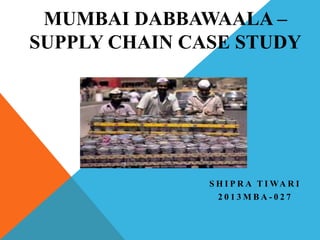
MUMBAI DABBAWAALA –
SUPPLY CHAIN CASE STUDY
S H I P R A T I WA R I
2 0 1 3 M B A - 0 2 7
INTRODUCTION
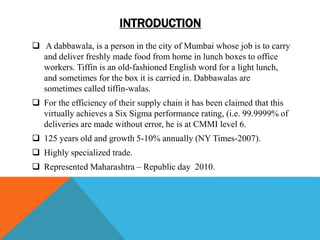
 A dabbawala, is a person in the city of Mumbai whose job is to carry
and deliver freshly made food from home in lunch boxes to office
workers. Tiffin is an old-fashioned English word for a light lunch,
and sometimes for the box it is carried in. Dabbawalas are
sometimes called tiffin-walas.
 For the efficiency of their supply chain it has been claimed that this
virtually achieves a Six Sigma performance rating, (i.e. 99.9999% of
deliveries are made without error, he is at CMMI level 6.
 125 years old and growth 5-10% annually (NY Times-2007).
 Highly specialized trade.
 Represented Maharashtra – Republic day 2010.
CONTENTS
• Three Point Formula
• About NMTBSA
• Some Facts
• Organizational Structure
• Internal Assessment
• Supply Chain and Logistics Study
• Porter’s Five Force Model
• Economic Analysis
• SWOT Analysis
• HR Practices
• Management Learnings
• Competitive Advantage
• Achievements
• Conclusion
THREE POINT FORMULA
 Discipline.
 Code of conduct.
 Hard work.
WHAT IS NMTBSA?
(NUTAN MUMBAI TIFFIN BOX SUPPLIERS ASSOCIATION)
• History : Started in 1890
• Charitable trust : Registered in 1956
• Avg. Literacy Rate : 8th Grade Schooling
• Total area coverage : 60 km
• Employee Strength : 5000
• Number of Tiffin's : 2,00,000 Tiffin Boxes i.e 4,00,000
transactions every day.
• Time taken : 3 hours
FACTS
• Error Rate : 1 in 16 million transactions
• Six Sigma performance (99.999997)
• Technological Backup : Nil.
• Cost of service - Rs. 300/- to 350/- month.
• Standard price for all (Weight, Distance, Space)
• Rs. 70 to 80 Cr. Turnover approximately.
• “No strike” record as each one a share holder
• Earnings - Rs. 5000/- to 6000/- per month.
• Diwali Bonus: One month’s extra payment
from customers.
ORGANISATIONAL STRUCTURE
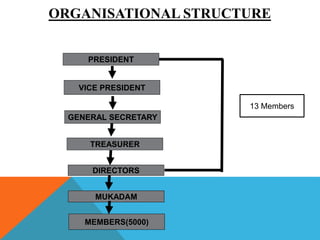
PRESIDENT
VICE PRESIDENT
GENERAL SECRETARY
TREASURER
DIRECTORS
MEMBERS(5000)
MUKADAM
13 Members
A) ZERO % FUEL
B) ZERO % INVESTMENT
C) ZERO % MODERN TECHNOLOGY
D) ZERO % DISPUTES
E) 99.9999% PERFORMANCE
F) 100 % CUSTOMER SATISFACTION
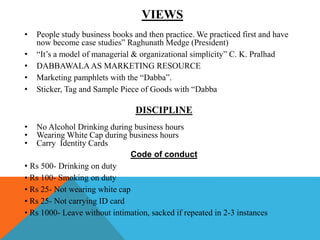
VIEWS
• People study business books and then practice. We practiced first and have
now become case studies” Raghunath Medge (President)
• “It’s a model of managerial & organizational simplicity” C. K. Pralhad
• DABBAWALA AS MARKETING RESOURCE
• Marketing pamphlets with the “Dabba”.
• Sticker, Tag and Sample Piece of Goods with “Dabba
DISCIPLINE
• No Alcohol Drinking during business hours
• Wearing White Cap during business hours
• Carry Identity Cards
Code of conduct
• Rs 500- Drinking on duty
• Rs 100- Smoking on duty
• Rs 25- Not wearing white cap
• Rs 25- Not carrying ID card
• Rs 1000- Leave without intimation, sacked if repeated in 2-3 instances
CASE STUDY : TBSA
TIFFIN BOX SUPPLIERS ASSOCIATION
How do they do it…?
• Operations
• War against Time
(10.30 – 1.00)
• The Code
• Logistics/Supply
Chain
• Internal & External
Assessment
Executive Committee
(5 members)
Teams of 20-25 headed by a
group leader
Individual dabbawallahs
workload: Collect from home –35
tiffins
Delivery at office –35 tiffins
Return empty tiffins to home –35
tiffins
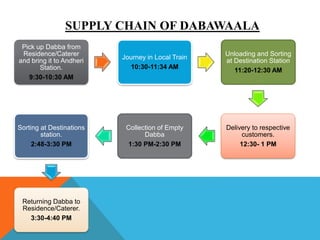
SUPPLY CHAIN OF DABAWAALA
Pick up Dabba from
Residence/Caterer
and bring it to Andheri
Station.
9:30-10:30 AM
Journey in Local Train
10:30-11:34 AM
Unloading and Sorting
at Destination Station
11:20-12:30 AM
Delivery to respective
customers.
12:30- 1 PM
Collection of Empty
Dabba
1:30 PM-2:30 PM
Sorting at Destinations
station.
2:48-3:30 PM
Returning Dabba to
Residence/Caterer.
3:30-4:40 PM
10:34-11:20 am
This time period is actually the journey time. The dabbawalas load the wooden
crates filled with tiffins onto the luggage or goods compartment in the train.
Generally, they choose to occupy the last compartment of the train.
11:20 – 12:30 pm
At this stage, the unloading takes place at the destination station
Re-arrangement of tiffins takes place as per the destination area and
destination building
 In particular areas with high density of customers, a special crate is
dedicated to the area. This crate carries 150 tiffins and is driven by 3-4
dabbawalas!
1:15 – 2:00 pm
Here on begins the collection process where the dabbawalas have to pick up the tiffin's
from the offices where they had delivered almost an hour ago.
RETURN JOURNEY:
2:00 – 2:30 pm
The group members meet for the segregation as per the destination suburb.
2:48 – 3:30 pm
• The return journey by train where the group finally meets up after the day’s routine
of dispatching and collecting from various destination offices.
• Usually, since it is more of a pleasant journey compared to the earlier part of the day,
the dabbawalas lighten up the moment with merry making, joking around and
singing.
3:30 – 4:00 pm
This is the stage where the final sorting and dispatch takes place. The group meets up at
origin station and they finally sort out the tiffin's as per the origin area
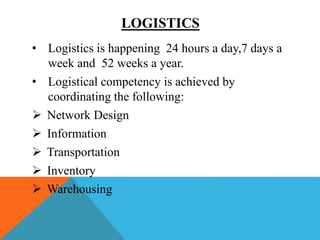
LOGISTICS
• Logistics is happening 24 hours a day,7 days a
week and 52 weeks a year.
• Logistical competency is achieved by
coordinating the following:
 Network Design
 Information
 Transportation
 Inventory
 Warehousing
PORTER’S FIVE FORCE MODEL
COMPETITION
THREAT OF
NEW
ENTRANTS
BARGAINING
POWER OF
SUPPLIERS
THREAT OF
SUBSTITUTES
BARGAINING
POWER OF
BUYERS
• Competition: Its difficult to replicate their supply chain
network
• New entrants: Fast food joints as well as office canteens.
However, since neither of these serve home food, the
dabbawallas' core offering remains unchallenged.
• Bargaining power of buyers: Delivery rates are so nominal
(about Rs 300 per month) that one simply wouldn't bargain
any further.
• Bargaining power of sellers: minimum infrastructure and
practically no technology is used, hence they are not
dependent on suppliers.
• Threat of a new substitute product or service: No
substitutes to home cooked food in Indian scenario, hence
threat to the dabbawalla service is not an issue at least in the
foreseeable future.
ECONOMIC ANALYSIS
• Everyone gets paid about two to four thousand rupees per
month.
• More than 1,75,000 or 2,00,000 lunches get moved every
day by an estimated 4,500 to 5,000 dabbawala.
• Only one mistake in every 6,000,000 deliveries.
• The New York Times reported in 2007 that the 125 year
old dabbawala industry continues to grow at a rate of 5-
10% per year.
SWOT ANALYSIS
Strengths:
• Simplicity in organization with Innovative service
• Coordination, team spirit, & time management
• Low operation cost
• Customer satisfaction
Weaknesses:
• High dependability on local trains
• Funds for the association
• Limited Access to Education
Opportunities
• Wide range publicity
• Operational cost is low
• Catering
Threats
• Indirect competition is being faced from caterers like maharaja community
• Indirect threats from fast foods and hotels
• Change in timings
• Company transport
HR PRACTICES
• Flat organization
• No hire and fire rule
• Community based Recruitment
• Sharing common beliefs, values, ethics
• Following of strict dress code
• Loyalty & trust is their monopoly
• Training provided to the new joiners
• Owner + Employee is the designation of each
• Quarterly Meetings to discuss issues
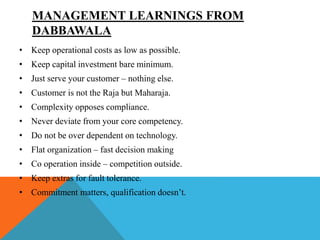
MANAGEMENT LEARNINGS FROM
DABBAWALA
• Keep operational costs as low as possible.
• Keep capital investment bare minimum.
• Just serve your customer – nothing else.
• Customer is not the Raja but Maharaja.
• Complexity opposes compliance.
• Never deviate from your core competency.
• Do not be over dependent on technology.
• Flat organization – fast decision making
• Co operation inside – competition outside.
• Keep extras for fault tolerance.
• Commitment matters, qualification doesn’t.
• Know the implication of failure.
• Build your services around existing infrastructure.
• Abandon bad customers.
• Strike means suicide – labor means life.
• Penalize employees for non compliance.
• Do not transfer your employees very often.
• Keep your employees emotionally united.
• High salary alone cannot retain employees.
• Be humble and do not boast your success.
COMPETITIVE STRATEGY
• Home made food is best for health and because health is
wealth.
• Home made food is cheaper
• Safety - The Local train of Mumbai
• Dabbawalas give reliable services and their performance
and accuracy match six sigma standards
• DabbaWalas never go on strike
• By taking their services you are proving direct
employment to 5000+
• They regularly organize bhajan and kirtans and spread
the essence of Marathi culture , good will and one ness
of India
ACHIEVEMENTS
• Documentaries made by :
BBC ,UTV, MTV, ZEE TV, AAJ TAK, TV TODAY, SAHARA
SAMAY, STAR TV, CNBC TV 18, CNN, SONY TV, TV
TOKYO, NDTV.
• CASE STUDY made by :
ICFAI Press Hyderabad & Bangalore
Richard Ivey School of Business – Canada
Also, Included in a subject in Graduate School of Journalism
University of California, Berkeley
 World record in Best Time Management with Six Sigma rating.
 Name in “GUINESS BOOK of World Records”.
CONCLUSION
• In this highly technologically advanced time
‘dabbawalas’ are working absolutely without
technology. They have an excellent supply chain, despite
the fact that they don’t even know what it means.
• Most of the people working with them are semi-literate
but still they read the tiffin code correctly and deliver it.
• Their attitude of competitive collaboration is equally
unusual, particularly in India. Their excellent sense of
deep commitment, sense of work ethics and unparalleled
time management system are best in place.
REFERENCES
• Nishesh Patel (EMBA 2006) Naveen Vedula (EMBA 2006) ,
DABBAWALAS OF MUMBAI
• Amberish K Diwanji, "Dabbawallahs: Mumbai's best managed business",
Rediff.com, November 4, 2003
• Chakravarty, Subrata N. "Fast food." Forbes. 10 Aug. 1998. Forbes
Magazine. 21 Sept. 2013
http://www.forbes.com/global/1998/0810/0109078a.html.
• http://en.wikipedia.org/wiki/Dabbawala
• Mumbai's amazing Dabbawalas.Rediff.com (November 11, 2005).
• Mydabbawala.com: Accolades To Dabbawala
THANK YOU!!

Dabbawala case study

  • 1.
    MUMBAI DABBAWAALA – SUPPLYCHAIN CASE STUDY S H I P R A T I WA R I 2 0 1 3 M B A - 0 2 7
  • 2.
    INTRODUCTION  A dabbawala,is a person in the city of Mumbai whose job is to carry and deliver freshly made food from home in lunch boxes to office workers. Tiffin is an old-fashioned English word for a light lunch, and sometimes for the box it is carried in. Dabbawalas are sometimes called tiffin-walas.  For the efficiency of their supply chain it has been claimed that this virtually achieves a Six Sigma performance rating, (i.e. 99.9999% of deliveries are made without error, he is at CMMI level 6.  125 years old and growth 5-10% annually (NY Times-2007).  Highly specialized trade.  Represented Maharashtra – Republic day 2010.
  • 3.
    CONTENTS • Three PointFormula • About NMTBSA • Some Facts • Organizational Structure • Internal Assessment • Supply Chain and Logistics Study • Porter’s Five Force Model • Economic Analysis • SWOT Analysis • HR Practices • Management Learnings • Competitive Advantage • Achievements • Conclusion
  • 4.
    THREE POINT FORMULA Discipline.  Code of conduct.  Hard work.
  • 5.
    WHAT IS NMTBSA? (NUTANMUMBAI TIFFIN BOX SUPPLIERS ASSOCIATION) • History : Started in 1890 • Charitable trust : Registered in 1956 • Avg. Literacy Rate : 8th Grade Schooling • Total area coverage : 60 km • Employee Strength : 5000 • Number of Tiffin's : 2,00,000 Tiffin Boxes i.e 4,00,000 transactions every day. • Time taken : 3 hours
  • 6.
    FACTS • Error Rate: 1 in 16 million transactions • Six Sigma performance (99.999997) • Technological Backup : Nil. • Cost of service - Rs. 300/- to 350/- month. • Standard price for all (Weight, Distance, Space) • Rs. 70 to 80 Cr. Turnover approximately. • “No strike” record as each one a share holder • Earnings - Rs. 5000/- to 6000/- per month. • Diwali Bonus: One month’s extra payment from customers.
  • 7.
    ORGANISATIONAL STRUCTURE PRESIDENT VICE PRESIDENT GENERALSECRETARY TREASURER DIRECTORS MEMBERS(5000) MUKADAM 13 Members
  • 8.
    A) ZERO %FUEL B) ZERO % INVESTMENT C) ZERO % MODERN TECHNOLOGY D) ZERO % DISPUTES E) 99.9999% PERFORMANCE F) 100 % CUSTOMER SATISFACTION
  • 9.
    VIEWS • People studybusiness books and then practice. We practiced first and have now become case studies” Raghunath Medge (President) • “It’s a model of managerial & organizational simplicity” C. K. Pralhad • DABBAWALA AS MARKETING RESOURCE • Marketing pamphlets with the “Dabba”. • Sticker, Tag and Sample Piece of Goods with “Dabba DISCIPLINE • No Alcohol Drinking during business hours • Wearing White Cap during business hours • Carry Identity Cards Code of conduct • Rs 500- Drinking on duty • Rs 100- Smoking on duty • Rs 25- Not wearing white cap • Rs 25- Not carrying ID card • Rs 1000- Leave without intimation, sacked if repeated in 2-3 instances
  • 10.
    CASE STUDY :TBSA TIFFIN BOX SUPPLIERS ASSOCIATION How do they do it…? • Operations • War against Time (10.30 – 1.00) • The Code • Logistics/Supply Chain • Internal & External Assessment Executive Committee (5 members) Teams of 20-25 headed by a group leader Individual dabbawallahs workload: Collect from home –35 tiffins Delivery at office –35 tiffins Return empty tiffins to home –35 tiffins
  • 11.
    SUPPLY CHAIN OFDABAWAALA Pick up Dabba from Residence/Caterer and bring it to Andheri Station. 9:30-10:30 AM Journey in Local Train 10:30-11:34 AM Unloading and Sorting at Destination Station 11:20-12:30 AM Delivery to respective customers. 12:30- 1 PM Collection of Empty Dabba 1:30 PM-2:30 PM Sorting at Destinations station. 2:48-3:30 PM Returning Dabba to Residence/Caterer. 3:30-4:40 PM
  • 12.
    10:34-11:20 am This timeperiod is actually the journey time. The dabbawalas load the wooden crates filled with tiffins onto the luggage or goods compartment in the train. Generally, they choose to occupy the last compartment of the train. 11:20 – 12:30 pm At this stage, the unloading takes place at the destination station Re-arrangement of tiffins takes place as per the destination area and destination building  In particular areas with high density of customers, a special crate is dedicated to the area. This crate carries 150 tiffins and is driven by 3-4 dabbawalas!
  • 13.
    1:15 – 2:00pm Here on begins the collection process where the dabbawalas have to pick up the tiffin's from the offices where they had delivered almost an hour ago. RETURN JOURNEY: 2:00 – 2:30 pm The group members meet for the segregation as per the destination suburb. 2:48 – 3:30 pm • The return journey by train where the group finally meets up after the day’s routine of dispatching and collecting from various destination offices. • Usually, since it is more of a pleasant journey compared to the earlier part of the day, the dabbawalas lighten up the moment with merry making, joking around and singing. 3:30 – 4:00 pm This is the stage where the final sorting and dispatch takes place. The group meets up at origin station and they finally sort out the tiffin's as per the origin area
  • 14.
    LOGISTICS • Logistics ishappening 24 hours a day,7 days a week and 52 weeks a year. • Logistical competency is achieved by coordinating the following:  Network Design  Information  Transportation  Inventory  Warehousing
  • 18.
    PORTER’S FIVE FORCEMODEL COMPETITION THREAT OF NEW ENTRANTS BARGAINING POWER OF SUPPLIERS THREAT OF SUBSTITUTES BARGAINING POWER OF BUYERS
  • 19.
    • Competition: Itsdifficult to replicate their supply chain network • New entrants: Fast food joints as well as office canteens. However, since neither of these serve home food, the dabbawallas' core offering remains unchallenged. • Bargaining power of buyers: Delivery rates are so nominal (about Rs 300 per month) that one simply wouldn't bargain any further. • Bargaining power of sellers: minimum infrastructure and practically no technology is used, hence they are not dependent on suppliers. • Threat of a new substitute product or service: No substitutes to home cooked food in Indian scenario, hence threat to the dabbawalla service is not an issue at least in the foreseeable future.
  • 20.
    ECONOMIC ANALYSIS • Everyonegets paid about two to four thousand rupees per month. • More than 1,75,000 or 2,00,000 lunches get moved every day by an estimated 4,500 to 5,000 dabbawala. • Only one mistake in every 6,000,000 deliveries. • The New York Times reported in 2007 that the 125 year old dabbawala industry continues to grow at a rate of 5- 10% per year.
  • 21.
    SWOT ANALYSIS Strengths: • Simplicityin organization with Innovative service • Coordination, team spirit, & time management • Low operation cost • Customer satisfaction Weaknesses: • High dependability on local trains • Funds for the association • Limited Access to Education Opportunities • Wide range publicity • Operational cost is low • Catering Threats • Indirect competition is being faced from caterers like maharaja community • Indirect threats from fast foods and hotels • Change in timings • Company transport
  • 22.
    HR PRACTICES • Flatorganization • No hire and fire rule • Community based Recruitment • Sharing common beliefs, values, ethics • Following of strict dress code • Loyalty & trust is their monopoly • Training provided to the new joiners • Owner + Employee is the designation of each • Quarterly Meetings to discuss issues
  • 23.
    MANAGEMENT LEARNINGS FROM DABBAWALA •Keep operational costs as low as possible. • Keep capital investment bare minimum. • Just serve your customer – nothing else. • Customer is not the Raja but Maharaja. • Complexity opposes compliance. • Never deviate from your core competency. • Do not be over dependent on technology. • Flat organization – fast decision making • Co operation inside – competition outside. • Keep extras for fault tolerance. • Commitment matters, qualification doesn’t.
  • 24.
    • Know theimplication of failure. • Build your services around existing infrastructure. • Abandon bad customers. • Strike means suicide – labor means life. • Penalize employees for non compliance. • Do not transfer your employees very often. • Keep your employees emotionally united. • High salary alone cannot retain employees. • Be humble and do not boast your success.
  • 25.
    COMPETITIVE STRATEGY • Homemade food is best for health and because health is wealth. • Home made food is cheaper • Safety - The Local train of Mumbai • Dabbawalas give reliable services and their performance and accuracy match six sigma standards • DabbaWalas never go on strike • By taking their services you are proving direct employment to 5000+ • They regularly organize bhajan and kirtans and spread the essence of Marathi culture , good will and one ness of India
  • 26.
    ACHIEVEMENTS • Documentaries madeby : BBC ,UTV, MTV, ZEE TV, AAJ TAK, TV TODAY, SAHARA SAMAY, STAR TV, CNBC TV 18, CNN, SONY TV, TV TOKYO, NDTV. • CASE STUDY made by : ICFAI Press Hyderabad & Bangalore Richard Ivey School of Business – Canada Also, Included in a subject in Graduate School of Journalism University of California, Berkeley  World record in Best Time Management with Six Sigma rating.  Name in “GUINESS BOOK of World Records”.
  • 27.
    CONCLUSION • In thishighly technologically advanced time ‘dabbawalas’ are working absolutely without technology. They have an excellent supply chain, despite the fact that they don’t even know what it means. • Most of the people working with them are semi-literate but still they read the tiffin code correctly and deliver it. • Their attitude of competitive collaboration is equally unusual, particularly in India. Their excellent sense of deep commitment, sense of work ethics and unparalleled time management system are best in place.
  • 28.
    REFERENCES • Nishesh Patel(EMBA 2006) Naveen Vedula (EMBA 2006) , DABBAWALAS OF MUMBAI • Amberish K Diwanji, "Dabbawallahs: Mumbai's best managed business", Rediff.com, November 4, 2003 • Chakravarty, Subrata N. "Fast food." Forbes. 10 Aug. 1998. Forbes Magazine. 21 Sept. 2013 http://www.forbes.com/global/1998/0810/0109078a.html. • http://en.wikipedia.org/wiki/Dabbawala • Mumbai's amazing Dabbawalas.Rediff.com (November 11, 2005). • Mydabbawala.com: Accolades To Dabbawala
  • 29.