EWRT 1A
Day 19
Almost there!
Agenda
 MLA style quiz game!
 Review: Essay #4:
 The Problem
 The Solution
 New
 The Counterargument
 The Alternative Solutions
MLA Style Game!
 Play in your Houses.
 Someone in your House must have a
smart phone or laptop.
 You will need a good view of the
projection screen at the front.
 Each House will receive the (adjusted)
number of House points they score.
 https://play.kahoot.it/#/k/e784cd46-0f16-
437d-b669-d61be4e9327d
 You should go to: http://kahoot.it
Essay #4
Looking at the parts of the essay
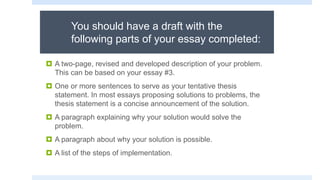
You should have a draft with the
following parts of your essay completed:
 A two-page, revised and developed description of your problem.
This can be based on your essay #3.
 One or more sentences to serve as your tentative thesis
statement. In most essays proposing solutions to problems, the
thesis statement is a concise announcement of the solution.
 A paragraph explaining why your solution would solve the
problem.
 A paragraph about why your solution is possible.
 A list of the steps of implementation.
Presentation of the problem: Read (yes, right
now) this section of your essay. Make sure you
have included the following:
Compelling evidence that shows that the
problem exists and that it is serious
A clear discussion of the cause or causes
of this problem.
A clear discussion of the consequences of
failing to solve this problem.
Thesis Statement: Review
 You have probably written your thesis statement already. If so, refine
it, and make sure you have included it in your draft. If not, write it in
right now. Your thesis goes after a thorough explanation of the
problem.
 If you have not yet written it, write one or more sentences to serve
as your tentative thesis statement. In most essays proposing
solutions to problems, the thesis statement is a concise
announcement of the solution. Think about how emphatic you
should make the thesis and whether you should forecast your
reasons.
 How can you transition from the conclusion of your Paper 3 into
your thesis statement?
Description of the proposed solution
Read your working draft of your proposed
solution.
Have you explained how or why it would solve
the problem? If not, make notes here. If yes,
read and revise.
Have you explained how or why your solution
is possible. If not, make notes here. If yes,
read and revise.
We will address the steps of implementation next, so don’t
worry about that section quite yet.
List of steps for implementing the solution
 You should have written out these steps for your
homework. Read what you have, making sure you
have included each part.
 Now, put your steps into paragraph form. Make
sure to use transitions and connecting words so
the paragraph does not read like a list. Explain
exactly what you mean as you go through the
steps.
Planning a
Counterargument
Anticipate Objections.
Remember, you write a counterargument that addresses objections readers might have to your solution.
Write a few sentences responding to the following objections you think are most likely. For homework,
you will further develop your ideas.
 We can’t afford your solution.
 Your solution would take too long to implement or to show results.
 People would not accept your solution, or they would not participate in it.
 Too few would benefit from your solution.
 You would benefit personally from your solution.
 We already tried your solution, with unsatisfactory results.
Consider Alternative Solutions
This requires thinking! Remember, ultimately, you are going to show why your
solution is better than these alternatives!
Considering Alternative Solutions
List two or three alternative solutions. You may have
discovered these alternatives while you were looking for
a good solution. You may have found alternative
solutions when you did your research. You do not have
to list every solution that has been mentioned, but you
should include the most popular or serious alternatives.
If you include only obviously weak solutions in your
argument, your credibility will be harmed and you could
be accused of committing the straw man fallacy, which
involves directing your counterargument against an
alternative that nobody takes seriously anyway.
Developing your evaluation of alternative solutions
Write a paragraph for each alternative solution you think you should include in your
argument. Describe the alternative solution fairly, quoting supporters if possible.
Then work out the reasons you believe the alternative solution. You will further
develop your ideas for your homework.
 The alternative solution would not be feasible,
 The alternative solution would not solve the problem,
 The alternative solution would not be approved,
 The alternative solution would be hard to implement, or
 The alternative solution would be too costly, disruptive, or time-consuming to put
into effect.
Plan Follow-Up Research.
Make notes about the kinds of
information you think would help
make your counterargument
convincing for your readers and
where you think you can find this
information.
Homework for Thursday
 Discussion #23 Post a paragraph addressing at
least one counterargument.
 Discussion #24 Post a paragraph addressing at
least one alternative solution.
 Put all of the parts of your essay into the outline we
wrote today. Read your essay aloud to make sure it
is in a logical order. Integrate your research into
your essay. Begin your works cited page.
 Bring a copy of posts #23 & #24

D19-EWRT 1A

  • 1.
  • 2.
    Agenda  MLA stylequiz game!  Review: Essay #4:  The Problem  The Solution  New  The Counterargument  The Alternative Solutions
  • 3.
    MLA Style Game! Play in your Houses.  Someone in your House must have a smart phone or laptop.  You will need a good view of the projection screen at the front.  Each House will receive the (adjusted) number of House points they score.  https://play.kahoot.it/#/k/e784cd46-0f16- 437d-b669-d61be4e9327d  You should go to: http://kahoot.it
  • 4.
    Essay #4 Looking atthe parts of the essay
  • 5.
    You should havea draft with the following parts of your essay completed:  A two-page, revised and developed description of your problem. This can be based on your essay #3.  One or more sentences to serve as your tentative thesis statement. In most essays proposing solutions to problems, the thesis statement is a concise announcement of the solution.  A paragraph explaining why your solution would solve the problem.  A paragraph about why your solution is possible.  A list of the steps of implementation.
  • 6.
    Presentation of theproblem: Read (yes, right now) this section of your essay. Make sure you have included the following: Compelling evidence that shows that the problem exists and that it is serious A clear discussion of the cause or causes of this problem. A clear discussion of the consequences of failing to solve this problem.
  • 7.
    Thesis Statement: Review You have probably written your thesis statement already. If so, refine it, and make sure you have included it in your draft. If not, write it in right now. Your thesis goes after a thorough explanation of the problem.  If you have not yet written it, write one or more sentences to serve as your tentative thesis statement. In most essays proposing solutions to problems, the thesis statement is a concise announcement of the solution. Think about how emphatic you should make the thesis and whether you should forecast your reasons.  How can you transition from the conclusion of your Paper 3 into your thesis statement?
  • 8.
    Description of theproposed solution Read your working draft of your proposed solution. Have you explained how or why it would solve the problem? If not, make notes here. If yes, read and revise. Have you explained how or why your solution is possible. If not, make notes here. If yes, read and revise. We will address the steps of implementation next, so don’t worry about that section quite yet.
  • 9.
    List of stepsfor implementing the solution  You should have written out these steps for your homework. Read what you have, making sure you have included each part.  Now, put your steps into paragraph form. Make sure to use transitions and connecting words so the paragraph does not read like a list. Explain exactly what you mean as you go through the steps.
  • 10.
  • 11.
    Anticipate Objections. Remember, youwrite a counterargument that addresses objections readers might have to your solution. Write a few sentences responding to the following objections you think are most likely. For homework, you will further develop your ideas.  We can’t afford your solution.  Your solution would take too long to implement or to show results.  People would not accept your solution, or they would not participate in it.  Too few would benefit from your solution.  You would benefit personally from your solution.  We already tried your solution, with unsatisfactory results.
  • 12.
    Consider Alternative Solutions Thisrequires thinking! Remember, ultimately, you are going to show why your solution is better than these alternatives!
  • 13.
    Considering Alternative Solutions Listtwo or three alternative solutions. You may have discovered these alternatives while you were looking for a good solution. You may have found alternative solutions when you did your research. You do not have to list every solution that has been mentioned, but you should include the most popular or serious alternatives. If you include only obviously weak solutions in your argument, your credibility will be harmed and you could be accused of committing the straw man fallacy, which involves directing your counterargument against an alternative that nobody takes seriously anyway.
  • 14.
    Developing your evaluationof alternative solutions Write a paragraph for each alternative solution you think you should include in your argument. Describe the alternative solution fairly, quoting supporters if possible. Then work out the reasons you believe the alternative solution. You will further develop your ideas for your homework.  The alternative solution would not be feasible,  The alternative solution would not solve the problem,  The alternative solution would not be approved,  The alternative solution would be hard to implement, or  The alternative solution would be too costly, disruptive, or time-consuming to put into effect.
  • 15.
    Plan Follow-Up Research. Makenotes about the kinds of information you think would help make your counterargument convincing for your readers and where you think you can find this information.
  • 16.
    Homework for Thursday Discussion #23 Post a paragraph addressing at least one counterargument.  Discussion #24 Post a paragraph addressing at least one alternative solution.  Put all of the parts of your essay into the outline we wrote today. Read your essay aloud to make sure it is in a logical order. Integrate your research into your essay. Begin your works cited page.  Bring a copy of posts #23 & #24