Secure your Digital
Presence with the
highest level of
Cyber Protection
Cyber-attacks are an alarming threat to all types of businesses & organizations.
The risk of a cyber-attack is not just a risk to your company but also to your privacy.
Hence, cybersecurity is crucial for every business.
If you are looking for tools to fight against cyber threats,
then Techwave's tools & technologies with adequate controls
will help your organization stay protected.
Index
1) Introduction
2) Why is Cybersecurity important?
3) Cybersecurity Governance
a) Principles
4) Cybersecurity Strategies
a) Defense-in-Depth
b) Digital Certificate
5) Techwave’s approach to Cyber Attacks
a) Techwave Cybersecurity Solutions
01
01
02
03
05
05
06
07
08
Cybersecurity protects critical data from cyber attackers. This includes sensitive data, governmental
and industry information, personal information, personally identifiable information (PII), intellectual
property, and protected health information (PHI).
Introduction
Why is Cybersecurity Important?
Cyberattacks have become increasingly
common and severe over the past few years.
Hence, cybersecurity is a crucial concern for
businesses today, particularly for small and
medium enterprises.
The reports show that cyber-attacks are
widespread, and the cost of recovery can be
crippling for a small business. Hence, it's not
surprising that several SMEs collapse post a
cyber-attack.
Thus, ignoring crucial steps for data protection
could put your entire company at risk.
Also, the stake for businesses has grown
exponentially, making it essential for everyone in
the company, from the CEO to entry-level
employees, to be aware of cybersecurity risks
and best practices.
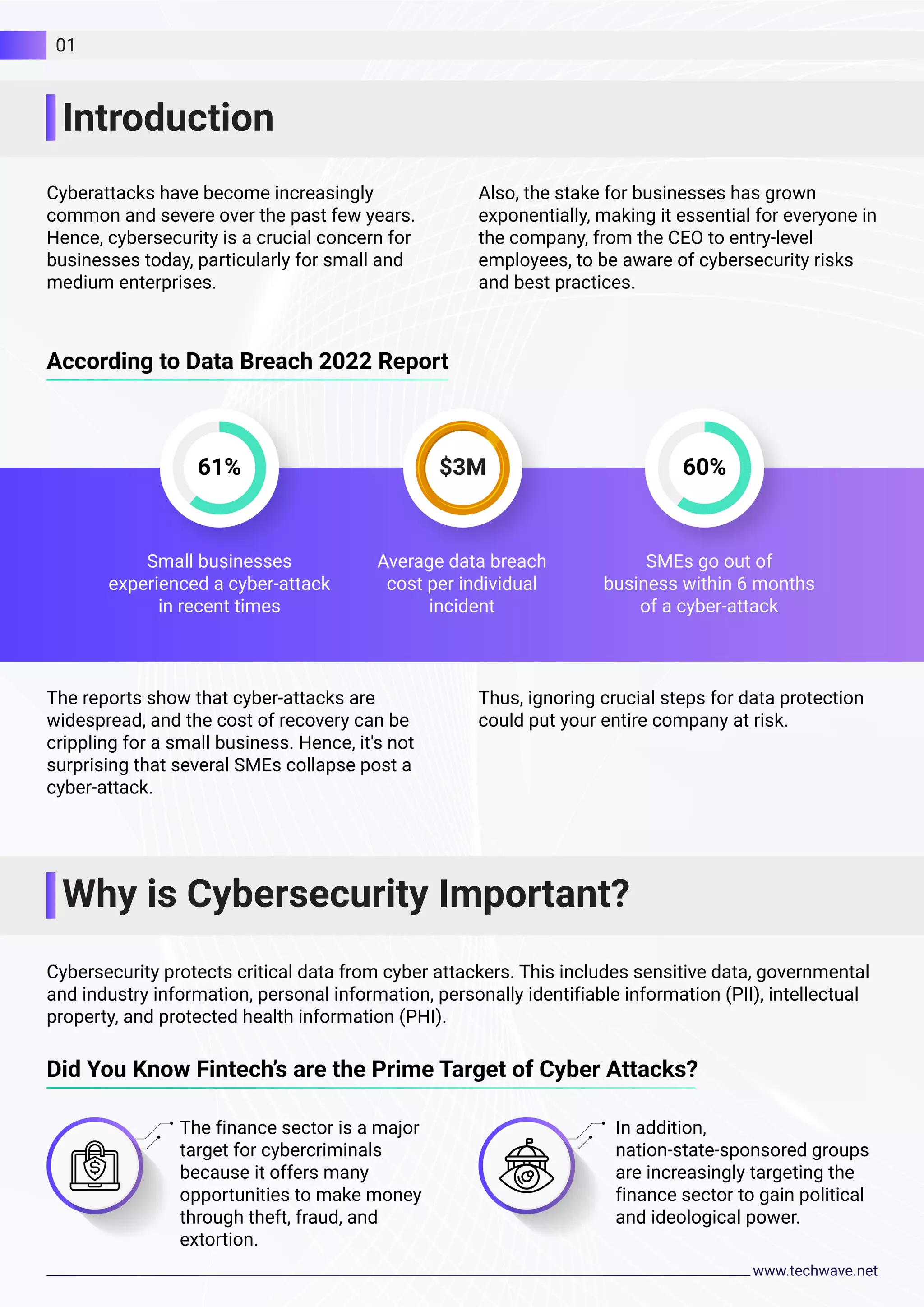
According to Data Breach 2022 Report
61%
Small businesses
experienced a cyber-attack
in recent times
Average data breach
cost per individual
incident
SMEs go out of
business within 6 months
of a cyber-attack
60%
$3M
01
Did You Know Fintech’s are the Prime Target of Cyber Attacks?
The finance sector is a major
target for cybercriminals
because it offers many
opportunities to make money
through theft, fraud, and
extortion.
In addition,
nation-state-sponsored groups
are increasingly targeting the
finance sector to gain political
and ideological power.
Organizations must adopt a proactive approach
to security operations and implement a
comprehensive cybersecurity transformation
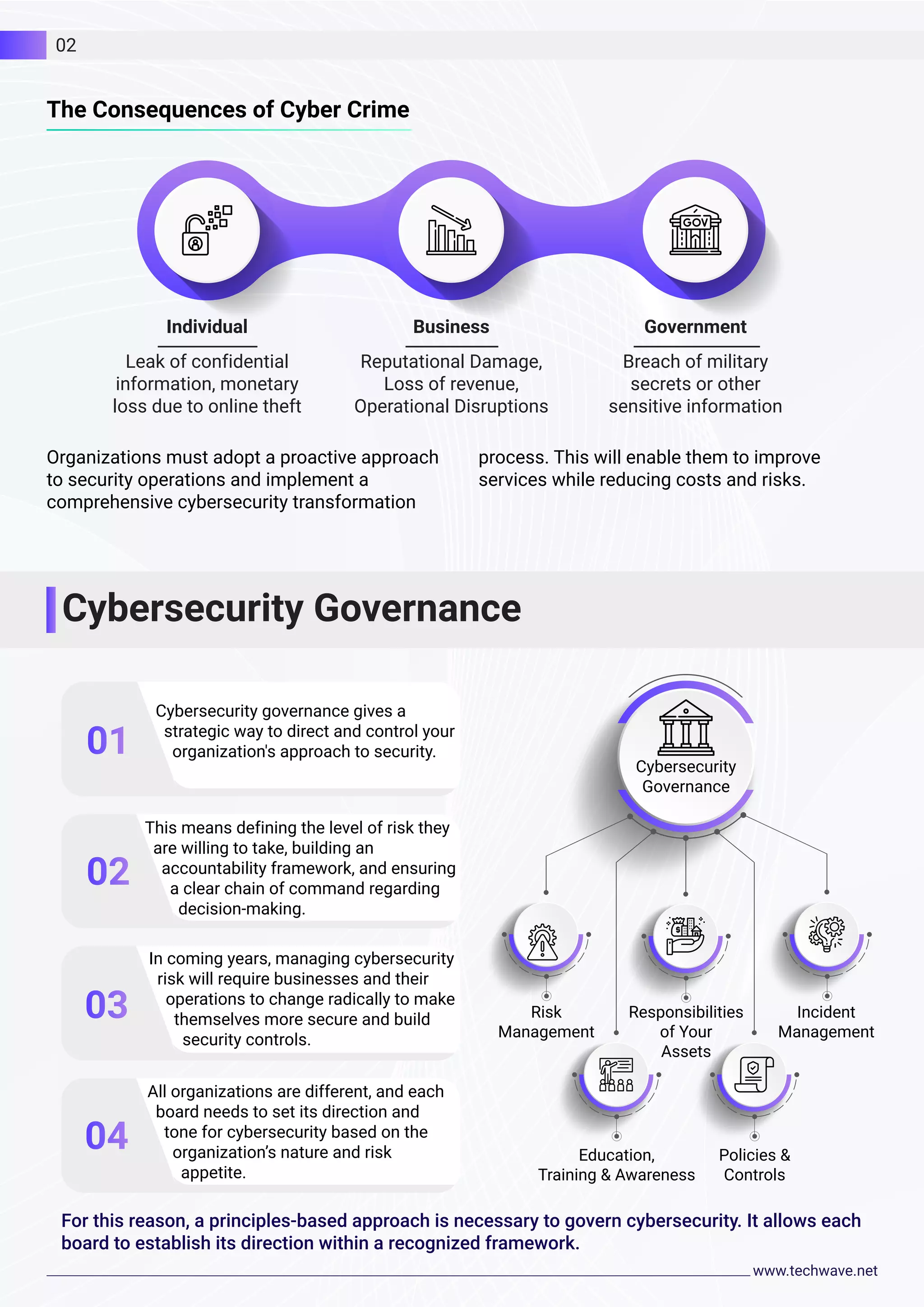
The Consequences of Cyber Crime
process. This will enable them to improve
services while reducing costs and risks.
Cybersecurity Governance
Cybersecurity governance gives a
strategic way to direct and control your
organization's approach to security.
This means defining the level of risk they
are willing to take, building an
accountability framework, and ensuring
a clear chain of command regarding
decision-making.
In coming years, managing cybersecurity
risk will require businesses and their
operations to change radically to make
themselves more secure and build
security controls.
All organizations are different, and each
board needs to set its direction and
tone for cybersecurity based on the
organization’s nature and risk
appetite.
For this reason, a principles-based approach is necessary to govern cybersecurity. It allows each
board to establish its direction within a recognized framework.
02
Individual
Leak of confidential
information, monetary
loss due to online theft
Business
Reputational Damage,
Loss of revenue,
Operational Disruptions
Government
Breach of military
secrets or other
sensitive information
Risk
Management
Responsibilities
of Your
Assets
Incident
Management
Education,
Training & Awareness
Policies &
Controls
Cybersecurity
Governance
03
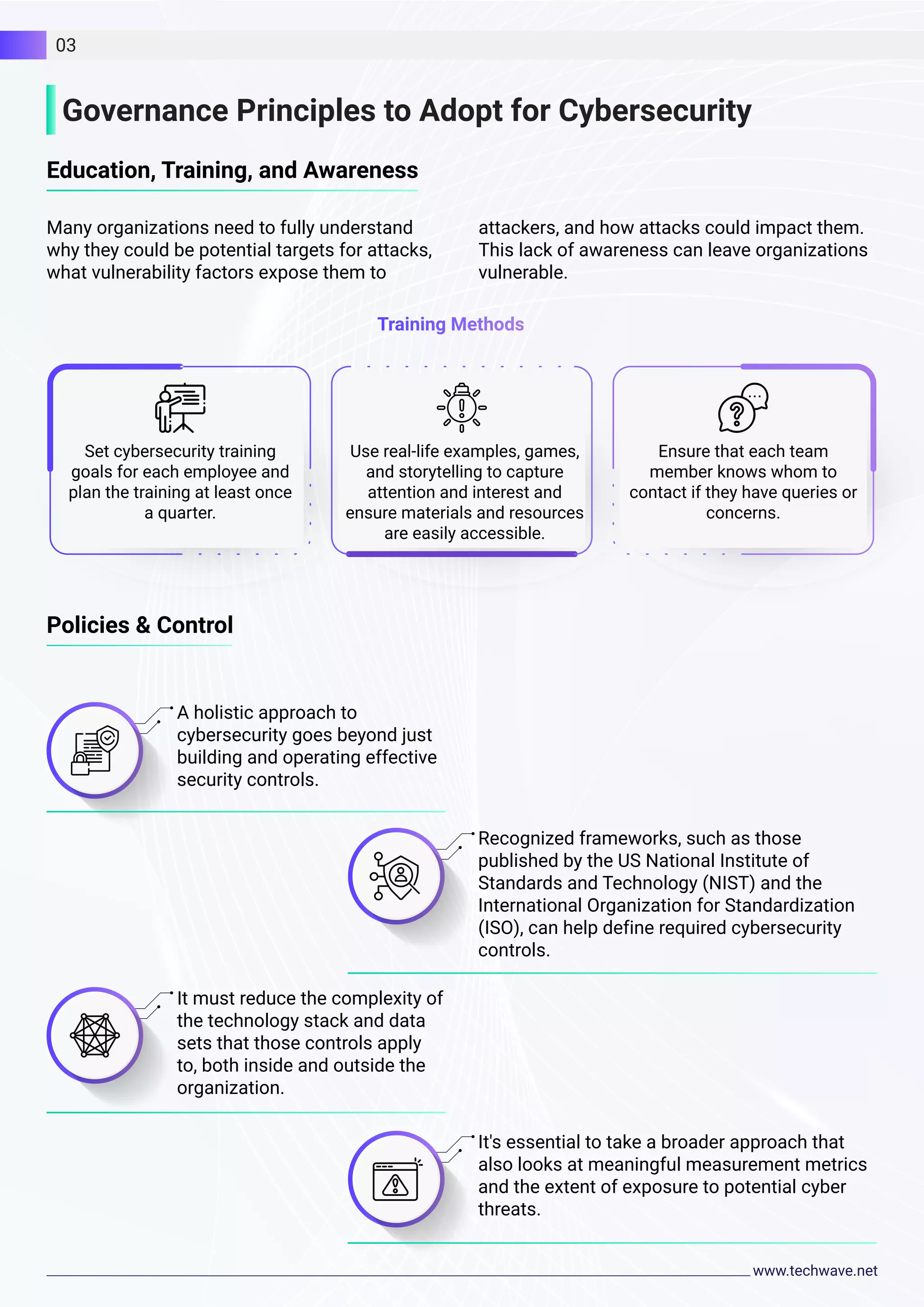
Many organizations need to fully understand
why they could be potential targets for attacks,
what vulnerability factors expose them to
attackers, and how attacks could impact them.
This lack of awareness can leave organizations
vulnerable.
Governance Principles to Adopt for Cybersecurity
Education, Training, and Awareness
Policies & Control
Set cybersecurity training
goals for each employee and
plan the training at least once
a quarter.
Use real-life examples, games,
and storytelling to capture
attention and interest and
ensure materials and resources
are easily accessible.
Ensure that each team
member knows whom to
contact if they have queries or
concerns.
A holistic approach to
cybersecurity goes beyond just
building and operating effective
security controls.
It must reduce the complexity of
the technology stack and data
sets that those controls apply
to, both inside and outside the
organization.
Recognized frameworks, such as those
published by the US National Institute of
Standards and Technology (NIST) and the
International Organization for Standardization
(ISO), can help define required cybersecurity
controls.
It's essential to take a broader approach that
also looks at meaningful measurement metrics
and the extent of exposure to potential cyber
threats.
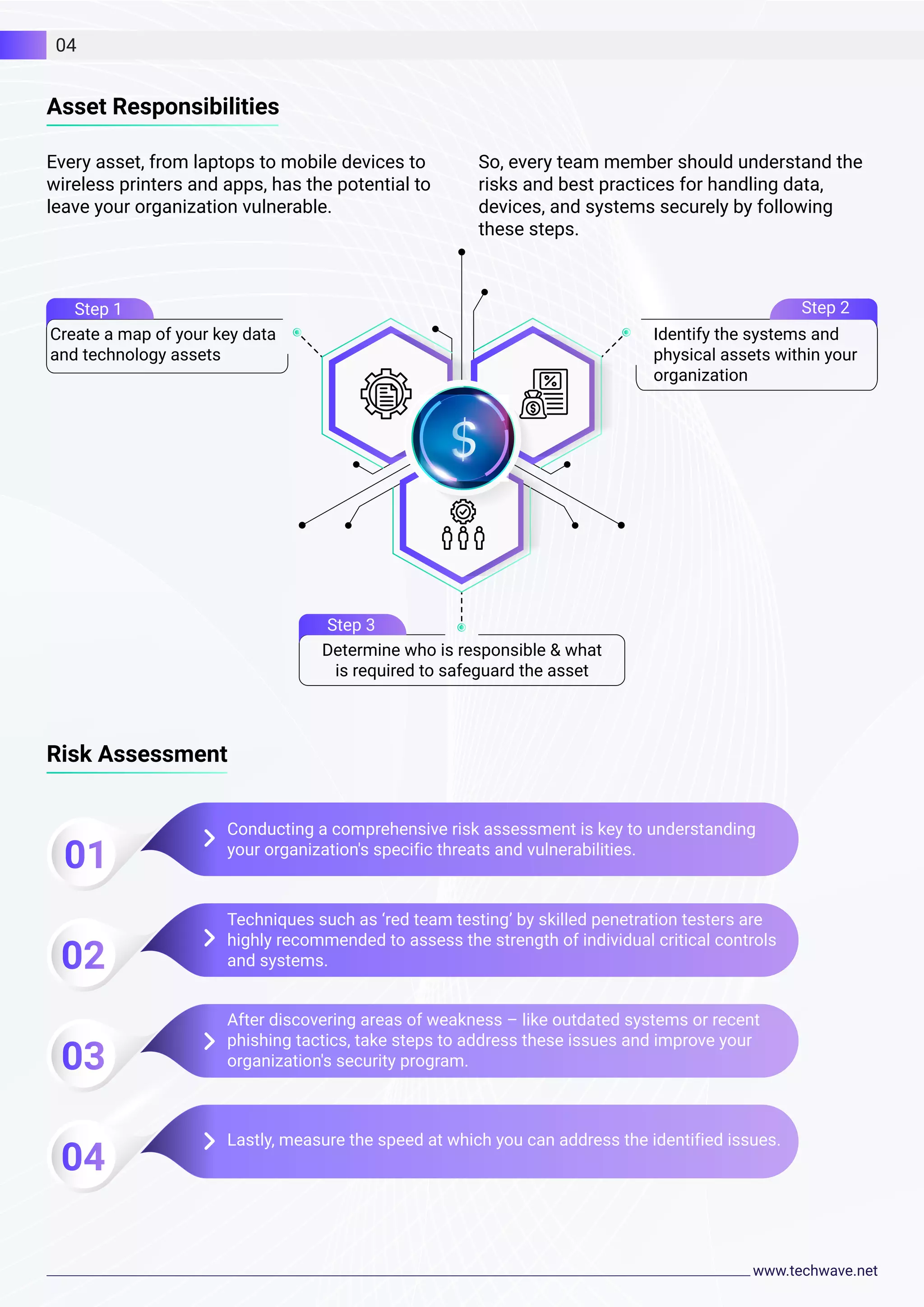
Asset Responsibilities
Every asset, from laptops to mobile devices to
wireless printers and apps, has the potential to
leave your organization vulnerable.
Risk Assessment
So, every team member should understand the
risks and best practices for handling data,
devices, and systems securely by following
these steps.
Create a map of your key data
and technology assets
Determine who is responsible & what
is required to safeguard the asset
Identify the systems and
physical assets within your
organization
Conducting a comprehensive risk assessment is key to understanding
your organization's specific threats and vulnerabilities.
Techniques such as ‘red team testing’ by skilled penetration testers are
highly recommended to assess the strength of individual critical controls
and systems.
After discovering areas of weakness – like outdated systems or recent
phishing tactics, take steps to address these issues and improve your
organization's security program.
Lastly, measure the speed at which you can address the identified issues.
04
Step 1 Step 2
Step 3
There are many strategies that organizations
can adopt to protect their assets, such as the
defense-in-depth approach, which consists of
multiple layers of security, or the 3-tier network
security model.
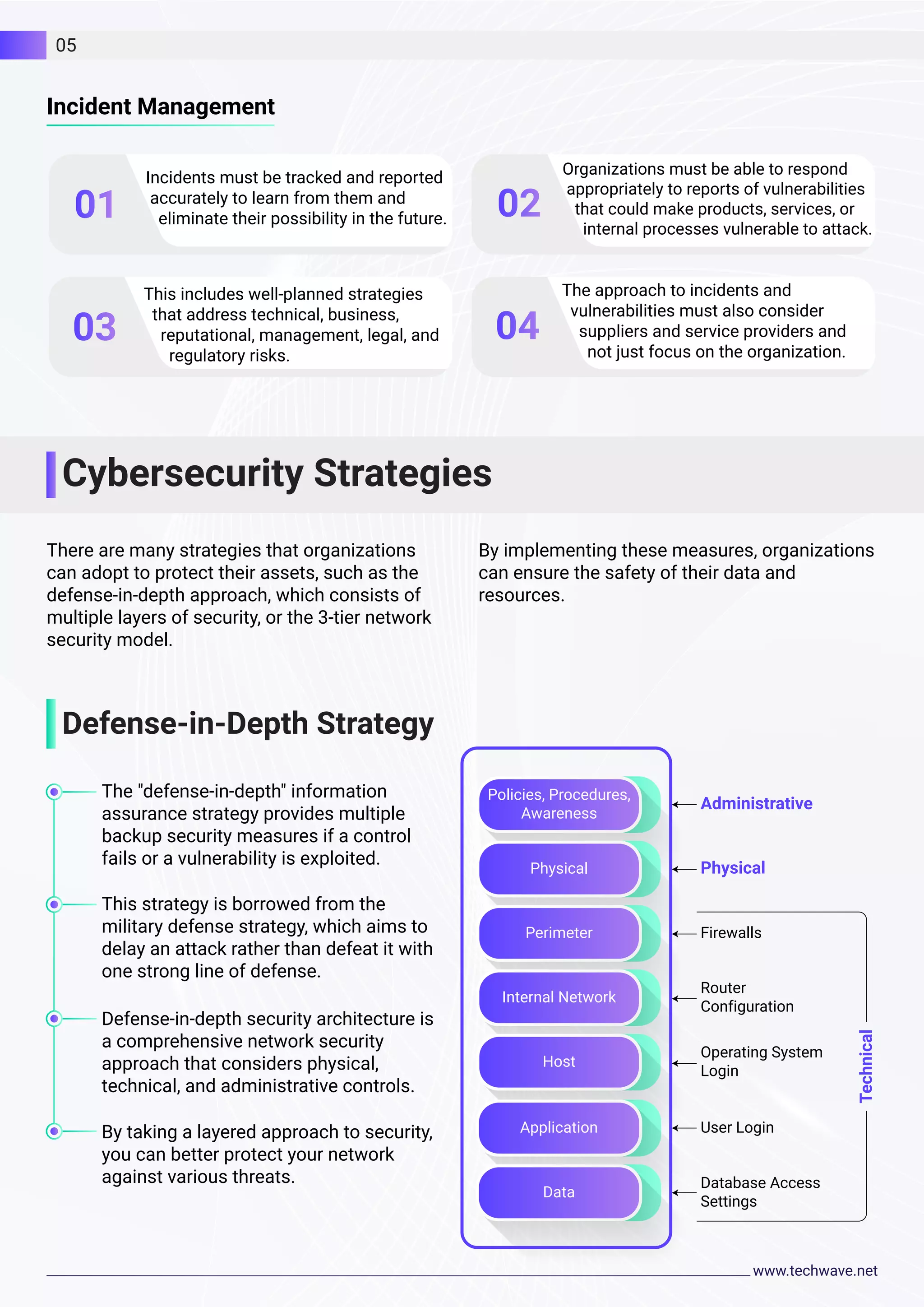
The "defense-in-depth" information
assurance strategy provides multiple
backup security measures if a control
fails or a vulnerability is exploited.
This strategy is borrowed from the
military defense strategy, which aims to
delay an attack rather than defeat it with
one strong line of defense.
Defense-in-depth security architecture is
a comprehensive network security
approach that considers physical,
technical, and administrative controls.
By taking a layered approach to security,
you can better protect your network
against various threats.
By implementing these measures, organizations
can ensure the safety of their data and
resources.
Incident Management
Defense-in-Depth Strategy
Incidents must be tracked and reported
accurately to learn from them and
eliminate their possibility in the future.
Organizations must be able to respond
appropriately to reports of vulnerabilities
that could make products, services, or
internal processes vulnerable to attack.
This includes well-planned strategies
that address technical, business,
reputational, management, legal, and
regulatory risks.
The approach to incidents and
vulnerabilities must also consider
suppliers and service providers and
not just focus on the organization.
Cybersecurity Strategies
Policies, Procedures,
Awareness
Physical
Perimeter
Internal Network
Host
Application
Data
Administrative
Physical Technical
Firewalls
Router
Configuration
Operating System
Login
User Login
Database Access
Settings
05
Digital Certificate
How to Get a Digital Certificate?
Digital Certificate Issuance Process
A Digital Certificate is an electronic file that
uses a key pair to authenticate the identity of
websites, individuals, organizations, users,
devices, or servers.
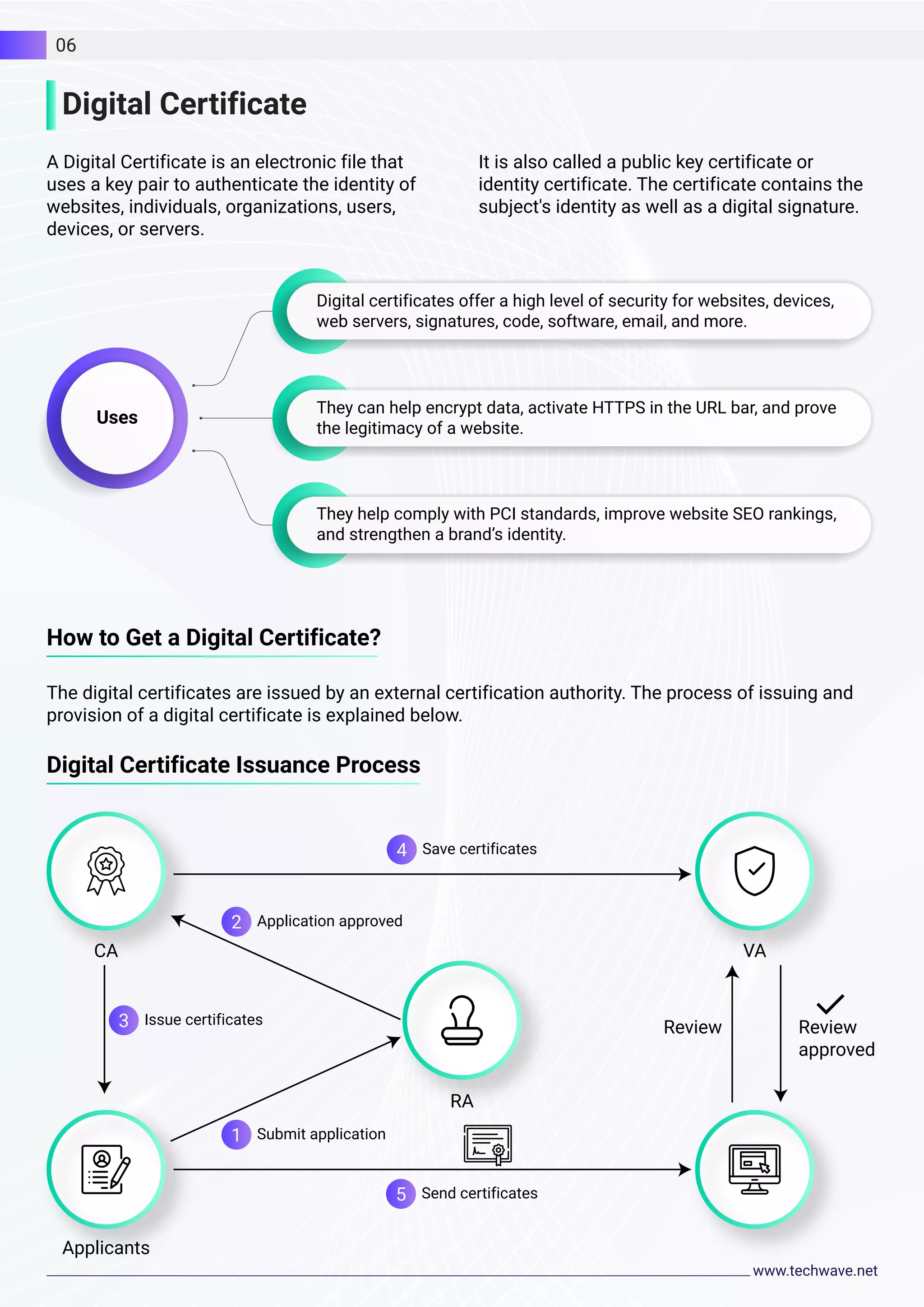
The digital certificates are issued by an external certification authority. The process of issuing and
provision of a digital certificate is explained below.
It is also called a public key certificate or
identity certificate. The certificate contains the
subject's identity as well as a digital signature.
Uses
Digital certificates offer a high level of security for websites, devices,
web servers, signatures, code, software, email, and more.
They can help encrypt data, activate HTTPS in the URL bar, and prove
the legitimacy of a website.
They help comply with PCI standards, improve website SEO rankings,
and strengthen a brand’s identity.
Review Review
approved
Submit application
VA
RA
Applicants
CA
1
Application approved
2
Save certificates
4
Send certificates
5
Issue certificates
3
06
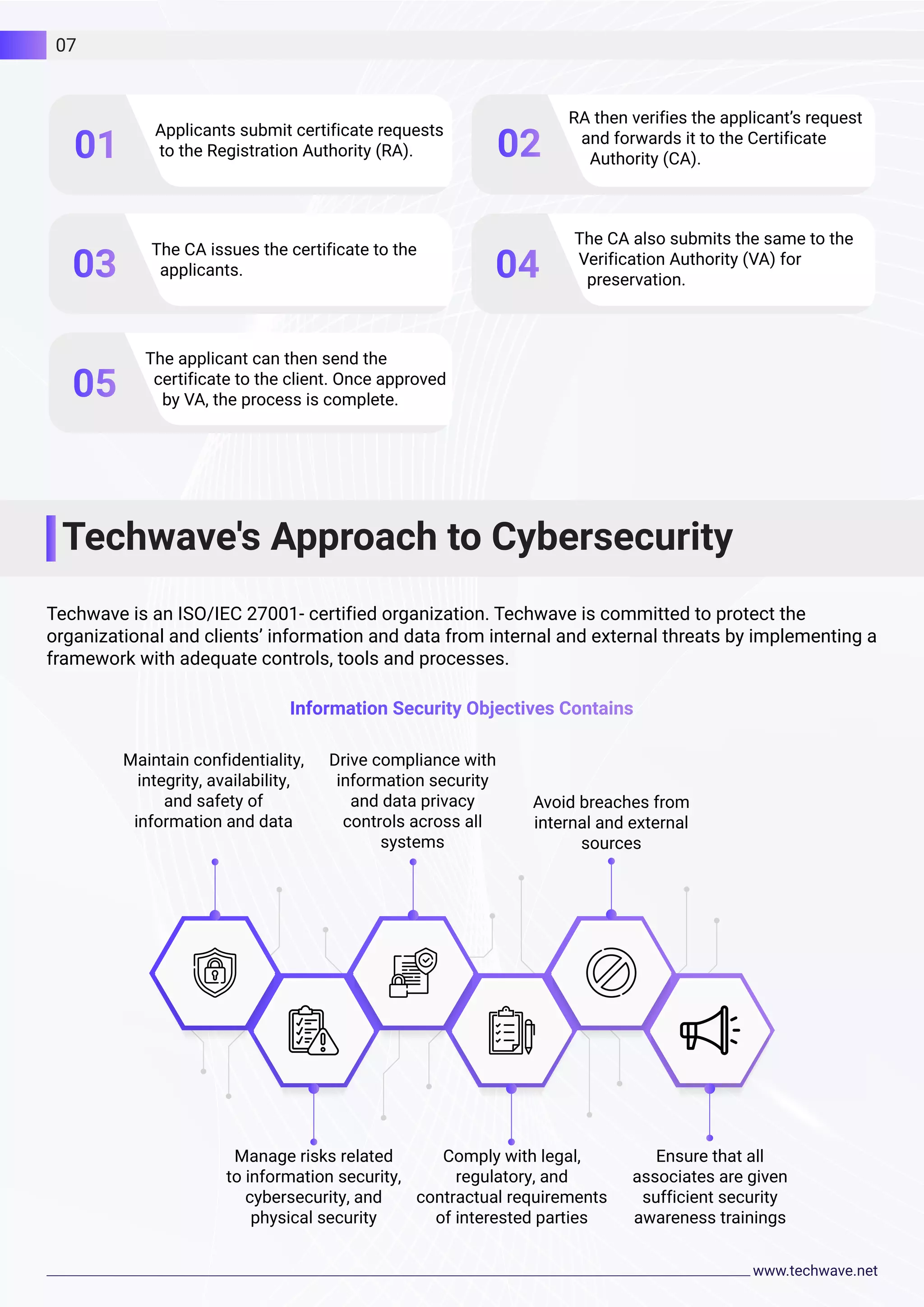
Applicants submit certificate requests
to the Registration Authority (RA).
RA then verifies the applicant’s request
and forwards it to the Certificate
Authority (CA).
The CA issues the certificate to the
applicants.
Techwave's Approach to Cybersecurity
07
Techwave is an ISO/IEC 27001- certified organization. Techwave is committed to protect the
organizational and clients’ information and data from internal and external threats by implementing a
framework with adequate controls, tools and processes.
Maintain confidentiality,
integrity, availability,
and safety of
information and data
Drive compliance with
information security
and data privacy
controls across all
systems
Manage risks related
to information security,
cybersecurity, and
physical security
Avoid breaches from
internal and external
sources
Comply with legal,
regulatory, and
contractual requirements
of interested parties
Ensure that all
associates are given
sufficient security
awareness trainings
The CA also submits the same to the
Verification Authority (VA) for
preservation.
The applicant can then send the
certificate to the client. Once approved
by VA, the process is complete.
Techwave Cybersecurity Solutions
08
Our team is dedicated to helping
our clients stay ahead of the curve
and protect their businesses
against potential threats.
Our security experts have a proven
track record of delivering innovative
solutions to leading companies
across various industries.
We excel in assessing the feasibility
and performance of business
processes and architecture and
optimizing and securing them.
Our security experts will evaluate
your business and IT infrastructure
to determine what security
measures need to be implemented.
We provide a comprehensive road
map for Private, Public, and Hybrid
Cloud security for your specific
business needs and then
implement and integrate various
security products and solutions.
We always follow up our
assessment with a strategic plan
and proof-of-concept (POC)
implementation.
13501 Katy Fwy Suite 1000, Houston,
TX 77079, USA.
Ph: +1 281 829 4831
infoNA@techwave.net
Global Headquarters
Suite 104, 18-20 Ross Street,
Parramatta, Sydney, NSW 2150, Australia,
Ph: +61 398 678 903
info@techwave.net
APAC Headquarters
Techwave is a leading global IT services and
solutions company that helps clients worldwide
scale their offerings by leveraging its expertise
in Digital Transformation, Enterprise Application,
and Engineering Services. Founded in 2004,
Techwave has 1,400+ employees across 11
countries, and serving 500+ customers.

Cyber-Security-Whitepaper.pdf

  • 1.
    Secure your Digital Presencewith the highest level of Cyber Protection Cyber-attacks are an alarming threat to all types of businesses & organizations. The risk of a cyber-attack is not just a risk to your company but also to your privacy. Hence, cybersecurity is crucial for every business. If you are looking for tools to fight against cyber threats, then Techwave's tools & technologies with adequate controls will help your organization stay protected.
  • 2.
    Index 1) Introduction 2) Whyis Cybersecurity important? 3) Cybersecurity Governance a) Principles 4) Cybersecurity Strategies a) Defense-in-Depth b) Digital Certificate 5) Techwave’s approach to Cyber Attacks a) Techwave Cybersecurity Solutions 01 01 02 03 05 05 06 07 08
  • 3.
    Cybersecurity protects criticaldata from cyber attackers. This includes sensitive data, governmental and industry information, personal information, personally identifiable information (PII), intellectual property, and protected health information (PHI). Introduction Why is Cybersecurity Important? Cyberattacks have become increasingly common and severe over the past few years. Hence, cybersecurity is a crucial concern for businesses today, particularly for small and medium enterprises. The reports show that cyber-attacks are widespread, and the cost of recovery can be crippling for a small business. Hence, it's not surprising that several SMEs collapse post a cyber-attack. Thus, ignoring crucial steps for data protection could put your entire company at risk. Also, the stake for businesses has grown exponentially, making it essential for everyone in the company, from the CEO to entry-level employees, to be aware of cybersecurity risks and best practices. According to Data Breach 2022 Report 61% Small businesses experienced a cyber-attack in recent times Average data breach cost per individual incident SMEs go out of business within 6 months of a cyber-attack 60% $3M 01 Did You Know Fintech’s are the Prime Target of Cyber Attacks? The finance sector is a major target for cybercriminals because it offers many opportunities to make money through theft, fraud, and extortion. In addition, nation-state-sponsored groups are increasingly targeting the finance sector to gain political and ideological power.
  • 4.
    Organizations must adopta proactive approach to security operations and implement a comprehensive cybersecurity transformation The Consequences of Cyber Crime process. This will enable them to improve services while reducing costs and risks. Cybersecurity Governance Cybersecurity governance gives a strategic way to direct and control your organization's approach to security. This means defining the level of risk they are willing to take, building an accountability framework, and ensuring a clear chain of command regarding decision-making. In coming years, managing cybersecurity risk will require businesses and their operations to change radically to make themselves more secure and build security controls. All organizations are different, and each board needs to set its direction and tone for cybersecurity based on the organization’s nature and risk appetite. For this reason, a principles-based approach is necessary to govern cybersecurity. It allows each board to establish its direction within a recognized framework. 02 Individual Leak of confidential information, monetary loss due to online theft Business Reputational Damage, Loss of revenue, Operational Disruptions Government Breach of military secrets or other sensitive information Risk Management Responsibilities of Your Assets Incident Management Education, Training & Awareness Policies & Controls Cybersecurity Governance
  • 5.
    03 Many organizations needto fully understand why they could be potential targets for attacks, what vulnerability factors expose them to attackers, and how attacks could impact them. This lack of awareness can leave organizations vulnerable. Governance Principles to Adopt for Cybersecurity Education, Training, and Awareness Policies & Control Set cybersecurity training goals for each employee and plan the training at least once a quarter. Use real-life examples, games, and storytelling to capture attention and interest and ensure materials and resources are easily accessible. Ensure that each team member knows whom to contact if they have queries or concerns. A holistic approach to cybersecurity goes beyond just building and operating effective security controls. It must reduce the complexity of the technology stack and data sets that those controls apply to, both inside and outside the organization. Recognized frameworks, such as those published by the US National Institute of Standards and Technology (NIST) and the International Organization for Standardization (ISO), can help define required cybersecurity controls. It's essential to take a broader approach that also looks at meaningful measurement metrics and the extent of exposure to potential cyber threats.
  • 6.
    Asset Responsibilities Every asset,from laptops to mobile devices to wireless printers and apps, has the potential to leave your organization vulnerable. Risk Assessment So, every team member should understand the risks and best practices for handling data, devices, and systems securely by following these steps. Create a map of your key data and technology assets Determine who is responsible & what is required to safeguard the asset Identify the systems and physical assets within your organization Conducting a comprehensive risk assessment is key to understanding your organization's specific threats and vulnerabilities. Techniques such as ‘red team testing’ by skilled penetration testers are highly recommended to assess the strength of individual critical controls and systems. After discovering areas of weakness – like outdated systems or recent phishing tactics, take steps to address these issues and improve your organization's security program. Lastly, measure the speed at which you can address the identified issues. 04 Step 1 Step 2 Step 3
  • 7.
    There are manystrategies that organizations can adopt to protect their assets, such as the defense-in-depth approach, which consists of multiple layers of security, or the 3-tier network security model. The "defense-in-depth" information assurance strategy provides multiple backup security measures if a control fails or a vulnerability is exploited. This strategy is borrowed from the military defense strategy, which aims to delay an attack rather than defeat it with one strong line of defense. Defense-in-depth security architecture is a comprehensive network security approach that considers physical, technical, and administrative controls. By taking a layered approach to security, you can better protect your network against various threats. By implementing these measures, organizations can ensure the safety of their data and resources. Incident Management Defense-in-Depth Strategy Incidents must be tracked and reported accurately to learn from them and eliminate their possibility in the future. Organizations must be able to respond appropriately to reports of vulnerabilities that could make products, services, or internal processes vulnerable to attack. This includes well-planned strategies that address technical, business, reputational, management, legal, and regulatory risks. The approach to incidents and vulnerabilities must also consider suppliers and service providers and not just focus on the organization. Cybersecurity Strategies Policies, Procedures, Awareness Physical Perimeter Internal Network Host Application Data Administrative Physical Technical Firewalls Router Configuration Operating System Login User Login Database Access Settings 05
  • 8.
    Digital Certificate How toGet a Digital Certificate? Digital Certificate Issuance Process A Digital Certificate is an electronic file that uses a key pair to authenticate the identity of websites, individuals, organizations, users, devices, or servers. The digital certificates are issued by an external certification authority. The process of issuing and provision of a digital certificate is explained below. It is also called a public key certificate or identity certificate. The certificate contains the subject's identity as well as a digital signature. Uses Digital certificates offer a high level of security for websites, devices, web servers, signatures, code, software, email, and more. They can help encrypt data, activate HTTPS in the URL bar, and prove the legitimacy of a website. They help comply with PCI standards, improve website SEO rankings, and strengthen a brand’s identity. Review Review approved Submit application VA RA Applicants CA 1 Application approved 2 Save certificates 4 Send certificates 5 Issue certificates 3 06
  • 9.
    Applicants submit certificaterequests to the Registration Authority (RA). RA then verifies the applicant’s request and forwards it to the Certificate Authority (CA). The CA issues the certificate to the applicants. Techwave's Approach to Cybersecurity 07 Techwave is an ISO/IEC 27001- certified organization. Techwave is committed to protect the organizational and clients’ information and data from internal and external threats by implementing a framework with adequate controls, tools and processes. Maintain confidentiality, integrity, availability, and safety of information and data Drive compliance with information security and data privacy controls across all systems Manage risks related to information security, cybersecurity, and physical security Avoid breaches from internal and external sources Comply with legal, regulatory, and contractual requirements of interested parties Ensure that all associates are given sufficient security awareness trainings The CA also submits the same to the Verification Authority (VA) for preservation. The applicant can then send the certificate to the client. Once approved by VA, the process is complete.
  • 10.
    Techwave Cybersecurity Solutions 08 Ourteam is dedicated to helping our clients stay ahead of the curve and protect their businesses against potential threats. Our security experts have a proven track record of delivering innovative solutions to leading companies across various industries. We excel in assessing the feasibility and performance of business processes and architecture and optimizing and securing them. Our security experts will evaluate your business and IT infrastructure to determine what security measures need to be implemented. We provide a comprehensive road map for Private, Public, and Hybrid Cloud security for your specific business needs and then implement and integrate various security products and solutions. We always follow up our assessment with a strategic plan and proof-of-concept (POC) implementation. 13501 Katy Fwy Suite 1000, Houston, TX 77079, USA. Ph: +1 281 829 4831 infoNA@techwave.net Global Headquarters Suite 104, 18-20 Ross Street, Parramatta, Sydney, NSW 2150, Australia, Ph: +61 398 678 903 info@techwave.net APAC Headquarters Techwave is a leading global IT services and solutions company that helps clients worldwide scale their offerings by leveraging its expertise in Digital Transformation, Enterprise Application, and Engineering Services. Founded in 2004, Techwave has 1,400+ employees across 11 countries, and serving 500+ customers.