Cutting corners at a most vulnerable time
The customer’s perspective on abuses in the informal funeral parlour
market in South Africa
Prepared for FinMark Trust by Cenfri
March 2016
Funeral parlour abuses 2016
1 | P a g e
Authors:
Iske van den Berg
Albert van der Linden
Christine Hougaard
Louise de Villiers
Funeral parlour abuses 2016
2 | P a g e
Contents
1. Introduction.....................................................................................................................................................3
1.1 Methodology...............................................................................................................................................4
1.2 Structure......................................................................................................................................................4
2. Consumer needs..............................................................................................................................................5
3. Consumer options...........................................................................................................................................6
4. Unpacking abuses in the market................................................................................................................ 10
5. How do people respond?............................................................................................................................. 15
6. Implications for regulation?........................................................................................................................ 17
Funeral parlour abuses 2016
3 | P a g e
1. Introduction
A formalisation imperative. In 2011 National Treasury published a Policy Document titled “The South
African Microinsurance Regulatory Framework”. This document stems from a policy process dating back
to the Parliamentary Committee on Finance hearings in 2003 and 2005 on abuses in the funeral parlour
market in South Africa, which called National Treasury and the Financial Services Board (FSB) to action in
planning a road to formalisation for funeral insurance in South Africa. This focus has since broadened to
microinsurance and more broadly to the development of the lower-income insurance market. The
regulatory framework proposed in the Policy Document aims to create a dedicated microinsurance
licence in order to achieve two objectives: provide a space for informal entities to graduate into in order
to achieve formalisation, as well as for established insurers to reach the lower-income market on a level
playing-field. As part of the implementation plan, it recognises the need for an enforcement strategy in
the informal funeral parlour market. How feasible will this be?
Informality is core to many operators’ business model. Since the publication of the Microinsurance Policy
Document, FinMark Trust and Cenfri have done in-depth research in order to better understand the
nature of the informal funeral parlour market in South Africa. A supply-side survey and deep-dive analysis
conducted by Cenfri in 20121
found that informality is part and parcel of much of the funeral parlour
industry. Many informal funeral parlours lack general business skills, are using insurance premiums for
cash flow to establish their business and to acquire business assets, do not keep insurance funds
separately and have no sound pricing practices. Hence they are forced to flex the value of funerals offered
to be able to cover costs, should mortality experience not be as expected. The study found that it is
common for different parlours to sell multiple policies on the same life and that the regulatory
requirement to provide a monetary benefit option is not adhered to2
. Indeed, it is core to informal funeral
parlours’ business to be able to adjust the value of services offered. Should they be forced to provide a
cash option to the advertised value of the funeral service, many will be forced out of the market. This is
exacerbated by the growing competition in the market due to declining mortality rates on the back of
better HIV/AIDS treatment.
Informality is no small phenomenon. The FinScope Consumer Survey (2015) estimates 60% of all South
African adults to have some kind of funeral cover. 27% of adults have cover from a funeral parlour. It is
likely that much of this cover is informal. Though no hard data is available, the National Funeral Director’s
Association (NFDA) estimates there to be over 7 000 funeral parlours in South Africa. It is a fragmented
industry, with previous research estimating that less than 15% of total revenue is generated by the big
three formal funeral parlour chains3
. Based on the annual number of deaths, we estimate the industry to
be worth at least R4.5 bn. Even should one make a lower bound estimate that the informal market
represents only half the market, this means that the informal industry is more than R2bn per year strong4
.
1
See the comprehensive study and shorter policy brief funded by the Canadian International Development Research Center (IDRC) called “The Nature of
Informality in the South African Funeral Services Market – Implications for Policymakers and Regulators” (Cenfri, 2012).
2 The Long-term Insurance Act, 52 of 1998 requires that, where assistance policy benefits are paid in-kind (for example via the provision of a funeral
service), the policyholder is given the right to a monetary benefit. Since the Insurance Laws Amendment Act of 2008, the amount does not need to be
equal to the cost that would be incurred to the insurer, had the in-kind benefit been provided, but must be clearly stated. The 2011 Microinsurance
Policy Document (National Treasury, 2011;13) states the right to a monetary benefit in the assistance business sphere will be extended to all
microinsurance. In addition, it will be required that the face value of the in-kind benefit and the monetary option provided must be the same (rather
than the cost to the insurer). The insurer will also have to revise the value of the monetary benefit over time to ensure that it keeps track with changes in
the value of the benefit-in-kind.
3
Source: Proprietary market research
4
Estimate from unpublished research conducted by FinMark Trust for the Financial Services Board in early 2015.
Funeral parlour abuses 2016
4 | P a g e
Regulation imminent. The Insurance Bill, B1-2016, was tabled to Parliament in January 20165
. It contains
the first formal mention of microinsurance in legislation and hence paves the way for the long-awaited
implementation of the microinsurance regulatory framework. The FSB plans to publish a microinsurance
regulatory roadmap to give clarity on how the regulatory framework will be implemented and enforced.
What emphasis should be placed on the formalisation of informal funeral parlours in the implementation of
the framework? Ultimately, the imperative for formalisation depends on the extent and nature of abuse in
the industry. Regulators are tasked to protect consumers, but at the same time to facilitate market
development. If the industry is on the whole delivering satisfactory consumer value, with enough market
mitigating factors (for example, if word-of-mouth in the community acts against funeral parlours, should
contracts not be honoured), a different enforcement approach may be called for than if blatant consumer
abuse is the order of the day. Though anecdotal evidence abounds on consumer abuses in the informal
funeral parlour industry, there is no clear picture of the nature and extent of consumer abuse, as
experienced from the customer’s perspective.
This study investigated the nature of abuse in the informal funeral parlour market by talking to
consumers themselves. It aims to give consumers a voice, thereby generating an information base to
inform the enforcement question.
1.1 Methodology
A multi-pronged qualitative data collection methodology was used to gain insights into the experiences
of consumers. The information was collected from the following groups:
• 12 Focus Group Discussions: Participants all experienced a bereavement in the last 12 months
and were responsible for at least half of the financial contribution to the funeral. Most of the
respondents were recruited to have experienced poor service from a funeral parlour.
• 12 In-depth interviews with the management of burial societies: The in-depth interviews were
conducted to learn more about the comparative value of informal funeral insurance; to explore
the awareness and past experience of abuse by informal funeral parlours as well as the options for
recourse when abuse is experienced. The discussions with the management of burial societies
also highlighted the complex relationships between burial societies and funeral parlours.
• 18 Informal intercept interviews: Intercept interviews were conducted with community leaders,
pastors and police officers to find out more about how prevalent abuse is and how it is reported.
The research was conducted in four areas: Gauteng: Johannesburg (urban) and Hammanskraal (peri-
urban); Kwa-Zulu Natal: Durban (urban) and Eastern Cape: Mthatha surrounding areas (rural). Discussions
and interviews were conducted in the vernacular and then transcribed into English.
The qualitative fieldwork is also supported with data from the FinScope South Africa Consumer survey
2015. It is a nationally representative survey of adult individuals in South Africa.
1.2 Structure
The rest of the report is structured as follows:
 Section 2 outlines the various needs that consumers have after the death of a loved one
5
It provides the legal framework for the prudential regulation of insurance in South Africa in line with international standards and the move towards
Twin Peaks regulation. A separate regulatory framework is being developed for Conduct of Business. Together, these two Acts will replace the Long-
term and Short-term Insurance Acts of 1998.
Funeral parlour abuses 2016
5 | P a g e
 Section 3 sets out the different provider options available to meet these needs, highlighting the role of
funeral parlours vis-à-vis other avenues. Particular attention is paid to the relationship between burial
societies and funeral parlours and the power relationships arising.
 This provides the basis for an in-depth consideration in Section 4 of the various informal funeral
parlour abuses identified in the research.
 Section 5 considers consumers’ response in the face of abuses.
 Section 6 concludes on the implications of the findings.
2. Consumer needs
Understanding consumer needs is the first step to understanding the scope for and nature of abuse in the
industry. The research found that funeral services are essential to consumers, as funerals are an
important part of South African culture. When a loved one dies, consumers face essentially two sets of
needs: functional needs for the various aspects of the burial, and social needs:
Functional needs a necessity. When a person passes away there are a number of essential services
required. The most immediate needs highlighted in the research include:
• Removal of the body from the family’s home/hospital
• Transport of the body
• Issuing of a death certificate
• Washing of the body
• Refrigeration of the body
• Burial (including the grave, equipment, etc.)
• Catering equipment and services
“In my village, funeral parlours bring dignity to the whole send-off ceremony. They bring a platform, a choir,
pastors, and some dignified men who sit around the pastors – even though the deceased was not a church
goer “ – Male, rural area
Culturally important social needs. During the focus group discussions, social needs were emphasised as
equally important to the functional needs relating to the burial. A funeral is a time for extended families
to get together. The social needs highlighted in the research include:
• Dignified transition to the afterlife
• Opportunity for the community to pay their last respects and celebrate the life of the deceased
• Hosting of an elaborate funeral to meet expectations
• Assistance (helping hands) during the ceremony and catering for all the guests
A non-negotiable cost. When asked what a funeral typically costs, responses varied, but there was
consensus that it is very costly – some respondents felt that it is overly so, and that an expensive funeral
has become a “social competition”. For example: one respondent reported total funeral costs of R80,000,
while others mentioned amounts of R10,000, R15,00o, R20,000 or R40,000. All respondents emphasised
the importance of providing catering for guests and the associated costs: “We wait for people that are
arriving from far-away places, so we have to cook from morning until supper from the day it’s announced
that the person has died.”
Funeral parlour abuses 2016
6 | P a g e
One focus group explained the situation as follows:
Moderator: How much is a funeral supposed to cost?
Respondent1: Before we even talk about the coffin, the grocery, people having to do their hair
Respondent2: Before the day of the burial you have already spent a lot of money
Respondent3: Remember people are coming every day and you need to cater for them
Respondent4: It is quite costly: remember the R8000 package, it’s only for the day of the burial, it doesn’t
take into account the process before the day of the burial
Some respondents mentioned that the cost depends on the stature of the deceased and family in the
community. If the deceased was well-known, more people attend the funeral and need to be catered for.
Insurance gives peace of mind. The respondents were very much aware of the need to plan and provide for
the expenses relating to the various needs. Belonging to a burial society and having a funeral policy is
often regarded as non-negotiable, as it gives them the peace of mind that the funeral will be taken care of
and that there will be helping hands to assist. Paying a monthly premium in the expectation that a funeral
service will be rendered means that the expense is defined and, hence, smoothed over a longer period.
Total monthly contributions among respondents ranged from as little as R20 to as high as R500. Average
monthly contributions were highest in the urban sample in Gauteng province, where people on average
contributed R327. This was followed by the Durban sample, where the average was R209, the peri-urban
Gauteng sample at R146 and the rural Eastern Cape sample at R141 per month. It is important to note
that these amounts are indicative only, as they are derived from a limited qualitative sample.
Multiple funeral cover speaks to diversity of needs. It was common for respondents and their families to
belong to a burial society and have a funeral parlour policy. The urban respondents were most likely to
also have a formal policy from an insurer – each for a different primary purpose. Thus people take out
multiple funeral cover to meet diverse needs and ensure that the financial risk is sufficiently covered. The
next section considers’ the various options for funeral cover as identified in the research.
3. Consumer options
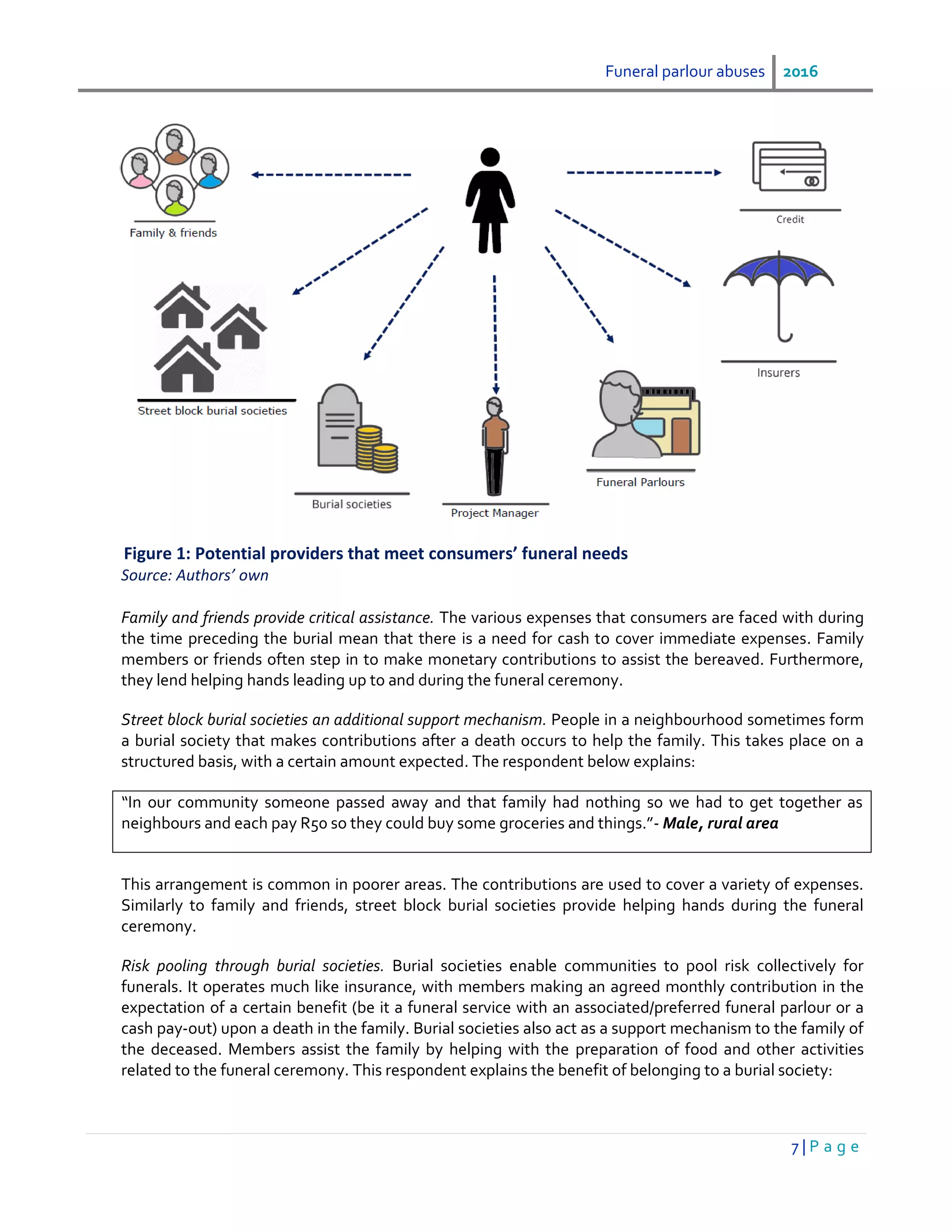
Various options to meet funeral needs. Figure 1 below illustrates the various providers that consumers can
use to meet their needs. Different providers cater to different needs. Therefore, consumers often have to
diversify in order to meet all their needs.
Funeral parlour abuses 2016
7 | P a g e
Source: Authors’ own
Family and friends provide critical assistance. The various expenses that consumers are faced with during
the time preceding the burial mean that there is a need for cash to cover immediate expenses. Family
members or friends often step in to make monetary contributions to assist the bereaved. Furthermore,
they lend helping hands leading up to and during the funeral ceremony.
Street block burial societies an additional support mechanism. People in a neighbourhood sometimes form
a burial society that makes contributions after a death occurs to help the family. This takes place on a
structured basis, with a certain amount expected. The respondent below explains:
This arrangement is common in poorer areas. The contributions are used to cover a variety of expenses.
Similarly to family and friends, street block burial societies provide helping hands during the funeral
ceremony.
Risk pooling through burial societies. Burial societies enable communities to pool risk collectively for
funerals. It operates much like insurance, with members making an agreed monthly contribution in the
expectation of a certain benefit (be it a funeral service with an associated/preferred funeral parlour or a
cash pay-out) upon a death in the family. Burial societies also act as a support mechanism to the family of
the deceased. Members assist the family by helping with the preparation of food and other activities
related to the funeral ceremony. This respondent explains the benefit of belonging to a burial society:
“In our community someone passed away and that family had nothing so we had to get together as
neighbours and each pay R50 so they could buy some groceries and things.”- Male, rural area
Figure 1: Potential providers that meet consumers’ funeral needs
Funeral parlour abuses 2016
8 | P a g e
“They [burial societies] act as a second policy. They come through for you financially since death is
unexpected. The advantages are that you have helping hands during a funeral, with the cooking and other
chores.” – Female, rural area
Project managers act as intermediaries between consumers and funeral parlours. Project managers are
funeral undertakers that do not own facilities like fully-fledged funeral parlours do, but outsource the
service delivery part of their business to funeral parlours. They have been referred to as “suitcase
operators” and have a reputation for being cheaper, but also less reliable. A major drawback for
consumers is that they cannot pick the parlour that ultimately provides the funeral service, because the
project managers typically have relationships with particular funeral parlours6
.
Funeral parlours provide the funeral service. Full service funeral parlours provide for all the consumers’
functional needs. The parlour collects the body, either from home or from the hospital, and stores it until
the time of the funeral service and burial. They also provide additional services that consumers require on
the day of the funeral, as mentioned by the female respondent below. Ultimately, consumers rely entirely
on the funeral parlour for a dignified burial.
“They must join the funeral parlour because the important thing is that the body of the deceased is
transported from wherever to the mortuary as soon as possible. – Male, urban area
“I joined Sizo Funeral Parlour. I contribute R200, they provide 3 buses, a tent, 4 tables, 50 chairs, a toilet, a
storage container and a coffin as well as a grave.” – Female, urban area
Formal insurance policies often used as life insurance policies. Funeral insurance provided by licensed
insurers and not sold via burial societies or funeral parlours provide a monetary pay-out to consumers
instead of funeral services. Respondents indicated that the pay-out is generally of higher value than what
consumers can access in the informal market, but also more expensive. However, because formal policies
provide cash and not funeral services, it does not address the immediate functional needs of consumers.
Furthermore, policies normally pay out only after 48 hours. Consequently, respondents tended to use
formal insurance as a quasi-life insurance policy whereby the benefits are used after the initial funeral
expenses, for which a funeral parlour policy or burial society is still used.
Credit used as a stop-gap measure for cash flow. Respondents indicated that almost immediately after a
death occurs consumers have to incur expenses. Those that have not made adequate provision are forced
to borrow money to ensure that the funeral can take place. Credit can also be a mechanism to bridge the
gap between the time of death and the pay-out from a formal funeral insurance policy.
Various inter-relationships determine balance of power. The research showed that there are often
relationships between the various consumer options. This gives rise to power relationships between
different players that determine the scope for and nature of abuse. The table below outlines which
services are rendered by which options:
6
For a full overview of different types of funeral service providers, see Cenfri (2012), ibid.
Funeral parlour abuses 2016
9 | P a g e
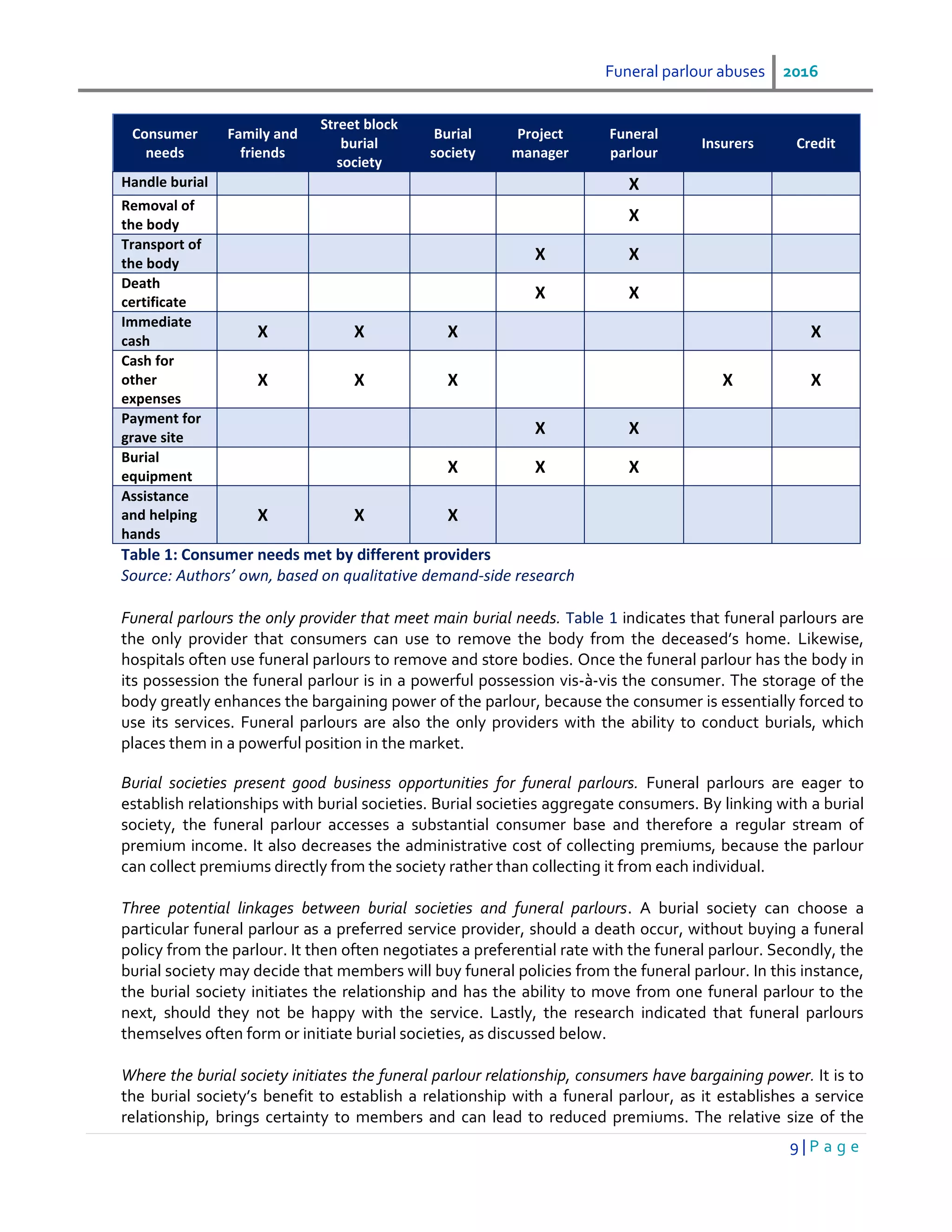
Consumer
needs
Family and
friends
Street block
burial
society
Burial
society
Project
manager
Funeral
parlour
Insurers Credit
Handle burial X
Removal of
the body
X
Transport of
the body
X X
Death
certificate
X X
Immediate
cash
X X X X
Cash for
other
expenses
X X X X X
Payment for
grave site
X X
Burial
equipment
X X X
Assistance
and helping
hands
X X X
Table 1: Consumer needs met by different providers
Source: Authors’ own, based on qualitative demand-side research
Funeral parlours the only provider that meet main burial needs. Table 1 indicates that funeral parlours are
the only provider that consumers can use to remove the body from the deceased’s home. Likewise,
hospitals often use funeral parlours to remove and store bodies. Once the funeral parlour has the body in
its possession the funeral parlour is in a powerful possession vis-à-vis the consumer. The storage of the
body greatly enhances the bargaining power of the parlour, because the consumer is essentially forced to
use its services. Funeral parlours are also the only providers with the ability to conduct burials, which
places them in a powerful position in the market.
Burial societies present good business opportunities for funeral parlours. Funeral parlours are eager to
establish relationships with burial societies. Burial societies aggregate consumers. By linking with a burial
society, the funeral parlour accesses a substantial consumer base and therefore a regular stream of
premium income. It also decreases the administrative cost of collecting premiums, because the parlour
can collect premiums directly from the society rather than collecting it from each individual.
Three potential linkages between burial societies and funeral parlours. A burial society can choose a
particular funeral parlour as a preferred service provider, should a death occur, without buying a funeral
policy from the parlour. It then often negotiates a preferential rate with the funeral parlour. Secondly, the
burial society may decide that members will buy funeral policies from the funeral parlour. In this instance,
the burial society initiates the relationship and has the ability to move from one funeral parlour to the
next, should they not be happy with the service. Lastly, the research indicated that funeral parlours
themselves often form or initiate burial societies, as discussed below.
Where the burial society initiates the funeral parlour relationship, consumers have bargaining power. It is to
the burial society’s benefit to establish a relationship with a funeral parlour, as it establishes a service
relationship, brings certainty to members and can lead to reduced premiums. The relative size of the
Funeral parlour abuses 2016
10 | P a g e
burial society on the parlour’s books establishes the extent of the bargaining power of the burial. Burial
societies in strong positions often negotiate for lower premiums or additional benefits. Furthermore, the
management of the burial society is in a strong position to advocate for its members if the funeral parlour
delivers a sub-standard service.
Funeral parlour-initiated relationships leave consumers vulnerable to abuse. Respondents explained that it
is common practice for funeral parlours to create “their own” burial societies to capture a consumer base.
The parlour decides on the management structure of the burial society and may be represented on the
management team. This arrangement creates a conflict of interest. The management of the burial
society is essentially controlled by the funeral parlour and is typically unwilling to advocate for the
members of the society. Members in turn are forced to use the services of the particular funeral parlour.
Consequently, the members of the society have negligible bargaining power.
The existence of a funeral policy is core to power relationships. The discussion in Section 2 showed that
respondents attach great value to funeral policies, as it removes the risk of not having sufficient resources
to pay for the burial and helps to guarantee a dignified funeral. It also acts as a commitment device to
ensure that people make provision for the inevitability of having to pay for funeral expenses at some
time. As outlined above, it is the existence of a policy that sets funeral parlours and insurers aside from
burial societies and community support. It is also the existence of a policy that introduces power
imbalances to the funeral parlour-burial society relationship. The policy allows the funeral parlour to
secure or “capture” clients for their future services. The research suggests, as will be discussed in Section
5, that clients are reticent to move to a different parlour because they see it as a waste of money after
having paid premiums for some time and because a new waiting period will apply. As the discussion on
the various abuses encountered in the market below will show, it is this “capture” of the client via the
policy that enables the funeral parlour to exploit the consumer. Without a policy, that is, should the client
pay cash for the service, consumers are better able to “vote with their feet”.
4. Unpacking abuses in the market
The discussion above highlighted the position of power of funeral parlours vis-à-vis many consumers. This
reliance on funeral parlours creates the potential for abuse. This section unpacks the nature of abuses
identified in the qualitative research, and where relevant adds quantitative evidence from FinScope
(2015) on the extent of such abuse.
Abuses cut across different spheres. The research encountered a wide range of abuses in the informal
funeral parlour market: related to health services, labour practices and the financial service rendered.
These various abuses are interrelated, with the main source being the manner in which the informal
funeral parlour business model operates and the power relationship between funeral parlours and clients
and burial societies.
Reduced funeral service quality the most prevalent form of consumer abuse. Previous supply-side research,
as referred to in Section 1, found that it is integral to informal funeral parlours’ business models to adjust
the quality of the funeral service according to their cash flow constraints. The current research confirmed
this practice: it was common for respondents to have received a lower quality service than what was
promised on the contract. The quality of funerals differ even for customers with exactly the same policy,
depending on how much money the parlour has available at the time that the service needs to be
rendered. Indeed, many of the individual types of abuse listed in the discussion below relate to sub-
standard service quality. Respondents indicated that the social stature of the deceased, or the deceased’s
family, often determines the quality of the funeral service. However, instances of total non-delivery are
Funeral parlour abuses 2016
11 | P a g e
rare and was recounted by only one respondent (indicated below). Funeral parlours try to at least provide
some sort of service, even if of sub-standard quality. The following consumer quotes illustrate:
“Last year January I was dissatisfied with my parlour because they brought a different coffin saying the one
we contracted for was out of stock. I got a cheap [inferior] one.” – Female, urban area
“I had paid all my dues. Well, what a run around, instead of mourning their father, the children had to march
in and out of the offices of this parlour – he did not do any burial at all. He did not give us anything; no coffin,
nothing.”– Female, rural area
“You see your money and your reputation will determine what kind of service you are going to receive, for
example if you live in a shack you will probably get bad service. Whereas if they doing a funeral of high profile
person they will put their best foot forward because they know that the people attending the funeral have
money.”– Female, urban area
“They come to you with a list of all the things they promise to do but when it comes to the day of the funeral
they will not be able to fulfil those promises.” – Female, urban area
“Although they were informed immediately and they are just 10 km away….. they only arrived at 4pm [4
hours later] to pick him up.” – Female, rural area
“Bodies held for ransom”. Another practice often encountered (and again confirming previous supply-side
research), is a situation where hospitals and morgues establish relationships with funeral parlours. The
bodies of the recently deceased are delivered to these parlours. This practice then forces the family to
engage with the specific parlour, or else to pay a fee for the body to be released to a different parlour. The
“ownership” of the body hence determines who has bargaining power. The following consumer quotes
illustrate:
“The first problem is the hospital mortuary. They hand over the body to any funeral parlour on the day’s
roster. Parlours that are on the queue are the first to take the body. Meanwhile you have been paying a
different parlour all along. This means you must now pay an extra fee in order to release the body to the
parlour at which you have a policy.”– Male, urban area
If you notice, at the wall of the hospital, there is a roster on the wall. This roster determines which parlour
should take bodies on that particular day. It has the days of the week. On each day, only those parlours listed
on that day may take bodies. – Female, rural area
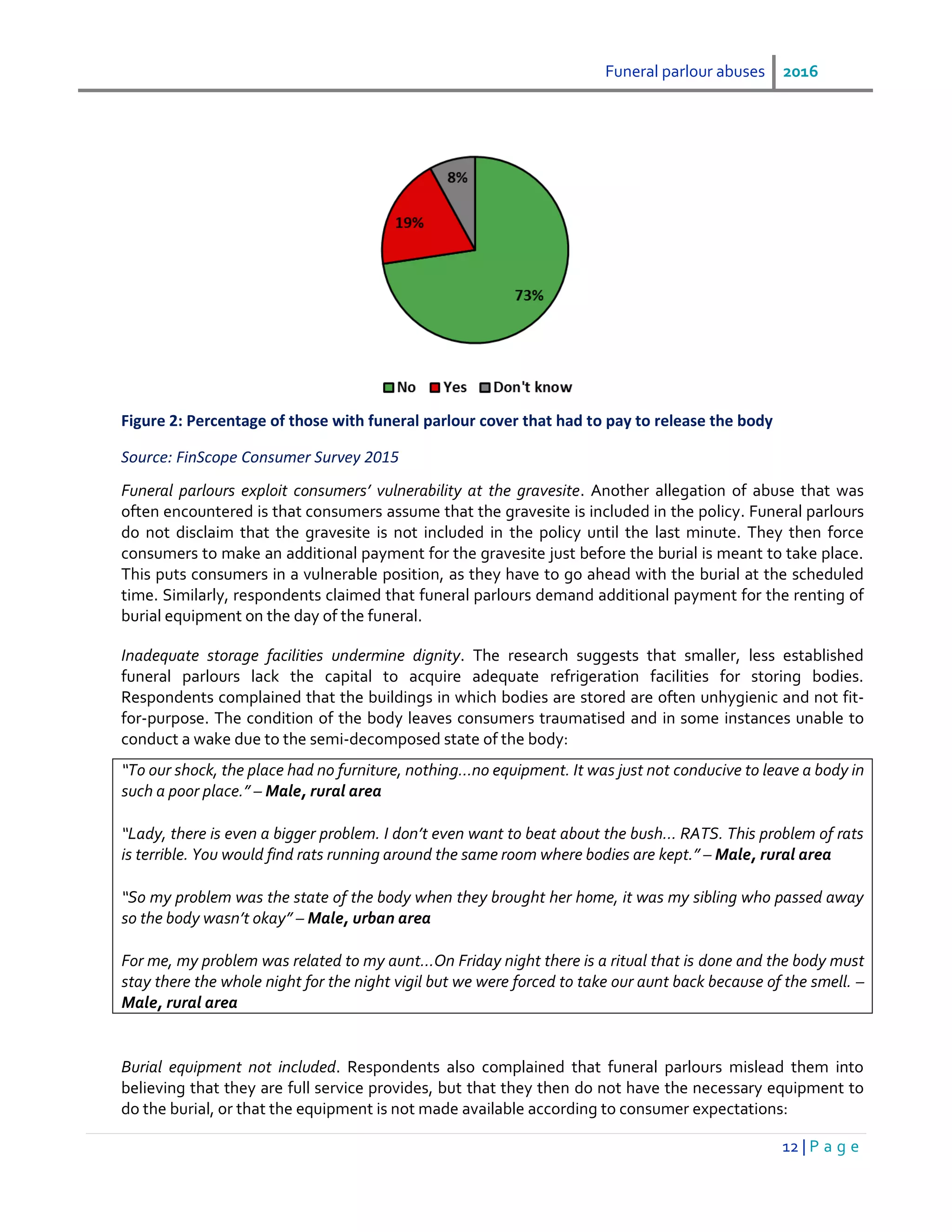
In the FinScope consumer survey, almost 20% of all those with funeral cover from a funeral parlour that
experienced a death in the family in the past twelve months indicated that they had to pay a fee to
release the body:
Funeral parlour abuses 2016
12 | P a g e
Figure 2: Percentage of those with funeral parlour cover that had to pay to release the body
Source: FinScope Consumer Survey 2015
Funeral parlours exploit consumers’ vulnerability at the gravesite. Another allegation of abuse that was
often encountered is that consumers assume that the gravesite is included in the policy. Funeral parlours
do not disclaim that the gravesite is not included in the policy until the last minute. They then force
consumers to make an additional payment for the gravesite just before the burial is meant to take place.
This puts consumers in a vulnerable position, as they have to go ahead with the burial at the scheduled
time. Similarly, respondents claimed that funeral parlours demand additional payment for the renting of
burial equipment on the day of the funeral.
Inadequate storage facilities undermine dignity. The research suggests that smaller, less established
funeral parlours lack the capital to acquire adequate refrigeration facilities for storing bodies.
Respondents complained that the buildings in which bodies are stored are often unhygienic and not fit-
for-purpose. The condition of the body leaves consumers traumatised and in some instances unable to
conduct a wake due to the semi-decomposed state of the body:
“To our shock, the place had no furniture, nothing…no equipment. It was just not conducive to leave a body in
such a poor place.” – Male, rural area
“Lady, there is even a bigger problem. I don’t even want to beat about the bush… RATS. This problem of rats
is terrible. You would find rats running around the same room where bodies are kept.” – Male, rural area
“So my problem was the state of the body when they brought her home, it was my sibling who passed away
so the body wasn’t okay” – Male, urban area
For me, my problem was related to my aunt…On Friday night there is a ritual that is done and the body must
stay there the whole night for the night vigil but we were forced to take our aunt back because of the smell. –
Male, rural area
Burial equipment not included. Respondents also complained that funeral parlours mislead them into
believing that they are full service provides, but that they then do not have the necessary equipment to
do the burial, or that the equipment is not made available according to consumer expectations:
Funeral parlour abuses 2016
13 | P a g e
“The machines to bring down the coffin into the grave they will say it’s part of the package but when it’s time
for you to claim they will say pay an extra R600 for it.” – Female, urban area
Untrained staff behaving inappropriately. Another reported abuse is that funeral parlours use casual staff
that are not sufficiently trained to conduct a dignified funeral or remove the body in a dignified way.
Funeral parlours are reported to hire staff on an ad hoc basis to minimise wages. Consequently, staff
members are not given the proper training, especially regarding the handling of the body. Consumers
also complain about the behaviour of staff members, showing disregard for the dignity of the deceased,
to the distress of the family. Respondents even recounted instances of drunkenness among staff.
“There is definitely problems also with the people they employ. One time one of the drivers came to pick up a
body drunk.” – Female, rural area
“The informal funeral parlours are basically fly-by-night operators where the person will borrow everything…
They will even hire people who don’t have the necessary skills to work at a funeral parlour.” – Female, urban
area
“I was disgusted with the way they handled my sister. They transported her naked with buttocks showing.” –
Female, urban area
Transport unreliable and quality of vehicles adjusted. Respondents reported that the deceased arrives late
for funerals because funeral parlours do not have enough hearses to cope with periods of high demand or
the hearse breaks down en route to the funeral. Funeral parlours also under-deliver on the number of
passenger vehicles due to cash flow constraints. Consumers are then forced to make alternative transport
arrangements and incur additional costs. This is difficult because of the high volume of mourners that
require transport.
“Sometimes they promise you two buses and then they send a double decker. Yet they promised you two
buses, so many people get left behind as a result ” – Female, urban area
“You find that there are four funerals and the buses from this funeral need to attend to all the funerals and
the hearse and family cars as well. So [the funeral parlour] will still be busy at Evalon but the buses need to
go because they have another funeral to get to. “ – Male, urban area
Contracts are informal and not an accurate indication of the quality of service promised. Respondents
complained that funeral parlours use contracts to entice consumers to use their services. They present
misinformation to make their service offering seem more attractive than their competitors. When the
death occurs, the parlours can then not fulfil their contractual obligations. Respondents also complained
that contracts are overly complicated. They reported that recourse options are often stated on contracts,
but are not available in reality.
“I realised they only advertised the cow because they wanted to draw people. It was the first time they had
advertised a cow, because most parlours don’t” – Female, urban area
“Even with the registered ones you find the same problem, but it’s to a minimum. I think the biggest problem
we have is the contract. The understanding of a contract, that’s what creates the problem at the end of the
day” – Female, urban area
Funeral parlour abuses 2016
14 | P a g e
No monetary benefit option. A last, very significant, abuse to note is that it was very rare, if not unheard of,
for respondents to be offered the option of a monetary benefit instead of a funeral service. By law (as
discussed in Section 1), funeral insurance where the pay-out is in the form of a funeral service must give
consumers the option of a cash pay-out. This is relevant to protect consumers against three situations: (i)
where services rendered are not of the same value as the services advertised; (ii) where multiple policies
cover the same life, but only one policy can deliver a service; or (iii) where the person that is covered is
outside of a funeral parlour’s service area at the time of death. However, the consumers in the qualitative
sample were not aware of their right to insist on a monetary pay-out. Indeed, it does not occur to them
that this could be an option, as their need is for the funeral service rendered. One respondent provided
the research team with a copy of a policy contract from a funeral parlour that is a registered financial
service provider that explicitly states that no “no cash pay-out whatsoever” will be provided.
“That’s an interesting one, because we do not think funeral parlours are supposed to give you a cash pay-out
at all. They give you a coffin and whatever was promised in the deal but with the Standard Bank one you
know that they are going to give you a cash pay-out.” – Female, urban area
Respondents did note instances where multiple policies had been taken out by different family members
from different funeral parlours on a single person’s life. However, they did not realise that the resultant
inability to claim on more than one policy could be prevented7
. Instead, they regarded it merely as a fact
of life.
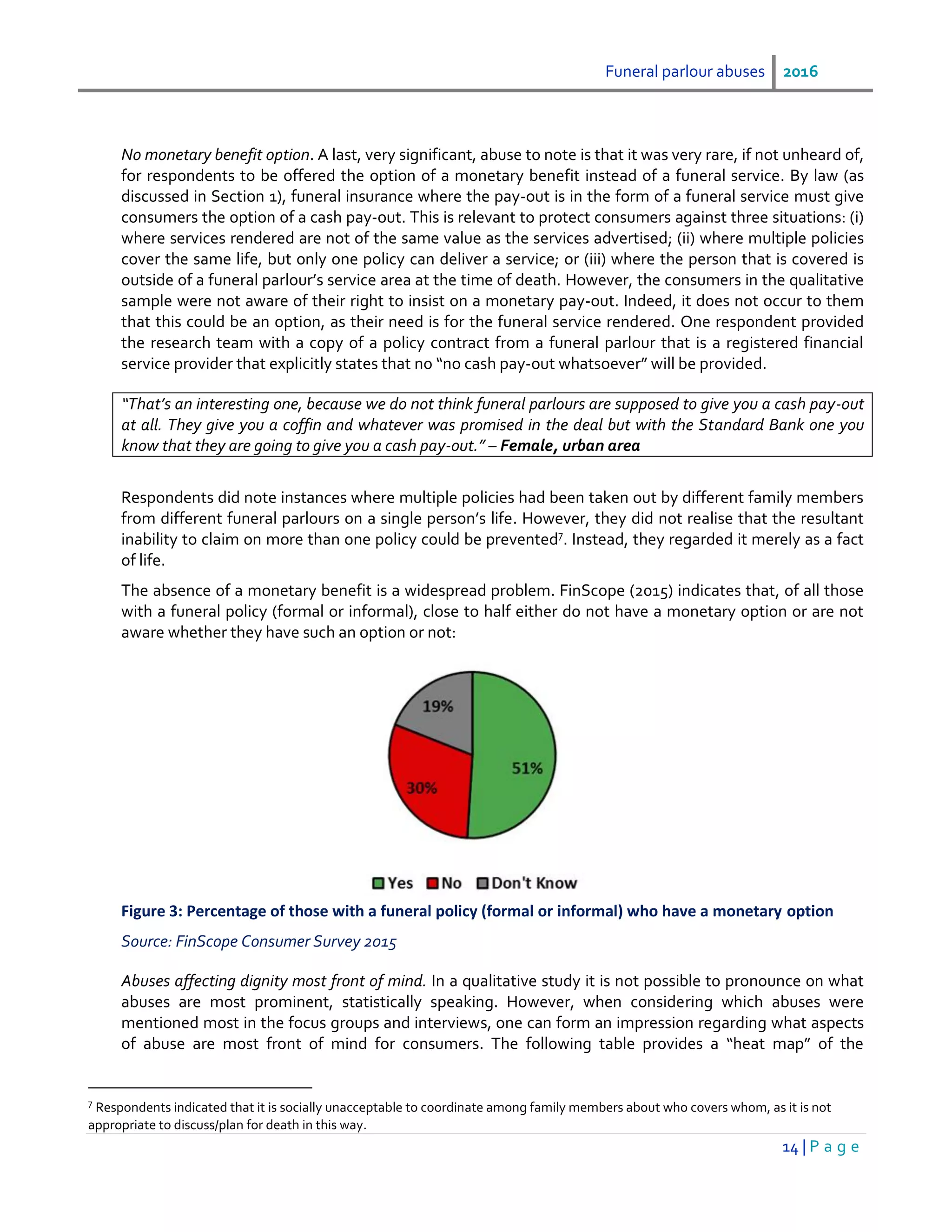
The absence of a monetary benefit is a widespread problem. FinScope (2015) indicates that, of all those
with a funeral policy (formal or informal), close to half either do not have a monetary option or are not
aware whether they have such an option or not:
Figure 3: Percentage of those with a funeral policy (formal or informal) who have a monetary option
Source: FinScope Consumer Survey 2015
Abuses affecting dignity most front of mind. In a qualitative study it is not possible to pronounce on what
abuses are most prominent, statistically speaking. However, when considering which abuses were
mentioned most in the focus groups and interviews, one can form an impression regarding what aspects
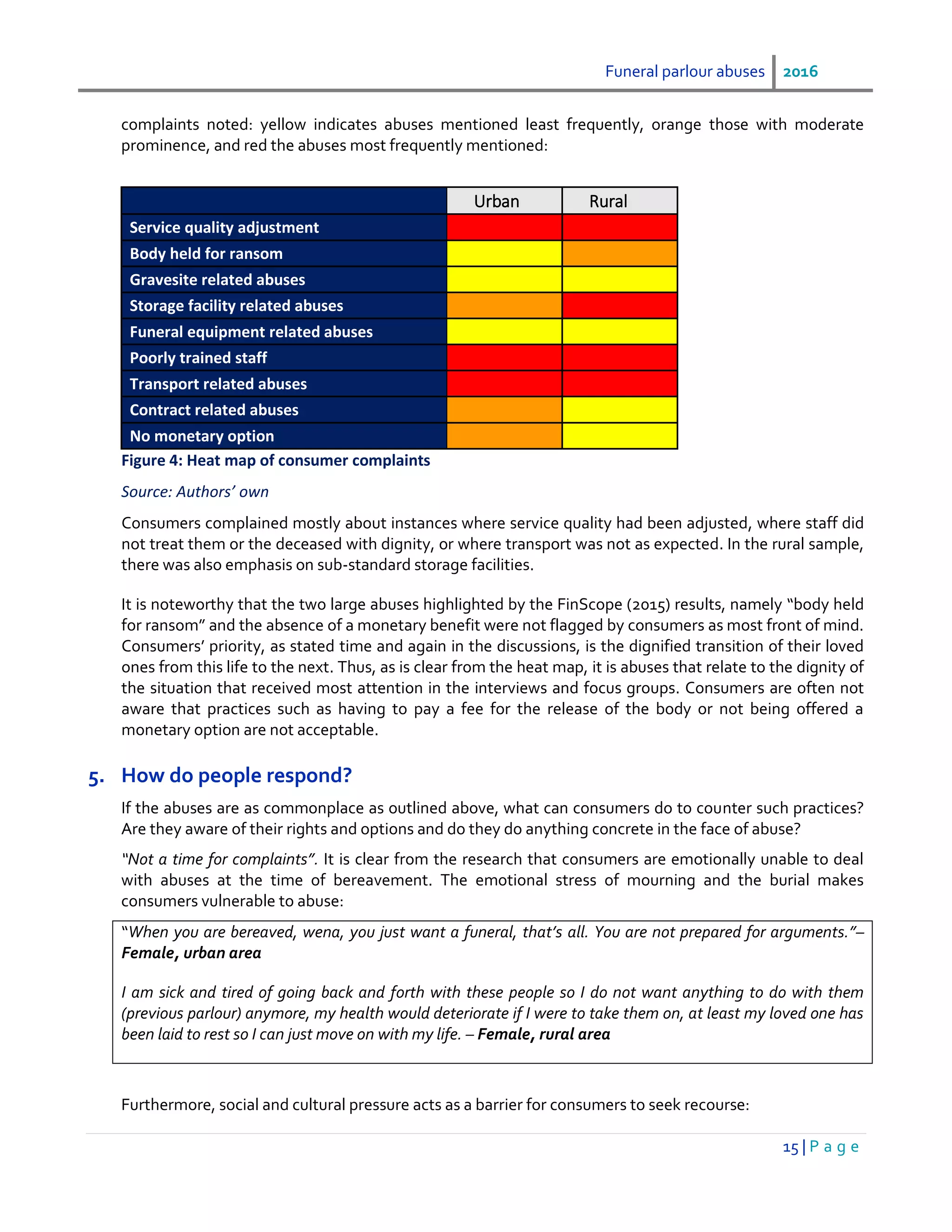
of abuse are most front of mind for consumers. The following table provides a “heat map” of the
7
Respondents indicated that it is socially unacceptable to coordinate among family members about who covers whom, as it is not
appropriate to discuss/plan for death in this way.
Funeral parlour abuses 2016
15 | P a g e
complaints noted: yellow indicates abuses mentioned least frequently, orange those with moderate
prominence, and red the abuses most frequently mentioned:
Urban Rural
Service quality adjustment
Body held for ransom
Gravesite related abuses
Storage facility related abuses
Funeral equipment related abuses
Poorly trained staff
Transport related abuses
Contract related abuses
No monetary option
Figure 4: Heat map of consumer complaints
Source: Authors’ own
Consumers complained mostly about instances where service quality had been adjusted, where staff did
not treat them or the deceased with dignity, or where transport was not as expected. In the rural sample,
there was also emphasis on sub-standard storage facilities.
It is noteworthy that the two large abuses highlighted by the FinScope (2015) results, namely “body held
for ransom” and the absence of a monetary benefit were not flagged by consumers as most front of mind.
Consumers’ priority, as stated time and again in the discussions, is the dignified transition of their loved
ones from this life to the next. Thus, as is clear from the heat map, it is abuses that relate to the dignity of
the situation that received most attention in the interviews and focus groups. Consumers are often not
aware that practices such as having to pay a fee for the release of the body or not being offered a
monetary option are not acceptable.
5. How do people respond?
If the abuses are as commonplace as outlined above, what can consumers do to counter such practices?
Are they aware of their rights and options and do they do anything concrete in the face of abuse?
“Not a time for complaints”. It is clear from the research that consumers are emotionally unable to deal
with abuses at the time of bereavement. The emotional stress of mourning and the burial makes
consumers vulnerable to abuse:
“When you are bereaved, wena, you just want a funeral, that’s all. You are not prepared for arguments.”–
Female, urban area
I am sick and tired of going back and forth with these people so I do not want anything to do with them
(previous parlour) anymore, my health would deteriorate if I were to take them on, at least my loved one has
been laid to rest so I can just move on with my life. – Female, rural area
Furthermore, social and cultural pressure acts as a barrier for consumers to seek recourse:
Funeral parlour abuses 2016
16 | P a g e
“I am wearing mourning clothes. That is why I stopped my daughter and son from laying a case. I cannot go
into the witness box with these clothes” – Female, rural area
“We don’t want to complain in public because we are scared of what people might say. If for instance now I
complain that the body was not frozen properly people might say I used a cheap mortuary and that would be
embarrassing to me and my family so I don’t want that.” – Female, urban area
Few recourse options in practice. Many of the respondents were simply unaware of any recourse options.
When prompted in the focus groups, the concepts of being able to consult a list of registered parlours, or
an ombudsman where one can complain, and a telephone number for complaints all appealed to
respondents. However, they doubted whether it is in fact possible to ensure compliance. Furthermore,
the discussions speak of a general sense of hopelessness that recourse actions will make any difference.
The respondents agreed that funeral parlours are inaccessible as a recourse option, and that official
channels are ineffective:
“When I tried to do follow up that other lady that I know said I’m just wasting my time these people won’t
listen to me or they keep telling me stories. Indeed, when I got there no one gave me a straight answer.” –
Female, rural area
“The Parlour kept on saying they will meet me the next day when that day comes they are not available and
will not pick my calls till I gave up.” – Male, rural area
“Well the person passed away at home was my sister I expected to receive R10000 and I was given R7000. I
couldn’t fight or argue with them I was still mourning” – Female, rural area
“The biggest hindrance is that whatever setbacks you have encountered the burial must proceed. Therefore
you do not have sufficient time to address the problems. You just have to accept the alternatives offered and
proceed with the burial. So after the burial you have already used the poor service, there is very little in real
terms that you can do about the situation.” – Female, urban area
“When you go to the police station to report they will send you to small claims court and it drags on forever.”
– Male, urban area
“There is nowhere to turn to. You just go back to the parlours and hope for the best. Otherwise what would
the police do? It is outside their scope and line of duty anyway.” – Female, urban area
Consumers are also reluctant to change funeral parlours as that means that a new waiting period will be
applied, leaving them without cover for a few months:
“Yes you continue. You have no choice because you take account the number of years you have been paying
them. If you change to another parlour you will be put on probation period for six months and therefore not
eligible for any assistance with in case of a death in the family. If you move you are forfeiting all the
premiums you have paid over the years and you become vulnerable because you are not covered for the time
between the change and the end of the probation in a new parlour. And you are not even sure that this new
parlour will not disappoint you also.” – Male, urban area
Funeral parlour abuses 2016
17 | P a g e
Voting with your feet. Some, however, do move to a different funeral parlour despite the cost of losing
their policy. They would then opt to go to a parlour recommended by others.
“I stopped, I’d rather lose the money I’ve already put in than to continue paying for something which I have
seen does not work. Then we warn others not to join that parlour.” – Male, urban area
“I spoke to the person but we didn’t agree and then I just stopped my policy with them” – Female, urban
area
Thus respondents recognised that their best recourse is word-of-mouth: to warn people for future use.
However, this is difficult if for instance a burial society is aligned with a specific funeral parlour.
Furthermore, it is problematic that funeral parlours do not give consistently good or bad service. Thus a
person may buy a policy from a specific parlour where a relative or acquaintance received good service,
but not receive the same service themselves.
Indications that mass media may be effective. A number of respondents across groups and locations
referred to the impact of television in raising awareness of consumer rights:
“They would never do that to me I would take them to “Speak Out”.” – Female, urban area
6. Implications for regulation?
Delivering value, but… This study has shown that funeral parlours and burial societies deliver value to
consumers by meeting essential needs for burial services, as well as by meeting social and cultural needs.
Power imbalances. This, however, does not mean that there are no abuses. In particular, the powerful
position of informal funeral parlours vis-à-vis consumers at the time of bereavement allows them to
abuse vulnerable clients. This power imbalance is due to the nature of the value chain and the necessity of
using a funeral parlour’s services to remove the body soon after death and to get access to a gravesite.
There is additional concern of funeral parlours gaining access to bodies and coercing families to use their
services or charging “release” fees. The interlinked relationship between burial societies and funeral
parlours is also at the heart of many of the abuses, especially where burial society management is
“captured” by the funeral parlour.
Health abuses spill over into financial services. Abuse is a multi-pronged reality, spanning the health
service as well as the financial service aspects. Once a policy is purchased it creates the expectation of a
certain service by clients. This means that abuses on the health services side become interrelated with
that on the financial services side. There are regulatory gatekeepers8
for health-related services, but the
fact that health services are regulated at the municipal level challenges coordination from a financial
services regulation point of view.
No effective recourse. It is clear that consumers have limited effective recourse options and are more often
than not unaware of their rights. After the death of a loved one, they simply do not feel emotionally up to
responding to abusive practices. Thus external consumer protection intervention is called for. Targeted
consumer education on consumer rights may be one avenue, as the impact of television programmes
reported in the qualitative research suggests. However, this can be only part of the full enforcement
solution.
8
For example, a funeral parlour must have a certificate of competence to be able to remove and store a body. This is enforced at municipal level.
Funeral parlour abuses 2016
18 | P a g e
Giving consumers the last word. All of the above suggests a strong imperative for regulatory and
supervisory action – but no easy solution. What do consumers think? Those in the sample argued that
regulators need to strengthen their hand in responding to abusive practices:
“There should be a number that we should be able to use if problems were to occur on the day of the funeral
something similar to the number you use for SAPS” – Female, rural area
“I think the law should be stricter and not allow a person who is not registered to open a funeral parlour, we
will now be able to lay a charge when one didn’t deliver as promised. I think that can at least be controllable.”
– Female, rural area
“I would suggest that the parlours be listed; the ombudsman can have a website where they are all listed and
if there is a problem you as the bereaved should know all the procedures. There could already be a legislation
in place, but it ends at the top; it doesn’t come down to the people. That’s why I said it should be available in
all the official languages so that the illiterate can also be included.” – Male, urban area

Cutting corners at a most vulnerable time

  • 1.
    Cutting corners ata most vulnerable time The customer’s perspective on abuses in the informal funeral parlour market in South Africa Prepared for FinMark Trust by Cenfri March 2016
  • 2.
    Funeral parlour abuses2016 1 | P a g e Authors: Iske van den Berg Albert van der Linden Christine Hougaard Louise de Villiers
  • 3.
    Funeral parlour abuses2016 2 | P a g e Contents 1. Introduction.....................................................................................................................................................3 1.1 Methodology...............................................................................................................................................4 1.2 Structure......................................................................................................................................................4 2. Consumer needs..............................................................................................................................................5 3. Consumer options...........................................................................................................................................6 4. Unpacking abuses in the market................................................................................................................ 10 5. How do people respond?............................................................................................................................. 15 6. Implications for regulation?........................................................................................................................ 17
  • 4.
    Funeral parlour abuses2016 3 | P a g e 1. Introduction A formalisation imperative. In 2011 National Treasury published a Policy Document titled “The South African Microinsurance Regulatory Framework”. This document stems from a policy process dating back to the Parliamentary Committee on Finance hearings in 2003 and 2005 on abuses in the funeral parlour market in South Africa, which called National Treasury and the Financial Services Board (FSB) to action in planning a road to formalisation for funeral insurance in South Africa. This focus has since broadened to microinsurance and more broadly to the development of the lower-income insurance market. The regulatory framework proposed in the Policy Document aims to create a dedicated microinsurance licence in order to achieve two objectives: provide a space for informal entities to graduate into in order to achieve formalisation, as well as for established insurers to reach the lower-income market on a level playing-field. As part of the implementation plan, it recognises the need for an enforcement strategy in the informal funeral parlour market. How feasible will this be? Informality is core to many operators’ business model. Since the publication of the Microinsurance Policy Document, FinMark Trust and Cenfri have done in-depth research in order to better understand the nature of the informal funeral parlour market in South Africa. A supply-side survey and deep-dive analysis conducted by Cenfri in 20121 found that informality is part and parcel of much of the funeral parlour industry. Many informal funeral parlours lack general business skills, are using insurance premiums for cash flow to establish their business and to acquire business assets, do not keep insurance funds separately and have no sound pricing practices. Hence they are forced to flex the value of funerals offered to be able to cover costs, should mortality experience not be as expected. The study found that it is common for different parlours to sell multiple policies on the same life and that the regulatory requirement to provide a monetary benefit option is not adhered to2 . Indeed, it is core to informal funeral parlours’ business to be able to adjust the value of services offered. Should they be forced to provide a cash option to the advertised value of the funeral service, many will be forced out of the market. This is exacerbated by the growing competition in the market due to declining mortality rates on the back of better HIV/AIDS treatment. Informality is no small phenomenon. The FinScope Consumer Survey (2015) estimates 60% of all South African adults to have some kind of funeral cover. 27% of adults have cover from a funeral parlour. It is likely that much of this cover is informal. Though no hard data is available, the National Funeral Director’s Association (NFDA) estimates there to be over 7 000 funeral parlours in South Africa. It is a fragmented industry, with previous research estimating that less than 15% of total revenue is generated by the big three formal funeral parlour chains3 . Based on the annual number of deaths, we estimate the industry to be worth at least R4.5 bn. Even should one make a lower bound estimate that the informal market represents only half the market, this means that the informal industry is more than R2bn per year strong4 . 1 See the comprehensive study and shorter policy brief funded by the Canadian International Development Research Center (IDRC) called “The Nature of Informality in the South African Funeral Services Market – Implications for Policymakers and Regulators” (Cenfri, 2012). 2 The Long-term Insurance Act, 52 of 1998 requires that, where assistance policy benefits are paid in-kind (for example via the provision of a funeral service), the policyholder is given the right to a monetary benefit. Since the Insurance Laws Amendment Act of 2008, the amount does not need to be equal to the cost that would be incurred to the insurer, had the in-kind benefit been provided, but must be clearly stated. The 2011 Microinsurance Policy Document (National Treasury, 2011;13) states the right to a monetary benefit in the assistance business sphere will be extended to all microinsurance. In addition, it will be required that the face value of the in-kind benefit and the monetary option provided must be the same (rather than the cost to the insurer). The insurer will also have to revise the value of the monetary benefit over time to ensure that it keeps track with changes in the value of the benefit-in-kind. 3 Source: Proprietary market research 4 Estimate from unpublished research conducted by FinMark Trust for the Financial Services Board in early 2015.
  • 5.
    Funeral parlour abuses2016 4 | P a g e Regulation imminent. The Insurance Bill, B1-2016, was tabled to Parliament in January 20165 . It contains the first formal mention of microinsurance in legislation and hence paves the way for the long-awaited implementation of the microinsurance regulatory framework. The FSB plans to publish a microinsurance regulatory roadmap to give clarity on how the regulatory framework will be implemented and enforced. What emphasis should be placed on the formalisation of informal funeral parlours in the implementation of the framework? Ultimately, the imperative for formalisation depends on the extent and nature of abuse in the industry. Regulators are tasked to protect consumers, but at the same time to facilitate market development. If the industry is on the whole delivering satisfactory consumer value, with enough market mitigating factors (for example, if word-of-mouth in the community acts against funeral parlours, should contracts not be honoured), a different enforcement approach may be called for than if blatant consumer abuse is the order of the day. Though anecdotal evidence abounds on consumer abuses in the informal funeral parlour industry, there is no clear picture of the nature and extent of consumer abuse, as experienced from the customer’s perspective. This study investigated the nature of abuse in the informal funeral parlour market by talking to consumers themselves. It aims to give consumers a voice, thereby generating an information base to inform the enforcement question. 1.1 Methodology A multi-pronged qualitative data collection methodology was used to gain insights into the experiences of consumers. The information was collected from the following groups: • 12 Focus Group Discussions: Participants all experienced a bereavement in the last 12 months and were responsible for at least half of the financial contribution to the funeral. Most of the respondents were recruited to have experienced poor service from a funeral parlour. • 12 In-depth interviews with the management of burial societies: The in-depth interviews were conducted to learn more about the comparative value of informal funeral insurance; to explore the awareness and past experience of abuse by informal funeral parlours as well as the options for recourse when abuse is experienced. The discussions with the management of burial societies also highlighted the complex relationships between burial societies and funeral parlours. • 18 Informal intercept interviews: Intercept interviews were conducted with community leaders, pastors and police officers to find out more about how prevalent abuse is and how it is reported. The research was conducted in four areas: Gauteng: Johannesburg (urban) and Hammanskraal (peri- urban); Kwa-Zulu Natal: Durban (urban) and Eastern Cape: Mthatha surrounding areas (rural). Discussions and interviews were conducted in the vernacular and then transcribed into English. The qualitative fieldwork is also supported with data from the FinScope South Africa Consumer survey 2015. It is a nationally representative survey of adult individuals in South Africa. 1.2 Structure The rest of the report is structured as follows:  Section 2 outlines the various needs that consumers have after the death of a loved one 5 It provides the legal framework for the prudential regulation of insurance in South Africa in line with international standards and the move towards Twin Peaks regulation. A separate regulatory framework is being developed for Conduct of Business. Together, these two Acts will replace the Long- term and Short-term Insurance Acts of 1998.
  • 6.
    Funeral parlour abuses2016 5 | P a g e  Section 3 sets out the different provider options available to meet these needs, highlighting the role of funeral parlours vis-à-vis other avenues. Particular attention is paid to the relationship between burial societies and funeral parlours and the power relationships arising.  This provides the basis for an in-depth consideration in Section 4 of the various informal funeral parlour abuses identified in the research.  Section 5 considers consumers’ response in the face of abuses.  Section 6 concludes on the implications of the findings. 2. Consumer needs Understanding consumer needs is the first step to understanding the scope for and nature of abuse in the industry. The research found that funeral services are essential to consumers, as funerals are an important part of South African culture. When a loved one dies, consumers face essentially two sets of needs: functional needs for the various aspects of the burial, and social needs: Functional needs a necessity. When a person passes away there are a number of essential services required. The most immediate needs highlighted in the research include: • Removal of the body from the family’s home/hospital • Transport of the body • Issuing of a death certificate • Washing of the body • Refrigeration of the body • Burial (including the grave, equipment, etc.) • Catering equipment and services “In my village, funeral parlours bring dignity to the whole send-off ceremony. They bring a platform, a choir, pastors, and some dignified men who sit around the pastors – even though the deceased was not a church goer “ – Male, rural area Culturally important social needs. During the focus group discussions, social needs were emphasised as equally important to the functional needs relating to the burial. A funeral is a time for extended families to get together. The social needs highlighted in the research include: • Dignified transition to the afterlife • Opportunity for the community to pay their last respects and celebrate the life of the deceased • Hosting of an elaborate funeral to meet expectations • Assistance (helping hands) during the ceremony and catering for all the guests A non-negotiable cost. When asked what a funeral typically costs, responses varied, but there was consensus that it is very costly – some respondents felt that it is overly so, and that an expensive funeral has become a “social competition”. For example: one respondent reported total funeral costs of R80,000, while others mentioned amounts of R10,000, R15,00o, R20,000 or R40,000. All respondents emphasised the importance of providing catering for guests and the associated costs: “We wait for people that are arriving from far-away places, so we have to cook from morning until supper from the day it’s announced that the person has died.”
  • 7.
    Funeral parlour abuses2016 6 | P a g e One focus group explained the situation as follows: Moderator: How much is a funeral supposed to cost? Respondent1: Before we even talk about the coffin, the grocery, people having to do their hair Respondent2: Before the day of the burial you have already spent a lot of money Respondent3: Remember people are coming every day and you need to cater for them Respondent4: It is quite costly: remember the R8000 package, it’s only for the day of the burial, it doesn’t take into account the process before the day of the burial Some respondents mentioned that the cost depends on the stature of the deceased and family in the community. If the deceased was well-known, more people attend the funeral and need to be catered for. Insurance gives peace of mind. The respondents were very much aware of the need to plan and provide for the expenses relating to the various needs. Belonging to a burial society and having a funeral policy is often regarded as non-negotiable, as it gives them the peace of mind that the funeral will be taken care of and that there will be helping hands to assist. Paying a monthly premium in the expectation that a funeral service will be rendered means that the expense is defined and, hence, smoothed over a longer period. Total monthly contributions among respondents ranged from as little as R20 to as high as R500. Average monthly contributions were highest in the urban sample in Gauteng province, where people on average contributed R327. This was followed by the Durban sample, where the average was R209, the peri-urban Gauteng sample at R146 and the rural Eastern Cape sample at R141 per month. It is important to note that these amounts are indicative only, as they are derived from a limited qualitative sample. Multiple funeral cover speaks to diversity of needs. It was common for respondents and their families to belong to a burial society and have a funeral parlour policy. The urban respondents were most likely to also have a formal policy from an insurer – each for a different primary purpose. Thus people take out multiple funeral cover to meet diverse needs and ensure that the financial risk is sufficiently covered. The next section considers’ the various options for funeral cover as identified in the research. 3. Consumer options Various options to meet funeral needs. Figure 1 below illustrates the various providers that consumers can use to meet their needs. Different providers cater to different needs. Therefore, consumers often have to diversify in order to meet all their needs.
  • 8.
    Funeral parlour abuses2016 7 | P a g e Source: Authors’ own Family and friends provide critical assistance. The various expenses that consumers are faced with during the time preceding the burial mean that there is a need for cash to cover immediate expenses. Family members or friends often step in to make monetary contributions to assist the bereaved. Furthermore, they lend helping hands leading up to and during the funeral ceremony. Street block burial societies an additional support mechanism. People in a neighbourhood sometimes form a burial society that makes contributions after a death occurs to help the family. This takes place on a structured basis, with a certain amount expected. The respondent below explains: This arrangement is common in poorer areas. The contributions are used to cover a variety of expenses. Similarly to family and friends, street block burial societies provide helping hands during the funeral ceremony. Risk pooling through burial societies. Burial societies enable communities to pool risk collectively for funerals. It operates much like insurance, with members making an agreed monthly contribution in the expectation of a certain benefit (be it a funeral service with an associated/preferred funeral parlour or a cash pay-out) upon a death in the family. Burial societies also act as a support mechanism to the family of the deceased. Members assist the family by helping with the preparation of food and other activities related to the funeral ceremony. This respondent explains the benefit of belonging to a burial society: “In our community someone passed away and that family had nothing so we had to get together as neighbours and each pay R50 so they could buy some groceries and things.”- Male, rural area Figure 1: Potential providers that meet consumers’ funeral needs
  • 9.
    Funeral parlour abuses2016 8 | P a g e “They [burial societies] act as a second policy. They come through for you financially since death is unexpected. The advantages are that you have helping hands during a funeral, with the cooking and other chores.” – Female, rural area Project managers act as intermediaries between consumers and funeral parlours. Project managers are funeral undertakers that do not own facilities like fully-fledged funeral parlours do, but outsource the service delivery part of their business to funeral parlours. They have been referred to as “suitcase operators” and have a reputation for being cheaper, but also less reliable. A major drawback for consumers is that they cannot pick the parlour that ultimately provides the funeral service, because the project managers typically have relationships with particular funeral parlours6 . Funeral parlours provide the funeral service. Full service funeral parlours provide for all the consumers’ functional needs. The parlour collects the body, either from home or from the hospital, and stores it until the time of the funeral service and burial. They also provide additional services that consumers require on the day of the funeral, as mentioned by the female respondent below. Ultimately, consumers rely entirely on the funeral parlour for a dignified burial. “They must join the funeral parlour because the important thing is that the body of the deceased is transported from wherever to the mortuary as soon as possible. – Male, urban area “I joined Sizo Funeral Parlour. I contribute R200, they provide 3 buses, a tent, 4 tables, 50 chairs, a toilet, a storage container and a coffin as well as a grave.” – Female, urban area Formal insurance policies often used as life insurance policies. Funeral insurance provided by licensed insurers and not sold via burial societies or funeral parlours provide a monetary pay-out to consumers instead of funeral services. Respondents indicated that the pay-out is generally of higher value than what consumers can access in the informal market, but also more expensive. However, because formal policies provide cash and not funeral services, it does not address the immediate functional needs of consumers. Furthermore, policies normally pay out only after 48 hours. Consequently, respondents tended to use formal insurance as a quasi-life insurance policy whereby the benefits are used after the initial funeral expenses, for which a funeral parlour policy or burial society is still used. Credit used as a stop-gap measure for cash flow. Respondents indicated that almost immediately after a death occurs consumers have to incur expenses. Those that have not made adequate provision are forced to borrow money to ensure that the funeral can take place. Credit can also be a mechanism to bridge the gap between the time of death and the pay-out from a formal funeral insurance policy. Various inter-relationships determine balance of power. The research showed that there are often relationships between the various consumer options. This gives rise to power relationships between different players that determine the scope for and nature of abuse. The table below outlines which services are rendered by which options: 6 For a full overview of different types of funeral service providers, see Cenfri (2012), ibid.
  • 10.
    Funeral parlour abuses2016 9 | P a g e Consumer needs Family and friends Street block burial society Burial society Project manager Funeral parlour Insurers Credit Handle burial X Removal of the body X Transport of the body X X Death certificate X X Immediate cash X X X X Cash for other expenses X X X X X Payment for grave site X X Burial equipment X X X Assistance and helping hands X X X Table 1: Consumer needs met by different providers Source: Authors’ own, based on qualitative demand-side research Funeral parlours the only provider that meet main burial needs. Table 1 indicates that funeral parlours are the only provider that consumers can use to remove the body from the deceased’s home. Likewise, hospitals often use funeral parlours to remove and store bodies. Once the funeral parlour has the body in its possession the funeral parlour is in a powerful possession vis-à-vis the consumer. The storage of the body greatly enhances the bargaining power of the parlour, because the consumer is essentially forced to use its services. Funeral parlours are also the only providers with the ability to conduct burials, which places them in a powerful position in the market. Burial societies present good business opportunities for funeral parlours. Funeral parlours are eager to establish relationships with burial societies. Burial societies aggregate consumers. By linking with a burial society, the funeral parlour accesses a substantial consumer base and therefore a regular stream of premium income. It also decreases the administrative cost of collecting premiums, because the parlour can collect premiums directly from the society rather than collecting it from each individual. Three potential linkages between burial societies and funeral parlours. A burial society can choose a particular funeral parlour as a preferred service provider, should a death occur, without buying a funeral policy from the parlour. It then often negotiates a preferential rate with the funeral parlour. Secondly, the burial society may decide that members will buy funeral policies from the funeral parlour. In this instance, the burial society initiates the relationship and has the ability to move from one funeral parlour to the next, should they not be happy with the service. Lastly, the research indicated that funeral parlours themselves often form or initiate burial societies, as discussed below. Where the burial society initiates the funeral parlour relationship, consumers have bargaining power. It is to the burial society’s benefit to establish a relationship with a funeral parlour, as it establishes a service relationship, brings certainty to members and can lead to reduced premiums. The relative size of the
  • 11.
    Funeral parlour abuses2016 10 | P a g e burial society on the parlour’s books establishes the extent of the bargaining power of the burial. Burial societies in strong positions often negotiate for lower premiums or additional benefits. Furthermore, the management of the burial society is in a strong position to advocate for its members if the funeral parlour delivers a sub-standard service. Funeral parlour-initiated relationships leave consumers vulnerable to abuse. Respondents explained that it is common practice for funeral parlours to create “their own” burial societies to capture a consumer base. The parlour decides on the management structure of the burial society and may be represented on the management team. This arrangement creates a conflict of interest. The management of the burial society is essentially controlled by the funeral parlour and is typically unwilling to advocate for the members of the society. Members in turn are forced to use the services of the particular funeral parlour. Consequently, the members of the society have negligible bargaining power. The existence of a funeral policy is core to power relationships. The discussion in Section 2 showed that respondents attach great value to funeral policies, as it removes the risk of not having sufficient resources to pay for the burial and helps to guarantee a dignified funeral. It also acts as a commitment device to ensure that people make provision for the inevitability of having to pay for funeral expenses at some time. As outlined above, it is the existence of a policy that sets funeral parlours and insurers aside from burial societies and community support. It is also the existence of a policy that introduces power imbalances to the funeral parlour-burial society relationship. The policy allows the funeral parlour to secure or “capture” clients for their future services. The research suggests, as will be discussed in Section 5, that clients are reticent to move to a different parlour because they see it as a waste of money after having paid premiums for some time and because a new waiting period will apply. As the discussion on the various abuses encountered in the market below will show, it is this “capture” of the client via the policy that enables the funeral parlour to exploit the consumer. Without a policy, that is, should the client pay cash for the service, consumers are better able to “vote with their feet”. 4. Unpacking abuses in the market The discussion above highlighted the position of power of funeral parlours vis-à-vis many consumers. This reliance on funeral parlours creates the potential for abuse. This section unpacks the nature of abuses identified in the qualitative research, and where relevant adds quantitative evidence from FinScope (2015) on the extent of such abuse. Abuses cut across different spheres. The research encountered a wide range of abuses in the informal funeral parlour market: related to health services, labour practices and the financial service rendered. These various abuses are interrelated, with the main source being the manner in which the informal funeral parlour business model operates and the power relationship between funeral parlours and clients and burial societies. Reduced funeral service quality the most prevalent form of consumer abuse. Previous supply-side research, as referred to in Section 1, found that it is integral to informal funeral parlours’ business models to adjust the quality of the funeral service according to their cash flow constraints. The current research confirmed this practice: it was common for respondents to have received a lower quality service than what was promised on the contract. The quality of funerals differ even for customers with exactly the same policy, depending on how much money the parlour has available at the time that the service needs to be rendered. Indeed, many of the individual types of abuse listed in the discussion below relate to sub- standard service quality. Respondents indicated that the social stature of the deceased, or the deceased’s family, often determines the quality of the funeral service. However, instances of total non-delivery are
  • 12.
    Funeral parlour abuses2016 11 | P a g e rare and was recounted by only one respondent (indicated below). Funeral parlours try to at least provide some sort of service, even if of sub-standard quality. The following consumer quotes illustrate: “Last year January I was dissatisfied with my parlour because they brought a different coffin saying the one we contracted for was out of stock. I got a cheap [inferior] one.” – Female, urban area “I had paid all my dues. Well, what a run around, instead of mourning their father, the children had to march in and out of the offices of this parlour – he did not do any burial at all. He did not give us anything; no coffin, nothing.”– Female, rural area “You see your money and your reputation will determine what kind of service you are going to receive, for example if you live in a shack you will probably get bad service. Whereas if they doing a funeral of high profile person they will put their best foot forward because they know that the people attending the funeral have money.”– Female, urban area “They come to you with a list of all the things they promise to do but when it comes to the day of the funeral they will not be able to fulfil those promises.” – Female, urban area “Although they were informed immediately and they are just 10 km away….. they only arrived at 4pm [4 hours later] to pick him up.” – Female, rural area “Bodies held for ransom”. Another practice often encountered (and again confirming previous supply-side research), is a situation where hospitals and morgues establish relationships with funeral parlours. The bodies of the recently deceased are delivered to these parlours. This practice then forces the family to engage with the specific parlour, or else to pay a fee for the body to be released to a different parlour. The “ownership” of the body hence determines who has bargaining power. The following consumer quotes illustrate: “The first problem is the hospital mortuary. They hand over the body to any funeral parlour on the day’s roster. Parlours that are on the queue are the first to take the body. Meanwhile you have been paying a different parlour all along. This means you must now pay an extra fee in order to release the body to the parlour at which you have a policy.”– Male, urban area If you notice, at the wall of the hospital, there is a roster on the wall. This roster determines which parlour should take bodies on that particular day. It has the days of the week. On each day, only those parlours listed on that day may take bodies. – Female, rural area In the FinScope consumer survey, almost 20% of all those with funeral cover from a funeral parlour that experienced a death in the family in the past twelve months indicated that they had to pay a fee to release the body:
  • 13.
    Funeral parlour abuses2016 12 | P a g e Figure 2: Percentage of those with funeral parlour cover that had to pay to release the body Source: FinScope Consumer Survey 2015 Funeral parlours exploit consumers’ vulnerability at the gravesite. Another allegation of abuse that was often encountered is that consumers assume that the gravesite is included in the policy. Funeral parlours do not disclaim that the gravesite is not included in the policy until the last minute. They then force consumers to make an additional payment for the gravesite just before the burial is meant to take place. This puts consumers in a vulnerable position, as they have to go ahead with the burial at the scheduled time. Similarly, respondents claimed that funeral parlours demand additional payment for the renting of burial equipment on the day of the funeral. Inadequate storage facilities undermine dignity. The research suggests that smaller, less established funeral parlours lack the capital to acquire adequate refrigeration facilities for storing bodies. Respondents complained that the buildings in which bodies are stored are often unhygienic and not fit- for-purpose. The condition of the body leaves consumers traumatised and in some instances unable to conduct a wake due to the semi-decomposed state of the body: “To our shock, the place had no furniture, nothing…no equipment. It was just not conducive to leave a body in such a poor place.” – Male, rural area “Lady, there is even a bigger problem. I don’t even want to beat about the bush… RATS. This problem of rats is terrible. You would find rats running around the same room where bodies are kept.” – Male, rural area “So my problem was the state of the body when they brought her home, it was my sibling who passed away so the body wasn’t okay” – Male, urban area For me, my problem was related to my aunt…On Friday night there is a ritual that is done and the body must stay there the whole night for the night vigil but we were forced to take our aunt back because of the smell. – Male, rural area Burial equipment not included. Respondents also complained that funeral parlours mislead them into believing that they are full service provides, but that they then do not have the necessary equipment to do the burial, or that the equipment is not made available according to consumer expectations:
  • 14.
    Funeral parlour abuses2016 13 | P a g e “The machines to bring down the coffin into the grave they will say it’s part of the package but when it’s time for you to claim they will say pay an extra R600 for it.” – Female, urban area Untrained staff behaving inappropriately. Another reported abuse is that funeral parlours use casual staff that are not sufficiently trained to conduct a dignified funeral or remove the body in a dignified way. Funeral parlours are reported to hire staff on an ad hoc basis to minimise wages. Consequently, staff members are not given the proper training, especially regarding the handling of the body. Consumers also complain about the behaviour of staff members, showing disregard for the dignity of the deceased, to the distress of the family. Respondents even recounted instances of drunkenness among staff. “There is definitely problems also with the people they employ. One time one of the drivers came to pick up a body drunk.” – Female, rural area “The informal funeral parlours are basically fly-by-night operators where the person will borrow everything… They will even hire people who don’t have the necessary skills to work at a funeral parlour.” – Female, urban area “I was disgusted with the way they handled my sister. They transported her naked with buttocks showing.” – Female, urban area Transport unreliable and quality of vehicles adjusted. Respondents reported that the deceased arrives late for funerals because funeral parlours do not have enough hearses to cope with periods of high demand or the hearse breaks down en route to the funeral. Funeral parlours also under-deliver on the number of passenger vehicles due to cash flow constraints. Consumers are then forced to make alternative transport arrangements and incur additional costs. This is difficult because of the high volume of mourners that require transport. “Sometimes they promise you two buses and then they send a double decker. Yet they promised you two buses, so many people get left behind as a result ” – Female, urban area “You find that there are four funerals and the buses from this funeral need to attend to all the funerals and the hearse and family cars as well. So [the funeral parlour] will still be busy at Evalon but the buses need to go because they have another funeral to get to. “ – Male, urban area Contracts are informal and not an accurate indication of the quality of service promised. Respondents complained that funeral parlours use contracts to entice consumers to use their services. They present misinformation to make their service offering seem more attractive than their competitors. When the death occurs, the parlours can then not fulfil their contractual obligations. Respondents also complained that contracts are overly complicated. They reported that recourse options are often stated on contracts, but are not available in reality. “I realised they only advertised the cow because they wanted to draw people. It was the first time they had advertised a cow, because most parlours don’t” – Female, urban area “Even with the registered ones you find the same problem, but it’s to a minimum. I think the biggest problem we have is the contract. The understanding of a contract, that’s what creates the problem at the end of the day” – Female, urban area
  • 15.
    Funeral parlour abuses2016 14 | P a g e No monetary benefit option. A last, very significant, abuse to note is that it was very rare, if not unheard of, for respondents to be offered the option of a monetary benefit instead of a funeral service. By law (as discussed in Section 1), funeral insurance where the pay-out is in the form of a funeral service must give consumers the option of a cash pay-out. This is relevant to protect consumers against three situations: (i) where services rendered are not of the same value as the services advertised; (ii) where multiple policies cover the same life, but only one policy can deliver a service; or (iii) where the person that is covered is outside of a funeral parlour’s service area at the time of death. However, the consumers in the qualitative sample were not aware of their right to insist on a monetary pay-out. Indeed, it does not occur to them that this could be an option, as their need is for the funeral service rendered. One respondent provided the research team with a copy of a policy contract from a funeral parlour that is a registered financial service provider that explicitly states that no “no cash pay-out whatsoever” will be provided. “That’s an interesting one, because we do not think funeral parlours are supposed to give you a cash pay-out at all. They give you a coffin and whatever was promised in the deal but with the Standard Bank one you know that they are going to give you a cash pay-out.” – Female, urban area Respondents did note instances where multiple policies had been taken out by different family members from different funeral parlours on a single person’s life. However, they did not realise that the resultant inability to claim on more than one policy could be prevented7 . Instead, they regarded it merely as a fact of life. The absence of a monetary benefit is a widespread problem. FinScope (2015) indicates that, of all those with a funeral policy (formal or informal), close to half either do not have a monetary option or are not aware whether they have such an option or not: Figure 3: Percentage of those with a funeral policy (formal or informal) who have a monetary option Source: FinScope Consumer Survey 2015 Abuses affecting dignity most front of mind. In a qualitative study it is not possible to pronounce on what abuses are most prominent, statistically speaking. However, when considering which abuses were mentioned most in the focus groups and interviews, one can form an impression regarding what aspects of abuse are most front of mind for consumers. The following table provides a “heat map” of the 7 Respondents indicated that it is socially unacceptable to coordinate among family members about who covers whom, as it is not appropriate to discuss/plan for death in this way.
  • 16.
    Funeral parlour abuses2016 15 | P a g e complaints noted: yellow indicates abuses mentioned least frequently, orange those with moderate prominence, and red the abuses most frequently mentioned: Urban Rural Service quality adjustment Body held for ransom Gravesite related abuses Storage facility related abuses Funeral equipment related abuses Poorly trained staff Transport related abuses Contract related abuses No monetary option Figure 4: Heat map of consumer complaints Source: Authors’ own Consumers complained mostly about instances where service quality had been adjusted, where staff did not treat them or the deceased with dignity, or where transport was not as expected. In the rural sample, there was also emphasis on sub-standard storage facilities. It is noteworthy that the two large abuses highlighted by the FinScope (2015) results, namely “body held for ransom” and the absence of a monetary benefit were not flagged by consumers as most front of mind. Consumers’ priority, as stated time and again in the discussions, is the dignified transition of their loved ones from this life to the next. Thus, as is clear from the heat map, it is abuses that relate to the dignity of the situation that received most attention in the interviews and focus groups. Consumers are often not aware that practices such as having to pay a fee for the release of the body or not being offered a monetary option are not acceptable. 5. How do people respond? If the abuses are as commonplace as outlined above, what can consumers do to counter such practices? Are they aware of their rights and options and do they do anything concrete in the face of abuse? “Not a time for complaints”. It is clear from the research that consumers are emotionally unable to deal with abuses at the time of bereavement. The emotional stress of mourning and the burial makes consumers vulnerable to abuse: “When you are bereaved, wena, you just want a funeral, that’s all. You are not prepared for arguments.”– Female, urban area I am sick and tired of going back and forth with these people so I do not want anything to do with them (previous parlour) anymore, my health would deteriorate if I were to take them on, at least my loved one has been laid to rest so I can just move on with my life. – Female, rural area Furthermore, social and cultural pressure acts as a barrier for consumers to seek recourse:
  • 17.
    Funeral parlour abuses2016 16 | P a g e “I am wearing mourning clothes. That is why I stopped my daughter and son from laying a case. I cannot go into the witness box with these clothes” – Female, rural area “We don’t want to complain in public because we are scared of what people might say. If for instance now I complain that the body was not frozen properly people might say I used a cheap mortuary and that would be embarrassing to me and my family so I don’t want that.” – Female, urban area Few recourse options in practice. Many of the respondents were simply unaware of any recourse options. When prompted in the focus groups, the concepts of being able to consult a list of registered parlours, or an ombudsman where one can complain, and a telephone number for complaints all appealed to respondents. However, they doubted whether it is in fact possible to ensure compliance. Furthermore, the discussions speak of a general sense of hopelessness that recourse actions will make any difference. The respondents agreed that funeral parlours are inaccessible as a recourse option, and that official channels are ineffective: “When I tried to do follow up that other lady that I know said I’m just wasting my time these people won’t listen to me or they keep telling me stories. Indeed, when I got there no one gave me a straight answer.” – Female, rural area “The Parlour kept on saying they will meet me the next day when that day comes they are not available and will not pick my calls till I gave up.” – Male, rural area “Well the person passed away at home was my sister I expected to receive R10000 and I was given R7000. I couldn’t fight or argue with them I was still mourning” – Female, rural area “The biggest hindrance is that whatever setbacks you have encountered the burial must proceed. Therefore you do not have sufficient time to address the problems. You just have to accept the alternatives offered and proceed with the burial. So after the burial you have already used the poor service, there is very little in real terms that you can do about the situation.” – Female, urban area “When you go to the police station to report they will send you to small claims court and it drags on forever.” – Male, urban area “There is nowhere to turn to. You just go back to the parlours and hope for the best. Otherwise what would the police do? It is outside their scope and line of duty anyway.” – Female, urban area Consumers are also reluctant to change funeral parlours as that means that a new waiting period will be applied, leaving them without cover for a few months: “Yes you continue. You have no choice because you take account the number of years you have been paying them. If you change to another parlour you will be put on probation period for six months and therefore not eligible for any assistance with in case of a death in the family. If you move you are forfeiting all the premiums you have paid over the years and you become vulnerable because you are not covered for the time between the change and the end of the probation in a new parlour. And you are not even sure that this new parlour will not disappoint you also.” – Male, urban area
  • 18.
    Funeral parlour abuses2016 17 | P a g e Voting with your feet. Some, however, do move to a different funeral parlour despite the cost of losing their policy. They would then opt to go to a parlour recommended by others. “I stopped, I’d rather lose the money I’ve already put in than to continue paying for something which I have seen does not work. Then we warn others not to join that parlour.” – Male, urban area “I spoke to the person but we didn’t agree and then I just stopped my policy with them” – Female, urban area Thus respondents recognised that their best recourse is word-of-mouth: to warn people for future use. However, this is difficult if for instance a burial society is aligned with a specific funeral parlour. Furthermore, it is problematic that funeral parlours do not give consistently good or bad service. Thus a person may buy a policy from a specific parlour where a relative or acquaintance received good service, but not receive the same service themselves. Indications that mass media may be effective. A number of respondents across groups and locations referred to the impact of television in raising awareness of consumer rights: “They would never do that to me I would take them to “Speak Out”.” – Female, urban area 6. Implications for regulation? Delivering value, but… This study has shown that funeral parlours and burial societies deliver value to consumers by meeting essential needs for burial services, as well as by meeting social and cultural needs. Power imbalances. This, however, does not mean that there are no abuses. In particular, the powerful position of informal funeral parlours vis-à-vis consumers at the time of bereavement allows them to abuse vulnerable clients. This power imbalance is due to the nature of the value chain and the necessity of using a funeral parlour’s services to remove the body soon after death and to get access to a gravesite. There is additional concern of funeral parlours gaining access to bodies and coercing families to use their services or charging “release” fees. The interlinked relationship between burial societies and funeral parlours is also at the heart of many of the abuses, especially where burial society management is “captured” by the funeral parlour. Health abuses spill over into financial services. Abuse is a multi-pronged reality, spanning the health service as well as the financial service aspects. Once a policy is purchased it creates the expectation of a certain service by clients. This means that abuses on the health services side become interrelated with that on the financial services side. There are regulatory gatekeepers8 for health-related services, but the fact that health services are regulated at the municipal level challenges coordination from a financial services regulation point of view. No effective recourse. It is clear that consumers have limited effective recourse options and are more often than not unaware of their rights. After the death of a loved one, they simply do not feel emotionally up to responding to abusive practices. Thus external consumer protection intervention is called for. Targeted consumer education on consumer rights may be one avenue, as the impact of television programmes reported in the qualitative research suggests. However, this can be only part of the full enforcement solution. 8 For example, a funeral parlour must have a certificate of competence to be able to remove and store a body. This is enforced at municipal level.
  • 19.
    Funeral parlour abuses2016 18 | P a g e Giving consumers the last word. All of the above suggests a strong imperative for regulatory and supervisory action – but no easy solution. What do consumers think? Those in the sample argued that regulators need to strengthen their hand in responding to abusive practices: “There should be a number that we should be able to use if problems were to occur on the day of the funeral something similar to the number you use for SAPS” – Female, rural area “I think the law should be stricter and not allow a person who is not registered to open a funeral parlour, we will now be able to lay a charge when one didn’t deliver as promised. I think that can at least be controllable.” – Female, rural area “I would suggest that the parlours be listed; the ombudsman can have a website where they are all listed and if there is a problem you as the bereaved should know all the procedures. There could already be a legislation in place, but it ends at the top; it doesn’t come down to the people. That’s why I said it should be available in all the official languages so that the illiterate can also be included.” – Male, urban area