• Their principal use is twofold:
  1. Within organizations, the collection, analysis
               g         ,               ,     y
     and dissemination of these data ensuring
     that they have a positive experience with
              y        p            p
     the company’s goods and services
                               services.
  2.
  2 Although sales or market share can indicate
     how well a firm is performing currently,
     satisfaction is an indicator of how many
     customers will make further purchases in
     the future
         future.
• There are various ways to obtain customer 
                   g
  feedback with regard to their satisfaction 
  levels with the product(s) and the 
  company. Some of them are,
  company Some of them are
  – Telephone follow‐up
    Telephone follow‐
  – Customer complaint data
    Customer complaint d
                   l     data
  – Direct customer visits
    Direct customer visits
  – Customer advisory councils
    Customer advisory councils
  – User conferences
    User conferences
• Th
  There are ththree common methods t gather survey
                                    th d to th
  data: face‐to‐face interviews, telephone interviews,
  and mailed questionnaires.
• The personal interview method requires the
  interviewer to ask questions based on a pre‐structured
                                             pre‐
  questionnaire and to record the answers
                                      answers.
• Telephone interviews are less expensive than face‐to‐
  face interviews. These can be monitored by the
  research t
          h team t ensure th t th specified i t i
                    to         that the      ifi d interview
  procedure is followed.
• The mailed questionnaire is less expensive However,
                                       expensive.
  this savings is usually at the expense of response rates
                                                       rates.
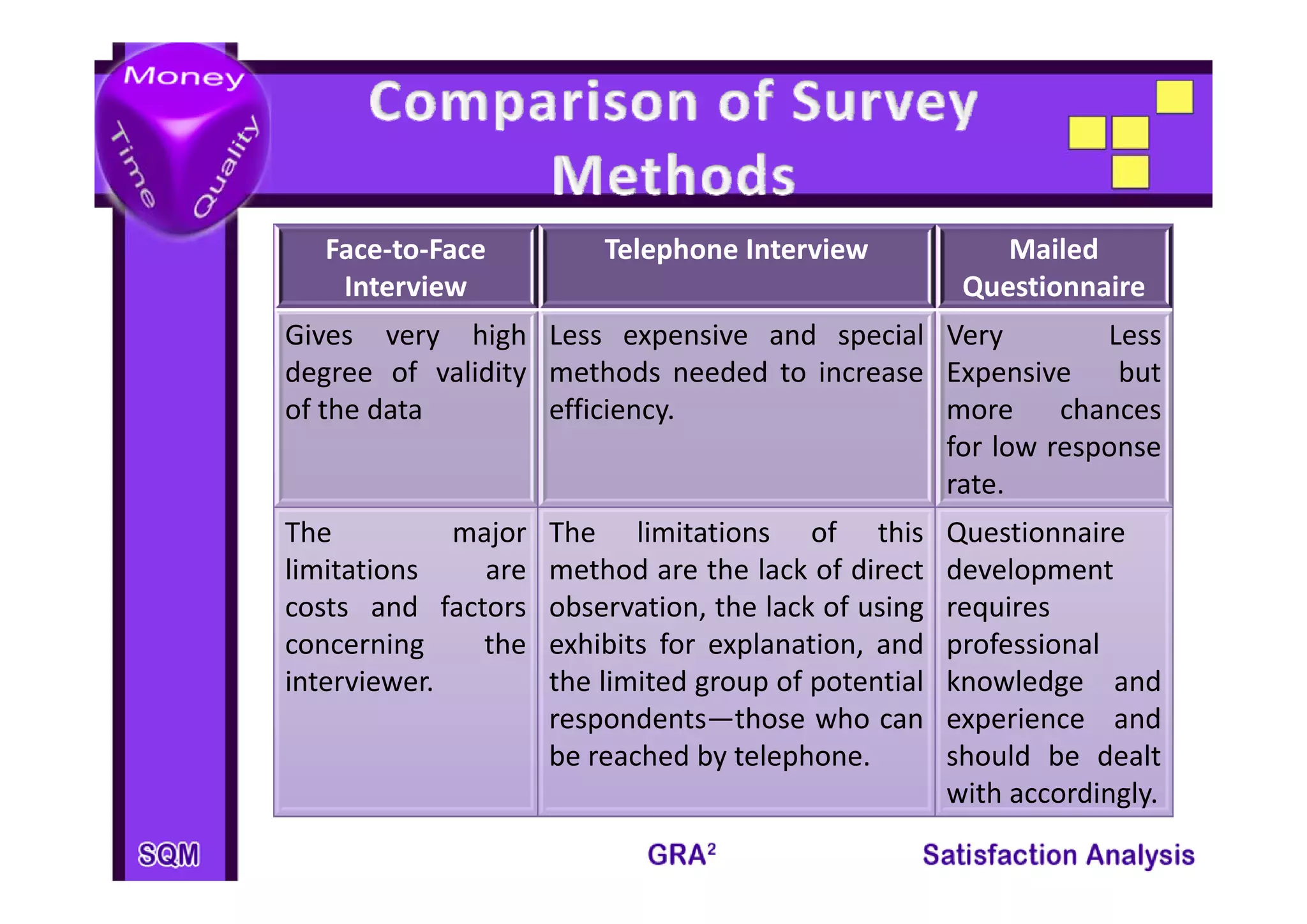
Face‐to‐Face          Telephone Interview
                         Telephone Interview               Mailed 
                                                           Mailed
    Interview                                           Questionnaire 
Gives very high Less expensive and special Very            Less
degree of validity methods needed to increase Expensive     but
of the data        efficiency.                more     chances
                                              for low response
                                                         p
                                              rate.
The          major   The limitations of this           Questionnaire
limitations    are   method are the lack of direct     development
costs and factors    observation, the lack of using    requires
concerning    the    exhibits for explanation, and     professional
interviewer.
i     i              the li i d group of potential
                      h limited         f        i l   knowledge and
                                                       k    l d        d
                     respondents—those who can         experience and
                     be reached by telephone.          should be dealt
                                                       with accordingly.
Survey


                                               se Rate


                                                                                     ations
                                                                                              Length of 
                                                                      bility


                                                                                                   view
                                 pling


                                                                                                               bits
                                                                                                                          dity
                                                            ed
                         st


                                                         Spee
    ype of S


                                                                               Observa


                                                                                                           Exhib
                       Cos


                                                                                                                      Valid
                                                                                              Interv
                                                                 Flexib
                                          espons
                              Samp
                                         Re


                                                                               O
   Ty


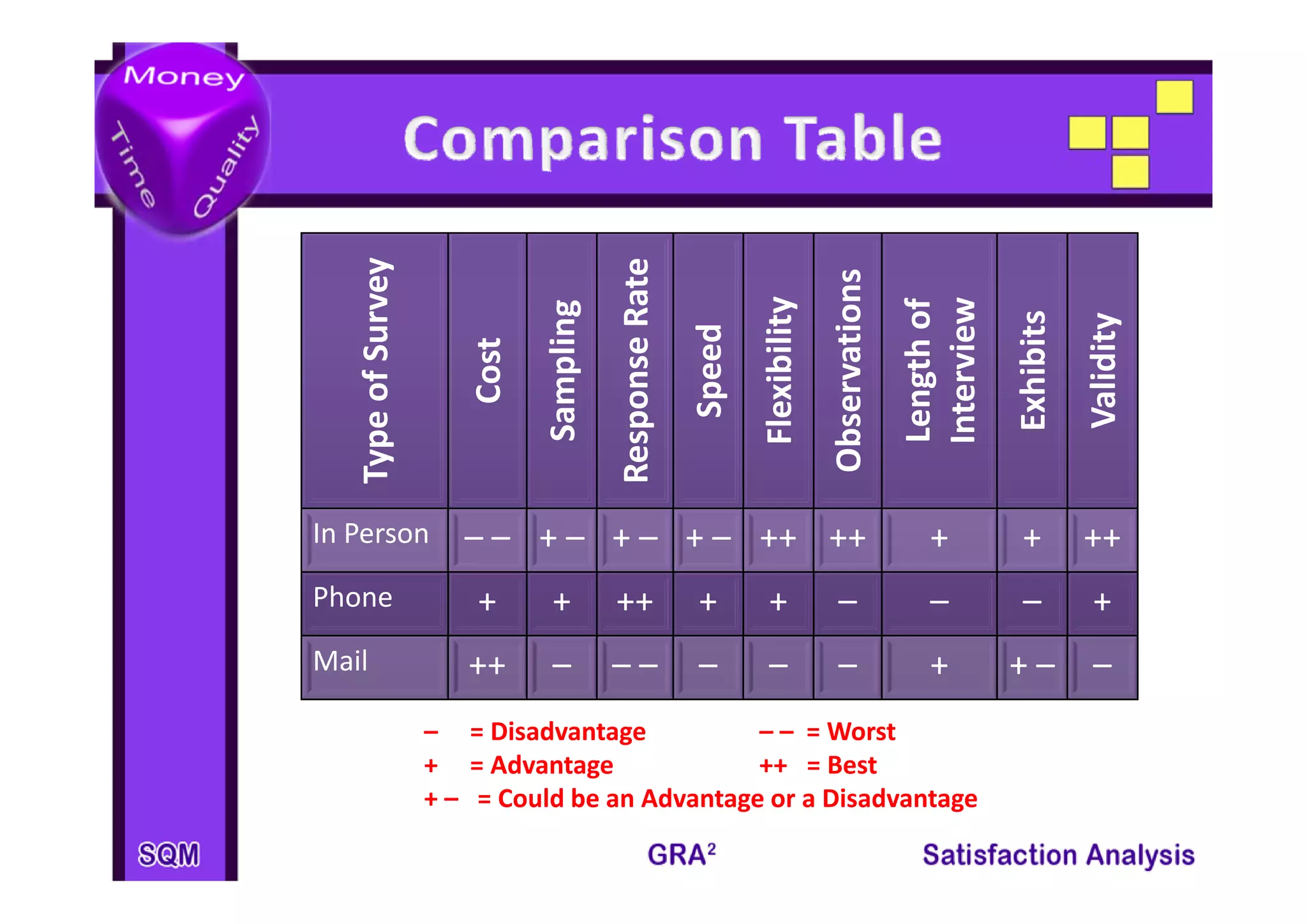
In Person              – – + – + – + – ++ ++                                                     +          +         ++
Phone                   +      +         ++              +        +             –                –          –          +
Mail                   ++      –         ––              –        –             –                +         + 
                                                                                                           +–          –
                    – = Disadvantage           – – = Worst
                                   g
                    +     = Advantage          ++   = Best
                    + – = Could be an Advantage or a Disadvantage
• Wh th customer b
  When the      t       base i l
                             is large it i t costly t
                                large, is too   tl to
  survey all customers.
             customers
• Estimating the satisfaction level of the entire
  customer population through a representative
  sample is more efficient
                  efficient.
• To do that Scientific probability sampling methods
  are used.
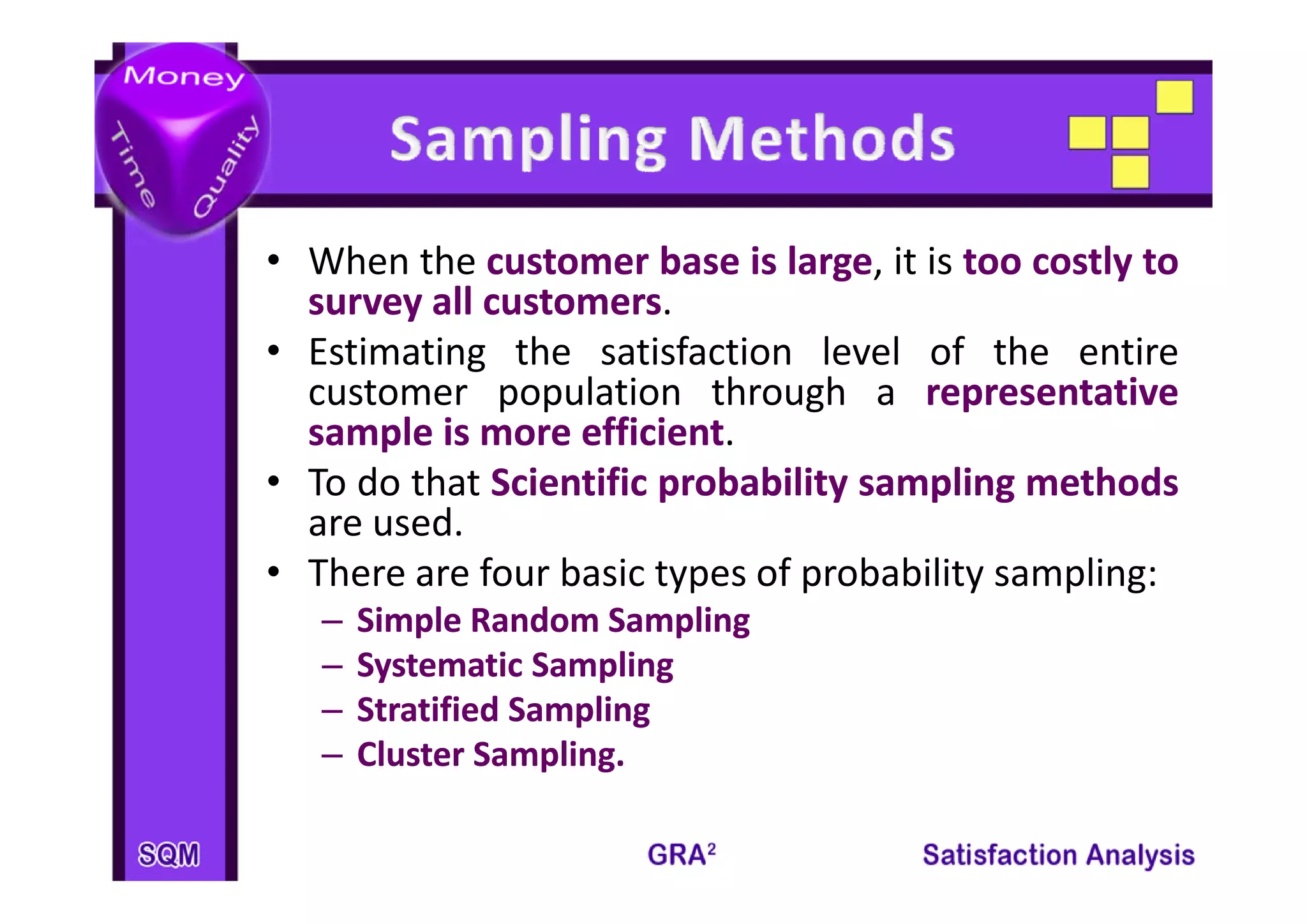
• There are four basic types of probability sampling
                                            sampling:
   –   Simple Random Sampling
   –   Systematic Sampling
   –   Stratified Sampling
   –   Cluster Sampling.
                Sampling.
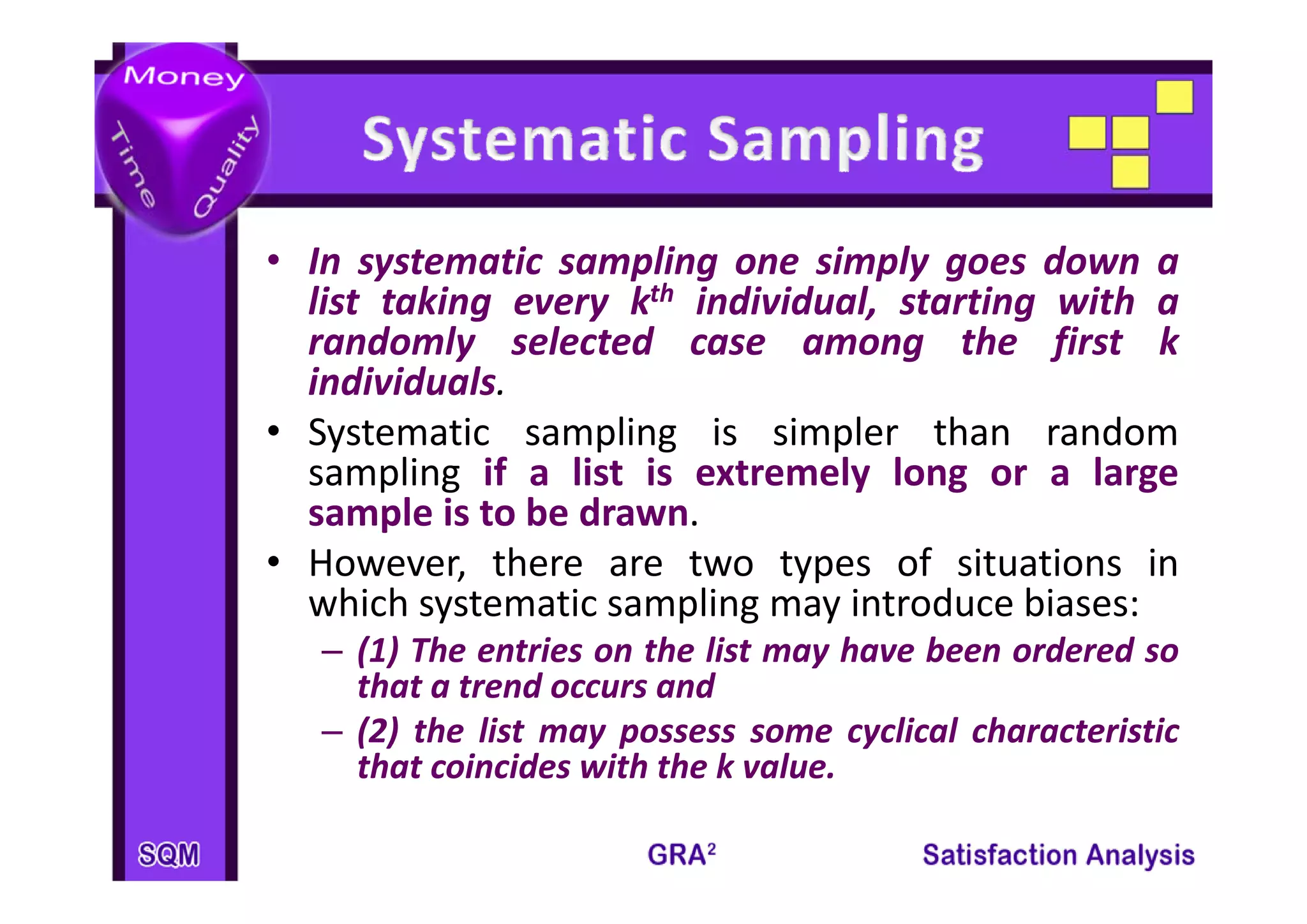
• I systematic sampling one simply goes d
  In     t   ti        li       i l         down a
  list taking every kth individual, starting with a
  randomly selected case among the first k
           y                        g        f
  individuals.
• Systematic sampling is simpler than random
  sampling if a li t i extremely l
        li       list is t       l long or a l large
  sample is to be drawn.
• However there are two types of situations in
  However,
  which systematic sampling may introduce biases:
   – (1) The entries on the list may have been ordered so
     that a trend occurs and
   – (2) the list may possess some cyclical characteristic
     that coincides with the k value.
• I
  In a stratified sample, we first 
        t tifi d      l      fi t
                                             , and 
           . 
• The strata are usually based on important variables 
  pertaining to the parameter of interest.
      t i i t th            t   fi t     t
• Stratified sampling, when properly designed, is 
  more efficient than simple random sampling and 
  more efficient than simple random sampling and
  systematic sampling.
• Stratified samples can be designed to yield greater 
                p               g        y    g
  accuracy for the same cost, or for the same 
  accuracy with less cost.
• I t tifi d
  In stratified sampling we sample within each 
                    li          l ithi       h
  stratum. Sometimes it is advantageous to divide 
  the 
                                                       . 
• A cluster sample is a simple random sample in 
  which each sampling unit is a cluster of elements. 
    hi h     h      li     it i   l t    f l     t
• Usually geographical units such as 
                  .
• Cluster sampling is generally less efficient than 
             p g g            y
  simple random sampling, but it is 
           .
• H l
  How large a sample i sufficient?
                  l is ffi i t?
• The answer to this question
                            and
                 .
• The higher the level of confidence we want from
  the sample estimate, and the smaller the error
  margin,                                 , and vice
  versa.
  versa
• For each probability sampling method,
                                                   ,
  some of which (such as that for cluster sampling)
  are quite complicated.
• The following formula is for 

                        (e.g., percent satisfied) based 
  on 
  on                                      :
                   NZ × p(1 − p )
                               2
              n=
                 NB 2 + [ Z 2 × p (1 − p)]
 N – Population Size                        for 80% Confidence Level, Z = 1.28
 Z – Z Statistic from normal distribution   for 85% Confidence Level, Z = 1.45
 P – Estimated Satisfaction Level           for 90% Confidence Level, Z = 1.65
 B – Margin of Error                        for 95% Confidence Level, Z = 1.96
• The five‐point satisfaction scale (
   h fi        i      if i          l (very 
  satisfied, satisfied, neutral, dissatisfied, 
  and very dissatisfied) is often used in 
  customer satisfaction surveys. 
• The data are usually summarized in terms 
     p
  of percent satisfied. 
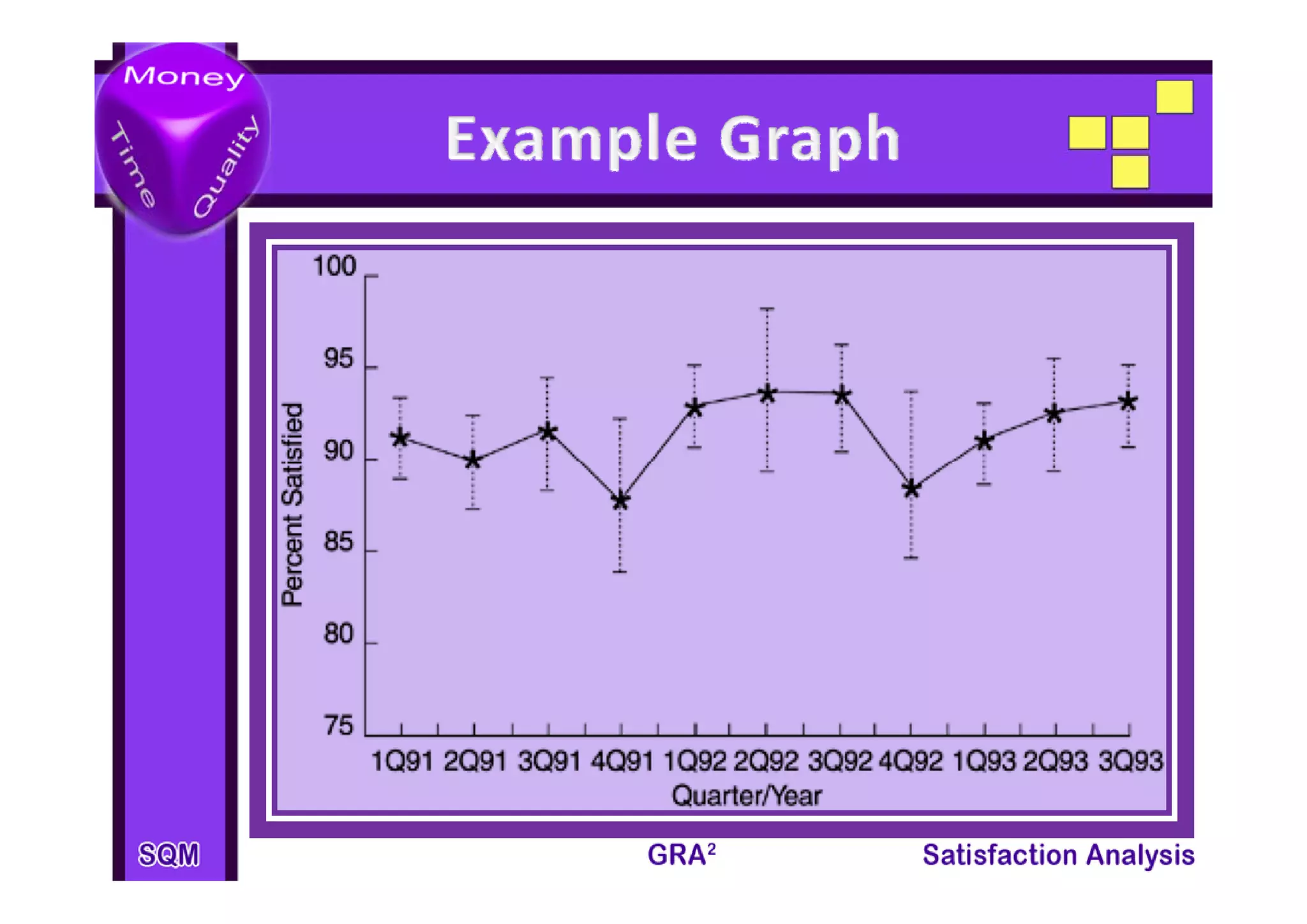
• In presentation, run charts or bar charts to 
  show the trend of percent satisfied are 
  show the trend of percent satisfied are
  often used.
Customer satisfaction

Customer satisfaction

  • 4.
    • Their principal use is twofold: 1. Within organizations, the collection, analysis g , , y and dissemination of these data ensuring that they have a positive experience with y p p the company’s goods and services services. 2. 2 Although sales or market share can indicate how well a firm is performing currently, satisfaction is an indicator of how many customers will make further purchases in the future future.
  • 5.
    • There are various ways to obtain customer  g feedback with regard to their satisfaction  levels with the product(s) and the  company. Some of them are, company Some of them are – Telephone follow‐up Telephone follow‐ – Customer complaint data Customer complaint d l data – Direct customer visits Direct customer visits – Customer advisory councils Customer advisory councils – User conferences User conferences
  • 6.
    • Th There are ththree common methods t gather survey th d to th data: face‐to‐face interviews, telephone interviews, and mailed questionnaires. • The personal interview method requires the interviewer to ask questions based on a pre‐structured pre‐ questionnaire and to record the answers answers. • Telephone interviews are less expensive than face‐to‐ face interviews. These can be monitored by the research t h team t ensure th t th specified i t i to that the ifi d interview procedure is followed. • The mailed questionnaire is less expensive However, expensive. this savings is usually at the expense of response rates rates.
  • 7.
    Face‐to‐Face Telephone Interview Telephone Interview Mailed  Mailed Interview Questionnaire  Gives very high Less expensive and special Very Less degree of validity methods needed to increase Expensive but of the data efficiency. more chances for low response p rate. The major The limitations of this Questionnaire limitations are method are the lack of direct development costs and factors observation, the lack of using requires concerning the exhibits for explanation, and professional interviewer. i i the li i d group of potential h limited f i l knowledge and k l d d respondents—those who can experience and be reached by telephone. should be dealt with accordingly.
  • 8.
    Survey se Rate ations Length of  bility view pling bits dity ed st Spee ype of S Observa Exhib Cos Valid Interv Flexib espons Samp Re O Ty In Person – – + – + – + – ++ ++ + + ++ Phone + + ++ + + – – – + Mail ++ – –– – – – + +  +– – – = Disadvantage – – = Worst g +     = Advantage ++   = Best + – = Could be an Advantage or a Disadvantage
  • 9.
    • Wh thcustomer b When the t base i l is large it i t costly t large, is too tl to survey all customers. customers • Estimating the satisfaction level of the entire customer population through a representative sample is more efficient efficient. • To do that Scientific probability sampling methods are used. • There are four basic types of probability sampling sampling: – Simple Random Sampling – Systematic Sampling – Stratified Sampling – Cluster Sampling. Sampling.
  • 11.
    • I systematicsampling one simply goes d In t ti li i l down a list taking every kth individual, starting with a randomly selected case among the first k y g f individuals. • Systematic sampling is simpler than random sampling if a li t i extremely l li list is t l long or a l large sample is to be drawn. • However there are two types of situations in However, which systematic sampling may introduce biases: – (1) The entries on the list may have been ordered so that a trend occurs and – (2) the list may possess some cyclical characteristic that coincides with the k value.
  • 12.
    • I In a stratified sample, we first  t tifi d l fi t , and  .  • The strata are usually based on important variables  pertaining to the parameter of interest. t i i t th t fi t t • Stratified sampling, when properly designed, is  more efficient than simple random sampling and  more efficient than simple random sampling and systematic sampling. • Stratified samples can be designed to yield greater  p g y g accuracy for the same cost, or for the same  accuracy with less cost.
  • 13.
    • I ttifi d In stratified sampling we sample within each  li l ithi h stratum. Sometimes it is advantageous to divide  the  .  • A cluster sample is a simple random sample in  which each sampling unit is a cluster of elements.  hi h h li it i l t f l t • Usually geographical units such as  . • Cluster sampling is generally less efficient than  p g g y simple random sampling, but it is  .
  • 14.
    • H l How large a sample i sufficient? l is ffi i t? • The answer to this question and . • The higher the level of confidence we want from the sample estimate, and the smaller the error margin, , and vice versa. versa • For each probability sampling method, , some of which (such as that for cluster sampling) are quite complicated.
  • 15.
    • The following formula is for  (e.g., percent satisfied) based  on  on : NZ × p(1 − p ) 2 n= NB 2 + [ Z 2 × p (1 − p)] N – Population Size for 80% Confidence Level, Z = 1.28 Z – Z Statistic from normal distribution for 85% Confidence Level, Z = 1.45 P – Estimated Satisfaction Level for 90% Confidence Level, Z = 1.65 B – Margin of Error for 95% Confidence Level, Z = 1.96
  • 16.
    • The five‐point satisfaction scale ( h fi i if i l (very  satisfied, satisfied, neutral, dissatisfied,  and very dissatisfied) is often used in  customer satisfaction surveys.  • The data are usually summarized in terms  p of percent satisfied.  • In presentation, run charts or bar charts to  show the trend of percent satisfied are  show the trend of percent satisfied are often used.