CX
CUSTOMER EXPERIENCE
1
PRESENTED BY
Dr. Ramadan Babers
https://w ww.linkedin.com/in/ramadan-babers-phd-78976345/
objectives
1 • introduction
2 • Evolution of Marketing
3 • CX Definition
4 • Why is CX important for your business
5 • The benefits of delivering a great CX
6 • What is a good CX
7 • The difference between CX & CS
8 • The CX Cycle
9 • Ways to Communicate your Customer
10 • Measuring CX
11 • Analyzing CX
2
1- Introduction
 Customer love to tell OTHERS about their extraordinary service
experience
3
2- Evolution of Marketing
 Product / Production -orientation Stage
 “make all you can.”
 All that is made can be sold.
 The production conceptholds that consumers will prefer products that
are widely available and inexpensive.
 late 1800s and early 1930s.
“The American public can have any color car
it wants so long as it’sblack.” Henry Ford
4
2- Evolution of Marketing
 Sales-orientation Stage
 “sell all you make.
 Supply frequently exceeds demand.
 Focus is on promotionand pricing;
objective is to sell all the inventory.
 Between early 1930s and 1950s.
5
2- Evolution of Marketing
 Market-orientation Stage
 “make what you can sell.”
 Variety in markets, variety in products.
 Employs full marketingmix.
 Focus is on customer needs and
satisfaction.
6
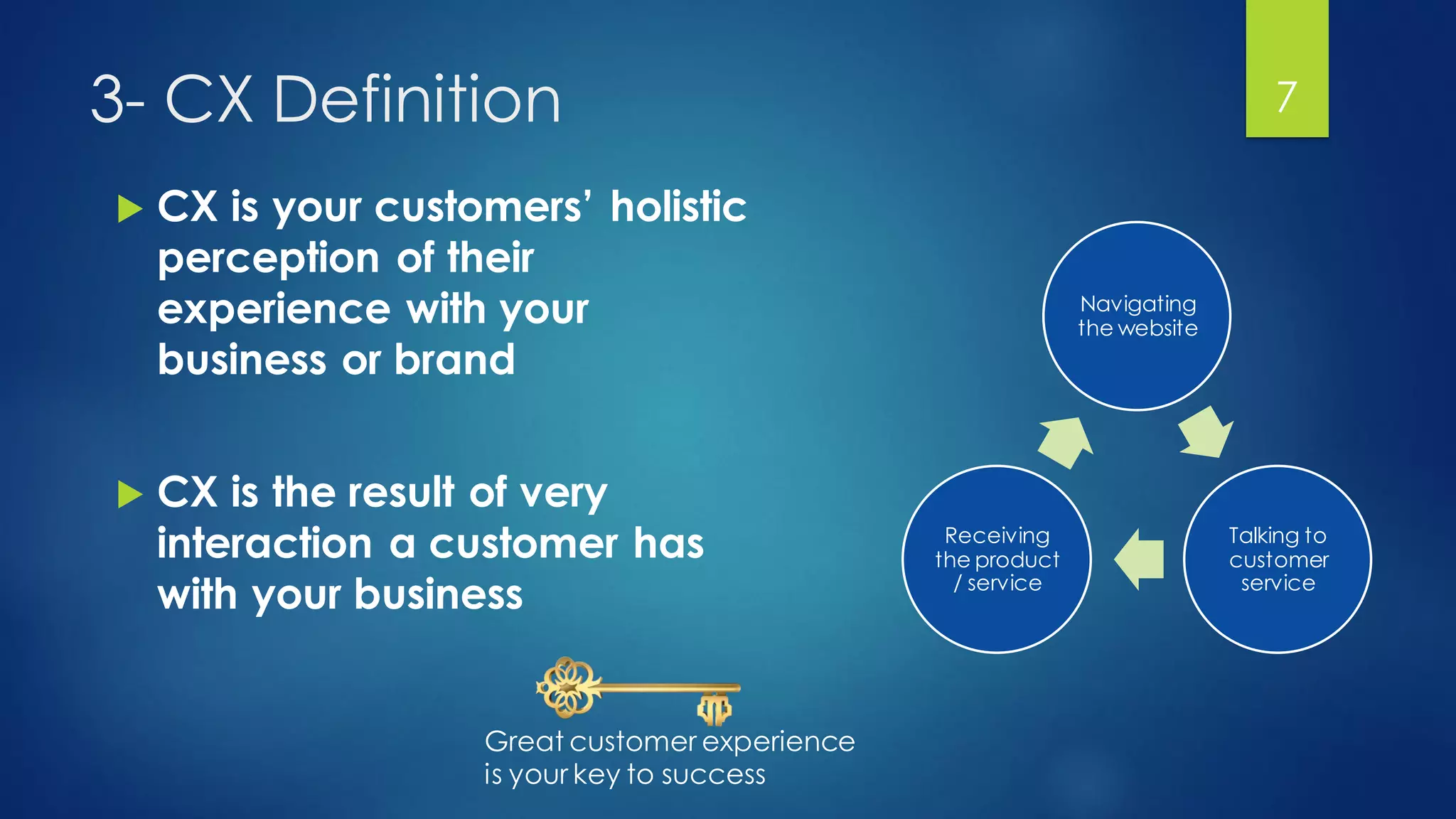
3- CX Definition
 CX is your customers’ holistic
perception of their
experience with your
business or brand
 CX is the result of very
interaction a customer has
with your business
Navigating
the website
Talking to
customer
service
Receiving
the product
/ service
Great customer experience
is your key to success
7
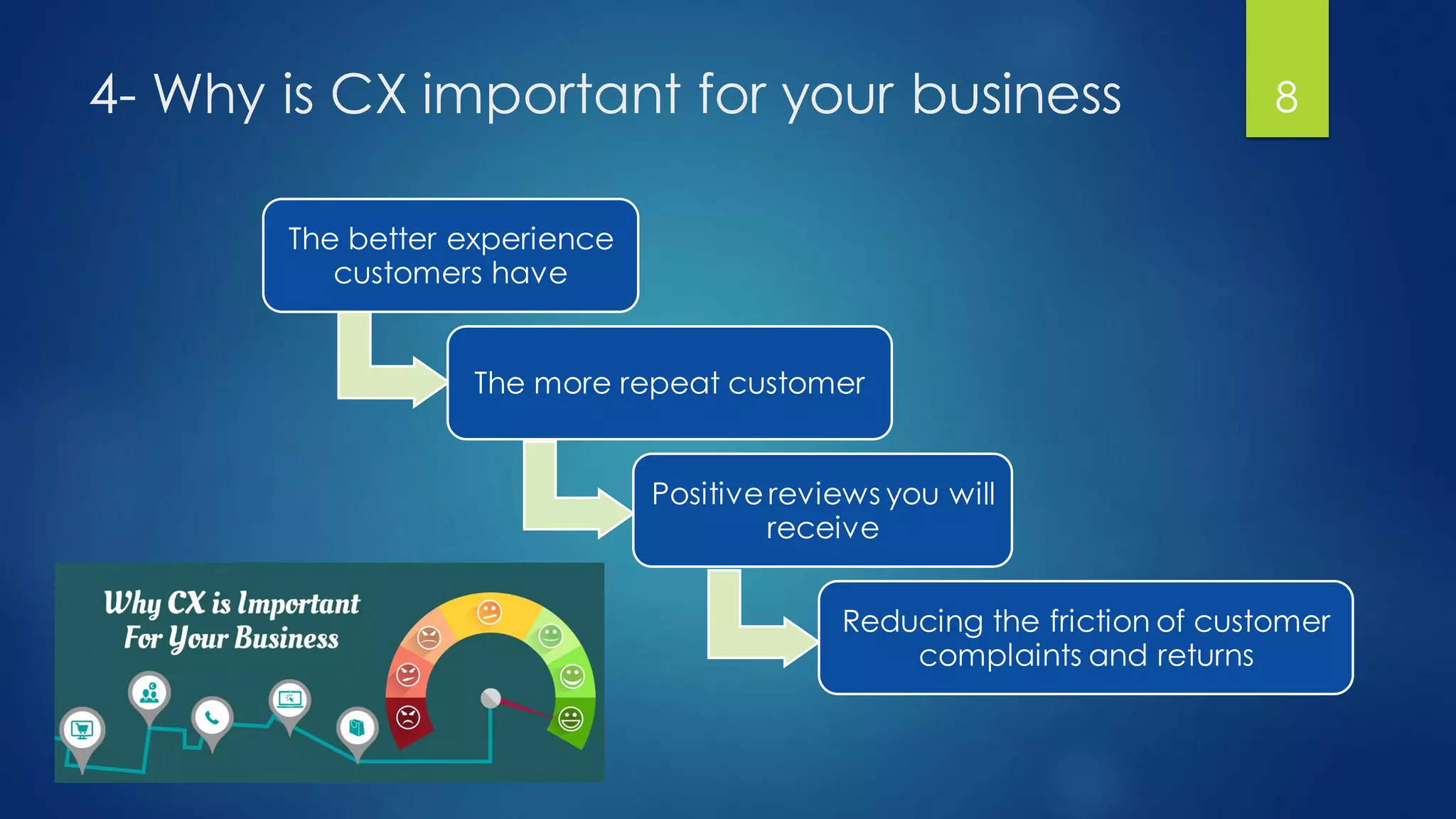
4- Why is CX important for your business
The better experience
customers have
The more repeat customer
Positive reviews you will
receive
Reducing the friction of customer
complaints and returns
8
5- The benefits of delivering a great CX
Increased customer loyalty
Increased customer satisfaction
Better word-of-mouth marketing
Increased positive reviews
Increased recommendations
9
1
2
3
4
5
6- What is a good CX
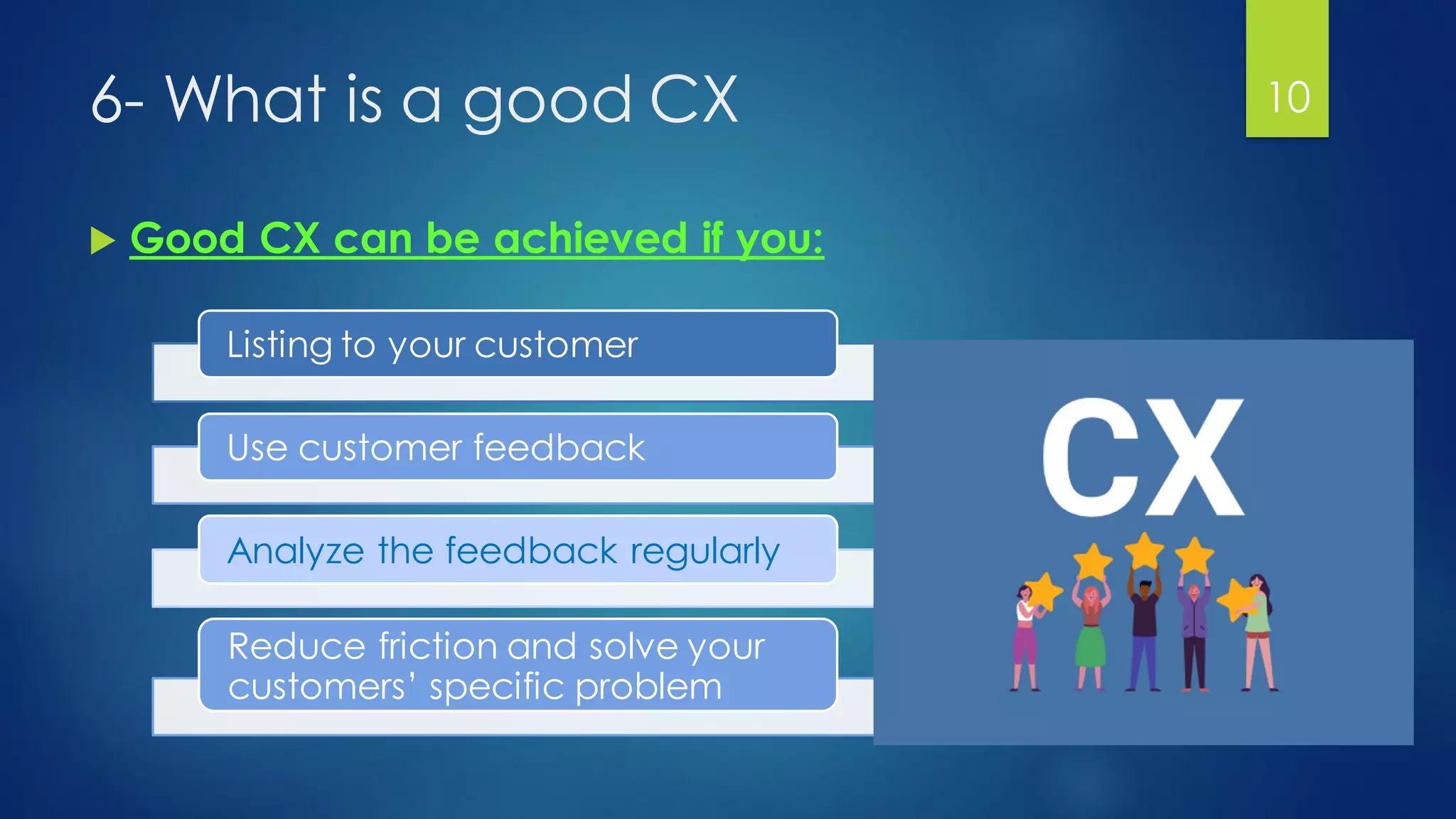
 Good CX can be achieved if you:
Listing to your customer
Use customer feedback
Analyze the feedback regularly
Reduce friction and solve your
customers’ specific problem
10
7- The difference between CX & CS 11
CS
One part of CX
Refers to specific touch point within
the experience where a customer
request and receive help
e.g.
• Calling an operator to request ----
• Interacting via email
CX
Larger than CS
Includes every touch-point a customer
ever has with your company
e.g.
•First hear about you
•Appears in search in Google
•Time the customercalls yourCS team
Bad CX is primarily caused by:
Long wait times
Employees who do not understand customer needs
Unresolved issues/questions
Too much automation/not enough of a human touch
Service that is not personalized
Rude/angry employees
12
Why you should use customer feedback
as part of your CX strategy?
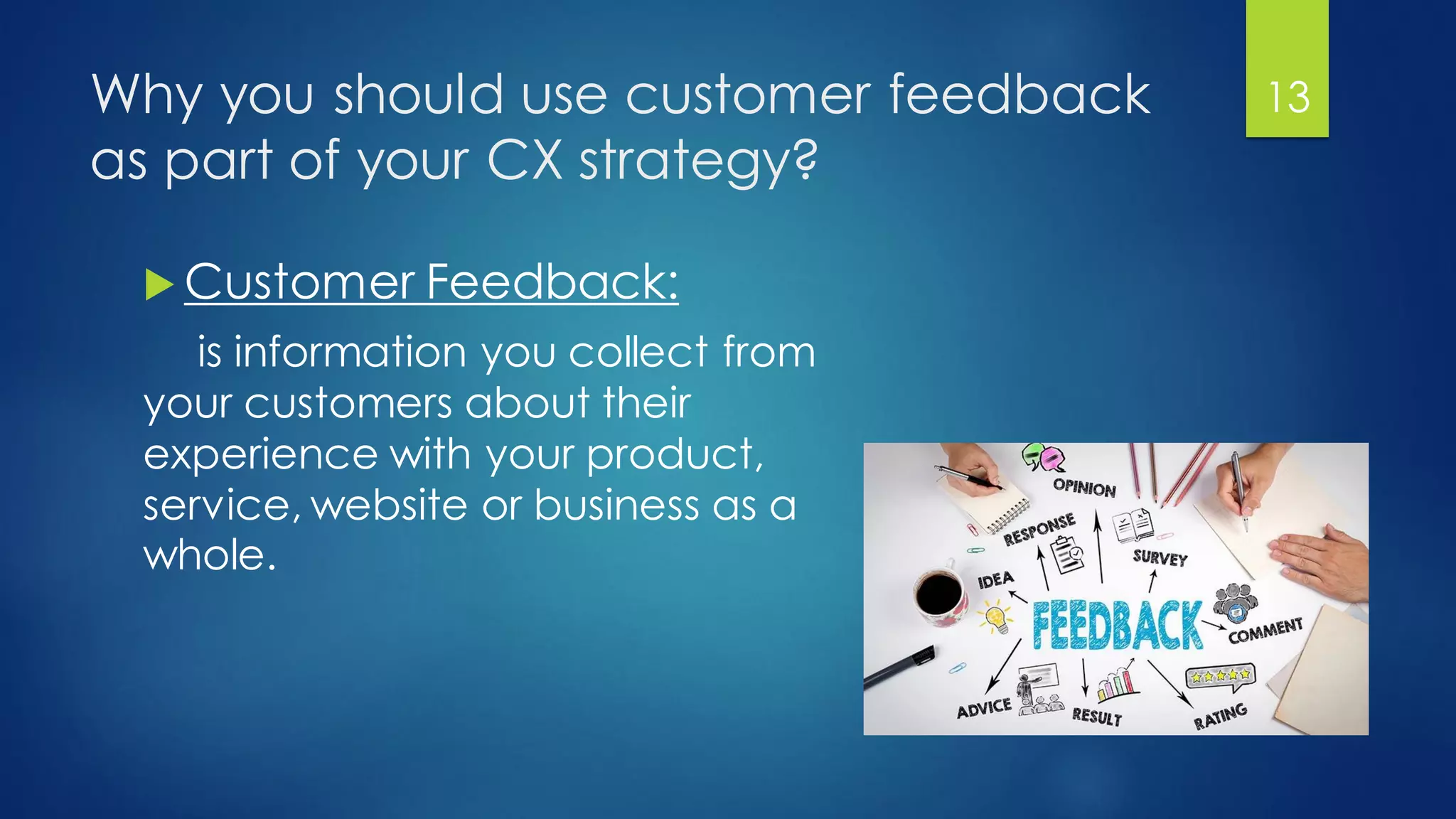
 Customer Feedback:
is information you collect from
your customers about their
experience with your product,
service, website or business as a
whole.
13
14
Improve CX
Target
If is not measured & analyzed:
Missing out on the opportunity to use it
to improveCX
Problem
by
Increasing +ve
touch points
Removing or
reducing areas
of friction
8- The CX Cycle 15
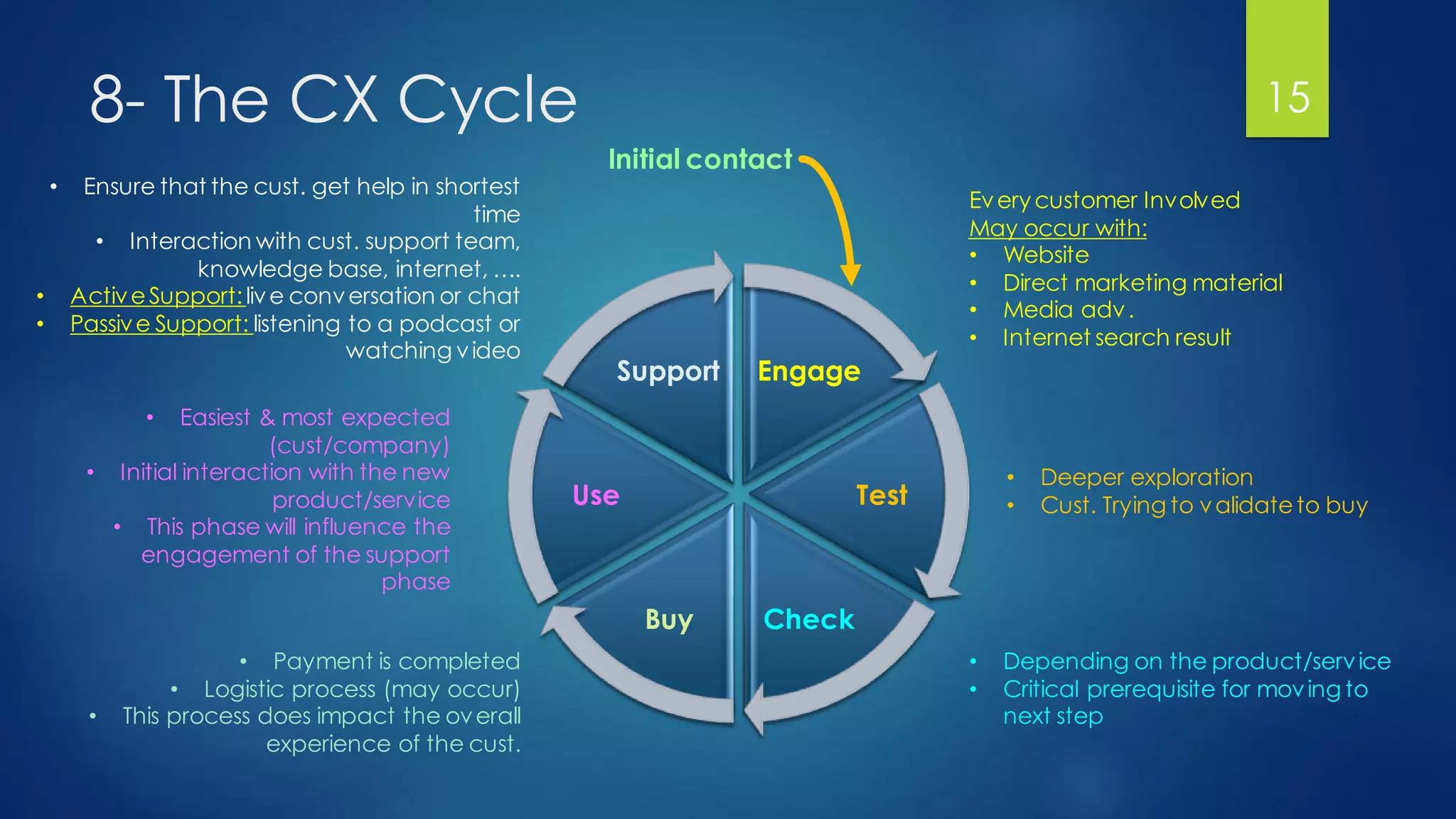
Engage
Test
CheckBuy
Use
Support
Everycustomer Involved
May occur with:
• Website
• Direct marketing material
• Media adv.
• Internet search result
Initial contact
• Depending on the product/service
• Critical prerequisite for moving to
next step
• Deeper exploration
• Cust. Trying to validateto buy
• Payment is completed
• Logistic process (may occur)
• This process does impact the overall
experience of the cust.
• Easiest & most expected
(cust/company)
• Initial interaction with the new
product/service
• This phase will influence the
engagement of the support
phase
• Ensure that the cust. get help in shortest
time
• Interaction with cust. support team,
knowledge base, internet, ….
• ActiveSupport: live conversation or chat
• Passive Support: listening to a podcast or
watching video
CX Models 16
Successful organization have ensured that all stages of
their CX cycle have clear alignment to their CX strategy.
A clear model for guiding CX is important
The main goal is to allow customers to realize their
expectations throughout the different phases.
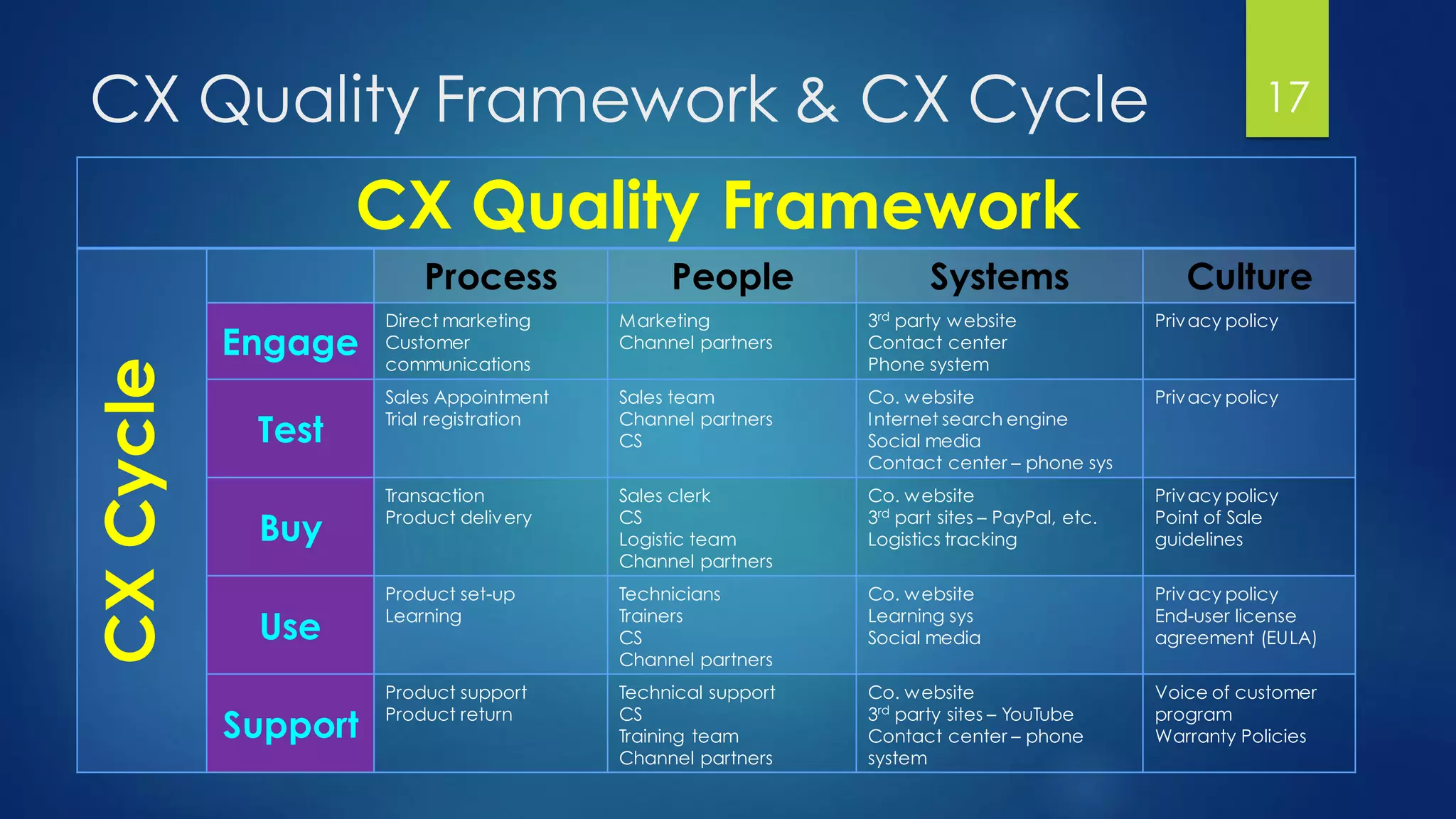
CX Quality Framework & CX Cycle 17
CX Quality Framework
CultureSystemsPeopleProcess
CXCycle
Privacy policy3rd
party website
Contact center
Phone system
Marketing
Channel partners
Direct marketing
Customer
communications
Engage
Privacy policyCo. website
Internet search engine
Social media
Contact center – phone sys
Sales team
Channel partners
CS
Sales Appointment
Trial registration
Test
Privacy policy
Point of Sale
guidelines
Co. website
3rd part sites – PayPal, etc.
Logistics tracking
Sales clerk
CS
Logistic team
Channel partners
Transaction
Product delivery
Buy
Privacy policy
End-user license
agreement (EULA)
Co. website
Learning sys
Social media
Technicians
Trainers
CS
Channel partners
Product set-up
Learning
Use
Voice of customer
program
Warranty Policies
Co. website
3rd
party sites – YouTube
Contact center – phone
system
Technical support
CS
Training team
Channel partners
Product support
Product return
Support
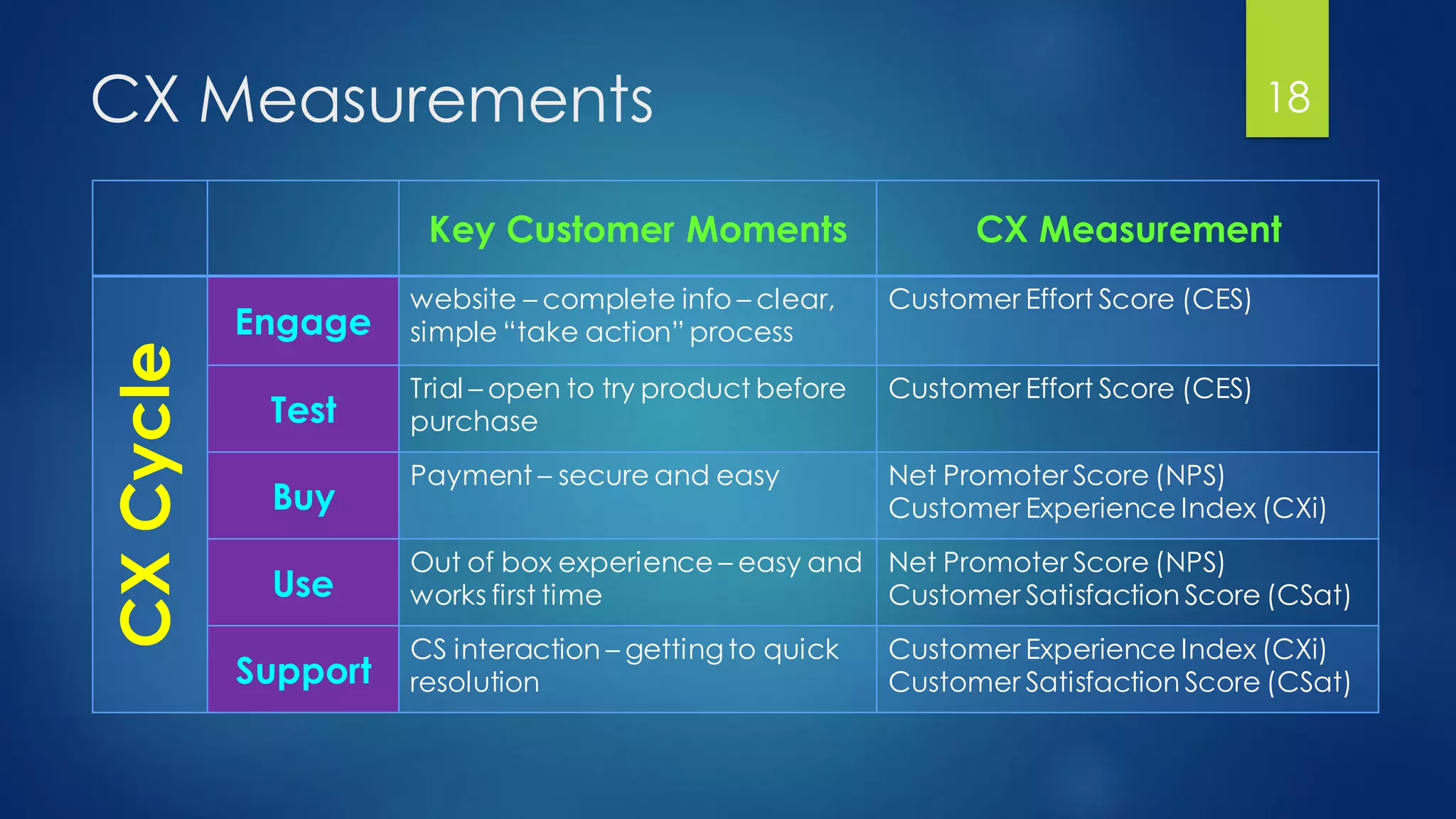
CX Measurements 18
CX MeasurementKey Customer Moments
Customer Effort Score (CES)website – complete info – clear,
simple “take action” processEngage
CXCycle
Customer Effort Score (CES)Trial – open to try product before
purchaseTest
Net Promoter Score (NPS)
Customer Experience Index (CXi)
Payment – secure and easy
Buy
Net Promoter Score (NPS)
Customer Satisfaction Score (CSat)
Out of box experience – easy and
works first timeUse
Customer Experience Index (CXi)
Customer Satisfaction Score (CSat)
CS interaction – gettingto quick
resolutionSupport
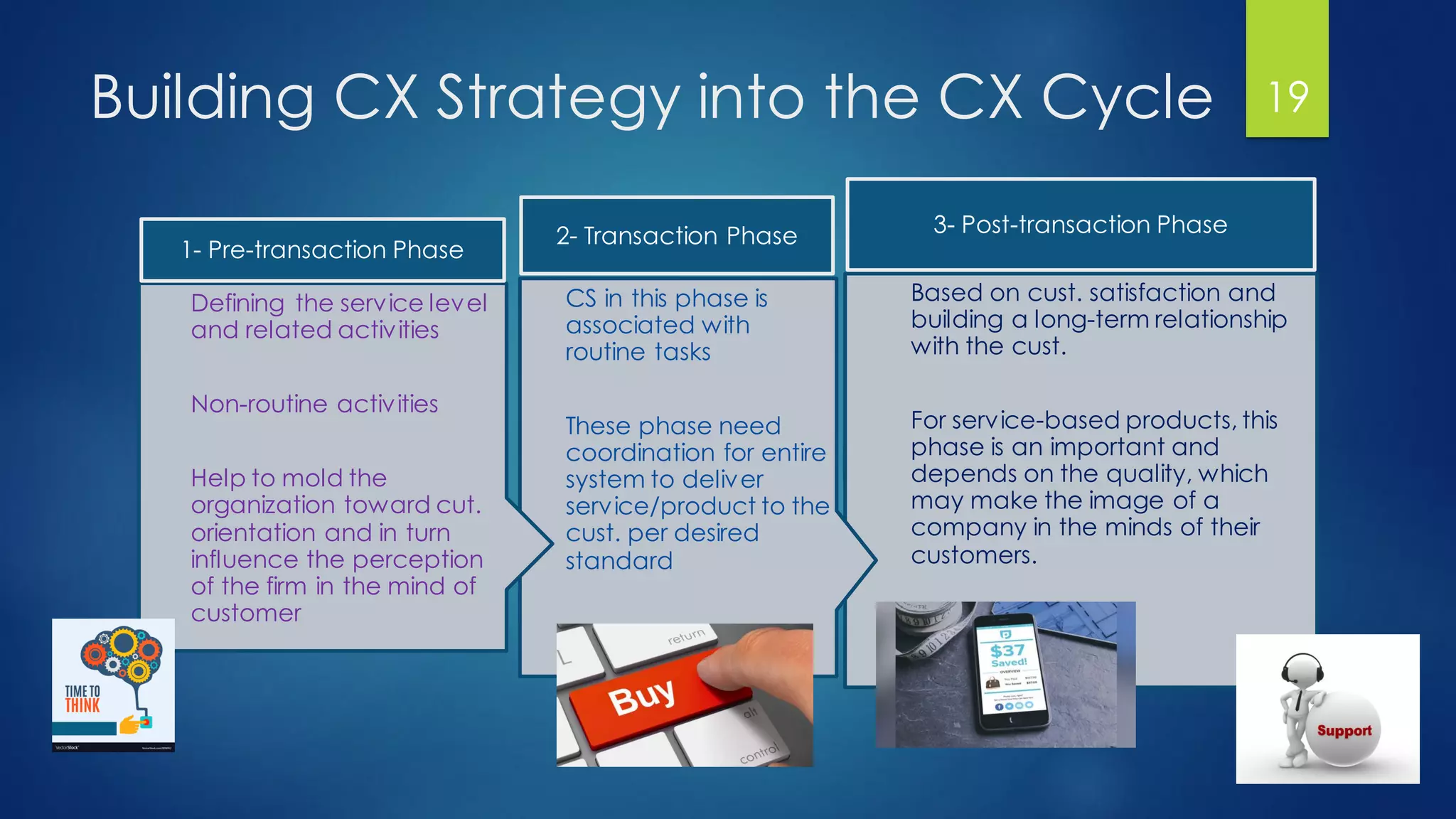
Building CX Strategy into the CX Cycle
Based on cust. satisfaction and
building a long-term relationship
with the cust.
For service-based products, this
phase is an important and
depends on the quality, which
may make the image of a
company in the minds of their
customers.
3- Post-transaction Phase
CS in this phase is
associated with
routine tasks
These phase need
coordination for entire
system to deliver
service/product to the
cust. per desired
standard
2- Transaction Phase
Defining the service level
and related activities
Non-routine activities
Help to mold the
organization toward cut.
orientation and in turn
influence the perception
of the firm in the mind of
customer
1- Pre-transaction Phase
19
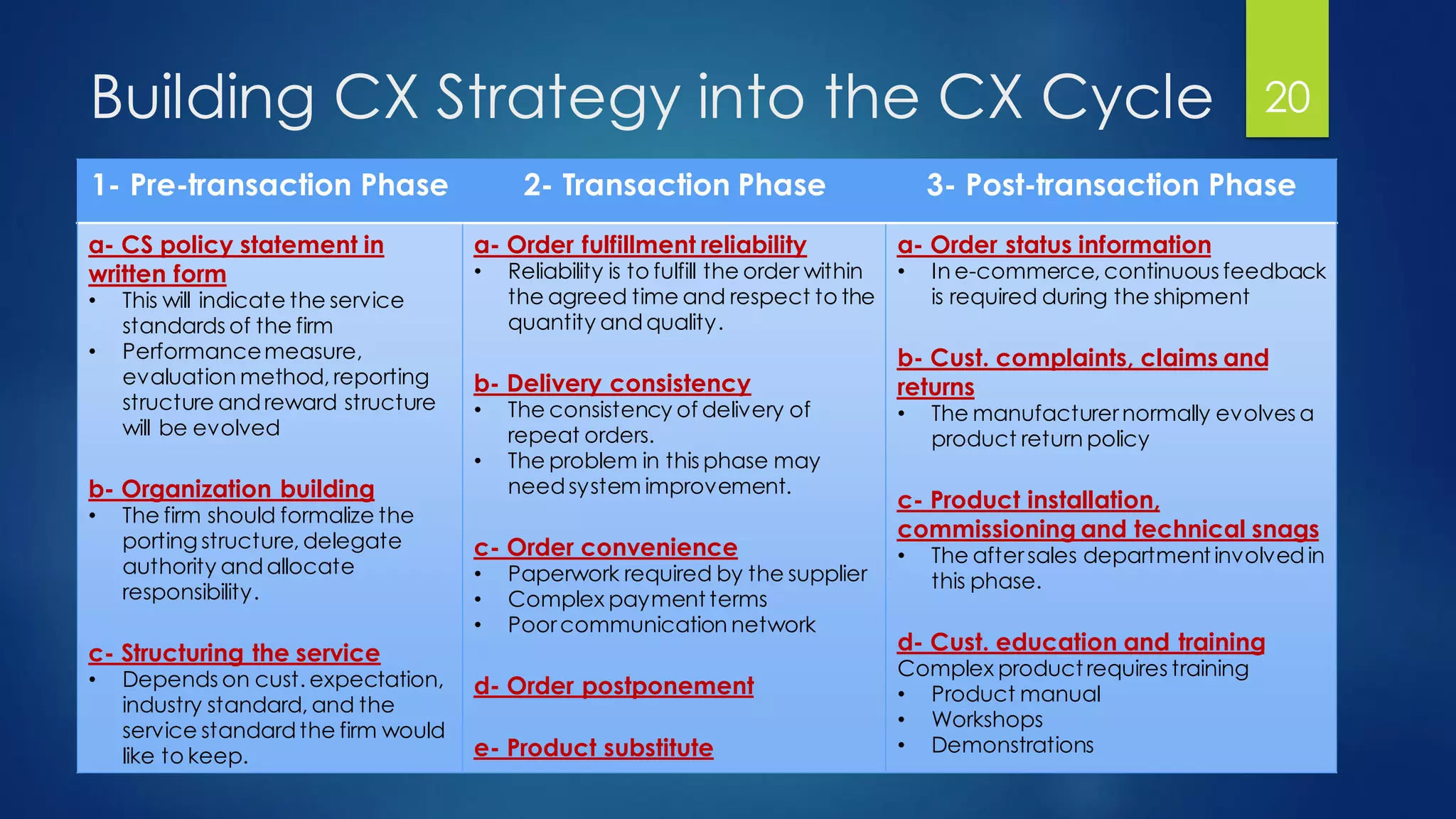
Building CX Strategy into the CX Cycle 20
3- Post-transaction Phase2- Transaction Phase1- Pre-transaction Phase
a- Order status information
• In e-commerce, continuous feedback
is required during the shipment
b- Cust. complaints, claims and
returns
• The manufacturernormally evolves a
product return policy
c- Product installation,
commissioning and technical snags
• The aftersales department involvedin
this phase.
d- Cust. education and training
Complex product requires training
• Product manual
• Workshops
• Demonstrations
a- Order fulfillment reliability
• Reliability is to fulfill the order within
the agreed time and respect to the
quantity andquality.
b- Delivery consistency
• The consistency of delivery of
repeat orders.
• The problem in this phase may
needsystem improvement.
c- Order convenience
• Paperwork required by the supplier
• Complex payment terms
• Poorcommunication network
d- Order postponement
e- Product substitute
a- CS policy statement in
written form
• This will indicate the service
standards of the firm
• Performancemeasure,
evaluation method, reporting
structure andreward structure
will be evolved
b- Organization building
• The firm should formalize the
porting structure, delegate
authority andallocate
responsibility.
c- Structuring the service
• Depends on cust. expectation,
industry standard, and the
service standardthe firm would
like to keep.
9- Ways to Communicate your Customer
Customer
In-Person
Email
Phone
Video
Presents
21
• Oldest medium
• Speaking to the cust. directly and
looking them in the eyes
• Read the customers’ body language
• These interactions eliminate any
misunderstanding that can arise in
other forms of communication.
• Cust. are increasingly consuming
information via videoon YouTube
• The informal video often works
better than the more polished
version
• the most overlooked ways to
trigger positive customer
emotions
• the best presents are meaningful
and personalized
• The primary medium businesses
use to interact with customers
• Inexpensive& easy to track
• Very few people are checking
their email! But they are feel that
this way is personalized and
purposeful
• “Reach out and touch someone” &
“in person”
• 91% of people keep their phone less
than three feet away from their body
at all time.
• 90 min to respond to an email
• 90 sec to respond a text message
Getting start your CX strategy
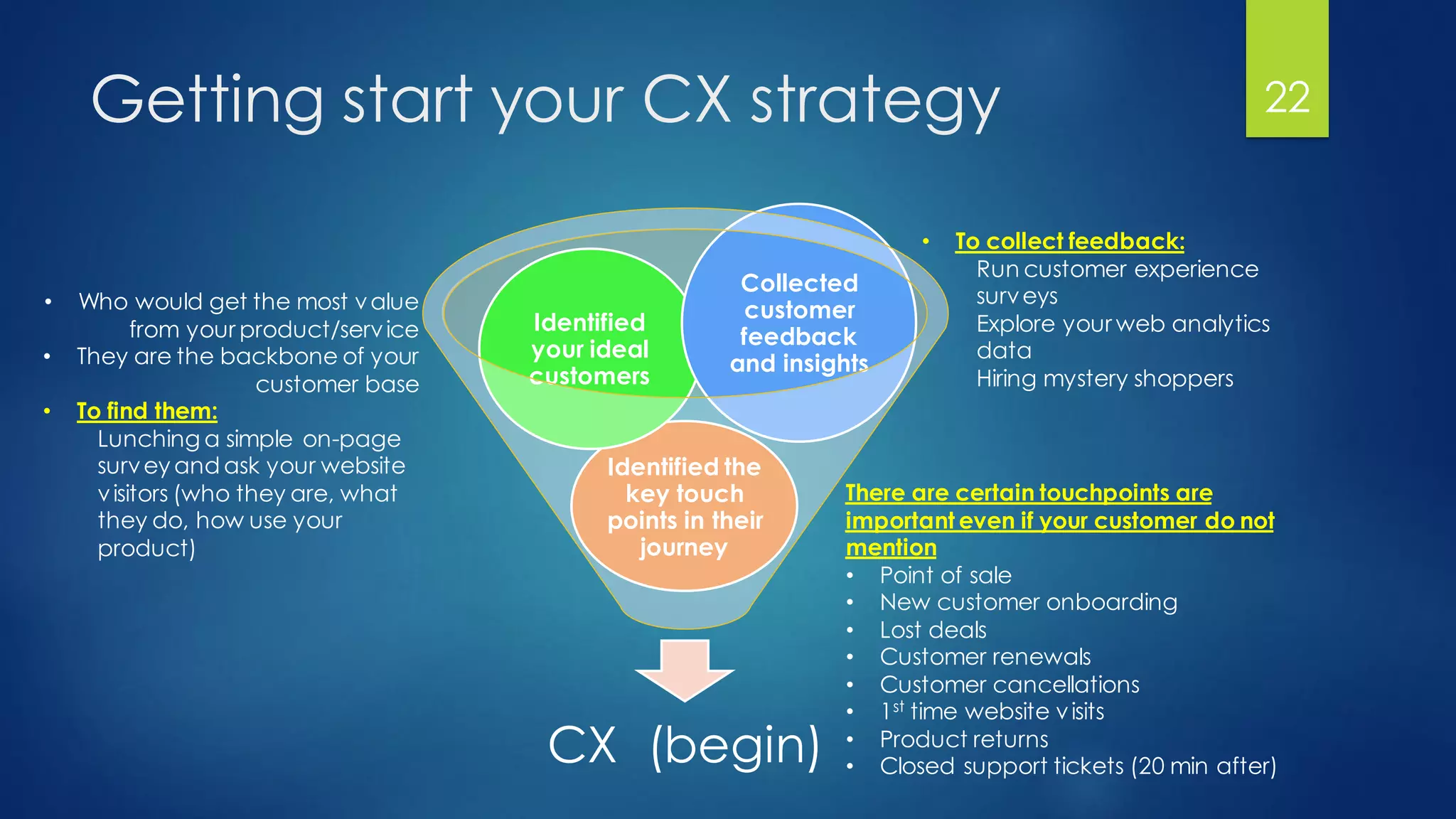
CX (begin)
Identified the
key touch
points in their
journey
Identified
your ideal
customers
Collected
customer
feedback
and insights
22
• Who would get the most value
from your product/service
• They are the backbone of your
customer base
• To find them:
Lunching a simple on-page
survey and ask your website
visitors (who they are, what
they do, how use your
product)
There are certain touchpoints are
important even if your customer do not
mention
• Point of sale
• New customer onboarding
• Lost deals
• Customer renewals
• Customer cancellations
• 1st time website visits
• Product returns
• Closed support tickets (20 min after)
• To collect feedback:
Run customer experience
surveys
Explore your web analytics
data
Hiring mystery shoppers
10- Measuring CX
 CX survey:
• Is a questionnaire designed to help a
business capture customers’ thoughts
and feelings about its brand, products,
or service.
• Help you gather data at specific touch
points.
• Will help you improve the experience for
both your current and future customers.
23
Lunching a CX survey in 4 steps 24
Determine
what you want
to study
Pick the right
survey
Decide which
types of
questions to
ask
Build and send
your survey
Step1: Determine what you want to study 25
 Pick one touch point you want to study
Pre-sale
•Information is
enough to make a
purchase?
•Is anything stopping
them to take a
decision?
Post-sale
•Are they happy
with the product?
•Ordering process
was easy?
•Wouldthey change
something?
•Wouldthey
recommend you to
a friend?
Following a
support call
•Did you solve their
problem?
•How easy was it to
find a solution?
•How does that
affect their opinion
of your
product/service?
Downgrading,
canceling or
returning an
item
•Are they unhappy
with the
product/service?
•If so, why?
Step2: Pick the right survey 26
 Five of the most effective surveys you can get
Customer
satisfaction
(CSAT) score
Simple questions (yes/no& sad/happy face)
Tracking CSAT is very useful, as a sudden drop
can quickly alert you to check
Net Promoter
Score (NPS)
Asks how likely someoneis, on scale of 0-10
It allows you to ask “why” follow up questions.
NPS is the strongest predictorof a company’s future
growth.
Customer Effort
Score (CES)
Measure the effort it takes for cust. to do things
like fixing a problem or using the product.
Point-of-conversion
survey
Is sent out aftercustomers reach a very specific milestone
and complete apurchase on yoursite.
Buying experiencescale (1 “hate it” – 5 “lovedit”
Retention Survey
Investigates why customers are canceling a
service or returning an item
Investigatethe main reasons people decidedto
leave yourcompany or product
1
2
3
4
5
The Most Effective Surveys You Can Get for CX
How to Use
Survey Where to askWhen to use itWho to ask
on-page survey or
via email
following any website
interaction you want to
evaluate
anyone
Customer satisfaction
(CSAT) score
can send viaemailwaituntil customers use
your product/service
payingcustomers
(had some time with
your product)
Net Promoter Score
(NPS)
on page survey or
via email
20-30 min after a support
call
customer attempting
to achieve a goal on
your website
Customer Effort Score
(CES)
on-page surveyimmediately following the
sale
customersPoint-of-conversion
survey
on-page surveyduring the cancelation or
return process
clients who are
canceling
service/return an item
Retention Survey
27
Step3: Decide which types of questions to ask 28
 Questions does not chosen at random
 Each type of questions serves a specific purpose and has advantages & disadvantages
Open-ended questions
Multiple-choice questions
Rating scale questions (ordinal questions)
Binary scale questions
Nominal questions
Likert scale questions
Semantic differential questions
1
2
3
4
5
6
7
29• Offer a range of answers that
correspond to a numeric scale
• e.g. a scale of 1-5
(1: not easy at all, 5: very easy)
• Two possibilities (yes/no or happy face/sad face)
• Less ambiguous than a rating scale
• Specify separate categories for answers
• Answers don’t overlap unless there is an “all of the
above”option.
• No numeric valuein answer
• 5 or 7 point scale used to evaluatecustomer
sentiment (1: extreme +ve,7: opposite extreme and
4 indicates a more moderate view)
• Like Likert scale questions (use 5 or 7 point scale)
• Do not ask agree or disagree as in Likert (ask to
choose the point that best describes their position)
Ratingscale
(ordinal)
Binary scale
Nominal
Likert scale
Semantic
differential
• Customers can write
anything they want
• The data is more
challenging to
analyze
• Limited no of
possible answers
• Easy to analyze
Questions
Types
MCQ
Open-ended
Step4: Build and send your survey 30
 Regardless of your tool of choice, always keep the following three tips in mind:
Three
Tips
1- Start
small
2- Pick an
ideal time to
distribute your
survey
3- Evaluate
your data
Do not set up all surveys at once
• Start small
• See how it goes
• If certain questions do not work
(replace/remove them)
• Learn from your mistakes & improve
with the next round
• 20-30 min after the interaction,
which givesthe customer
enough time to check the
service/product
• When your sample size is large
enough
• Use a sample size calculator to
figure out how many data points
you need to achievestatistical
significance
11- Analyzing CX
• Once all the data points are in
your hand, it is important to
address:
 Micro-level (individual complaint)
• Issue from an employee (needtraining)
• Issue form company policy (managercan
explain/explore otheralternatives)
 Macro-level (company process,
policies, product issue, …)
• Take a look at the big picture and identify
where in the customerjourney, the largest
complaints occurfrom yourideal customers
31
11- Analyzing CX
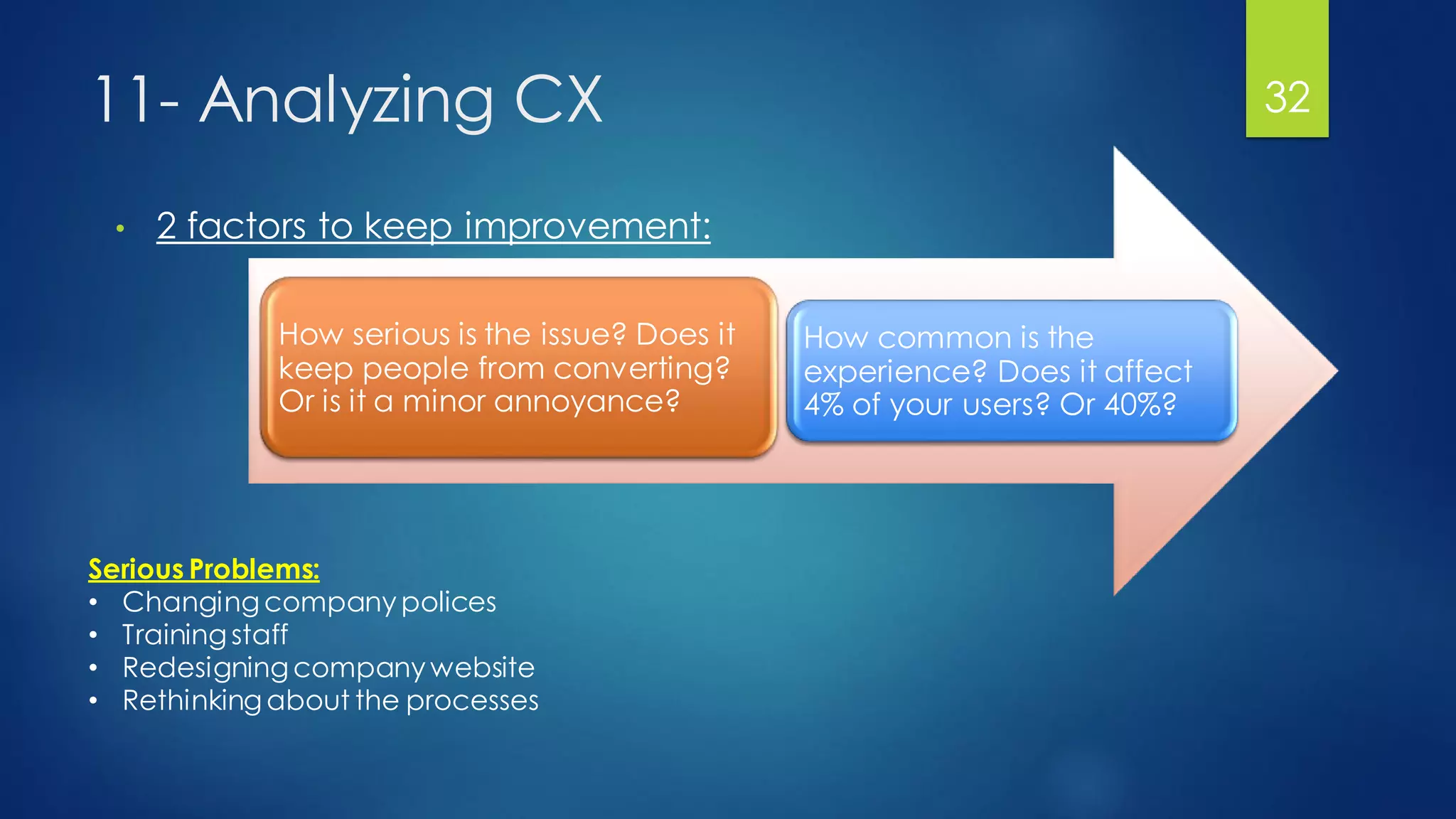
• 2 factors to keep improvement:
32
How serious is the issue? Does it
keep people from converting?
Or is it a minor annoyance?
How common is the
experience? Does it affect
4% of your users? Or 40%?
Serious Problems:
• Changingcompany polices
• Trainingstaff
• Redesigningcompany website
• Rethinking about the processes
11- Analyzing CX 33
• Regular CX analysis is vital because it tells
you whether your effort are paying off.
• If you notice a downward trend, you have
got to look deeper and identify the root
cause.
End
Q & A
34

Customer Experience (CX)

  • 1.
    CX CUSTOMER EXPERIENCE 1 PRESENTED BY Dr.Ramadan Babers https://w ww.linkedin.com/in/ramadan-babers-phd-78976345/
  • 2.
    objectives 1 • introduction 2• Evolution of Marketing 3 • CX Definition 4 • Why is CX important for your business 5 • The benefits of delivering a great CX 6 • What is a good CX 7 • The difference between CX & CS 8 • The CX Cycle 9 • Ways to Communicate your Customer 10 • Measuring CX 11 • Analyzing CX 2
  • 3.
    1- Introduction  Customerlove to tell OTHERS about their extraordinary service experience 3
  • 4.
    2- Evolution ofMarketing  Product / Production -orientation Stage  “make all you can.”  All that is made can be sold.  The production conceptholds that consumers will prefer products that are widely available and inexpensive.  late 1800s and early 1930s. “The American public can have any color car it wants so long as it’sblack.” Henry Ford 4
  • 5.
    2- Evolution ofMarketing  Sales-orientation Stage  “sell all you make.  Supply frequently exceeds demand.  Focus is on promotionand pricing; objective is to sell all the inventory.  Between early 1930s and 1950s. 5
  • 6.
    2- Evolution ofMarketing  Market-orientation Stage  “make what you can sell.”  Variety in markets, variety in products.  Employs full marketingmix.  Focus is on customer needs and satisfaction. 6
  • 7.
    3- CX Definition CX is your customers’ holistic perception of their experience with your business or brand  CX is the result of very interaction a customer has with your business Navigating the website Talking to customer service Receiving the product / service Great customer experience is your key to success 7
  • 8.
    4- Why isCX important for your business The better experience customers have The more repeat customer Positive reviews you will receive Reducing the friction of customer complaints and returns 8
  • 9.
    5- The benefitsof delivering a great CX Increased customer loyalty Increased customer satisfaction Better word-of-mouth marketing Increased positive reviews Increased recommendations 9 1 2 3 4 5
  • 10.
    6- What isa good CX  Good CX can be achieved if you: Listing to your customer Use customer feedback Analyze the feedback regularly Reduce friction and solve your customers’ specific problem 10
  • 11.
    7- The differencebetween CX & CS 11 CS One part of CX Refers to specific touch point within the experience where a customer request and receive help e.g. • Calling an operator to request ---- • Interacting via email CX Larger than CS Includes every touch-point a customer ever has with your company e.g. •First hear about you •Appears in search in Google •Time the customercalls yourCS team
  • 12.
    Bad CX isprimarily caused by: Long wait times Employees who do not understand customer needs Unresolved issues/questions Too much automation/not enough of a human touch Service that is not personalized Rude/angry employees 12
  • 13.
    Why you shoulduse customer feedback as part of your CX strategy?  Customer Feedback: is information you collect from your customers about their experience with your product, service, website or business as a whole. 13
  • 14.
    14 Improve CX Target If isnot measured & analyzed: Missing out on the opportunity to use it to improveCX Problem by Increasing +ve touch points Removing or reducing areas of friction
  • 15.
    8- The CXCycle 15 Engage Test CheckBuy Use Support Everycustomer Involved May occur with: • Website • Direct marketing material • Media adv. • Internet search result Initial contact • Depending on the product/service • Critical prerequisite for moving to next step • Deeper exploration • Cust. Trying to validateto buy • Payment is completed • Logistic process (may occur) • This process does impact the overall experience of the cust. • Easiest & most expected (cust/company) • Initial interaction with the new product/service • This phase will influence the engagement of the support phase • Ensure that the cust. get help in shortest time • Interaction with cust. support team, knowledge base, internet, …. • ActiveSupport: live conversation or chat • Passive Support: listening to a podcast or watching video
  • 16.
    CX Models 16 Successfulorganization have ensured that all stages of their CX cycle have clear alignment to their CX strategy. A clear model for guiding CX is important The main goal is to allow customers to realize their expectations throughout the different phases.
  • 17.
    CX Quality Framework& CX Cycle 17 CX Quality Framework CultureSystemsPeopleProcess CXCycle Privacy policy3rd party website Contact center Phone system Marketing Channel partners Direct marketing Customer communications Engage Privacy policyCo. website Internet search engine Social media Contact center – phone sys Sales team Channel partners CS Sales Appointment Trial registration Test Privacy policy Point of Sale guidelines Co. website 3rd part sites – PayPal, etc. Logistics tracking Sales clerk CS Logistic team Channel partners Transaction Product delivery Buy Privacy policy End-user license agreement (EULA) Co. website Learning sys Social media Technicians Trainers CS Channel partners Product set-up Learning Use Voice of customer program Warranty Policies Co. website 3rd party sites – YouTube Contact center – phone system Technical support CS Training team Channel partners Product support Product return Support
  • 18.
    CX Measurements 18 CXMeasurementKey Customer Moments Customer Effort Score (CES)website – complete info – clear, simple “take action” processEngage CXCycle Customer Effort Score (CES)Trial – open to try product before purchaseTest Net Promoter Score (NPS) Customer Experience Index (CXi) Payment – secure and easy Buy Net Promoter Score (NPS) Customer Satisfaction Score (CSat) Out of box experience – easy and works first timeUse Customer Experience Index (CXi) Customer Satisfaction Score (CSat) CS interaction – gettingto quick resolutionSupport
  • 19.
    Building CX Strategyinto the CX Cycle Based on cust. satisfaction and building a long-term relationship with the cust. For service-based products, this phase is an important and depends on the quality, which may make the image of a company in the minds of their customers. 3- Post-transaction Phase CS in this phase is associated with routine tasks These phase need coordination for entire system to deliver service/product to the cust. per desired standard 2- Transaction Phase Defining the service level and related activities Non-routine activities Help to mold the organization toward cut. orientation and in turn influence the perception of the firm in the mind of customer 1- Pre-transaction Phase 19
  • 20.
    Building CX Strategyinto the CX Cycle 20 3- Post-transaction Phase2- Transaction Phase1- Pre-transaction Phase a- Order status information • In e-commerce, continuous feedback is required during the shipment b- Cust. complaints, claims and returns • The manufacturernormally evolves a product return policy c- Product installation, commissioning and technical snags • The aftersales department involvedin this phase. d- Cust. education and training Complex product requires training • Product manual • Workshops • Demonstrations a- Order fulfillment reliability • Reliability is to fulfill the order within the agreed time and respect to the quantity andquality. b- Delivery consistency • The consistency of delivery of repeat orders. • The problem in this phase may needsystem improvement. c- Order convenience • Paperwork required by the supplier • Complex payment terms • Poorcommunication network d- Order postponement e- Product substitute a- CS policy statement in written form • This will indicate the service standards of the firm • Performancemeasure, evaluation method, reporting structure andreward structure will be evolved b- Organization building • The firm should formalize the porting structure, delegate authority andallocate responsibility. c- Structuring the service • Depends on cust. expectation, industry standard, and the service standardthe firm would like to keep.
  • 21.
    9- Ways toCommunicate your Customer Customer In-Person Email Phone Video Presents 21 • Oldest medium • Speaking to the cust. directly and looking them in the eyes • Read the customers’ body language • These interactions eliminate any misunderstanding that can arise in other forms of communication. • Cust. are increasingly consuming information via videoon YouTube • The informal video often works better than the more polished version • the most overlooked ways to trigger positive customer emotions • the best presents are meaningful and personalized • The primary medium businesses use to interact with customers • Inexpensive& easy to track • Very few people are checking their email! But they are feel that this way is personalized and purposeful • “Reach out and touch someone” & “in person” • 91% of people keep their phone less than three feet away from their body at all time. • 90 min to respond to an email • 90 sec to respond a text message
  • 22.
    Getting start yourCX strategy CX (begin) Identified the key touch points in their journey Identified your ideal customers Collected customer feedback and insights 22 • Who would get the most value from your product/service • They are the backbone of your customer base • To find them: Lunching a simple on-page survey and ask your website visitors (who they are, what they do, how use your product) There are certain touchpoints are important even if your customer do not mention • Point of sale • New customer onboarding • Lost deals • Customer renewals • Customer cancellations • 1st time website visits • Product returns • Closed support tickets (20 min after) • To collect feedback: Run customer experience surveys Explore your web analytics data Hiring mystery shoppers
  • 23.
    10- Measuring CX CX survey: • Is a questionnaire designed to help a business capture customers’ thoughts and feelings about its brand, products, or service. • Help you gather data at specific touch points. • Will help you improve the experience for both your current and future customers. 23
  • 24.
    Lunching a CXsurvey in 4 steps 24 Determine what you want to study Pick the right survey Decide which types of questions to ask Build and send your survey
  • 25.
    Step1: Determine whatyou want to study 25  Pick one touch point you want to study Pre-sale •Information is enough to make a purchase? •Is anything stopping them to take a decision? Post-sale •Are they happy with the product? •Ordering process was easy? •Wouldthey change something? •Wouldthey recommend you to a friend? Following a support call •Did you solve their problem? •How easy was it to find a solution? •How does that affect their opinion of your product/service? Downgrading, canceling or returning an item •Are they unhappy with the product/service? •If so, why?
  • 26.
    Step2: Pick theright survey 26  Five of the most effective surveys you can get Customer satisfaction (CSAT) score Simple questions (yes/no& sad/happy face) Tracking CSAT is very useful, as a sudden drop can quickly alert you to check Net Promoter Score (NPS) Asks how likely someoneis, on scale of 0-10 It allows you to ask “why” follow up questions. NPS is the strongest predictorof a company’s future growth. Customer Effort Score (CES) Measure the effort it takes for cust. to do things like fixing a problem or using the product. Point-of-conversion survey Is sent out aftercustomers reach a very specific milestone and complete apurchase on yoursite. Buying experiencescale (1 “hate it” – 5 “lovedit” Retention Survey Investigates why customers are canceling a service or returning an item Investigatethe main reasons people decidedto leave yourcompany or product 1 2 3 4 5
  • 27.
    The Most EffectiveSurveys You Can Get for CX How to Use Survey Where to askWhen to use itWho to ask on-page survey or via email following any website interaction you want to evaluate anyone Customer satisfaction (CSAT) score can send viaemailwaituntil customers use your product/service payingcustomers (had some time with your product) Net Promoter Score (NPS) on page survey or via email 20-30 min after a support call customer attempting to achieve a goal on your website Customer Effort Score (CES) on-page surveyimmediately following the sale customersPoint-of-conversion survey on-page surveyduring the cancelation or return process clients who are canceling service/return an item Retention Survey 27
  • 28.
    Step3: Decide whichtypes of questions to ask 28  Questions does not chosen at random  Each type of questions serves a specific purpose and has advantages & disadvantages Open-ended questions Multiple-choice questions Rating scale questions (ordinal questions) Binary scale questions Nominal questions Likert scale questions Semantic differential questions 1 2 3 4 5 6 7
  • 29.
    29• Offer arange of answers that correspond to a numeric scale • e.g. a scale of 1-5 (1: not easy at all, 5: very easy) • Two possibilities (yes/no or happy face/sad face) • Less ambiguous than a rating scale • Specify separate categories for answers • Answers don’t overlap unless there is an “all of the above”option. • No numeric valuein answer • 5 or 7 point scale used to evaluatecustomer sentiment (1: extreme +ve,7: opposite extreme and 4 indicates a more moderate view) • Like Likert scale questions (use 5 or 7 point scale) • Do not ask agree or disagree as in Likert (ask to choose the point that best describes their position) Ratingscale (ordinal) Binary scale Nominal Likert scale Semantic differential • Customers can write anything they want • The data is more challenging to analyze • Limited no of possible answers • Easy to analyze Questions Types MCQ Open-ended
  • 30.
    Step4: Build andsend your survey 30  Regardless of your tool of choice, always keep the following three tips in mind: Three Tips 1- Start small 2- Pick an ideal time to distribute your survey 3- Evaluate your data Do not set up all surveys at once • Start small • See how it goes • If certain questions do not work (replace/remove them) • Learn from your mistakes & improve with the next round • 20-30 min after the interaction, which givesthe customer enough time to check the service/product • When your sample size is large enough • Use a sample size calculator to figure out how many data points you need to achievestatistical significance
  • 31.
    11- Analyzing CX •Once all the data points are in your hand, it is important to address:  Micro-level (individual complaint) • Issue from an employee (needtraining) • Issue form company policy (managercan explain/explore otheralternatives)  Macro-level (company process, policies, product issue, …) • Take a look at the big picture and identify where in the customerjourney, the largest complaints occurfrom yourideal customers 31
  • 32.
    11- Analyzing CX •2 factors to keep improvement: 32 How serious is the issue? Does it keep people from converting? Or is it a minor annoyance? How common is the experience? Does it affect 4% of your users? Or 40%? Serious Problems: • Changingcompany polices • Trainingstaff • Redesigningcompany website • Rethinking about the processes
  • 33.
    11- Analyzing CX33 • Regular CX analysis is vital because it tells you whether your effort are paying off. • If you notice a downward trend, you have got to look deeper and identify the root cause.
  • 34.