Custom Software
Blueprint
What is Custom
Software Blueprint
A Custom Software Blueprint, also known as a
Custom Software Architecture or Design Document,
is a detailed plan that outlines the specific structure,
components, and functionalities of a bespoke
software solution tailored to meet the unique needs
of a particular organization or client. It serves as a
roadmap for building the custom software
application from scratch, ensuring that all
stakeholders have a clear understanding of the
system's design and behavior.
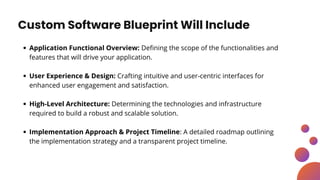
Custom Software Blueprint Will Include
Application Functional Overview: Defining the scope of the functionalities and
features that will drive your application.
User Experience & Design: Crafting intuitive and user-centric interfaces for
enhanced user engagement and satisfaction.
High-Level Architecture: Determining the technologies and infrastructure
required to build a robust and scalable solution.
Implementation Approach & Project Timeline: A detailed roadmap outlining
the implementation strategy and a transparent project timeline.
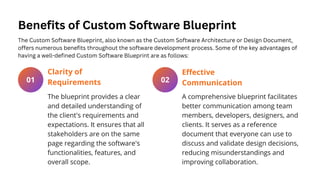
The blueprint provides a clear
and detailed understanding of
the client's requirements and
expectations. It ensures that all
stakeholders are on the same
page regarding the software's
functionalities, features, and
overall scope.
01
Clarity of
Requirements
A comprehensive blueprint facilitates
better communication among team
members, developers, designers, and
clients. It serves as a reference
document that everyone can use to
discuss and validate design decisions,
reducing misunderstandings and
improving collaboration.
02
Effective
Communication
Benefits of Custom Software Blueprint
The Custom Software Blueprint, also known as the Custom Software Architecture or Design Document,
offers numerous benefits throughout the software development process. Some of the key advantages of
having a well-defined Custom Software Blueprint are as follows:
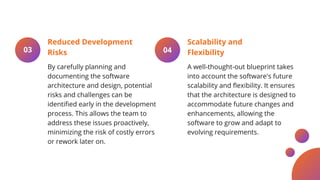
By carefully planning and
documenting the software
architecture and design, potential
risks and challenges can be
identified early in the development
process. This allows the team to
address these issues proactively,
minimizing the risk of costly errors
or rework later on.
03
Reduced Development
Risks
A well-thought-out blueprint takes
into account the software's future
scalability and flexibility. It ensures
that the architecture is designed to
accommodate future changes and
enhancements, allowing the
software to grow and adapt to
evolving requirements.
04
Scalability and
Flexibility
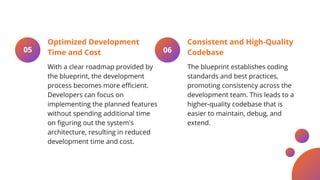
With a clear roadmap provided by
the blueprint, the development
process becomes more efficient.
Developers can focus on
implementing the planned features
without spending additional time
on figuring out the system's
architecture, resulting in reduced
development time and cost.
05
Optimized Development
Time and Cost
The blueprint establishes coding
standards and best practices,
promoting consistency across the
development team. This leads to a
higher-quality codebase that is
easier to maintain, debug, and
extend.
06
Consistent and High-Quality
Codebase
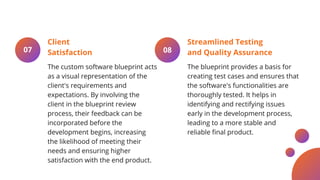
The custom software blueprint acts
as a visual representation of the
client's requirements and
expectations. By involving the
client in the blueprint review
process, their feedback can be
incorporated before the
development begins, increasing
the likelihood of meeting their
needs and ensuring higher
satisfaction with the end product.
07
Client
Satisfaction
The blueprint provides a basis for
creating test cases and ensures that
the software's functionalities are
thoroughly tested. It helps in
identifying and rectifying issues
early in the development process,
leading to a more stable and
reliable final product.
08
Streamlined Testing
and Quality Assurance
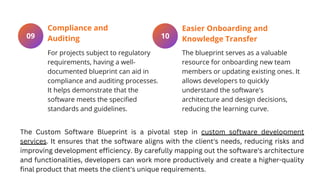
For projects subject to regulatory
requirements, having a well-
documented blueprint can aid in
compliance and auditing processes.
It helps demonstrate that the
software meets the specified
standards and guidelines.
09
Compliance and
Auditing
The blueprint serves as a valuable
resource for onboarding new team
members or updating existing ones. It
allows developers to quickly
understand the software's
architecture and design decisions,
reducing the learning curve.
10
Easier Onboarding and
Knowledge Transfer
The Custom Software Blueprint is a pivotal step in custom software development
services. It ensures that the software aligns with the client's needs, reducing risks and
improving development efficiency. By carefully mapping out the software's architecture
and functionalities, developers can work more productively and create a higher-quality
final product that meets the client's unique requirements.
Thank You

Custom Software Blueprint

  • 1.
  • 2.
    What is Custom SoftwareBlueprint A Custom Software Blueprint, also known as a Custom Software Architecture or Design Document, is a detailed plan that outlines the specific structure, components, and functionalities of a bespoke software solution tailored to meet the unique needs of a particular organization or client. It serves as a roadmap for building the custom software application from scratch, ensuring that all stakeholders have a clear understanding of the system's design and behavior.
  • 3.
    Custom Software BlueprintWill Include Application Functional Overview: Defining the scope of the functionalities and features that will drive your application. User Experience & Design: Crafting intuitive and user-centric interfaces for enhanced user engagement and satisfaction. High-Level Architecture: Determining the technologies and infrastructure required to build a robust and scalable solution. Implementation Approach & Project Timeline: A detailed roadmap outlining the implementation strategy and a transparent project timeline.
  • 4.
    The blueprint providesa clear and detailed understanding of the client's requirements and expectations. It ensures that all stakeholders are on the same page regarding the software's functionalities, features, and overall scope. 01 Clarity of Requirements A comprehensive blueprint facilitates better communication among team members, developers, designers, and clients. It serves as a reference document that everyone can use to discuss and validate design decisions, reducing misunderstandings and improving collaboration. 02 Effective Communication Benefits of Custom Software Blueprint The Custom Software Blueprint, also known as the Custom Software Architecture or Design Document, offers numerous benefits throughout the software development process. Some of the key advantages of having a well-defined Custom Software Blueprint are as follows:
  • 5.
    By carefully planningand documenting the software architecture and design, potential risks and challenges can be identified early in the development process. This allows the team to address these issues proactively, minimizing the risk of costly errors or rework later on. 03 Reduced Development Risks A well-thought-out blueprint takes into account the software's future scalability and flexibility. It ensures that the architecture is designed to accommodate future changes and enhancements, allowing the software to grow and adapt to evolving requirements. 04 Scalability and Flexibility
  • 6.
    With a clearroadmap provided by the blueprint, the development process becomes more efficient. Developers can focus on implementing the planned features without spending additional time on figuring out the system's architecture, resulting in reduced development time and cost. 05 Optimized Development Time and Cost The blueprint establishes coding standards and best practices, promoting consistency across the development team. This leads to a higher-quality codebase that is easier to maintain, debug, and extend. 06 Consistent and High-Quality Codebase
  • 7.
    The custom softwareblueprint acts as a visual representation of the client's requirements and expectations. By involving the client in the blueprint review process, their feedback can be incorporated before the development begins, increasing the likelihood of meeting their needs and ensuring higher satisfaction with the end product. 07 Client Satisfaction The blueprint provides a basis for creating test cases and ensures that the software's functionalities are thoroughly tested. It helps in identifying and rectifying issues early in the development process, leading to a more stable and reliable final product. 08 Streamlined Testing and Quality Assurance
  • 8.
    For projects subjectto regulatory requirements, having a well- documented blueprint can aid in compliance and auditing processes. It helps demonstrate that the software meets the specified standards and guidelines. 09 Compliance and Auditing The blueprint serves as a valuable resource for onboarding new team members or updating existing ones. It allows developers to quickly understand the software's architecture and design decisions, reducing the learning curve. 10 Easier Onboarding and Knowledge Transfer The Custom Software Blueprint is a pivotal step in custom software development services. It ensures that the software aligns with the client's needs, reducing risks and improving development efficiency. By carefully mapping out the software's architecture and functionalities, developers can work more productively and create a higher-quality final product that meets the client's unique requirements.
  • 9.