An Introduction
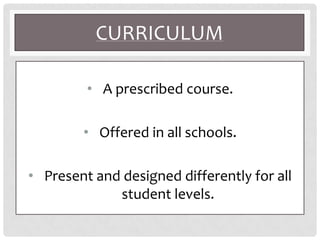
CURRICULUM
• A prescribed course.
• Offered in all schools.
• Present and designed differently for all
student levels.
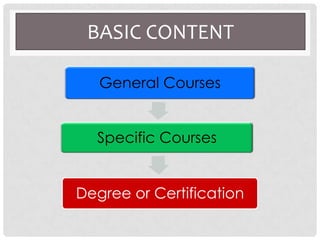
BASIC CONTENT
General Courses
Specific Courses
Degree or Certification
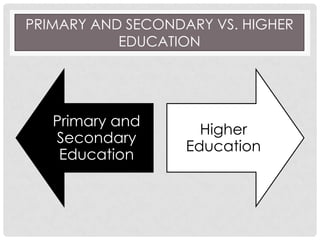
PRIMARY AND SECONDARY VS. HIGHER
EDUCATION
Primary and
Secondary
Education
Higher
Education
TYPES OF CURRICULUM
1. Traditional Curriculum
• Text-book-Workbook approach.
• Focuses on grades.
TYPES OF CURRICULUM
2. Thematic Unit Study
• Integrated study.
• More focused on academics based on
the student’s interests.
TYPES OF CURRICULUM
3. Programmed
• Self-paced; based on the student’s
desired pacing.
• Little direction from teachers or tutors.
TYPES OF CURRICULUM
4. Classical
• This coincides with the child’s cognitive
development.
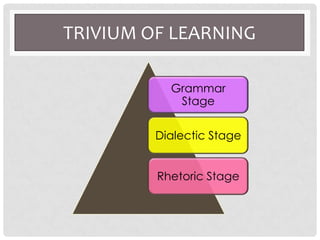
• Involves the TRIVIUM of learning.
TRIVIUM OF LEARNING
Grammar
Stage
Dialectic Stage
Rhetoric Stage
TYPES OF CLASSROOM CURRICULUM
1. Written Curriculum
• Published part of formal education.
• Includes the following:
a. Objectives b. Course guides c. Lesson
plans and course material d. grading
criteria
TYPES OF CLASSROOM CURRICULUM
2. Hidden Curriculumm
• Based on norms and values of
the educational institute.
• Gives prioritize to certain
subjects.
TYPES OF CLASSROOM CURRICULUM
3. Null curriculum
• Material and subjects not taught
in the class.
TYPES OF CLASSROOM CURRICULUM
4. Tested curriculum
• Body information on which
students will be tested.
TYPES OF CLASSROOM CURRICULUM
5. Electronic curriculum
• Internet-based
• Focused on critical thinking
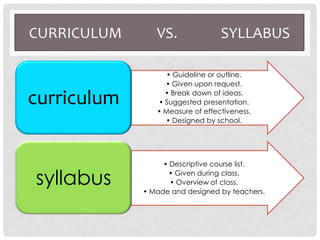
CURRICULUM VS. SYLLABUS
• Guideline or outline.
• Given upon request.
• Break down of ideas.
• Suggested presentation.
• Measure of effectiveness.
• Designed by school.
curriculum
• Descriptive course list.
• Given during class.
• Overview of class.
• Made and designed by teachers.
syllabus
CURRICULUM PLANNING
•A process where a teacher
builds a class curriculum
through coordinating with
school boards in order to
achieve uniform goals.
CURRICULUM PLANNING
What is a curriculum plan?
• Helps with planning material. [Objective planning]
• Maintains uniformity.
• Mainly for Primary and Secondary levels.
PROCESS AND MAIN COMPONENTS
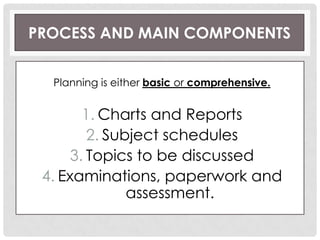
Planning is either basic or comprehensive.
1. Charts and Reports
2. Subject schedules
3. Topics to be discussed
4. Examinations, paperwork and
assessment.
MAIN COMPONENTS
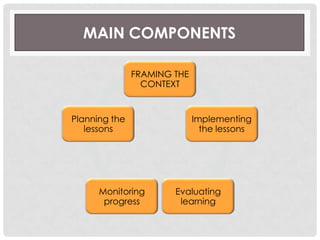
FRAMING THE
CONTEXT
Implementing
the lessons
Evaluating
learning
Monitoring
progress
Planning the
lessons
ASSESSMENT OF SUCCESS
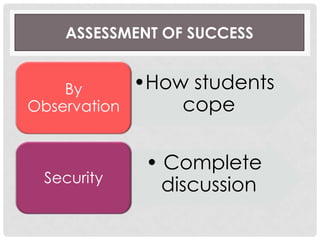
•How students
cope
By
Observation
• Complete
discussionSecurity
CURRICULUM DEVELOPMENT
•Method of which teaching
organizations and training
institutes guide learning.
•Both inside and outside the
classroom.
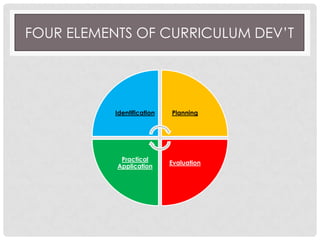
FOUR ELEMENTS OF CURRICULUM DEV’T
Identification Planning
Evaluation
Practical
Application
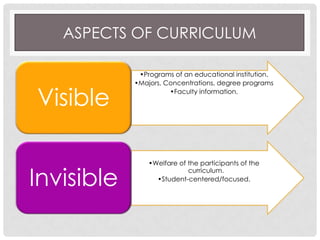
ASPECTS OF CURRICULUM
•Programs of an educational institution.
•Majors, Concentrations, degree programs
•Faculty information.
Visible
•Welfare of the participants of the
curriculum.
•Student-centered/focused.
Invisible
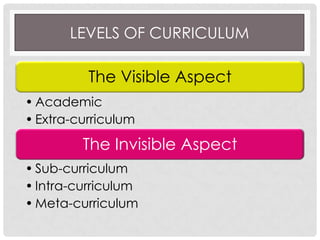
LEVELS OF CURRICULUM
The Visible Aspect
• Academic
• Extra-curriculum
The Invisible Aspect
• Sub-curriculum
• Intra-curriculum
• Meta-curriculum
LEVELS OF CURRICULUM
1. Academic Curriculum
• Courses and subjects.
2. Extra-curriculum
• Amplifier of the academic curriculum.
LEVELS OF CURRICULUM
1. Sub-curricular
• Physical and emotional state of the
student.
2. Intra-curriculum
• Bias of certain aspects of a person’s
being.
LEVELS OF CURRICULUM
1. Sub-curricular
• Physical and emotional state of the
student.
2. Intra-curriculum
• Bias of certain aspects of a person’s
being.
LEVELS OF CURRICULUM
3. Meta-curriculum
• Funding, research quality, institutional
and environmental aspects.
• Also includes the spiritual aspect of the
curriculum.
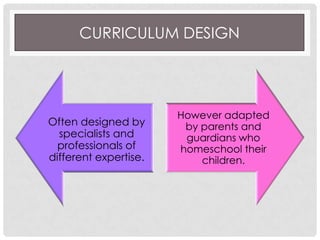
CURRICULUM DESIGN
Often designed by
specialists and
professionals of
different expertise.
However adapted
by parents and
guardians who
homeschool their
children.
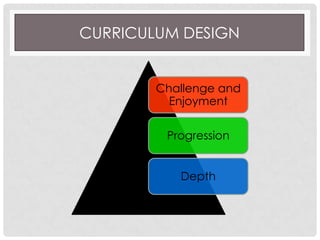
CURRICULUM DESIGN
Challenge and
Enjoyment
Progression
Depth
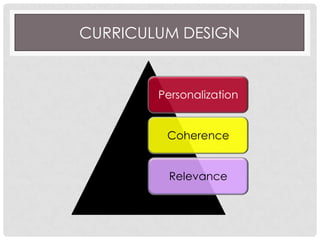
CURRICULUM DESIGN
Personalization
Coherence
Relevance
CURRICULUM EVALUATION
• Determining the worth of an entire
curriculum.
• Helps the policy-making bodies and
administrators in making decisions.
• Reference for people involved in the school
body.
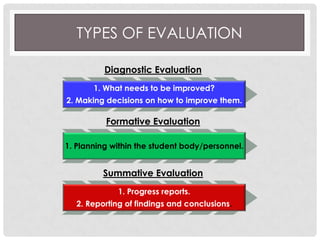
TYPES OF EVALUATION
Diagnostic Evaluation
1. What needs to be improved?
2. Making decisions on how to improve them.
Formative Evaluation
1. Planning within the student body/personnel.
Summative Evaluation
1. Progress reports.
2. Reporting of findings and conclusions.
METHODS OF EVALUATION
1. External evaluation
•People from outside the
school system with various
expertise.
METHODS OF EVALUATION
Why is external evaluation needed?
1. Need for independence
2. Span of control
3. Legal requirements
4. Expertise of the people involved.
METHODS OF EVALUATION
1. Internal evaluation
•People from within the
student body or institution.
•Existing groups within the
system.
METHODS OF EVALUATION
Why is internal evaluation
needed?
•For centralization and
decentralization.
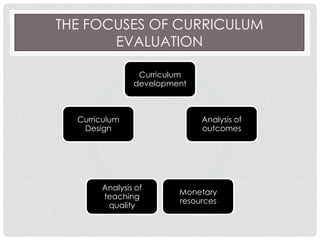
THE FOCUSES OF CURRICULUM
EVALUATION
Curriculum
development
Analysis of
outcomes
Monetary
resources
Analysis of
teaching
quality
Curriculum
Design
REFERENCES:
• Smith, S.E. , Wallace, O. (September 11, 2012). What Is
Curriculum Design? Retrieved from:
http://www.wisegeek.com/what-is-curriculum-
design.htm
• Ellis-Chistensen, T. , Wallace, O. (October 1, 2012). What
is Curriculum? Retrieved from:
http://www.wisegeek.com/what-is-curriculum.htm
• Faria, Allison , Wallace, O. (July 17, 2012). What is
Curriculum Planning? Retrieved from:
http://www.wisegeek.com/what-is-curriculum-
planning.htm
• Curriculum (n.d.) , In Wikipedia. Retrieved from:
http://en.wikipedia.org/wiki/Curriculum
REFERENCES:
• Vientiane, L. Building Capacities of Curriculum Specialists for
Educational Reform [PDF Document] Retrieved from IBE
UNESCO website
• http://www.ibe.unesco.org/fileadmin/user_upload/archive/cu
rriculum/Asia%20Networkpdf/vienrepor.pdf
• Primary School Curriculum. Retrieved. October 12, 2012
• http://www.curriculumonline.ie/en/primary_school_curriculum
/
• What is Curriculum Development? Retrieved October 11, 2012
• http://www.cglrc.cgiar.org/icraf/toolkit/What_is_curriculum_d
evelopment_.htm
• Principles for Curriculum Design
• http://www.educationscotland.gov.uk/thecurriculum/howisth
ecurriculumorganised/principles/index.asp

An Introduction to the Curriculum

  • 1.
  • 2.
    CURRICULUM • A prescribedcourse. • Offered in all schools. • Present and designed differently for all student levels.
  • 3.
    BASIC CONTENT General Courses SpecificCourses Degree or Certification
  • 4.
    PRIMARY AND SECONDARYVS. HIGHER EDUCATION Primary and Secondary Education Higher Education
  • 5.
    TYPES OF CURRICULUM 1.Traditional Curriculum • Text-book-Workbook approach. • Focuses on grades.
  • 6.
    TYPES OF CURRICULUM 2.Thematic Unit Study • Integrated study. • More focused on academics based on the student’s interests.
  • 7.
    TYPES OF CURRICULUM 3.Programmed • Self-paced; based on the student’s desired pacing. • Little direction from teachers or tutors.
  • 8.
    TYPES OF CURRICULUM 4.Classical • This coincides with the child’s cognitive development. • Involves the TRIVIUM of learning.
  • 9.
  • 10.
    TYPES OF CLASSROOMCURRICULUM 1. Written Curriculum • Published part of formal education. • Includes the following: a. Objectives b. Course guides c. Lesson plans and course material d. grading criteria
  • 11.
    TYPES OF CLASSROOMCURRICULUM 2. Hidden Curriculumm • Based on norms and values of the educational institute. • Gives prioritize to certain subjects.
  • 12.
    TYPES OF CLASSROOMCURRICULUM 3. Null curriculum • Material and subjects not taught in the class.
  • 13.
    TYPES OF CLASSROOMCURRICULUM 4. Tested curriculum • Body information on which students will be tested.
  • 14.
    TYPES OF CLASSROOMCURRICULUM 5. Electronic curriculum • Internet-based • Focused on critical thinking
  • 15.
    CURRICULUM VS. SYLLABUS •Guideline or outline. • Given upon request. • Break down of ideas. • Suggested presentation. • Measure of effectiveness. • Designed by school. curriculum • Descriptive course list. • Given during class. • Overview of class. • Made and designed by teachers. syllabus
  • 16.
    CURRICULUM PLANNING •A processwhere a teacher builds a class curriculum through coordinating with school boards in order to achieve uniform goals.
  • 17.
    CURRICULUM PLANNING What isa curriculum plan? • Helps with planning material. [Objective planning] • Maintains uniformity. • Mainly for Primary and Secondary levels.
  • 18.
    PROCESS AND MAINCOMPONENTS Planning is either basic or comprehensive. 1. Charts and Reports 2. Subject schedules 3. Topics to be discussed 4. Examinations, paperwork and assessment.
  • 19.
    MAIN COMPONENTS FRAMING THE CONTEXT Implementing thelessons Evaluating learning Monitoring progress Planning the lessons
  • 20.
    ASSESSMENT OF SUCCESS •Howstudents cope By Observation • Complete discussionSecurity
  • 21.
    CURRICULUM DEVELOPMENT •Method ofwhich teaching organizations and training institutes guide learning. •Both inside and outside the classroom.
  • 22.
    FOUR ELEMENTS OFCURRICULUM DEV’T Identification Planning Evaluation Practical Application
  • 23.
    ASPECTS OF CURRICULUM •Programsof an educational institution. •Majors, Concentrations, degree programs •Faculty information. Visible •Welfare of the participants of the curriculum. •Student-centered/focused. Invisible
  • 24.
    LEVELS OF CURRICULUM TheVisible Aspect • Academic • Extra-curriculum The Invisible Aspect • Sub-curriculum • Intra-curriculum • Meta-curriculum
  • 25.
    LEVELS OF CURRICULUM 1.Academic Curriculum • Courses and subjects. 2. Extra-curriculum • Amplifier of the academic curriculum.
  • 26.
    LEVELS OF CURRICULUM 1.Sub-curricular • Physical and emotional state of the student. 2. Intra-curriculum • Bias of certain aspects of a person’s being.
  • 27.
    LEVELS OF CURRICULUM 1.Sub-curricular • Physical and emotional state of the student. 2. Intra-curriculum • Bias of certain aspects of a person’s being.
  • 28.
    LEVELS OF CURRICULUM 3.Meta-curriculum • Funding, research quality, institutional and environmental aspects. • Also includes the spiritual aspect of the curriculum.
  • 29.
    CURRICULUM DESIGN Often designedby specialists and professionals of different expertise. However adapted by parents and guardians who homeschool their children.
  • 30.
  • 31.
  • 32.
    CURRICULUM EVALUATION • Determiningthe worth of an entire curriculum. • Helps the policy-making bodies and administrators in making decisions. • Reference for people involved in the school body.
  • 33.
    TYPES OF EVALUATION DiagnosticEvaluation 1. What needs to be improved? 2. Making decisions on how to improve them. Formative Evaluation 1. Planning within the student body/personnel. Summative Evaluation 1. Progress reports. 2. Reporting of findings and conclusions.
  • 34.
    METHODS OF EVALUATION 1.External evaluation •People from outside the school system with various expertise.
  • 35.
    METHODS OF EVALUATION Whyis external evaluation needed? 1. Need for independence 2. Span of control 3. Legal requirements 4. Expertise of the people involved.
  • 36.
    METHODS OF EVALUATION 1.Internal evaluation •People from within the student body or institution. •Existing groups within the system.
  • 37.
    METHODS OF EVALUATION Whyis internal evaluation needed? •For centralization and decentralization.
  • 38.
    THE FOCUSES OFCURRICULUM EVALUATION Curriculum development Analysis of outcomes Monetary resources Analysis of teaching quality Curriculum Design
  • 39.
    REFERENCES: • Smith, S.E., Wallace, O. (September 11, 2012). What Is Curriculum Design? Retrieved from: http://www.wisegeek.com/what-is-curriculum- design.htm • Ellis-Chistensen, T. , Wallace, O. (October 1, 2012). What is Curriculum? Retrieved from: http://www.wisegeek.com/what-is-curriculum.htm • Faria, Allison , Wallace, O. (July 17, 2012). What is Curriculum Planning? Retrieved from: http://www.wisegeek.com/what-is-curriculum- planning.htm • Curriculum (n.d.) , In Wikipedia. Retrieved from: http://en.wikipedia.org/wiki/Curriculum
  • 40.
    REFERENCES: • Vientiane, L.Building Capacities of Curriculum Specialists for Educational Reform [PDF Document] Retrieved from IBE UNESCO website • http://www.ibe.unesco.org/fileadmin/user_upload/archive/cu rriculum/Asia%20Networkpdf/vienrepor.pdf • Primary School Curriculum. Retrieved. October 12, 2012 • http://www.curriculumonline.ie/en/primary_school_curriculum / • What is Curriculum Development? Retrieved October 11, 2012 • http://www.cglrc.cgiar.org/icraf/toolkit/What_is_curriculum_d evelopment_.htm • Principles for Curriculum Design • http://www.educationscotland.gov.uk/thecurriculum/howisth ecurriculumorganised/principles/index.asp