Current status of groundnut improvement in Uganda
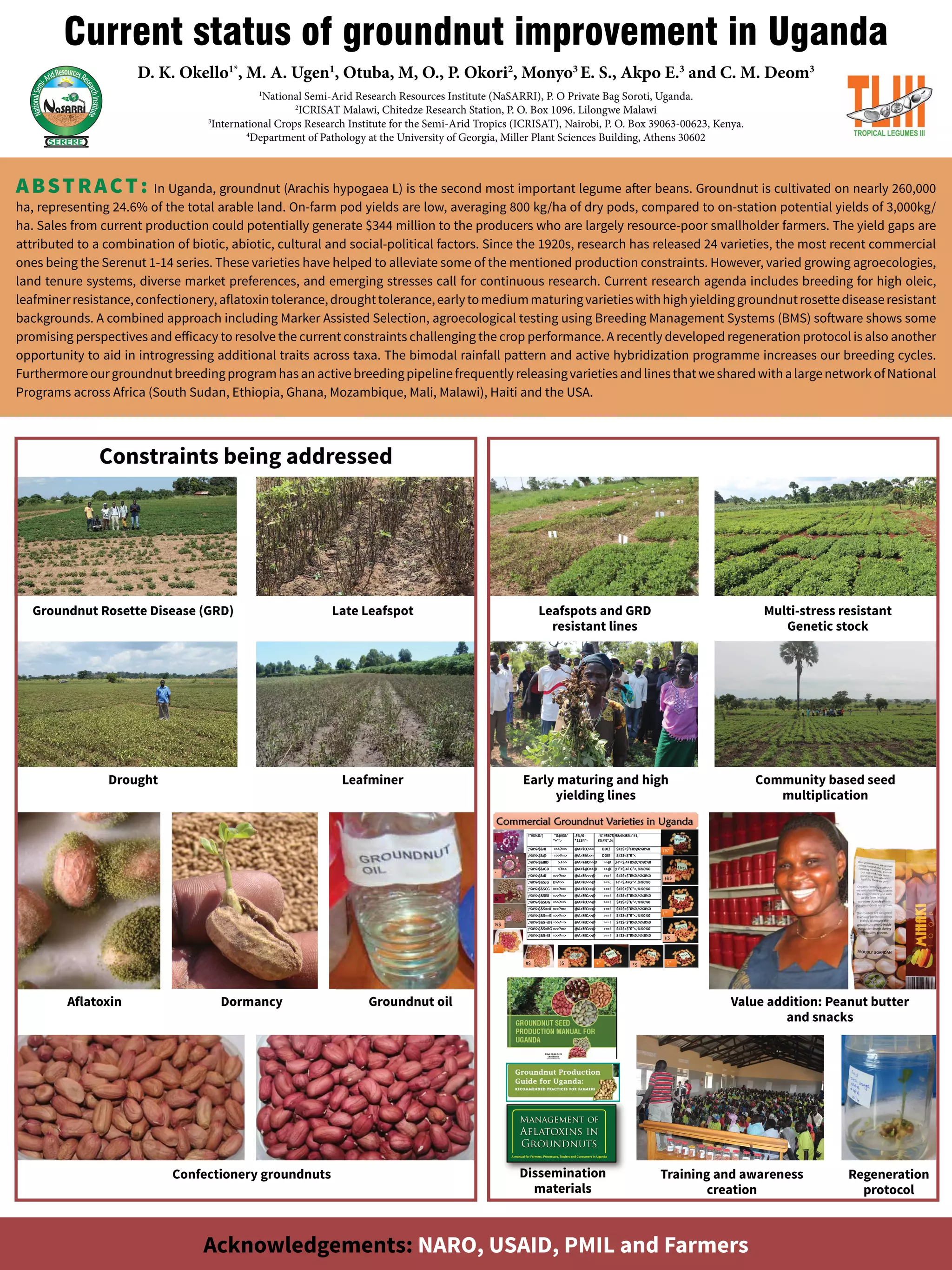
ABSTRACT: In Uganda, groundnut (Arachis hypogaea L) is the second most important legume after beans. Groundnut is cultivated on nearly 260,000
ha, representing 24.6% of the total arable land. On-farm pod yields are low, averaging 800 kg/ha of dry pods, compared to on-station potential yields of 3,000kg/
ha. Sales from current production could potentially generate $344 million to the producers who are largely resource-poor smallholder farmers. The yield gaps are
attributed to a combination of biotic, abiotic, cultural and social-political factors. Since the 1920s, research has released 24 varieties, the most recent commercial
ones being the Serenut 1-14 series. These varieties have helped to alleviate some of the mentioned production constraints. However, varied growing agroecologies,
land tenure systems, diverse market preferences, and emerging stresses call for continuous research. Current research agenda includes breeding for high oleic,
leafminerresistance,confectionery,aflatoxintolerance,droughttolerance,earlytomediummaturingvarietieswithhighyieldinggroundnutrosettediseaseresistant
backgrounds. A combined approach including Marker Assisted Selection, agroecological testing using Breeding Management Systems (BMS) software shows some
promising perspectives and efficacy to resolve the current constraints challenging the crop performance. A recently developed regeneration protocol is also another
opportunity to aid in introgressing additional traits across taxa. The bimodal rainfall pattern and active hybridization programme increases our breeding cycles.
FurthermoreourgroundnutbreedingprogramhasanactivebreedingpipelinefrequentlyreleasingvarietiesandlinesthatwesharedwithalargenetworkofNational
Programs across Africa (South Sudan, Ethiopia, Ghana, Mozambique, Mali, Malawi), Haiti and the USA.
D. K. Okello1*
, M. A. Ugen1
, Otuba, M, O., P. Okori2
, Monyo3
E. S., Akpo E.3
and C. M. Deom3
1
National Semi-Arid Research Resources Institute (NaSARRI), P. O Private Bag Soroti, Uganda.
2
ICRISAT Malawi, Chitedze Research Station, P. O. Box 1096. Lilongwe Malawi
3
International Crops Research Institute for the Semi-Arid Tropics (ICRISAT), Nairobi, P. O. Box 39063-00623, Kenya.
4
Department of Pathology at the University of Georgia, Miller Plant Sciences Building, Athens 30602
Constraints being addressed
Acknowledgements: NARO, USAID, PMIL and Farmers
Groundnut Rosette Disease (GRD)
Drought
Aflatoxin Dormancy
Confectionery groundnuts
Groundnut oil
Late Leafspot Leafspots and GRD
resistant lines
Multi-stress resistant
Genetic stock
Early maturing and high
yielding lines
Community based seed
multiplication
Training and awareness
creation
Value addition: Peanut butter
and snacks
Leafminer
Commercial Groundnut Varieties in Uganda
!"
#$
%$
&"
'
(" !"#$%&'( "&)#$&'
*+"',-
.$%/0
*1234"-
.%"#5675
8%/%",%
9&4%#8%:"#1,
;%#%<)&=8 =>>?==> @A>>?BC>>= DDE! $#2$<$"F8%0;%%0%0
;%#%<)&@ =>>?==> @A>>?BA>>= DDE! $#2$<$"FG"<
;%#%<)&B8D >?=>> @A>>?@D>>@ >>@ ;H"<$,4F8%0;%%0%0
;%#%<)&IGD >?=>> @A>>?@D>>@ >>@ ;H"<$,4FG"<, %%0%0
;%#%<)&A8 =>>?==> @A>>?B>>>@ >=>! $#2$<$"F8%0,%%0%0
;%#%<)&5JG D>?=>> @A>>?B>>>@ >=>; H"<$,4FG"< ,%%0%0
;%#%<)&5CG =>>?==> @A>>?BC>>@ >==! $#2$<$"FG"<, %%0%0
;%#%<)&5E8 =>>?==> @A>>?BC>>@ >==! $#2$<$"F8%0,%%0%0
;%#%<)&5DG =>>?==> @A>>?BC>>@ >==! $#2$<$"FG"<, %%0%0
;%#%<)&5=>8 =>>?==> @A>>?BC>>@ >==! $#2$<$"F8%0,%%0%0
;%#%<)&5==G =>>?==> @A>>?BC>>@ >==! $#2$<$"FG"<, %%0%0
;%#%<)&5=@8=>>?==> @A>>?BC>>@ >==! $#2$<$"F8%0,%%0%0
;%#%<)&5=BG =>>?==> @A>>?BC>>@ >==! $#2$<$"FG"<, %%0%0
;%#%<)&5=I8 =>>?==> @A>>?BC>>@ >==! $#2$<$"F8%0,%%0%0
)$ *$
(($
(&$
+" (,"
('"
(%"
Regeneration
protocol
Dissemination
materials

Current status of groundnut improvement in uganda

  • 1.
    Current status ofgroundnut improvement in Uganda ABSTRACT: In Uganda, groundnut (Arachis hypogaea L) is the second most important legume after beans. Groundnut is cultivated on nearly 260,000 ha, representing 24.6% of the total arable land. On-farm pod yields are low, averaging 800 kg/ha of dry pods, compared to on-station potential yields of 3,000kg/ ha. Sales from current production could potentially generate $344 million to the producers who are largely resource-poor smallholder farmers. The yield gaps are attributed to a combination of biotic, abiotic, cultural and social-political factors. Since the 1920s, research has released 24 varieties, the most recent commercial ones being the Serenut 1-14 series. These varieties have helped to alleviate some of the mentioned production constraints. However, varied growing agroecologies, land tenure systems, diverse market preferences, and emerging stresses call for continuous research. Current research agenda includes breeding for high oleic, leafminerresistance,confectionery,aflatoxintolerance,droughttolerance,earlytomediummaturingvarietieswithhighyieldinggroundnutrosettediseaseresistant backgrounds. A combined approach including Marker Assisted Selection, agroecological testing using Breeding Management Systems (BMS) software shows some promising perspectives and efficacy to resolve the current constraints challenging the crop performance. A recently developed regeneration protocol is also another opportunity to aid in introgressing additional traits across taxa. The bimodal rainfall pattern and active hybridization programme increases our breeding cycles. FurthermoreourgroundnutbreedingprogramhasanactivebreedingpipelinefrequentlyreleasingvarietiesandlinesthatwesharedwithalargenetworkofNational Programs across Africa (South Sudan, Ethiopia, Ghana, Mozambique, Mali, Malawi), Haiti and the USA. D. K. Okello1* , M. A. Ugen1 , Otuba, M, O., P. Okori2 , Monyo3 E. S., Akpo E.3 and C. M. Deom3 1 National Semi-Arid Research Resources Institute (NaSARRI), P. O Private Bag Soroti, Uganda. 2 ICRISAT Malawi, Chitedze Research Station, P. O. Box 1096. Lilongwe Malawi 3 International Crops Research Institute for the Semi-Arid Tropics (ICRISAT), Nairobi, P. O. Box 39063-00623, Kenya. 4 Department of Pathology at the University of Georgia, Miller Plant Sciences Building, Athens 30602 Constraints being addressed Acknowledgements: NARO, USAID, PMIL and Farmers Groundnut Rosette Disease (GRD) Drought Aflatoxin Dormancy Confectionery groundnuts Groundnut oil Late Leafspot Leafspots and GRD resistant lines Multi-stress resistant Genetic stock Early maturing and high yielding lines Community based seed multiplication Training and awareness creation Value addition: Peanut butter and snacks Leafminer Commercial Groundnut Varieties in Uganda !" #$ %$ &" ' (" !"#$%&'( "&)#$&' *+"',- .$%/0 *1234"- .%"#5675 8%/%",% 9&4%#8%:"#1, ;%#%<)&=8 =>>?==> @A>>?BC>>= DDE! $#2$<$"F8%0;%%0%0 ;%#%<)&@ =>>?==> @A>>?BA>>= DDE! $#2$<$"FG"< ;%#%<)&B8D >?=>> @A>>?@D>>@ >>@ ;H"<$,4F8%0;%%0%0 ;%#%<)&IGD >?=>> @A>>?@D>>@ >>@ ;H"<$,4FG"<, %%0%0 ;%#%<)&A8 =>>?==> @A>>?B>>>@ >=>! $#2$<$"F8%0,%%0%0 ;%#%<)&5JG D>?=>> @A>>?B>>>@ >=>; H"<$,4FG"< ,%%0%0 ;%#%<)&5CG =>>?==> @A>>?BC>>@ >==! $#2$<$"FG"<, %%0%0 ;%#%<)&5E8 =>>?==> @A>>?BC>>@ >==! $#2$<$"F8%0,%%0%0 ;%#%<)&5DG =>>?==> @A>>?BC>>@ >==! $#2$<$"FG"<, %%0%0 ;%#%<)&5=>8 =>>?==> @A>>?BC>>@ >==! $#2$<$"F8%0,%%0%0 ;%#%<)&5==G =>>?==> @A>>?BC>>@ >==! $#2$<$"FG"<, %%0%0 ;%#%<)&5=@8=>>?==> @A>>?BC>>@ >==! $#2$<$"F8%0,%%0%0 ;%#%<)&5=BG =>>?==> @A>>?BC>>@ >==! $#2$<$"FG"<, %%0%0 ;%#%<)&5=I8 =>>?==> @A>>?BC>>@ >==! $#2$<$"F8%0,%%0%0 )$ *$ (($ (&$ +" (," ('" (%" Regeneration protocol Dissemination materials