Corporate Sustainability Reporting
Directive (CSRD)
EAA in conversation with
1 March 2023
European Commission, DG FISMA/C1
The information and views expressed in this presentation do not necessarily
reflect the official position of the European Commission/European Union
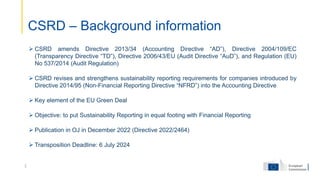
 CSRD amends Directive 2013/34 (Accounting Directive “AD”), Directive 2004/109/EC
(Transparency Directive “TD”), Directive 2006/43/EU (Audit Directive “AuD”), and Regulation (EU)
No 537/2014 (Audit Regulation)
 CSRD revises and strengthens sustainability reporting requirements for companies introduced by
Directive 2014/95 (Non-Financial Reporting Directive “NFRD”) into the Accounting Directive
 Key element of the EU Green Deal
 Objective: to put Sustainability Reporting in equal footing with Financial Reporting
 Publication in OJ in December 2022 (Directive 2022/2464)
 Transposition Deadline: 6 July 2024
2
CSRD – Background information
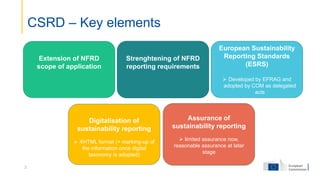
CSRD – Key elements
Extension of NFRD
scope of application
Strenghtening of NFRD
reporting requirements
European Sustainability
Reporting Standards
(ESRS)
 Developed by EFRAG and
adopted by COM as delegated
acts
Digitalisation of
sustainability reporting
 XHTML format (+ marking-up of
the information once digital
taxonomy is adopted)
Assurance of
sustainability reporting
 limited assurance now,
reasonable assurance at later
stage
3
1) All large companies
2) All listed companies (except listed micro-enterprises)
3) Non-EU companies with branches or subsidiaries in the EU above certain thresholds*
4
Scope
Listed SMEs:
• Option to use simpler, proportionate standards
• Possibility to opt-out for 2 years after entry into
application*
Non-EU:
• Separate standards*
• Not covering all reporting areas: impact
focus, no reporting on risks*
Content of sustainability reporting
(Artt. 19a and 29a AD)
 Business model and strategy
 Role of management
 Incentive schemes
 Company’s policies and targets
 Due diligence process and principal adverse impacts
 Principal risks and opportunities
 Indicators
 Risks of sustainability matters on company + Impacts of company on sustainability matters
 Information about company’s own operations and value chain
- First 3 years of application: if not all information available, explanation of efforts made
5
 Cross-cutting standards and standards
for all sustainability topics
 Including information needed to comply with SFDR requirements
(Regulation (EU) No 2019/2088)
 Sector-specific standards
 Standards for listed SMEs
 Standards for non-EU companies exceeding
EU turnover threshold
European Sustainability Reporting Standards
“ESRS”
Adoption by
COM 30 June
2024
Adoption by
COM 30 June
2023
“ESRS”
(Art. 29b AD)
“ESRS
for certain
non-EU
companies”
(Art. 40b AD)
“ESRS
for SMEs”
(Art. 29c AD)
6
 “NFRD companies”: FY 2024 (first reports published 2025)
 Other large companies: FY 2025 (reports 2026)
 Listed SMEs: FY 2026 (reports 2027)
 Non-EU companies with branches/subsidiaries: FY 2028 (reports 2029)
7
Phased entry into application
 Large companies and listed SMEs (except micro undertakings) > individual sustainability reporting
(Art. 19a AD)
 Parent companies of a large group > consolidated sustainability reporting (Art. 29a AD)
 Exemptions (not applicable to large listed companies):
− no sustainability reporting if company (and its subsidiaries) is included in consolidated
sustainability reporting of a parent company drawn-up in compliance with ESRS or equivalent
(Artt. 19a(9) and 29a(8) AD)
− no individual sustainability reporting by parent company that is reporting at consolidated level
(Art. 29a(7) AD)
8
Individual and consolidated sustainability reporting
(Art 19a AD and 29aAD)
Sustainability reports concerning certain non-EU
companies (Art. 40a AD)
 Companies in scope:
− EU subsidiaries (large undertakings and listed SMEs) of non-EU companies with net turnover
above EUR 150 millions; or
− EU branches (with net turnover above EUR 40 millions) of non-EU companies with net
turnover above EUR 150 millions
 Content of sustainability reports: a subset of the information required under Art. 29a AD
 Sustainability report provided at consolidated level of the parent company
 Use of « ESRS for certain non-EU companies » (alternatively, ESRS or equivalent)
 No exemptions (unless ESRS or equivalent are used)
 Assurance
9
• ESRS to take account of international reporting standards (ISSB and others) “to the
maximum extent possible.”
• CSRD: EU standards will integrate all ISSB disclosure requirements, provided they
are consistent with our legal framework and with the ambitions of the European
Green Deal.
• ESRS are more comprehensive: ISSB is only addressing climate but and only from
the perspective of risks to the company.
• Ongoing bilateral discussions EFRAG/Commission with ISSB to reach inter-
operablity
10
ESRS and global standards
11
Digitalisation
(Art. 29d AD)
Management report in XHTML format
Mark-up of sustainability information (dedicated section of
management report) in accordance with digital taxonomy (to be) set
out in Commission Delegated Regulation 2019/815 on European
Single Electronic Format (ESEF)
Commission may adopted limited/reasonable assurance standards only where they:
(a) have been developed with proper due process, public oversight and transparency;
(b) contribute a high level of credibility and quality to the annual or consolidated sustainability reporting;
(c) are conducive to the Union public good.’
(d) do not amend any of the requirements of this Directive or supplement any of its requirements apart from
those set out in Articles 25b, 27a and 28a.
12
Assurance
(Art. 34 AD and 28a AuD)
 Initial requirement is for limited assurance. Date of move to reasonable assurance will be
specified in Commission act that adopts standards for reasonable assurance
Assurance standards
• COM to adopt limited assurance standards by October 2026. In the meantime, MS may apply own rules
• COM to adopt reasonable assurance standards by October 2028, after assessment of feasibility
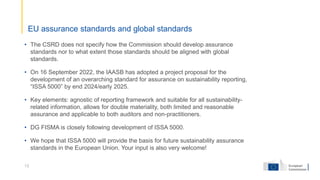
• The CSRD does not specify how the Commission should develop assurance
standards nor to what extent those standards should be aligned with global
standards.
• On 16 September 2022, the IAASB has adopted a project proposal for the
development of an overarching standard for assurance on sustainability reporting,
“ISSA 5000” by end 2024/early 2025.
• Key elements: agnostic of reporting framework and suitable for all sustainability-
related information, allows for double materiality, both limited and reasonable
assurance and applicable to both auditors and non-practitioners.
• DG FISMA is closely following development of ISSA 5000.
• We hope that ISSA 5000 will provide the basis for future sustainability assurance
standards in the European Union. Your input is also very welcome!
13
EU assurance standards and global standards
© European Union, 2023
Reuse authorised under the Creative Commons Attribution 4.0 International (CC BY 4.0) licence.
Thank you

CSRD_EAA-conversation-1March2023for_reading

  • 1.
    Corporate Sustainability Reporting Directive(CSRD) EAA in conversation with 1 March 2023 European Commission, DG FISMA/C1 The information and views expressed in this presentation do not necessarily reflect the official position of the European Commission/European Union
  • 2.
     CSRD amendsDirective 2013/34 (Accounting Directive “AD”), Directive 2004/109/EC (Transparency Directive “TD”), Directive 2006/43/EU (Audit Directive “AuD”), and Regulation (EU) No 537/2014 (Audit Regulation)  CSRD revises and strengthens sustainability reporting requirements for companies introduced by Directive 2014/95 (Non-Financial Reporting Directive “NFRD”) into the Accounting Directive  Key element of the EU Green Deal  Objective: to put Sustainability Reporting in equal footing with Financial Reporting  Publication in OJ in December 2022 (Directive 2022/2464)  Transposition Deadline: 6 July 2024 2 CSRD – Background information
  • 3.
    CSRD – Keyelements Extension of NFRD scope of application Strenghtening of NFRD reporting requirements European Sustainability Reporting Standards (ESRS)  Developed by EFRAG and adopted by COM as delegated acts Digitalisation of sustainability reporting  XHTML format (+ marking-up of the information once digital taxonomy is adopted) Assurance of sustainability reporting  limited assurance now, reasonable assurance at later stage 3
  • 4.
    1) All largecompanies 2) All listed companies (except listed micro-enterprises) 3) Non-EU companies with branches or subsidiaries in the EU above certain thresholds* 4 Scope Listed SMEs: • Option to use simpler, proportionate standards • Possibility to opt-out for 2 years after entry into application* Non-EU: • Separate standards* • Not covering all reporting areas: impact focus, no reporting on risks*
  • 5.
    Content of sustainabilityreporting (Artt. 19a and 29a AD)  Business model and strategy  Role of management  Incentive schemes  Company’s policies and targets  Due diligence process and principal adverse impacts  Principal risks and opportunities  Indicators  Risks of sustainability matters on company + Impacts of company on sustainability matters  Information about company’s own operations and value chain - First 3 years of application: if not all information available, explanation of efforts made 5
  • 6.
     Cross-cutting standardsand standards for all sustainability topics  Including information needed to comply with SFDR requirements (Regulation (EU) No 2019/2088)  Sector-specific standards  Standards for listed SMEs  Standards for non-EU companies exceeding EU turnover threshold European Sustainability Reporting Standards “ESRS” Adoption by COM 30 June 2024 Adoption by COM 30 June 2023 “ESRS” (Art. 29b AD) “ESRS for certain non-EU companies” (Art. 40b AD) “ESRS for SMEs” (Art. 29c AD) 6
  • 7.
     “NFRD companies”:FY 2024 (first reports published 2025)  Other large companies: FY 2025 (reports 2026)  Listed SMEs: FY 2026 (reports 2027)  Non-EU companies with branches/subsidiaries: FY 2028 (reports 2029) 7 Phased entry into application
  • 8.
     Large companiesand listed SMEs (except micro undertakings) > individual sustainability reporting (Art. 19a AD)  Parent companies of a large group > consolidated sustainability reporting (Art. 29a AD)  Exemptions (not applicable to large listed companies): − no sustainability reporting if company (and its subsidiaries) is included in consolidated sustainability reporting of a parent company drawn-up in compliance with ESRS or equivalent (Artt. 19a(9) and 29a(8) AD) − no individual sustainability reporting by parent company that is reporting at consolidated level (Art. 29a(7) AD) 8 Individual and consolidated sustainability reporting (Art 19a AD and 29aAD)
  • 9.
    Sustainability reports concerningcertain non-EU companies (Art. 40a AD)  Companies in scope: − EU subsidiaries (large undertakings and listed SMEs) of non-EU companies with net turnover above EUR 150 millions; or − EU branches (with net turnover above EUR 40 millions) of non-EU companies with net turnover above EUR 150 millions  Content of sustainability reports: a subset of the information required under Art. 29a AD  Sustainability report provided at consolidated level of the parent company  Use of « ESRS for certain non-EU companies » (alternatively, ESRS or equivalent)  No exemptions (unless ESRS or equivalent are used)  Assurance 9
  • 10.
    • ESRS totake account of international reporting standards (ISSB and others) “to the maximum extent possible.” • CSRD: EU standards will integrate all ISSB disclosure requirements, provided they are consistent with our legal framework and with the ambitions of the European Green Deal. • ESRS are more comprehensive: ISSB is only addressing climate but and only from the perspective of risks to the company. • Ongoing bilateral discussions EFRAG/Commission with ISSB to reach inter- operablity 10 ESRS and global standards
  • 11.
    11 Digitalisation (Art. 29d AD) Managementreport in XHTML format Mark-up of sustainability information (dedicated section of management report) in accordance with digital taxonomy (to be) set out in Commission Delegated Regulation 2019/815 on European Single Electronic Format (ESEF)
  • 12.
    Commission may adoptedlimited/reasonable assurance standards only where they: (a) have been developed with proper due process, public oversight and transparency; (b) contribute a high level of credibility and quality to the annual or consolidated sustainability reporting; (c) are conducive to the Union public good.’ (d) do not amend any of the requirements of this Directive or supplement any of its requirements apart from those set out in Articles 25b, 27a and 28a. 12 Assurance (Art. 34 AD and 28a AuD)  Initial requirement is for limited assurance. Date of move to reasonable assurance will be specified in Commission act that adopts standards for reasonable assurance Assurance standards • COM to adopt limited assurance standards by October 2026. In the meantime, MS may apply own rules • COM to adopt reasonable assurance standards by October 2028, after assessment of feasibility
  • 13.
    • The CSRDdoes not specify how the Commission should develop assurance standards nor to what extent those standards should be aligned with global standards. • On 16 September 2022, the IAASB has adopted a project proposal for the development of an overarching standard for assurance on sustainability reporting, “ISSA 5000” by end 2024/early 2025. • Key elements: agnostic of reporting framework and suitable for all sustainability- related information, allows for double materiality, both limited and reasonable assurance and applicable to both auditors and non-practitioners. • DG FISMA is closely following development of ISSA 5000. • We hope that ISSA 5000 will provide the basis for future sustainability assurance standards in the European Union. Your input is also very welcome! 13 EU assurance standards and global standards
  • 14.
    © European Union,2023 Reuse authorised under the Creative Commons Attribution 4.0 International (CC BY 4.0) licence. Thank you

Editor's Notes

  • #10 information to be reported is understandable, relevant, representative, verifiable, comparable, and is represented in a faithful manner. - specify the information that undertakings are to disclose about environmental factors, including information about: (i) climate change mitigation; (ii) climate change adaptation; (iii) water and marine resources; (iv) resource use and circular economy; (v) pollution; (vi) biodiversity and ecosystems; specify the information that undertakings are to disclose about social factors, including information about: (i) equal opportunities for all, including gender equality, training and skills development, and employment and inclusion of people with disabilities; (ii) working conditions, including secure and adaptable employment, wages, social dialogue, collective bargaining and the involvement of workers, work-life balance, and a healthy, safe and well-adapted work environment; (iii) respect for the human rights, fundamental freedoms, democratic principles and standards established in the International Bill of Human Rights and other core UN human rights conventions, the International Labour Organization’s Declaration on Fundamental Principles and Rights at Work and the ILO fundamental conventions and the Charter of Fundamental Rights of the European Union. specify the information that undertakings are to disclose about governance factors, including information about: (i) the role of the undertaking’s administrative, management and supervisory bodies, including with regard to sustainability matters, and their composition; (ii) business ethics and corporate culture, including anti-corruption and anti-bribery; (iii) political engagements of the undertaking, including its lobbying activities; (iv) the management and quality of relationships with business partners, including payment practices; the undertaking’s internal control and risk management systems, including in relation to the undertaking’s reporting process.
  • #15 Update/add/delete parts of the copy right notice where appropriate. More information: https://myintracomm.ec.europa.eu/corp/intellectual-property/Documents/2019_Reuse-guidelines%28CC-BY%29.pdf