Corporate Social Responsibility Towards the Competition By  Raymund N. Sanchez
Agenda Overview of CSR
Unfair competition - Definition
- Antitrust laws
- Microsoft case Cartels
Intellectual Property Rights
Blood Diamonds
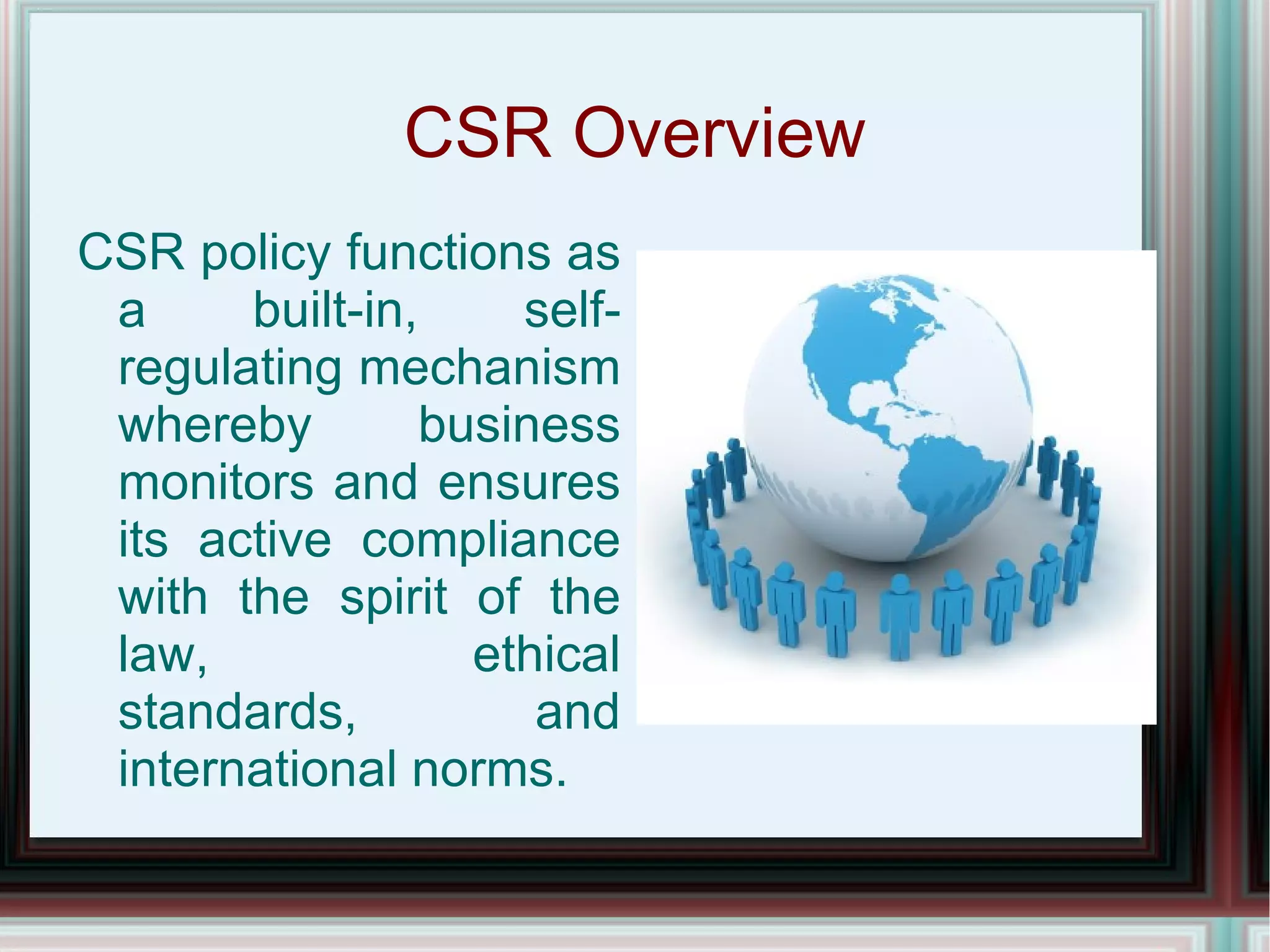
CSR Overview CSR policy functions as a built-in, self-regulating mechanism whereby business monitors and ensures its active compliance with the spirit of the law, ethical standards, and international norms.
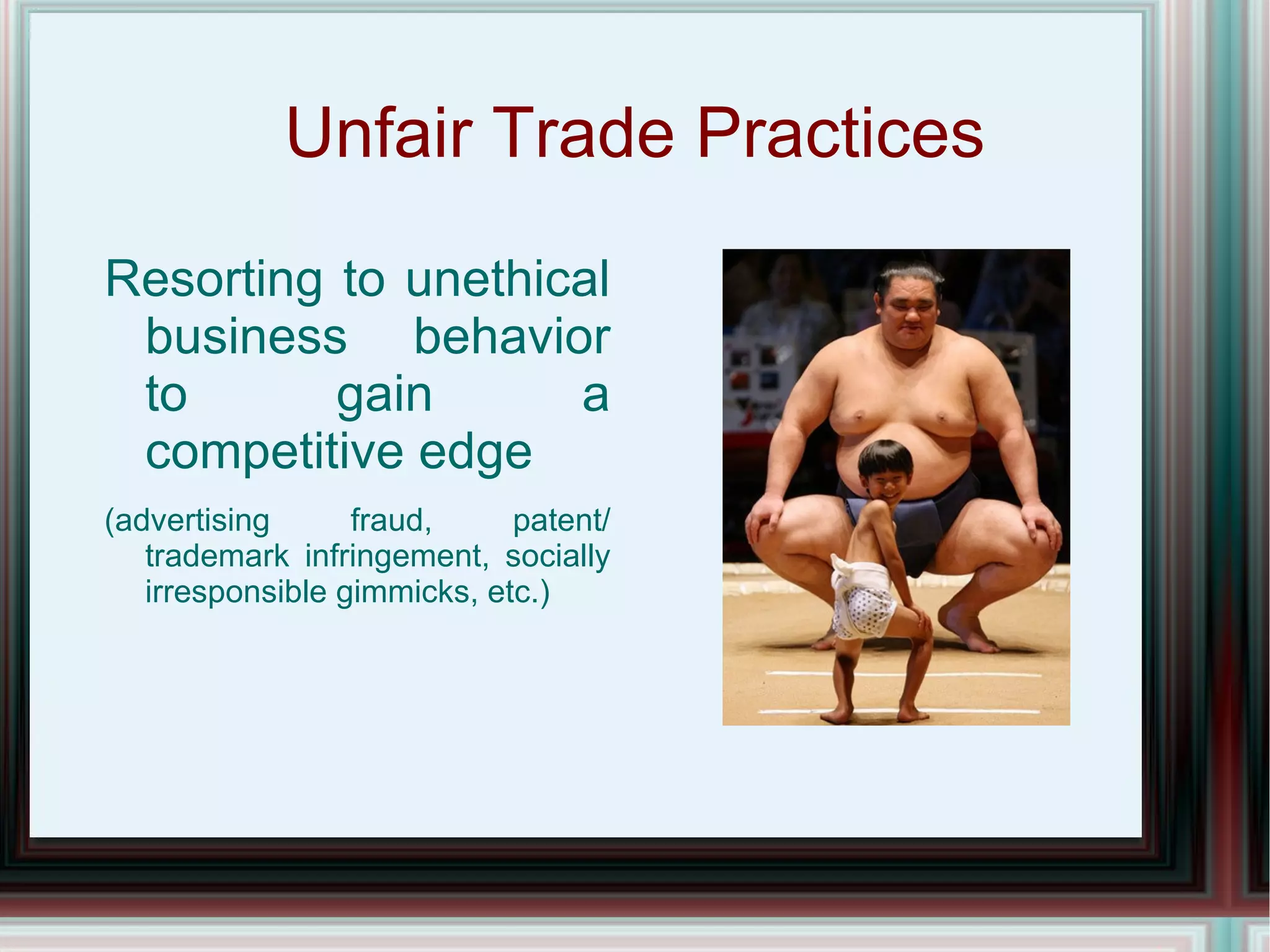
Unfair Trade Practices Resorting to unethical business behavior to gain a competitive edge  (advertising fraud, patent/ trademark infringement, socially irresponsible gimmicks, etc.)
Reasons why companies resort to Unfair Trade Practices Globalization of competition
Better informed & more discerning customers
Increasing number of competitors
Rapid advance in both soft & hard technology
Advances in scientific fields
In short, competition is getting stiffer & stiffer, Any kind of edge will count, which is why some companies resort to unethical practices.
When profit maximization becomes the sole driving force of the business that it pursues it with any means necessary. Resorting to: Fraud
Violation of human dignity
Patent/Trademark infringement
Socially irresponsible gimmicks
others When does competition become  UNFAIR ?
Anti Trust Laws Trust: or corporate monopoly was created for the purpose of eliminating competition in an area of business & of controlling the market for a product
Coverage of Anti Trust Laws Price fixing between competitors
Abuses of market power by a monopolist or dominant firm
Agreement between competitors to restrict output
Price Fixing between Competitors PRICE: often the principal way by which firms compete
Agreements on price initiatives, price ranges, price targets, collusion between competitors on floor prices are generally illegal under antitrust laws
Price Fixing between Competitors Are similarity of prices, simultaneous price changes, or high price, indications of price fixing? NO, not always Supply & Demand can cause these. Price fixing must be PROVEN. (systematic  exchanges of pricing information between competitors)
How do we determine the  “Just Price” Pricing Process: requires business to effectively calculate resources/needs, supply/demand.
Just Price: one in which both buyer & seller are given what is due them  (price a manufacturer charges its customers for G&S is total cost of investment plus normal profit)
How do we determine the  “Just Price” “ Buying & selling were instituted for the common good of both parties since each needs the product of the other... Therefore, the contract between them should rest upon equality of thing to things. The measure of a value of a thing which is exchanged should be given by its money price. Hence to sell a thing dearer or buy it cheaper than it is worth is unjust”  -St. Thomas Aquinas
How do we determine the  “Just Price” Prada
Louis Vuitton
Rolex
Rolls Royce
Q: Do these products ask for a “Just Price”?
Abusing Market Dominance Dominance: refers to a position of considerable economic power in a market held over a period of time
Abusing Market Dominance Q1: Is Being Dominant bad? Q2: Why is the law punishing companies for being too good at what they do?
Abusing Market Dominance Conduct of dominant companies that violate antitrust laws: Refusal to supply for non-objective reasons
Unfair discrimination between equivalent transactions
Non-objective refusal to grant access to essential facilities
Unfair / predatory pricing

Csr presentation

  • 1.
    Corporate Social ResponsibilityTowards the Competition By Raymund N. Sanchez
  • 2.
  • 3.
  • 4.
  • 5.
  • 6.
  • 7.
  • 8.
    CSR Overview CSRpolicy functions as a built-in, self-regulating mechanism whereby business monitors and ensures its active compliance with the spirit of the law, ethical standards, and international norms.
  • 9.
    Unfair Trade PracticesResorting to unethical business behavior to gain a competitive edge (advertising fraud, patent/ trademark infringement, socially irresponsible gimmicks, etc.)
  • 10.
    Reasons why companiesresort to Unfair Trade Practices Globalization of competition
  • 11.
    Better informed &more discerning customers
  • 12.
  • 13.
    Rapid advance inboth soft & hard technology
  • 14.
  • 15.
    In short, competitionis getting stiffer & stiffer, Any kind of edge will count, which is why some companies resort to unethical practices.
  • 16.
    When profit maximizationbecomes the sole driving force of the business that it pursues it with any means necessary. Resorting to: Fraud
  • 17.
  • 18.
  • 19.
  • 20.
    others When doescompetition become UNFAIR ?
  • 21.
    Anti Trust LawsTrust: or corporate monopoly was created for the purpose of eliminating competition in an area of business & of controlling the market for a product
  • 22.
    Coverage of AntiTrust Laws Price fixing between competitors
  • 23.
    Abuses of marketpower by a monopolist or dominant firm
  • 24.
  • 25.
    Price Fixing betweenCompetitors PRICE: often the principal way by which firms compete
  • 26.
    Agreements on priceinitiatives, price ranges, price targets, collusion between competitors on floor prices are generally illegal under antitrust laws
  • 27.
    Price Fixing betweenCompetitors Are similarity of prices, simultaneous price changes, or high price, indications of price fixing? NO, not always Supply & Demand can cause these. Price fixing must be PROVEN. (systematic exchanges of pricing information between competitors)
  • 28.
    How do wedetermine the “Just Price” Pricing Process: requires business to effectively calculate resources/needs, supply/demand.
  • 29.
    Just Price: onein which both buyer & seller are given what is due them (price a manufacturer charges its customers for G&S is total cost of investment plus normal profit)
  • 30.
    How do wedetermine the “Just Price” “ Buying & selling were instituted for the common good of both parties since each needs the product of the other... Therefore, the contract between them should rest upon equality of thing to things. The measure of a value of a thing which is exchanged should be given by its money price. Hence to sell a thing dearer or buy it cheaper than it is worth is unjust” -St. Thomas Aquinas
  • 31.
    How do wedetermine the “Just Price” Prada
  • 32.
  • 33.
  • 34.
  • 35.
    Q: Do theseproducts ask for a “Just Price”?
  • 36.
    Abusing Market DominanceDominance: refers to a position of considerable economic power in a market held over a period of time
  • 37.
    Abusing Market DominanceQ1: Is Being Dominant bad? Q2: Why is the law punishing companies for being too good at what they do?
  • 38.
    Abusing Market DominanceConduct of dominant companies that violate antitrust laws: Refusal to supply for non-objective reasons
  • 39.
    Unfair discrimination betweenequivalent transactions
  • 40.
    Non-objective refusal togrant access to essential facilities
  • 41.
  • 42.
    Engaging in practicesto raise rivals costs or foreclose competitor entry
  • 43.
  • 44.
    Case Study –Microsoft IE During the browser wars, 95% of PC were pre-loaded with Windows
  • 45.
    Microsoft's IE wasintroduced in 1995 due to being incorporated into the Windows 95 OS
  • 46.
    Market share diminishedfrom Netscape who then charged Microsoft with anti competitive behavior
  • 47.
    Oligopoly: Agreements betweencompetitors Oligopoly: agreements between competitors wherein prices can be set at highly profitable levels & restricts competition
  • 48.
    Oligopoly: Agreements betweencompetitors Why is Oligopoly wrong? 1) It is basically a monopoly 2) No competition = no benefit to the consumer -no improved product quality -no better price -no choice
  • 49.
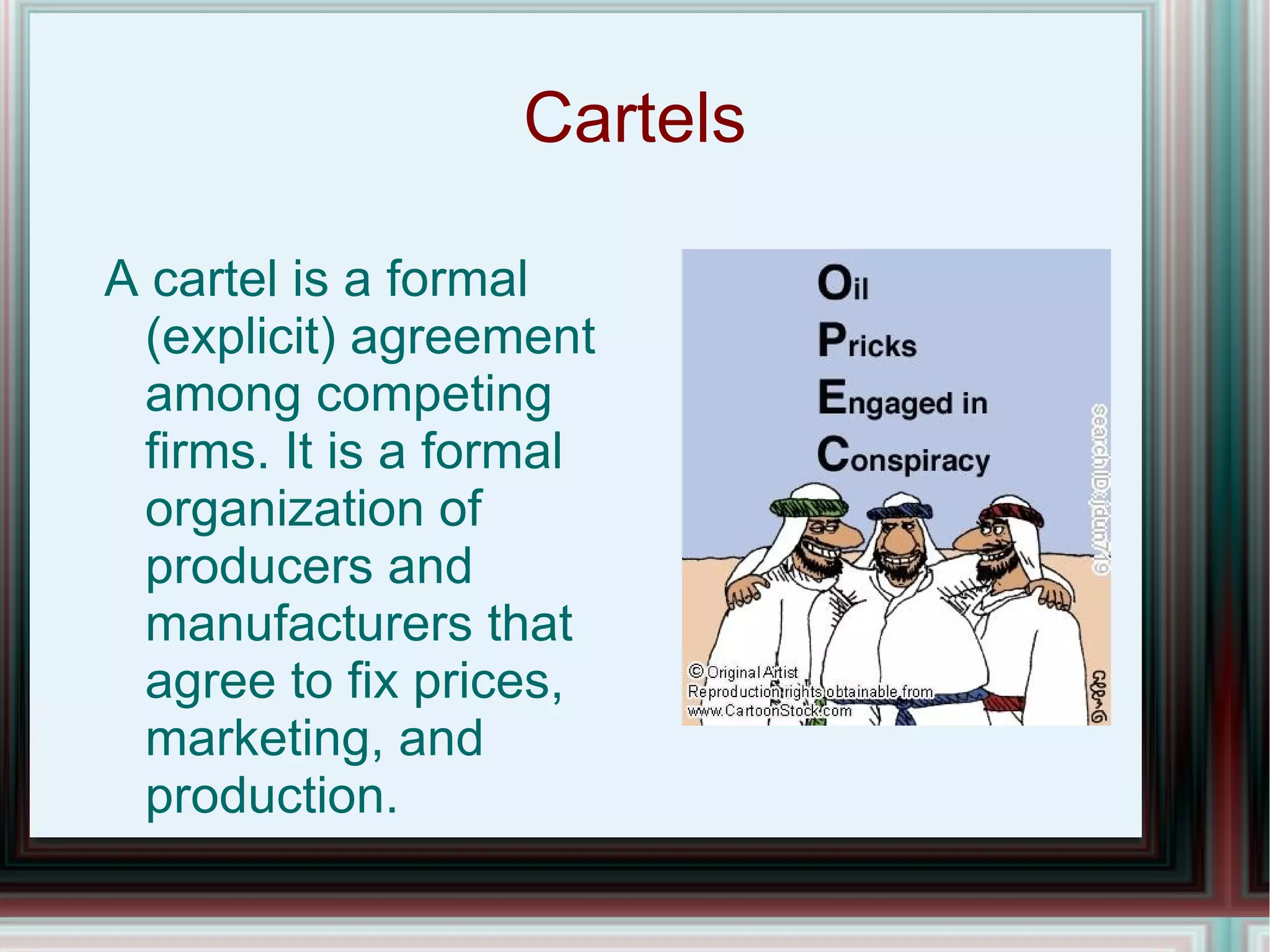
    Cartels A cartelis a formal (explicit) agreement among competing firms. It is a formal organization of producers and manufacturers that agree to fix prices, marketing, and production.
  • 50.
    Cartels Strategies ofCartels Market division & market sharing
  • 51.
  • 52.
  • 53.
  • 54.
    Cartels Market division& market sharing: conformity among competitors to divide sales territories or allocate customers (agreement not to compete)
  • 55.
    Cartels Agreements betweencompetitors to restrict output: collusion between competitors to restrict production facilities in order to drive up the price
  • 56.
    Cartels Collective boycotts: conformity between competitors not to deal with anther person or business (illegal because it twists/deforms the competitive process by foreclosing competitive opportunities for suppliers or by denying customer choice)
  • 57.
    Cartels Resale pricemaintenance agreements: agreement between a supplier & dealer that fixes the minimum resale price of a product
  • 58.
    Grey Areas Anagreement between competitors to adopt standards that require fire-resistant materials for certain products. Con: The agreement to adopt is restrictive. The manufacturers have limited their own ability to use other materials & have limited supplier choice Pro: Will benefit consumers in terms of safety Q: Is this a Cartel? Should this be illegal?
  • 59.
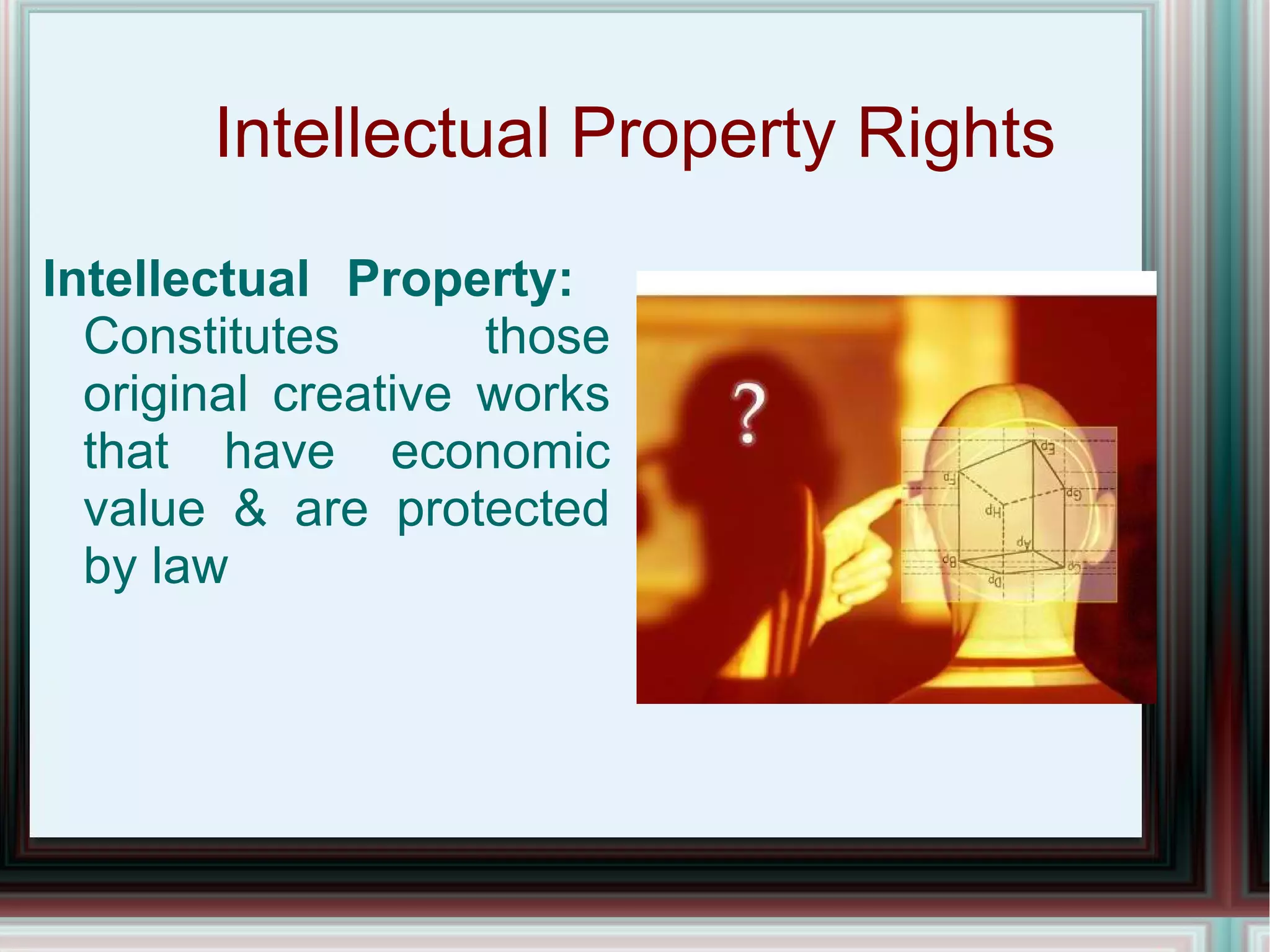
    Intellectual Property RightsIntellectual Property: Constitutes those original creative works that have economic value & are protected by law
  • 60.
    Reasons for Intellectual Property Rights They reward the creators of original works by preventing others from copying, performing or distributing those works without permission
  • 61.
    They provide incentivesfor people to produce scientific & creative works that benefit society at large
  • 62.
    Intellectual Property RightsPatent law: protects inventions that demonstrate technological progress
  • 63.
    Intellectual Property RightsCopyright law: protects a variety of literary & artistic works, including paintings sculpture, prose, poetry, plays, musical competitions, dances, photographs, motion pictures, radio, TV, computer programs
  • 64.
    Intellectual Property RightsTrademark law: protects words & symbols that serve to identify different brands of G&S in the marketplace
  • 65.
    Intellectual Property RightsQ: By assigning exclusive rights to an idea/thing, doesn't it make IPR anti-competitive? A: Trick Question. IPR has an expiration date.
  • 66.
    Intellectual Property RightsBy giving IPR a termination date, it allows society to benefit from the idea/thing after the inventor has had an opportunity to earn a good/fair/reasonable reward. Note: trademarks never expire
  • 67.
    Intellectual Property RightsCounterfeiting: a criminal offense of making an imitation of an article with intent to defraud others into accepting it as a genuine item
  • 68.
    Intellectual Property RightsIs piracy truly a 'Victimless' Crime? No! 1) Creators are robbed of income supposed to be for them 2) Consumers receive defective products
  • 69.
    Intellectual Property RightsReverse Engineering: process of analyzing & copying products off the competitor, sufficient to replicate the parts using appropriate fabrication techniques & coming out with new products in the company's own version
  • 70.
    Intellectual Property RightsHow do we protect IPR? Government implementation
  • 71.
  • 72.
  • 73.
    References Corporate SocialResponsibility, Basic Principles & Best Practices by Jose Mario B. Maximo
  • 74.
    Multinationals & CorporateSocial Responsibility by Jennifer A Zerk
  • 75.