Otogenic sigmoid sinus
thrombosis
current practice
Nassr Saif ALBarhi
ENT Resident
Outline
 Introduction.
 Epidemiology.
 Etiology.
 Presentation.
 Management.
 References.
Introduction
 Sigmoid sinus thrombosis is a rare condition, usually caused by:
 Thrombophilia.
 Head injuries.
 Intravenous (IV) drug use.
 Mainly by infections.
 When the etiology is infectious, it is called sigmoid sinus septic thrombosis (SSST)
 Acute or chronic otitis media are the most common causes of this condition
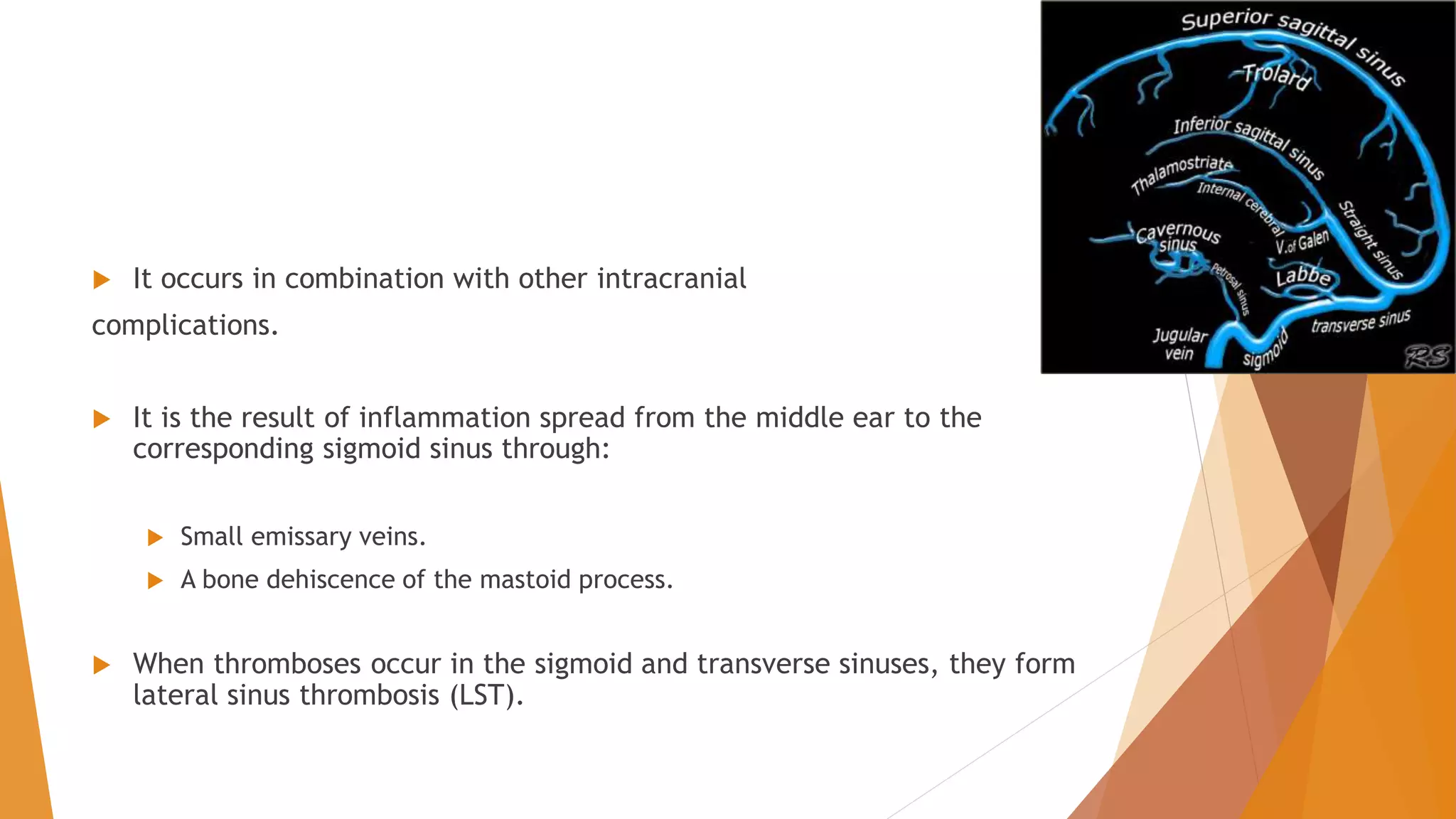
 It occurs in combination with other intracranial
complications.
 It is the result of inflammation spread from the middle ear to the
corresponding sigmoid sinus through:
 Small emissary veins.
 A bone dehiscence of the mastoid process.
 When thromboses occur in the sigmoid and transverse sinuses, they form
lateral sinus thrombosis (LST).
Epidemiology
 Before the age of antibiotics, LST was ranked second to meningitis as the most frequent
fatal complication of otitis media.
 The mortality rates for LST in the modern era are lower, but still range from 5 to 10%.
 It is less often a disease of children in association with acute otitis media.
 More often, it is seen in the adult patient after a long history of chronic ear disease.
Etiology
 Common pathogens responsible for this condition are:
 Staphylococcus aureus.
 β-haemolytic Streptococcus
 A retrospective study by Schneider et al suggested that pediatric patients with
otogenic lateral sinus thrombosis may have an underlying thrombophilic condition.
 The investigators found that 37 individuals in the study (43%) demonstrated evidence of
thrombophilia.
Pathophysiology
 Infection from the mastoid air cell system reaches the perisinus area,
resulting in perisinus abscess, which then spreads to the dura and
intimal layer of the sinuses, causing mural thrombus.
 Unless effective treatment is promptly started, the mural thrombus
grows and necrotizes, forming an intramural abscess.
 The mural thrombus within the lumen of the sinus propagates
proximally to other cerebral venous sinuses, and extends caudally to
the internal jugular and subclavian veins.
 Embolization of the propagating infected thrombus into the systemic
circulation causes septicemia.
 Early diagnosis and rapid treatment are crucial to improving the prognosis of this
potentially lethal disease.
 The diagnosis is based on clinical manifestations and confirmed by imaging.
 Due to the decreased incidence and change in presentation of this complication, a high
level of suspicion is required in order to make a diagnosis.
Presentations
 Clinical features vary according to the stage of the disease.
 Lateral sinus thrombosis should be suspected in patients who have
persistent:
 Fever, otorrhea, headache and postauricular edema despite
adequate antibiotic treatment.
 A picket fence fever curve, due to the periodic release of hemolytic
streptococci from the septic sinus thrombus
 With the occlusion of the lumen of the sinus, an interruption of the cortical venous
circulation results in headache, papilledema, and increased intracranial pressure.
 Tenderness and edema over the mastoid (the Griesinger sign) are highly suggestive of
lateral sinus thrombosis and reflex thrombosis of mastoid emissary vein.
 With the extension of thrombophlebitis into the jugular bulb and
internal jugular vein, pain may be present in the neck, particularly on
rotation.
Work-up
 Culture and sensitivity of purulent material
 CBC count and differential count
 Blood culture
Imaging Studies
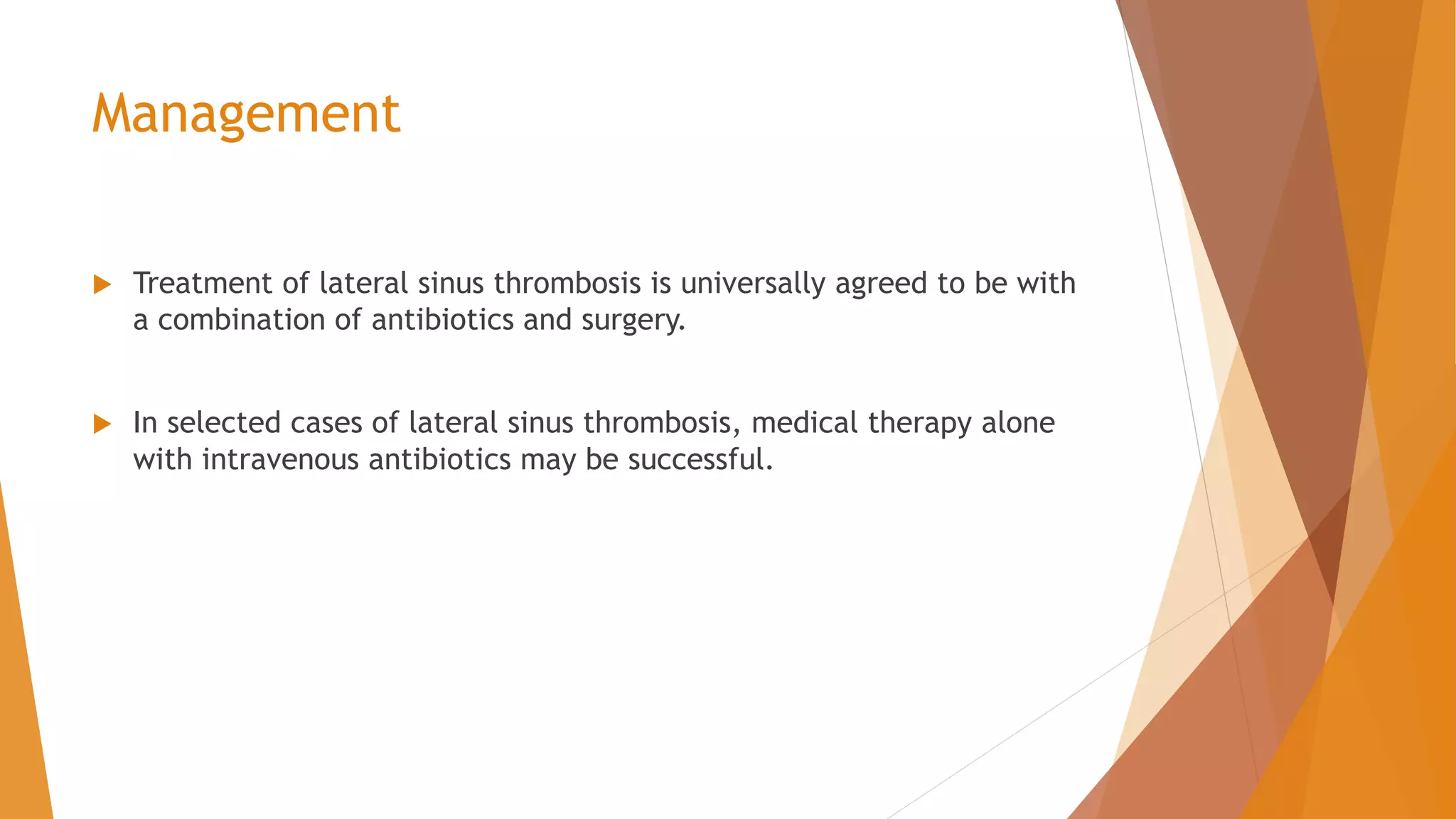
 CT is particularly important for demonstrating pathology in the mastoid and cranial cavity
and excluding existing intracranial complication.
 CT scanning with contrast can demonstrate a filling defect in thrombosed sinus and
ring enhancement or the “delta sign” around the thrombosed sigmoid sinus.
 MRI is more sensitive than CT scanning in detecting the thrombus.
 It shows blood flow, sinus obstruction, and the subsequent reversal of flow.
Management
 Treatment of lateral sinus thrombosis is universally agreed to be with
a combination of antibiotics and surgery.
 In selected cases of lateral sinus thrombosis, medical therapy alone
with intravenous antibiotics may be successful.
 A literature review by Au et al of 104 pediatric patients
with lateral sinus thrombosis (using case reports from
1993-2011) found the prevalence of various management
strategies to be as follows :
 Broad-spectrum antibiotics (100%)
 Mastoidectomy (94%)
 Anticoagulation (57%)
 Manipulation of the thrombosed sinus (50%)
 Regarding the use of thrombolitic agents, there is much controversy. Some
authors advocate their use routinely1,6,8,9 and others do not believe they
would be efficient.5,7,10 Even among the authors who advocate their routine
use, there is an understanding that the ideal anticoagulation therapeutic
level is not reached for most of the patients treated with heparin.1 Now, the
sigmoid sinus recanalization may occur even without the use of oral
anticoagulants
Roles of using anticoagulant therapy
 Regarding the use of thrombolitic agents, there is much controversy.
 Some authors advocate their use routinely and others do not believe they
would be efficient.
 Most authors agree that anticoagulants have no place in the
management of lateral sinus thrombosis.
 Anticoagulants have been advocated to prevent extension of the
thrombus to the distal sinuses.
 However, they are rarely used now, because most infections can be
controlled with antibiotics and surgery, and this tends to prevent the
thrombus from propagating.
 The risks of anticoagulation include releasing septic emboli from clot
breakdown and uncontrollable hemorrhage at the bleeding site.
 Anticoagulants arrest the spread of thrombosis but may increase the
risk of venous infarctions and are therefore no longer used.
 Systemic anticoagulation is not necessary unless the clot is shown to
involve the sagittal sinus, or signs of increased intracranial pressure
persist despite medical management.
 This review represents the largest summary of the available pre-2015
otolaryngology literature and includes 190 cases of pediatric otogenic
cerebral venous thrombosis.
 Conclusions were based on 15 case studies and 21 case series.
 Of these, 92.1% of patients underwent surgery and 59% received
anticoagulation.
 Follow-up ranged from 4 days to 3 years.
 Of the 111 cases with known follow-up, 51% had complete recanalization,
30% had partial recanalization, and 15% had persistent thrombus.
 Interestingly, among those who were confirmed as having been
anticoagulated and had follow-up imaging (n 47), complete
recanalization was 47%; partial recanalization was 36%; and persistent
thrombus was 17%.
 This compared to 55%, 27%, and 18%, respectively, in those confirmed
as having had follow-up imaging but who were not anticoagulated (n
11).
 Statistical significance testing was not undertaken.
 Eight of 111 anticoagulated cases were complicated by
bleeding:
 1 incisional bleeding,
 1 epistaxis,
 6 postoperative hematomas.
 In a large prospective study, Ichord et al. reported on 170 pediatric
cases from a multicenter pediatric registry.
 Forty-one percent had acute head and neck infections, including
mastoiditis.
 Although this is a mixed population, it is useful to draw conclusions
from the safety and efficacy of anticoagulation (83% of patients were
anticoagulated).
 Overall, discharge neurological state was normal in 48%, abnormal in
43%, and unknown in 5%.
 Mortality occurred in 4%, of whom 50% received antithrombotic
treatment.
 Prothombotic risk factors were present in 20%.
 There was an association between risk of death and not being
anticoagulated in this mixed series
 A Cochrane review by Coutinho in 2011 addressed SST in adults and
identified two trials comparing heparin versus placebo in the
management of cerebral venous thrombosis (although not exclusively
otogenic).
 Whereas their analysis did not reach statistical significance, their data
did demonstrate a trend toward a reduction in risk of death or
dependency with anticoagulation compared to placebo.
Surgical Therapy
 The management of lateral sinus thrombosis includes the combination
therapy of appropriate antibiotics and surgeries.
 A mastoidectomy with the removal of the infected clot and thrombus
in the lateral sinus is considered the standard surgical care.
 Cortical mastoidectomy is sufficient for non cholesteatomatous ear
disease.
 It allows the drainage of the initiating infection and confirms the
diagnosis of lateral sinus thrombosis.
 Perisinus disease can be found despite a normal-appearing sinus plate.
 Current recommendations state that the removal of the sinus plate
that overlays the sinus should always be performed.
 Most cases are due to attico antral type of ear disease.
 Cholesteatoma is a persistent source of infection and is unresponsive
to antibiotics.
 The early removal of this source of infection:
 Reduces the possibility of further intracranial extension.
 Shortens the duration of illness.
 Provides definitive treatment.
 Canal wall down mastoidectomy has been used
successfully in the treatment of cholesteatomatous ears
with lateral sinus thrombosis.
 Although an appropriate management of the thrombus in the sinus is
not certain, most authors propose needling of the lateral sinus before
incision in order to confirm the diagnosis.
 No further intervention is required, if free blood is aspirated.
 If blood is not returned, the diagnosis can be confirmed with incision
on the sinus and evacuation of the clot, and obtaining free bleeding
from the sinus is unnecessary.
 Recent reports have shown that if the surrounding granulation tissue
and inflammation are removed through a mastoidectomy, the sinus
will recannalize without clot evacuation.
 Jun et al are of the opinion that the organized thrombus is an initial
step for spontaneous resolution, finally inducing recanalization of a
sinus.
 Internal jugular vein ligation may possibly isolate the cause of
infection and prevent embolization, thus increasing the cure rates of
lateral sinus thrombosis.
 But internal jugular vein ligation may not eliminate septic
complications because of collateral veins and may predispose the
patient to retrograde-intracranial septic complications and add
surgical risks of additional cervical dissections.
 Internal jugular vein ligation should be reserved for those cases in
which septicemia and embolization do not respond to initial surgery
and antibiotic treatment.
 Recently, several studies showed the possibility of conservative
managements with limited indications for the internal jugular vein
ligation.
 A study by Ryan et al of seven pediatric patients with otogenic lateral
sinus thrombosis indicated that the condition can be successfully
treated with aggressive management of the mastoid cavity, with no
thrombectomy required.
 All of the study’s patients achieved good recovery without major
sequelae after undergoing treatment with intravenous antibiotics and
mastoidectomy, with the sigmoid sinus unroofed and a tympanostomy
tube placed.
 None of the children underwent sinus exploration with thrombectomy.
 Five of the patients were treated with perioperative anticoagulation
without complication.
References
 Kangsanarak J, Fooanant S, Ruckphaopunt K, Navacharoen N,
Teotrakul S. Extracranial and intracranial complications of suppurative
otitis media. Report of 102 cases. J Laryngol Otol 1993; 107(11):999–
1004.
 Garcia RD, Baker AS, Cunningham MJ, Weber AL. Lateral sinus
thrombosis associated with otitis media and mastoiditis in children.
Pediatr Infect Dis J 1995;14(07):617–623.
 https://emedicine.medscape.com/article/1048625-overview#a8
 https://reference.medscape.com/medline/abstract/23177380
 Manolidis S, Kutz JW Jr. Diagnosis and management of lateral sinus
thrombosis. Otol Neurotol. 2005 Sep. 26(5):1045-51.
 Ryan JT, Pena M, Zalzal GH, Preciado DA. Otogenic lateral sinus
thrombosis in children: a review of 7 cases. Ear Nose Throat J. 2016 Mar.
95 (3):108-12.
 Holzmann D, Huisman TAGM, Linder TE Lateral dural sinus thrombosis in
childhood. Laryngoscope 1999;109:645-51.
 Agarwal A, Lowry P, Isaacson G. Natural history of sigmoid sinus
thrombosis. Ann Otol Rhinol Laryngol 2003;112:191-4.
Thank you

CSOM with sigmoid sinus thrombosis-curren practise.pdf

  • 1.
    Otogenic sigmoid sinus thrombosis currentpractice Nassr Saif ALBarhi ENT Resident
  • 2.
    Outline  Introduction.  Epidemiology. Etiology.  Presentation.  Management.  References.
  • 3.
    Introduction  Sigmoid sinusthrombosis is a rare condition, usually caused by:  Thrombophilia.  Head injuries.  Intravenous (IV) drug use.  Mainly by infections.  When the etiology is infectious, it is called sigmoid sinus septic thrombosis (SSST)  Acute or chronic otitis media are the most common causes of this condition
  • 4.
     It occursin combination with other intracranial complications.  It is the result of inflammation spread from the middle ear to the corresponding sigmoid sinus through:  Small emissary veins.  A bone dehiscence of the mastoid process.  When thromboses occur in the sigmoid and transverse sinuses, they form lateral sinus thrombosis (LST).
  • 5.
    Epidemiology  Before theage of antibiotics, LST was ranked second to meningitis as the most frequent fatal complication of otitis media.  The mortality rates for LST in the modern era are lower, but still range from 5 to 10%.  It is less often a disease of children in association with acute otitis media.  More often, it is seen in the adult patient after a long history of chronic ear disease.
  • 6.
    Etiology  Common pathogensresponsible for this condition are:  Staphylococcus aureus.  β-haemolytic Streptococcus  A retrospective study by Schneider et al suggested that pediatric patients with otogenic lateral sinus thrombosis may have an underlying thrombophilic condition.  The investigators found that 37 individuals in the study (43%) demonstrated evidence of thrombophilia.
  • 7.
    Pathophysiology  Infection fromthe mastoid air cell system reaches the perisinus area, resulting in perisinus abscess, which then spreads to the dura and intimal layer of the sinuses, causing mural thrombus.  Unless effective treatment is promptly started, the mural thrombus grows and necrotizes, forming an intramural abscess.
  • 8.
     The muralthrombus within the lumen of the sinus propagates proximally to other cerebral venous sinuses, and extends caudally to the internal jugular and subclavian veins.  Embolization of the propagating infected thrombus into the systemic circulation causes septicemia.
  • 9.
     Early diagnosisand rapid treatment are crucial to improving the prognosis of this potentially lethal disease.  The diagnosis is based on clinical manifestations and confirmed by imaging.  Due to the decreased incidence and change in presentation of this complication, a high level of suspicion is required in order to make a diagnosis.
  • 10.
    Presentations  Clinical featuresvary according to the stage of the disease.  Lateral sinus thrombosis should be suspected in patients who have persistent:  Fever, otorrhea, headache and postauricular edema despite adequate antibiotic treatment.  A picket fence fever curve, due to the periodic release of hemolytic streptococci from the septic sinus thrombus
  • 11.
     With theocclusion of the lumen of the sinus, an interruption of the cortical venous circulation results in headache, papilledema, and increased intracranial pressure.  Tenderness and edema over the mastoid (the Griesinger sign) are highly suggestive of lateral sinus thrombosis and reflex thrombosis of mastoid emissary vein.
  • 12.
     With theextension of thrombophlebitis into the jugular bulb and internal jugular vein, pain may be present in the neck, particularly on rotation.
  • 13.
    Work-up  Culture andsensitivity of purulent material  CBC count and differential count  Blood culture
  • 14.
    Imaging Studies  CTis particularly important for demonstrating pathology in the mastoid and cranial cavity and excluding existing intracranial complication.  CT scanning with contrast can demonstrate a filling defect in thrombosed sinus and ring enhancement or the “delta sign” around the thrombosed sigmoid sinus.  MRI is more sensitive than CT scanning in detecting the thrombus.  It shows blood flow, sinus obstruction, and the subsequent reversal of flow.
  • 16.
    Management  Treatment oflateral sinus thrombosis is universally agreed to be with a combination of antibiotics and surgery.  In selected cases of lateral sinus thrombosis, medical therapy alone with intravenous antibiotics may be successful.
  • 17.
     A literaturereview by Au et al of 104 pediatric patients with lateral sinus thrombosis (using case reports from 1993-2011) found the prevalence of various management strategies to be as follows :  Broad-spectrum antibiotics (100%)  Mastoidectomy (94%)  Anticoagulation (57%)  Manipulation of the thrombosed sinus (50%)
  • 18.
     Regarding theuse of thrombolitic agents, there is much controversy. Some authors advocate their use routinely1,6,8,9 and others do not believe they would be efficient.5,7,10 Even among the authors who advocate their routine use, there is an understanding that the ideal anticoagulation therapeutic level is not reached for most of the patients treated with heparin.1 Now, the sigmoid sinus recanalization may occur even without the use of oral anticoagulants
  • 19.
    Roles of usinganticoagulant therapy  Regarding the use of thrombolitic agents, there is much controversy.  Some authors advocate their use routinely and others do not believe they would be efficient.  Most authors agree that anticoagulants have no place in the management of lateral sinus thrombosis.  Anticoagulants have been advocated to prevent extension of the thrombus to the distal sinuses.  However, they are rarely used now, because most infections can be controlled with antibiotics and surgery, and this tends to prevent the thrombus from propagating.
  • 20.
     The risksof anticoagulation include releasing septic emboli from clot breakdown and uncontrollable hemorrhage at the bleeding site.  Anticoagulants arrest the spread of thrombosis but may increase the risk of venous infarctions and are therefore no longer used.  Systemic anticoagulation is not necessary unless the clot is shown to involve the sagittal sinus, or signs of increased intracranial pressure persist despite medical management.
  • 21.
     This reviewrepresents the largest summary of the available pre-2015 otolaryngology literature and includes 190 cases of pediatric otogenic cerebral venous thrombosis.  Conclusions were based on 15 case studies and 21 case series.  Of these, 92.1% of patients underwent surgery and 59% received anticoagulation.
  • 22.
     Follow-up rangedfrom 4 days to 3 years.  Of the 111 cases with known follow-up, 51% had complete recanalization, 30% had partial recanalization, and 15% had persistent thrombus.  Interestingly, among those who were confirmed as having been anticoagulated and had follow-up imaging (n 47), complete recanalization was 47%; partial recanalization was 36%; and persistent thrombus was 17%.  This compared to 55%, 27%, and 18%, respectively, in those confirmed as having had follow-up imaging but who were not anticoagulated (n 11).
  • 23.
     Statistical significancetesting was not undertaken.  Eight of 111 anticoagulated cases were complicated by bleeding:  1 incisional bleeding,  1 epistaxis,  6 postoperative hematomas.
  • 24.
     In alarge prospective study, Ichord et al. reported on 170 pediatric cases from a multicenter pediatric registry.  Forty-one percent had acute head and neck infections, including mastoiditis.  Although this is a mixed population, it is useful to draw conclusions from the safety and efficacy of anticoagulation (83% of patients were anticoagulated).
  • 25.
     Overall, dischargeneurological state was normal in 48%, abnormal in 43%, and unknown in 5%.  Mortality occurred in 4%, of whom 50% received antithrombotic treatment.  Prothombotic risk factors were present in 20%.  There was an association between risk of death and not being anticoagulated in this mixed series
  • 26.
     A Cochranereview by Coutinho in 2011 addressed SST in adults and identified two trials comparing heparin versus placebo in the management of cerebral venous thrombosis (although not exclusively otogenic).  Whereas their analysis did not reach statistical significance, their data did demonstrate a trend toward a reduction in risk of death or dependency with anticoagulation compared to placebo.
  • 27.
    Surgical Therapy  Themanagement of lateral sinus thrombosis includes the combination therapy of appropriate antibiotics and surgeries.  A mastoidectomy with the removal of the infected clot and thrombus in the lateral sinus is considered the standard surgical care.  Cortical mastoidectomy is sufficient for non cholesteatomatous ear disease.  It allows the drainage of the initiating infection and confirms the diagnosis of lateral sinus thrombosis.
  • 28.
     Perisinus diseasecan be found despite a normal-appearing sinus plate.  Current recommendations state that the removal of the sinus plate that overlays the sinus should always be performed.  Most cases are due to attico antral type of ear disease.  Cholesteatoma is a persistent source of infection and is unresponsive to antibiotics.
  • 29.
     The earlyremoval of this source of infection:  Reduces the possibility of further intracranial extension.  Shortens the duration of illness.  Provides definitive treatment.  Canal wall down mastoidectomy has been used successfully in the treatment of cholesteatomatous ears with lateral sinus thrombosis.
  • 30.
     Although anappropriate management of the thrombus in the sinus is not certain, most authors propose needling of the lateral sinus before incision in order to confirm the diagnosis.  No further intervention is required, if free blood is aspirated.  If blood is not returned, the diagnosis can be confirmed with incision on the sinus and evacuation of the clot, and obtaining free bleeding from the sinus is unnecessary.
  • 31.
     Recent reportshave shown that if the surrounding granulation tissue and inflammation are removed through a mastoidectomy, the sinus will recannalize without clot evacuation.  Jun et al are of the opinion that the organized thrombus is an initial step for spontaneous resolution, finally inducing recanalization of a sinus.
  • 32.
     Internal jugularvein ligation may possibly isolate the cause of infection and prevent embolization, thus increasing the cure rates of lateral sinus thrombosis.  But internal jugular vein ligation may not eliminate septic complications because of collateral veins and may predispose the patient to retrograde-intracranial septic complications and add surgical risks of additional cervical dissections.
  • 33.
     Internal jugularvein ligation should be reserved for those cases in which septicemia and embolization do not respond to initial surgery and antibiotic treatment.  Recently, several studies showed the possibility of conservative managements with limited indications for the internal jugular vein ligation.
  • 34.
     A studyby Ryan et al of seven pediatric patients with otogenic lateral sinus thrombosis indicated that the condition can be successfully treated with aggressive management of the mastoid cavity, with no thrombectomy required.  All of the study’s patients achieved good recovery without major sequelae after undergoing treatment with intravenous antibiotics and mastoidectomy, with the sigmoid sinus unroofed and a tympanostomy tube placed.
  • 35.
     None ofthe children underwent sinus exploration with thrombectomy.  Five of the patients were treated with perioperative anticoagulation without complication.
  • 36.
    References  Kangsanarak J,Fooanant S, Ruckphaopunt K, Navacharoen N, Teotrakul S. Extracranial and intracranial complications of suppurative otitis media. Report of 102 cases. J Laryngol Otol 1993; 107(11):999– 1004.  Garcia RD, Baker AS, Cunningham MJ, Weber AL. Lateral sinus thrombosis associated with otitis media and mastoiditis in children. Pediatr Infect Dis J 1995;14(07):617–623.  https://emedicine.medscape.com/article/1048625-overview#a8  https://reference.medscape.com/medline/abstract/23177380
  • 37.
     Manolidis S,Kutz JW Jr. Diagnosis and management of lateral sinus thrombosis. Otol Neurotol. 2005 Sep. 26(5):1045-51.  Ryan JT, Pena M, Zalzal GH, Preciado DA. Otogenic lateral sinus thrombosis in children: a review of 7 cases. Ear Nose Throat J. 2016 Mar. 95 (3):108-12.  Holzmann D, Huisman TAGM, Linder TE Lateral dural sinus thrombosis in childhood. Laryngoscope 1999;109:645-51.  Agarwal A, Lowry P, Isaacson G. Natural history of sigmoid sinus thrombosis. Ann Otol Rhinol Laryngol 2003;112:191-4.
  • 38.