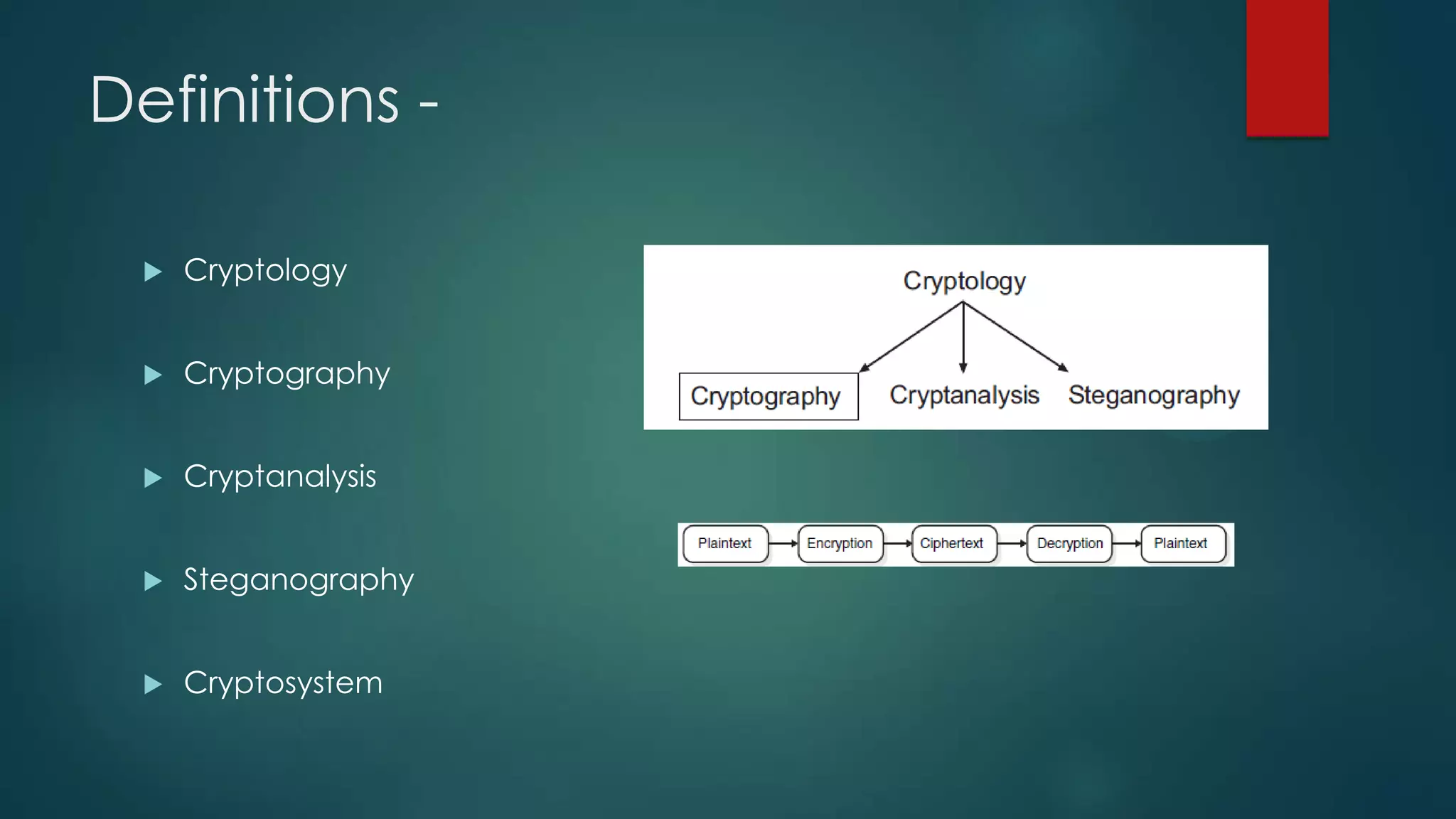
This document provides an overview of cryptography. It begins with basic definitions related to cryptography and a brief history of its use from ancient times to modern ciphers. It then describes different types of ciphers like stream ciphers, block ciphers, and public key cryptosystems. It also covers cryptography methods like symmetric and asymmetric algorithms. Common types of attacks on cryptosystems like brute force, chosen ciphertext, and frequency analysis are also discussed.
Cryptography is everywhere
Secure communication:
–web traffic: HTTPS
–wireless traffic: 802.11i WPA2 (and WEP), GSM, Bluetooth
Encrypting files on disk: EFS, TrueCrypt
Content protection (e.g. DVD, Blu-ray): CSS, AACS
User authentication
… and much much more
6.
History of Cryptography
The first known evidence of the use of cryptography (in some form)
was found in an inscription carved around 1900 BC, in the main
chamber of the tomb of the nobleman Khnumhotep II, in Egypt.
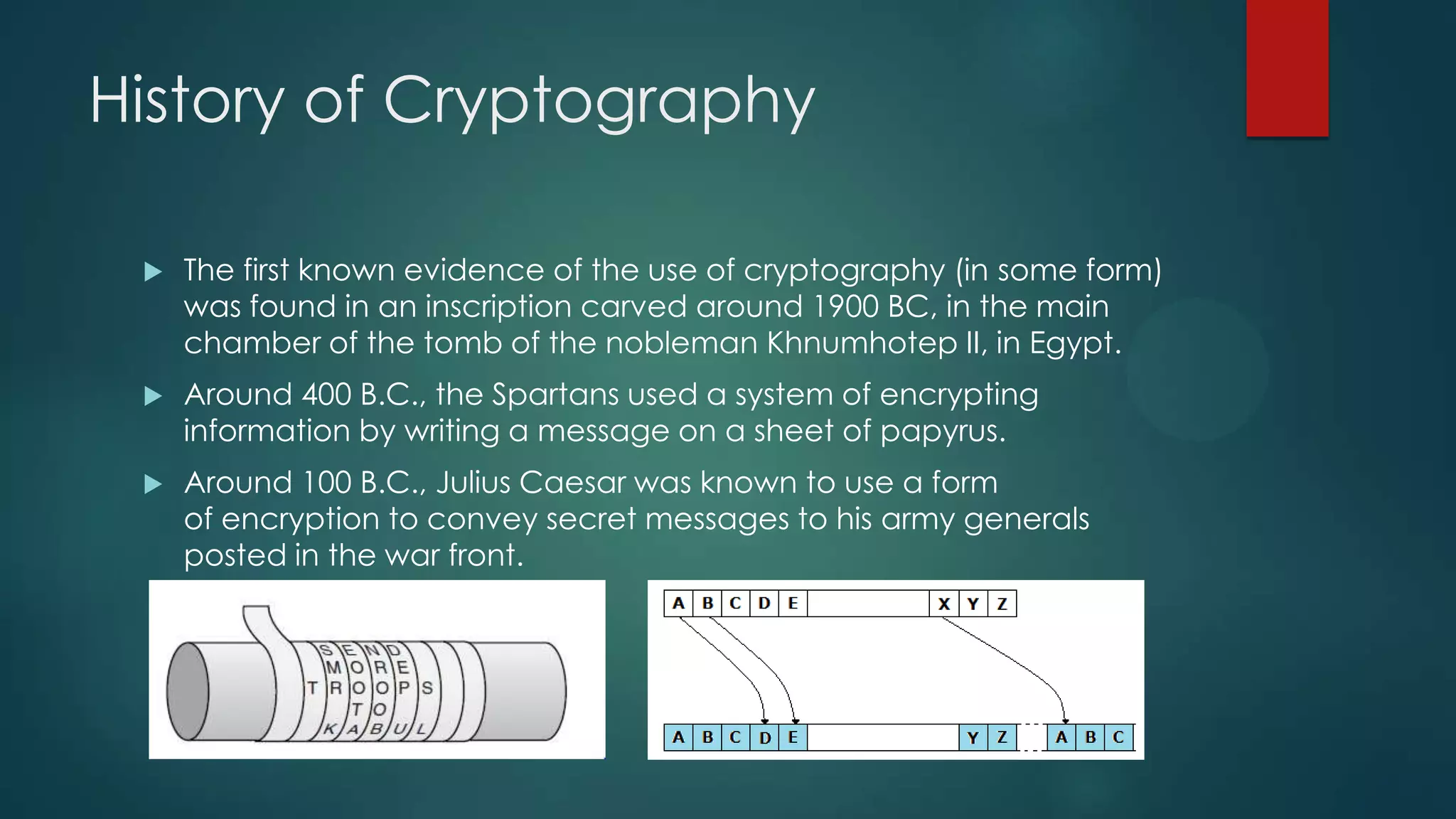
Around 400 B.C., the Spartans used a system of encrypting
information by writing a message on a sheet of papyrus.
Around 100 B.C., Julius Caesar was known to use a form
of encryption to convey secret messages to his army generals
posted in the war front.
7.
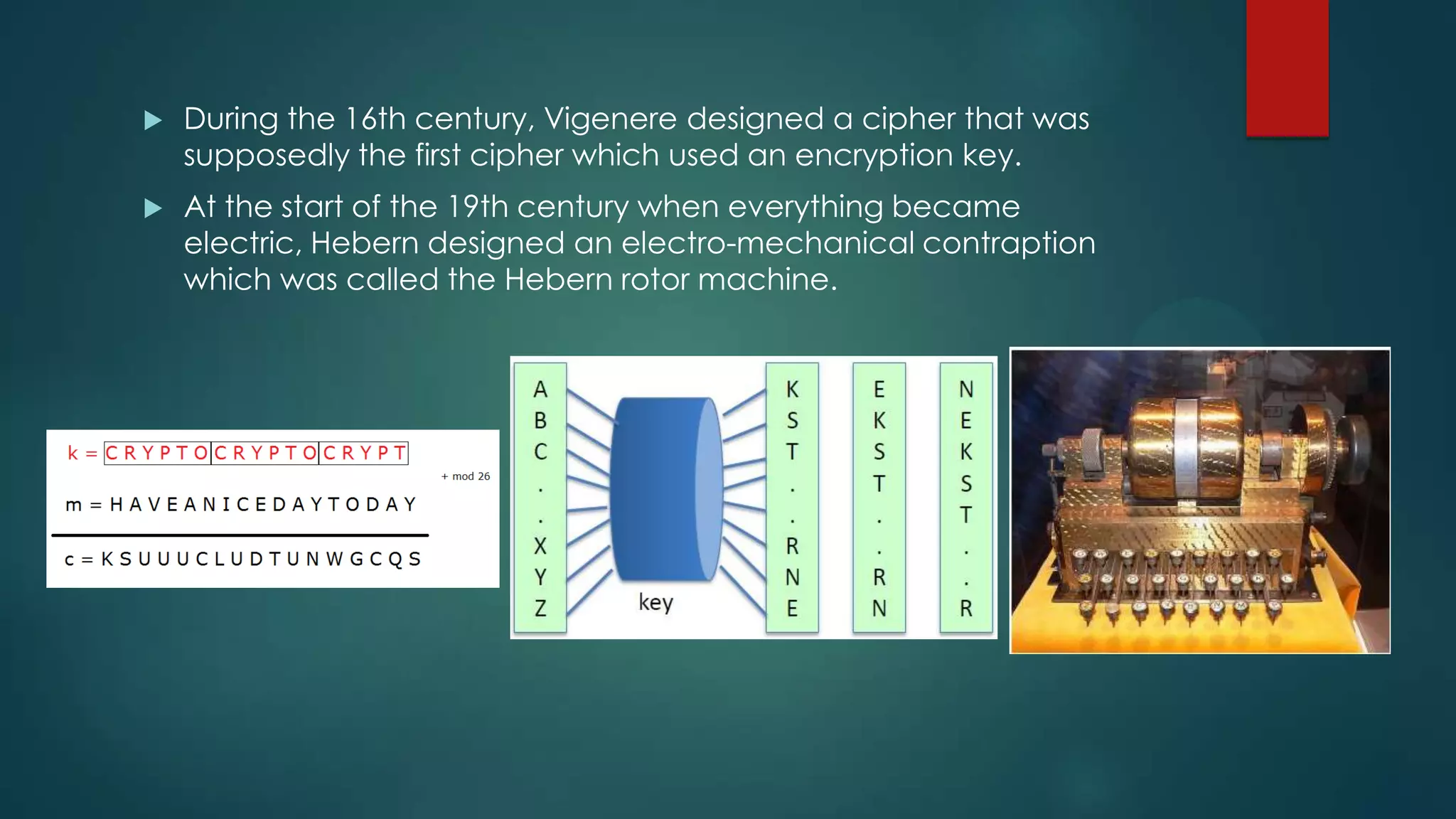
During the16th century, Vigenere designed a cipher that was
supposedly the first cipher which used an encryption key.
At the start of the 19th century when everything became
electric, Hebern designed an electro-mechanical contraption
which was called the Hebern rotor machine.
8.
The Engimamachine was invented by German engineer Arthur
Scherbius at the end of World War I, and was heavily used by the
German forces during the Second World War.
9.
IBM inearly 1970s designed a cipher called Lucifer. Lucifer was
eventually accepted by NIST and was called DES or the Data
Encryption Standard.
In 2000, NIST accepted Rijndael, and named it as AES or the
Advanced Encryption Standard.
10.
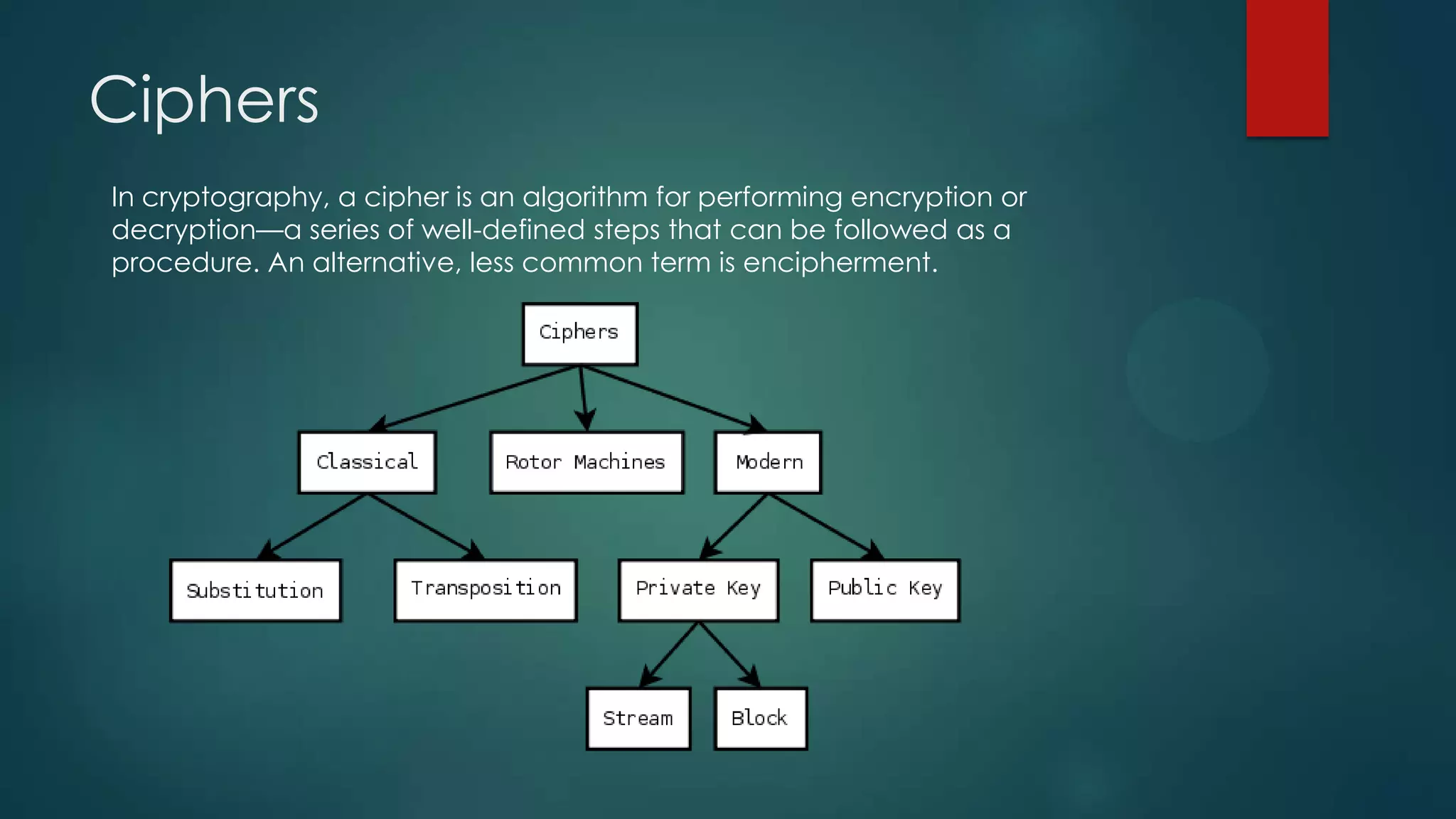
Ciphers
In cryptography, acipher is an algorithm for performing encryption or
decryption—a series of well-defined steps that can be followed as a
procedure. An alternative, less common term is encipherment.
Stream cipher
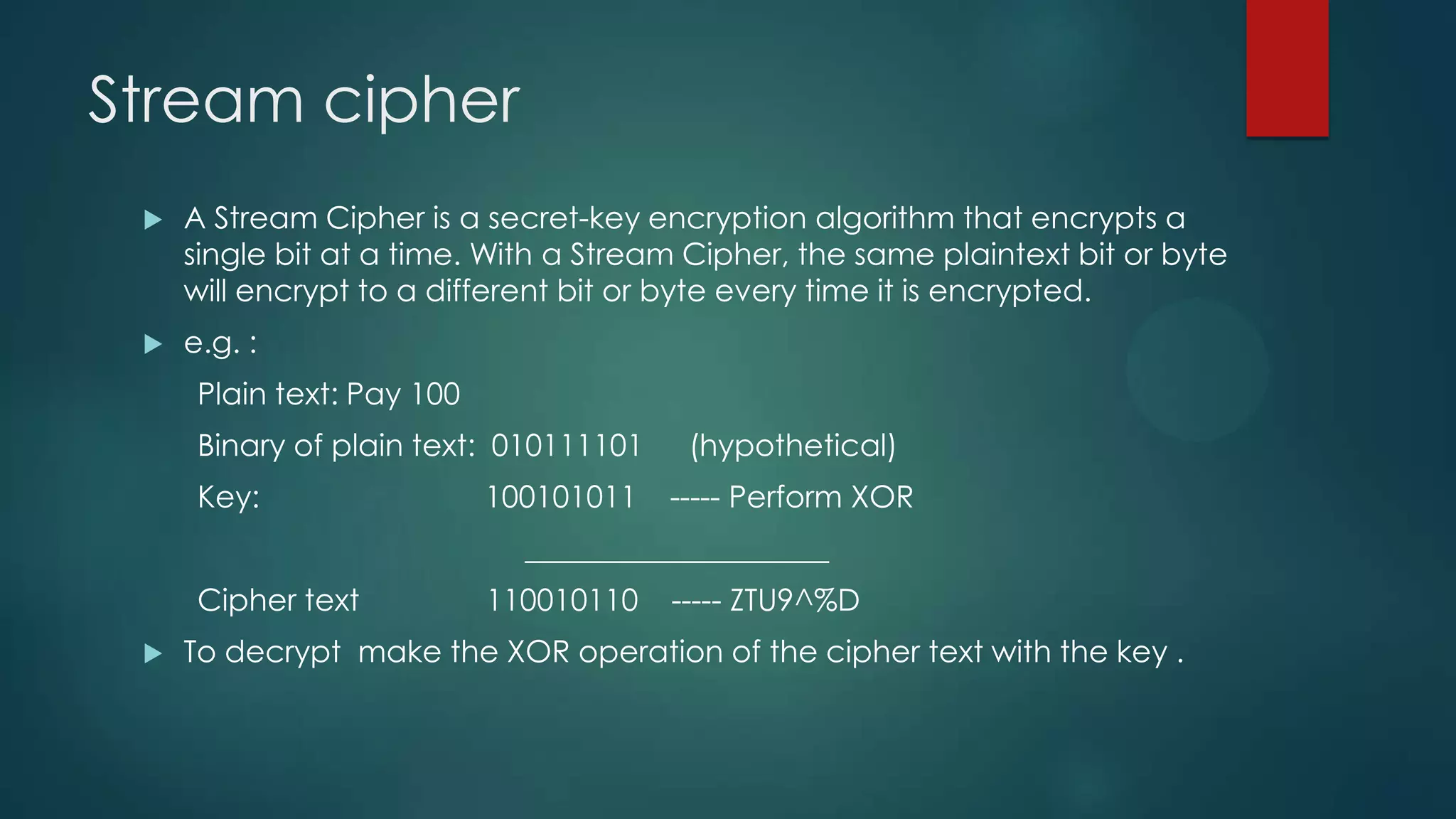
AStream Cipher is a secret-key encryption algorithm that encrypts a
single bit at a time. With a Stream Cipher, the same plaintext bit or byte
will encrypt to a different bit or byte every time it is encrypted.
e.g. :
Plain text: Pay 100
Binary of plain text: 010111101 (hypothetical)
Key: 100101011 ----- Perform XOR
____________________
Cipher text 110010110 ----- ZTU9^%D
To decrypt make the XOR operation of the cipher text with the key .
13.
Block cipher
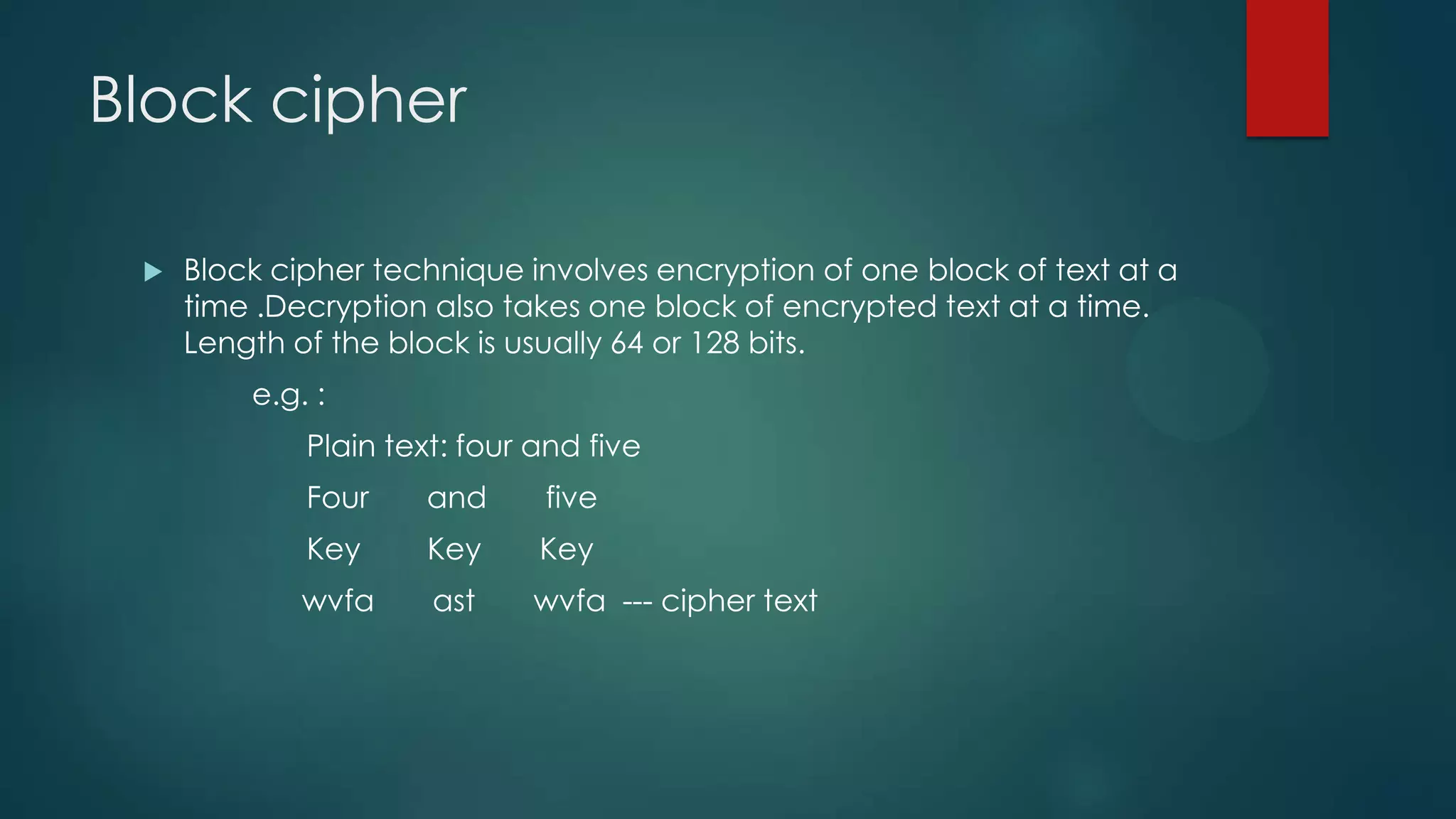
Blockcipher technique involves encryption of one block of text at a
time .Decryption also takes one block of encrypted text at a time.
Length of the block is usually 64 or 128 bits.
e.g. :
Plain text: four and five
Four and five
Key Key Key
wvfa ast wvfa --- cipher text
14.
Public Key Cryptosystem
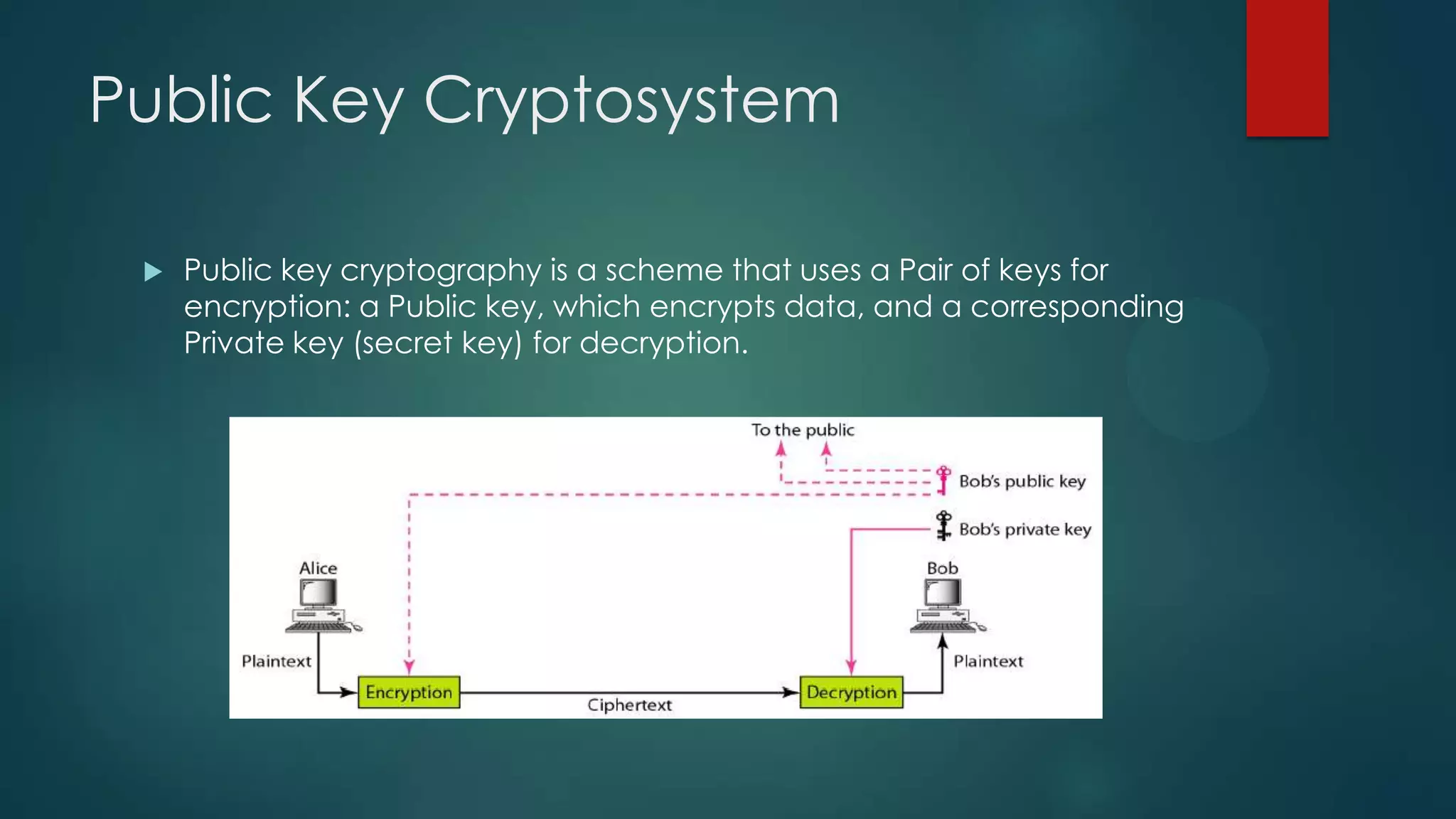
Public key cryptography is a scheme that uses a Pair of keys for
encryption: a Public key, which encrypts data, and a corresponding
Private key (secret key) for decryption.
15.
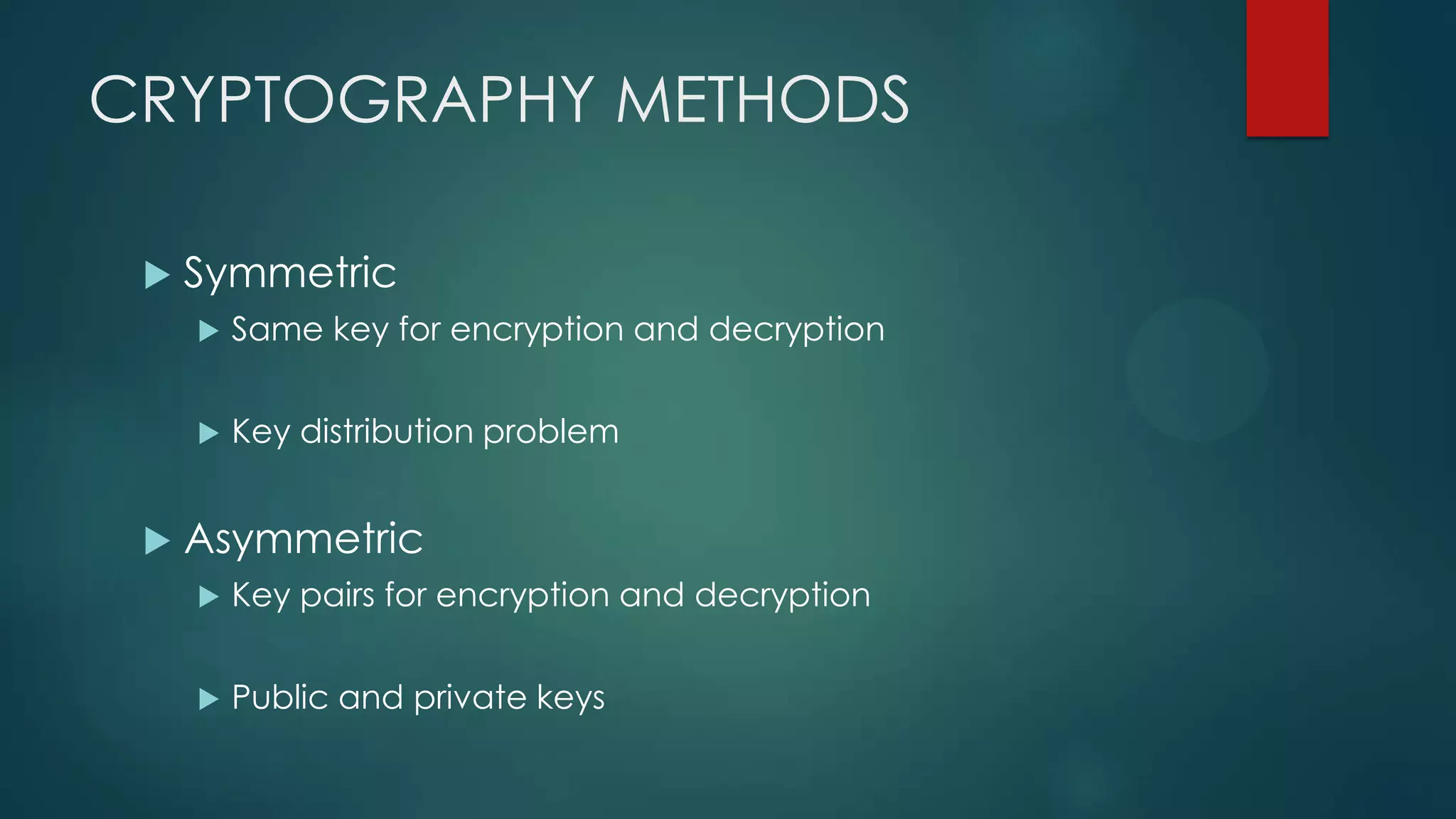
CRYPTOGRAPHY METHODS
Symmetric
Same key for encryption and decryption
Key distribution problem
Asymmetric
Key pairs for encryption and decryption
Public and private keys
16.
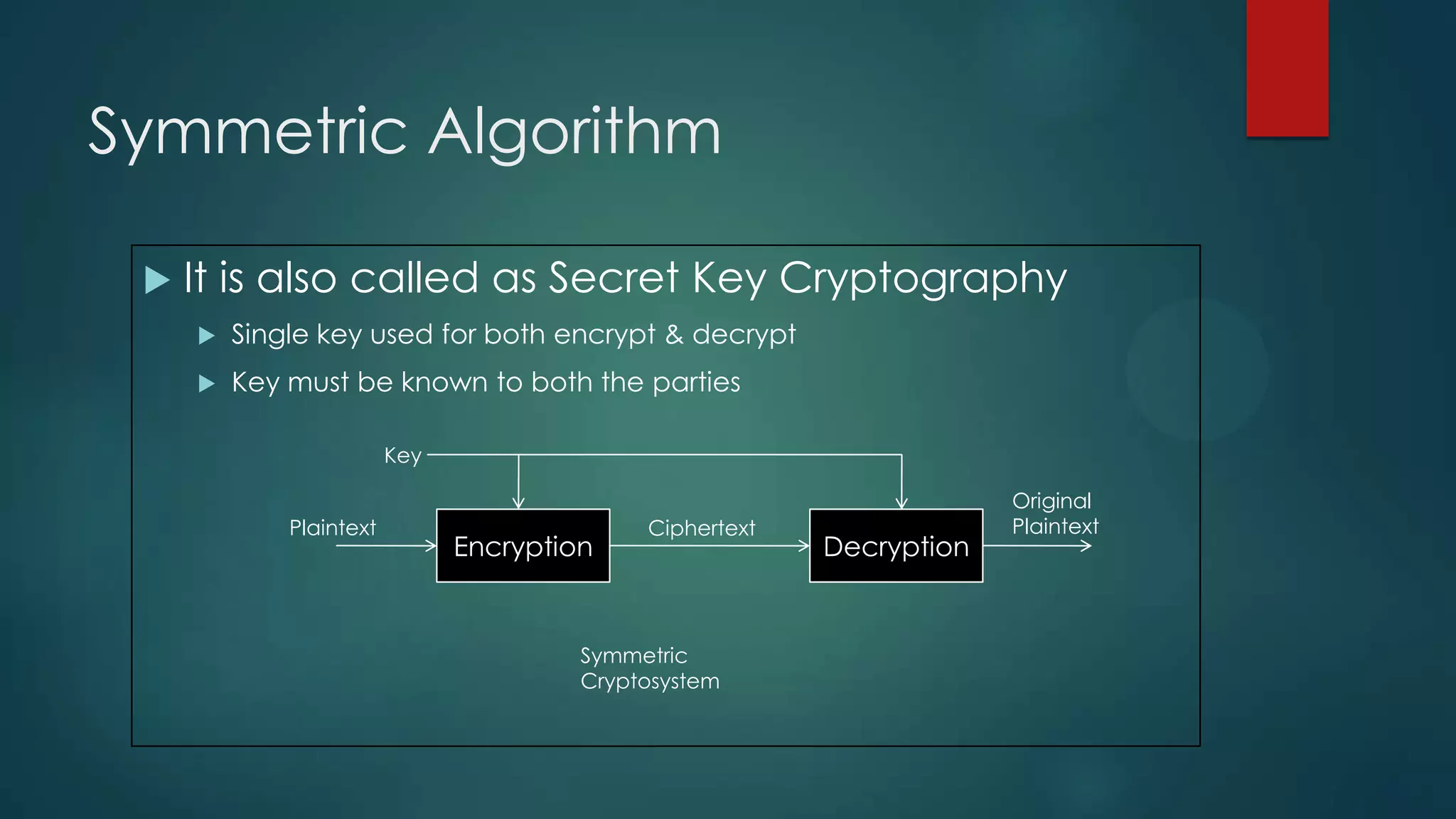
Symmetric Algorithm
Itis also called as Secret Key Cryptography
Single key used for both encrypt & decrypt
Key must be known to both the parties
Encryption Decryption
Key
Plaintext Ciphertext
Original
Plaintext
Symmetric
Cryptosystem
17.
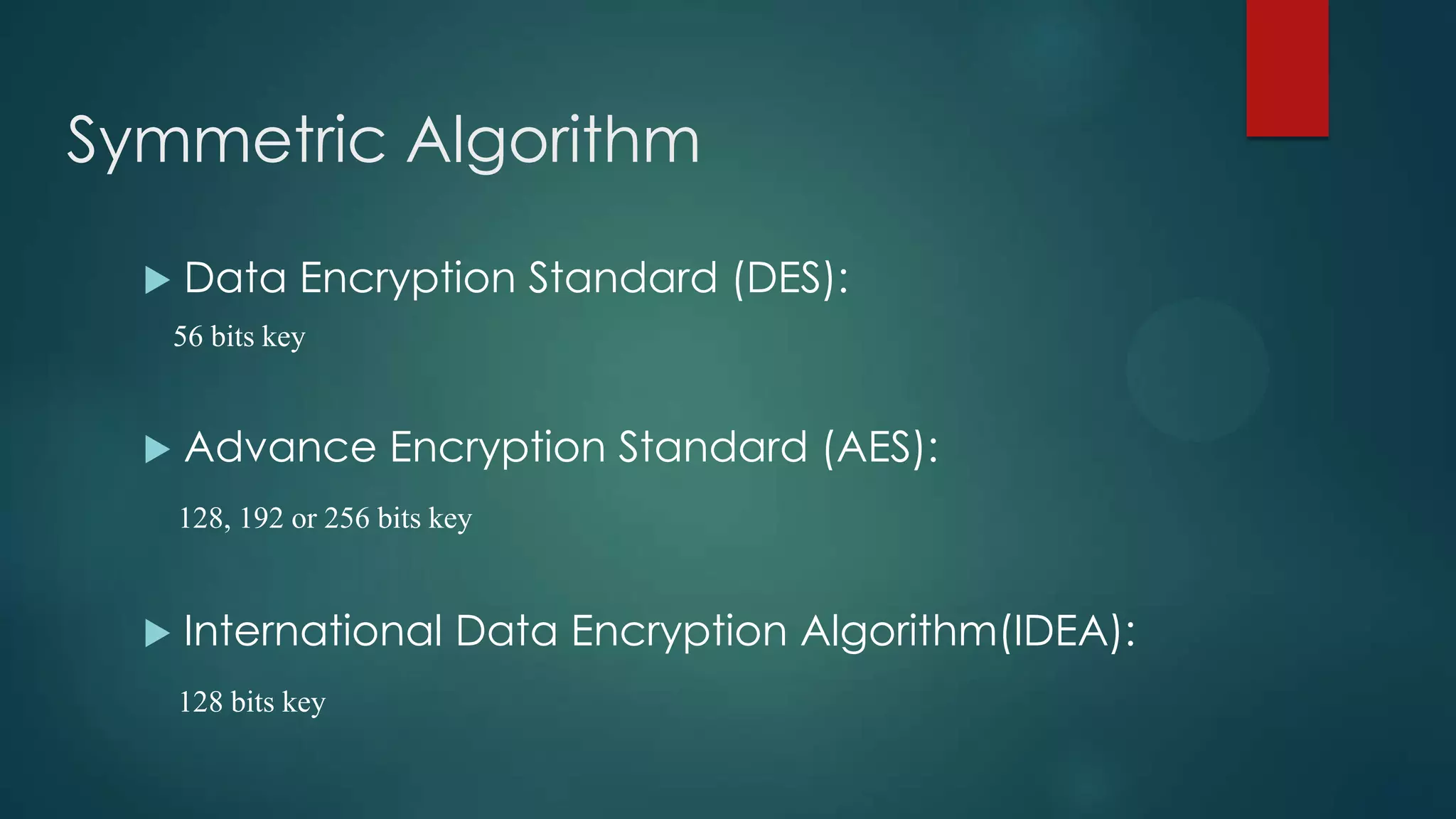
Symmetric Algorithm
DataEncryption Standard (DES):
56 bits key
Advance Encryption Standard (AES):
128, 192 or 256 bits key
International Data Encryption Algorithm(IDEA):
128 bits key
18.
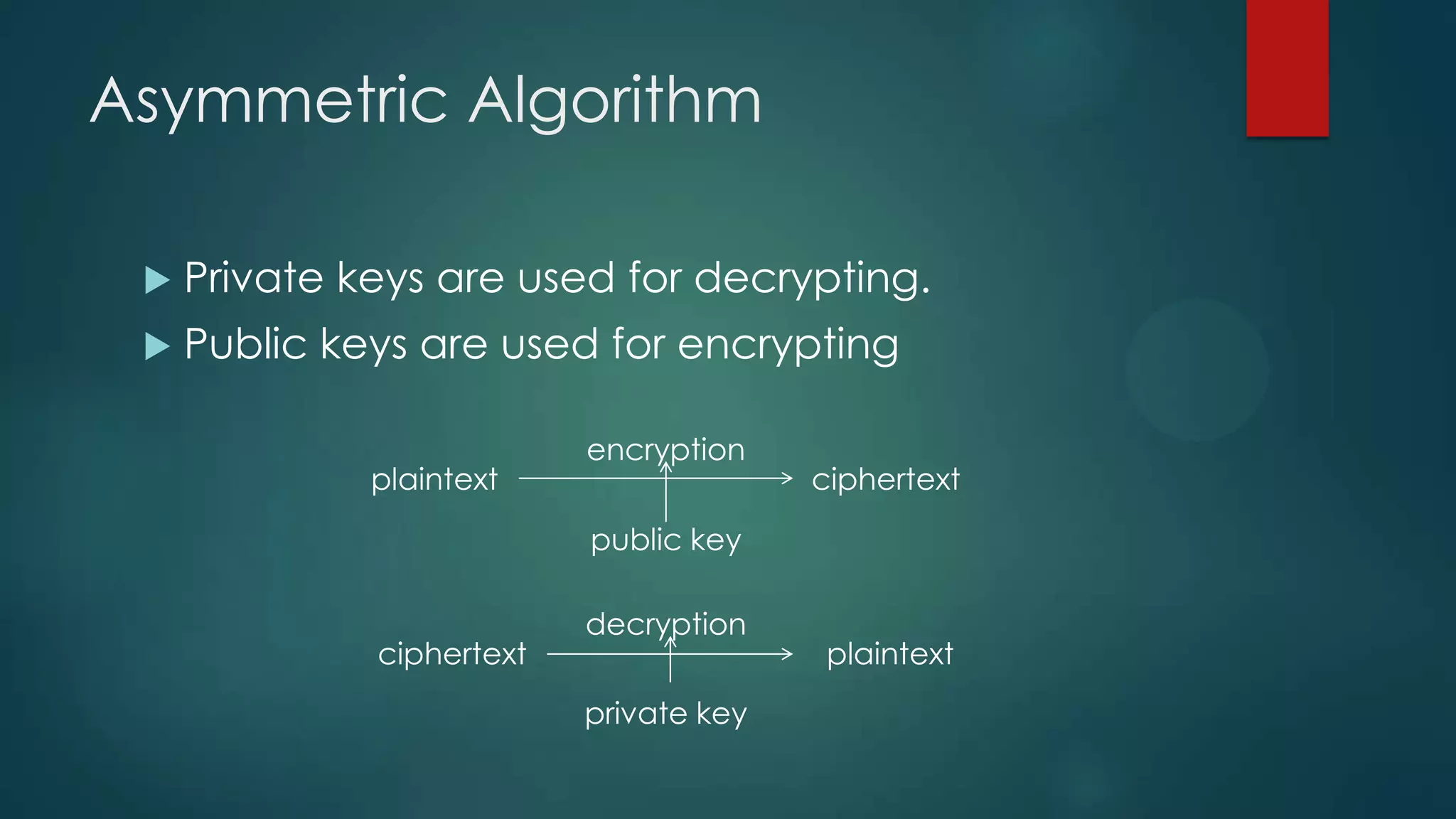
Asymmetric Algorithm
Privatekeys are used for decrypting.
Public keys are used for encrypting
encryption
plaintext ciphertext
public key
decryption
ciphertext plaintext
private key
19.
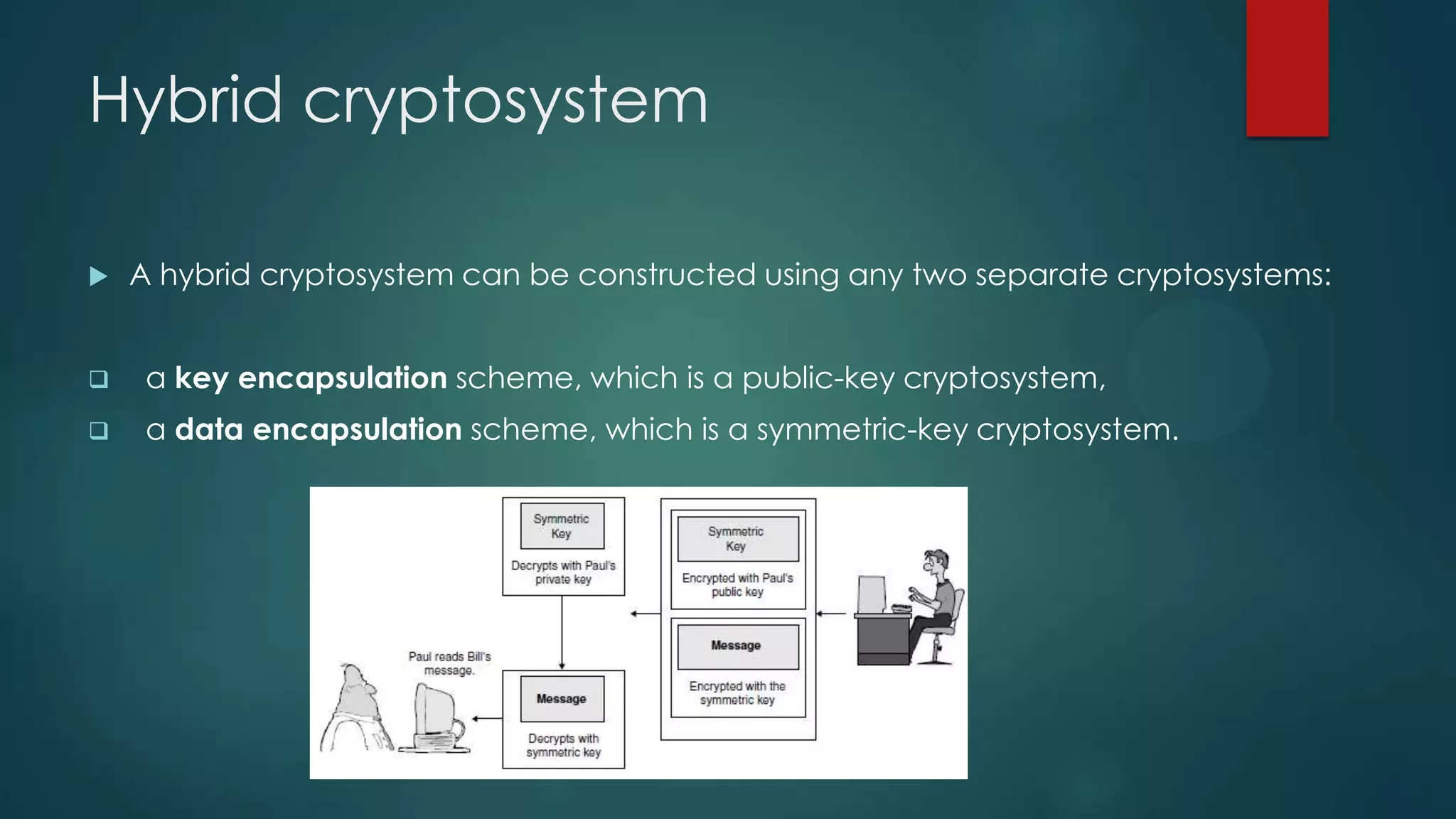
Hybrid cryptosystem
Ahybrid cryptosystem can be constructed using any two separate cryptosystems:
a key encapsulation scheme, which is a public-key cryptosystem,
a data encapsulation scheme, which is a symmetric-key cryptosystem.
20.
COMMON TYPES OFATTACKS
Brute force
Trying all key values in the keyspace.
Chosen Ciphertext
Decrypt known ciphertext to discover key.
Dictionary Attack
Find plaintext based on common words.
Frequency Analysis
Guess values based on frequency of occurrence.
21.
References
An introductionto cryptography and cryptanalysis
-Edward Schaefer,Santa Clara University
http://en.wikipedia.org/wiki/History_of_cryptography
https://securityblog.redhat.com/2013/08/14/a-brief-history-of-
cryptography/
Contemporary Cryptography - Rolf Oppliger
Cryptography Theory And Practice - Douglas Stinson
Modern Cryptography Theory and Practice - Wenbo Mao
22.
One must acknowledgewith cryptography no
amount of violence will ever solve a math problem
― Jacob Appelbaum, Cypherpunks: Freedom and the Future of the Internet
Editor's Notes
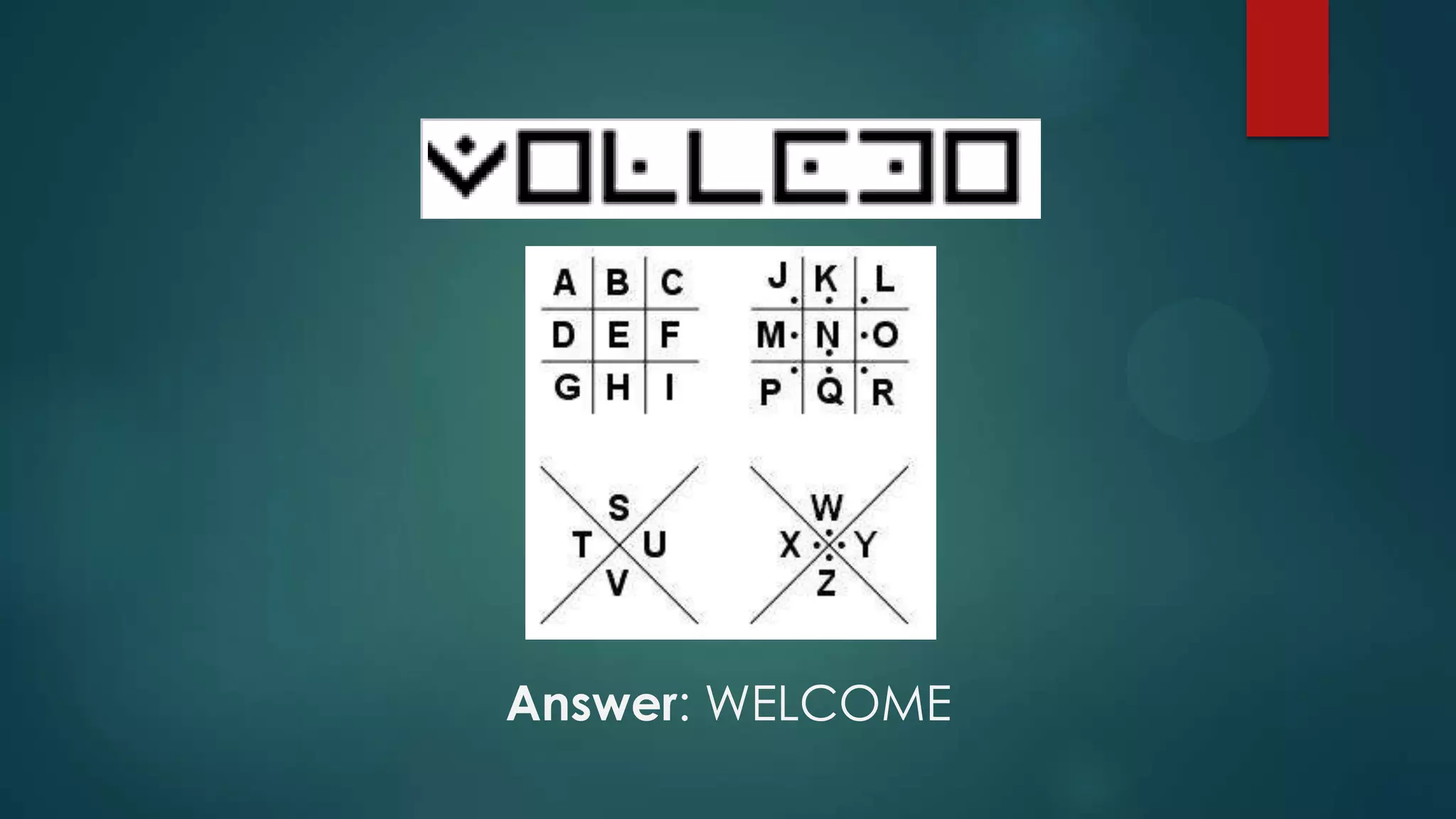
#12 The Pigpen cipher (sometimes called the Masonic cipher or Freemason's cipher) is a simple substitution cipher exchanging letters for symbols based on a grid (or the "pigpen") surrounding it.




![Vibe Coding vs. Spec-Driven Development [Free Meetup]](https://cdn.slidesharecdn.com/ss_thumbnails/vibecodingvsspecdrivendevelopment-251209105622-43f455e7-thumbnail.jpg?width=640&height=640&fit=bounds)


