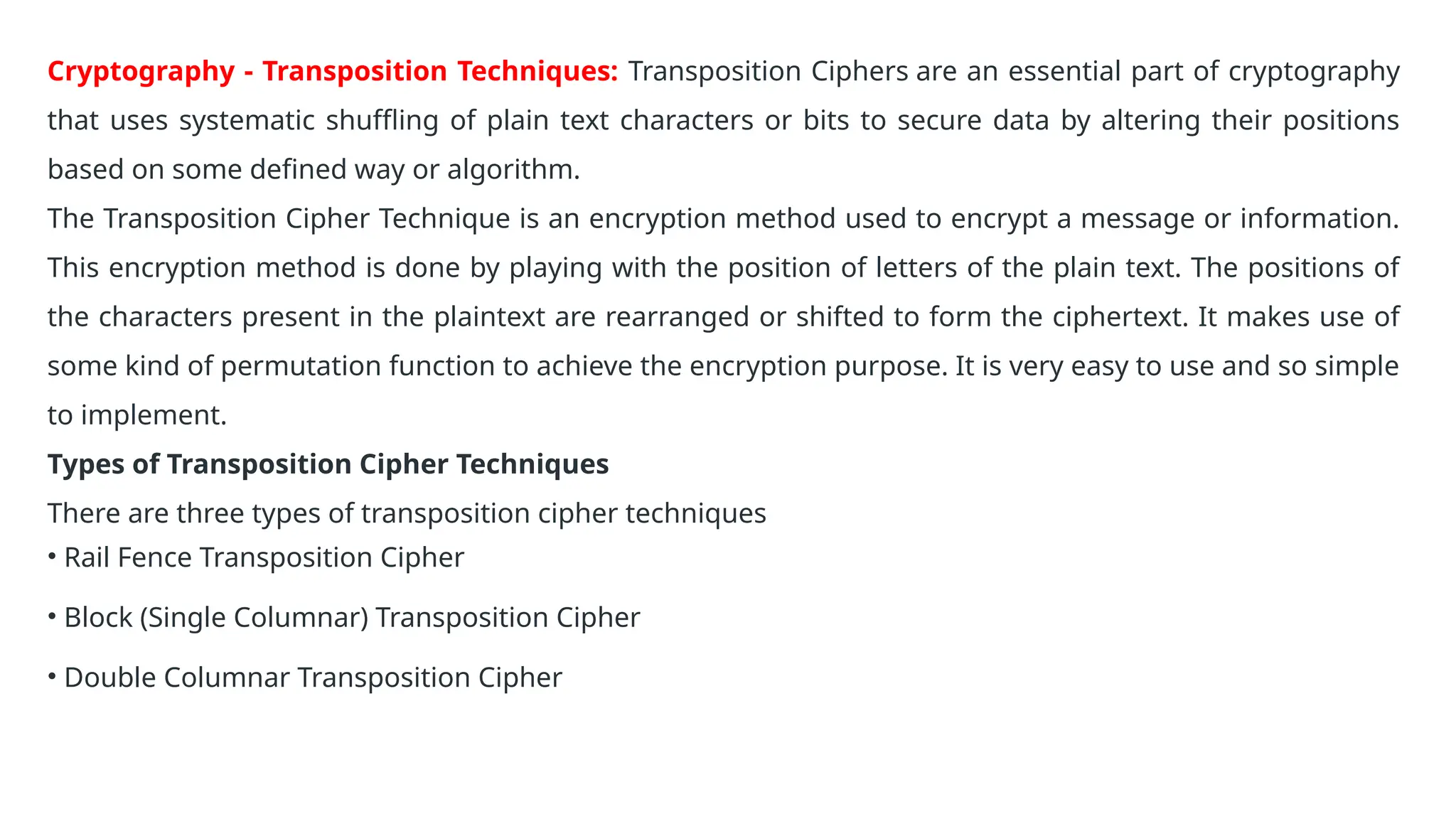
Cryptography - TranspositionTechniques: Transposition Ciphers are an essential part of cryptography
that uses systematic shuffling of plain text characters or bits to secure data by altering their positions
based on some defined way or algorithm.
The Transposition Cipher Technique is an encryption method used to encrypt a message or information.
This encryption method is done by playing with the position of letters of the plain text. The positions of
the characters present in the plaintext are rearranged or shifted to form the ciphertext. It makes use of
some kind of permutation function to achieve the encryption purpose. It is very easy to use and so simple
to implement.
Types of Transposition Cipher Techniques
There are three types of transposition cipher techniques
• Rail Fence Transposition Cipher
• Block (Single Columnar) Transposition Cipher
• Double Columnar Transposition Cipher
2.
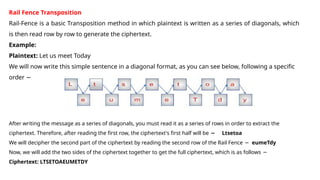
Rail Fence Transposition
Rail-Fenceis a basic Transposition method in which plaintext is written as a series of diagonals, which
is then read row by row to generate the ciphertext.
Example:
Plaintext: Let us meet Today
We will now write this simple sentence in a diagonal format, as you can see below, following a specific
order −
After writing the message as a series of diagonals, you must read it as a series of rows in order to extract the
ciphertext. Therefore, after reading the first row, the ciphertext's first half will be Ltsetoa
−
We will decipher the second part of the ciphertext by reading the second row of the Rail Fence − eumeTdy
Now, we will add the two sides of the ciphertext together to get the full ciphertext, which is as follows −
Ciphertext: LTSETOAEUMETDY
3.
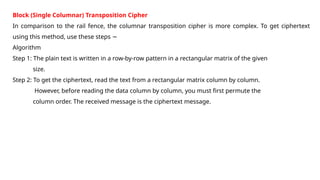
Block (Single Columnar)Transposition Cipher
In comparison to the rail fence, the columnar transposition cipher is more complex. To get ciphertext
using this method, use these steps −
Algorithm
Step 1: The plain text is written in a row-by-row pattern in a rectangular matrix of the given
size.
Step 2: To get the ciphertext, read the text from a rectangular matrix column by column.
However, before reading the data column by column, you must first permute the
column order. The received message is the ciphertext message.
4.
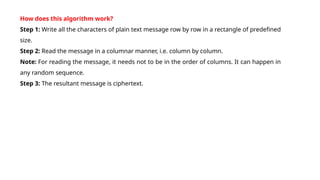
How does thisalgorithm work?
Step 1: Write all the characters of plain text message row by row in a rectangle of predefined
size.
Step 2: Read the message in a columnar manner, i.e. column by column.
Note: For reading the message, it needs not to be in the order of columns. It can happen in
any random sequence.
Step 3: The resultant message is ciphertext.
5.
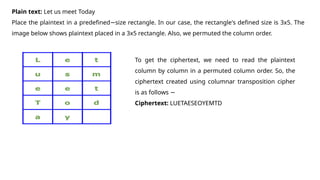
Plain text: Letus meet Today
Place the plaintext in a predefined size rectangle. In our case, the rectangle's defined size is 3x5. The
−
image below shows plaintext placed in a 3x5 rectangle. Also, we permuted the column order.
To get the ciphertext, we need to read the plaintext
column by column in a permuted column order. So, the
ciphertext created using columnar transposition cipher
is as follows −
Ciphertext: LUETAESEOYEMTD
6.
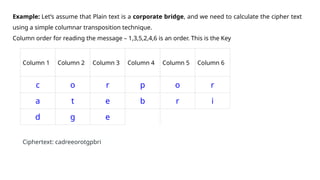
Column 1 Column2 Column 3 Column 4 Column 5 Column 6
c o r p o r
a t e b r i
d g e
Example: Let’s assume that Plain text is a corporate bridge, and we need to calculate the cipher text
using a simple columnar transposition technique.
Column order for reading the message – 1,3,5,2,4,6 is an order. This is the Key
Ciphertext: cadreeorotgpbri
7.
Double Columnar TranspositionCipher (Simple columnar transposition technique – Multiple
rounds)
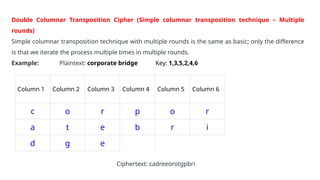
Simple columnar transposition technique with multiple rounds is the same as basic; only the difference
is that we iterate the process multiple times in multiple rounds.
Example: Plaintext: corporate bridge Key: 1,3,5,2,4,6
Column 1 Column 2 Column 3 Column 4 Column 5 Column 6
c o r p o r
a t e b r i
d g e
Ciphertext: cadreeorotgpbri
8.
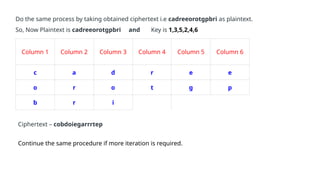
Do the sameprocess by taking obtained ciphertext i.e cadreeorotgpbri as plaintext.
So, Now Plaintext is cadreeorotgpbri and Key is 1,3,5,2,4,6
Column 1 Column 2 Column 3 Column 4 Column 5 Column 6
c a d r e e
o r o t g p
b r i
Ciphertext – cobdoiegarrrtep
Continue the same procedure if more iteration is required.