CREATIVE WRITING
Intertextuality
a. Understand intertextuality as a
technique of drama
b. Write a one-act play applying
intertextuality as a technique of drama;
and
c. Value the importance of reading and
writing drama
Unscramble Me! (Elements of Drama)
Direction: The previous module
introduced you to the elements of drama.
Below are the elements in jumbled order.
Unscramble each of them and write your
answer on the blank before each item.
1) g o d e l a i u
2) r h t c a a r s e c
3) h e t e m
4) t o c i a n
5) f n l t c c i o
6) l p t o
7) t s n i g a g
DRAMA
Drama Defined
The word drama comes from the Greek meaning “to act, do or
perform”, and it is in the several subtle and diverse meanings
of “to perform” that drama can be said to have begun. Drama
is one of the major forms of literature. As a literary form, it is
designed for the theater because characters are assigned a
role and they act out their roles as the action is enacted on
stage. It is difficult to separate drama from performance
because during the stage performance of a play, drama brings
life experiences realistically to the audience. Drama is
therefore presented in dialogue.
Drama is an imitation of life. It is different from other
forms of literature because of its unique characteristics.
It is read, but basically, it is composed to be performed,
so the ultimate aim of dramatic composition is for it to
be presented on stage before an audience. This implies
that it is a medium of communication. It has a message
to communicate to the audience. It uses actors to
convey this message. Drama mirrors the life, customs,
manner and general living habits of the people.
“A play is a just and lively image of
human nature, representing its
passions and humors and the
changes of fortune to which it is
subject for the delight and instruction
of mankind”. - John Dryden
“Drama is a composition in verse or prose
intended to portray life or character or tell
a story usually involving conflicts and
emotions through action and dialogue
and typically designed for theatrical
performance”. - Webster’s English
Dictionary
“Drama is a composition in verse or prose
and verse, adapted to be acted on the
stage, in which a story is related by
means of dialogue and action and is
represented with accompanying gesture,
costume and scenery as in real life”. -
Shorter Oxford Dictionary
“Drama is a composition designed for
performance in the theatre, in which
actors take the roles of the characters,
perform the indicated action and utter the
written dialogue”. - A Glossary of Literary
Terms by M. H. Abrams
Intertextuality Defined
Intertextuality is the interconnection between similar or related
works of literature that reflect and influence a reader’s
interpretation of the text. It is a literary device that creates an
interrelationship between texts and generates related
understanding in separate works. The term “Intertextuality”
was developed in 1966 by the French semiotician Julia Kristeva.
She created the term from the Latin word “intertexto” which
means to intermingle while weaving.
Kristeva developed the term in order to synthesize
Ferdinand de Saussure’s semiotics – the study of how
signs derive their meaning within the structure of a text;
and Mikhail Bakhtin’s dialogism – theory which
suggests a continual dialogue with other works of
literature and other authors, and his examination of the
multiple meanings in each text (especially novels) and
in each word (heteroglossia).
Kristeva argued that all works of literature
being produced contemporarily are
intertextual with the works that came before
it. As she stated, “Any text is constructed of a
mosaic of quotations; any text is the
absorption and transformation of another.”
Point to Ponder: What is the implication of
Kristeva’s theory?
These references are made to influence the
reader and add layers of depth to a text,
based on the readers’ prior knowledge and
understanding.
The function and effectiveness of
intertextuality can often depend quite a bit
on the reader’s prior knowledge and
understanding before reading the secondary
text.
Parodies and allusions depend on the reader
knowing what is being parodied or alluded
to.
In a nutshell, intertextuality is a literary discourse
strategy utilized by writers in novels, poetry, theater and
even in non-written texts (such as performances and
digital media). Examples of intertextuality are an
author's borrowing and transformation of a prior text,
and a reader's referencing of one text in reading
another.
INTERTEXTUALITY
FIGURES
1. Allusion is a figure of speech, in which an object or
circumstance from unrelated context is referred to
covertly or indirectly. If the allusion is explicitly stated
(as opposed to indirectly implied), it is usually termed a
reference.
Examples of Allusion
- He was lying so obviously, you could almost see his nose growing. -
Jack and Rose are star-crossed lovers. - It’s hard being an adult. I wish I
were a child forever. - Kimi (in Kimi Dora): “Why, am I my sister’s
keeper?”
2. Quotation is the repetition of one
expression as part of another one, particularly
when the quoted expression is well-known or
explicitly attributed by citation to its original
source, and it is indicated by quotation marks.
3. A calque or loan translation is a word or phrase borrowed from another
language by literal, word-for-word or root-for-root translation.
When used as a verb, to “calque” means to borrow a word or phrase from another
language while translating its components, so as to create a new lexeme in the
target language.
Examples of calque:
1. “flea market” – is a loan translation of the French marche aux puces (market with
fleas)
Danish loppemarked Dutch vlooienmarkt Finnish kirpputori German Flohmarkt
Hungarian bolhapiac Italian mercato delle pulci
2. skyscraper Czech mrakodrap (cloud-scraper) Danish skyskraber (cloud-scraper)
Dutch wolkenkrabber (cloud-scratcher) French gratte-ciel (scrapes sky) German
wolkenkratzer (cloud scraper)
3. The computer mouse was named in English for its
resemblance to the animal. Many other languages have
extended their own native word for “mouse” to include the
sense of the “computer mouse”.
Spanish raton Swahili kipanya Turkish fare Danish mus Dutch
muis Portuguese rato
4. Plagiarism is considered academic dishonesty and a breach of
journalistic ethics. In academia and industry, it is a serious ethical
offense, punishable due to prejudicial causes such as copyright
infringement.
In the 1st century, the use of the Latin word “plagiarus” (kidnapper) to
denote stealing someone else’s work was pioneered by the Roman poet
Martial, who complained that another poet had “kidnapped his verses”.
Plagiary, a derivative of plagiarus, was introduced into English in 1601
by dramatist Ben Jonson during the Jacobean Era to describe someone
guilty of literary theft.
5. Translation is the communication
of the meaning of a source-language
text by means of an equivalent
target-language text.
6. A parody (also called spoof or lampoon) is a work created
to imitate, make fun of, or comment on an original work – its
subject, author, style, or some other target- by means of satiric
or ironic imitation.
Denis Diderot’s Encyclopedie distinguishes between the
parody and the burlesque. “A good parody is a fine
amusement, capable of amusing and instructing the most
sensible and polished minds; the burlesque is a miserable
buffoonery which can only please the populace.
7. Unlike parody, pastiche celebrates rather than mocks, the
work it imitates. The word pastiche is a French cognate of the
Italian noun pasticcio, which is a pie-filling mixed from diverse
ingredients.
8. Appropriation is a reworking or re-imagination of a well-
known text, to change or extend its meaning. For example,
Marcel Duchamp’s artwork, L.H.O.O.Q. is an appropriation of
Da Vinci’s Mona Lisa. Duchamp took an image of the painting
and drew a moustache on it.
9. Adaptation. A film, TV, drama or stage
play is based on a written work. For
example, J.K. Rowling’s Harry Potter has a
film adaptation.
Steps in Identifying and Analyzing
Intertextuality
1. Read the passage to identify any clear
intertextual references to literature, music,
art, film or another text type.
2. Research or use your own knowledge
of the text you have identified and find
any themes or messages that can be
linked to your current text.
3. Determine the significance of using the
reference.
- How does it compliment the author’s intended
message?
- Does it deepen your current understanding and
perspective of the text?
4. Discuss your insights.
What Is a One-Act Play?
A one-act play is usually between 10-40 pages long,
and is often called a “tenner” because of the short
length. Writing one-acts can be an excellent way for
new playwrights to learn the basics of story and
character construction. While there are no set rules for
how to write a one-act play, some basic guidelines may
help clear away any confusing format or content
problems.
Traditional plays, and often one-act plays, sometimes
conform to the unities of drama as discussed by the
philosopher Aristotle. These guidelines suggest that a
play should take place with a unity of location, time and
action. In other words, one-act plays should have: - one
location, - be set over a period of no more than one
day, - and have one central plot.
These unities are somewhat more helpful in
writing one-acts, as the 10-40 minute running
time will not leave a lot of room for set changes or
subplots. A one-act play usually will have four or
fewer characters that are developed in varying
degrees. Depending on the story you are trying to
tell, there may be one or more main characters.
In some short plays, the roles are balanced
equally; in others, some roles may only have a
few lines. Even though your play is short, you
should have a clear idea of who your
characters are, what they want, and how they
will try to get what they want.
The most important element to any play is
conflict. This does not necessarily mean fighting
or arguing. A man being sad about throwing away
his baby blanket is in conflict with himself. Equally,
two people trying to decide what couch to buy is
also a conflict. Conflicts are essential to give a
scene and a play life.
Because a one-act play is so short, most experts recommend
you avoid extensive exposition. If the play is about Mary and
John arguing in a restaurant, the audience does not need to
know where they were born, how many siblings they have or
any information extraneous to the play.
It does not mean that the playwright cannot know these
things, but you can waste valuable time giving explanations or
background about things that do not affect the immediate
outcome of the scene or situation.
Avoid using a narrator. You may wish to read examples of
one-act plays to understand how they are written and what
can be done with them. If you like classical literature, Moliere
and Anton Chekov both wrote extensive collections of one-
acts. David Ives is considered by many theater critics to be the
greatest modern mind when it comes to one-act comedies. For
drama, you may wish to look at the work of Horton Foote or
David Henry Hwang.
Rules of Thumb
One-Act plays should:
1) be set in a single location
2) be set over a period of no more than one day
3) have one central plot
4) have four or fewer characters
5) have conflict that is resolved by the end
6) develop characters primarily through dialogue
7) not rely on the use of a narrator (instead, dramatize
everything)
8) be a complete, compact drama, with a beginning,
middle and end
9) follow the standard format of a short story - opening
situation - rising action, which develops the conflict -
conflict - climax (the turning point) - falling action -
resolution (the conflict is resolved)
Story Development – Ten Tips
1. Create a world that's true to real life or fantastical or
that mixes the mundane with the magical. But whatever
set of rules you create for that world, make sure you
follow them.
2. Write a conflict that builds as the play progresses. As
you structure the conflict, think in terms of your play
having a beginning, a middle and an end.
3. Write characters that want something (which puts
them in conflict with other characters) and try to get
what they want at every moment.
4. Make sure that each character has something at
stake, a consequence if he doesn't get what he wants.
5. Create a "ticking clock" that puts the characters under
pressure to get what they want right away.
6. Make sure there is a good reason, an "event,"
for your play. It's not enough for two characters to
sit around and talk for a while and then leave.
There needs to be some important reason why
we're watching them now, at this particular
moment.
7. Write dialogue that illuminates your characters
and advances the plot at the same time.
8. Make each character speak in a distinctive
voice. If you have trouble with that, try imagining
a specific actor you know - even if it's someone
who will never play the part - in the role.
9. Do not have a character tell us something she
can show us instead. For example, it's much more
effective to hide under the bed than to say "I'm
afraid."
10. Give each character a "moment," something
that justifies the character's existence in your play
and that makes him attractive for an actor to play.
Bear in mind that…
In order to apply intertextuality in a one-act play, simply
come up with a character or theme based on a well-
known story. For example, you can begin your play by
creating a character whose action resembles that of a
famous one like the doctor in Frankenstein; or you may
come up with the theme of tragic love like that in
Romeo and Juliet.
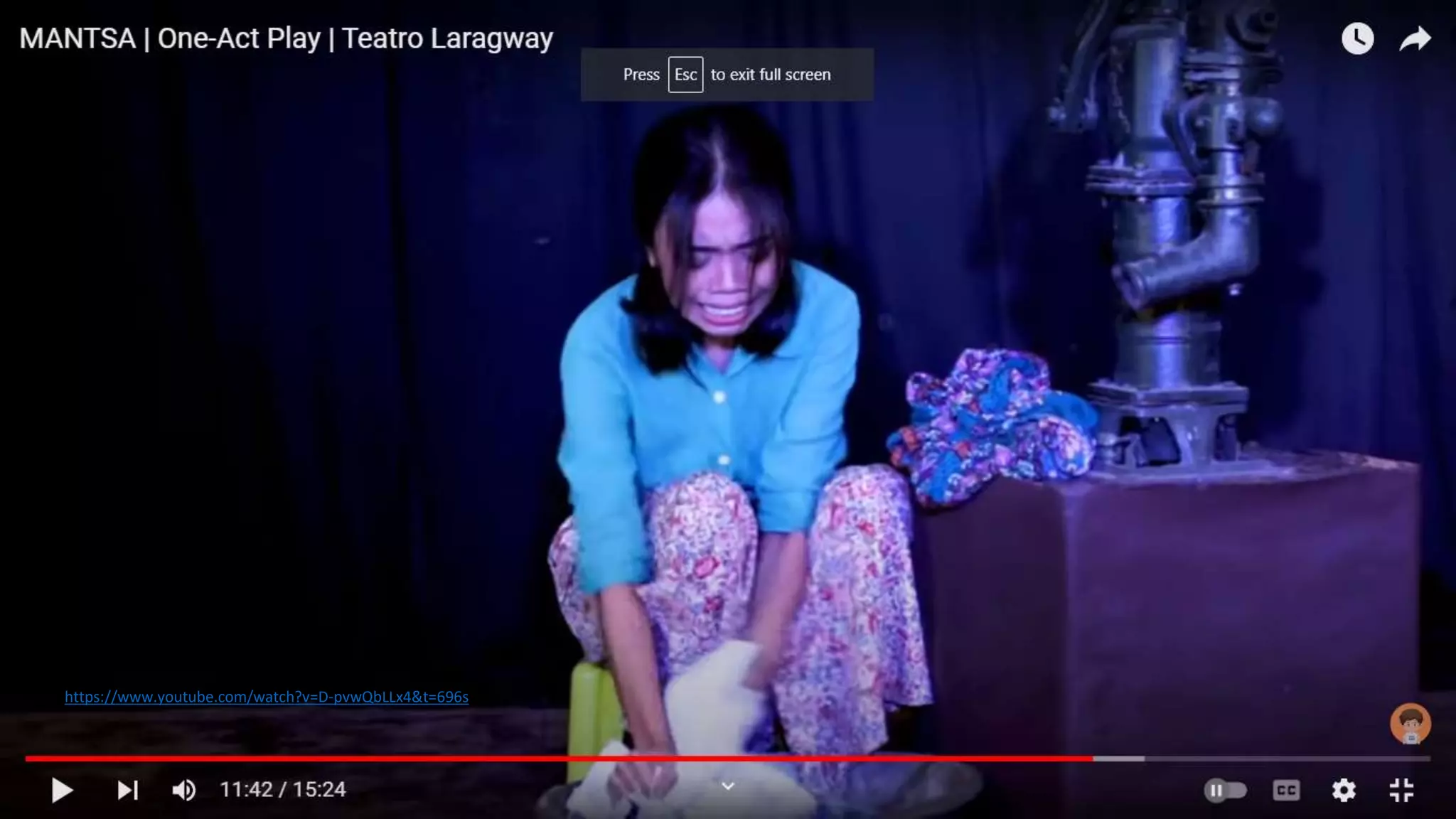
https://www.youtube.com/watch?v=D-pvwQbLLx4&t=696s

Creative Writing - Intertextuality.pptx

  • 1.
  • 2.
    a. Understand intertextualityas a technique of drama b. Write a one-act play applying intertextuality as a technique of drama; and c. Value the importance of reading and writing drama
  • 3.
    Unscramble Me! (Elementsof Drama) Direction: The previous module introduced you to the elements of drama. Below are the elements in jumbled order. Unscramble each of them and write your answer on the blank before each item.
  • 4.
    1) g od e l a i u 2) r h t c a a r s e c 3) h e t e m 4) t o c i a n 5) f n l t c c i o 6) l p t o 7) t s n i g a g
  • 6.
  • 7.
    Drama Defined The worddrama comes from the Greek meaning “to act, do or perform”, and it is in the several subtle and diverse meanings of “to perform” that drama can be said to have begun. Drama is one of the major forms of literature. As a literary form, it is designed for the theater because characters are assigned a role and they act out their roles as the action is enacted on stage. It is difficult to separate drama from performance because during the stage performance of a play, drama brings life experiences realistically to the audience. Drama is therefore presented in dialogue.
  • 8.
    Drama is animitation of life. It is different from other forms of literature because of its unique characteristics. It is read, but basically, it is composed to be performed, so the ultimate aim of dramatic composition is for it to be presented on stage before an audience. This implies that it is a medium of communication. It has a message to communicate to the audience. It uses actors to convey this message. Drama mirrors the life, customs, manner and general living habits of the people.
  • 9.
    “A play isa just and lively image of human nature, representing its passions and humors and the changes of fortune to which it is subject for the delight and instruction of mankind”. - John Dryden
  • 10.
    “Drama is acomposition in verse or prose intended to portray life or character or tell a story usually involving conflicts and emotions through action and dialogue and typically designed for theatrical performance”. - Webster’s English Dictionary
  • 11.
    “Drama is acomposition in verse or prose and verse, adapted to be acted on the stage, in which a story is related by means of dialogue and action and is represented with accompanying gesture, costume and scenery as in real life”. - Shorter Oxford Dictionary
  • 12.
    “Drama is acomposition designed for performance in the theatre, in which actors take the roles of the characters, perform the indicated action and utter the written dialogue”. - A Glossary of Literary Terms by M. H. Abrams
  • 13.
    Intertextuality Defined Intertextuality isthe interconnection between similar or related works of literature that reflect and influence a reader’s interpretation of the text. It is a literary device that creates an interrelationship between texts and generates related understanding in separate works. The term “Intertextuality” was developed in 1966 by the French semiotician Julia Kristeva. She created the term from the Latin word “intertexto” which means to intermingle while weaving.
  • 14.
    Kristeva developed theterm in order to synthesize Ferdinand de Saussure’s semiotics – the study of how signs derive their meaning within the structure of a text; and Mikhail Bakhtin’s dialogism – theory which suggests a continual dialogue with other works of literature and other authors, and his examination of the multiple meanings in each text (especially novels) and in each word (heteroglossia).
  • 15.
    Kristeva argued thatall works of literature being produced contemporarily are intertextual with the works that came before it. As she stated, “Any text is constructed of a mosaic of quotations; any text is the absorption and transformation of another.”
  • 16.
    Point to Ponder:What is the implication of Kristeva’s theory? These references are made to influence the reader and add layers of depth to a text, based on the readers’ prior knowledge and understanding.
  • 17.
    The function andeffectiveness of intertextuality can often depend quite a bit on the reader’s prior knowledge and understanding before reading the secondary text. Parodies and allusions depend on the reader knowing what is being parodied or alluded to.
  • 18.
    In a nutshell,intertextuality is a literary discourse strategy utilized by writers in novels, poetry, theater and even in non-written texts (such as performances and digital media). Examples of intertextuality are an author's borrowing and transformation of a prior text, and a reader's referencing of one text in reading another.
  • 19.
  • 20.
    1. Allusion isa figure of speech, in which an object or circumstance from unrelated context is referred to covertly or indirectly. If the allusion is explicitly stated (as opposed to indirectly implied), it is usually termed a reference. Examples of Allusion - He was lying so obviously, you could almost see his nose growing. - Jack and Rose are star-crossed lovers. - It’s hard being an adult. I wish I were a child forever. - Kimi (in Kimi Dora): “Why, am I my sister’s keeper?”
  • 21.
    2. Quotation isthe repetition of one expression as part of another one, particularly when the quoted expression is well-known or explicitly attributed by citation to its original source, and it is indicated by quotation marks.
  • 22.
    3. A calqueor loan translation is a word or phrase borrowed from another language by literal, word-for-word or root-for-root translation. When used as a verb, to “calque” means to borrow a word or phrase from another language while translating its components, so as to create a new lexeme in the target language. Examples of calque: 1. “flea market” – is a loan translation of the French marche aux puces (market with fleas) Danish loppemarked Dutch vlooienmarkt Finnish kirpputori German Flohmarkt Hungarian bolhapiac Italian mercato delle pulci 2. skyscraper Czech mrakodrap (cloud-scraper) Danish skyskraber (cloud-scraper) Dutch wolkenkrabber (cloud-scratcher) French gratte-ciel (scrapes sky) German wolkenkratzer (cloud scraper)
  • 23.
    3. The computermouse was named in English for its resemblance to the animal. Many other languages have extended their own native word for “mouse” to include the sense of the “computer mouse”. Spanish raton Swahili kipanya Turkish fare Danish mus Dutch muis Portuguese rato
  • 24.
    4. Plagiarism isconsidered academic dishonesty and a breach of journalistic ethics. In academia and industry, it is a serious ethical offense, punishable due to prejudicial causes such as copyright infringement. In the 1st century, the use of the Latin word “plagiarus” (kidnapper) to denote stealing someone else’s work was pioneered by the Roman poet Martial, who complained that another poet had “kidnapped his verses”. Plagiary, a derivative of plagiarus, was introduced into English in 1601 by dramatist Ben Jonson during the Jacobean Era to describe someone guilty of literary theft.
  • 25.
    5. Translation isthe communication of the meaning of a source-language text by means of an equivalent target-language text.
  • 26.
    6. A parody(also called spoof or lampoon) is a work created to imitate, make fun of, or comment on an original work – its subject, author, style, or some other target- by means of satiric or ironic imitation. Denis Diderot’s Encyclopedie distinguishes between the parody and the burlesque. “A good parody is a fine amusement, capable of amusing and instructing the most sensible and polished minds; the burlesque is a miserable buffoonery which can only please the populace.
  • 27.
    7. Unlike parody,pastiche celebrates rather than mocks, the work it imitates. The word pastiche is a French cognate of the Italian noun pasticcio, which is a pie-filling mixed from diverse ingredients. 8. Appropriation is a reworking or re-imagination of a well- known text, to change or extend its meaning. For example, Marcel Duchamp’s artwork, L.H.O.O.Q. is an appropriation of Da Vinci’s Mona Lisa. Duchamp took an image of the painting and drew a moustache on it.
  • 28.
    9. Adaptation. Afilm, TV, drama or stage play is based on a written work. For example, J.K. Rowling’s Harry Potter has a film adaptation.
  • 29.
    Steps in Identifyingand Analyzing Intertextuality 1. Read the passage to identify any clear intertextual references to literature, music, art, film or another text type.
  • 30.
    2. Research oruse your own knowledge of the text you have identified and find any themes or messages that can be linked to your current text.
  • 31.
    3. Determine thesignificance of using the reference. - How does it compliment the author’s intended message? - Does it deepen your current understanding and perspective of the text? 4. Discuss your insights.
  • 33.
    What Is aOne-Act Play? A one-act play is usually between 10-40 pages long, and is often called a “tenner” because of the short length. Writing one-acts can be an excellent way for new playwrights to learn the basics of story and character construction. While there are no set rules for how to write a one-act play, some basic guidelines may help clear away any confusing format or content problems.
  • 34.
    Traditional plays, andoften one-act plays, sometimes conform to the unities of drama as discussed by the philosopher Aristotle. These guidelines suggest that a play should take place with a unity of location, time and action. In other words, one-act plays should have: - one location, - be set over a period of no more than one day, - and have one central plot.
  • 35.
    These unities aresomewhat more helpful in writing one-acts, as the 10-40 minute running time will not leave a lot of room for set changes or subplots. A one-act play usually will have four or fewer characters that are developed in varying degrees. Depending on the story you are trying to tell, there may be one or more main characters.
  • 36.
    In some shortplays, the roles are balanced equally; in others, some roles may only have a few lines. Even though your play is short, you should have a clear idea of who your characters are, what they want, and how they will try to get what they want.
  • 37.
    The most importantelement to any play is conflict. This does not necessarily mean fighting or arguing. A man being sad about throwing away his baby blanket is in conflict with himself. Equally, two people trying to decide what couch to buy is also a conflict. Conflicts are essential to give a scene and a play life.
  • 38.
    Because a one-actplay is so short, most experts recommend you avoid extensive exposition. If the play is about Mary and John arguing in a restaurant, the audience does not need to know where they were born, how many siblings they have or any information extraneous to the play. It does not mean that the playwright cannot know these things, but you can waste valuable time giving explanations or background about things that do not affect the immediate outcome of the scene or situation.
  • 39.
    Avoid using anarrator. You may wish to read examples of one-act plays to understand how they are written and what can be done with them. If you like classical literature, Moliere and Anton Chekov both wrote extensive collections of one- acts. David Ives is considered by many theater critics to be the greatest modern mind when it comes to one-act comedies. For drama, you may wish to look at the work of Horton Foote or David Henry Hwang.
  • 40.
    Rules of Thumb One-Actplays should: 1) be set in a single location 2) be set over a period of no more than one day 3) have one central plot 4) have four or fewer characters 5) have conflict that is resolved by the end
  • 41.
    6) develop charactersprimarily through dialogue 7) not rely on the use of a narrator (instead, dramatize everything) 8) be a complete, compact drama, with a beginning, middle and end 9) follow the standard format of a short story - opening situation - rising action, which develops the conflict - conflict - climax (the turning point) - falling action - resolution (the conflict is resolved)
  • 42.
    Story Development –Ten Tips 1. Create a world that's true to real life or fantastical or that mixes the mundane with the magical. But whatever set of rules you create for that world, make sure you follow them. 2. Write a conflict that builds as the play progresses. As you structure the conflict, think in terms of your play having a beginning, a middle and an end.
  • 43.
    3. Write charactersthat want something (which puts them in conflict with other characters) and try to get what they want at every moment. 4. Make sure that each character has something at stake, a consequence if he doesn't get what he wants. 5. Create a "ticking clock" that puts the characters under pressure to get what they want right away.
  • 44.
    6. Make surethere is a good reason, an "event," for your play. It's not enough for two characters to sit around and talk for a while and then leave. There needs to be some important reason why we're watching them now, at this particular moment.
  • 45.
    7. Write dialoguethat illuminates your characters and advances the plot at the same time. 8. Make each character speak in a distinctive voice. If you have trouble with that, try imagining a specific actor you know - even if it's someone who will never play the part - in the role.
  • 46.
    9. Do nothave a character tell us something she can show us instead. For example, it's much more effective to hide under the bed than to say "I'm afraid." 10. Give each character a "moment," something that justifies the character's existence in your play and that makes him attractive for an actor to play.
  • 47.
    Bear in mindthat… In order to apply intertextuality in a one-act play, simply come up with a character or theme based on a well- known story. For example, you can begin your play by creating a character whose action resembles that of a famous one like the doctor in Frankenstein; or you may come up with the theme of tragic love like that in Romeo and Juliet.
  • 48.