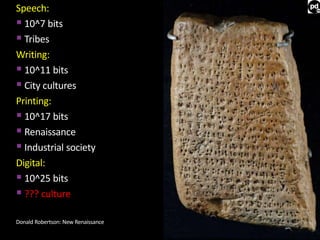
Speech: 
 10^7 bits 
 Tribes 
Writing: 
 10^11 bits 
 City cultures 
Printing: 
 10^17 bits 
 Renaissance 
 Industrial society 
Digital: 
 10^25 bits 
 ??? culture 
Donald Robertson: New Renaissance
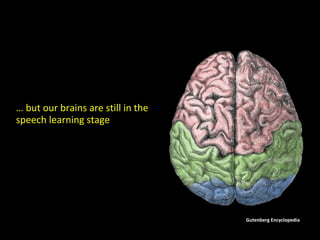
Gutenberg Encyclopedia 
… but our brains are still in the 
speech learning stage
The Future Is not What It Used to Be 
Jyrki J.J. Kasvi 
Finnish Information Society Development Centre
Digitalisation revolutionises everything! 
Content industries are just among the first ones to face the new realities... 
…along with banking, stock market, agriculture, logging, …
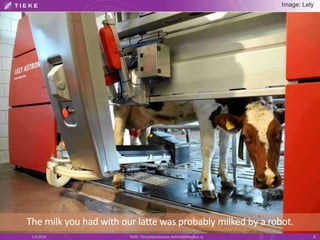
Image: Lely 
The milk you had with our latte was probably milked by a robot. 
5.9.2014 TIEKE Tietoyhteiskunnan kehittämiskeskus ry 6
During the next two years, the calculating 
power of humanity is going to double. 
We ain’t seen nothing, yet.
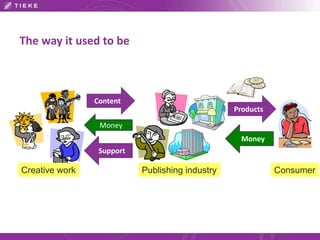
The way it used to be 
Content 
Products 
Money 
Money 
Support 
Creative work Publishing industry Consumer
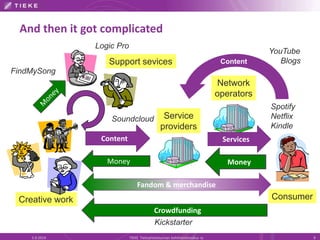
FindMySong 
Creative work 
Logic Pro 
Support sevices 
YouTube 
Blogs 
Spotify 
Netflix 
Kindle 
Consumer 
Service 
providers 
Content 
Network 
operators 
And then it got complicated 
Soundcloud 
Content 
Services 
Money Money 
Fandom & merchandise 
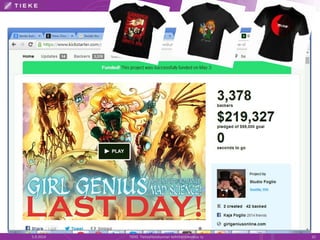
Crowdfunding 
Kickstarter 
5.9.2014 TIEKE Tietoyhteiskunnan kehittämiskeskus ry 9
5.9.2014 TIEKE Tietoyhteiskunnan kehittämiskeskus ry 10
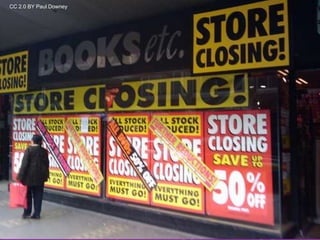
Please do not shoot the messenger! 
Who is just pointing out the reality for you.
CC 2.0 BY Paul Downey 
5.9.2014 TIEKE Tietoyhteiskunnan kehittämiskeskus ry 12
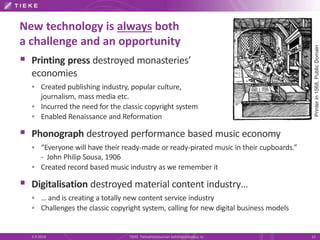
New technology is always both 
a challenge and an opportunity 
 Printing press destroyed monasteries’ 
economies 
 Created publishing industry, popular culture, 
journalism, mass media etc. 
 Incurred the need for the classic copyright system 
 Enabled Renaissance and Reformation 
 Phonograph destroyed performance based music economy 
 “Everyone will have their ready-made or ready-pirated music in their cupboards.” 
- John Philip Sousa, 1906 
 Created record based music industry as we remember it 
 Digitalisation destroyed material content industry… 
 … and is creating a totally new content service industry 
 Challenges the classic copyright system, calling for new digital business models 
Printer in 1568, Public Domain 
5.9.2014 TIEKE Tietoyhteiskunnan kehittämiskeskus ry 13
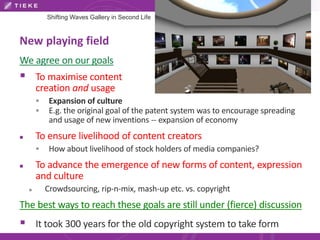
Shifting Waves Gallery in Second Life 
New playing field 
We agree on our goals 
 To maximise content 
creation and usage 
 Expansion of culture 
 E.g. the original goal of the patent system was to encourage spreading 
and usage of new inventions -- expansion of economy 
 To ensure livelihood of content creators 
 How about livelihood of stock holders of media companies? 
 To advance the emergence of new forms of content, expression 
and culture 
 Crowdsourcing, rip-n-mix, mash-up etc. vs. copyright 
The best ways to reach these goals are still under (fierce) discussion 
 It took 300 years for the old copyright system to take form
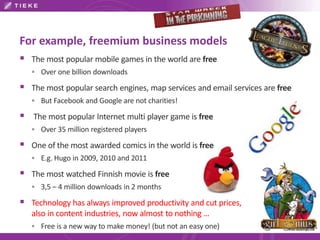
For example, freemium business models 
 The most popular mobile games in the world are free 
 Over one billion downloads 
 The most popular search engines, map services and email services are free 
 But Facebook and Google are not charities! 
 The most popular Internet multi player game is free 
 Over 35 million registered players 
 One of the most awarded comics in the world is free 
 E.g. Hugo in 2009, 2010 and 2011 
 The most watched Finnish movie is free 
 3,5 – 4 million downloads in 2 months 
 Technology has always improved productivity and cut prices, 
also in content industries, now almost to nothing … 
 Free is a new way to make money! (but not an easy one)
New challenges 
 Content consumers 
 Have access to unprecedented selection 
 consume content more than ever 
 have become content creators 
 Interact with content creators 
 Can choose most cost effective sources 
 Content creators 
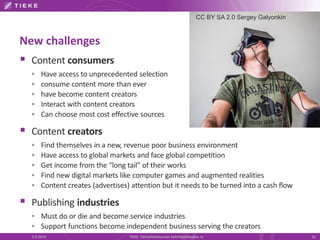
CC BY SA 2.0 Sergey Galyonkin 
 Find themselves in a new, revenue poor business environment 
 Have access to global markets and face global competition 
 Get income from the “long tail” of their works 
 Find new digital markets like computer games and augmented realities 
 Content creates (advertises) attention but it needs to be turned into a cash flow 
 Publishing industries 
 Must do or die and become service industries 
 Support functions become independent business serving the creators 
5.9.2014 TIEKE Tietoyhteiskunnan kehittämiskeskus ry 16
Digital content revolution 
 Internet has already replaced television 
 Finns spend as much time in Internet as watching TV 
 E-readers replace papers and books 
 Bookstores are facing the fate of record stores as 
newspapers and literature are becoming cloud services 
 Only a third of Danes are still reading paper newspapers 
 Games have been a bigger industry than movies for over 10 years 
 Finnish game development industry needs 600 new employees every year! 
 Mail delivery is ending 
 Paper invoices and newspapers are disappearing 
 Online shopping deliveries replaces letters 
 Libraries either disappear or become digital media centres 
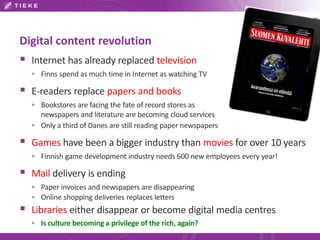
 Is culture becoming a privilege of the rich, again?
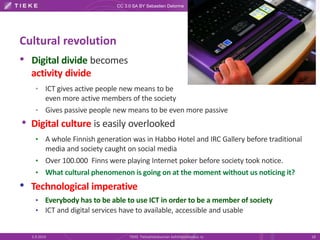
CC 3.0 SA BY Sebastien Delorme 
Cultural revolution 
• Digital divide becomes 
activity divide 
• ICT gives active people new means to be 
even more active members of the society 
• Gives passive people new means to be even more passive 
• Digital culture is easily overlooked 
• A whole Finnish generation was in Habbo Hotel and IRC Gallery before traditional 
media and society caught on social media 
• Over 100.000 Finns were playing Internet poker before society took notice. 
• What cultural phenomenon is going on at the moment without us noticing it? 
• Technological imperative 
• Everybody has to be able to use ICT in order to be a member of society 
• ICT and digital services have to available, accessible and usable 
5.9.2014 TIEKE Tietoyhteiskunnan kehittämiskeskus ry 18
The fun times are just beginning 
 Electronic paper 
 Soon almost free. 
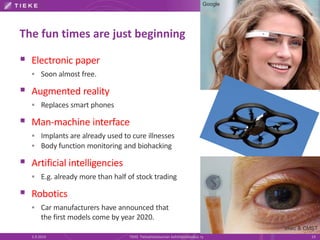
 Augmented reality 
 Replaces smart phones 
 Man-machine interface 
 Implants are already used to cure illnesses 
 Body function monitoring and biohacking 
 Artificial intelligencies 
 E.g. already more than half of stock trading 
 Robotics 
 Car manufacturers have announced that 
the first models come by year 2020. 
Google 
Imec & CMST 
5.9.2014 TIEKE Tietoyhteiskunnan kehittämiskeskus ry 19
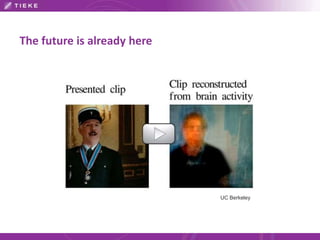
The future is already here 
UC Berkeley
Sukupuolten välinen digikuilu? 
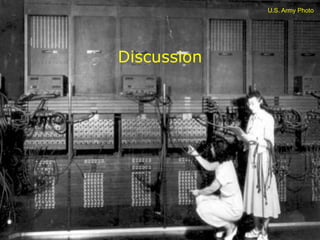
Discussion 
U.S. Army Photo 
30.9.2010 www.kasvi.org 21

Creative digital future

  • 2.
    Speech:  10^7bits  Tribes Writing:  10^11 bits  City cultures Printing:  10^17 bits  Renaissance  Industrial society Digital:  10^25 bits  ??? culture Donald Robertson: New Renaissance
  • 3.
    Gutenberg Encyclopedia …but our brains are still in the speech learning stage
  • 4.
    The Future Isnot What It Used to Be Jyrki J.J. Kasvi Finnish Information Society Development Centre
  • 5.
    Digitalisation revolutionises everything! Content industries are just among the first ones to face the new realities... …along with banking, stock market, agriculture, logging, …
  • 6.
    Image: Lely Themilk you had with our latte was probably milked by a robot. 5.9.2014 TIEKE Tietoyhteiskunnan kehittämiskeskus ry 6
  • 7.
    During the nexttwo years, the calculating power of humanity is going to double. We ain’t seen nothing, yet.
  • 8.
    The way itused to be Content Products Money Money Support Creative work Publishing industry Consumer
  • 9.
    FindMySong Creative work Logic Pro Support sevices YouTube Blogs Spotify Netflix Kindle Consumer Service providers Content Network operators And then it got complicated Soundcloud Content Services Money Money Fandom & merchandise Crowdfunding Kickstarter 5.9.2014 TIEKE Tietoyhteiskunnan kehittämiskeskus ry 9
  • 10.
    5.9.2014 TIEKE Tietoyhteiskunnankehittämiskeskus ry 10
  • 11.
    Please do notshoot the messenger! Who is just pointing out the reality for you.
  • 12.
    CC 2.0 BYPaul Downey 5.9.2014 TIEKE Tietoyhteiskunnan kehittämiskeskus ry 12
  • 13.
    New technology isalways both a challenge and an opportunity  Printing press destroyed monasteries’ economies  Created publishing industry, popular culture, journalism, mass media etc.  Incurred the need for the classic copyright system  Enabled Renaissance and Reformation  Phonograph destroyed performance based music economy  “Everyone will have their ready-made or ready-pirated music in their cupboards.” - John Philip Sousa, 1906  Created record based music industry as we remember it  Digitalisation destroyed material content industry…  … and is creating a totally new content service industry  Challenges the classic copyright system, calling for new digital business models Printer in 1568, Public Domain 5.9.2014 TIEKE Tietoyhteiskunnan kehittämiskeskus ry 13
  • 14.
    Shifting Waves Galleryin Second Life New playing field We agree on our goals  To maximise content creation and usage  Expansion of culture  E.g. the original goal of the patent system was to encourage spreading and usage of new inventions -- expansion of economy  To ensure livelihood of content creators  How about livelihood of stock holders of media companies?  To advance the emergence of new forms of content, expression and culture  Crowdsourcing, rip-n-mix, mash-up etc. vs. copyright The best ways to reach these goals are still under (fierce) discussion  It took 300 years for the old copyright system to take form
  • 15.
    For example, freemiumbusiness models  The most popular mobile games in the world are free  Over one billion downloads  The most popular search engines, map services and email services are free  But Facebook and Google are not charities!  The most popular Internet multi player game is free  Over 35 million registered players  One of the most awarded comics in the world is free  E.g. Hugo in 2009, 2010 and 2011  The most watched Finnish movie is free  3,5 – 4 million downloads in 2 months  Technology has always improved productivity and cut prices, also in content industries, now almost to nothing …  Free is a new way to make money! (but not an easy one)
  • 16.
    New challenges Content consumers  Have access to unprecedented selection  consume content more than ever  have become content creators  Interact with content creators  Can choose most cost effective sources  Content creators CC BY SA 2.0 Sergey Galyonkin  Find themselves in a new, revenue poor business environment  Have access to global markets and face global competition  Get income from the “long tail” of their works  Find new digital markets like computer games and augmented realities  Content creates (advertises) attention but it needs to be turned into a cash flow  Publishing industries  Must do or die and become service industries  Support functions become independent business serving the creators 5.9.2014 TIEKE Tietoyhteiskunnan kehittämiskeskus ry 16
  • 17.
    Digital content revolution  Internet has already replaced television  Finns spend as much time in Internet as watching TV  E-readers replace papers and books  Bookstores are facing the fate of record stores as newspapers and literature are becoming cloud services  Only a third of Danes are still reading paper newspapers  Games have been a bigger industry than movies for over 10 years  Finnish game development industry needs 600 new employees every year!  Mail delivery is ending  Paper invoices and newspapers are disappearing  Online shopping deliveries replaces letters  Libraries either disappear or become digital media centres  Is culture becoming a privilege of the rich, again?
  • 18.
    CC 3.0 SABY Sebastien Delorme Cultural revolution • Digital divide becomes activity divide • ICT gives active people new means to be even more active members of the society • Gives passive people new means to be even more passive • Digital culture is easily overlooked • A whole Finnish generation was in Habbo Hotel and IRC Gallery before traditional media and society caught on social media • Over 100.000 Finns were playing Internet poker before society took notice. • What cultural phenomenon is going on at the moment without us noticing it? • Technological imperative • Everybody has to be able to use ICT in order to be a member of society • ICT and digital services have to available, accessible and usable 5.9.2014 TIEKE Tietoyhteiskunnan kehittämiskeskus ry 18
  • 19.
    The fun timesare just beginning  Electronic paper  Soon almost free.  Augmented reality  Replaces smart phones  Man-machine interface  Implants are already used to cure illnesses  Body function monitoring and biohacking  Artificial intelligencies  E.g. already more than half of stock trading  Robotics  Car manufacturers have announced that the first models come by year 2020. Google Imec & CMST 5.9.2014 TIEKE Tietoyhteiskunnan kehittämiskeskus ry 19
  • 20.
    The future isalready here UC Berkeley
  • 21.
    Sukupuolten välinen digikuilu? Discussion U.S. Army Photo 30.9.2010 www.kasvi.org 21