









While we may be producing a
smart, self-assured generation of
young people, today’s kids are
also the most self-centered and
stressed-out on record.
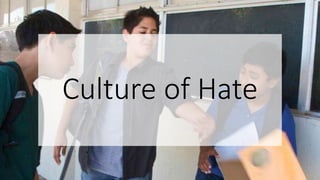
Culture of Hate
Glorification of the
Vulgar
Thrill of Viral Bashing
Self-Absorption
Epidemic
REALITY CHECK: Teens are now
40 percent lower in empathy levels
than three decades ago, and in the
same period, narcissism has
increased 58 percent.
Rise in Cases of Suicide
Rise in Cases of
Depression
If we really want our children
become caring people we must show
them ways to respond to another’s
concerns, distress, frustrations or
sorrow. It’s our best tactic to keep
their empathy capacities open, and
avoid the infamous Empathy Gap.
A great man shows his
greatness by the way he
treats little men.
Thomas Carlyle
–Johnny Appleseed
“Type a quote here.”
Research: student achievement
increases when students feel
comfortable in their learning
environment.
Gentleness and kindness
will make our homes a
paradise upon earth.
C. A. Bartol
A caring classroom is not only
comfortable,
it allows the teacher to spend
more time teaching and less time
handling student conflicts.
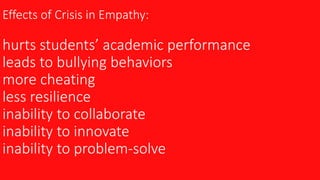
Effects of Crisis in Empathy:
hurts students’ academic performance
leads to bullying behaviors
more cheating
less resilience
inability to collaborate
inability to innovate
inability to problem-solve
18
Strategies to Win
the War
20
THE DAILY FOUR
1. Share good news (with a partner; 1 min
each).
2. Tell about someone or something you’re
grateful for (new partner; 1 min. each).
3. Affirm someone in the class.
4. Make us laugh. (Joke must be clean.)
—Hal Urban, Lessons from the Classroom: 20
Things Good Teachers Do
(www.halurban.com)
Comprehensive Character Education
BIG IDEA #1:
A high-quality, comprehensive
approach to character education is
the most effective way to develop
caring classrooms and schools—
and thereby reduce bullying.
The 12-point comprehensive approach to
character education. . .
. . . is intentional, deliberately seeking
to positively impact character
development through every phase of
school and classroom life.
School Climate Matters
Bullying is strongly related to overall school climate.
Bullying decreases when:
 school climate improves
 students have greater voice and responsibility for
solving problems and making decisions that improve
their school.
—Dr. Maurice Elias, Rutgers University (based on a study of more than 100
schools)
What Commercially Available
Bullying Prevention Programs
Work?
Educational Leadership (9/2011):
 A meta-analysis of 44 bullying prevention
programs found that fewer than half (19) were
effective.
 Vreeman & Carrroll analysis (2007):
Classroom curricula alone did not reduce bullying.
Programs found to be effective . . .
1. Work to create a school
climate where bullying is
socially unacceptable
2. Enlist the support of the
community
3. Increase supervision of
playground and other areas
Programs found to be effective . . .
4. Institute firm sanctions for
bullying
5. Use ongoing messages to
help students recognize
aggression and support and
stick up for victims.
28
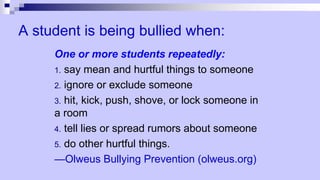
A student is being bullied when:
One or more students repeatedly:
1. say mean and hurtful things to someone
2. ignore or exclude someone
3. hit, kick, push, shove, or lock someone in
a room
4. tell lies or spread rumors about someone
5. do other hurtful things.
—Olweus Bullying Prevention (olweus.org)
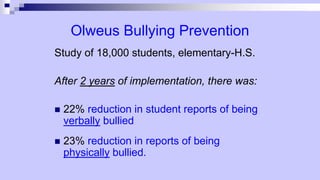
Olweus Bullying Prevention
Study of 18,000 students, elementary-H.S.
After 2 years of implementation, there was:
 22% reduction in student reports of being
verbally bullied
 23% reduction in reports of being
physically bullied.
The challenge:
 How to reduce the nearly 80% of the bullying
that remains even after implementing a state-
of-the-art bullying prevention program such as
Olweus?
Wherever there is a
human being, there is
an opportunity for a
kindness.
Lucius Annaeus Seneca
Answer:
A comprehensive character education
program that not only seeks to suppress the
negative behavior of bullying but also to
promote its psychological opposites:
virtues of respect, cooperation,
and kindness.
34
35
BIG IDEA #2:
Any virtue, and character as a
whole, has 3 parts:
 Knowing (habits of the mind)
 Feeling (habits of the heart)
 Behavior (habits of behavior)
36
Good Character:
You have to . . .
 know it in your head
 feel it in your heart
 show it with your hands.
Kindness makes a fellow
feel good whether it’s
being done to him or by
him.
Frank A. Clark
Young people develop character by what
they see, what they hear, and what they
are repeatedly led to do.
Directed practice is the most important
part.
—James Stenson, Compass: A Handbook of Parent
Leadership
39
40
BIG IDEA #3:
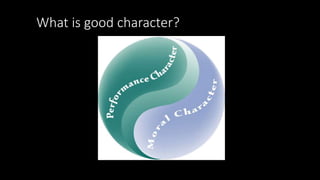
Students need MORAL
VIRTUES to become good
and behave ethically.
They need PERFORMANCE
VIRTUES to become smart
and do their best work.
What is good character?
41
SMART & GOOD SCHOOLS INITIATIVE
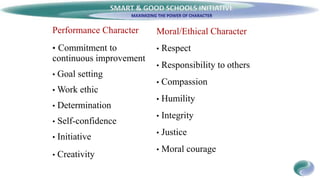
Performance Character
• Commitment to
continuous improvement
• Goal setting
• Work ethic
• Determination
• Self-confidence
• Initiative
• Creativity
Moral/Ethical Character
• Respect
• Responsibility to others
• Compassion
• Humility
• Integrity
• Justice
• Moral courage
SMART & GOOD SCHOOLS INITIATIVE
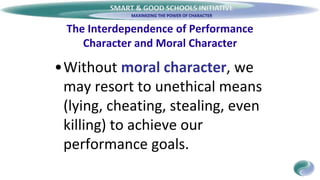
The Interdependence of Performance
Character and Moral Character
•Without moral character, we
may resort to unethical means
(lying, cheating, stealing, even
killing) to achieve our
performance goals.
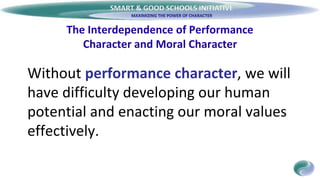
SMART & GOOD SCHOOLS INITIATIVE
The Interdependence of Performance
Character and Moral Character
Without performance character, we will
have difficulty developing our human
potential and enacting our moral values
effectively.
The Mission of Every School:
To develop performance
character and moral character—
best work and best behavior—
through an ethical learning
community.
SMART & GOOD SCHOOLS INITIATIVE
What is character education?
• The deliberate effort
• to develop moral and performance
virtues
• through every phase of school and
classroom life.
47
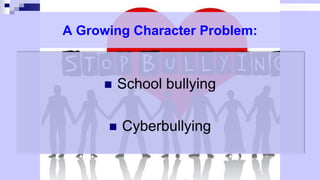
A Growing Character Problem:
 School bullying
 Cyberbullying
Children remind me of chickens, seeking out the
weak and wounded and pecking them to death.
They have discovered that my 9-year-old son,
who is autistic, is bothered by loud noises, and
they scream and whistle in his ear until he cries.
—A mother
Treat everyone with
respect and kindness.
Period. No exceptions.
Kiana Tom
When students are victims of peer cruelty, it:
 Interferes with their learning.
 Disrupts their social and moral
development.
 Makes school a miserable experience.
 Causes some to seek revenge.
 Causes others to become depressed and
even suicidal.
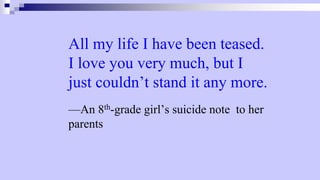
All my life I have been teased.
I love you very much, but I
just couldn’t stand it any more.
—An 8th-grade girl’s suicide note to her
parents
Kindness is showing
someone they
matter.
Unknown
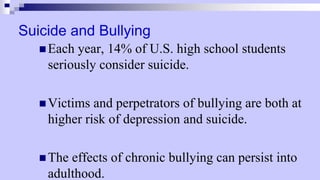
Suicide and Bullying
 Each year, 14% of U.S. high school students
seriously consider suicide.
 Victims and perpetrators of bullying are both at
higher risk of depression and suicide.
 The effects of chronic bullying can persist into
adulthood.
U.S. Secret Service Study:
Two-thirds of the student shooters had
been bullied by fellow students.
The Societal Costs of Bullying
 By adulthood, 60% of school
bullies will have a criminal
conviction.
The Educational Costs of Bullying
 Peer exclusion in kindergarten is
associated with lower academic
achievement in later grades.
 Even observing someone else being
bullied can lower a student’s
academic performance.
You can accomplish by
kindness what you
cannot by force.
Publilius Syrus
PROMOTING AUTHENTIC RESPECT
“We uphold standards of behavior which
honor the dignity and worth of all
individuals regardless of gender,
ethnicity, race, age, physical or mental
abilities, religious beliefs, sexual
orientation, or socioeconomic
background.”
3 Secrets of Success
1.Staff involvement
2.Student involvement
3.Parent involvement
When I was young, I used to
admire intelligent people;
as I grow older, I admire
kind people.
Abraham Joshua Heschel
“How to Make Your School a
School of Character”
 Ch. 11, Character Matters, p. 219
How to get staff involved
Create a Touchstone
pp. 220-221
Develop a school touchstone or
“way.”
Written by staff and students
together, the touchstone
expresses the school’s core
moral and performance values.
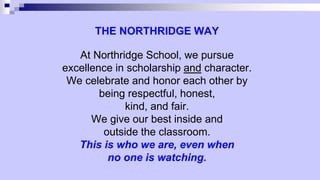
THE NORTHRIDGE WAY
At Northridge School, we pursue
excellence in scholarship and character.
We celebrate and honor each other by
being respectful, honest,
kind, and fair.
We give our best inside and
outside the classroom.
This is who we are, even when
no one is watching.
Be kind whenever
possible. It is always
possible.
Dalai Lama
THE ROOSEVELT WAY
“There’s a way that students here
are expected to act, and a way
that they expected not to act.”
—High School Counselor
Self-Study: Touchstone Implementation
Visibility
The touchstone is displayed in all
classrooms and included in all school
documents.
Academics
Teachers make connections with the
touchstone when teaching their subject
area.
Self-Study: Touchstone Implementation
Discipline
Staff refer to the touchstone when
disciplining.
New students
There is a plan for teaching the touchstone
to students who enroll during the school
year.
Ongoing Professional Development
 Regular staff sharing of best practices (through
buddy system, faculty and dept. meetings, etc.)
 Staff training in cooperative learning, class
meetings, and other key strategies
Kindness does
wonderful things to
a face.
Dixie Doyle
“Involve Students in Creating a
School of Character”
 Ch. 12, Character Matters, p. 247
How to get students involved
20 Kinds of Class Meetings
 How to Get Kids To Talk in Class Meetings
Educating for Character, T. Lickona,
Ch. 8
88
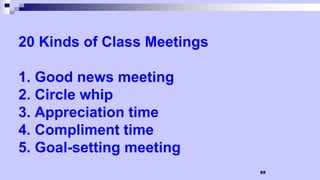
20 Kinds of Class Meetings
1. Good news meeting
2. Circle whip
3. Appreciation time
4. Compliment time
5. Goal-setting meeting
89
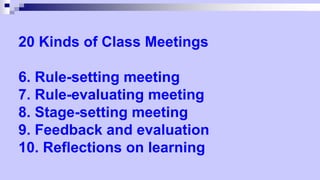
20 Kinds of Class Meetings
6. Rule-setting meeting
7. Rule-evaluating meeting
8. Stage-setting meeting
9. Feedback and evaluation
10. Reflections on learning
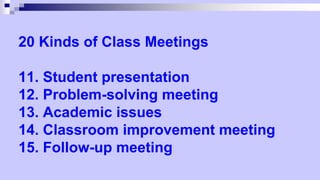
20 Kinds of Class Meetings
11. Student presentation
12. Problem-solving meeting
13. Academic issues
14. Classroom improvement meeting
15. Follow-up meeting
93
20 Kinds of Class Meetings
16. Planning meeting
17. Concept meeting
18. Sticky situations
19. Suggestion box/class business box
20. Meeting on meetings
Student Voice and Cyberbullying
 Challenge student gov’t: “What can
students, parents, and the school,
working together, do to prevent
cyberbullying?”
 Have schoolwide discussion, with delegates
from each classroom.
 Ask students to take responsibility for a
schoolwide campaign.
 Resource: www.stopcyberbullying.org
Get students to take responsibility:
 Counselors create anti-bullying
“intervention teams” at each grade level.
(Team members step in when they see
someone being picked on.)
 Students provide emotional support to
victims.
WELCOMING FRESHMEN
 Seniors plan and lead a half-day
welcome for the new freshmen.
The smallest act of kindness
is worth more than the
greatest intention.
Kahlil Gibran
FRESHMAN TRANSITION PROGRAM
 Older students are assigned as mentors to all
freshmen.
 The school trains the mentors.
 Mentors and their freshmen meet weekly.
BUDDY CLASSES
An older class is paired with a younger
class.
The buddy classes get together weekly or
bi-weekly.
The older kids read to their little buddies,
help them with their schoolwork, do a
special project together, and so on.
101
102
103
104
105
“Build a Strong Home-School
Partnership”
 Ch. 3, Character Matters, p. 60
How to get parents involved
Communicate to Parents
1. “Parents are the first and most
important character educators.”
2. “The school’s job is to reinforce
the character virtues being
taught at home.”
Expect Parents to Participate
There’s no such things as a
small act of kindness. Every
act creates a ripple with no
logical end.
Scott Adams
Get the Program to the Parents
Let parents know what the
school is doing in character
education—and how they can
help.
Parents and Cyber-Bullying
Send home guidelines to help
parents monitor kids’ online
activity.
Character Education Homework
 Parent and child, independently,
each make a list:
“Who are 5 of your heroes? Why?”
 Then compare and discuss lists.
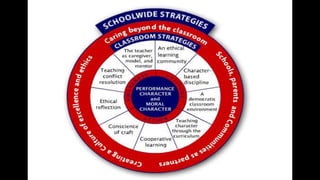
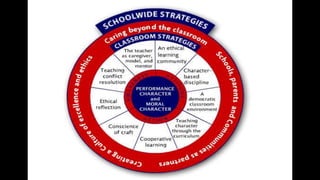
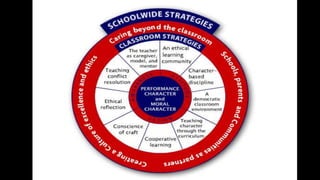
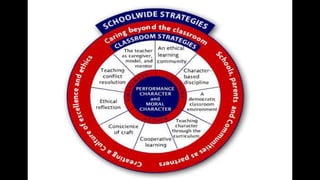
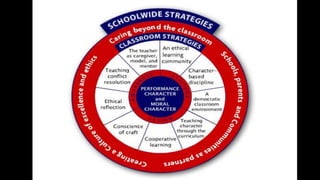
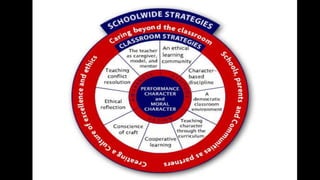
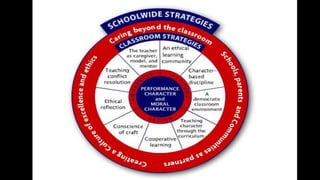
Component #1 (inner wheel)
The teacher as:
1. caregiver (building bonds)
2. model
3. mentor (moral and spiritual
guide/coach)
Kind people are the
best kind of people.
Research on Resilience
Resilient kids possess 4 strengths:
1. Social competence
2. Problem-solving skills
3. A sense of identity
4. Hope for the future.
They often cite a “special teacher” who
was a confidant and an inspiring role
model.
Kind words can be short
and easy to speak but their
echoes are truly endless.
Mother Teresa
118
The Difference a Teacher Makes
“I was a bully before I came to this
school. I used to make little kids cry.
“When I met Mrs. Brown, I changed.
I’m not a bully anymore, because
Mrs. Brown taught me about
character.”
—a 6th-grade boy
119
Never lose a chance of
saying a kind word.
William Makepeace Thackeray
“Help Me Know Your Child”
Jenny Carnahan, 4th-grade teacher, sends
home a questionnaire:
 List 5 words that describe your child’s
character or personality
 What motivates your child?
 What upsets your child?
 What are your child’s outside of school
interests?
 What else should I know?
Who are you? (high school)
Your answers will remain private. Skip any you wish. Feel
free to ask me the same Q’s.
1. What’s your favorite leisure-time
activity?
2. What’s something you do well?
3. What would you like to do for
work/career?
4. What are two words that describe
you? —Hal Urban, Lessons from the
Classroom: 20 Things Good Teachers Do
Who are you? (high school)
Your answers will remain private. Skip any you wish. Feel
free to ask me the same Q’s.
5. What is your best quality?
6. What do you like most about
school? Least?
7. What co-curricular activities are
you involved in?
8. What else would you like me to
know about you?
—Hal Urban, Lessons from the Classroom: 20 Things
Good Teachers Do
124
Handshake at the Door
 “In the second it takes me to shake a
hand, I renew my relationship with
that student.”
 “I can tell in a heartbeat what kind of
a day a kid is having. You can nip
problems in the bud at the door.”
125
Teacher’s Corner
1. In my Teacher’s Corner, I display pictures
of my husband, children, and dog; photos
of classes I taught when I lived in
California; my college diploma; favorite
books; sports I enjoy; and other things
that reflect my interests.
126
Teacher’s Corner
2. During the first few weeks, I meet with
each of my kids in the Teachers Corner
for about 10 minutes. They bring an “All
About Me” book they’ve made. These
conversations have given me a closer
relationship with each child.
127
128
Teacher as Model: Self-Inventory
1. Do I warmly greet each student?
2. Do I seek other opportunities to connect with
each student?
3. Am I well-prepared for class? On time?
4. Do I model patience and courtesy, even
under stress?
5. Do I treat my all students impartially?
6. Do I challenge all of them to do their best
work?
129
Teacher as Mentor:
Quote of the day
Life is 10% what happens to
me and 90% how I react to it.
—Charles Swindoll
Component #2
A caring classroom community
1. Students know each other.
2. Students affirm and care about
each other.
3. Every student feels like a valued
member of the group.
Seat Lottery
Janet Fagal, 5th-grade teacher:
1. Struggled with cliques.
2. She arranged desks in a “U” and
gave each a number.
3. At the end of the week, students
drew a number—their new desk for
the next week. It changed the social
chemistry of the class.
The Two-Minute Interview
2-Minute Interviews
“I used the first 4 minutes of every class during the first month of
school to have students do paired 2-minute interviews (they had to
finish it on their own in the next 3 weeks):
1. What’s something you own that’s special to you?
2. What’s your proudest achievement so far?
3. What’s an important goal you have for your life?
4. A special interest you have?
5. Who is someone you greatly admire? Why?
6. A question of your choice.
—Hal Urban, Lessons from the Classroom
 They had to fill in a sheet with the information for every
class member—and turn it in, as with any assignment.
 We continued until every student had interviewed every
other student. They were required to interview me as
well, and I interviewed each of them.
 My students loved this activity. After 3 weeks, we all
knew each other well.
The first test asks them to list the names of all class
members.
136
Anonymous Compliments
1. Each student draws the name of a classmate.
2. By the week’s end, the student writes an
anonymous compliment about that person on a
strip of paper, shows it to the teacher, and puts
it in the Compliment Box.
3. On Friday, the teacher posts all the
compliments on the bulletin board.
PEERS AFFIRMING PEERS
At the end of the day:
 “Who saw kindness today?”
 “Who saw respect?”
 “Who saw determination?”
 “Who saw sharing?”
—Jenna Smith, 3rd-grade teacher
Practice Kindness
At the start of the day, all students take out
their Good Deeds Journal and write:
1. A good deed I did yesterday . . .
2. A good deed I will do today . . .
In all subjects, teachers make a connection to
the good deeds theme.
Component #3
 Character-Based Discipline
141
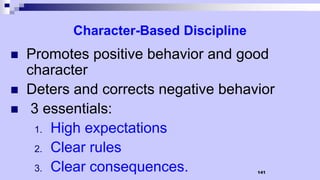
Character-Based Discipline
 Promotes positive behavior and good
character
 Deters and corrects negative behavior
 3 essentials:
1. High expectations
2. Clear rules
3. Clear consequences.
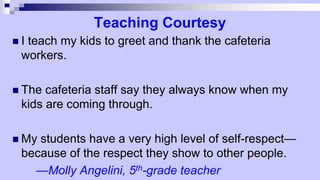
Teaching Courtesy
 I teach my kids to greet and thank the cafeteria
workers.
 The cafeteria staff say they always know when my
kids are coming through.
 My students have a very high level of self-respect—
because of the respect they show to other people.
—Molly Angelini, 5th-grade teacher
143
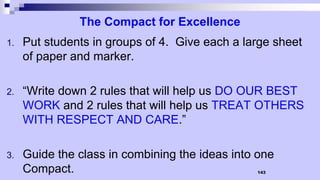
The Compact for Excellence
1. Put students in groups of 4. Give each a large sheet
of paper and marker.
2. “Write down 2 rules that will help us DO OUR BEST
WORK and 2 rules that will help us TREAT OTHERS
WITH RESPECT AND CARE.”
3. Guide the class in combining the ideas into one
Compact.
SMART & GOOD SCHOOLS INITIATIVE
144
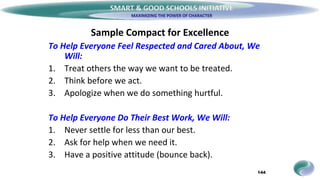
Sample Compact for Excellence
To Help Everyone Feel Respected and Cared About, We
Will:
1. Treat others the way we want to be treated.
2. Think before we act.
3. Apologize when we do something hurtful.
To Help Everyone Do Their Best Work, We Will:
1. Never settle for less than our best.
2. Ask for help when we need it.
3. Have a positive attitude (bounce back).
SMART & GOOD SCHOOLS INITIATIVE
145
Behavior contracts have proved
helpful with kids who bully.
“I will not hit or hurt anyone. If I do, I will
have to call my parents and report what I
did.”
146
Have Kids Make Up for What
They Did (Restitution):
“If a student calls someone a
name, or is unkind in any other
way, I ask that child to write a
sincere letter of apology to the
person he or she has offended.”
Component #4
 A democratic classroom
environment
CLASS MEETINGS
1. involve students in shared decision
making that gives them responsibility for
making the classroom the best it can be.
2. a face-to-face, interactive circle
discussion
3. can deal with problems (cutting in lunch
line, put-downs, homework issues) or
help to plan upcoming events (the day, a
field trip, a cooperative activity, the next
unit).
Weekly H.S. Class Meetings
 “Weekly class meetings are important for
discussing and role-playing what bystanders can
do.”
 Resource: Class Meetings That Matter
—Olweus program (www.olweus.org)
151
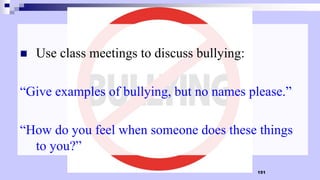
 Use class meetings to discuss bullying:
“Give examples of bullying, but no names please.”
“How do you feel when someone does these things
to you?”
Component #8
 Ethical reflection
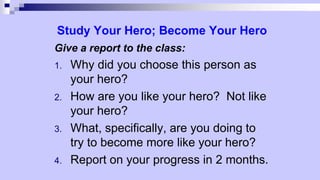
Study Your Hero; Become Your Hero
Give a report to the class:
1. Why did you choose this person as
your hero?
2. How are you like your hero? Not like
your hero?
3. What, specifically, are you doing to
try to become more like your hero?
4. Report on your progress in 2 months.
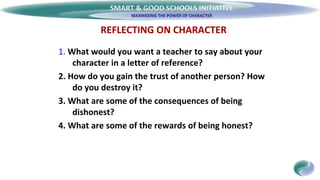
SMART & GOOD SCHOOLS INITIATIVE
REFLECTING ON CHARACTER
1. What would you want a teacher to say about your
character in a letter of reference?
2. How do you gain the trust of another person? How
do you destroy it?
3. What are some of the consequences of being
dishonest?
4. What are some of the rewards of being honest?
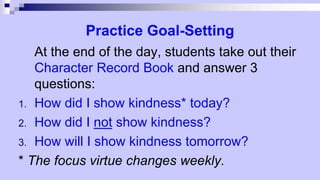
Practice Goal-Setting
At the end of the day, students take out their
Character Record Book and answer 3
questions:
1. How did I show kindness* today?
2. How did I not show kindness?
3. How will I show kindness tomorrow?
* The focus virtue changes weekly.
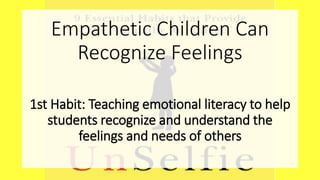
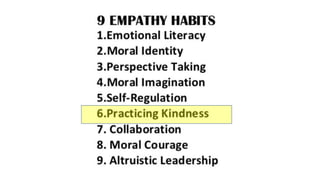
Empathetic Children Can
Recognize Feelings
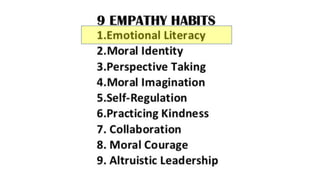
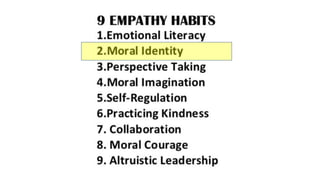
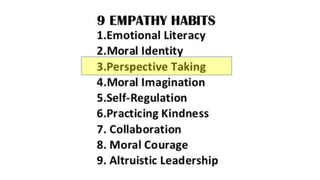
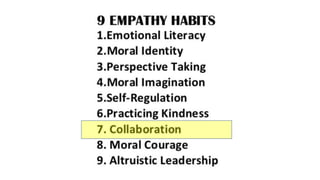
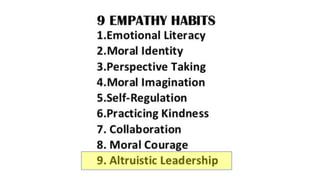
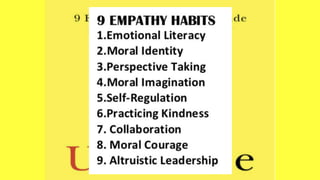
1st Habit: Teaching emotional literacy to help
students recognize and understand the
feelings and needs of others
Be pitiful, for every
man is fighting a
hard battle.
Ian Maclaren
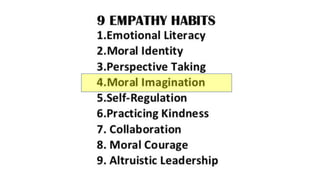
Empathetic Children Have a
“Moral Identity”
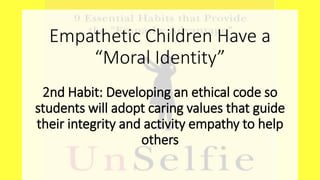
2nd Habit: Developing an ethical code so
students will adopt caring values that guide
their integrity and activity empathy to help
others
Empathetic Children Understand
the Needs of Others
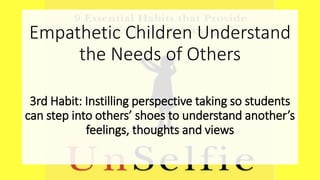
3rd Habit: Instilling perspective taking so students
can step into others’ shoes to understand another’s
feelings, thoughts and views
Kindness has converted
more sinners than zeal,
eloquence or learning.
Frederick W. Faber
Empathetic Children Have A
“Moral Imagination”
4th Habit: Instilling a moral imagination so students
can use literature, films and emotionally- charged
imaged as a source of inspiration to feel with others
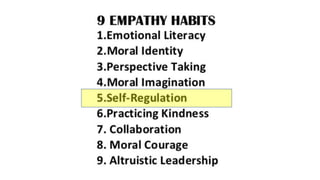
Empathetic Children Can Keep
Their Cool
5th Habit: Mastering self-regulation to help
students learn to manage strong emotions and
reduce personal distress so they can help
others
A single sunbeam is
enough to drive away
many shadows.
Francis of Assis
Empathetic Children Practice
Kindness
6th Habit: Developing and exercising
compassion to increase students’ concern
about the welfare and feelings of others
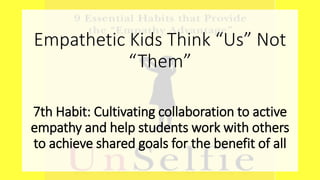
Empathetic Kids Think “Us” Not
“Them”
7th Habit: Cultivating collaboration to active
empathy and help students work with others
to achieve shared goals for the benefit of all
Kindness gives birth
to kindness.
Sophocles
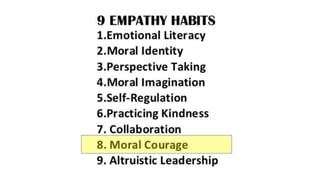
Empathetic Kids Stick Their Necks
Out
8th Habit: Promoting moral courage to
embolden kids to speak out, step in and help
others
Empathetic Kids Want to Make a
Difference
9th Habit: Cultivating altruistic leadership
abilities to motivate students to make a
difference for others, no matter how small it
may be, and become Changemakers
Kind words do not cost
much. Yet they
accomplish much.
Blaise Pascal
8 CONCRETE STRATEGIES THAT
HELP RAISE CARING CHILDREN
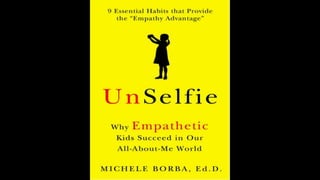
UnSelfie: Why Empathetic Kids Succeed In
Our All- About-Me World
1. Look Face-to-Face
A simple way to increase face
to face connection is to enforce
one habit: “Always look at the
color of the talker’s eyes.”
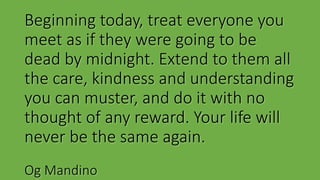
Beginning today, treat everyone you
meet as if they were going to be
dead by midnight. Extend to them all
the care, kindness and understanding
you can muster, and do it with no
thought of any reward. Your life will
never be the same again.
Og Mandino
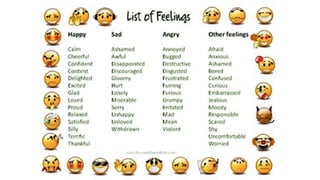
2. Use More Emotion
Words
3. Praise Caring
Actions
A study found that praising children’s
character traits rather than their behavior
helped them internalize caring as part of their
identities. The character-praised kids were
also more likely to be more generous than
those children who were told that they had
donated because they were expected to do.
4. Use Discipline to
Redo Uncaring
Behavior
5. Capture Caring
Moments
Make sure to display prominently
photos of your kids engaged in
kind and thoughtful endeavors so
they recognize that “caring
matters.”
6. Use Real Events,
Books, and News
Help stretch your child’s
perspective-taking skills (the
cognitive part of empathy)
using spontaneous everyday
moments.
In books: “Take the bears’ side. How would
you feel if Goldilocks used your beds and
chairs without asking?”
In the news: “The cyclone destroyed most of
those children’s homes. What do you think
those kids are feeling and thinking? What do
you think we can do to help?”
In your family: “How does Dad feel hearing
that his mom is so sick?” Don’t overlook
asking: “I wonder if there’s a way we can
help?”
7. Be a Caring Role
Model
One of the greatest questions to ask yourself
each day is: “If I were the only example my
child had to learn kindness and empathy, what
did she learn today?”
8.Reflect On
Kindness
So instead of always asking, “What did you
learn today?” or “What grade did you get?”
include:
“What’s something you did
that was kind?”
“What kind thing did you see
someone do?”
“… children are hard-wired
to care, but their capacity
for empathy must be
nurtured …”
Three things in human life
are important. The first is to
be kind. The second is to be
kind. And the third is to be
kind.
Henry James
info@mannrentoy.com
0908-864-84-91
www.mannrentoy.com
Creating Kind and Caring Classroom

Creating Kind and Caring Classroom

  • 2.
    While we maybe producing a smart, self-assured generation of young people, today’s kids are also the most self-centered and stressed-out on record.
  • 3.
  • 4.
  • 5.
  • 6.
  • 7.
    REALITY CHECK: Teensare now 40 percent lower in empathy levels than three decades ago, and in the same period, narcissism has increased 58 percent.
  • 8.
    Rise in Casesof Suicide
  • 9.
    Rise in Casesof Depression
  • 10.
    If we reallywant our children become caring people we must show them ways to respond to another’s concerns, distress, frustrations or sorrow. It’s our best tactic to keep their empathy capacities open, and avoid the infamous Empathy Gap.
  • 11.
    A great manshows his greatness by the way he treats little men. Thomas Carlyle
  • 12.
  • 13.
    Research: student achievement increaseswhen students feel comfortable in their learning environment.
  • 14.
    Gentleness and kindness willmake our homes a paradise upon earth. C. A. Bartol
  • 16.
    A caring classroomis not only comfortable, it allows the teacher to spend more time teaching and less time handling student conflicts.
  • 17.
    Effects of Crisisin Empathy: hurts students’ academic performance leads to bullying behaviors more cheating less resilience inability to collaborate inability to innovate inability to problem-solve
  • 18.
  • 20.
    20 THE DAILY FOUR 1.Share good news (with a partner; 1 min each). 2. Tell about someone or something you’re grateful for (new partner; 1 min. each). 3. Affirm someone in the class. 4. Make us laugh. (Joke must be clean.) —Hal Urban, Lessons from the Classroom: 20 Things Good Teachers Do (www.halurban.com)
  • 21.
    Comprehensive Character Education BIGIDEA #1: A high-quality, comprehensive approach to character education is the most effective way to develop caring classrooms and schools— and thereby reduce bullying.
  • 23.
    The 12-point comprehensiveapproach to character education. . . . . . is intentional, deliberately seeking to positively impact character development through every phase of school and classroom life.
  • 24.
    School Climate Matters Bullyingis strongly related to overall school climate. Bullying decreases when:  school climate improves  students have greater voice and responsibility for solving problems and making decisions that improve their school. —Dr. Maurice Elias, Rutgers University (based on a study of more than 100 schools)
  • 25.
    What Commercially Available BullyingPrevention Programs Work? Educational Leadership (9/2011):  A meta-analysis of 44 bullying prevention programs found that fewer than half (19) were effective.  Vreeman & Carrroll analysis (2007): Classroom curricula alone did not reduce bullying.
  • 26.
    Programs found tobe effective . . . 1. Work to create a school climate where bullying is socially unacceptable 2. Enlist the support of the community 3. Increase supervision of playground and other areas
  • 27.
    Programs found tobe effective . . . 4. Institute firm sanctions for bullying 5. Use ongoing messages to help students recognize aggression and support and stick up for victims.
  • 28.
  • 29.
    A student isbeing bullied when: One or more students repeatedly: 1. say mean and hurtful things to someone 2. ignore or exclude someone 3. hit, kick, push, shove, or lock someone in a room 4. tell lies or spread rumors about someone 5. do other hurtful things. —Olweus Bullying Prevention (olweus.org)
  • 30.
    Olweus Bullying Prevention Studyof 18,000 students, elementary-H.S. After 2 years of implementation, there was:  22% reduction in student reports of being verbally bullied  23% reduction in reports of being physically bullied.
  • 31.
    The challenge:  Howto reduce the nearly 80% of the bullying that remains even after implementing a state- of-the-art bullying prevention program such as Olweus?
  • 32.
    Wherever there isa human being, there is an opportunity for a kindness. Lucius Annaeus Seneca
  • 33.
    Answer: A comprehensive charactereducation program that not only seeks to suppress the negative behavior of bullying but also to promote its psychological opposites: virtues of respect, cooperation, and kindness.
  • 34.
  • 35.
    35 BIG IDEA #2: Anyvirtue, and character as a whole, has 3 parts:  Knowing (habits of the mind)  Feeling (habits of the heart)  Behavior (habits of behavior)
  • 36.
    36 Good Character: You haveto . . .  know it in your head  feel it in your heart  show it with your hands.
  • 37.
    Kindness makes afellow feel good whether it’s being done to him or by him. Frank A. Clark
  • 38.
    Young people developcharacter by what they see, what they hear, and what they are repeatedly led to do. Directed practice is the most important part. —James Stenson, Compass: A Handbook of Parent Leadership
  • 39.
  • 40.
    40 BIG IDEA #3: Studentsneed MORAL VIRTUES to become good and behave ethically. They need PERFORMANCE VIRTUES to become smart and do their best work.
  • 41.
    What is goodcharacter? 41
  • 42.
    SMART & GOODSCHOOLS INITIATIVE Performance Character • Commitment to continuous improvement • Goal setting • Work ethic • Determination • Self-confidence • Initiative • Creativity Moral/Ethical Character • Respect • Responsibility to others • Compassion • Humility • Integrity • Justice • Moral courage
  • 43.
    SMART & GOODSCHOOLS INITIATIVE The Interdependence of Performance Character and Moral Character •Without moral character, we may resort to unethical means (lying, cheating, stealing, even killing) to achieve our performance goals.
  • 44.
    SMART & GOODSCHOOLS INITIATIVE The Interdependence of Performance Character and Moral Character Without performance character, we will have difficulty developing our human potential and enacting our moral values effectively.
  • 45.
    The Mission ofEvery School: To develop performance character and moral character— best work and best behavior— through an ethical learning community.
  • 46.
    SMART & GOODSCHOOLS INITIATIVE What is character education? • The deliberate effort • to develop moral and performance virtues • through every phase of school and classroom life.
  • 47.
  • 48.
    A Growing CharacterProblem:  School bullying  Cyberbullying
  • 49.
    Children remind meof chickens, seeking out the weak and wounded and pecking them to death. They have discovered that my 9-year-old son, who is autistic, is bothered by loud noises, and they scream and whistle in his ear until he cries. —A mother
  • 50.
    Treat everyone with respectand kindness. Period. No exceptions. Kiana Tom
  • 52.
    When students arevictims of peer cruelty, it:  Interferes with their learning.  Disrupts their social and moral development.  Makes school a miserable experience.  Causes some to seek revenge.  Causes others to become depressed and even suicidal.
  • 53.
    All my lifeI have been teased. I love you very much, but I just couldn’t stand it any more. —An 8th-grade girl’s suicide note to her parents
  • 54.
    Kindness is showing someonethey matter. Unknown
  • 56.
    Suicide and Bullying Each year, 14% of U.S. high school students seriously consider suicide.  Victims and perpetrators of bullying are both at higher risk of depression and suicide.  The effects of chronic bullying can persist into adulthood.
  • 57.
    U.S. Secret ServiceStudy: Two-thirds of the student shooters had been bullied by fellow students.
  • 58.
    The Societal Costsof Bullying  By adulthood, 60% of school bullies will have a criminal conviction.
  • 59.
    The Educational Costsof Bullying  Peer exclusion in kindergarten is associated with lower academic achievement in later grades.  Even observing someone else being bullied can lower a student’s academic performance.
  • 60.
    You can accomplishby kindness what you cannot by force. Publilius Syrus
  • 61.
    PROMOTING AUTHENTIC RESPECT “Weuphold standards of behavior which honor the dignity and worth of all individuals regardless of gender, ethnicity, race, age, physical or mental abilities, religious beliefs, sexual orientation, or socioeconomic background.”
  • 62.
    3 Secrets ofSuccess 1.Staff involvement 2.Student involvement 3.Parent involvement
  • 63.
    When I wasyoung, I used to admire intelligent people; as I grow older, I admire kind people. Abraham Joshua Heschel
  • 64.
    “How to MakeYour School a School of Character”  Ch. 11, Character Matters, p. 219 How to get staff involved
  • 65.
  • 66.
    Develop a schooltouchstone or “way.” Written by staff and students together, the touchstone expresses the school’s core moral and performance values.
  • 67.
    THE NORTHRIDGE WAY AtNorthridge School, we pursue excellence in scholarship and character. We celebrate and honor each other by being respectful, honest, kind, and fair. We give our best inside and outside the classroom. This is who we are, even when no one is watching.
  • 68.
    Be kind whenever possible.It is always possible. Dalai Lama
  • 69.
    THE ROOSEVELT WAY “There’sa way that students here are expected to act, and a way that they expected not to act.” —High School Counselor
  • 70.
    Self-Study: Touchstone Implementation Visibility Thetouchstone is displayed in all classrooms and included in all school documents. Academics Teachers make connections with the touchstone when teaching their subject area.
  • 71.
    Self-Study: Touchstone Implementation Discipline Staffrefer to the touchstone when disciplining. New students There is a plan for teaching the touchstone to students who enroll during the school year.
  • 72.
    Ongoing Professional Development Regular staff sharing of best practices (through buddy system, faculty and dept. meetings, etc.)  Staff training in cooperative learning, class meetings, and other key strategies
  • 86.
    Kindness does wonderful thingsto a face. Dixie Doyle
  • 87.
    “Involve Students inCreating a School of Character”  Ch. 12, Character Matters, p. 247 How to get students involved
  • 88.
    20 Kinds ofClass Meetings  How to Get Kids To Talk in Class Meetings Educating for Character, T. Lickona, Ch. 8 88
  • 89.
    20 Kinds ofClass Meetings 1. Good news meeting 2. Circle whip 3. Appreciation time 4. Compliment time 5. Goal-setting meeting 89
  • 91.
    20 Kinds ofClass Meetings 6. Rule-setting meeting 7. Rule-evaluating meeting 8. Stage-setting meeting 9. Feedback and evaluation 10. Reflections on learning
  • 92.
    20 Kinds ofClass Meetings 11. Student presentation 12. Problem-solving meeting 13. Academic issues 14. Classroom improvement meeting 15. Follow-up meeting
  • 93.
  • 94.
    20 Kinds ofClass Meetings 16. Planning meeting 17. Concept meeting 18. Sticky situations 19. Suggestion box/class business box 20. Meeting on meetings
  • 95.
    Student Voice andCyberbullying  Challenge student gov’t: “What can students, parents, and the school, working together, do to prevent cyberbullying?”  Have schoolwide discussion, with delegates from each classroom.  Ask students to take responsibility for a schoolwide campaign.  Resource: www.stopcyberbullying.org
  • 96.
    Get students totake responsibility:  Counselors create anti-bullying “intervention teams” at each grade level. (Team members step in when they see someone being picked on.)  Students provide emotional support to victims.
  • 97.
    WELCOMING FRESHMEN  Seniorsplan and lead a half-day welcome for the new freshmen.
  • 98.
    The smallest actof kindness is worth more than the greatest intention. Kahlil Gibran
  • 99.
    FRESHMAN TRANSITION PROGRAM Older students are assigned as mentors to all freshmen.  The school trains the mentors.  Mentors and their freshmen meet weekly.
  • 100.
    BUDDY CLASSES An olderclass is paired with a younger class. The buddy classes get together weekly or bi-weekly. The older kids read to their little buddies, help them with their schoolwork, do a special project together, and so on.
  • 101.
  • 102.
  • 103.
  • 104.
  • 105.
  • 106.
    “Build a StrongHome-School Partnership”  Ch. 3, Character Matters, p. 60 How to get parents involved
  • 107.
    Communicate to Parents 1.“Parents are the first and most important character educators.” 2. “The school’s job is to reinforce the character virtues being taught at home.”
  • 108.
    Expect Parents toParticipate
  • 109.
    There’s no suchthings as a small act of kindness. Every act creates a ripple with no logical end. Scott Adams
  • 110.
    Get the Programto the Parents Let parents know what the school is doing in character education—and how they can help.
  • 111.
    Parents and Cyber-Bullying Sendhome guidelines to help parents monitor kids’ online activity.
  • 112.
    Character Education Homework Parent and child, independently, each make a list: “Who are 5 of your heroes? Why?”  Then compare and discuss lists.
  • 114.
    Component #1 (innerwheel) The teacher as: 1. caregiver (building bonds) 2. model 3. mentor (moral and spiritual guide/coach)
  • 115.
    Kind people arethe best kind of people.
  • 116.
    Research on Resilience Resilientkids possess 4 strengths: 1. Social competence 2. Problem-solving skills 3. A sense of identity 4. Hope for the future. They often cite a “special teacher” who was a confidant and an inspiring role model.
  • 117.
    Kind words canbe short and easy to speak but their echoes are truly endless. Mother Teresa
  • 118.
    118 The Difference aTeacher Makes “I was a bully before I came to this school. I used to make little kids cry. “When I met Mrs. Brown, I changed. I’m not a bully anymore, because Mrs. Brown taught me about character.” —a 6th-grade boy
  • 119.
  • 120.
    Never lose achance of saying a kind word. William Makepeace Thackeray
  • 121.
    “Help Me KnowYour Child” Jenny Carnahan, 4th-grade teacher, sends home a questionnaire:  List 5 words that describe your child’s character or personality  What motivates your child?  What upsets your child?  What are your child’s outside of school interests?  What else should I know?
  • 122.
    Who are you?(high school) Your answers will remain private. Skip any you wish. Feel free to ask me the same Q’s. 1. What’s your favorite leisure-time activity? 2. What’s something you do well? 3. What would you like to do for work/career? 4. What are two words that describe you? —Hal Urban, Lessons from the Classroom: 20 Things Good Teachers Do
  • 123.
    Who are you?(high school) Your answers will remain private. Skip any you wish. Feel free to ask me the same Q’s. 5. What is your best quality? 6. What do you like most about school? Least? 7. What co-curricular activities are you involved in? 8. What else would you like me to know about you? —Hal Urban, Lessons from the Classroom: 20 Things Good Teachers Do
  • 124.
    124 Handshake at theDoor  “In the second it takes me to shake a hand, I renew my relationship with that student.”  “I can tell in a heartbeat what kind of a day a kid is having. You can nip problems in the bud at the door.”
  • 125.
    125 Teacher’s Corner 1. Inmy Teacher’s Corner, I display pictures of my husband, children, and dog; photos of classes I taught when I lived in California; my college diploma; favorite books; sports I enjoy; and other things that reflect my interests.
  • 126.
    126 Teacher’s Corner 2. Duringthe first few weeks, I meet with each of my kids in the Teachers Corner for about 10 minutes. They bring an “All About Me” book they’ve made. These conversations have given me a closer relationship with each child.
  • 127.
  • 128.
    128 Teacher as Model:Self-Inventory 1. Do I warmly greet each student? 2. Do I seek other opportunities to connect with each student? 3. Am I well-prepared for class? On time? 4. Do I model patience and courtesy, even under stress? 5. Do I treat my all students impartially? 6. Do I challenge all of them to do their best work?
  • 129.
    129 Teacher as Mentor: Quoteof the day Life is 10% what happens to me and 90% how I react to it. —Charles Swindoll
  • 131.
    Component #2 A caringclassroom community 1. Students know each other. 2. Students affirm and care about each other. 3. Every student feels like a valued member of the group.
  • 132.
    Seat Lottery Janet Fagal,5th-grade teacher: 1. Struggled with cliques. 2. She arranged desks in a “U” and gave each a number. 3. At the end of the week, students drew a number—their new desk for the next week. It changed the social chemistry of the class.
  • 133.
  • 134.
    2-Minute Interviews “I usedthe first 4 minutes of every class during the first month of school to have students do paired 2-minute interviews (they had to finish it on their own in the next 3 weeks): 1. What’s something you own that’s special to you? 2. What’s your proudest achievement so far? 3. What’s an important goal you have for your life? 4. A special interest you have? 5. Who is someone you greatly admire? Why? 6. A question of your choice. —Hal Urban, Lessons from the Classroom
  • 135.
     They hadto fill in a sheet with the information for every class member—and turn it in, as with any assignment.  We continued until every student had interviewed every other student. They were required to interview me as well, and I interviewed each of them.  My students loved this activity. After 3 weeks, we all knew each other well. The first test asks them to list the names of all class members.
  • 136.
    136 Anonymous Compliments 1. Eachstudent draws the name of a classmate. 2. By the week’s end, the student writes an anonymous compliment about that person on a strip of paper, shows it to the teacher, and puts it in the Compliment Box. 3. On Friday, the teacher posts all the compliments on the bulletin board.
  • 137.
    PEERS AFFIRMING PEERS Atthe end of the day:  “Who saw kindness today?”  “Who saw respect?”  “Who saw determination?”  “Who saw sharing?” —Jenna Smith, 3rd-grade teacher
  • 138.
    Practice Kindness At thestart of the day, all students take out their Good Deeds Journal and write: 1. A good deed I did yesterday . . . 2. A good deed I will do today . . . In all subjects, teachers make a connection to the good deeds theme.
  • 140.
  • 141.
    141 Character-Based Discipline  Promotespositive behavior and good character  Deters and corrects negative behavior  3 essentials: 1. High expectations 2. Clear rules 3. Clear consequences.
  • 142.
    Teaching Courtesy  Iteach my kids to greet and thank the cafeteria workers.  The cafeteria staff say they always know when my kids are coming through.  My students have a very high level of self-respect— because of the respect they show to other people. —Molly Angelini, 5th-grade teacher
  • 143.
    143 The Compact forExcellence 1. Put students in groups of 4. Give each a large sheet of paper and marker. 2. “Write down 2 rules that will help us DO OUR BEST WORK and 2 rules that will help us TREAT OTHERS WITH RESPECT AND CARE.” 3. Guide the class in combining the ideas into one Compact.
  • 144.
    SMART & GOODSCHOOLS INITIATIVE 144 Sample Compact for Excellence To Help Everyone Feel Respected and Cared About, We Will: 1. Treat others the way we want to be treated. 2. Think before we act. 3. Apologize when we do something hurtful. To Help Everyone Do Their Best Work, We Will: 1. Never settle for less than our best. 2. Ask for help when we need it. 3. Have a positive attitude (bounce back).
  • 145.
    SMART & GOODSCHOOLS INITIATIVE 145 Behavior contracts have proved helpful with kids who bully. “I will not hit or hurt anyone. If I do, I will have to call my parents and report what I did.”
  • 146.
    146 Have Kids MakeUp for What They Did (Restitution): “If a student calls someone a name, or is unkind in any other way, I ask that child to write a sincere letter of apology to the person he or she has offended.”
  • 148.
    Component #4  Ademocratic classroom environment
  • 149.
    CLASS MEETINGS 1. involvestudents in shared decision making that gives them responsibility for making the classroom the best it can be. 2. a face-to-face, interactive circle discussion 3. can deal with problems (cutting in lunch line, put-downs, homework issues) or help to plan upcoming events (the day, a field trip, a cooperative activity, the next unit).
  • 150.
    Weekly H.S. ClassMeetings  “Weekly class meetings are important for discussing and role-playing what bystanders can do.”  Resource: Class Meetings That Matter —Olweus program (www.olweus.org)
  • 151.
    151  Use classmeetings to discuss bullying: “Give examples of bullying, but no names please.” “How do you feel when someone does these things to you?”
  • 153.
  • 154.
    Study Your Hero;Become Your Hero Give a report to the class: 1. Why did you choose this person as your hero? 2. How are you like your hero? Not like your hero? 3. What, specifically, are you doing to try to become more like your hero? 4. Report on your progress in 2 months.
  • 155.
    SMART & GOODSCHOOLS INITIATIVE REFLECTING ON CHARACTER 1. What would you want a teacher to say about your character in a letter of reference? 2. How do you gain the trust of another person? How do you destroy it? 3. What are some of the consequences of being dishonest? 4. What are some of the rewards of being honest?
  • 156.
    Practice Goal-Setting At theend of the day, students take out their Character Record Book and answer 3 questions: 1. How did I show kindness* today? 2. How did I not show kindness? 3. How will I show kindness tomorrow? * The focus virtue changes weekly.
  • 159.
    Empathetic Children Can RecognizeFeelings 1st Habit: Teaching emotional literacy to help students recognize and understand the feelings and needs of others
  • 160.
    Be pitiful, forevery man is fighting a hard battle. Ian Maclaren
  • 162.
    Empathetic Children Havea “Moral Identity” 2nd Habit: Developing an ethical code so students will adopt caring values that guide their integrity and activity empathy to help others
  • 164.
    Empathetic Children Understand theNeeds of Others 3rd Habit: Instilling perspective taking so students can step into others’ shoes to understand another’s feelings, thoughts and views
  • 165.
    Kindness has converted moresinners than zeal, eloquence or learning. Frederick W. Faber
  • 167.
    Empathetic Children HaveA “Moral Imagination” 4th Habit: Instilling a moral imagination so students can use literature, films and emotionally- charged imaged as a source of inspiration to feel with others
  • 169.
    Empathetic Children CanKeep Their Cool 5th Habit: Mastering self-regulation to help students learn to manage strong emotions and reduce personal distress so they can help others
  • 170.
    A single sunbeamis enough to drive away many shadows. Francis of Assis
  • 172.
    Empathetic Children Practice Kindness 6thHabit: Developing and exercising compassion to increase students’ concern about the welfare and feelings of others
  • 174.
    Empathetic Kids Think“Us” Not “Them” 7th Habit: Cultivating collaboration to active empathy and help students work with others to achieve shared goals for the benefit of all
  • 175.
    Kindness gives birth tokindness. Sophocles
  • 177.
    Empathetic Kids StickTheir Necks Out 8th Habit: Promoting moral courage to embolden kids to speak out, step in and help others
  • 179.
    Empathetic Kids Wantto Make a Difference 9th Habit: Cultivating altruistic leadership abilities to motivate students to make a difference for others, no matter how small it may be, and become Changemakers
  • 180.
    Kind words donot cost much. Yet they accomplish much. Blaise Pascal
  • 182.
    8 CONCRETE STRATEGIESTHAT HELP RAISE CARING CHILDREN UnSelfie: Why Empathetic Kids Succeed In Our All- About-Me World
  • 183.
  • 184.
    A simple wayto increase face to face connection is to enforce one habit: “Always look at the color of the talker’s eyes.”
  • 185.
    Beginning today, treateveryone you meet as if they were going to be dead by midnight. Extend to them all the care, kindness and understanding you can muster, and do it with no thought of any reward. Your life will never be the same again. Og Mandino
  • 186.
    2. Use MoreEmotion Words
  • 188.
  • 189.
    A study foundthat praising children’s character traits rather than their behavior helped them internalize caring as part of their identities. The character-praised kids were also more likely to be more generous than those children who were told that they had donated because they were expected to do.
  • 190.
    4. Use Disciplineto Redo Uncaring Behavior
  • 191.
  • 192.
    Make sure todisplay prominently photos of your kids engaged in kind and thoughtful endeavors so they recognize that “caring matters.”
  • 193.
    6. Use RealEvents, Books, and News
  • 194.
    Help stretch yourchild’s perspective-taking skills (the cognitive part of empathy) using spontaneous everyday moments.
  • 195.
    In books: “Takethe bears’ side. How would you feel if Goldilocks used your beds and chairs without asking?”
  • 196.
    In the news:“The cyclone destroyed most of those children’s homes. What do you think those kids are feeling and thinking? What do you think we can do to help?”
  • 197.
    In your family:“How does Dad feel hearing that his mom is so sick?” Don’t overlook asking: “I wonder if there’s a way we can help?”
  • 198.
    7. Be aCaring Role Model
  • 199.
    One of thegreatest questions to ask yourself each day is: “If I were the only example my child had to learn kindness and empathy, what did she learn today?”
  • 200.
  • 201.
    So instead ofalways asking, “What did you learn today?” or “What grade did you get?” include:
  • 202.
    “What’s something youdid that was kind?” “What kind thing did you see someone do?”
  • 203.
    “… children arehard-wired to care, but their capacity for empathy must be nurtured …”
  • 204.
    Three things inhuman life are important. The first is to be kind. The second is to be kind. And the third is to be kind. Henry James
  • 206.