
Class Number :
Department :
PRESENTED BY:-
Faheem khan
Crane Types And Its Uses In Civil Engineering
 A crane is a type of machine, generally
equipped with a hoist, wire ropes or chains,
and sheaves, that can be used both to lift and
lower materials and to move them
horizontally.
 It uses one or more simple to create
mechanical advantage and thus move loads
beyond the normal capability of a human.
 On the basis of modern crane study and
advancement there are two basic types of cranes:-
A). Fixed crane
B) Mobile or movable crane
 A fixed crane is the type of crane which lift the
loads without any appreciable movement.
 A mobile crane is the type of crane which moves
from one place to another as well as movement of
the crane basic tools.
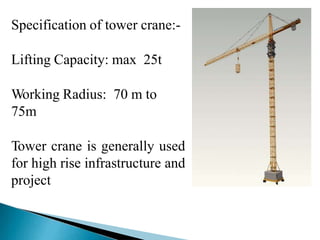
1.TOWER CRANE
The tower crane is a modern form
of balance crane. Fixed to the ground (and
sometimes attached to the sides of
structures as well), tower cranes often give
the best combination of height and lifting
capacity and are used in the construction of
tall buildings.
Specification of tower crane:-
Lifting Capacity: max 25t
Working Radius: 70 m to
75m
Tower crane is generally used
for high rise infrastructure and
project
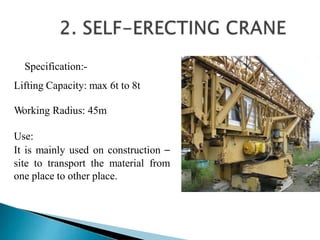
Specification:-
Lifting Capacity: max 6t to 8t
Working Radius: 45m
Use:
It is mainly used on construction –
site to transport the material from
one place to other place.
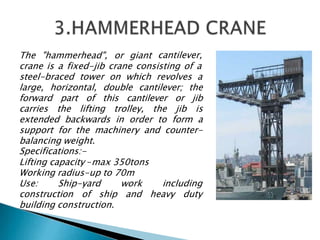
The "hammerhead", or giant cantilever,
crane is a fixed-jib crane consisting of a
steel-braced tower on which revolves a
large, horizontal, double cantilever; the
forward part of this cantilever or jib
carries the lifting trolley, the jib is
extended backwards in order to form a
support for the machinery and counter-
balancing weight.
Specifications:-
Lifting capacity –max 350tons
Working radius-up to 70m
Use: Ship-yard
construction of ship
building construction.
work including
and heavy duty
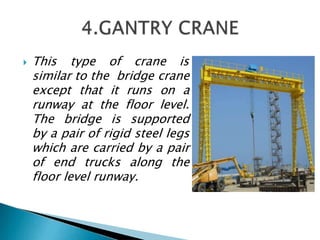
 This type of crane is
similar to the bridge crane
except that it runs on a
runway at the floor level.
The bridge is supported
by a pair of rigid steel legs
which are carried by a pair
of end trucks along the
floor level runway.
Specifications:-
Lifting Capacity: 5 tones to 10 tones
Working Radius: 23 m
Use:
In the construction of
superstructure for lifting heavy girder.
Bridge
In Ship manufacturing industry ,for lifting
heavy parts of ships.
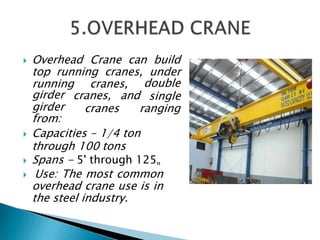
 Overhead Crane can build
top running cranes, under
running cranes, double
singlegirder
girder
from:
cranes, and
cranes ranging
 Capacities - 1/4 ton
through 100 tons
 Spans - 5' through 125„
 Use: The most common
overhead crane use is in
the steel industry.
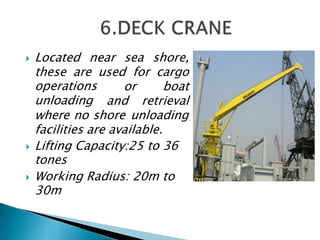
 Located near sea shore,
these are used for cargo
operations
unloading
or boat
and retrieval
where no shore unloading
facilities are available.
 Lifting Capacity:25 to 36
tones
 Working Radius: 20m to
30m
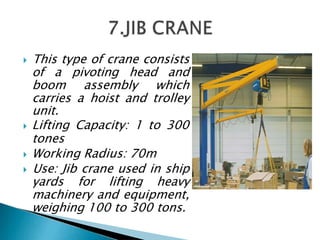
 This type of crane consists
of a pivoting head and
boom assembly which
carries a hoist and trolley
unit.
 Lifting Capacity: 1 to 300
tones
 Working Radius: 70m
 Use: Jib crane used in ship
yards for lifting heavy
machinery and equipment,
weighing 100 to 300 tons.
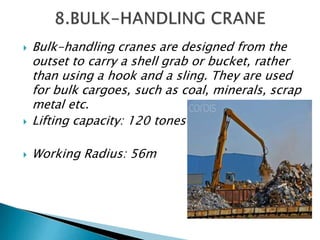
 Bulk-handling cranes are designed from the
outset to carry a shell grab or bucket, rather
than using a hook and a sling. They are used
for bulk cargoes, such as coal, minerals, scrap
metal etc.
 Lifting capacity: 120 tones
 Working Radius: 56m
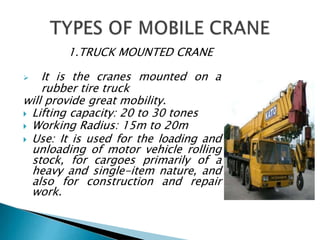
1.TRUCK MOUNTED CRANE
 It is the cranes mounted on a
rubber tire truck
will provide great mobility.
 Lifting capacity: 20 to 30 tones
 Working Radius: 15m to 20m
 Use: It is used for the loading and
unloading of motor vehicle rolling
stock, for cargoes primarily of a
heavy and single-item nature, and
also for construction and repair
work.
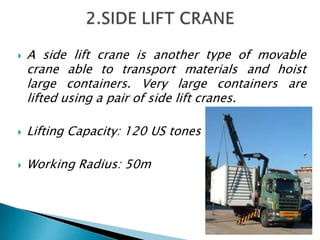
 A side lift crane is another type of movable
crane able to transport materials
large containers. Very large containers are
and hoist
lifted using a pair of side lift cranes.
 Lifting Capacity: 120 US tones
 Working Radius: 50m
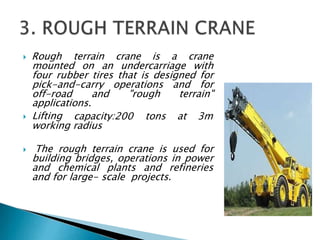
 Rough terrain crane is a crane
mounted on an undercarriage with
four rubber tires that is designed for
pick-and-carry operations and for
off-road and "rough terrain"
applications.
 Lifting capacity:200 tons at 3m
working radius
 The rough terrain crane is used for
building bridges, operations in power
and chemical plants and refineries
and for large- scale projects.
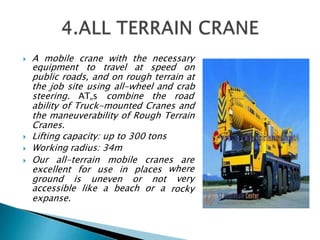
 A mobile crane with the necessary
equipment to travel at speed on
public roads, and on rough terrain at
the job site using all-wheel and crab
steering. AT„s combine the road
ability of Truck-mounted Cranes and
the maneuverability of Rough Terrain
Cranes.
 Lifting capacity: up to 300 tons
 Working radius: 34m
 Our all-terrain mobile cranes are
excellent for use in places where
very
rocky
ground is uneven or not
accessible like a beach or a
expanse.
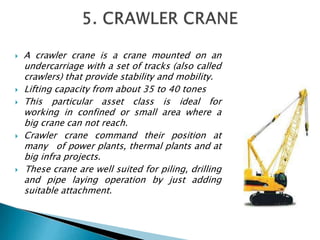
 A crawler crane is a crane mounted on an
undercarriage with a set of tracks (also called
crawlers) that provide stability and mobility.
 Lifting capacity from about 35 to 40 tones
 This particular asset class is ideal for
working in confined or small area where a
big crane can not reach.
 Crawler crane command their position at
many of power plants, thermal plants and at
big infra projects.
 These crane are well suited for piling, drilling
and pipe laying operation by just adding
suitable attachment.
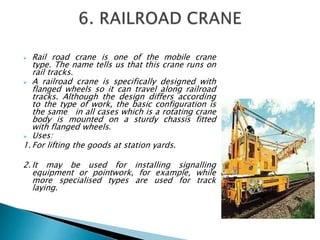
 Rail road crane is one of the mobile crane
type. The name tells us that this crane runs on
rail tracks.
 A railroad crane is specifically designed with
flanged wheels so it can travel along railroad
tracks. Although the design differs according
to the type of work, the basic configuration is
the same in all cases which is a rotating crane
body is mounted on a sturdy chassis fitted
with flanged wheels.
 Uses:
1. For lifting the goods at station yards.
2. It may be used for installing signalling
equipment or pointwork, for example, while
more specialised types are used for track
laying.
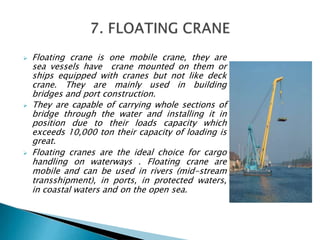
 Floating crane is one mobile crane, they are
sea vessels have crane mounted on them or
ships equipped with cranes but not like deck
crane. They are mainly used in building
bridges and port construction.
 They are capable of carrying whole sections of
bridge through the water and installing it in
position due to their loads capacity which
exceeds 10,000 ton their capacity of loading is
great.
 Floating cranes are the ideal choice for cargo
handling on waterways . Floating crane are
mobile and can be used in rivers (mid-stream
transshipment), in ports, in protected waters,
in coastal waters and on the open sea.
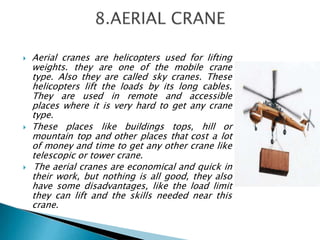
 Aerial cranes are helicopters used for lifting
weights. they are one of the mobile crane
type. Also they are called sky cranes. These
helicopters lift the loads by its long cables.
They are used in remote and accessible
places where it is very hard to get any crane
type.
 These places like buildings tops, hill or
mountain top and other places that cost a lot
of money and time to get any other crane like
telescopic or tower crane.
 The aerial cranes are economical and quick in
their work, but nothing is all good, they also
have some disadvantages, like the load limit
they can lift and the skills needed near this
crane.
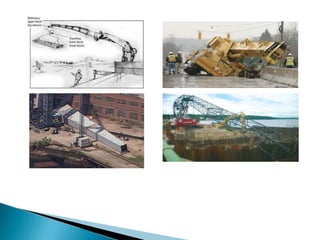
The main causes of crane failure are listed as:
1.Struck by Load
2.Electrocution
3.Crushed During Assembly/Disassembly
4.Failure of Boom/Cable
5.Crane Tip Over
6.Struck by Cab/Counterweight
7.Falls
 A crane is heavy mechanical equipment, which is used for
lifting the heavy materials.
 After this studied we conclude that, crane plays a vital role in
the construction industry, and makes the construction faster
and economical.
 This paper investigates crane safety in related to the
understanding
requirements
cranes
and degree of executing statutory
and non-statutory guidelines for the use of
 After the study of it we know about crane and their uses in
different places.
 This presentation gives the information about the causes of
failure and the preventive measures.
 Al-Hussein. (1995). “A compute Integrated System
for crane selection for High Rise Building
Construction, M.A.Sc. Thesis, Centre For Building
Studies, Concordia
 A journal of “Civil engineering & construction
review” July 2012 pg.no.62-84
 ASCE (2002)Adaptive Probabilistic Neural Network
Based Crane Type Selection System “Journal of
construction Engineering and Management.”
Vol.(128):265-273
Cran and its types

Cran and its types

  • 1.
    Class Number : Department: PRESENTED BY:- Faheem khan Crane Types And Its Uses In Civil Engineering
  • 2.
     A craneis a type of machine, generally equipped with a hoist, wire ropes or chains, and sheaves, that can be used both to lift and lower materials and to move them horizontally.  It uses one or more simple to create mechanical advantage and thus move loads beyond the normal capability of a human.
  • 3.
     On thebasis of modern crane study and advancement there are two basic types of cranes:- A). Fixed crane B) Mobile or movable crane  A fixed crane is the type of crane which lift the loads without any appreciable movement.  A mobile crane is the type of crane which moves from one place to another as well as movement of the crane basic tools.
  • 4.
    1.TOWER CRANE The towercrane is a modern form of balance crane. Fixed to the ground (and sometimes attached to the sides of structures as well), tower cranes often give the best combination of height and lifting capacity and are used in the construction of tall buildings.
  • 5.
    Specification of towercrane:- Lifting Capacity: max 25t Working Radius: 70 m to 75m Tower crane is generally used for high rise infrastructure and project
  • 6.
    Specification:- Lifting Capacity: max6t to 8t Working Radius: 45m Use: It is mainly used on construction – site to transport the material from one place to other place.
  • 7.
    The "hammerhead", orgiant cantilever, crane is a fixed-jib crane consisting of a steel-braced tower on which revolves a large, horizontal, double cantilever; the forward part of this cantilever or jib carries the lifting trolley, the jib is extended backwards in order to form a support for the machinery and counter- balancing weight. Specifications:- Lifting capacity –max 350tons Working radius-up to 70m Use: Ship-yard construction of ship building construction. work including and heavy duty
  • 8.
     This typeof crane is similar to the bridge crane except that it runs on a runway at the floor level. The bridge is supported by a pair of rigid steel legs which are carried by a pair of end trucks along the floor level runway.
  • 9.
    Specifications:- Lifting Capacity: 5tones to 10 tones Working Radius: 23 m Use: In the construction of superstructure for lifting heavy girder. Bridge In Ship manufacturing industry ,for lifting heavy parts of ships.
  • 10.
     Overhead Cranecan build top running cranes, under running cranes, double singlegirder girder from: cranes, and cranes ranging  Capacities - 1/4 ton through 100 tons  Spans - 5' through 125„  Use: The most common overhead crane use is in the steel industry.
  • 11.
     Located nearsea shore, these are used for cargo operations unloading or boat and retrieval where no shore unloading facilities are available.  Lifting Capacity:25 to 36 tones  Working Radius: 20m to 30m
  • 12.
     This typeof crane consists of a pivoting head and boom assembly which carries a hoist and trolley unit.  Lifting Capacity: 1 to 300 tones  Working Radius: 70m  Use: Jib crane used in ship yards for lifting heavy machinery and equipment, weighing 100 to 300 tons.
  • 13.
     Bulk-handling cranesare designed from the outset to carry a shell grab or bucket, rather than using a hook and a sling. They are used for bulk cargoes, such as coal, minerals, scrap metal etc.  Lifting capacity: 120 tones  Working Radius: 56m
  • 14.
    1.TRUCK MOUNTED CRANE It is the cranes mounted on a rubber tire truck will provide great mobility.  Lifting capacity: 20 to 30 tones  Working Radius: 15m to 20m  Use: It is used for the loading and unloading of motor vehicle rolling stock, for cargoes primarily of a heavy and single-item nature, and also for construction and repair work.
  • 15.
     A sidelift crane is another type of movable crane able to transport materials large containers. Very large containers are and hoist lifted using a pair of side lift cranes.  Lifting Capacity: 120 US tones  Working Radius: 50m
  • 16.
     Rough terraincrane is a crane mounted on an undercarriage with four rubber tires that is designed for pick-and-carry operations and for off-road and "rough terrain" applications.  Lifting capacity:200 tons at 3m working radius  The rough terrain crane is used for building bridges, operations in power and chemical plants and refineries and for large- scale projects.
  • 17.
     A mobilecrane with the necessary equipment to travel at speed on public roads, and on rough terrain at the job site using all-wheel and crab steering. AT„s combine the road ability of Truck-mounted Cranes and the maneuverability of Rough Terrain Cranes.  Lifting capacity: up to 300 tons  Working radius: 34m  Our all-terrain mobile cranes are excellent for use in places where very rocky ground is uneven or not accessible like a beach or a expanse.
  • 18.
     A crawlercrane is a crane mounted on an undercarriage with a set of tracks (also called crawlers) that provide stability and mobility.  Lifting capacity from about 35 to 40 tones  This particular asset class is ideal for working in confined or small area where a big crane can not reach.  Crawler crane command their position at many of power plants, thermal plants and at big infra projects.  These crane are well suited for piling, drilling and pipe laying operation by just adding suitable attachment.
  • 19.
     Rail roadcrane is one of the mobile crane type. The name tells us that this crane runs on rail tracks.  A railroad crane is specifically designed with flanged wheels so it can travel along railroad tracks. Although the design differs according to the type of work, the basic configuration is the same in all cases which is a rotating crane body is mounted on a sturdy chassis fitted with flanged wheels.  Uses: 1. For lifting the goods at station yards. 2. It may be used for installing signalling equipment or pointwork, for example, while more specialised types are used for track laying.
  • 20.
     Floating craneis one mobile crane, they are sea vessels have crane mounted on them or ships equipped with cranes but not like deck crane. They are mainly used in building bridges and port construction.  They are capable of carrying whole sections of bridge through the water and installing it in position due to their loads capacity which exceeds 10,000 ton their capacity of loading is great.  Floating cranes are the ideal choice for cargo handling on waterways . Floating crane are mobile and can be used in rivers (mid-stream transshipment), in ports, in protected waters, in coastal waters and on the open sea.
  • 21.
     Aerial cranesare helicopters used for lifting weights. they are one of the mobile crane type. Also they are called sky cranes. These helicopters lift the loads by its long cables. They are used in remote and accessible places where it is very hard to get any crane type.  These places like buildings tops, hill or mountain top and other places that cost a lot of money and time to get any other crane like telescopic or tower crane.  The aerial cranes are economical and quick in their work, but nothing is all good, they also have some disadvantages, like the load limit they can lift and the skills needed near this crane.
  • 22.
    The main causesof crane failure are listed as: 1.Struck by Load 2.Electrocution 3.Crushed During Assembly/Disassembly 4.Failure of Boom/Cable 5.Crane Tip Over 6.Struck by Cab/Counterweight 7.Falls
  • 24.
     A craneis heavy mechanical equipment, which is used for lifting the heavy materials.  After this studied we conclude that, crane plays a vital role in the construction industry, and makes the construction faster and economical.  This paper investigates crane safety in related to the understanding requirements cranes and degree of executing statutory and non-statutory guidelines for the use of  After the study of it we know about crane and their uses in different places.  This presentation gives the information about the causes of failure and the preventive measures.
  • 25.
     Al-Hussein. (1995).“A compute Integrated System for crane selection for High Rise Building Construction, M.A.Sc. Thesis, Centre For Building Studies, Concordia  A journal of “Civil engineering & construction review” July 2012 pg.no.62-84  ASCE (2002)Adaptive Probabilistic Neural Network Based Crane Type Selection System “Journal of construction Engineering and Management.” Vol.(128):265-273