CARDIOPULMONARY
RESUSCITATION
Some basic points…
What are the vital organs?
Why only C – P – C – R?
Start CPR Immediately
Better chance of survival
Brain damage starts in 4-6 minutes
Brain damage is certain after 10
minutes without CPR
Support & restore effective oxygenation,
ventilation and circulation with return of intact
neurological function.
Intermediate Goal:
Return of spontaneous circulation (ROSC)
Approach
 BLS ( Basic Life Support) Primary survey.
 ACLS (Advanced Cardiovascular Life Support)
Secondary survey
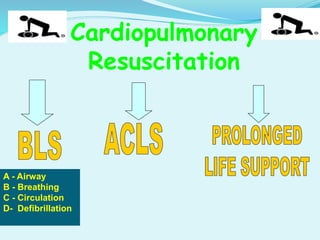
Cardiopulmonary
Resuscitation
A - Airway
B - Breathing
C - Circulation
D- Defibrillation
Basic life support
 BLS
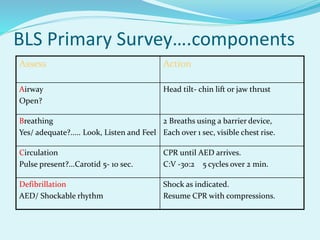
BLS Primary Survey….components
Assess Action
Airway
Open?
Head tilt- chin lift or jaw thrust
Breathing
Yes/ adequate?..... Look, Listen and Feel
2 Breaths using a barrier device,
Each over 1 sec, visible chest rise.
Circulation
Pulse present?...Carotid 5- 10 sec.
CPR until AED arrives.
C:V -30:2 5 cycles over 2 min.
Defibrillation
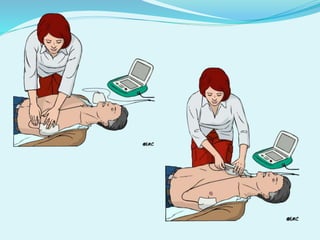
AED/ Shockable rhythm
Shock as indicated.
Resume CPR with compressions.
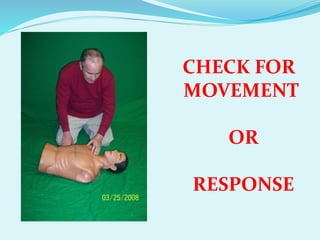
CHECK FOR
MOVEMENT
OR
RESPONSE
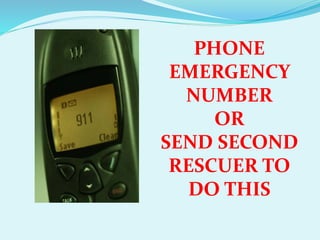
PHONE
EMERGENCY
NUMBER
OR
SEND SECOND
RESCUER TO
DO THIS
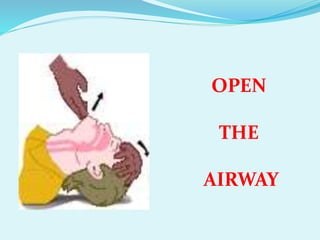
OPEN
THE
AIRWAY
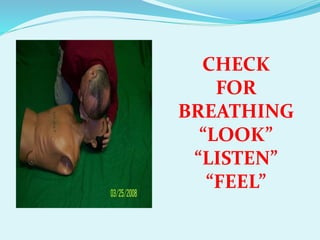
CHECK
FOR
BREATHING
“LOOK”
“LISTEN”
“FEEL”
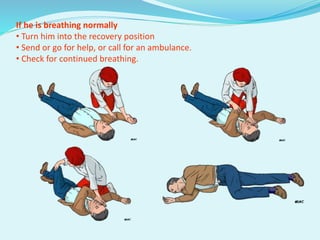
If he is breathing normally
• Turn him into the recovery position
• Send or go for help, or call for an ambulance.
• Check for continued breathing.
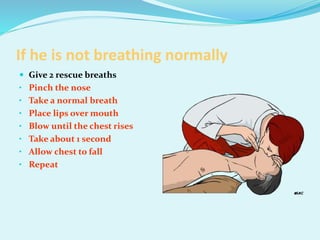
If he is not breathing normally
 Give 2 rescue breaths
• Pinch the nose
• Take a normal breath
• Place lips over mouth
• Blow until the chest rises
• Take about 1 second
• Allow chest to fall
• Repeat
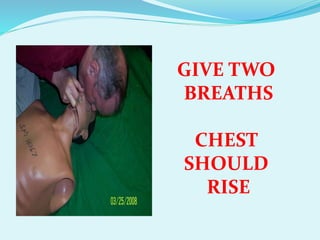
GIVE TWO
BREATHS
CHEST
SHOULD
RISE
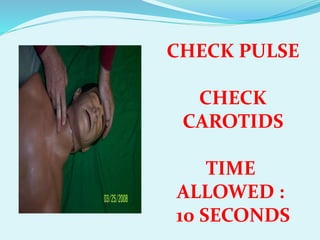
CHECK PULSE
CHECK
CAROTIDS
TIME
ALLOWED :
10 SECONDS
If there is pulse
- Give 1 breath every 5-6sec
- Recheck pulse every 2 min
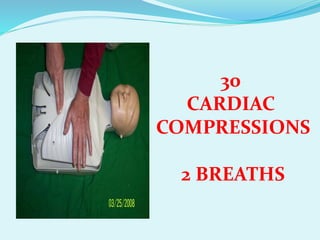
30
CARDIAC
COMPRESSIONS
2 BREATHS
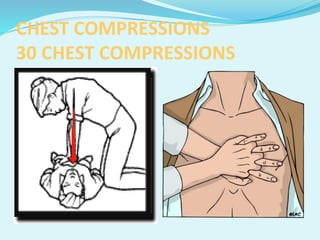
Chest Compressions
 Patient positioning:
Firm and hard surface (ground, table/ hard bed) deflate air/
water mattresses.
 Rescuer's position:
Level with patient, elbows vertically straight and locked,
shoulders directly above the hands, heel of one palm over the
other.
 Site : sternum in inter-mammary line.
 Depth: 11/2- 2 inches.
 Rate: (5 cycles of 30:2-C:V over 2 min.).
 Allow complete chest recoil.
CHEST COMPRESSIONS
30 CHEST COMPRESSIONS
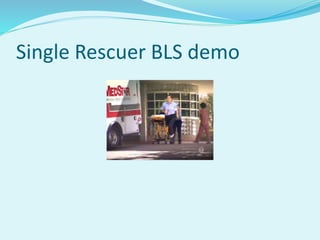
Single Rescuer BLS demo
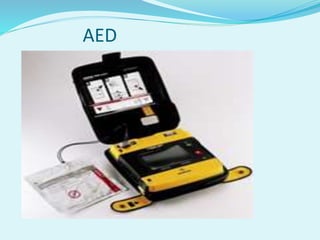
AED
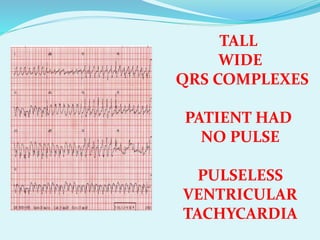
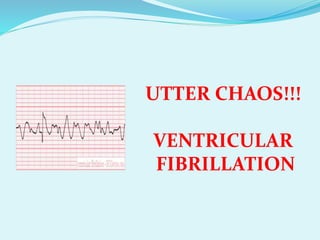
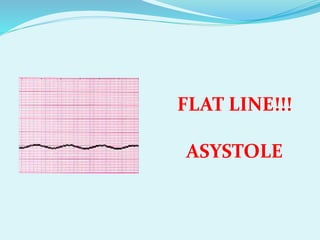
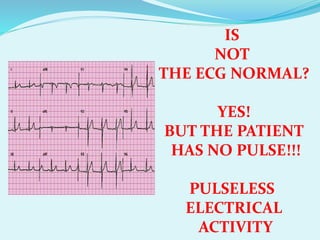
ECG RHYTHMS
TALL
WIDE
QRS COMPLEXES
PATIENT HAD
NO PULSE
PULSELESS
VENTRICULAR
TACHYCARDIA
UTTER CHAOS!!!
VENTRICULAR
FIBRILLATION
FLAT LINE!!!
ASYSTOLE
IS
NOT
THE ECG NORMAL?
YES!
BUT THE PATIENT
HAS NO PULSE!!!
PULSELESS
ELECTRICAL
ACTIVITY
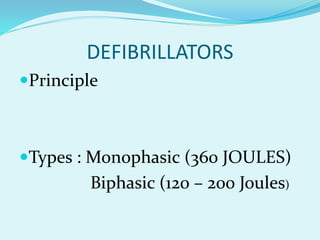
DEFIBRILLATORS
Principle
Types : Monophasic (360 JOULES)
Biphasic (120 – 200 Joules)
ADVANCED
CARDIAC
LIFE SUPPORT
ACLS Secondary survey
Advanced, invasive assessment and management techniques
required.
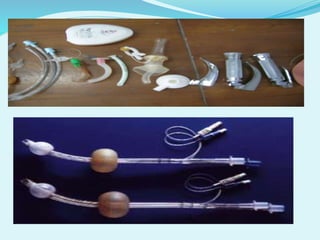
Basic airway adjuncts:
OPA, NPA
Advanced Airway interventions:
Combitube, LMA, Endotracheal intubation.
Advanced circulatory interventions:
Drugs to control heart rhythm and blood pressure.
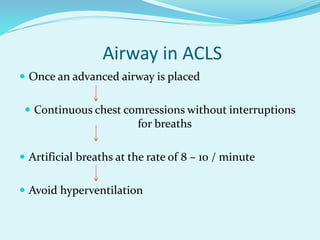
Airway in ACLS
 Once an advanced airway is placed
 Continuous chest comressions without interruptions
for breaths
 Artificial breaths at the rate of 8 – 10 / minute
 Avoid hyperventilation
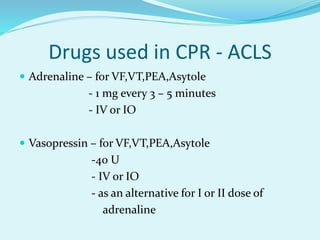
Drugs used in CPR - ACLS
 Adrenaline – for VF,VT,PEA,Asytole
- 1 mg every 3 – 5 minutes
- IV or IO
 Vasopressin – for VF,VT,PEA,Asytole
-40 U
- IV or IO
- as an alternative for I or II dose of
adrenaline
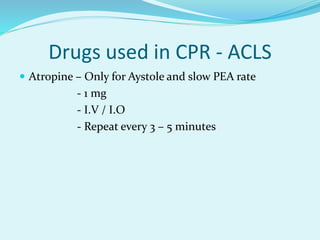
Drugs used in CPR - ACLS
 Atropine – Only for Aystole and slow PEA rate
- 1 mg
- I.V / I.O
- Repeat every 3 – 5 minutes
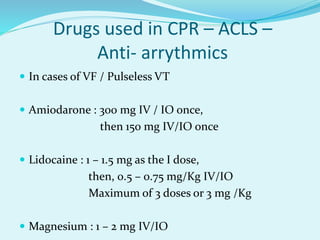
Drugs used in CPR – ACLS –
Anti- arrythmics
 In cases of VF / Pulseless VT
 Amiodarone : 300 mg IV / IO once,
then 150 mg IV/IO once
 Lidocaine : 1 – 1.5 mg as the I dose,
then, 0.5 – 0.75 mg/Kg IV/IO
Maximum of 3 doses or 3 mg /Kg
 Magnesium : 1 – 2 mg IV/IO
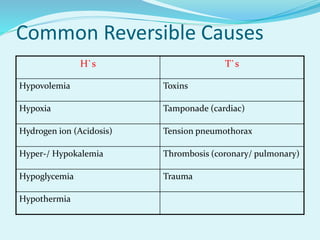
Common Reversible Causes
H`s T`s
Hypovolemia Toxins
Hypoxia Tamponade (cardiac)
Hydrogen ion (Acidosis) Tension pneumothorax
Hyper-/ Hypokalemia Thrombosis (coronary/ pulmonary)
Hypoglycemia Trauma
Hypothermia
DO REMEMBER
TO LOOK FOR AND TREAT
THE FACTOR WHICH LEAD TO
THE CARDIAC ARREST!!!
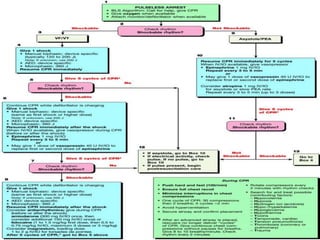
ADVANCED CARDIAC
LIFE SUPPORT
ALGORITHM
Thank u

CPCR.ppt