2019 - Novel Coronavirus
COVID 19
Kalimujjaman Molla
2nd Year PGT ( General Medicine)
Midnapore Medical College & Hospital
INTRODUCTION
 The suspicion of emergence of new virus arose when a
cluster of people in a sea-food market at Wuhan City,
China developed pneumonia without any clear cause.
 On 31 December 2019, WHO was alerted to several cases
of pneumonia in Wuhan City, China.
 One week later, on 7 January, Chinese authorities
confirmed that they had identified a new virus.
 This new virus was temporarily named “2019-nCoV.”
CORONAVIRUS
 Identified in 1960.
 Enveloped RNA Virus
 Crown-like spikes on their
surface.
 They mostly infect animals,
including camels, cattle, cats &
bats.
The virus was relatively simple
& nonfatal.
2012
MERS-CoV
(Saudi Arabia)
2494 cases
Mortality - 37%
Death - 858
2002
SARS-CoV (China)
8098 cases
Mortality 15%
774 deaths
2019
2019 nCoV (Chaina)
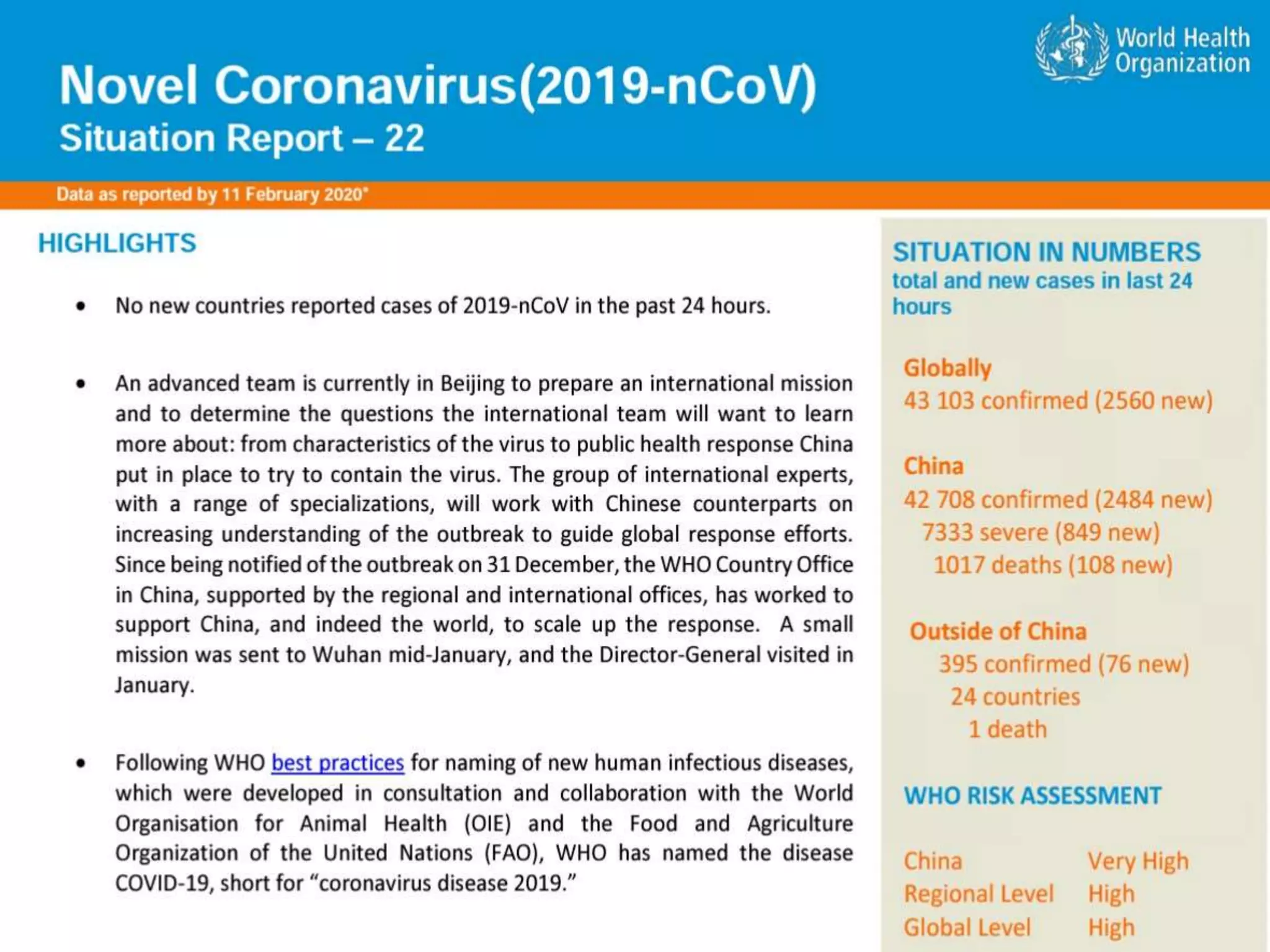
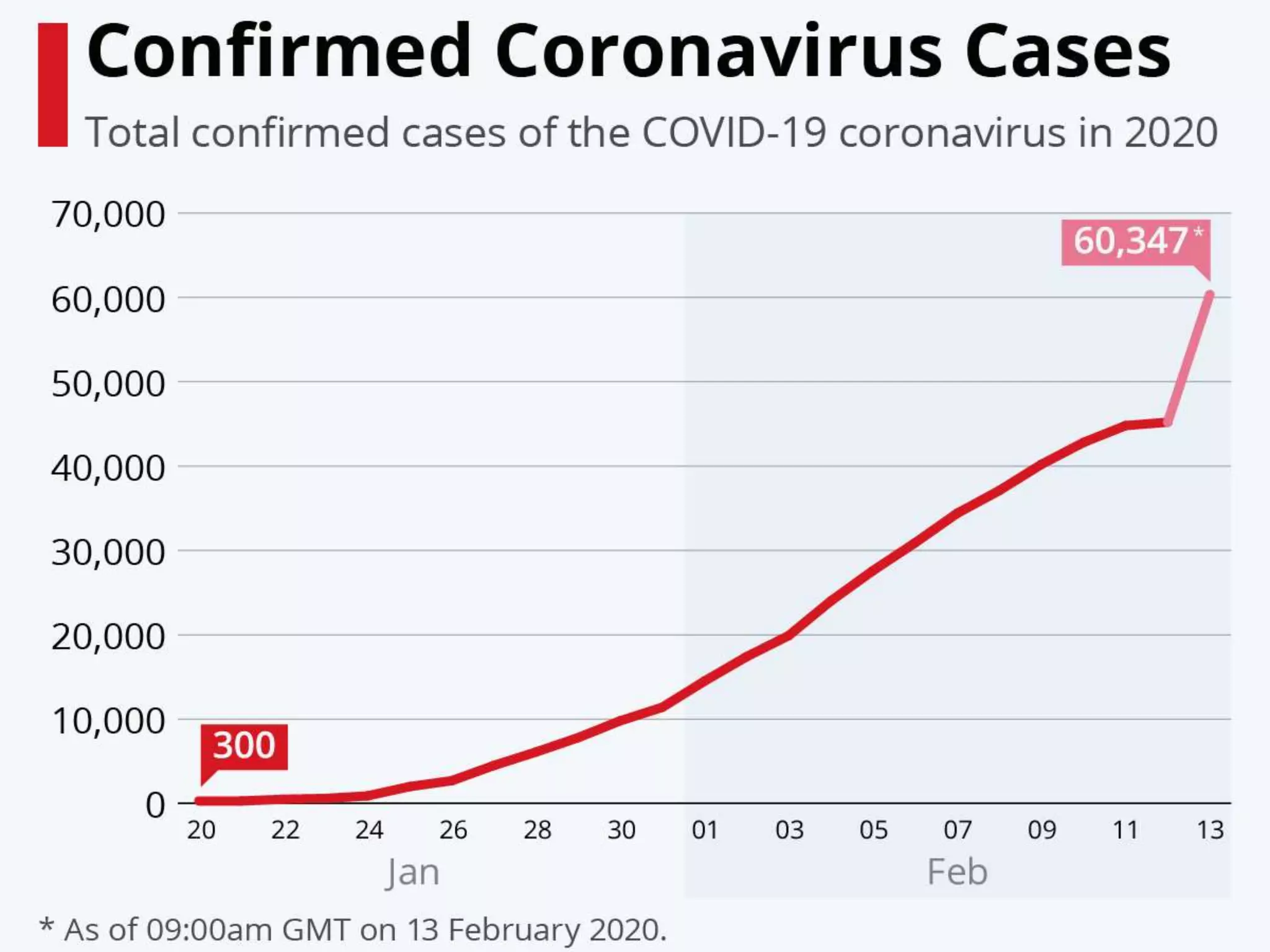
43103 cases
1018 death
Types Human coronaviruses
There are 7 known strains of human coronaviruses:
I. 229E alpha coronavirus
II. NL63 alpha coronavirus
III. OC43 beta coronavirus
IV. HKU1 beta coronavirus
V. MERS-CoV (beta CoV)
VI. SARS-CoV (beta CoV)
VII.2019 Novel CoV (nCoV)
2019 - Novel Coronavirus
It is a newstrainof coronavirus.
Genetic structure did not match with any specific type
of coronavirus.
Its in the same family of SARS-CoV & MERS-CoV
Genetic homology is about 75-80% with SARS-CoV
& 96% with Bat corona viruses.
It has the ability for efficient human transmission.
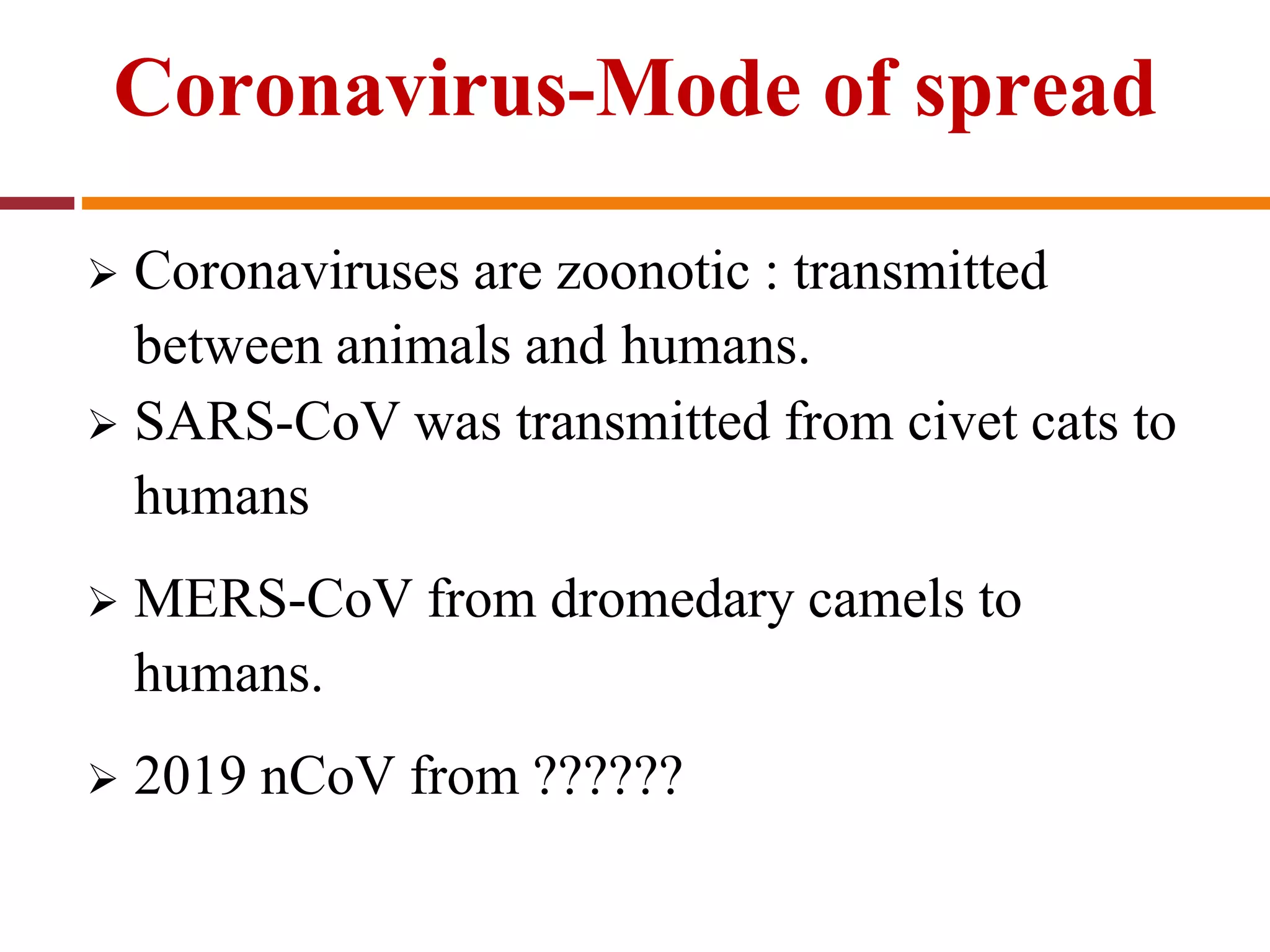
Coronavirus-Mode of spread
 Coronaviruses are zoonotic : transmitted
between animals and humans.
 SARS-CoV was transmitted from civet cats to
humans
 MERS-CoV from dromedary camels to
humans.
 2019 nCoV from ??????
2019-nCoV is thought to be a zoonotic virus, as most of the
first group of patients were workers or customers of a local
whole sale seafood market which also sold live consumable
animals, including poultry, donkey, sheep, pig, camels,
hedgehogs, snakes etc
First Transmission of 2019-nCoV was zoonotic
 2019-nCoV might have jumped from host
species bats to snakes and then to humans.
 Snake is the intermediate host between
human & bat.
 In the animal host viruses undergo repeated
mutations to get allowed to transmit to the
human
 After reaching the human, person to person
transmission is possible.
First Transmission of 2019-nCoV was zoonotic
Human to Human Transmission
Human coronaviruses most commonly spread from an
infected person to others through droplets
 By coughing and sneezing
 Close personal contact, such as touching or shaking
hands
 Touching an object or surface with the virus on it, then
touching your mouth, nose, or eyes before washing your
hands
 Rarely, fecal contamination
PREVENTION
 No vaccine to prevent 2019-nCoV infection.
 Best way to prevent infection is to avoid exposure
and preventing transmission.
 Wash your hands often with soap and water or
use an alcohol-based hand sanitizer.
 Avoid touching your eyes, nose, and mouth
with unwashed hands.
 Avoid close contact with people who are sick.
Stay home when you are sick.
Food Safety
Avoid direct unprotected contact with live
animals
The consumption of raw or undercooked
animal products should be avoided.
Incubation period
 2 to 14 days
 CDC believes at this time that symptoms of
2019-nCoV may appear in as few as 2 days or
as long as 14 after exposure.
Case definitions for surveillance
SUSPECT CASE:
A person with acute respiratory illness (fever with cough
and/or shortness of breath) and any of the following:
A history of travel to China in the 14 days prior to
symptoms onset.
Or
A close physical contact in the past 14 days with a
confirmed case of nCoV-2019 infection.
Case definitions for surveillance
PROBABLE CASE:
A suspect case for whom testing for 2019-nCoV is
inconclusive or for whom testing was positive on a
pan-coronavirus assay.
CONFIRMED CASE:
A person with lab confirmation of 2019-nCoV
infection, irrespective of clinical signs and symptoms.
SPECIMEN
Oropharyngeal swab
Nasopharyngeal swab
Nasal aspirate
For intubated patients
•Endotracheal aspirate
•Bronchoalveolar lavage (BAL)
•Sputum specimens
Tissue Biopsy & Serum samples ( Paired serum
sample Acute/ Convalescent phase 4 weeks apart)
PACKAGING AND TRANSPORT
The heads of swabs are broken of into tubes of viral transport
medium (VTM).
Three layer packing to be done as per guidelines.
Use ice packs in a sealed box for transport.
Labelling and fill referral form as per NIV Pune & Transport as
soon as possible.
Courier service number as provided by NIV Pune.
Pre inform State nodal officer and Nodal officer NIV Pune
contact details as provided on their website.
The swab should be replaced in its tube with care not to soil
Laboratory diagnosis
 At this stage, the laboratory testing for 2019-nCoV is
performed only at the NIV, Pune.
 It is advised that lower respiratory specimens such as
sputum, endotracheal aspirate, or Broncho alveolar
lavage be used when possible.
 If patients do not have signs or symptoms of lower
respiratory tract infection or lower tract specimens are
not possible or clinically indicated, nasopharyngeal
specimens should be collected
Laboratory Diagnosis
Personnel Protective Equipment( PPE)
N-95 masks only to be used for people who are
likely to come in close contact with the
patient(One meter) or while taking samples.
Make sure the mask fits properly
Ensure PPE (eye protection, medical mask, long‐sleeved
gown, gloves) and N95 mask while collecting and
handling laboratory specimen.
Personnel Protective Equipment( PPE)
Clinicalpresentation
Common symptoms:
URTI : Rhinorrhoea,Sneezing, or Sore Throat
Fever [83%]
Cough [82%]
Myalgia or Fatigue [11%]
Dyspnoea[31%]
Headache[8%]
Haemoptysis
Diarrhoea
Vomiting
Complications
Bilateral Pneumonia-75% patients
Acute Respiratory DistressSyndrome
Aaemia
Pericarditis
Acute KidneyInjury
MODS
Secondary infection
Death
Investigations
• Labs:
• Aaemia
• Leucopenia
• Lymphopenia
• AST/ALTRaised
• PTINR
• Imaging:
• Bilateral ground-glassopacities
• Bilateralmultiple lobular and subsegmental
areas of consolidation
Treatment
There is no specific antiviral treatment
recommended for 2019-nCoV infection.
People infected with 2019-nCoV should
receive supportive care.
For severe cases, treatment should
include to support vital organ functions.
CORTICOSTEROIDS
Corticosteroids were given
to very few non-ICU cases
with 2019- nCoV
infections.
Further evidence is urgently
needed to assessrisk and
benefits
NOVEL TREATMENT
Randomised controlled trial
has been initiated quickly to
assessthe efficacy and safety
of combined use of
Lopinavir and Ritonavir in
patients hospitalised with
2019- nCoV infection.
DischargeCriteria
 Absence of fever for at
least10 days.
 Improvement of chest
radiographic evidence.
 Viral clearance in
respiratory samples from
URT.
Covid 19
Covid 19
Covid 19
Covid 19

Covid 19

  • 1.
    2019 - NovelCoronavirus COVID 19 Kalimujjaman Molla 2nd Year PGT ( General Medicine) Midnapore Medical College & Hospital
  • 2.
    INTRODUCTION  The suspicionof emergence of new virus arose when a cluster of people in a sea-food market at Wuhan City, China developed pneumonia without any clear cause.  On 31 December 2019, WHO was alerted to several cases of pneumonia in Wuhan City, China.  One week later, on 7 January, Chinese authorities confirmed that they had identified a new virus.  This new virus was temporarily named “2019-nCoV.”
  • 3.
    CORONAVIRUS  Identified in1960.  Enveloped RNA Virus  Crown-like spikes on their surface.  They mostly infect animals, including camels, cattle, cats & bats. The virus was relatively simple & nonfatal.
  • 4.
    2012 MERS-CoV (Saudi Arabia) 2494 cases Mortality- 37% Death - 858 2002 SARS-CoV (China) 8098 cases Mortality 15% 774 deaths 2019 2019 nCoV (Chaina) 43103 cases 1018 death
  • 5.
    Types Human coronaviruses Thereare 7 known strains of human coronaviruses: I. 229E alpha coronavirus II. NL63 alpha coronavirus III. OC43 beta coronavirus IV. HKU1 beta coronavirus V. MERS-CoV (beta CoV) VI. SARS-CoV (beta CoV) VII.2019 Novel CoV (nCoV)
  • 6.
    2019 - NovelCoronavirus It is a newstrainof coronavirus. Genetic structure did not match with any specific type of coronavirus. Its in the same family of SARS-CoV & MERS-CoV Genetic homology is about 75-80% with SARS-CoV & 96% with Bat corona viruses. It has the ability for efficient human transmission.
  • 10.
    Coronavirus-Mode of spread Coronaviruses are zoonotic : transmitted between animals and humans.  SARS-CoV was transmitted from civet cats to humans  MERS-CoV from dromedary camels to humans.  2019 nCoV from ??????
  • 11.
    2019-nCoV is thoughtto be a zoonotic virus, as most of the first group of patients were workers or customers of a local whole sale seafood market which also sold live consumable animals, including poultry, donkey, sheep, pig, camels, hedgehogs, snakes etc First Transmission of 2019-nCoV was zoonotic
  • 12.
     2019-nCoV mighthave jumped from host species bats to snakes and then to humans.  Snake is the intermediate host between human & bat.  In the animal host viruses undergo repeated mutations to get allowed to transmit to the human  After reaching the human, person to person transmission is possible. First Transmission of 2019-nCoV was zoonotic
  • 13.
    Human to HumanTransmission Human coronaviruses most commonly spread from an infected person to others through droplets  By coughing and sneezing  Close personal contact, such as touching or shaking hands  Touching an object or surface with the virus on it, then touching your mouth, nose, or eyes before washing your hands  Rarely, fecal contamination
  • 14.
    PREVENTION  No vaccineto prevent 2019-nCoV infection.  Best way to prevent infection is to avoid exposure and preventing transmission.  Wash your hands often with soap and water or use an alcohol-based hand sanitizer.  Avoid touching your eyes, nose, and mouth with unwashed hands.  Avoid close contact with people who are sick. Stay home when you are sick.
  • 15.
    Food Safety Avoid directunprotected contact with live animals The consumption of raw or undercooked animal products should be avoided.
  • 16.
    Incubation period  2to 14 days  CDC believes at this time that symptoms of 2019-nCoV may appear in as few as 2 days or as long as 14 after exposure.
  • 17.
    Case definitions forsurveillance SUSPECT CASE: A person with acute respiratory illness (fever with cough and/or shortness of breath) and any of the following: A history of travel to China in the 14 days prior to symptoms onset. Or A close physical contact in the past 14 days with a confirmed case of nCoV-2019 infection.
  • 18.
    Case definitions forsurveillance PROBABLE CASE: A suspect case for whom testing for 2019-nCoV is inconclusive or for whom testing was positive on a pan-coronavirus assay. CONFIRMED CASE: A person with lab confirmation of 2019-nCoV infection, irrespective of clinical signs and symptoms.
  • 19.
    SPECIMEN Oropharyngeal swab Nasopharyngeal swab Nasalaspirate For intubated patients •Endotracheal aspirate •Bronchoalveolar lavage (BAL) •Sputum specimens Tissue Biopsy & Serum samples ( Paired serum sample Acute/ Convalescent phase 4 weeks apart)
  • 23.
    PACKAGING AND TRANSPORT Theheads of swabs are broken of into tubes of viral transport medium (VTM). Three layer packing to be done as per guidelines. Use ice packs in a sealed box for transport. Labelling and fill referral form as per NIV Pune & Transport as soon as possible. Courier service number as provided by NIV Pune. Pre inform State nodal officer and Nodal officer NIV Pune contact details as provided on their website. The swab should be replaced in its tube with care not to soil
  • 24.
    Laboratory diagnosis  Atthis stage, the laboratory testing for 2019-nCoV is performed only at the NIV, Pune.  It is advised that lower respiratory specimens such as sputum, endotracheal aspirate, or Broncho alveolar lavage be used when possible.  If patients do not have signs or symptoms of lower respiratory tract infection or lower tract specimens are not possible or clinically indicated, nasopharyngeal specimens should be collected
  • 25.
  • 26.
    Personnel Protective Equipment(PPE) N-95 masks only to be used for people who are likely to come in close contact with the patient(One meter) or while taking samples. Make sure the mask fits properly Ensure PPE (eye protection, medical mask, long‐sleeved gown, gloves) and N95 mask while collecting and handling laboratory specimen.
  • 27.
  • 28.
    Clinicalpresentation Common symptoms: URTI :Rhinorrhoea,Sneezing, or Sore Throat Fever [83%] Cough [82%] Myalgia or Fatigue [11%] Dyspnoea[31%] Headache[8%] Haemoptysis Diarrhoea Vomiting
  • 29.
    Complications Bilateral Pneumonia-75% patients AcuteRespiratory DistressSyndrome Aaemia Pericarditis Acute KidneyInjury MODS Secondary infection Death
  • 32.
    Investigations • Labs: • Aaemia •Leucopenia • Lymphopenia • AST/ALTRaised • PTINR • Imaging: • Bilateral ground-glassopacities • Bilateralmultiple lobular and subsegmental areas of consolidation
  • 33.
    Treatment There is nospecific antiviral treatment recommended for 2019-nCoV infection. People infected with 2019-nCoV should receive supportive care. For severe cases, treatment should include to support vital organ functions.
  • 34.
    CORTICOSTEROIDS Corticosteroids were given tovery few non-ICU cases with 2019- nCoV infections. Further evidence is urgently needed to assessrisk and benefits
  • 35.
    NOVEL TREATMENT Randomised controlledtrial has been initiated quickly to assessthe efficacy and safety of combined use of Lopinavir and Ritonavir in patients hospitalised with 2019- nCoV infection.
  • 36.
    DischargeCriteria  Absence offever for at least10 days.  Improvement of chest radiographic evidence.  Viral clearance in respiratory samples from URT.