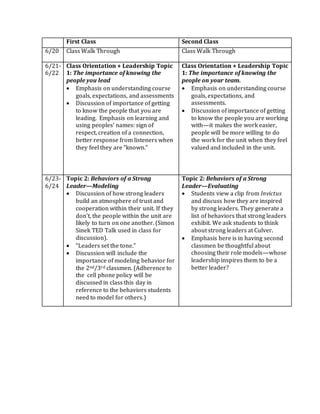
First Class Second Class
6/20 Class Walk Through Class Walk Through
6/21-
6/22
Class Orientation + Leadership Topic
1: The importance of knowing the
people you lead
 Emphasis on understanding course
goals, expectations, and assessments
 Discussion of importance of getting
to know the people that you are
leading. Emphasis on learning and
using peoples’ names: sign of
respect, creation of a connection,
better response from listeners when
they feel they are “known.”
Class Orientation + Leadership Topic
1: The importance of knowing the
people on your team.
 Emphasis on understanding course
goals, expectations, and
assessments.
 Discussion of importance of getting
to know the people you are working
with—it makes the work easier,
people will be more willing to do
the work for the unit when they feel
valued and included in the unit.
6/23-
6/24
Topic 2: Behaviors of a Strong
Leader—Modeling
 Discussion of how strong leaders
build an atmosphere of trust and
cooperation within their unit. If they
don’t, the people within the unit are
likely to turn on one another. (Simon
Sinek TED Talk used in class for
discussion).
 “Leaders set the tone.”
 Discussion will include the
importance of modeling behavior for
the 2nd/3rd classmen. (Adherence to
the cell phone policy will be
discussed in class this day in
reference to the behaviors students
need to model for others.)
Topic 2: Behaviors of a Strong
Leader—Evaluating
 Students view a clip from Invictus
and discuss how they are inspired
by strong leaders. They generate a
list of behaviors that strong leaders
exhibit. We ask students to think
about strong leaders at Culver.
 Emphasis here is in having second
classmen be thoughtful about
choosing their role models—whose
leadership inspires them to be a
better leader?
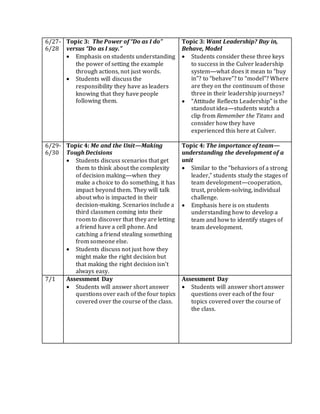
6/27-
6/28
Topic 3: The Power of “Do as I do”
versus “Do as I say.”
 Emphasis on students understanding
the power of setting the example
through actions, not just words.
 Students will discuss the
responsibility they have as leaders
knowing that they have people
following them.
Topic 3: Want Leadership? Buy in,
Behave, Model
 Students consider these three keys
to success in the Culver leadership
system—what does it mean to “buy
in”? to “behave”? to “model”? Where
are they on the continuum of those
three in their leadership journeys?
 “Attitude Reflects Leadership” is the
standout idea—students watch a
clip from Remember the Titans and
consider how they have
experienced this here at Culver.
6/29-
6/30
Topic 4: Me and the Unit—Making
Tough Decisions
 Students discuss scenarios that get
them to think about the complexity
of decision making—when they
make a choice to do something, it has
impact beyond them. They will talk
about who is impacted in their
decision-making. Scenarios include a
third classmen coming into their
room to discover that they are letting
a friend have a cell phone. And
catching a friend stealing something
from someone else.
 Students discuss not just how they
might make the right decision but
that making the right decision isn’t
always easy.
Topic 4: The importance of team—
understanding the development of a
unit
 Similar to the “behaviors of a strong
leader,” students study the stages of
team development—cooperation,
trust, problem-solving, individual
challenge.
 Emphasis here is on students
understanding how to develop a
team and how to identify stages of
team development.
7/1 Assessment Day
 Students will answer short answer
questions over each of the four topics
covered over the course of the class.
Assessment Day
 Students will answer short answer
questions over each of the four
topics covered over the course of
the class.
Third Class
7/4,
7/5
Class Orientation + Leadership Topic 1:
The importance of knowing the people
of the community
 Emphasis on understanding course
goals, expectations, and assessments
 Discussion of importance of getting
to know the people that you are
living with. Emphasis on benefits of
knowing the people of the
community: making connections
with people here gives students a
sense of belonging, gives them more
of a voice in the community, shows a
desire to connect with the
community
7/6,
7/7
Topic 2: Behaviors of a Strong
Leader—Learning
 Students work to
identify the specific behaviors
they need from their leaders.
Goal of the lesson is to make the
students more aware of how
they can observe and learn
about leadership (both good
and bad) from the leaders they
see.
7/8,
7/11
Topic 3: Being the first follower
 Emphasis on students understanding
the power of being the first follower
and how “followers” are also,
actually, leaders.
Students will discuss the responsibility
they have as “first followers” and the
importance of recognizing which
“movements” are worth supporting and
how to appropriately support them
7/12,
7/14
Topic 4: Taking care of
yourself and taking care of
the unit –growth mindset
 Building on the idea of having
“power” as the “first
follower,” we work with
students to discuss taking
responsibility for the things
that they can control—their
mindset—bridge to winter
school leadership.
Students will consider the
poem, “Our Deepest Fear” by
Marianne Williamson (Coach
Carter) as the starter to
discussions for this class, and
then they will look at
different scenarios and
determine what it is in their
control to change and what it
is not
7/15
Assessment Day
Students will answer short answer questions over each of the four topics covered over the
course of the class.
Course Summary for Counselors

Course Summary for Counselors

  • 1.
    First Class SecondClass 6/20 Class Walk Through Class Walk Through 6/21- 6/22 Class Orientation + Leadership Topic 1: The importance of knowing the people you lead  Emphasis on understanding course goals, expectations, and assessments  Discussion of importance of getting to know the people that you are leading. Emphasis on learning and using peoples’ names: sign of respect, creation of a connection, better response from listeners when they feel they are “known.” Class Orientation + Leadership Topic 1: The importance of knowing the people on your team.  Emphasis on understanding course goals, expectations, and assessments.  Discussion of importance of getting to know the people you are working with—it makes the work easier, people will be more willing to do the work for the unit when they feel valued and included in the unit. 6/23- 6/24 Topic 2: Behaviors of a Strong Leader—Modeling  Discussion of how strong leaders build an atmosphere of trust and cooperation within their unit. If they don’t, the people within the unit are likely to turn on one another. (Simon Sinek TED Talk used in class for discussion).  “Leaders set the tone.”  Discussion will include the importance of modeling behavior for the 2nd/3rd classmen. (Adherence to the cell phone policy will be discussed in class this day in reference to the behaviors students need to model for others.) Topic 2: Behaviors of a Strong Leader—Evaluating  Students view a clip from Invictus and discuss how they are inspired by strong leaders. They generate a list of behaviors that strong leaders exhibit. We ask students to think about strong leaders at Culver.  Emphasis here is in having second classmen be thoughtful about choosing their role models—whose leadership inspires them to be a better leader?
  • 2.
    6/27- 6/28 Topic 3: ThePower of “Do as I do” versus “Do as I say.”  Emphasis on students understanding the power of setting the example through actions, not just words.  Students will discuss the responsibility they have as leaders knowing that they have people following them. Topic 3: Want Leadership? Buy in, Behave, Model  Students consider these three keys to success in the Culver leadership system—what does it mean to “buy in”? to “behave”? to “model”? Where are they on the continuum of those three in their leadership journeys?  “Attitude Reflects Leadership” is the standout idea—students watch a clip from Remember the Titans and consider how they have experienced this here at Culver. 6/29- 6/30 Topic 4: Me and the Unit—Making Tough Decisions  Students discuss scenarios that get them to think about the complexity of decision making—when they make a choice to do something, it has impact beyond them. They will talk about who is impacted in their decision-making. Scenarios include a third classmen coming into their room to discover that they are letting a friend have a cell phone. And catching a friend stealing something from someone else.  Students discuss not just how they might make the right decision but that making the right decision isn’t always easy. Topic 4: The importance of team— understanding the development of a unit  Similar to the “behaviors of a strong leader,” students study the stages of team development—cooperation, trust, problem-solving, individual challenge.  Emphasis here is on students understanding how to develop a team and how to identify stages of team development. 7/1 Assessment Day  Students will answer short answer questions over each of the four topics covered over the course of the class. Assessment Day  Students will answer short answer questions over each of the four topics covered over the course of the class.
  • 3.
    Third Class 7/4, 7/5 Class Orientation+ Leadership Topic 1: The importance of knowing the people of the community  Emphasis on understanding course goals, expectations, and assessments  Discussion of importance of getting to know the people that you are living with. Emphasis on benefits of knowing the people of the community: making connections with people here gives students a sense of belonging, gives them more of a voice in the community, shows a desire to connect with the community 7/6, 7/7 Topic 2: Behaviors of a Strong Leader—Learning  Students work to identify the specific behaviors they need from their leaders. Goal of the lesson is to make the students more aware of how they can observe and learn about leadership (both good and bad) from the leaders they see. 7/8, 7/11 Topic 3: Being the first follower  Emphasis on students understanding the power of being the first follower and how “followers” are also, actually, leaders. Students will discuss the responsibility they have as “first followers” and the importance of recognizing which “movements” are worth supporting and how to appropriately support them 7/12, 7/14 Topic 4: Taking care of yourself and taking care of the unit –growth mindset  Building on the idea of having “power” as the “first follower,” we work with students to discuss taking responsibility for the things that they can control—their mindset—bridge to winter school leadership. Students will consider the poem, “Our Deepest Fear” by Marianne Williamson (Coach Carter) as the starter to discussions for this class, and then they will look at different scenarios and determine what it is in their control to change and what it is not 7/15 Assessment Day Students will answer short answer questions over each of the four topics covered over the course of the class.