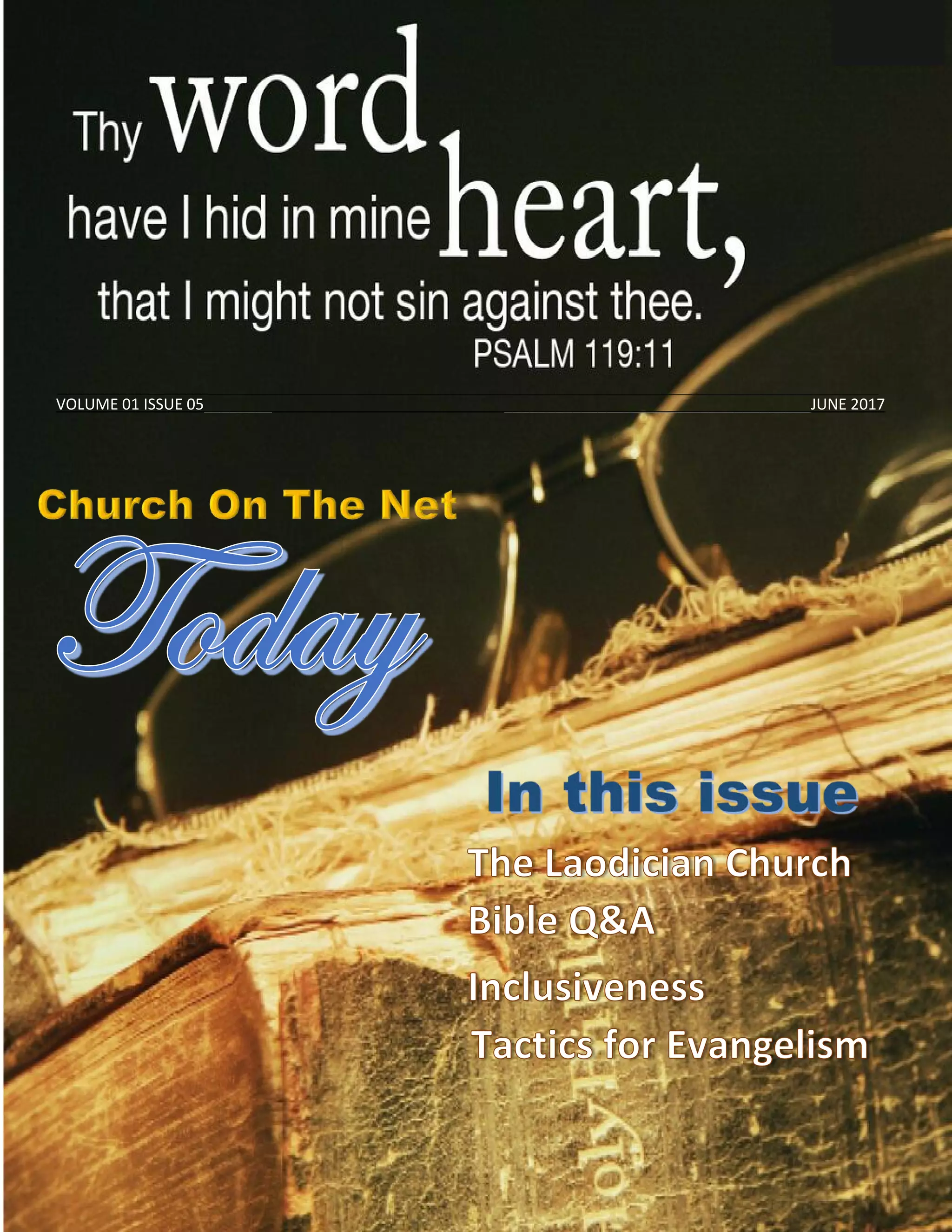
VOLUME 01 ISSUE 05________ ____________________________________JUNE 2017
Q: Why pray if God is already working according to His plan?
A: To a degree this is much like asking, “since I’m just going to get dirty again, why bathe”? Or
how about, “I’m just going to get hungry again, why eat?” The quick answer is that God either
cannot, by design, or will not, by choice, take any action on our behalf until we invite Him to
(until we pray). Some believe that God foreknows my future free actions (an Armenian
perspective) while some would say that God foreordains all future actions, and therefore there
is no choice (a Calvinist perspective). Freedom and choice are taught constantly in the scripture. God asks us to choose now whom
we will serve and what we will do. God may foreknow my future actions. But ultimately I still make the choice whether I'm going to
pray or not, and if I pray, God responds in the now. Even if God already knew that He would in the future respond to my prayer, and
perhaps that was already part of his plan, from my perspective, I've made the free choice to pray and in the now, He has answered
(or not answered.) It must be remembered that God is outside of time, so “knowing what we’re going to do” isn’t a real big problem.
From God’s perspective, it isn’t a question of if we did or if we will. There is no future or past, so He already knows and His plan is
unfolding accordingly. In that respect our prayers matter greatly.
The Laodicean Church
Continuing with Revelation 3:9,
Jesus will also make those who say
they are Jews, but are not, bow at
their feet. God exhorts them, “hold
fast to what you have (faithful
perseverance), so no one will take
your crown.” By this we see that
rewards (crowns) are different and
separate from eternal life since Jesus
promised that no man can take the
latter from us (John 10:28-29).
God’s promise to the faithful and
obedient overcomer in the church of
Philadelphia is that He will make them
a pillar in His temple. A pillar is
symbolic of a steadfast figure of
strength and durability. Thus, these
faithful saints will remain secure and
firm in their positions of strength at
the Lord’s side and enjoy close
fellowship with Him. Because of this,
they will not have “a little cabin in the
corner”, but an eternal home in the
sanctuary. The Lord also says He will
also write upon them the Name of
God, the name of the city of God
(Jerusalem) and His own name. The
Laodicean church is believed by most
to be the church age we are all a part
of now. Laodicea then represents the
last days church, which is neither “hot
nor cold.” Perhaps it’s what some call
“seeker friendly”?
The music and worship programs create excitement, but
the message is so cliché and generic that it does not
challenge a continuously renewed commitment of
faithfulness to the Lord. As this Scripture notes, it is
“neither hot nor cold.” Today’s deadness in church comes
from following the truth only with our minds, not with our
hearts or our lives. These saints say they are rich and in
need of nothing, but in truth and from God’s perspective,
they are wretched, miserable, poor, blind and naked.
These are the nominal and unfaithful Christians that He is
speaking about here that are found to be “naked” because
they do not have on the appropriate garments. Revelation
16:15 tells us, “Behold, I am coming as a thief. Blessed is he
who watches, and keeps his garments, lest he walk naked
and they see his shame.”
Unfortunately, there is nothing
good said about this church.
God then exhorts the saints
in Laodicea to “buy of Him gold
tried in the fire18
” (in other
words, begin to produce “works
of gold”, works that we persist
in no matter how difficult,
works that will withstand the
fire of God’s coming judgment).
He says, if they do, they will be
clothed in white raiment (the
wedding garment that
symbolizes purity) and “the
shame of their nakedness will
not appear.” Philadelphia
within Laodicea?
Notice something else
interesting here. The Scripture
we always hear quoted
referring to unbelievers is verse
20 which says: “Behold I stand
at the door and knock; if any
man hear My voice, and open
the door, I will come in to him,
and will sup with him, and he
with Me.” Who is God speaking
to here? He’s addressing
believers, right? Yet, Christ is
on the “outside” knocking on
believers’ hearts asking them to
let Him in!
[continued next month]
ABOUT THIS PUBLICATION
To make information more portable, Church On The Net Today is published monthly as a downloadable PDF. The information is gleaned
from 40+ years of Christian service and 30+ years as a BBS and web developer.
If you have a question, email it to me at dennis@churchonthenet.com
Also, more information can be found at churchonthenet.com or mag.churchonthenet.com
Inclusiveness
It came up again this week: a
leader saying, “I’m a Christian
and we must not side with
those in the church who would
exclude a certain group of
people. Jesus never excluded
anyone.”
And there’s a bigger problem
with this statement of his than
either the group or the issue, so
I’m not going to name it here
since it would only distract
from the main question. I know
you’ll know what I’m referring
to. What I write here could
apply equally as well to other
issues, though, in other times
and places. This isn’t about any
specific issue; it’s about a
Christians’ dangerous tendency
to bend their view of Scripture
to accommodate current
cultural demands, whatever
those demands may be.
That leader’s statement was
both careless and almost
entirely false. It usurps God’s
place, putting humans in charge
of our relationships with him. It
also tends to set aside the most
central fact of Christianity —
redemption through the cross
— as if it were hardly relevant.
The Church should indeed
welcome everyone. There’s no
denying that.
The Church has never fully
practiced that welcome.
There’s no denying that, either.
But hold on a moment: what do
we mean by “welcome”? Can
we use a little care in defining
our terms, please?
If we mean the Church
should invite everyone into a
loving, truth-filled, warmly-
offered opportunity to seek
God together with us, then yes,
we should welcome everyone.
Often, however, this statement
means everyone may be
welcomed into full communion
and fellowship as members of
the people of God, including
positions of church leadership.
For those who take the Bible
seriously — who look to the
evidence to determine whether
Jesus excluded anyone or not
— this is obviously false. Jesus
pointedly excluded the scribes
and Pharisees (see all of
Matthew 23). He obviously
excluded certain ideas and
beliefs, including the belief that
1 Corinthians 6:9-10 is optional.
In 1 Corinthians 5:1-5 Paul very
pointedly excluded a man who
claimed to be a brother in
Christ but was practicing
immorality. The reason Paul
did that, the passage says, is so
“his spirit may be saved in the
day of the Lord.” Exclusion
from fellowship is a signal, a
warning sent to unrepentant
sinners telling them it’s wrong to think
they’re at one with the people of Christ
while they persist in open disobedience
to God.
Conversely, then, to allow people into
full fellowship (including leadership)
while they persist in open disobedience
is to send them a false signal that
everything’s okay. It’s like saying, “Hey,
whatever, we don’t care. It doesn’t
matter.” It paves the way to their spirit’s
destruction. It’s not loving.
The error that “Jesus never excluded
anyone” may come from confused
thinking about the truth that he invited
everyone. He made it very clear that all
are welcome in his kingdom. It’s fine and
good to affirm that. The error associated
with it comes from forgetting that he
extends his invitation on his terms. And it
comes as well from forgetting that we
are welcome on his terms. See for
example Matt. 8:18-22 and Mark 10:17-
22. This is no small error. God does have
the right, doesn’t he, to determine how
we relate to him?
“Tactics” is a book written by
Greg Koukl. Greg demonstrates
how to get in the driver’s seat,
keeping any conversation moving
with thoughtful, artful diplomacy.
You’ll learn how to maneuver
comfortably and graciously
through the minefields, stop
challengers in their tracks, turn
the tables and—most
importantly—get people thinking
about Jesus. Soon, your
conversations will look more like
diplomacy than D-Day.
Drawing on extensive experience
defending Christianity in the
public square, Koukl shows you
how to:
- Initiate conversations
effortlessly
- Present the truth clearly,
cleverly, and persuasively
- Graciously and effectively
expose faulty thinking
- Skillfully manage the details of
dialogue
- Maintain an engaging, disarming
style even under attack
Tactics provides the game plan
for communicating the
compelling truth about
Christianity with confidence and
grace.
http://cotn.in/tacticsbook
Being prepared to make a defense of the hope you have within
you.
(1st Peter 3:15)
During the earlier years of my Christian life, from
time to time I would share the gospel with
people. I was more evangelistic than some, but
nowhere near as evangelistic as I should have
been. On rare occasions, a person would indicate
a desire to receive Christ as Lord and Savior. So, I
would do what I was taught to do: lead the
person in a "sinner's prayer."
I would say something like this: “If you want
to receive Jesus as your Lord and Savior, then it is
as simple as asking Him to come into your life.
Are you sure you want to do that? Then, why
don't we pray. I'll pray and then you just repeat
after me.”
I assumed the awkwardness on the part of the
other person was just nerves, or maybe a little
embarrassment. Maybe he had never prayed
aloud. While those things might be true, it never
dawned on me that the person might not be
coming to genuine faith in Jesus Christ.
The moment would end with a handshake or a
hug and some words of encouragement from me.
And then I would leave them with words like
these: “The devil is going to try to convince you
that what just happened to you isn't real. And get
ready to have your new-found faith in Jesus
challenged by family, friends, and co-workers.
You may even feel a bit silly and start to question
it yourself. Don’t worry. That’s normal.
Do you have a Bible? You should start reading it
every day. And you need to get into a good church.
It would be great if you started coming to church
with me.”
The following Sunday, I would look at the doors
of the church, anxiously waiting for the new convert
to arrive. It rarely, if ever, happened.
I wince every time I hear someone use the phrase
"close the deal" when writing or speaking about
evangelism. There is no way one can disassociate
the phrase with its original and primary meaning:
that of completing a sale. The Gospel is not a sales
pitch. The Gospel is not for sale.
The first question I ask is: "Is there any reason
why you wouldn't turn from your sin, turn to God,
and receive Jesus Christ as your Lord and Savior
right now?" When I ask questions like this, I always
watch their demeanor. Are they looking around to
see if anyone is watching, as if they would be
embarrassed to make a profession of faith in front
of other people? Do they seem uncomfortable--not
with their sin --but with the discomfort that comes
from feeling pressured to do something they are not
ready or willing to do?
These are indications to me that the Spirit of God
is not, at that moment, moving on the person's
heart and mind. And the last thing I want to do is
create a false convert by compelling the person to
do something entirely fleshly, and not as one moved
by God and His gospel.
“Let's be honest. There is not a single
verse or passage of Scripture that gives
any credence to the belief that the
"sinner's prayer" is biblical.”
Church on the Net Today
JUNE 2017 Vol.1 Issue 05
Edited by: D.L. Wyer
A digital publication from ChurchOnTheNet.com Ministries and D.L. Wyer Evangelism
Church on the Net Today is published monthly by Church on the Net, 11 Erman Drive, Sod, WV 25564. Digital
subscriptions are available free of charge by subscribing at cotn.in/subscribe.
-Tony Miano

COTN Journal June 2017

  • 1.
    VOLUME 01 ISSUE05________ ____________________________________JUNE 2017
  • 2.
    Q: Why prayif God is already working according to His plan? A: To a degree this is much like asking, “since I’m just going to get dirty again, why bathe”? Or how about, “I’m just going to get hungry again, why eat?” The quick answer is that God either cannot, by design, or will not, by choice, take any action on our behalf until we invite Him to (until we pray). Some believe that God foreknows my future free actions (an Armenian perspective) while some would say that God foreordains all future actions, and therefore there is no choice (a Calvinist perspective). Freedom and choice are taught constantly in the scripture. God asks us to choose now whom we will serve and what we will do. God may foreknow my future actions. But ultimately I still make the choice whether I'm going to pray or not, and if I pray, God responds in the now. Even if God already knew that He would in the future respond to my prayer, and perhaps that was already part of his plan, from my perspective, I've made the free choice to pray and in the now, He has answered (or not answered.) It must be remembered that God is outside of time, so “knowing what we’re going to do” isn’t a real big problem. From God’s perspective, it isn’t a question of if we did or if we will. There is no future or past, so He already knows and His plan is unfolding accordingly. In that respect our prayers matter greatly. The Laodicean Church Continuing with Revelation 3:9, Jesus will also make those who say they are Jews, but are not, bow at their feet. God exhorts them, “hold fast to what you have (faithful perseverance), so no one will take your crown.” By this we see that rewards (crowns) are different and separate from eternal life since Jesus promised that no man can take the latter from us (John 10:28-29). God’s promise to the faithful and obedient overcomer in the church of Philadelphia is that He will make them a pillar in His temple. A pillar is symbolic of a steadfast figure of strength and durability. Thus, these faithful saints will remain secure and firm in their positions of strength at the Lord’s side and enjoy close fellowship with Him. Because of this, they will not have “a little cabin in the corner”, but an eternal home in the sanctuary. The Lord also says He will also write upon them the Name of God, the name of the city of God (Jerusalem) and His own name. The Laodicean church is believed by most to be the church age we are all a part of now. Laodicea then represents the last days church, which is neither “hot nor cold.” Perhaps it’s what some call “seeker friendly”? The music and worship programs create excitement, but the message is so cliché and generic that it does not challenge a continuously renewed commitment of faithfulness to the Lord. As this Scripture notes, it is “neither hot nor cold.” Today’s deadness in church comes from following the truth only with our minds, not with our hearts or our lives. These saints say they are rich and in need of nothing, but in truth and from God’s perspective, they are wretched, miserable, poor, blind and naked. These are the nominal and unfaithful Christians that He is speaking about here that are found to be “naked” because they do not have on the appropriate garments. Revelation 16:15 tells us, “Behold, I am coming as a thief. Blessed is he who watches, and keeps his garments, lest he walk naked and they see his shame.” Unfortunately, there is nothing good said about this church. God then exhorts the saints in Laodicea to “buy of Him gold tried in the fire18 ” (in other words, begin to produce “works of gold”, works that we persist in no matter how difficult, works that will withstand the fire of God’s coming judgment). He says, if they do, they will be clothed in white raiment (the wedding garment that symbolizes purity) and “the shame of their nakedness will not appear.” Philadelphia within Laodicea? Notice something else interesting here. The Scripture we always hear quoted referring to unbelievers is verse 20 which says: “Behold I stand at the door and knock; if any man hear My voice, and open the door, I will come in to him, and will sup with him, and he with Me.” Who is God speaking to here? He’s addressing believers, right? Yet, Christ is on the “outside” knocking on believers’ hearts asking them to let Him in! [continued next month]
  • 3.
    ABOUT THIS PUBLICATION Tomake information more portable, Church On The Net Today is published monthly as a downloadable PDF. The information is gleaned from 40+ years of Christian service and 30+ years as a BBS and web developer. If you have a question, email it to me at dennis@churchonthenet.com Also, more information can be found at churchonthenet.com or mag.churchonthenet.com Inclusiveness It came up again this week: a leader saying, “I’m a Christian and we must not side with those in the church who would exclude a certain group of people. Jesus never excluded anyone.” And there’s a bigger problem with this statement of his than either the group or the issue, so I’m not going to name it here since it would only distract from the main question. I know you’ll know what I’m referring to. What I write here could apply equally as well to other issues, though, in other times and places. This isn’t about any specific issue; it’s about a Christians’ dangerous tendency to bend their view of Scripture to accommodate current cultural demands, whatever those demands may be. That leader’s statement was both careless and almost entirely false. It usurps God’s place, putting humans in charge of our relationships with him. It also tends to set aside the most central fact of Christianity — redemption through the cross — as if it were hardly relevant. The Church should indeed welcome everyone. There’s no denying that. The Church has never fully practiced that welcome. There’s no denying that, either. But hold on a moment: what do we mean by “welcome”? Can we use a little care in defining our terms, please? If we mean the Church should invite everyone into a loving, truth-filled, warmly- offered opportunity to seek God together with us, then yes, we should welcome everyone. Often, however, this statement means everyone may be welcomed into full communion and fellowship as members of the people of God, including positions of church leadership. For those who take the Bible seriously — who look to the evidence to determine whether Jesus excluded anyone or not — this is obviously false. Jesus pointedly excluded the scribes and Pharisees (see all of Matthew 23). He obviously excluded certain ideas and beliefs, including the belief that 1 Corinthians 6:9-10 is optional. In 1 Corinthians 5:1-5 Paul very pointedly excluded a man who claimed to be a brother in Christ but was practicing immorality. The reason Paul did that, the passage says, is so “his spirit may be saved in the day of the Lord.” Exclusion from fellowship is a signal, a warning sent to unrepentant sinners telling them it’s wrong to think they’re at one with the people of Christ while they persist in open disobedience to God. Conversely, then, to allow people into full fellowship (including leadership) while they persist in open disobedience is to send them a false signal that everything’s okay. It’s like saying, “Hey, whatever, we don’t care. It doesn’t matter.” It paves the way to their spirit’s destruction. It’s not loving. The error that “Jesus never excluded anyone” may come from confused thinking about the truth that he invited everyone. He made it very clear that all are welcome in his kingdom. It’s fine and good to affirm that. The error associated with it comes from forgetting that he extends his invitation on his terms. And it comes as well from forgetting that we are welcome on his terms. See for example Matt. 8:18-22 and Mark 10:17- 22. This is no small error. God does have the right, doesn’t he, to determine how we relate to him?
  • 4.
    “Tactics” is abook written by Greg Koukl. Greg demonstrates how to get in the driver’s seat, keeping any conversation moving with thoughtful, artful diplomacy. You’ll learn how to maneuver comfortably and graciously through the minefields, stop challengers in their tracks, turn the tables and—most importantly—get people thinking about Jesus. Soon, your conversations will look more like diplomacy than D-Day. Drawing on extensive experience defending Christianity in the public square, Koukl shows you how to: - Initiate conversations effortlessly - Present the truth clearly, cleverly, and persuasively - Graciously and effectively expose faulty thinking - Skillfully manage the details of dialogue - Maintain an engaging, disarming style even under attack Tactics provides the game plan for communicating the compelling truth about Christianity with confidence and grace. http://cotn.in/tacticsbook Being prepared to make a defense of the hope you have within you. (1st Peter 3:15) During the earlier years of my Christian life, from time to time I would share the gospel with people. I was more evangelistic than some, but nowhere near as evangelistic as I should have been. On rare occasions, a person would indicate a desire to receive Christ as Lord and Savior. So, I would do what I was taught to do: lead the person in a "sinner's prayer." I would say something like this: “If you want to receive Jesus as your Lord and Savior, then it is as simple as asking Him to come into your life. Are you sure you want to do that? Then, why don't we pray. I'll pray and then you just repeat after me.” I assumed the awkwardness on the part of the other person was just nerves, or maybe a little embarrassment. Maybe he had never prayed aloud. While those things might be true, it never dawned on me that the person might not be coming to genuine faith in Jesus Christ. The moment would end with a handshake or a hug and some words of encouragement from me. And then I would leave them with words like these: “The devil is going to try to convince you that what just happened to you isn't real. And get ready to have your new-found faith in Jesus challenged by family, friends, and co-workers. You may even feel a bit silly and start to question it yourself. Don’t worry. That’s normal. Do you have a Bible? You should start reading it every day. And you need to get into a good church. It would be great if you started coming to church with me.” The following Sunday, I would look at the doors of the church, anxiously waiting for the new convert to arrive. It rarely, if ever, happened. I wince every time I hear someone use the phrase "close the deal" when writing or speaking about evangelism. There is no way one can disassociate the phrase with its original and primary meaning: that of completing a sale. The Gospel is not a sales pitch. The Gospel is not for sale. The first question I ask is: "Is there any reason why you wouldn't turn from your sin, turn to God, and receive Jesus Christ as your Lord and Savior right now?" When I ask questions like this, I always watch their demeanor. Are they looking around to see if anyone is watching, as if they would be embarrassed to make a profession of faith in front of other people? Do they seem uncomfortable--not with their sin --but with the discomfort that comes from feeling pressured to do something they are not ready or willing to do? These are indications to me that the Spirit of God is not, at that moment, moving on the person's heart and mind. And the last thing I want to do is create a false convert by compelling the person to do something entirely fleshly, and not as one moved by God and His gospel. “Let's be honest. There is not a single verse or passage of Scripture that gives any credence to the belief that the "sinner's prayer" is biblical.” Church on the Net Today JUNE 2017 Vol.1 Issue 05 Edited by: D.L. Wyer A digital publication from ChurchOnTheNet.com Ministries and D.L. Wyer Evangelism Church on the Net Today is published monthly by Church on the Net, 11 Erman Drive, Sod, WV 25564. Digital subscriptions are available free of charge by subscribing at cotn.in/subscribe. -Tony Miano