Diploma Project Management
       Captain Cook College
                Sharon Boyle
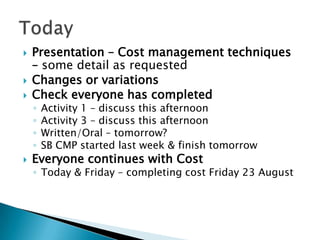
   Presentation – Cost management techniques
    – some detail as requested
   Changes or variations
   Check everyone has completed
    ◦   Activity 1 – discuss this afternoon
    ◦   Activity 3 – discuss this afternoon
    ◦   Written/Oral – tomorrow?
    ◦   SB CMP started last week & finish tomorrow
   Everyone continues with Cost
    ◦ Today & Friday – completing cost Friday 23 August
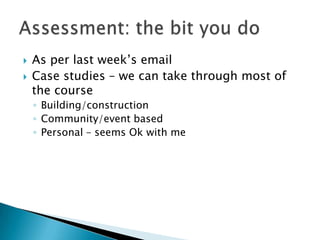
   As per last week’s email
   Case studies – we can take through most of
    the course
    ◦ Building/construction
    ◦ Community/event based
    ◦ Personal – seems Ok with me
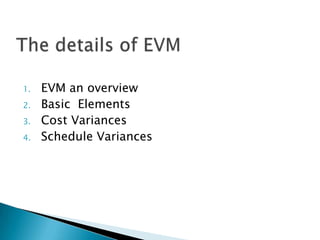
1.   EVM an overview
2.   Basic Elements
3.   Cost Variances
4.   Schedule Variances
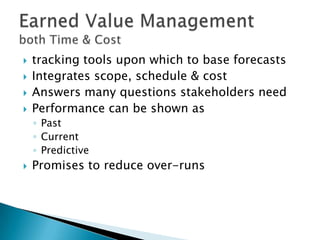
   tracking tools upon which to base forecasts
   Integrates scope, schedule & cost
   Answers many questions stakeholders need
   Performance can be shown as
    ◦ Past
    ◦ Current
    ◦ Predictive
   Promises to reduce over-runs
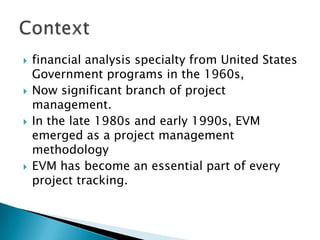
   financial analysis specialty from United States
    Government programs in the 1960s,
   Now significant branch of project
    management.
   In the late 1980s and early 1990s, EVM
    emerged as a project management
    methodology
   EVM has become an essential part of every
    project tracking.
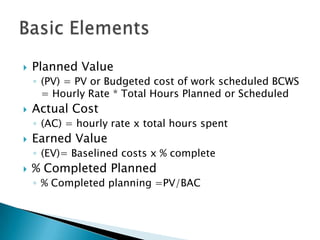
   Planned Value
    ◦ (PV) = PV or Budgeted cost of work scheduled BCWS
      = Hourly Rate * Total Hours Planned or Scheduled
   Actual Cost
    ◦ (AC) = hourly rate x total hours spent
   Earned Value
    ◦ (EV)= Baselined costs x % complete
   % Completed Planned
    ◦ % Completed planning =PV/BAC
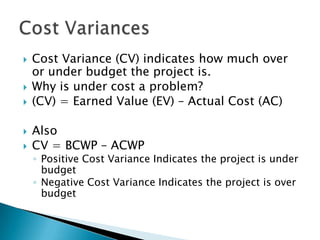
   Cost Variance (CV) indicates how much over
    or under budget the project is.
   Why is under cost a problem?
   (CV) = Earned Value (EV) – Actual Cost (AC)

   Also
   CV = BCWP – ACWP
    ◦ Positive Cost Variance Indicates the project is under
      budget
    ◦ Negative Cost Variance Indicates the project is over
      budget
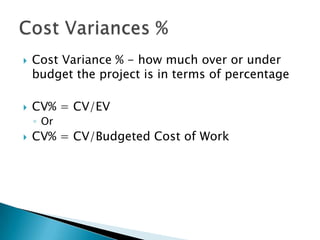
   Cost Variance % - how much over or under
    budget the project is in terms of percentage

   CV% = CV/EV
    ◦ Or
   CV% = CV/Budgeted Cost of Work
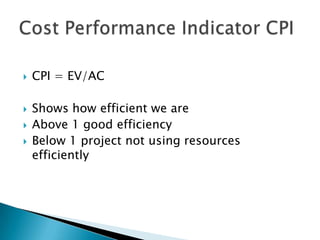
   CPI = EV/AC

   Shows how efficient we are
   Above 1 good efficiency
   Below 1 project not using resources
    efficiently
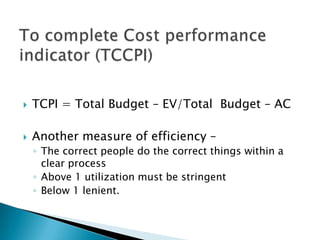
   TCPI = Total Budget – EV/Total Budget – AC

   Another measure of efficiency –
    ◦ The correct people do the correct things within a
      clear process
    ◦ Above 1 utilization must be stringent
    ◦ Below 1 lenient.
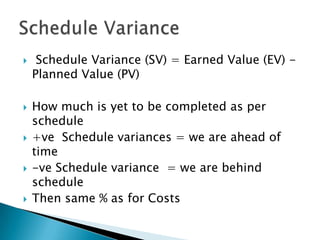
    Schedule Variance (SV) = Earned Value (EV) -
    Planned Value (PV)

   How much is yet to be completed as per
    schedule
   +ve Schedule variances = we are ahead of
    time
   -ve Schedule variance = we are behind
    schedule
   Then same % as for Costs
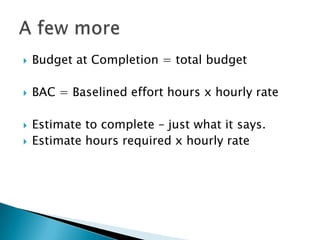
   Budget at Completion = total budget

   BAC = Baselined effort hours x hourly rate

   Estimate to complete – just what it says.
   Estimate hours required x hourly rate
   http://www.youtube.com/watch?v=7WsfuvHe
    gxE&feature=related
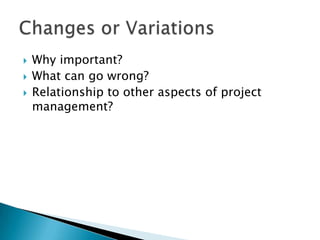
   Why important?
   What can go wrong?
   Relationship to other aspects of project
    management?
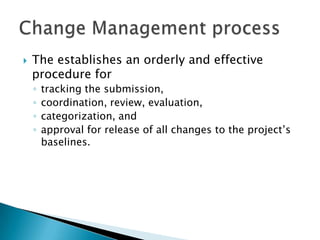
   The establishes an orderly and effective
    procedure for
    ◦   tracking the submission,
    ◦   coordination, review, evaluation,
    ◦   categorization, and
    ◦   approval for release of all changes to the project’s
        baselines.
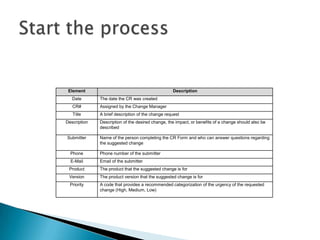
Element                                           Description
   Date       The date the CR was created
   CR#        Assigned by the Change Manager
   Title      A brief description of the change request
Description   Description of the desired change, the impact, or benefits of a change should also be
              described

Submitter     Name of the person completing the CR Form and who can answer questions regarding
              the suggested change

  Phone       Phone number of the submitter
  E-Mail      Email of the submitter
 Product      The product that the suggested change is for
 Version      The product version that the suggested change is for
  Priority    A code that provides a recommended categorization of the urgency of the requested
              change (High, Medium, Low)
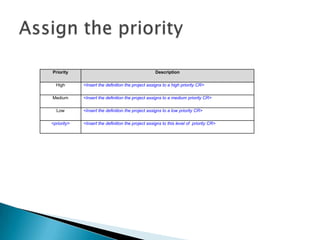
Priority                                            Description

  High       <Insert the definition the project assigns to a high priority CR>

Medium       <Insert the definition the project assigns to a medium priority CR>

  Low        <Insert the definition the project assigns to a low priority CR>

<priority>   <Insert the definition the project assigns to this level of priority CR>
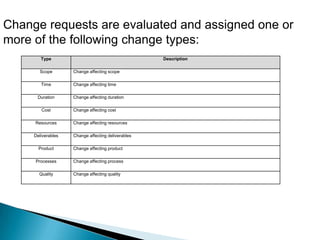
Change requests are evaluated and assigned one or
more of the following change types:
        Type                                        Description

       Scope        Change affecting scope

        Time        Change affecting time

      Duration      Change affecting duration

        Cost        Change affecting cost

     Resources      Change affecting resources

     Deliverables   Change affecting deliverables

       Product      Change affecting product

     Processes      Change affecting process

       Quality      Change affecting quality
   Any more examples to choose from the
    internet.
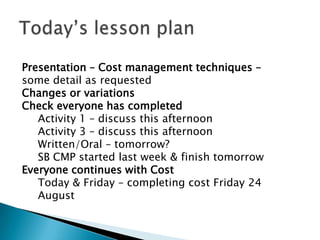
Presentation – Cost management techniques –
some detail as requested
Changes or variations
Check everyone has completed
   Activity 1 – discuss this afternoon
   Activity 3 – discuss this afternoon
   Written/Oral – tomorrow?
   SB CMP started last week & finish tomorrow
Everyone continues with Cost
   Today & Friday – completing cost Friday 24
   August
   Master of Ceremonies suddenly taken ill two
    weeks before event and will not be available
    for the event. A strong suggestion from
    Councillors to get a professional.
   The Council access officer wants to know how
    the event is to cater meet council’s Universal
    access policy.

Cost unit 2012 part 2

  • 1.
    Diploma Project Management Captain Cook College Sharon Boyle
  • 2.
    Presentation – Cost management techniques – some detail as requested  Changes or variations  Check everyone has completed ◦ Activity 1 – discuss this afternoon ◦ Activity 3 – discuss this afternoon ◦ Written/Oral – tomorrow? ◦ SB CMP started last week & finish tomorrow  Everyone continues with Cost ◦ Today & Friday – completing cost Friday 23 August
  • 3.
    As per last week’s email  Case studies – we can take through most of the course ◦ Building/construction ◦ Community/event based ◦ Personal – seems Ok with me
  • 4.
    1. EVM an overview 2. Basic Elements 3. Cost Variances 4. Schedule Variances
  • 5.
    tracking tools upon which to base forecasts  Integrates scope, schedule & cost  Answers many questions stakeholders need  Performance can be shown as ◦ Past ◦ Current ◦ Predictive  Promises to reduce over-runs
  • 6.
    financial analysis specialty from United States Government programs in the 1960s,  Now significant branch of project management.  In the late 1980s and early 1990s, EVM emerged as a project management methodology  EVM has become an essential part of every project tracking.
  • 7.
    Planned Value ◦ (PV) = PV or Budgeted cost of work scheduled BCWS = Hourly Rate * Total Hours Planned or Scheduled  Actual Cost ◦ (AC) = hourly rate x total hours spent  Earned Value ◦ (EV)= Baselined costs x % complete  % Completed Planned ◦ % Completed planning =PV/BAC
  • 8.
    Cost Variance (CV) indicates how much over or under budget the project is.  Why is under cost a problem?  (CV) = Earned Value (EV) – Actual Cost (AC)  Also  CV = BCWP – ACWP ◦ Positive Cost Variance Indicates the project is under budget ◦ Negative Cost Variance Indicates the project is over budget
  • 9.
    Cost Variance % - how much over or under budget the project is in terms of percentage  CV% = CV/EV ◦ Or  CV% = CV/Budgeted Cost of Work
  • 10.
    CPI = EV/AC  Shows how efficient we are  Above 1 good efficiency  Below 1 project not using resources efficiently
  • 11.
    TCPI = Total Budget – EV/Total Budget – AC  Another measure of efficiency – ◦ The correct people do the correct things within a clear process ◦ Above 1 utilization must be stringent ◦ Below 1 lenient.
  • 12.
    Schedule Variance (SV) = Earned Value (EV) - Planned Value (PV)  How much is yet to be completed as per schedule  +ve Schedule variances = we are ahead of time  -ve Schedule variance = we are behind schedule  Then same % as for Costs
  • 13.
    Budget at Completion = total budget  BAC = Baselined effort hours x hourly rate  Estimate to complete – just what it says.  Estimate hours required x hourly rate
  • 14.
    http://www.youtube.com/watch?v=7WsfuvHe gxE&feature=related
  • 15.
    Why important?  What can go wrong?  Relationship to other aspects of project management?
  • 16.
    The establishes an orderly and effective procedure for ◦ tracking the submission, ◦ coordination, review, evaluation, ◦ categorization, and ◦ approval for release of all changes to the project’s baselines.
  • 17.
    Element Description Date The date the CR was created CR# Assigned by the Change Manager Title A brief description of the change request Description Description of the desired change, the impact, or benefits of a change should also be described Submitter Name of the person completing the CR Form and who can answer questions regarding the suggested change Phone Phone number of the submitter E-Mail Email of the submitter Product The product that the suggested change is for Version The product version that the suggested change is for Priority A code that provides a recommended categorization of the urgency of the requested change (High, Medium, Low)
  • 18.
    Priority Description High <Insert the definition the project assigns to a high priority CR> Medium <Insert the definition the project assigns to a medium priority CR> Low <Insert the definition the project assigns to a low priority CR> <priority> <Insert the definition the project assigns to this level of priority CR>
  • 19.
    Change requests areevaluated and assigned one or more of the following change types: Type Description Scope Change affecting scope Time Change affecting time Duration Change affecting duration Cost Change affecting cost Resources Change affecting resources Deliverables Change affecting deliverables Product Change affecting product Processes Change affecting process Quality Change affecting quality
  • 20.
    Any more examples to choose from the internet.
  • 21.
    Presentation – Costmanagement techniques – some detail as requested Changes or variations Check everyone has completed Activity 1 – discuss this afternoon Activity 3 – discuss this afternoon Written/Oral – tomorrow? SB CMP started last week & finish tomorrow Everyone continues with Cost Today & Friday – completing cost Friday 24 August
  • 22.
    Master of Ceremonies suddenly taken ill two weeks before event and will not be available for the event. A strong suggestion from Councillors to get a professional.  The Council access officer wants to know how the event is to cater meet council’s Universal access policy.