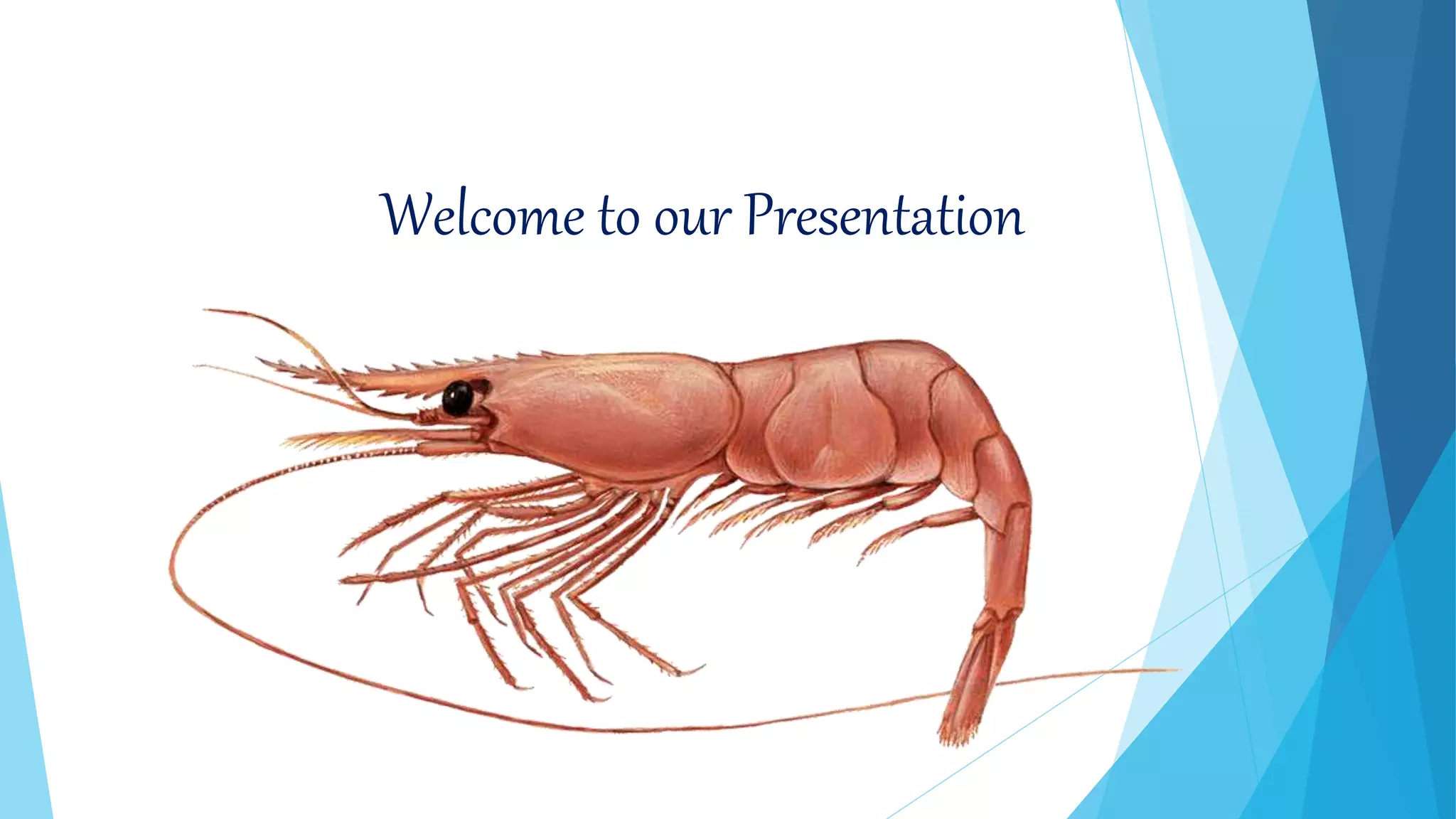


Welcome to our Presentation
Our Presentation Topic is
Cost benefit analysis of an ideal
Prawn Hatchery
Group Number-15
Group Members are-
Sumon kumar Audhikary (ASH1502024M)
Mujahidul Islam (ASH1502034M)
Md.Tahmidul Haque (ASH1502045M)
Introduction
 Prawn aquaculture is an important economic activity in Bangladesh.It
contributes in poverty alleviation ,employment creation,community
development and foreign exchange earnings for the country and price
 Golda (M.rosenbergii or prawn) is the main species of prawn that is cultured
in Bangladesh.
 Golda is cultivated in sweat water in any region of the country.
 The introduction of prawn culture has changed the socio economic
,institutional ,ecological and environmental conditions of the coastal regions
of Bangladesh.
What is Cost Benefit Analysis?
A cost Benefit Analysis is a process by which organizations
can analyze decisions ,systems or projects or determine a
value for intangibles.
The Model is built by identifying the benefits of an action as
well as the associated costs, and substracting the costs from
benefits
Reasons of Cost Benefit Analysis(CBA)
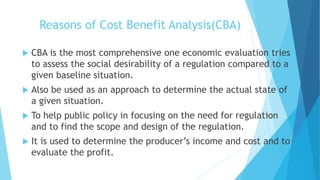
 CBA is the most comprehensive one economic evaluation tries
to assess the social desirability of a regulation compared to a
given baseline situation.
 Also be used as an approach to determine the actual state of
a given situation.
 To help public policy in focusing on the need for regulation
and to find the scope and design of the regulation.
 It is used to determine the producer’s income and cost and to
evaluate the profit.
Steps of Cost Benefit Analysis
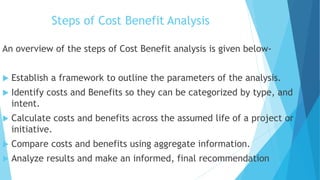
An overview of the steps of Cost Benefit analysis is given below-
 Establish a framework to outline the parameters of the analysis.
 Identify costs and Benefits so they can be categorized by type, and
intent.
 Calculate costs and benefits across the assumed life of a project or
initiative.
 Compare costs and benefits using aggregate information.
 Analyze results and make an informed, final recommendation
Cost Benefit analysis in Hatchery Operation
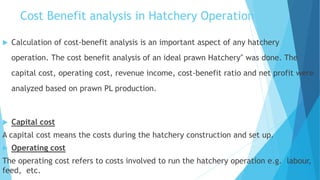
 Calculation of cost-benefit analysis is an important aspect of any hatchery
operation. The cost benefit analysis of an ideal prawn Hatchery‟ was done. The
capital cost, operating cost, revenue income, cost-benefit ratio and net profit were
analyzed based on prawn PL production.
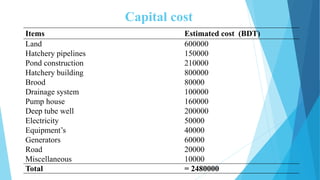
 Capital cost
A capital cost means the costs during the hatchery construction and set up.
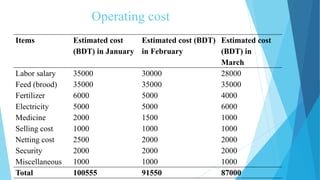
 Operating cost
The operating cost refers to costs involved to run the hatchery operation e.g. labour,
feed, etc.
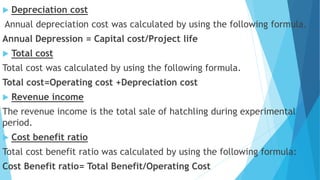
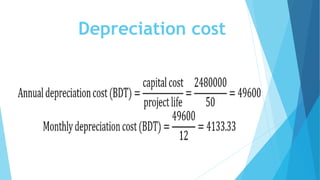
 Depreciation cost
Annual depreciation cost was calculated by using the following formula.
Annual Depression = Capital cost/Project life
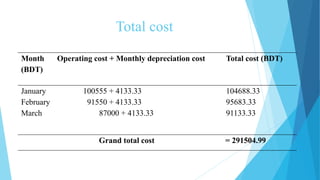
 Total cost
Total cost was calculated by using the following formula.
Total cost=Operating cost +Depreciation cost
 Revenue income
The revenue income is the total sale of hatchling during experimental
period.
 Cost benefit ratio
Total cost benefit ratio was calculated by using the following formula:
Cost Benefit ratio= Total Benefit/Operating Cost
Capital cost
Items Estimated cost (BDT)
Land 600000
Hatchery pipelines 150000
Pond construction 210000
Hatchery building 800000
Brood 80000
Drainage system 100000
Pump house 160000
Deep tube well 200000
Electricity 50000
Equipment’s 40000
Generators 60000
Road 20000
Miscellaneous 10000
Total = 2480000
Depreciation cost
Operating cost
Items Estimated cost
(BDT) in January
Estimated cost (BDT)
in February
Estimated cost
(BDT) in
March
Labor salary 35000 30000 28000
Feed (brood) 35000 35000 35000
Fertilizer 6000 5000 4000
Electricity 5000 5000 6000
Medicine 2000 1500 1000
Selling cost 1000 1000 1000
Netting cost 2500 2000 2000
Security 2000 2000 2000
Miscellaneous 1000 1000 1000
Total 100555 91550 87000
Total cost
Month Operating cost + Monthly depreciation cost
(BDT)
Total cost (BDT)
January 100555 + 4133.33
February 91550 + 4133.33
March 87000 + 4133.33
104688.33
95683.33
91133.33
Grand total cost = 291504.99
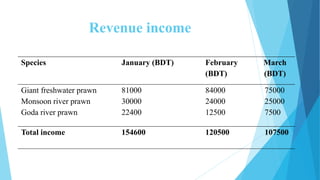
Revenue income
Species January (BDT) February
(BDT)
March
(BDT)
Giant freshwater prawn
Monsoon river prawn
Goda river prawn
81000
30000
22400
84000
24000
12500
75000
25000
7500
Total income 154600 120500 107500
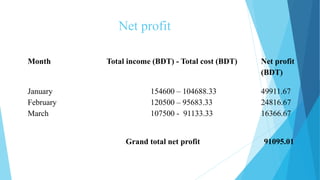
Net profit
Month Total income (BDT) - Total cost (BDT) Net profit
(BDT)
January
February
March
154600 – 104688.33
120500 – 95683.33
107500 - 91133.33
49911.67
24816.67
16366.67
Grand total net profit 91095.01
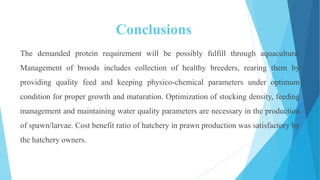
Conclusions
The demanded protein requirement will be possibly fulfill through aquaculture.
Management of broods includes collection of healthy breeders, rearing them by
providing quality feed and keeping physico-chemical parameters under optimum
condition for proper growth and maturation. Optimization of stocking density, feeding
management and maintaining water quality parameters are necessary in the production
of spawn/larvae. Cost benefit ratio of hatchery in prawn production was satisfactory by
the hatchery owners.
ANY
QUESTION…??
Thanks All..

cost benifit analysis

  • 1.
    Welcome to ourPresentation
  • 2.
    Our Presentation Topicis Cost benefit analysis of an ideal Prawn Hatchery Group Number-15 Group Members are- Sumon kumar Audhikary (ASH1502024M) Mujahidul Islam (ASH1502034M) Md.Tahmidul Haque (ASH1502045M)
  • 3.
    Introduction  Prawn aquacultureis an important economic activity in Bangladesh.It contributes in poverty alleviation ,employment creation,community development and foreign exchange earnings for the country and price  Golda (M.rosenbergii or prawn) is the main species of prawn that is cultured in Bangladesh.  Golda is cultivated in sweat water in any region of the country.  The introduction of prawn culture has changed the socio economic ,institutional ,ecological and environmental conditions of the coastal regions of Bangladesh.
  • 4.
    What is CostBenefit Analysis? A cost Benefit Analysis is a process by which organizations can analyze decisions ,systems or projects or determine a value for intangibles. The Model is built by identifying the benefits of an action as well as the associated costs, and substracting the costs from benefits
  • 5.
    Reasons of CostBenefit Analysis(CBA)  CBA is the most comprehensive one economic evaluation tries to assess the social desirability of a regulation compared to a given baseline situation.  Also be used as an approach to determine the actual state of a given situation.  To help public policy in focusing on the need for regulation and to find the scope and design of the regulation.  It is used to determine the producer’s income and cost and to evaluate the profit.
  • 6.
    Steps of CostBenefit Analysis An overview of the steps of Cost Benefit analysis is given below-  Establish a framework to outline the parameters of the analysis.  Identify costs and Benefits so they can be categorized by type, and intent.  Calculate costs and benefits across the assumed life of a project or initiative.  Compare costs and benefits using aggregate information.  Analyze results and make an informed, final recommendation
  • 7.
    Cost Benefit analysisin Hatchery Operation  Calculation of cost-benefit analysis is an important aspect of any hatchery operation. The cost benefit analysis of an ideal prawn Hatchery‟ was done. The capital cost, operating cost, revenue income, cost-benefit ratio and net profit were analyzed based on prawn PL production.  Capital cost A capital cost means the costs during the hatchery construction and set up.  Operating cost The operating cost refers to costs involved to run the hatchery operation e.g. labour, feed, etc.
  • 8.
     Depreciation cost Annualdepreciation cost was calculated by using the following formula. Annual Depression = Capital cost/Project life  Total cost Total cost was calculated by using the following formula. Total cost=Operating cost +Depreciation cost  Revenue income The revenue income is the total sale of hatchling during experimental period.  Cost benefit ratio Total cost benefit ratio was calculated by using the following formula: Cost Benefit ratio= Total Benefit/Operating Cost
  • 9.
    Capital cost Items Estimatedcost (BDT) Land 600000 Hatchery pipelines 150000 Pond construction 210000 Hatchery building 800000 Brood 80000 Drainage system 100000 Pump house 160000 Deep tube well 200000 Electricity 50000 Equipment’s 40000 Generators 60000 Road 20000 Miscellaneous 10000 Total = 2480000
  • 10.
  • 11.
    Operating cost Items Estimatedcost (BDT) in January Estimated cost (BDT) in February Estimated cost (BDT) in March Labor salary 35000 30000 28000 Feed (brood) 35000 35000 35000 Fertilizer 6000 5000 4000 Electricity 5000 5000 6000 Medicine 2000 1500 1000 Selling cost 1000 1000 1000 Netting cost 2500 2000 2000 Security 2000 2000 2000 Miscellaneous 1000 1000 1000 Total 100555 91550 87000
  • 12.
    Total cost Month Operatingcost + Monthly depreciation cost (BDT) Total cost (BDT) January 100555 + 4133.33 February 91550 + 4133.33 March 87000 + 4133.33 104688.33 95683.33 91133.33 Grand total cost = 291504.99
  • 13.
    Revenue income Species January(BDT) February (BDT) March (BDT) Giant freshwater prawn Monsoon river prawn Goda river prawn 81000 30000 22400 84000 24000 12500 75000 25000 7500 Total income 154600 120500 107500
  • 14.
    Net profit Month Totalincome (BDT) - Total cost (BDT) Net profit (BDT) January February March 154600 – 104688.33 120500 – 95683.33 107500 - 91133.33 49911.67 24816.67 16366.67 Grand total net profit 91095.01
  • 15.
    Conclusions The demanded proteinrequirement will be possibly fulfill through aquaculture. Management of broods includes collection of healthy breeders, rearing them by providing quality feed and keeping physico-chemical parameters under optimum condition for proper growth and maturation. Optimization of stocking density, feeding management and maintaining water quality parameters are necessary in the production of spawn/larvae. Cost benefit ratio of hatchery in prawn production was satisfactory by the hatchery owners.
  • 16.
  • 17.