1
Definition
• Corporal punishment: violence
inflicted on children by parents,
teachers, guardian and others in the
name of “discipline” .
• Discipline: is training that corrects, molds
or perfects the mental facilities or moral
character.
Types:
School corporal punishment
Parental or domestic corporal
punishment
Judicial corporal punishment
6
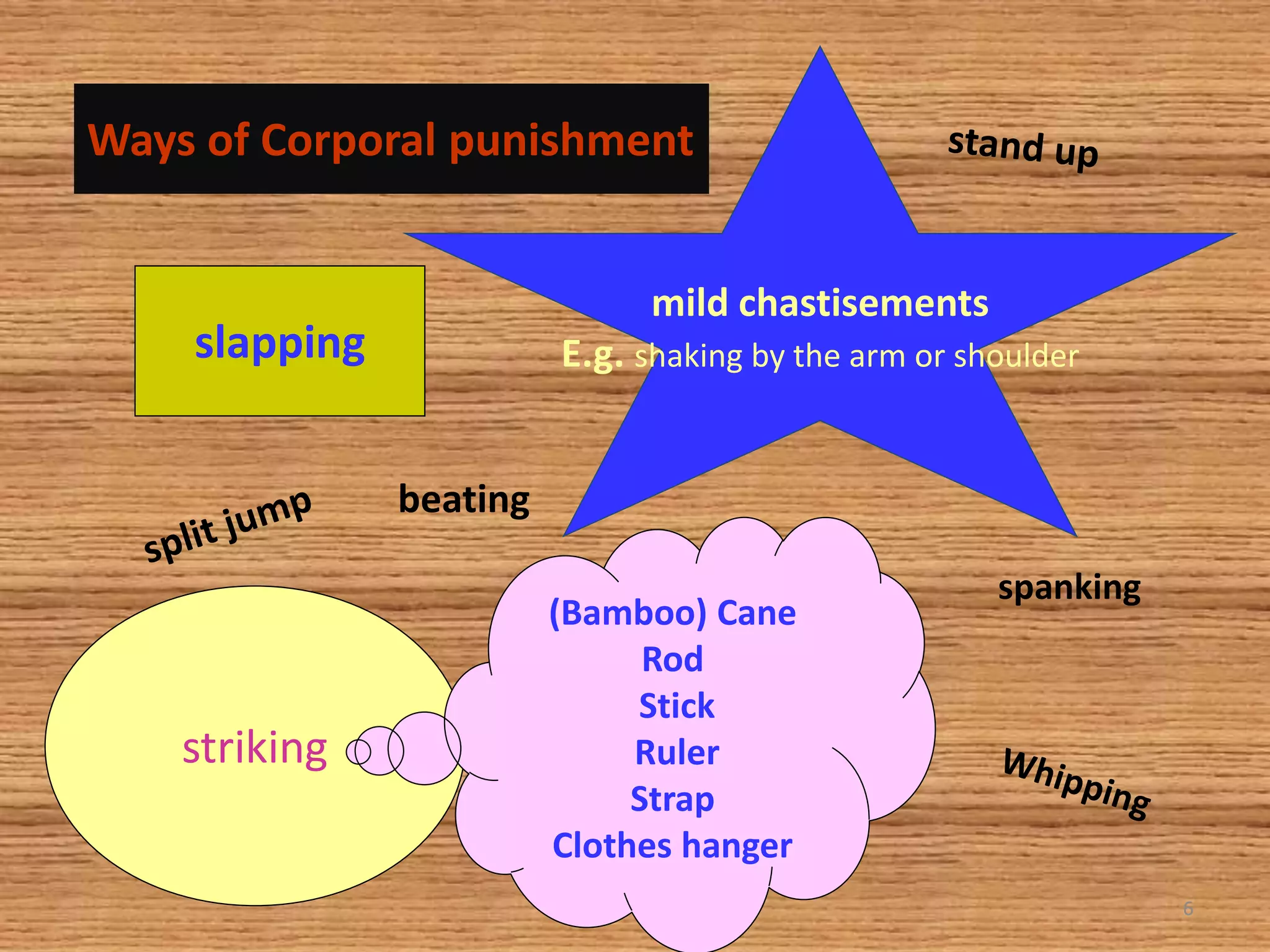
Ways of Corporal punishment
striking
slapping
(Bamboo) Cane
Rod
Stick
Ruler
Strap
Clothes hanger
mild chastisements
E.g. shaking by the arm or shoulder
spanking
beating
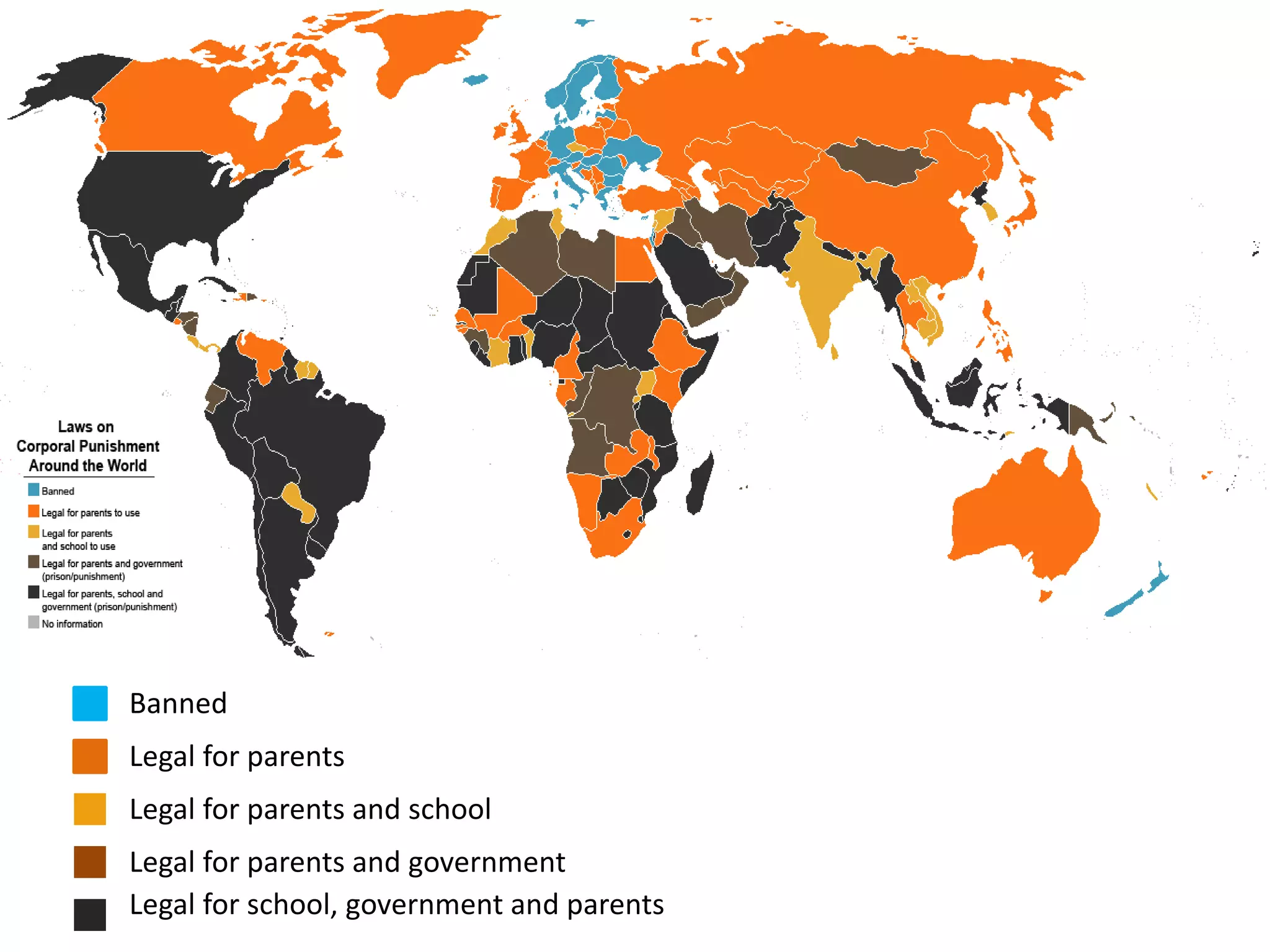
Banned
Legal for parents
Legal for parents and school
Legal for parents and government
Legal for school, government and parents
The effects of corporal punishment
(1) Direct physical harm
• Corporal punishment kills thousands of
children each year, injures many more and is
the direct cause of many children’s physical
impairments. Research in countries in all
regions attests to the severity of the physical
violence which children experience in the
name of “discipline”.
(2) Increased aggression in
children
• The reasons may include that aggression is a
reflexive response to experiencing pain, that
children learn that violence is an appropriate
method of getting what you want and that
children copy their parents’ behavior. Children
describe feeling aggressive after being
physically punished.
(3) Increased antisocial behavior
• Corporal punishment has been found to be a
factor in behaviors such as bullying, lying,
cheating, running away, truancy, school
behavior problems and involvement in crime
as a child and young adult
(4)Mental harm and indirect
physical harm
• Corporal punishment is emotionally as well
as physically painful and its links to poor
mental health in childhood are clear. Corporal
punishment is significantly associated with a
decrease in children’s mental health, including
with behavior disorders, anxiety disorders,
depression and hopelessness.Later studies
have found associations with suicide
attempts, alcohol and drug dependency, low
self-esteem, hostility and emotional
instability
PROBLEMS:
• Lack of student involvement
• Noise
• Cheating in exams
• The students may not attend the class
• The students may not listen to the teacher
• The students may not do their homeworks or tasks
• The students may come to the class on purpose
• The students do different kinds of things in the class
such as sleeping or drawing pictures etc.
SOLUTIONS:
• The teacher should choose activities which appeal to
the students
• The teacher may set some classroom rules with the
students
• The teacher should try to keep the students as busy
as possible and should not let them to be interested
in different things
• The teacher should attend personal development
courses
• The teacher may want one of her collegues to help
her
• The teacher should take the attendance
regularly to solve the problems about
attending the class
• The teacher should talk with the students and
decide what to do with the late comers
• The teacher may ask for one of her collegue’s
help in the exams in order to prevent cheating
• The teacher may talk to some students
individually, if it is necessary
• The teacher should work cooperatively with
the ministry
ALTERNATIVES FOR CHANGE IN THE
SCHOOL AND CLASSROOM
ENVIRONMENT
• Encourage programs that emphasize early
diagnosis and intervention for school
problems including problems of staff and
problems of students
• Encourage programs that emphasize values,
school pride, and personal responsibility and
that support the mental health needs of
children
• Monitor school and classroom environments
continuously to facilitate early detection of
difficulties and facilitate proactive problem
solving to address behavior difficulties
• Encourage development of fair, reasonable,
and consistent rules with input from students,
parents, school personnel, and community
members about the nature of the rules and
appropriate consequences for violations
• Promote strong family–school collaboration
and parent support
7. Conclusion
Children who grow in an environment with love will learn to show
gratitude in the future;
children grow in an environment with tolerance will learn to show
tolerance in the future;
children who grow in an environment with practice of democratic
disciplines will learn liberalism in the future;
children who grow in an environment with forgiveness will learn to
show compassion in the future.
I do hereby bring up the following advices for educators’ reference:
Corporal punishment in schools (how to avoid)

Corporal punishment in schools (how to avoid)

  • 1.
    1 Definition • Corporal punishment:violence inflicted on children by parents, teachers, guardian and others in the name of “discipline” . • Discipline: is training that corrects, molds or perfects the mental facilities or moral character.
  • 2.
    Types: School corporal punishment Parentalor domestic corporal punishment Judicial corporal punishment
  • 6.
    6 Ways of Corporalpunishment striking slapping (Bamboo) Cane Rod Stick Ruler Strap Clothes hanger mild chastisements E.g. shaking by the arm or shoulder spanking beating
  • 7.
    Banned Legal for parents Legalfor parents and school Legal for parents and government Legal for school, government and parents
  • 8.
    The effects ofcorporal punishment (1) Direct physical harm • Corporal punishment kills thousands of children each year, injures many more and is the direct cause of many children’s physical impairments. Research in countries in all regions attests to the severity of the physical violence which children experience in the name of “discipline”.
  • 9.
    (2) Increased aggressionin children • The reasons may include that aggression is a reflexive response to experiencing pain, that children learn that violence is an appropriate method of getting what you want and that children copy their parents’ behavior. Children describe feeling aggressive after being physically punished.
  • 10.
    (3) Increased antisocialbehavior • Corporal punishment has been found to be a factor in behaviors such as bullying, lying, cheating, running away, truancy, school behavior problems and involvement in crime as a child and young adult
  • 11.
    (4)Mental harm andindirect physical harm • Corporal punishment is emotionally as well as physically painful and its links to poor mental health in childhood are clear. Corporal punishment is significantly associated with a decrease in children’s mental health, including with behavior disorders, anxiety disorders, depression and hopelessness.Later studies have found associations with suicide attempts, alcohol and drug dependency, low self-esteem, hostility and emotional instability
  • 13.
    PROBLEMS: • Lack ofstudent involvement • Noise • Cheating in exams • The students may not attend the class • The students may not listen to the teacher • The students may not do their homeworks or tasks • The students may come to the class on purpose • The students do different kinds of things in the class such as sleeping or drawing pictures etc.
  • 14.
    SOLUTIONS: • The teachershould choose activities which appeal to the students • The teacher may set some classroom rules with the students • The teacher should try to keep the students as busy as possible and should not let them to be interested in different things • The teacher should attend personal development courses • The teacher may want one of her collegues to help her
  • 16.
    • The teachershould take the attendance regularly to solve the problems about attending the class • The teacher should talk with the students and decide what to do with the late comers • The teacher may ask for one of her collegue’s help in the exams in order to prevent cheating • The teacher may talk to some students individually, if it is necessary • The teacher should work cooperatively with the ministry
  • 17.
    ALTERNATIVES FOR CHANGEIN THE SCHOOL AND CLASSROOM ENVIRONMENT • Encourage programs that emphasize early diagnosis and intervention for school problems including problems of staff and problems of students • Encourage programs that emphasize values, school pride, and personal responsibility and that support the mental health needs of children
  • 18.
    • Monitor schooland classroom environments continuously to facilitate early detection of difficulties and facilitate proactive problem solving to address behavior difficulties • Encourage development of fair, reasonable, and consistent rules with input from students, parents, school personnel, and community members about the nature of the rules and appropriate consequences for violations • Promote strong family–school collaboration and parent support
  • 19.
    7. Conclusion Children whogrow in an environment with love will learn to show gratitude in the future; children grow in an environment with tolerance will learn to show tolerance in the future; children who grow in an environment with practice of democratic disciplines will learn liberalism in the future; children who grow in an environment with forgiveness will learn to show compassion in the future. I do hereby bring up the following advices for educators’ reference: