Download the full version and explore a variety of test banks
or solution manuals at https://testbankfan.com
Core Concepts of Accounting Information Systems
Canadian 1st Edition SimKin Solutions Manual

_____ Tap the link below to start your download _____
https://testbankfan.com/product/core-concepts-of-accounting-
information-systems-canadian-1st-edition-simkin-solutions-
manual/
Find test banks or solution manuals at testbankfan.com today!
We believe these products will be a great fit for you. Click
the link to download now, or visit testbankfan.com
to discover even more!
Core Concepts of Accounting Information Systems Canadian
1st Edition SimKin Test Bank
https://testbankfan.com/product/core-concepts-of-accounting-
information-systems-canadian-1st-edition-simkin-test-bank/
Core Concepts of Accounting Information Systems 13th
Edition Simkin Solutions Manual
https://testbankfan.com/product/core-concepts-of-accounting-
information-systems-13th-edition-simkin-solutions-manual/
Core Concepts of Accounting Information Systems 14th
Edition Simkin Solutions Manual
https://testbankfan.com/product/core-concepts-of-accounting-
information-systems-14th-edition-simkin-solutions-manual/
Language Of Medicine 11th Edition Chabner Test Bank
https://testbankfan.com/product/language-of-medicine-11th-edition-
chabner-test-bank/
Marketing Management A Strategic Decision-Making Approach
8th Edition Mullins Test Bank
https://testbankfan.com/product/marketing-management-a-strategic-
decision-making-approach-8th-edition-mullins-test-bank/
Plants and Society 7th Edition Levetin Test Bank
https://testbankfan.com/product/plants-and-society-7th-edition-
levetin-test-bank/
Measurement and Assessment in Teaching 11th Edition Miller
Test Bank
https://testbankfan.com/product/measurement-and-assessment-in-
teaching-11th-edition-miller-test-bank/
Diversity and Society Race Ethnicity and Gender 5th
Edition Healey Test Bank
https://testbankfan.com/product/diversity-and-society-race-ethnicity-
and-gender-5th-edition-healey-test-bank/
Vector Mechanics for Engineers Statics and Dynamics 10th
Edition Beer Solutions Manual
https://testbankfan.com/product/vector-mechanics-for-engineers-
statics-and-dynamics-10th-edition-beer-solutions-manual/
Auction Theory 2nd Edition Krishna Solutions Manual
https://testbankfan.com/product/auction-theory-2nd-edition-krishna-
solutions-manual/
Chapter 9 Solutions manual to accompany Accounting Information Systems, Cdn ed Simkin et al.
p. 1
Chapter 9
Introduction to Internal Control Systems
Discussion Questions
9-1. The primary provisions for the 1992 COSO Report and the 2004 Report are outlined
in Figure 9-1.
Business and operating environment have change dramatically since the release of the first
COSO Report. The major drivers of change were globalization, technological innovation, and
increase in overall business complexity. On May 14, 2013, COSO released an updated version
of its Internal Control—Integrated Framework. The new framework has several important
changes, it:
• Codifies principles that support five components of internal control and explicitly states 17
principles representing fundamental concepts associated with five components of internal
control.
• Clarifies the role of objective-setting in internal control.
• Incorporates increased relevance of information technology.
• Reflects on enhanced discussion of governance concepts.
• Expands the reporting category of objectives.
• Enhances consideration of anti-fraud expectations.
• Increases focus on non-financial reporting objectives.
For further information review http://www.coso.org/documents/coso%20mcnallytransition%20article-
final%20coso%20version%20proof_5-31-13.pdf
9-2. The primary provisions of the original version of COBIT, as well as the current
version (5), are outlined in Figure 9-1.
9-3. COSO stands for Committee of Sponsoring Organizations, which was established by
the Treadway Commission to work on a common definition for internal control. COBIT stands
for Control Objectives for Information and Related Technology. It was a project undertaken by
the Information Systems Audit and Control Foundation that involved an extensive examination
of the internal control area.
An important role played by COSO in the internal control area was to come up with a definition
of internal control along with a description of five interrelated components (control environment,
risk assessment, control activities, information and communication, and monitoring) that should
be included within an internal control system. Regarding COBIT and its role in the internal
control area, COBIT adapted its definition of internal control based on the COSO report. COBIT
(as well as COSO) emphasizes that people at every level of an organization are a very
important part of the organization’s internal control system.
COSO is an important framework that management of organizations might use to help ensure
that they have effective corporate governance. This is the case because the COSO framework
presents criteria to evaluate an organization’s internal control systems. According to SOX,
Section 404, management must now document the effectiveness of their internal controls and
then issue a report that accompanies the company’s annual report. Similarly, COBIT is used by
managers to ensure effective IT governance.
Chapter 9 Solutions manual to accompany Accounting Information Systems, Cdn ed Simkin et al.
p. 2
9-4. The control environment establishes the tone of a company, influencing the control
awareness of the company’s employees. It is the foundation for all the other internal control
components. Risk assessment recognizes the fact that every organization faces risks to its
success and that risks which appear to affect the accomplishment of a company’s goals should
be identified, analyzed, and acted upon. Control activities reflect the policies and procedures
that help ensure that management directives are carried out. Regarding information and
communication, the former refers to the accounting system, which includes the methods and
records used to record, process, summarize, and report a company’s transactions as well as
maintain accountability for the company’s assets, liabilities, and equity. The latter,
communication, refers to providing a company’s personnel with an understanding of their roles
and responsibilities in regard to internal control over financial reporting. Finally, monitoring is
the process that assesses the quality of internal control performance over time. Performance
reports prepared on a timely basis contribute to the monitoring component of an internal control
system.
Concerning which component is the most important, this is a matter of opinion. Most students
indicate that the control environment is the most important component of an internal control
system because, as mentioned in the textbook, it is the foundation for all the other internal
control components, providing discipline and structure.
9-5. Accountants should be concerned that their organization’s financial resources are
protected from activities such as loss, waste, or theft. To protect organizational assets, an
internal control system must be developed and implemented within a company’s AIS as well as
within other parts of the company’s system. In addition to safeguarding assets, an efficient and
effective internal control system should also:
1) Check the accuracy and reliability of accounting data
2) Promote operational efficiency
3) Encourage adherence to prescribed managerial policies.
Accountants should be concerned that all of these objectives are accomplished by their
organization’s internal control system.
9-6. Preventive control procedures are designed and implemented before an activity is
performed to prevent some potential problem (e.g., the inaccurate handling of cash receipts)
from occurring that relates to the activity. Detective control procedures are designed and
implemented to provide feedback to management regarding whether or not operational
efficiency and adherence to prescribed managerial policies have been achieved. In other
words, preventive controls should be developed prior to operating activities taking place and
detective controls should be developed to evaluate if operating efficiency and adherence to
policies of management have occurred after operating activities have taken place. Corrective
control procedures come into play based on the findings from the detective control procedures.
That is, through detective controls, corrective control procedures should be developed to identify
the cause of an organization’s problem, correct any difficulties or errors resulting from the
problem, and modify the organization’s processing system so that future occurrences of the
problem will hopefully be eliminated or at least minimized.
Examples of each type of controls are as follows:
Preventive: scenario planning, risk management, segregation of duties, controlling access to
assets
Detective: duplicate check of calculations, bank reconciliations, monthly trial balances
Corrective: backup copies of transactions and master files, training personnel to perform
their jobs
Chapter 9 Solutions manual to accompany Accounting Information Systems, Cdn ed Simkin et al.
p. 3
9-7. Competent employees are definitely important to an organization's internal control
system because employees will be working continually with the organization's various asset
resources. The employees will be, for example, handling cash, acquiring and disbursing
inventory, and operating expensive production equipment. If the organization has incompetent
employees, there is a strong likelihood that inefficient use of the firm's asset resources will
result. This inefficiency will lead to overall operating inefficiency within the organization, thereby
preventing the adherence to management's prescribed policies.
9-8. The “separation of duties” element of an organization’s internal control system
means that, for instance, employees who are given responsibility for the physical custody of
specific company assets (e.g., handling cash or inventory) should not also be given
responsibility for the record-keeping functions relating to the assets (e.g., recording cash or
inventory transactions in the company's journals and ledgers). Otherwise, an employee could
misappropriate company assets and then attempt to conceal this fraud by falsifying the
accounting records.
Through the separation of duties, one employee acts as a check on the work of another
employee. Thus, if an employee attempts to embezzle cash from a customer payment, but
does not have access to the accounts receivable subsidiary ledger to cover up this theft, he or
she would likely be detected. The other employee who performs the record-keeping activities
for accounts receivable would not have recorded the customer's payment since it was
embezzled by the employee handling cash. Consequently, the customer would complain to the
company upon receiving a subsequent billing statement which would not reflect his or her recent
payment. Upon investigating this complaint, the dishonest employee would likely be caught. It
should be noted, however, that through collusion among the employees handling assets and
recording assets, irregularities are usually not detected as quickly as when individuals work
alone (as described earlier).
In addition to detecting irregularities, separation of duties can also be helpful in detecting
accidental errors. If the same employee performs all accounting functions related to a specific
activity (e.g., handling inventory items and recording the inventory transactions), an accidental
human error by this employee, such as incorrectly recording an inventory transaction, may not
be detected. However, with two or more employees handling the accounting functions relating
to a specific activity, an accidental human error made by one employee should be detected by
another employee involved with the same activity.
9-9. Many organizations have a large volume of cash disbursement transactions. In
order to detect any errors and irregularities relating to cash disbursements, a good audit trail for
cash issuances is essential. If an organization uses both a voucher system and prenumbered
cheques for cash disbursement transactions, its audit trail of cash outlays can easily be traced.
The use of prenumbered cheques for making authorized cash disbursements enables a
company to maintain accountability over its issued cheques and its unissued cheques. After the
issued cheques clear the bank in a particular month and are returned to the organization with
the monthly bank statement, these cheques represent evidence of the actual cash
disbursements that were made. Two advantages of employing a voucher system along with
prenumbered cheques are (1) the number of cash disbursement cheques that are written is
reduced, since several invoices to the same vendor can be included on one disbursement
voucher, and (2) the disbursement voucher is an internally generated document; thus, each
voucher can be prenumbered to simplify the tracking of all payables, thereby contributing to an
effective audit trail over cash disbursements.
Chapter 9 Solutions manual to accompany Accounting Information Systems, Cdn ed Simkin et al.
p. 4
Sometimes, prenumbered cheques are not efficient for an organization to use. For example, for
expenditures of small dollar amounts (e.g., spending a few dollars to have the company
president's car washed) cash payment might be a better choice. Because of the time and effort
involved in processing cheques, it is normally more efficient to use a petty cash fund for making
various small, miscellaneous expenditures. However, to exercise good internal control over the
petty cash fund's use, one employee (called the petty cash custodian) should be given the
responsibility for handling petty cash transactions.
9-10. Under the cost-benefit concept, an analysis is performed on each potential control
procedure (i.e., compare the expected costs of designing, implementing, and operating each
control to its expected benefits). Only those controls whose benefits are expected to be greater
than, or at least equal to, the expected costs should be implemented into the company’s
system. Cost-effective controls are those whose anticipated benefits exceed their anticipated
costs.
Ideal control procedures (i.e., those that would reduce the risk to practically zero of any
undetected errors and irregularities occurring) may be impractical for a company because the
expected costs may be larger than their expected benefits. The implementation of controls
whose costs are expected to exceed the controls benefits would not contribute to a company’s
overall operating efficiency. In these cases, control procedures which are less than ideal for
detecting errors and irregularities (but whose expected benefits exceed the expected costs)
should be implemented within the company’s internal control system.
From the standpoint of evaluating a company’s internal control system, a performance report is
a type of report that provides information to management on how efficiently and effectively its
company’s internal controls are functioning. Based on accurately prepared performance
reports, management receives feedback on the success or failure of the previously implemented
package of internal controls. The preparation of a performance report is a detective control
procedure.
Performance reports should be an essential element within a company’s internal control system
because they are the major means of communicating to management regarding the actual
operations of the company’s internal control systems. For specific controls that are not
operating the way they were originally planned, as indicated by a performance report,
management can then take action to correct identified problems.
Timely information to managers, regarding internal control problems, is critical so that mangers
can initiate action to correct the problems. Thus, performance reports should be prepared on a
timely basis in order that a minimum period elapses between the occurrence of operational
problems with certain controls and the feedback to management on these poorly functioning
controls.
9-11. Discussion question 9-5 identifies a number of reasons why accountants are so
concerned about their organizations’ internal control systems. However, the managers of these
organizations are particularly concerned about the effectiveness and efficiency of internal
controls due to the SOX legislation. Under Section 302 of this legislation, the CEO and CFO are
legally responsible for establishing and maintaining internal controls in the organization. In
addition, they must have evaluated the effectiveness of the company’s internal controls and
submitted their report to the external auditors, who evaluate the sufficiency of those internal
Chapter 9 Solutions manual to accompany Accounting Information Systems, Cdn ed Simkin et al.
p. 5
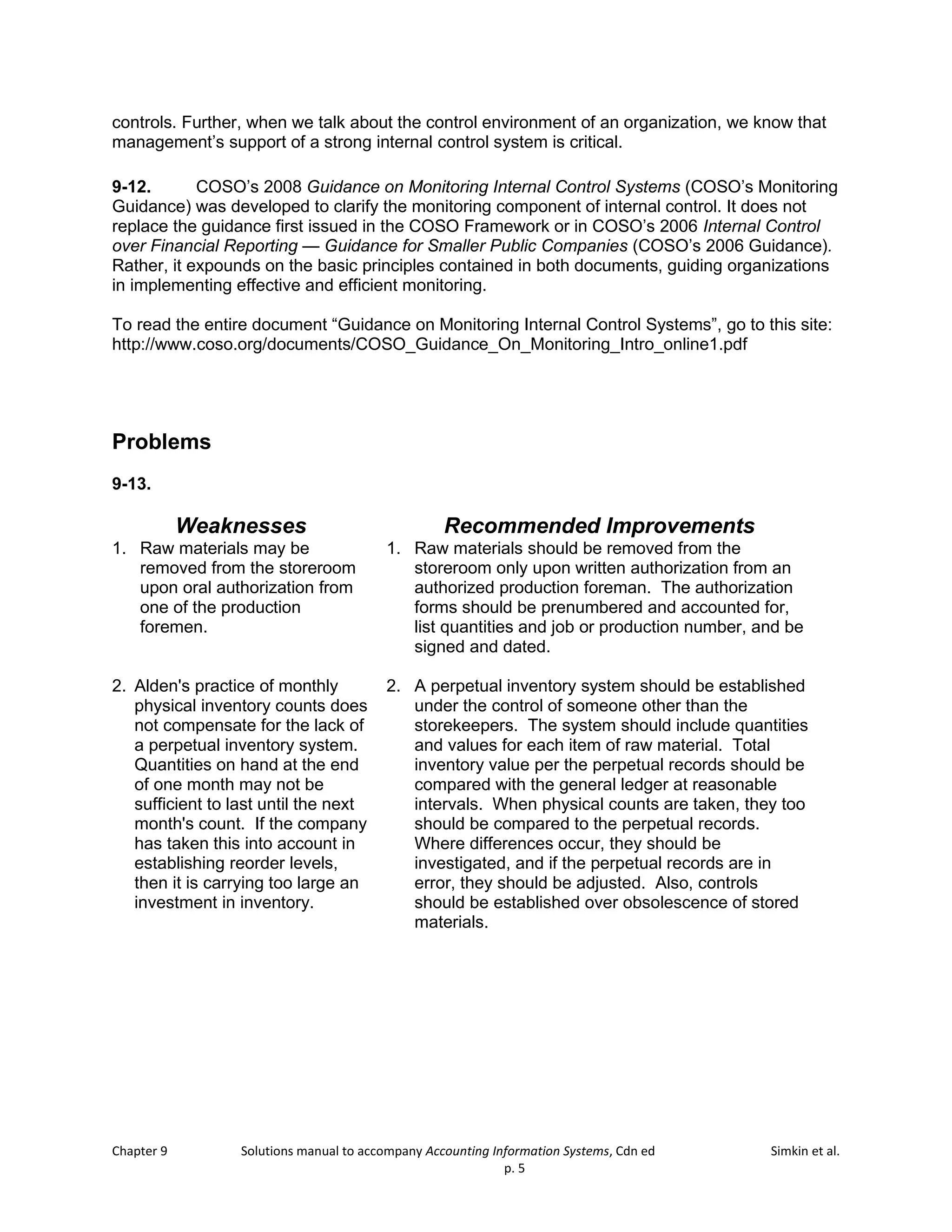
controls. Further, when we talk about the control environment of an organization, we know that
management’s support of a strong internal control system is critical.
9-12. COSO’s 2008 Guidance on Monitoring Internal Control Systems (COSO’s Monitoring
Guidance) was developed to clarify the monitoring component of internal control. It does not
replace the guidance first issued in the COSO Framework or in COSO’s 2006 Internal Control
over Financial Reporting — Guidance for Smaller Public Companies (COSO’s 2006 Guidance).
Rather, it expounds on the basic principles contained in both documents, guiding organizations
in implementing effective and efficient monitoring.
To read the entire document “Guidance on Monitoring Internal Control Systems”, go to this site:
http://www.coso.org/documents/COSO_Guidance_On_Monitoring_Intro_online1.pdf
Problems
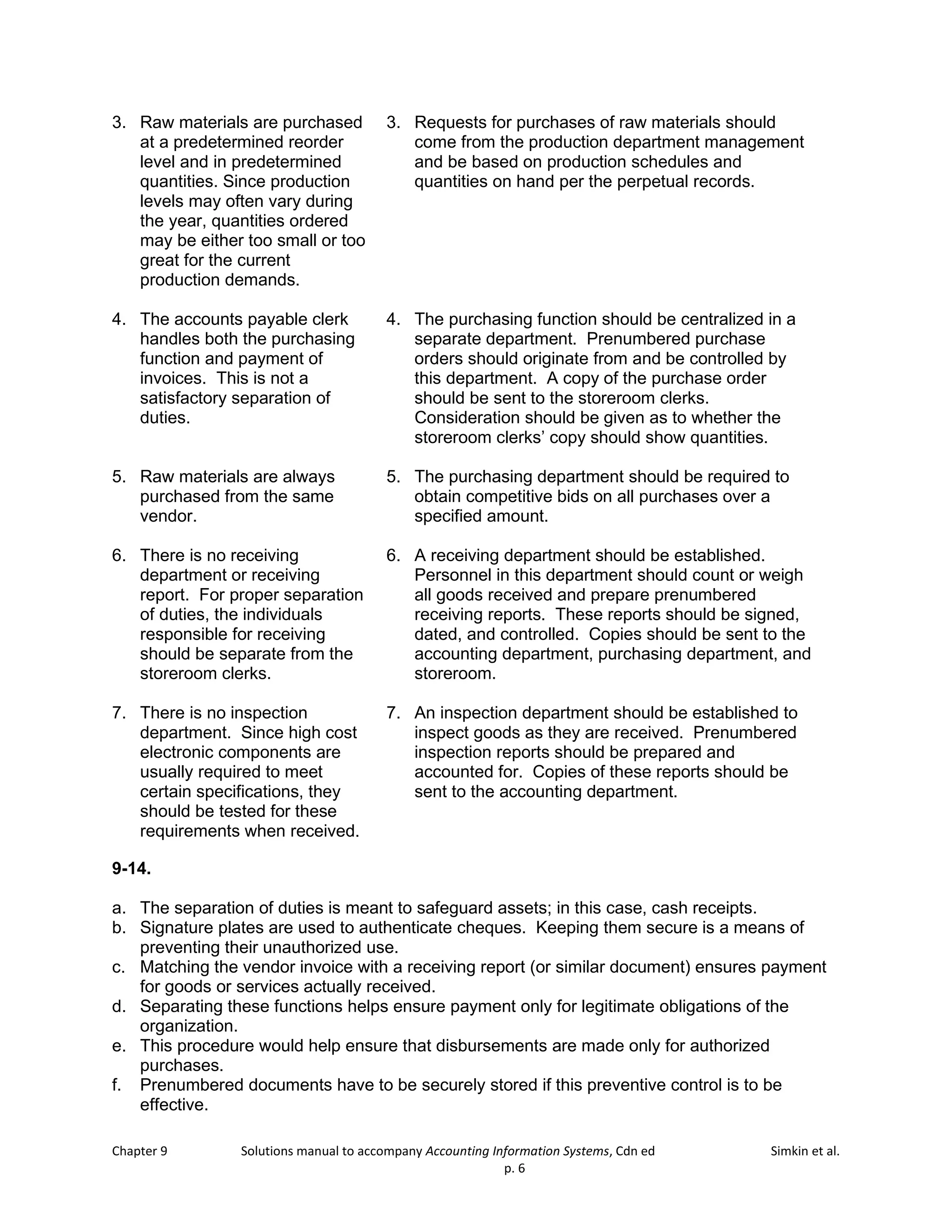
9-13.
Weaknesses Recommended Improvements
1. Raw materials may be
removed from the storeroom
upon oral authorization from
one of the production
foremen.
1. Raw materials should be removed from the
storeroom only upon written authorization from an
authorized production foreman. The authorization
forms should be prenumbered and accounted for,
list quantities and job or production number, and be
signed and dated.
2. Alden's practice of monthly
physical inventory counts does
not compensate for the lack of
a perpetual inventory system.
Quantities on hand at the end
of one month may not be
sufficient to last until the next
month's count. If the company
has taken this into account in
establishing reorder levels,
then it is carrying too large an
investment in inventory.
2. A perpetual inventory system should be established
under the control of someone other than the
storekeepers. The system should include quantities
and values for each item of raw material. Total
inventory value per the perpetual records should be
compared with the general ledger at reasonable
intervals. When physical counts are taken, they too
should be compared to the perpetual records.
Where differences occur, they should be
investigated, and if the perpetual records are in
error, they should be adjusted. Also, controls
should be established over obsolescence of stored
materials.
Chapter 9 Solutions manual to accompany Accounting Information Systems, Cdn ed Simkin et al.
p. 6
3. Raw materials are purchased
at a predetermined reorder
level and in predetermined
quantities. Since production
levels may often vary during
the year, quantities ordered
may be either too small or too
great for the current
production demands.
3. Requests for purchases of raw materials should
come from the production department management
and be based on production schedules and
quantities on hand per the perpetual records.
4. The accounts payable clerk
handles both the purchasing
function and payment of
invoices. This is not a
satisfactory separation of
duties.
4. The purchasing function should be centralized in a
separate department. Prenumbered purchase
orders should originate from and be controlled by
this department. A copy of the purchase order
should be sent to the storeroom clerks.
Consideration should be given as to whether the
storeroom clerks’ copy should show quantities.
5. Raw materials are always
purchased from the same
vendor.
5. The purchasing department should be required to
obtain competitive bids on all purchases over a
specified amount.
6. There is no receiving
department or receiving
report. For proper separation
of duties, the individuals
responsible for receiving
should be separate from the
storeroom clerks.
6. A receiving department should be established.
Personnel in this department should count or weigh
all goods received and prepare prenumbered
receiving reports. These reports should be signed,
dated, and controlled. Copies should be sent to the
accounting department, purchasing department, and
storeroom.
7. There is no inspection
department. Since high cost
electronic components are
usually required to meet
certain specifications, they
should be tested for these
requirements when received.
7. An inspection department should be established to
inspect goods as they are received. Prenumbered
inspection reports should be prepared and
accounted for. Copies of these reports should be
sent to the accounting department.
9-14.
a. The separation of duties is meant to safeguard assets; in this case, cash receipts.
b. Signature plates are used to authenticate cheques. Keeping them secure is a means of
preventing their unauthorized use.
c. Matching the vendor invoice with a receiving report (or similar document) ensures payment
for goods or services actually received.
d. Separating these functions helps ensure payment only for legitimate obligations of the
organization.
e. This procedure would help ensure that disbursements are made only for authorized
purchases.
f. Prenumbered documents have to be securely stored if this preventive control is to be
effective.
Chapter 9 Solutions manual to accompany Accounting Information Systems, Cdn ed Simkin et al.
p. 7
g. Using an imprest or special account for payroll limits the loss due to incorrectly printed
cheques associated with each period’s total payroll.
h. Separation of functions prevents one person from diverting cash assets and subsequently
concealing the wrongdoing.
i. Cheque protectors use a number of methods which make it difficult to successfully change
the cheque amount.
j. Both the surprise counts and the knowledge of their likelihood deter the unauthorized use of
cash.
k. Approved vendor lists help prevent unauthorized purchases (irregularities or embezzlement
of assets).
l. Such separation of duties helps prevent unauthorized purchases.
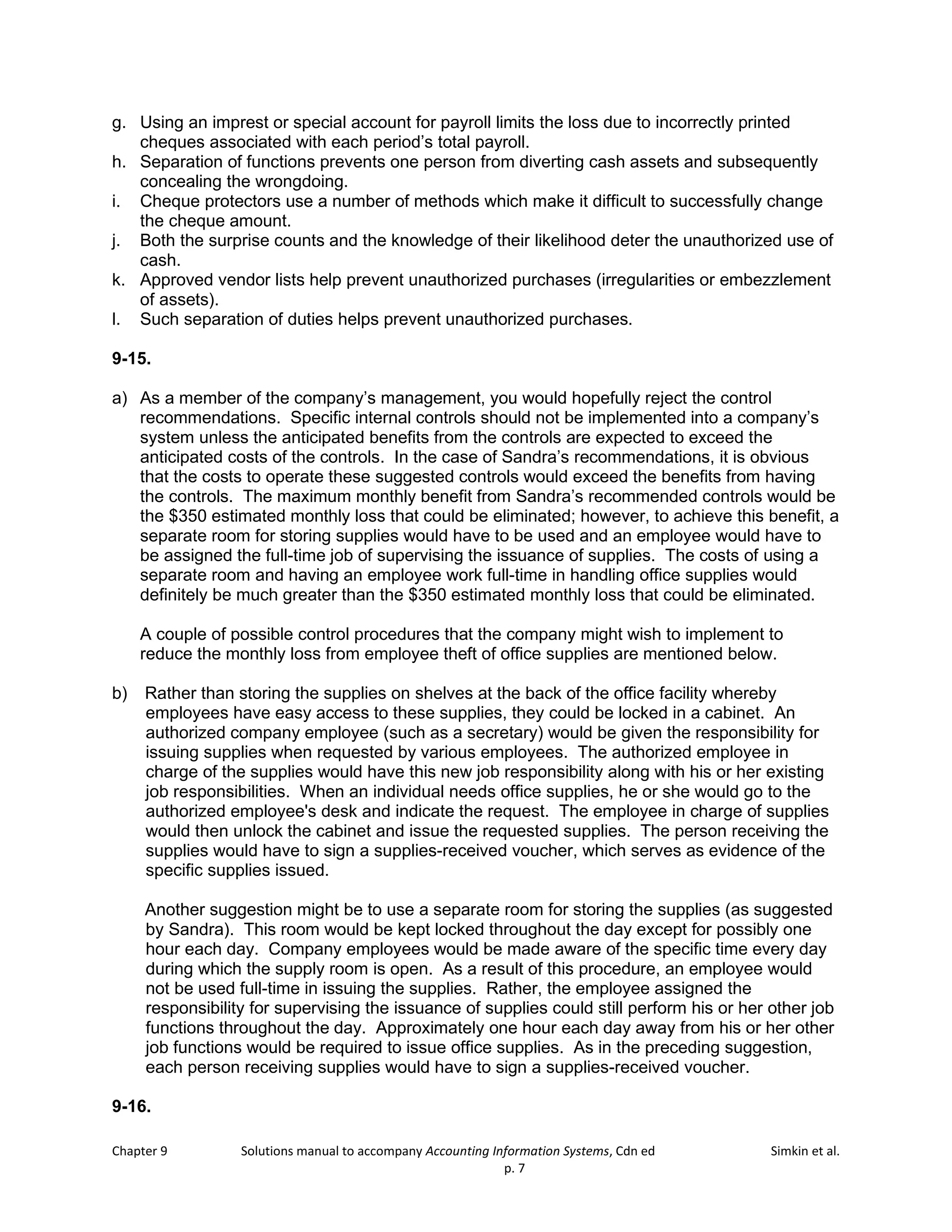
9-15.
a) As a member of the company’s management, you would hopefully reject the control
recommendations. Specific internal controls should not be implemented into a company’s
system unless the anticipated benefits from the controls are expected to exceed the
anticipated costs of the controls. In the case of Sandra’s recommendations, it is obvious
that the costs to operate these suggested controls would exceed the benefits from having
the controls. The maximum monthly benefit from Sandra’s recommended controls would be
the $350 estimated monthly loss that could be eliminated; however, to achieve this benefit, a
separate room for storing supplies would have to be used and an employee would have to
be assigned the full-time job of supervising the issuance of supplies. The costs of using a
separate room and having an employee work full-time in handling office supplies would
definitely be much greater than the $350 estimated monthly loss that could be eliminated.
A couple of possible control procedures that the company might wish to implement to
reduce the monthly loss from employee theft of office supplies are mentioned below.
b) Rather than storing the supplies on shelves at the back of the office facility whereby
employees have easy access to these supplies, they could be locked in a cabinet. An
authorized company employee (such as a secretary) would be given the responsibility for
issuing supplies when requested by various employees. The authorized employee in
charge of the supplies would have this new job responsibility along with his or her existing
job responsibilities. When an individual needs office supplies, he or she would go to the
authorized employee's desk and indicate the request. The employee in charge of supplies
would then unlock the cabinet and issue the requested supplies. The person receiving the
supplies would have to sign a supplies-received voucher, which serves as evidence of the
specific supplies issued.
Another suggestion might be to use a separate room for storing the supplies (as suggested
by Sandra). This room would be kept locked throughout the day except for possibly one
hour each day. Company employees would be made aware of the specific time every day
during which the supply room is open. As a result of this procedure, an employee would
not be used full-time in issuing the supplies. Rather, the employee assigned the
responsibility for supervising the issuance of supplies could still perform his or her other job
functions throughout the day. Approximately one hour each day away from his or her other
job functions would be required to issue office supplies. As in the preceding suggestion,
each person receiving supplies would have to sign a supplies-received voucher.
9-16.
Chapter 9 Solutions manual to accompany Accounting Information Systems, Cdn ed Simkin et al.
p. 8
1. Most students believe that Ron Mitchell’s method of stealing cash receipts will be detected
by the movie theatre's manager assuming that the manager uses a few internal control
procedures.
First, the tickets issued by Ron to theatre patrons should be prenumbered and controlled by
the manager. At the beginning of Ron's work shift, he should be made accountable for a
specific quantity of prenumbered tickets and not have access to any other tickets. At the
end of Ron's work shift, the manager should count the total number of ticket-halves that he
has accumulated from customers who have entered the theatre. From multiplying the
selling price per ticket by the number of ticket-halves in his possession, the manager can
determine the total cash receipts that should have been collected by Ron. If there is more
than one price for tickets, such as children prices and adult prices, the differently
priced-tickets can be colour-coded to enable the manager to compute the total cash
receipts that should have been collected. The manager can then count the total actual cash
that Ron collected during his work shift. (Of course, the amount of change fund that Ron
was provided at the start of his shift should be subtracted from his total cash.) Through this
procedure, the manager can determine if the actual cash receipts collected by Ron are
equal to the cash receipts that should have been collected (based on the manager's
accumulated ticket-halves). The cash receipts that were pocketed by Ron should thus be
detected, since the manager's count of actual cash receipts would fall short of the cash
receipts that should have been collected.
2. An additional control procedure that the theatre manager may want to implement is to
periodically observe Ron while he is performing his work functions. This procedure should
take place without Ron being aware that he is being observed. If, as a result of observing
Ron's work activities, the manager is suspicious of irregular acts, he can watch Ron even
closer until his suspicions are fully confirmed.
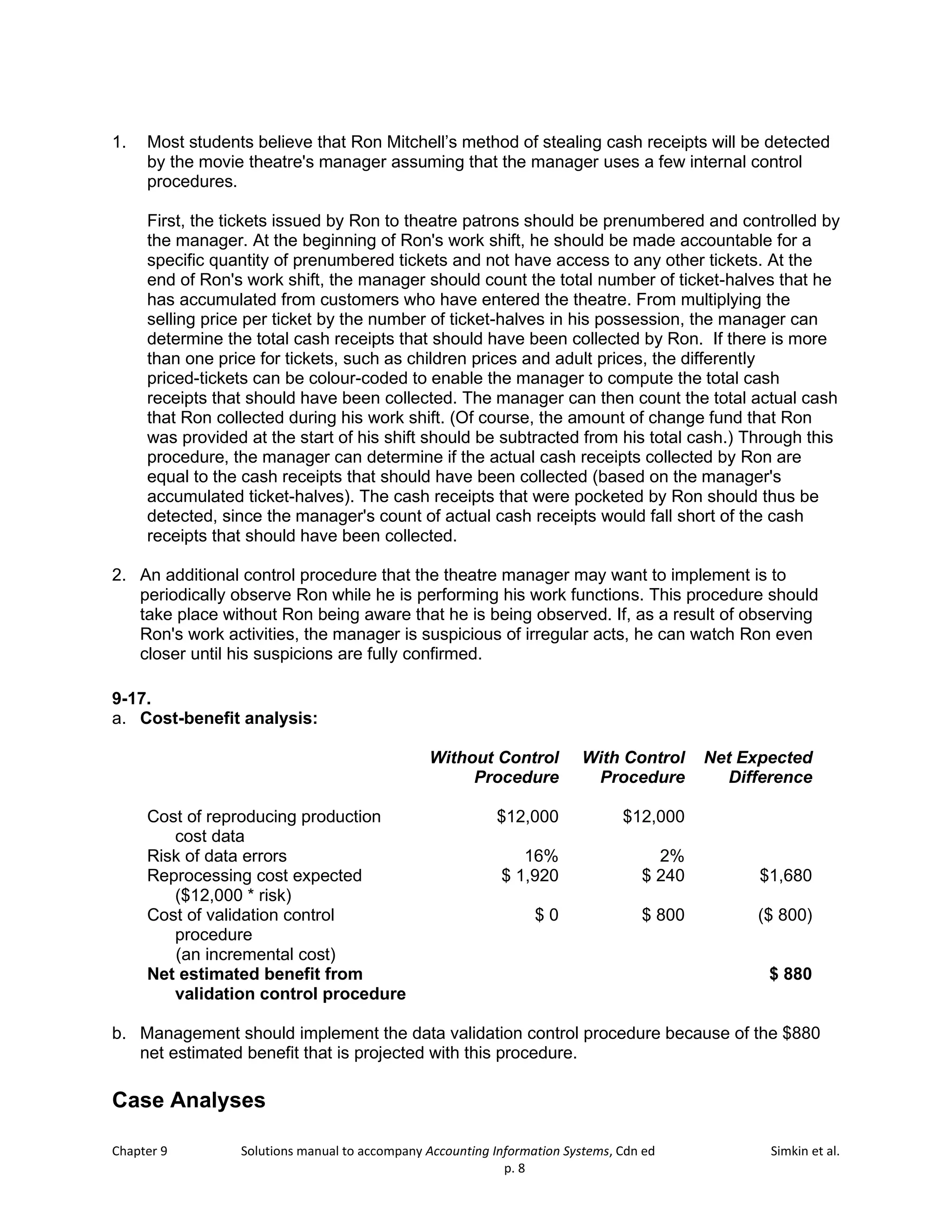
9-17.
a. Cost-benefit analysis:
Without Control
Procedure
With Control
Procedure
Net Expected
Difference
Cost of reproducing production
cost data
$12,000 $12,000
Risk of data errors 16% 2%
Reprocessing cost expected
($12,000 * risk)
$ 1,920 $ 240 $1,680
Cost of validation control
procedure
(an incremental cost)
$ 0 $ 800 ($ 800)
Net estimated benefit from
validation control procedure
$ 880
b. Management should implement the data validation control procedure because of the $880
net estimated benefit that is projected with this procedure.
Case Analyses
Chapter 9 Solutions manual to accompany Accounting Information Systems, Cdn ed Simkin et al.
p. 9
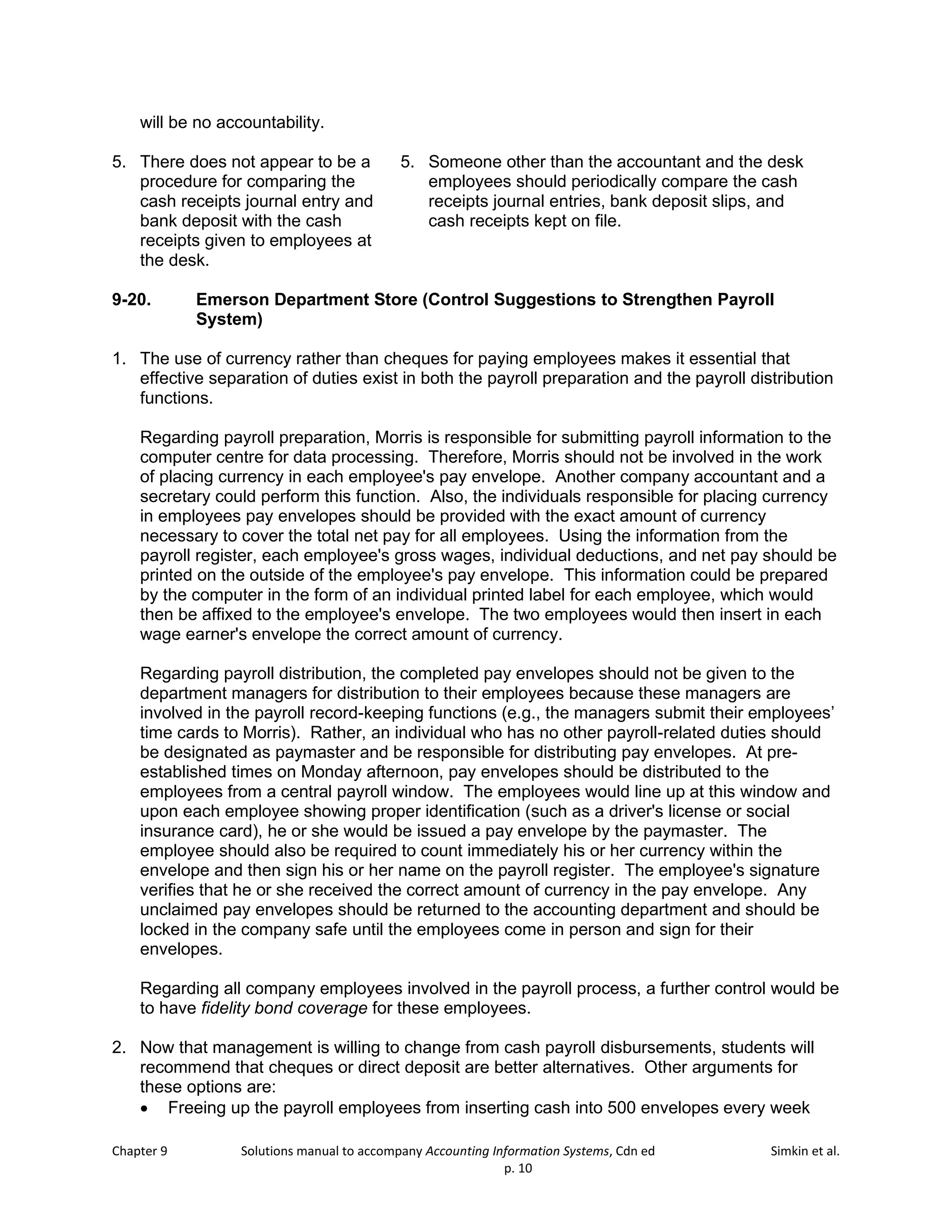
9-18. Manitoba Menswear (Risk Assessment and Control Procedures)
1. (a) The risk is that merchandise is stolen.
(b) Shoplifting is a very large problem for retailers. There should be better inventory
controls. These might include closed circuit cameras, tags that are removed at the end
of the sales process, and security personnel.
2. (a) The risk is that stolen merchandise (perhaps at the same two stores in point #4) is being
returned for cash.
(b) Returns should require a sales receipt. The store may also consider a policy of allowing
returns for merchandise credit only.
3. (a) The risk is that the store is losing income.
(b) Either revenues are down or cost of sales has increased. Management needs to inspect
these numbers closely to see where the problem lies. At least part of it could be
attributable to poor inventory control.
4. (a) The risk is that cash was not deposited.
(b) This can easily be controlled by requiring daily reconciliations by an employee not
involved in receiving or depositing cash.
5. (a) The risk is that cash was not collected from customers.
(b) The employee should be reprimanded. Either all cheques or cheques exceeding a
specific dollar amount should be approved by someone other than the salesperson.
6. (a) The risk is that petty cash was pilfered.
(b) There should be a custodian over petty cash who has sole responsibility for it. The
custodian should never disburse cash without obtaining a receipt.
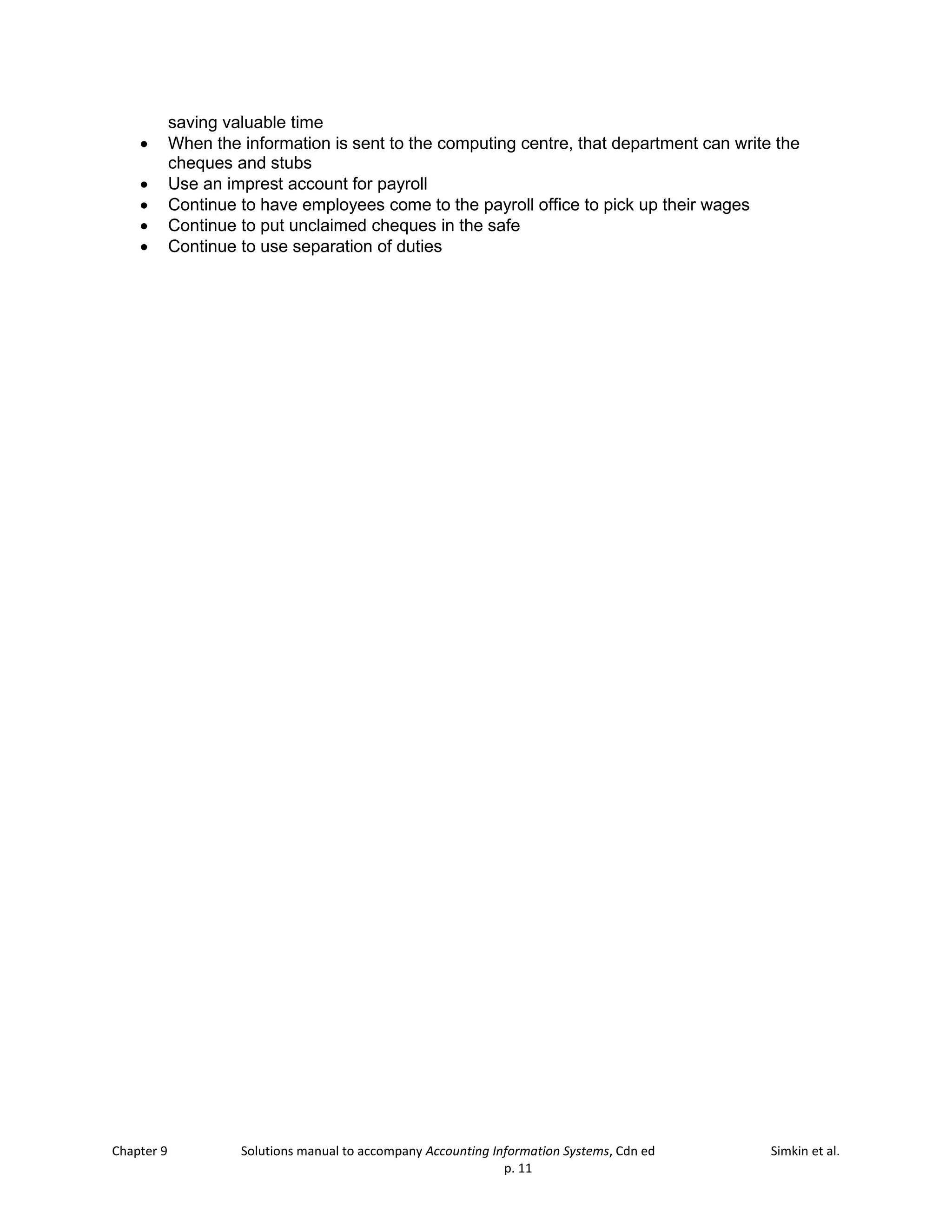
9-19. Cuts-n-Curves Athletic Club (Analyzing Internal Controls)
Weaknesses Recommended Improvements
1. The employee at the desk could
allow friends to enter at no
charge.
1. There needs to be some separation of duties.
There could be another person at the front desk
where the visitor completes the waiver form and
obtains a daily pass. The first employee would
then require a pass and would not handle cash.
(Note - this may be cost prohibitive)
2. The employee at the desk could
pocket cash.
2. The same control as #1.
3. The cash receipts are not
controlled.
3. The cash receipts should be kept in a file. They
should also be sequentially numbered.
4. There may be many different
desk employees throughout the
day. If cash is missing, there
4. There should be a log of employees and their
working hours. They need to sign in and out.
Chapter 9 Solutions manual to accompany Accounting Information Systems, Cdn ed Simkin et al.
p. 10
will be no accountability.
5. There does not appear to be a
procedure for comparing the
cash receipts journal entry and
bank deposit with the cash
receipts given to employees at
the desk.
5. Someone other than the accountant and the desk
employees should periodically compare the cash
receipts journal entries, bank deposit slips, and
cash receipts kept on file.
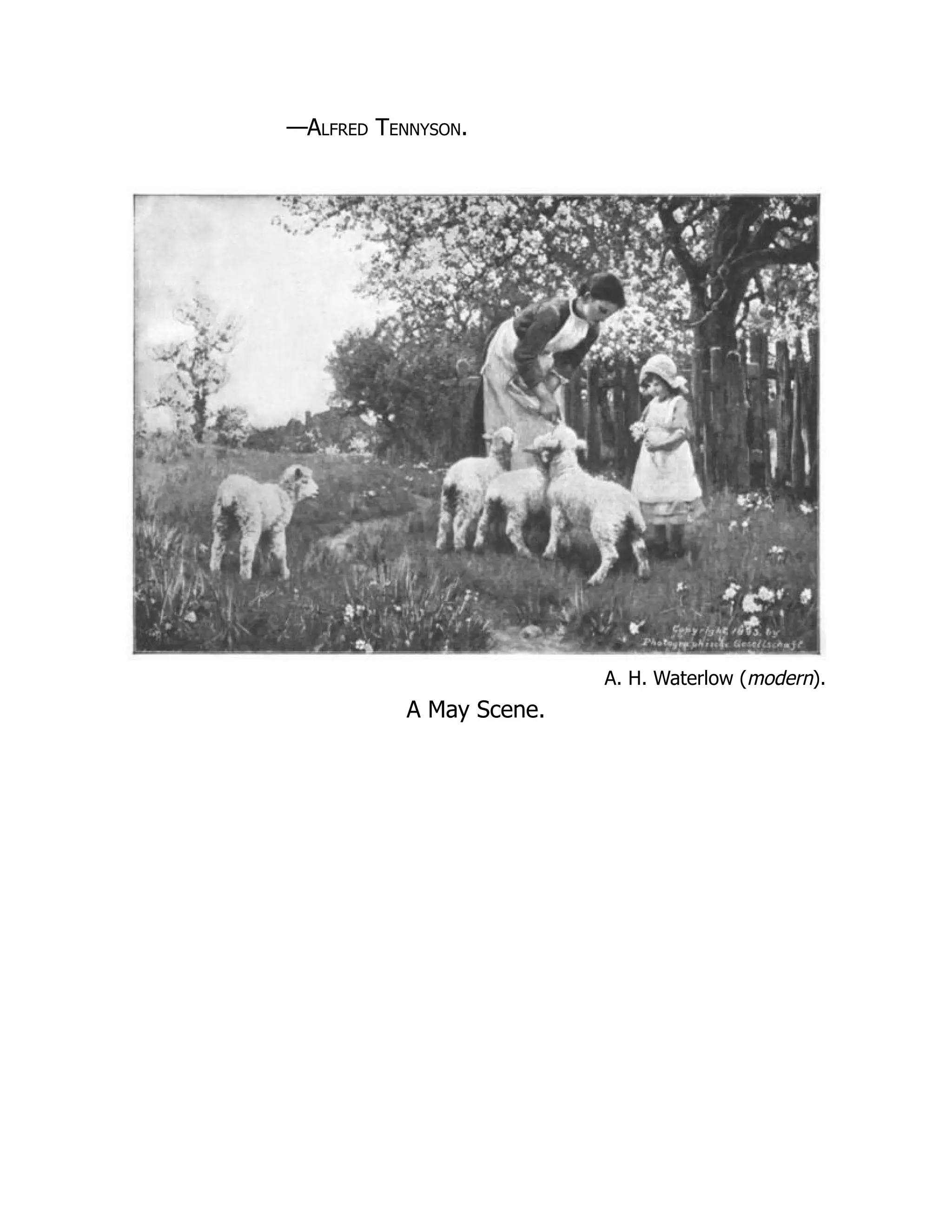
9-20. Emerson Department Store (Control Suggestions to Strengthen Payroll
System)
1. The use of currency rather than cheques for paying employees makes it essential that
effective separation of duties exist in both the payroll preparation and the payroll distribution
functions.
Regarding payroll preparation, Morris is responsible for submitting payroll information to the
computer centre for data processing. Therefore, Morris should not be involved in the work
of placing currency in each employee's pay envelope. Another company accountant and a
secretary could perform this function. Also, the individuals responsible for placing currency
in employees pay envelopes should be provided with the exact amount of currency
necessary to cover the total net pay for all employees. Using the information from the
payroll register, each employee's gross wages, individual deductions, and net pay should be
printed on the outside of the employee's pay envelope. This information could be prepared
by the computer in the form of an individual printed label for each employee, which would
then be affixed to the employee's envelope. The two employees would then insert in each
wage earner's envelope the correct amount of currency.
Regarding payroll distribution, the completed pay envelopes should not be given to the
department managers for distribution to their employees because these managers are
involved in the payroll record-keeping functions (e.g., the managers submit their employees’
time cards to Morris). Rather, an individual who has no other payroll-related duties should
be designated as paymaster and be responsible for distributing pay envelopes. At pre-
established times on Monday afternoon, pay envelopes should be distributed to the
employees from a central payroll window. The employees would line up at this window and
upon each employee showing proper identification (such as a driver's license or social
insurance card), he or she would be issued a pay envelope by the paymaster. The
employee should also be required to count immediately his or her currency within the
envelope and then sign his or her name on the payroll register. The employee's signature
verifies that he or she received the correct amount of currency in the pay envelope. Any
unclaimed pay envelopes should be returned to the accounting department and should be
locked in the company safe until the employees come in person and sign for their
envelopes.
Regarding all company employees involved in the payroll process, a further control would be
to have fidelity bond coverage for these employees.
2. Now that management is willing to change from cash payroll disbursements, students will
recommend that cheques or direct deposit are better alternatives. Other arguments for
these options are:
• Freeing up the payroll employees from inserting cash into 500 envelopes every week
Chapter 9 Solutions manual to accompany Accounting Information Systems, Cdn ed Simkin et al.
p. 11
saving valuable time
• When the information is sent to the computing centre, that department can write the
cheques and stubs
• Use an imprest account for payroll
• Continue to have employees come to the payroll office to pick up their wages
• Continue to put unclaimed cheques in the safe
• Continue to use separation of duties
Another Random Scribd Document
with Unrelated Content
—Alfred Tennyson.
A. H. Waterlow (modern).
A May Scene.
THE HOLIDAYS OF THE YEAR.
When the New Year comes, we all hold out our hands to the
welcome guest, and are glad to see his young and smiling face. So
we have made the first day of January a holiday, that friends may
wish one another a “Happy New Year.”
February has many days that are dear to us. The birthdays of our
noble presidents, Lincoln and Washington, are always celebrated
with honor for their greatness and rejoicings for our country’s
prosperity. Longfellow and Lowell, two of our greatest poets, are
also remembered. St. Valentine’s Day is a festival welcome to
children, and to all who love to see young people gay and happy.
In March we have no holiday.
In many of our states a very interesting holiday has been given to
April. It is called “Arbor Day,” for on this day trees are planted. Men
have always felt a reverence for trees, and have believed that
“The groves were God’s first temples.”
The Greeks gave a personality to trees, and the Druids worshiped
the strong and noble oak. So we are setting aside a day when all the
people shall make holiday, and plant trees whose shade shall refresh
and whose fruit shall nourish us. This is a beautiful holiday, and one
full of meaning. Our poet Bryant says,—
“What plant we in this apple tree?
Sweets for a hundred flowery springs
To load the May wind’s restless wings,
When, from the orchard row, he pours
Its fragrance through our open doors;
A world of blossoms for the bee,
Flowers for the sick girl’s silent room,
For the glad infant sprigs of bloom,
We plant with the apple tree.”
May brings with her one of the most sacred and beautiful days of all
the year. On Memorial, or Decoration, Day we cover with flowers the
graves of those who died to preserve the nation.
In England and in Sweden, May Day is given up to dance and song
and flower shows. This festival began in honor of Odin, the old
Norse god of the sun.
June has no day that is remembered as a universal holiday. But in
July we find the greatest day of the year—the Fourth of July,
Independence Day. Every child knows that on this day our nation
was born. The flags, the drums, the trumpets, the cannon,—all
awaken in the breast of every American a thrill of love and pride that
will never pass away.
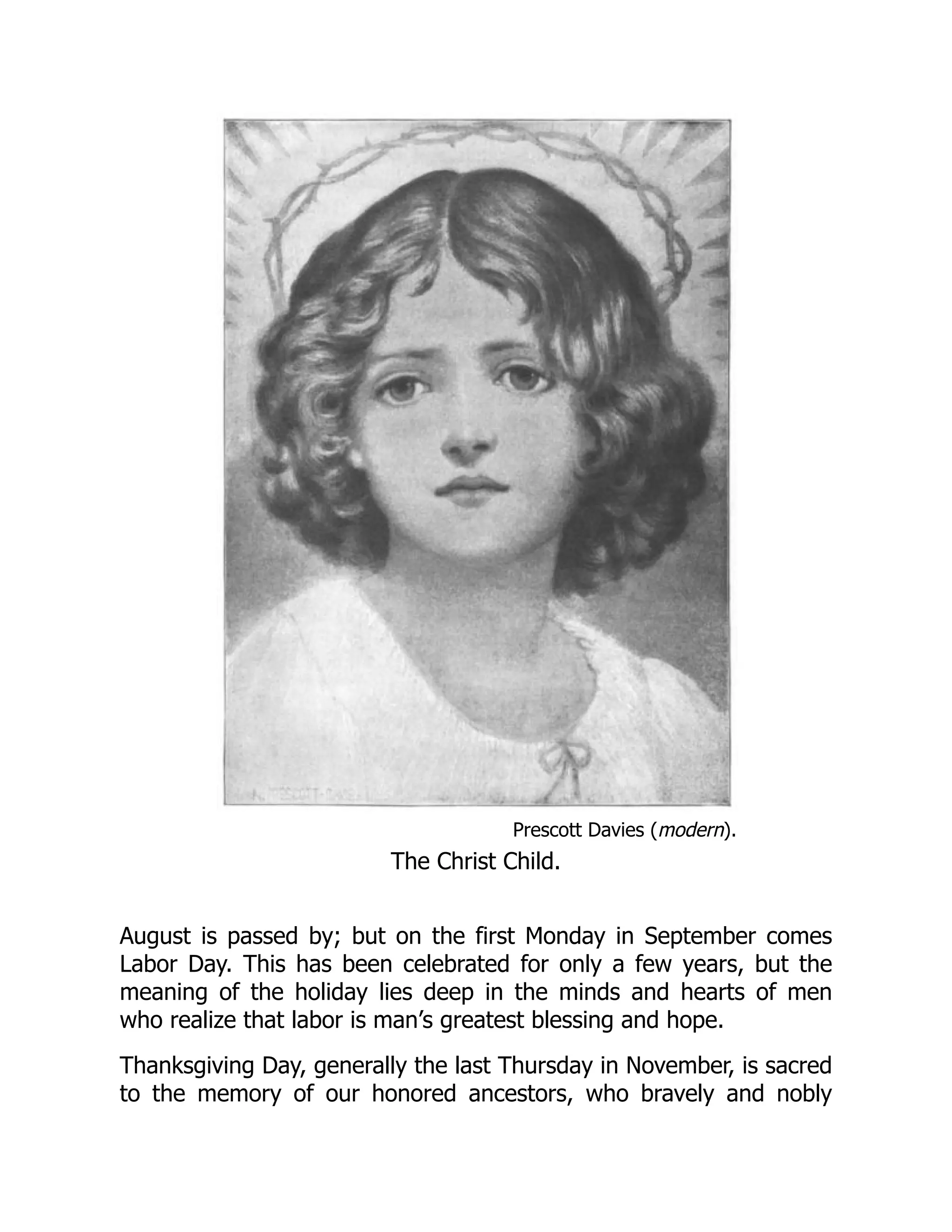
Prescott Davies (modern).
The Christ Child.
August is passed by; but on the first Monday in September comes
Labor Day. This has been celebrated for only a few years, but the
meaning of the holiday lies deep in the minds and hearts of men
who realize that labor is man’s greatest blessing and hope.
Thanksgiving Day, generally the last Thursday in November, is sacred
to the memory of our honored ancestors, who bravely and nobly
endured the cold and want of that first New England winter,
confident that the God whom they trusted and served would not
forget them.
“Aye, call it holy ground,
The soil where first they trod!
They have left unstained what there they found,—
Freedom to worship God!”
December has the children’s great festal day,—the blessed
Christmas, when the lessons of Christ’s life blossom into deeds, and
a loving spirit seems to spread over all the land. The carols, the
Christmas trees, the merry bells, make the heart gay, and all the air
resounds with Christmas glee. We read the Christmas stories, sing
the old songs, send loving greetings to absent friends, and rejoice
with the happy children, for “of such is the kingdom of heaven.”
THE DAYS OF THE WEEK.
In the southern countries of Europe, the days of the week were
named after the gods of the Greeks and Romans. But in our country,
and in some of the countries of northern Europe, the gods of the
North have given their names to the days.
Sunday and Monday received their names from the sun and the
moon—the radiant lamps that light the earth by day and by night.
Tiw is the god of honorable war, the son of Odin and Frigga, the
earth mother. His emblem is the sword, and in olden days the people
did him great homage. Tuesday, the third day of the week, was
named in his honor.
Wednesday was called Woden’s day, in honor of Woden, or Odin, the
king of the gods. He was often called the All Father.
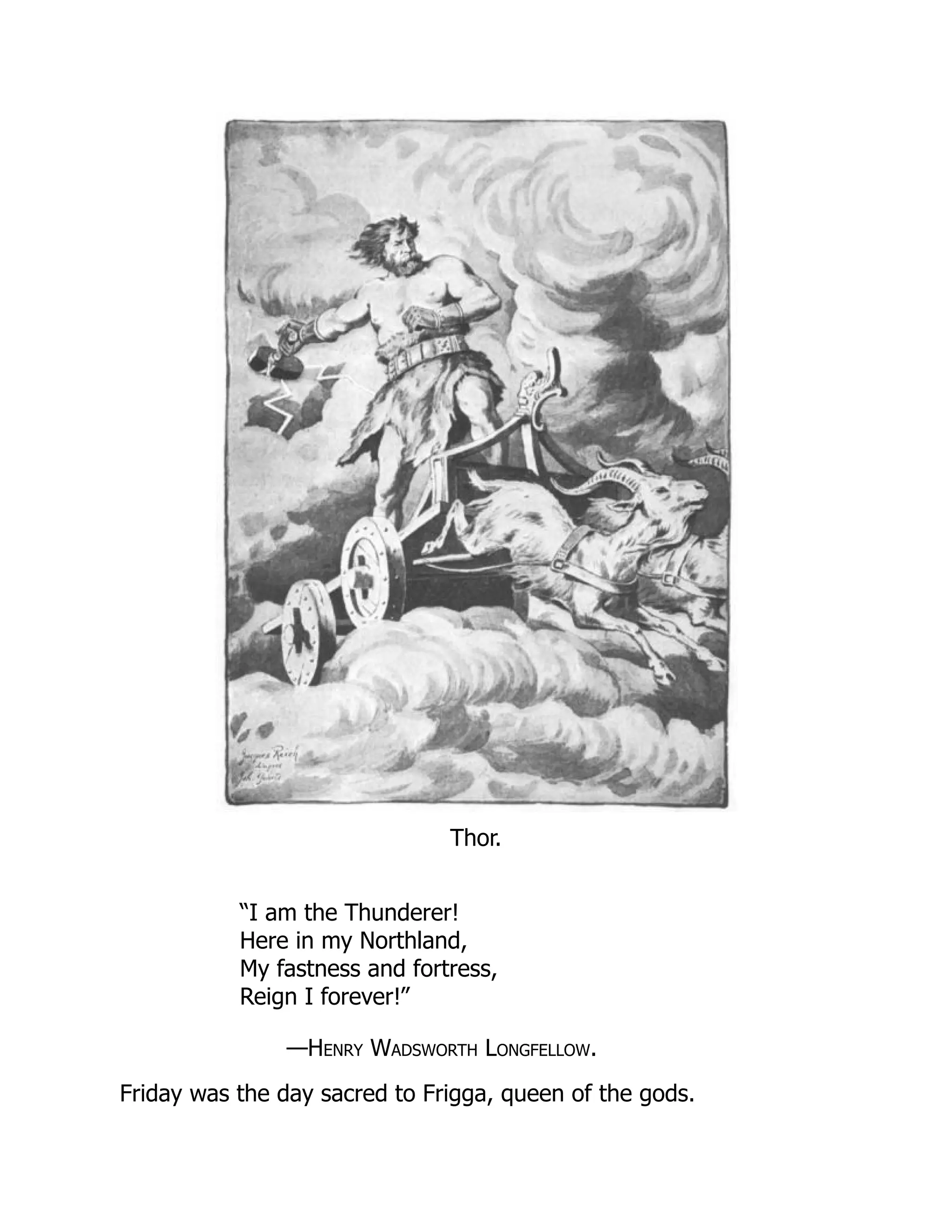
Thor, the son of Odin, is one of the twelve great gods of northern
mythology. “Whenever he throws his wonderful hammer,” they used
to say, “the noise of thunder is heard through the heavens. He is the
only god who cannot cross from earth to heaven upon the rainbow,
for he is so heavy and powerful that the gods fear it will break under
his weight.” Thursday was sacred to Thor.
Thor.
“I am the Thunderer!
Here in my Northland,
My fastness and fortress,
Reign I forever!”
—Henry Wadsworth Longfellow.
Friday was the day sacred to Frigga, queen of the gods.
Saturday received its name from Sæter, god of the harvest.
“One poor day!—
Remember whose, and not how short it is!
It is God’s day, it is Columbus’s.
A lavish day! One day, with life and heart,
Is more than time enough to find a world.”
—James Russell Lowell.
“No man is born into the world whose work
Is not born with him. There is always work,
And tools to work withal, for those who will;
And blesséd are the horny hands of toil!
The busy world shoves angrily aside
The man who stands with arms akimbo set,
Until occasion tells him what to do;
And he who waits to have his task marked out
Shall die and leave his errand unfulfilled.”
—James Russell Lowell.
ODE.
The spacious firmament on high,
With all the blue ethereal sky
And spangled heavens, a shining frame,
Their great Original proclaim.
The unwearied sun, from day to day,
Does his Creator’s power display;
And publishes to every land
The work of an Almighty hand.
Soon as the evening shades prevail,
The moon takes up the wondrous tale,
And nightly, to the listening earth,
Repeats the story of her birth;
Whilst all the stars that round her burn,
And all the planets in their turn,
Confirm the tidings as they roll,
And spread the truth from pole to pole.
What though, in solemn silence, all
Move round this dark terrestrial ball?
What though no real voice nor sound
Amidst their radiant orbs be found?
In reason’s ear they all rejoice,
And utter forth a glorious voice,
Forever singing, as they shine,
“The hand that made us is divine!”
—Joseph Addison.
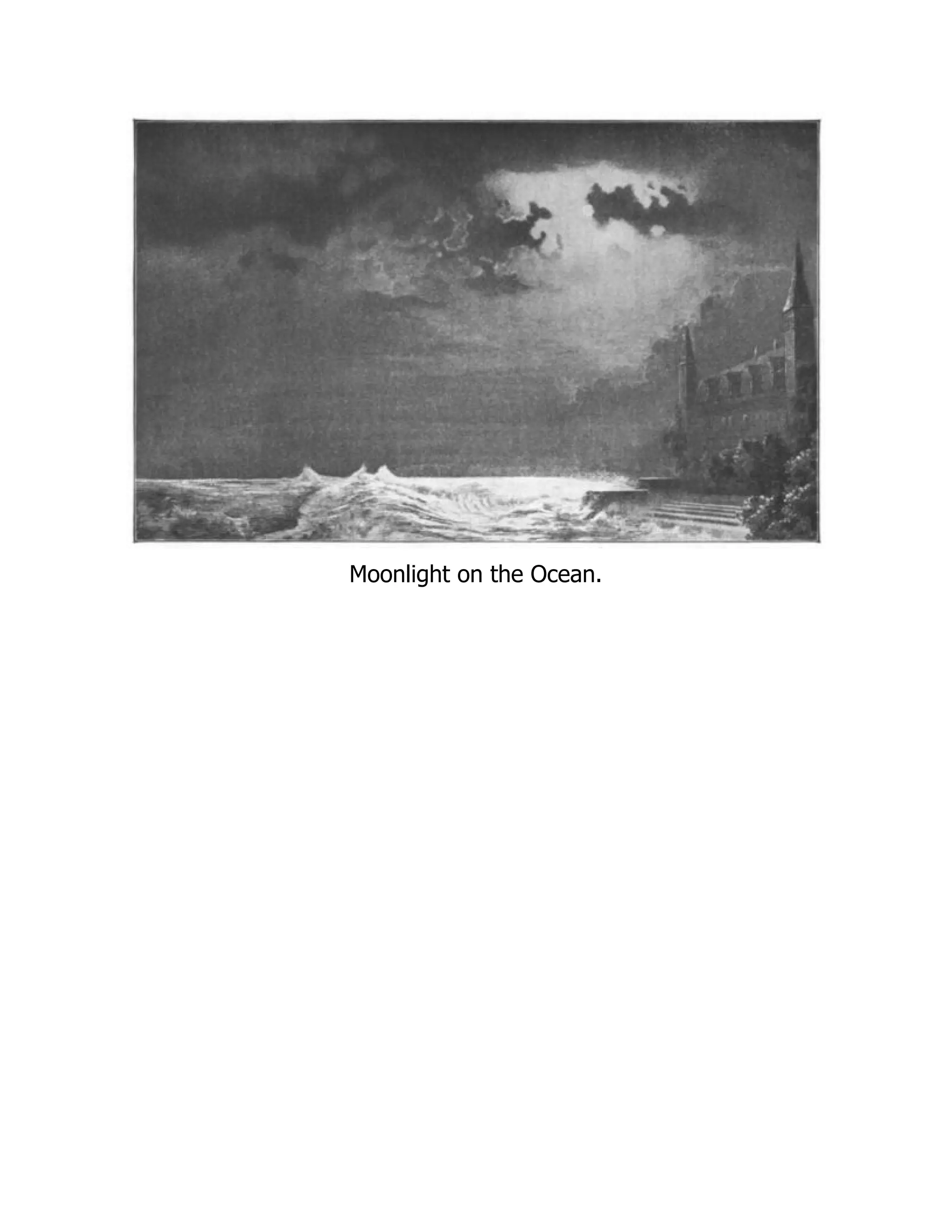
Moonlight on the Ocean.
CERES.
All through the warm days of July and August, the grain ripens in the
rays of the sun, and in September the fields are yellow with nodding
heads of golden grain. Ceres, the earth mother, has been driving
north and south, east and west.
Two beautiful maidens always attend her,—Flora, with garlands of
roses, who cares for the lovely flowers, and Pomona, who ripens the
fruits for man to eat.
As Ceres passes, the fields and woods gleam with color and beauty,
and all the voices of nature join man’s in hymns of thanksgiving for
her bounty. The old Greeks tell us, that it is she who taught men
how to cultivate the fields; how to prepare the soil for the seed,
when to plant the many grains and fruits, and how to care for the
young and tender plants.
In autumn, after the work of spring and summer, she rejoices in the
bounteous harvests, in the vineyards filled with purple grapes. Great
golden pumpkins, like huge apples, lie basking in Apollo’s rays; the
purple aster and the golden-rod add color to the landscape. Ceres is
glad at heart. She is happy in the results of her labor and in the
presence of her lovely daughter, Persephone. But when Persephone
leaves her mother, Ceres is sad, and winter, cold and drear, settles
over the earth.
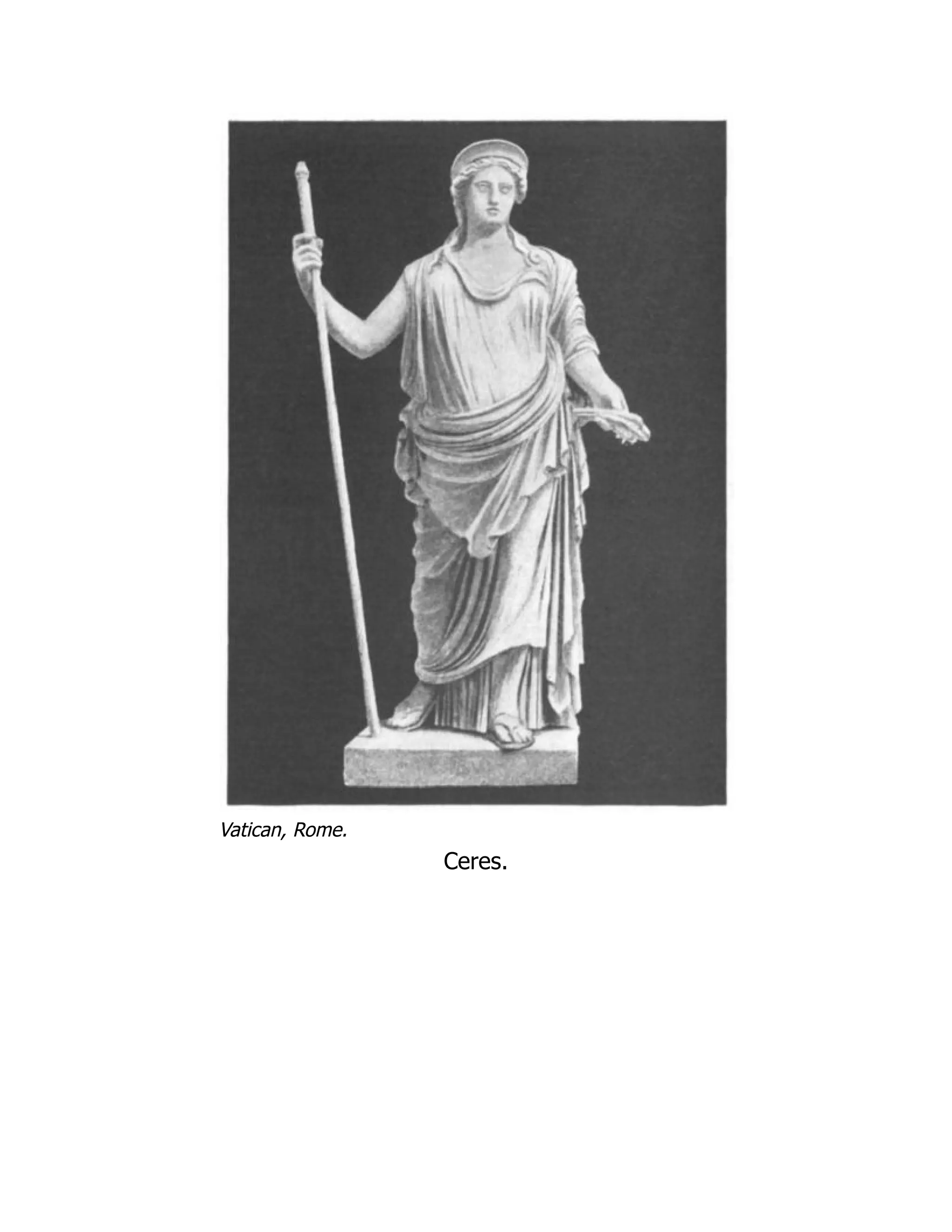
Vatican, Rome.
Ceres.
TO THE FRINGED GENTIAN.
Thou blossom bright with autumn dew,
And colored with the heaven’s own blue,
That openest when the quiet light
Succeeds the keen and frosty night.
Thou comest not when violets lean
O’er wandering brooks and springs unseen,
Or columbines, in purple dressed,
Nod o’er the ground bird’s hidden nest.
Thou waitest late, and com’st alone,
When woods are bare and birds are flown,
And frosts and shortening days portend
The aged year is near his end.
Then doth thy sweet and quiet eye
Look through its fringes to the sky,
Blue—blue—as if that sky let fall
A flower from its cerulean wall.
I would that thus, when I shall see
The hour of death draw near to me,
Hope, blossoming within my heart,
May look to heaven as I depart.
—William Cullen Bryant.
CERES AND PERSEPHONE.
You will wonder why Persephone is not always with her mother. This
is the story the Greeks tell.
As Ceres takes care of the ripening grains and fruits all over the
earth, it is necessary for her to visit every country of the world. One
day she was seated in her chariot drawn by those wonderful winged
dragons, ready to set forth on her travels. She kissed her little
daughter, and warned her not to go far from home. She had never
before felt so anxious about leaving her little girl, but she had to go.
Persephone threw a loving kiss to her fond mother, and then went to
the shore of the sea to play with the sea nymphs. They are graceful,
slender girls, with sea-green hair and eyes like opals. They are
charming playmates, but cannot come out of the water. Persephone
gathered flowers for them, and was obedient to her mother’s
command.
But Pluto, the god of the palaces of gold and silver under the earth,
looking out from one of the caverns, saw the pretty child, and
wanted to carry her away to his home. So he caused a wonderful
flower, all crimson and gold, to charm Persephone farther away. She
stooped to pick it; and lo! it came up by the roots, a deep cavern
yawned, and the chariot of King Pluto appeared.
The driver, who was King Pluto himself, caught the frightened
Persephone in his arms. Whipping his coal-black steeds, he hurried
away with her to his home in Hades.
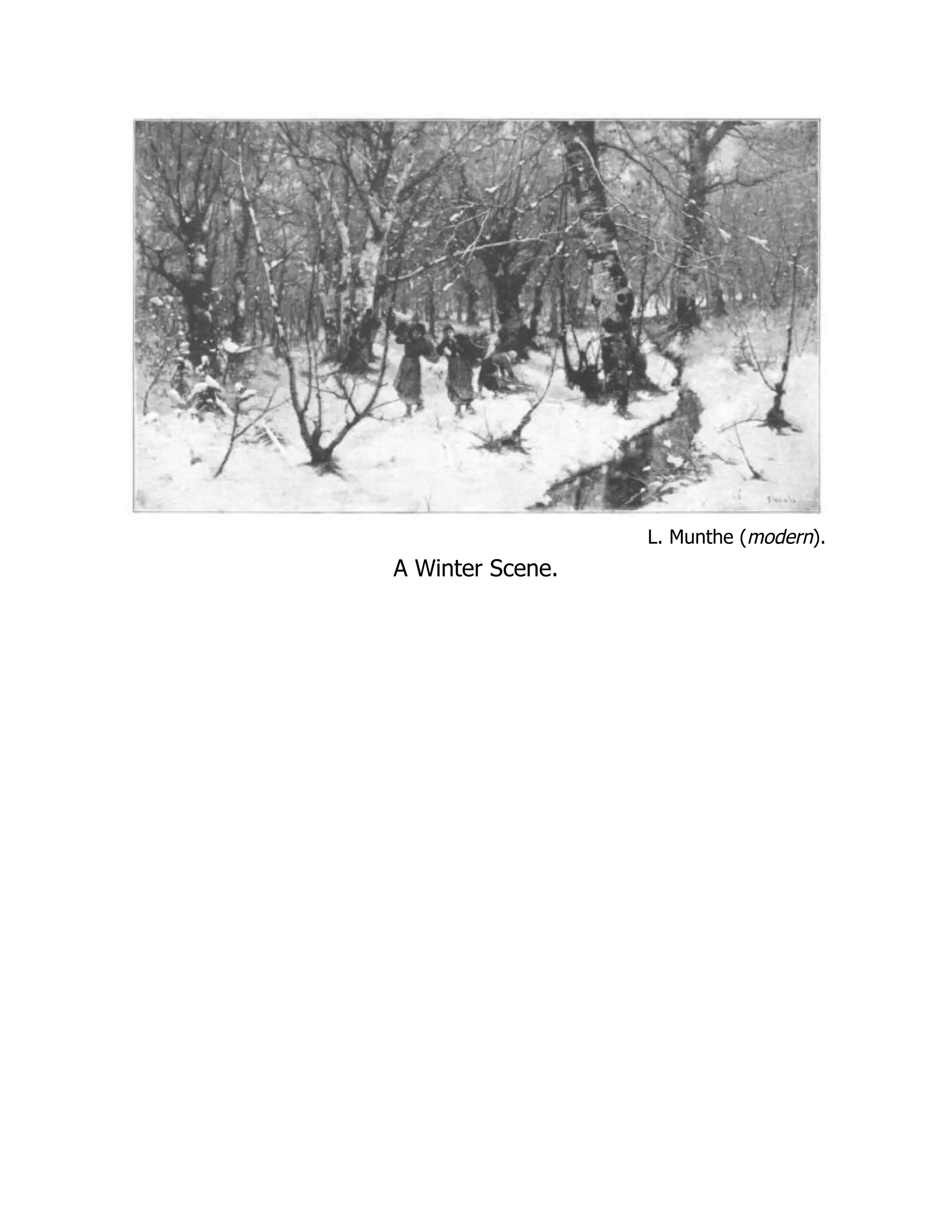
L. Munthe (modern).
A Winter Scene.
ARBUTUS ASLEEP.
Arbutus lies beneath the snows,
While winter waits her brief repose,
And says, “No fairer flower grows!”
Of sunny April days she dreams,
Of robins’ notes and murmuring streams,
And smiling in her sleep she seems.
She thinks her rosy buds expand
Beneath the touch of childhood’s hand,
And beauty breathes throughout the land.
The arching elders bending o’er
The silent river’s sandy shore,
Their golden tresses trim once more.
The pussy willows in their play
Their varnished caps have flung away,
And hung their furs on every spray.
The toads their cheery music chant,
The squirrel seeks his summer haunt,
And life revives in every plant.
“I must awake! I hear the bee!
The butterfly I long to see!
The buds are bursting on the tree!”
Ah! blossom, thou art dreaming, dear;
The wild winds howl about thee here
The dirges of the dying year!
Thy gentle eyes with tears are wet;
In sweeter sleep these pains forget;
Thy merry morning comes not yet!
—William Whitman Bailey.
THE SEARCH OF CERES.
When Ceres returned and could not find her little girl, she was
frantic. Over the whole earth she drove her chariot, calling upon all
things to help her in her search—but in vain!
Then she became so sad that she refused to allow the earth to
produce any food for man or beast. The flowers and trees and
harvests drooped and faded. In vain did gods and men plead with
her. She would not be comforted.
At last Jupiter sent the swift-flying Mercury, messenger of the gods,
to Pluto, commanding him to release Persephone. When Ceres saw
her daughter restored to her, what joy was hers! Yet she feared one
thing.
“Have you eaten anything in Pluto’s kingdom, my child?” was her
anxious question.
“Yes, dear mother,” Persephone replied, “six pomegranate seeds.”
“Alas! then you must remain with Pluto six months of every year,”
said the sad Ceres.
Thus it is that for six months Ceres and Persephone are together, the
earth is covered with the blessed gifts of Ceres, and it is summer
over the land. But when they are separated, the mother grieves, and
winter is king.
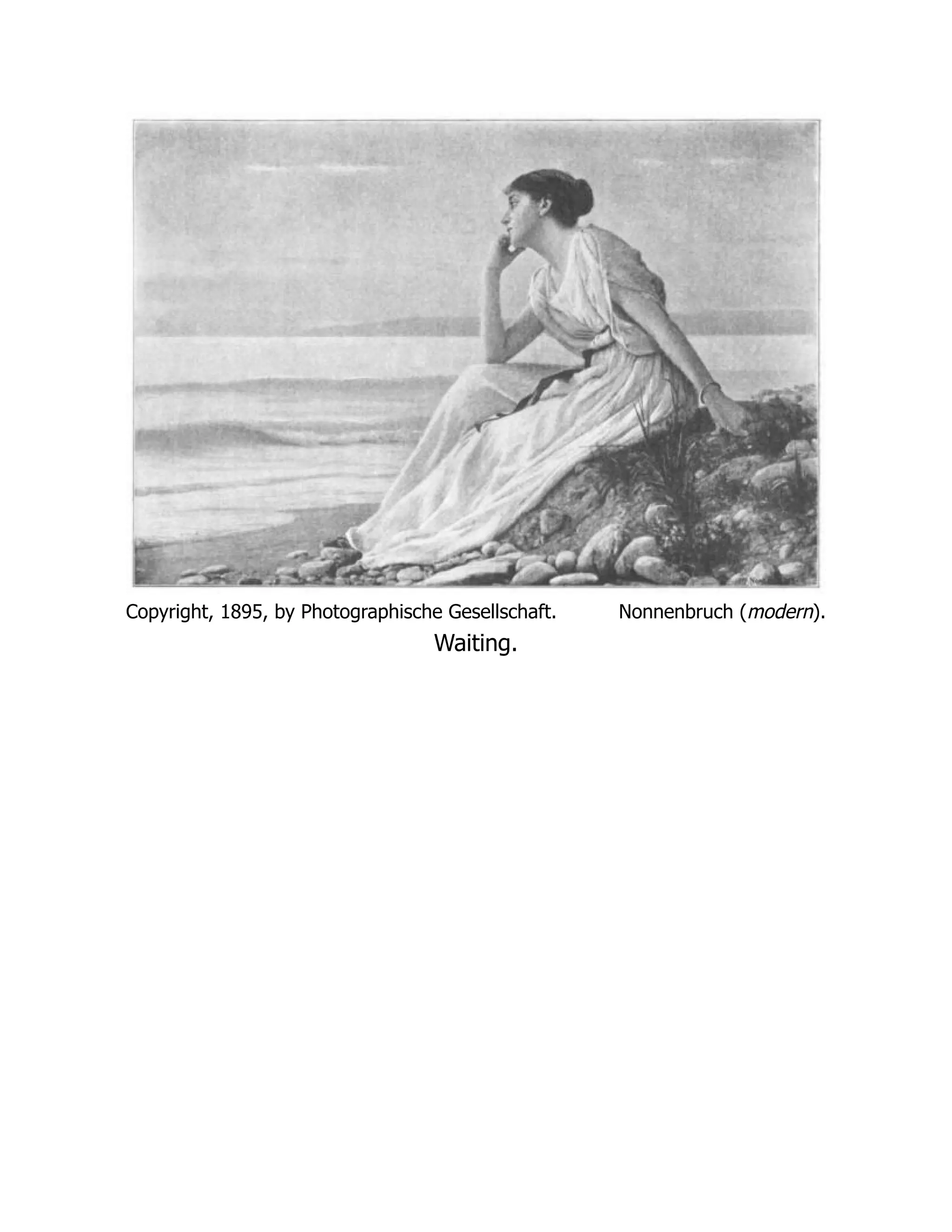
Nonnenbruch (modern).
Copyright, 1895, by Photographische Gesellschaft.
Waiting.
WAITING.
Serene I fold my hands and wait,
Nor care for wind, nor tide, nor sea;
I rave no more ’gainst time or fate
For lo, my own shall come to me.
I stay my haste, I make delays;
For what avails this eager pace?
I stand amid the eternal ways,
And what is mine shall know my face.
Asleep, awake, by night or day,
The friends I seek are seeking me;
No wind can drive my bark away
Nor change the tide of destiny.
What matter if I stand alone?
I wait with joy the coming years;
My heart shall reap where it has sown,
And gather up its fruits of tears.
The waters know their own and draw
The brook that springs from yonder height.
So flows the good with equal law
Unto the soul of pure delight.
The stars come nightly to the sky,
The tidal wave unto the sea;
Nor time, nor space, nor deep, nor high
Can keep my own away from me.
—John Burroughs.
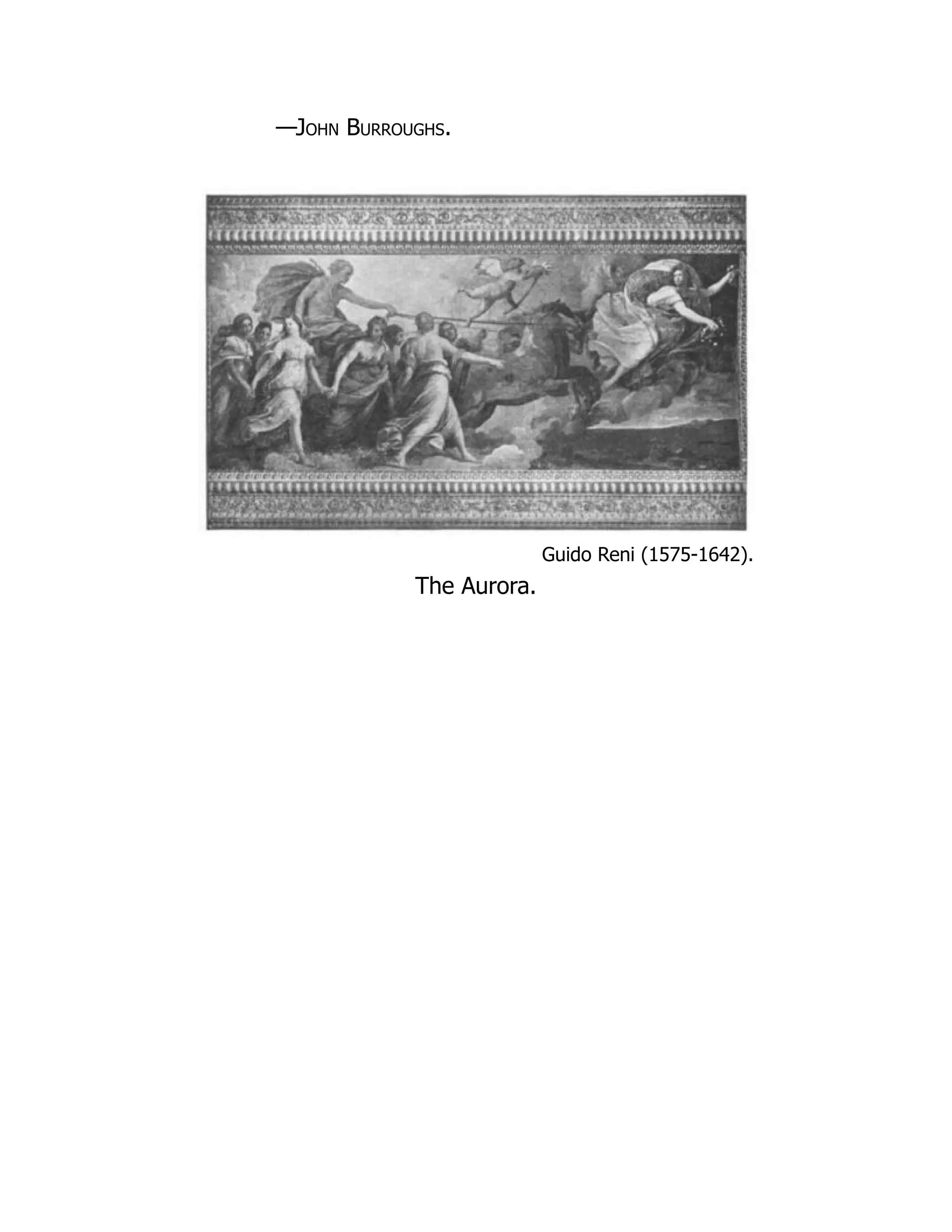
Guido Reni (1575-1642).
The Aurora.
APOLLO.
The palace of the sun is far away in the east. The walls are of silver,
the ceilings of carved ivory, and the pillars of gold shining with many
jewels.
Phœbus Apollo, in a robe of royal purple, sits upon a golden throne,
and the bright rays shining from his golden hair light up the palace
and dazzle the eyes. On either hand stand the Day, the Month, the
Year, and the rosy Hours, who attend him in his daily course through
the heavens.
When his beautiful twin sister, Diana, the queen of the night, has
finished her course through the deep blue sky, and all the stars are
gone, Aurora, the dawn, opens the silvery eastern bars and shows a
path covered with roses. Beautiful, rosy boys hold torches to light up
the path, and to tell the people of the earth that the sun god is
coming. The agile Hours quickly harness the impatient horses, Apollo
mounts his chariot, takes the reins, and away they gallop, delighted
with their task.
The wind arises from the sea, and wafts the clouds along; the birds
stir in the trees, and begin their sweet morning song; the leaves
rustle, and the flowers raise their perfumed heads and say “good
morning!” The little children open their eyes with a laugh and shout,
for another day of play. All the world is awake to give thanks for the
glorious sunlight!
HARK! HARK! THE LARK.
Hark! hark! the lark at heaven’s gate sings,
And Phœbus ’gins arise,
His steeds to water at those springs
On chaliced flowers that lies;
And winking Mary-buds begin
To ope their golden eyes;
With everything that pretty bin
My lady sweet, arise!
Arise, arise!
—William Shakespeare.
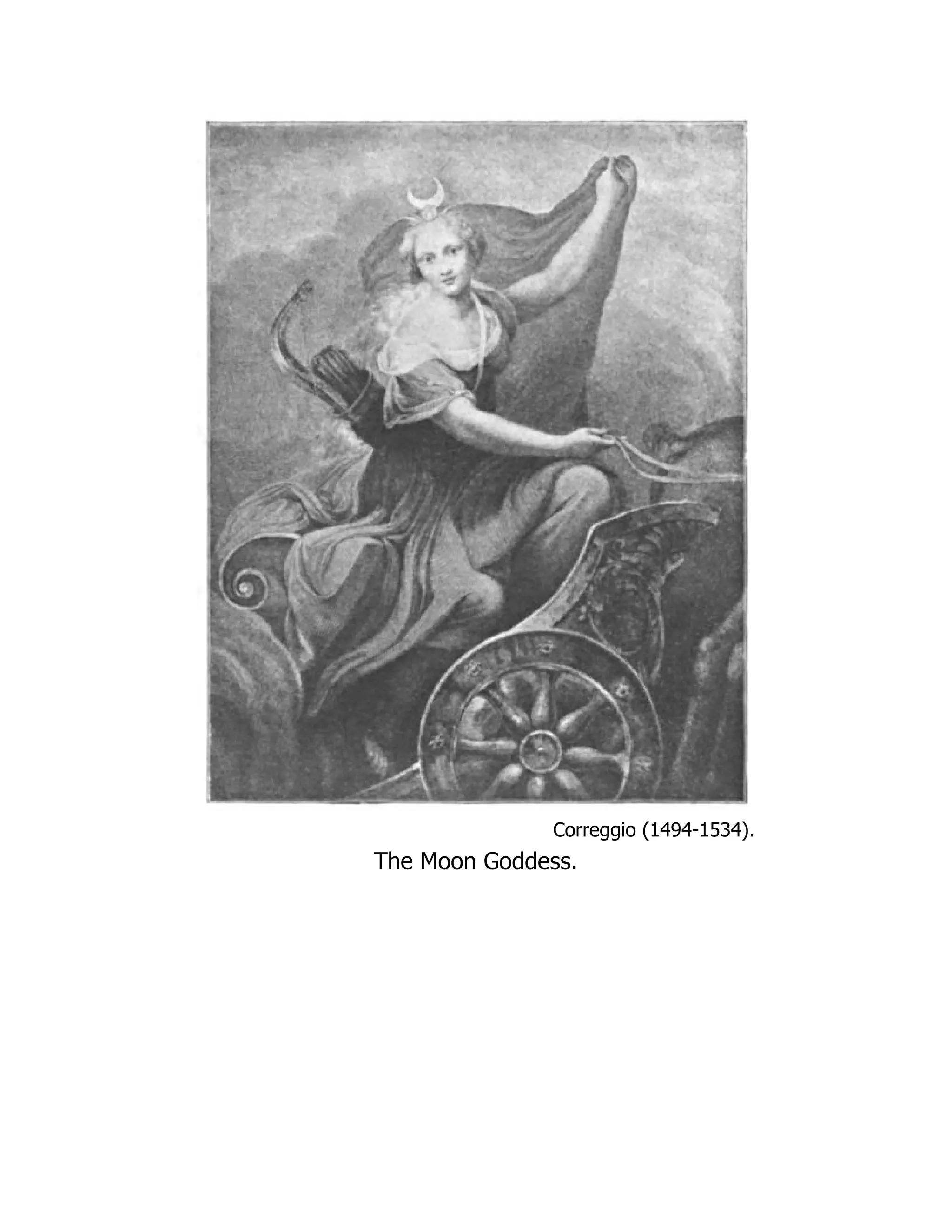
Correggio (1494-1534).
The Moon Goddess.
DIANA.
Diana, the goddess of the moon, is the twin sister of Apollo. She
completes her journey around the earth once in a month. Her
chariot is of polished silver, and her horses are dark as night. She is
a strong and beautiful goddess, with a robe of deepest azure, and a
golden crescent in her black hair.
When Apollo sinks in the west, the chariot of Diana appears, and she
drives like a queen over the floor of heaven, which is studded with
twinkling stars. How lovely is the night! Sometimes we see only a
silver crescent, and the rim of the moon. This the children call the
baby moon. But night after night the moon shows more and more of
her silver face, until she seems like a great ball floating high in air.
This we call the full moon. The stars are her maidens, who welcome
her coming and attend her on her journey.
In September, the grains are gathered into the barns, and we call
the full moon in that month the Harvest Moon.
The October full moon is the Hunter’s Moon, for in that month Diana
leads the jolly hunters. Then, according to the old Greeks, she leaves
her chariot, sees that her bow and arrows are ready, calls her
maidens, and steps forward, strong and free, to the chase.
Mason (modern).
The Harvest Moon.
LADY MOON.
Lady moon, lady moon,
Sailing so high!
Drop down to baby
From out the blue sky:
Babykin, babykin,
Down far below,
I hear thee calling,
But I cannot go.
But lady moon sendeth thee
Soft, shining rays;
Moon loves the baby,
The moonlight says.
In her house dark and blue,
Though she must stay,
Kindly she’ll watch thee
Till dawns the new day.
F. A. Kaulbach (modern).
Lady Moon.
THE PLEIADES.
Diana had seven graceful maidens who hunted the deer with her.
One day they saw Orion, a great hunter, coming toward them with
his dog and his big club. Orion was a giant, and the maidens feared
him and ran away.
Orion called to them not to be afraid, for he wished to hunt with
them. But still they fled, and when they were weary and saw that he
was overtaking them, they called upon the gods to save them from
the mighty hunter. The gods loved them, and listened to their cries.
When Orion thought he had at last caught up with them, he saw,
not the maidens, but seven snow-white doves flying away under the
azure sky.
At night, when the queenly Diana looked down from her chariot, she
saw that her attendants had been transformed to doves. As she
could not give them their original form, she placed them in the
heavens as stars to attend her during the night.
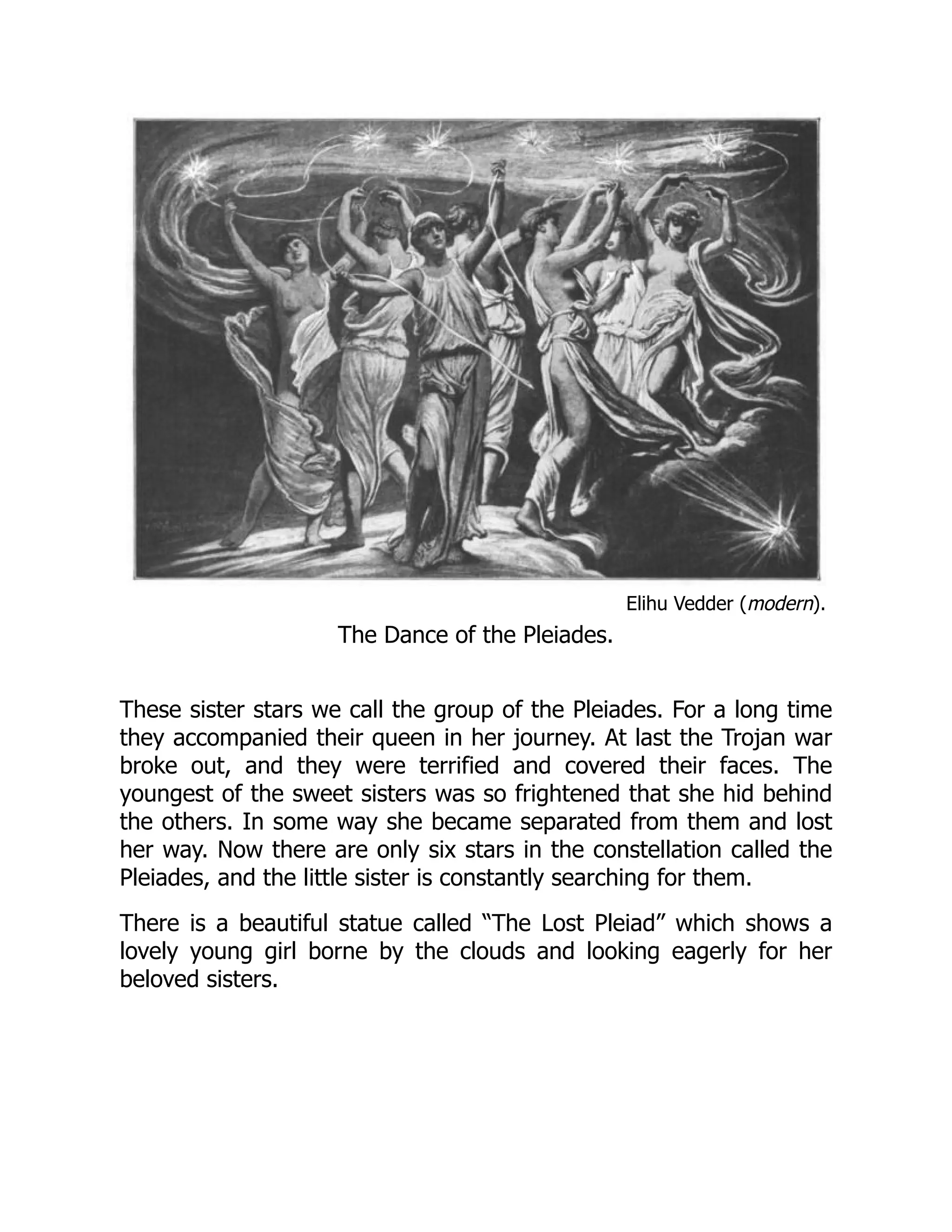
Elihu Vedder (modern).
The Dance of the Pleiades.
These sister stars we call the group of the Pleiades. For a long time
they accompanied their queen in her journey. At last the Trojan war
broke out, and they were terrified and covered their faces. The
youngest of the sweet sisters was so frightened that she hid behind
the others. In some way she became separated from them and lost
her way. Now there are only six stars in the constellation called the
Pleiades, and the little sister is constantly searching for them.
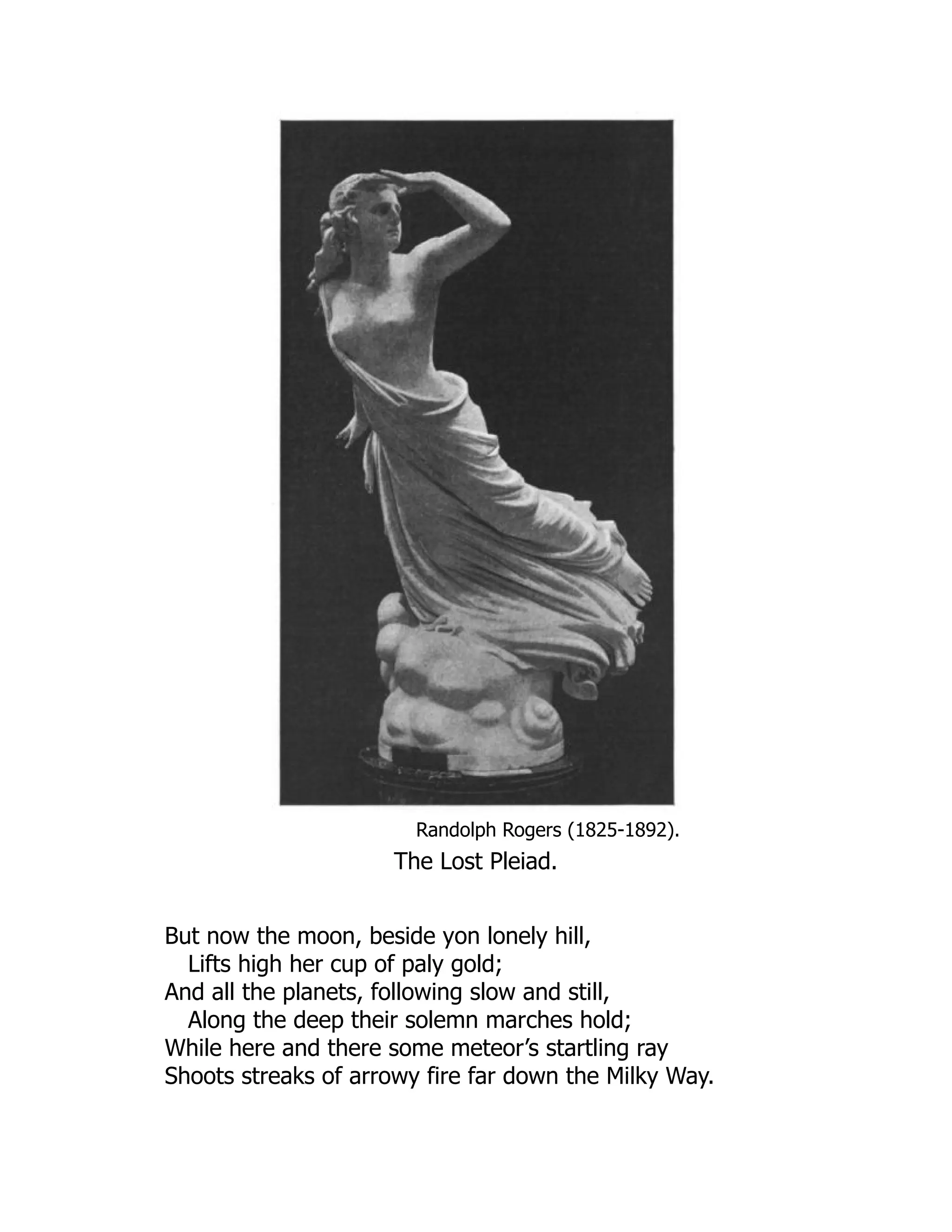
There is a beautiful statue called “The Lost Pleiad” which shows a
lovely young girl borne by the clouds and looking eagerly for her
beloved sisters.
THE STARS.
Ye snow-white clouds, whose fleecy wings enfold
The stars, that light yon boundless breadth of blue,
Roll back your edges, tinged with deepest gold,
And softly let the peaceful wanderers through;
Till, one by one, they burst upon my eyes,
O’ertaking my young heart with sudden sweet surprise.
How oft, when but a child, in wildest glee,
I’ve climbed the summit of some breezy hill,
Whose mossy sides went sloping to the sea
Where slept another heaven serenely still;
While, from the mighty stronghold of the seas,
The dead send up their dirge upon the twilight breeze.
And there beneath a fringe of dewy leaves,
That drooped away from many a bended bough,
I used to lie on summer’s golden eves,
And gaze about as I am gazing now,
Thinking each lustrous star a heavenly shrine
For an immortal soul, and wondered which was mine.
Randolph Rogers (1825-1892).
The Lost Pleiad.
But now the moon, beside yon lonely hill,
Lifts high her cup of paly gold;
And all the planets, following slow and still,
Along the deep their solemn marches hold;
While here and there some meteor’s startling ray
Shoots streaks of arrowy fire far down the Milky Way.
Welcome to our website – the perfect destination for book lovers and
knowledge seekers. We believe that every book holds a new world,
offering opportunities for learning, discovery, and personal growth.
That’s why we are dedicated to bringing you a diverse collection of
books, ranging from classic literature and specialized publications to
self-development guides and children's books.
More than just a book-buying platform, we strive to be a bridge
connecting you with timeless cultural and intellectual values. With an
elegant, user-friendly interface and a smart search system, you can
quickly find the books that best suit your interests. Additionally,
our special promotions and home delivery services help you save time
and fully enjoy the joy of reading.
Join us on a journey of knowledge exploration, passion nurturing, and
personal growth every day!
testbankfan.com

Core Concepts of Accounting Information Systems Canadian 1st Edition SimKin Solutions Manual
  • 1.
    Download the fullversion and explore a variety of test banks or solution manuals at https://testbankfan.com Core Concepts of Accounting Information Systems Canadian 1st Edition SimKin Solutions Manual _____ Tap the link below to start your download _____ https://testbankfan.com/product/core-concepts-of-accounting- information-systems-canadian-1st-edition-simkin-solutions- manual/ Find test banks or solution manuals at testbankfan.com today!
  • 2.
    We believe theseproducts will be a great fit for you. Click the link to download now, or visit testbankfan.com to discover even more! Core Concepts of Accounting Information Systems Canadian 1st Edition SimKin Test Bank https://testbankfan.com/product/core-concepts-of-accounting- information-systems-canadian-1st-edition-simkin-test-bank/ Core Concepts of Accounting Information Systems 13th Edition Simkin Solutions Manual https://testbankfan.com/product/core-concepts-of-accounting- information-systems-13th-edition-simkin-solutions-manual/ Core Concepts of Accounting Information Systems 14th Edition Simkin Solutions Manual https://testbankfan.com/product/core-concepts-of-accounting- information-systems-14th-edition-simkin-solutions-manual/ Language Of Medicine 11th Edition Chabner Test Bank https://testbankfan.com/product/language-of-medicine-11th-edition- chabner-test-bank/
  • 3.
    Marketing Management AStrategic Decision-Making Approach 8th Edition Mullins Test Bank https://testbankfan.com/product/marketing-management-a-strategic- decision-making-approach-8th-edition-mullins-test-bank/ Plants and Society 7th Edition Levetin Test Bank https://testbankfan.com/product/plants-and-society-7th-edition- levetin-test-bank/ Measurement and Assessment in Teaching 11th Edition Miller Test Bank https://testbankfan.com/product/measurement-and-assessment-in- teaching-11th-edition-miller-test-bank/ Diversity and Society Race Ethnicity and Gender 5th Edition Healey Test Bank https://testbankfan.com/product/diversity-and-society-race-ethnicity- and-gender-5th-edition-healey-test-bank/ Vector Mechanics for Engineers Statics and Dynamics 10th Edition Beer Solutions Manual https://testbankfan.com/product/vector-mechanics-for-engineers- statics-and-dynamics-10th-edition-beer-solutions-manual/
  • 4.
    Auction Theory 2ndEdition Krishna Solutions Manual https://testbankfan.com/product/auction-theory-2nd-edition-krishna- solutions-manual/
  • 5.
    Chapter 9 Solutionsmanual to accompany Accounting Information Systems, Cdn ed Simkin et al. p. 1 Chapter 9 Introduction to Internal Control Systems Discussion Questions 9-1. The primary provisions for the 1992 COSO Report and the 2004 Report are outlined in Figure 9-1. Business and operating environment have change dramatically since the release of the first COSO Report. The major drivers of change were globalization, technological innovation, and increase in overall business complexity. On May 14, 2013, COSO released an updated version of its Internal Control—Integrated Framework. The new framework has several important changes, it: • Codifies principles that support five components of internal control and explicitly states 17 principles representing fundamental concepts associated with five components of internal control. • Clarifies the role of objective-setting in internal control. • Incorporates increased relevance of information technology. • Reflects on enhanced discussion of governance concepts. • Expands the reporting category of objectives. • Enhances consideration of anti-fraud expectations. • Increases focus on non-financial reporting objectives. For further information review http://www.coso.org/documents/coso%20mcnallytransition%20article- final%20coso%20version%20proof_5-31-13.pdf 9-2. The primary provisions of the original version of COBIT, as well as the current version (5), are outlined in Figure 9-1. 9-3. COSO stands for Committee of Sponsoring Organizations, which was established by the Treadway Commission to work on a common definition for internal control. COBIT stands for Control Objectives for Information and Related Technology. It was a project undertaken by the Information Systems Audit and Control Foundation that involved an extensive examination of the internal control area. An important role played by COSO in the internal control area was to come up with a definition of internal control along with a description of five interrelated components (control environment, risk assessment, control activities, information and communication, and monitoring) that should be included within an internal control system. Regarding COBIT and its role in the internal control area, COBIT adapted its definition of internal control based on the COSO report. COBIT (as well as COSO) emphasizes that people at every level of an organization are a very important part of the organization’s internal control system. COSO is an important framework that management of organizations might use to help ensure that they have effective corporate governance. This is the case because the COSO framework presents criteria to evaluate an organization’s internal control systems. According to SOX, Section 404, management must now document the effectiveness of their internal controls and then issue a report that accompanies the company’s annual report. Similarly, COBIT is used by managers to ensure effective IT governance.
  • 6.
    Chapter 9 Solutionsmanual to accompany Accounting Information Systems, Cdn ed Simkin et al. p. 2 9-4. The control environment establishes the tone of a company, influencing the control awareness of the company’s employees. It is the foundation for all the other internal control components. Risk assessment recognizes the fact that every organization faces risks to its success and that risks which appear to affect the accomplishment of a company’s goals should be identified, analyzed, and acted upon. Control activities reflect the policies and procedures that help ensure that management directives are carried out. Regarding information and communication, the former refers to the accounting system, which includes the methods and records used to record, process, summarize, and report a company’s transactions as well as maintain accountability for the company’s assets, liabilities, and equity. The latter, communication, refers to providing a company’s personnel with an understanding of their roles and responsibilities in regard to internal control over financial reporting. Finally, monitoring is the process that assesses the quality of internal control performance over time. Performance reports prepared on a timely basis contribute to the monitoring component of an internal control system. Concerning which component is the most important, this is a matter of opinion. Most students indicate that the control environment is the most important component of an internal control system because, as mentioned in the textbook, it is the foundation for all the other internal control components, providing discipline and structure. 9-5. Accountants should be concerned that their organization’s financial resources are protected from activities such as loss, waste, or theft. To protect organizational assets, an internal control system must be developed and implemented within a company’s AIS as well as within other parts of the company’s system. In addition to safeguarding assets, an efficient and effective internal control system should also: 1) Check the accuracy and reliability of accounting data 2) Promote operational efficiency 3) Encourage adherence to prescribed managerial policies. Accountants should be concerned that all of these objectives are accomplished by their organization’s internal control system. 9-6. Preventive control procedures are designed and implemented before an activity is performed to prevent some potential problem (e.g., the inaccurate handling of cash receipts) from occurring that relates to the activity. Detective control procedures are designed and implemented to provide feedback to management regarding whether or not operational efficiency and adherence to prescribed managerial policies have been achieved. In other words, preventive controls should be developed prior to operating activities taking place and detective controls should be developed to evaluate if operating efficiency and adherence to policies of management have occurred after operating activities have taken place. Corrective control procedures come into play based on the findings from the detective control procedures. That is, through detective controls, corrective control procedures should be developed to identify the cause of an organization’s problem, correct any difficulties or errors resulting from the problem, and modify the organization’s processing system so that future occurrences of the problem will hopefully be eliminated or at least minimized. Examples of each type of controls are as follows: Preventive: scenario planning, risk management, segregation of duties, controlling access to assets Detective: duplicate check of calculations, bank reconciliations, monthly trial balances Corrective: backup copies of transactions and master files, training personnel to perform their jobs

  • 7.
    Chapter 9 Solutionsmanual to accompany Accounting Information Systems, Cdn ed Simkin et al. p. 3 9-7. Competent employees are definitely important to an organization's internal control system because employees will be working continually with the organization's various asset resources. The employees will be, for example, handling cash, acquiring and disbursing inventory, and operating expensive production equipment. If the organization has incompetent employees, there is a strong likelihood that inefficient use of the firm's asset resources will result. This inefficiency will lead to overall operating inefficiency within the organization, thereby preventing the adherence to management's prescribed policies. 9-8. The “separation of duties” element of an organization’s internal control system means that, for instance, employees who are given responsibility for the physical custody of specific company assets (e.g., handling cash or inventory) should not also be given responsibility for the record-keeping functions relating to the assets (e.g., recording cash or inventory transactions in the company's journals and ledgers). Otherwise, an employee could misappropriate company assets and then attempt to conceal this fraud by falsifying the accounting records. Through the separation of duties, one employee acts as a check on the work of another employee. Thus, if an employee attempts to embezzle cash from a customer payment, but does not have access to the accounts receivable subsidiary ledger to cover up this theft, he or she would likely be detected. The other employee who performs the record-keeping activities for accounts receivable would not have recorded the customer's payment since it was embezzled by the employee handling cash. Consequently, the customer would complain to the company upon receiving a subsequent billing statement which would not reflect his or her recent payment. Upon investigating this complaint, the dishonest employee would likely be caught. It should be noted, however, that through collusion among the employees handling assets and recording assets, irregularities are usually not detected as quickly as when individuals work alone (as described earlier). In addition to detecting irregularities, separation of duties can also be helpful in detecting accidental errors. If the same employee performs all accounting functions related to a specific activity (e.g., handling inventory items and recording the inventory transactions), an accidental human error by this employee, such as incorrectly recording an inventory transaction, may not be detected. However, with two or more employees handling the accounting functions relating to a specific activity, an accidental human error made by one employee should be detected by another employee involved with the same activity. 9-9. Many organizations have a large volume of cash disbursement transactions. In order to detect any errors and irregularities relating to cash disbursements, a good audit trail for cash issuances is essential. If an organization uses both a voucher system and prenumbered cheques for cash disbursement transactions, its audit trail of cash outlays can easily be traced. The use of prenumbered cheques for making authorized cash disbursements enables a company to maintain accountability over its issued cheques and its unissued cheques. After the issued cheques clear the bank in a particular month and are returned to the organization with the monthly bank statement, these cheques represent evidence of the actual cash disbursements that were made. Two advantages of employing a voucher system along with prenumbered cheques are (1) the number of cash disbursement cheques that are written is reduced, since several invoices to the same vendor can be included on one disbursement voucher, and (2) the disbursement voucher is an internally generated document; thus, each voucher can be prenumbered to simplify the tracking of all payables, thereby contributing to an effective audit trail over cash disbursements.
  • 8.
    Chapter 9 Solutionsmanual to accompany Accounting Information Systems, Cdn ed Simkin et al. p. 4 Sometimes, prenumbered cheques are not efficient for an organization to use. For example, for expenditures of small dollar amounts (e.g., spending a few dollars to have the company president's car washed) cash payment might be a better choice. Because of the time and effort involved in processing cheques, it is normally more efficient to use a petty cash fund for making various small, miscellaneous expenditures. However, to exercise good internal control over the petty cash fund's use, one employee (called the petty cash custodian) should be given the responsibility for handling petty cash transactions. 9-10. Under the cost-benefit concept, an analysis is performed on each potential control procedure (i.e., compare the expected costs of designing, implementing, and operating each control to its expected benefits). Only those controls whose benefits are expected to be greater than, or at least equal to, the expected costs should be implemented into the company’s system. Cost-effective controls are those whose anticipated benefits exceed their anticipated costs. Ideal control procedures (i.e., those that would reduce the risk to practically zero of any undetected errors and irregularities occurring) may be impractical for a company because the expected costs may be larger than their expected benefits. The implementation of controls whose costs are expected to exceed the controls benefits would not contribute to a company’s overall operating efficiency. In these cases, control procedures which are less than ideal for detecting errors and irregularities (but whose expected benefits exceed the expected costs) should be implemented within the company’s internal control system. From the standpoint of evaluating a company’s internal control system, a performance report is a type of report that provides information to management on how efficiently and effectively its company’s internal controls are functioning. Based on accurately prepared performance reports, management receives feedback on the success or failure of the previously implemented package of internal controls. The preparation of a performance report is a detective control procedure. Performance reports should be an essential element within a company’s internal control system because they are the major means of communicating to management regarding the actual operations of the company’s internal control systems. For specific controls that are not operating the way they were originally planned, as indicated by a performance report, management can then take action to correct identified problems. Timely information to managers, regarding internal control problems, is critical so that mangers can initiate action to correct the problems. Thus, performance reports should be prepared on a timely basis in order that a minimum period elapses between the occurrence of operational problems with certain controls and the feedback to management on these poorly functioning controls. 9-11. Discussion question 9-5 identifies a number of reasons why accountants are so concerned about their organizations’ internal control systems. However, the managers of these organizations are particularly concerned about the effectiveness and efficiency of internal controls due to the SOX legislation. Under Section 302 of this legislation, the CEO and CFO are legally responsible for establishing and maintaining internal controls in the organization. In addition, they must have evaluated the effectiveness of the company’s internal controls and submitted their report to the external auditors, who evaluate the sufficiency of those internal
  • 9.
    Chapter 9 Solutionsmanual to accompany Accounting Information Systems, Cdn ed Simkin et al. p. 5 controls. Further, when we talk about the control environment of an organization, we know that management’s support of a strong internal control system is critical. 9-12. COSO’s 2008 Guidance on Monitoring Internal Control Systems (COSO’s Monitoring Guidance) was developed to clarify the monitoring component of internal control. It does not replace the guidance first issued in the COSO Framework or in COSO’s 2006 Internal Control over Financial Reporting — Guidance for Smaller Public Companies (COSO’s 2006 Guidance). Rather, it expounds on the basic principles contained in both documents, guiding organizations in implementing effective and efficient monitoring. To read the entire document “Guidance on Monitoring Internal Control Systems”, go to this site: http://www.coso.org/documents/COSO_Guidance_On_Monitoring_Intro_online1.pdf Problems 9-13. Weaknesses Recommended Improvements 1. Raw materials may be removed from the storeroom upon oral authorization from one of the production foremen. 1. Raw materials should be removed from the storeroom only upon written authorization from an authorized production foreman. The authorization forms should be prenumbered and accounted for, list quantities and job or production number, and be signed and dated. 2. Alden's practice of monthly physical inventory counts does not compensate for the lack of a perpetual inventory system. Quantities on hand at the end of one month may not be sufficient to last until the next month's count. If the company has taken this into account in establishing reorder levels, then it is carrying too large an investment in inventory. 2. A perpetual inventory system should be established under the control of someone other than the storekeepers. The system should include quantities and values for each item of raw material. Total inventory value per the perpetual records should be compared with the general ledger at reasonable intervals. When physical counts are taken, they too should be compared to the perpetual records. Where differences occur, they should be investigated, and if the perpetual records are in error, they should be adjusted. Also, controls should be established over obsolescence of stored materials.
  • 10.
    Chapter 9 Solutionsmanual to accompany Accounting Information Systems, Cdn ed Simkin et al. p. 6 3. Raw materials are purchased at a predetermined reorder level and in predetermined quantities. Since production levels may often vary during the year, quantities ordered may be either too small or too great for the current production demands. 3. Requests for purchases of raw materials should come from the production department management and be based on production schedules and quantities on hand per the perpetual records. 4. The accounts payable clerk handles both the purchasing function and payment of invoices. This is not a satisfactory separation of duties. 4. The purchasing function should be centralized in a separate department. Prenumbered purchase orders should originate from and be controlled by this department. A copy of the purchase order should be sent to the storeroom clerks. Consideration should be given as to whether the storeroom clerks’ copy should show quantities. 5. Raw materials are always purchased from the same vendor. 5. The purchasing department should be required to obtain competitive bids on all purchases over a specified amount. 6. There is no receiving department or receiving report. For proper separation of duties, the individuals responsible for receiving should be separate from the storeroom clerks. 6. A receiving department should be established. Personnel in this department should count or weigh all goods received and prepare prenumbered receiving reports. These reports should be signed, dated, and controlled. Copies should be sent to the accounting department, purchasing department, and storeroom. 7. There is no inspection department. Since high cost electronic components are usually required to meet certain specifications, they should be tested for these requirements when received. 7. An inspection department should be established to inspect goods as they are received. Prenumbered inspection reports should be prepared and accounted for. Copies of these reports should be sent to the accounting department. 9-14. a. The separation of duties is meant to safeguard assets; in this case, cash receipts. b. Signature plates are used to authenticate cheques. Keeping them secure is a means of preventing their unauthorized use. c. Matching the vendor invoice with a receiving report (or similar document) ensures payment for goods or services actually received. d. Separating these functions helps ensure payment only for legitimate obligations of the organization. e. This procedure would help ensure that disbursements are made only for authorized purchases. f. Prenumbered documents have to be securely stored if this preventive control is to be effective.
  • 11.
    Chapter 9 Solutionsmanual to accompany Accounting Information Systems, Cdn ed Simkin et al. p. 7 g. Using an imprest or special account for payroll limits the loss due to incorrectly printed cheques associated with each period’s total payroll. h. Separation of functions prevents one person from diverting cash assets and subsequently concealing the wrongdoing. i. Cheque protectors use a number of methods which make it difficult to successfully change the cheque amount. j. Both the surprise counts and the knowledge of their likelihood deter the unauthorized use of cash. k. Approved vendor lists help prevent unauthorized purchases (irregularities or embezzlement of assets). l. Such separation of duties helps prevent unauthorized purchases. 9-15. a) As a member of the company’s management, you would hopefully reject the control recommendations. Specific internal controls should not be implemented into a company’s system unless the anticipated benefits from the controls are expected to exceed the anticipated costs of the controls. In the case of Sandra’s recommendations, it is obvious that the costs to operate these suggested controls would exceed the benefits from having the controls. The maximum monthly benefit from Sandra’s recommended controls would be the $350 estimated monthly loss that could be eliminated; however, to achieve this benefit, a separate room for storing supplies would have to be used and an employee would have to be assigned the full-time job of supervising the issuance of supplies. The costs of using a separate room and having an employee work full-time in handling office supplies would definitely be much greater than the $350 estimated monthly loss that could be eliminated. A couple of possible control procedures that the company might wish to implement to reduce the monthly loss from employee theft of office supplies are mentioned below. b) Rather than storing the supplies on shelves at the back of the office facility whereby employees have easy access to these supplies, they could be locked in a cabinet. An authorized company employee (such as a secretary) would be given the responsibility for issuing supplies when requested by various employees. The authorized employee in charge of the supplies would have this new job responsibility along with his or her existing job responsibilities. When an individual needs office supplies, he or she would go to the authorized employee's desk and indicate the request. The employee in charge of supplies would then unlock the cabinet and issue the requested supplies. The person receiving the supplies would have to sign a supplies-received voucher, which serves as evidence of the specific supplies issued. Another suggestion might be to use a separate room for storing the supplies (as suggested by Sandra). This room would be kept locked throughout the day except for possibly one hour each day. Company employees would be made aware of the specific time every day during which the supply room is open. As a result of this procedure, an employee would not be used full-time in issuing the supplies. Rather, the employee assigned the responsibility for supervising the issuance of supplies could still perform his or her other job functions throughout the day. Approximately one hour each day away from his or her other job functions would be required to issue office supplies. As in the preceding suggestion, each person receiving supplies would have to sign a supplies-received voucher. 9-16.
  • 12.
    Chapter 9 Solutionsmanual to accompany Accounting Information Systems, Cdn ed Simkin et al. p. 8 1. Most students believe that Ron Mitchell’s method of stealing cash receipts will be detected by the movie theatre's manager assuming that the manager uses a few internal control procedures. First, the tickets issued by Ron to theatre patrons should be prenumbered and controlled by the manager. At the beginning of Ron's work shift, he should be made accountable for a specific quantity of prenumbered tickets and not have access to any other tickets. At the end of Ron's work shift, the manager should count the total number of ticket-halves that he has accumulated from customers who have entered the theatre. From multiplying the selling price per ticket by the number of ticket-halves in his possession, the manager can determine the total cash receipts that should have been collected by Ron. If there is more than one price for tickets, such as children prices and adult prices, the differently priced-tickets can be colour-coded to enable the manager to compute the total cash receipts that should have been collected. The manager can then count the total actual cash that Ron collected during his work shift. (Of course, the amount of change fund that Ron was provided at the start of his shift should be subtracted from his total cash.) Through this procedure, the manager can determine if the actual cash receipts collected by Ron are equal to the cash receipts that should have been collected (based on the manager's accumulated ticket-halves). The cash receipts that were pocketed by Ron should thus be detected, since the manager's count of actual cash receipts would fall short of the cash receipts that should have been collected. 2. An additional control procedure that the theatre manager may want to implement is to periodically observe Ron while he is performing his work functions. This procedure should take place without Ron being aware that he is being observed. If, as a result of observing Ron's work activities, the manager is suspicious of irregular acts, he can watch Ron even closer until his suspicions are fully confirmed. 9-17. a. Cost-benefit analysis: Without Control Procedure With Control Procedure Net Expected Difference Cost of reproducing production cost data $12,000 $12,000 Risk of data errors 16% 2% Reprocessing cost expected ($12,000 * risk) $ 1,920 $ 240 $1,680 Cost of validation control procedure (an incremental cost) $ 0 $ 800 ($ 800) Net estimated benefit from validation control procedure $ 880 b. Management should implement the data validation control procedure because of the $880 net estimated benefit that is projected with this procedure. Case Analyses
  • 13.
    Chapter 9 Solutionsmanual to accompany Accounting Information Systems, Cdn ed Simkin et al. p. 9 9-18. Manitoba Menswear (Risk Assessment and Control Procedures) 1. (a) The risk is that merchandise is stolen. (b) Shoplifting is a very large problem for retailers. There should be better inventory controls. These might include closed circuit cameras, tags that are removed at the end of the sales process, and security personnel. 2. (a) The risk is that stolen merchandise (perhaps at the same two stores in point #4) is being returned for cash. (b) Returns should require a sales receipt. The store may also consider a policy of allowing returns for merchandise credit only. 3. (a) The risk is that the store is losing income. (b) Either revenues are down or cost of sales has increased. Management needs to inspect these numbers closely to see where the problem lies. At least part of it could be attributable to poor inventory control. 4. (a) The risk is that cash was not deposited. (b) This can easily be controlled by requiring daily reconciliations by an employee not involved in receiving or depositing cash. 5. (a) The risk is that cash was not collected from customers. (b) The employee should be reprimanded. Either all cheques or cheques exceeding a specific dollar amount should be approved by someone other than the salesperson. 6. (a) The risk is that petty cash was pilfered. (b) There should be a custodian over petty cash who has sole responsibility for it. The custodian should never disburse cash without obtaining a receipt. 9-19. Cuts-n-Curves Athletic Club (Analyzing Internal Controls) Weaknesses Recommended Improvements 1. The employee at the desk could allow friends to enter at no charge. 1. There needs to be some separation of duties. There could be another person at the front desk where the visitor completes the waiver form and obtains a daily pass. The first employee would then require a pass and would not handle cash. (Note - this may be cost prohibitive) 2. The employee at the desk could pocket cash. 2. The same control as #1. 3. The cash receipts are not controlled. 3. The cash receipts should be kept in a file. They should also be sequentially numbered. 4. There may be many different desk employees throughout the day. If cash is missing, there 4. There should be a log of employees and their working hours. They need to sign in and out.
  • 14.
    Chapter 9 Solutionsmanual to accompany Accounting Information Systems, Cdn ed Simkin et al. p. 10 will be no accountability. 5. There does not appear to be a procedure for comparing the cash receipts journal entry and bank deposit with the cash receipts given to employees at the desk. 5. Someone other than the accountant and the desk employees should periodically compare the cash receipts journal entries, bank deposit slips, and cash receipts kept on file. 9-20. Emerson Department Store (Control Suggestions to Strengthen Payroll System) 1. The use of currency rather than cheques for paying employees makes it essential that effective separation of duties exist in both the payroll preparation and the payroll distribution functions. Regarding payroll preparation, Morris is responsible for submitting payroll information to the computer centre for data processing. Therefore, Morris should not be involved in the work of placing currency in each employee's pay envelope. Another company accountant and a secretary could perform this function. Also, the individuals responsible for placing currency in employees pay envelopes should be provided with the exact amount of currency necessary to cover the total net pay for all employees. Using the information from the payroll register, each employee's gross wages, individual deductions, and net pay should be printed on the outside of the employee's pay envelope. This information could be prepared by the computer in the form of an individual printed label for each employee, which would then be affixed to the employee's envelope. The two employees would then insert in each wage earner's envelope the correct amount of currency. Regarding payroll distribution, the completed pay envelopes should not be given to the department managers for distribution to their employees because these managers are involved in the payroll record-keeping functions (e.g., the managers submit their employees’ time cards to Morris). Rather, an individual who has no other payroll-related duties should be designated as paymaster and be responsible for distributing pay envelopes. At pre- established times on Monday afternoon, pay envelopes should be distributed to the employees from a central payroll window. The employees would line up at this window and upon each employee showing proper identification (such as a driver's license or social insurance card), he or she would be issued a pay envelope by the paymaster. The employee should also be required to count immediately his or her currency within the envelope and then sign his or her name on the payroll register. The employee's signature verifies that he or she received the correct amount of currency in the pay envelope. Any unclaimed pay envelopes should be returned to the accounting department and should be locked in the company safe until the employees come in person and sign for their envelopes. Regarding all company employees involved in the payroll process, a further control would be to have fidelity bond coverage for these employees. 2. Now that management is willing to change from cash payroll disbursements, students will recommend that cheques or direct deposit are better alternatives. Other arguments for these options are: • Freeing up the payroll employees from inserting cash into 500 envelopes every week
  • 15.
    Chapter 9 Solutionsmanual to accompany Accounting Information Systems, Cdn ed Simkin et al. p. 11 saving valuable time • When the information is sent to the computing centre, that department can write the cheques and stubs • Use an imprest account for payroll • Continue to have employees come to the payroll office to pick up their wages • Continue to put unclaimed cheques in the safe • Continue to use separation of duties
  • 16.
    Another Random ScribdDocument with Unrelated Content
  • 17.
    —Alfred Tennyson. A. H.Waterlow (modern). A May Scene.
  • 18.
    THE HOLIDAYS OFTHE YEAR. When the New Year comes, we all hold out our hands to the welcome guest, and are glad to see his young and smiling face. So we have made the first day of January a holiday, that friends may wish one another a “Happy New Year.” February has many days that are dear to us. The birthdays of our noble presidents, Lincoln and Washington, are always celebrated with honor for their greatness and rejoicings for our country’s prosperity. Longfellow and Lowell, two of our greatest poets, are also remembered. St. Valentine’s Day is a festival welcome to children, and to all who love to see young people gay and happy. In March we have no holiday. In many of our states a very interesting holiday has been given to April. It is called “Arbor Day,” for on this day trees are planted. Men have always felt a reverence for trees, and have believed that “The groves were God’s first temples.” The Greeks gave a personality to trees, and the Druids worshiped the strong and noble oak. So we are setting aside a day when all the people shall make holiday, and plant trees whose shade shall refresh and whose fruit shall nourish us. This is a beautiful holiday, and one full of meaning. Our poet Bryant says,— “What plant we in this apple tree? Sweets for a hundred flowery springs To load the May wind’s restless wings, When, from the orchard row, he pours
  • 19.
    Its fragrance throughour open doors; A world of blossoms for the bee, Flowers for the sick girl’s silent room, For the glad infant sprigs of bloom, We plant with the apple tree.” May brings with her one of the most sacred and beautiful days of all the year. On Memorial, or Decoration, Day we cover with flowers the graves of those who died to preserve the nation. In England and in Sweden, May Day is given up to dance and song and flower shows. This festival began in honor of Odin, the old Norse god of the sun. June has no day that is remembered as a universal holiday. But in July we find the greatest day of the year—the Fourth of July, Independence Day. Every child knows that on this day our nation was born. The flags, the drums, the trumpets, the cannon,—all awaken in the breast of every American a thrill of love and pride that will never pass away.
  • 20.
    Prescott Davies (modern). TheChrist Child. August is passed by; but on the first Monday in September comes Labor Day. This has been celebrated for only a few years, but the meaning of the holiday lies deep in the minds and hearts of men who realize that labor is man’s greatest blessing and hope. Thanksgiving Day, generally the last Thursday in November, is sacred to the memory of our honored ancestors, who bravely and nobly
  • 21.
    endured the coldand want of that first New England winter, confident that the God whom they trusted and served would not forget them. “Aye, call it holy ground, The soil where first they trod! They have left unstained what there they found,— Freedom to worship God!” December has the children’s great festal day,—the blessed Christmas, when the lessons of Christ’s life blossom into deeds, and a loving spirit seems to spread over all the land. The carols, the Christmas trees, the merry bells, make the heart gay, and all the air resounds with Christmas glee. We read the Christmas stories, sing the old songs, send loving greetings to absent friends, and rejoice with the happy children, for “of such is the kingdom of heaven.”
  • 22.
    THE DAYS OFTHE WEEK. In the southern countries of Europe, the days of the week were named after the gods of the Greeks and Romans. But in our country, and in some of the countries of northern Europe, the gods of the North have given their names to the days. Sunday and Monday received their names from the sun and the moon—the radiant lamps that light the earth by day and by night. Tiw is the god of honorable war, the son of Odin and Frigga, the earth mother. His emblem is the sword, and in olden days the people did him great homage. Tuesday, the third day of the week, was named in his honor. Wednesday was called Woden’s day, in honor of Woden, or Odin, the king of the gods. He was often called the All Father. Thor, the son of Odin, is one of the twelve great gods of northern mythology. “Whenever he throws his wonderful hammer,” they used to say, “the noise of thunder is heard through the heavens. He is the only god who cannot cross from earth to heaven upon the rainbow, for he is so heavy and powerful that the gods fear it will break under his weight.” Thursday was sacred to Thor.
  • 23.
    Thor. “I am theThunderer! Here in my Northland, My fastness and fortress, Reign I forever!” —Henry Wadsworth Longfellow. Friday was the day sacred to Frigga, queen of the gods.
  • 24.
    Saturday received itsname from Sæter, god of the harvest. “One poor day!— Remember whose, and not how short it is! It is God’s day, it is Columbus’s. A lavish day! One day, with life and heart, Is more than time enough to find a world.” —James Russell Lowell. “No man is born into the world whose work Is not born with him. There is always work, And tools to work withal, for those who will; And blesséd are the horny hands of toil! The busy world shoves angrily aside The man who stands with arms akimbo set, Until occasion tells him what to do; And he who waits to have his task marked out Shall die and leave his errand unfulfilled.” —James Russell Lowell.
  • 25.
    ODE. The spacious firmamenton high, With all the blue ethereal sky And spangled heavens, a shining frame, Their great Original proclaim. The unwearied sun, from day to day, Does his Creator’s power display; And publishes to every land The work of an Almighty hand. Soon as the evening shades prevail, The moon takes up the wondrous tale, And nightly, to the listening earth, Repeats the story of her birth; Whilst all the stars that round her burn, And all the planets in their turn, Confirm the tidings as they roll, And spread the truth from pole to pole. What though, in solemn silence, all Move round this dark terrestrial ball? What though no real voice nor sound Amidst their radiant orbs be found? In reason’s ear they all rejoice, And utter forth a glorious voice, Forever singing, as they shine, “The hand that made us is divine!” —Joseph Addison.
  • 26.
  • 27.
    CERES. All through thewarm days of July and August, the grain ripens in the rays of the sun, and in September the fields are yellow with nodding heads of golden grain. Ceres, the earth mother, has been driving north and south, east and west. Two beautiful maidens always attend her,—Flora, with garlands of roses, who cares for the lovely flowers, and Pomona, who ripens the fruits for man to eat. As Ceres passes, the fields and woods gleam with color and beauty, and all the voices of nature join man’s in hymns of thanksgiving for her bounty. The old Greeks tell us, that it is she who taught men how to cultivate the fields; how to prepare the soil for the seed, when to plant the many grains and fruits, and how to care for the young and tender plants. In autumn, after the work of spring and summer, she rejoices in the bounteous harvests, in the vineyards filled with purple grapes. Great golden pumpkins, like huge apples, lie basking in Apollo’s rays; the purple aster and the golden-rod add color to the landscape. Ceres is glad at heart. She is happy in the results of her labor and in the presence of her lovely daughter, Persephone. But when Persephone leaves her mother, Ceres is sad, and winter, cold and drear, settles over the earth.
  • 28.
  • 29.
    TO THE FRINGEDGENTIAN. Thou blossom bright with autumn dew, And colored with the heaven’s own blue, That openest when the quiet light Succeeds the keen and frosty night. Thou comest not when violets lean O’er wandering brooks and springs unseen, Or columbines, in purple dressed, Nod o’er the ground bird’s hidden nest. Thou waitest late, and com’st alone, When woods are bare and birds are flown, And frosts and shortening days portend The aged year is near his end. Then doth thy sweet and quiet eye Look through its fringes to the sky, Blue—blue—as if that sky let fall A flower from its cerulean wall. I would that thus, when I shall see The hour of death draw near to me, Hope, blossoming within my heart, May look to heaven as I depart. —William Cullen Bryant.
  • 30.
    CERES AND PERSEPHONE. Youwill wonder why Persephone is not always with her mother. This is the story the Greeks tell. As Ceres takes care of the ripening grains and fruits all over the earth, it is necessary for her to visit every country of the world. One day she was seated in her chariot drawn by those wonderful winged dragons, ready to set forth on her travels. She kissed her little daughter, and warned her not to go far from home. She had never before felt so anxious about leaving her little girl, but she had to go. Persephone threw a loving kiss to her fond mother, and then went to the shore of the sea to play with the sea nymphs. They are graceful, slender girls, with sea-green hair and eyes like opals. They are charming playmates, but cannot come out of the water. Persephone gathered flowers for them, and was obedient to her mother’s command. But Pluto, the god of the palaces of gold and silver under the earth, looking out from one of the caverns, saw the pretty child, and wanted to carry her away to his home. So he caused a wonderful flower, all crimson and gold, to charm Persephone farther away. She stooped to pick it; and lo! it came up by the roots, a deep cavern yawned, and the chariot of King Pluto appeared. The driver, who was King Pluto himself, caught the frightened Persephone in his arms. Whipping his coal-black steeds, he hurried away with her to his home in Hades.
  • 31.
    L. Munthe (modern). AWinter Scene.
  • 32.
    ARBUTUS ASLEEP. Arbutus liesbeneath the snows, While winter waits her brief repose, And says, “No fairer flower grows!” Of sunny April days she dreams, Of robins’ notes and murmuring streams, And smiling in her sleep she seems. She thinks her rosy buds expand Beneath the touch of childhood’s hand, And beauty breathes throughout the land. The arching elders bending o’er The silent river’s sandy shore, Their golden tresses trim once more. The pussy willows in their play Their varnished caps have flung away, And hung their furs on every spray. The toads their cheery music chant, The squirrel seeks his summer haunt, And life revives in every plant. “I must awake! I hear the bee! The butterfly I long to see! The buds are bursting on the tree!” Ah! blossom, thou art dreaming, dear; The wild winds howl about thee here
  • 33.
    The dirges ofthe dying year! Thy gentle eyes with tears are wet; In sweeter sleep these pains forget; Thy merry morning comes not yet! —William Whitman Bailey.
  • 34.
    THE SEARCH OFCERES. When Ceres returned and could not find her little girl, she was frantic. Over the whole earth she drove her chariot, calling upon all things to help her in her search—but in vain! Then she became so sad that she refused to allow the earth to produce any food for man or beast. The flowers and trees and harvests drooped and faded. In vain did gods and men plead with her. She would not be comforted. At last Jupiter sent the swift-flying Mercury, messenger of the gods, to Pluto, commanding him to release Persephone. When Ceres saw her daughter restored to her, what joy was hers! Yet she feared one thing. “Have you eaten anything in Pluto’s kingdom, my child?” was her anxious question. “Yes, dear mother,” Persephone replied, “six pomegranate seeds.” “Alas! then you must remain with Pluto six months of every year,” said the sad Ceres. Thus it is that for six months Ceres and Persephone are together, the earth is covered with the blessed gifts of Ceres, and it is summer over the land. But when they are separated, the mother grieves, and winter is king.
  • 35.
    Nonnenbruch (modern). Copyright, 1895,by Photographische Gesellschaft. Waiting.
  • 36.
    WAITING. Serene I foldmy hands and wait, Nor care for wind, nor tide, nor sea; I rave no more ’gainst time or fate For lo, my own shall come to me. I stay my haste, I make delays; For what avails this eager pace? I stand amid the eternal ways, And what is mine shall know my face. Asleep, awake, by night or day, The friends I seek are seeking me; No wind can drive my bark away Nor change the tide of destiny. What matter if I stand alone? I wait with joy the coming years; My heart shall reap where it has sown, And gather up its fruits of tears. The waters know their own and draw The brook that springs from yonder height. So flows the good with equal law Unto the soul of pure delight. The stars come nightly to the sky, The tidal wave unto the sea; Nor time, nor space, nor deep, nor high Can keep my own away from me.
  • 37.
    —John Burroughs. Guido Reni(1575-1642). The Aurora.
  • 38.
    APOLLO. The palace ofthe sun is far away in the east. The walls are of silver, the ceilings of carved ivory, and the pillars of gold shining with many jewels. Phœbus Apollo, in a robe of royal purple, sits upon a golden throne, and the bright rays shining from his golden hair light up the palace and dazzle the eyes. On either hand stand the Day, the Month, the Year, and the rosy Hours, who attend him in his daily course through the heavens. When his beautiful twin sister, Diana, the queen of the night, has finished her course through the deep blue sky, and all the stars are gone, Aurora, the dawn, opens the silvery eastern bars and shows a path covered with roses. Beautiful, rosy boys hold torches to light up the path, and to tell the people of the earth that the sun god is coming. The agile Hours quickly harness the impatient horses, Apollo mounts his chariot, takes the reins, and away they gallop, delighted with their task. The wind arises from the sea, and wafts the clouds along; the birds stir in the trees, and begin their sweet morning song; the leaves rustle, and the flowers raise their perfumed heads and say “good morning!” The little children open their eyes with a laugh and shout, for another day of play. All the world is awake to give thanks for the glorious sunlight!
  • 39.
    HARK! HARK! THELARK. Hark! hark! the lark at heaven’s gate sings, And Phœbus ’gins arise, His steeds to water at those springs On chaliced flowers that lies; And winking Mary-buds begin To ope their golden eyes; With everything that pretty bin My lady sweet, arise! Arise, arise! —William Shakespeare.
  • 40.
  • 41.
    DIANA. Diana, the goddessof the moon, is the twin sister of Apollo. She completes her journey around the earth once in a month. Her chariot is of polished silver, and her horses are dark as night. She is a strong and beautiful goddess, with a robe of deepest azure, and a golden crescent in her black hair. When Apollo sinks in the west, the chariot of Diana appears, and she drives like a queen over the floor of heaven, which is studded with twinkling stars. How lovely is the night! Sometimes we see only a silver crescent, and the rim of the moon. This the children call the baby moon. But night after night the moon shows more and more of her silver face, until she seems like a great ball floating high in air. This we call the full moon. The stars are her maidens, who welcome her coming and attend her on her journey. In September, the grains are gathered into the barns, and we call the full moon in that month the Harvest Moon. The October full moon is the Hunter’s Moon, for in that month Diana leads the jolly hunters. Then, according to the old Greeks, she leaves her chariot, sees that her bow and arrows are ready, calls her maidens, and steps forward, strong and free, to the chase.
  • 42.
  • 43.
    LADY MOON. Lady moon,lady moon, Sailing so high! Drop down to baby From out the blue sky: Babykin, babykin, Down far below, I hear thee calling, But I cannot go. But lady moon sendeth thee Soft, shining rays; Moon loves the baby, The moonlight says. In her house dark and blue, Though she must stay, Kindly she’ll watch thee Till dawns the new day.
  • 44.
    F. A. Kaulbach(modern). Lady Moon.
  • 45.
    THE PLEIADES. Diana hadseven graceful maidens who hunted the deer with her. One day they saw Orion, a great hunter, coming toward them with his dog and his big club. Orion was a giant, and the maidens feared him and ran away. Orion called to them not to be afraid, for he wished to hunt with them. But still they fled, and when they were weary and saw that he was overtaking them, they called upon the gods to save them from the mighty hunter. The gods loved them, and listened to their cries. When Orion thought he had at last caught up with them, he saw, not the maidens, but seven snow-white doves flying away under the azure sky. At night, when the queenly Diana looked down from her chariot, she saw that her attendants had been transformed to doves. As she could not give them their original form, she placed them in the heavens as stars to attend her during the night.
  • 46.
    Elihu Vedder (modern). TheDance of the Pleiades. These sister stars we call the group of the Pleiades. For a long time they accompanied their queen in her journey. At last the Trojan war broke out, and they were terrified and covered their faces. The youngest of the sweet sisters was so frightened that she hid behind the others. In some way she became separated from them and lost her way. Now there are only six stars in the constellation called the Pleiades, and the little sister is constantly searching for them. There is a beautiful statue called “The Lost Pleiad” which shows a lovely young girl borne by the clouds and looking eagerly for her beloved sisters.
  • 47.
    THE STARS. Ye snow-whiteclouds, whose fleecy wings enfold The stars, that light yon boundless breadth of blue, Roll back your edges, tinged with deepest gold, And softly let the peaceful wanderers through; Till, one by one, they burst upon my eyes, O’ertaking my young heart with sudden sweet surprise. How oft, when but a child, in wildest glee, I’ve climbed the summit of some breezy hill, Whose mossy sides went sloping to the sea Where slept another heaven serenely still; While, from the mighty stronghold of the seas, The dead send up their dirge upon the twilight breeze. And there beneath a fringe of dewy leaves, That drooped away from many a bended bough, I used to lie on summer’s golden eves, And gaze about as I am gazing now, Thinking each lustrous star a heavenly shrine For an immortal soul, and wondered which was mine.
  • 48.
    Randolph Rogers (1825-1892). TheLost Pleiad. But now the moon, beside yon lonely hill, Lifts high her cup of paly gold; And all the planets, following slow and still, Along the deep their solemn marches hold; While here and there some meteor’s startling ray Shoots streaks of arrowy fire far down the Milky Way.
  • 49.
    Welcome to ourwebsite – the perfect destination for book lovers and knowledge seekers. We believe that every book holds a new world, offering opportunities for learning, discovery, and personal growth. That’s why we are dedicated to bringing you a diverse collection of books, ranging from classic literature and specialized publications to self-development guides and children's books. More than just a book-buying platform, we strive to be a bridge connecting you with timeless cultural and intellectual values. With an elegant, user-friendly interface and a smart search system, you can quickly find the books that best suit your interests. Additionally, our special promotions and home delivery services help you save time and fully enjoy the joy of reading. Join us on a journey of knowledge exploration, passion nurturing, and personal growth every day! testbankfan.com