Copyrights and Fair Use
In a variety of contexts for the Recreation Center.
The Communication’s team
As a recreation center, we are to reach
out to people and build upon the idea
of community.
This world has so much to offer. It is
our job as communication specialists to
know what information and ideas to
gather and how to communicate it to
the public to reach our goal of
maintaining this recreation center a
mound of fellowship.
With that being said, we must be
knowledgeable about copyrights in
communication and media.
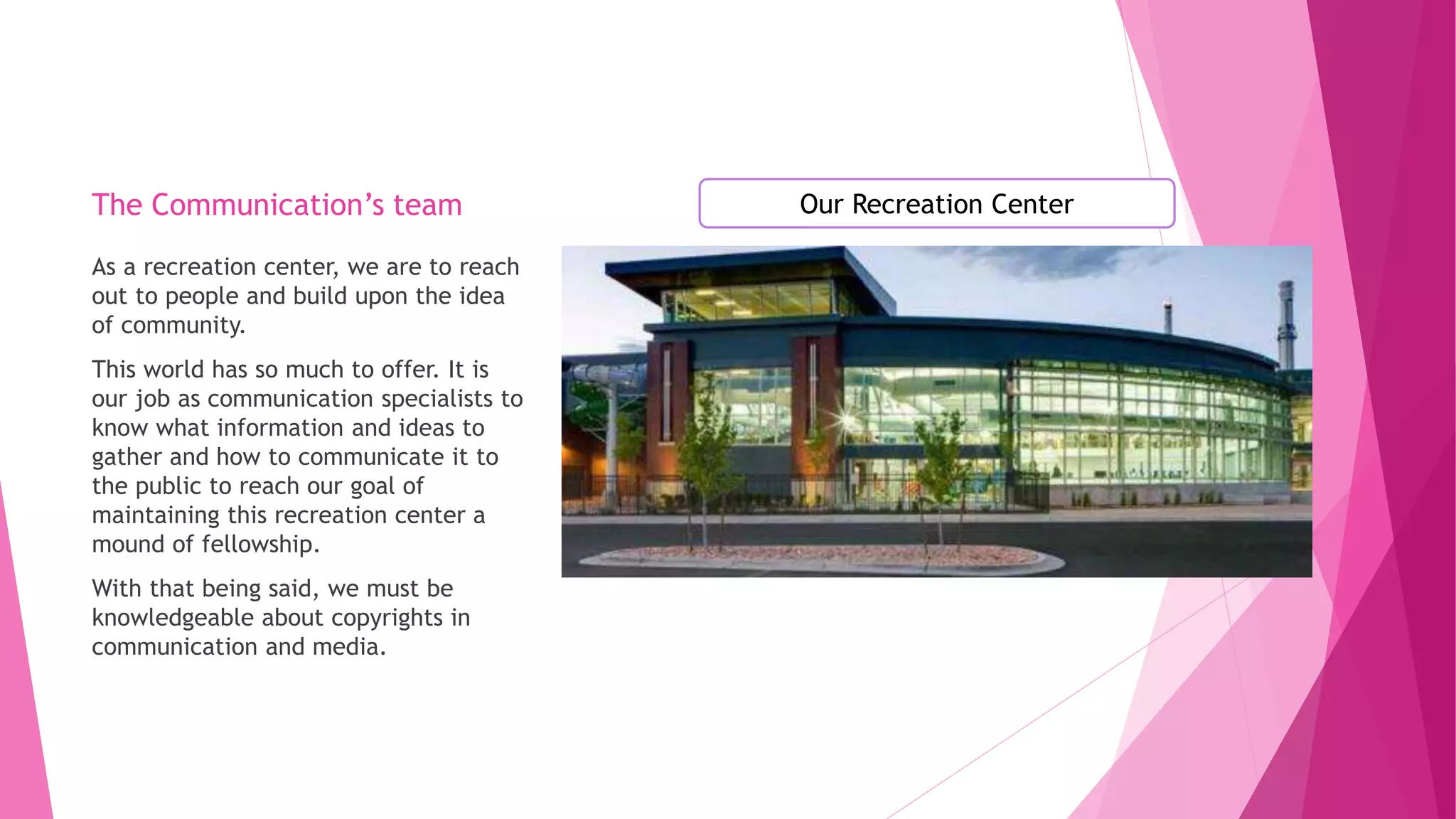
Our Recreation Center
What is copyrightable?
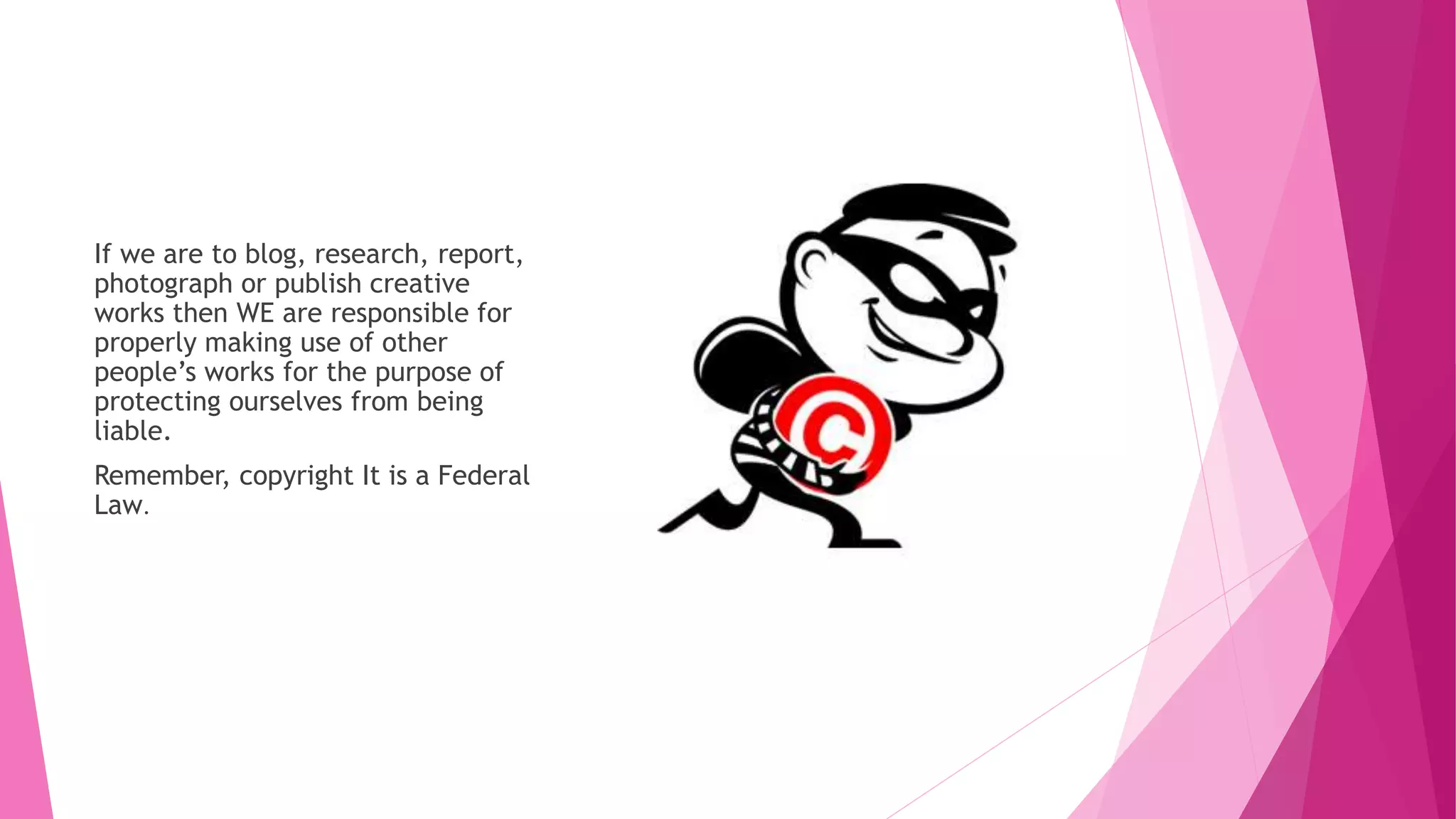
If we are to blog, research, report,
photograph or publish creative
works then WE are responsible for
properly making use of other
people’s works for the purpose of
protecting ourselves from being
liable.
Remember, copyright It is a Federal
Law.
Double check with these sites.
 Copyright: http://www.dmlp.org/legal-guide/copyright
 Using the Work of Others: http://www.dmlp.org/legal-guide/using-work-
others
 Circumventing Copyright Controls: http://www.dmlp.org/legal-
guide/circumventing-copyright-controls
 Creative Commons: http://creativecommons.org/licenses/
A nice list to consider copyrights
 Literary works –a news story, scientific paper, novel, poetry, or any other form
of "words-only" (or words-and-pictures) creative work.
 Musical works –lyrics and melodies, advertising jingles and/ or symphonies.
 Dramatic works – plays, including any accompanying music.
 Pictorial, graphic, and sculptural works – photographs, drawings, paintings,
and any other kind of two- or three-dimensional art.
 Motion pictures and other audiovisual works – movies, television shows,
YouTube videos, and any kind of multimedia.
 Sound recordings – in addition to the copyright on words and music (above) a
separate copyright protects a recording artist’s rendition of a work
 Architectural works – blueprints and similar plans for buildings.
Types of Intellectual property
“ Products of the Mind” that inspire an overall benefit to our society.
Types of Intellectual Property
 Copyrights are “original works of
authorship.”
 This means that the original owner
exclusively gets to decide what to
do with their works and who to
share it with.
 Trademarks gives businesses the
ability apply those copyrights onto
their works usually in the form of:
 Words
 Phrases
 Symbols
 Sponsorship
Types of Intellectual Property
How many
trademarks can
you identify ?
Types of Intellectual Property
 Trade Secrets is the information
that gives that business or
company its economic advantage
over its competitors.
 Do not commit improper means
such as:
 Theft
 Trespass
 Hacking
 Breach of confidentiality
agreement
 Patent are like copyrights for
unique things such as:
 Processes
 Procedures
 Methods
 Inventions
 Discoveries
 I like this one because one gets
twenty years of patent rights with
the idea that inventors receive the
financial incentive to invent.
Types of Intellectual Property
Are there conditions under which
copyrighted material can be used?
Yes, Fair Use
 Section 107 of the copyright Act says the above statement in more detail.
 Realize that there are four factors that help protect you.
 Purpose and Character of Your Use
 Nature of the Copyrighted Work
 Amount and Substantiality of the Portion Used
 The Effect of Your Use Upon the Potential Market for the copyrighted Work
Fair Use continued…
 Purpose and Character of Your Use
 Does it add new meaning from the original work?
 Nature of the Copyrighted Work
 Was the author’s work intended to be factual or creative use for the public
interest?
 Amount and Substantiality of the Portion Used
 Do you only use other material to enhance your overall purpose to convey
your message?
 The Effect of Your Use Upon the Potential Market for the copyrighted
Work
 Will the amount of work used from another author limit you from becoming
widespread?
What is a public domain, creative
commons?
Public Domain
 How do you find out if a work is in the public domain?
 It was published before 1923
 If a work does have a copyright notice between 1923-1977
 Works created after 1989 its probably not in the public domain
Creative Commons
 The idea of creative commons was expanded and biased from copyright
guidelines.
 Licensors get to decide how to share their work and still retain credit for their
work.
 Creative Commons has a few different ways to show a work is protected
 Text ( legal code )
 Commons deed ( human readable )
 Software ( machine readable )
Copyright and media use
recommendations for the Rec Center.
Spreading God’s Kingdome through your
work.
 “The tongue of the wise commends knowledge, but the mouths of fools pour
out folly” ( Proverbs 15:2, NIV).
The Communication’s Team
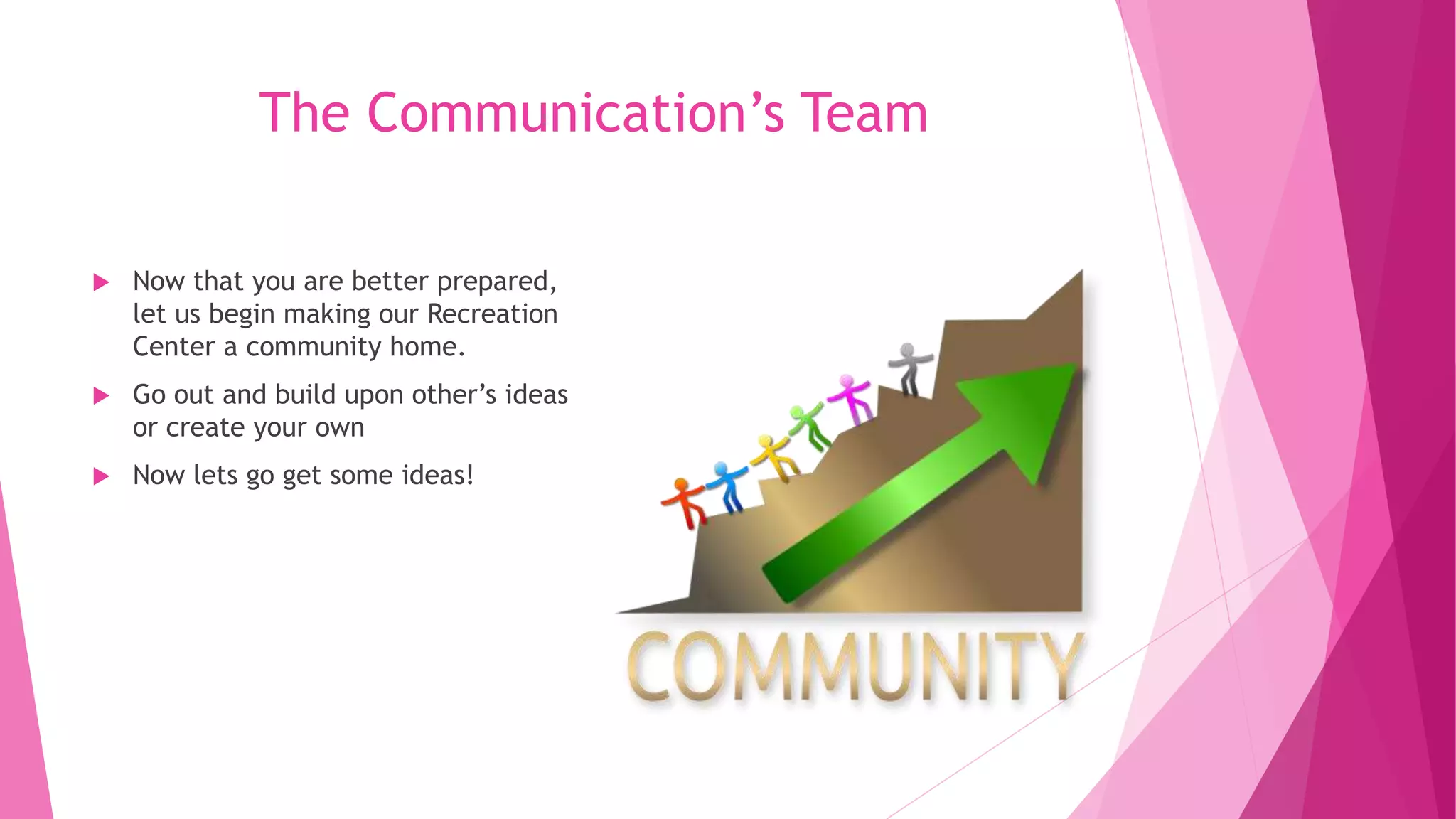
 Now that you are better prepared,
let us begin making our Recreation
Center a community home.
 Go out and build upon other’s ideas
or create your own
 Now lets go get some ideas!
References
Bible, H. (2011). New International Version. Grand Rapids: Zondervan.
Commons, C. (2016, March 4). About The Licenses. Retrieved from Creative
Commons.org: Purpose and Character of Your Use
Copyrights. (2016, March 2). Copyright. Retrieved from Digital Media Law
Project: http://www.dmlp.org/legal-guide/copyright
Messenger, A. (2015). Practical Guide to Media Law. Upper Saddle River, NJ:
Pearson.
Using the Work of Others. (2016, March 4). Retrieved from Digital Medial Law
Project: http://www.dmlp.org/legal-guide/circumventing-copyright-controls

Copyrights and fair use

  • 1.
    Copyrights and FairUse In a variety of contexts for the Recreation Center.
  • 2.
    The Communication’s team Asa recreation center, we are to reach out to people and build upon the idea of community. This world has so much to offer. It is our job as communication specialists to know what information and ideas to gather and how to communicate it to the public to reach our goal of maintaining this recreation center a mound of fellowship. With that being said, we must be knowledgeable about copyrights in communication and media. Our Recreation Center
  • 3.
  • 4.
    If we areto blog, research, report, photograph or publish creative works then WE are responsible for properly making use of other people’s works for the purpose of protecting ourselves from being liable. Remember, copyright It is a Federal Law.
  • 5.
    Double check withthese sites.  Copyright: http://www.dmlp.org/legal-guide/copyright  Using the Work of Others: http://www.dmlp.org/legal-guide/using-work- others  Circumventing Copyright Controls: http://www.dmlp.org/legal- guide/circumventing-copyright-controls  Creative Commons: http://creativecommons.org/licenses/
  • 6.
    A nice listto consider copyrights  Literary works –a news story, scientific paper, novel, poetry, or any other form of "words-only" (or words-and-pictures) creative work.  Musical works –lyrics and melodies, advertising jingles and/ or symphonies.  Dramatic works – plays, including any accompanying music.  Pictorial, graphic, and sculptural works – photographs, drawings, paintings, and any other kind of two- or three-dimensional art.  Motion pictures and other audiovisual works – movies, television shows, YouTube videos, and any kind of multimedia.  Sound recordings – in addition to the copyright on words and music (above) a separate copyright protects a recording artist’s rendition of a work  Architectural works – blueprints and similar plans for buildings.
  • 7.
    Types of Intellectualproperty “ Products of the Mind” that inspire an overall benefit to our society.
  • 8.
    Types of IntellectualProperty  Copyrights are “original works of authorship.”  This means that the original owner exclusively gets to decide what to do with their works and who to share it with.  Trademarks gives businesses the ability apply those copyrights onto their works usually in the form of:  Words  Phrases  Symbols  Sponsorship
  • 9.
    Types of IntellectualProperty How many trademarks can you identify ?
  • 10.
    Types of IntellectualProperty  Trade Secrets is the information that gives that business or company its economic advantage over its competitors.  Do not commit improper means such as:  Theft  Trespass  Hacking  Breach of confidentiality agreement  Patent are like copyrights for unique things such as:  Processes  Procedures  Methods  Inventions  Discoveries  I like this one because one gets twenty years of patent rights with the idea that inventors receive the financial incentive to invent.
  • 11.
  • 12.
    Are there conditionsunder which copyrighted material can be used?
  • 13.
    Yes, Fair Use Section 107 of the copyright Act says the above statement in more detail.  Realize that there are four factors that help protect you.  Purpose and Character of Your Use  Nature of the Copyrighted Work  Amount and Substantiality of the Portion Used  The Effect of Your Use Upon the Potential Market for the copyrighted Work
  • 14.
    Fair Use continued… Purpose and Character of Your Use  Does it add new meaning from the original work?  Nature of the Copyrighted Work  Was the author’s work intended to be factual or creative use for the public interest?  Amount and Substantiality of the Portion Used  Do you only use other material to enhance your overall purpose to convey your message?  The Effect of Your Use Upon the Potential Market for the copyrighted Work  Will the amount of work used from another author limit you from becoming widespread?
  • 15.
    What is apublic domain, creative commons?
  • 16.
    Public Domain  Howdo you find out if a work is in the public domain?  It was published before 1923  If a work does have a copyright notice between 1923-1977  Works created after 1989 its probably not in the public domain
  • 17.
    Creative Commons  Theidea of creative commons was expanded and biased from copyright guidelines.  Licensors get to decide how to share their work and still retain credit for their work.  Creative Commons has a few different ways to show a work is protected  Text ( legal code )  Commons deed ( human readable )  Software ( machine readable )
  • 18.
    Copyright and mediause recommendations for the Rec Center.
  • 19.
    Spreading God’s Kingdomethrough your work.  “The tongue of the wise commends knowledge, but the mouths of fools pour out folly” ( Proverbs 15:2, NIV).
  • 20.
    The Communication’s Team Now that you are better prepared, let us begin making our Recreation Center a community home.  Go out and build upon other’s ideas or create your own  Now lets go get some ideas!
  • 21.
    References Bible, H. (2011).New International Version. Grand Rapids: Zondervan. Commons, C. (2016, March 4). About The Licenses. Retrieved from Creative Commons.org: Purpose and Character of Your Use Copyrights. (2016, March 2). Copyright. Retrieved from Digital Media Law Project: http://www.dmlp.org/legal-guide/copyright Messenger, A. (2015). Practical Guide to Media Law. Upper Saddle River, NJ: Pearson. Using the Work of Others. (2016, March 4). Retrieved from Digital Medial Law Project: http://www.dmlp.org/legal-guide/circumventing-copyright-controls

Editor's Notes

  • #2 Welcome everyone and thank you for taking time out of your busy day to sit here with me today and talk about using other people’s work with less risk of being liable. Let us begin.
  • #3 Our job is to build our community by successfully communicating the correct idea to the public. We are to continually bring in new and fresh opportunities and ideas so that we have plenty to offer and express a welcome to a large divers group of individuals. We also need to be knowledgeable and keep up with the trends of cultural norms. So, being involved with media, news, reports, statistics, music and social media can place one in a vulnerable position to copy or take too much of someone else’s ideas. The best way to keep yourself out of liabilities' way is to at least have a good idea about copyrights and fair use.
  • #5 Don’t forget that you will have new ideas that you will create and even you could copyright your work. Think about what your reaction would be if you saw a portion your work being displayed by someone else in the marketing world and either making money off of it or used it in the wrong context. How would that make you feel?
  • #6 At first, it is hard to familiarize yourself with copyrights, using the work of others, and creative commons. I have provided you with these websites to help you get familiar. If you save these to you favorites on your browser toolbar you can reference them quickly and after a while they will become familiar.
  • #7 When researching, one should assume that almost everything has copyrights. There are some materials that are not copyrighted like public domain, but we will visit that subject a bit later. Here is a nice list to consider what may be copyrighted and that would mean we need to make sure we are citing, or building off of an idea in a way that promotes creativity or benefits the public.
  • #8 Isn't it amazing to think that products of the mind are to be protected? I found it silly at first, but after looking at it closely it is actually quite important. After all, everything begins with a thought before it reaches the form of a song, document, media, book and so on.
  • #9 There are different kinds of copyrights, if you will, depending of the material or content that is being protected.
  • #10 The picture on the left should look familiar and the trademarks on the rights should be even more recognizable.
  • #11 I found trade secrets very fascinating because without this right, nothing within the market could hold its value to be unique. Then we encounter patents, to me, they are the upmost kind of intellectual property, wouldn’t you say?
  • #12 Have you ever had a knock-off of Coca-Cola and it just did not fulfill your craving? Well, that is why sometimes it is worth paying a little extra for that trade secret.
  • #13 Absolutely!
  • #14 Fair use is awesome because as long as one uses an authors work as a “contribution to society by continuing the public discourse or creating a new work in the process, fair use may protect you”.
  • #15 If you answered yes to all questions, then you will remain protected under the Fair Use Law because you have passed the Fair Use Factors. Great job! If you honestly answered no to at least one, then you may want to reconsider how you are using new material.
  • #16 Just a few more to keep in mind. Your doing great and you’ve learned so much.
  • #17 The public domain is awesome, here is why…one does not need permission from the copyrights owner after the copyright has expired and fallen into the “public domain”.
  • #18 Creative commons is a branch off of copyright. There are different ways to show how your own work can be protected and remember that means that there are a few ways to find how a work is protected. Text, commons deed and software.
  • #19 Now that your have learned about copyrights and things of that nature, don’t be afraid of being creative! I recommend that as long as you keep yourself informed you can create wonderful things for this recreation center. Think outside the box. Our goal is to communicate good things out into the community so that people have a chance to act out in good nature.
  • #20 Keep this in mind, we want wo promote righteousness. Your good intensions with your work will spread God’s kingdom on this earth and yes, through his Recreation Center.
  • #21 Make sure to double check if you are liable, remember we have large populous and either your work or your infringement will be recognized. Thank you so much for your time, I hope this presentation was helpful to you. I will be over by the cookies and drinks to answer any of your questions.