Copyright Crash CourseGeorge Saenz
Create and Share InformationCopyright- how it plays in what we research and what we teach in class.  Who owns it if its on the Web?You created it and posted it now how do you protect it?  How do you manage what you created.
Copyright How we research and How we teach it in class.  Whenever we use outside information from an outside source we must give credit to the Author.Copyright helps us and places awkward blocks in our paths. If you take the time to learn a little bit about it, you can make use of its profit and avoid its pitfalls. I am inviting  you to explore the Copyright Crash Course.
Who owns What?Non copyrightable expressions:Copyrightable expressions:Poetry; prose; software applications; artwork; musical notation; recorded music and/or song; animations; video; Java applets; a Web page; a Website design, blog posts and comments; architectural drawings; photographsMere facts; exact duplications of public domain works; ideas; systems; works created by employees of the Federal Government; titles and short phrases; logos and slogans; forms that only collect information (rather than provide information).
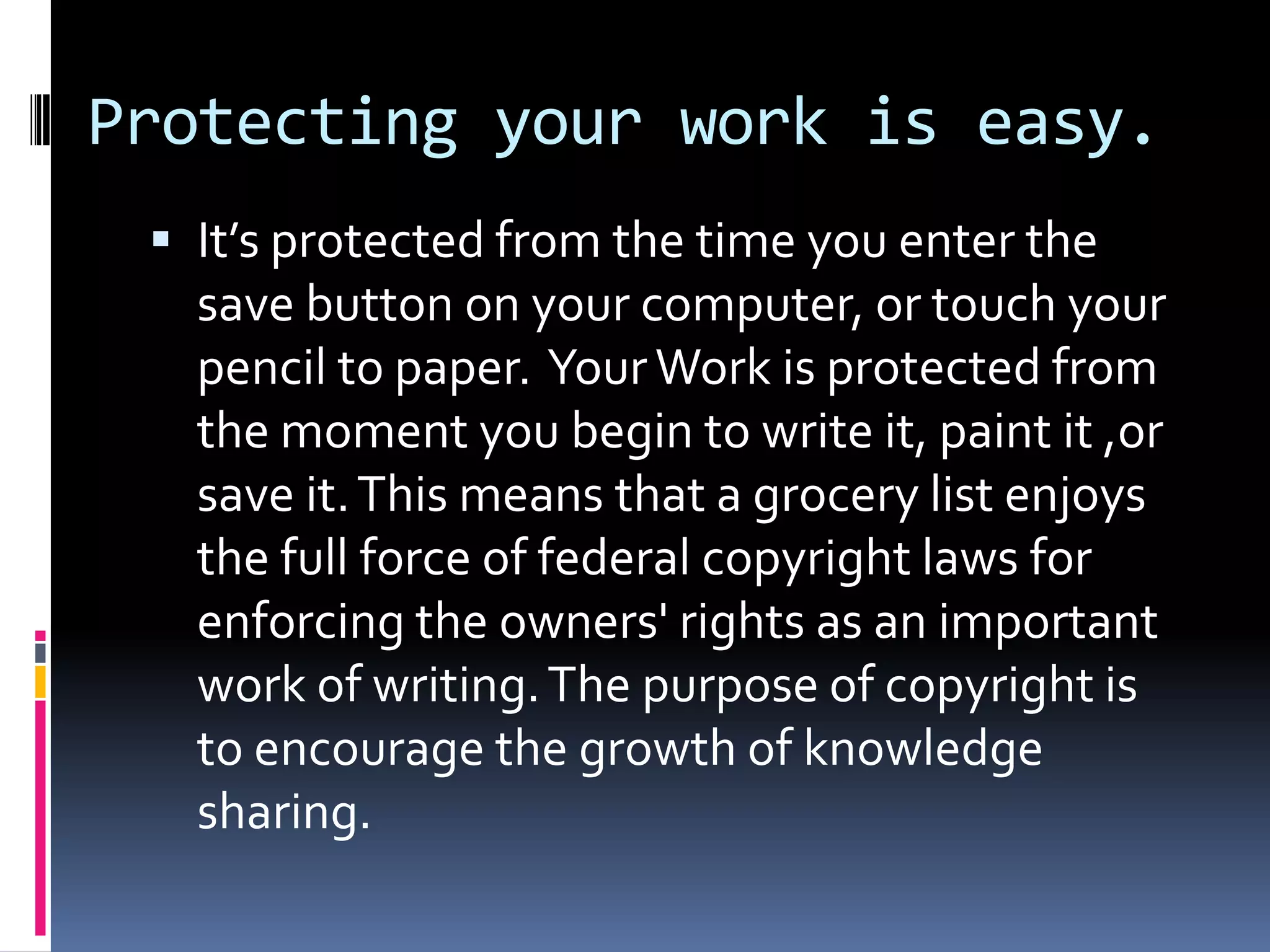
Protecting your work is easy.It’s protected from the time you enter the save button on your computer, or touch your pencil to paper.  Your Work is protected from the moment you begin to write it, paint it ,or save it. This means that a grocery list enjoys the full force of federal copyright laws for enforcing the owners' rights as an important work of writing. The purpose of copyright is to encourage the growth of knowledge sharing.
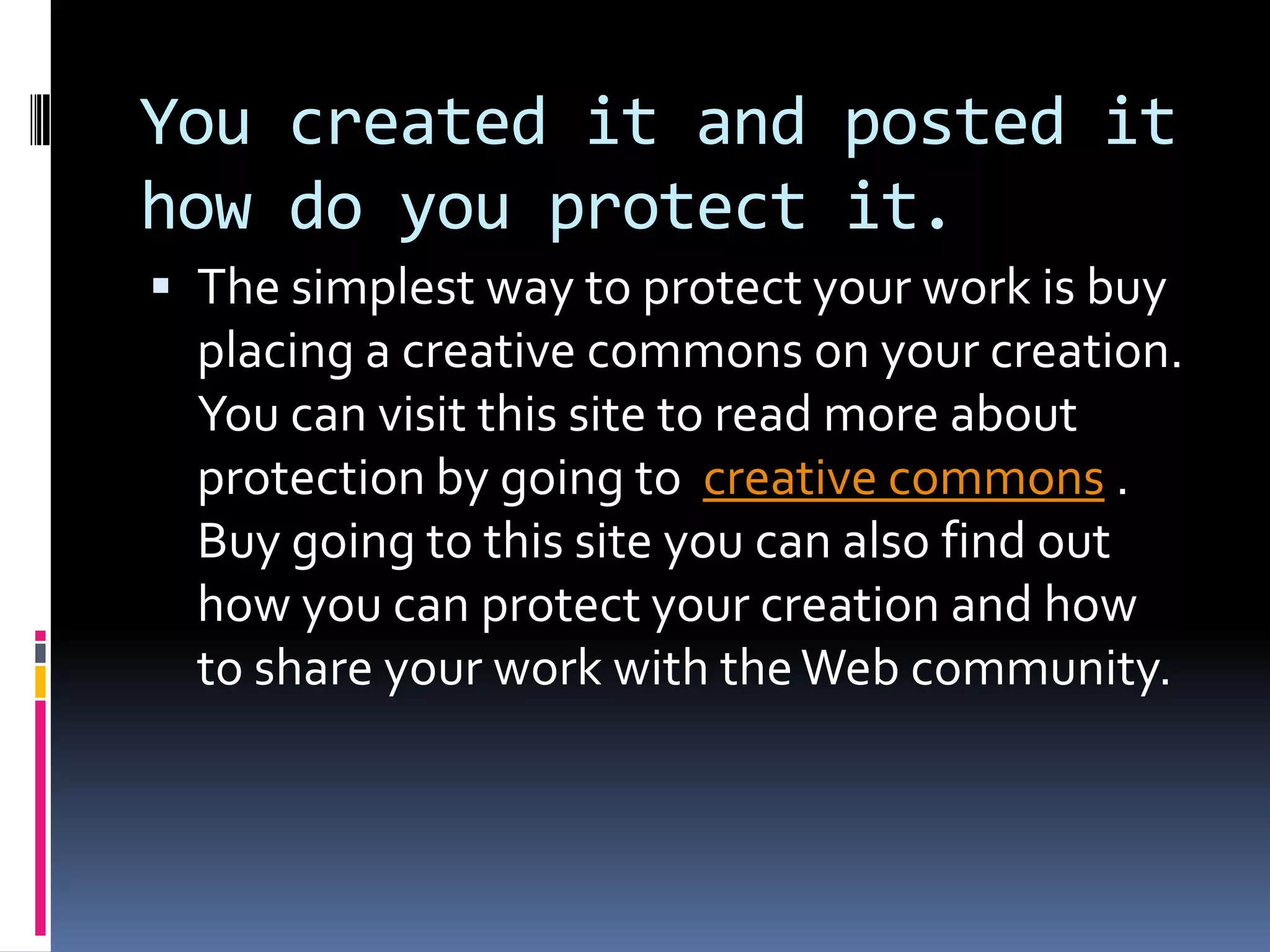
You created it and posted it how do you protect it.  The simplest way to protect your work is buy placing a creative commons on your creation.  You can visit this site to read more about protection by going to  creative commons .  Buy going to this site you can also find out how you can protect your creation and how to share your work with the Web community.
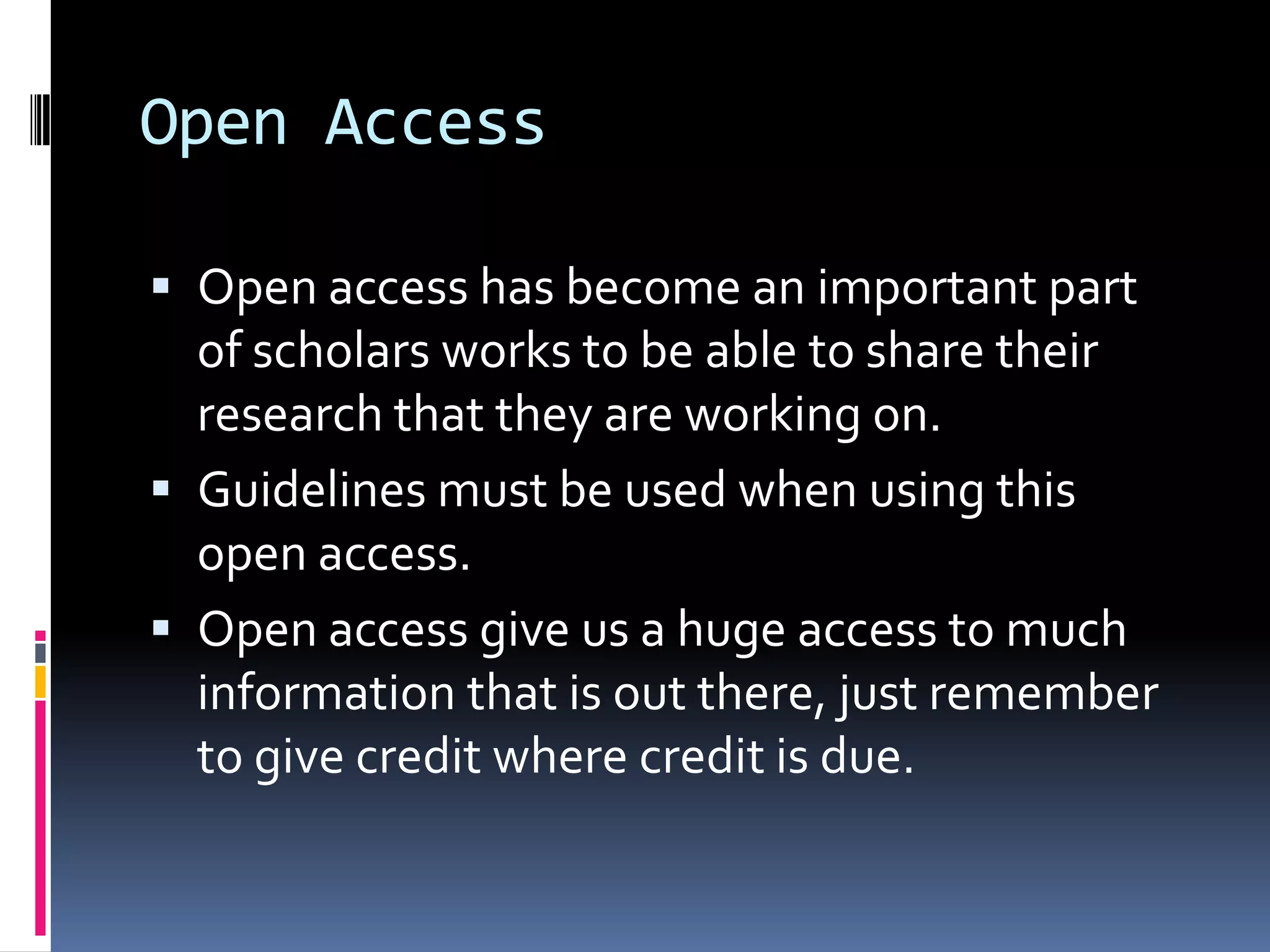
Open AccessOpen access has become an important part of scholars works to be able to share their research that they are working on. Guidelines must be used when using this open access.Open access give us a huge access to much information that is out there, just remember to give credit where credit is due.
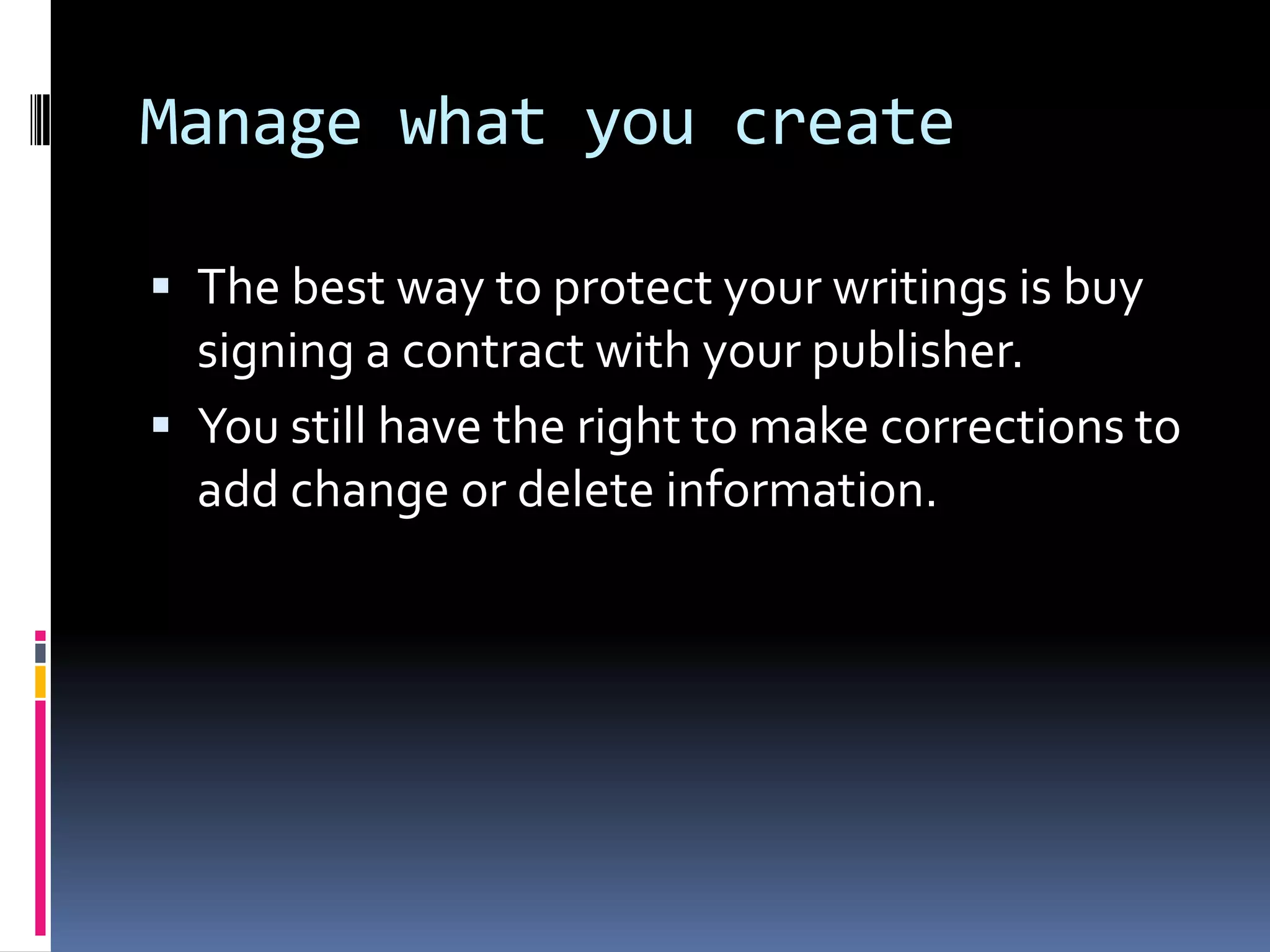
Manage what you createThe best way to protect your writings is buy signing a contract with your publisher.  You still have the right to make corrections to add change or delete information.
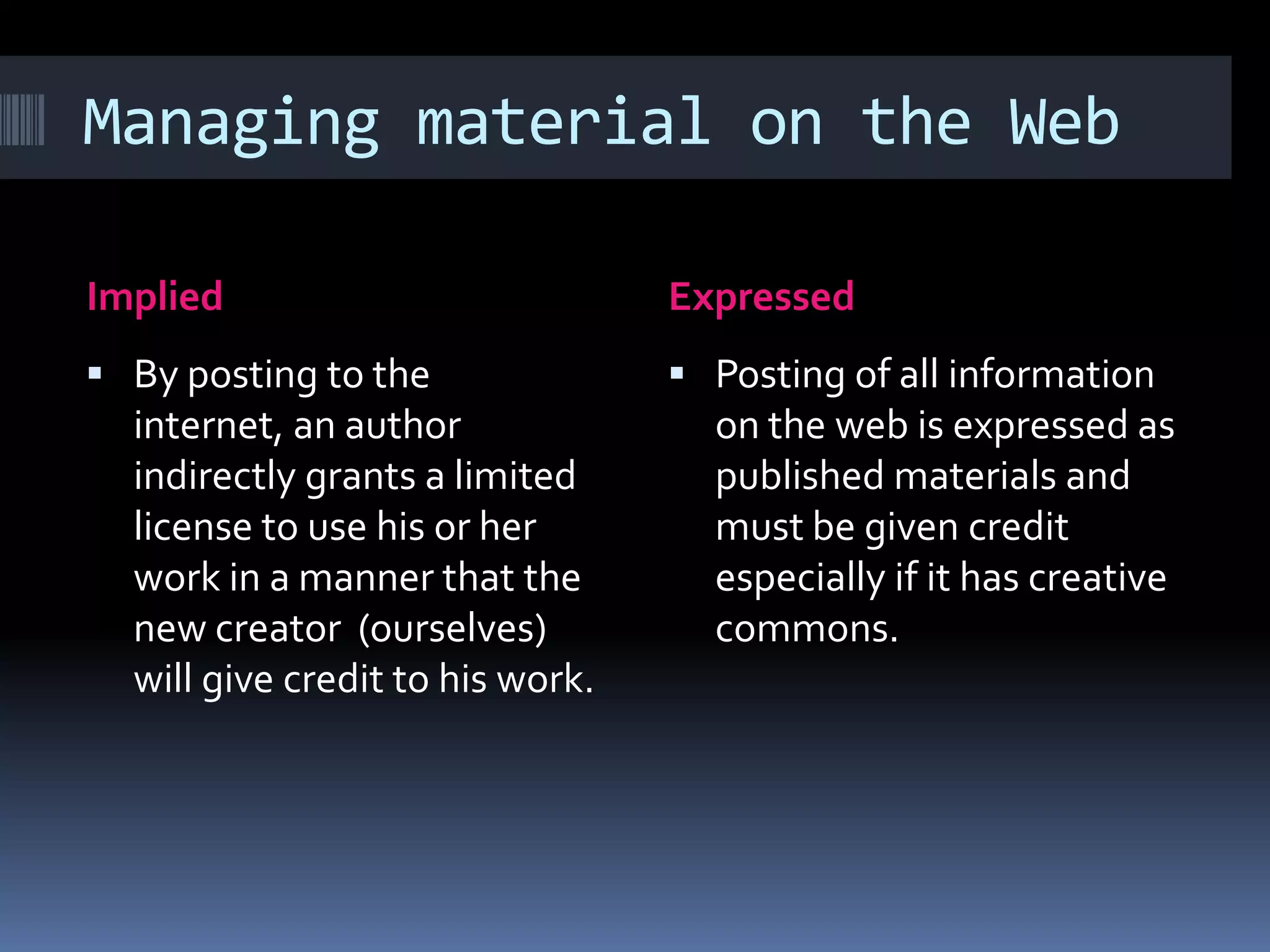
Managing material on the WebImpliedExpressedBy posting to the internet, an author indirectly grants a limited license to use his or her  work in a manner that the new creator  (ourselves) will give credit to his work. Posting of all information on the web is expressed as published materials and must be given credit  especially if it has creative commons.
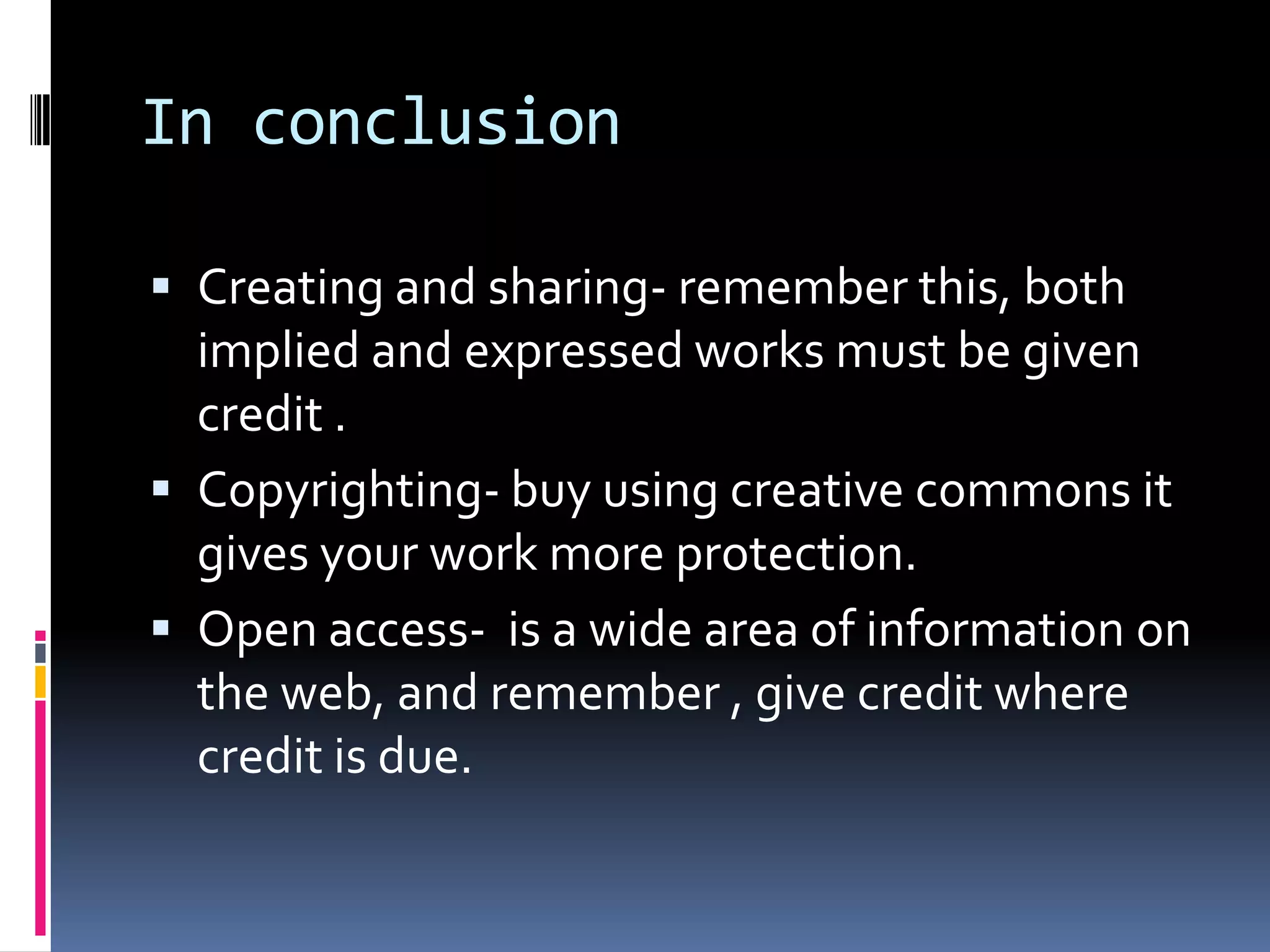
In conclusionCreating and sharing- remember this, both implied and expressed works must be given credit . Copyrighting- buy using creative commons it gives your work more protection.Open access-  is a wide area of information on the web, and remember , give credit where credit is due.
Harper k. George, Copyright Crash Course, University of Texas Libraries, 2001, 2007, <http://copyright.lib.utexas.edu/useofweb.html>Work cited
The End

Copyright crash course

  • 1.
  • 2.
    Create and ShareInformationCopyright- how it plays in what we research and what we teach in class. Who owns it if its on the Web?You created it and posted it now how do you protect it? How do you manage what you created.
  • 3.
    Copyright How weresearch and How we teach it in class. Whenever we use outside information from an outside source we must give credit to the Author.Copyright helps us and places awkward blocks in our paths. If you take the time to learn a little bit about it, you can make use of its profit and avoid its pitfalls. I am inviting you to explore the Copyright Crash Course.
  • 4.
    Who owns What?Noncopyrightable expressions:Copyrightable expressions:Poetry; prose; software applications; artwork; musical notation; recorded music and/or song; animations; video; Java applets; a Web page; a Website design, blog posts and comments; architectural drawings; photographsMere facts; exact duplications of public domain works; ideas; systems; works created by employees of the Federal Government; titles and short phrases; logos and slogans; forms that only collect information (rather than provide information).
  • 5.
    Protecting your workis easy.It’s protected from the time you enter the save button on your computer, or touch your pencil to paper. Your Work is protected from the moment you begin to write it, paint it ,or save it. This means that a grocery list enjoys the full force of federal copyright laws for enforcing the owners' rights as an important work of writing. The purpose of copyright is to encourage the growth of knowledge sharing.
  • 6.
    You created itand posted it how do you protect it. The simplest way to protect your work is buy placing a creative commons on your creation. You can visit this site to read more about protection by going to creative commons . Buy going to this site you can also find out how you can protect your creation and how to share your work with the Web community.
  • 7.
    Open AccessOpen accesshas become an important part of scholars works to be able to share their research that they are working on. Guidelines must be used when using this open access.Open access give us a huge access to much information that is out there, just remember to give credit where credit is due.
  • 8.
    Manage what youcreateThe best way to protect your writings is buy signing a contract with your publisher. You still have the right to make corrections to add change or delete information.
  • 9.
    Managing material onthe WebImpliedExpressedBy posting to the internet, an author indirectly grants a limited license to use his or her work in a manner that the new creator (ourselves) will give credit to his work. Posting of all information on the web is expressed as published materials and must be given credit especially if it has creative commons.
  • 10.
    In conclusionCreating andsharing- remember this, both implied and expressed works must be given credit . Copyrighting- buy using creative commons it gives your work more protection.Open access- is a wide area of information on the web, and remember , give credit where credit is due.
  • 11.
    Harper k. George,Copyright Crash Course, University of Texas Libraries, 2001, 2007, <http://copyright.lib.utexas.edu/useofweb.html>Work cited
  • 12.