Copyright Basics Registration, Use, and Infringement Care of
What is a copyright? A bundle of six different rights Right to reproduce Right to make derivative works Right to distribute copies to the public Right to public display Right to public performance Right to perform via digital audio transmission
What can you copyright? “Original works of authorship” Original: some creativity was required Ideas may not be copyrighted Your version of an idea may be copyrighted Authorship: Any published or unpublished literary, artistic, dramatic, or musical work
Who owns a copyright? The artist/artists “ joint work” – both artists’ contributions must be individually copyrightable, and both must have intended it to be a joint work. The contract holder You can transfer one or all of your rights to someone via contract “ Work made for hire” Works made in an employment relationship – NOT necessarily commissions
When is a work copyrighted? As soon as it is “fixed in a tangible medium” You own the copyright as soon as you paint, sculpt, write, or record something subject to protection Just write “copyright 2009 (your name)”  The “poor man’s copyright” is a myth
Then why should I register? You cannot make an infringement claim without registration If someone uses your work and you have registered it, you are entitled to statutory damages. Someone wishing to use your work will be able to find you This could mean more money for you It’s the easiest form of intellectual property to protect Compared to patents and trademarks, copyrights are cheap, easy to obtain, and last much longer
How do I register? All copyright may now be done online at  www.copyright.gov Filing costs $35 per application, if filed online If you have any doubts, call TALA or an entertainment attorney
How long does a copyright last? A copyright now lasts for the life of the author plus 70 years Intellectual property rights may be passed down to heirs in a will A work-made-for-hire lasts 95 years This is pursuant to the 1976 copyright act: earlier works have different protection periods
Using someone else’s work Can be used for free if: The work is in the public domain It falls under the fair use exception Otherwise, you need permission This can be accomplished through a license The cost of the license will vary based on your use and your relationship with the copyright owner
Derivative Works Definition: “a derivative work is a work based upon one or more preexisting works, such as a translation, musical arrangement, dramatization, motion picture version…art reproduction…or any other form in which a work may be recast, transformed, or adapted.”
Derivative Works Your copyright in a derivative work extends only to the material you added Your addition must be different enough from the original, or contain a substantial enough amount of new material, to be considered a new work Your derivative work does not effect the copyright for the underlying work in any way Lee  case: a store owner cut up greeting card art and mounted it on coasters; not considered derivative work because there was no original contribution
Fair Use Four factors used Purpose and character of the use (commerical v. educational/non-profit) The nature of the copyrighted work The amount of the copyrighted work used The effect of the use on the market for the original work
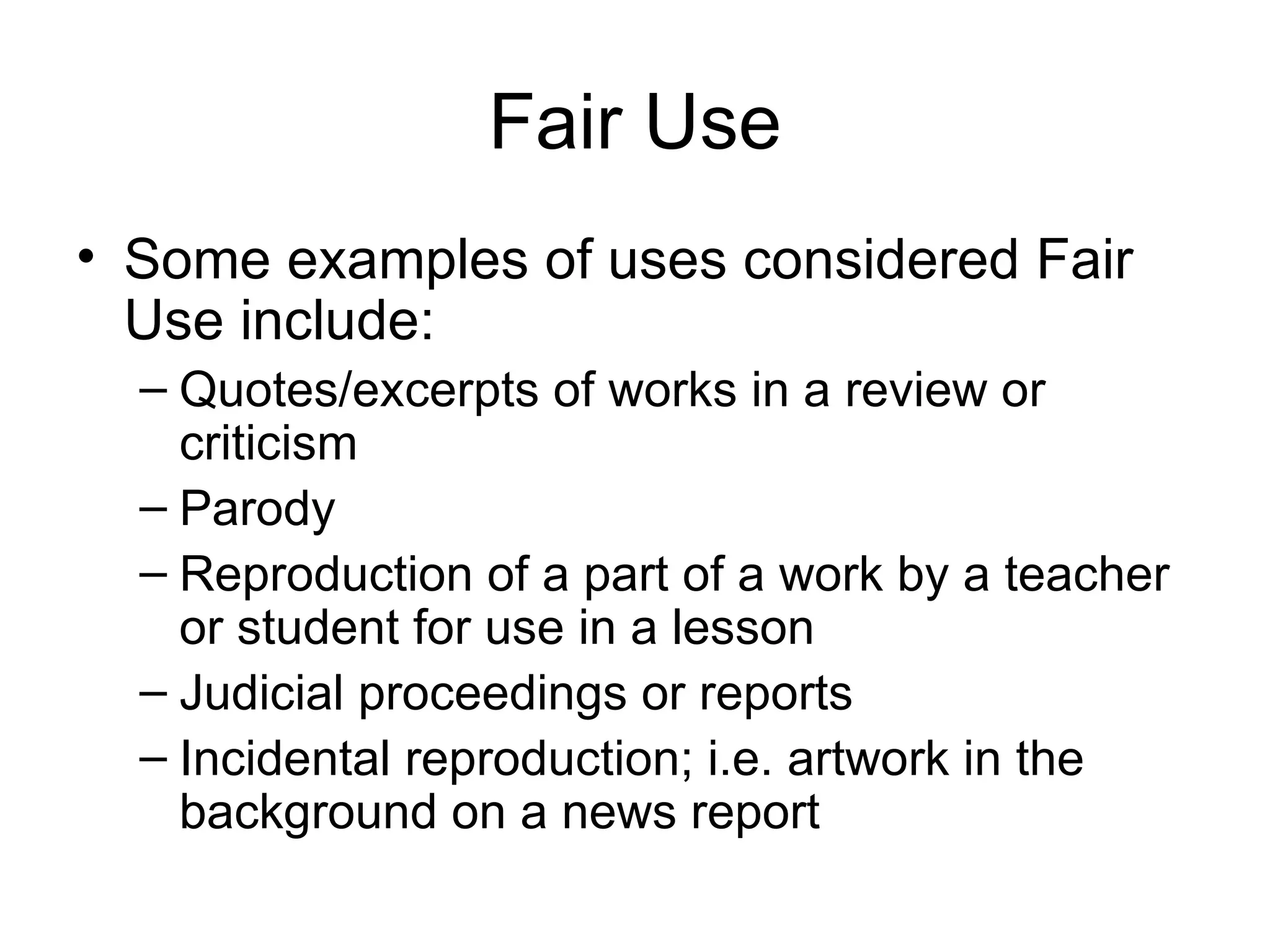
Fair Use Some examples of uses considered Fair Use include: Quotes/excerpts of works in a review or criticism Parody Reproduction of a part of a work by a teacher or student for use in a lesson Judicial proceedings or reports Incidental reproduction; i.e. artwork in the background on a news report
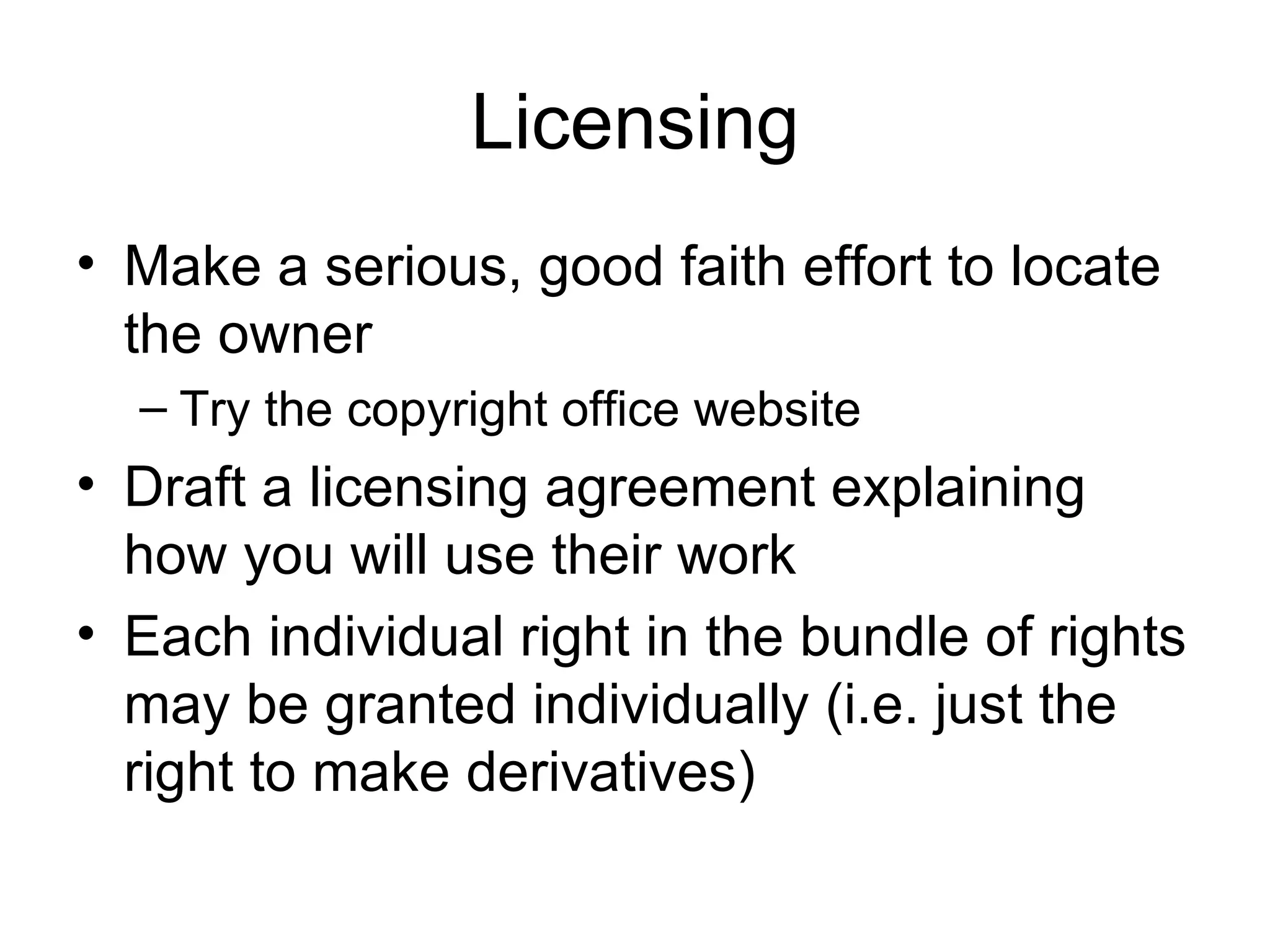
Licensing Make a serious, good faith effort to locate the owner Try the copyright office website Draft a licensing agreement explaining how you will use their work Each individual right in the bundle of rights may be granted individually (i.e. just the right to make derivatives)
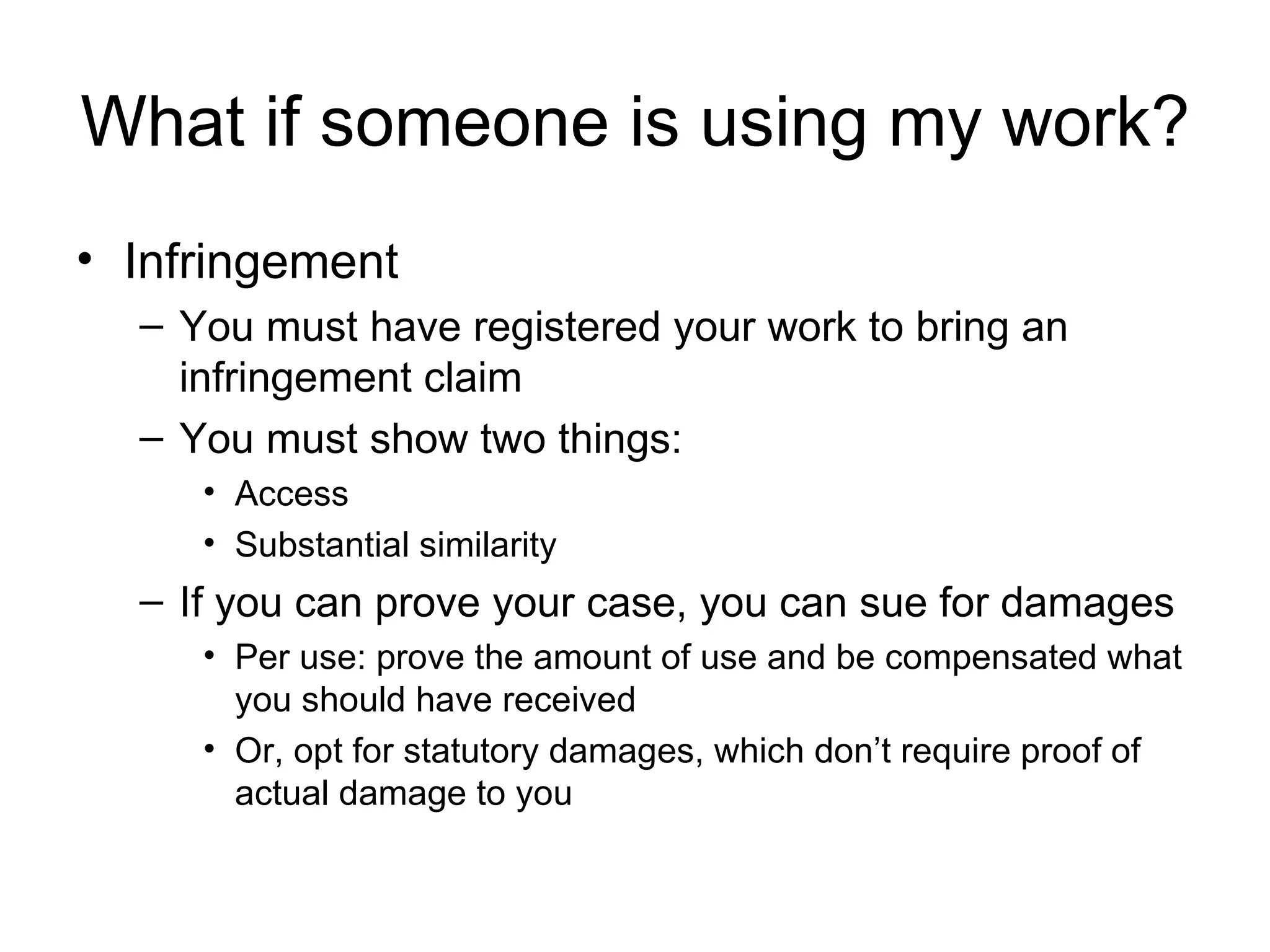
What if someone is using my work? Infringement You must have registered your work to bring an infringement claim You must show two things: Access Substantial similarity If you can prove your case, you can sue for damages Per use: prove the amount of use and be compensated what you should have received Or, opt for statutory damages, which don’t require proof of actual damage to you
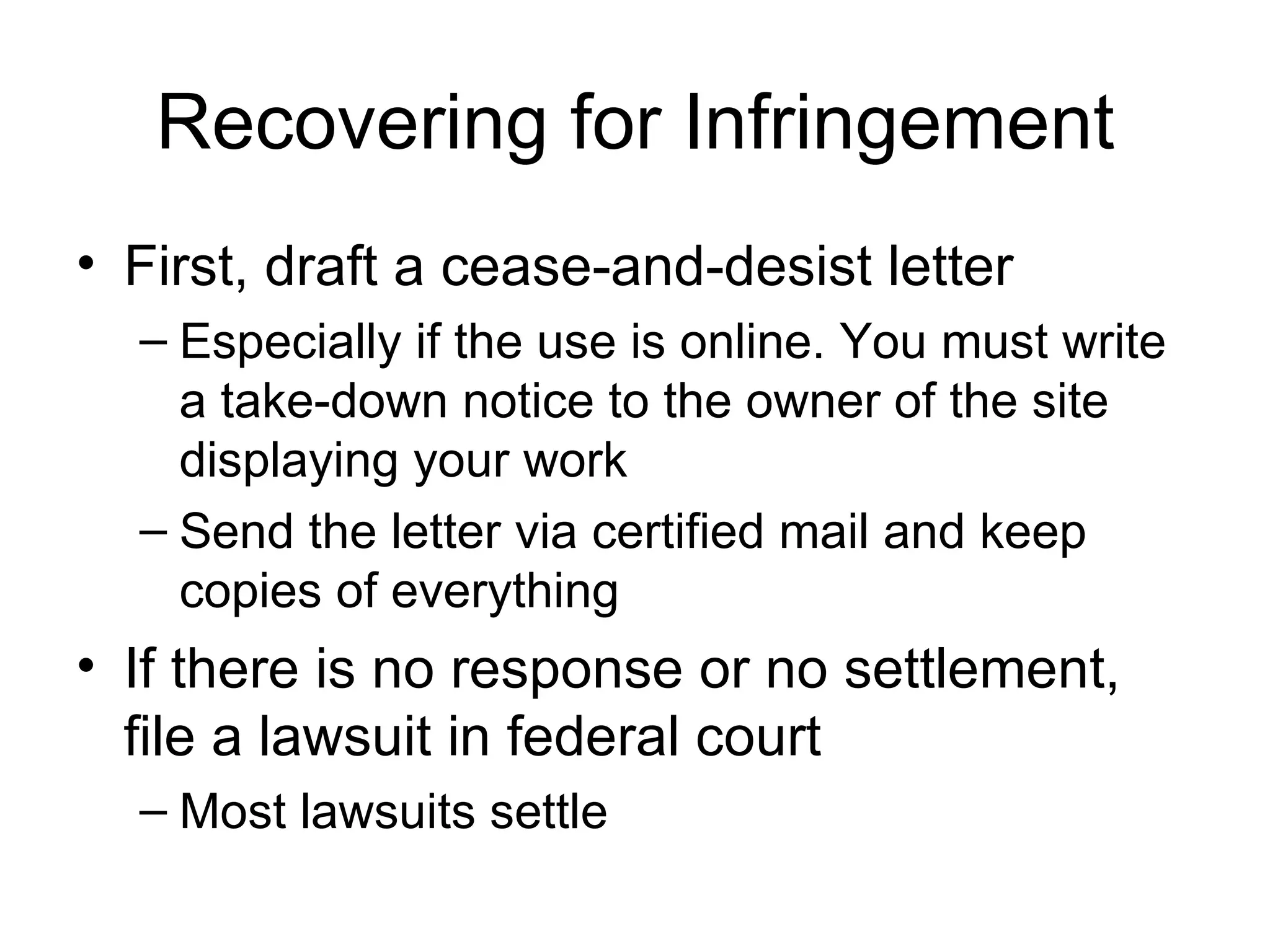
Recovering for Infringement First, draft a cease-and-desist letter Especially if the use is online. You must write a take-down notice to the owner of the site displaying your work Send the letter via certified mail and keep copies of everything If there is no response or no settlement, file a lawsuit in federal court Most lawsuits settle
Other Intellectual Property Protection Trademark – a word, name, or logo used in commerce Patent – for inventions or processes Trade dress – the general look and feel of a business or product
Trademark Registration is slightly more expensive than copyright Protects the use of your business name or logo in commerce A band name may be trademarked
Patent The most expensive form of protection Lasts approximately 17 years Intended to protect inventions and methods
Creative Commons Not an alternative to copyright You still need to register; CC licenses alone will not protect your work Narrows the scope of your copyright You can choose “some rights reserved” (license) or “no rights reserved” (direct to public domain) For use on any creative work For software, use open source licenses instead
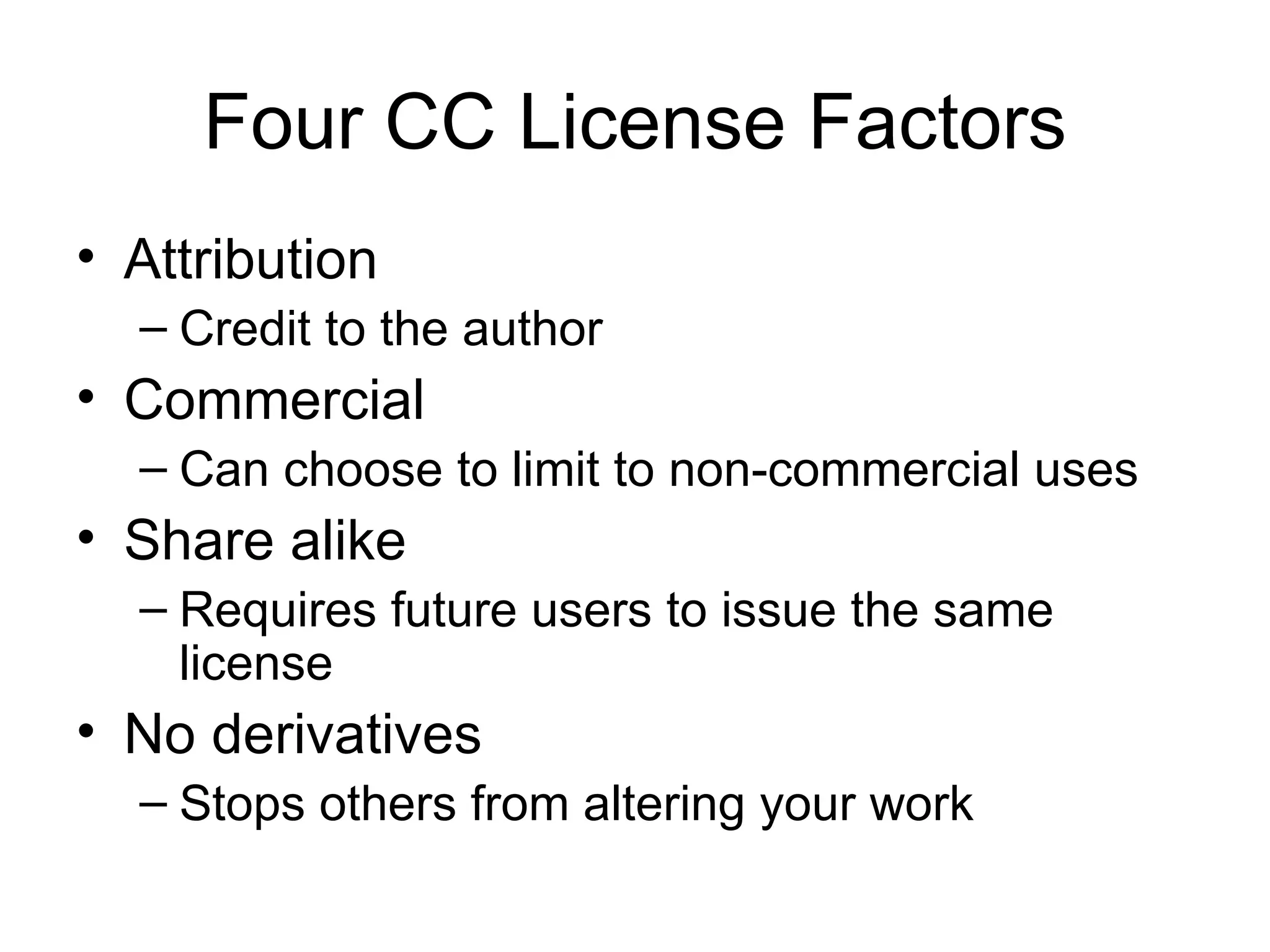
Four CC License Factors Attribution Credit to the author Commercial Can choose to limit to non-commercial uses Share alike Requires future users to issue the same license  No derivatives Stops others from altering your work
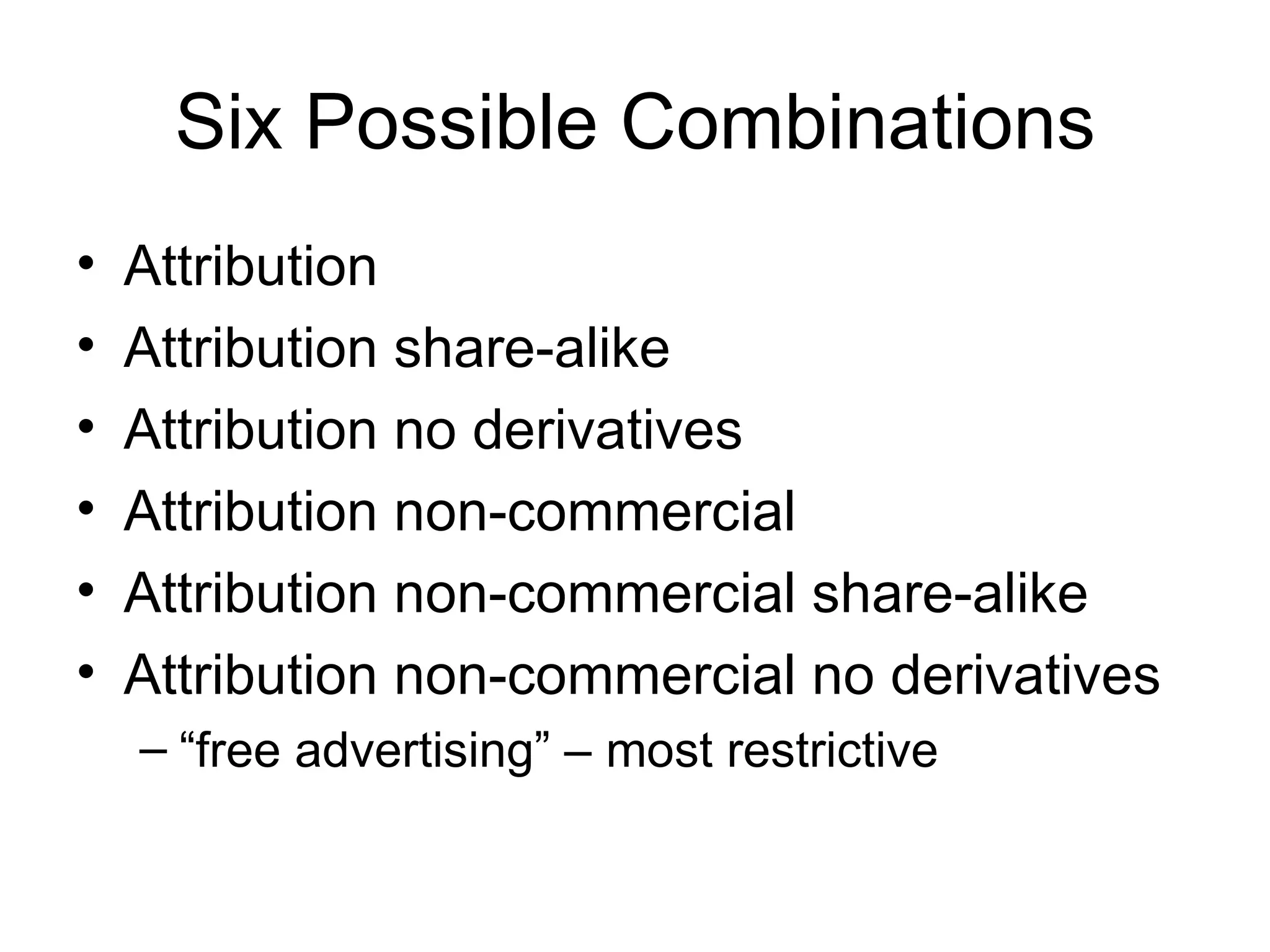
Six Possible Combinations Attribution  Attribution share-alike Attribution no derivatives Attribution non-commercial Attribution non-commercial share-alike Attribution non-commercial no derivatives “ free advertising” – most restrictive
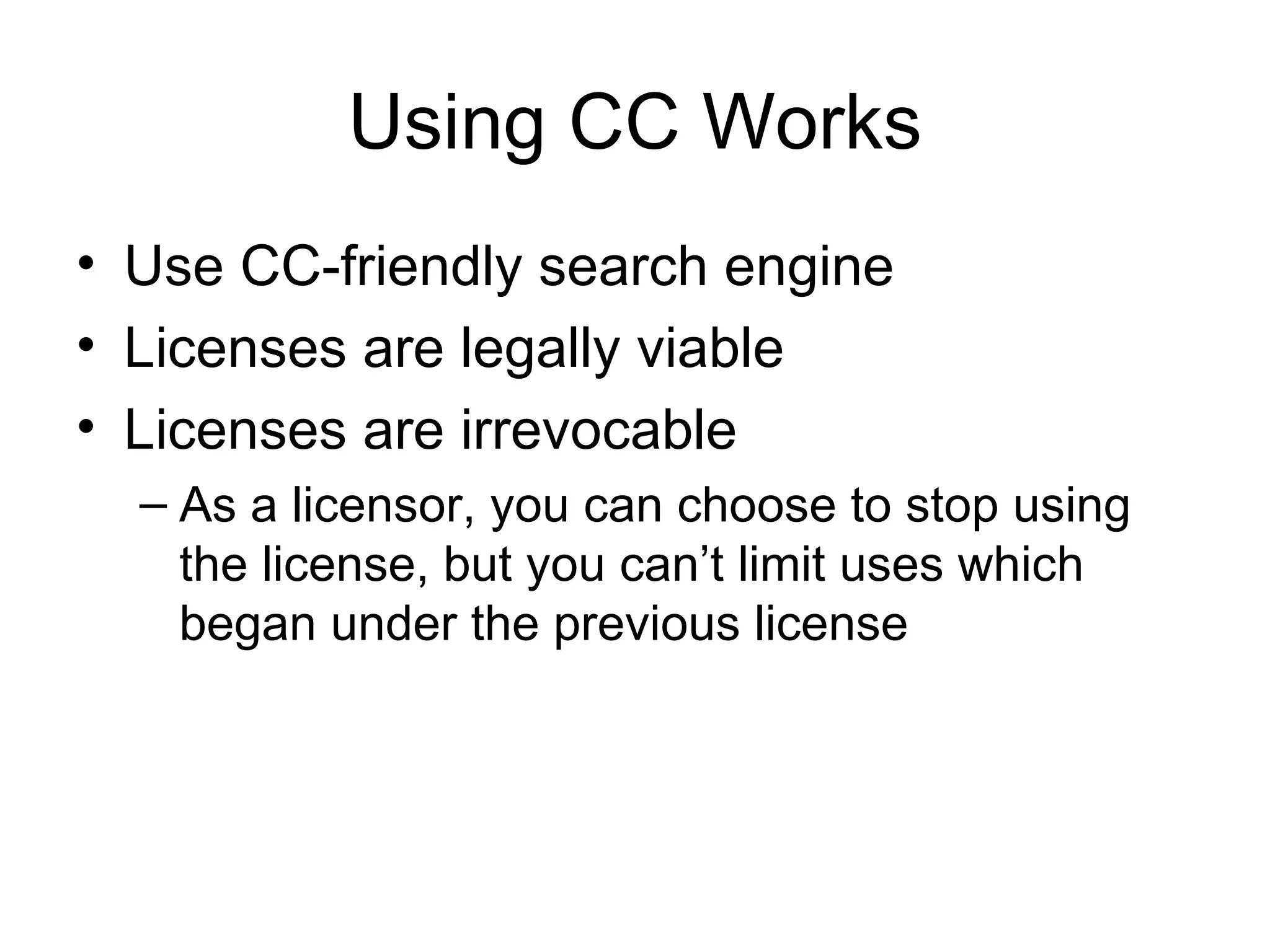
Using CC Works Use CC-friendly search engine Licenses are legally viable Licenses are irrevocable As a licensor, you can choose to stop using the license, but you can’t limit uses which began under the previous license

Copyright Basics by TALA & Spacetaker

  • 1.
    Copyright Basics Registration,Use, and Infringement Care of
  • 2.
    What is acopyright? A bundle of six different rights Right to reproduce Right to make derivative works Right to distribute copies to the public Right to public display Right to public performance Right to perform via digital audio transmission
  • 3.
    What can youcopyright? “Original works of authorship” Original: some creativity was required Ideas may not be copyrighted Your version of an idea may be copyrighted Authorship: Any published or unpublished literary, artistic, dramatic, or musical work
  • 4.
    Who owns acopyright? The artist/artists “ joint work” – both artists’ contributions must be individually copyrightable, and both must have intended it to be a joint work. The contract holder You can transfer one or all of your rights to someone via contract “ Work made for hire” Works made in an employment relationship – NOT necessarily commissions
  • 5.
    When is awork copyrighted? As soon as it is “fixed in a tangible medium” You own the copyright as soon as you paint, sculpt, write, or record something subject to protection Just write “copyright 2009 (your name)” The “poor man’s copyright” is a myth
  • 6.
    Then why shouldI register? You cannot make an infringement claim without registration If someone uses your work and you have registered it, you are entitled to statutory damages. Someone wishing to use your work will be able to find you This could mean more money for you It’s the easiest form of intellectual property to protect Compared to patents and trademarks, copyrights are cheap, easy to obtain, and last much longer
  • 7.
    How do Iregister? All copyright may now be done online at www.copyright.gov Filing costs $35 per application, if filed online If you have any doubts, call TALA or an entertainment attorney
  • 8.
    How long doesa copyright last? A copyright now lasts for the life of the author plus 70 years Intellectual property rights may be passed down to heirs in a will A work-made-for-hire lasts 95 years This is pursuant to the 1976 copyright act: earlier works have different protection periods
  • 9.
    Using someone else’swork Can be used for free if: The work is in the public domain It falls under the fair use exception Otherwise, you need permission This can be accomplished through a license The cost of the license will vary based on your use and your relationship with the copyright owner
  • 10.
    Derivative Works Definition:“a derivative work is a work based upon one or more preexisting works, such as a translation, musical arrangement, dramatization, motion picture version…art reproduction…or any other form in which a work may be recast, transformed, or adapted.”
  • 11.
    Derivative Works Yourcopyright in a derivative work extends only to the material you added Your addition must be different enough from the original, or contain a substantial enough amount of new material, to be considered a new work Your derivative work does not effect the copyright for the underlying work in any way Lee case: a store owner cut up greeting card art and mounted it on coasters; not considered derivative work because there was no original contribution
  • 12.
    Fair Use Fourfactors used Purpose and character of the use (commerical v. educational/non-profit) The nature of the copyrighted work The amount of the copyrighted work used The effect of the use on the market for the original work
  • 13.
    Fair Use Someexamples of uses considered Fair Use include: Quotes/excerpts of works in a review or criticism Parody Reproduction of a part of a work by a teacher or student for use in a lesson Judicial proceedings or reports Incidental reproduction; i.e. artwork in the background on a news report
  • 14.
    Licensing Make aserious, good faith effort to locate the owner Try the copyright office website Draft a licensing agreement explaining how you will use their work Each individual right in the bundle of rights may be granted individually (i.e. just the right to make derivatives)
  • 15.
    What if someoneis using my work? Infringement You must have registered your work to bring an infringement claim You must show two things: Access Substantial similarity If you can prove your case, you can sue for damages Per use: prove the amount of use and be compensated what you should have received Or, opt for statutory damages, which don’t require proof of actual damage to you
  • 16.
    Recovering for InfringementFirst, draft a cease-and-desist letter Especially if the use is online. You must write a take-down notice to the owner of the site displaying your work Send the letter via certified mail and keep copies of everything If there is no response or no settlement, file a lawsuit in federal court Most lawsuits settle
  • 17.
    Other Intellectual PropertyProtection Trademark – a word, name, or logo used in commerce Patent – for inventions or processes Trade dress – the general look and feel of a business or product
  • 18.
    Trademark Registration isslightly more expensive than copyright Protects the use of your business name or logo in commerce A band name may be trademarked
  • 19.
    Patent The mostexpensive form of protection Lasts approximately 17 years Intended to protect inventions and methods
  • 20.
    Creative Commons Notan alternative to copyright You still need to register; CC licenses alone will not protect your work Narrows the scope of your copyright You can choose “some rights reserved” (license) or “no rights reserved” (direct to public domain) For use on any creative work For software, use open source licenses instead
  • 21.
    Four CC LicenseFactors Attribution Credit to the author Commercial Can choose to limit to non-commercial uses Share alike Requires future users to issue the same license No derivatives Stops others from altering your work
  • 22.
    Six Possible CombinationsAttribution Attribution share-alike Attribution no derivatives Attribution non-commercial Attribution non-commercial share-alike Attribution non-commercial no derivatives “ free advertising” – most restrictive
  • 23.
    Using CC WorksUse CC-friendly search engine Licenses are legally viable Licenses are irrevocable As a licensor, you can choose to stop using the license, but you can’t limit uses which began under the previous license