Chapter 2 Propertiesof Gases
Perfect Gas:-
It obeys the Boyle’s law and Charles law and the characteristic equation of a
gas which is obtained by the above two laws.
No gas is perfect but many gases behaves nearly as perfect gas in the
temperature and pressure ranges of applied thermodynamics.
2.
Many gases likeAir, Oxygen, Nitrogen, Hydrogen etc can be regarded as
perfect gases.
They are known as real gases.
3.
Vapour:-
It is agaseous state of the fluid but at a temperature not too away from its
boiling point. It may have liquid particles in suspension.
Such Vapours are known as wet vapours. Whereas gases remain in the
gaseous state except under extreme pressure and temperature.
4.
Behavior of wetvapour can not be determined by the Boyle’s and Charles’s
laws.
Vapour do not obey these laws but one can use for the approximate solution
under certain condition.
5.
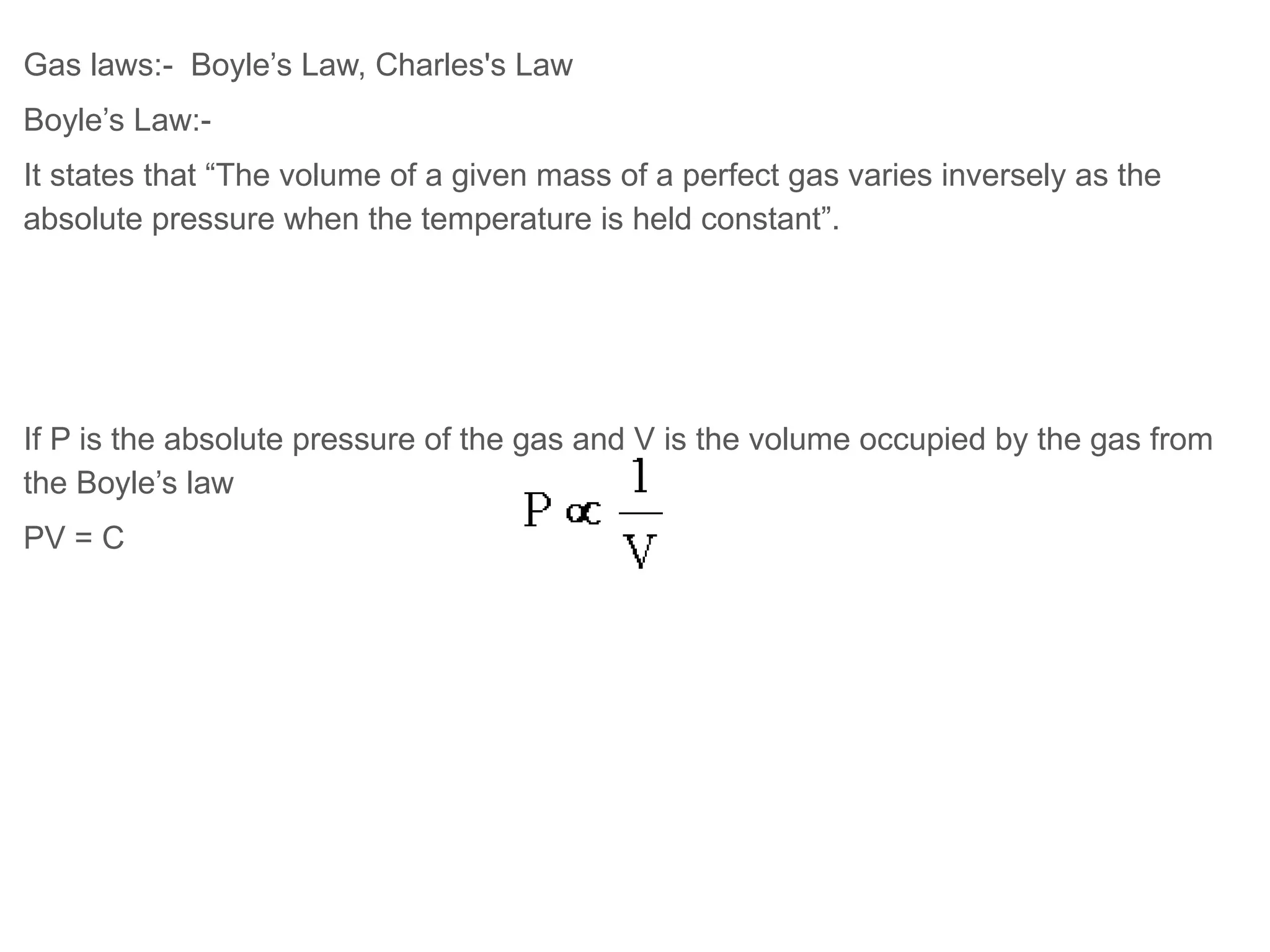
Gas laws:- Boyle’sLaw, Charles's Law
Boyle’s Law:-
It states that “The volume of a given mass of a perfect gas varies inversely as the
absolute pressure when the temperature is held constant”.
If P is the absolute pressure of the gas and V is the volume occupied by the gas from
the Boyle’s law
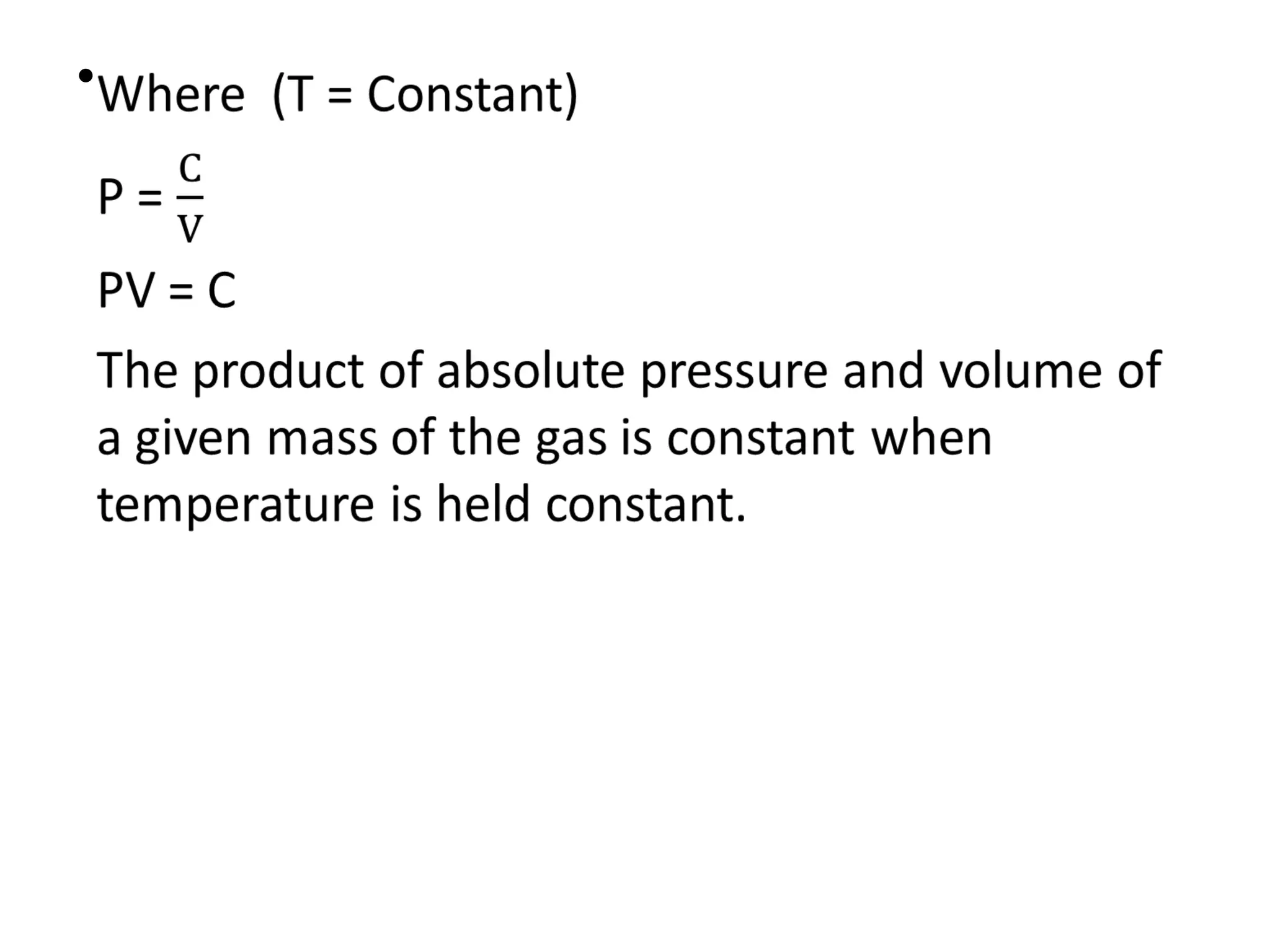
PV = C
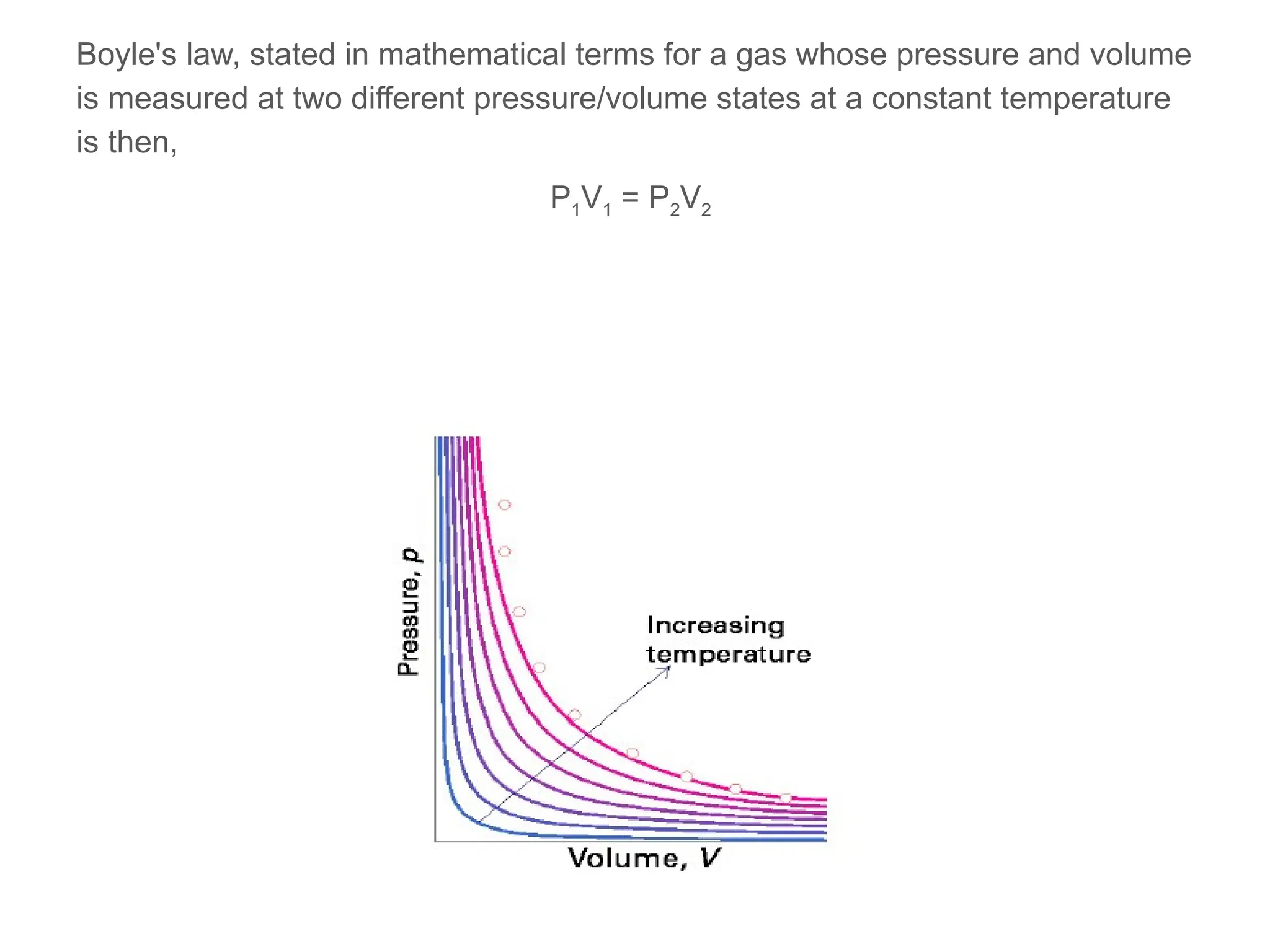
Boyle's law, statedin mathematical terms for a gas whose pressure and volume
is measured at two different pressure/volume states at a constant temperature
is then,
P1V1 = P2V2
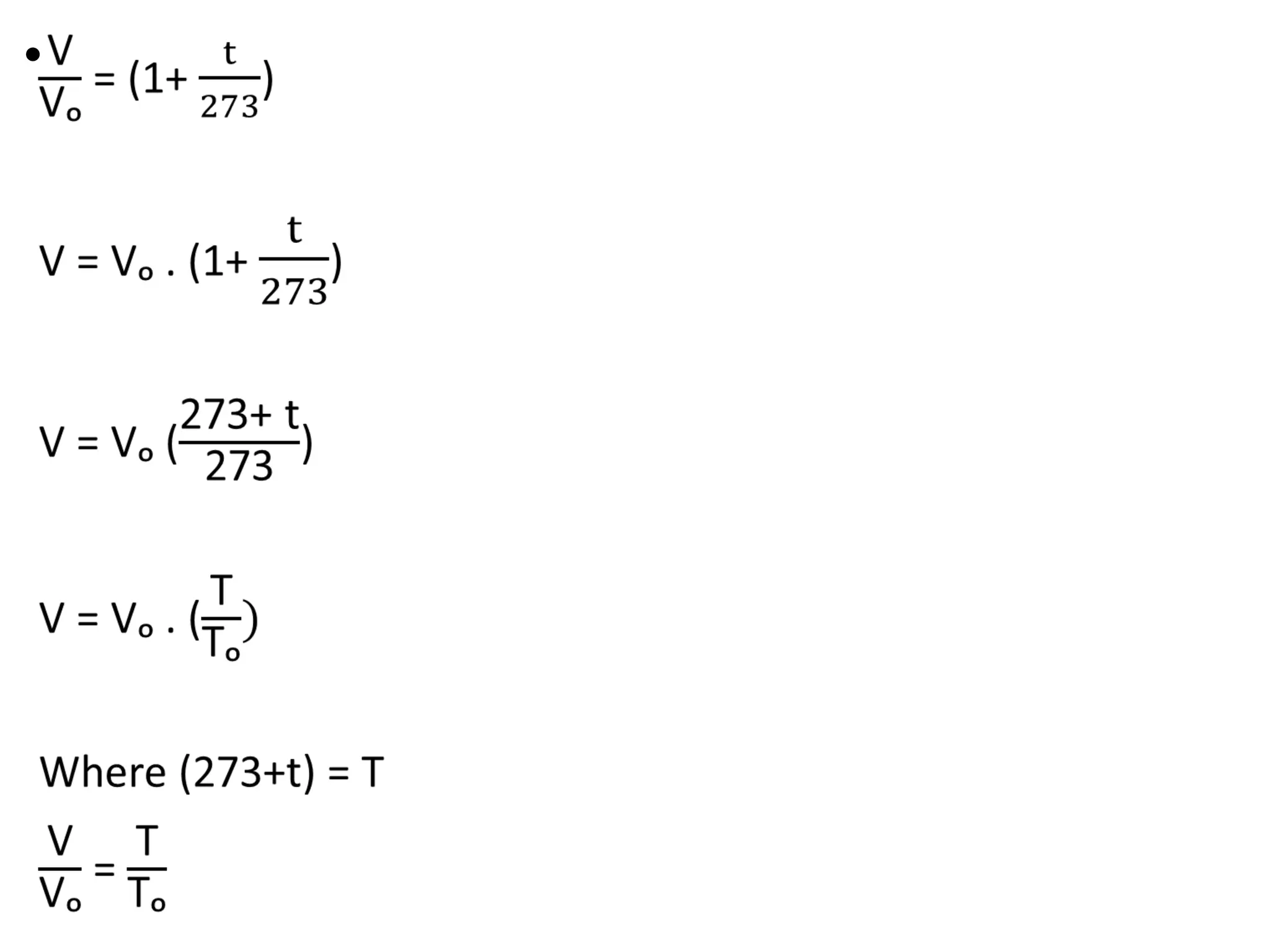
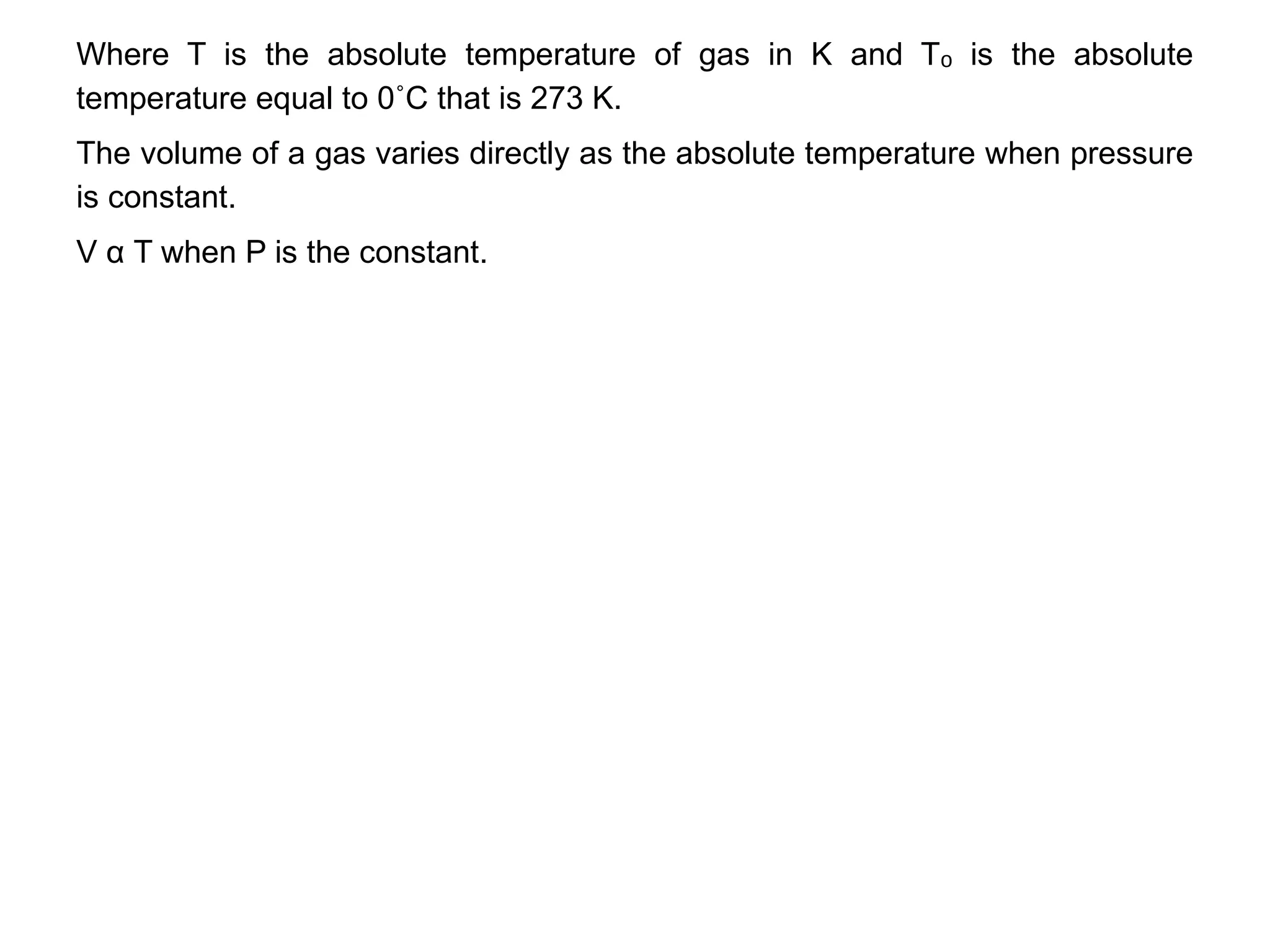
Where T isthe absolute temperature of gas in K and T is the absolute
ₒ
temperature equal to 0˚C that is 273 K.
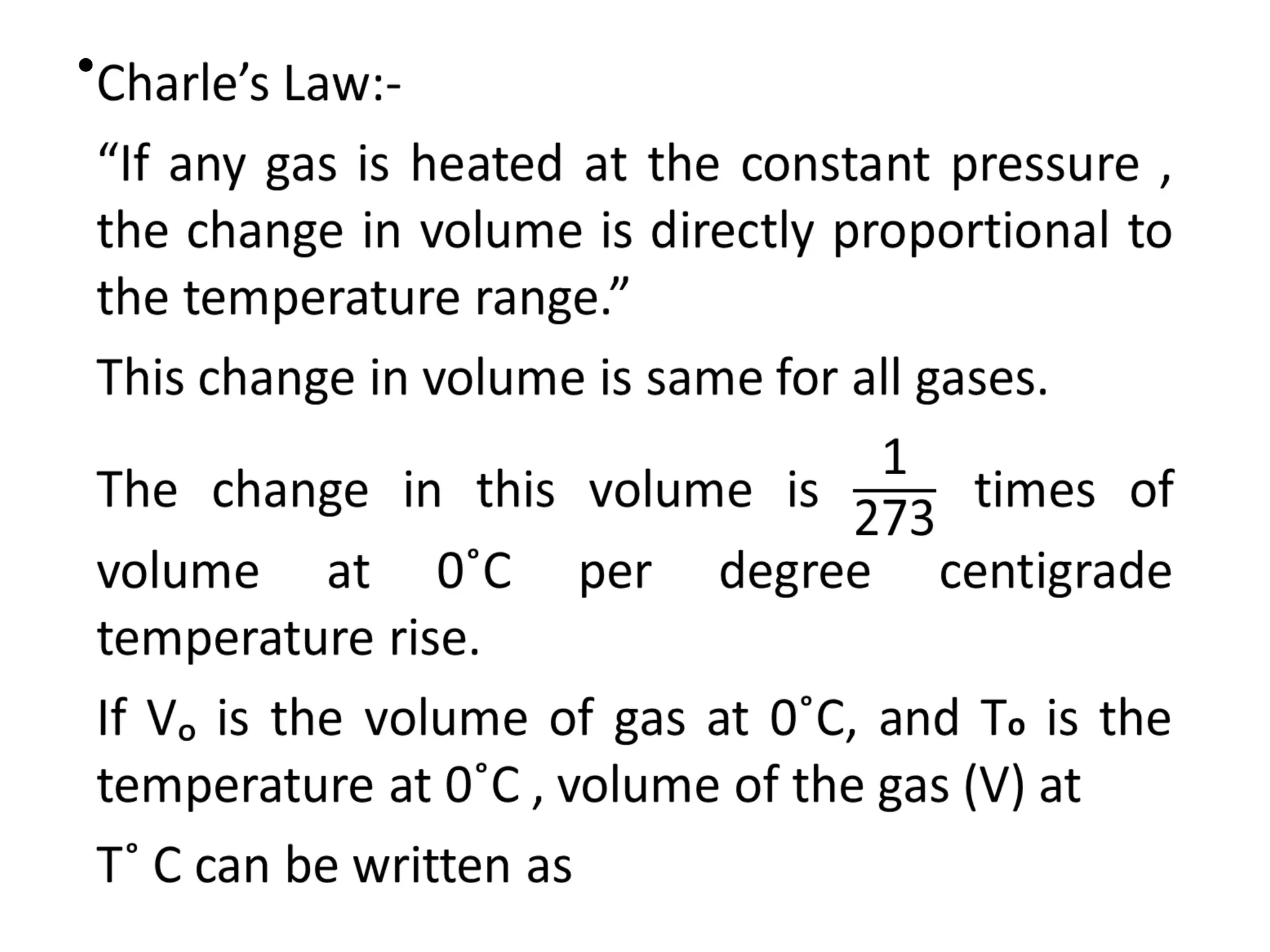
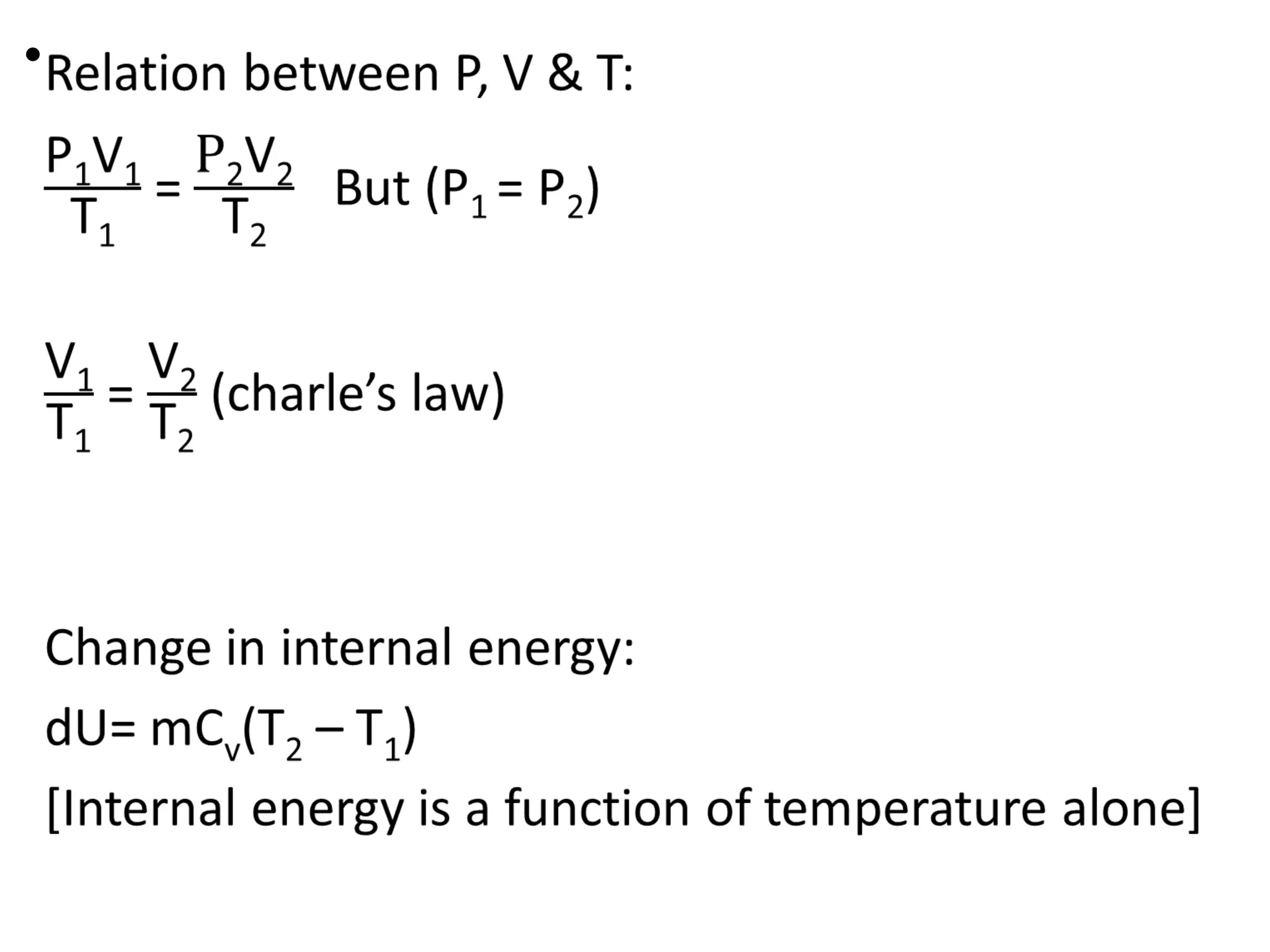
The volume of a gas varies directly as the absolute temperature when pressure
is constant.
V α T when P is the constant.
11.
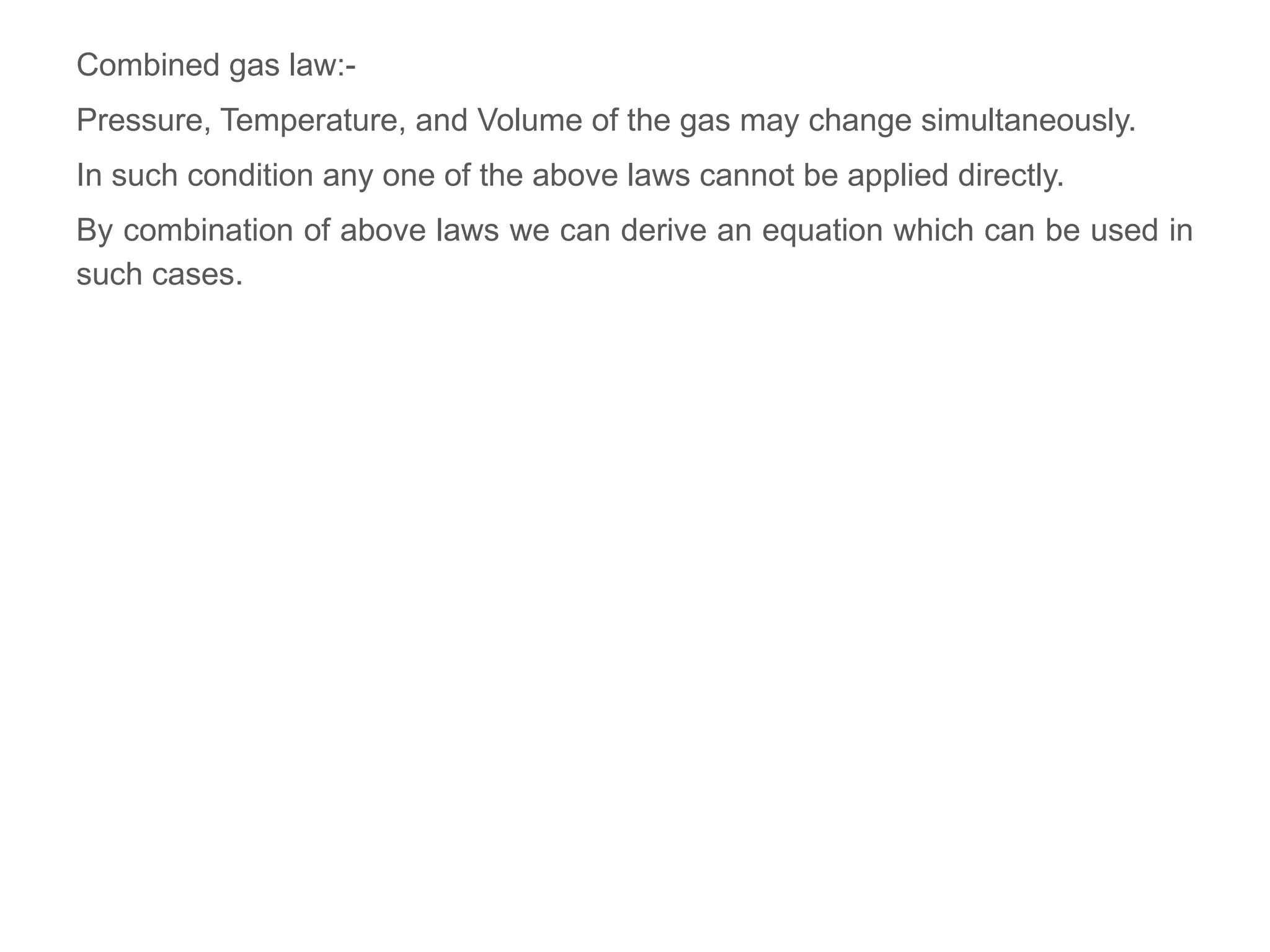
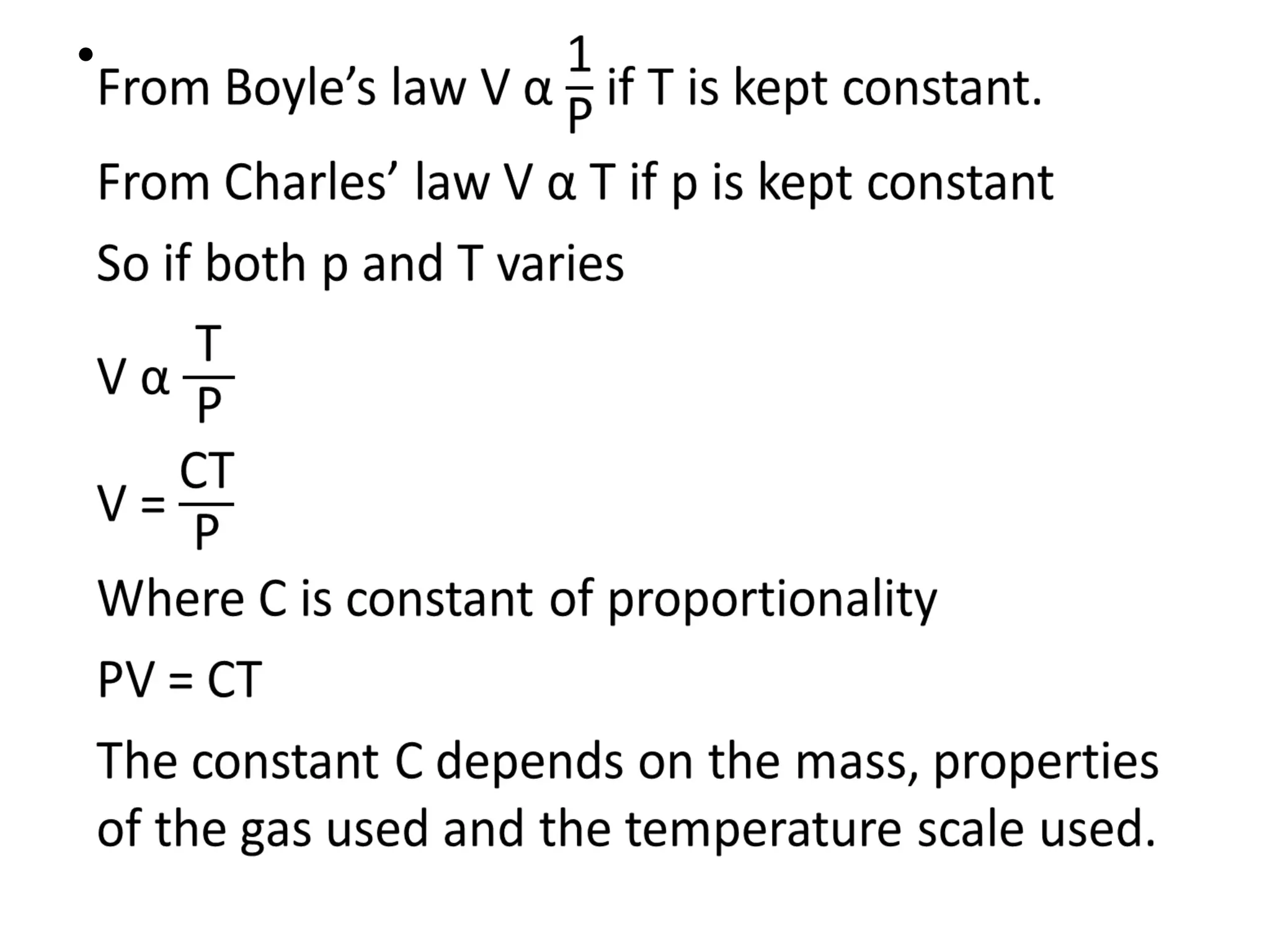
Combined gas law:-
Pressure,Temperature, and Volume of the gas may change simultaneously.
In such condition any one of the above laws cannot be applied directly.
By combination of above laws we can derive an equation which can be used in
such cases.
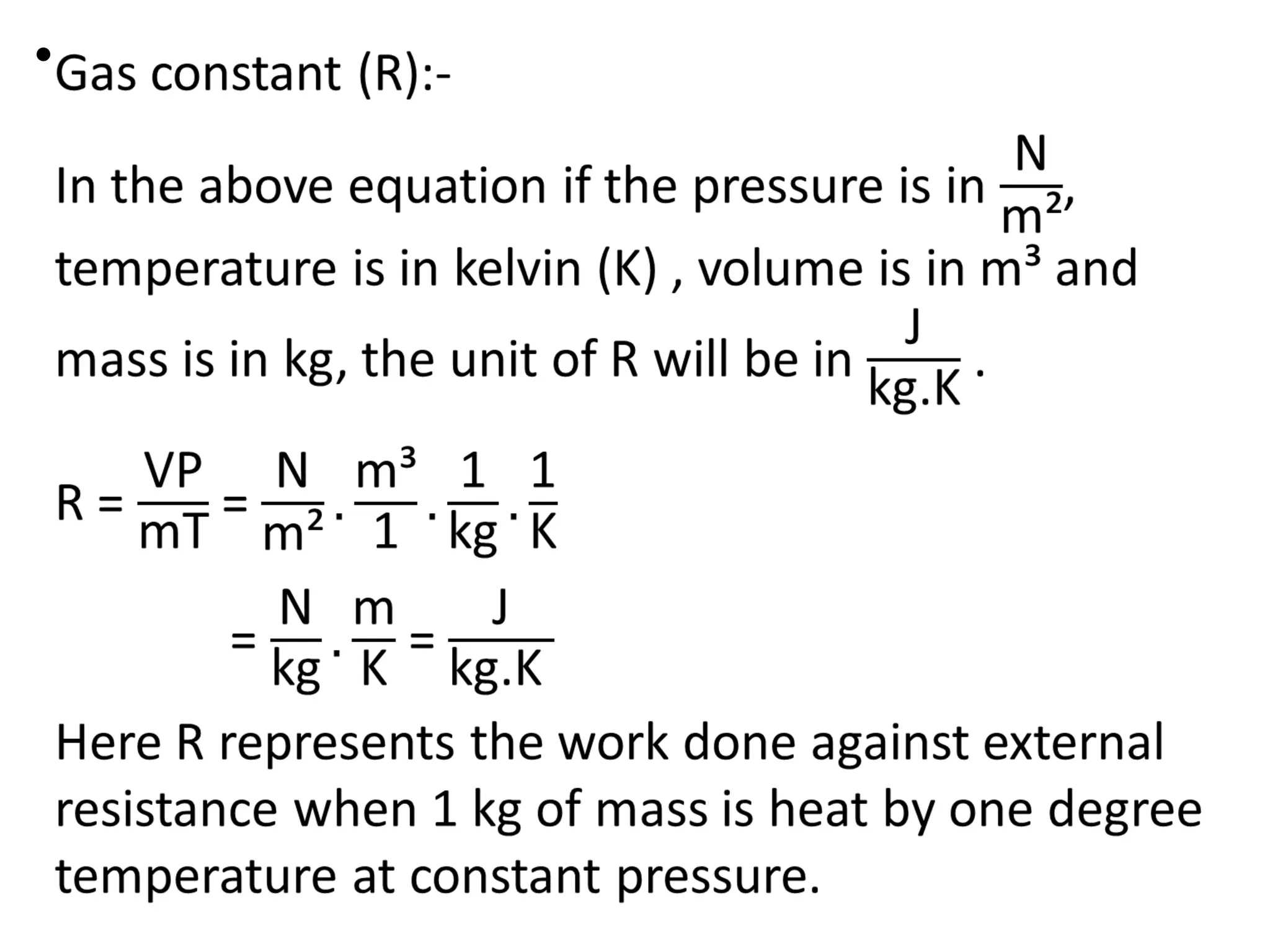
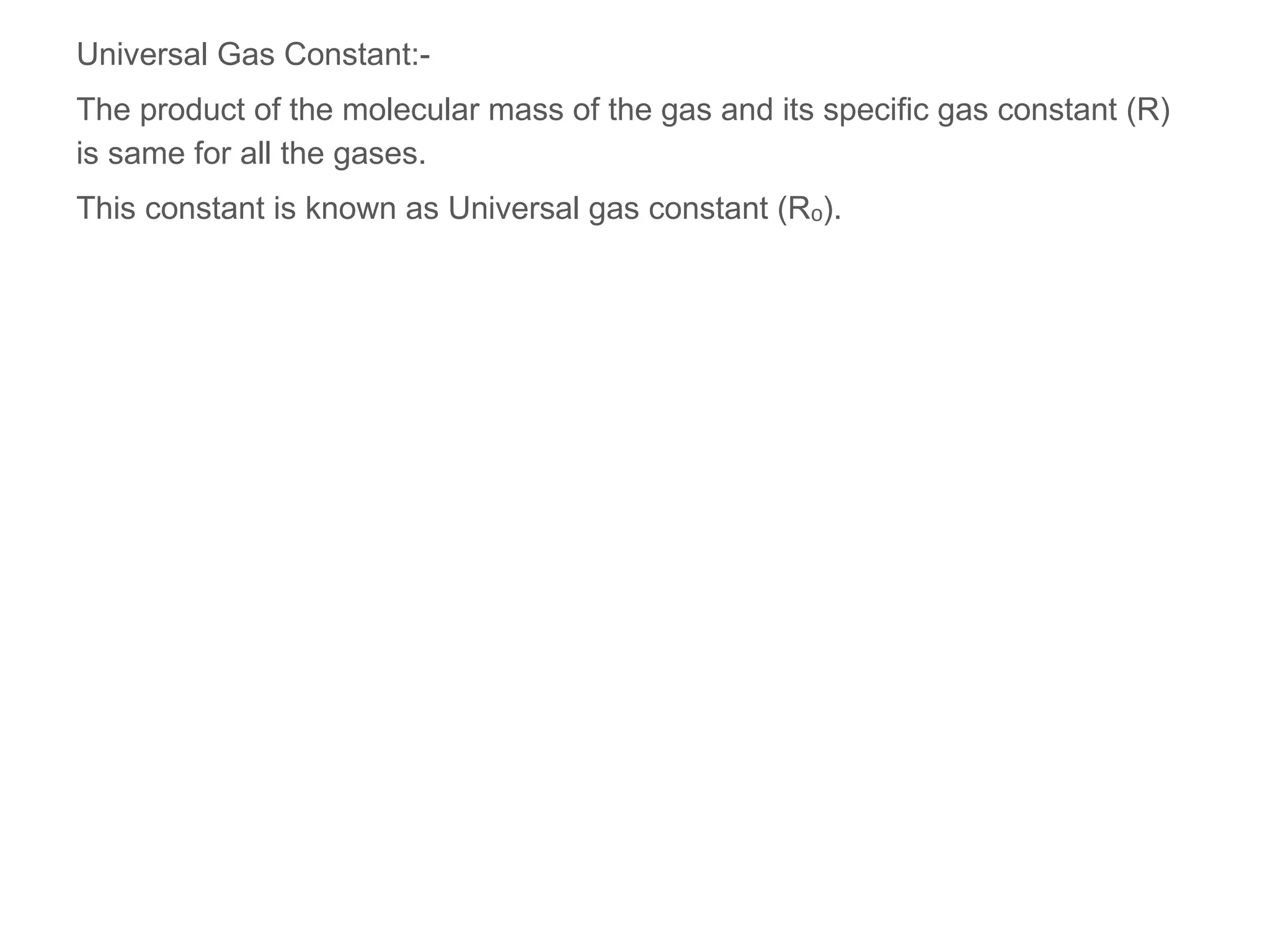
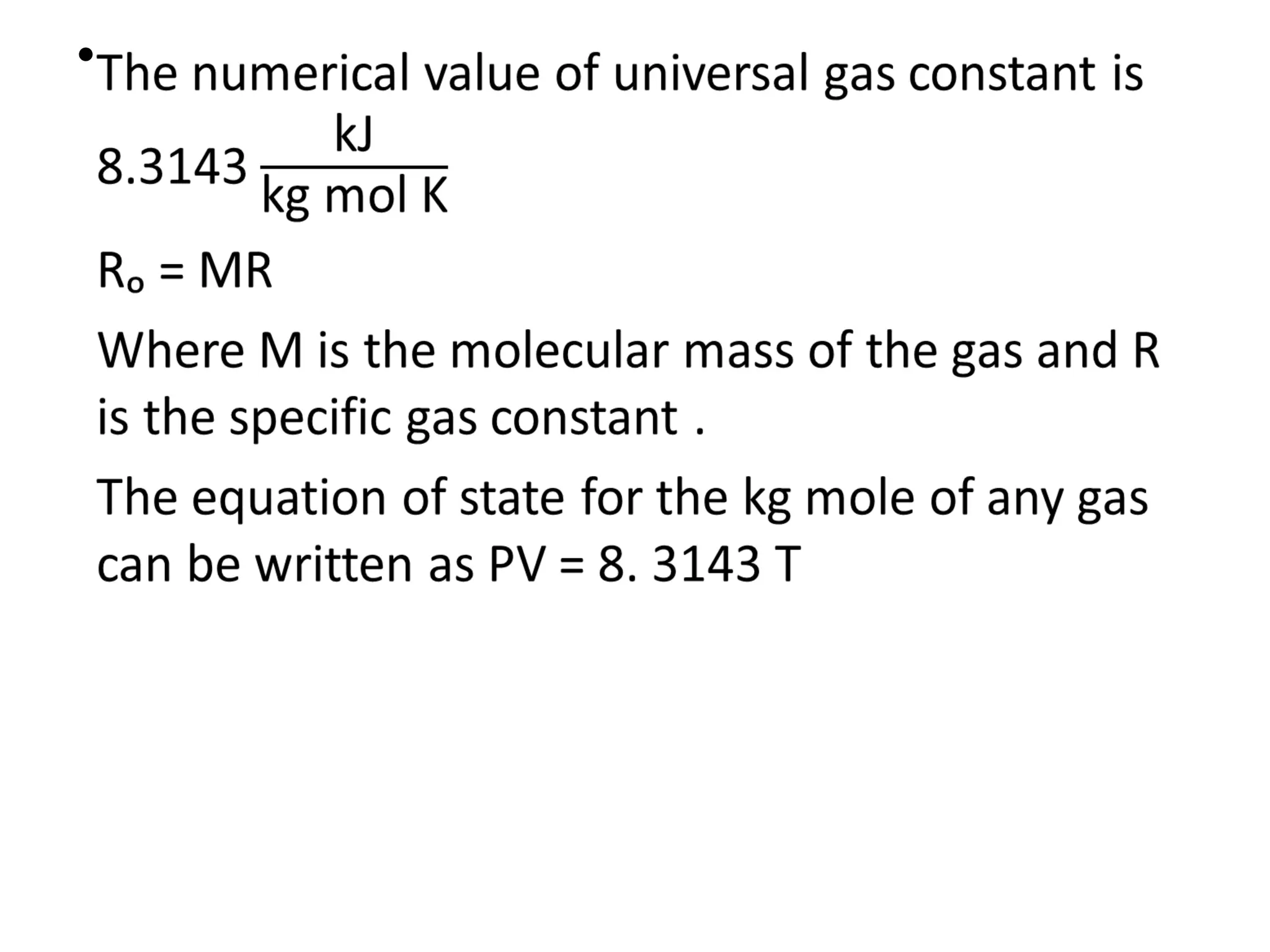
Universal Gas Constant:-
Theproduct of the molecular mass of the gas and its specific gas constant (R)
is same for all the gases.
This constant is known as Universal gas constant (R ).
ₒ
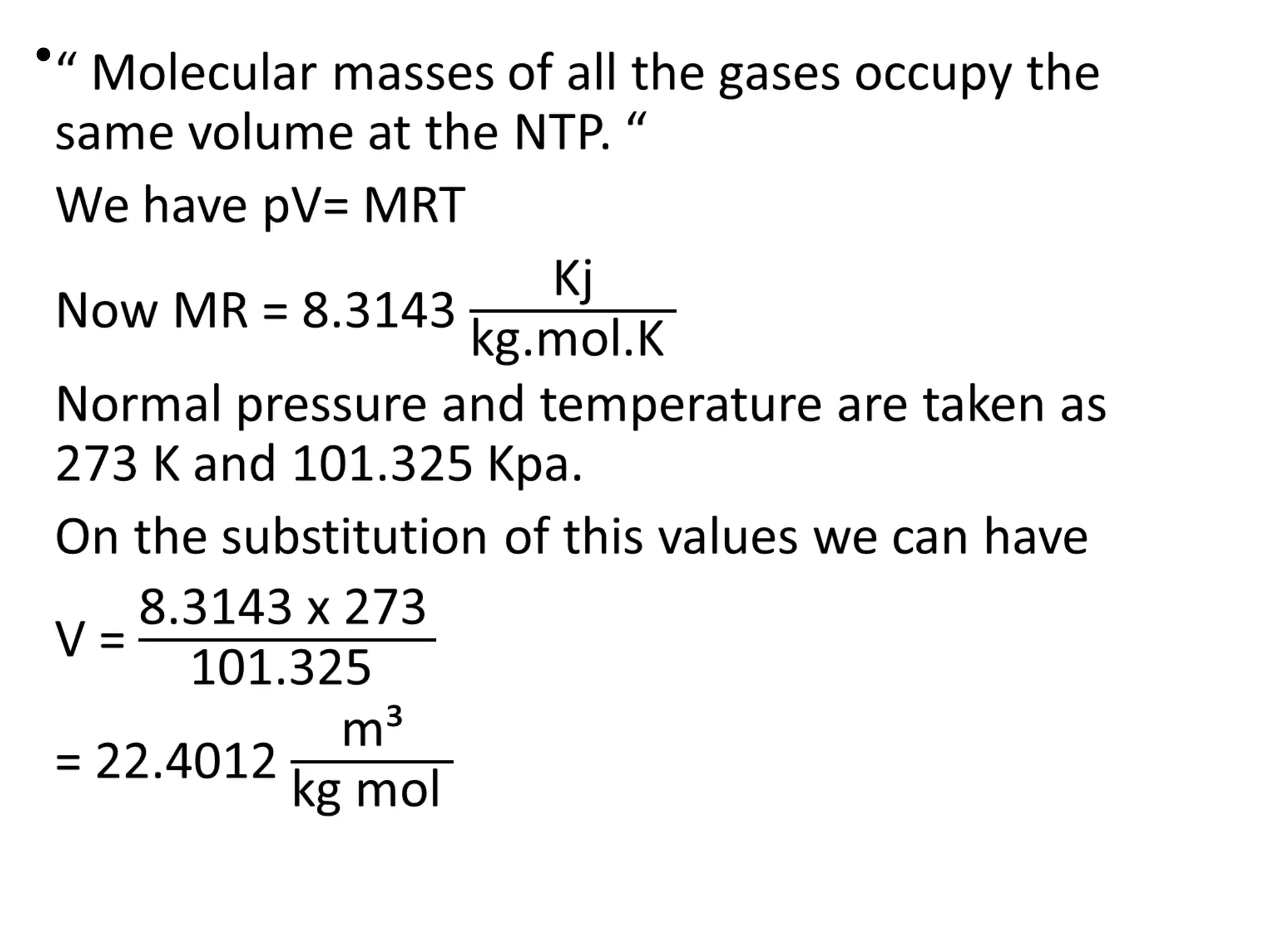
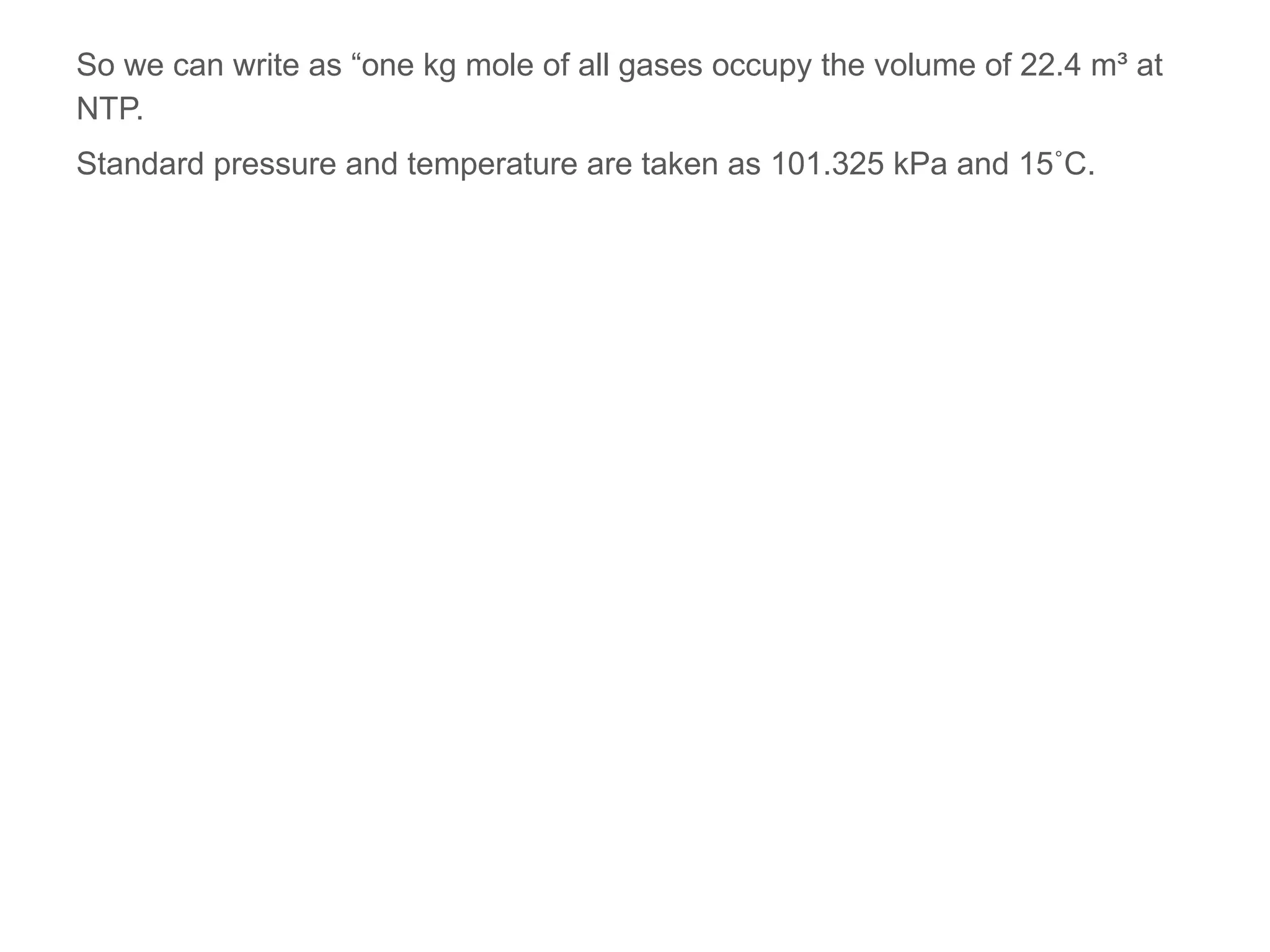
So we canwrite as “one kg mole of all gases occupy the volume of 22.4 m³ at
NTP.
Standard pressure and temperature are taken as 101.325 kPa and 15˚C.
21.
Joule’s law ofInternal Energy:-
The internal energy is a property of the system and hence it depends only on
the state of the system.
Change in the internal energy does not depends on the path followed by the
system.
When any of the system parameters like pressure, volume, temperature etc
changes there may be change in the internal energy because of the change in
the state.
22.
But Joule’s lawof internal energy states that If change in the internal energy
(U2-U1) , then temperature changes from T1 to T2 will be same no matter
how pressure P and volume V changes.
So from Joule’s experiments internal energy is only function of temperature and
not of pressure and volume.
23.
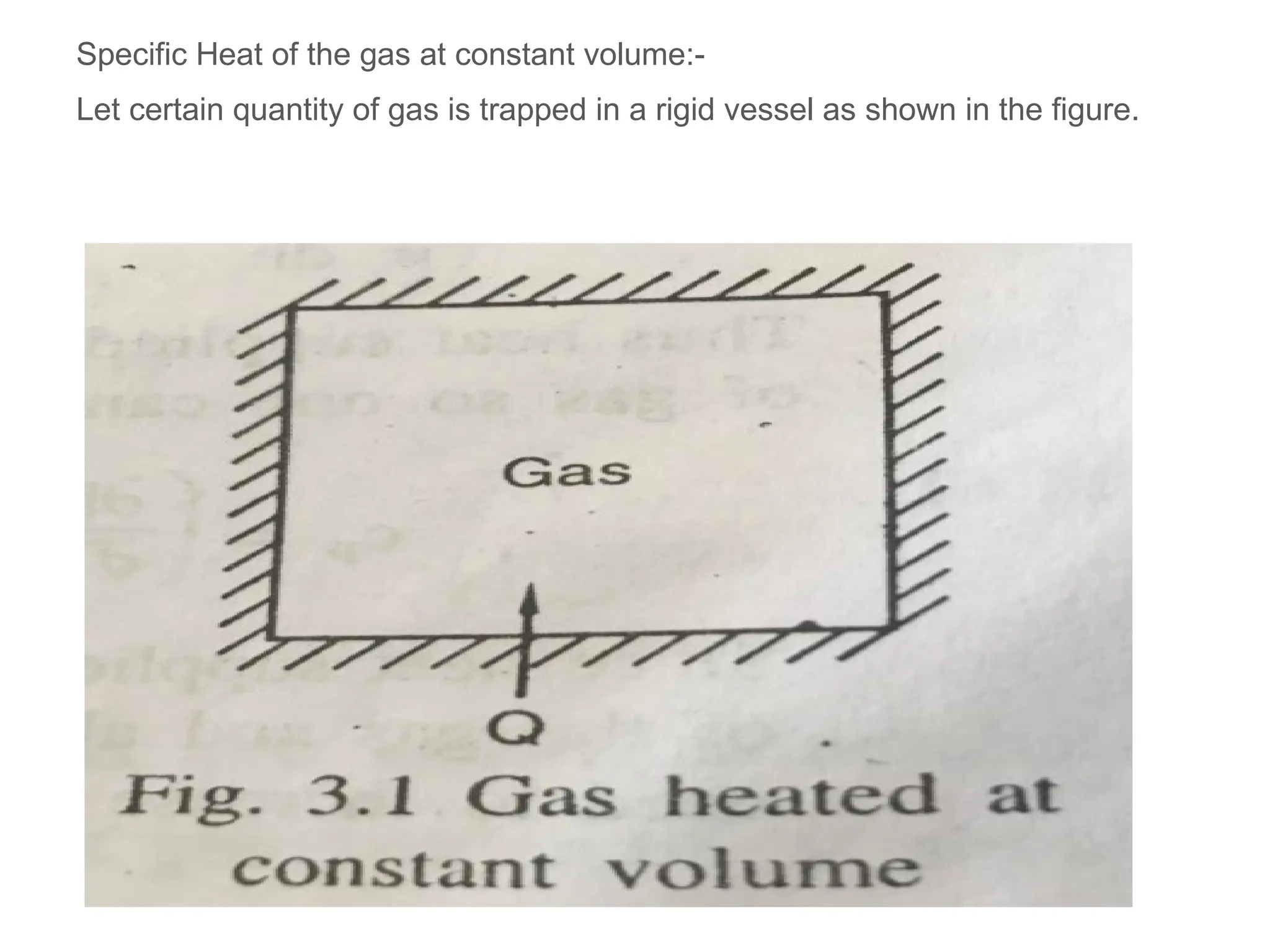
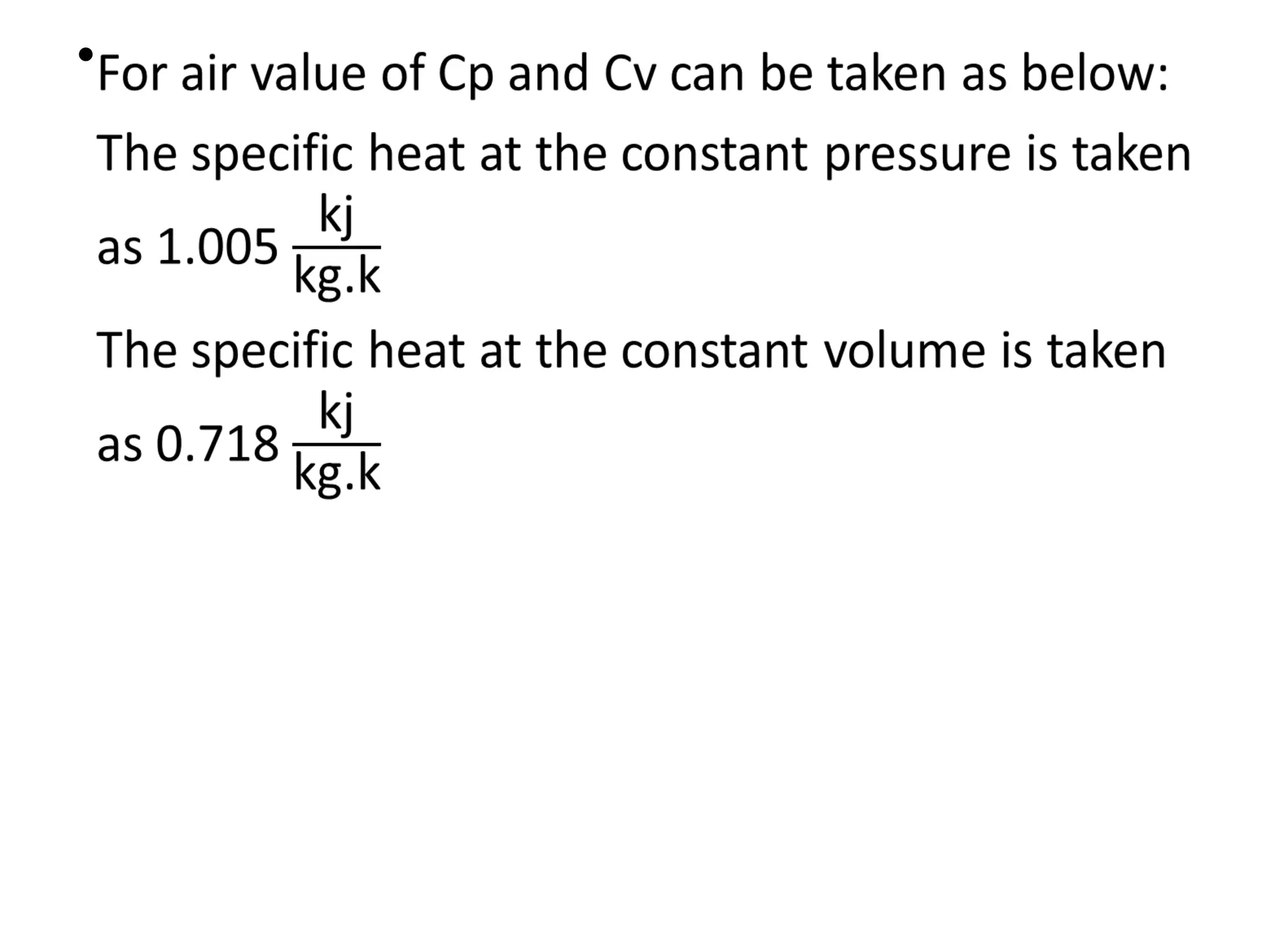
Specific Heat ofthe gas at constant volume:-
Let certain quantity of gas is trapped in a rigid vessel as shown in the figure.
24.
When heat issupplied to gas, it will be heated at the constant volume.
The whole heat energy is used to increases the internal energy of the gas
which can be view as the increases in the temperature of the gas.
Thus heat require to increases the temperature of 1 kg of gas by 1 K when
volume is kept constant is known as specific heat at the constant volume.
So mathematically we can write as below:
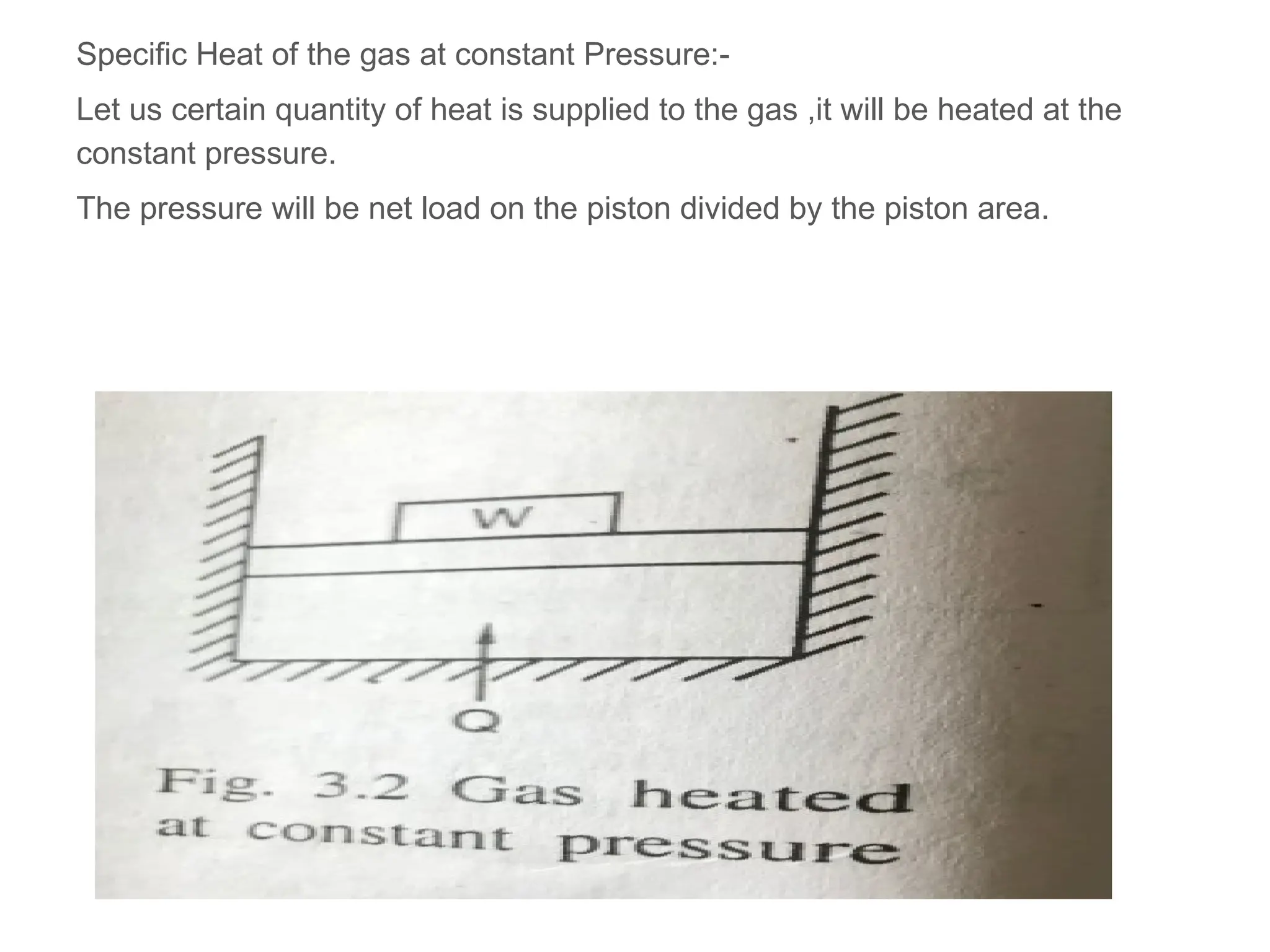
Specific Heat ofthe gas at constant Pressure:-
Let us certain quantity of heat is supplied to the gas ,it will be heated at the
constant pressure.
The pressure will be net load on the piston divided by the piston area.
27.
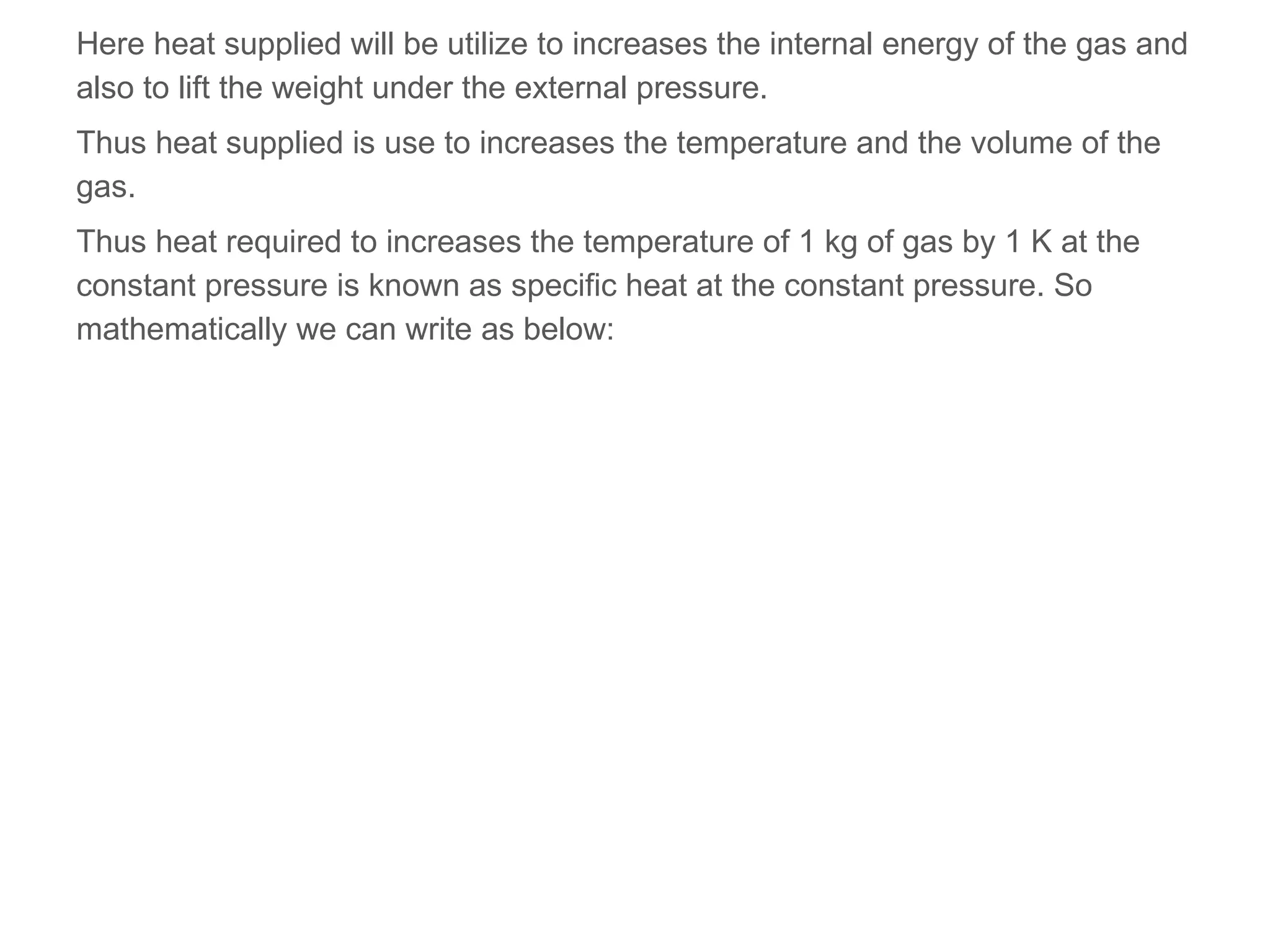
Here heat suppliedwill be utilize to increases the internal energy of the gas and
also to lift the weight under the external pressure.
Thus heat supplied is use to increases the temperature and the volume of the
gas.
Thus heat required to increases the temperature of 1 kg of gas by 1 K at the
constant pressure is known as specific heat at the constant pressure. So
mathematically we can write as below:
28.
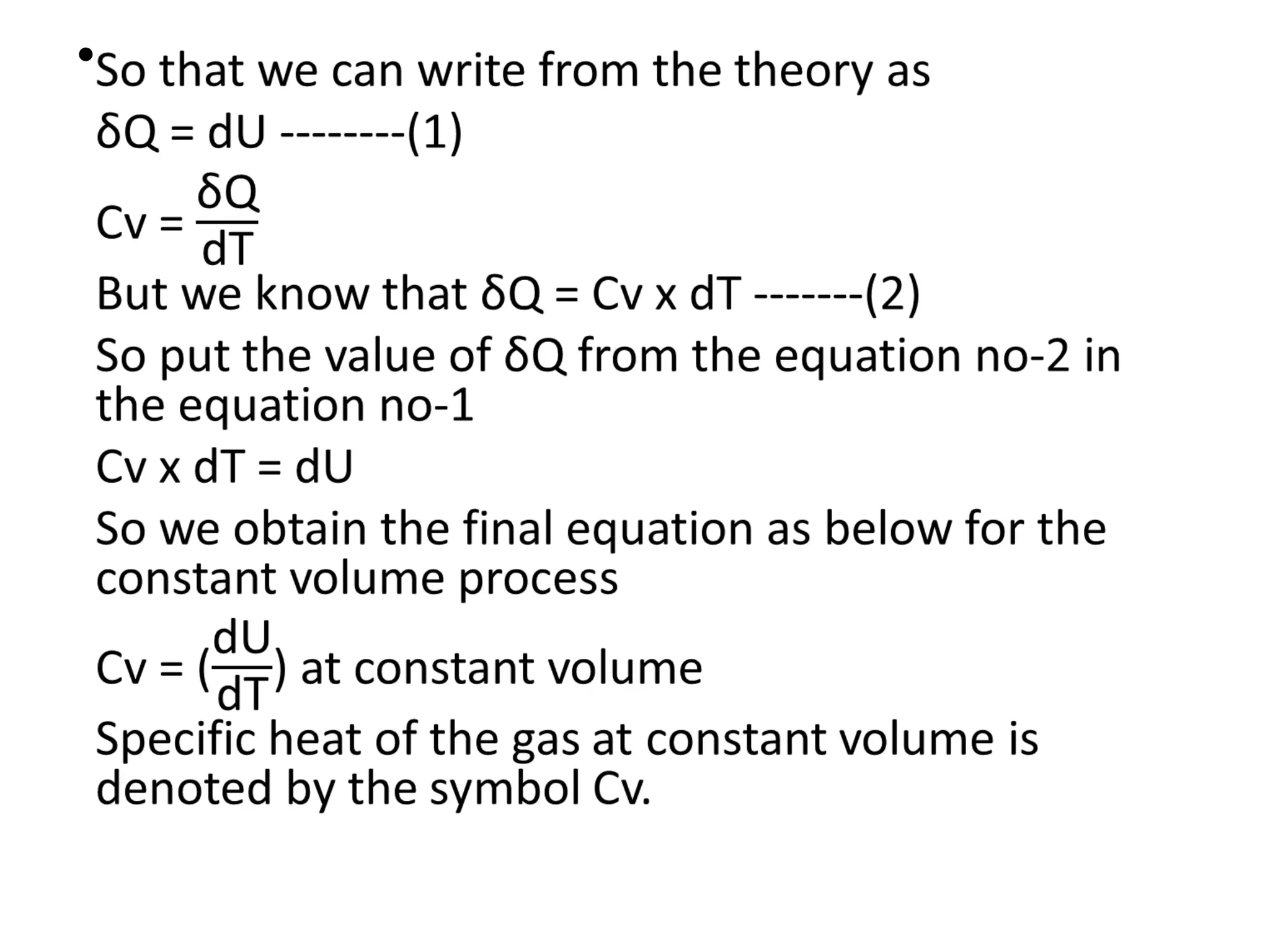
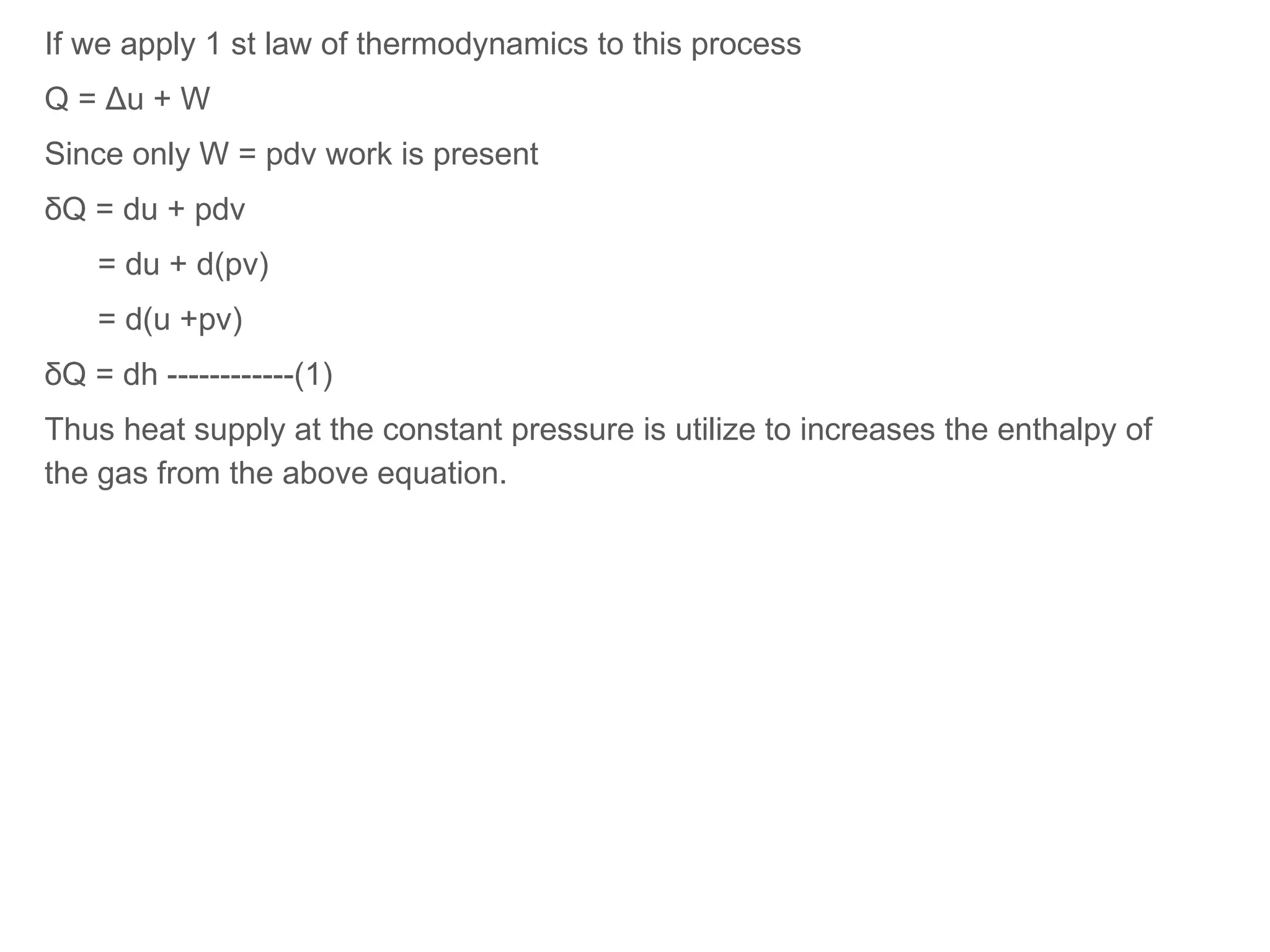
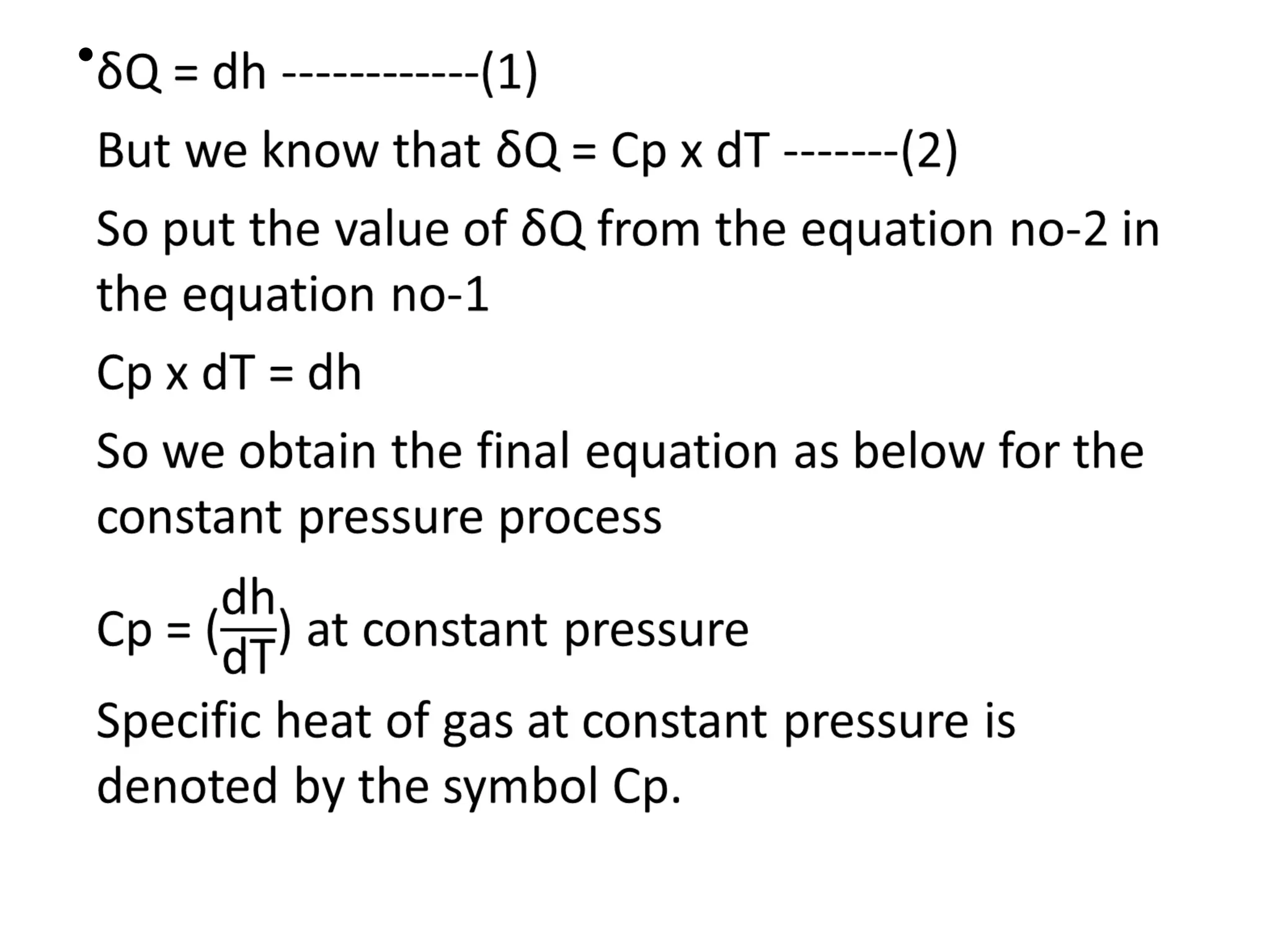
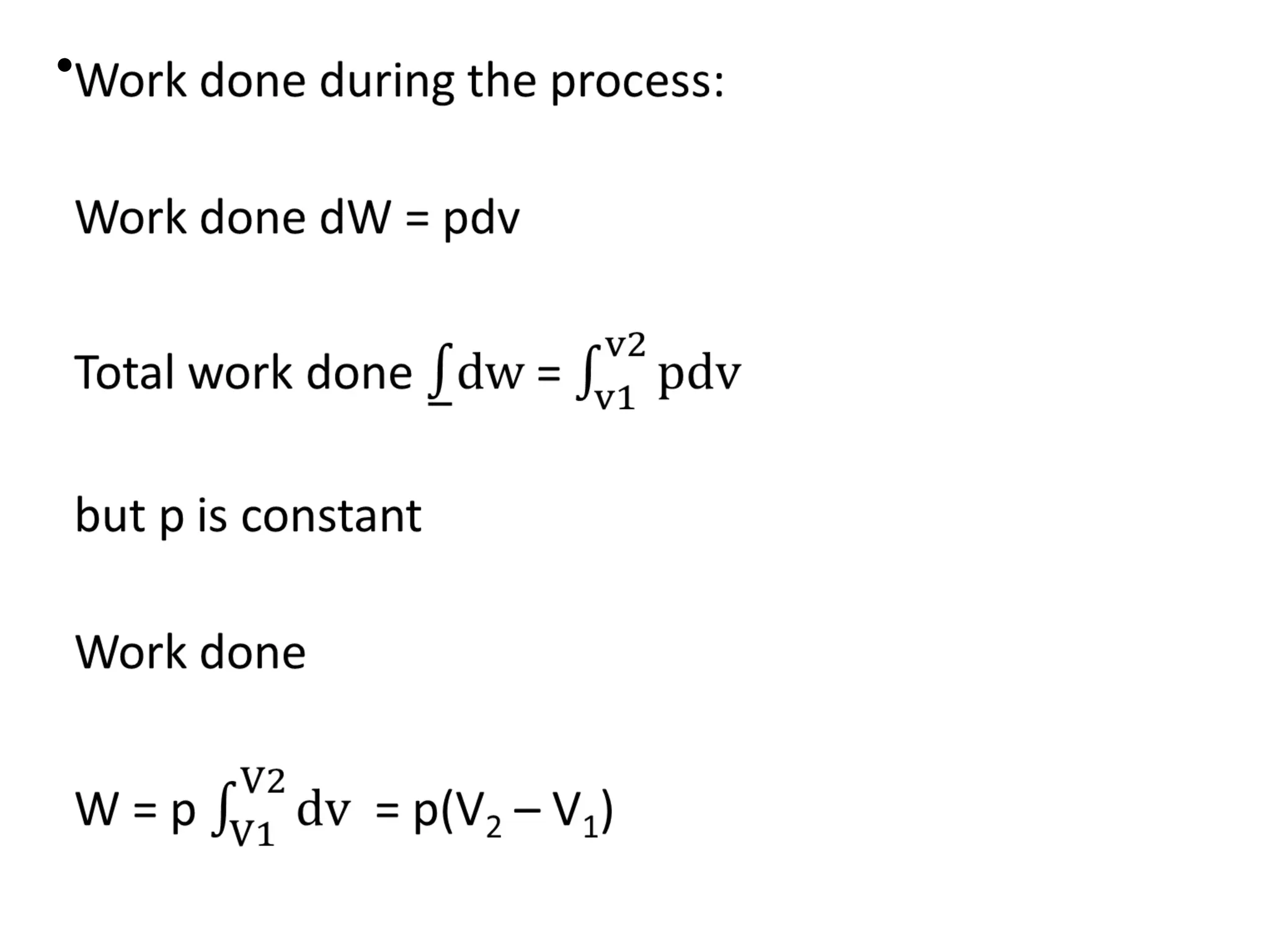
If we apply1 st law of thermodynamics to this process
Q = Δu + W
Since only W = pdv work is present
δQ = du + pdv
= du + d(pv)
= d(u +pv)
δQ = dh ------------(1)
Thus heat supply at the constant pressure is utilize to increases the enthalpy of
the gas from the above equation.
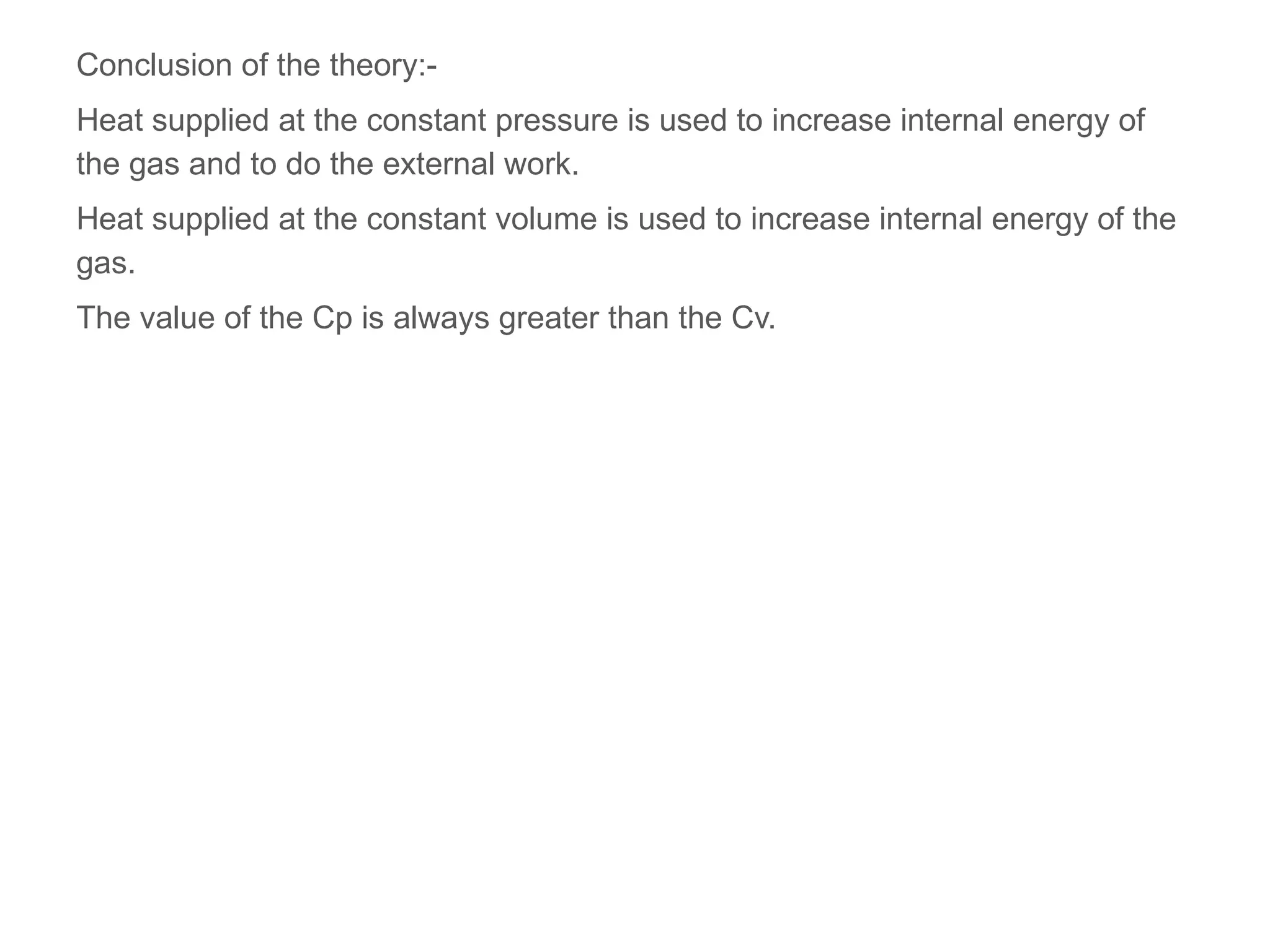
Conclusion of thetheory:-
Heat supplied at the constant pressure is used to increase internal energy of
the gas and to do the external work.
Heat supplied at the constant volume is used to increase internal energy of the
gas.
The value of the Cp is always greater than the Cv.
31.
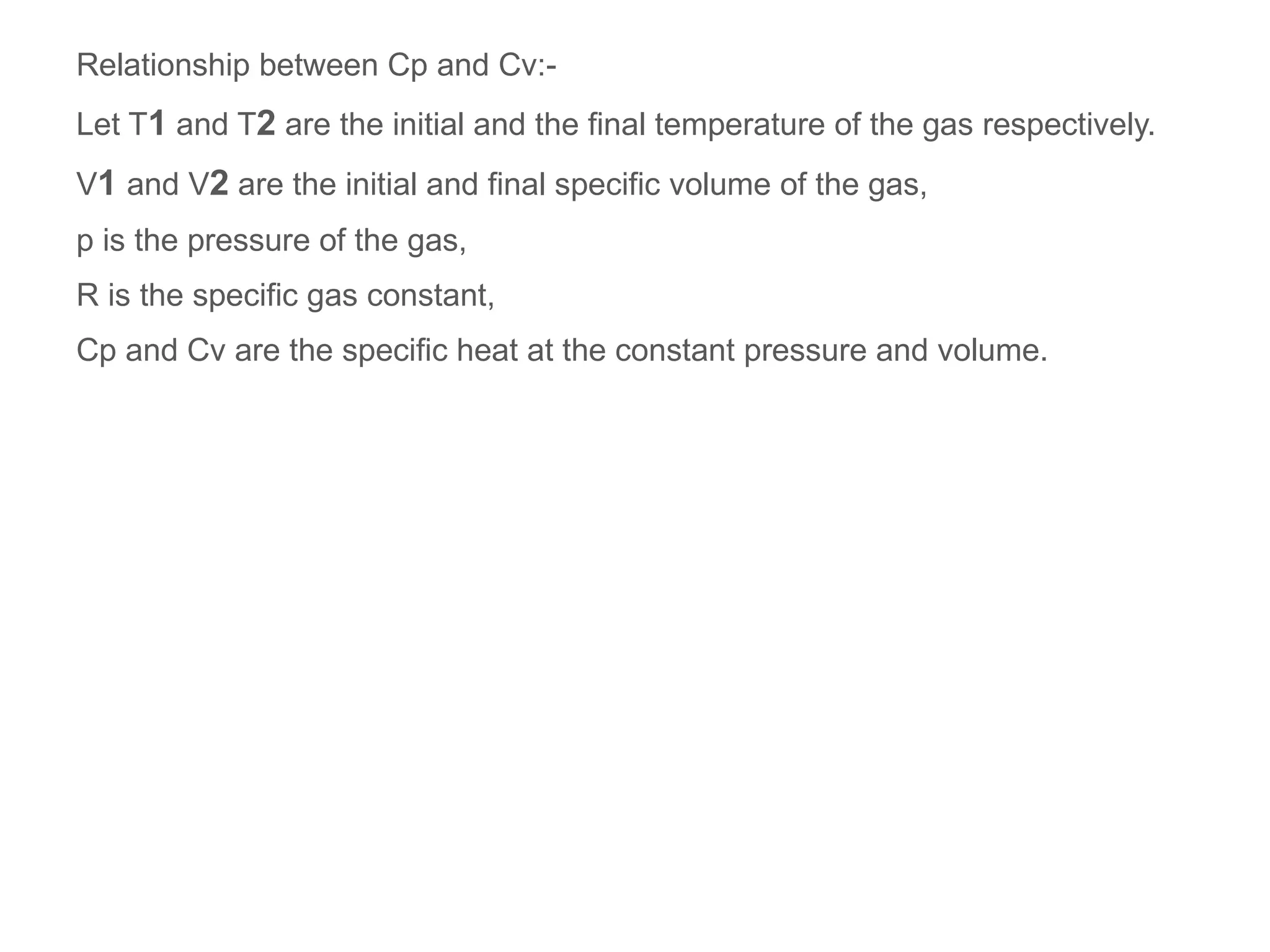
Relationship between Cpand Cv:-
Let T1 and T2 are the initial and the final temperature of the gas respectively.
V1 and V2 are the initial and final specific volume of the gas,
p is the pressure of the gas,
R is the specific gas constant,
Cp and Cv are the specific heat at the constant pressure and volume.
32.
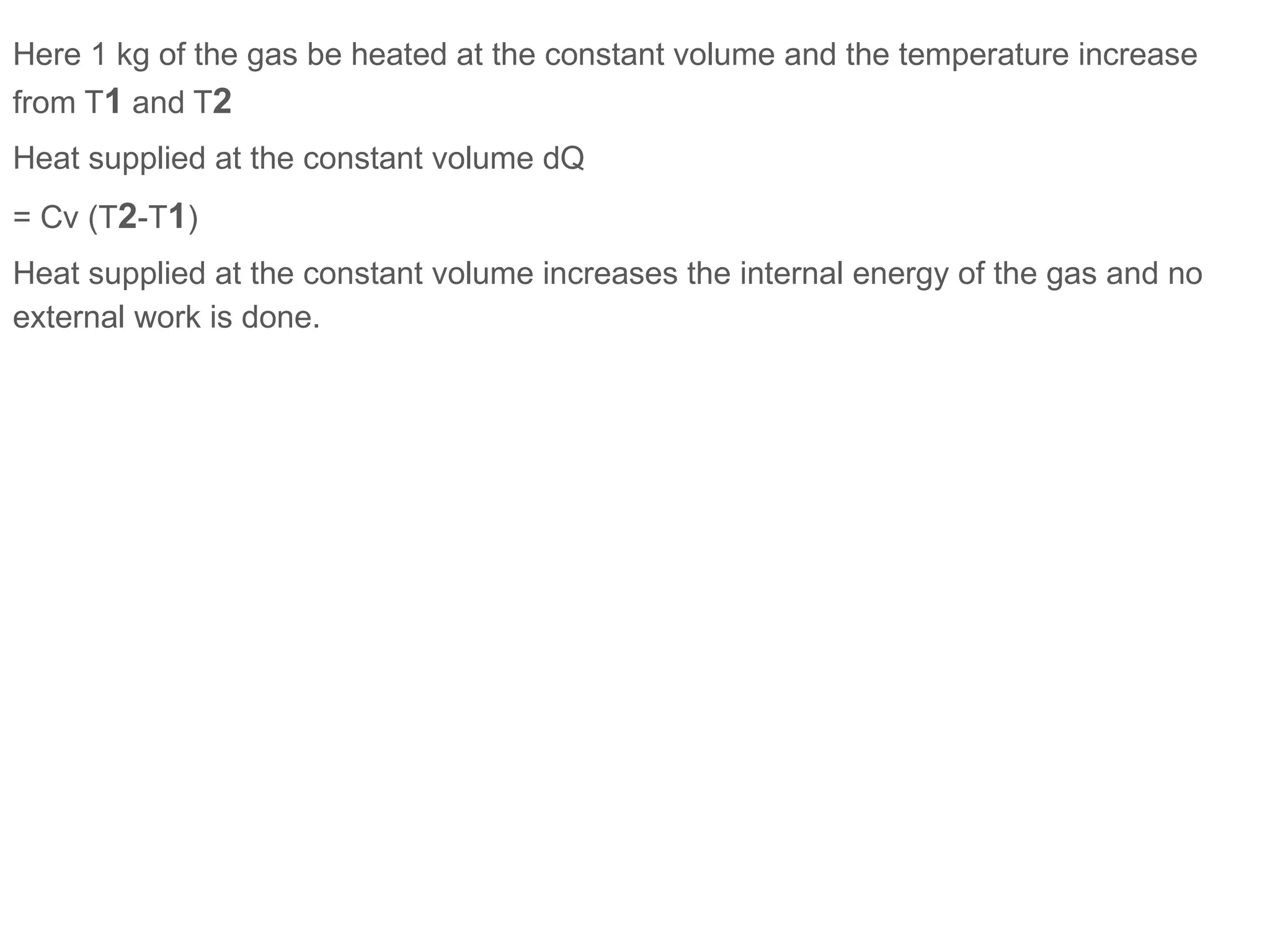
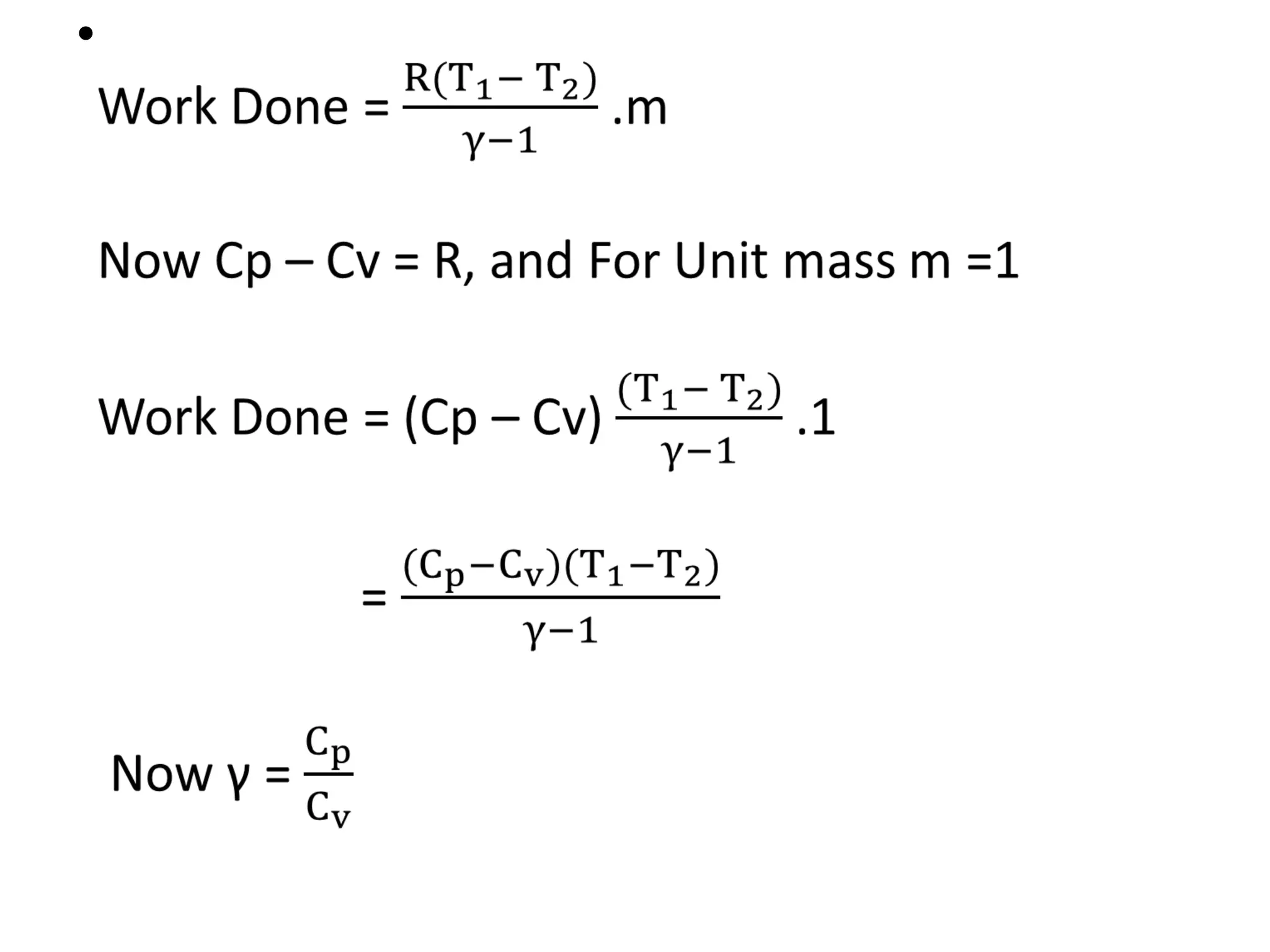
Here 1 kgof the gas be heated at the constant volume and the temperature increase
from T1 and T2
Heat supplied at the constant volume dQ
= Cv (T2-T1)
Heat supplied at the constant volume increases the internal energy of the gas and no
external work is done.
33.
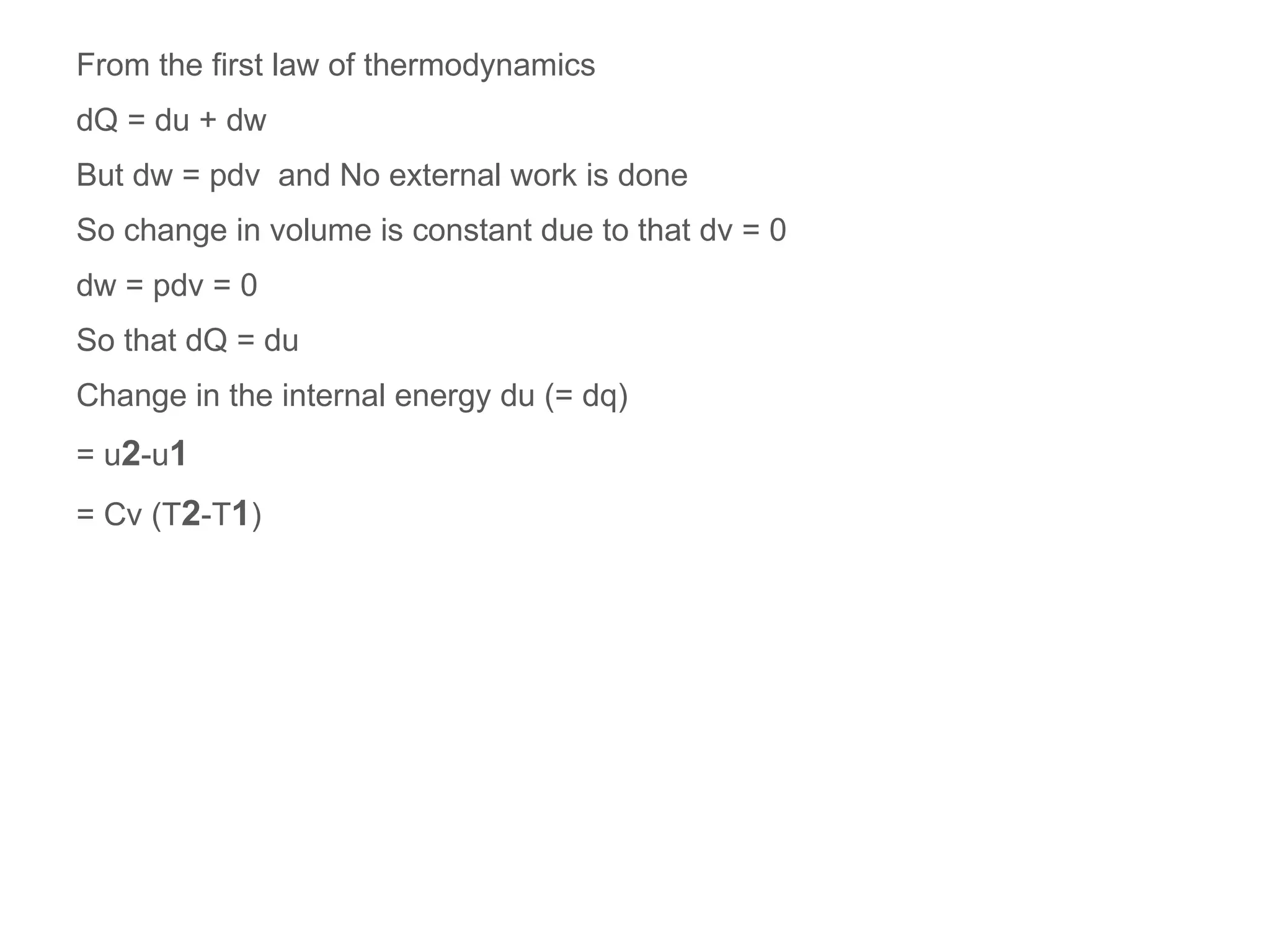
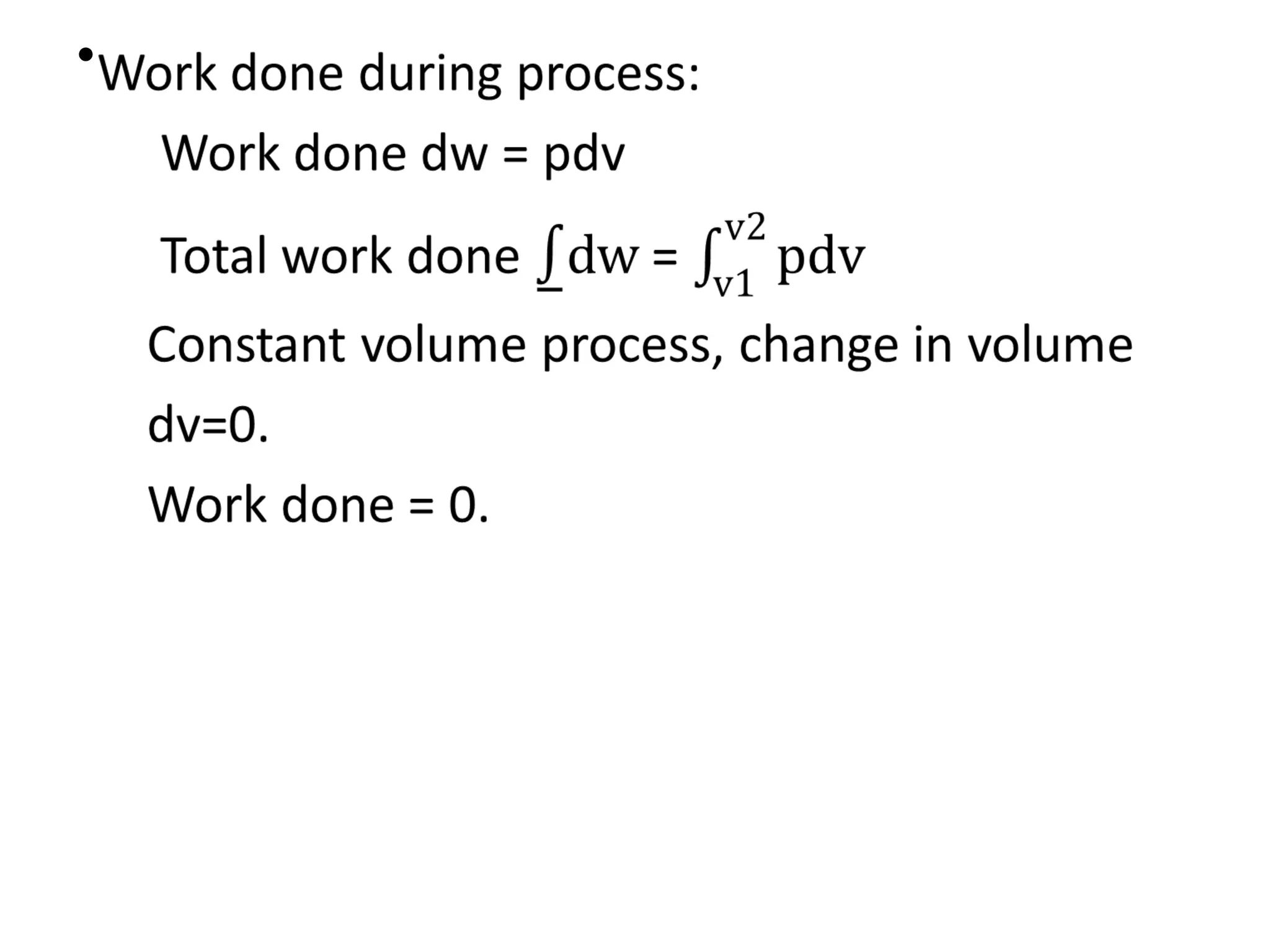
From the firstlaw of thermodynamics
dQ = du + dw
But dw = pdv and No external work is done
So change in volume is constant due to that dv = 0
dw = pdv = 0
So that dQ = du
Change in the internal energy du (= dq)
= u2-u1
= Cv (T2-T1)
34.
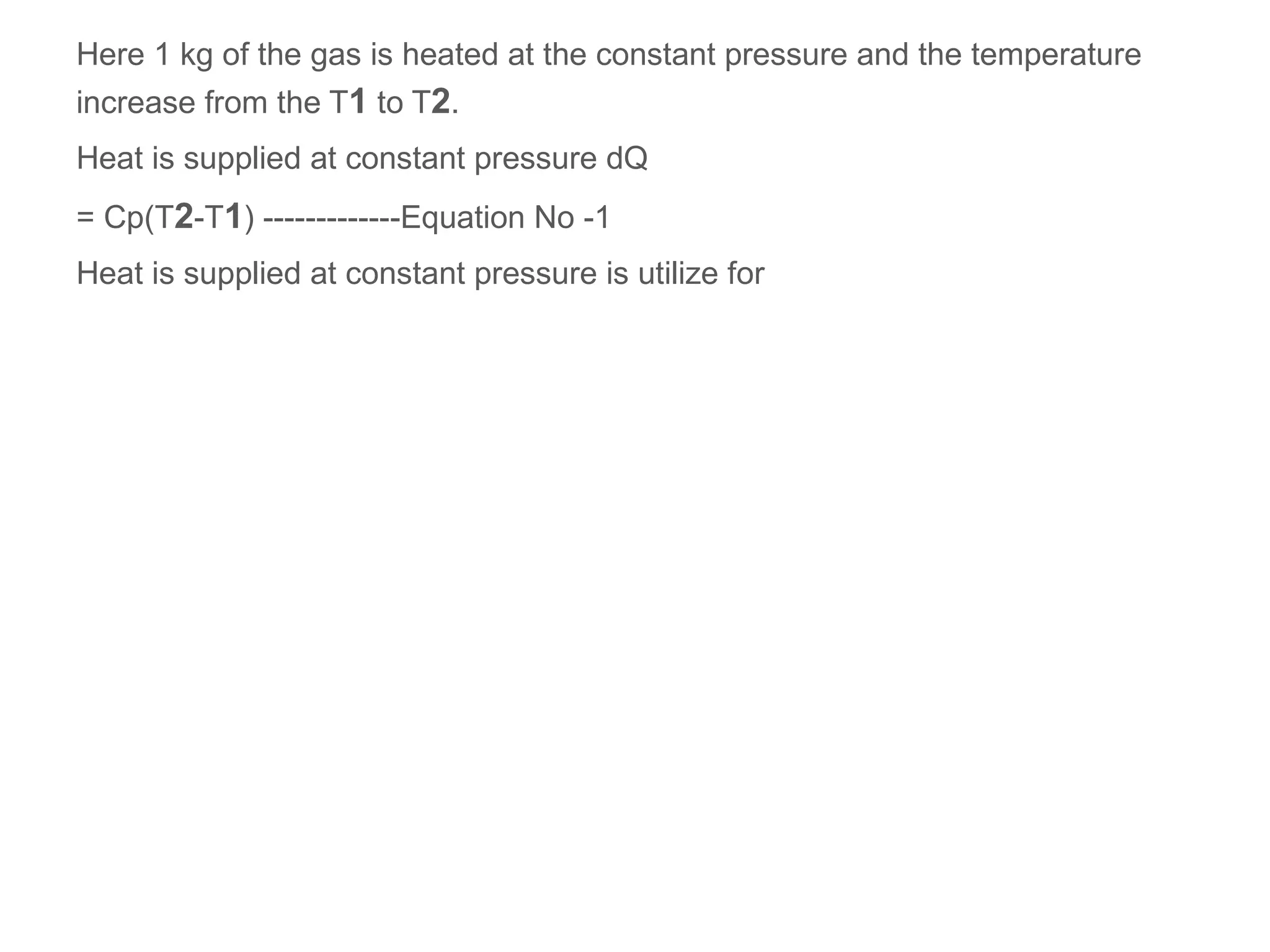
Here 1 kgof the gas is heated at the constant pressure and the temperature
increase from the T1 to T2.
Heat is supplied at constant pressure dQ
= Cp(T2-T1) -------------Equation No -1
Heat is supplied at constant pressure is utilize for
35.
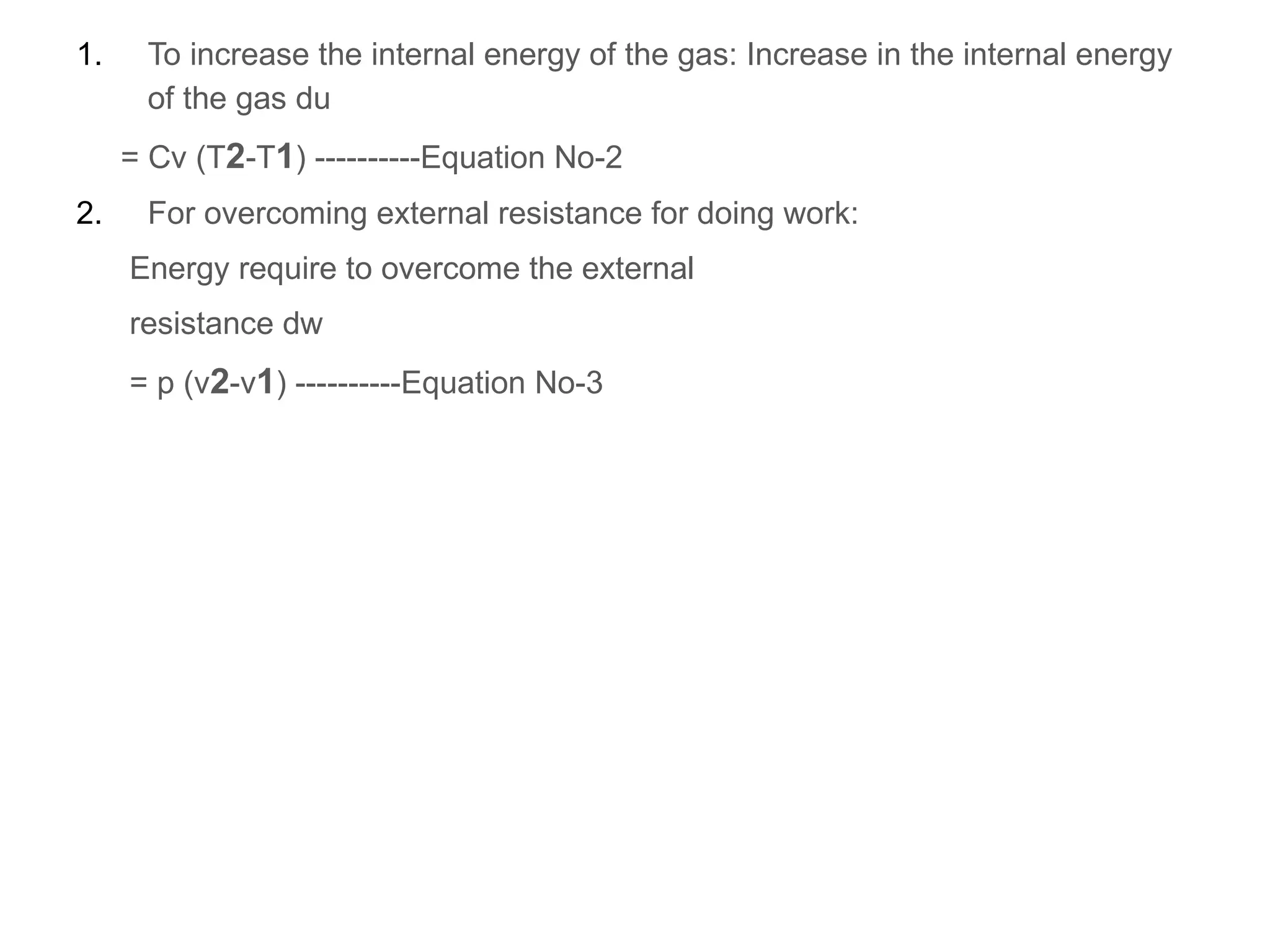
1. To increasethe internal energy of the gas: Increase in the internal energy
of the gas du
= Cv (T2-T1) ----------Equation No-2
2. For overcoming external resistance for doing work:
Energy require to overcome the external
resistance dw
= p (v2-v1) ----------Equation No-3
36.
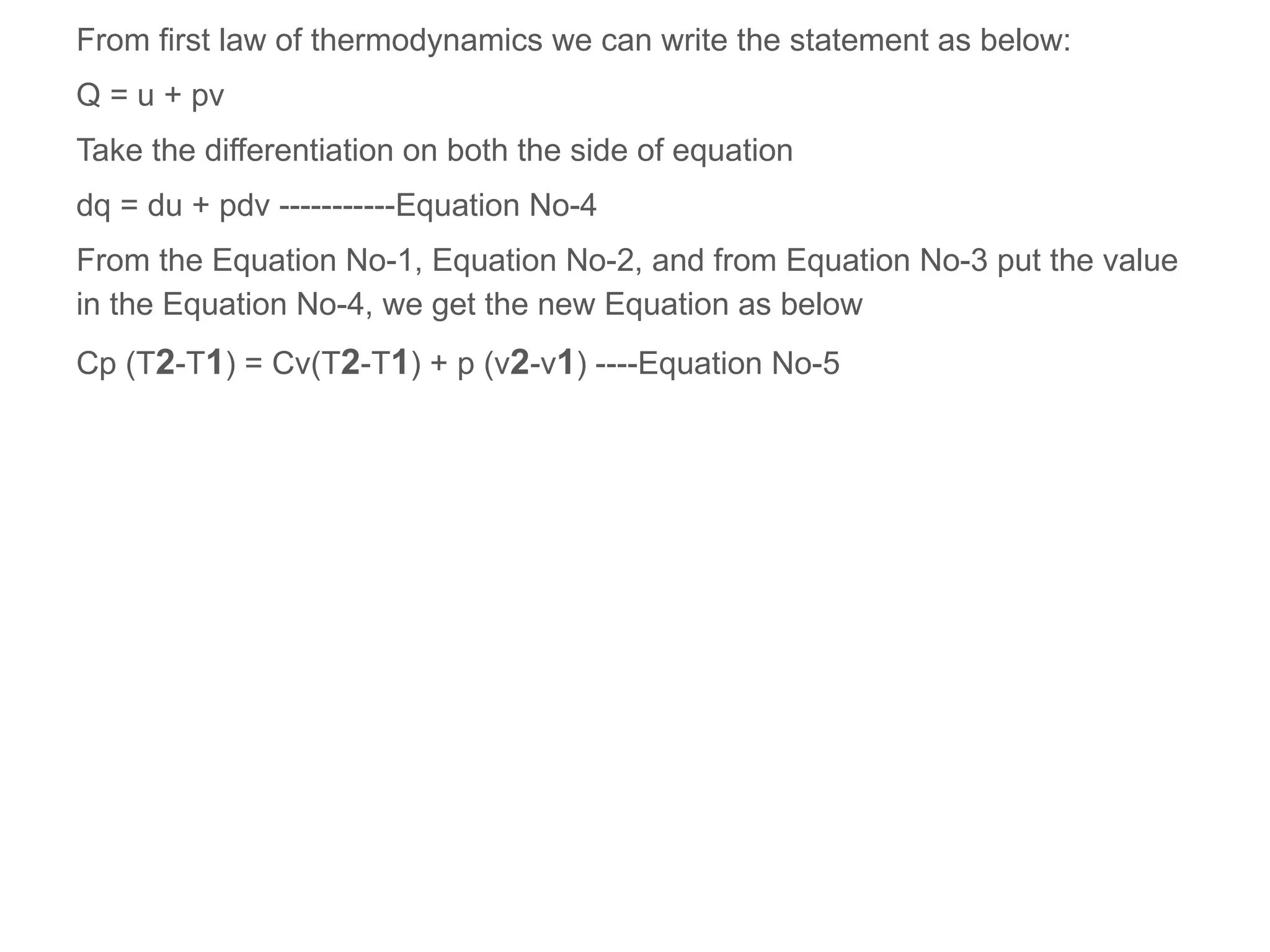
From first lawof thermodynamics we can write the statement as below:
Q = u + pv
Take the differentiation on both the side of equation
dq = du + pdv -----------Equation No-4
From the Equation No-1, Equation No-2, and from Equation No-3 put the value
in the Equation No-4, we get the new Equation as below
Cp (T2-T1) = Cv(T2-T1) + p (v2-v1) ----Equation No-5
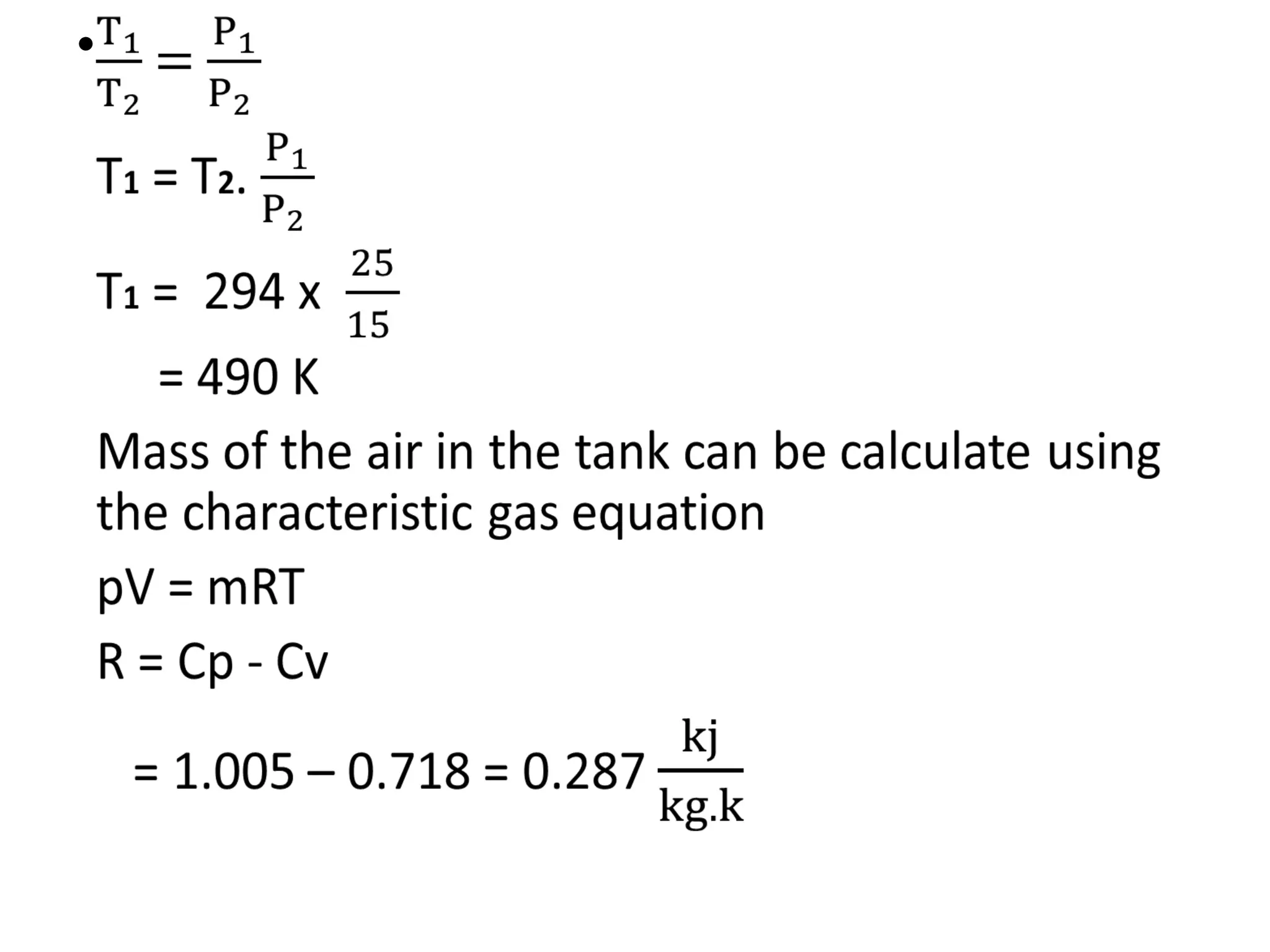
37.
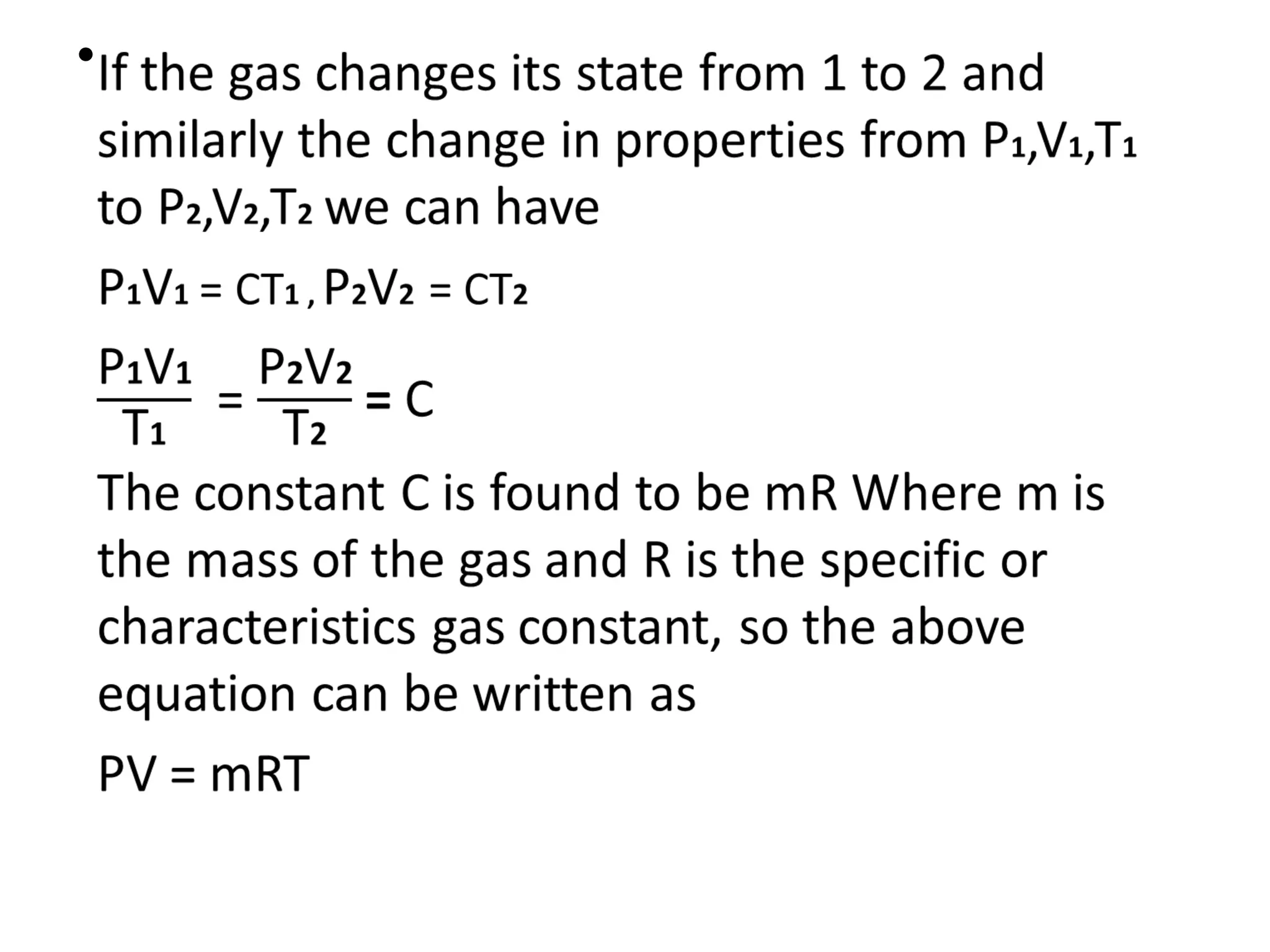
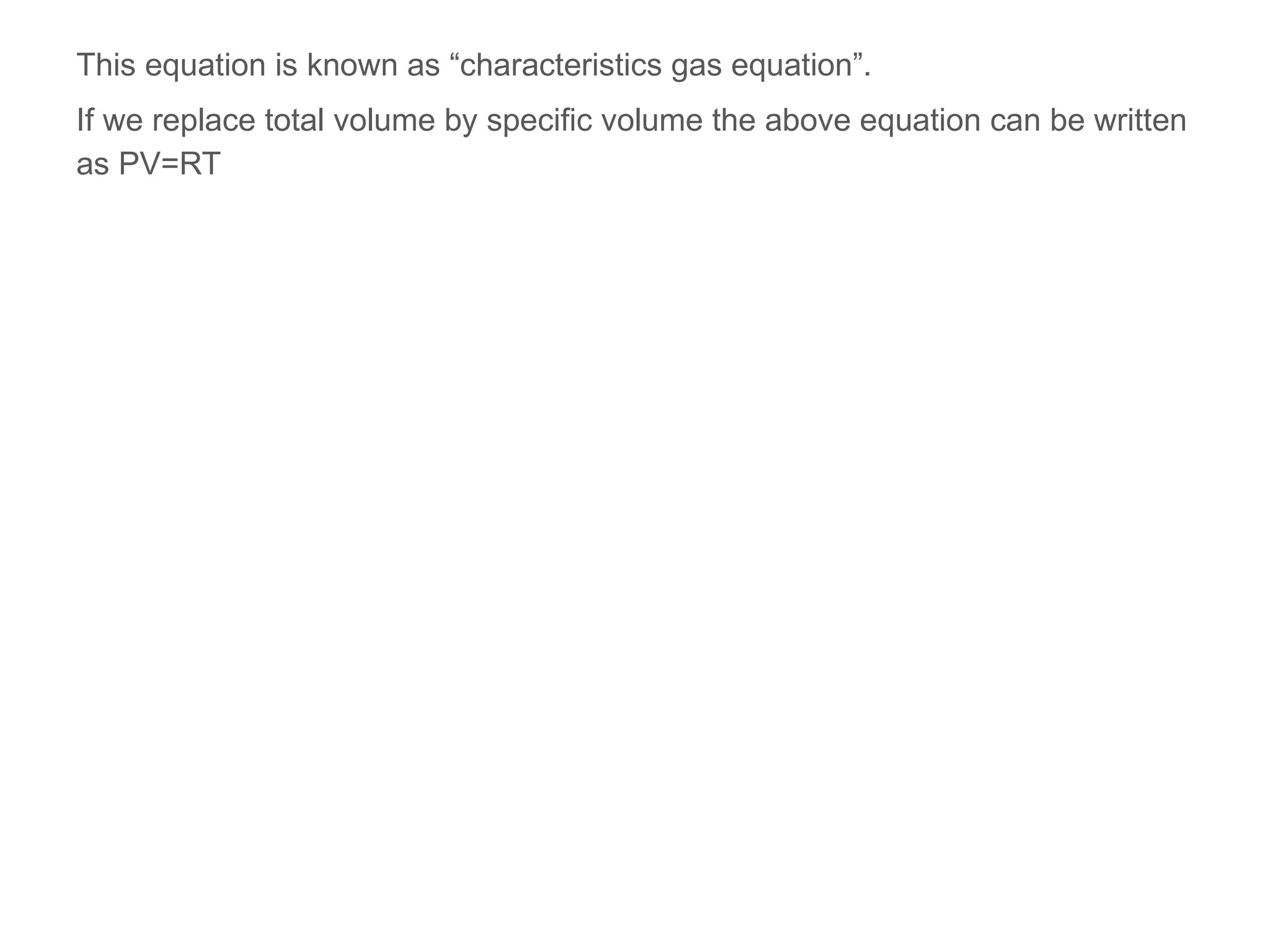
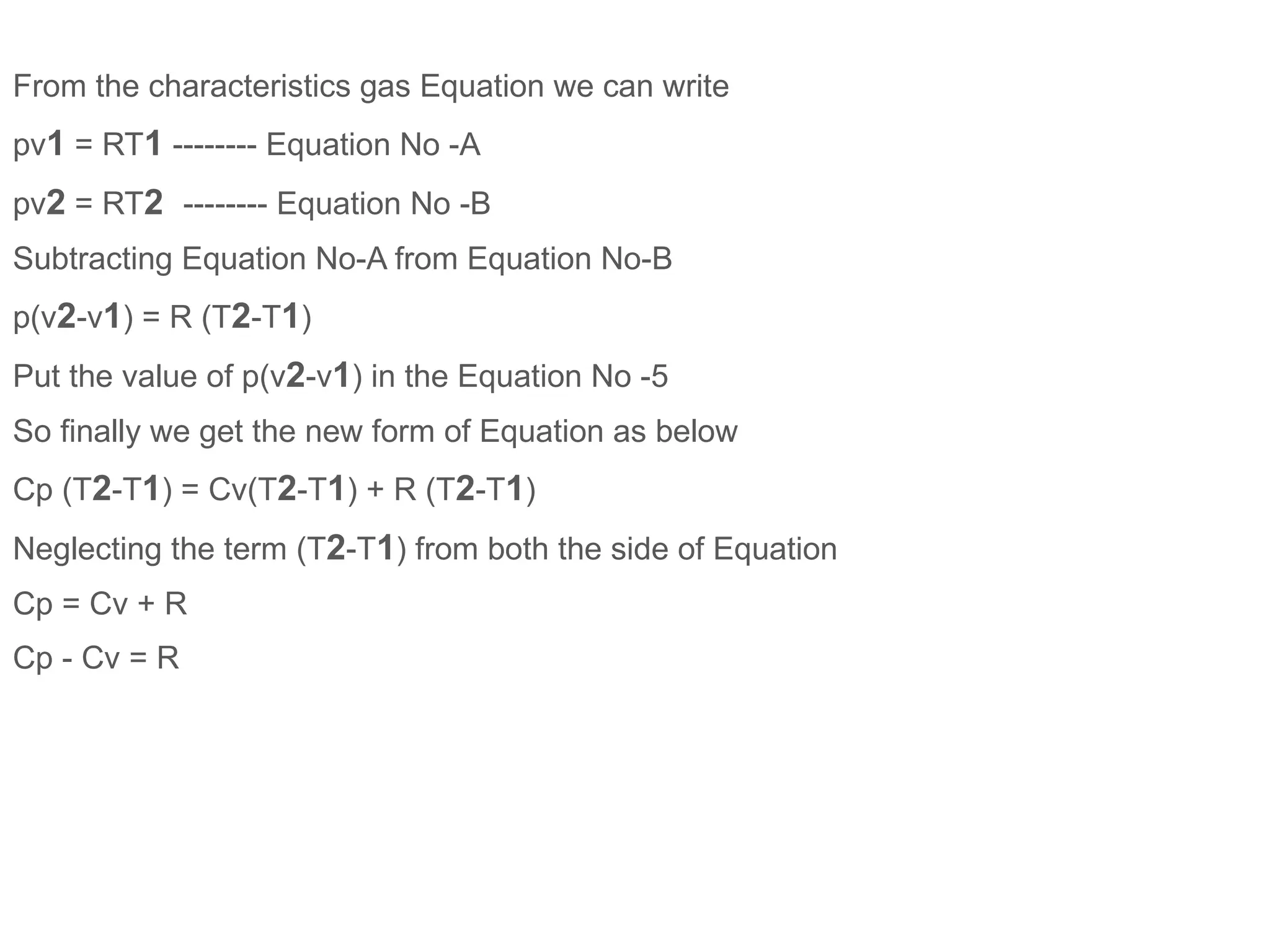
From the characteristicsgas Equation we can write
pv1 = RT1 -------- Equation No -A
pv2 = RT2 -------- Equation No -B
Subtracting Equation No-A from Equation No-B
p(v2-v1) = R (T2-T1)
Put the value of p(v2-v1) in the Equation No -5
So finally we get the new form of Equation as below
Cp (T2-T1) = Cv(T2-T1) + R (T2-T1)
Neglecting the term (T2-T1) from both the side of Equation
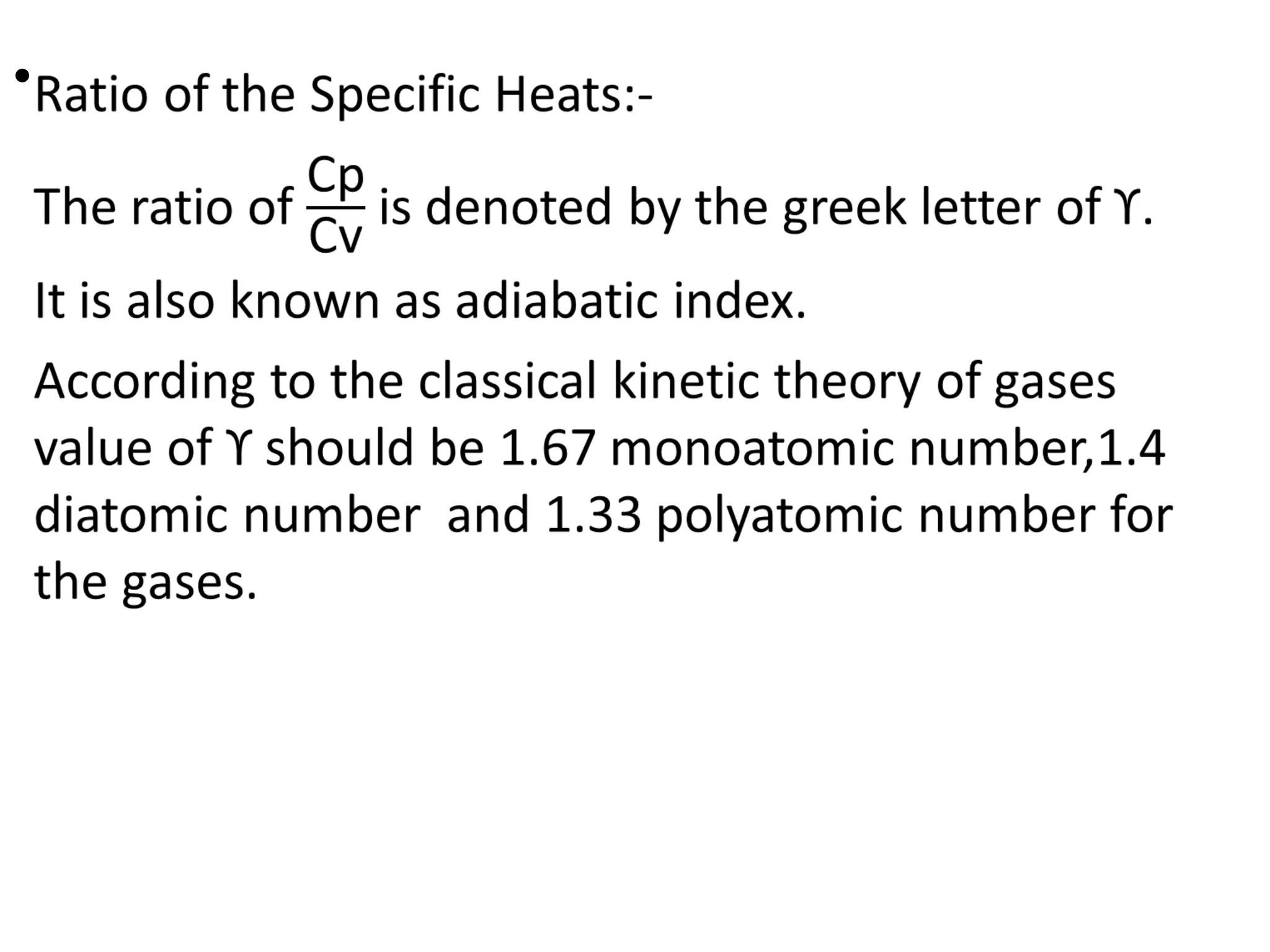
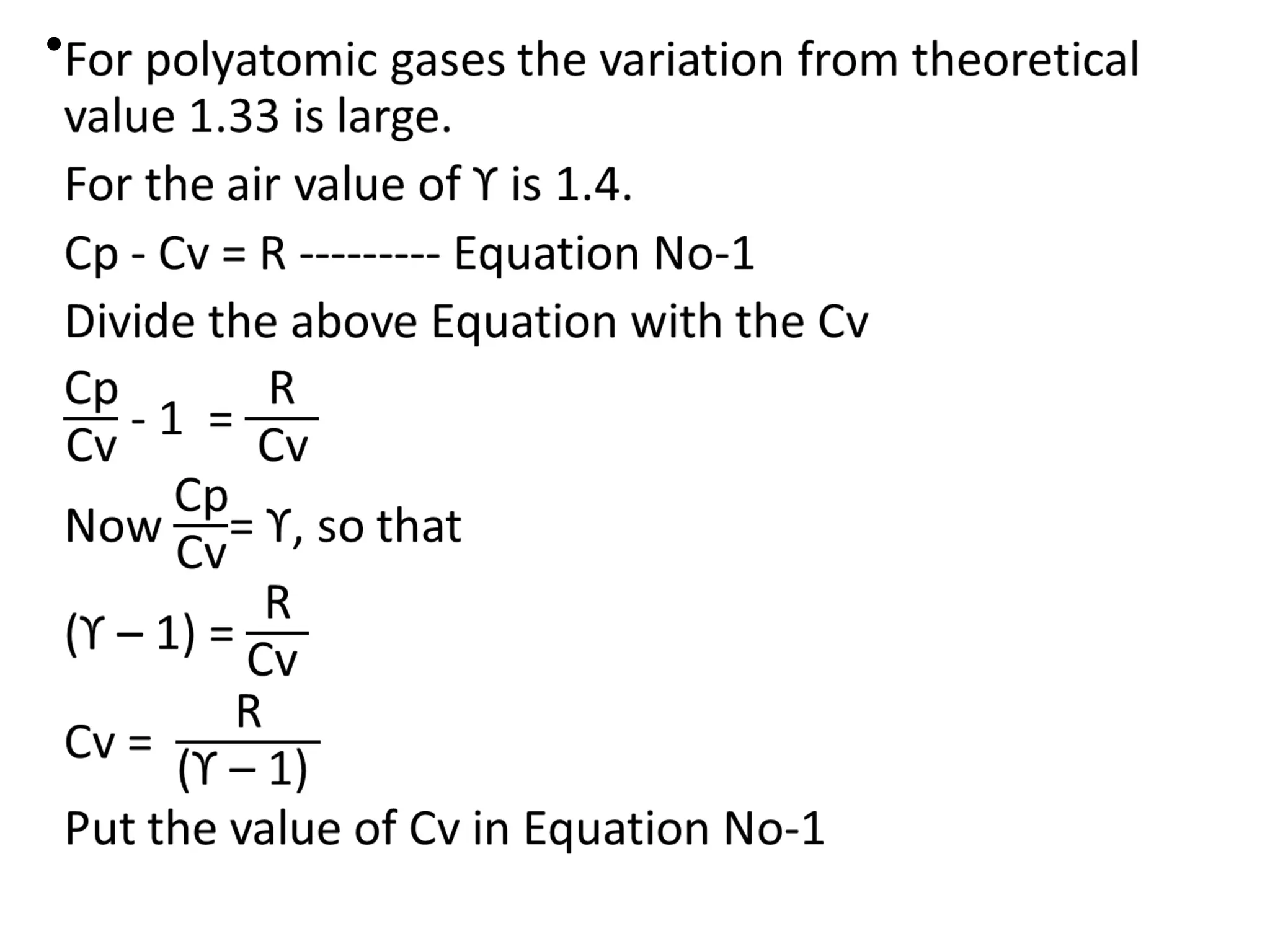
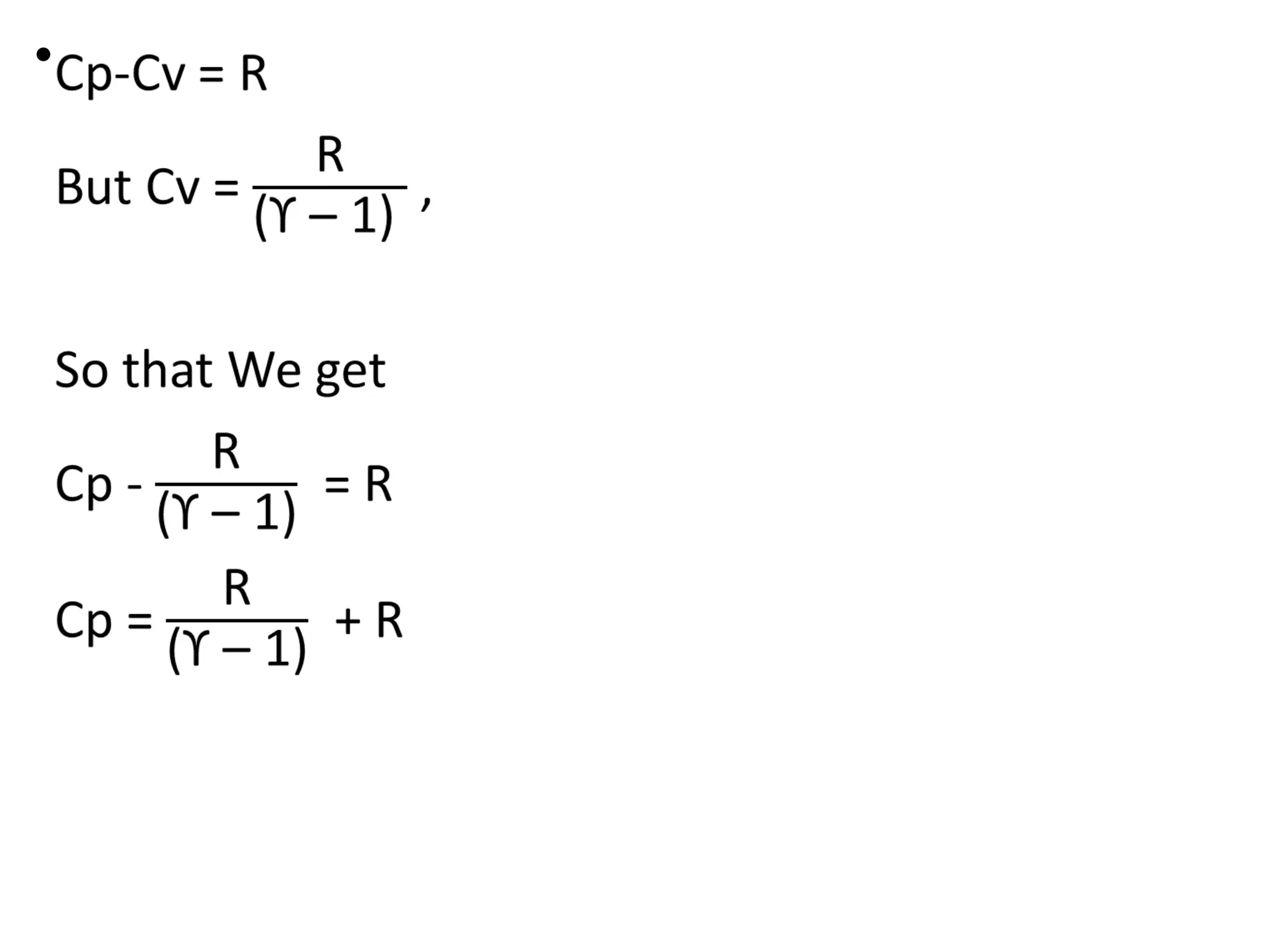
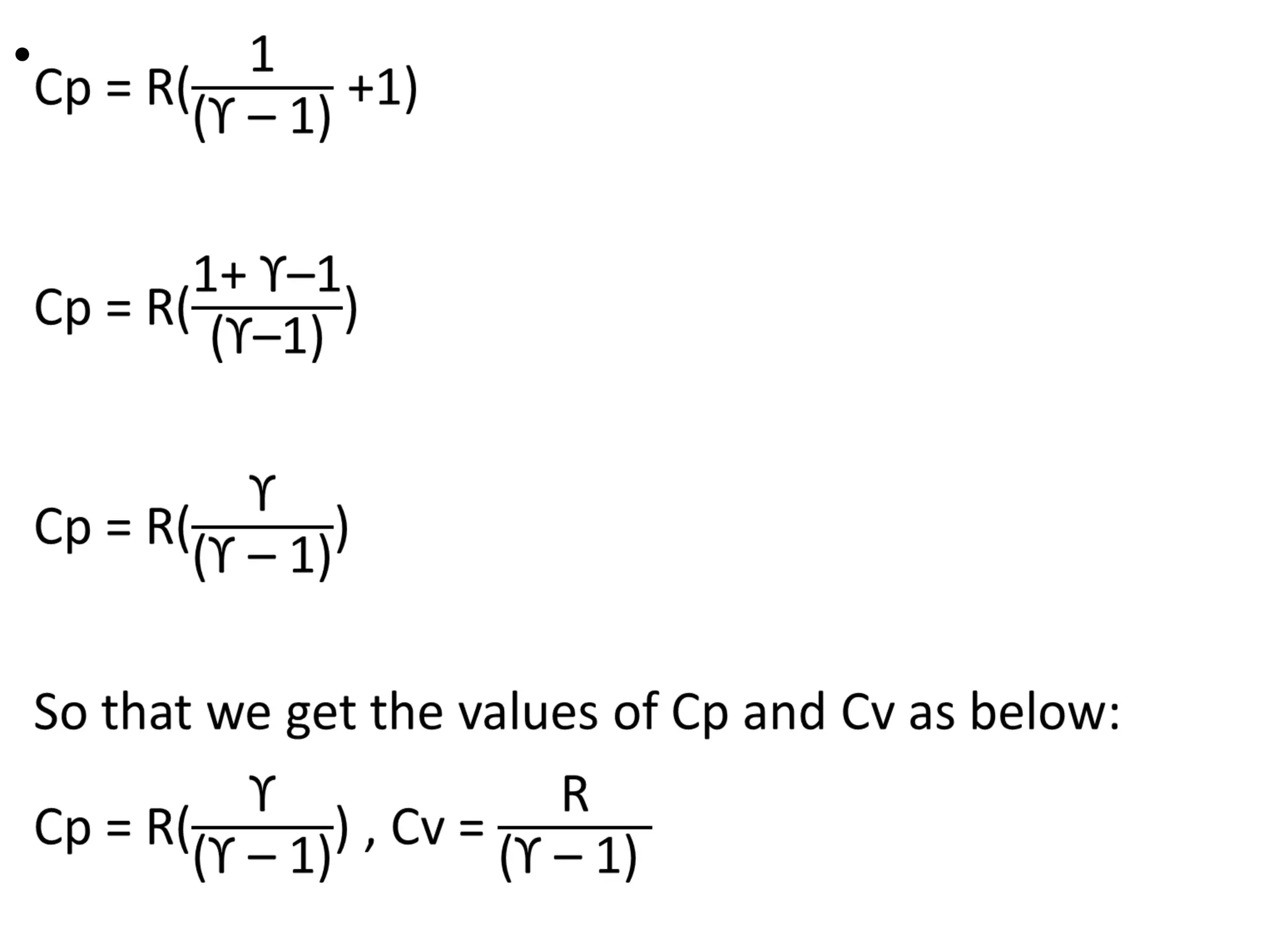
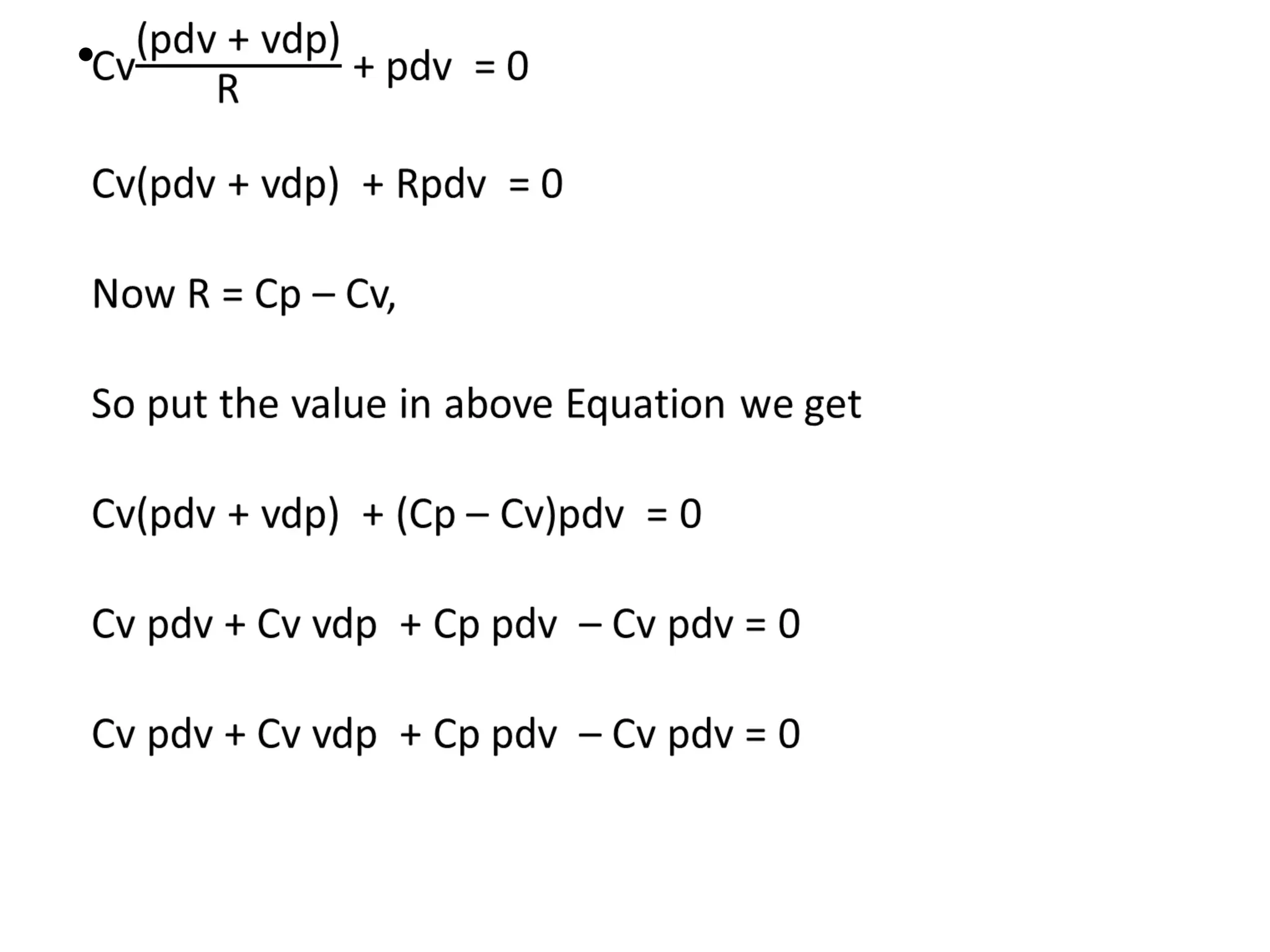
Cp = Cv + R
Cp - Cv = R
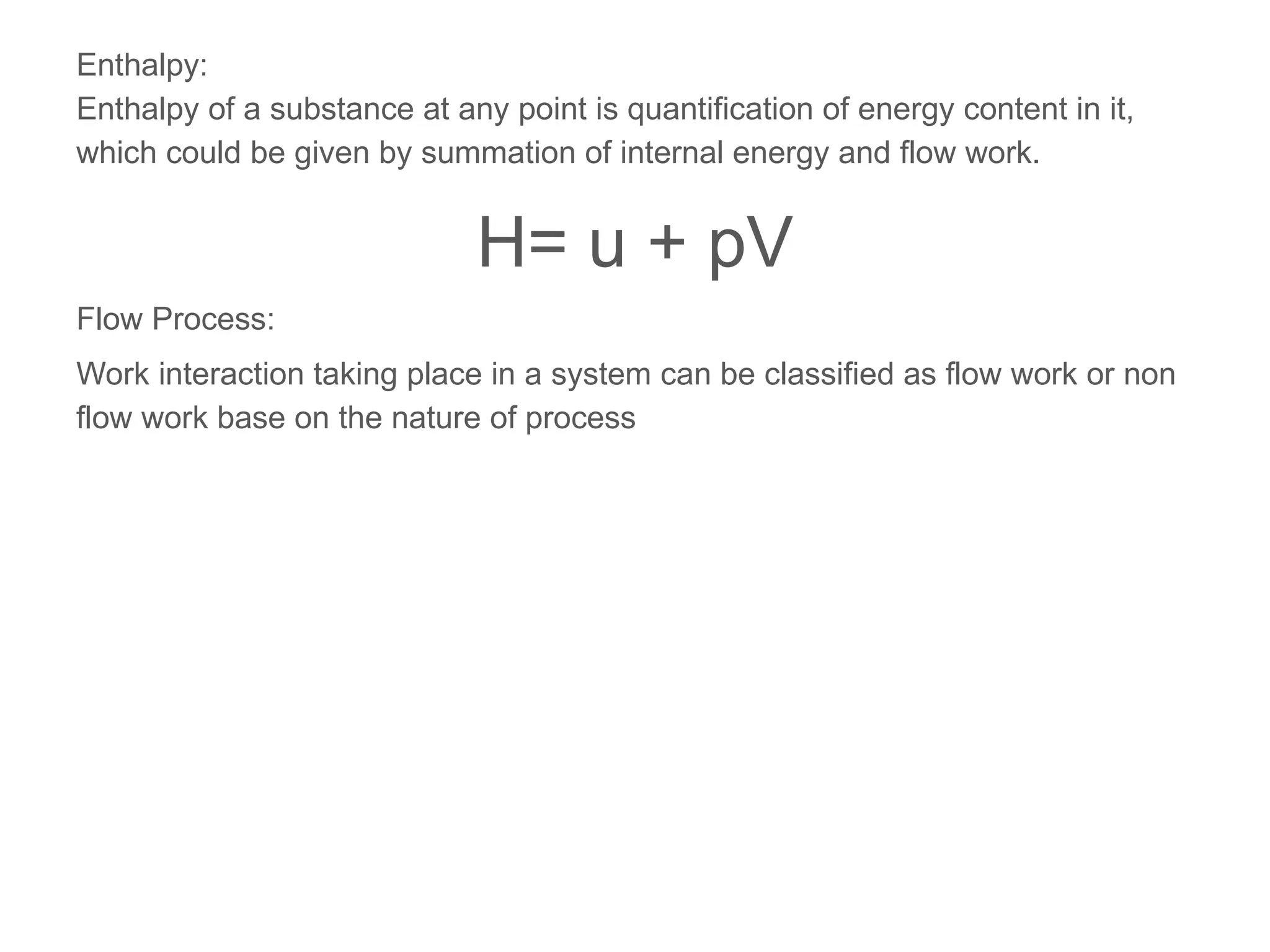
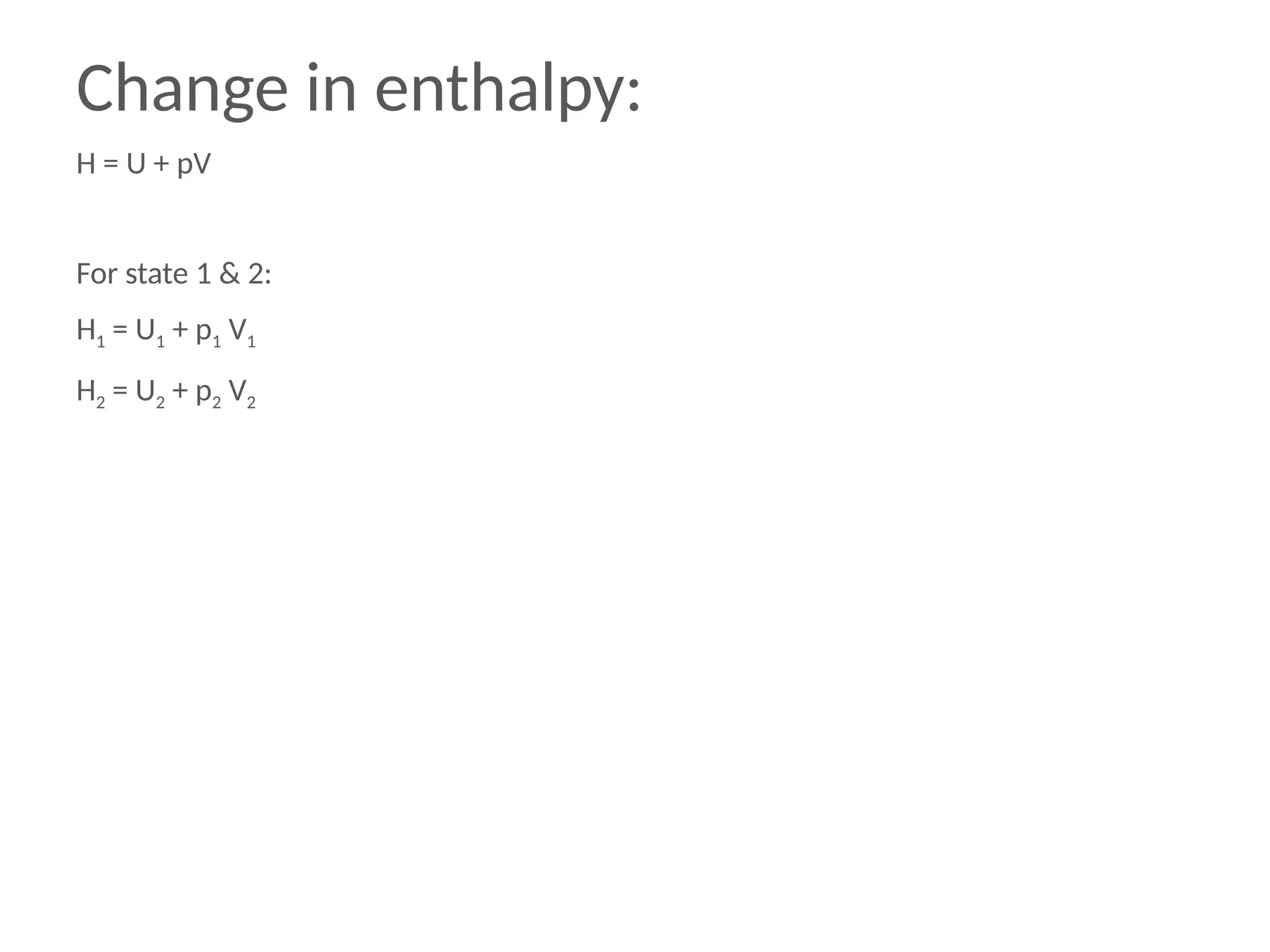
Enthalpy:
Enthalpy of asubstance at any point is quantification of energy content in it,
which could be given by summation of internal energy and flow work.
H= u + pV
Flow Process:
Work interaction taking place in a system can be classified as flow work or non
flow work base on the nature of process
44.
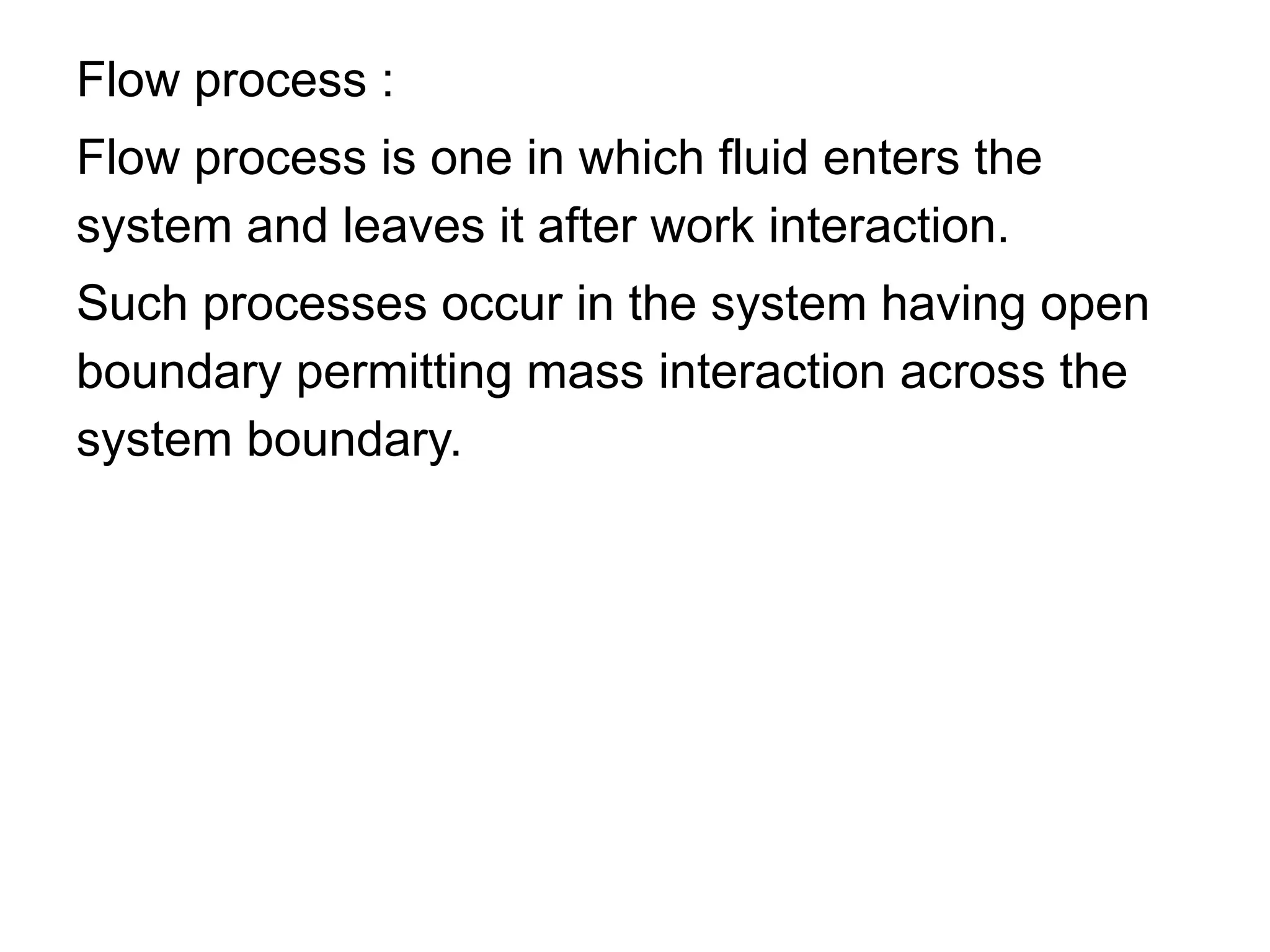
Flow process :
Flowprocess is one in which fluid enters the
system and leaves it after work interaction.
Such processes occur in the system having open
boundary permitting mass interaction across the
system boundary.
45.
Non flow process:
Nonflow process is the one in which there is no mass interaction across the
system boundaries during the occurrence of the process.
46.
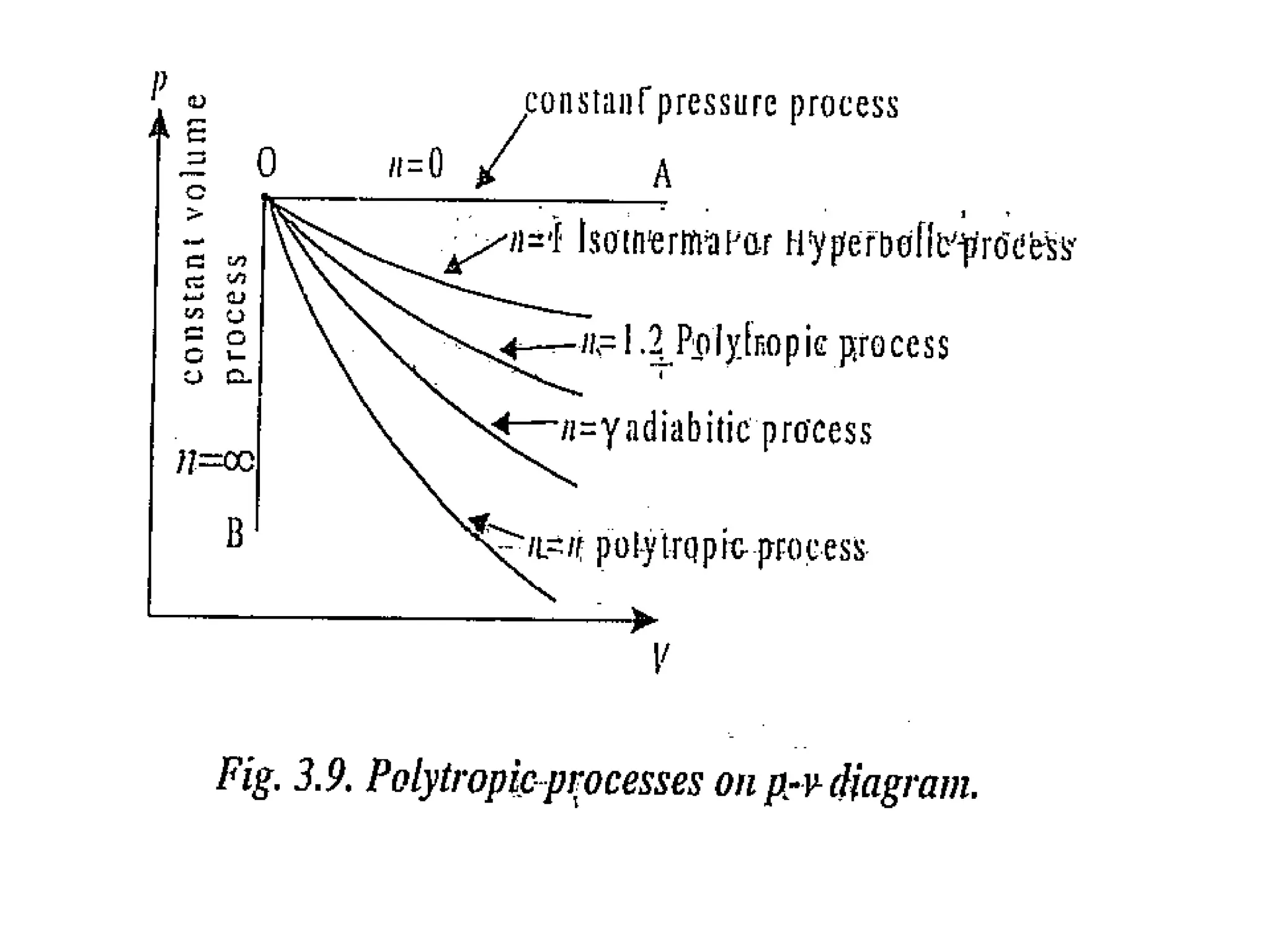
Different types ofnon flow process of perfect gases are :
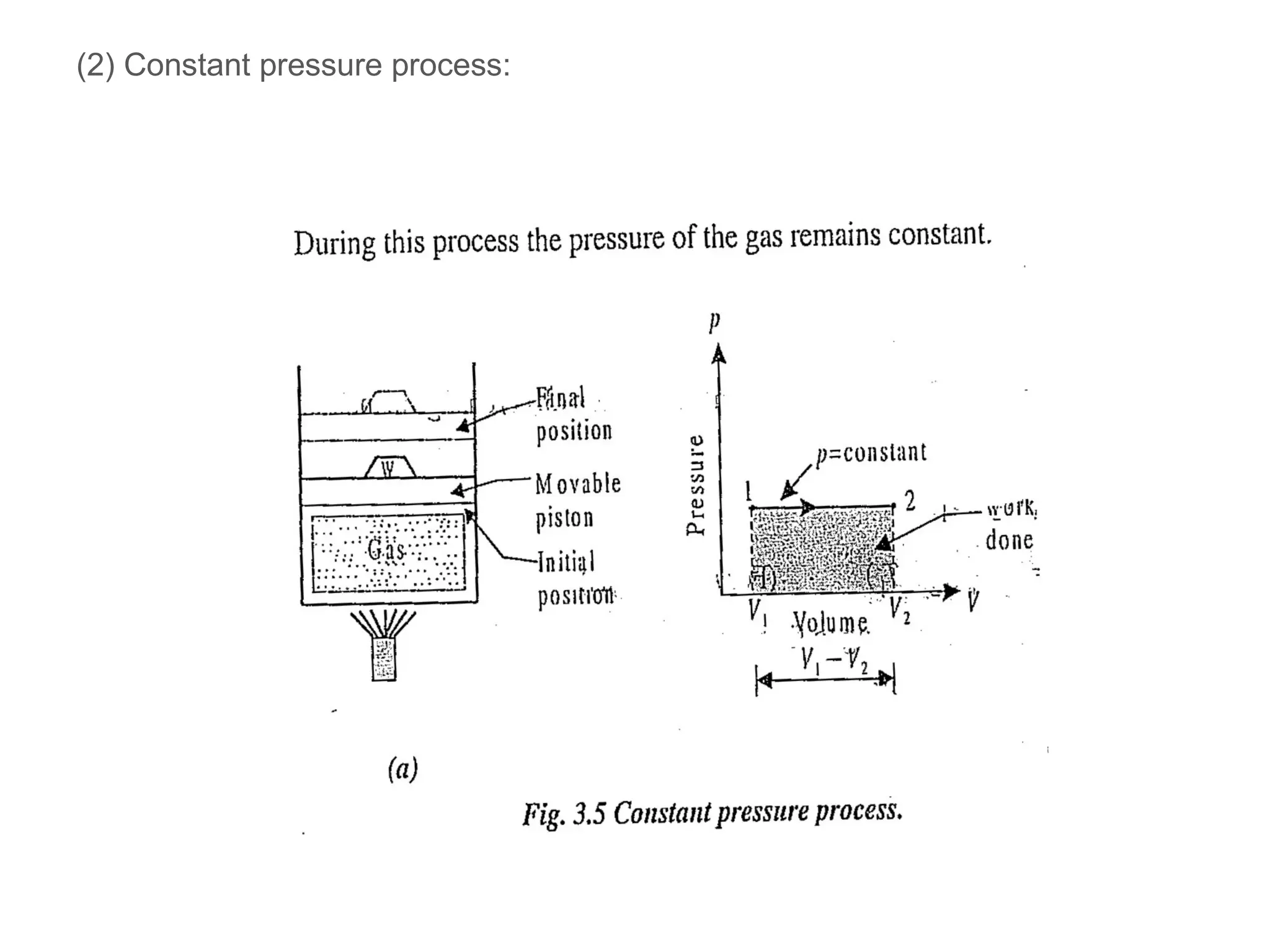
(a) constant volume process
(b) constant pressure process
(c) constant temperature process
(d) adiabatic process
(e) polytrophic process
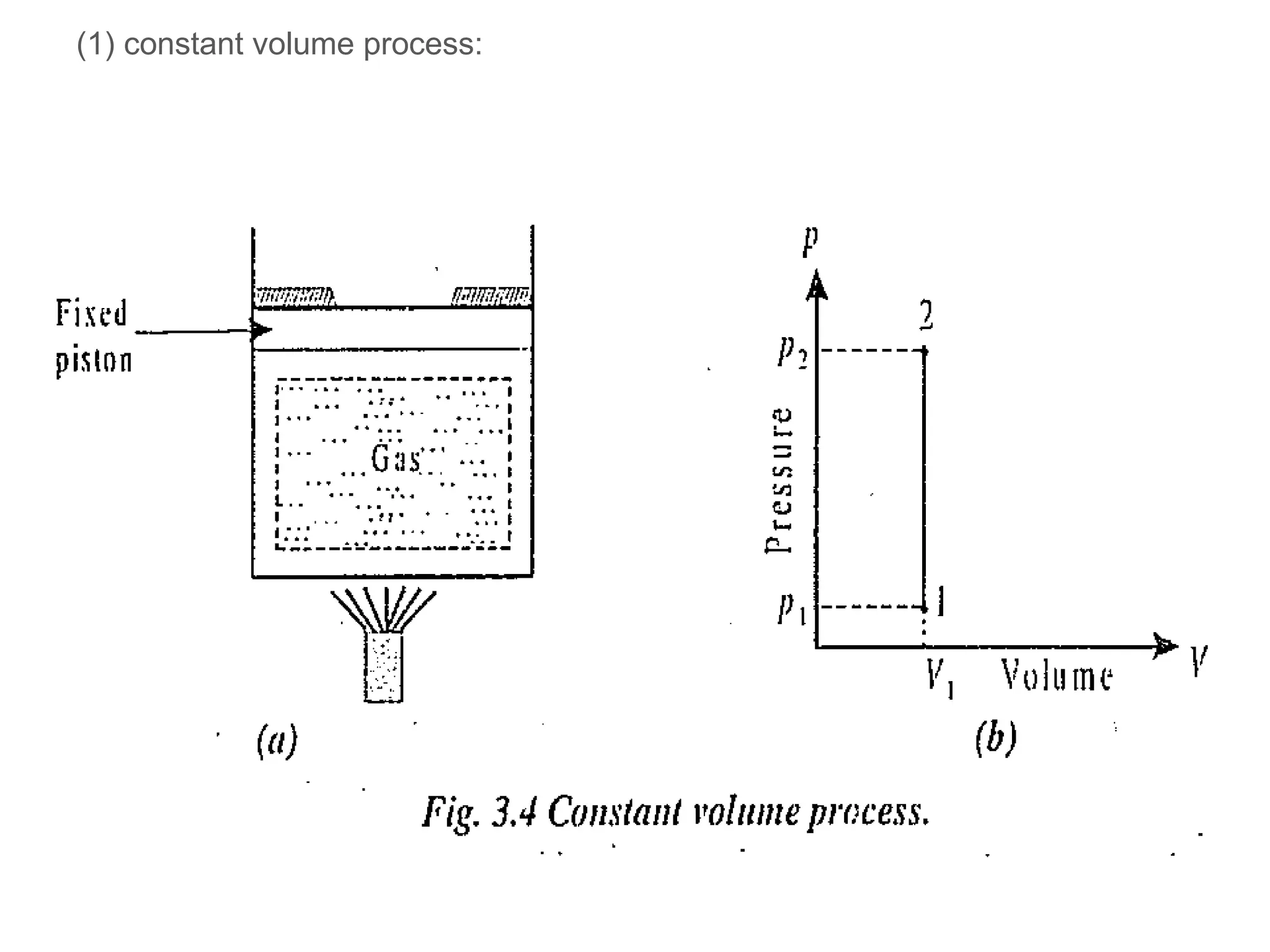
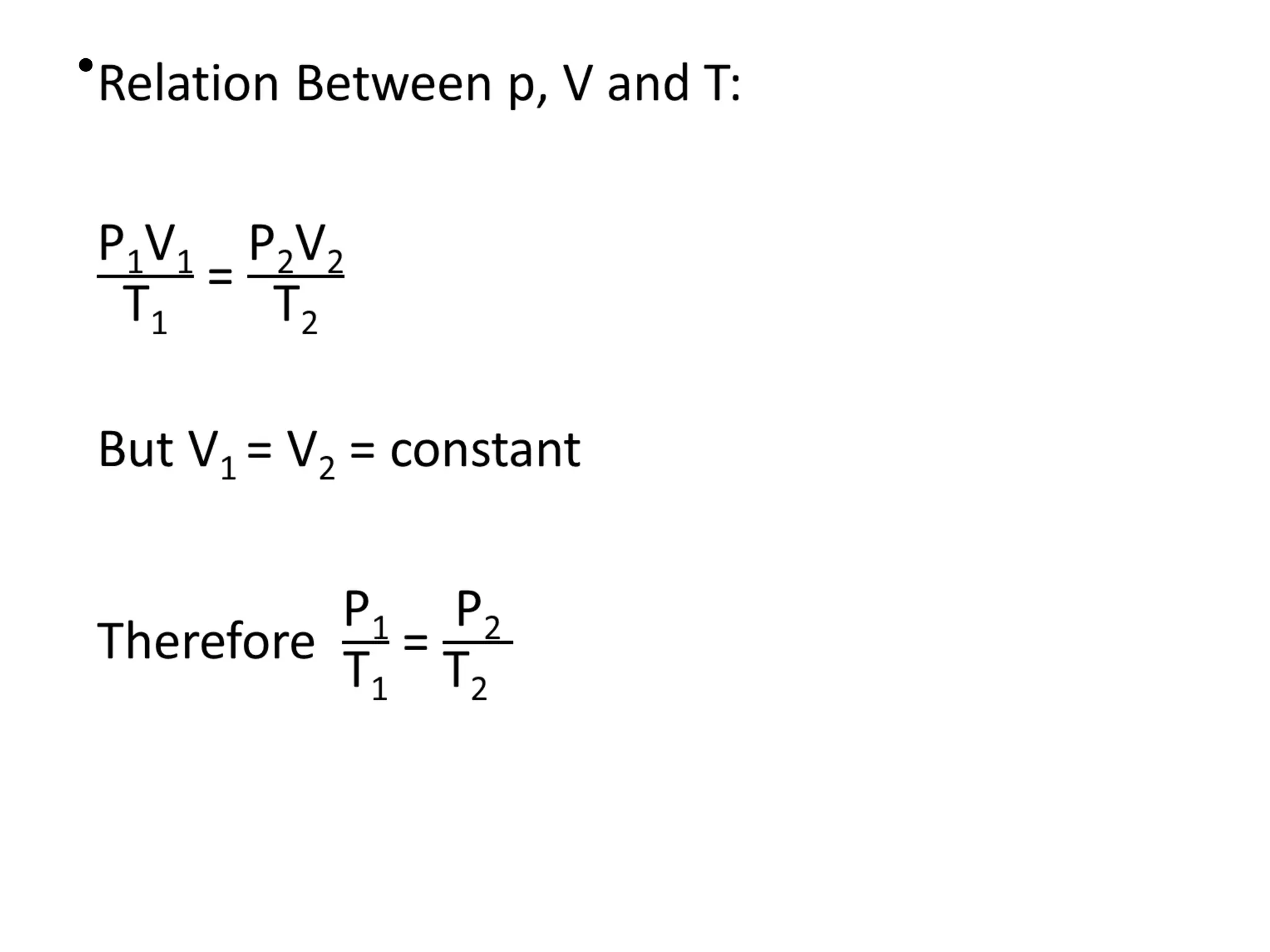
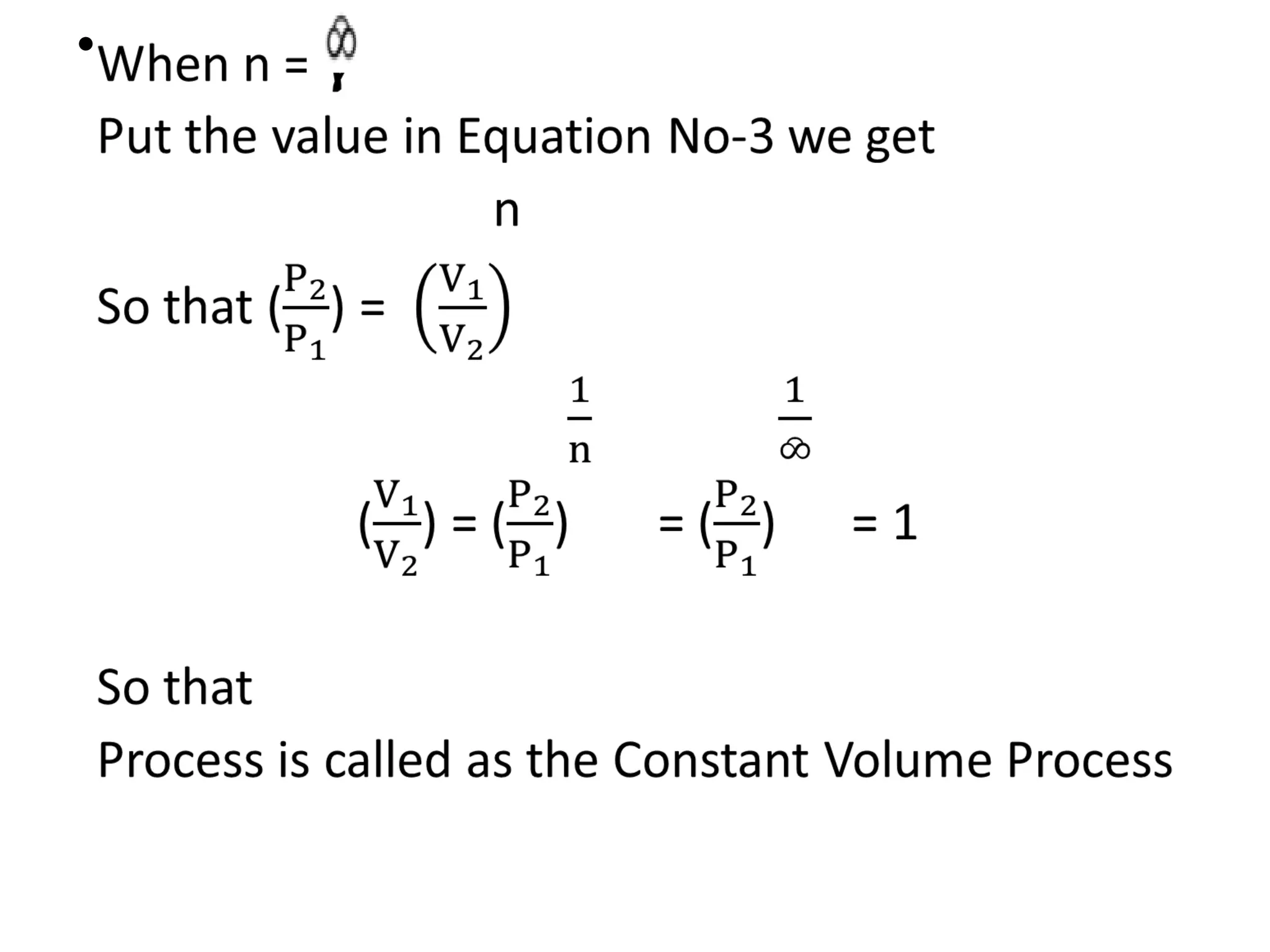
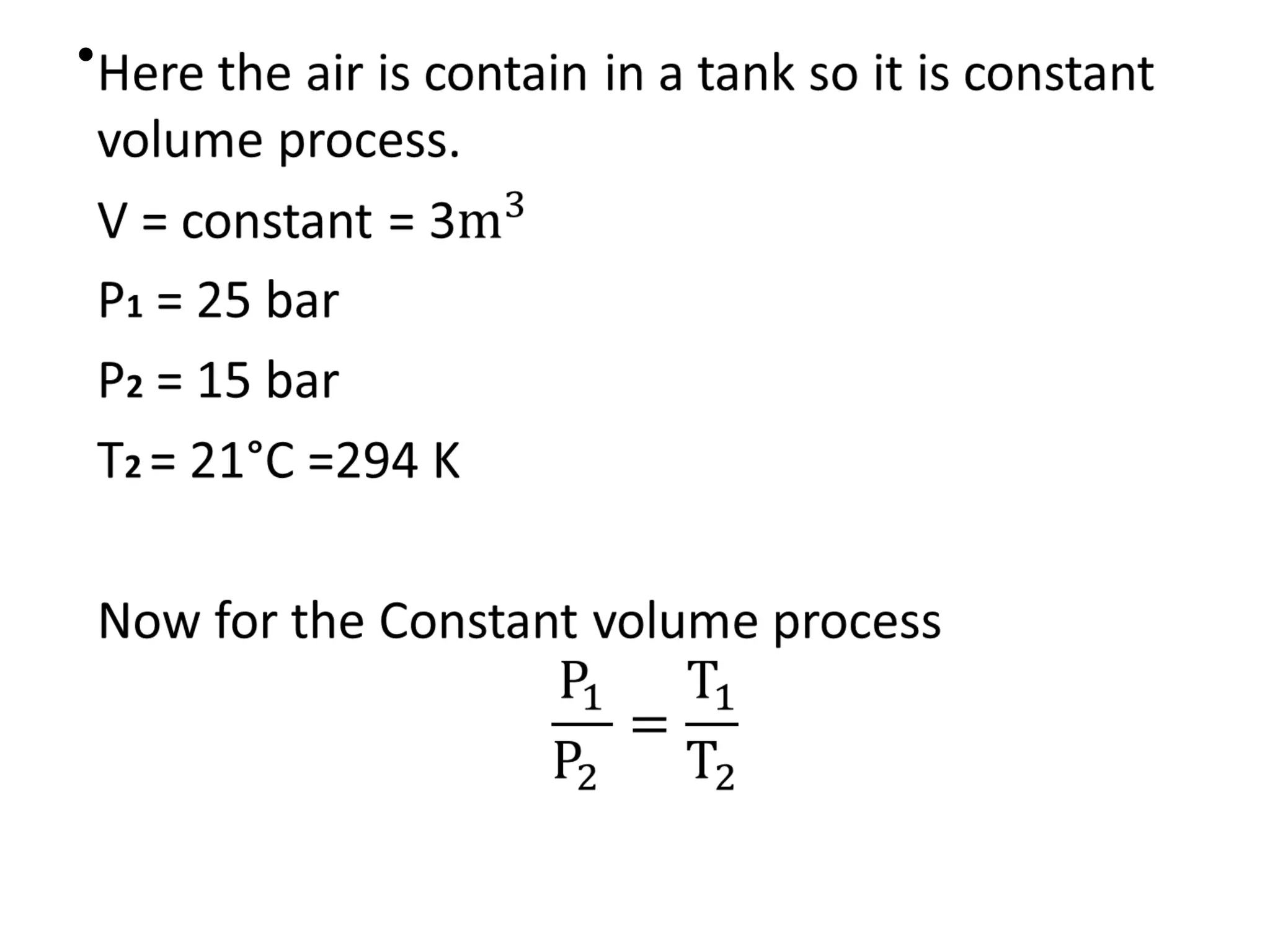
In constant volumeprocess the working substance is contained in a rigid vessel,
hence boundaries of a system are immovable and no work can be done on or
by the system.
This process is also known as Isochoric process.
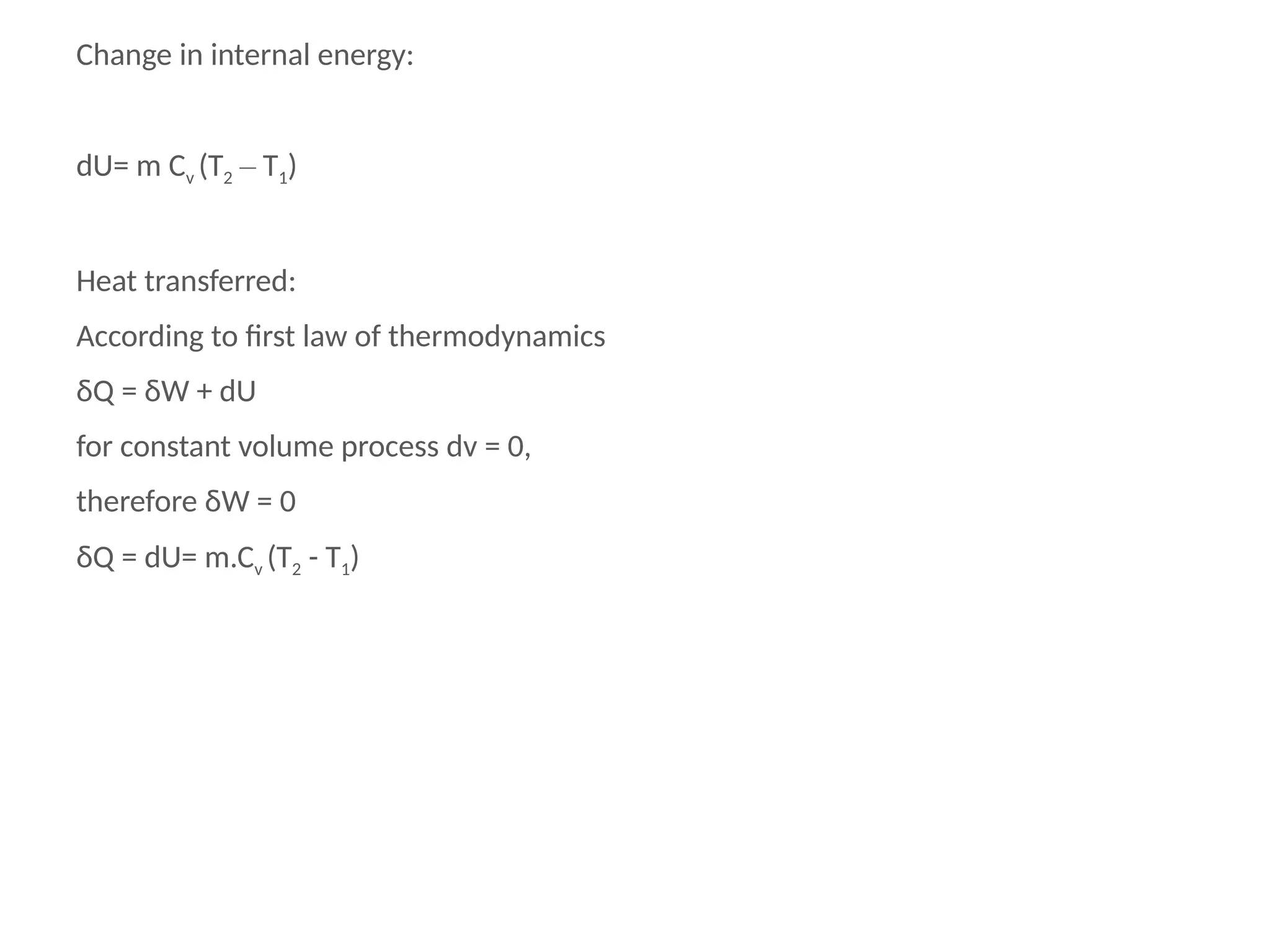
Change in internalenergy:
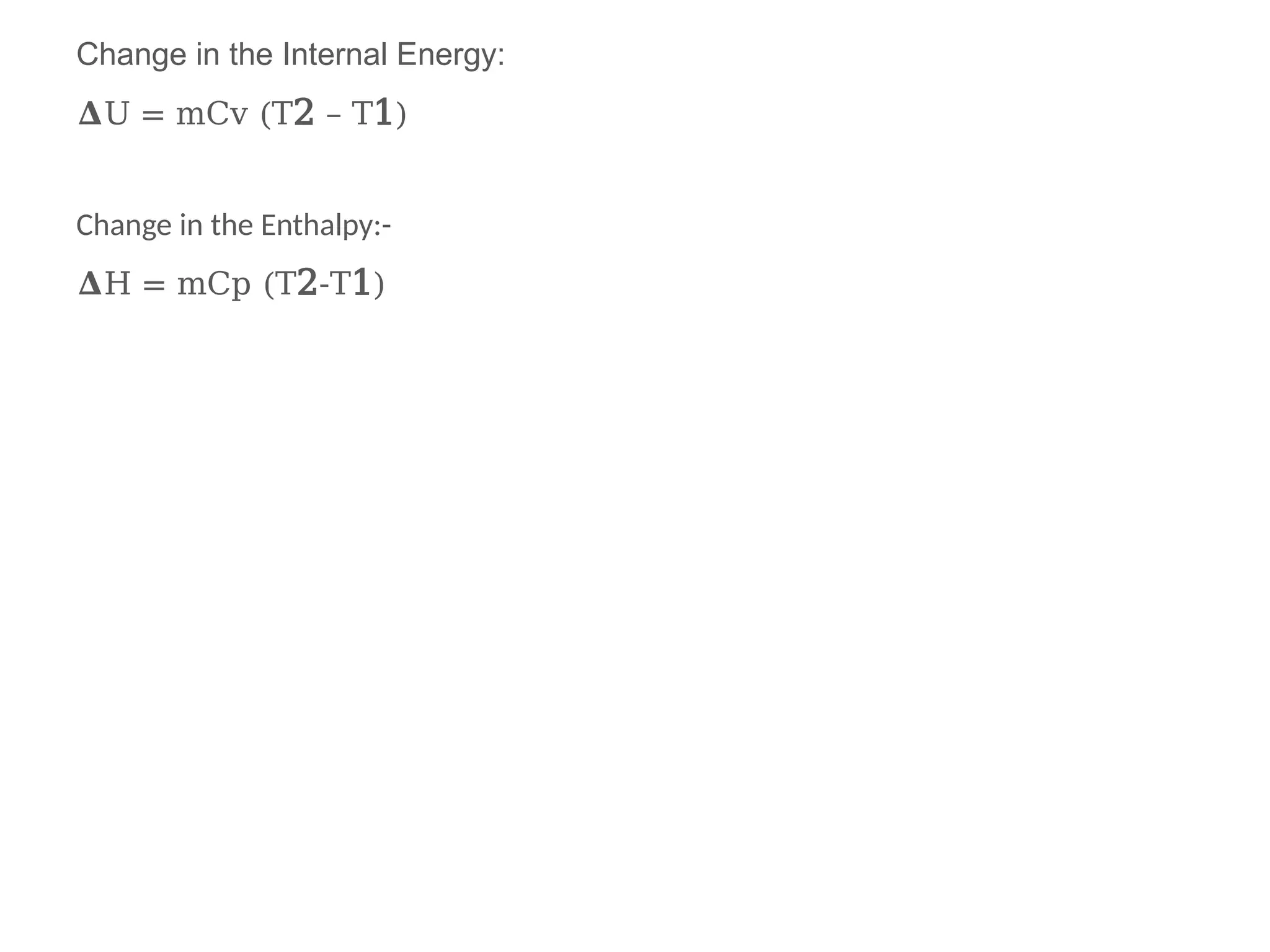
dU= m Cv (T2 – T1)
Heat transferred:
According to first law of thermodynamics
δQ = δW + dU
for constant volume process dv = 0,
therefore δW = 0
δQ = dU= m.Cv (T2 - T1)
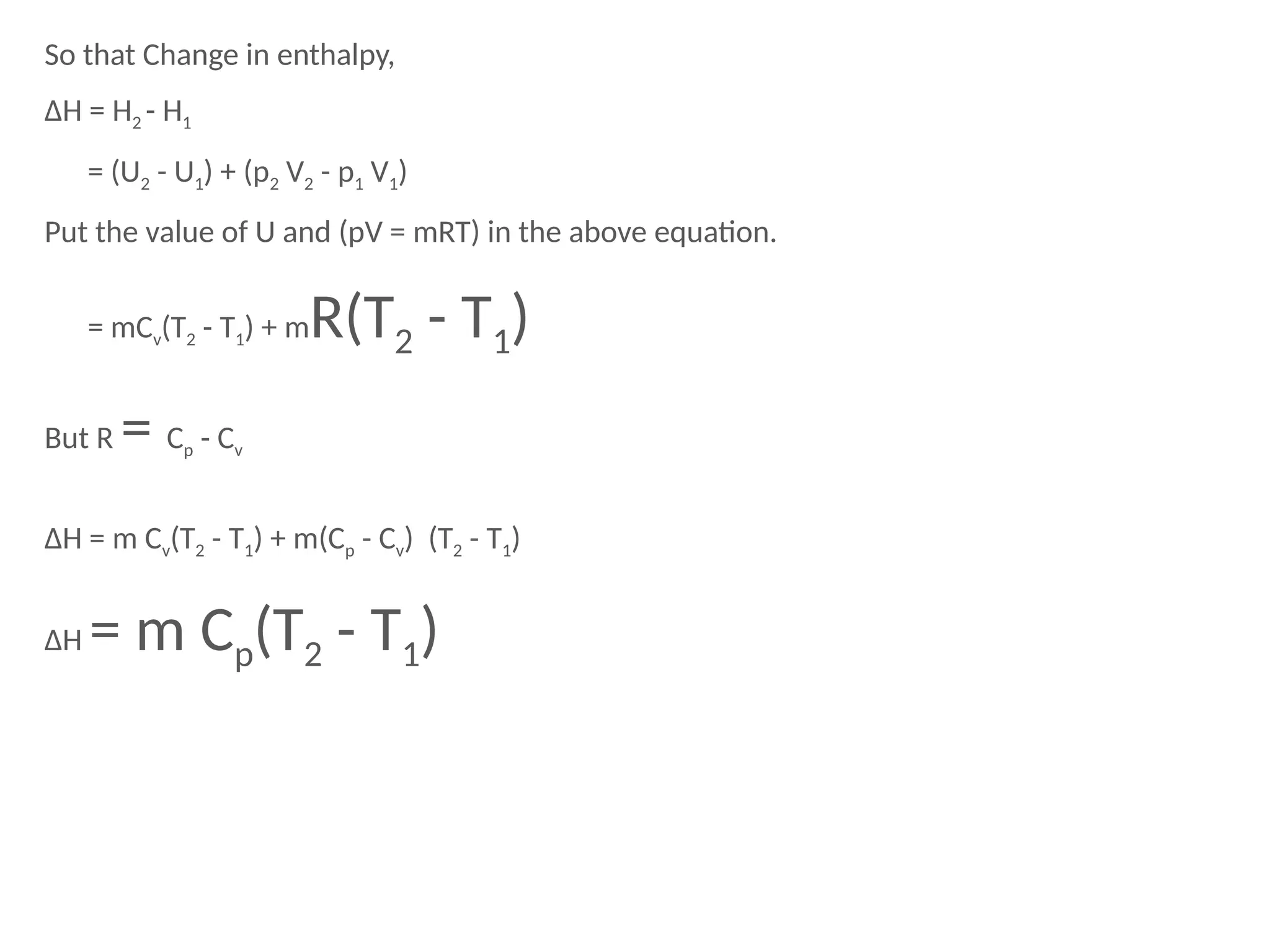
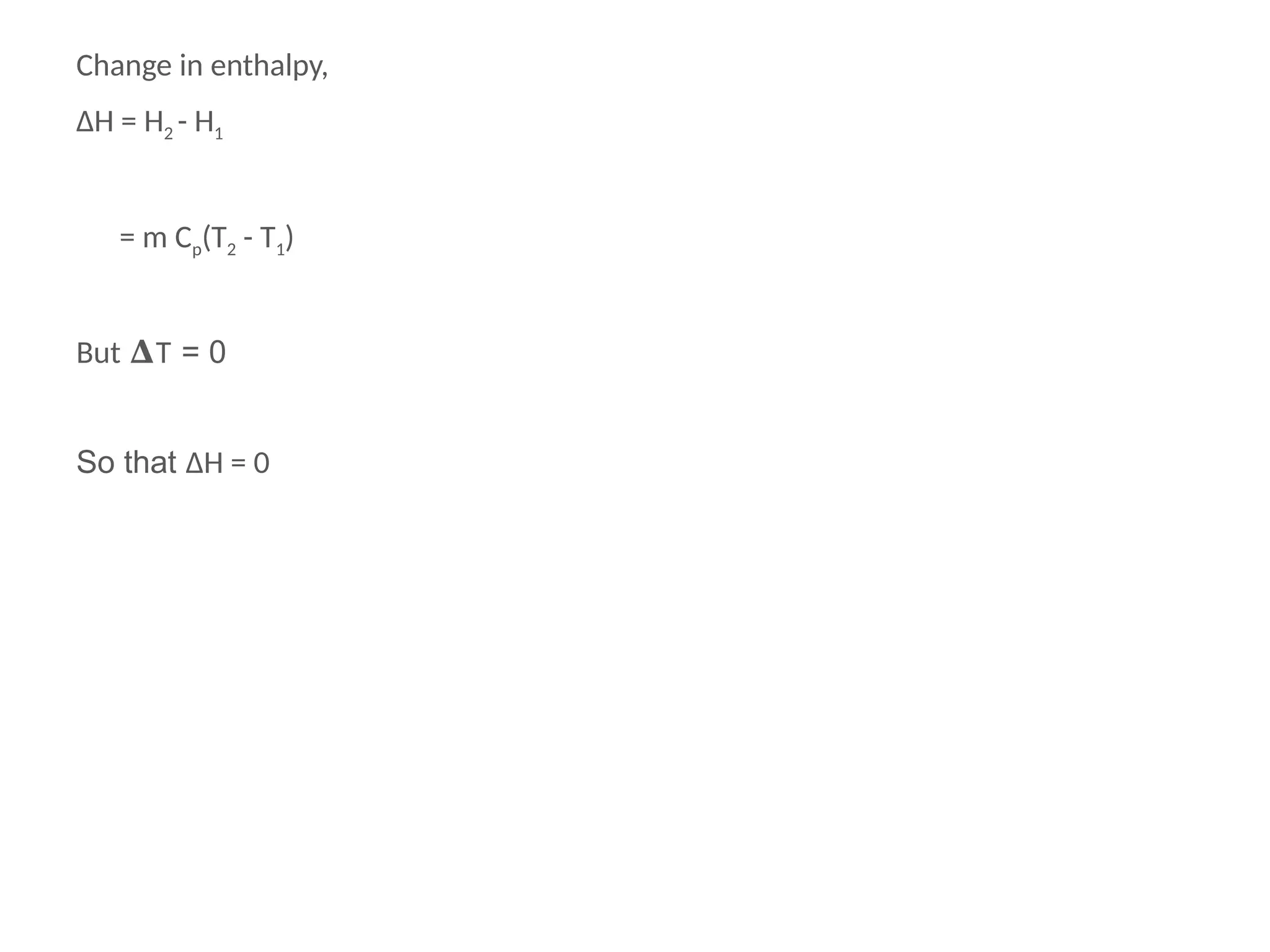
So that Changein enthalpy,
ΔH = H2 - H1
= (U2 - U1) + (p2 V2 - p1 V1)
Put the value of U and (pV = mRT) in the above equation.
= mCv(T2 - T1) + mR(T2 - T1)
But R = Cp - Cv
ΔH = m Cv(T2 - T1) + m(Cp - Cv) (T2 - T1)
ΔH = m Cp(T2 - T1)
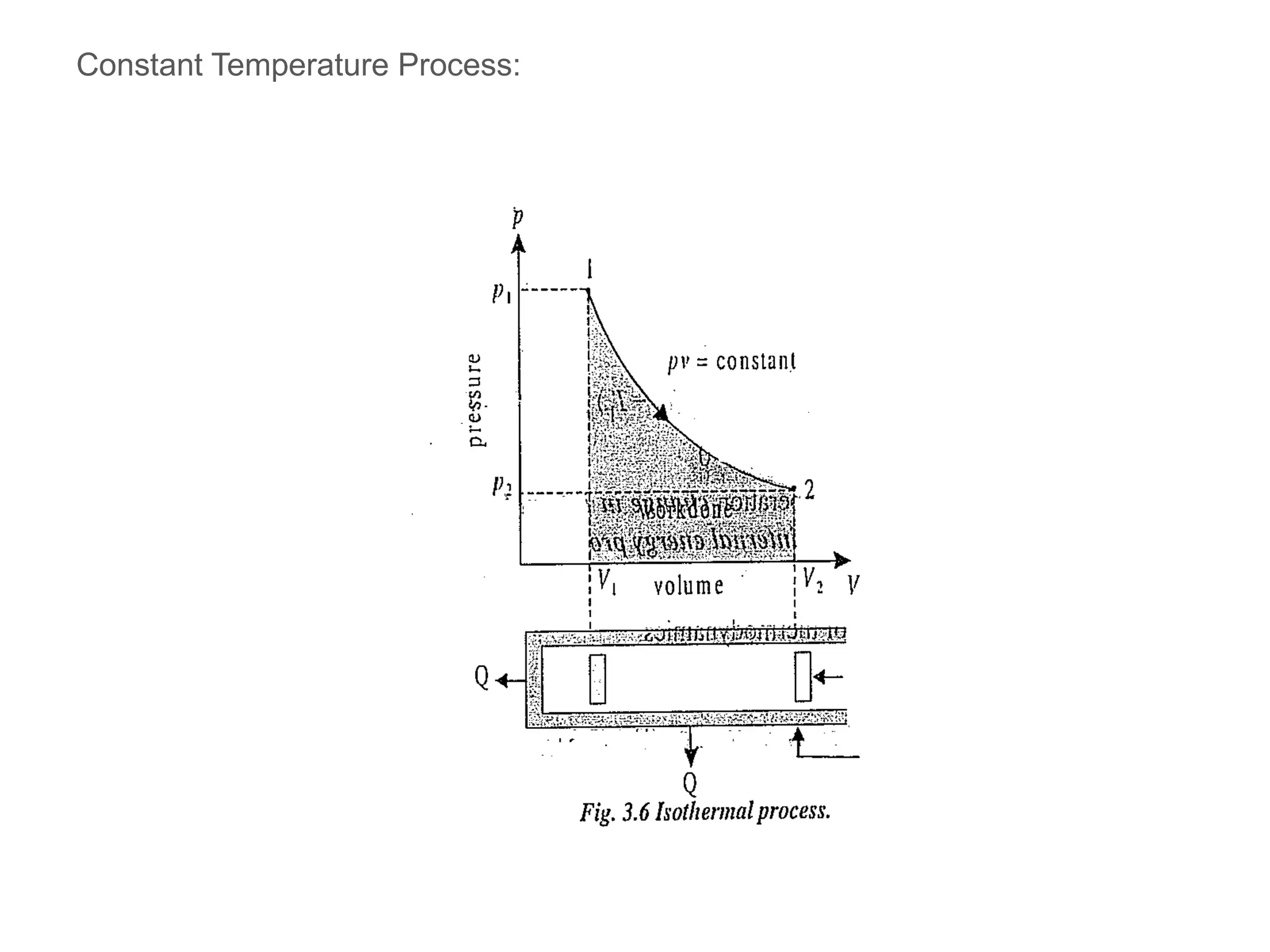
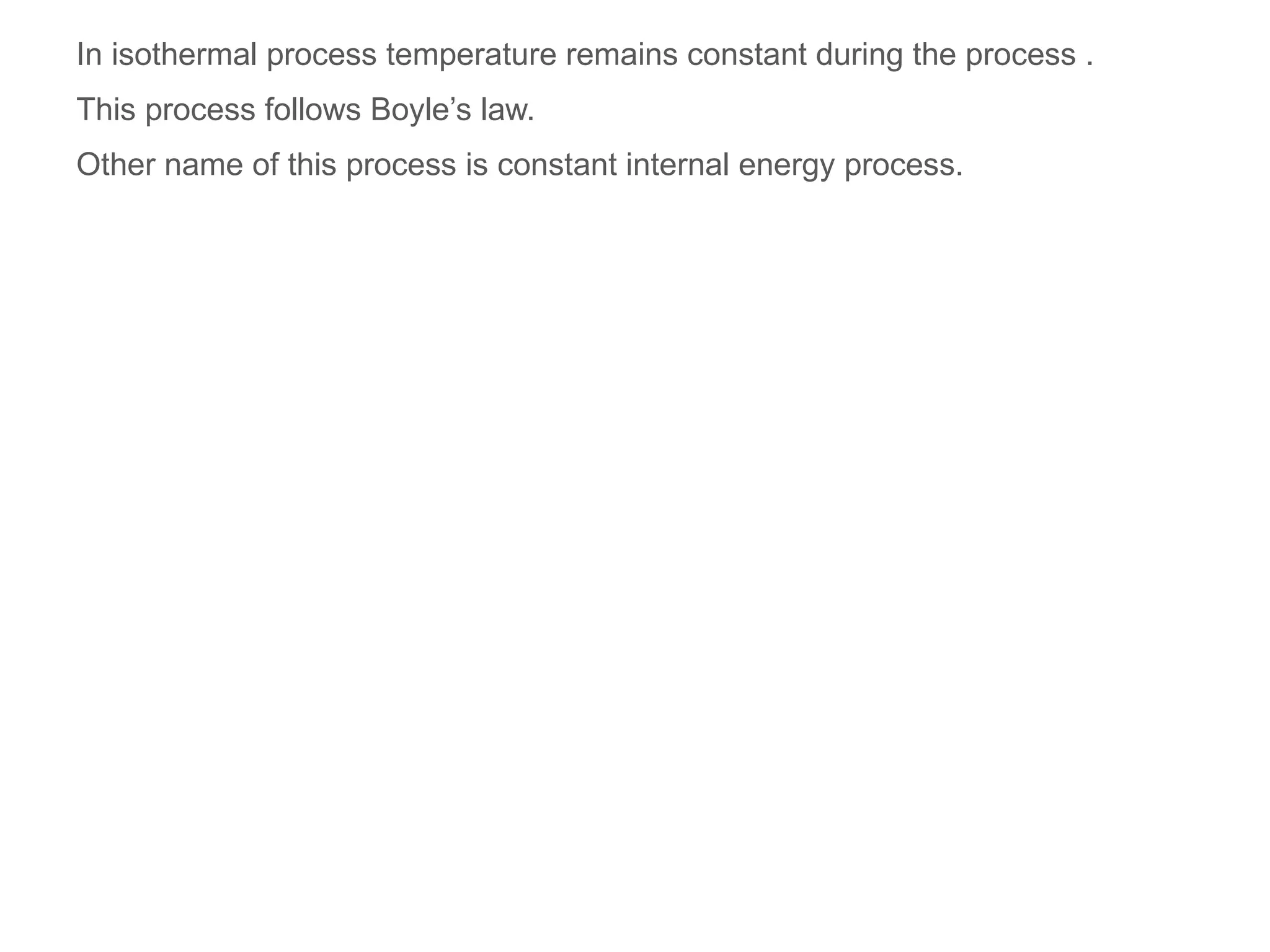
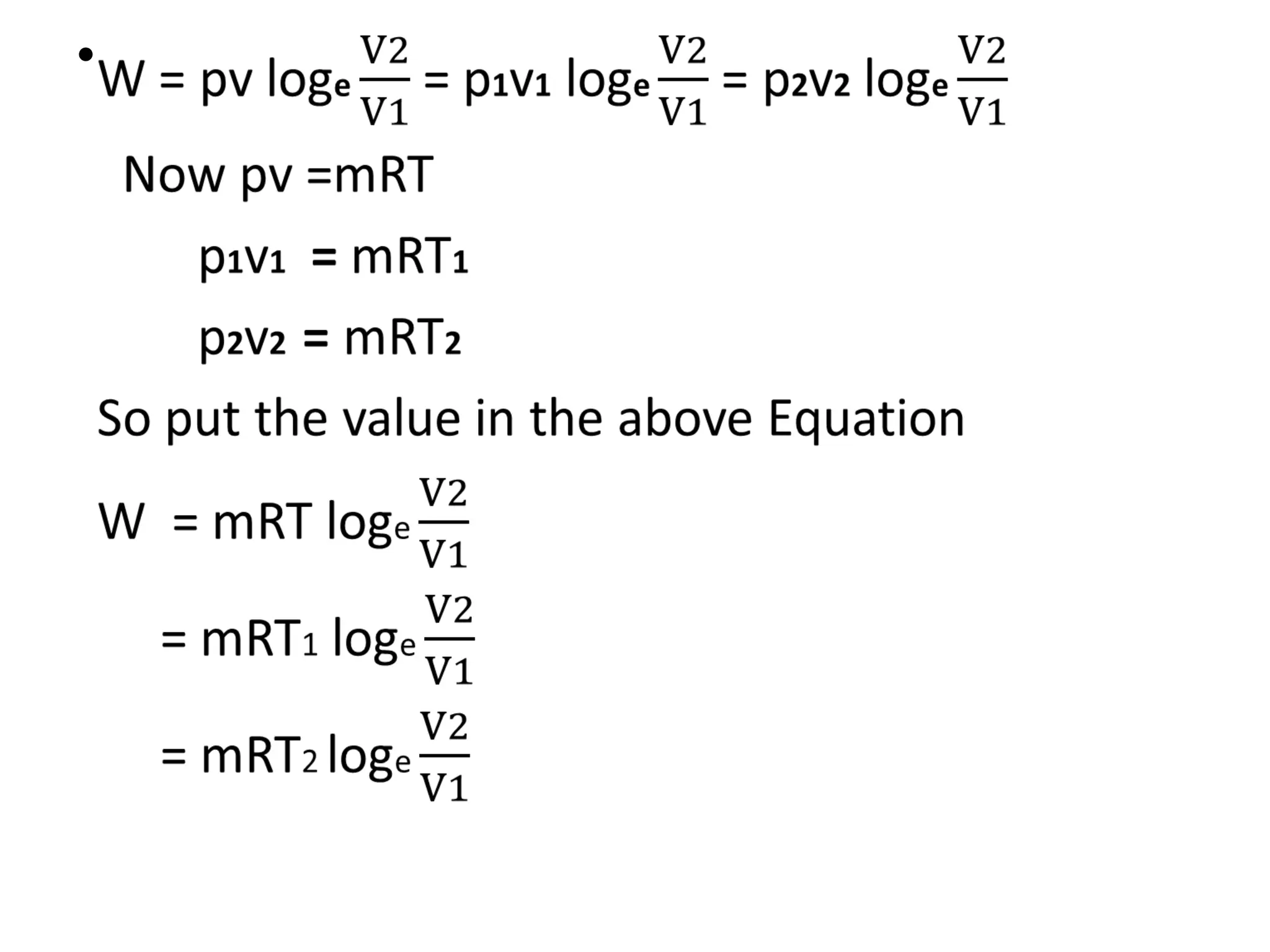
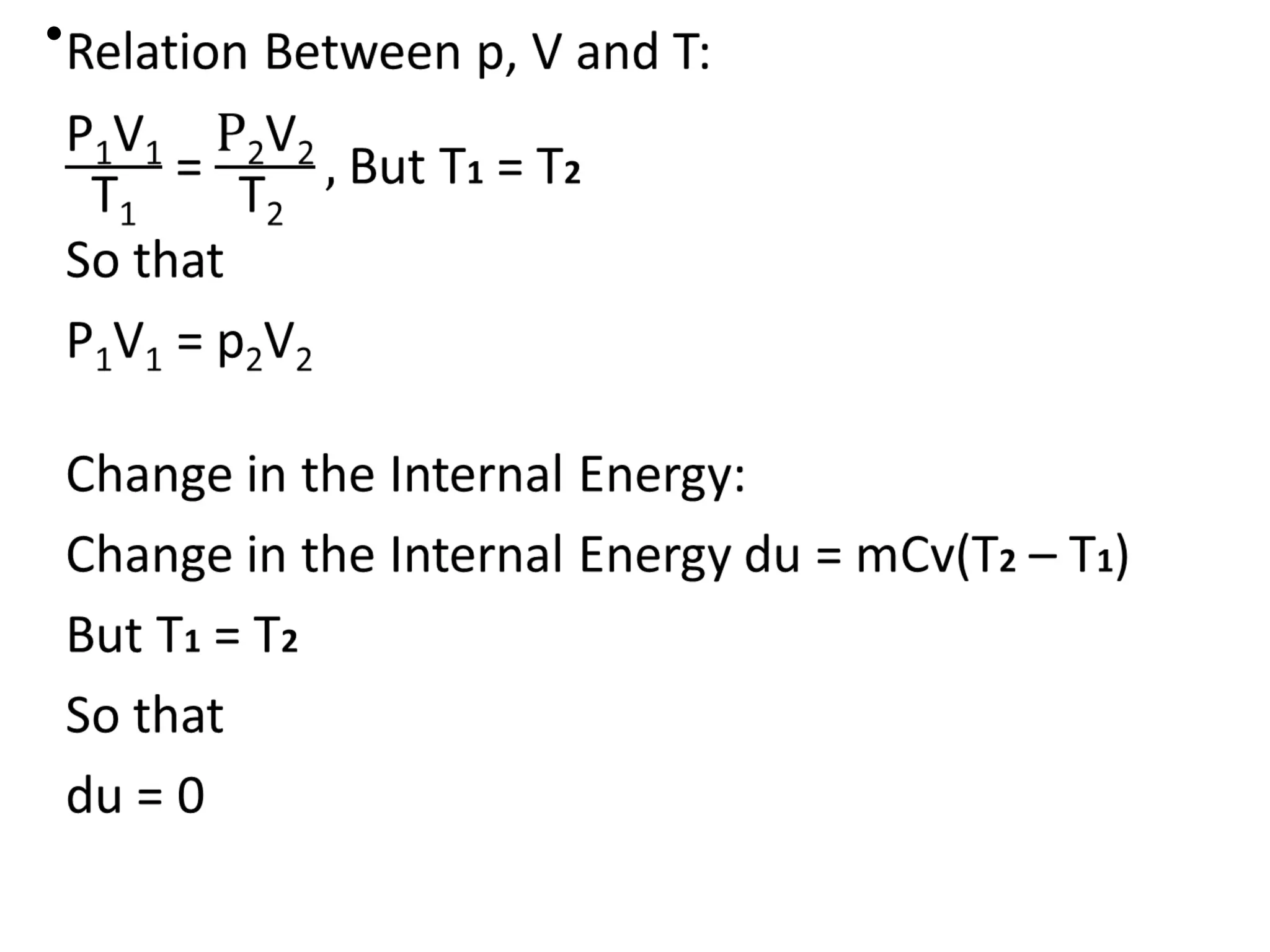
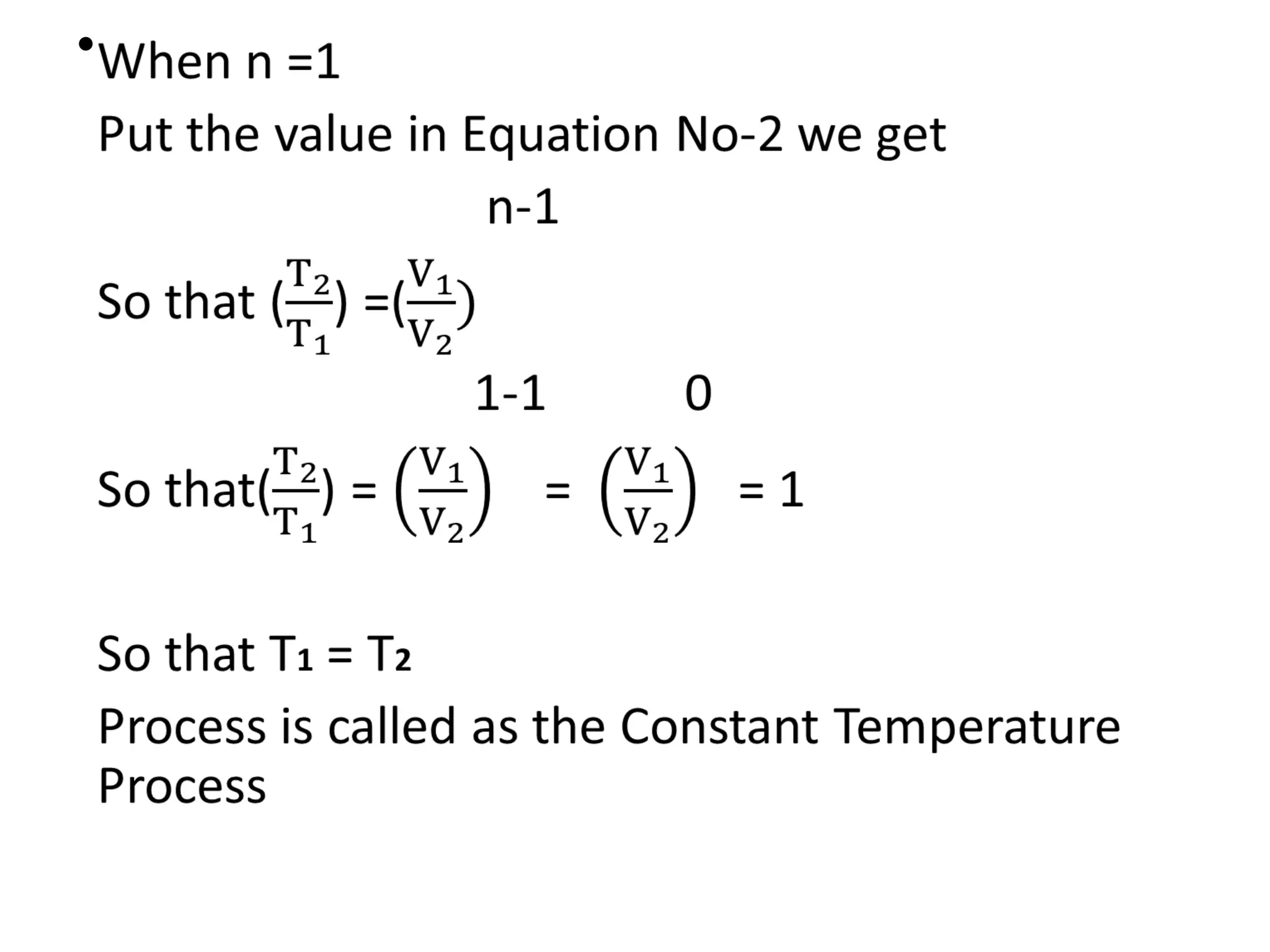
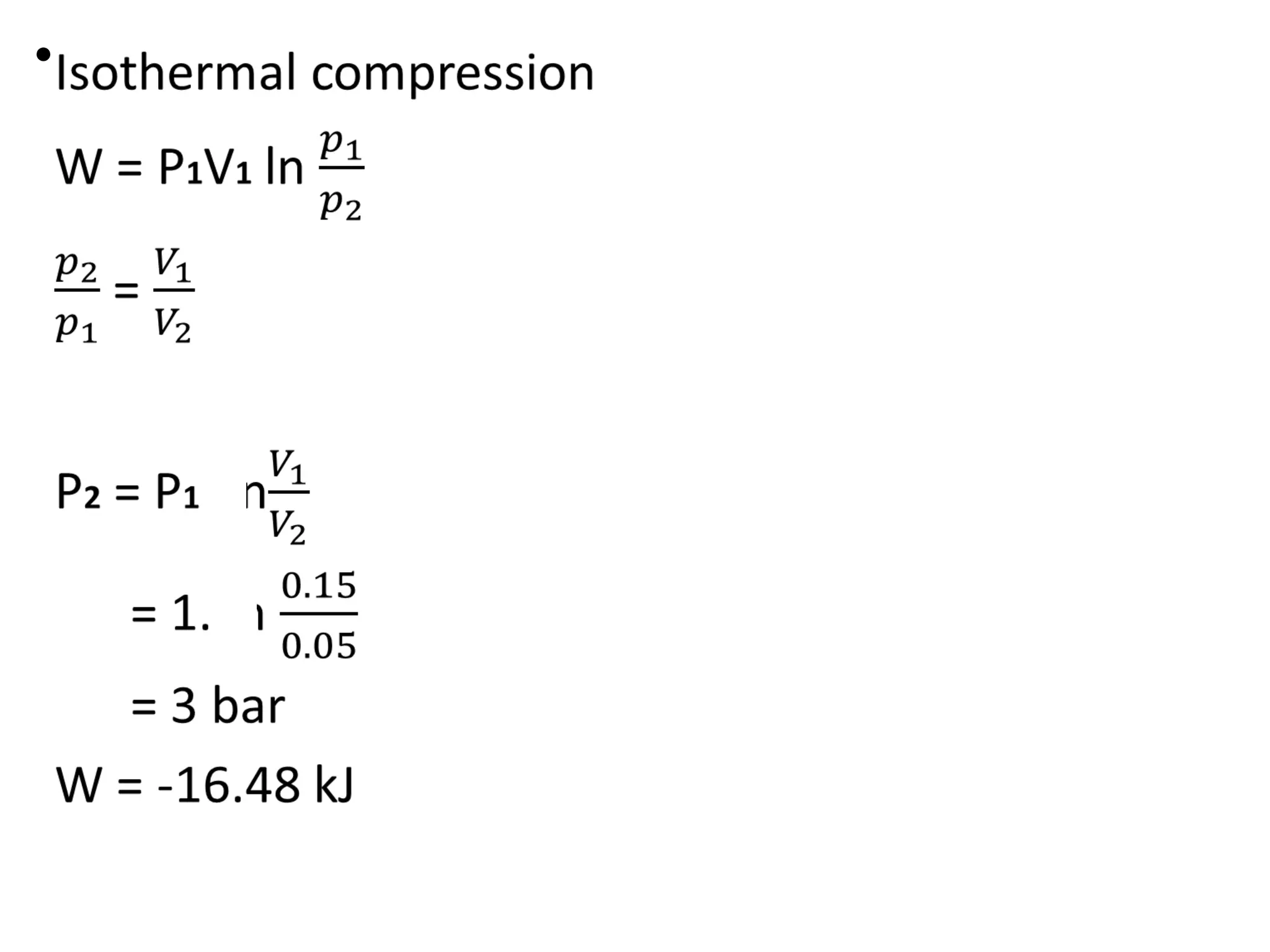
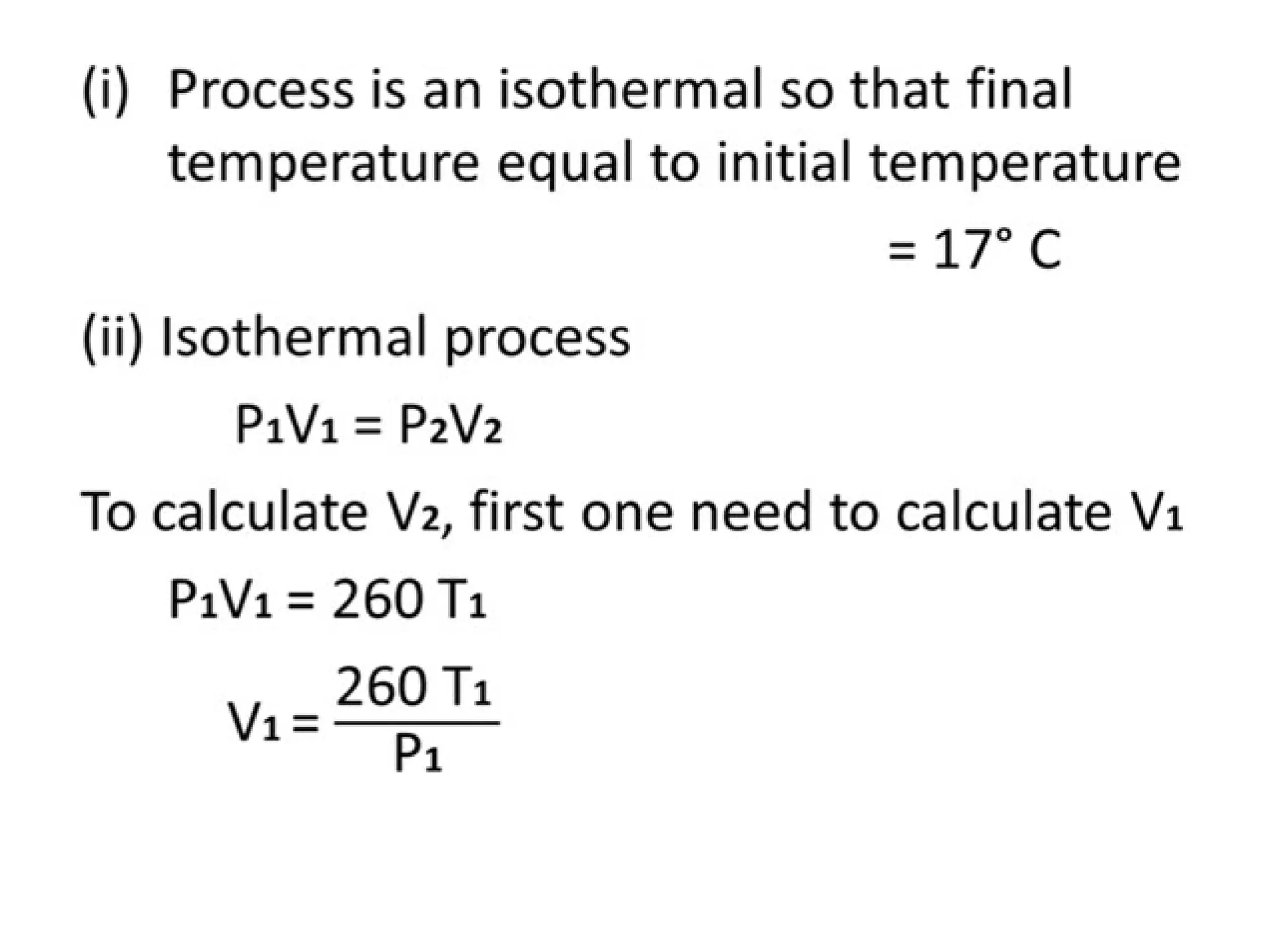
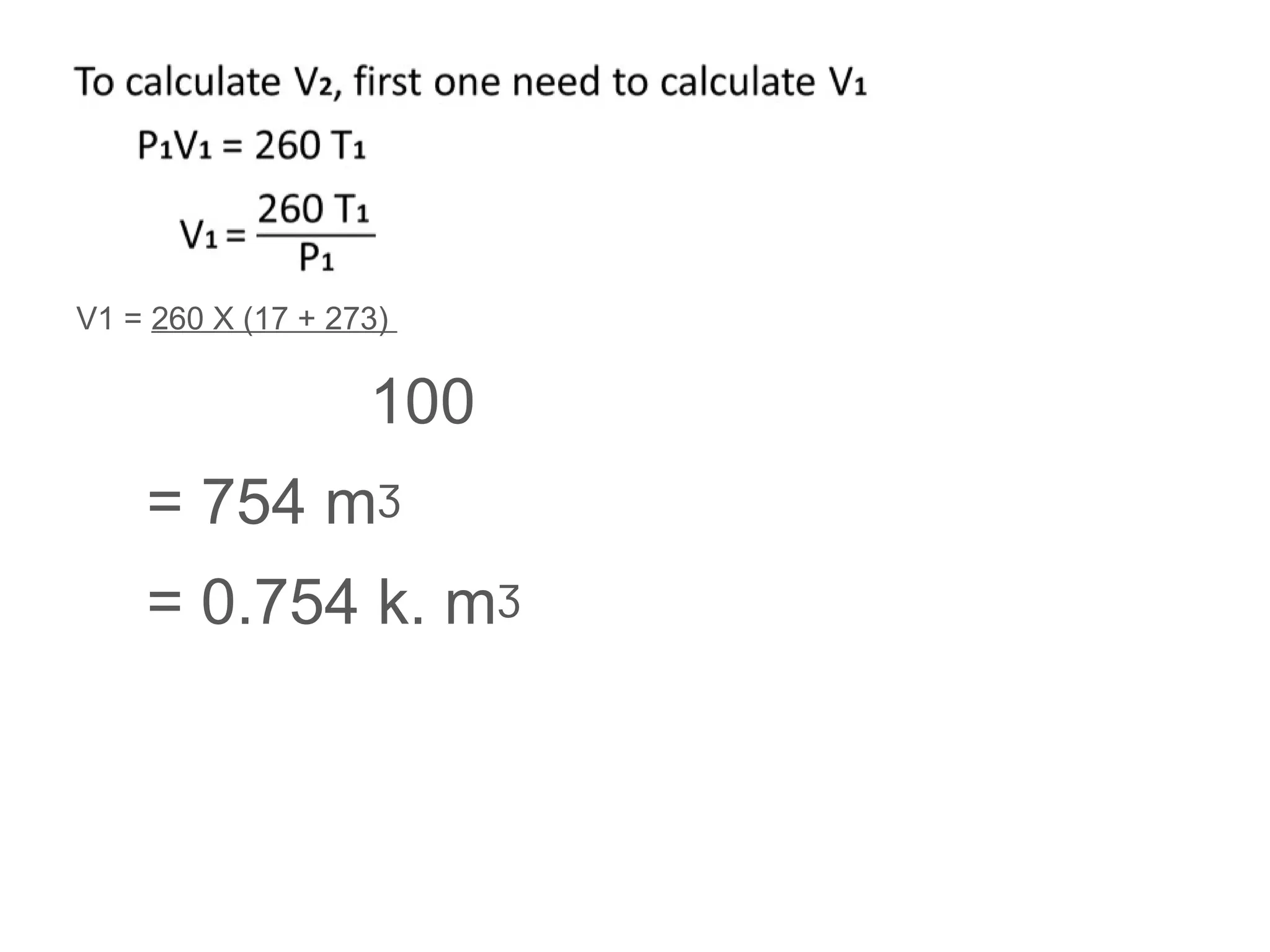
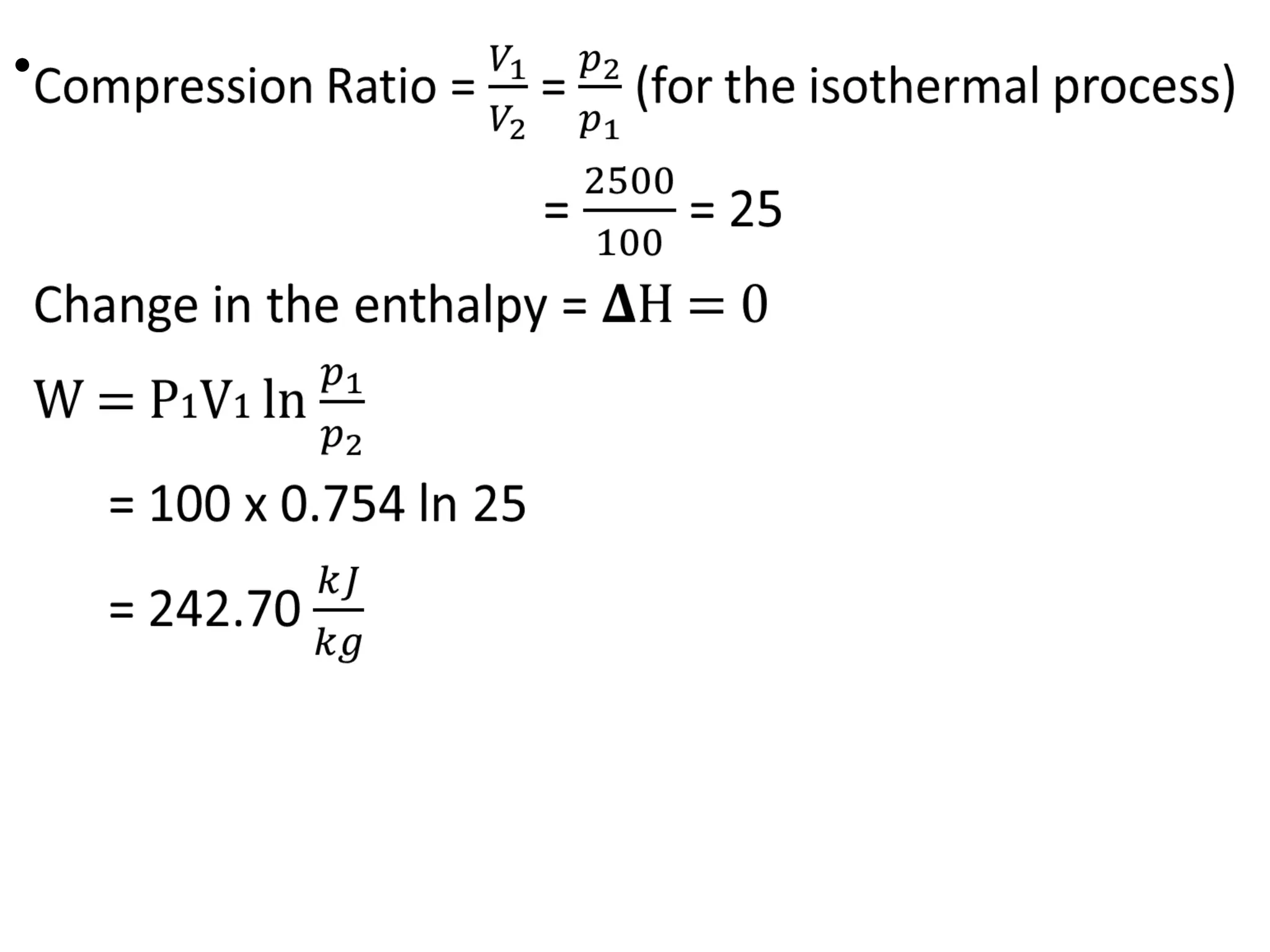
In isothermal processtemperature remains constant during the process .
This process follows Boyle’s law.
Other name of this process is constant internal energy process.
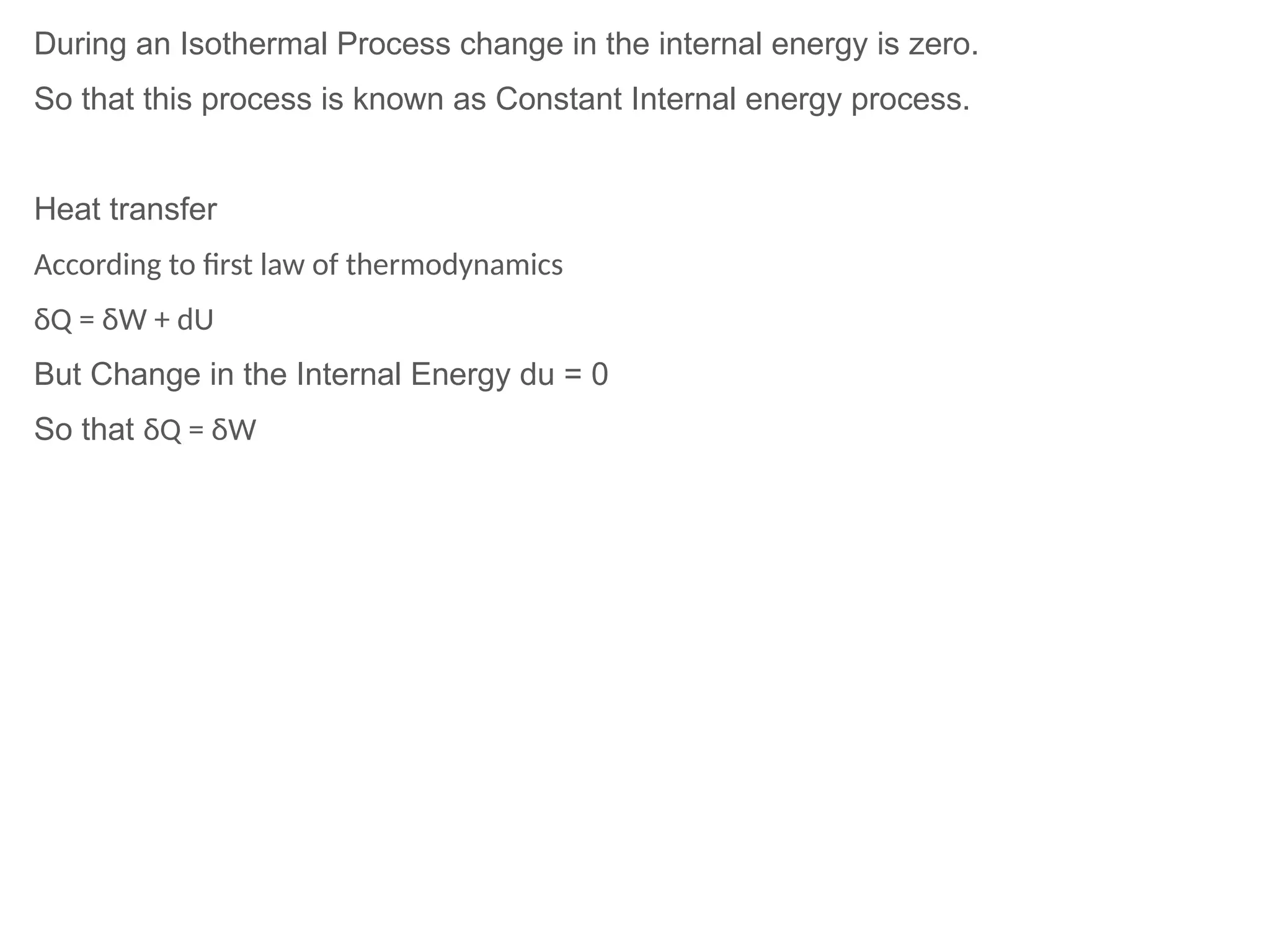
During an IsothermalProcess change in the internal energy is zero.
So that this process is known as Constant Internal energy process.
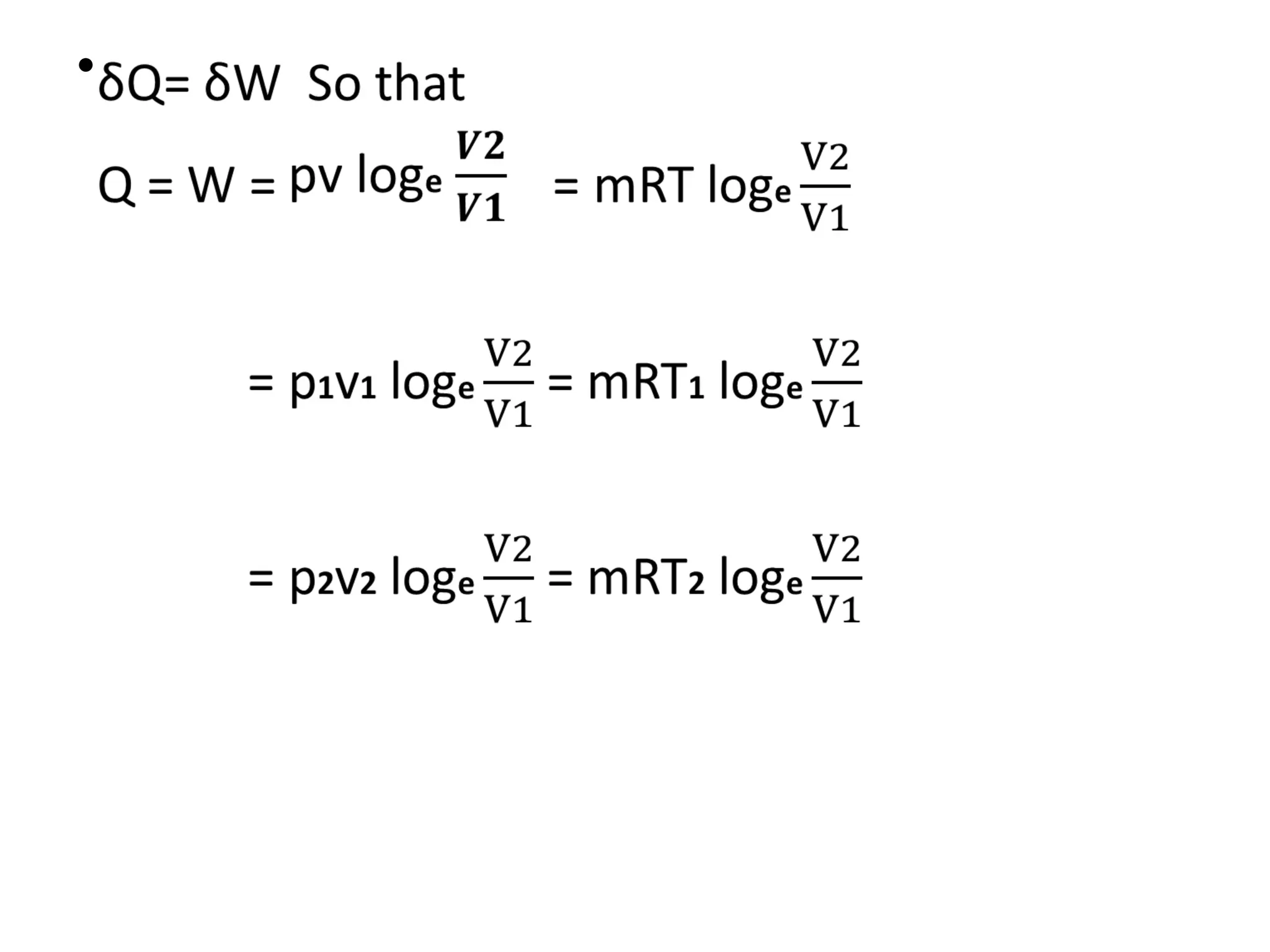
Heat transfer
According to first law of thermodynamics
δQ = δW + dU
But Change in the Internal Energy du = 0
So that δQ = δW
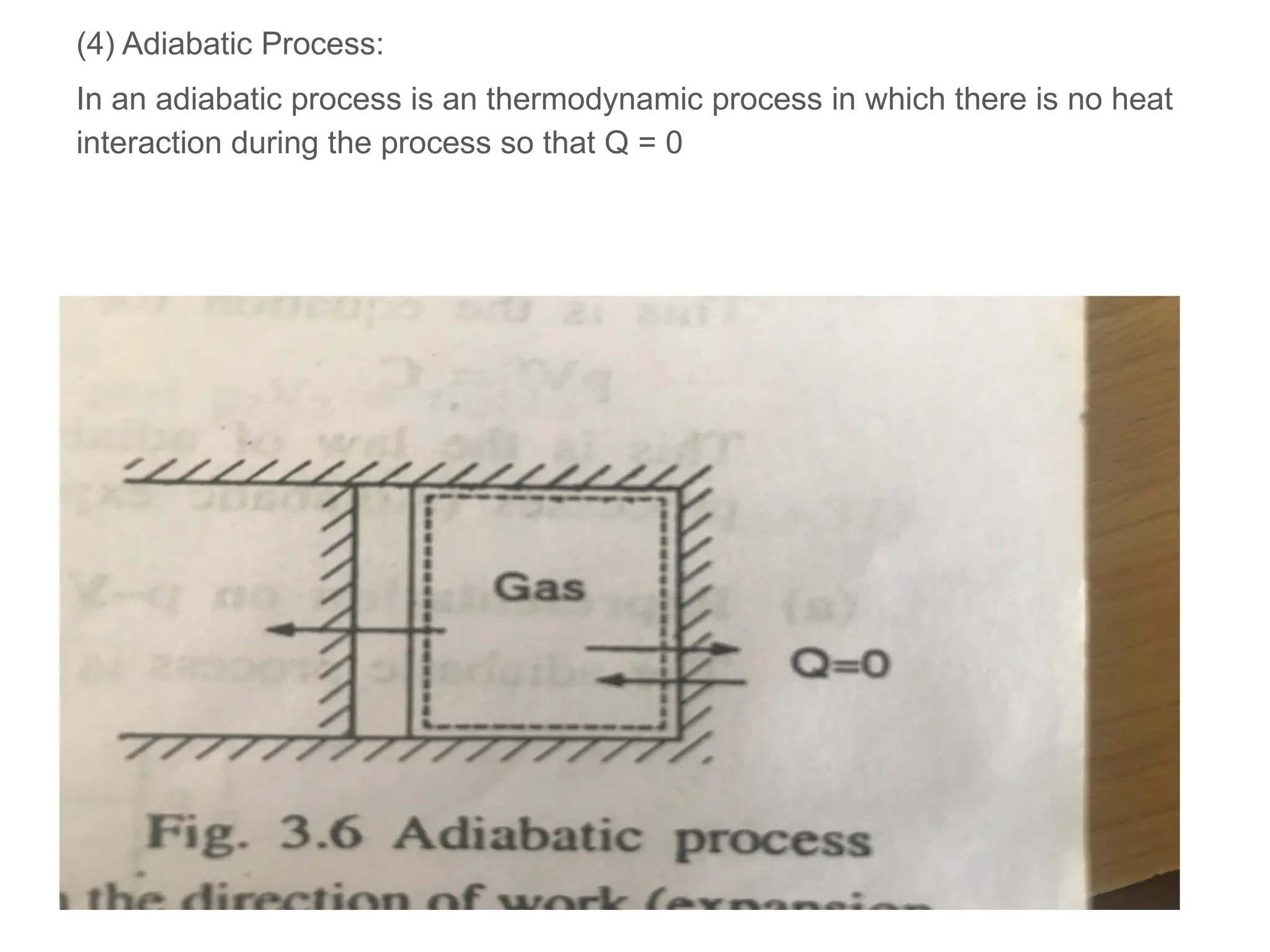
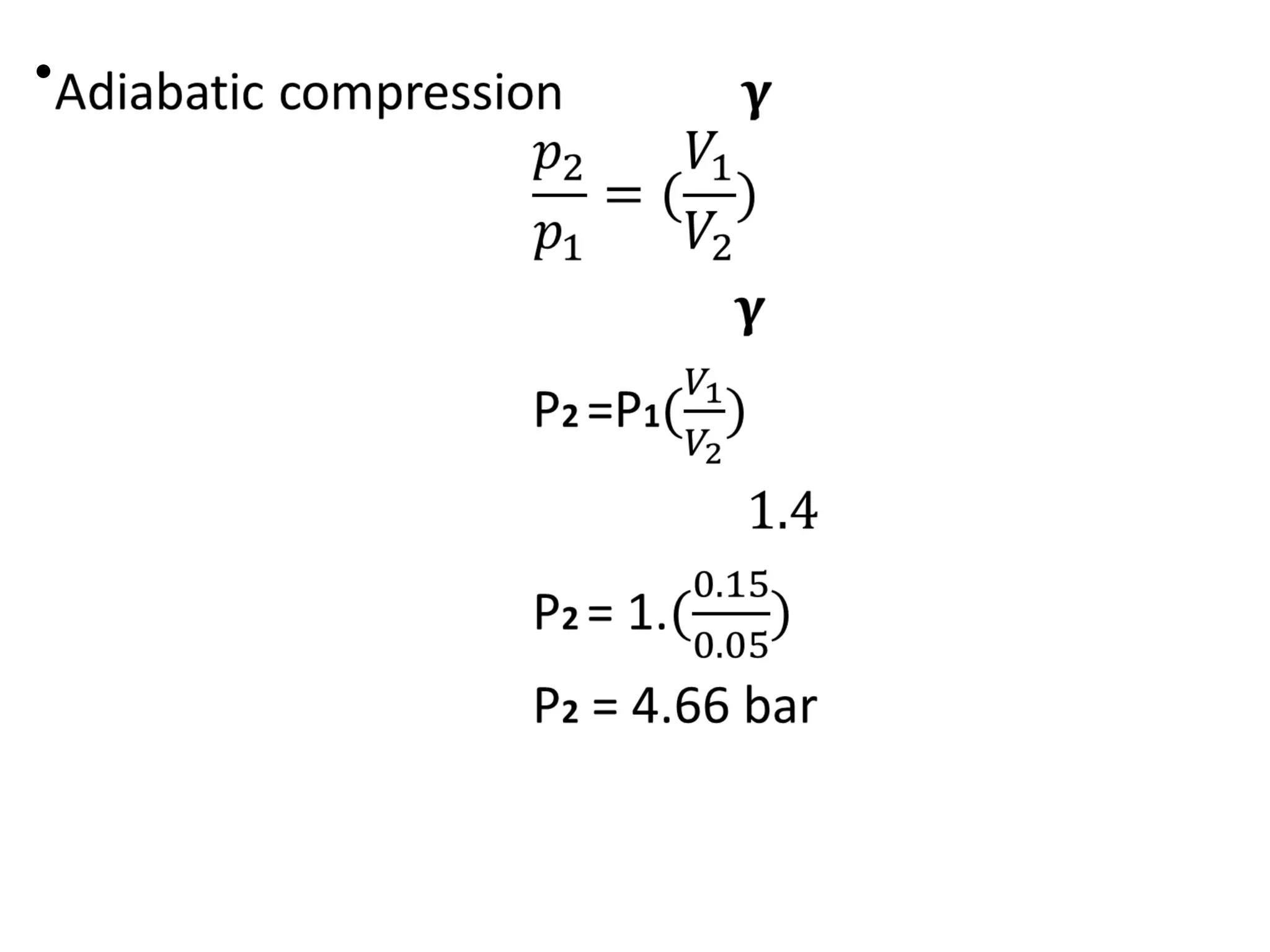
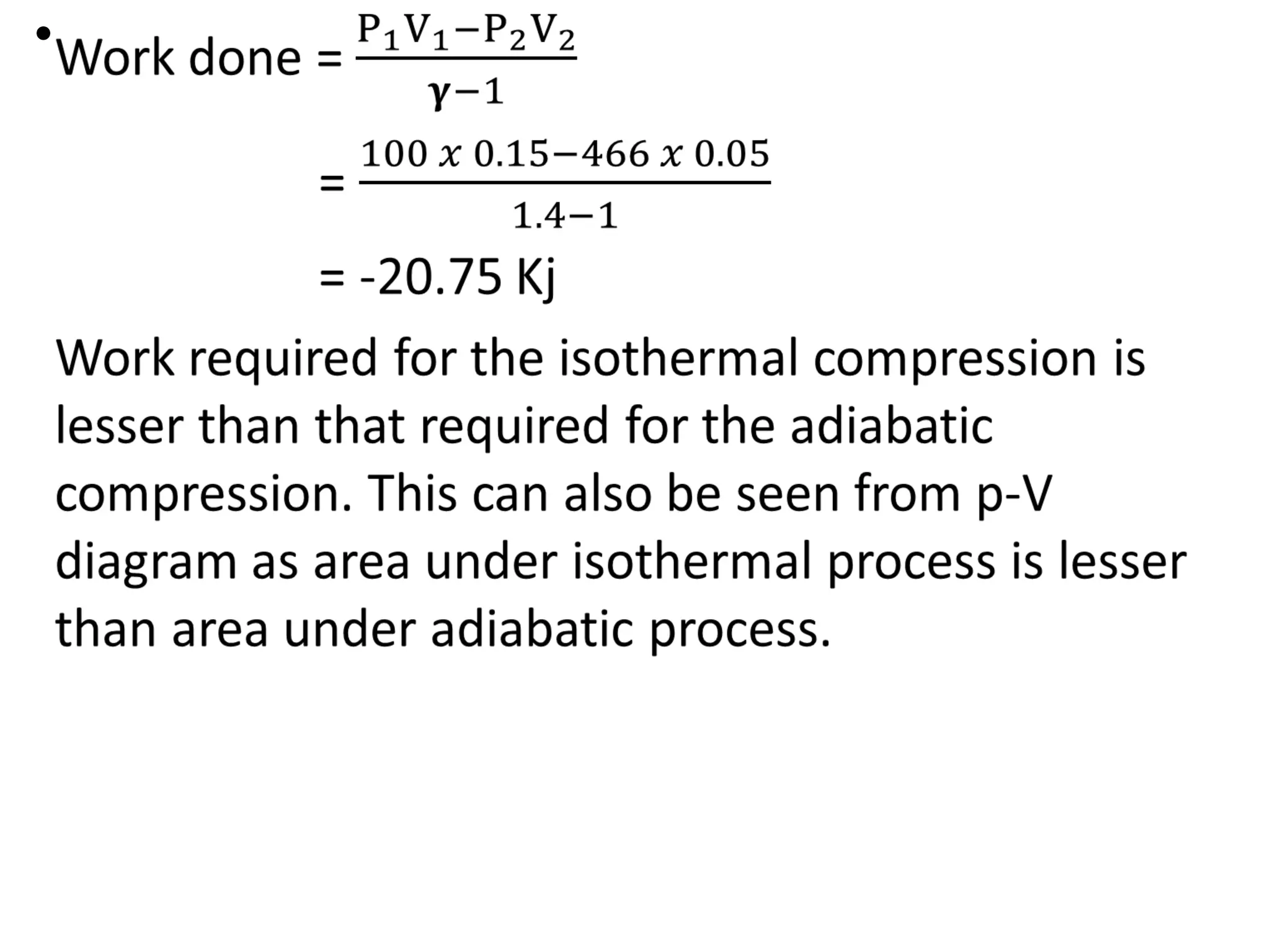
(4) Adiabatic Process:
Inan adiabatic process is an thermodynamic process in which there is no heat
interaction during the process so that Q = 0
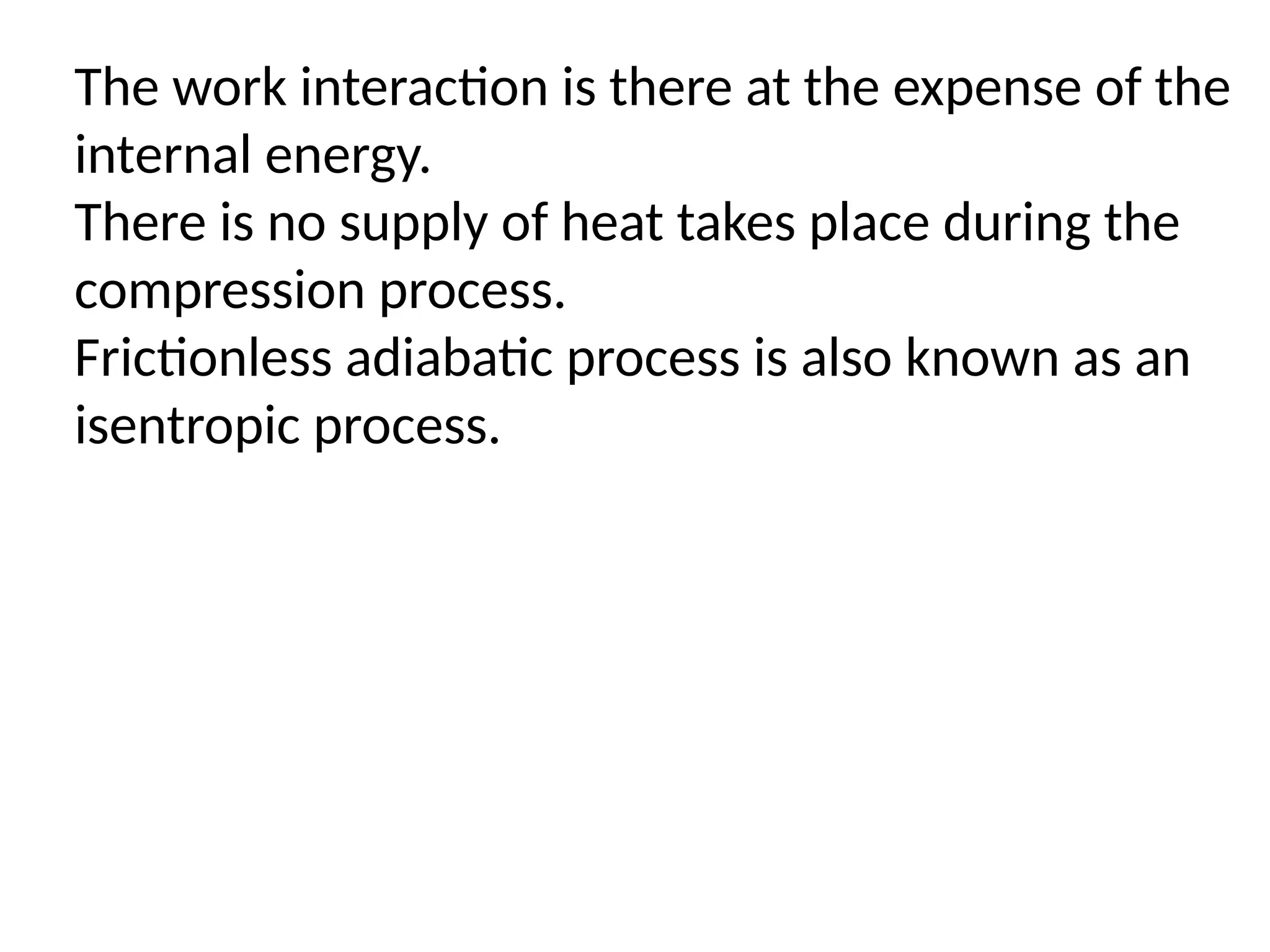
70.
The work interactionis there at the expense of the
internal energy.
There is no supply of heat takes place during the
compression process.
Frictionless adiabatic process is also known as an
isentropic process.
72.
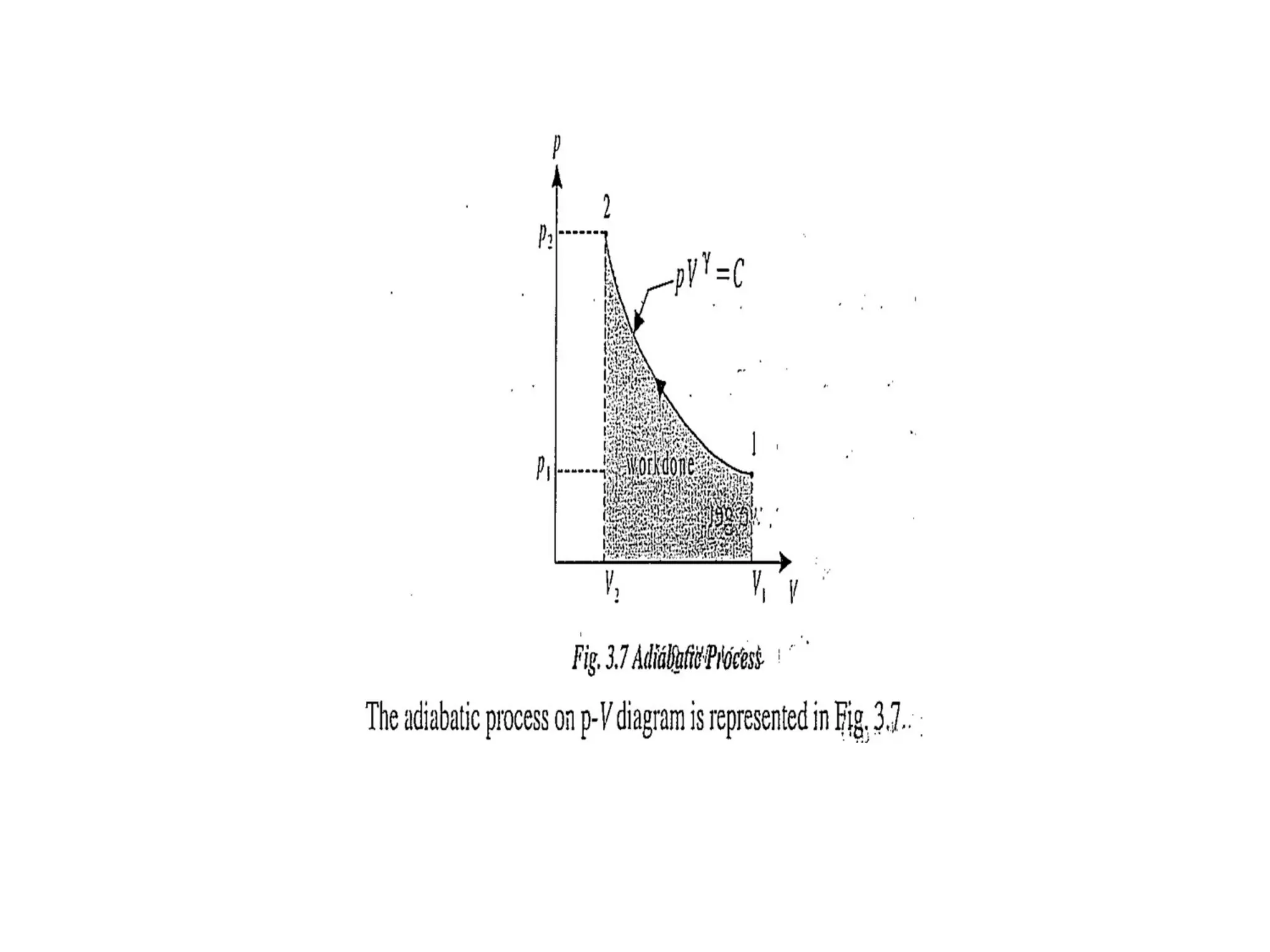
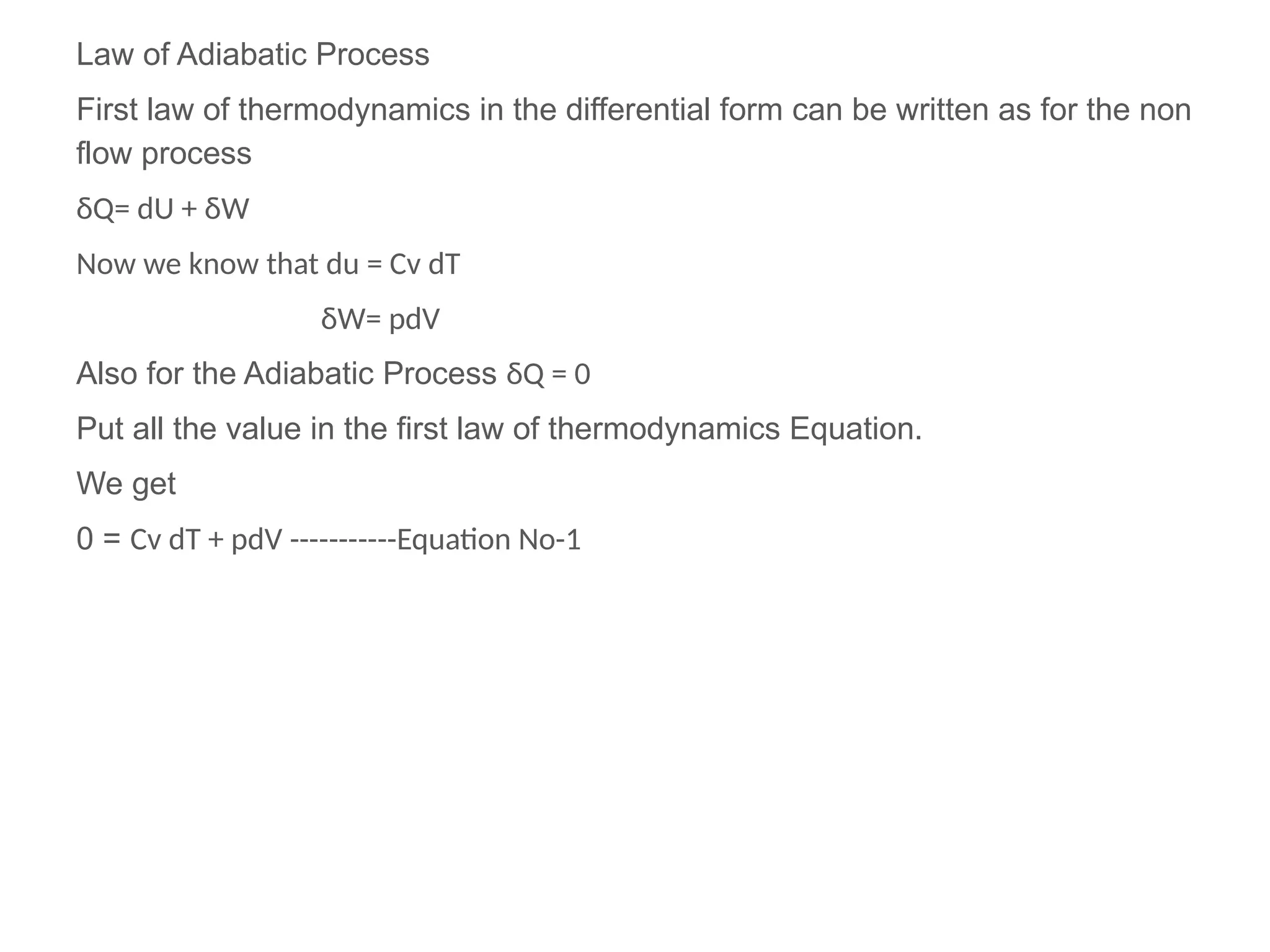
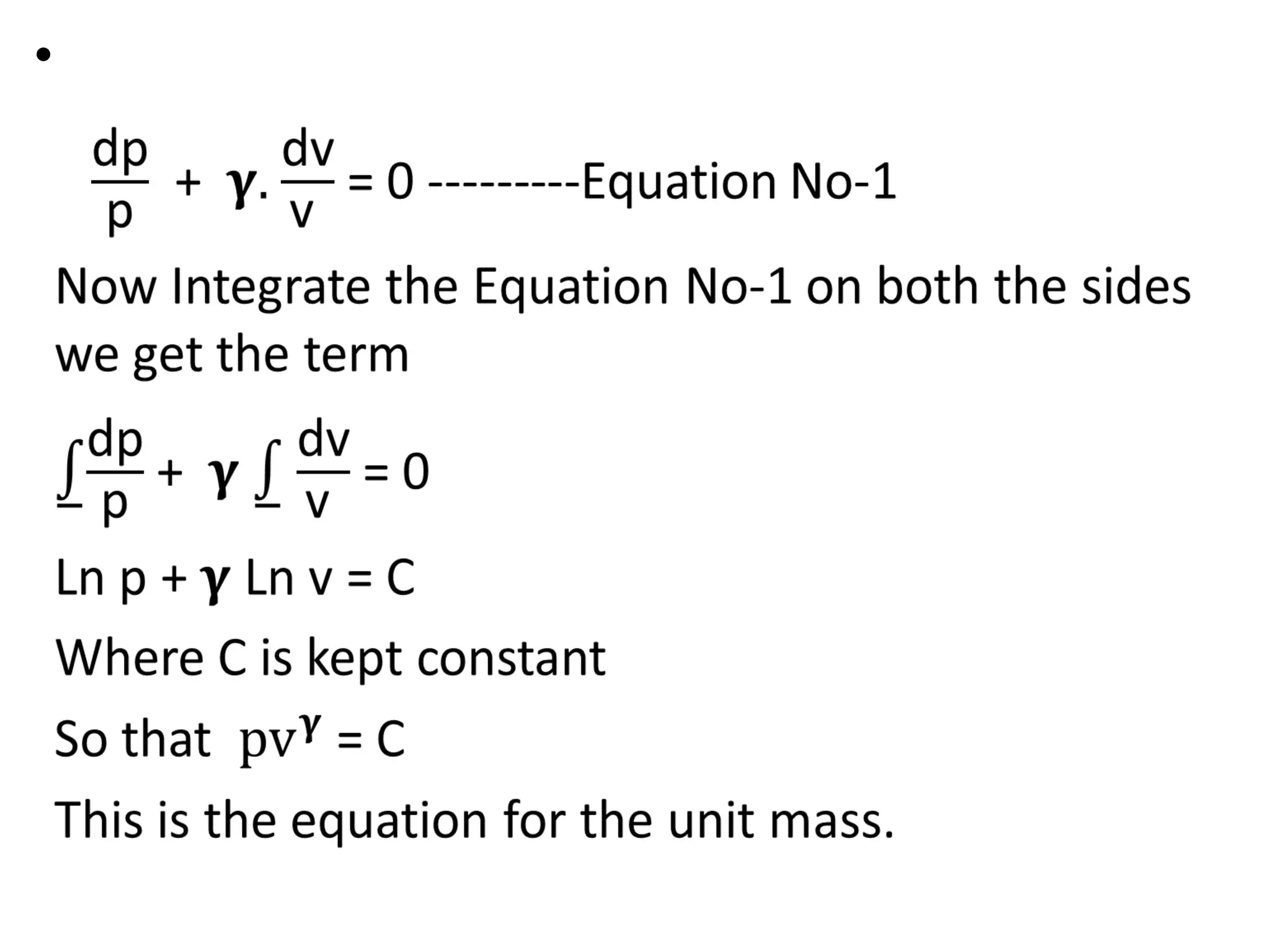
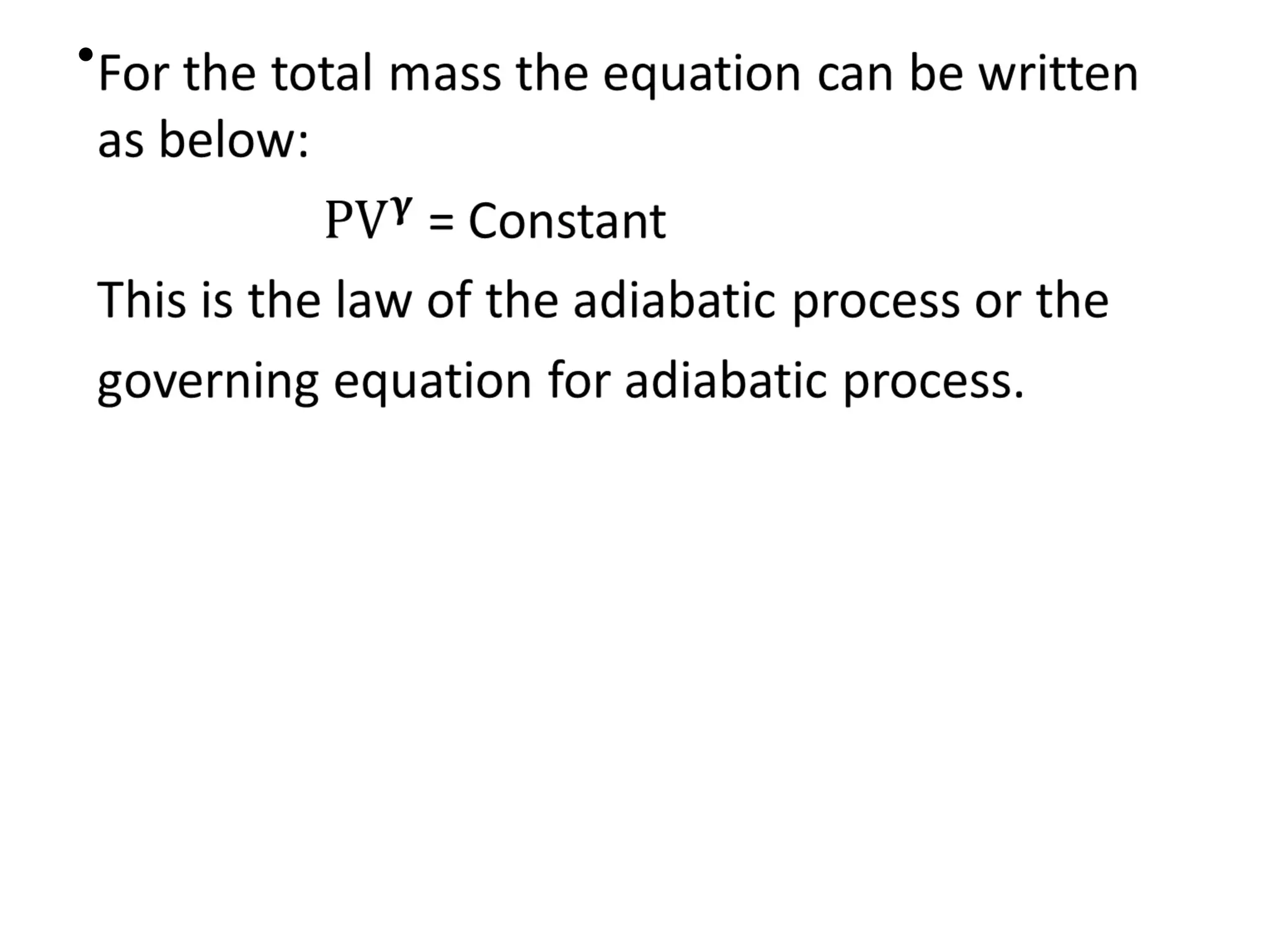
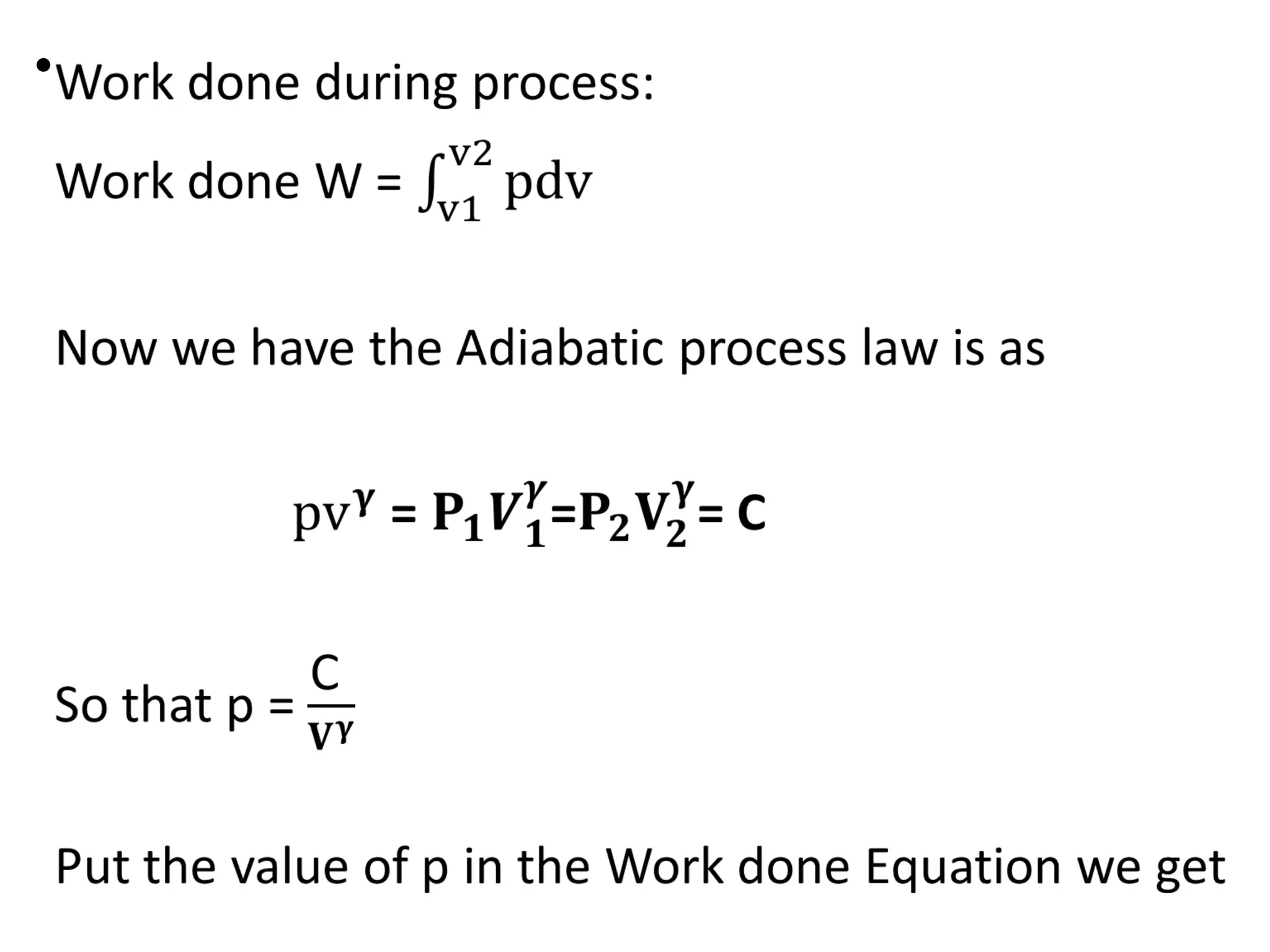
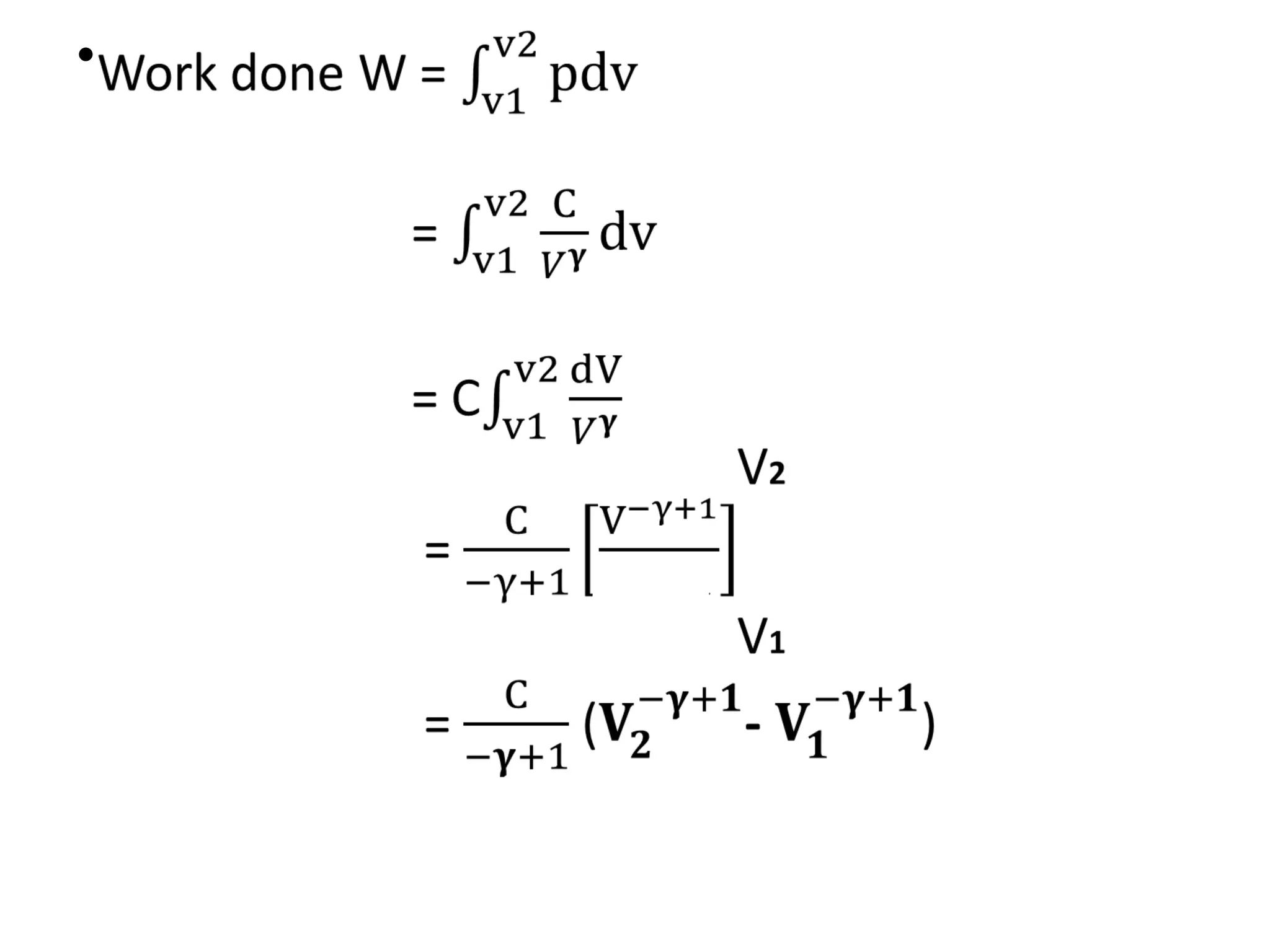
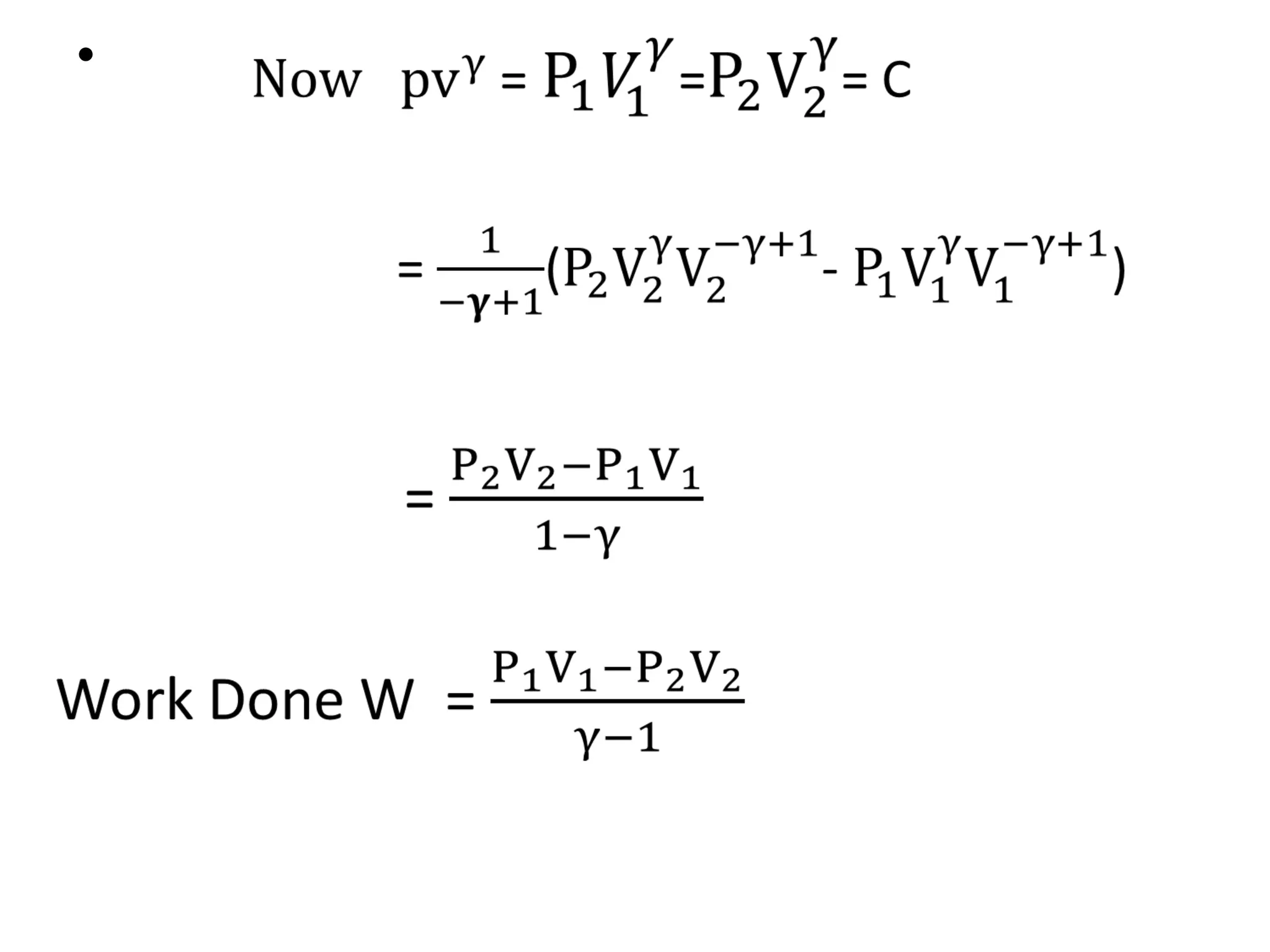
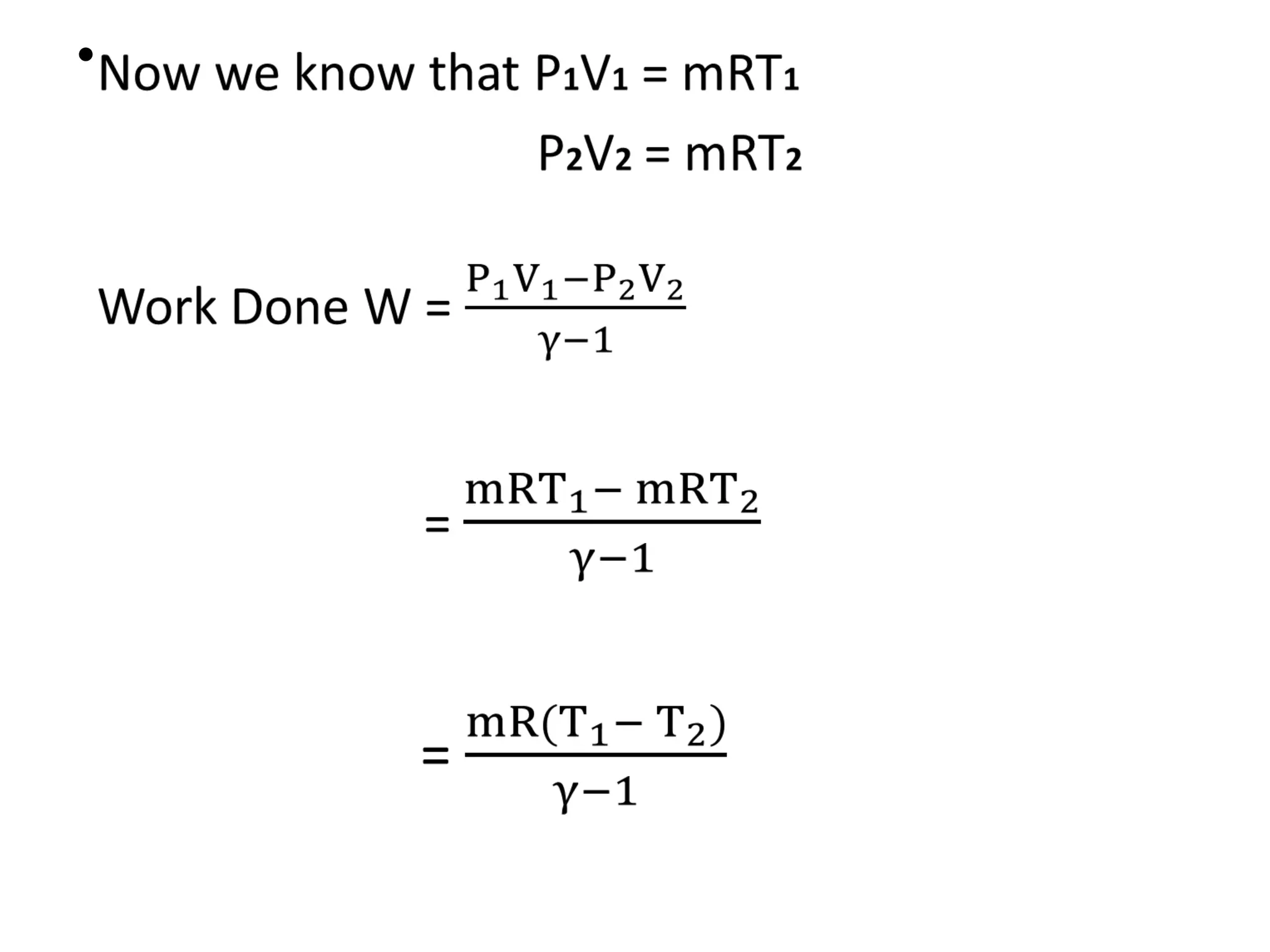
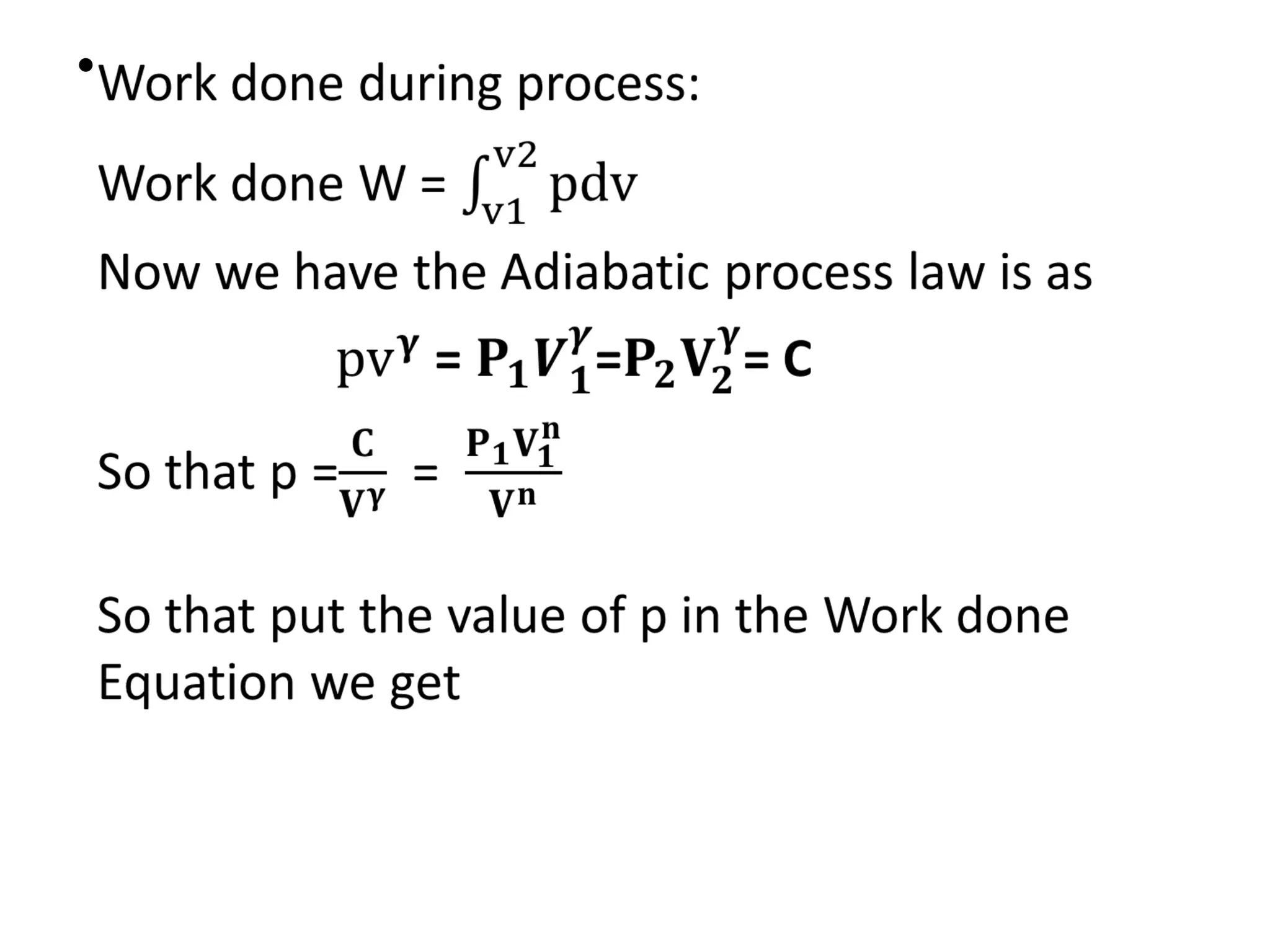
Law of AdiabaticProcess
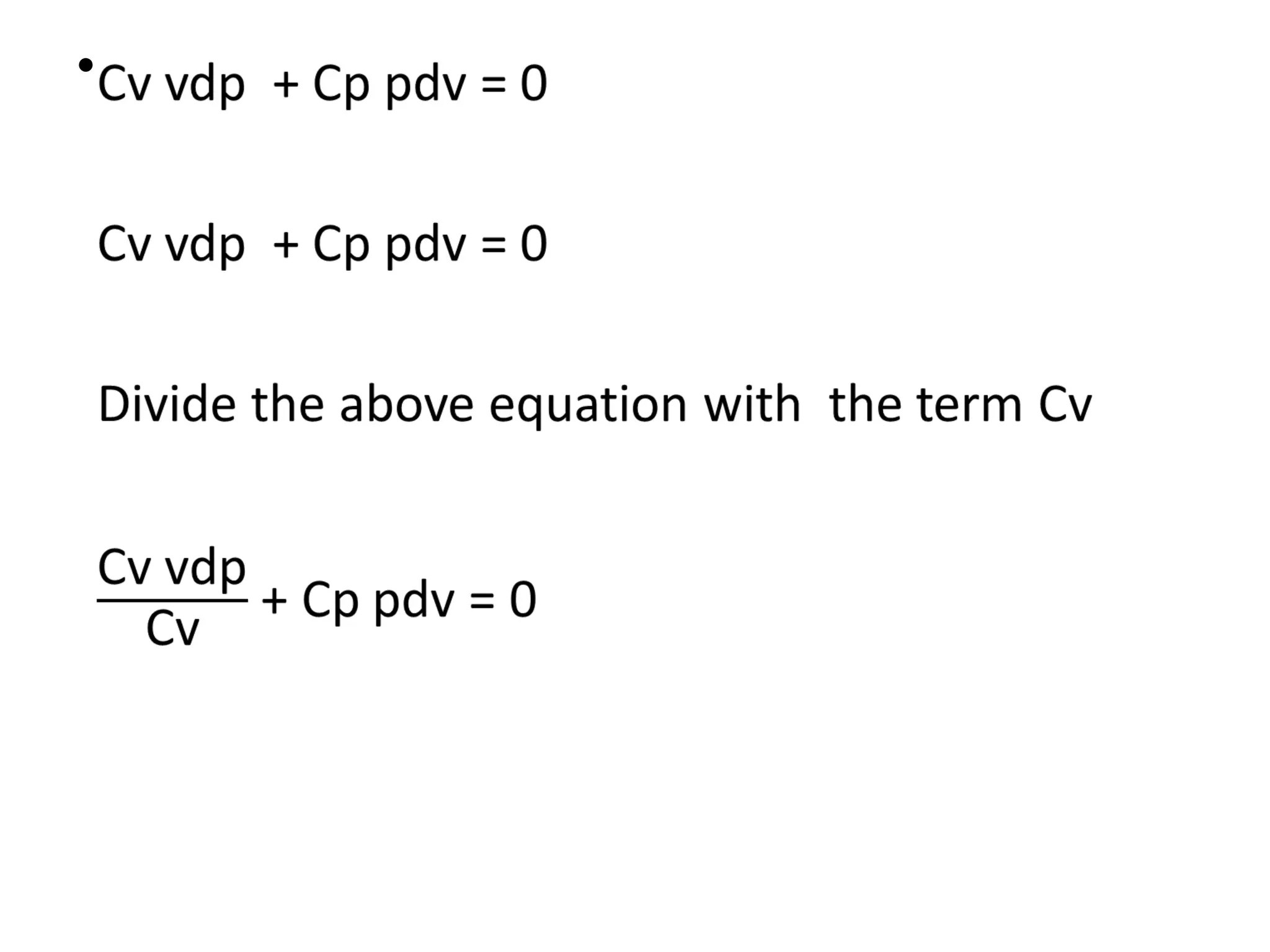
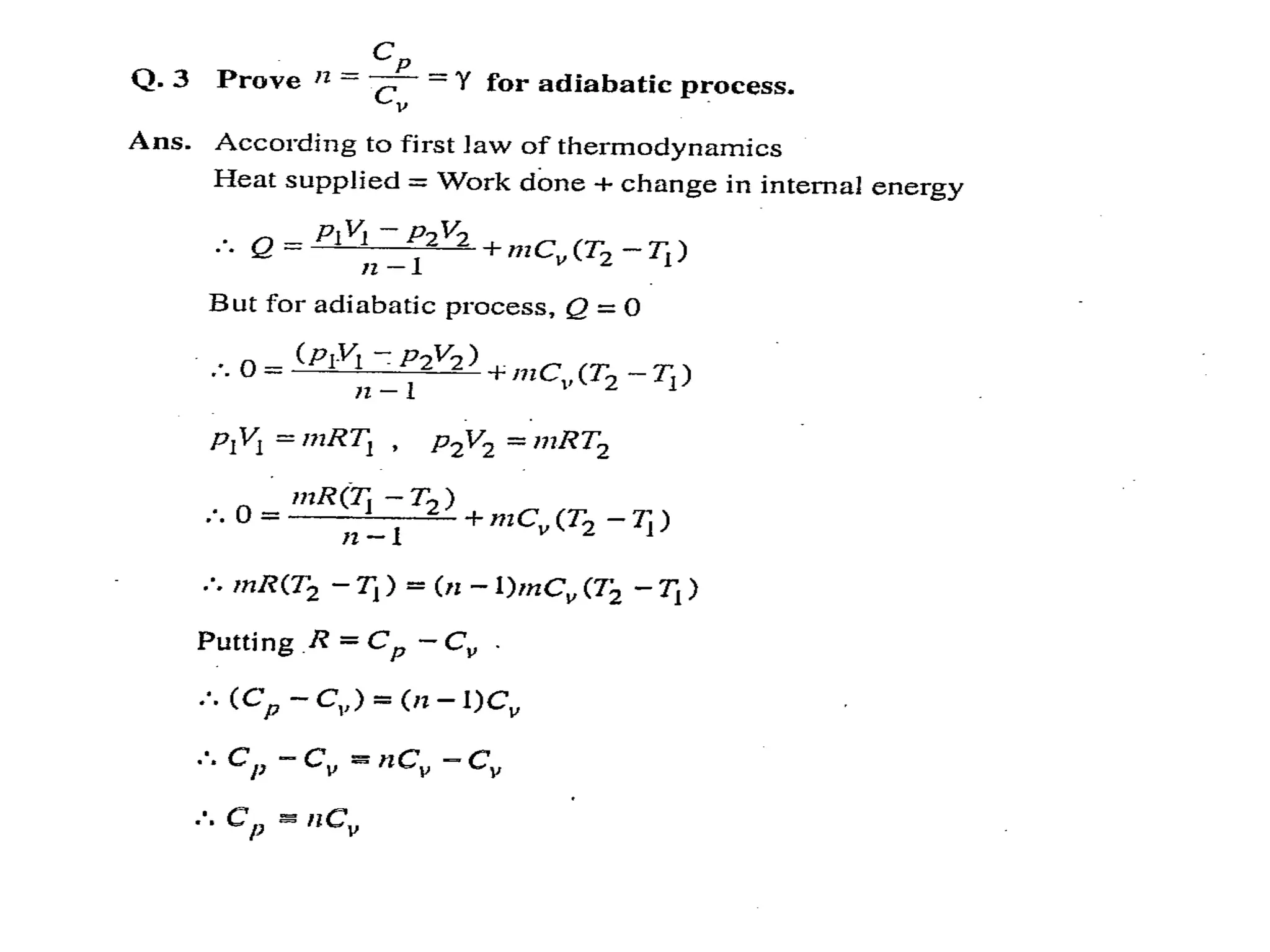
First law of thermodynamics in the differential form can be written as for the non
flow process
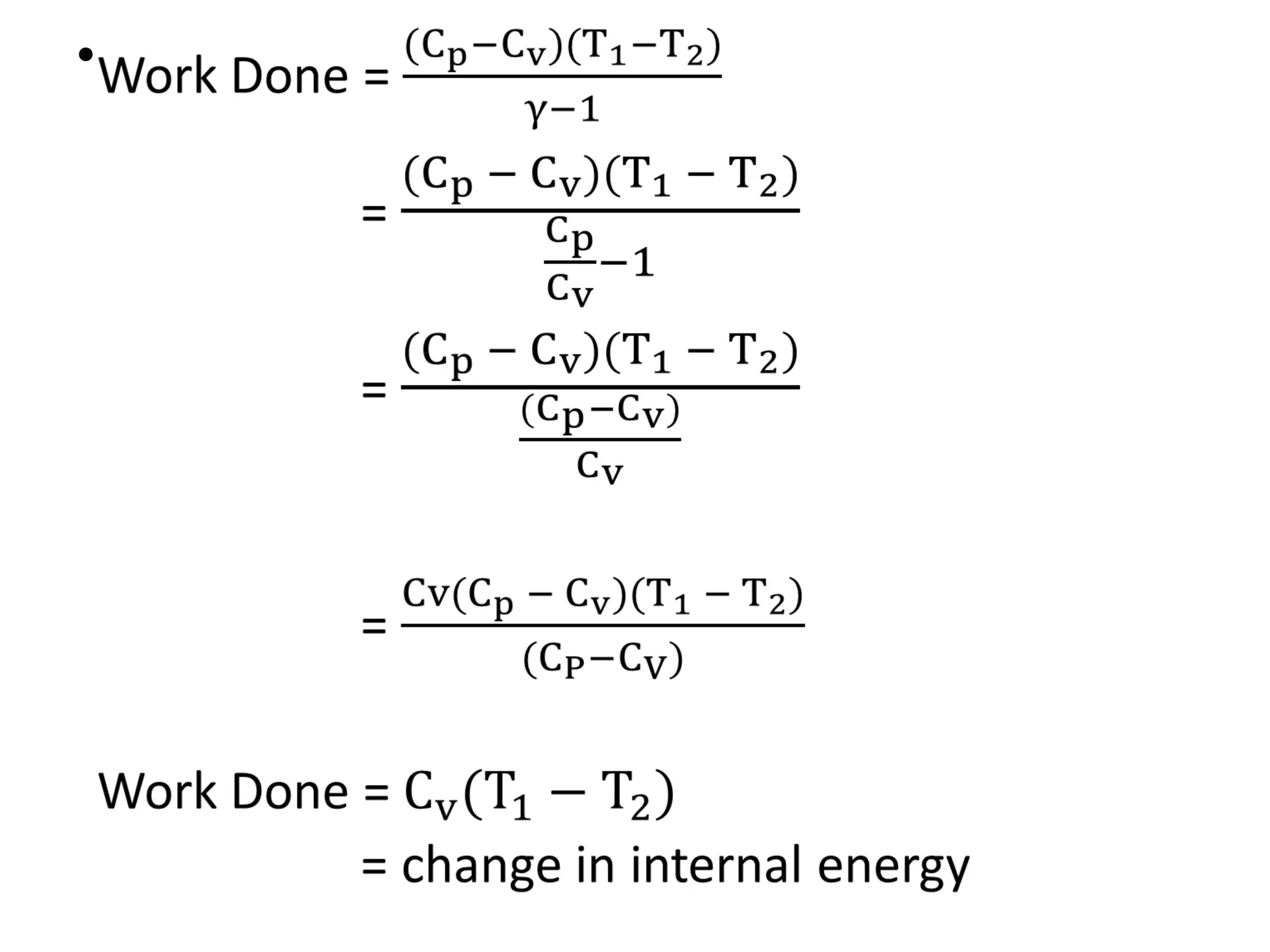
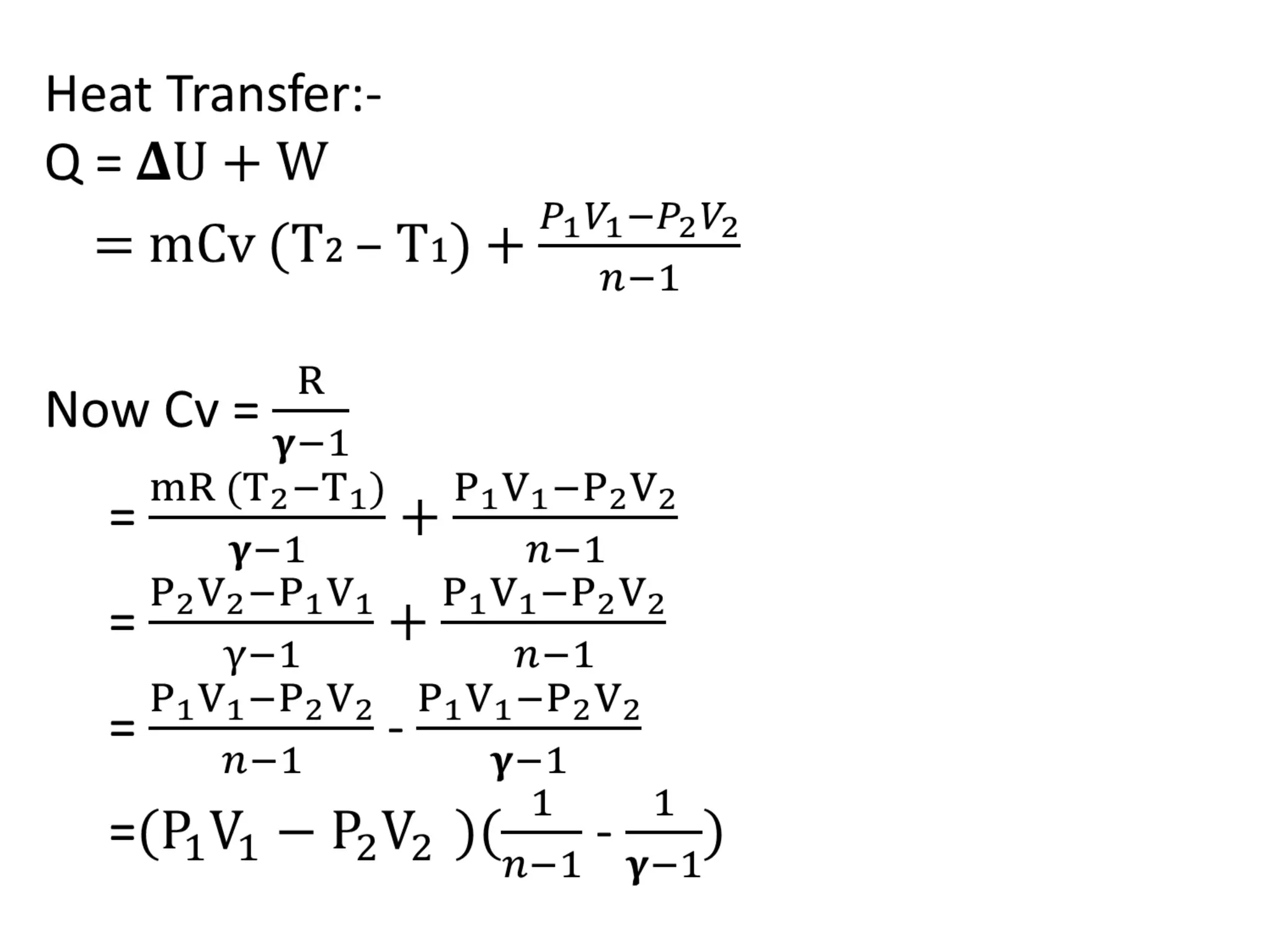
δQ= dU + δW
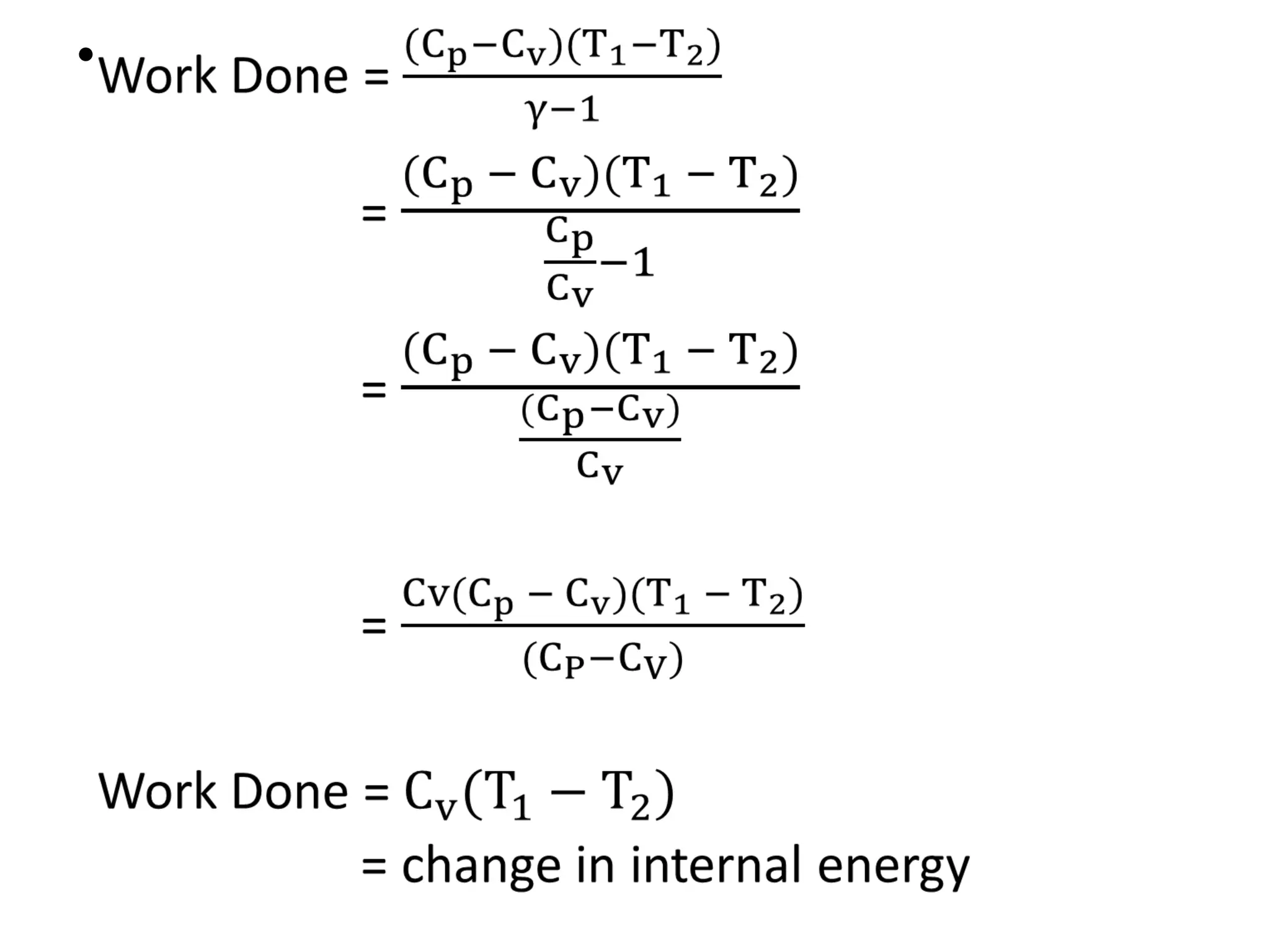
Now we know that du = Cv dT
δW= pdV
Also for the Adiabatic Process δQ = 0
Put all the value in the first law of thermodynamics Equation.
We get
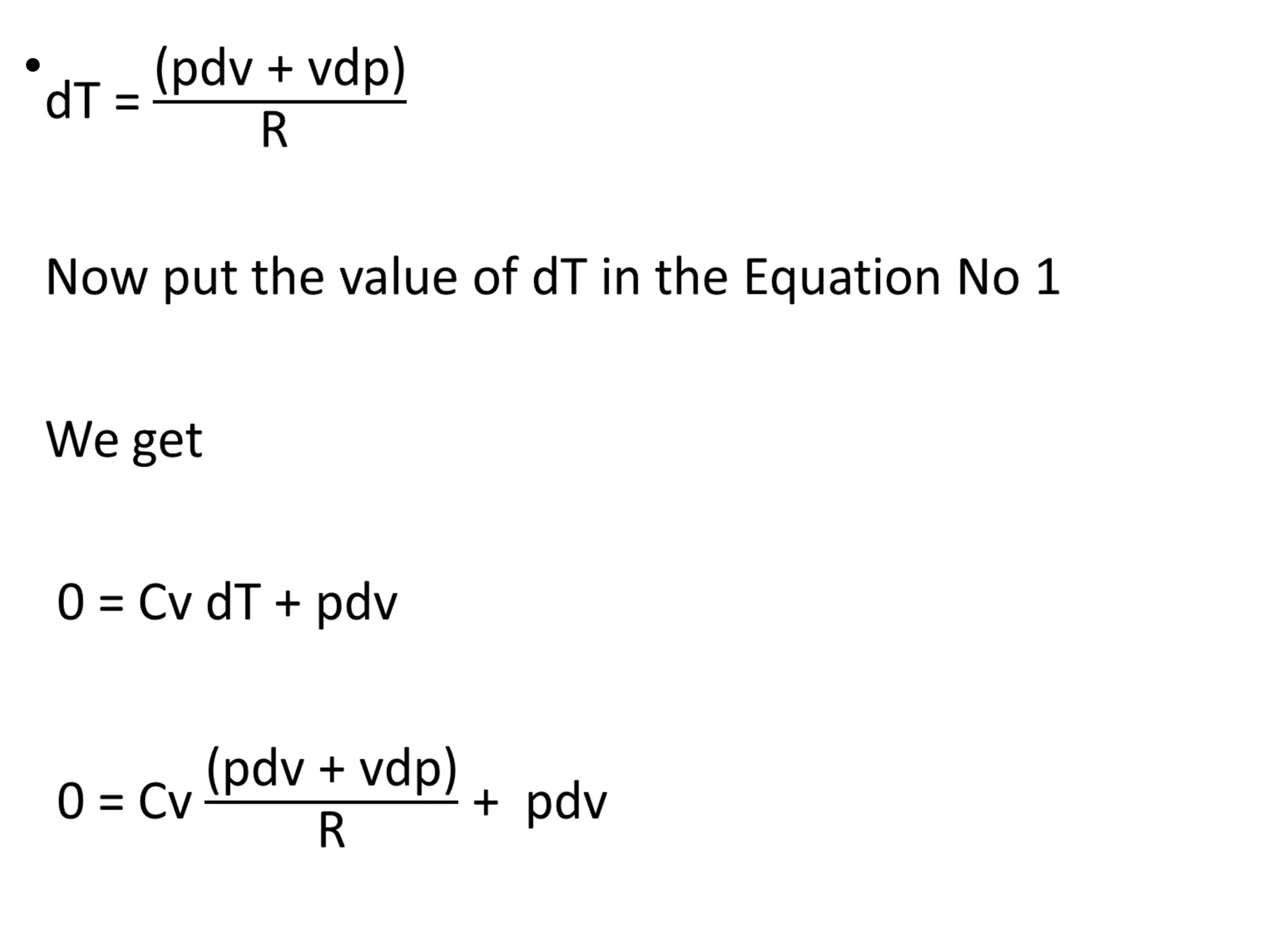
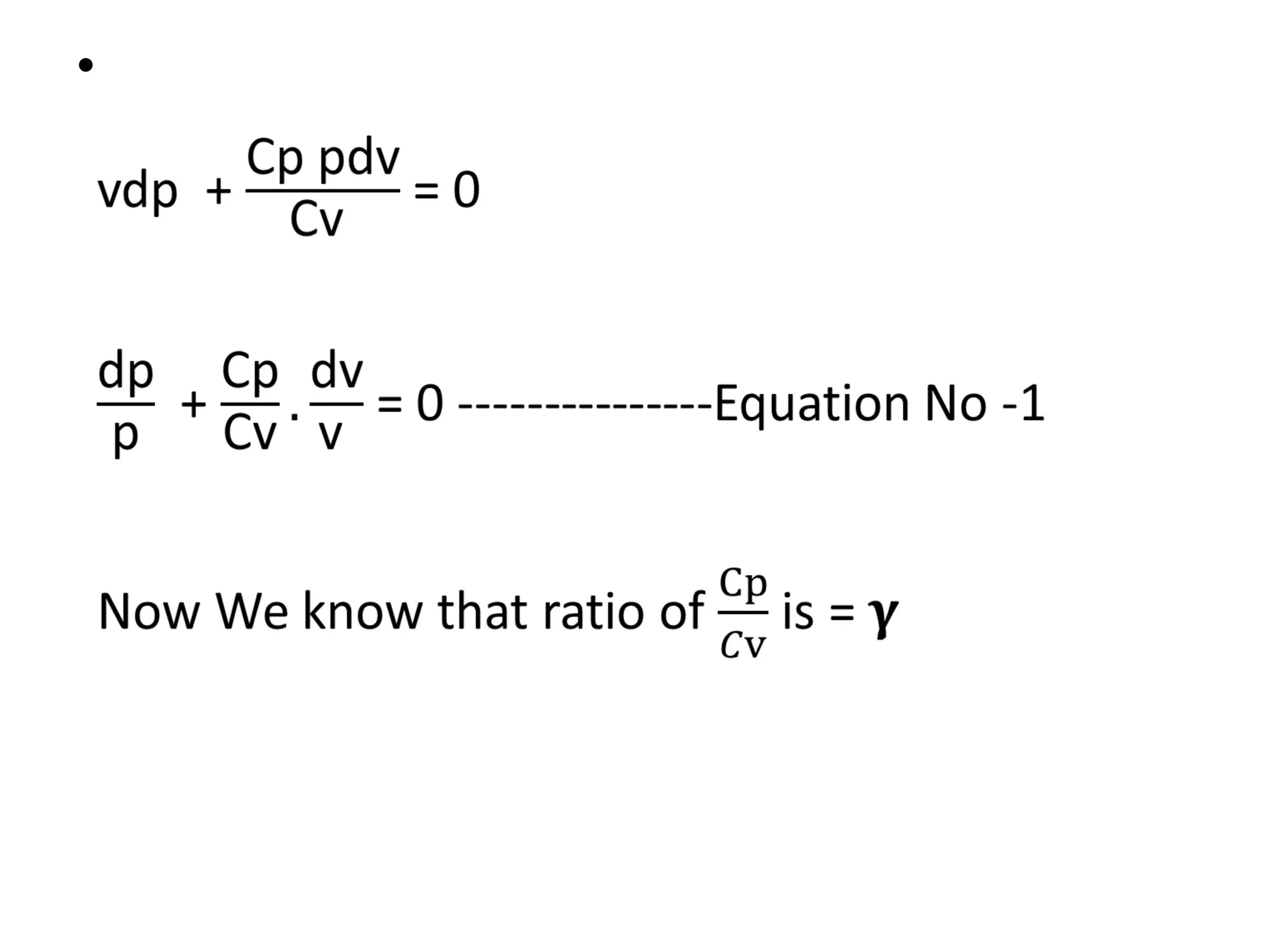
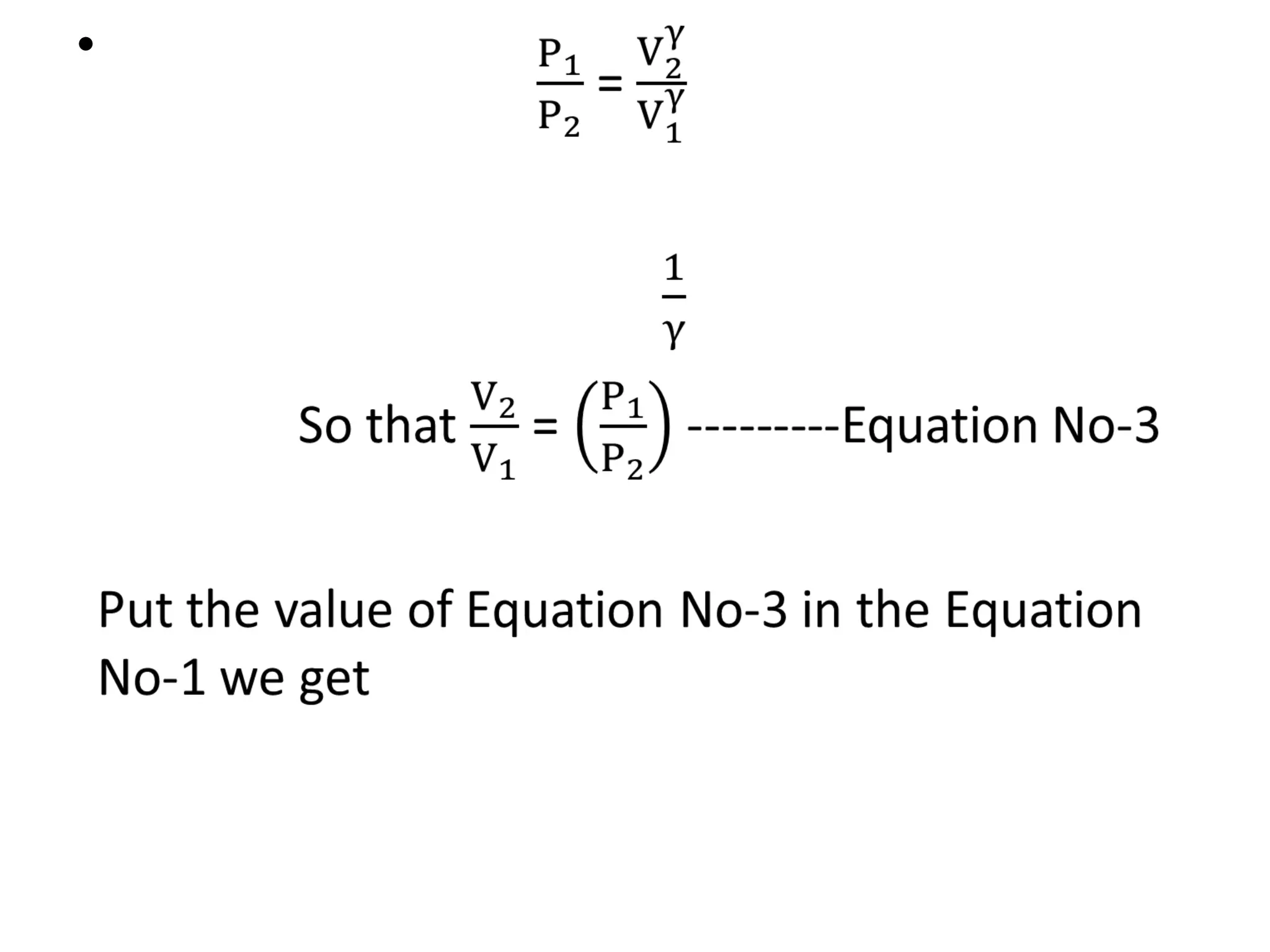
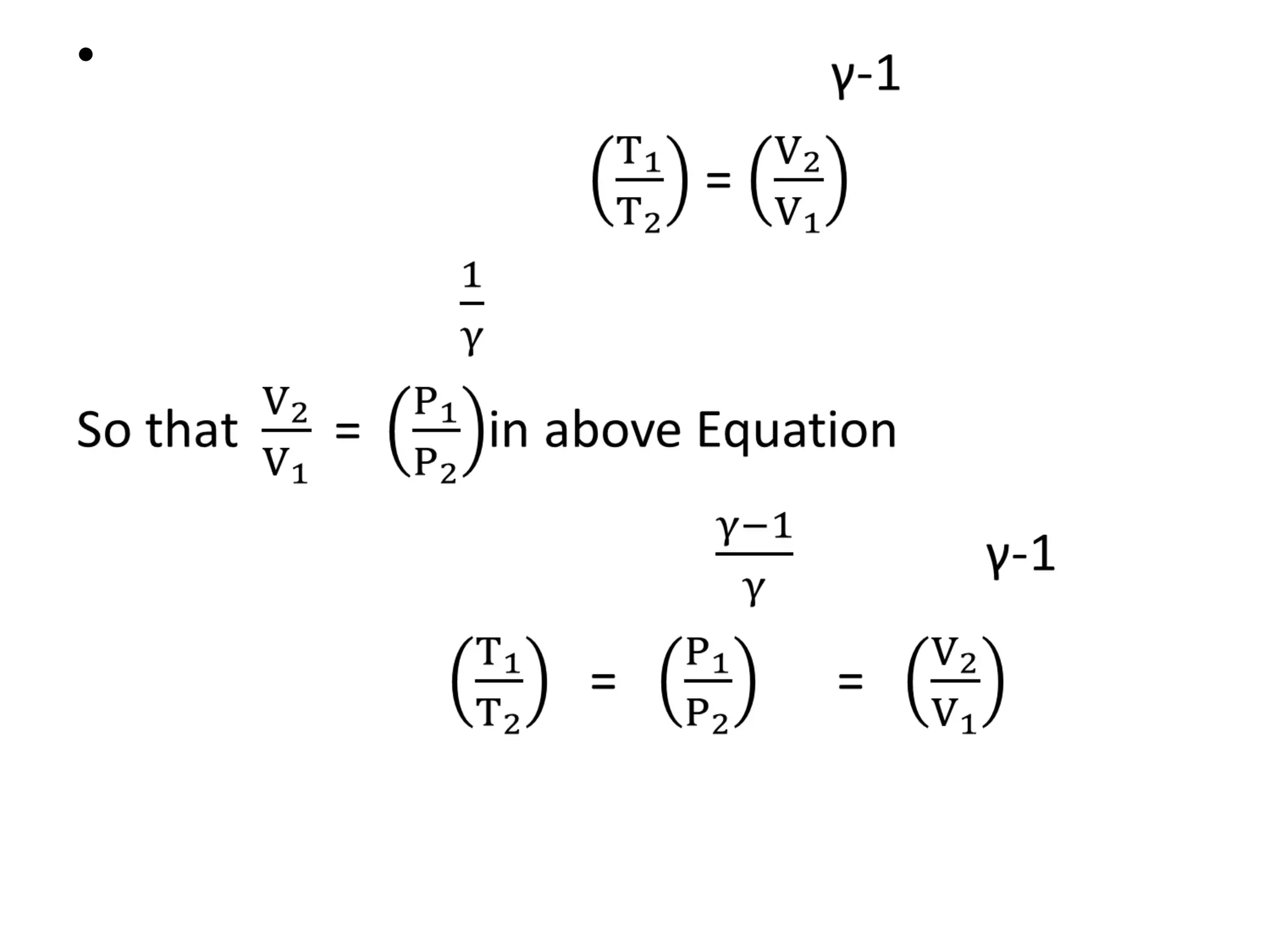
0 = Cv dT + pdV -----------Equation No-1
73.
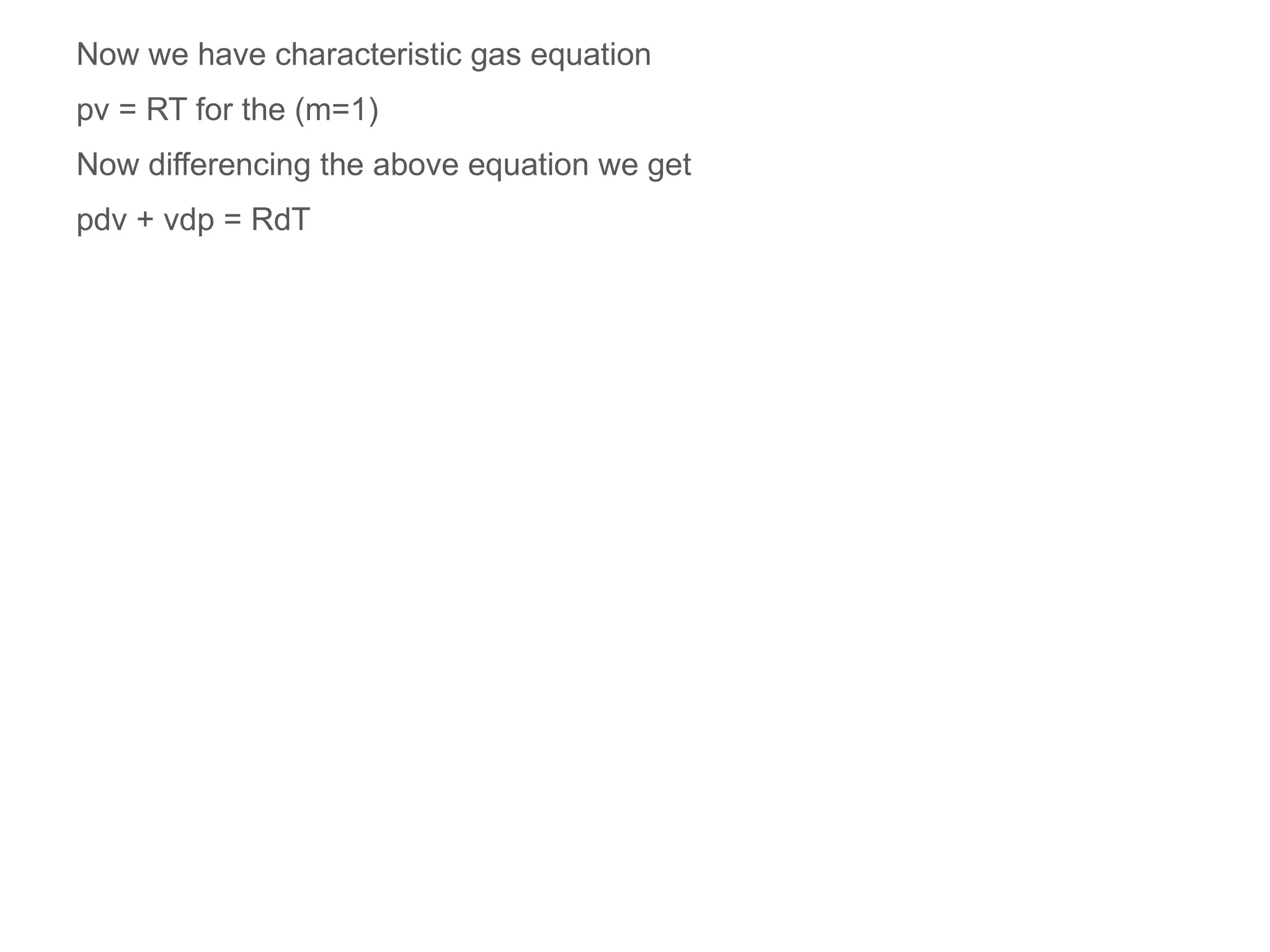
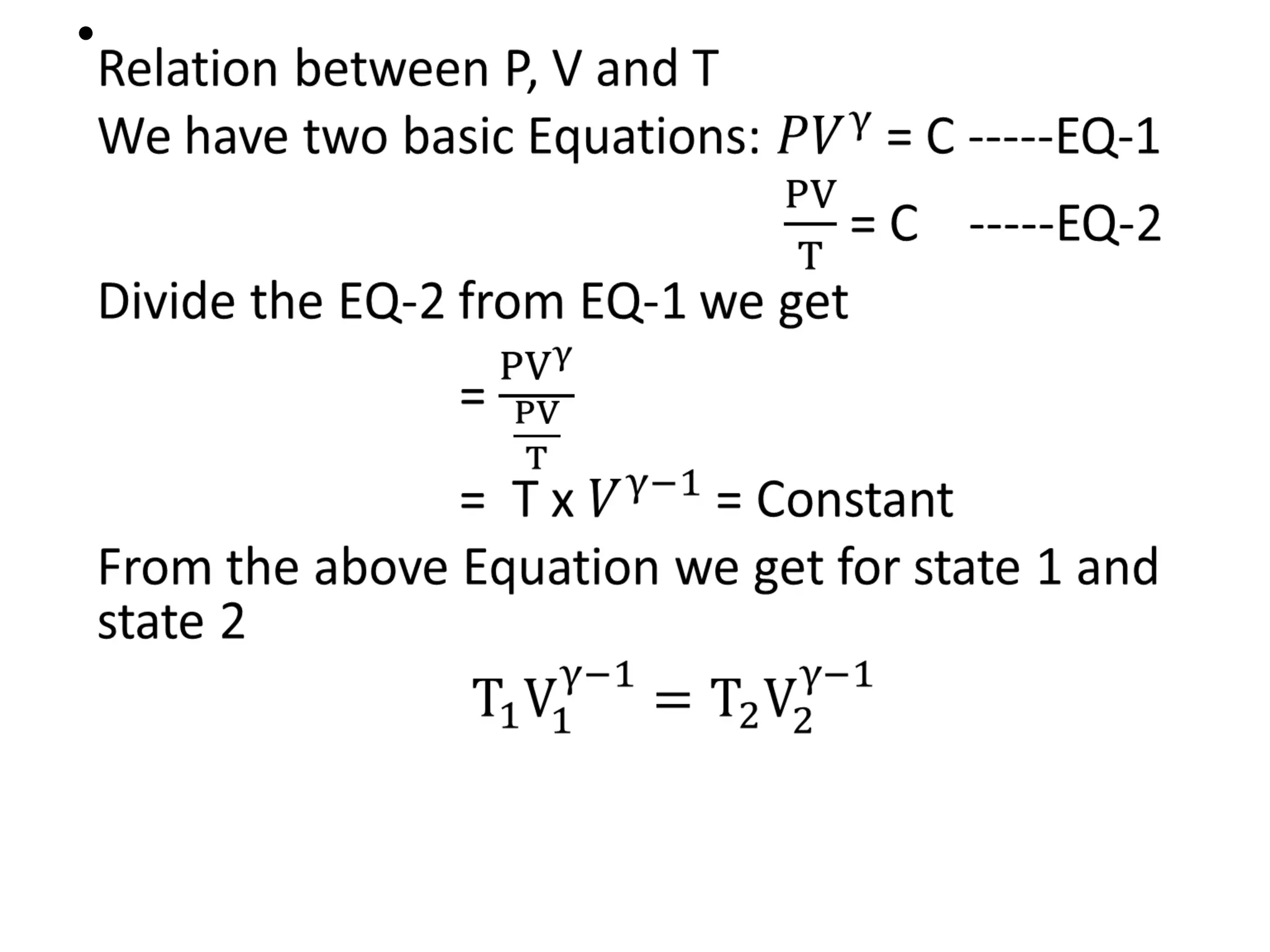
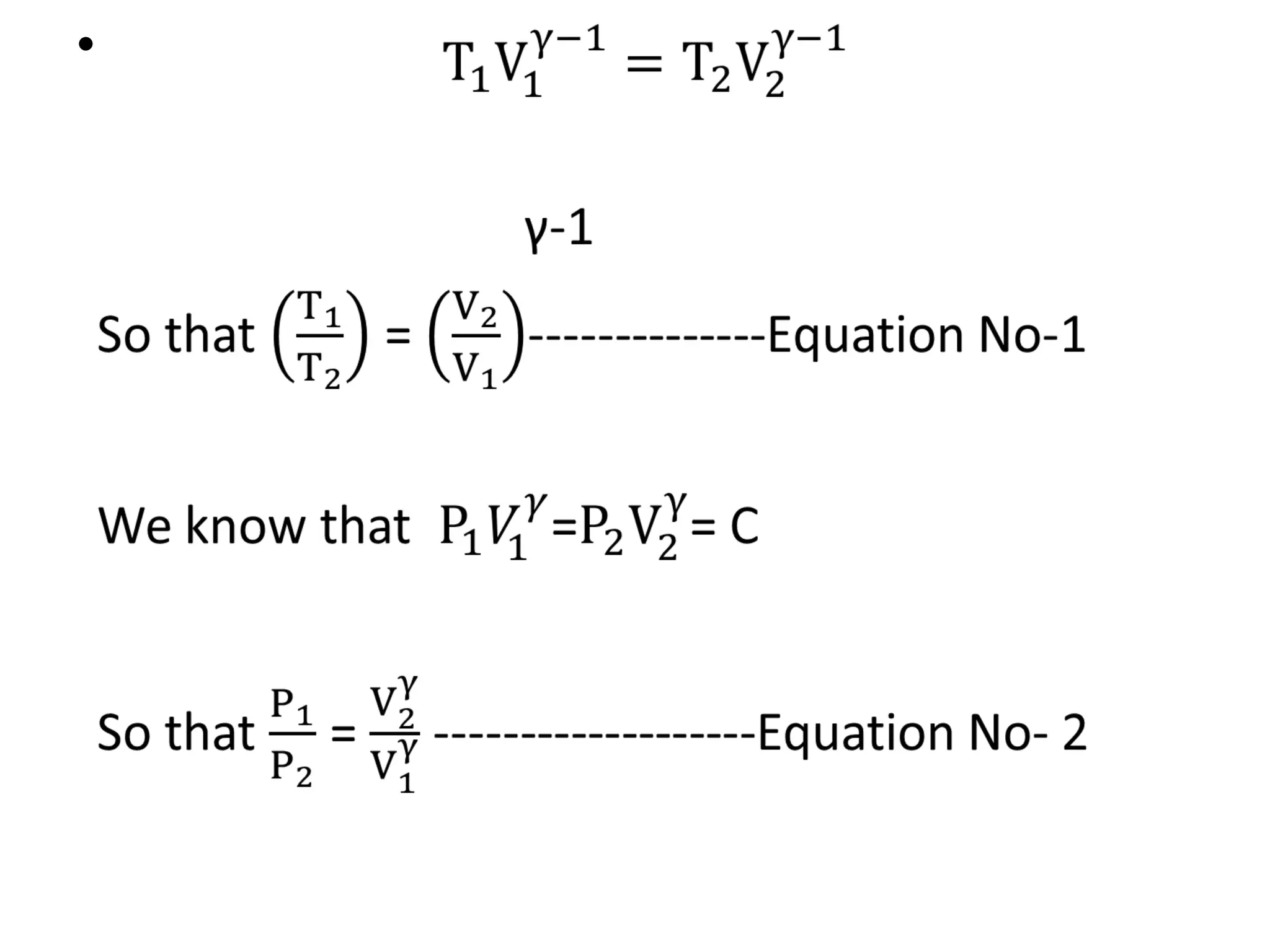
Now we havecharacteristic gas equation
pv = RT for the (m=1)
Now differencing the above equation we get
pdv + vdp = RdT
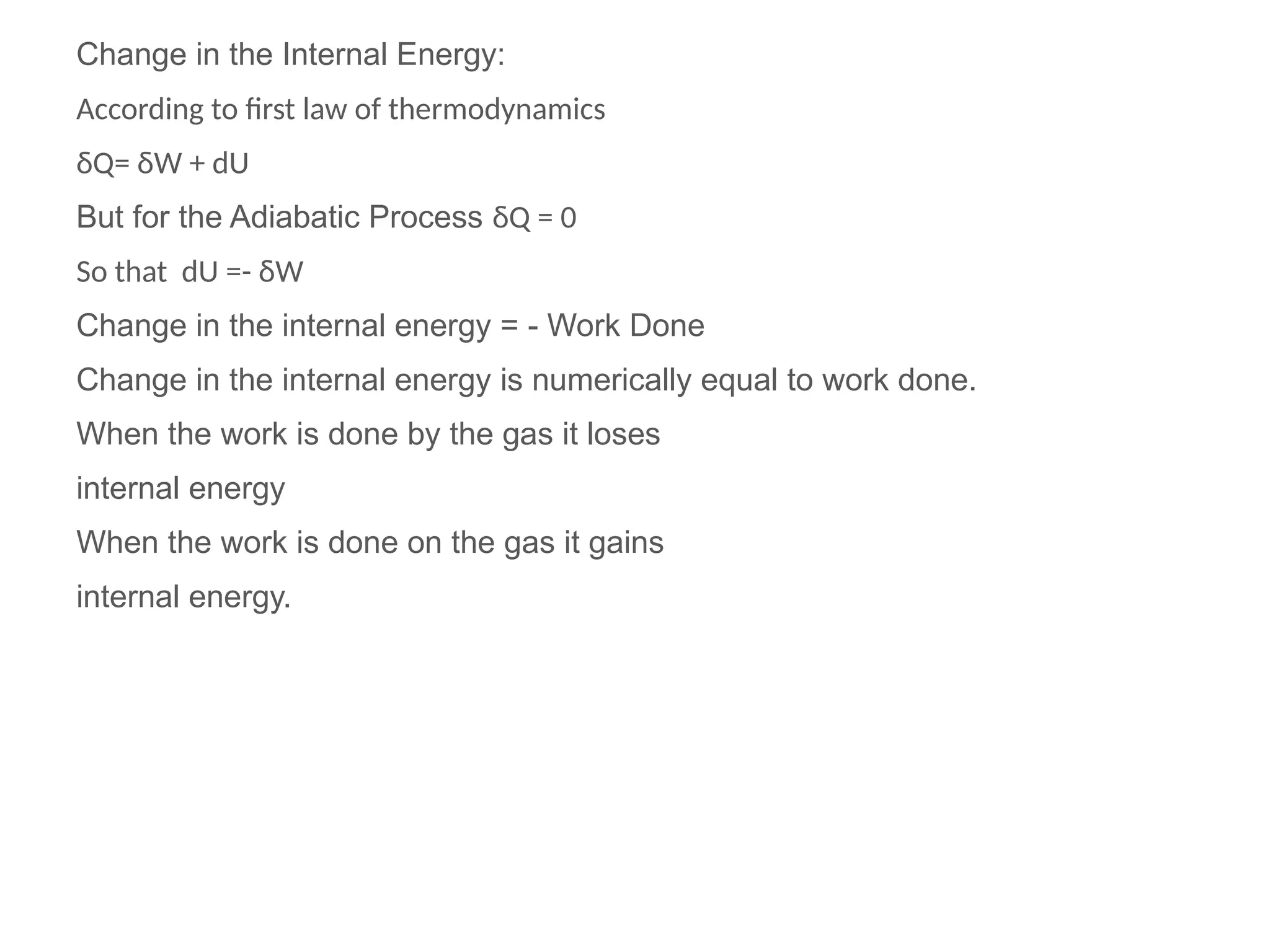
Change in theInternal Energy:
According to first law of thermodynamics
δQ= δW + dU
But for the Adiabatic Process δQ = 0
So that dU =- δW
Change in the internal energy = - Work Done
Change in the internal energy is numerically equal to work done.
When the work is done by the gas it loses
internal energy
When the work is done on the gas it gains
internal energy.
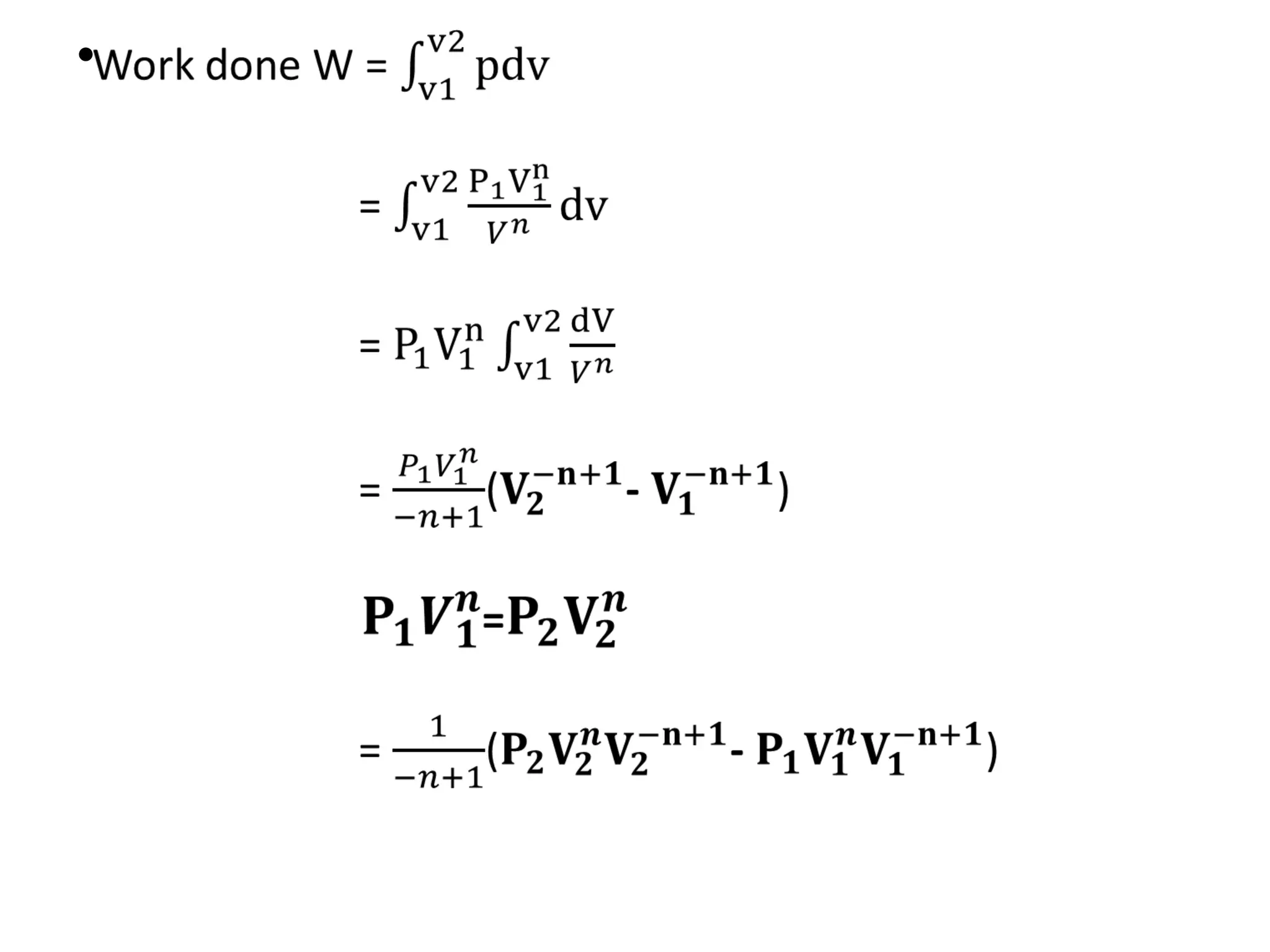
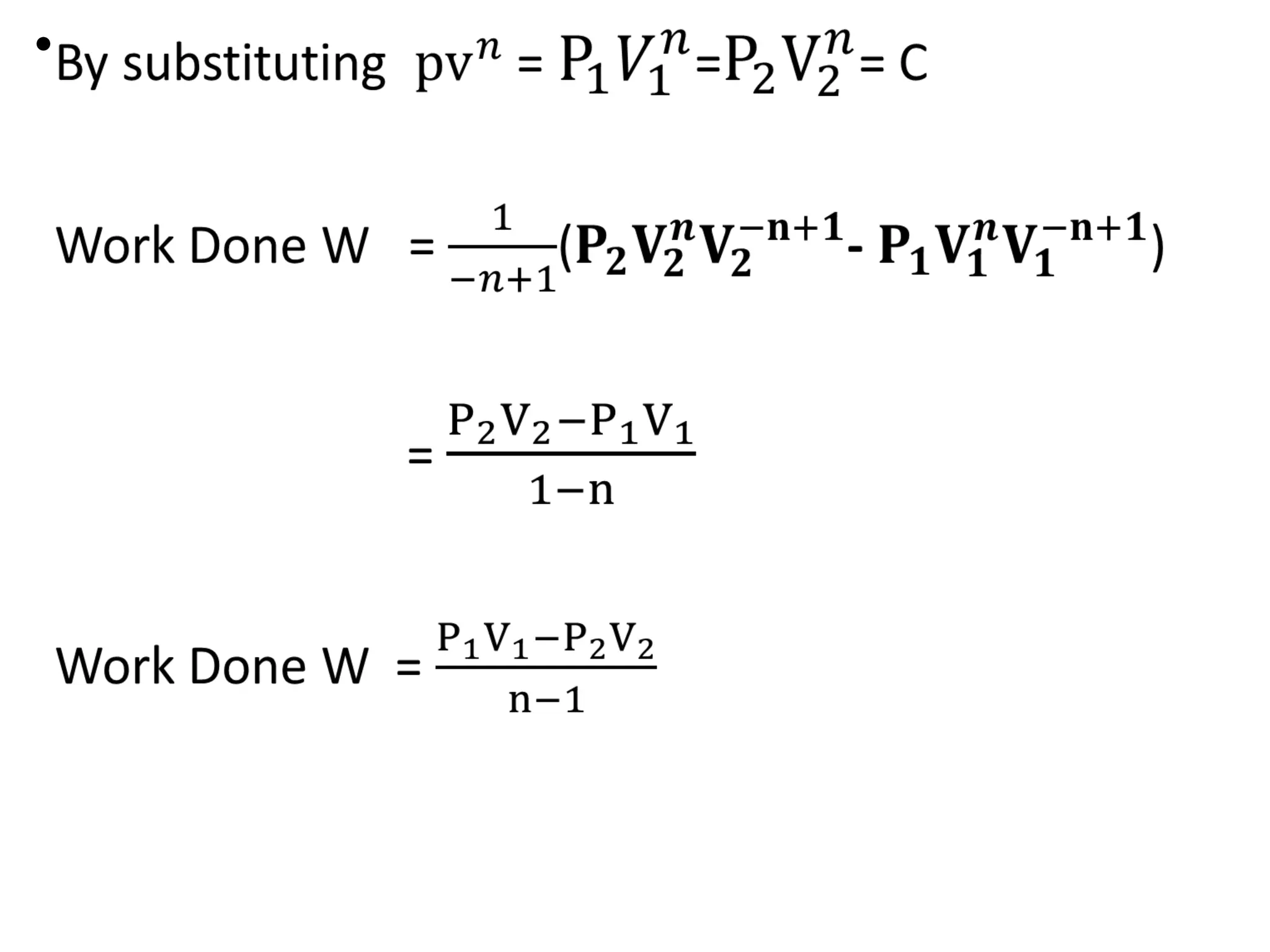
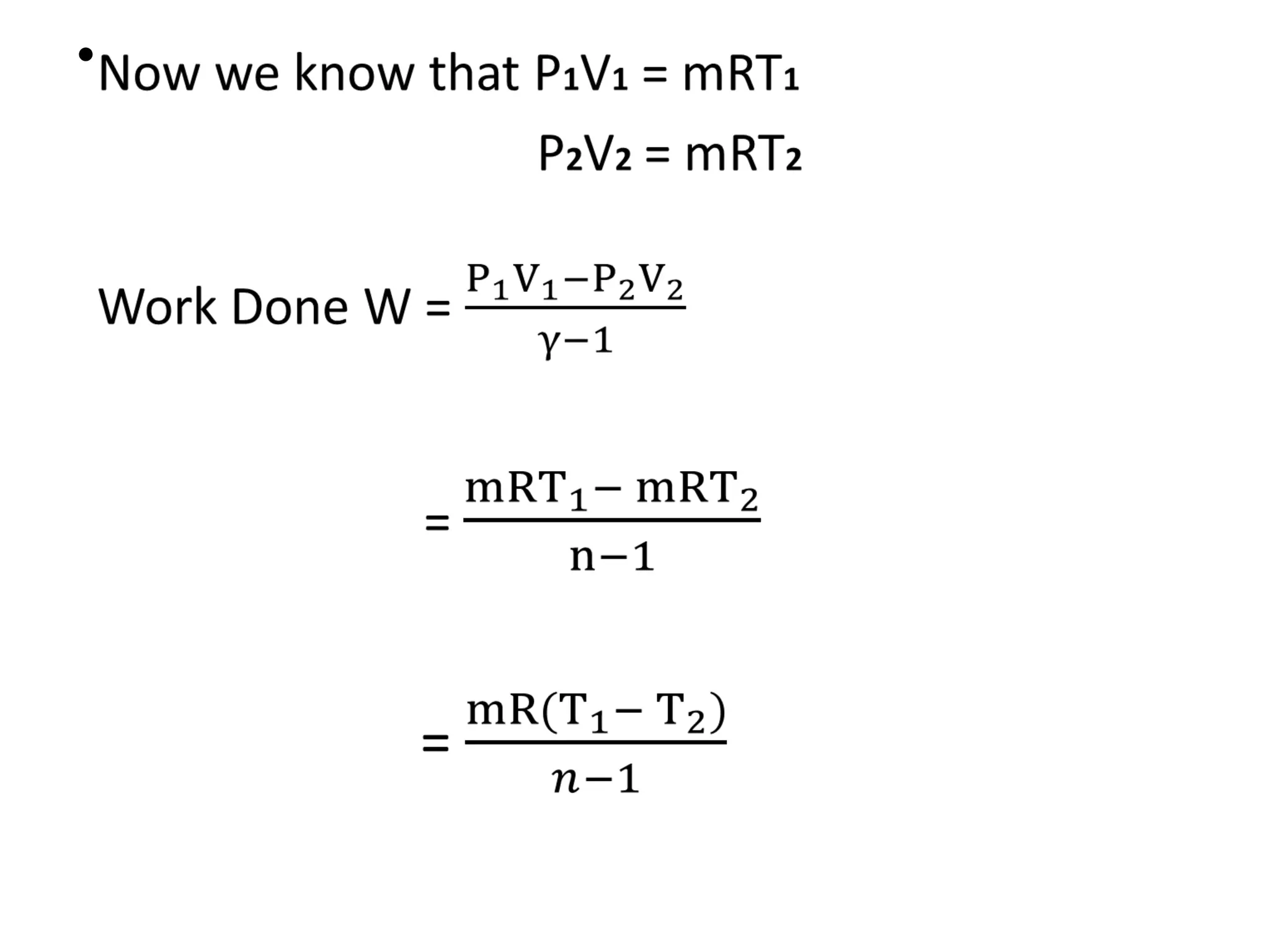
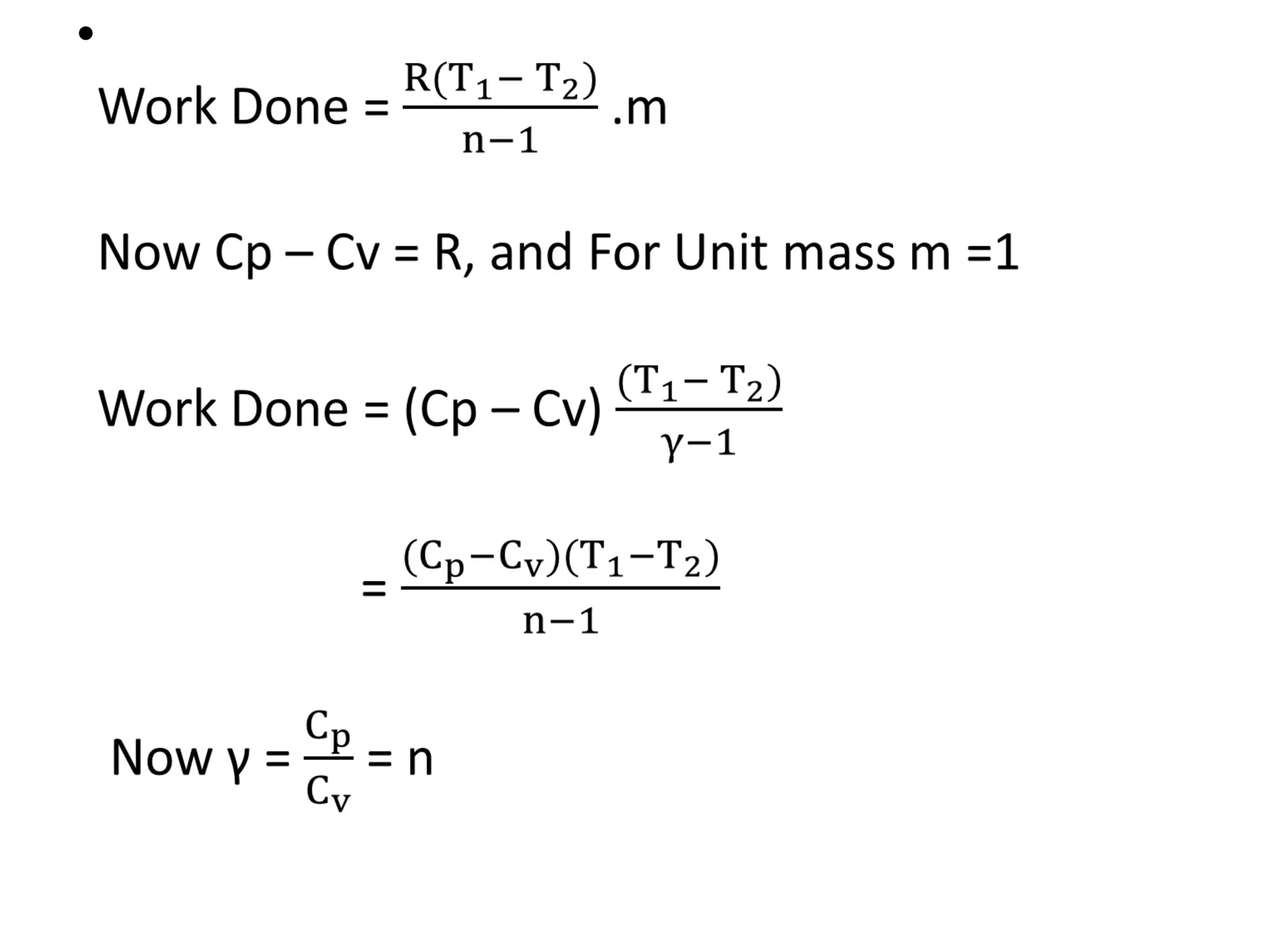
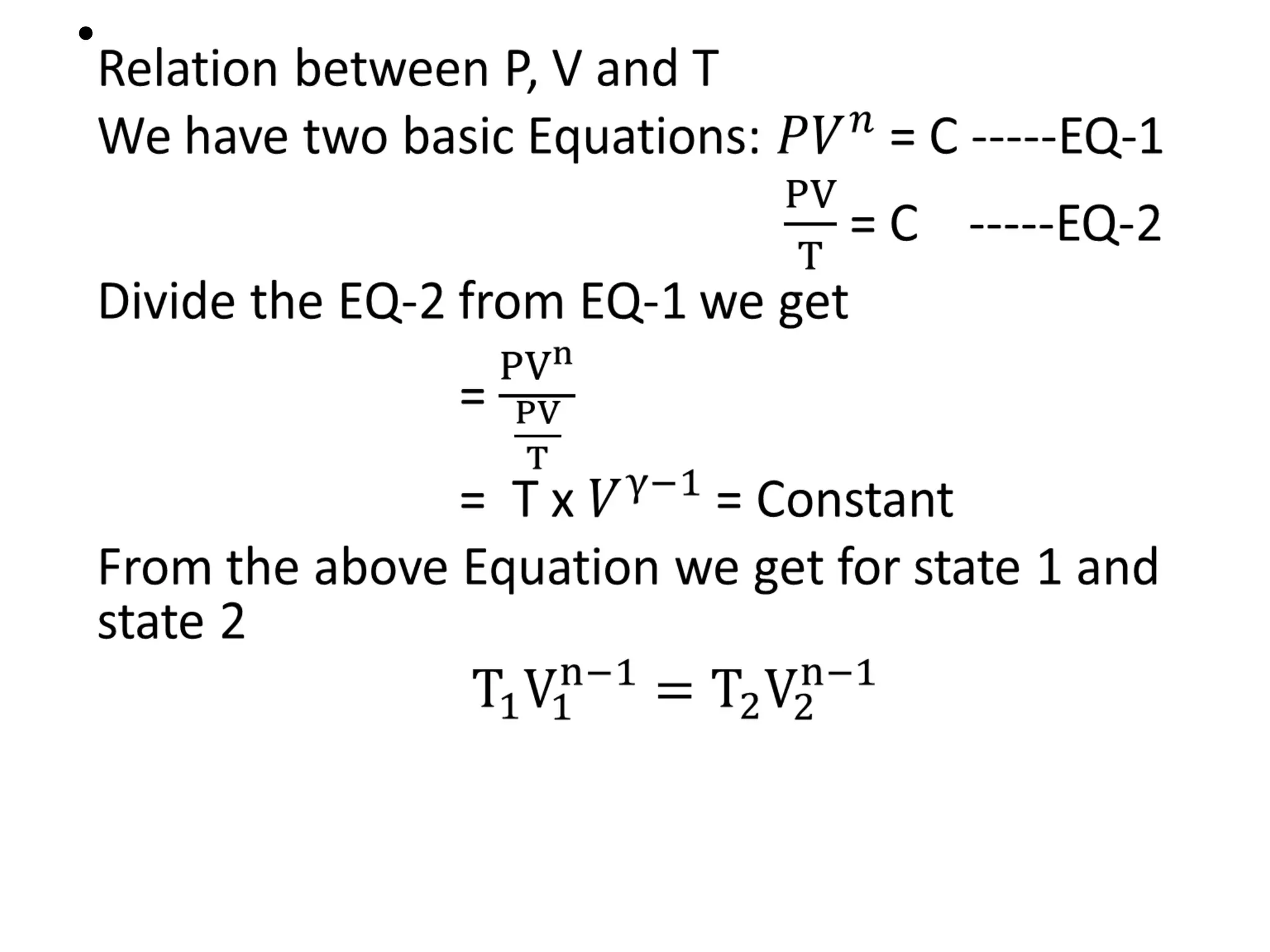
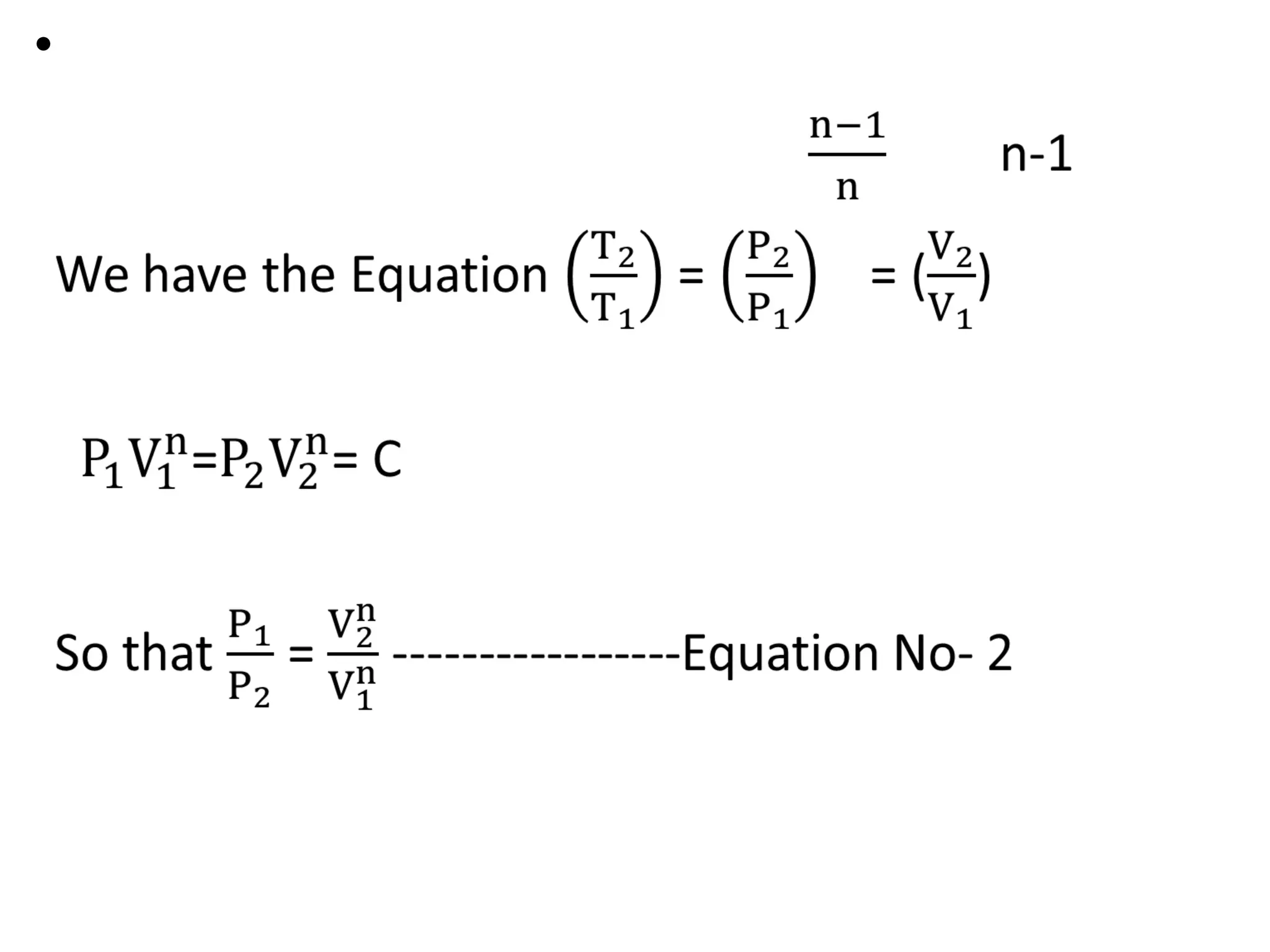
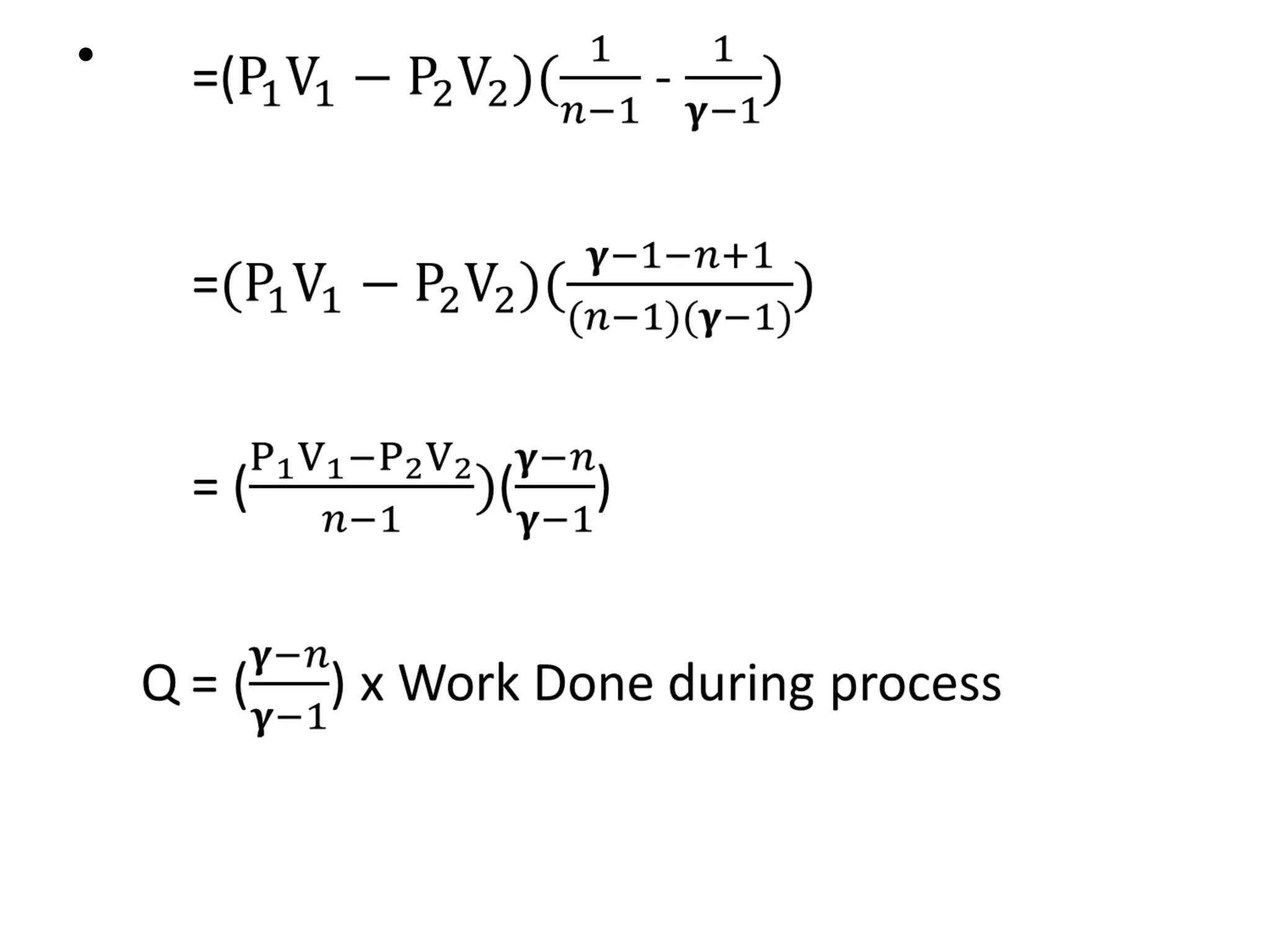
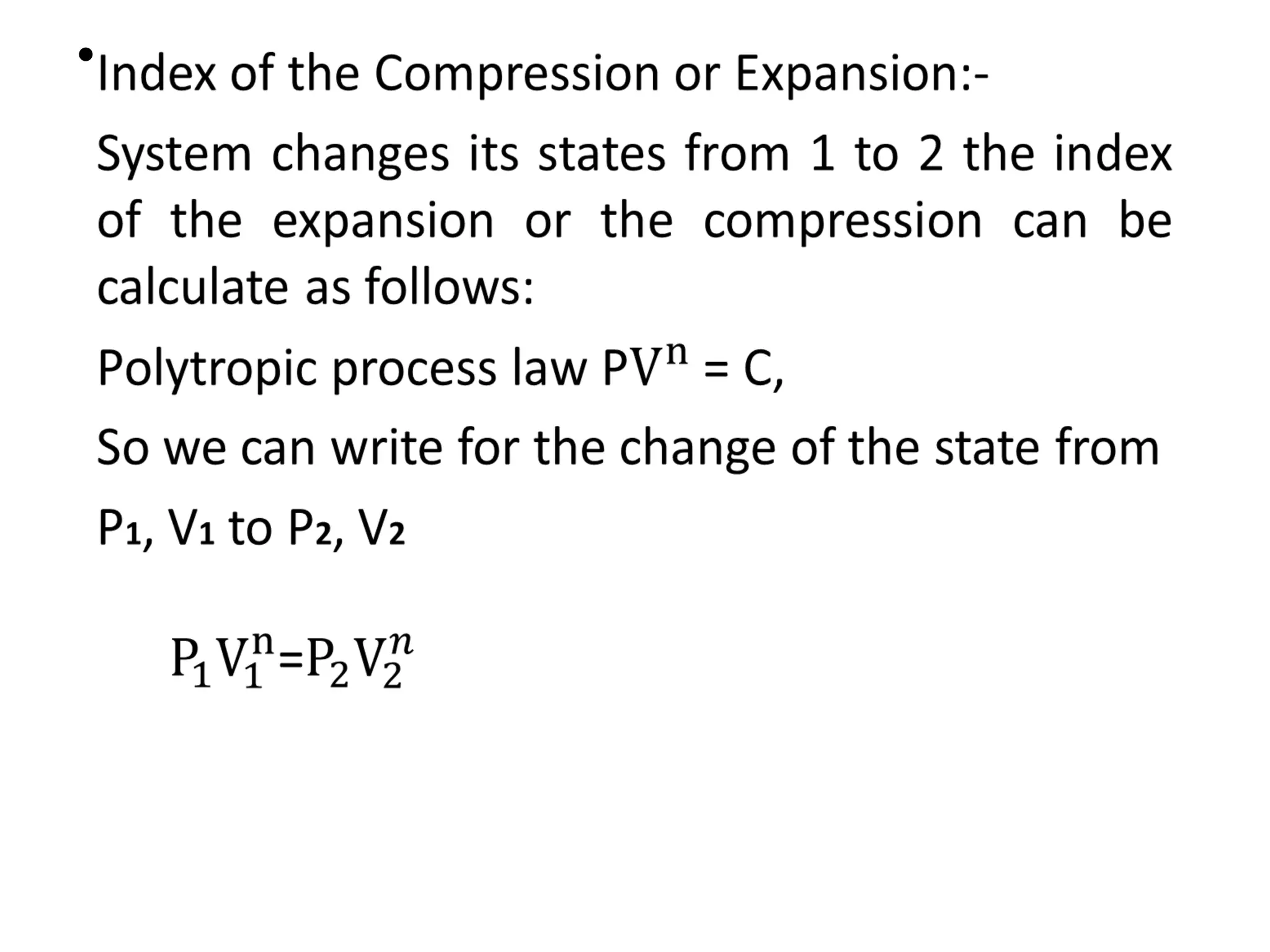
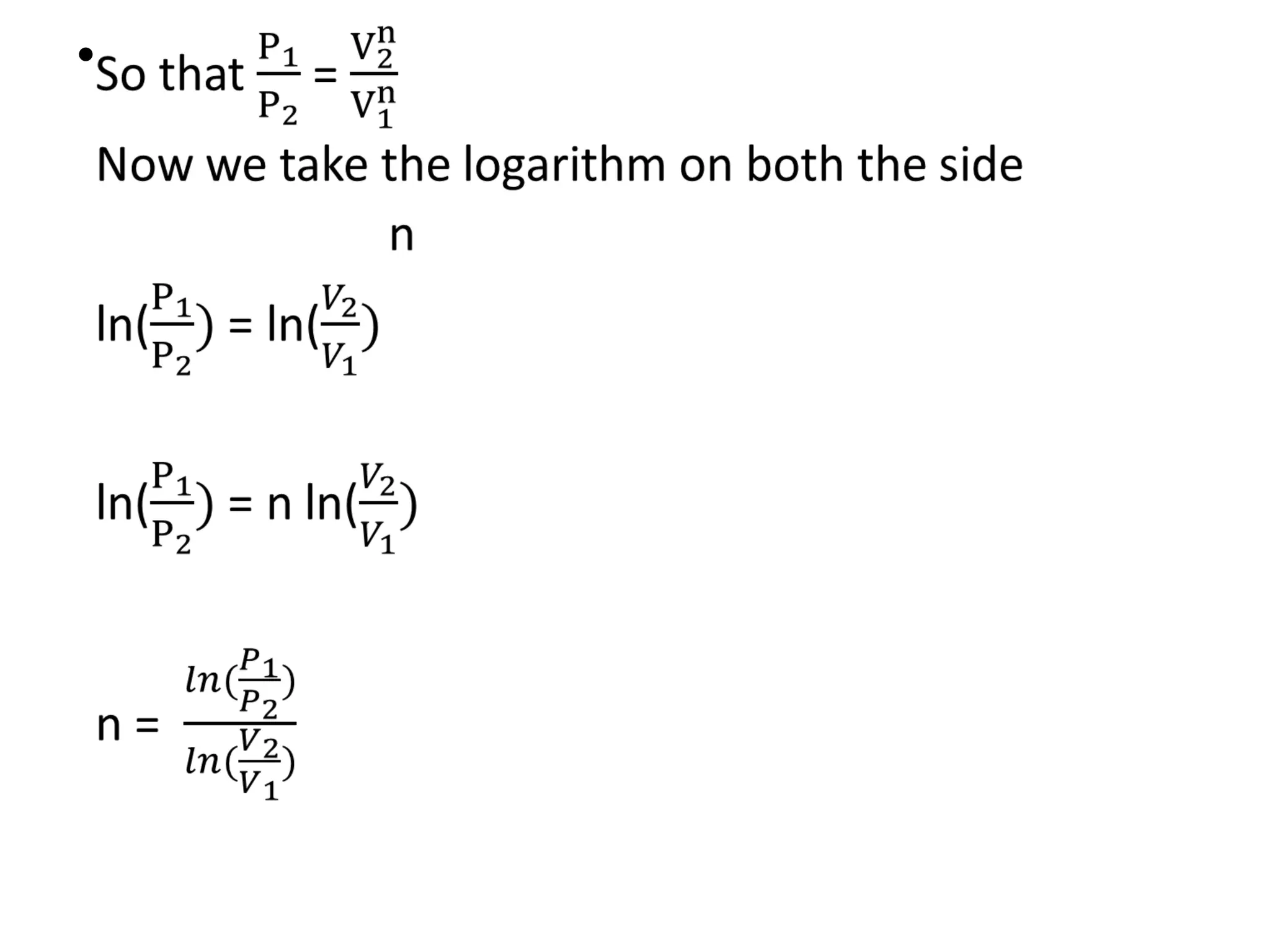
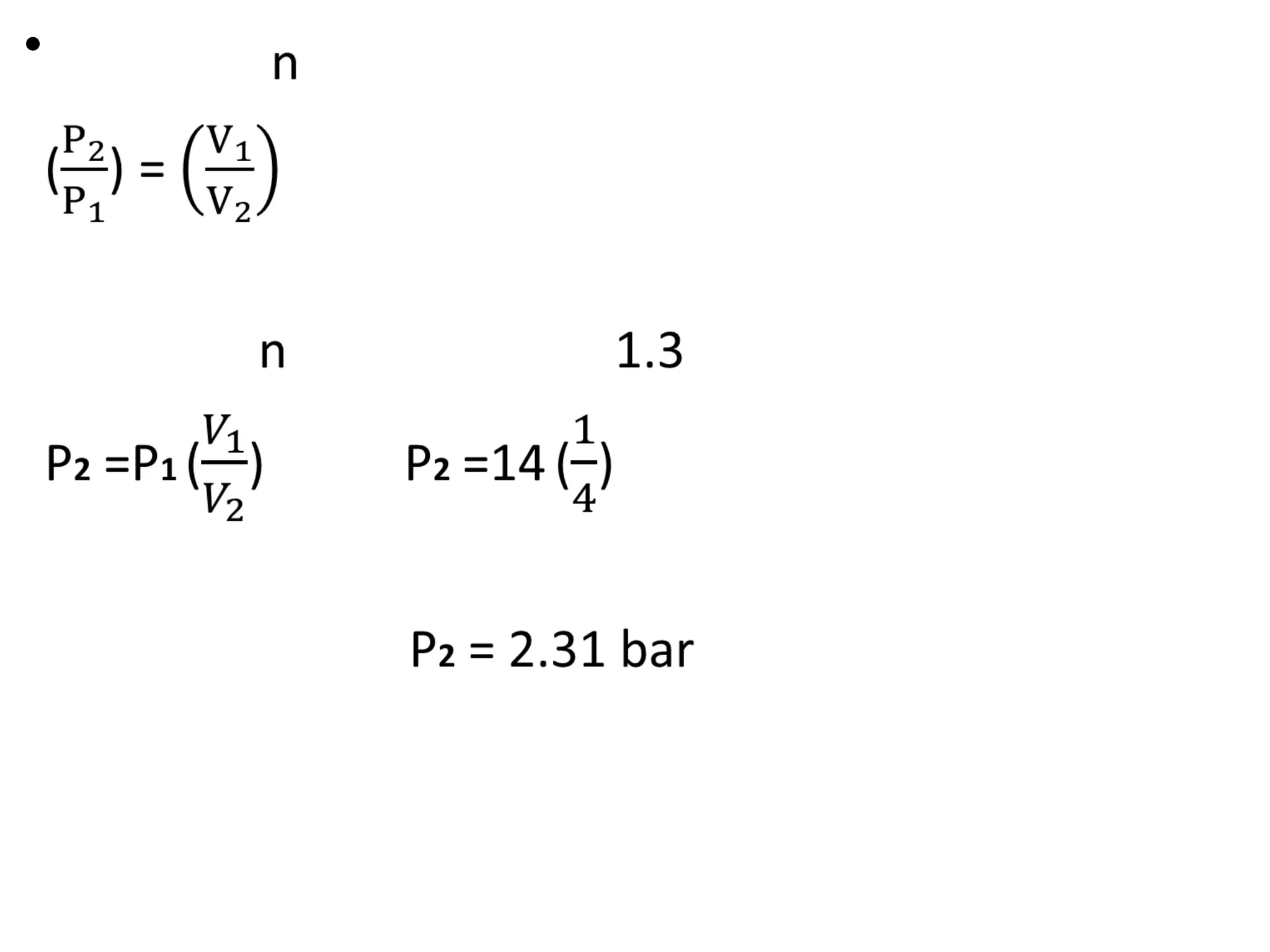
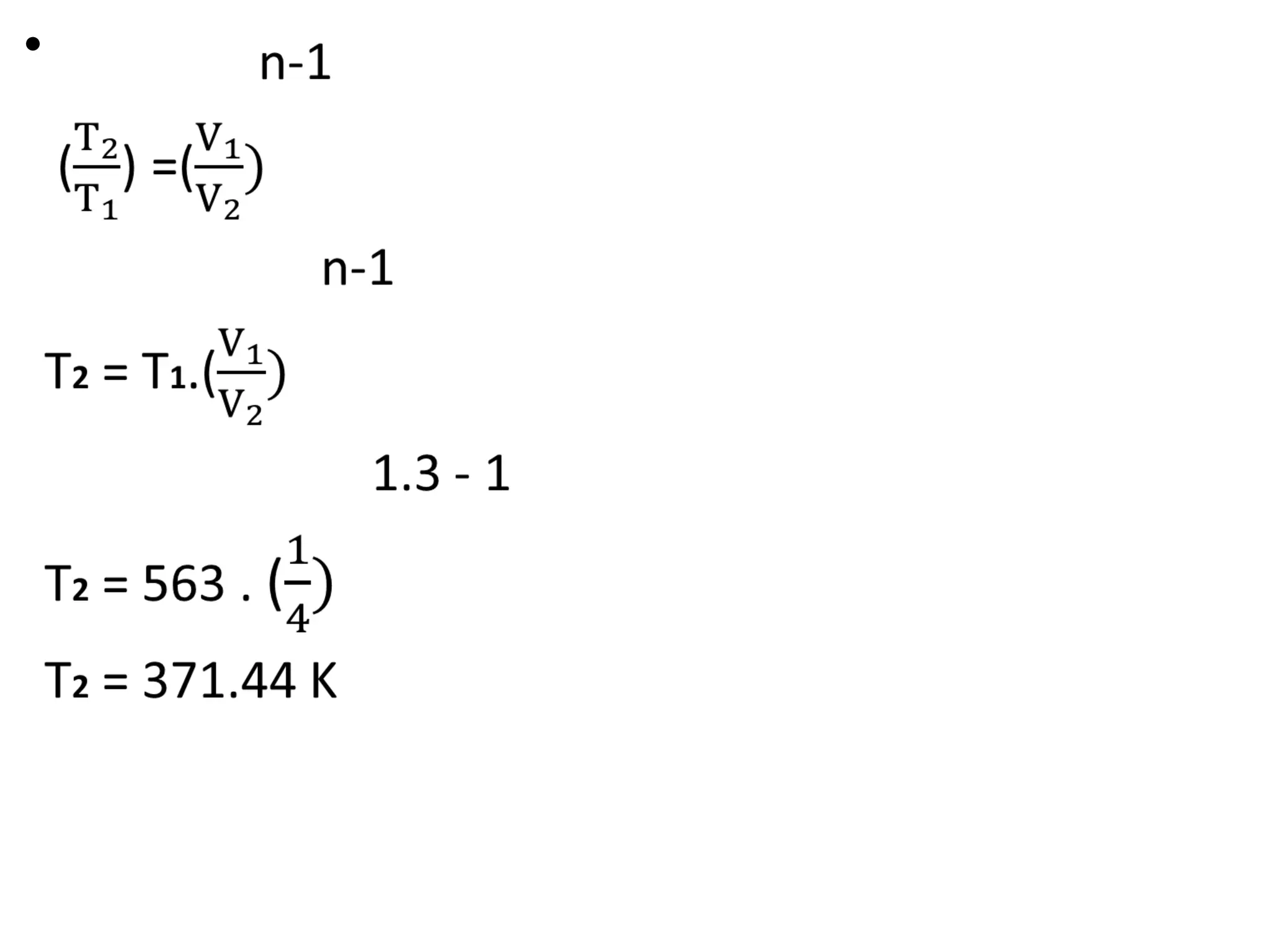
The main differencein the equation between isentropic process and the
polytropic process is that if we replacing γ by n in the relation of adiabatic
operation we get the relation for the polytropic process.
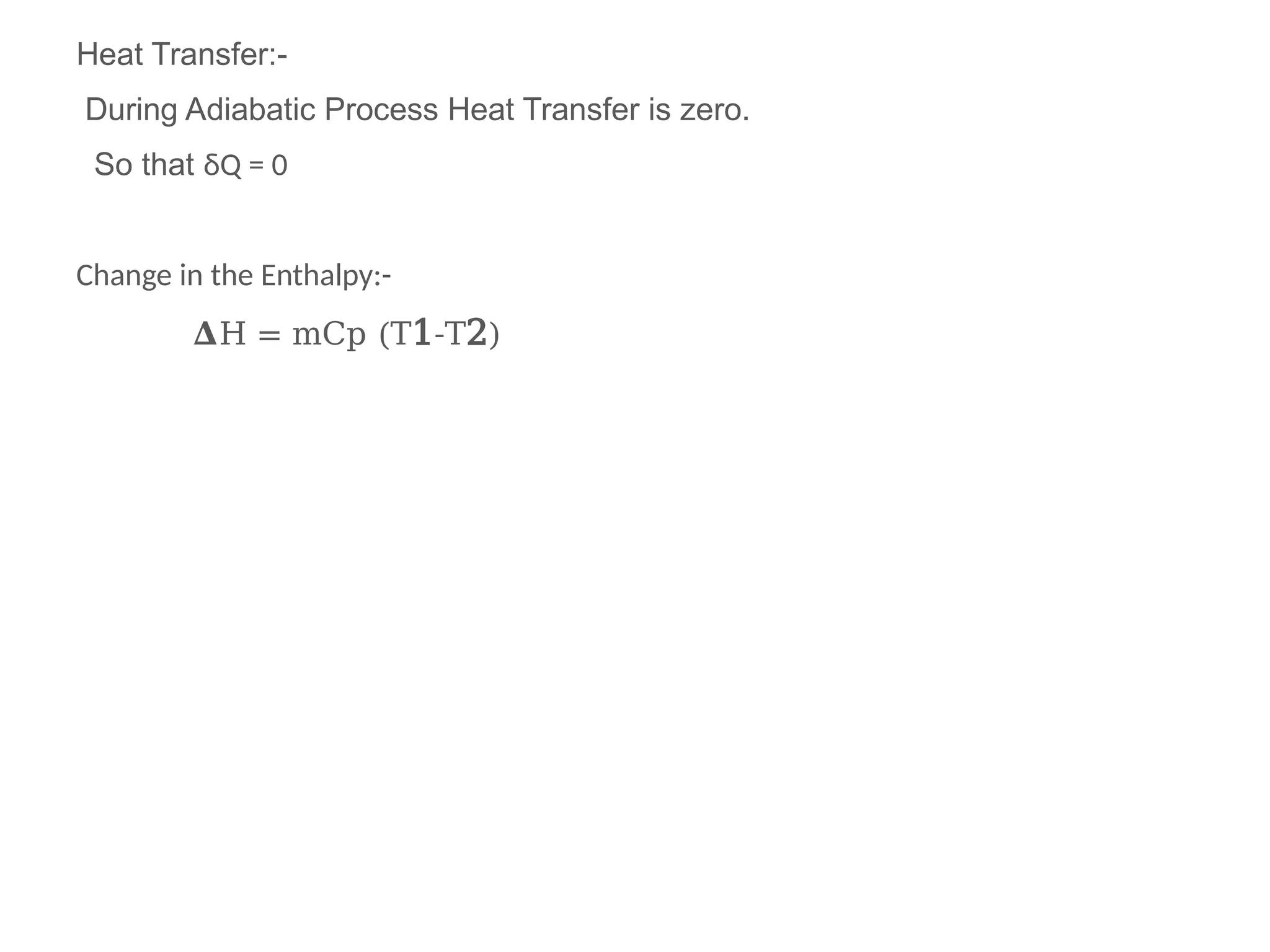
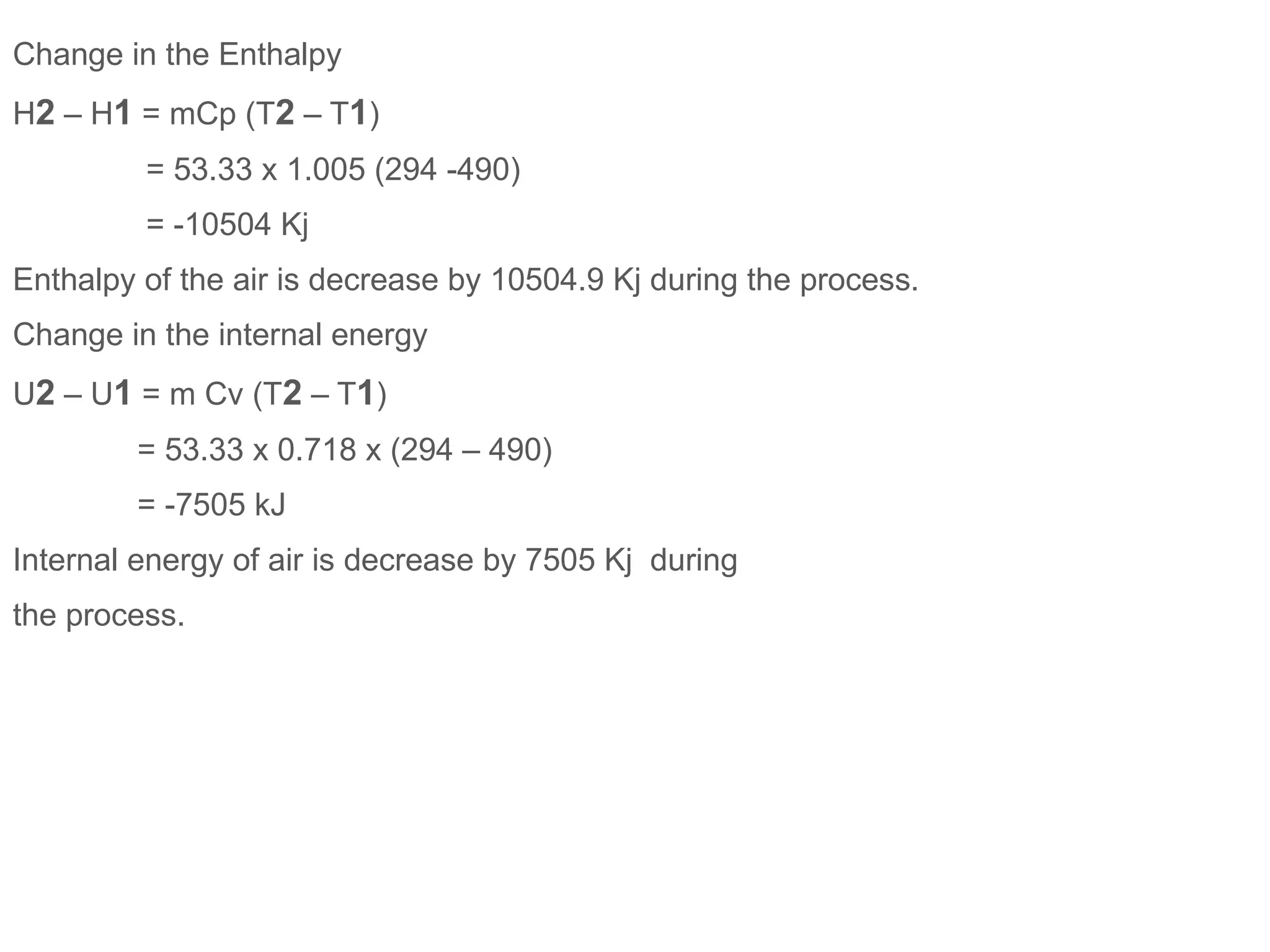
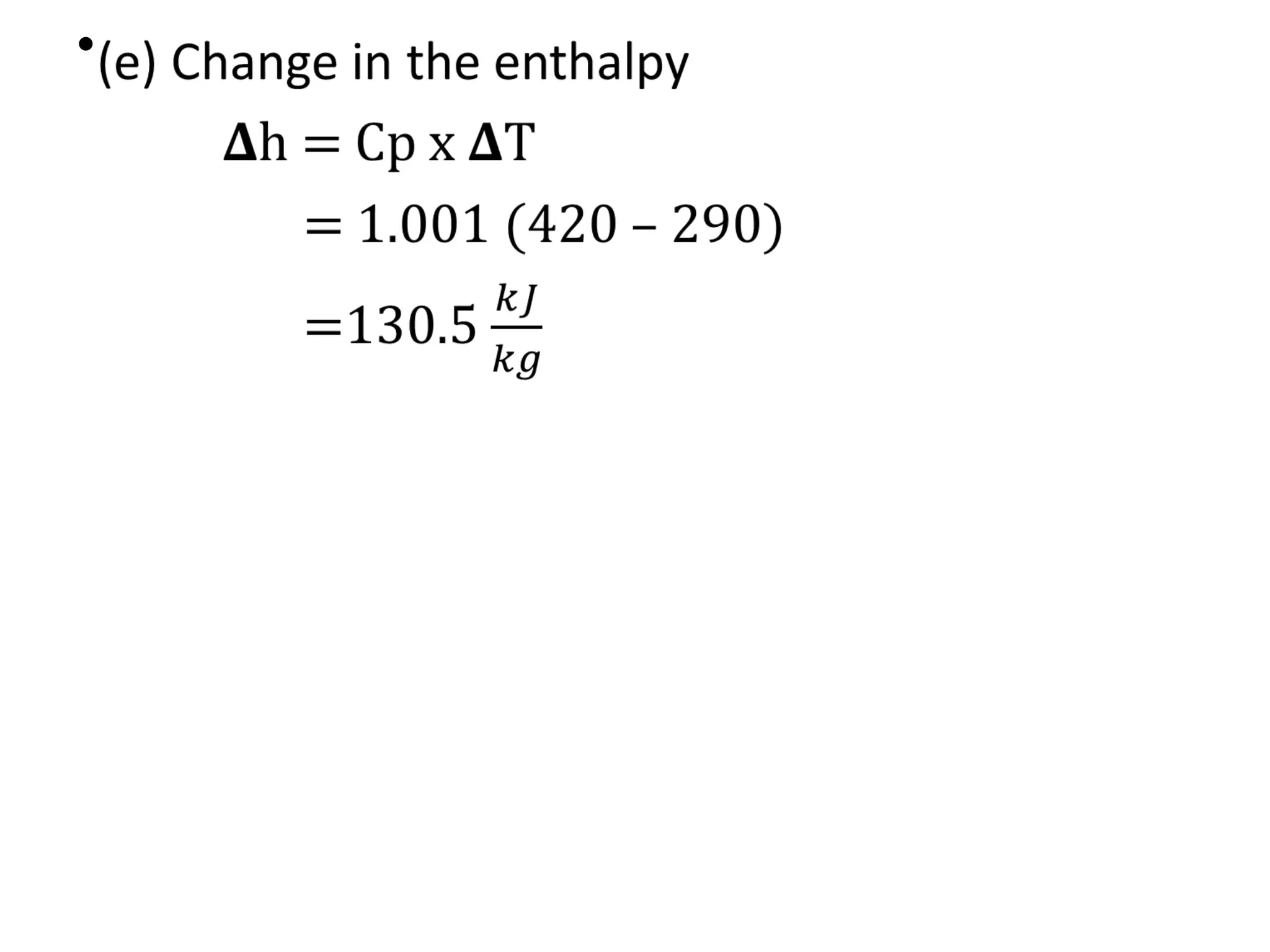
Change in theEnthalpy
H2 – H1 = mCp (T2 – T1)
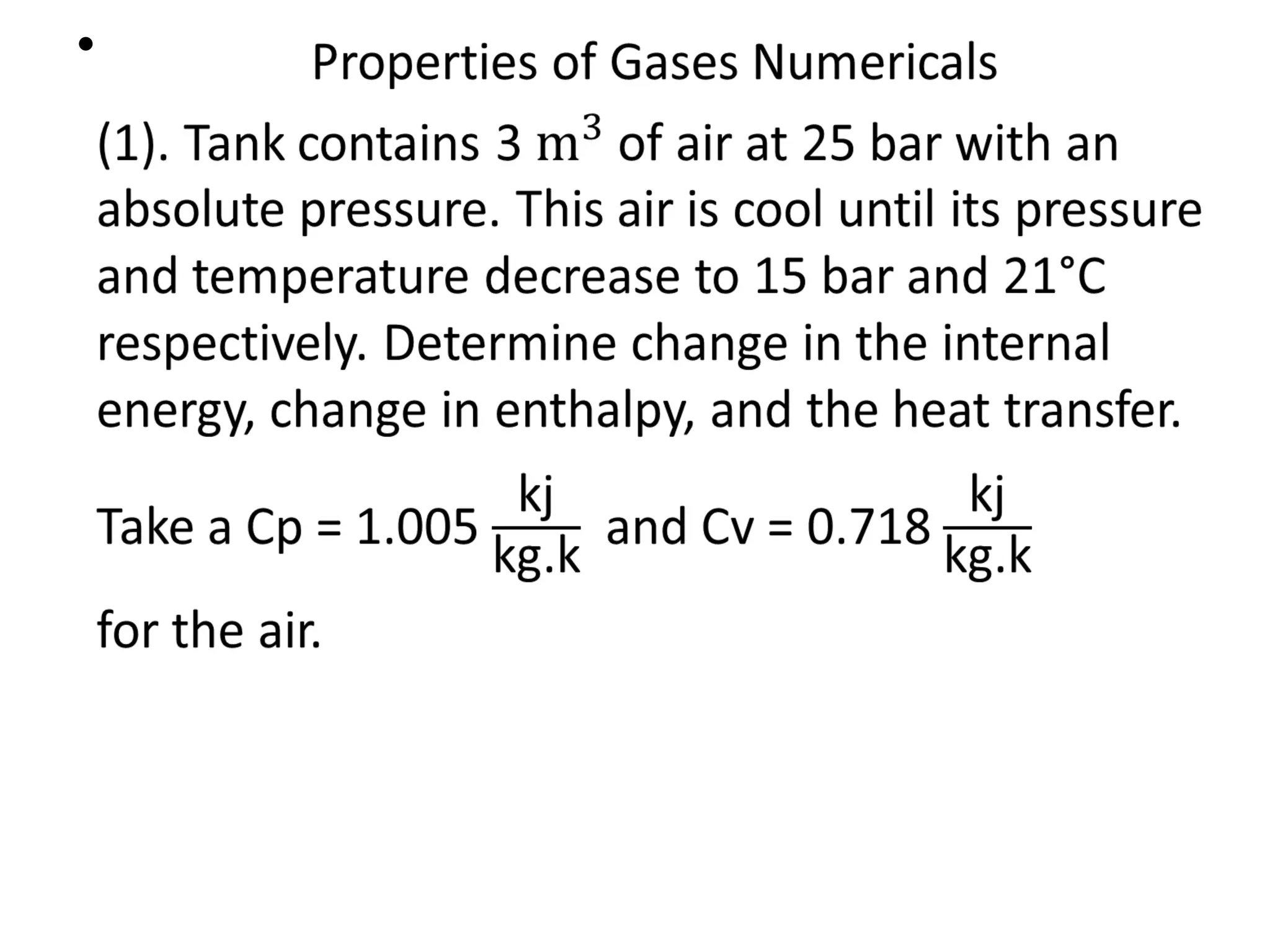
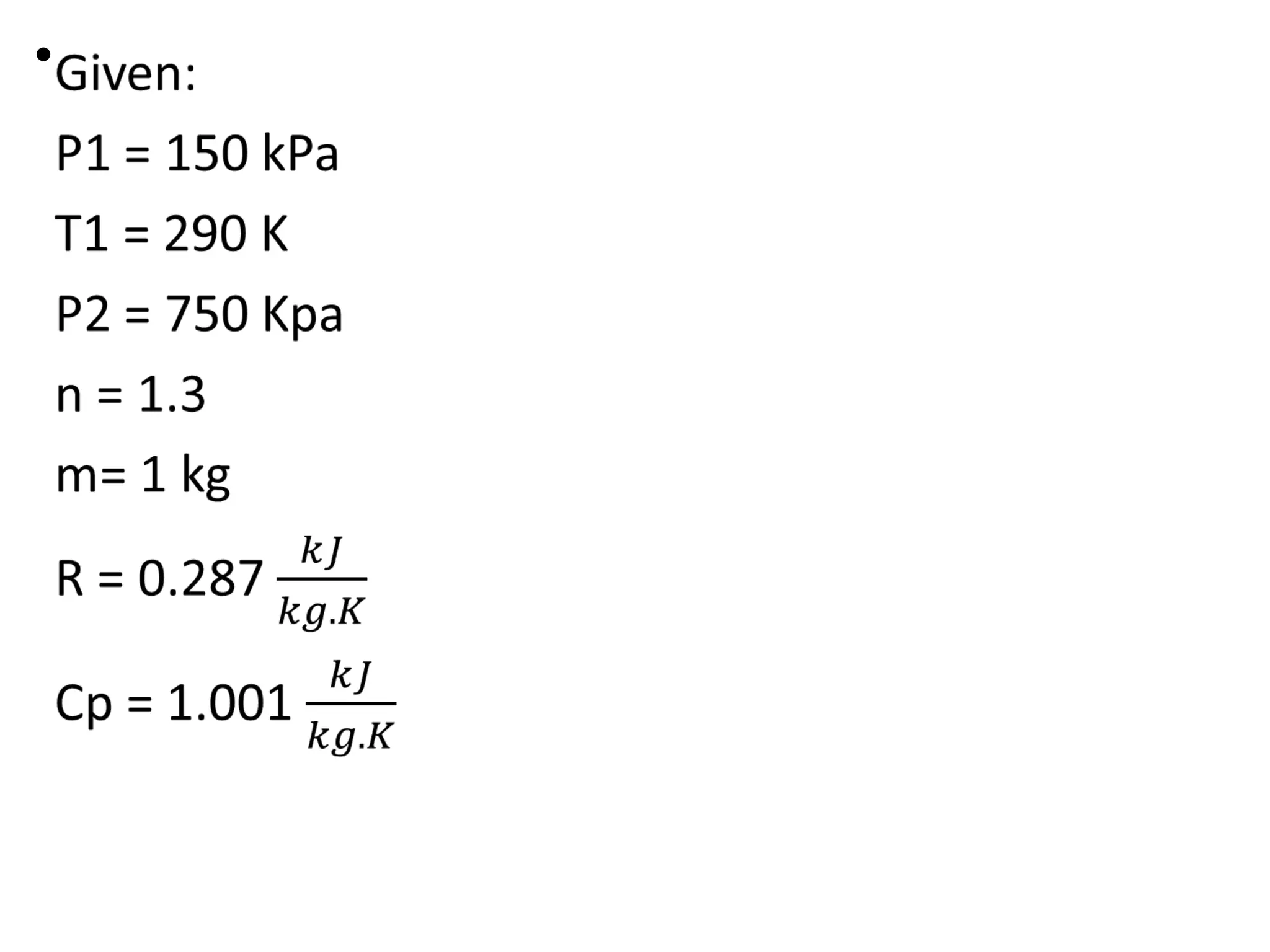
= 53.33 x 1.005 (294 -490)
= -10504 Kj
Enthalpy of the air is decrease by 10504.9 Kj during the process.
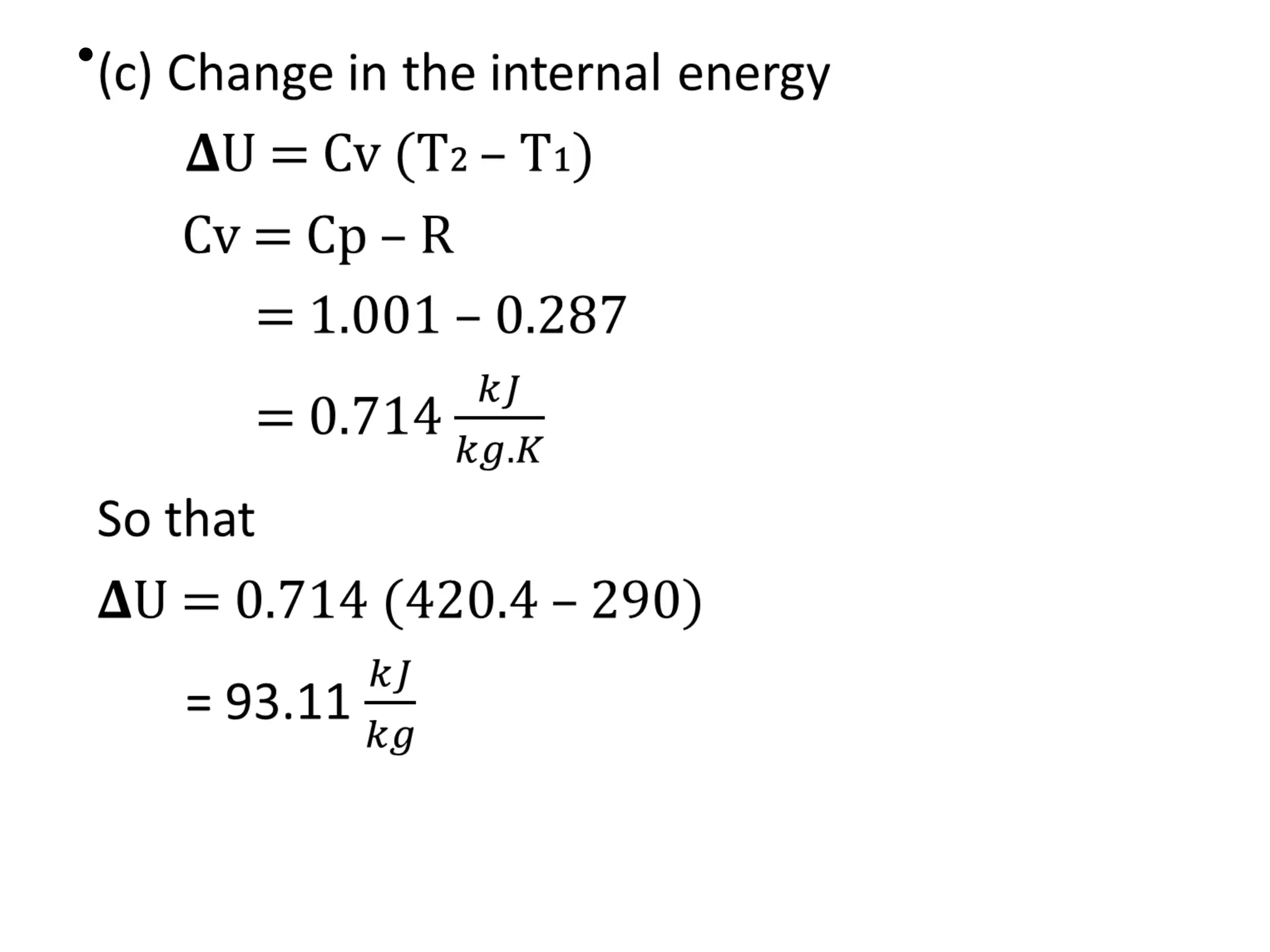
Change in the internal energy
U2 – U1 = m Cv (T2 – T1)
= 53.33 x 0.718 x (294 – 490)
= -7505 kJ
Internal energy of air is decrease by 7505 Kj during
the process.
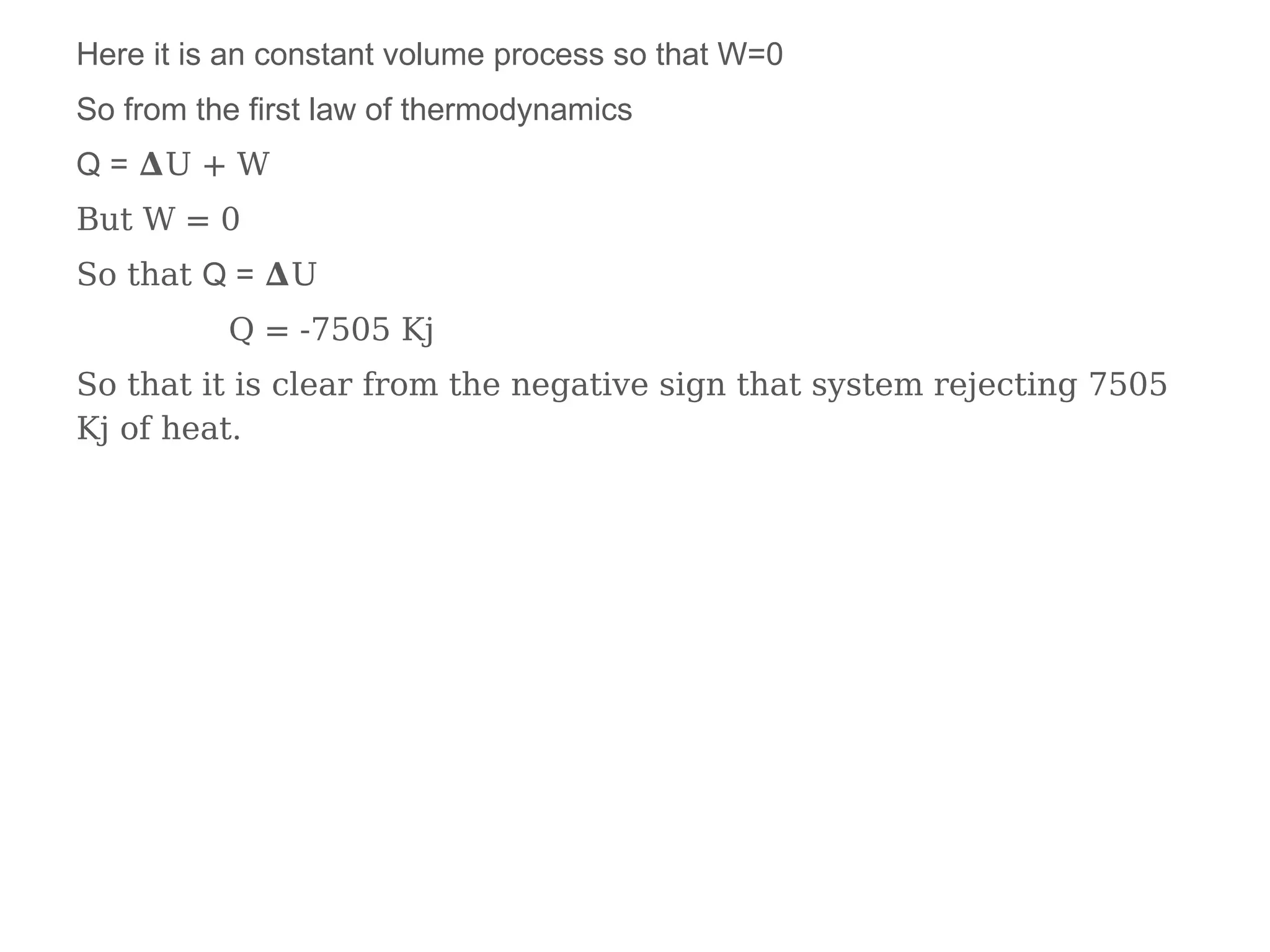
117.
Here it isan constant volume process so that W=0
So from the first law of thermodynamics
Q = 𝚫U + W
But W = 0
So that Q = 𝚫U
Q = -7505 Kj
So that it is clear from the negative sign that system rejecting 7505
Kj of heat.
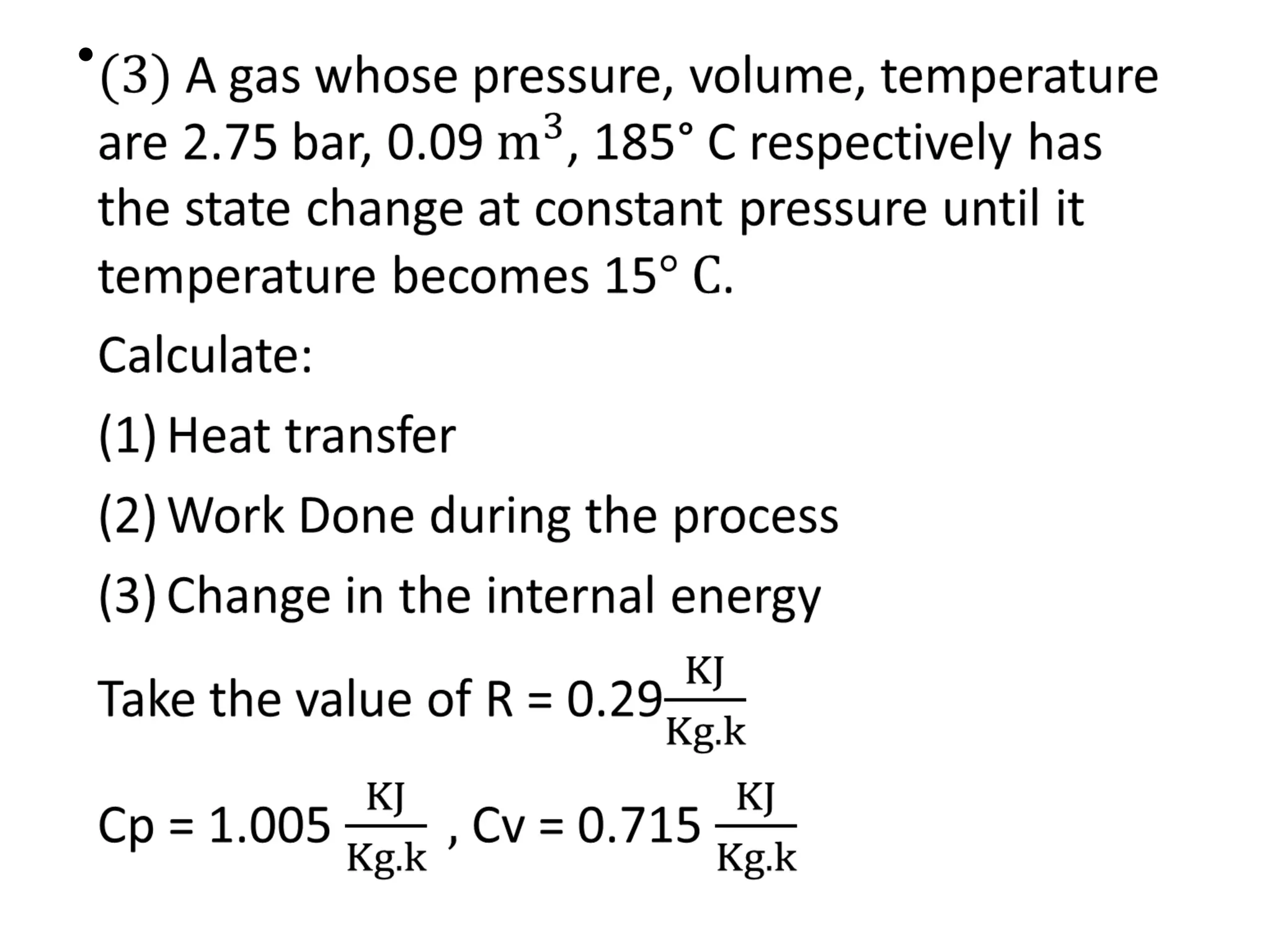
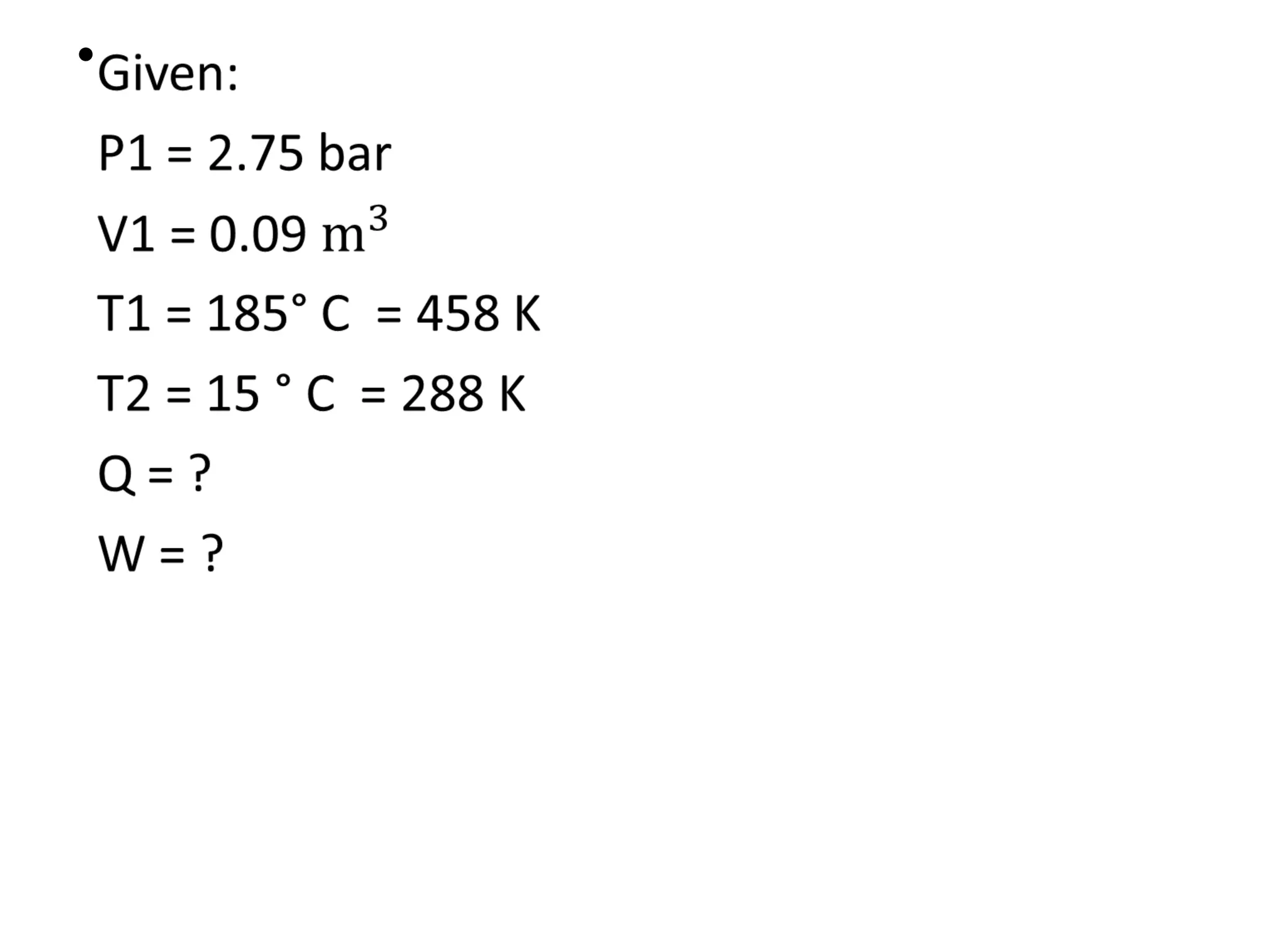
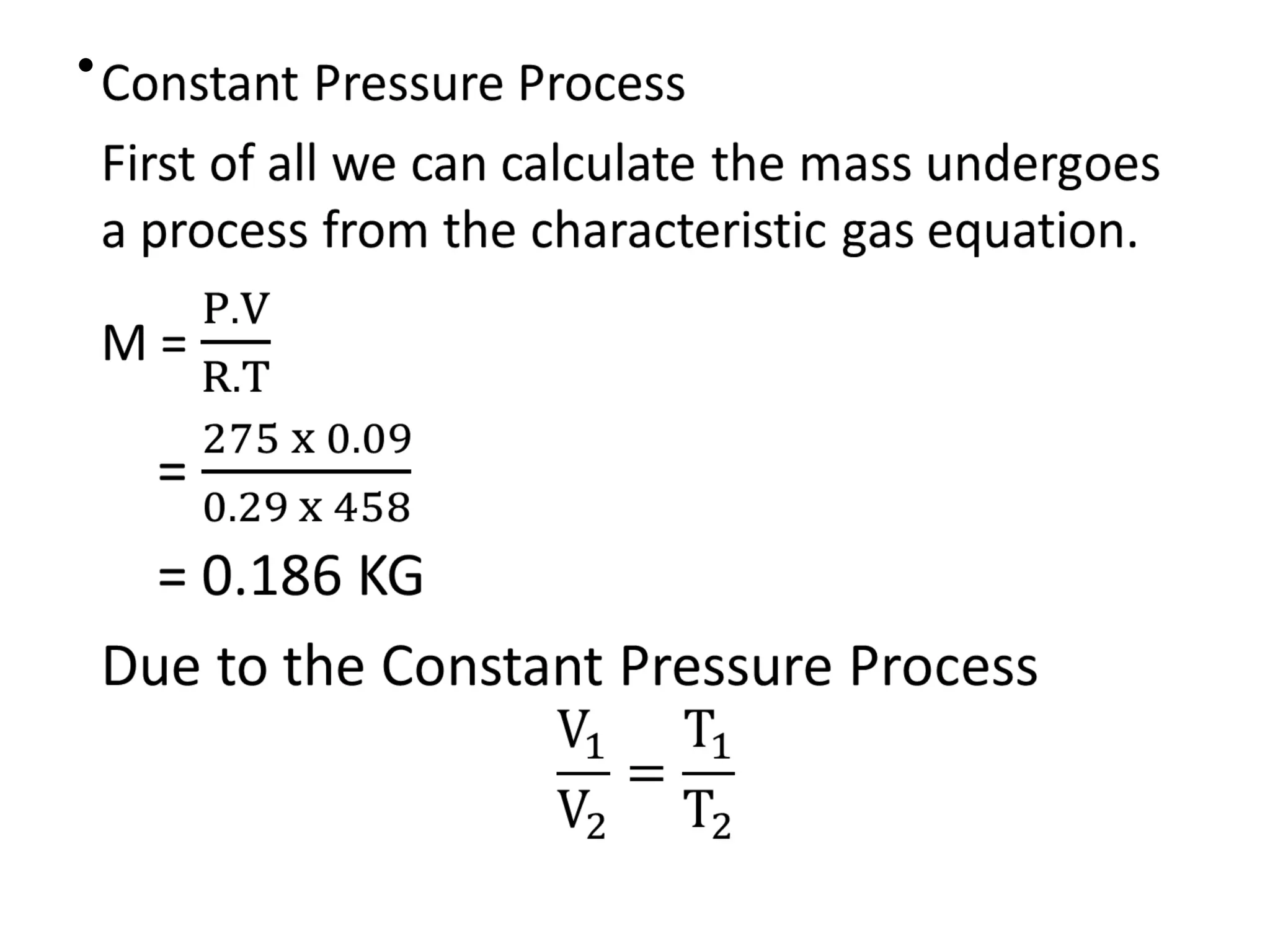
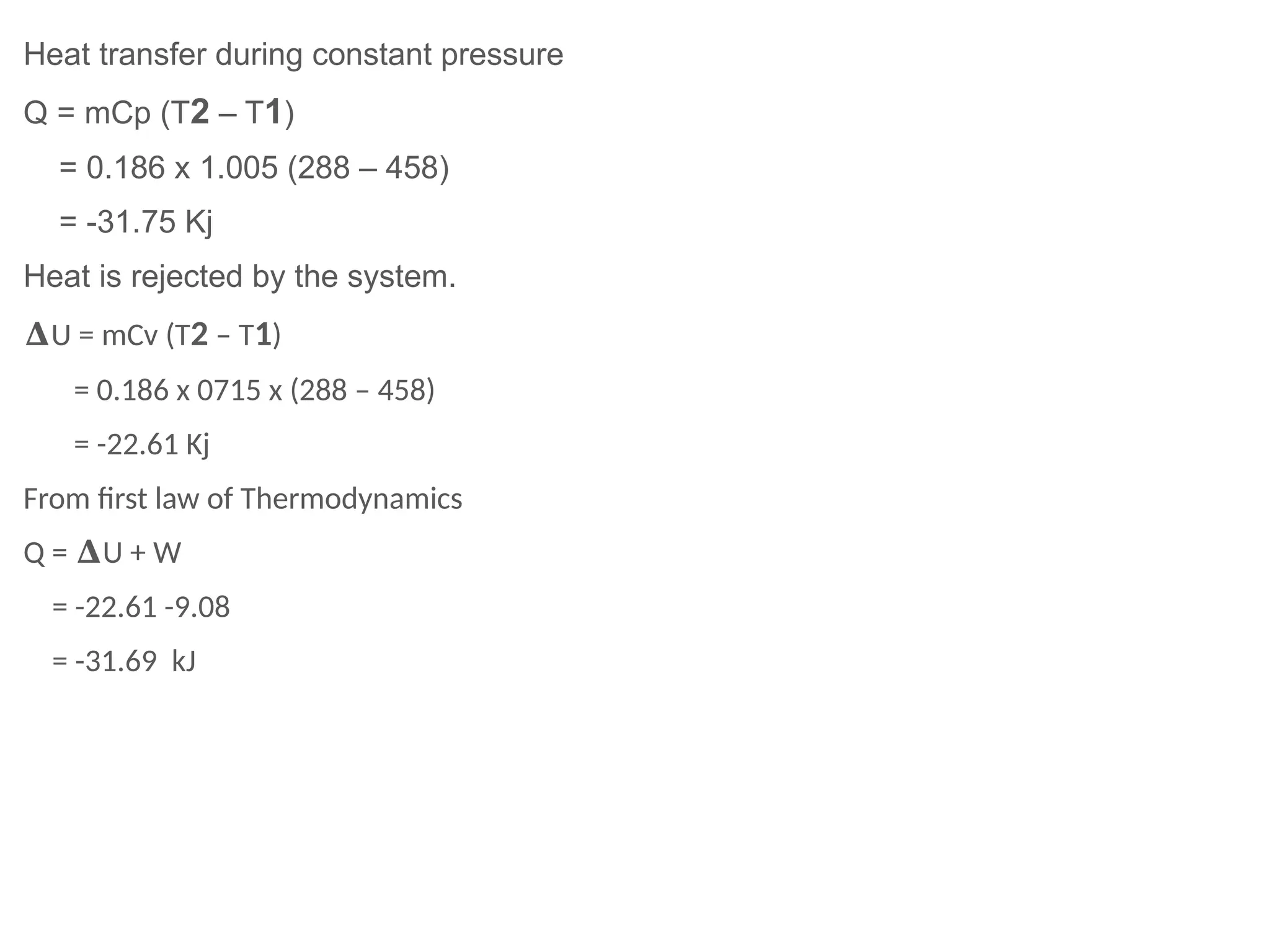
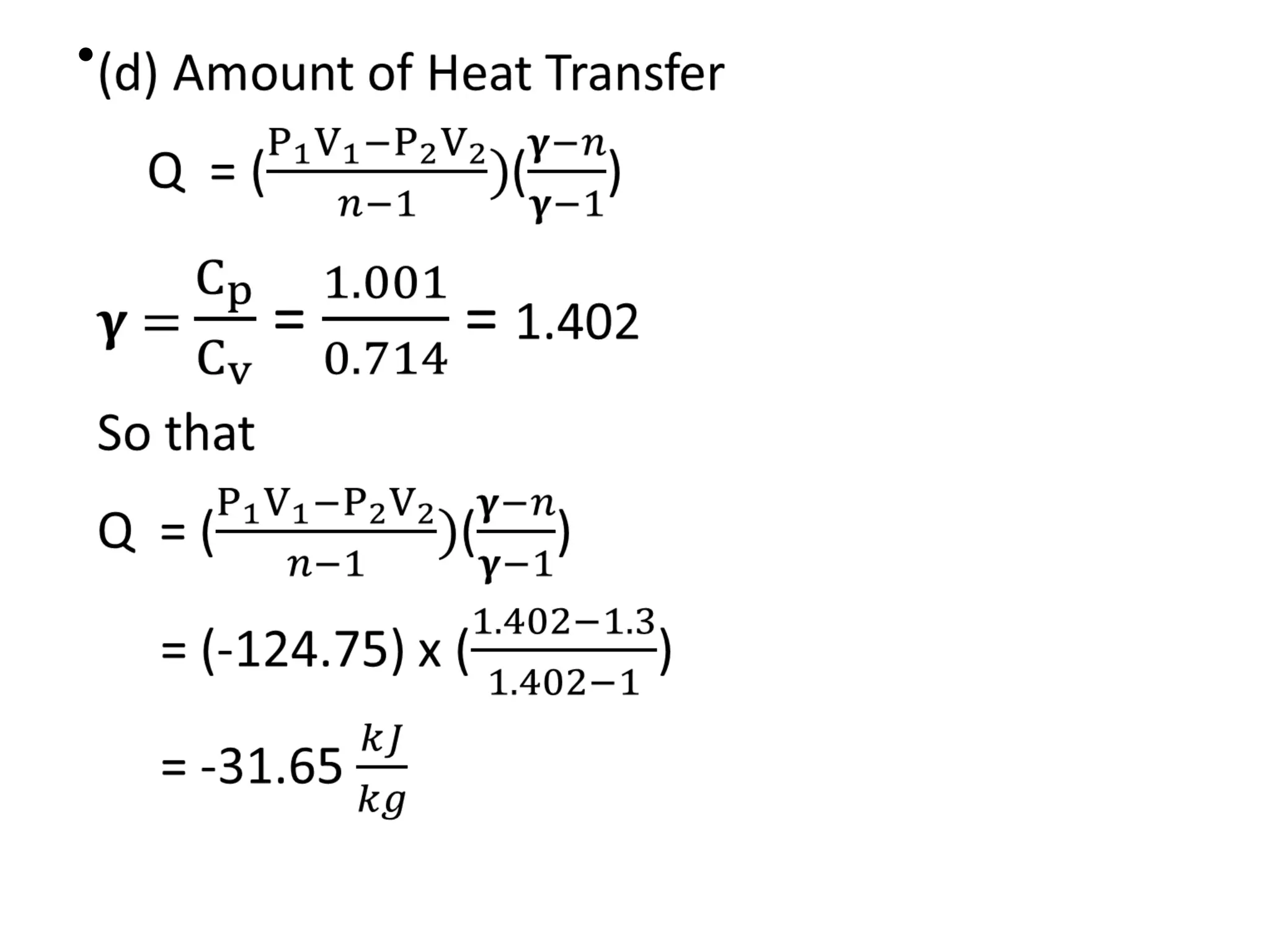
Heat transfer duringconstant pressure
Q = mCp (T2 – T1)
= 0.186 x 1.005 (288 – 458)
= -31.75 Kj
Heat is rejected by the system.
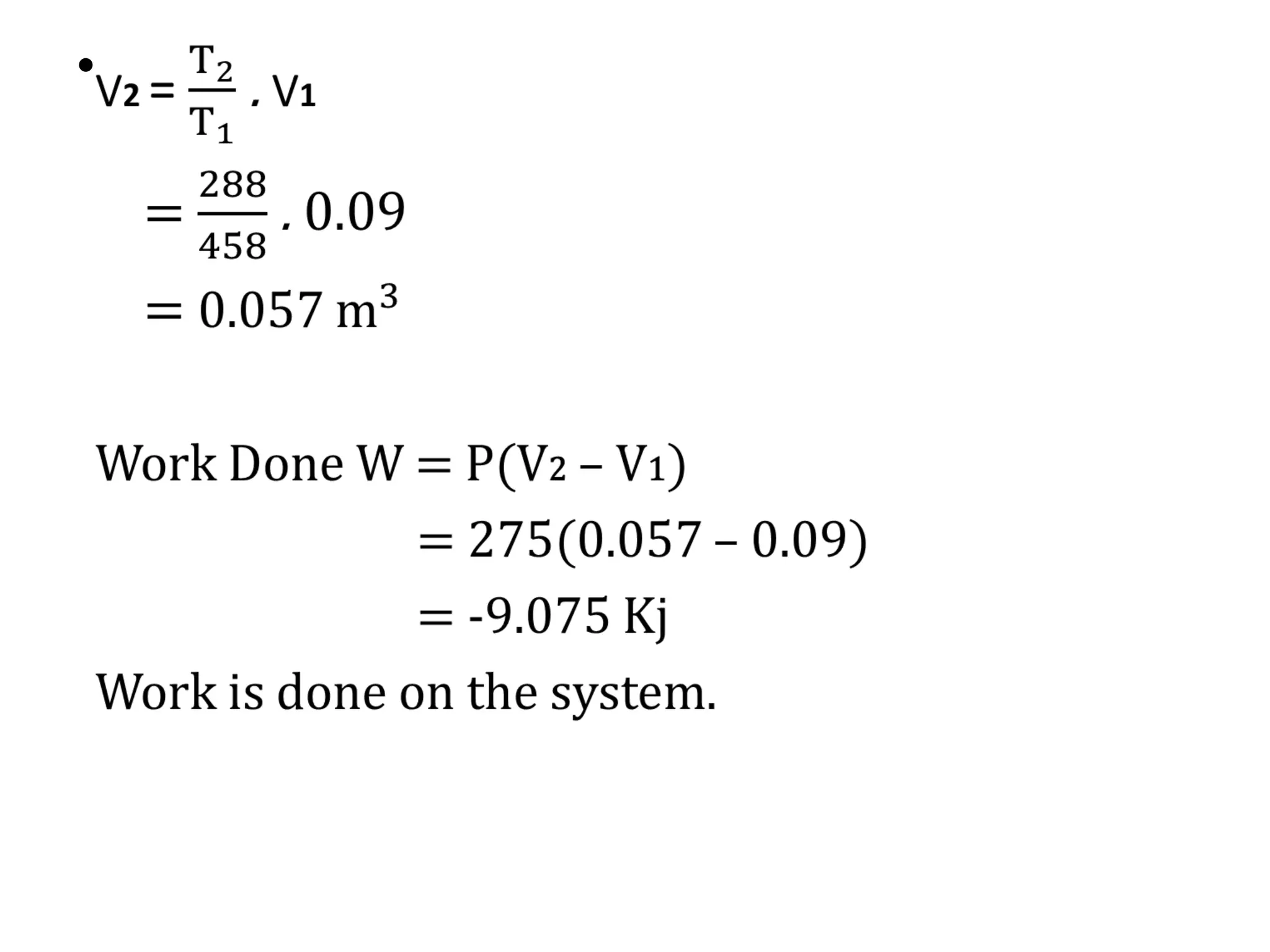
𝚫U = mCv (T2 – T1)
= 0.186 x 0715 x (288 – 458)
= -22.61 Kj
From first law of Thermodynamics
Q = U + W
𝚫
= -22.61 -9.08
= -31.69 kJ
![Heat transfer:
According to first law of thermodynamics
δQ= δW + dU
= p(V2 – V1) + mCv(T2 – T1)
But [ PV = mRT]
= mR(T2 - T1) + mCv(T2 – T1)
But R= Cp - Cv
= m(Cp - Cv) (T2 – T1) + mCv(T2 – T1)
δQ = mCp(T2 - T1)](https://image.slidesharecdn.com/copyofchapterno-2propertiesofgas-250423152543-43ff1b75/75/Copy-of-CHAPTER-NO-2-Properties-of-gas-pptx-57-2048.jpg)

![So that Change in enthalpy,
ΔH = H2 - H1
= (U2 - U1) + (p2 V2 - p1 V1)
= mCv(T2 - T1) + mR (T2 - T1) [ PV = mRT]
But R= Cp - Cv
ΔH = mCv(T2 - T1) + m(Cp - Cv) (T2 - T1)
ΔH = m Cp(T2 - T1)](https://image.slidesharecdn.com/copyofchapterno-2propertiesofgas-250423152543-43ff1b75/75/Copy-of-CHAPTER-NO-2-Properties-of-gas-pptx-59-2048.jpg)
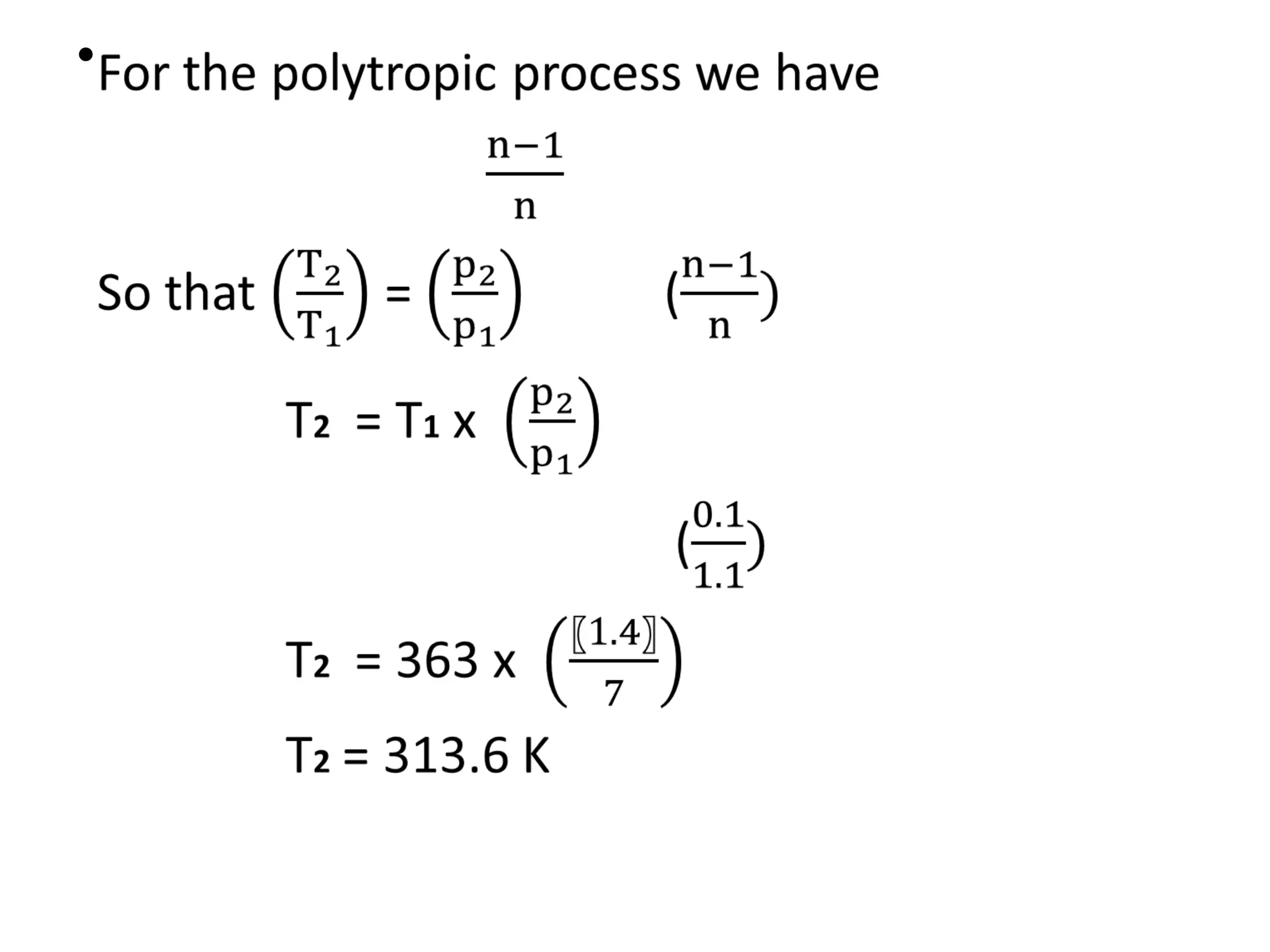
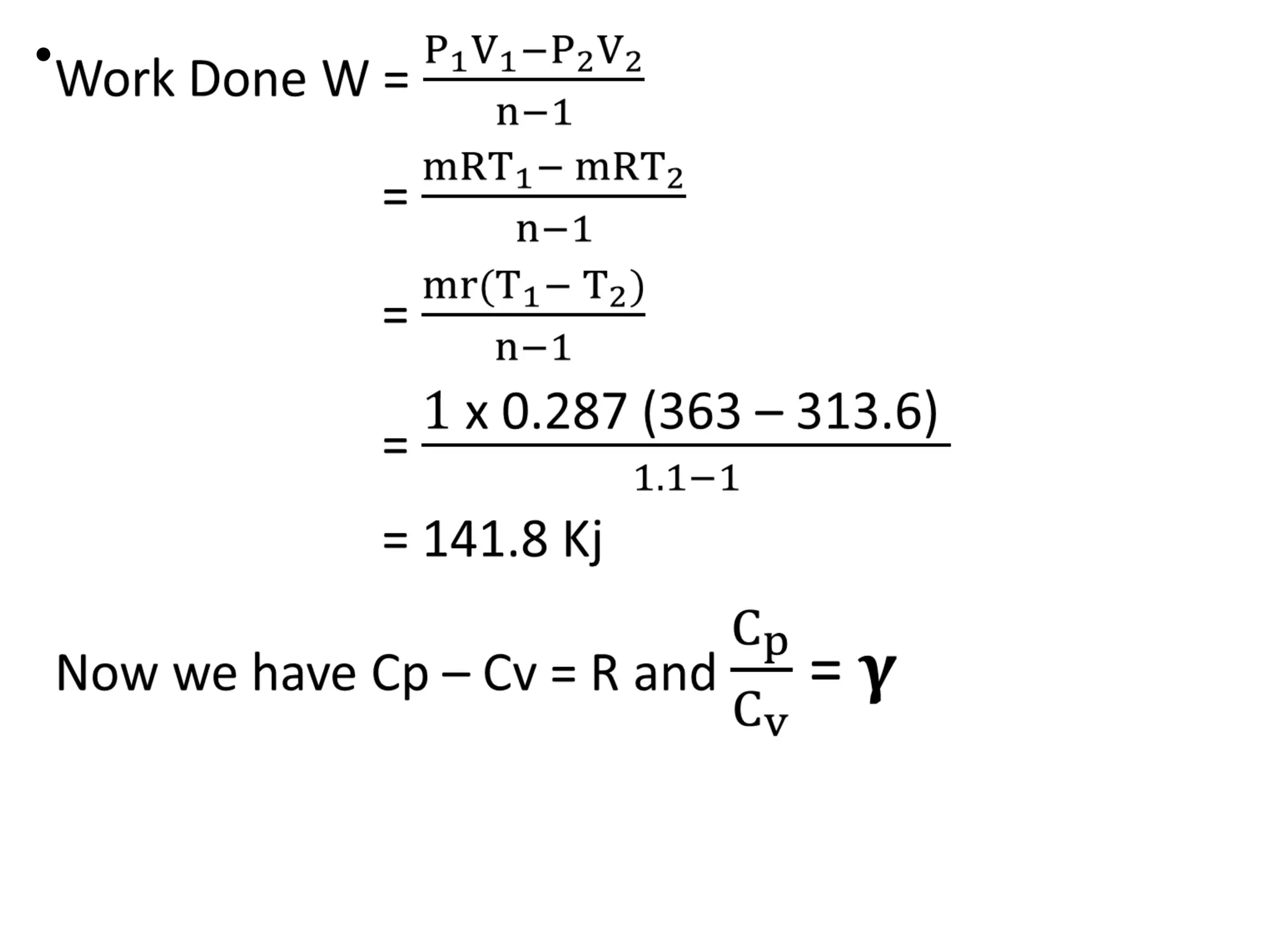
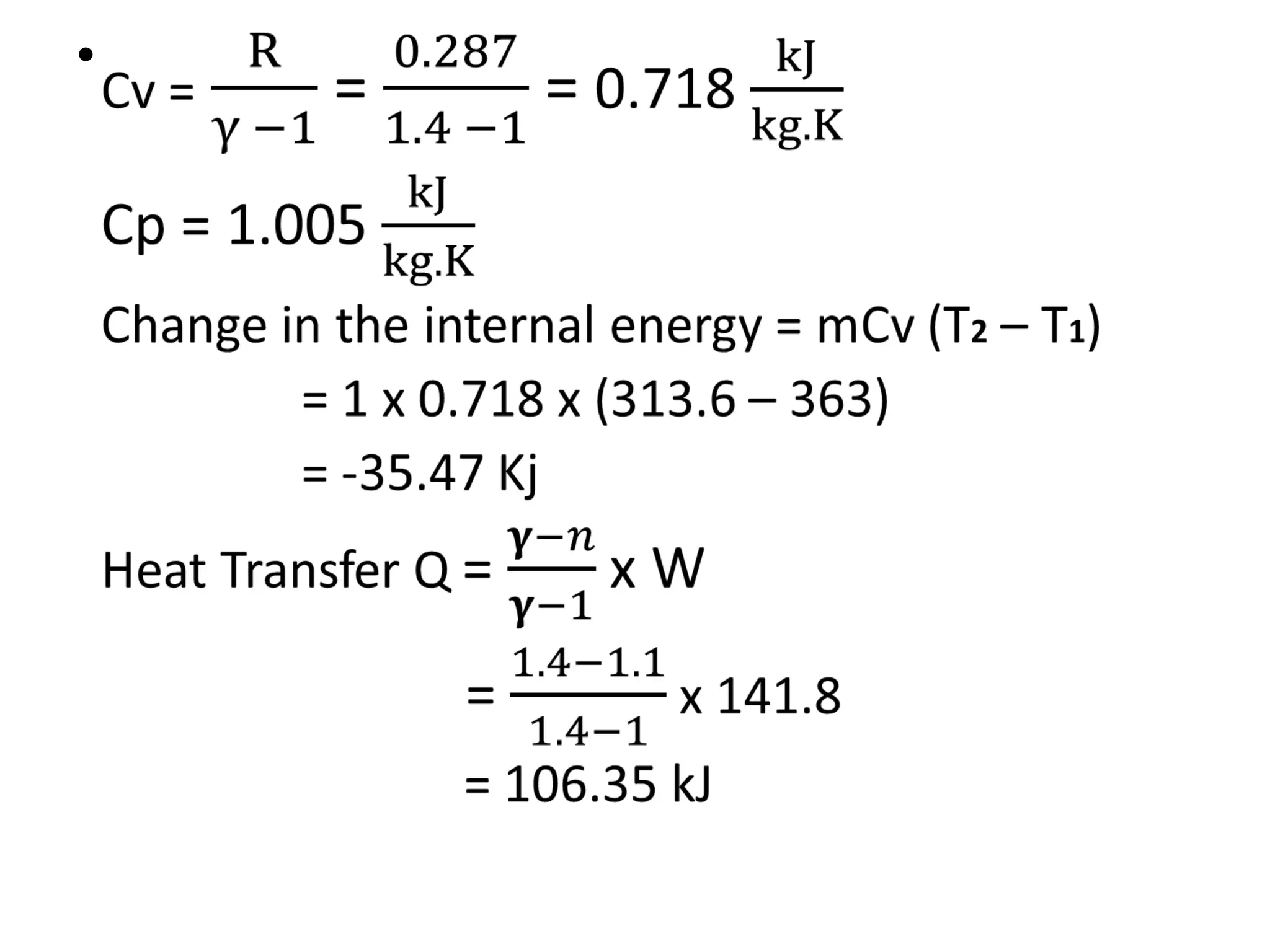
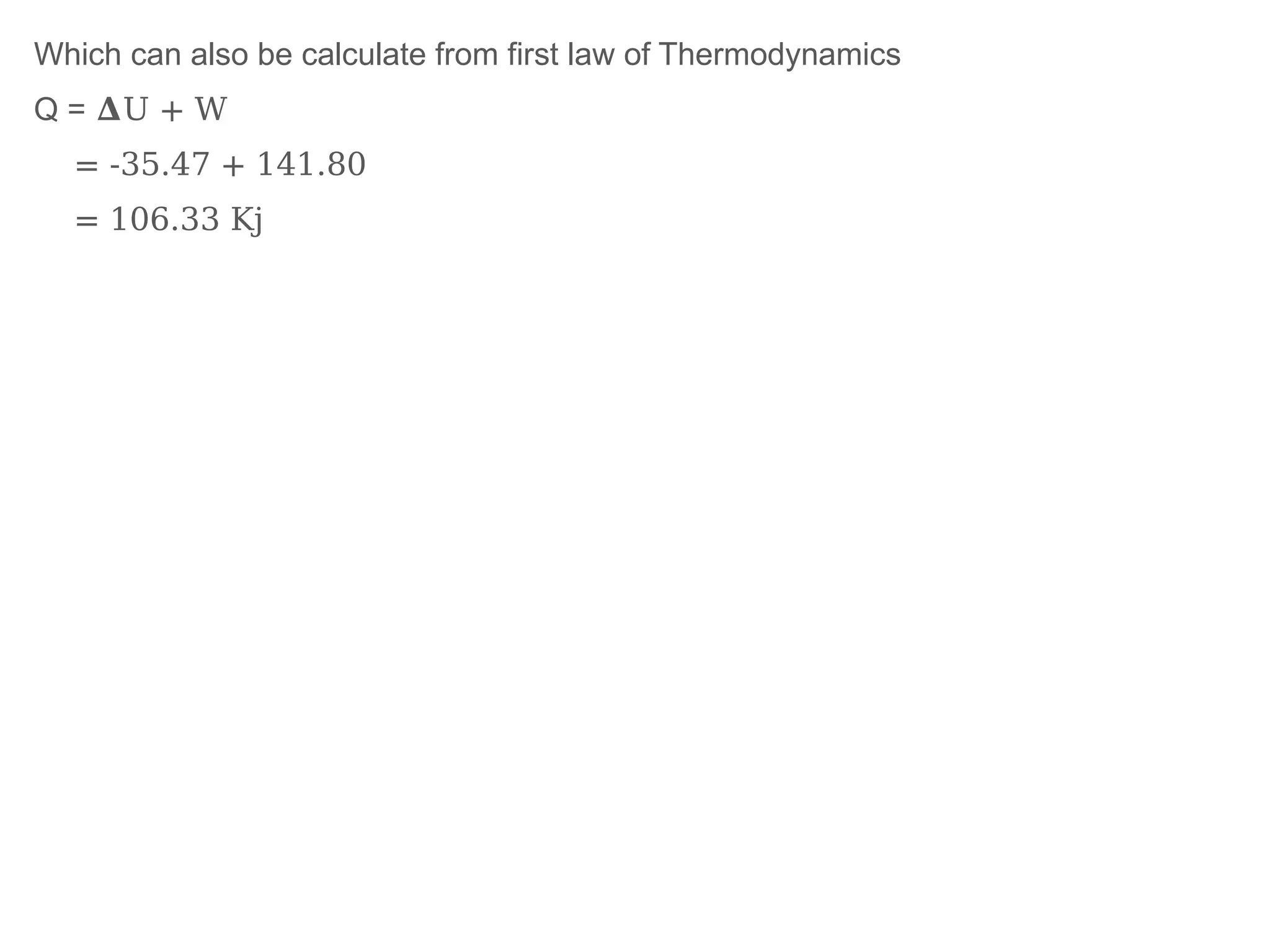



![[DSC Europe 25] Boris Perkovic - Lost in performance.pptx](https://cdn.slidesharecdn.com/ss_thumbnails/uq5hrp7vsuahqkxzifux-1-251204082258-fd2ee09d-thumbnail.jpg?width=640&height=640&fit=bounds)
![[DSC Europe 25] Bogdan Daniel Maruneac - AI - It starts with you.pptx](https://cdn.slidesharecdn.com/ss_thumbnails/odov3snhrcqs9hx5ny2n-4-251205085715-f1daacfe-thumbnail.jpg?width=640&height=640&fit=bounds)

![[DSC Europe 25] Marija Vlajkovic & Andrea Radonjanin - Integration of AI tool...](https://cdn.slidesharecdn.com/ss_thumbnails/qf1jrglttoc3bm8s3aop-final-integration-of-ai-tools-251208151905-394f3a6a-thumbnail.jpg?width=640&height=640&fit=bounds)
![[DSC Europe 25] Goran Obradovic - The Rise of Sovereign AI: Building the Regi...](https://cdn.slidesharecdn.com/ss_thumbnails/7nw2xxixrxqdxvrb5wca-6-251205085714-ab09a2ac-thumbnail.jpg?width=640&height=640&fit=bounds)
![[DSC Europe 25] Andy Cotgreave - Nothing is new in analytics.pptx](https://cdn.slidesharecdn.com/ss_thumbnails/mba4vzcurvoh5lfrd5zw-6-251205194645-341bbbbe-thumbnail.jpg?width=640&height=640&fit=bounds)
![[DSC Europe 25] Dusan Jovicic - AI Story: From on-prem to cloud and back agai...](https://cdn.slidesharecdn.com/ss_thumbnails/8kp49m6uq22ifnbwhfnk-2-251205085715-964d11a6-thumbnail.jpg?width=640&height=640&fit=bounds)