PEER MANAGEMENT TRAINING
Cooperative Language
Learning
Presented by: HAN Piseth
April 24th, 2015
ContentsI. Background
II. The Approach
1. Theory of language
2. Theory of learning
III. Design
1. Objectives
2. Syllabus
3. Learning and Teaching Activities
4. Roles of Learners
5. Roles of Teacher
6. Roles Instructional Materials
IV. Conclustion
Background
• It is an approach that makes maximum use of cooperative
activities involving pairs and small groups of learners in
the classroom.
Key Features
• Raise the achievement of all students, including those
who are gifted or academically handicapped.
• Help the teacher build positive relationships among
students.
• Give students the experiences they need for healthy
social, psychological and cognitive development.
• Replace the competitive organizational structure of
most classrooms and schools with a team-based, high
performance organizational structure.
Goals of Cooperative Language Learning
• To provide opportunities for naturalistic second
language acquisition through the use of interactive pair
and group activities.
• To provide teachers with a methodology to enable
them to achieve this goal and one that can be applied
in a variety of curriculum settings (e.g., content-based,
foreign language classrooms).
• To enable focused attention to particular lexical items,
language structures, and communicative functions
through the use of interactive tasks.
• To provide opportunities for learners to develop
successful learning and communication strategies.
• To enhance learner motivation and reduce learner
stress and to create a positive affective classroom
climate.
Approach
Theory of Language
 Interactive View (Founded in some basic
premises).
• Premise 1: Born to talk (primary purpose is to
communicate).
• Premise 2: Conversation (most talk/speech).
• Premise 3: Conversation operated according to
cooperative rules or “maxims”
• Premise 4: Cooperative maxim realized in one’s
native language (L1): Everyday Conversation inter..
• Premise 5: Cooperative maxim realize in L2:
through cooperatively structured interactional
activities.
Approach
Theory of Learning
 Social interaction in learning: (Jean Piaget and
Vygotsky) by structure situation, interactive
structure, and Question Matrix (Bloom).
To achieve what?
• Critical thinking skill, communication competence,
language skill, social skills, mental development.
Design
Objectives
 Cooperation rather than competition
 Critical thinking skills
 Communicative Competence
The Syllabus
 Not assume particular form of language syllabus
 CLL used in teaching content class, ESP, Four
skills, Grammar, Pronunciation, Vocabulary.
 CLL is defined because it is systematic and
carefully planed use of group-based procedures.
(Not teacher fronted)
To achieve group-based procedure, three types of
cooperative learning group defined by Johnson et al:
1. Formal Cooperative learning group: one period to
several weeks. (Specific task involve students
working together to achieve share learning goal.
Group assignment, Group projects, and some other
similar tasks.
2. Informal Cooperative Learning Group: a few
minutes to a class period (facilitate the direct
teaching)
3. Cooperative base groups: at least one year.
Support each other to achieve academic goal
Role play, Group Discussion. Overall, activities in one
class session.
Achieving the successful group-based learning in CL,
Olsen and Kagan (1992) proposed the following
elements:
Positive Interdependence: fail one fail all, mutual
support. Example, single product like score.
Group formation: deciding group size, assigning
students to group, student roles in group.
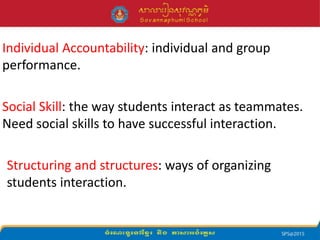
Individual Accountability: individual and group
performance.
Social Skill: the way students interact as teammates.
Need social skills to have successful interaction.
Structuring and structures: ways of organizing
students interaction.
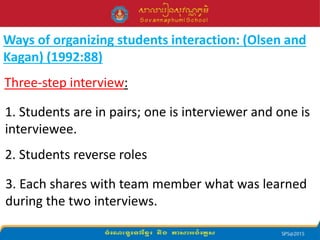
Ways of organizing students interaction: (Olsen and
Kagan) (1992:88)
Three-step interview:
1. Students are in pairs; one is interviewer and one is
interviewee.
2. Students reverse roles
3. Each shares with team member what was learned
during the two interviews.
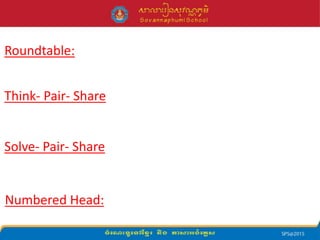
Roundtable:
Think- Pair- Share
Solve- Pair- Share
Numbered Head:
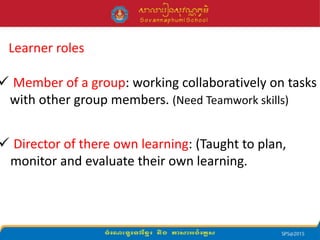
Learner roles
 Member of a group: working collaboratively on tasks
with other group members. (Need Teamwork skills)
 Director of there own learning: (Taught to plan,
monitor and evaluate their own learning.
Teacher roles
 Create a highly-structured and well-organized
learning environment.
 Setting goals, planning and structuring the tasks,
assigning students group roles, selecting materials….
 Facilitator of learning.
 Teacher speak less than in teacher fronted class. Post
question to challenge critical thinking.
The role of instructional materials
 Materials play an important part in creating
opportunities for student to work cooperatively.
 Materials might be specially designed for CLL
learning (such as commercially sold jigsaw and
information-gap activities, modified from existing
materials, or borrowed from other disciplines.
Conclusion
 In cooperative learning, group activities are the
major mode of learning and system for the use of
group work in teaching
 Group activities are carefully planned to maximize
student interaction and facilitate students
'contribution to each other' learning.
Communicative Competence
• In 1980, the applied linguists Canale and Swain
published an influential article in which they argued
that the ability to communicate required four different
sub-competencies:
• grammatical (ability to create grammatically correct
utterances),
• sociolinguistic (ability to produce sociolinguistically
appropriate utterances),
• discourse (ability to produce coherent and cohesive
utterances), and
• strategic (ability to solve communication problems as
they arise).

Cooperative language learning

  • 1.
    PEER MANAGEMENT TRAINING CooperativeLanguage Learning Presented by: HAN Piseth April 24th, 2015
  • 2.
    ContentsI. Background II. TheApproach 1. Theory of language 2. Theory of learning III. Design 1. Objectives 2. Syllabus 3. Learning and Teaching Activities 4. Roles of Learners 5. Roles of Teacher 6. Roles Instructional Materials IV. Conclustion
  • 3.
    Background • It isan approach that makes maximum use of cooperative activities involving pairs and small groups of learners in the classroom. Key Features • Raise the achievement of all students, including those who are gifted or academically handicapped. • Help the teacher build positive relationships among students.
  • 4.
    • Give studentsthe experiences they need for healthy social, psychological and cognitive development. • Replace the competitive organizational structure of most classrooms and schools with a team-based, high performance organizational structure.
  • 5.
    Goals of CooperativeLanguage Learning • To provide opportunities for naturalistic second language acquisition through the use of interactive pair and group activities. • To provide teachers with a methodology to enable them to achieve this goal and one that can be applied in a variety of curriculum settings (e.g., content-based, foreign language classrooms).
  • 6.
    • To enablefocused attention to particular lexical items, language structures, and communicative functions through the use of interactive tasks. • To provide opportunities for learners to develop successful learning and communication strategies. • To enhance learner motivation and reduce learner stress and to create a positive affective classroom climate.
  • 7.
    Approach Theory of Language Interactive View (Founded in some basic premises). • Premise 1: Born to talk (primary purpose is to communicate). • Premise 2: Conversation (most talk/speech).
  • 8.
    • Premise 3:Conversation operated according to cooperative rules or “maxims” • Premise 4: Cooperative maxim realized in one’s native language (L1): Everyday Conversation inter.. • Premise 5: Cooperative maxim realize in L2: through cooperatively structured interactional activities.
  • 9.
    Approach Theory of Learning Social interaction in learning: (Jean Piaget and Vygotsky) by structure situation, interactive structure, and Question Matrix (Bloom). To achieve what? • Critical thinking skill, communication competence, language skill, social skills, mental development.
  • 10.
    Design Objectives  Cooperation ratherthan competition  Critical thinking skills  Communicative Competence
  • 11.
    The Syllabus  Notassume particular form of language syllabus  CLL used in teaching content class, ESP, Four skills, Grammar, Pronunciation, Vocabulary.  CLL is defined because it is systematic and carefully planed use of group-based procedures. (Not teacher fronted)
  • 12.
    To achieve group-basedprocedure, three types of cooperative learning group defined by Johnson et al: 1. Formal Cooperative learning group: one period to several weeks. (Specific task involve students working together to achieve share learning goal. Group assignment, Group projects, and some other similar tasks.
  • 13.
    2. Informal CooperativeLearning Group: a few minutes to a class period (facilitate the direct teaching) 3. Cooperative base groups: at least one year. Support each other to achieve academic goal Role play, Group Discussion. Overall, activities in one class session.
  • 14.
    Achieving the successfulgroup-based learning in CL, Olsen and Kagan (1992) proposed the following elements: Positive Interdependence: fail one fail all, mutual support. Example, single product like score. Group formation: deciding group size, assigning students to group, student roles in group.
  • 15.
    Individual Accountability: individualand group performance. Social Skill: the way students interact as teammates. Need social skills to have successful interaction. Structuring and structures: ways of organizing students interaction.
  • 16.
    Ways of organizingstudents interaction: (Olsen and Kagan) (1992:88) Three-step interview: 1. Students are in pairs; one is interviewer and one is interviewee. 2. Students reverse roles 3. Each shares with team member what was learned during the two interviews.
  • 17.
    Roundtable: Think- Pair- Share Solve-Pair- Share Numbered Head:
  • 18.
    Learner roles  Memberof a group: working collaboratively on tasks with other group members. (Need Teamwork skills)  Director of there own learning: (Taught to plan, monitor and evaluate their own learning.
  • 19.
    Teacher roles  Createa highly-structured and well-organized learning environment.  Setting goals, planning and structuring the tasks, assigning students group roles, selecting materials….  Facilitator of learning.  Teacher speak less than in teacher fronted class. Post question to challenge critical thinking.
  • 20.
    The role ofinstructional materials  Materials play an important part in creating opportunities for student to work cooperatively.  Materials might be specially designed for CLL learning (such as commercially sold jigsaw and information-gap activities, modified from existing materials, or borrowed from other disciplines.
  • 21.
    Conclusion  In cooperativelearning, group activities are the major mode of learning and system for the use of group work in teaching  Group activities are carefully planned to maximize student interaction and facilitate students 'contribution to each other' learning.
  • 22.
    Communicative Competence • In1980, the applied linguists Canale and Swain published an influential article in which they argued that the ability to communicate required four different sub-competencies: • grammatical (ability to create grammatically correct utterances), • sociolinguistic (ability to produce sociolinguistically appropriate utterances), • discourse (ability to produce coherent and cohesive utterances), and • strategic (ability to solve communication problems as they arise).

Editor's Notes

  • #12 1. Wide variety of curriculum orientation can be taught via cooperative language learning.