COOKERY RULES & PRESERVATION OF NUTRIENTS
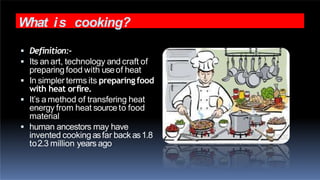
What is cooking?
 Definition:-
 Its an art, technology and craft of
preparing food with useof heat
 In simpler terms its preparingfood
with heat orfire.
 It’s a method of transfering heat
energy from heat source to food
material
 human ancestors may have
invented cooking asfar back as1.8
to2.3 million years ago
1) Food become safe for consumption after it is cooked above
40 degree.
2) After cooking palatability and quality of food increases.
3) Cooking facilitates and fastens the digestion process. Cooked
food is absorbed by the digestive system and assimilated by
the body.
4) Increases availability of nutrients e.g. in raw egg, avidin
binds biotin making it unavailable to the body.
5) Cooking introduces variety in food by cookingsame
ingredient in many different ways and methods.
6) Cooking increases the shelf life of food.
7) Moderate heating improves the biological value of proteins,
but prolonged heating can denature the proteins thus willnot
be available to the body.
Why cooking i s done?
 Tastesbetter
 Makes food easier tochew
 Makes digestion moreefficient
 Takesless energy to digest
 Improves nutritional quality(avadin)
 Kills microorganisms
 Inactivates enzymes
 Improves absorption
 For appearance
(some foods cannot eaten raw)
 Lastslonger
According to recent studies:-
chimpanzees spendsmore than sixhours
aday simply chewing their food
 Pythons found to use less energy
after eating cooked meat than raw
meat
 Cooked or raw food hassameamount
of Ca,Mn,Mg,Fe,Znexcept
potassium
 In cooking there is a transfer of energy from a heat
source to food and this energy alters the food
molecules,
 Heat brings about chemical, physical and
microbiological changes.
 In kitchen, mainly 3 types of devices are used to cook
food:
i. Stovetop
ii. Conventional oven
iii. Microwave oven
Principles of cooking:-
 1)conduction
 2)convection
 3)radiation
1) CONDUCTION METHOD:
 Heat transfer through direct contact.
 When cooking on the stovetop, the heat from the
flame or electric grill is applied directly to the fry
pan to cook food.
 Most pans are made up of cooper and aluminum,
that conduct heat very efficiently and do not melt on
stovetop.
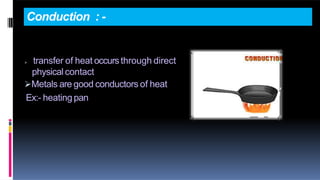
Conduction : -
 transfer of heat occursthrough direct
physical contact
Metals are good conductors of heat
Ex:- heatingpan
2) CONVECTION METHOD:
 In this method, heat transfer through a fluid.
 The fluid can be liquid or gas and even in case
convection oven it may be air.
 An oven is a confined area that gets hot by flames or
electric coils.
 The air inside is warmed to a desired temperature
and, as a result, cooks the food from all directions.
 This method of heat transfer is responsible for pizza,
cakes, and other baked foods.
3) RADIATION:
 In this heat is transferred using electromagnetic
radiations.
 A microwave oven uses strong radio waves which
are very weak and not hot.
 Microwave ovens work by spinning water, fat,
sugars and oil inside the food.
 This causes friction, which then heats the food and
cooks it from the inside.
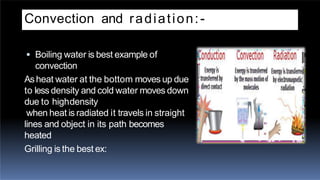
Convection and radiation:-
 Boiling water is best example of
convection
Asheat water at the bottom moves up due
to lessdensity and cold water moves down
due to highdensity
when heat is radiated it travels in straight
lines and object in its path becomes
heated
Grilling is the best ex:
3) ELECTRONIC HEAT TRANSFER:
 Microwave ovens have magnetron fitted in it which
converts electric currents to microwaves that are
similar to light or radio waves .
 This energy is focused towards the food to be
cooked.
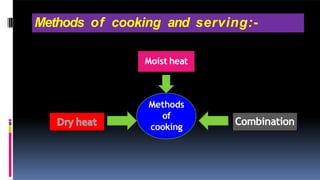
Methods of cooking and serving:-
Methods
of
cooking
Combination
Moist heat
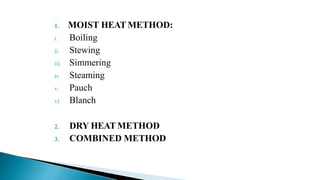
1. MOIST HEAT METHOD:
i. Boiling
ii. Stewing
iii. Simmering
iv. Steaming
v. Pauch
vi. Blanch
2. DRY HEATMETHOD
3. COMBINED METHOD
In this method the heat is conducted to the food product
by water (liquid) or steam.
I. BOILING:
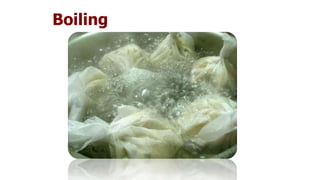
 Boiling means cooking food in a rapidly bubbling
liquid.
 Some vegetables such as roots and tubers, pulses,
cereals are cooked by boiling.
 The high temperature would cause protein to
toughen and rapid bubbling would break up
delicate products.
Boiling
ADVANTAGES:
• It is an easy method of cooking.
• It saves time and fuel.
• Boiled food is easily digestible.
 DISADVANTAGES:
• The high temperature would cause protein foods and
toughen and the rapid boiling would break up
duplicate products.
• Rapid boiling does not cook the food faster.
• It may effects the flavor, color and appearance of
food.
• Some valuable nutrients may be lost when the
cooking water is discarded.
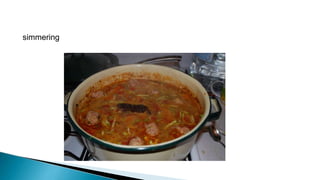
2) SIMMERING:
 It means to cook in a small amount of liquid that is bubbling
very gently.
 Most foods are meat, pulses and dried vegetables are cooked
by this method.
 They are cooked for a longer period to make them tender
and digestible.
 ADVANTAGES:
• Stewed foods are nourishing because nutrients and soluble
vitamins pass in to water that served as gravy.
• It enhance the taste and flavor of food.
 DISADVANTAGES:
 It is slow process.
 Vitamin C is destroyed by slow process.
simmering
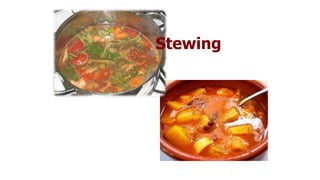
3) STEWING:
 Simmering and stewing are almost one and the same.
 Solid food is cooked is liquid and served with gravy.
 Carrot, potatoes and meat can be cooked by stewing.
 Food is cut into even size pieces and the heavy based sauce
pan with a suitable lid is used.
 ADVANTAGE:
• Food is nourishing since it is cooked in covered pan.
• Almost all nutrients are retained as gravy which is served
also.
Stewing
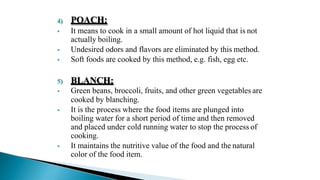
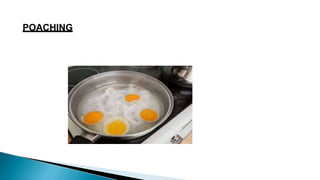
4) POACH:
 It means to cook in a small amount of hot liquid that is not
actually boiling.
 Undesired odors and flavors are eliminated by this method.
 Soft foods are cooked by this method, e.g. fish, egg etc.
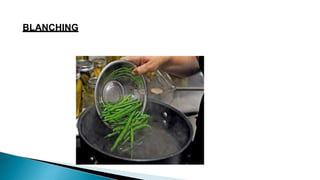
5) BLANCH:
 Green beans, broccoli, fruits, and other green vegetables are
cooked by blanching.
 It is the process where the food items are plunged into
boiling water for a short period of time and then removed
and placed under cold running water to stop the process of
cooking.
 It maintains the nutritive value of the food and the natural
color of the food item.
POACHING
BLANCHING
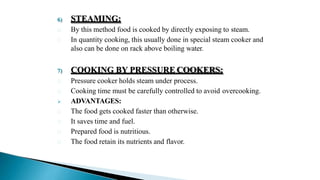
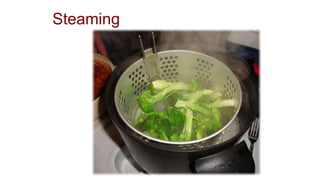
6) STEAMING:
By this method food is cooked by directly exposing to steam.
In quantity cooking, this usually done in special steam cooker and
also can be done on rack above boiling water.
7) COOKING BY PRESSURE COOKERS:
Pressure cooker holds steam under process.
Cooking time must be carefully controlled to avoid overcooking.
 ADVANTAGES:
The food gets cooked faster than otherwise.
It saves time and fuel.
Prepared food is nutritious.
The food retain its nutrients and flavor.
Steaming
1. Roasting and baking
2. Broiling
3. Grilling
4. Sauté
5. Frying
• Pan frying
• Deep frying
1) ROASTING AND BAKING:
In this method heat is transferred by convection method.
Cakes, cookies, biscuits etc. are cooked by this method.
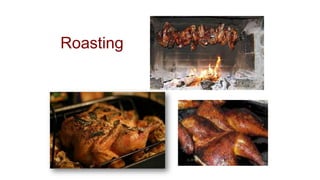
Roasting usually applies to meat and poultry.
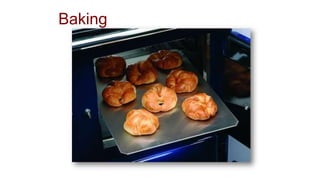
Baking applies to bread, pastries and cakes and cookies.
Fish could also be baked.
Cooking uncovered is essential to roasting. Covering holds
in steam, which changes the process from dry to heat
cooking.
Roasting can be done in 3 different equipments:
1. Spit roasting
2. Oven roasting
3. Pot roasting.
Roasting
Baking
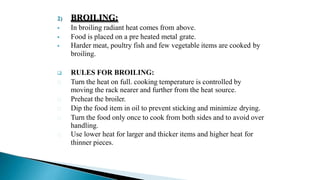
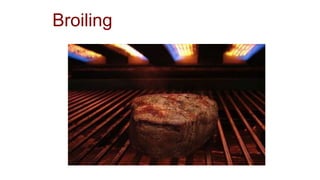
2) BROILING:
 In broiling radiant heat comes from above.
 Food is placed on a pre heated metal grate.
 Harder meat, poultry fish and few vegetable items are cooked by
broiling.
 RULES FOR BROILING:
Turn the heat on full. cooking temperature is controlled by
moving the rack nearer and further from the heat source.
Preheat the broiler.
Dip the food item in oil to prevent sticking and minimize drying.
Turn the food only once to cook from both sides and to avoid over
handling.
Use lower heat for larger and thicker items and higher heat for
thinner pieces.
Broiling
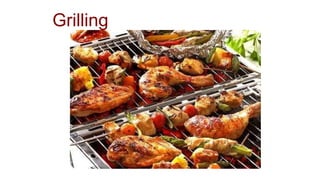
3) Grilling:
Heat is used from below.
It is done on an open grid over heat sources which may be
charcoal, an electric element or gas method.
Meat kebab & cheese are cooked by grilling method.
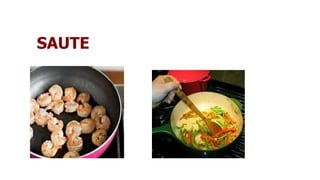
4) SAUTE:
In this small amount of oil is used.
High heat is applied.
Vegetable oil such as olive oil is used.
Butter is not used due to its smoke point.
Grilling
SAUTE
5) FRYING:
It is a dry heat cooking method as water is not used in this
method.
It involves cooking of food item in oil or other edible fats
such as vegetable oil, olive oil, ghee etc.
The items are cooked faster and get browned.
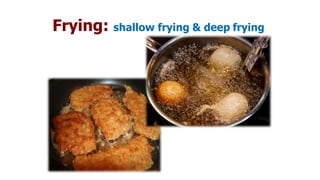
 Pan frying:
Frying means to cook in moderate amount of fat in a pan
over a moderate heat.
The amount of fat used depends on the food being cooked.
It is done over low heat than sauteing, because larger pieces
are being cooked.
Frying: shallow frying & deep frying
 Deep frying:
it means to cook food submerged in hot fat.
Many foods are dipped in a butter before frying.
This forms a protective coating between food and fat
and helps give the product crispness, color, flavor.
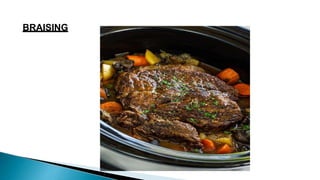
 BRAISING:
This method is a combination of dry heat and moist
heat.
Firstly an item is cooked by dry heat to ensure proper
caramelization.
Then liquid is added and simmer it until it becomes soft
and tender.
It is useful for tougher pieces of meat.
stewing (fat and then liquid)
BRAISING
Barbecuing
Barbecuing techniques include smoking,
roasting, and grilling. The technique for
which it is named involves cooking using
smoke at low temperatures and long
cooking times (several hours). Grilling is
done over direct, dry heat, usually over a hot
fire for a few minutes.
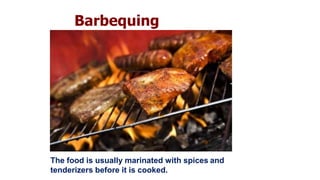
Barbequing
The food is usually marinated with spices and
tenderizers before it is cooked.
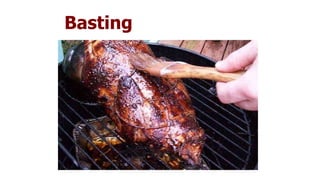
BASTING
Basting is a cooking technique that
involves cooking meat with either its own
juices or some type of preparation such as
a sauce or marinade. The meat is left
to cook, then periodically coated with the
juice.
Basting
 Dry heat cooking method includes:-
Broiling (Air)
Grilling (Air)
Roasting (Air)
Baking (Air)
Sauteing (fat)
Pan frying (fat)
Deep-frying(fat)
Moistheat method includes:-
Poaching (water or liquid)
Simmering (water orliquid)
Boiling (water or liquid)
Steaming (water orliquid)
Combination methodsincludes:-
Braising (fat and then liquid)
stewing(fatand thenliquid)
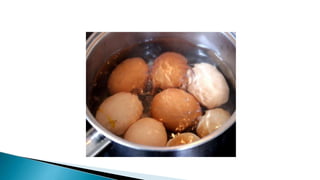
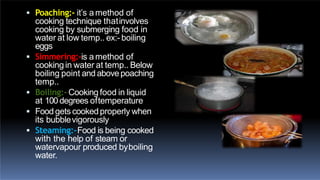
 Poaching:- it’s amethod of
cooking technique thatinvolves
cooking by submerging food in
water at low temp.. ex:- boiling
eggs
 Simmering:-is amethod of
cookingin water at temp.. Below
boiling point and abovepoaching
temp..
 Boiling:- Cooking food in liquid
at 100degrees oftemperature
 Food gets cookedproperly when
its bubblevigorously
 Steaming:-Food is being cooked
with the help of steam or
watervapour produced byboiling
water.
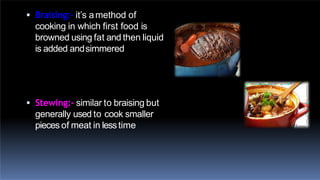
 Braising:- it’s amethod of
cooking in which first food is
browned using fat and then liquid
is added andsimmered
 Stewing:- similar to braising but
generally used to cook smaller
pieces of meat in lesstime
The END
Serving food:-
 Never leave meat, poultry, eggs, fish(raw or cooked) at room
temperature for more than 2 hours. If temp..Outside is more than
32degreecelsi..Then refrigerate within 1hour.
 Store leftovers in small, shallow containers to cool rapidly.
 Do not reheat food that is contaminated. Reheatingdoesnot makeit
safe.
 If you are not surehow long afood hasbeenin the refrigerator, throw it
out.
If you are not surewhether afood is safe, throw it out.
always clean utensilsand dishes properly
usehotboxesto packthe food sothat it last long for fresh
Safe food handling, Storage of food:--
 Buy vegetables whole. Leaving leaveson and stalks in allows vitaminCto
migrate to the edible parts of the plant.
 Cookfoods in the minimum amount of water, or steam them. usethis
mineral-rich water.(stock)
 Avoid high cooking temperaturesand long heat exposure.
 Do not allow food to stand for long periods at room temperature. Do not
store food in warm places.
 Do not soakvegetables for long periods.
 Do not peel fruit or vegetables
Preserving the nutrients of food with Proper care
• Brown Rice is more nutritious than regular white rice.
 Dark green leafy vegetables and deep-yellow vegetables have more vitaminAthan lighter-
colored ones.
 Cooked vegetables that are reheated after being kept in the refrigerator for two or three days
lose
more than half their vitaminC.
 Except for pineapples, fruits ripened on the plant and in the sunhave more vitamin Cthan
those picked green.
 In general, the longer food is stored in the refrigerator, freezer or cupboard,the greater the
nutrient losses.
 Orange juice canbe kept refrigerated in acovered container for several days before any
vitaminCis
lost.
 The three R's for nutrient preservation are to reduce the amount of
water used in cooking, reduce the cooking time and reduce the
surface area of the food that is exposed.
 Waterless cooking, pressure cooking, steaming, stir-frying and
microwaving are least destructive of
nutrients.
• if food is cooked in water, add it to asmall amount of boiling water,
cover the pot and cook it rapidly
Safe foodhandling:-
 Don't wash rice before cooking it.
 Thesmaller the piecesfood is cut into, the greater the chances of losing
nutrients. On the other hand, small pieces mean faster cooking. If
possible, delay cutting up fruits and vegetables.
 do not cook green vegetables with baking sodasinceit destroys thiamin
and vitaminC.
 Cooking in iron pots candestroy somevitamin C,but it canalso add
nutritious iron to the food, especiallyif the food is acidic.
 Cooking utensils madeof glass,stainless steel, aluminum or enamel or
lined with anonstick coating haveno effect on nutrient content.
 Thelonger meat is roasted, the more thiamin B1is lost.
Toxicity:-
 May occursdue to not cooking food thoroughly
 Dueto infections from exterior
 Improper storage offood
 Keeepingcooked foods unrefrigerated for long time
 Food touched byill
Food preservation and i t s methods:-
 Food preservationis to prevent the
growth ofbacteria, fungi,
and other micro-organisms aswell
asslowing the oxidation of fats that
causerancidity.
 Modern methodsincludes:-
Pasteurization
Vaccumpacking
Irradiation
Biopreservation
Cryopreservaation etc..
 Traditional methodsincludes:-
Drying
Cooling
Boiling
Salting
sugaring
Smoking
Pickling
Lye
Canning
Jellying
Jugging
burial
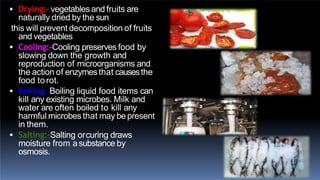
 Drying:- vegetables and fruits are
naturally dried by the sun
this will prevent decomposition of fruits
and vegetables
 Cooling:-Cooling preserves food by
slowing down the growth and
reproduction of microorganisms and
the action of enzymesthat causesthe
food torot.
 Boiling:-Boiling liquid food items can
kill any existing microbes. Milk and
water are often boiled to kill any
harmful microbesthat may be present
in them.
 Salting:-Salting orcuring draws
moisture from asubstance by
osmosis.
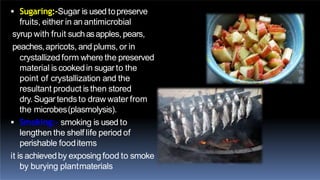
 Sugaring:-Sugar is used topreserve
fruits, either in an antimicrobial
syrup with fruit suchasapples, pears,
peaches,apricots, and plums, or in
crystallizedform where the preserved
material is cookedin sugarto the
point of crystallization and the
resultant product is then stored
dry.Sugar tends to draw water from
the microbes(plasmolysis).
 Smoking:- smoking is used to
lengthen the shelf life period of
perishable fooditems
it is achievedby exposingfood to smoke
by burying plantmaterials
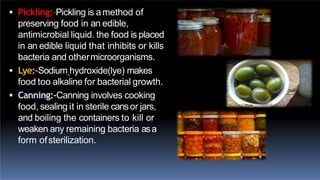
 Pickling:-Pickling is amethod of
preserving food in an edible,
antimicrobial liquid. the food is placed
in an edible liquid that inhibits or kills
bacteria and othermicroorganisms.
 Lye:-Sodium hydroxide(lye) makes
food too alkaline for bacterial growth.
 Canning:-Canning involves cooking
food, sealing it in sterile cansor jars,
and boiling the containers to kill or
weaken any remaining bacteria asa
form ofsterilization.
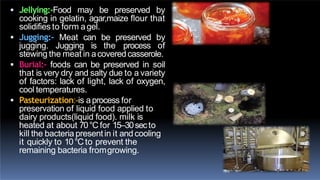
 Jellying:-Food may be preserved by
cooking in gelatin, agar,maize flour that
solidifies to form agel.
 Jugging:- Meat can be preserved by
jugging. Jugging is the process of
stewing the meat in acoveredcasserole.
 Burial:- foods can be preserved in soil
that is very dry and salty due to a variety
of factors: lack of light, lack of oxygen,
cool temperatures.
 Pasteurization:-is aprocess for
preservation of liquid food applied to
dairy products(liquid food). milk is
heated at about 70°Cfor 15–30secto
kill the bacteria present in it and cooling
it quickly to 10°Cto prevent the
remaining bacteria fromgrowing.
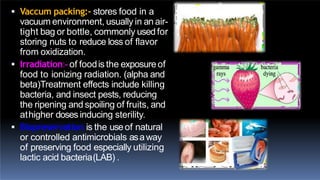
 Vaccum packing:- stores food in a
vacuum environment, usually in an air-
tight bag or bottle, commonly usedfor
storing nuts to reduce loss of flavor
from oxidization.
 Irradiation:- of foodis the exposureof
food to ionizing radiation. (alpha and
beta)Treatment effects include killing
bacteria, and insect pests, reducing
the ripening and spoiling of fruits, and
athigher doses inducing sterility.
 Biopreservation is the useof natural
or controlled antimicrobials asaway
of preserving food especially utilizing
lactic acid bacteria(LAB) .
Food additives:-
 Food additives are substances added to food to preserve flavor or
enhance its tasteand appearance.
Functions :-
 itmantains quality and freshness
 Prolong shelf lifeperiod
 Compensate vitamin, mineral deficiency and provide nutrition
 Aids in processing and preparation of foods (adds vit..lost during
processing)
Asmall percentage of people are sensitive to some food additives.
 Acidulents:- confer acid taste. it include vinegar, citric acid, tartaric acid, malic acid, fumaric acid, and lactic acid.
 Acidity regulators:- are usedfor controlling the pH of foods for stability .
 Anticaking agents:- prevents powders suchasmilk powder from caking.
 Antifoaming and foaming agents:-Anti foaming reduce or prevent foaming in foods. Foaming agents do the
reverse.
 Antioxidants:-such asvitamin Care preservatives by inhibiting the degradation of food by oxygen.
 Bulking agents:- suchasstarch increasethe bulk of afood without affecting its taste.
 Food coloring:-Colorings are added to food to replace colors lost or to make food look more attractive.
 Color retention agents :-areused to preserve afood's existing color.
 Emulsifiers:-allowwater and oils to remain mixed together in anemulsion.
 Flavors :-gives food aparticular taste or smell.
 Glazing agents:- provide ashiny appearance or protective coating to foods.
 Humectants:- prevent foods from dryingout.
 Sweeteners:- added to foods for flavoring,to keep the calories low.
 Thickeners:-increase its viscosity without changing its other properties.
 Raising agents:- increasesvolume of food through useof gases.
Facts about food additives:-
 Artificial food color is suspectedof causing increased
hyperactivity inchildren.
 dyeYellow No. 5hasbeen thought to worsen asthma
symptoms.
 FDA RedDyeNo. 2 after some studies found that large doses
could causecancer inrats.
Food adulteration
Examples of food adulteration:-
 milkwhich containts added water
 ghee which contains any added matter not exclusively derived from
milk fat
 mixture of two or more edible oils asan edible oil
 any article of food which contains any artificial sweetener beyond
the prescribedlimit
 turmeric containing any foreign substance
 dahi or curd not made out of milk
 milk or milk products containing constituents other than of milk

Food adulteration:-
 Adulterated food is impure, unsafe, food.
 Adulteration usually refers to mixing other matter of an
inferior and sometimes harmful quality with food or drink
intended to be sold.Asaresult food or drink becomesunfit for
human consumption.
 Reasons for foodadulteration:-
 sellers want profit
 Increase of foodproduction
 Topreservefood for economic activities
 Toearn money inlesstime
 Tomake food look more fresh and natural
Prevention of food adulteration
act,1954:-
 Objective:-
 to protect public from poisnous and harmful tools
 Toprotect the interests of consumers by eliminating fraudulent
practices
Functions:-
Toanalyse thesamples offoodsentby any authorised officer
 Penalities:-
 Guilt will be punished with imprisonment for aterm six months to 3
yearsand with fine upto one thousand rupees
Preparation of bevarages:-
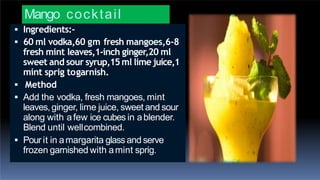
Mango cocktail
 Ingredients:-
 60 ml vodka,60 gm fresh mangoes,6-8
fresh mint leaves,1-inch ginger,20 ml
sweet and sour syrup,15ml lime juice,1
mint sprig togarnish.
 Method
 Add the vodka, fresh mangoes, mint
leaves,ginger, lime juice, sweet and sour
along with afew ice cubes in ablender.
Blend until wellcombined.
 Pourit in amargarita glass and serve
frozen garnished with amint sprig.
C
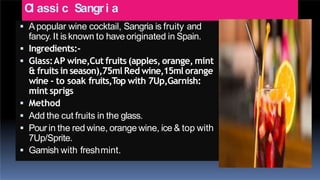
l assi c Sangri a
 A popular wine cocktail, Sangria is fruity and
fancy. It is known to have originated in Spain.
 Ingredients:-
 Glass:AP wine,Cut fruits (apples, orange, mint
& fruits in season),75ml Red wine,15ml orange
wine - to soak fruits,Top with 7Up,Garnish:
mint sprigs
 Method
 Add the cut fruits in the glass.
 Pour in the red wine, orange wine, ice & top with
7Up/Sprite.
 Garnish with freshmint.
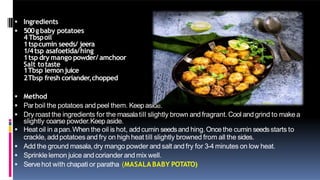
 Ingredients
 500gbaby potatoes
4 Tbspoil
1tspcumin seeds/ jeera
1/4tsp asafoetida/hing
1tsp dry mango powder/ amchoor
Salt totaste
1Tbsp lemonjuice
2Tbsp fresh coriander,chopped
 Method
 Parboil the potatoes and peel them. Keepaside.
 Dry roast the ingredients for the masalatill slightly brown and fragrant.Cool and grind to make a
slightly coarse powder.Keep aside.
 Heat oil in apan.When the oil is hot, add cumin seedsand hing.Once the cumin seedsstarts to
crackle, add potatoes and fry on high heat till slightly browned from all the sides.
 Add the ground masala,dry mango powder and salt and fry for 3-4 minutes on low heat.
 Sprinkle lemon juice and coriander and mix well.
 Servehot with chapati or paratha (MASALA BABY POTATO)

cookery rules.pptx

  • 1.
    COOKERY RULES &PRESERVATION OF NUTRIENTS
  • 2.
    What is cooking? Definition:-  Its an art, technology and craft of preparing food with useof heat  In simpler terms its preparingfood with heat orfire.  It’s a method of transfering heat energy from heat source to food material  human ancestors may have invented cooking asfar back as1.8 to2.3 million years ago
  • 3.
    1) Food becomesafe for consumption after it is cooked above 40 degree. 2) After cooking palatability and quality of food increases. 3) Cooking facilitates and fastens the digestion process. Cooked food is absorbed by the digestive system and assimilated by the body. 4) Increases availability of nutrients e.g. in raw egg, avidin binds biotin making it unavailable to the body. 5) Cooking introduces variety in food by cookingsame ingredient in many different ways and methods. 6) Cooking increases the shelf life of food. 7) Moderate heating improves the biological value of proteins, but prolonged heating can denature the proteins thus willnot be available to the body.
  • 4.
    Why cooking is done?  Tastesbetter  Makes food easier tochew  Makes digestion moreefficient  Takesless energy to digest  Improves nutritional quality(avadin)  Kills microorganisms  Inactivates enzymes  Improves absorption  For appearance (some foods cannot eaten raw)  Lastslonger According to recent studies:- chimpanzees spendsmore than sixhours aday simply chewing their food  Pythons found to use less energy after eating cooked meat than raw meat  Cooked or raw food hassameamount of Ca,Mn,Mg,Fe,Znexcept potassium
  • 5.
     In cookingthere is a transfer of energy from a heat source to food and this energy alters the food molecules,  Heat brings about chemical, physical and microbiological changes.  In kitchen, mainly 3 types of devices are used to cook food: i. Stovetop ii. Conventional oven iii. Microwave oven
  • 6.
    Principles of cooking:- 1)conduction  2)convection  3)radiation
  • 7.
    1) CONDUCTION METHOD: Heat transfer through direct contact.  When cooking on the stovetop, the heat from the flame or electric grill is applied directly to the fry pan to cook food.  Most pans are made up of cooper and aluminum, that conduct heat very efficiently and do not melt on stovetop.
  • 8.
    Conduction : - transfer of heat occursthrough direct physical contact Metals are good conductors of heat Ex:- heatingpan
  • 9.
    2) CONVECTION METHOD: In this method, heat transfer through a fluid.  The fluid can be liquid or gas and even in case convection oven it may be air.  An oven is a confined area that gets hot by flames or electric coils.  The air inside is warmed to a desired temperature and, as a result, cooks the food from all directions.  This method of heat transfer is responsible for pizza, cakes, and other baked foods.
  • 10.
    3) RADIATION:  Inthis heat is transferred using electromagnetic radiations.  A microwave oven uses strong radio waves which are very weak and not hot.  Microwave ovens work by spinning water, fat, sugars and oil inside the food.  This causes friction, which then heats the food and cooks it from the inside.
  • 11.
    Convection and radiation:- Boiling water is best example of convection Asheat water at the bottom moves up due to lessdensity and cold water moves down due to highdensity when heat is radiated it travels in straight lines and object in its path becomes heated Grilling is the best ex:
  • 12.
    3) ELECTRONIC HEATTRANSFER:  Microwave ovens have magnetron fitted in it which converts electric currents to microwaves that are similar to light or radio waves .  This energy is focused towards the food to be cooked.
  • 13.
    Methods of cookingand serving:- Methods of cooking Combination Moist heat
  • 15.
    1. MOIST HEATMETHOD: i. Boiling ii. Stewing iii. Simmering iv. Steaming v. Pauch vi. Blanch 2. DRY HEATMETHOD 3. COMBINED METHOD
  • 16.
    In this methodthe heat is conducted to the food product by water (liquid) or steam. I. BOILING:  Boiling means cooking food in a rapidly bubbling liquid.  Some vegetables such as roots and tubers, pulses, cereals are cooked by boiling.  The high temperature would cause protein to toughen and rapid bubbling would break up delicate products.
  • 17.
  • 19.
    ADVANTAGES: • It isan easy method of cooking. • It saves time and fuel. • Boiled food is easily digestible.  DISADVANTAGES: • The high temperature would cause protein foods and toughen and the rapid boiling would break up duplicate products. • Rapid boiling does not cook the food faster. • It may effects the flavor, color and appearance of food. • Some valuable nutrients may be lost when the cooking water is discarded.
  • 20.
    2) SIMMERING:  Itmeans to cook in a small amount of liquid that is bubbling very gently.  Most foods are meat, pulses and dried vegetables are cooked by this method.  They are cooked for a longer period to make them tender and digestible.  ADVANTAGES: • Stewed foods are nourishing because nutrients and soluble vitamins pass in to water that served as gravy. • It enhance the taste and flavor of food.  DISADVANTAGES:  It is slow process.  Vitamin C is destroyed by slow process.
  • 21.
  • 22.
    3) STEWING:  Simmeringand stewing are almost one and the same.  Solid food is cooked is liquid and served with gravy.  Carrot, potatoes and meat can be cooked by stewing.  Food is cut into even size pieces and the heavy based sauce pan with a suitable lid is used.  ADVANTAGE: • Food is nourishing since it is cooked in covered pan. • Almost all nutrients are retained as gravy which is served also.
  • 23.
  • 24.
    4) POACH:  Itmeans to cook in a small amount of hot liquid that is not actually boiling.  Undesired odors and flavors are eliminated by this method.  Soft foods are cooked by this method, e.g. fish, egg etc. 5) BLANCH:  Green beans, broccoli, fruits, and other green vegetables are cooked by blanching.  It is the process where the food items are plunged into boiling water for a short period of time and then removed and placed under cold running water to stop the process of cooking.  It maintains the nutritive value of the food and the natural color of the food item.
  • 25.
  • 26.
  • 27.
    6) STEAMING: By thismethod food is cooked by directly exposing to steam. In quantity cooking, this usually done in special steam cooker and also can be done on rack above boiling water. 7) COOKING BY PRESSURE COOKERS: Pressure cooker holds steam under process. Cooking time must be carefully controlled to avoid overcooking.  ADVANTAGES: The food gets cooked faster than otherwise. It saves time and fuel. Prepared food is nutritious. The food retain its nutrients and flavor.
  • 28.
  • 29.
    1. Roasting andbaking 2. Broiling 3. Grilling 4. Sauté 5. Frying • Pan frying • Deep frying
  • 30.
    1) ROASTING ANDBAKING: In this method heat is transferred by convection method. Cakes, cookies, biscuits etc. are cooked by this method. Roasting usually applies to meat and poultry. Baking applies to bread, pastries and cakes and cookies. Fish could also be baked. Cooking uncovered is essential to roasting. Covering holds in steam, which changes the process from dry to heat cooking. Roasting can be done in 3 different equipments: 1. Spit roasting 2. Oven roasting 3. Pot roasting.
  • 31.
  • 32.
  • 33.
    2) BROILING:  Inbroiling radiant heat comes from above.  Food is placed on a pre heated metal grate.  Harder meat, poultry fish and few vegetable items are cooked by broiling.  RULES FOR BROILING: Turn the heat on full. cooking temperature is controlled by moving the rack nearer and further from the heat source. Preheat the broiler. Dip the food item in oil to prevent sticking and minimize drying. Turn the food only once to cook from both sides and to avoid over handling. Use lower heat for larger and thicker items and higher heat for thinner pieces.
  • 34.
  • 35.
    3) Grilling: Heat isused from below. It is done on an open grid over heat sources which may be charcoal, an electric element or gas method. Meat kebab & cheese are cooked by grilling method. 4) SAUTE: In this small amount of oil is used. High heat is applied. Vegetable oil such as olive oil is used. Butter is not used due to its smoke point.
  • 36.
  • 37.
  • 38.
    5) FRYING: It isa dry heat cooking method as water is not used in this method. It involves cooking of food item in oil or other edible fats such as vegetable oil, olive oil, ghee etc. The items are cooked faster and get browned.  Pan frying: Frying means to cook in moderate amount of fat in a pan over a moderate heat. The amount of fat used depends on the food being cooked. It is done over low heat than sauteing, because larger pieces are being cooked.
  • 39.
  • 40.
     Deep frying: itmeans to cook food submerged in hot fat. Many foods are dipped in a butter before frying. This forms a protective coating between food and fat and helps give the product crispness, color, flavor.
  • 41.
     BRAISING: This methodis a combination of dry heat and moist heat. Firstly an item is cooked by dry heat to ensure proper caramelization. Then liquid is added and simmer it until it becomes soft and tender. It is useful for tougher pieces of meat. stewing (fat and then liquid)
  • 42.
  • 43.
    Barbecuing Barbecuing techniques includesmoking, roasting, and grilling. The technique for which it is named involves cooking using smoke at low temperatures and long cooking times (several hours). Grilling is done over direct, dry heat, usually over a hot fire for a few minutes.
  • 44.
    Barbequing The food isusually marinated with spices and tenderizers before it is cooked.
  • 45.
    BASTING Basting is acooking technique that involves cooking meat with either its own juices or some type of preparation such as a sauce or marinade. The meat is left to cook, then periodically coated with the juice.
  • 46.
  • 47.
     Dry heatcooking method includes:- Broiling (Air) Grilling (Air) Roasting (Air) Baking (Air) Sauteing (fat) Pan frying (fat) Deep-frying(fat) Moistheat method includes:- Poaching (water or liquid) Simmering (water orliquid) Boiling (water or liquid) Steaming (water orliquid) Combination methodsincludes:- Braising (fat and then liquid) stewing(fatand thenliquid)
  • 48.
     Poaching:- it’samethod of cooking technique thatinvolves cooking by submerging food in water at low temp.. ex:- boiling eggs  Simmering:-is amethod of cookingin water at temp.. Below boiling point and abovepoaching temp..  Boiling:- Cooking food in liquid at 100degrees oftemperature  Food gets cookedproperly when its bubblevigorously  Steaming:-Food is being cooked with the help of steam or watervapour produced byboiling water.
  • 49.
     Braising:- it’samethod of cooking in which first food is browned using fat and then liquid is added andsimmered  Stewing:- similar to braising but generally used to cook smaller pieces of meat in lesstime
  • 50.
  • 51.
    Serving food:-  Neverleave meat, poultry, eggs, fish(raw or cooked) at room temperature for more than 2 hours. If temp..Outside is more than 32degreecelsi..Then refrigerate within 1hour.  Store leftovers in small, shallow containers to cool rapidly.  Do not reheat food that is contaminated. Reheatingdoesnot makeit safe.  If you are not surehow long afood hasbeenin the refrigerator, throw it out. If you are not surewhether afood is safe, throw it out. always clean utensilsand dishes properly usehotboxesto packthe food sothat it last long for fresh
  • 52.
    Safe food handling,Storage of food:--  Buy vegetables whole. Leaving leaveson and stalks in allows vitaminCto migrate to the edible parts of the plant.  Cookfoods in the minimum amount of water, or steam them. usethis mineral-rich water.(stock)  Avoid high cooking temperaturesand long heat exposure.  Do not allow food to stand for long periods at room temperature. Do not store food in warm places.  Do not soakvegetables for long periods.  Do not peel fruit or vegetables
  • 53.
    Preserving the nutrientsof food with Proper care • Brown Rice is more nutritious than regular white rice.  Dark green leafy vegetables and deep-yellow vegetables have more vitaminAthan lighter- colored ones.  Cooked vegetables that are reheated after being kept in the refrigerator for two or three days lose more than half their vitaminC.  Except for pineapples, fruits ripened on the plant and in the sunhave more vitamin Cthan those picked green.  In general, the longer food is stored in the refrigerator, freezer or cupboard,the greater the nutrient losses.  Orange juice canbe kept refrigerated in acovered container for several days before any vitaminCis lost.
  • 54.
     The threeR's for nutrient preservation are to reduce the amount of water used in cooking, reduce the cooking time and reduce the surface area of the food that is exposed.  Waterless cooking, pressure cooking, steaming, stir-frying and microwaving are least destructive of nutrients. • if food is cooked in water, add it to asmall amount of boiling water, cover the pot and cook it rapidly
  • 55.
    Safe foodhandling:-  Don'twash rice before cooking it.  Thesmaller the piecesfood is cut into, the greater the chances of losing nutrients. On the other hand, small pieces mean faster cooking. If possible, delay cutting up fruits and vegetables.  do not cook green vegetables with baking sodasinceit destroys thiamin and vitaminC.  Cooking in iron pots candestroy somevitamin C,but it canalso add nutritious iron to the food, especiallyif the food is acidic.  Cooking utensils madeof glass,stainless steel, aluminum or enamel or lined with anonstick coating haveno effect on nutrient content.  Thelonger meat is roasted, the more thiamin B1is lost.
  • 56.
    Toxicity:-  May occursdueto not cooking food thoroughly  Dueto infections from exterior  Improper storage offood  Keeepingcooked foods unrefrigerated for long time  Food touched byill
  • 57.
    Food preservation andi t s methods:-  Food preservationis to prevent the growth ofbacteria, fungi, and other micro-organisms aswell asslowing the oxidation of fats that causerancidity.  Modern methodsincludes:- Pasteurization Vaccumpacking Irradiation Biopreservation Cryopreservaation etc..  Traditional methodsincludes:- Drying Cooling Boiling Salting sugaring Smoking Pickling Lye Canning Jellying Jugging burial
  • 58.
     Drying:- vegetablesand fruits are naturally dried by the sun this will prevent decomposition of fruits and vegetables  Cooling:-Cooling preserves food by slowing down the growth and reproduction of microorganisms and the action of enzymesthat causesthe food torot.  Boiling:-Boiling liquid food items can kill any existing microbes. Milk and water are often boiled to kill any harmful microbesthat may be present in them.  Salting:-Salting orcuring draws moisture from asubstance by osmosis.
  • 59.
     Sugaring:-Sugar isused topreserve fruits, either in an antimicrobial syrup with fruit suchasapples, pears, peaches,apricots, and plums, or in crystallizedform where the preserved material is cookedin sugarto the point of crystallization and the resultant product is then stored dry.Sugar tends to draw water from the microbes(plasmolysis).  Smoking:- smoking is used to lengthen the shelf life period of perishable fooditems it is achievedby exposingfood to smoke by burying plantmaterials
  • 60.
     Pickling:-Pickling isamethod of preserving food in an edible, antimicrobial liquid. the food is placed in an edible liquid that inhibits or kills bacteria and othermicroorganisms.  Lye:-Sodium hydroxide(lye) makes food too alkaline for bacterial growth.  Canning:-Canning involves cooking food, sealing it in sterile cansor jars, and boiling the containers to kill or weaken any remaining bacteria asa form ofsterilization.
  • 61.
     Jellying:-Food maybe preserved by cooking in gelatin, agar,maize flour that solidifies to form agel.  Jugging:- Meat can be preserved by jugging. Jugging is the process of stewing the meat in acoveredcasserole.  Burial:- foods can be preserved in soil that is very dry and salty due to a variety of factors: lack of light, lack of oxygen, cool temperatures.  Pasteurization:-is aprocess for preservation of liquid food applied to dairy products(liquid food). milk is heated at about 70°Cfor 15–30secto kill the bacteria present in it and cooling it quickly to 10°Cto prevent the remaining bacteria fromgrowing.
  • 62.
     Vaccum packing:-stores food in a vacuum environment, usually in an air- tight bag or bottle, commonly usedfor storing nuts to reduce loss of flavor from oxidization.  Irradiation:- of foodis the exposureof food to ionizing radiation. (alpha and beta)Treatment effects include killing bacteria, and insect pests, reducing the ripening and spoiling of fruits, and athigher doses inducing sterility.  Biopreservation is the useof natural or controlled antimicrobials asaway of preserving food especially utilizing lactic acid bacteria(LAB) .
  • 63.
    Food additives:-  Foodadditives are substances added to food to preserve flavor or enhance its tasteand appearance. Functions :-  itmantains quality and freshness  Prolong shelf lifeperiod  Compensate vitamin, mineral deficiency and provide nutrition  Aids in processing and preparation of foods (adds vit..lost during processing) Asmall percentage of people are sensitive to some food additives.
  • 64.
     Acidulents:- conferacid taste. it include vinegar, citric acid, tartaric acid, malic acid, fumaric acid, and lactic acid.  Acidity regulators:- are usedfor controlling the pH of foods for stability .  Anticaking agents:- prevents powders suchasmilk powder from caking.  Antifoaming and foaming agents:-Anti foaming reduce or prevent foaming in foods. Foaming agents do the reverse.  Antioxidants:-such asvitamin Care preservatives by inhibiting the degradation of food by oxygen.  Bulking agents:- suchasstarch increasethe bulk of afood without affecting its taste.  Food coloring:-Colorings are added to food to replace colors lost or to make food look more attractive.  Color retention agents :-areused to preserve afood's existing color.  Emulsifiers:-allowwater and oils to remain mixed together in anemulsion.  Flavors :-gives food aparticular taste or smell.  Glazing agents:- provide ashiny appearance or protective coating to foods.  Humectants:- prevent foods from dryingout.  Sweeteners:- added to foods for flavoring,to keep the calories low.  Thickeners:-increase its viscosity without changing its other properties.  Raising agents:- increasesvolume of food through useof gases.
  • 65.
    Facts about foodadditives:-  Artificial food color is suspectedof causing increased hyperactivity inchildren.  dyeYellow No. 5hasbeen thought to worsen asthma symptoms.  FDA RedDyeNo. 2 after some studies found that large doses could causecancer inrats.
  • 66.
  • 67.
    Examples of foodadulteration:-  milkwhich containts added water  ghee which contains any added matter not exclusively derived from milk fat  mixture of two or more edible oils asan edible oil  any article of food which contains any artificial sweetener beyond the prescribedlimit  turmeric containing any foreign substance  dahi or curd not made out of milk  milk or milk products containing constituents other than of milk 
  • 68.
    Food adulteration:-  Adulteratedfood is impure, unsafe, food.  Adulteration usually refers to mixing other matter of an inferior and sometimes harmful quality with food or drink intended to be sold.Asaresult food or drink becomesunfit for human consumption.  Reasons for foodadulteration:-  sellers want profit  Increase of foodproduction  Topreservefood for economic activities  Toearn money inlesstime  Tomake food look more fresh and natural
  • 69.
    Prevention of foodadulteration act,1954:-  Objective:-  to protect public from poisnous and harmful tools  Toprotect the interests of consumers by eliminating fraudulent practices Functions:- Toanalyse thesamples offoodsentby any authorised officer  Penalities:-  Guilt will be punished with imprisonment for aterm six months to 3 yearsand with fine upto one thousand rupees
  • 70.
  • 71.
    Mango cocktail  Ingredients:- 60 ml vodka,60 gm fresh mangoes,6-8 fresh mint leaves,1-inch ginger,20 ml sweet and sour syrup,15ml lime juice,1 mint sprig togarnish.  Method  Add the vodka, fresh mangoes, mint leaves,ginger, lime juice, sweet and sour along with afew ice cubes in ablender. Blend until wellcombined.  Pourit in amargarita glass and serve frozen garnished with amint sprig.
  • 72.
    C l assi cSangri a  A popular wine cocktail, Sangria is fruity and fancy. It is known to have originated in Spain.  Ingredients:-  Glass:AP wine,Cut fruits (apples, orange, mint & fruits in season),75ml Red wine,15ml orange wine - to soak fruits,Top with 7Up,Garnish: mint sprigs  Method  Add the cut fruits in the glass.  Pour in the red wine, orange wine, ice & top with 7Up/Sprite.  Garnish with freshmint.
  • 73.
     Ingredients  500gbabypotatoes 4 Tbspoil 1tspcumin seeds/ jeera 1/4tsp asafoetida/hing 1tsp dry mango powder/ amchoor Salt totaste 1Tbsp lemonjuice 2Tbsp fresh coriander,chopped  Method  Parboil the potatoes and peel them. Keepaside.  Dry roast the ingredients for the masalatill slightly brown and fragrant.Cool and grind to make a slightly coarse powder.Keep aside.  Heat oil in apan.When the oil is hot, add cumin seedsand hing.Once the cumin seedsstarts to crackle, add potatoes and fry on high heat till slightly browned from all the sides.  Add the ground masala,dry mango powder and salt and fry for 3-4 minutes on low heat.  Sprinkle lemon juice and coriander and mix well.  Servehot with chapati or paratha (MASALA BABY POTATO)