Programming
in Java
Control Flow
Flow of Control
Control flow statements help programmers make
decisions about which statements to execute and to
change the flow of execution in a program.
Four categories
Four categories
conditional statements
loops
exception
branch
Conditional Statements
When a program makes a decision, it determines,
based on the state of the program data whether
certain lines of code should be executed.
The two conditional statements provided by Java are:
 if
switch-case
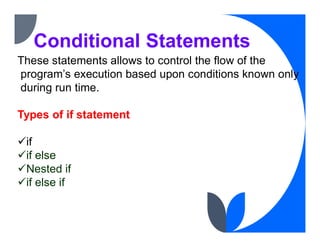
Conditional Statements
These statements allows to control the flow of the
program’s execution based upon conditions known only
during run time.
Types of if statement
if
if else
Nested if
if else if
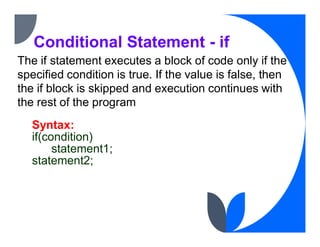
Conditional Statement - if
The if statement executes a block of code only if the
specified condition is true. If the value is false, then
the if block is skipped and execution continues with
the rest of the program
Syntax:
Syntax:
if(condition)
statement1;
statement2;
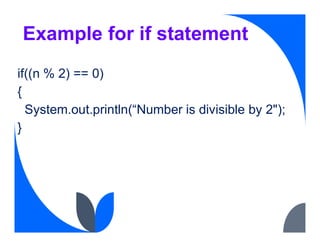
Example for if statement
if((n % 2) == 0)
{
System.out.println(“Number is divisible by 2");
}
}
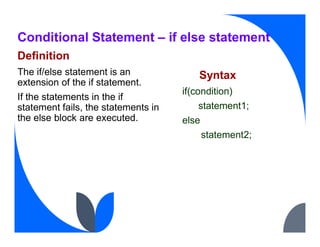
Conditional Statement – if else statement
Definition
The if/else statement is an
extension of the if statement.
If the statements in the if
statement fails, the statements in
the else block are executed.
Syntax
if(condition)
statement1;
else
else
statement2;
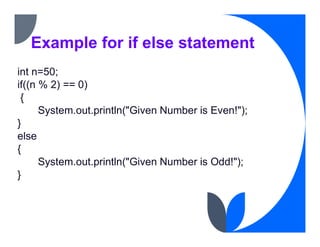
Example for if else statement
int n=50;
if((n % 2) == 0)
{
System.out.println("Given Number is Even!");
}
}
else
{
System.out.println("Given Number is Odd!");
}
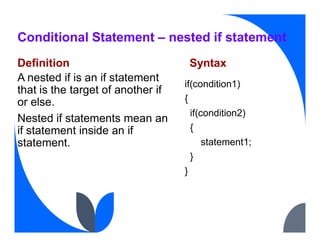
Conditional Statement – nested if statement
Definition
A nested if is an if statement
that is the target of another if
or else.
Nested if statements mean an
Syntax
if(condition1)
{
if(condition2)
{
Nested if statements mean an
if statement inside an if
statement.
{
statement1;
}
}
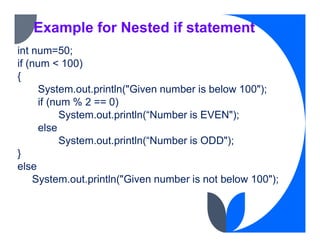
Example for Nested if statement
int num=50;
if (num < 100)
{
System.out.println("Given number is below 100");
if (num % 2 == 0)
System.out.println(“Number is EVEN");
else
else
System.out.println(“Number is ODD");
}
else
System.out.println("Given number is not below 100");
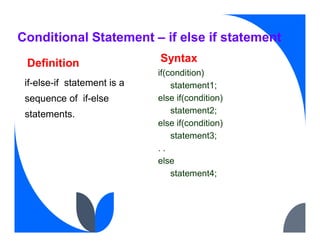
Conditional Statement – if else if statement
Definition
if-else-if statement is a
sequence of if-else
statements.
Syntax
if(condition)
statement1;
else if(condition)
statement2;
else if(condition)
else if(condition)
statement3;
. .
else
statement4;
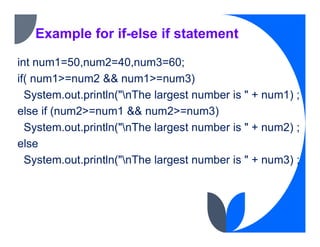
Example for if-else if statement
int num1=50,num2=40,num3=60;
if( num1>=num2 && num1>=num3)
System.out.println("nThe largest number is " + num1) ;
else if (num2>=num1 && num2>=num3)
System.out.println("nThe largest number is " + num2) ;
else
System.out.println("nThe largest number is " + num3) ;
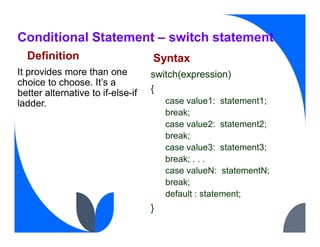
Conditional Statement – switch statement
Definition
It provides more than one
choice to choose. It’s a
better alternative to if-else-if
ladder.
Syntax
switch(expression)
{
case value1: statement1;
break;
case value2: statement2;
break;
case value3: statement3;
break; . . .
case valueN: statementN;
break;
default : statement;
}
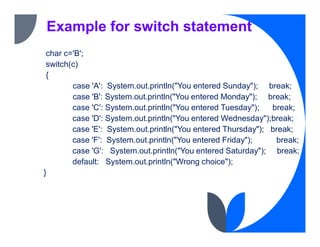
Example for switch statement
char c='B';
switch(c)
{
case 'A': System.out.println("You entered Sunday"); break;
case 'B': System.out.println("You entered Monday"); break;
case 'C': System.out.println("You entered Tuesday"); break;
case 'D': System.out.println("You entered Wednesday");break;
case 'E': System.out.println("You entered Thursday"); break;
case 'F': System.out.println("You entered Friday"); break;
case 'G': System.out.println("You entered Saturday"); break;
default: System.out.println("Wrong choice");
}

CONTROL FLOW STRUCTURE IN JAVA LANG.pdf

  • 1.
  • 2.
    Flow of Control Controlflow statements help programmers make decisions about which statements to execute and to change the flow of execution in a program. Four categories Four categories conditional statements loops exception branch
  • 3.
    Conditional Statements When aprogram makes a decision, it determines, based on the state of the program data whether certain lines of code should be executed. The two conditional statements provided by Java are: The two conditional statements provided by Java are:  if switch-case
  • 4.
    Conditional Statements These statementsallows to control the flow of the program’s execution based upon conditions known only during run time. Types of if statement if if else Nested if if else if
  • 5.
    Conditional Statement -if The if statement executes a block of code only if the specified condition is true. If the value is false, then the if block is skipped and execution continues with the rest of the program Syntax: Syntax: if(condition) statement1; statement2;
  • 6.
    Example for ifstatement if((n % 2) == 0) { System.out.println(“Number is divisible by 2"); } }
  • 7.
    Conditional Statement –if else statement Definition The if/else statement is an extension of the if statement. If the statements in the if statement fails, the statements in the else block are executed. Syntax if(condition) statement1; else else statement2;
  • 8.
    Example for ifelse statement int n=50; if((n % 2) == 0) { System.out.println("Given Number is Even!"); } } else { System.out.println("Given Number is Odd!"); }
  • 9.
    Conditional Statement –nested if statement Definition A nested if is an if statement that is the target of another if or else. Nested if statements mean an Syntax if(condition1) { if(condition2) { Nested if statements mean an if statement inside an if statement. { statement1; } }
  • 10.
    Example for Nestedif statement int num=50; if (num < 100) { System.out.println("Given number is below 100"); if (num % 2 == 0) System.out.println(“Number is EVEN"); else else System.out.println(“Number is ODD"); } else System.out.println("Given number is not below 100");
  • 11.
    Conditional Statement –if else if statement Definition if-else-if statement is a sequence of if-else statements. Syntax if(condition) statement1; else if(condition) statement2; else if(condition) else if(condition) statement3; . . else statement4;
  • 12.
    Example for if-elseif statement int num1=50,num2=40,num3=60; if( num1>=num2 && num1>=num3) System.out.println("nThe largest number is " + num1) ; else if (num2>=num1 && num2>=num3) System.out.println("nThe largest number is " + num2) ; System.out.println("nThe largest number is " + num2) ; else System.out.println("nThe largest number is " + num3) ;
  • 13.
    Conditional Statement –switch statement Definition It provides more than one choice to choose. It’s a better alternative to if-else-if ladder. Syntax switch(expression) { case value1: statement1; break; case value2: statement2; case value2: statement2; break; case value3: statement3; break; . . . case valueN: statementN; break; default : statement; }
  • 14.
    Example for switchstatement char c='B'; switch(c) { case 'A': System.out.println("You entered Sunday"); break; case 'B': System.out.println("You entered Monday"); break; case 'C': System.out.println("You entered Tuesday"); break; case 'D': System.out.println("You entered Wednesday");break; case 'E': System.out.println("You entered Thursday"); break; case 'F': System.out.println("You entered Friday"); break; case 'G': System.out.println("You entered Saturday"); break; default: System.out.println("Wrong choice"); }