 Decisions – if then else
 More decisions – switch
 Loops- while, do while, for
 Keyword break
 Keyword continue
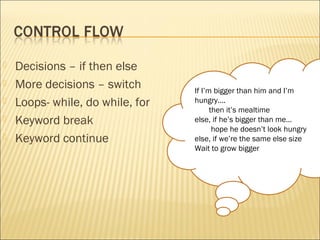
If I’m bigger than him and I’m
hungry….
then it’s mealtime
else, if he’s bigger than me…
hope he doesn’t look hungry
else, if we’re the same else size
Wait to grow bigger
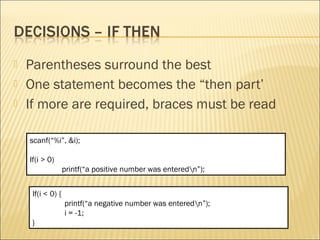
 Parentheses surround the best
 One statement becomes the “then part’
 If more are required, braces must be read
scanf(“%i”, &i);
If(i > 0)
printf(“a positive number was enteredn”);
If(i < 0) {
printf(“a negative number was enteredn”);
i = -1;
}
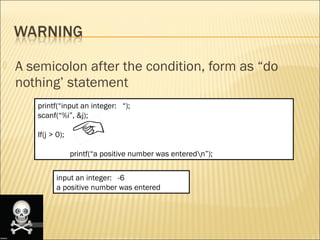
 A semicolon after the condition, form as “do
nothing’ statement
printf(“input an integer: “);
scanf(“%i”, &j);
If(j > 0);
printf(“a positive number was enteredn”);
input an integer: -6
a positive number was entered
 An optional else may be added
 One statement by default, if more are required,
braces must be used
if(i > 0)
printf(“i is positiven”);
else
printf(“i is negativen”);
if(i > 0)
printf(“i is positiven”);
else {
printf(“i is negativen”);
i = -1;
}
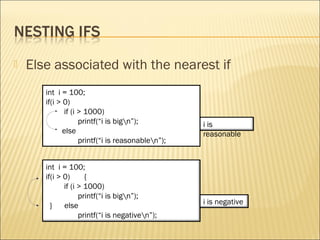
 Else associated with the nearest if
int i = 100;
if(i > 0)
if (i > 1000)
printf(“i is bign”);
else
printf(“i is reasonablen”);
int i = 100;
if(i > 0) {
if (i > 1000)
printf(“i is bign”);
} else
printf(“i is negativen”);
i is
reasonable
i is negative
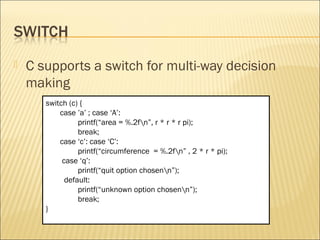
 C supports a switch for multi-way decision
making
switch (c) {
case ’a’ ; case ‘A’:
printf(“area = %.2fn”, r * r * r pi);
break;
case ‘c’: case ‘C’:
printf(“circumference = %.2fn” , 2 * r * pi);
case ‘q’:
printf(“quit option chosenn”);
default:
printf(“unknown option chosenn”);
break;
}
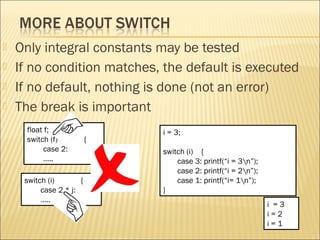
 Only integral constants may be tested
 If no condition matches, the default is executed
 If no default, nothing is done (not an error)
 The break is important
float f;
switch (f) {
case 2:
…..
switch (i) {
case 2 * j:
…..
i = 3;
switch (i) {
case 3: printf(“i = 3n”);
case 2: printf(“i = 2n”);
case 1: printf(“i= 1n”);
}
i = 3
i = 2
i = 1
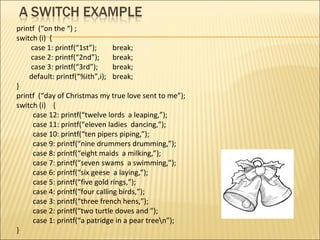
printf (“on the “) ;
switch (i) {
case 1: printf(“1st”); break;
case 2: printf(“2nd”); break;
case 3: printf(“3rd”); break;
default: printf(“%ith”,i); break;
}
printf (“day of Christmas my true love sent to me”);
switch (i) {
case 12: printf(“twelve lords a leaping,”);
case 11: printf(“eleven ladies dancing,”);
case 10: printf(“ten pipers piping,”);
case 9: printf(“nine drummers drumming,”);
case 8: printf(“eight maids a milking,”);
case 7: printf(“seven swams a swimming,”);
case 6: printf(“six geese a laying,”);
case 5: printf(“five gold rings,”);
case 4: printf(“four calling birds,”);
case 3: printf(“three french hens,”);
case 2: printf(“two turtle doves and ”);
case 1: printf(“a patridge in a pear treen”);
}
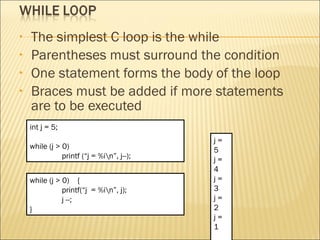
• The simplest C loop is the while
• Parentheses must surround the condition
• One statement forms the body of the loop
• Braces must be added if more statements
are to be executed
int j = 5;
while (j > 0)
printf (“j = %in”, j--);
while (j > 0) {
printf(“j = %in”, j);
j --;
}
j =
5
j =
4
j =
3
j =
2
j =
1
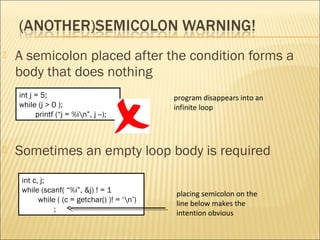
 A semicolon placed after the condition forms a
body that does nothing
 Sometimes an empty loop body is required
int j = 5;
while (j > 0 );
printf (“j = %in”, j --);
program disappears into an
infinite loop
int c, j;
while (scanf( “%i”, &j) ! = 1
while ( (c = getchar() )! = ‘n’)
;
placing semicolon on the
line below makes the
intention obvious
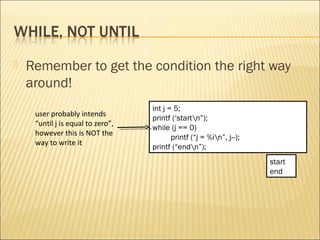
 Remember to get the condition the right way
around!
int j = 5;
printf (‘startn”);
while (j == 0)
printf (“j = %in”, j--);
printf (“endn”);
start
end
user probably intends
“until j is equal to zero”,
however this is NOT the
way to write it
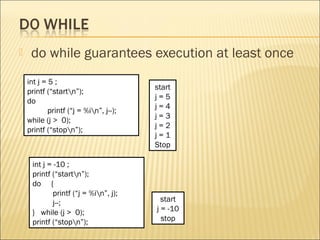
 do while guarantees execution at least once
int j = 5 ;
printf (“startn”);
do
printf (“j = %in”, j--);
while (j > 0);
printf (“stopn”);
start
j = 5
j = 4
j = 3
j = 2
j = 1
Stop
int j = -10 ;
printf (“startn”);
do {
printf (“j = %in”, j);
j--;
} while (j > 0);
printf (“stopn”);
start
j = -10
stop
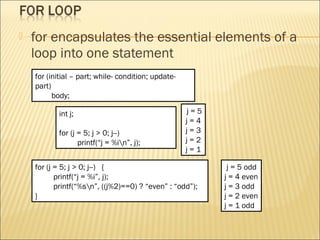
 for encapsulates the essential elements of a
loop into one statement
for (initial – part; while- condition; update-
part)
body;
int j;
for (j = 5; j > 0; j--)
printf(“j = %in”, j);
j = 5 odd
j = 4 even
j = 3 odd
j = 2 even
j = 1 odd
for (j = 5; j > 0; j--) {
printf(“j = %i”, j);
printf(“%sn”, ((j%2)==0) ? “even” : “odd”);
}
j = 5
j = 4
j = 3
j = 2
j = 1
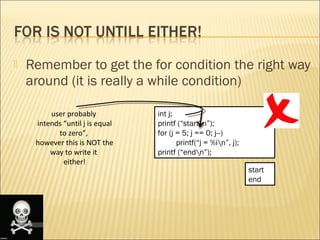
 Remember to get the for condition the right way
around (it is really a while condition)
int j;
printf (“startn”);
for (j = 5; j == 0; j--)
printf(“j = %in”, j);
printf (“endn”);
start
end
user probably
intends “until j is equal
to zero”,
however this is NOT the
way to write it
either!
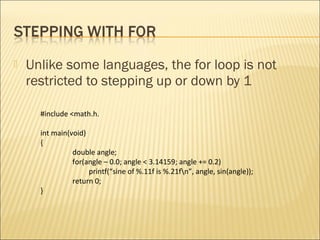
 Unlike some languages, the for loop is not
restricted to stepping up or down by 1
#include <math.h.
int main(void)
{
double angle;
for(angle – 0.0; angle < 3.14159; angle += 0.2)
printf(“sine of %.11f is %.21fn”, angle, sin(angle));
return 0;
}
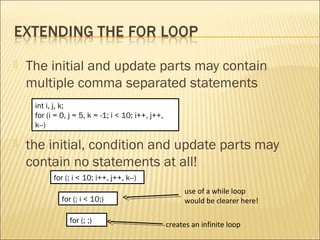
 The initial and update parts may contain
multiple comma separated statements
 the initial, condition and update parts may
contain no statements at all!
int i, j, k;
for (i = 0, j = 5, k = -1; i < 10; i++, j++,
k--)
for (; i < 10; i++, j++, k--)
for (; i < 10;)
for (; ;)
use of a while loop
would be clearer here!
creates an infinite loop
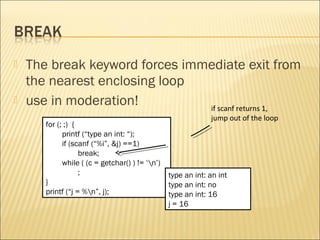
 The break keyword forces immediate exit from
the nearest enclosing loop
 use in moderation!
for (; ;) {
printf (“type an int: “);
if (scanf (“%i”, &j) ==1)
break;
while ( (c = getchar() ) != ‘n’)
;
}
printf (“j = %n”, j);
type an int: an int
type an int: no
type an int: 16
j = 16
if scanf returns 1,
jump out of the loop
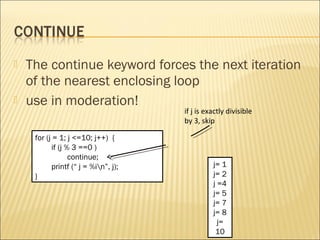
 The continue keyword forces the next iteration
of the nearest enclosing loop
 use in moderation!
for (j = 1; j <=10; j++) {
if (j % 3 ==0 )
continue;
printf (“ j = %in”, j);
}
j= 1
j= 2
j =4
j= 5
j= 7
j= 8
j=
10
if j is exactly divisible
by 3, skip
 If(then) else – watch the semicolons
 switch can test integer values
 while, do while, for – watch the semicolons
again
 break
 continue else…….
I want to be a tomato
!

Control flow in c

  • 1.
     Decisions –if then else  More decisions – switch  Loops- while, do while, for  Keyword break  Keyword continue If I’m bigger than him and I’m hungry…. then it’s mealtime else, if he’s bigger than me… hope he doesn’t look hungry else, if we’re the same else size Wait to grow bigger
  • 2.
     Parentheses surroundthe best  One statement becomes the “then part’  If more are required, braces must be read scanf(“%i”, &i); If(i > 0) printf(“a positive number was enteredn”); If(i < 0) { printf(“a negative number was enteredn”); i = -1; }
  • 3.
     A semicolonafter the condition, form as “do nothing’ statement printf(“input an integer: “); scanf(“%i”, &j); If(j > 0); printf(“a positive number was enteredn”); input an integer: -6 a positive number was entered
  • 4.
     An optionalelse may be added  One statement by default, if more are required, braces must be used if(i > 0) printf(“i is positiven”); else printf(“i is negativen”); if(i > 0) printf(“i is positiven”); else { printf(“i is negativen”); i = -1; }
  • 5.
     Else associatedwith the nearest if int i = 100; if(i > 0) if (i > 1000) printf(“i is bign”); else printf(“i is reasonablen”); int i = 100; if(i > 0) { if (i > 1000) printf(“i is bign”); } else printf(“i is negativen”); i is reasonable i is negative
  • 6.
     C supportsa switch for multi-way decision making switch (c) { case ’a’ ; case ‘A’: printf(“area = %.2fn”, r * r * r pi); break; case ‘c’: case ‘C’: printf(“circumference = %.2fn” , 2 * r * pi); case ‘q’: printf(“quit option chosenn”); default: printf(“unknown option chosenn”); break; }
  • 7.
     Only integralconstants may be tested  If no condition matches, the default is executed  If no default, nothing is done (not an error)  The break is important float f; switch (f) { case 2: ….. switch (i) { case 2 * j: ….. i = 3; switch (i) { case 3: printf(“i = 3n”); case 2: printf(“i = 2n”); case 1: printf(“i= 1n”); } i = 3 i = 2 i = 1
  • 8.
    printf (“on the“) ; switch (i) { case 1: printf(“1st”); break; case 2: printf(“2nd”); break; case 3: printf(“3rd”); break; default: printf(“%ith”,i); break; } printf (“day of Christmas my true love sent to me”); switch (i) { case 12: printf(“twelve lords a leaping,”); case 11: printf(“eleven ladies dancing,”); case 10: printf(“ten pipers piping,”); case 9: printf(“nine drummers drumming,”); case 8: printf(“eight maids a milking,”); case 7: printf(“seven swams a swimming,”); case 6: printf(“six geese a laying,”); case 5: printf(“five gold rings,”); case 4: printf(“four calling birds,”); case 3: printf(“three french hens,”); case 2: printf(“two turtle doves and ”); case 1: printf(“a patridge in a pear treen”); }
  • 9.
    • The simplestC loop is the while • Parentheses must surround the condition • One statement forms the body of the loop • Braces must be added if more statements are to be executed int j = 5; while (j > 0) printf (“j = %in”, j--); while (j > 0) { printf(“j = %in”, j); j --; } j = 5 j = 4 j = 3 j = 2 j = 1
  • 10.
     A semicolonplaced after the condition forms a body that does nothing  Sometimes an empty loop body is required int j = 5; while (j > 0 ); printf (“j = %in”, j --); program disappears into an infinite loop int c, j; while (scanf( “%i”, &j) ! = 1 while ( (c = getchar() )! = ‘n’) ; placing semicolon on the line below makes the intention obvious
  • 11.
     Remember toget the condition the right way around! int j = 5; printf (‘startn”); while (j == 0) printf (“j = %in”, j--); printf (“endn”); start end user probably intends “until j is equal to zero”, however this is NOT the way to write it
  • 12.
     do whileguarantees execution at least once int j = 5 ; printf (“startn”); do printf (“j = %in”, j--); while (j > 0); printf (“stopn”); start j = 5 j = 4 j = 3 j = 2 j = 1 Stop int j = -10 ; printf (“startn”); do { printf (“j = %in”, j); j--; } while (j > 0); printf (“stopn”); start j = -10 stop
  • 13.
     for encapsulatesthe essential elements of a loop into one statement for (initial – part; while- condition; update- part) body; int j; for (j = 5; j > 0; j--) printf(“j = %in”, j); j = 5 odd j = 4 even j = 3 odd j = 2 even j = 1 odd for (j = 5; j > 0; j--) { printf(“j = %i”, j); printf(“%sn”, ((j%2)==0) ? “even” : “odd”); } j = 5 j = 4 j = 3 j = 2 j = 1
  • 14.
     Remember toget the for condition the right way around (it is really a while condition) int j; printf (“startn”); for (j = 5; j == 0; j--) printf(“j = %in”, j); printf (“endn”); start end user probably intends “until j is equal to zero”, however this is NOT the way to write it either!
  • 15.
     Unlike somelanguages, the for loop is not restricted to stepping up or down by 1 #include <math.h. int main(void) { double angle; for(angle – 0.0; angle < 3.14159; angle += 0.2) printf(“sine of %.11f is %.21fn”, angle, sin(angle)); return 0; }
  • 16.
     The initialand update parts may contain multiple comma separated statements  the initial, condition and update parts may contain no statements at all! int i, j, k; for (i = 0, j = 5, k = -1; i < 10; i++, j++, k--) for (; i < 10; i++, j++, k--) for (; i < 10;) for (; ;) use of a while loop would be clearer here! creates an infinite loop
  • 17.
     The breakkeyword forces immediate exit from the nearest enclosing loop  use in moderation! for (; ;) { printf (“type an int: “); if (scanf (“%i”, &j) ==1) break; while ( (c = getchar() ) != ‘n’) ; } printf (“j = %n”, j); type an int: an int type an int: no type an int: 16 j = 16 if scanf returns 1, jump out of the loop
  • 18.
     The continuekeyword forces the next iteration of the nearest enclosing loop  use in moderation! for (j = 1; j <=10; j++) { if (j % 3 ==0 ) continue; printf (“ j = %in”, j); } j= 1 j= 2 j =4 j= 5 j= 7 j= 8 j= 10 if j is exactly divisible by 3, skip
  • 19.
     If(then) else– watch the semicolons  switch can test integer values  while, do while, for – watch the semicolons again  break  continue else……. I want to be a tomato !