Development (CPD)
DEPARTMENT OF EDUCATION
INTERNATIONAL ISLAMIC UNIVERSITY ISLAMABAD
5/13/2018
CPDofTeachers
1
by
Ijaz Ahmad
Plan of Talk
 Defining CPD
 Purpose of CPD
 Importance of CPD
 Models of CPD
 CPD models in Pakistan
 Conclusion
2
CPD
 CPD is a planned, continuous and lifelong process
 Where by teachers try to develop their personal and professional
qualities, and improve their knowledge, skills and practice
(Padwad, Amol, Dixit, Krishna, 2011)
 CPD encompasses all behaviors which are intended to effect
change in the classroom (Day, 1999)
3
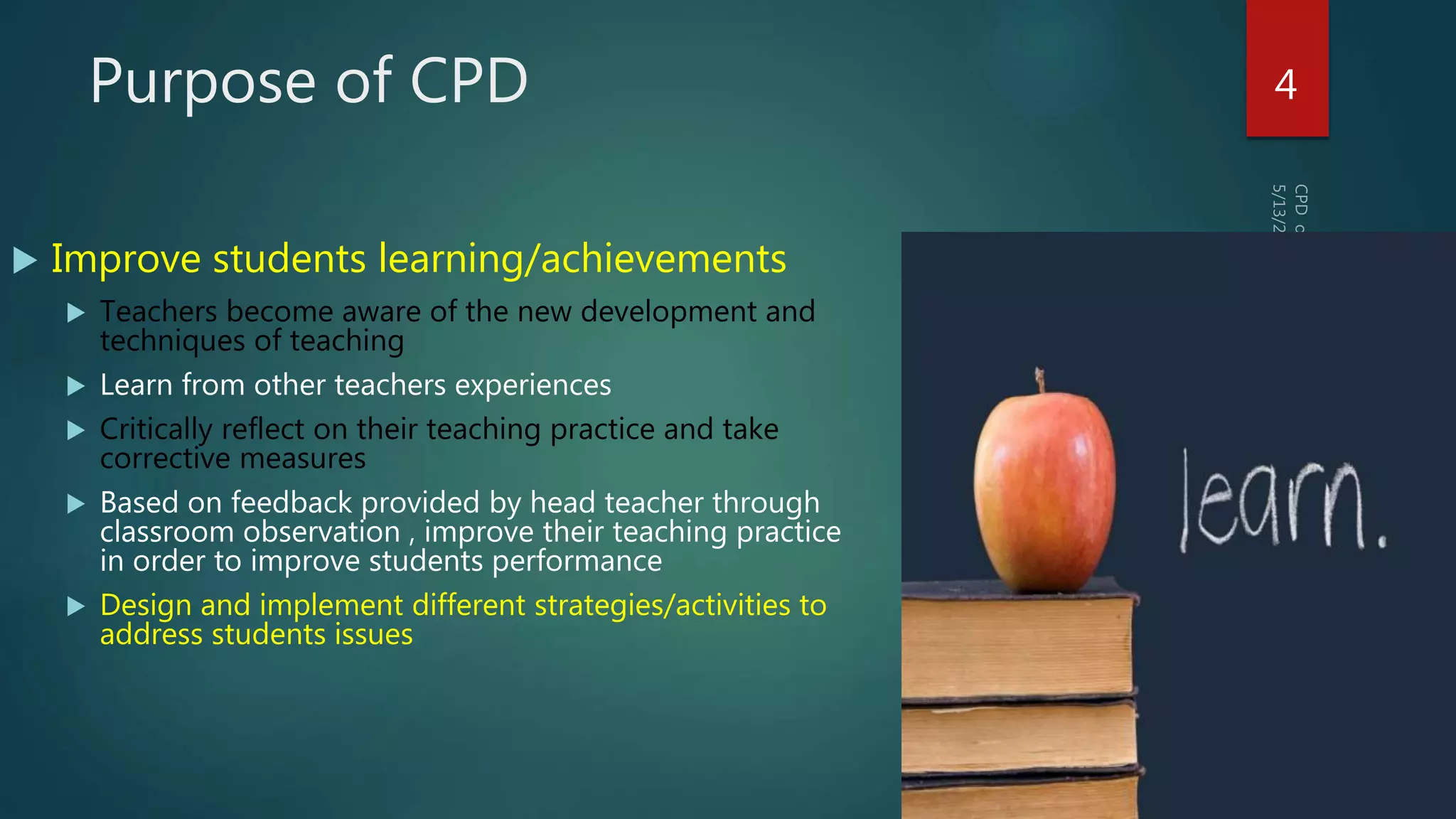
Purpose of CPD
 Improve students learning/achievements
 Teachers become aware of the new development and
techniques of teaching
 Learn from other teachers experiences
 Critically reflect on their teaching practice and take
corrective measures
 Based on feedback provided by head teacher through
classroom observation , improve their teaching practice
in order to improve students performance
 Design and implement different strategies/activities to
address students issues
4
Importance of CPD
 The education professional
 Enhance your confidence and motivation
 contribute to your career development as you become more effective in your workplace
 allow you to consolidate and demonstrate your professionalism, both to yourself and others
 The Learner
 The quality of teaching is recognized as one of the most important factors in determining learner
outcomes. In other words, a good teacher will achieve better results from their learners than a poor
one and vice versa
 Your workplace
 If access to effective CPD encourages you to be more confident, motivated and inspired, giving you
the reward of greater professional satisfaction
5
Models of CPD
 Lieberman (1996) classified CPD
into three types
1. Direct teaching (such as courses,
workshops)
2. learning in school (such as peer
coaching, critical friendships,
mentoring, action research) and
3. out of school learning (visits to other
schools, school-university
partnerships and so on)
6
• Training
• Award-bearing
• Deficit
• Cascade
• Standards-based
Coaching/Mentoring
• Community of
practice
• Action research
• Transformative
Kennedy (2005) identify nine models of CPD
Features of Effective CPD
The most effective CPD is that which is
 Personalized
 Relevant
 Sustained
 Supported
 Collaborative
7
5/13/2018
CPD of Teachers
8
CPD
in
Pakistan
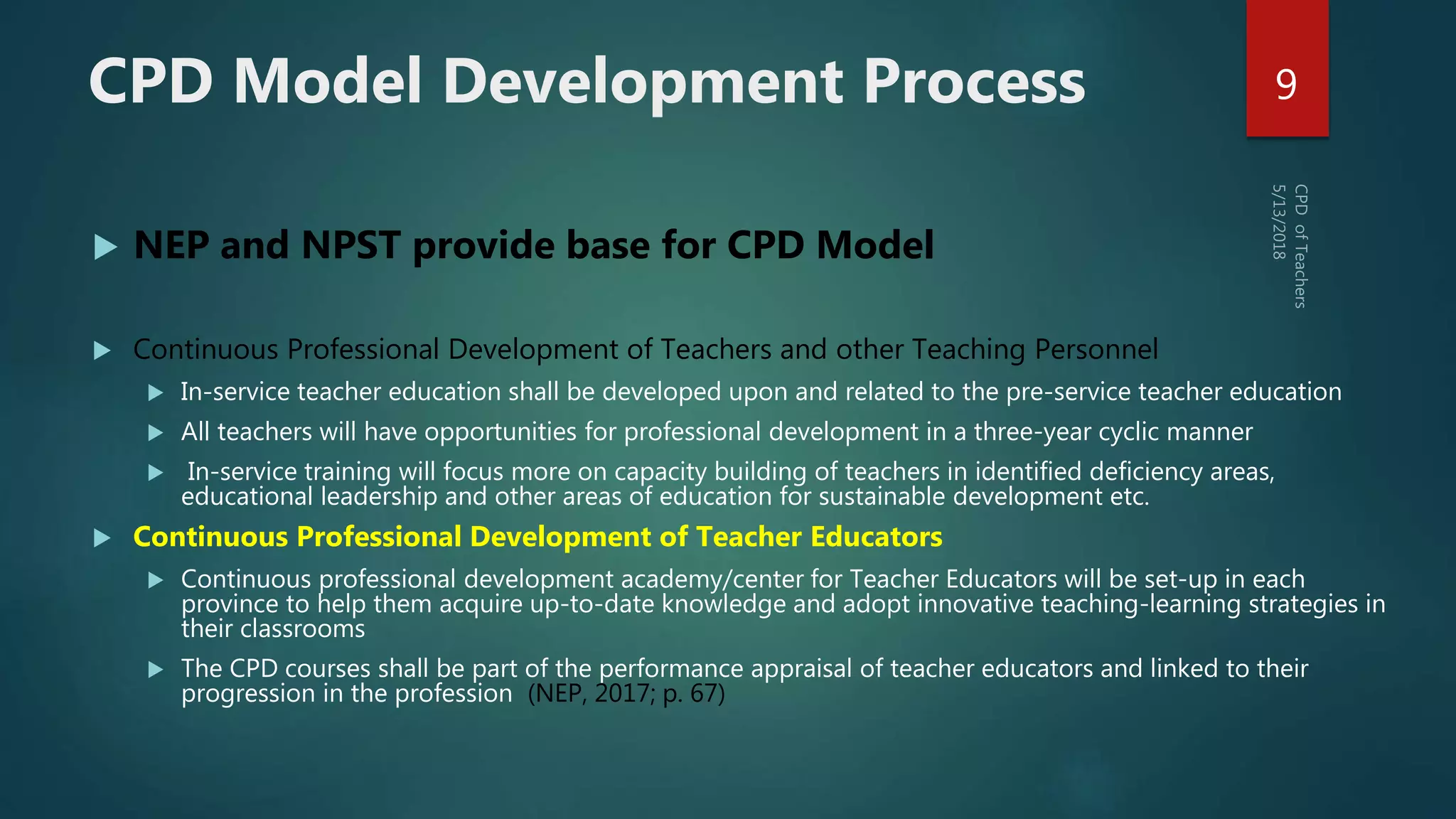
CPD Model Development Process
 NEP and NPST provide base for CPD Model
 Continuous Professional Development of Teachers and other Teaching Personnel
 In-service teacher education shall be developed upon and related to the pre-service teacher education
 All teachers will have opportunities for professional development in a three-year cyclic manner
 In-service training will focus more on capacity building of teachers in identified deficiency areas,
educational leadership and other areas of education for sustainable development etc.
 Continuous Professional Development of Teacher Educators
 Continuous professional development academy/center for Teacher Educators will be set-up in each
province to help them acquire up-to-date knowledge and adopt innovative teaching-learning strategies in
their classrooms
 The CPD courses shall be part of the performance appraisal of teacher educators and linked to their
progression in the profession (NEP, 2017; p. 67)
9
Cont.
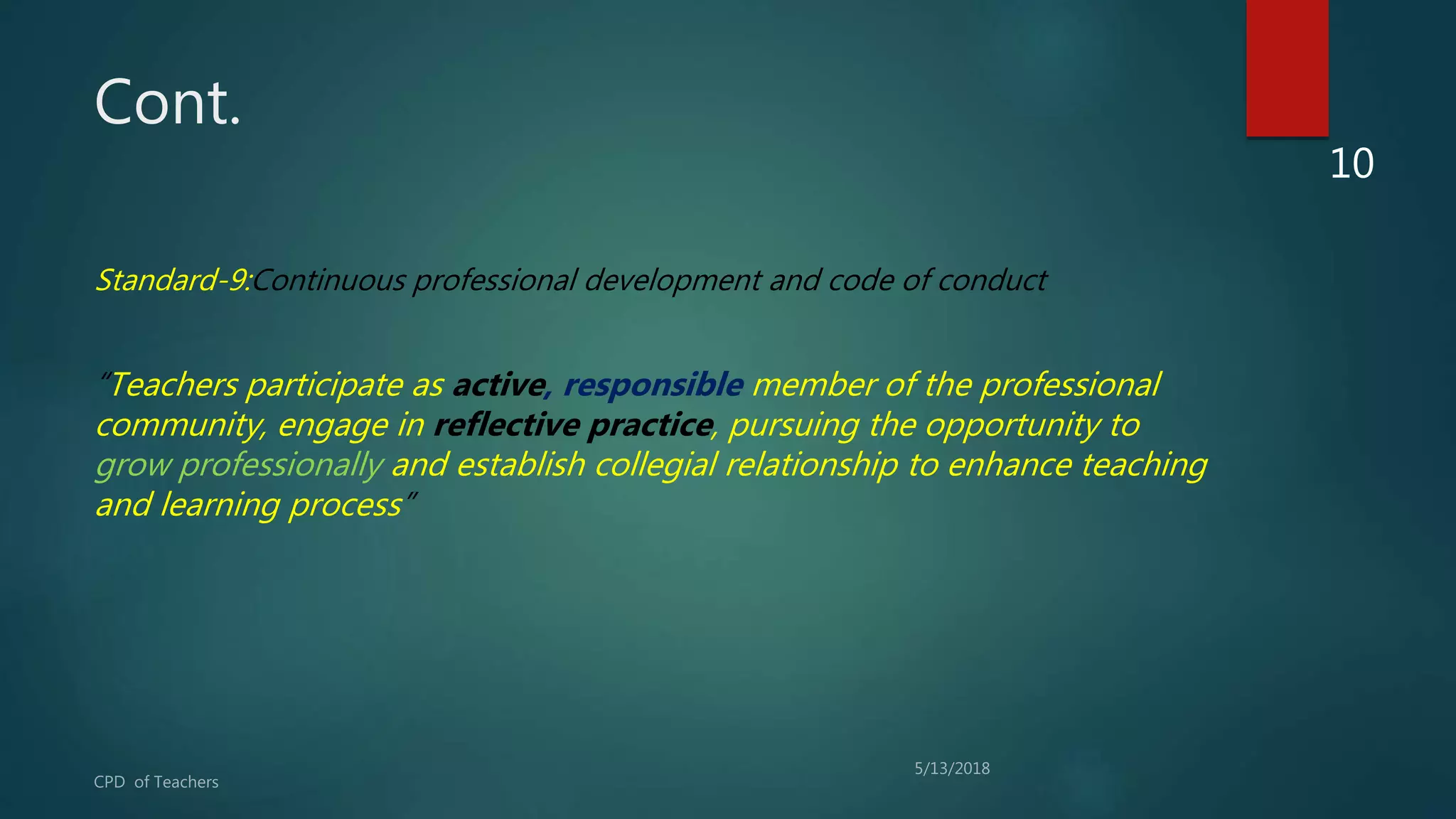
Standard-9:Continuous professional development and code of conduct
“Teachers participate as active, responsible member of the professional
community, engage in reflective practice, pursuing the opportunity to
grow professionally and establish collegial relationship to enhance teaching
and learning process”
10
Cont.
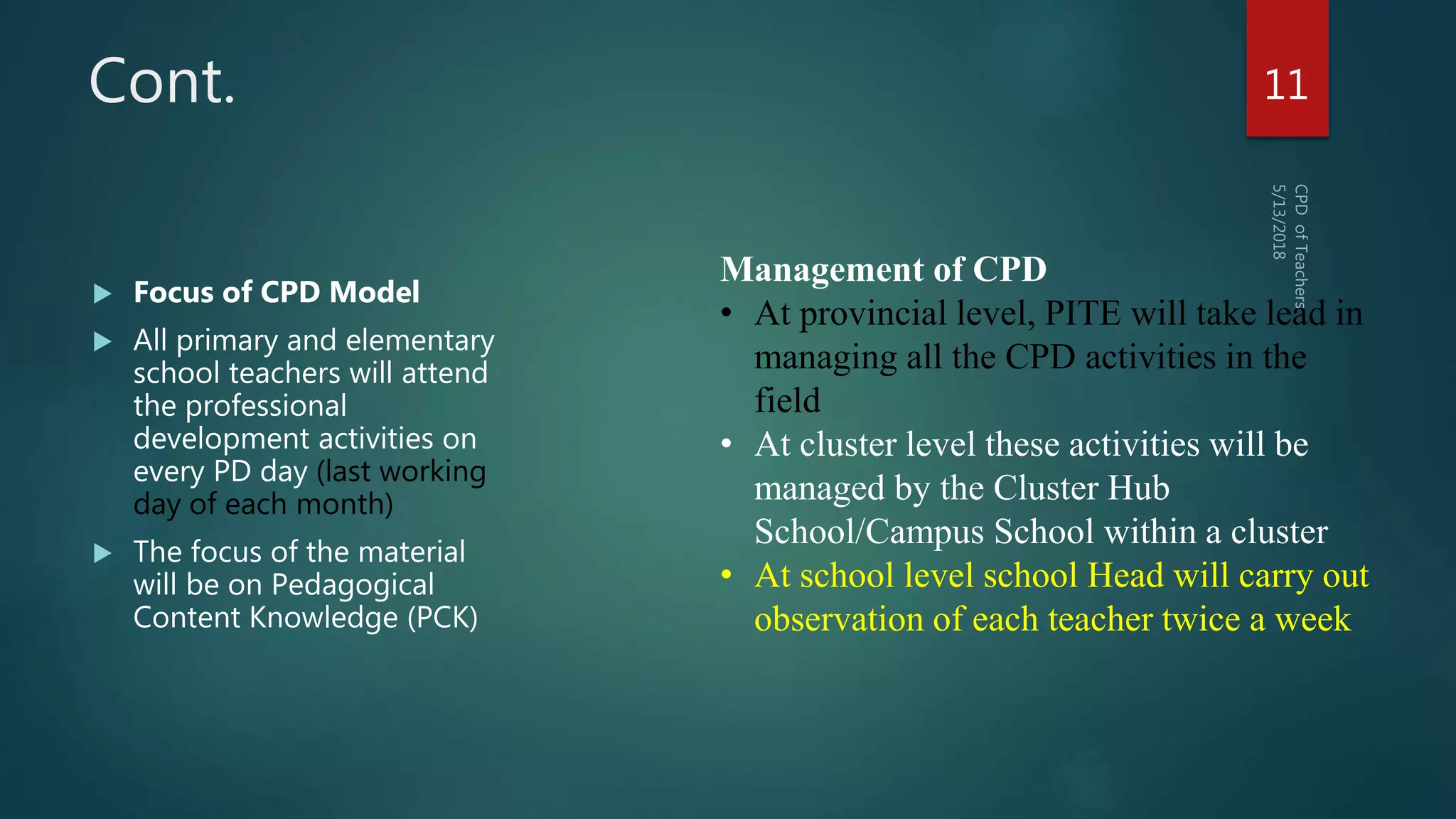
 Focus of CPD Model
 All primary and elementary
school teachers will attend
the professional
development activities on
every PD day (last working
day of each month)
 The focus of the material
will be on Pedagogical
Content Knowledge (PCK)
11
Management of CPD
• At provincial level, PITE will take lead in
managing all the CPD activities in the
field
• At cluster level these activities will be
managed by the Cluster Hub
School/Campus School within a cluster
• At school level school Head will carry out
observation of each teacher twice a week
CPD Model in Pakistan
 The CPD will be delivered through blended mode:
 Face-to-face interaction of trainers (who are referred as Guide Teachers/Subject
Coordinators/facilitator in the framework) with teachers in workshop setting;
 for all teachers within the school and/or at cluster level on regular basis for a short duration (two-hours
to one day), and
 for low performing teachers within District for one week to four-weeks during vacations
 On the job support through mentoring visits of schools by the trainers/ASDEO/ observaio by
Headmaster
 Online support for teacher and trainers through a dynamic web-portal to be administered by a
dedicated team of professionals based at PITE
12
5/13/2018
CPD of teachers
13
Stages of development
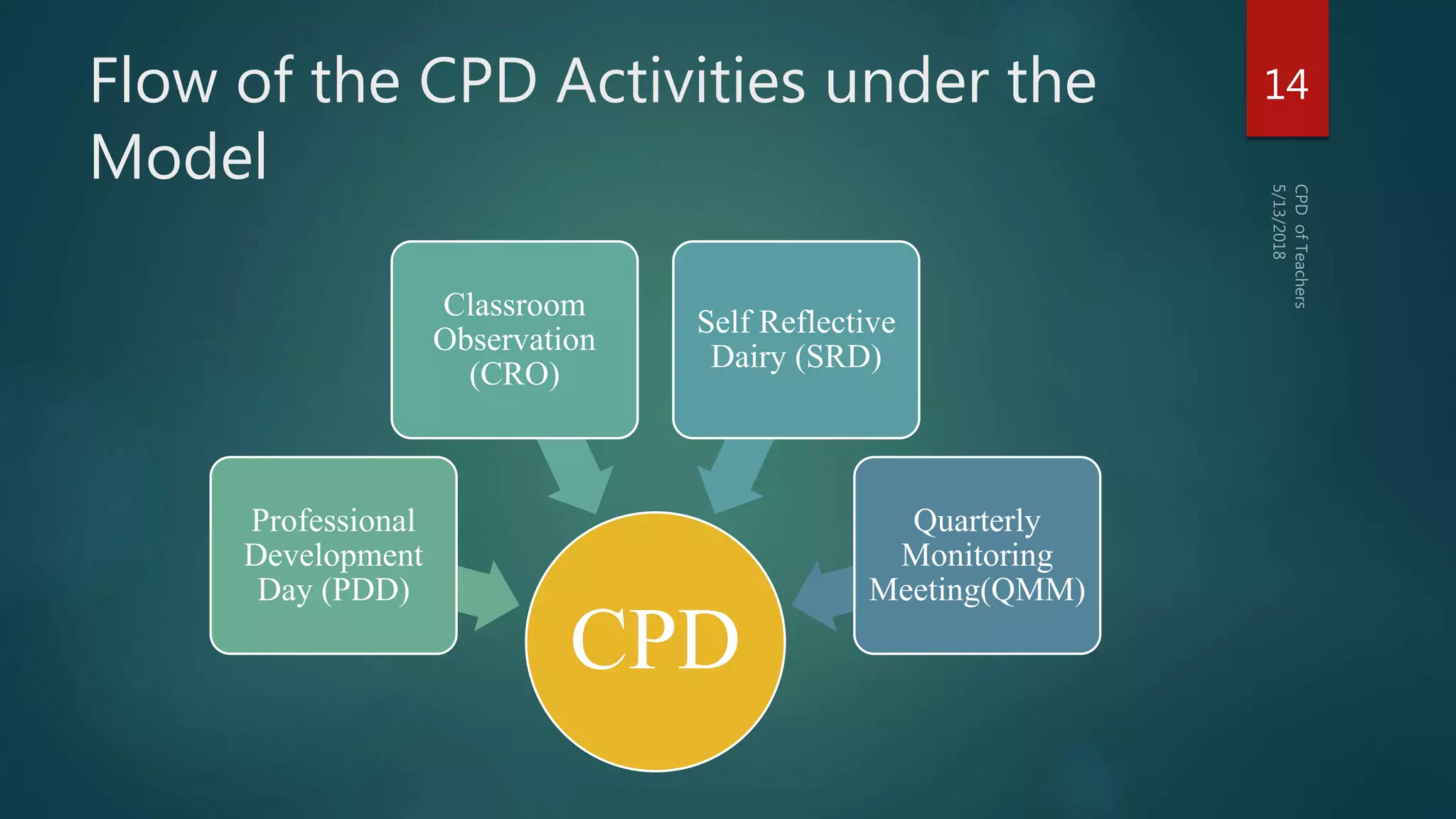
Flow of the CPD Activities under the
Model
CPD
Professional
Development
Day (PDD)
Classroom
Observation
(CRO)
Self Reflective
Dairy (SRD)
Quarterly
Monitoring
Meeting(QMM)
14
5/13/2018
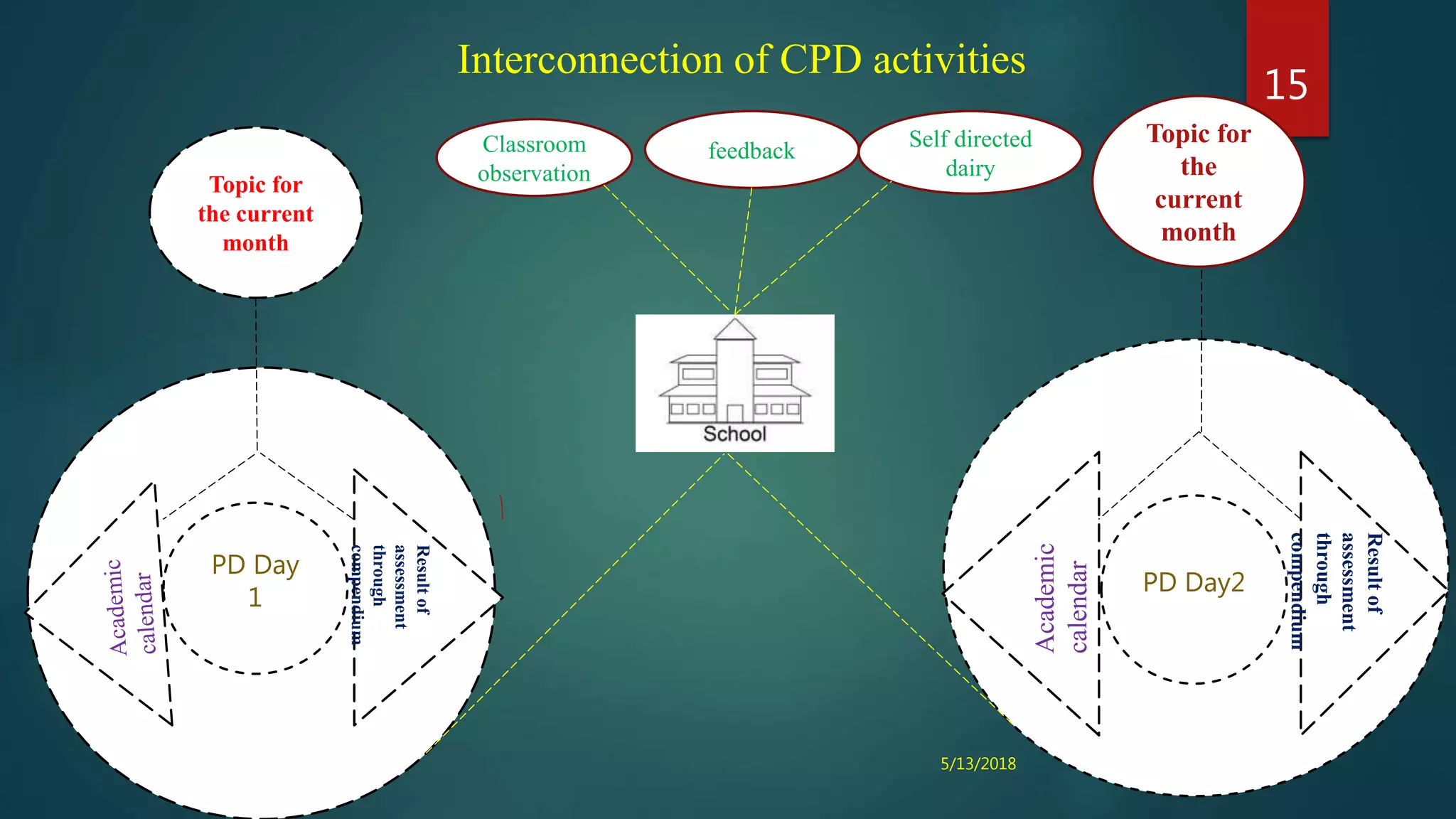
15
PD Day
1
Resultof
assessment
through
compendium
PD Day2
Academic
calendar
Resultof
assessment
through
compendium
Classroom
observation
feedback Self directed
dairy
Topic for
the
current
month
Topic for
the current
month
Interconnection of CPD activities
Conclusion
 Different model were in practice through reginal and international
organization but the new model of CPD now replace all other CPD models
and the impetus to restructure CPD in the provinces has now gained
momentum. There are many advantages of the proposed model including
collaborative working to improve teacher quality and student learning,
reduction in the number of monitors and officers visiting schools, and a
substantial increase in teacher training time. But one great limitation is that
the resources persons are not fully equipped with proper training. Further
more it is a continuing process and help the teachers to reflect on their
practices regularly.
16
References
Aslam, A. (2017). Reforming Teacher Professional Development in Punjab: Will it work? Institute of Development and Economic
Alternatives (IDEAS).
British Council . (2015). Teaching for Success: Continuing Professional Development (CPD) Framework for teachers. Retrieved from
www.teachingenglish.org.uk
Caena, F. (2011). Education and Training 2020 Thematic Working Group ‘Professional Development of Teachers’: Literature review
Quality in Teachers’ continuing professional development. European Commission Directorate-General for Education and
Culture.
(2015). CPD How to access it and why it’s essential. Association of Teachers and Lecturers. Retrieved from www.atl.org.uk/abouttime.
Kennedy, A. (2005). Models of contuining professional development a framewor. Journal of In-service Education, 31(2), 235-250.
Rose, J., & Reynold, D. (2018). Teachers’ Continuing Professional Development: A New Approach. Retrieved from
http://webcache.googleusercontent.com/search?q=cache:http://www.fm-kp.si/zalozba/ISBN/978-961-6573-65-8/219-240.pdf
17
5/13/2018
CPD of Teachers
18
Thank you
&
?
Ijaz Ahmad
PhD student
International Islamic university Islamabad

Continuing professional development (cpd)

  • 1.
    Development (CPD) DEPARTMENT OFEDUCATION INTERNATIONAL ISLAMIC UNIVERSITY ISLAMABAD 5/13/2018 CPDofTeachers 1 by Ijaz Ahmad
  • 2.
    Plan of Talk Defining CPD  Purpose of CPD  Importance of CPD  Models of CPD  CPD models in Pakistan  Conclusion 2
  • 3.
    CPD  CPD isa planned, continuous and lifelong process  Where by teachers try to develop their personal and professional qualities, and improve their knowledge, skills and practice (Padwad, Amol, Dixit, Krishna, 2011)  CPD encompasses all behaviors which are intended to effect change in the classroom (Day, 1999) 3
  • 4.
    Purpose of CPD Improve students learning/achievements  Teachers become aware of the new development and techniques of teaching  Learn from other teachers experiences  Critically reflect on their teaching practice and take corrective measures  Based on feedback provided by head teacher through classroom observation , improve their teaching practice in order to improve students performance  Design and implement different strategies/activities to address students issues 4
  • 5.
    Importance of CPD The education professional  Enhance your confidence and motivation  contribute to your career development as you become more effective in your workplace  allow you to consolidate and demonstrate your professionalism, both to yourself and others  The Learner  The quality of teaching is recognized as one of the most important factors in determining learner outcomes. In other words, a good teacher will achieve better results from their learners than a poor one and vice versa  Your workplace  If access to effective CPD encourages you to be more confident, motivated and inspired, giving you the reward of greater professional satisfaction 5
  • 6.
    Models of CPD Lieberman (1996) classified CPD into three types 1. Direct teaching (such as courses, workshops) 2. learning in school (such as peer coaching, critical friendships, mentoring, action research) and 3. out of school learning (visits to other schools, school-university partnerships and so on) 6 • Training • Award-bearing • Deficit • Cascade • Standards-based Coaching/Mentoring • Community of practice • Action research • Transformative Kennedy (2005) identify nine models of CPD
  • 7.
    Features of EffectiveCPD The most effective CPD is that which is  Personalized  Relevant  Sustained  Supported  Collaborative 7
  • 8.
  • 9.
    CPD Model DevelopmentProcess  NEP and NPST provide base for CPD Model  Continuous Professional Development of Teachers and other Teaching Personnel  In-service teacher education shall be developed upon and related to the pre-service teacher education  All teachers will have opportunities for professional development in a three-year cyclic manner  In-service training will focus more on capacity building of teachers in identified deficiency areas, educational leadership and other areas of education for sustainable development etc.  Continuous Professional Development of Teacher Educators  Continuous professional development academy/center for Teacher Educators will be set-up in each province to help them acquire up-to-date knowledge and adopt innovative teaching-learning strategies in their classrooms  The CPD courses shall be part of the performance appraisal of teacher educators and linked to their progression in the profession (NEP, 2017; p. 67) 9
  • 10.
    Cont. Standard-9:Continuous professional developmentand code of conduct “Teachers participate as active, responsible member of the professional community, engage in reflective practice, pursuing the opportunity to grow professionally and establish collegial relationship to enhance teaching and learning process” 10
  • 11.
    Cont.  Focus ofCPD Model  All primary and elementary school teachers will attend the professional development activities on every PD day (last working day of each month)  The focus of the material will be on Pedagogical Content Knowledge (PCK) 11 Management of CPD • At provincial level, PITE will take lead in managing all the CPD activities in the field • At cluster level these activities will be managed by the Cluster Hub School/Campus School within a cluster • At school level school Head will carry out observation of each teacher twice a week
  • 12.
    CPD Model inPakistan  The CPD will be delivered through blended mode:  Face-to-face interaction of trainers (who are referred as Guide Teachers/Subject Coordinators/facilitator in the framework) with teachers in workshop setting;  for all teachers within the school and/or at cluster level on regular basis for a short duration (two-hours to one day), and  for low performing teachers within District for one week to four-weeks during vacations  On the job support through mentoring visits of schools by the trainers/ASDEO/ observaio by Headmaster  Online support for teacher and trainers through a dynamic web-portal to be administered by a dedicated team of professionals based at PITE 12
  • 13.
  • 14.
    Flow of theCPD Activities under the Model CPD Professional Development Day (PDD) Classroom Observation (CRO) Self Reflective Dairy (SRD) Quarterly Monitoring Meeting(QMM) 14
  • 15.
    5/13/2018 15 PD Day 1 Resultof assessment through compendium PD Day2 Academic calendar Resultof assessment through compendium Classroom observation feedbackSelf directed dairy Topic for the current month Topic for the current month Interconnection of CPD activities
  • 16.
    Conclusion  Different modelwere in practice through reginal and international organization but the new model of CPD now replace all other CPD models and the impetus to restructure CPD in the provinces has now gained momentum. There are many advantages of the proposed model including collaborative working to improve teacher quality and student learning, reduction in the number of monitors and officers visiting schools, and a substantial increase in teacher training time. But one great limitation is that the resources persons are not fully equipped with proper training. Further more it is a continuing process and help the teachers to reflect on their practices regularly. 16
  • 17.
    References Aslam, A. (2017).Reforming Teacher Professional Development in Punjab: Will it work? Institute of Development and Economic Alternatives (IDEAS). British Council . (2015). Teaching for Success: Continuing Professional Development (CPD) Framework for teachers. Retrieved from www.teachingenglish.org.uk Caena, F. (2011). Education and Training 2020 Thematic Working Group ‘Professional Development of Teachers’: Literature review Quality in Teachers’ continuing professional development. European Commission Directorate-General for Education and Culture. (2015). CPD How to access it and why it’s essential. Association of Teachers and Lecturers. Retrieved from www.atl.org.uk/abouttime. Kennedy, A. (2005). Models of contuining professional development a framewor. Journal of In-service Education, 31(2), 235-250. Rose, J., & Reynold, D. (2018). Teachers’ Continuing Professional Development: A New Approach. Retrieved from http://webcache.googleusercontent.com/search?q=cache:http://www.fm-kp.si/zalozba/ISBN/978-961-6573-65-8/219-240.pdf 17
  • 18.
    5/13/2018 CPD of Teachers 18 Thankyou & ? Ijaz Ahmad PhD student International Islamic university Islamabad

Editor's Notes

  • #4 whereby teachers try to develop their personal and professional qualities, and to improve their knowledge, skills and practice, leading to their empowerment, the improvement of their agency and the development of their organization and their pupils CPD refers to any activity, formal or informal, that helps you develop your skills and knowledge, and enhances your professional practice
  • #7 Training - focuses on skills, with expert delivery, and little practical focus Award Bearing – usually in conjunction with a higher education institution, this brings the worrying discourse on the irrelevance of academia to the fore • Defecit - this looks at addressing shortcomings in an individual teacher, it tends to be individually tailored, but may not be good for confidence and is unsupportive of the development of a collective knowledge base within the school • Cascade – this is relatively cheap in terms of resources, but there are issues surrounding the loss of a collaborative element in the original learning • Standards Based – this assumes that there is a system of effective teaching, and is not flexible in terms of teacher learning. It can be useful for developing a common language but may be very narrow and limiting • Coaching / Mentoring – the development of a non-threatening relationship can encourage discussion, but a coach or mentor needs good communication skills
  • #8 Personalized: Built on your identified needs and requirements rather than a ‘one size fits all’ approach Relevant: Relates to your teaching theory and/ or subject specialism and the needs of your learners Sustained: New skills and ideas need time to take hold; experimentation and refinement is the best way to embed new ideas into your classroom practice Supported: by coaching or mentoring from experienced colleagues, either from within or from outside your school Collaborative: while teaching could be seen as a solitary profession, collaboration with your fellow teachers and colleagues has been identified as one of the most relevant features required for teacher learning
  • #11 The demands of a professional code of conduct.  How educational research can be used as a means for continuous learning, self assessment and development.  How to develop and maintain a personal professional portfolio.  Share successful professional experiences with others
  • #15 PDD will be held on the last working day of every month and the result of the assessment of grade 2 and 5 and need analysis conducted by DCTE and BISE will be used to cover the difficult topic CRO will used (head teacher or ASDEO) to provide constructive feedback the observation sheet will contain Academic calendar, teaching practiceintroduction, development of instructional stratagies, questioning/ evaluation summery and homework Managing learning environment and multigrade teaching SRD it is a daily work in which the teacher will write down their need or difficulties and will be discuss with Head or on PDD QMM will be held at each circle level and Head teachers will participate and will inform the concern officer about the progress