UNDERSTANDING MARKET ‘ Consumer Behavior’ Session 3 Chapter 5&6
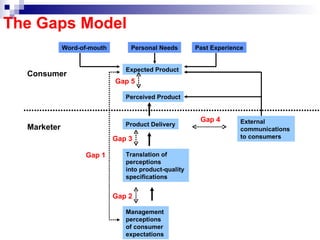
The Gaps Model Word-of-mouth Personal Needs Past Experience Expected Product Perceived Product Product Delivery Translation of  perceptions  into product-quality  specifications  Management  perceptions  of consumer  expectations External  communications  to consumers Gap 5 Gap 4 Gap 3 Gap 2 Gap 1 Consumer Marketer
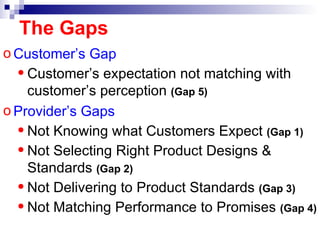
The Gaps Customer’s Gap Customer’s expectation not matching with customer’s perception  (Gap 5) Provider’s Gaps Not Knowing what Customers Expect  (Gap 1) Not Selecting Right Product Designs & Standards  (Gap 2) Not Delivering to Product Standards  (Gap 3) Not Matching Performance to Promises  (Gap 4)
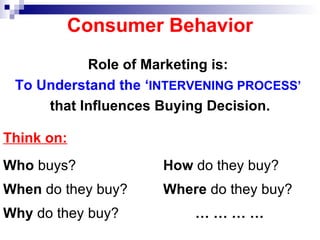
Consumer Behavior Role of Marketing is:  To Understand the ‘ INTERVENING PROCESS’   that Influences Buying Decision. Think on: Who  buys? How  do they buy?  When  do they buy? Where  do they buy?  Why  do they buy? … … … …
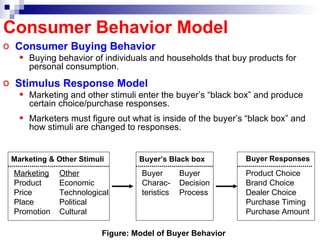
Consumer Buying Behavior Buying behavior of individuals and households that buy products for personal consumption. Stimulus Response Model Marketing and other stimuli enter the buyer’s “black box” and produce certain choice/purchase responses. Marketers must figure out what is inside of the buyer’s “black box” and how stimuli are changed to responses. Consumer Behavior Model   Marketing & Other Stimuli Marketing Product Price Place Promotion Other Economic Technological Political Cultural Buyer’s Black box Buyer Charac- teristics Buyer Decision Process Buyer Responses Product Choice Brand Choice Dealer Choice Purchase Timing Purchase Amount Figure: Model of Buyer Behavior
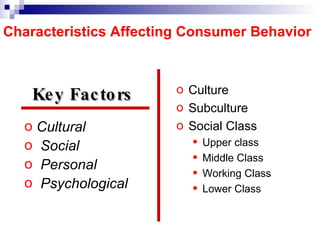
Characteristics Affecting Consumer Behavior Cultural Social Personal Psychological Culture Subculture Social Class Upper class Middle Class Working Class Lower Class Key Factors
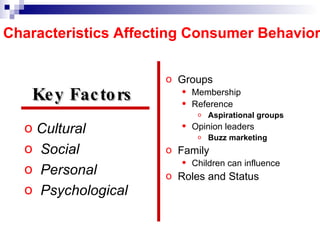
Characteristics Affecting Consumer Behavior Cultural Social Personal Psychological Groups Membership Reference Aspirational groups Opinion leaders Buzz marketing Family Children can influence Roles and Status Key Factors
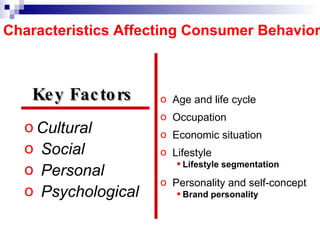
Characteristics Affecting Consumer Behavior Cultural Social Personal Psychological Age and life cycle Occupation Economic situation Lifestyle Lifestyle segmentation Personality and self-concept Brand personality Key Factors
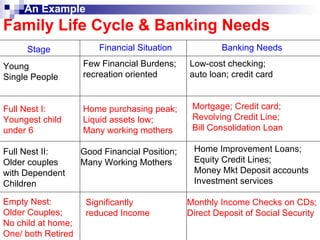
Family Life Cycle & Banking Needs An Example Stage Banking Needs Financial Situation Young Single People Few Financial Burdens;  recreation oriented Low-cost checking;  auto loan; credit card Full Nest I: Youngest child under 6 Home purchasing peak; Liquid assets low;  Many working mothers Mortgage; Credit card;  Revolving Credit Line;  Bill Consolidation Loan Full Nest II: Older couples with Dependent  Children Good Financial Position;  Many Working Mothers Home Improvement Loans; Equity Credit Lines; Money Mkt Deposit accounts Investment services Empty Nest: Older Couples; No child at home; One/ both Retired Significantly  reduced Income Monthly Income Checks on CDs; Direct Deposit of Social Security
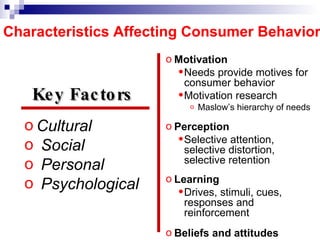
Characteristics Affecting Consumer Behavior Cultural Social Personal Psychological Motivation Needs provide motives for consumer behavior Motivation research Maslow’s hierarchy of needs Perception Selective attention, selective distortion, selective retention Learning Drives, stimuli, cues, responses and reinforcement Beliefs and attitudes Key Factors
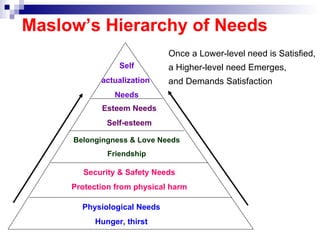
Maslow’s Hierarchy of Needs Once a Lower-level need is Satisfied,  a Higher-level need Emerges,  and Demands Satisfaction Physiological Needs Hunger, thirst Self actualization  Needs Esteem Needs Self-esteem Belongingness & Love Needs Friendship Security & Safety Needs Protection from physical harm
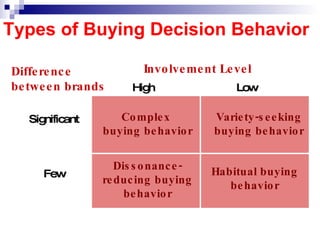
Types of Buying Decision Behavior Difference between brands Significant Complex  buying behavior Low Few Dissonance-reducing buying behavior Habitual buying behavior Variety-seeking buying behavior High Involvement Level
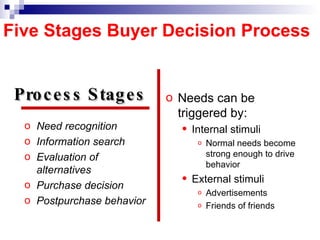
Five Stages Buyer Decision Process Need recognition Information search Evaluation of alternatives Purchase decision Postpurchase behavior Needs can be triggered by: Internal stimuli Normal needs become strong enough to drive behavior External stimuli Advertisements Friends of friends Process Stages
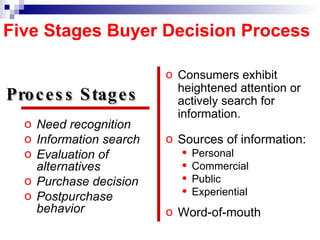
Need recognition Information search Evaluation of alternatives Purchase decision Postpurchase behavior Consumers exhibit heightened attention or actively search for information. Sources of information: Personal Commercial Public Experiential Word-of-mouth Process Stages  Five Stages Buyer Decision Process
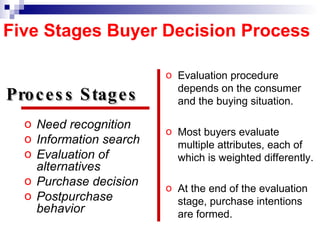
Need recognition Information search Evaluation of alternatives Purchase decision Postpurchase behavior Evaluation procedure depends on the consumer and the buying situation. Most buyers evaluate multiple attributes, each of which is weighted differently. At the end of the evaluation stage, purchase intentions are formed. Process Stages  Five Stages Buyer Decision Process
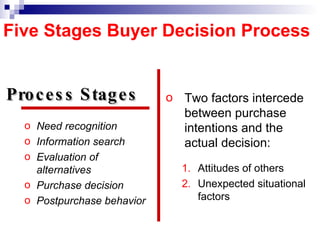
Need recognition Information search Evaluation of alternatives Purchase decision Postpurchase behavior Two factors intercede between purchase intentions and the actual decision: Attitudes of others Unexpected situational factors Process Stages  Five Stages Buyer Decision Process
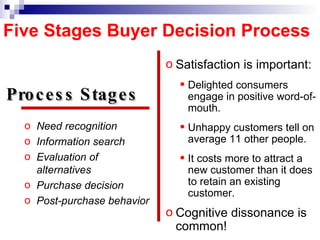
Need recognition Information search Evaluation of alternatives Purchase decision Post-purchase behavior Satisfaction is important: Delighted consumers engage in positive word-of-mouth. Unhappy customers tell on average 11 other people. It costs more to attract a new customer than it does to retain an existing customer. Cognitive dissonance is common! Process Stages  Five Stages Buyer Decision Process
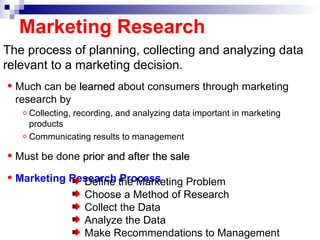
Marketing Research   The process of planning, collecting and analyzing data relevant to a marketing decision. Much can be  learned  about consumers through marketing research by Collecting, recording, and analyzing data important in marketing products Communicating results to management Must be done  prior and after the sale Marketing Research Process Define the Marketing Problem Choose a Method of Research Collect the Data Analyze the Data Make Recommendations to Management
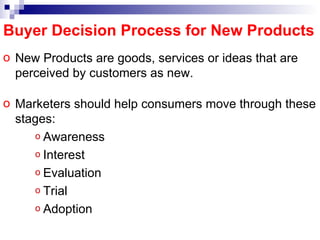
Buyer Decision Process for New Products New Products are goods, services or ideas that are perceived by customers as new. Marketers should help consumers move through these stages: Awareness Interest Evaluation Trial Adoption
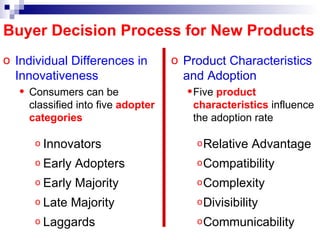
Individual Differences in Innovativeness Consumers can be classified into five  adopter categories Innovators Early Adopters Early Majority Late Majority Laggards Buyer Decision Process for New Products Product  Characteristics  and Adoption Five  product   characteristics  influence the adoption rate Relative Advantage Compatibility Complexity Divisibility Communicability
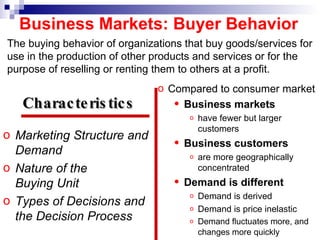
Business Markets: Buyer Behavior Marketing Structure and Demand Nature of the  Buying Unit Types of Decisions and the Decision Process Compared to consumer market Business markets   have fewer but larger customers Business customers   are more geographically concentrated Demand is different Demand is derived  Demand is price inelastic Demand fluctuates more, and changes more   quickly Characteristics   The buying behavior of organizations that buy goods/services for use in the production of other products and services or for the purpose of reselling or renting them to others at a profit.
Marketing Structure and Demand Nature of the  Buying Unit Types of Decisions and the Decision Process Compared to consumer purchases Business purchases involve  more buyers in the decision process . Purchasing efforts are undertaken by  professional buyers . Characteristics   Business Markets:   Buyer Behavior
Marketing Structure and Demand Nature of the  Buying Unit Types of Decisions and the Decision Process Compared to consumer purchases Business buyers face  more complex buying decisions . Buying process is more  formalized ,  more participants  in the process: Users Influencers Deciders Buyers Gatekeepers Buyers and sellers work more closely together and build  long-term relationships . Characteristics   Business Markets: Buyer Behavior
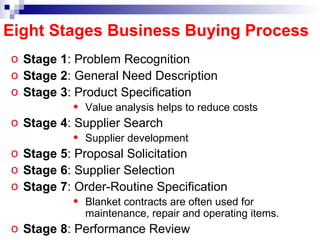
Stage 1 : Problem Recognition Stage 2 : General Need Description Stage 3 : Product Specification Value analysis helps to reduce costs Stage 4 : Supplier Search Supplier development  Stage 5 : Proposal Solicitation Stage 6 : Supplier Selection Stage 7 : Order-Routine Specification Blanket contracts are often used for maintenance, repair and operating items. Stage 8 : Performance Review Eight Stages Business Buying Process
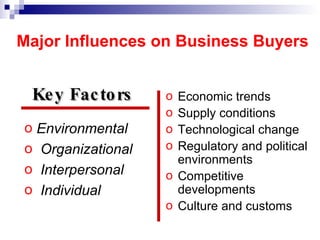
Major Influences on Business Buyers Environmental Organizational Interpersonal Individual Economic trends Supply conditions Technological change Regulatory and political environments Competitive developments Culture and customs Key Factors
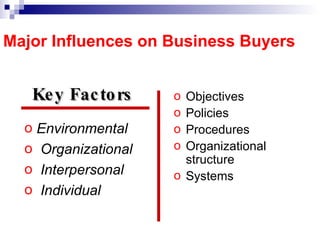
Major Influences on Business Buyers Environmental Organizational Interpersonal Individual Objectives Policies Procedures Organizational structure Systems Key Factors
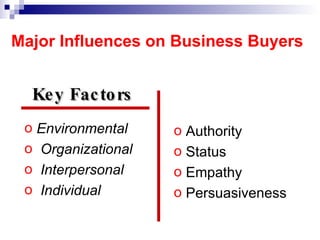
Major Influences on Business Buyers Environmental Organizational Interpersonal Individual Authority Status Empathy Persuasiveness Key Factors
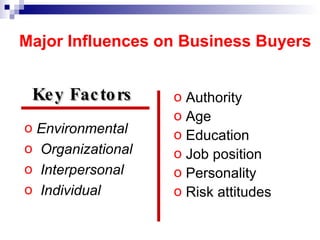
Major Influences on Business Buyers Environmental Organizational Interpersonal Individual Authority Age Education Job position Personality Risk attitudes Key Factors
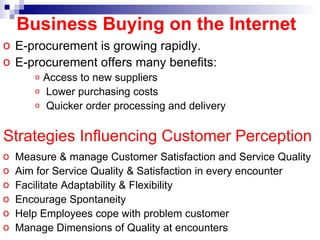
E-procurement is growing rapidly. E-procurement offers many benefits: Access to new suppliers Lower purchasing costs Quicker order processing and delivery Business Buying on the Internet Strategies Influencing Customer Perception   Measure & manage Customer Satisfaction and Service Quality Aim for Service Quality & Satisfaction in every encounter Facilitate Adaptability & Flexibility Encourage Spontaneity Help Employees cope with problem customer Manage Dimensions of Quality at encounters
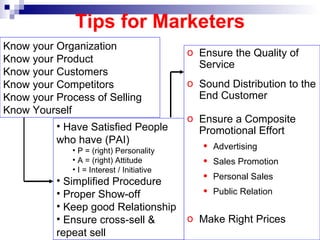
Ensure the Quality of Service  Sound Distribution to the End Customer Ensure a Composite Promotional Effort  Advertising Sales Promotion  Personal Sales Public Relation Make Right Prices Tips for Marketers Have Satisfied People who have (PAI) P = (right) Personality A = (right) Attitude I = Interest / Initiative Simplified Procedure Proper Show-off Keep good Relationship  Ensure cross-sell & repeat sell Know your Organization Know your Product Know your Customers Know your Competitors Know your Process of Selling Know Yourself

Consumer Behavior and Segmentation

  • 1.
    UNDERSTANDING MARKET ‘Consumer Behavior’ Session 3 Chapter 5&6
  • 2.
    The Gaps ModelWord-of-mouth Personal Needs Past Experience Expected Product Perceived Product Product Delivery Translation of perceptions into product-quality specifications Management perceptions of consumer expectations External communications to consumers Gap 5 Gap 4 Gap 3 Gap 2 Gap 1 Consumer Marketer
  • 3.
    The Gaps Customer’sGap Customer’s expectation not matching with customer’s perception (Gap 5) Provider’s Gaps Not Knowing what Customers Expect (Gap 1) Not Selecting Right Product Designs & Standards (Gap 2) Not Delivering to Product Standards (Gap 3) Not Matching Performance to Promises (Gap 4)
  • 4.
    Consumer Behavior Roleof Marketing is: To Understand the ‘ INTERVENING PROCESS’ that Influences Buying Decision. Think on: Who buys? How do they buy? When do they buy? Where do they buy? Why do they buy? … … … …
  • 5.
    Consumer Buying BehaviorBuying behavior of individuals and households that buy products for personal consumption. Stimulus Response Model Marketing and other stimuli enter the buyer’s “black box” and produce certain choice/purchase responses. Marketers must figure out what is inside of the buyer’s “black box” and how stimuli are changed to responses. Consumer Behavior Model Marketing & Other Stimuli Marketing Product Price Place Promotion Other Economic Technological Political Cultural Buyer’s Black box Buyer Charac- teristics Buyer Decision Process Buyer Responses Product Choice Brand Choice Dealer Choice Purchase Timing Purchase Amount Figure: Model of Buyer Behavior
  • 6.
    Characteristics Affecting ConsumerBehavior Cultural Social Personal Psychological Culture Subculture Social Class Upper class Middle Class Working Class Lower Class Key Factors
  • 7.
    Characteristics Affecting ConsumerBehavior Cultural Social Personal Psychological Groups Membership Reference Aspirational groups Opinion leaders Buzz marketing Family Children can influence Roles and Status Key Factors
  • 8.
    Characteristics Affecting ConsumerBehavior Cultural Social Personal Psychological Age and life cycle Occupation Economic situation Lifestyle Lifestyle segmentation Personality and self-concept Brand personality Key Factors
  • 9.
    Family Life Cycle& Banking Needs An Example Stage Banking Needs Financial Situation Young Single People Few Financial Burdens; recreation oriented Low-cost checking; auto loan; credit card Full Nest I: Youngest child under 6 Home purchasing peak; Liquid assets low; Many working mothers Mortgage; Credit card; Revolving Credit Line; Bill Consolidation Loan Full Nest II: Older couples with Dependent Children Good Financial Position; Many Working Mothers Home Improvement Loans; Equity Credit Lines; Money Mkt Deposit accounts Investment services Empty Nest: Older Couples; No child at home; One/ both Retired Significantly reduced Income Monthly Income Checks on CDs; Direct Deposit of Social Security
  • 10.
    Characteristics Affecting ConsumerBehavior Cultural Social Personal Psychological Motivation Needs provide motives for consumer behavior Motivation research Maslow’s hierarchy of needs Perception Selective attention, selective distortion, selective retention Learning Drives, stimuli, cues, responses and reinforcement Beliefs and attitudes Key Factors
  • 11.
    Maslow’s Hierarchy ofNeeds Once a Lower-level need is Satisfied, a Higher-level need Emerges, and Demands Satisfaction Physiological Needs Hunger, thirst Self actualization Needs Esteem Needs Self-esteem Belongingness & Love Needs Friendship Security & Safety Needs Protection from physical harm
  • 12.
    Types of BuyingDecision Behavior Difference between brands Significant Complex buying behavior Low Few Dissonance-reducing buying behavior Habitual buying behavior Variety-seeking buying behavior High Involvement Level
  • 13.
    Five Stages BuyerDecision Process Need recognition Information search Evaluation of alternatives Purchase decision Postpurchase behavior Needs can be triggered by: Internal stimuli Normal needs become strong enough to drive behavior External stimuli Advertisements Friends of friends Process Stages
  • 14.
    Need recognition Informationsearch Evaluation of alternatives Purchase decision Postpurchase behavior Consumers exhibit heightened attention or actively search for information. Sources of information: Personal Commercial Public Experiential Word-of-mouth Process Stages Five Stages Buyer Decision Process
  • 15.
    Need recognition Informationsearch Evaluation of alternatives Purchase decision Postpurchase behavior Evaluation procedure depends on the consumer and the buying situation. Most buyers evaluate multiple attributes, each of which is weighted differently. At the end of the evaluation stage, purchase intentions are formed. Process Stages Five Stages Buyer Decision Process
  • 16.
    Need recognition Informationsearch Evaluation of alternatives Purchase decision Postpurchase behavior Two factors intercede between purchase intentions and the actual decision: Attitudes of others Unexpected situational factors Process Stages Five Stages Buyer Decision Process
  • 17.
    Need recognition Informationsearch Evaluation of alternatives Purchase decision Post-purchase behavior Satisfaction is important: Delighted consumers engage in positive word-of-mouth. Unhappy customers tell on average 11 other people. It costs more to attract a new customer than it does to retain an existing customer. Cognitive dissonance is common! Process Stages Five Stages Buyer Decision Process
  • 18.
    Marketing Research The process of planning, collecting and analyzing data relevant to a marketing decision. Much can be learned about consumers through marketing research by Collecting, recording, and analyzing data important in marketing products Communicating results to management Must be done prior and after the sale Marketing Research Process Define the Marketing Problem Choose a Method of Research Collect the Data Analyze the Data Make Recommendations to Management
  • 19.
    Buyer Decision Processfor New Products New Products are goods, services or ideas that are perceived by customers as new. Marketers should help consumers move through these stages: Awareness Interest Evaluation Trial Adoption
  • 20.
    Individual Differences inInnovativeness Consumers can be classified into five adopter categories Innovators Early Adopters Early Majority Late Majority Laggards Buyer Decision Process for New Products Product Characteristics and Adoption Five product characteristics influence the adoption rate Relative Advantage Compatibility Complexity Divisibility Communicability
  • 21.
    Business Markets: BuyerBehavior Marketing Structure and Demand Nature of the Buying Unit Types of Decisions and the Decision Process Compared to consumer market Business markets have fewer but larger customers Business customers are more geographically concentrated Demand is different Demand is derived Demand is price inelastic Demand fluctuates more, and changes more quickly Characteristics The buying behavior of organizations that buy goods/services for use in the production of other products and services or for the purpose of reselling or renting them to others at a profit.
  • 22.
    Marketing Structure andDemand Nature of the Buying Unit Types of Decisions and the Decision Process Compared to consumer purchases Business purchases involve more buyers in the decision process . Purchasing efforts are undertaken by professional buyers . Characteristics Business Markets: Buyer Behavior
  • 23.
    Marketing Structure andDemand Nature of the Buying Unit Types of Decisions and the Decision Process Compared to consumer purchases Business buyers face more complex buying decisions . Buying process is more formalized , more participants in the process: Users Influencers Deciders Buyers Gatekeepers Buyers and sellers work more closely together and build long-term relationships . Characteristics Business Markets: Buyer Behavior
  • 24.
    Stage 1 :Problem Recognition Stage 2 : General Need Description Stage 3 : Product Specification Value analysis helps to reduce costs Stage 4 : Supplier Search Supplier development Stage 5 : Proposal Solicitation Stage 6 : Supplier Selection Stage 7 : Order-Routine Specification Blanket contracts are often used for maintenance, repair and operating items. Stage 8 : Performance Review Eight Stages Business Buying Process
  • 25.
    Major Influences onBusiness Buyers Environmental Organizational Interpersonal Individual Economic trends Supply conditions Technological change Regulatory and political environments Competitive developments Culture and customs Key Factors
  • 26.
    Major Influences onBusiness Buyers Environmental Organizational Interpersonal Individual Objectives Policies Procedures Organizational structure Systems Key Factors
  • 27.
    Major Influences onBusiness Buyers Environmental Organizational Interpersonal Individual Authority Status Empathy Persuasiveness Key Factors
  • 28.
    Major Influences onBusiness Buyers Environmental Organizational Interpersonal Individual Authority Age Education Job position Personality Risk attitudes Key Factors
  • 29.
    E-procurement is growingrapidly. E-procurement offers many benefits: Access to new suppliers Lower purchasing costs Quicker order processing and delivery Business Buying on the Internet Strategies Influencing Customer Perception Measure & manage Customer Satisfaction and Service Quality Aim for Service Quality & Satisfaction in every encounter Facilitate Adaptability & Flexibility Encourage Spontaneity Help Employees cope with problem customer Manage Dimensions of Quality at encounters
  • 30.
    Ensure the Qualityof Service Sound Distribution to the End Customer Ensure a Composite Promotional Effort Advertising Sales Promotion Personal Sales Public Relation Make Right Prices Tips for Marketers Have Satisfied People who have (PAI) P = (right) Personality A = (right) Attitude I = Interest / Initiative Simplified Procedure Proper Show-off Keep good Relationship Ensure cross-sell & repeat sell Know your Organization Know your Product Know your Customers Know your Competitors Know your Process of Selling Know Yourself