Consumer Behavior 7thEdition Hoyer Solutions Manual
download pdf
https://testbankdeal.com/product/consumer-behavior-7th-edition-hoyer-
solutions-manual/
Visit testbankdeal.com today to download the complete set of
test banks or solution manuals!
2.
We have selectedsome products that you may be interested in
Click the link to download now or visit testbankdeal.com
for more options!.
Consumer Behavior 7th Edition Hoyer Test Bank
https://testbankdeal.com/product/consumer-behavior-7th-edition-hoyer-
test-bank/
Consumer Behavior 6th Edition Hoyer Solutions Manual
https://testbankdeal.com/product/consumer-behavior-6th-edition-hoyer-
solutions-manual/
Consumer Behavior 6th Edition Hoyer Test Bank
https://testbankdeal.com/product/consumer-behavior-6th-edition-hoyer-
test-bank/
Macroeconomics Canadian 2nd Edition Hubbard Test Bank
https://testbankdeal.com/product/macroeconomics-canadian-2nd-edition-
hubbard-test-bank/
3.
Foundations of Astronomy13th Edition Seeds Solutions
Manual
https://testbankdeal.com/product/foundations-of-astronomy-13th-
edition-seeds-solutions-manual/
Economic Analysis of Social Issues 1st Edition Alan Grant
Test Bank
https://testbankdeal.com/product/economic-analysis-of-social-
issues-1st-edition-alan-grant-test-bank/
Ecgs Made Easy 5th Edition Aehlert Test Bank
https://testbankdeal.com/product/ecgs-made-easy-5th-edition-aehlert-
test-bank/
Assessment in Special Inclusive Education 13th Edition
Salvia Solutions Manual
https://testbankdeal.com/product/assessment-in-special-inclusive-
education-13th-edition-salvia-solutions-manual/
Guide to Computer Forensics and Investigations 5th edition
Bill Test Bank
https://testbankdeal.com/product/guide-to-computer-forensics-and-
investigations-5th-edition-bill-test-bank/
4.
Context of BusinessUnderstanding the Canadian Business
Environment Canadian 1st Edition Karakowsky Solutions
Manual
https://testbankdeal.com/product/context-of-business-understanding-
the-canadian-business-environment-canadian-1st-edition-karakowsky-
solutions-manual/
“We shall sitthis winter
And live happily,
Drain and talk over
The costly drink,
Teach the Húnar
To make their weapons ready
Which we boldly
Shall bear forth.
Well shall we, Hlöd,
Dress the warriors
And strongly
Press the shields;
Twelve-winters-old men,
And two-winters-old horses,
Thus shall the host
Of the Húnar be gathered.”
(Hervarar Saga, c. 16, 17.)
Property was divided also by mutual arrangement.
“Now that season passed and the moving days came. Thorkel told
Gisli that he wanted to have all the property divided between them,
and begin joint housekeeping with Thorgrim, his brother-in-law. Gisli
said: ‘It is best to see the property of brothers together, brother; and
I should be thankful if we did not divide.’ Thorkel answered: ‘I saw
long ago that we are unequally kept, as thou toilest night and day
for our household, while I am good for nothing.’ Gisli replied: ‘I am
well content, and would willingly let it be thus.’ But Thorkel would
listen to nothing but division, and said: ‘Thou shalt get the
homestead in the division, and our father’s estate, because I ask for
the division, but I will take the loose property.’ Gisli said: ‘We have
tried both to agree and to disagree, kinsman, and both of us have
succeeded better when we agreed; let us not change this, brother,
when we agree well.’ ‘It is of no use talking of it,’ said Thorkel; ‘the
property must be divided.’ ‘Then do whichever thou likest,’ said Gisli;
‘divide or choose; for I do not care which I do.’ ‘Then I want thee to
18.
divide,’ said Thorkel;and it was done. Thorkel chose the loose
property, which was more than the land which Gisli got. There were
two children to be supported by it, a boy Geirmund and a girl
Gudrid; the children of their kinsman Ingjald. Gudrid went with Gisli,
and Geirmund with Thorkel. Thorkel went to his brother-in-law
Thorgrim and lived with him; Gisli remained at Hól, and did not find
that the household was worse than before”[79]
(Gisli Sursson’s Saga,
p. 100).
At the arvel the debts of the dead were settled, and divisions made
if the heirs were several. If the property left was not sufficient to pay
the debts, then the creditors had to share the loss in proportion to
their claims. If the heirs were sons or daughters of the deceased
they had to pay the debts out of their own property.
“When a man is dead his heir shall sit in the high-seat and summon
all the creditors to come there on the seventh day and take away
each their due, as much as witnesses proved. If the property is not
enough all shall share the loss. The one to whom more was due
shall lose more. If a pauper’s and a woman’s share are in the
inheritance it holds good if there is money enough for both; if there
is not she shall lose her gagngjald (tilgjöf).... If there are sons or
daughters they shall pay the debts if they have property, but no
other man shall do so unless he inherits property” (Gulathing’s Law,
115).
After the debts were paid, then the paupers were distributed
between the heirs (or if only one pauper existed, each heir
supported him in turn in the same proportion as the inheritance), for
the community never intervened in the support of paupers.
“If people divide paupers without property between them the
division shall be kept up, however they may divide. They (paupers)
19.
shall follow theheirs”[80]
(Gulath., 127).
Only children by a lawful union were legitimate skirborinn (holy-
born), and consequently arfborinn (inheritance-born).
“The child whose mother is bought with mund is inheritance-born
when it comes into daylight living and receives food” (Gragas, i.
223).[81]
“The man who has been carried between the skaut (cloak-skirts) of
father and mother shall have the same rights as his father had”
(Earlier Frostathing’s Law, ix. 15).
“If a man lives with his concubine twenty winters or more, and they
never separate during that time, and no hindrances come forward
during the time, then their children are inheritance-born and they
are partners by law” (Gulath., 125).
In Christian times the arvel changed its name into that of soul-ale.
“Wherever men die and the heir wants to have an arvel, whether it
is in seven days or on the thirtieth morning or later, it is called erfiöl.
If they make ale and call it sálu-öl (soul-ale) they shall invite to it the
priest, of whom they buy service, with two other men at least. The
priest shall go to arvels or soul-ales if not hindered by necessity. If
he will not go he shall lose his tithe” (Gulath., 23).
No one who had lawful heirs was allowed to dispose of his property
before his death without the assent of these heirs.
20.
“No man shalldivide a property or inheritance before the owner
allows it, until men see that he spoils it. As long as a man has his
wits and can manage his farm and bargains, and is able to ride on
horseback and drink ale, he shall rule his property, and no man is
allowed to divide it; if it is divided it shall not be kept” (Gulath., 126).
[82]
“When two daughters inherit from their father, and one has a
daughter and the other a son, the son can redeem (the land) from
his kinswomen according to law. But if this son has only daughters,
while the daughter of his mother’s sister has a son, he can redeem
the land from them for the same sum as was paid to his mother.
Then the land shall remain where it is, for it has come three times
under spindle” (Gulath., 275).
The nearest of kin inherited the property, and the rules regulating
the inheritance are these:—
“A son shall take inheritance after his father if it goes as it ought,
and an adopted son like one family-born; and if things go badly (if
the son dies) the father inherits from his son if the latter has no heir.
“The second inheritance is the one which a daughter and son’s son
take, if he and also his father are lawfully born.
“If two lawfully born son’s sons are inheritance-born, and the one’s
father is lawfully born and the other’s not, then the first shall take
the inheritance.
“Brothers who have the same father inherit from each other. When a
brother dies, the sister born of the same father gets the inheritance.
“A father’s father, and father’s brother, and brother’s son each inherit
a third.
21.
“The sixth inheritanceis taken by a brother of the same mother
(half-brother), and by a brother’s sons.
“A lawfully born mother is the heir of her child, and then a lawfully
born father’s sister.
“A prisung[83]
and a thrall-born son, and a hornung,[84]
if freedom is
given to them, take the same inheritance, and each of them inherits
from the other.
“A mother’s father and daughter’s son both take the same
inheritance, and each inherits from the other.
“A mother’s brother and sister’s son both take the same inheritance,
and inherit from each other.
“Men who are sons of sister and brother both take the same
inheritance, and inherit from each other.
“Sons of two sisters take the same inheritance, and inherit from
each other.
“It is decided and decreed in the laws of men that if a man slays a
man in order to inherit from him, he has forfeited his inheritance,
and it shall be given according to law as if the man did not exist who
slays another for the sake of inheritance” (Frostath. viii. 1–14).
By the so-called ættleiding, or leading into the family, i.e. adoption,
a person could give the illegitimately born the right of inheritance, or
at least a right to a certain part of the inheritance, together with the
legal heirs, the consent of the latter being always necessary. The
ceremony appears from different laws to have been the same all
over the country, and its primitive form seems to indicate great
antiquity; a shoe was placed alongside the skapker, the large vat
into which the beer was poured in the banqueting hall, and from
which the smaller vats and horns were filled and carried round
among the guests. The ceremony which followed is thus described:
—
22.
“It is afull adoption, when a father leads into his family his son, and
those men assent who are the next heirs of the one who adopts his
son. Ale from three measures of grain shall be made, and a bull
three winters old be killed, and the skin be flayed off its right hind-
leg above the hough, and therefrom a shoe be made. The father
shall let the one to be adopted step into it, and have in his arms
those of his sons who are not of age, but those of his sons who are
full-grown shall step into that shoe. If he has no inheritance-born
sons those who are his nearest heirs shall step into the shoe. The
adopted man shall be led into the embrace of the man and the wife.
Women shall be witnesses as well as a man to a full adoption, as
well as to the shoe if it is kept. The thrall-born son to whom liberty is
given shall be adopted if either father or brother, or whoever is
nearest heir, whether he is young or old, gives him his liberty, and
those being the nearest heirs of the man who wants to adopt him
assent. The son of a freed woman shall be adopted like that of a
thrall-woman” (Earlier Frostathing’s Law, ix.).
“No man is allowed to give away an inheritance; a fraudulent
bargain shall be reckoned as no bargain. The father who adopts his
own son shall step into the shoe, and then his full-grown son. That
is a full adoption. If there is no son the one who consents to the
adoption shall step into the shoe. Then he who consents to his ódal
rights shall step into the shoe. He shall say this: ‘I lead this man to
the property which I give him, to payment and gift, to seat and
settle, to indemnities and rings, and to all rétt as if his mother had
been bought with mund” (Earlier Gulathings Law, c. 58).
The father[85]
had then to declare that he led the adopted son into
the share of the inheritance which he gave him, and with the same
rights as if his mother had been law fully wed. Those present had to
bear witness to this leading into the family, as also to the use of the
shoe, by means of which it had been done.
23.
The Gulathings Lawrequired the adopted to publicly announce his
adoption at the Thing every twenty years, until he stepped into his
inheritance.
“A man shall announce publicly his adoption every twenty winters
until he gets his inheritance, which shall thereafter be his witness”
(Gulath., 58).
“A woman could adopt as well as a man, but she could not adopt her
illegitimate son, nor a man his illegitimate daughter.
“A man must never lead a woman into his family (adopt her), nor a
woman a man” (Frostathings Law, ix. 21).
To an illegitimate son a father could not give more than a certain
amount without the consent of his heir.
“Höskuld Dala-Kollsson fell sick in his old age. He sent for his sons,
and other friends and kinsmen; when they came he said to the
brothers Bard and Thorleik: ‘I am now ill, but I have been a man not
apt to be taken ill. My third son is not legitimately born, and I ask
you, his brothers, to let Olaf inherit a third of my property, and you
the two other thirds.’ Bard answered first, and said he would do as
his father wanted. ‘I believe Olaf will do us credit in every respect,
and the more so the richer he is.’ Thorleik answered: ‘I do not want
Olaf to be made legitimate heir; he has already more than enough
property; thou, father, hast given him many things, and for a long
time hast shared very unequally between us brothers; I am not
willing to give up the honour to which I am born.’ Höskuld replied:
‘You will not object if I give my son three mörk[86]
(of gold), since he
is so high-born on his mother’s side.’ To this Thorleik consented.
Then Höskuld took the gold ring that Hakon jarl had given him,
24.
which weighed twomörk, and the sword which was the gift of the
king, on which was a mörk of gold” (Laxdæla, ch. 26).
The Gulathings Law expressly mentions those female degrees to
which the ódal descended. These were: daughter, sister, aunt,
father’s sister, daughter of brothers, and son’s daughters. It adds
that if two sisters inherited an ódal, and one had a son and the
other a daughter, the former had a right to purchase the shares of
his kinswomen in the ódal.
The right of inheritance does not seem to have extended further
than the third cousin on the father’s side, or second cousin on the
mother’s.
Where sons existed they always inherited to the exclusion of their
sisters.[87]
If an ódal by inheritance came to one not entitled to ódals-right, the
right of redemption was open to the nearest of kin, who had such
right.
If one of joint heirs had the right of ódal and the other not, the
former got his share of the inheritance in ódals land, the other in
personal property. In case a son’s son and daughter inherited
together, the former had the right of purchasing the latter’s share in
the ódal.
Daughters always inherited certain things, such as article of clothing,
household goods, bedding, ornaments, &c.
“This shall a daughter take in inheritance after her mother, if her
brother is alive: all clothes except cloaks (skikkja) of gudvef (costly
stuff), and all uncut clothes; these her brother owns. And of clothes
the brother shall take gold-lace, if he wants it; but woven cloaks and
all bed-hangings, and lace-clothes (i.e. edged with lace), brocades
and feather-clothes and down-clothes, the daughter shall have. If a
web is in the loom, the son owns that which is woven, and the
25.
daughter that whichis not woven. The son owns all mats and
bench-clothes, fur-hoods and house-furniture; the daughter owns
the bed-covers if her mother owned them, and the son if the father
owned them. The daughter owns five sheep, and all linen and yarn,
and five sheepskins with the wool on, and the geese, and the son
owns all the rest. The daughter owns all cloth-chests, if her mother
owned them. The daughter shall have a cross or a brooch,
whichever she may want; or the best breast-ornament, if it is not of
gold but of silver; and all brooches if they weigh one eyrir or less,
and are of silver and precious stones. All vessels out of which
women drink to each other across the floor at home belong to the
daughter, though they are ornamented with silver. The son shall own
the silver vessels. The daughter shall have one washing-basin,
unless there be a chain between two, then she shall have both”
(Earlier Frostathings Law, ix. 9).
If, during his lifetime, a father gave more property to one of his sons
than to another, such a gift was taken into consideration at the
division of the inheritance on the father’s death.
“If a man gives more to one of his sons than to the other then the
latter shall take as much from the undivided property as was given
to the one that got more; then they shall divide equally all that is
left” (Gulath., 129).
The property of a foreigner who died in the country went to the
country in which the man died unless the heir came to claim it.
“If English (Enskir) men die here or those whose language or tongue
is not known here, then the law does not require that their
inheritance be sent out of the country, unless a father or son or
brother of the deceased has been in this country and claims it. The
26.
inheritance of foreignersreceived here by law need not be given up
except to the heir” (Gragas, i. 224).
“King Svein held this feast in Ringstadir, and took great pains that
nothing should be wanting to render it more splendid than any
before it. The Jomsvikings came on the first day, and King Svein
welcomed with great kindness Sigvaldi jarl and all his men.
According to old custom the arvel had to be held during the year in
which the person died for whom the arvel was made, but the man
who gave it could not occupy the high-seat of him from whom he
inherited until the arvel was drunk. On the first evening of the arvel
many horns were to be filled, as is now done with memorial cups,
and there they drank in honour of their mightiest kinsmen, or of
Thor and other gods in the heathen times. The horn of Bragi was to
be filled last then he who gave the arvel was to make a vow at it,
and also all who were at the feast, after which the heir could sit
down in the seat of the man for whom the arvel was made, and
thereafter enjoy his inheritance and honour” (Fagrskinna, ch. 55).
27.
CHAPTER V.
FOSTER-BROTHERHOOD.
Sacred characterof foster-brotherhood—Ceremony of becoming
foster-brothers—The oath—Joint ownership of property—
Dissolution of the tie rare—Love between foster-children and
foster-parents—Obligations.
Perhaps the most beautiful, touching, and unselfish trait in the
character of man of which we have any record is the ancient custom
of foster-brotherhood, which prevailed among the earlier Norse
tribes. This relation between two men was of a most sacred and
binding character, and was not even severed by the death of one.
Foster-brothers were those who in their youth had been brought up
together—the sons of the fosterer and he who was fostered by him
—or men who had fought against each other. Many examples are
given of valiant men who fought against each other admiring each
other’s bravery and becoming foster-brothers, pledging themselves
by an oath, attended with the ceremony of letting their blood flow
together on the earth.
After this impressive ceremony the men considered themselves
bound to each other for life—to be unselfish and true to share the
same danger, and avenge each other’s death; in fact their motto
was, “One and the same fate may come over us.”
“In old times it had been the custom of valiant men, who made the
agreement between themselves, that the one who lived the longest
28.
should avenge theother; that they should walk under three
jardarmen,[88]
and that was their oath (equivalent to an oath). It was
done thus: Three long slices of turf were to be cut up; their ends
were to be fastened in the ground, and the loops raised so high that
a man could go under them. This Thorgeir (Hávarsson) and
Thormód (Bersason) did” (Fostbrædra Saga, 1).[89]
Gisli was at a Thing with his brother-in-law Vestein. There were also
a Godi named Thorgrim, and Gisli’s brother Thorkel. Gisli said:
“‘I think it right that we should bind our friendship still closer than
before, and we four swear one another foster-brotherhood.’ To this
they consented, and went on Eyrarhvolsoddi (point or tongue of
land), and there cut from the ground a loop of turf, both ends being
attached to the ground, and under this placed a spear inlaid with
ornaments, so long that a man could reach with his hand to the
spear-nail (i.e., the nail fastening the spear-point to the handle).
Under this were to go the four, Thorgrim, Gisli, Thorkel, and Véstein.
They then drew blood from themselves, and let it run together into
the mould, which had been cut under the loop of turf, and mixed
together the earth and the blood; thereupon they all fell on their
knees and swore an oath that each should avenge the other like a
brother, and called all the gods as witnesses. They all shook hands”
(Gisli Súrsson’s Saga, p. 11).[90]
When Angantýr and Beli were fighting, the latter became exhausted,
and would have been killed by the former but for Thorstein, who
came forward, and said:
“‘I think it right, Angantýr, that you should stop fighting, for I see
that Beli is exhausted, and I will not be so mean as to help him
against thee, but if thou becomest his slayer I will challenge thee to
a hólmganga, and I think we are not less unequal than thou and
29.
Beli; I wouldkill thee in that hólmganga, and it would be a great
loss if both of you were to die. Now will I offer thee this condition, if
thou givest Beli his life, that we swear each other foster-
brotherhood.’ Angantýr said: ‘It seems to me a fair offer, that I
become the foster-brother of Beli, but it is a great boon for me to
become thy foster-brother.’ This was then agreed upon. They let
blood flow from the hollow of their hands, and went under a sod,
and swore oaths that each one should avenge the other, if any one
of them was slain with weapons” (Thorstein Vikingsson, c. 21).
It was usual to swear an oath that whoever survived his foster-
brother should avenge him by weapons if he died, not sparing even
his own relatives.
Orm Storólfsson, an Icelander, went to Norway, and there met
Ásbjörn Prudi, from Vendilskagi in Jutland.
“They soon became friends, and tried many idróttir; they swore each
other föstbrœdralag (foster-brotherhood) according to ancient
custom, that the one who lived the longest should avenge the other,
if he was slain in battle” (Thatt of Orm Storólfsson, Fornmanna
Sögur 111).
In order that there should not be anything that might awaken the
temptation of ill-feeling or jealousy, foster-brothers owned jointly
and equally all their property, or any which might come into their
possession during their Viking expeditions, so that all either of them
owned or acquired was considered as belonging in equal shares to
the other.
“The two kings Högni and Hédin vied with one another in all idróttir;
they tried swimming and shooting, tournaments and skill with
weapons, and were equal in all.
30.
“After this theyswore themselves into foster-brotherhood, and to
own everything by halves” (Sörla Thátt, c. 6).
In very rare instances we see that foster-brotherhood could be
dissolved.
“Thorgeir and Thormod, after having performed many a deed of
valour, one day had a talk, and the former said to the latter:
‘Knowest thou anywhere two foster-brothers who are our equals in
courage and manliness?’ Thormod replied: ‘They might perhaps be
found, if we were to look for them far and wide.’ ‘Nowhere in
Iceland, I think; but which of us two, dost thou think, would be the
winner, if we were to try each other?’ Thorgeir inquired. ‘That I do
not know,’ Thormod answered; ‘but this I know, that thy question
puts an end to our fellowship and foster-brotherhood’”[91]
(Fostbrædra Saga).
This shows the proud spirit of the men of that period. Thormod felt
deeply wounded that such a thought should have entered the heart
of one with whom he had shared so many dangers.
The love which existed between foster-children and foster-parents is
seen in many instances. When Olaf, son of Höskuld and Melkorka,
daughter of king Mýrkjartan, came to Ireland—
“The foster-mother of Melkorka, who was bedridden from sickness
and old age, was most moved by this news; she walked without a
stick to see Olaf. The king (Mýrkjartan) said to Olaf: ‘Here is the
foster-mother of Melkorka, who would like to hear from thee about
her condition.’ Olaf took the old woman in his arms and seated her
on his knee, and told her that her foster-daughter was well-off in
Iceland. He handed to her the knife and the belt, and she recognized
them and wept with joy. She said the son of Melkorka was imposing
31.
in appearance, aswas likely, he being her son. The old woman was
in good health all that winter” (Laxdæla, c. 21).
To carry a foster-brother’s last request and greetings to his relatives
or friends, to bury him in a suitable manner, and to bring to the
funeral pile or to the mound his property with all the love that could
be shown, were considered obligatory by the surviving one.
“Asmund being one day in the forest met a man, who called himself
Aran, and after a while proposed that they should try each other in
some idróttir. Asmund saying he was ready, they proceeded with
such idróttir as were customary among young men in those times,
and no one could have determined who was the better man. They
then began to wrestle hard, and neither could excel the other, and
after it both were tired. Aran said to Asmund: ‘We will not try our
skill with weapons, for that would be to the injury of us both. I
should like to swear to each other foster-brotherhood, that each
shall avenge the other, and possess in common property gotten and
ungotten.’ They also took oaths that whoever lived the longest
should have a mound thrown up over the other, and place therein as
much property as seemed to him befitting, and the survivor had to
sit with the dead one in the mound for three nights, and then
depart, if he liked. Then both drew their blood and let it flow
together; this was then regarded as an oath” (Egil and Asmund’s
Saga, c. 6).
32.
CHAPTER VI.
WEAPONS.
Arms ofoffence—Defensive weapons—Swords: Their rich
ornamentation—Scabbards—Belts—Figurative names of swords
—Supernatural qualities attributed to weapons—Weapons as
heirlooms—Spears: Their figurative names—Axes: Their
figurative names—Bows and arrows: Their figurative names—
Mythical arrows—Slings—Shields: Their figurative names—
Coats of mail: Their figurative names—Helmets: Their
figurative names.
The finds, as well as the Sagas, fully corroborate the fact that from
the earliest times the Northmen were a very warlike people.
⅖ real size.
Fig. 782.—Sword-hilt
of iron. The pommel
and hilt inlaid with
bronze.—Norway.
33.
⅓ real size.
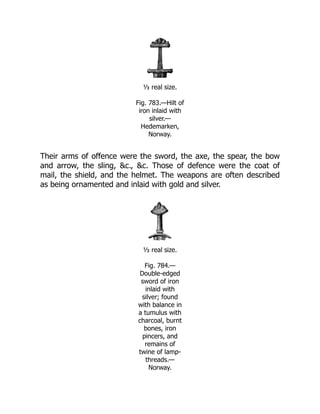
Fig.783.—Hilt of
iron inlaid with
silver.—
Hedemarken,
Norway.
Their arms of offence were the sword, the axe, the spear, the bow
and arrow, the sling, &c., &c. Those of defence were the coat of
mail, the shield, and the helmet. The weapons are often described
as being ornamented and inlaid with gold and silver.
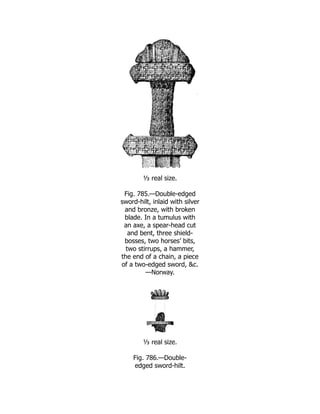
⅓ real size.
Fig. 784.—
Double-edged
sword of iron
inlaid with
silver; found
with balance in
a tumulus with
charcoal, burnt
bones, iron
pincers, and
remains of
twine of lamp-
threads.—
Norway.
34.
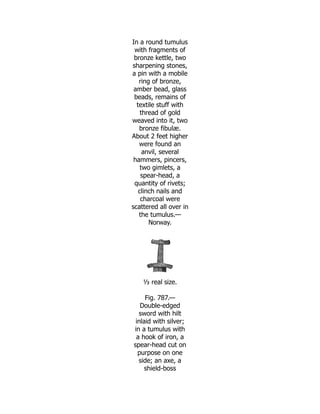
⅓ real size.
Fig.785.—Double-edged
sword-hilt, inlaid with silver
and bronze, with broken
blade. In a tumulus with
an axe, a spear-head cut
and bent, three shield-
bosses, two horses’ bits,
two stirrups, a hammer,
the end of a chain, a piece
of a two-edged sword, &c.
—Norway.
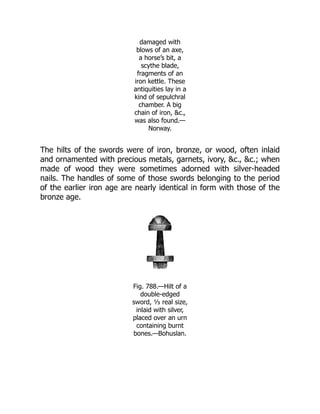
⅓ real size.
Fig. 786.—Double-
edged sword-hilt.
35.
In a roundtumulus
with fragments of
bronze kettle, two
sharpening stones,
a pin with a mobile
ring of bronze,
amber bead, glass
beads, remains of
textile stuff with
thread of gold
weaved into it, two
bronze fibulæ.
About 2 feet higher
were found an
anvil, several
hammers, pincers,
two gimlets, a
spear-head, a
quantity of rivets;
clinch nails and
charcoal were
scattered all over in
the tumulus.—
Norway.
⅓ real size.
Fig. 787.—
Double-edged
sword with hilt
inlaid with silver;
in a tumulus with
a hook of iron, a
spear-head cut on
purpose on one
side; an axe, a
shield-boss
36.
damaged with
blows ofan axe,
a horse’s bit, a
scythe blade,
fragments of an
iron kettle. These
antiquities lay in a
kind of sepulchral
chamber. A big
chain of iron, &c.,
was also found.—
Norway.
The hilts of the swords were of iron, bronze, or wood, often inlaid
and ornamented with precious metals, garnets, ivory, &c., &c.; when
made of wood they were sometimes adorned with silver-headed
nails. The handles of some of those swords belonging to the period
of the earlier iron age are nearly identical in form with those of the
bronze age.
Fig. 788.—Hilt of a
double-edged
sword, ⅓ real size,
inlaid with silver,
placed over an urn
containing burnt
bones.—Bohuslan.
37.
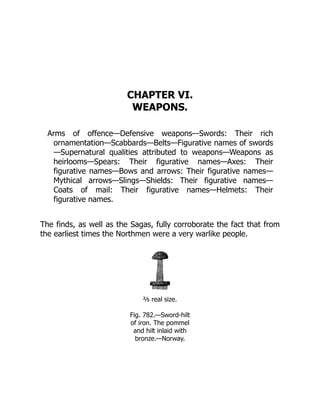
Fig. 789.—Hilt ofa
double-edged iron
sword, ⅖ real size,
inlaid with silver, found
with a spear-point of
iron.—Södermanland,
Sweden.
The scabbards were of wood, covered with skins, often richly
ornamented with gold and silver. The men carried them in a belt
across the shoulder, which by means of a double button could be
lengthened or shortened. The luxury of the ornamentation on their
weapons corresponds with that of the countries whence the
forefathers of the race claimed to come.[92]
“Eyvind Urarhorn was in the winter at the Yule-feast with King Olaf,
and received rich gifts from him, Brynjolf Ulfaldi was also there, and
got as Yule-gift from the king a gold ornamented sword, and also a
farm called Vettaland, which is a very large farm” (St. Olaf’s Saga,
ch. 60).
“There were in the house not a few gold ornamented swords. Sigvat
made a stanza, in which he said he would accept a sword if it were
given to him by the king. The king took one and gave it him; the hilt
was bound with gold, and the guards were gold ornamented; it was
a very costly weapon” (St. Olaf’s Saga, 172).
38.
⅓ real size.
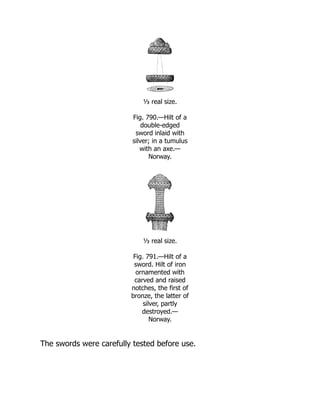
Fig.790.—Hilt of a
double-edged
sword inlaid with
silver; in a tumulus
with an axe.—
Norway.
⅓ real size.
Fig. 791.—Hilt of a
sword. Hilt of iron
ornamented with
carved and raised
notches, the first of
bronze, the latter of
silver, partly
destroyed.—
Norway.
The swords were carefully tested before use.
39.
“Thórólf took hisown sword and gave to Thorstein; it was a fine and
well-made sword. Thorstein took it, drew it, and catching its point,
bent the blade between his hands so that the point touched the
guard; he let it spring back, and it did not straighten again. He gave
it back to Thórólf, and asked for a stronger weapon....” (Svarfdæla,
ch. 2).
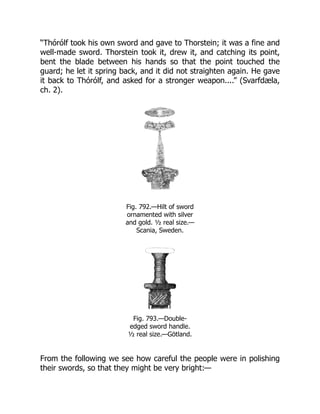
Fig. 792.—Hilt of sword
ornamented with silver
and gold. ½ real size.—
Scania, Sweden.
Fig. 793.—Double-
edged sword handle.
½ real size.—Götland.
From the following we see how careful the people were in polishing
their swords, so that they might be very bright:—
40.
“Thorir was theherdman of King Olaf, and was greatly honoured. As
a token of it the king gave him the sword which his kinsmen had
owned for a long time and been very fond of. It was called Thegn; it
was both long and broad, sharper than any other, and three times
polished” (An Bogsveigi’s, Saga, ch. 1).
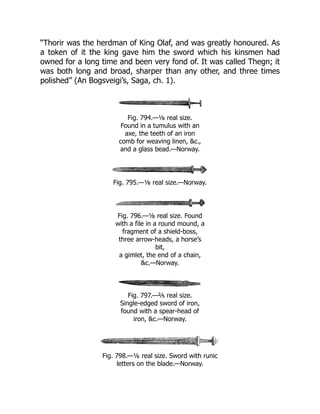
Fig. 794.—⅛ real size.
Found in a tumulus with an
axe, the teeth of an iron
comb for weaving linen, &c.,
and a glass bead.—Norway.
Fig. 795.—⅛ real size.—Norway.
Fig. 796.—⅛ real size. Found
with a file in a round mound, a
fragment of a shield-boss,
three arrow-heads, a horse’s
bit,
a gimlet, the end of a chain,
&c.—Norway.
Fig. 797.—⅖ real size.
Single-edged sword of iron,
found with a spear-head of
iron, &c.—Norway.
Fig. 798.—⅙ real size. Sword with runic
letters on the blade.—Norway.
41.
Iron Swords.
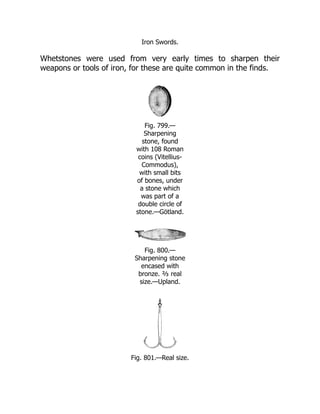
Whetstones wereused from very early times to sharpen their
weapons or tools of iron, for these are quite common in the finds.
Fig. 799.—
Sharpening
stone, found
with 108 Roman
coins (Vitellius-
Commodus),
with small bits
of bones, under
a stone which
was part of a
double circle of
stone.—Götland.
Fig. 800.—
Sharpening stone
encased with
bronze. ⅔ real
size.—Upland.
Fig. 801.—Real size.
42.
Real size.
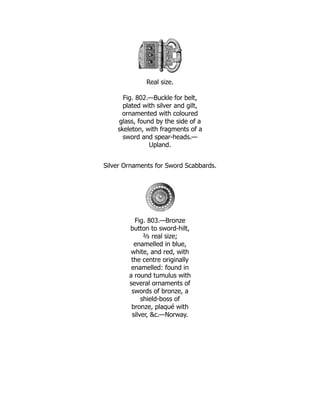
Fig. 802.—Bucklefor belt,
plated with silver and gilt,
ornamented with coloured
glass, found by the side of a
skeleton, with fragments of a
sword and spear-heads.—
Upland.
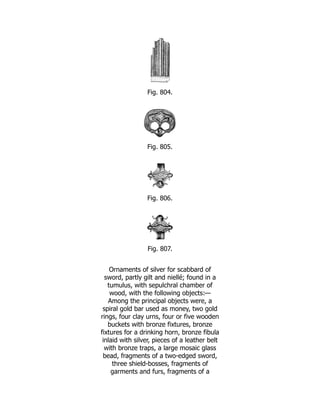
Silver Ornaments for Sword Scabbards.
Fig. 803.—Bronze
button to sword-hilt,
⅔ real size;
enamelled in blue,
white, and red, with
the centre originally
enamelled: found in
a round tumulus with
several ornaments of
swords of bronze, a
shield-boss of
bronze, plaqué with
silver, &c.—Norway.
43.
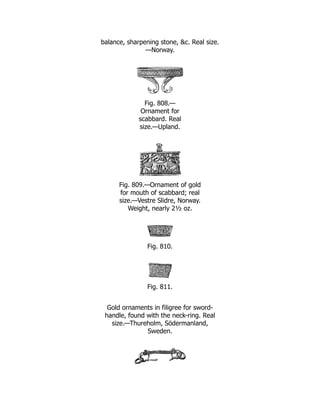
Fig. 804.
Fig. 805.
Fig.806.
Fig. 807.
Ornaments of silver for scabbard of
sword, partly gilt and niellé; found in a
tumulus, with sepulchral chamber of
wood, with the following objects:—
Among the principal objects were, a
spiral gold bar used as money, two gold
rings, four clay urns, four or five wooden
buckets with bronze fixtures, bronze
fixtures for a drinking horn, bronze fibula
inlaid with silver, pieces of a leather belt
with bronze traps, a large mosaic glass
bead, fragments of a two-edged sword,
three shield-bosses, fragments of
garments and furs, fragments of a
44.
balance, sharpening stone,&c. Real size.
—Norway.
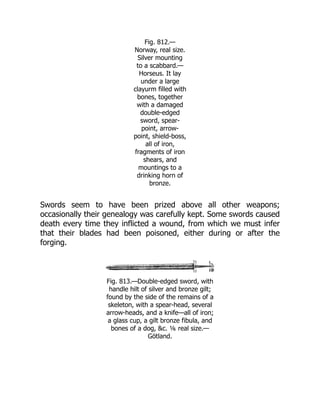
Fig. 808.—
Ornament for
scabbard. Real
size.—Upland.
Fig. 809.—Ornament of gold
for mouth of scabbard; real
size.—Vestre Slidre, Norway.
Weight, nearly 2½ oz.
Fig. 810.
Fig. 811.
Gold ornaments in filigree for sword-
handle, found with the neck-ring. Real
size.—Thureholm, Södermanland,
Sweden.
45.
Fig. 812.—
Norway, realsize.
Silver mounting
to a scabbard.—
Horseus. It lay
under a large
clayurm filled with
bones, together
with a damaged
double-edged
sword, spear-
point, arrow-
point, shield-boss,
all of iron,
fragments of iron
shears, and
mountings to a
drinking horn of
bronze.
Swords seem to have been prized above all other weapons;
occasionally their genealogy was carefully kept. Some swords caused
death every time they inflicted a wound, from which we must infer
that their blades had been poisoned, either during or after the
forging.
Fig. 813.—Double-edged sword, with
handle hilt of silver and bronze gilt;
found by the side of the remains of a
skeleton, with a spear-head, several
arrow-heads, and a knife—all of iron;
a glass cup, a gilt bronze fibula, and
bones of a dog, &c. ⅙ real size.—
Götland.
46.
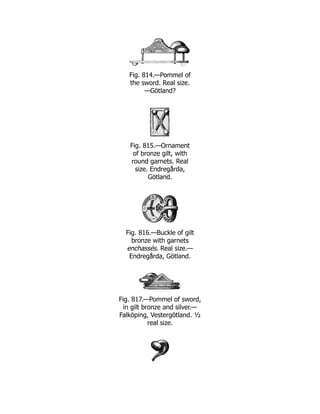
Fig. 814.—Pommel of
thesword. Real size.
—Götland?
Fig. 815.—Ornament
of bronze gilt, with
round garnets. Real
size. Endregårda,
Götland.
Fig. 816.—Buckle of gilt
bronze with garnets
enchassés. Real size.—
Endregårda, Götland.
Fig. 817.—Pommel of sword,
in gilt bronze and silver.—
Falköping, Vestergötland. ½
real size.
47.
Welcome to ourwebsite – the perfect destination for book lovers and
knowledge seekers. We believe that every book holds a new world,
offering opportunities for learning, discovery, and personal growth.
That’s why we are dedicated to bringing you a diverse collection of
books, ranging from classic literature and specialized publications to
self-development guides and children's books.
More than just a book-buying platform, we strive to be a bridge
connecting you with timeless cultural and intellectual values. With an
elegant, user-friendly interface and a smart search system, you can
quickly find the books that best suit your interests. Additionally,
our special promotions and home delivery services help you save time
and fully enjoy the joy of reading.
Join us on a journey of knowledge exploration, passion nurturing, and
personal growth every day!
testbankdeal.com




![divide,’ said Thorkel; and it was done. Thorkel chose the loose
property, which was more than the land which Gisli got. There were
two children to be supported by it, a boy Geirmund and a girl
Gudrid; the children of their kinsman Ingjald. Gudrid went with Gisli,
and Geirmund with Thorkel. Thorkel went to his brother-in-law
Thorgrim and lived with him; Gisli remained at Hól, and did not find
that the household was worse than before”[79]
(Gisli Sursson’s Saga,
p. 100).
At the arvel the debts of the dead were settled, and divisions made
if the heirs were several. If the property left was not sufficient to pay
the debts, then the creditors had to share the loss in proportion to
their claims. If the heirs were sons or daughters of the deceased
they had to pay the debts out of their own property.
“When a man is dead his heir shall sit in the high-seat and summon
all the creditors to come there on the seventh day and take away
each their due, as much as witnesses proved. If the property is not
enough all shall share the loss. The one to whom more was due
shall lose more. If a pauper’s and a woman’s share are in the
inheritance it holds good if there is money enough for both; if there
is not she shall lose her gagngjald (tilgjöf).... If there are sons or
daughters they shall pay the debts if they have property, but no
other man shall do so unless he inherits property” (Gulathing’s Law,
115).
After the debts were paid, then the paupers were distributed
between the heirs (or if only one pauper existed, each heir
supported him in turn in the same proportion as the inheritance), for
the community never intervened in the support of paupers.
“If people divide paupers without property between them the
division shall be kept up, however they may divide. They (paupers)](https://image.slidesharecdn.com/12597-250518000312-0acf5e12/85/Consumer-Behavior-7th-Edition-Hoyer-Solutions-Manual-18-320.jpg)
![shall follow the heirs”[80]
(Gulath., 127).
Only children by a lawful union were legitimate skirborinn (holy-
born), and consequently arfborinn (inheritance-born).
“The child whose mother is bought with mund is inheritance-born
when it comes into daylight living and receives food” (Gragas, i.
223).[81]
“The man who has been carried between the skaut (cloak-skirts) of
father and mother shall have the same rights as his father had”
(Earlier Frostathing’s Law, ix. 15).
“If a man lives with his concubine twenty winters or more, and they
never separate during that time, and no hindrances come forward
during the time, then their children are inheritance-born and they
are partners by law” (Gulath., 125).
In Christian times the arvel changed its name into that of soul-ale.
“Wherever men die and the heir wants to have an arvel, whether it
is in seven days or on the thirtieth morning or later, it is called erfiöl.
If they make ale and call it sálu-öl (soul-ale) they shall invite to it the
priest, of whom they buy service, with two other men at least. The
priest shall go to arvels or soul-ales if not hindered by necessity. If
he will not go he shall lose his tithe” (Gulath., 23).
No one who had lawful heirs was allowed to dispose of his property
before his death without the assent of these heirs.](https://image.slidesharecdn.com/12597-250518000312-0acf5e12/85/Consumer-Behavior-7th-Edition-Hoyer-Solutions-Manual-19-320.jpg)
![“No man shall divide a property or inheritance before the owner
allows it, until men see that he spoils it. As long as a man has his
wits and can manage his farm and bargains, and is able to ride on
horseback and drink ale, he shall rule his property, and no man is
allowed to divide it; if it is divided it shall not be kept” (Gulath., 126).
[82]
“When two daughters inherit from their father, and one has a
daughter and the other a son, the son can redeem (the land) from
his kinswomen according to law. But if this son has only daughters,
while the daughter of his mother’s sister has a son, he can redeem
the land from them for the same sum as was paid to his mother.
Then the land shall remain where it is, for it has come three times
under spindle” (Gulath., 275).
The nearest of kin inherited the property, and the rules regulating
the inheritance are these:—
“A son shall take inheritance after his father if it goes as it ought,
and an adopted son like one family-born; and if things go badly (if
the son dies) the father inherits from his son if the latter has no heir.
“The second inheritance is the one which a daughter and son’s son
take, if he and also his father are lawfully born.
“If two lawfully born son’s sons are inheritance-born, and the one’s
father is lawfully born and the other’s not, then the first shall take
the inheritance.
“Brothers who have the same father inherit from each other. When a
brother dies, the sister born of the same father gets the inheritance.
“A father’s father, and father’s brother, and brother’s son each inherit
a third.](https://image.slidesharecdn.com/12597-250518000312-0acf5e12/85/Consumer-Behavior-7th-Edition-Hoyer-Solutions-Manual-20-320.jpg)
![“The sixth inheritance is taken by a brother of the same mother
(half-brother), and by a brother’s sons.
“A lawfully born mother is the heir of her child, and then a lawfully
born father’s sister.
“A prisung[83]
and a thrall-born son, and a hornung,[84]
if freedom is
given to them, take the same inheritance, and each of them inherits
from the other.
“A mother’s father and daughter’s son both take the same
inheritance, and each inherits from the other.
“A mother’s brother and sister’s son both take the same inheritance,
and inherit from each other.
“Men who are sons of sister and brother both take the same
inheritance, and inherit from each other.
“Sons of two sisters take the same inheritance, and inherit from
each other.
“It is decided and decreed in the laws of men that if a man slays a
man in order to inherit from him, he has forfeited his inheritance,
and it shall be given according to law as if the man did not exist who
slays another for the sake of inheritance” (Frostath. viii. 1–14).
By the so-called ættleiding, or leading into the family, i.e. adoption,
a person could give the illegitimately born the right of inheritance, or
at least a right to a certain part of the inheritance, together with the
legal heirs, the consent of the latter being always necessary. The
ceremony appears from different laws to have been the same all
over the country, and its primitive form seems to indicate great
antiquity; a shoe was placed alongside the skapker, the large vat
into which the beer was poured in the banqueting hall, and from
which the smaller vats and horns were filled and carried round
among the guests. The ceremony which followed is thus described:
—](https://image.slidesharecdn.com/12597-250518000312-0acf5e12/85/Consumer-Behavior-7th-Edition-Hoyer-Solutions-Manual-21-320.jpg)
![“It is a full adoption, when a father leads into his family his son, and
those men assent who are the next heirs of the one who adopts his
son. Ale from three measures of grain shall be made, and a bull
three winters old be killed, and the skin be flayed off its right hind-
leg above the hough, and therefrom a shoe be made. The father
shall let the one to be adopted step into it, and have in his arms
those of his sons who are not of age, but those of his sons who are
full-grown shall step into that shoe. If he has no inheritance-born
sons those who are his nearest heirs shall step into the shoe. The
adopted man shall be led into the embrace of the man and the wife.
Women shall be witnesses as well as a man to a full adoption, as
well as to the shoe if it is kept. The thrall-born son to whom liberty is
given shall be adopted if either father or brother, or whoever is
nearest heir, whether he is young or old, gives him his liberty, and
those being the nearest heirs of the man who wants to adopt him
assent. The son of a freed woman shall be adopted like that of a
thrall-woman” (Earlier Frostathing’s Law, ix.).
“No man is allowed to give away an inheritance; a fraudulent
bargain shall be reckoned as no bargain. The father who adopts his
own son shall step into the shoe, and then his full-grown son. That
is a full adoption. If there is no son the one who consents to the
adoption shall step into the shoe. Then he who consents to his ódal
rights shall step into the shoe. He shall say this: ‘I lead this man to
the property which I give him, to payment and gift, to seat and
settle, to indemnities and rings, and to all rétt as if his mother had
been bought with mund” (Earlier Gulathings Law, c. 58).
The father[85]
had then to declare that he led the adopted son into
the share of the inheritance which he gave him, and with the same
rights as if his mother had been law fully wed. Those present had to
bear witness to this leading into the family, as also to the use of the
shoe, by means of which it had been done.](https://image.slidesharecdn.com/12597-250518000312-0acf5e12/85/Consumer-Behavior-7th-Edition-Hoyer-Solutions-Manual-22-320.jpg)
![The Gulathings Law required the adopted to publicly announce his
adoption at the Thing every twenty years, until he stepped into his
inheritance.
“A man shall announce publicly his adoption every twenty winters
until he gets his inheritance, which shall thereafter be his witness”
(Gulath., 58).
“A woman could adopt as well as a man, but she could not adopt her
illegitimate son, nor a man his illegitimate daughter.
“A man must never lead a woman into his family (adopt her), nor a
woman a man” (Frostathings Law, ix. 21).
To an illegitimate son a father could not give more than a certain
amount without the consent of his heir.
“Höskuld Dala-Kollsson fell sick in his old age. He sent for his sons,
and other friends and kinsmen; when they came he said to the
brothers Bard and Thorleik: ‘I am now ill, but I have been a man not
apt to be taken ill. My third son is not legitimately born, and I ask
you, his brothers, to let Olaf inherit a third of my property, and you
the two other thirds.’ Bard answered first, and said he would do as
his father wanted. ‘I believe Olaf will do us credit in every respect,
and the more so the richer he is.’ Thorleik answered: ‘I do not want
Olaf to be made legitimate heir; he has already more than enough
property; thou, father, hast given him many things, and for a long
time hast shared very unequally between us brothers; I am not
willing to give up the honour to which I am born.’ Höskuld replied:
‘You will not object if I give my son three mörk[86]
(of gold), since he
is so high-born on his mother’s side.’ To this Thorleik consented.
Then Höskuld took the gold ring that Hakon jarl had given him,](https://image.slidesharecdn.com/12597-250518000312-0acf5e12/85/Consumer-Behavior-7th-Edition-Hoyer-Solutions-Manual-23-320.jpg)
![which weighed two mörk, and the sword which was the gift of the
king, on which was a mörk of gold” (Laxdæla, ch. 26).
The Gulathings Law expressly mentions those female degrees to
which the ódal descended. These were: daughter, sister, aunt,
father’s sister, daughter of brothers, and son’s daughters. It adds
that if two sisters inherited an ódal, and one had a son and the
other a daughter, the former had a right to purchase the shares of
his kinswomen in the ódal.
The right of inheritance does not seem to have extended further
than the third cousin on the father’s side, or second cousin on the
mother’s.
Where sons existed they always inherited to the exclusion of their
sisters.[87]
If an ódal by inheritance came to one not entitled to ódals-right, the
right of redemption was open to the nearest of kin, who had such
right.
If one of joint heirs had the right of ódal and the other not, the
former got his share of the inheritance in ódals land, the other in
personal property. In case a son’s son and daughter inherited
together, the former had the right of purchasing the latter’s share in
the ódal.
Daughters always inherited certain things, such as article of clothing,
household goods, bedding, ornaments, &c.
“This shall a daughter take in inheritance after her mother, if her
brother is alive: all clothes except cloaks (skikkja) of gudvef (costly
stuff), and all uncut clothes; these her brother owns. And of clothes
the brother shall take gold-lace, if he wants it; but woven cloaks and
all bed-hangings, and lace-clothes (i.e. edged with lace), brocades
and feather-clothes and down-clothes, the daughter shall have. If a
web is in the loom, the son owns that which is woven, and the](https://image.slidesharecdn.com/12597-250518000312-0acf5e12/85/Consumer-Behavior-7th-Edition-Hoyer-Solutions-Manual-24-320.jpg)
![should avenge the other; that they should walk under three
jardarmen,[88]
and that was their oath (equivalent to an oath). It was
done thus: Three long slices of turf were to be cut up; their ends
were to be fastened in the ground, and the loops raised so high that
a man could go under them. This Thorgeir (Hávarsson) and
Thormód (Bersason) did” (Fostbrædra Saga, 1).[89]
Gisli was at a Thing with his brother-in-law Vestein. There were also
a Godi named Thorgrim, and Gisli’s brother Thorkel. Gisli said:
“‘I think it right that we should bind our friendship still closer than
before, and we four swear one another foster-brotherhood.’ To this
they consented, and went on Eyrarhvolsoddi (point or tongue of
land), and there cut from the ground a loop of turf, both ends being
attached to the ground, and under this placed a spear inlaid with
ornaments, so long that a man could reach with his hand to the
spear-nail (i.e., the nail fastening the spear-point to the handle).
Under this were to go the four, Thorgrim, Gisli, Thorkel, and Véstein.
They then drew blood from themselves, and let it run together into
the mould, which had been cut under the loop of turf, and mixed
together the earth and the blood; thereupon they all fell on their
knees and swore an oath that each should avenge the other like a
brother, and called all the gods as witnesses. They all shook hands”
(Gisli Súrsson’s Saga, p. 11).[90]
When Angantýr and Beli were fighting, the latter became exhausted,
and would have been killed by the former but for Thorstein, who
came forward, and said:
“‘I think it right, Angantýr, that you should stop fighting, for I see
that Beli is exhausted, and I will not be so mean as to help him
against thee, but if thou becomest his slayer I will challenge thee to
a hólmganga, and I think we are not less unequal than thou and](https://image.slidesharecdn.com/12597-250518000312-0acf5e12/85/Consumer-Behavior-7th-Edition-Hoyer-Solutions-Manual-28-320.jpg)
![“After this they swore themselves into foster-brotherhood, and to
own everything by halves” (Sörla Thátt, c. 6).
In very rare instances we see that foster-brotherhood could be
dissolved.
“Thorgeir and Thormod, after having performed many a deed of
valour, one day had a talk, and the former said to the latter:
‘Knowest thou anywhere two foster-brothers who are our equals in
courage and manliness?’ Thormod replied: ‘They might perhaps be
found, if we were to look for them far and wide.’ ‘Nowhere in
Iceland, I think; but which of us two, dost thou think, would be the
winner, if we were to try each other?’ Thorgeir inquired. ‘That I do
not know,’ Thormod answered; ‘but this I know, that thy question
puts an end to our fellowship and foster-brotherhood’”[91]
(Fostbrædra Saga).
This shows the proud spirit of the men of that period. Thormod felt
deeply wounded that such a thought should have entered the heart
of one with whom he had shared so many dangers.
The love which existed between foster-children and foster-parents is
seen in many instances. When Olaf, son of Höskuld and Melkorka,
daughter of king Mýrkjartan, came to Ireland—
“The foster-mother of Melkorka, who was bedridden from sickness
and old age, was most moved by this news; she walked without a
stick to see Olaf. The king (Mýrkjartan) said to Olaf: ‘Here is the
foster-mother of Melkorka, who would like to hear from thee about
her condition.’ Olaf took the old woman in his arms and seated her
on his knee, and told her that her foster-daughter was well-off in
Iceland. He handed to her the knife and the belt, and she recognized
them and wept with joy. She said the son of Melkorka was imposing](https://image.slidesharecdn.com/12597-250518000312-0acf5e12/85/Consumer-Behavior-7th-Edition-Hoyer-Solutions-Manual-30-320.jpg)
![Fig. 789.—Hilt of a
double-edged iron
sword, ⅖ real size,
inlaid with silver, found
with a spear-point of
iron.—Södermanland,
Sweden.
The scabbards were of wood, covered with skins, often richly
ornamented with gold and silver. The men carried them in a belt
across the shoulder, which by means of a double button could be
lengthened or shortened. The luxury of the ornamentation on their
weapons corresponds with that of the countries whence the
forefathers of the race claimed to come.[92]
“Eyvind Urarhorn was in the winter at the Yule-feast with King Olaf,
and received rich gifts from him, Brynjolf Ulfaldi was also there, and
got as Yule-gift from the king a gold ornamented sword, and also a
farm called Vettaland, which is a very large farm” (St. Olaf’s Saga,
ch. 60).
“There were in the house not a few gold ornamented swords. Sigvat
made a stanza, in which he said he would accept a sword if it were
given to him by the king. The king took one and gave it him; the hilt
was bound with gold, and the guards were gold ornamented; it was
a very costly weapon” (St. Olaf’s Saga, 172).](https://image.slidesharecdn.com/12597-250518000312-0acf5e12/85/Consumer-Behavior-7th-Edition-Hoyer-Solutions-Manual-37-320.jpg)