CONSTRUCTIVIST
APPROACH TO
TEACHING AND
LEARNING
Created By Christy F.
Constructivist Approach
to Teaching and Learning
   Overview of Constructivism

   Theorists supporting Constructivism

   How Constructivism is Applied in the
    Classroom

   My Constructivist Classroom
Overview of Constructivism
 The theory of constructivism is an
  approach to learning suggesting that
  children must construct their own
  understandings of the world in which they
  live.
 In comparison to behaviorism, the learner
  is not a blank slate (tabula rasa), but
  instead brings past experiences and
  cultural factors to a situation and new
  information is constructed from prior
                                        Next
  knowledge.
Overview of Constructivism
 Learners construct their own
  understanding and knowledge of the world
  through experiencing things and reflecting
  on those experiences.
 Learning is an active, contextualized
  process of constructing knowledge rather
  than acquiring it.
 Information must be mentally acted
  on, manipulated, and transformed by
  learners in order to have meaning.Main Menu
Theorists Supporting
Constructivism
   Jean Piaget (1896-1980):
     Stages   of Cognitive Development
   John Dewey (1859-1952):
     Progressive   Education
   Lev Vygotsky (1896-1934):
     Social   Development Theory
   Jerome Bruner (1915 -)
     Discovery   Learning Theory

                                          Main Menu
Piaget’s Theory of Cognitive
Development
   Piaget proposed that cognitive development
    followed an invariant sequence from infancy
    through adolescence.

   His particular insight was the role of
    maturation in children's increasing capacity to
    understand their world: they cannot undertake
    certain tasks until they are psychologically
    mature enough to do so.

                                            Next
Piaget’s Four Stages of Cognitive
Development
    Sensori-motor
     (Birth-2 yrs) Differentiates self from objects Recognizes
     self as agent of action and begins to act intentionally:
     e.g. pulls a string to set mobile in motion or shakes a
     rattle to make a noise.
     Achieves object permanence: realizes that things
     continue to exist even when no longer present or seen.
    Pre-operational
     (2-7 years) Learns to use language and to represent
     objects by images and words. Thinking is still
     egocentric: has difficulty taking the viewpoint of others.
     Classifies objects by a single feature: e.g. groups
     together all the red blocks regardless of shape or all the
     square blocks regardless of color.
                                                        Next
Piaget’s Four Stages of Cognitive
Development
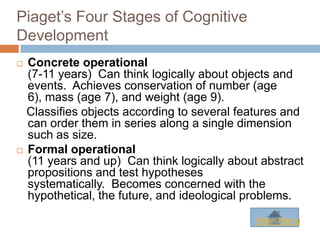
 Concrete operational
  (7-11 years) Can think logically about objects and
  events. Achieves conservation of number (age
  6), mass (age 7), and weight (age 9).
  Classifies objects according to several features and
  can order them in series along a single dimension
  such as size.
 Formal operational
  (11 years and up) Can think logically about abstract
  propositions and test hypotheses
  systematically. Becomes concerned with the
  hypothetical, the future, and ideological problems.

                                             Main Menu
How Constructivism is Applied in the
Classroom
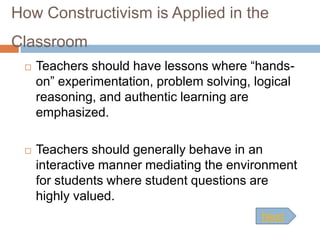
    Teachers should have lessons where “hands-
     on” experimentation, problem solving, logical
     reasoning, and authentic learning are
     emphasized.

    Teachers should generally behave in an
     interactive manner mediating the environment
     for students where student questions are
     highly valued.
                                            Next
How Constructivism is Applied in the
Classroom
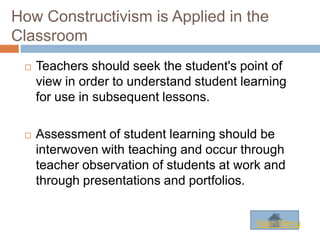
    Teachers should seek the student's point of
     view in order to understand student learning
     for use in subsequent lessons.

    Assessment of student learning should be
     interwoven with teaching and occur through
     teacher observation of students at work and
     through presentations and portfolios.


                                           Main Menu
My Constructivist Classroom

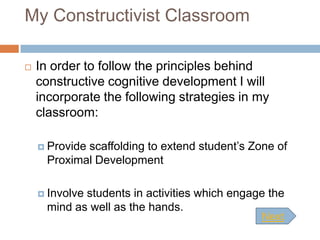
   In order to follow the principles behind
    constructive cognitive development I will
    incorporate the following strategies in my
    classroom:

     Providescaffolding to extend student’s Zone of
      Proximal Development

     Involvestudents in activities which engage the
      mind as well as the hands.
                                               Next
My Constructivist Classroom
 Continued:
  Have students work in groups often


  Initiate
          group discussions and debates allowing
   students to share their own thoughts and opinions


                                           Main Menu

Constructivist Approach to Teaching and Learning

  • 1.
  • 2.
    Constructivist Approach to Teachingand Learning  Overview of Constructivism  Theorists supporting Constructivism  How Constructivism is Applied in the Classroom  My Constructivist Classroom
  • 3.
    Overview of Constructivism The theory of constructivism is an approach to learning suggesting that children must construct their own understandings of the world in which they live.  In comparison to behaviorism, the learner is not a blank slate (tabula rasa), but instead brings past experiences and cultural factors to a situation and new information is constructed from prior Next knowledge.
  • 4.
    Overview of Constructivism Learners construct their own understanding and knowledge of the world through experiencing things and reflecting on those experiences.  Learning is an active, contextualized process of constructing knowledge rather than acquiring it.  Information must be mentally acted on, manipulated, and transformed by learners in order to have meaning.Main Menu
  • 5.
    Theorists Supporting Constructivism  Jean Piaget (1896-1980):  Stages of Cognitive Development  John Dewey (1859-1952):  Progressive Education  Lev Vygotsky (1896-1934):  Social Development Theory  Jerome Bruner (1915 -)  Discovery Learning Theory Main Menu
  • 6.
    Piaget’s Theory ofCognitive Development  Piaget proposed that cognitive development followed an invariant sequence from infancy through adolescence.  His particular insight was the role of maturation in children's increasing capacity to understand their world: they cannot undertake certain tasks until they are psychologically mature enough to do so. Next
  • 7.
    Piaget’s Four Stagesof Cognitive Development  Sensori-motor (Birth-2 yrs) Differentiates self from objects Recognizes self as agent of action and begins to act intentionally: e.g. pulls a string to set mobile in motion or shakes a rattle to make a noise. Achieves object permanence: realizes that things continue to exist even when no longer present or seen.  Pre-operational (2-7 years) Learns to use language and to represent objects by images and words. Thinking is still egocentric: has difficulty taking the viewpoint of others. Classifies objects by a single feature: e.g. groups together all the red blocks regardless of shape or all the square blocks regardless of color. Next
  • 8.
    Piaget’s Four Stagesof Cognitive Development  Concrete operational (7-11 years) Can think logically about objects and events. Achieves conservation of number (age 6), mass (age 7), and weight (age 9). Classifies objects according to several features and can order them in series along a single dimension such as size.  Formal operational (11 years and up) Can think logically about abstract propositions and test hypotheses systematically. Becomes concerned with the hypothetical, the future, and ideological problems. Main Menu
  • 9.
    How Constructivism isApplied in the Classroom  Teachers should have lessons where “hands- on” experimentation, problem solving, logical reasoning, and authentic learning are emphasized.  Teachers should generally behave in an interactive manner mediating the environment for students where student questions are highly valued. Next
  • 10.
    How Constructivism isApplied in the Classroom  Teachers should seek the student's point of view in order to understand student learning for use in subsequent lessons.  Assessment of student learning should be interwoven with teaching and occur through teacher observation of students at work and through presentations and portfolios. Main Menu
  • 11.
    My Constructivist Classroom  In order to follow the principles behind constructive cognitive development I will incorporate the following strategies in my classroom:  Providescaffolding to extend student’s Zone of Proximal Development  Involvestudents in activities which engage the mind as well as the hands. Next
  • 12.
    My Constructivist Classroom Continued:  Have students work in groups often  Initiate group discussions and debates allowing students to share their own thoughts and opinions Main Menu