CONSTRUCTIVISM
1919-1934










CONSTRUCTION





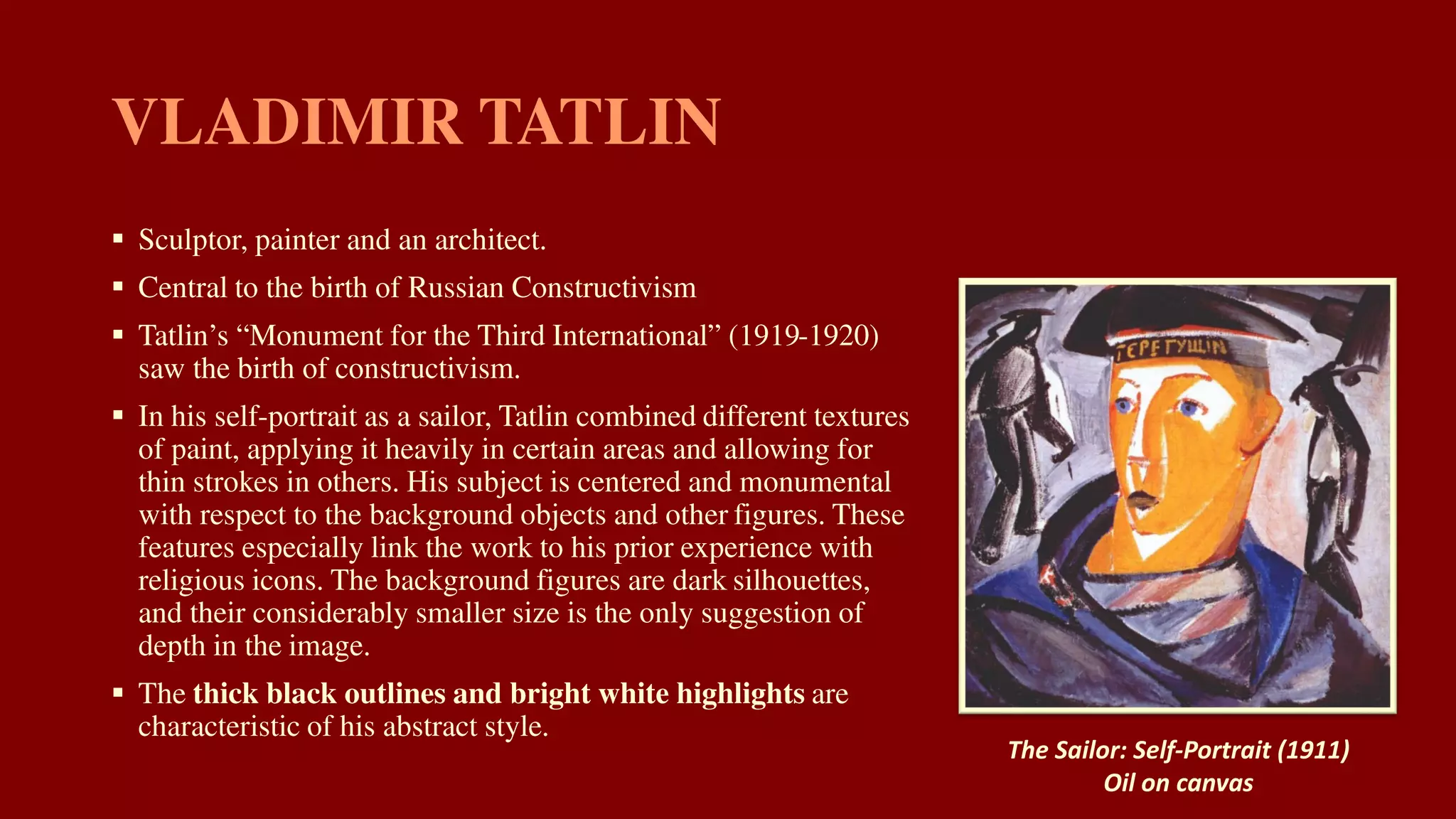
The Sailor: Self-Portrait (1911)
Oil on canvas





Model for the 3rd International
Tower (1919-1920)



Model for the 3rd International
Tower (1919-1920)





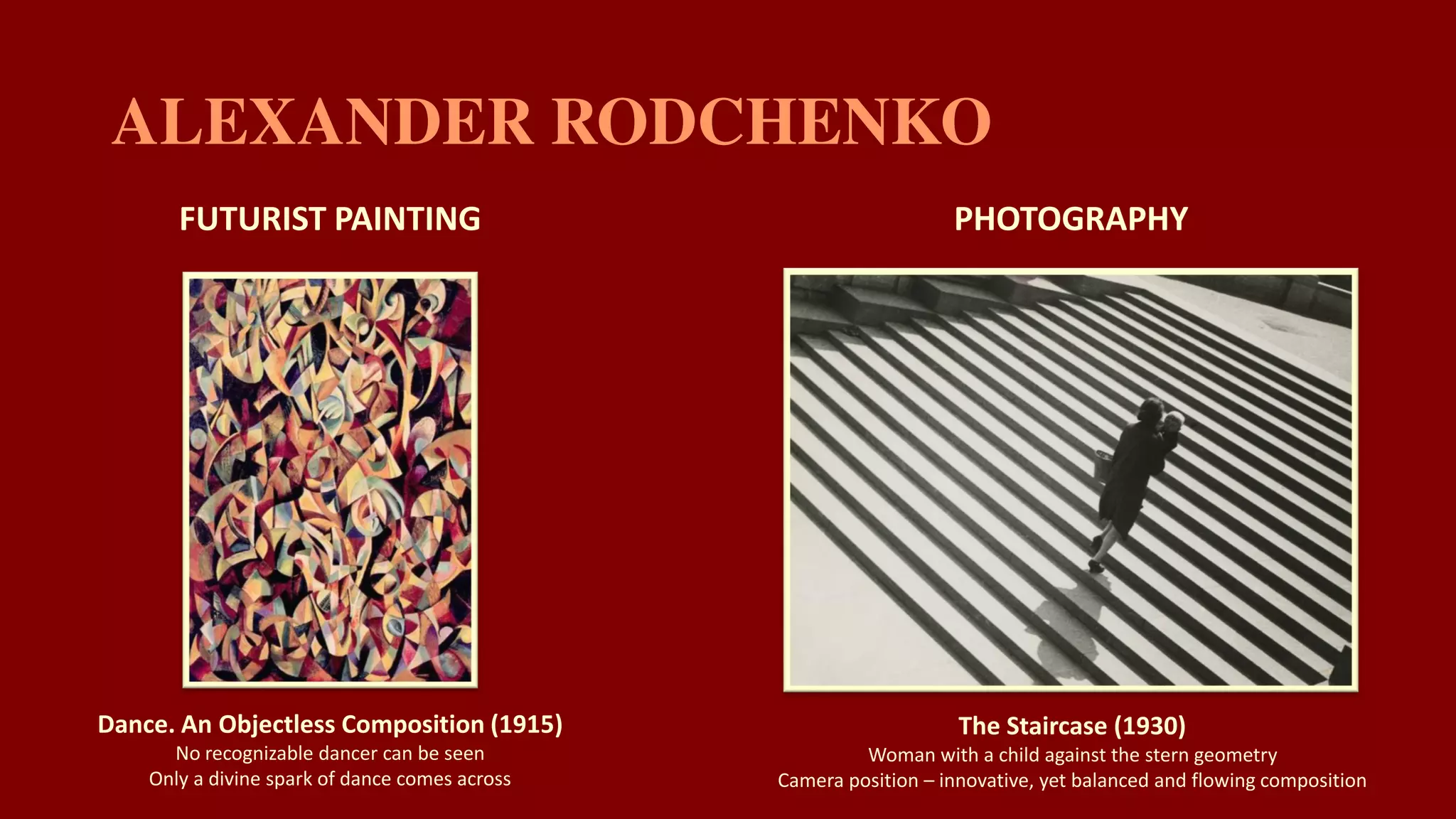
The Staircase (1930)
Woman with a child against the stern geometry
Camera position – innovative, yet balanced and flowing composition
PHOTOGRAPHY
Dance. An Objectless Composition (1915)
No recognizable dancer can be seen
Only a divine spark of dance comes across
FUTURIST PAINTING
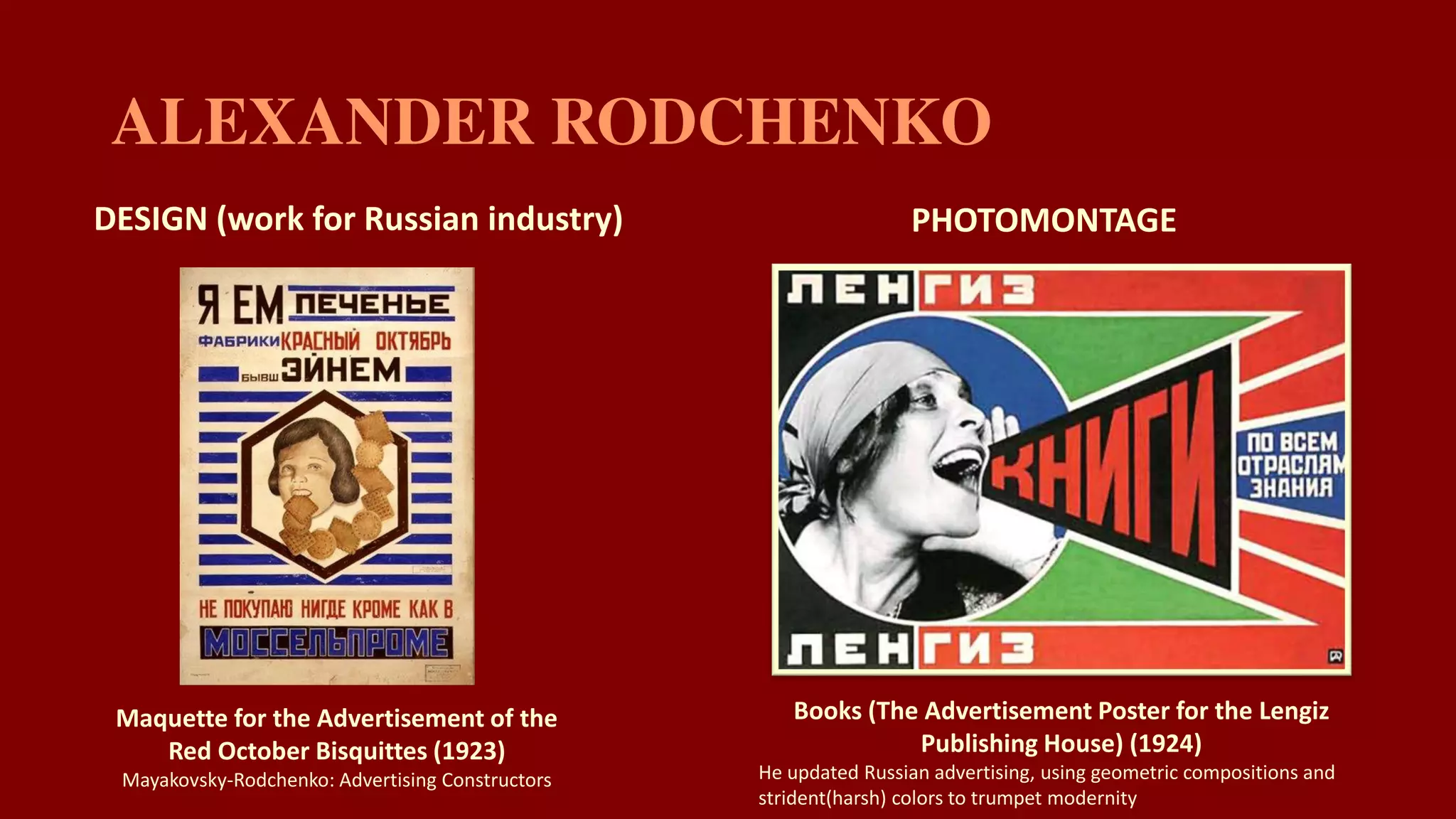
Books (The Advertisement Poster for the Lengiz
Publishing House) (1924)
He updated Russian advertising, using geometric compositions and
strident(harsh) colors to trumpet modernity
PHOTOMONTAGE
Maquette for the Advertisement of the
Red October Bisquittes (1923)
Mayakovsky-Rodchenko: Advertising Constructors
DESIGN (work for Russian industry)

 Believed that the artist could be an agent for change, which he
summarized to “goal-oriented creation”
 Began his career in illustrating children books, a teacher for
much of his career and an innovator
 Although often highly abstract and theoretical, Lissitzky's work
was able speak to the prevailing political discourse of his native
Russia, and then the nascent Soviet Union
 His Proun series of two-dimensional Suprematist paintings
sought to combine architecture and three-dimensional space
with traditional, albeit abstract, two-dimensional imagery.
 He was important in exporting Constructivist ideas to Germany
El Lissitzky in a self-portrait (1914)
The Runner (1930)
The segmented photo mimics the effect of
perceiving objects in motion
PHOTOMONTAGE
Proun 99 (1925)
An effort to create three-dimensional environments in which
two-dimensional shapes could exist in direct contrast to the space
SUPERMATISM
Beat the Whites with the Red Wedge (1919)
Red wedge – Bolsheviks
White circle – Kerensky forces
LITHOGRAPHY
USSR, The Russian exhibition
poster (1929)
Equality of the sexes
GRAPHIC DESIGN
Vladimir Tatlin,
Corner Counter-Relief (1914)
Sculpture with spatial qualities made of Iron,
copper, wood and strings
El Lissitzsky
Proun Room (1923)
Geometric Proun compositions into a room
environment
Naum Gabo,
Head No. 2 (1916)
Stereometric construction – Form through
space rather than mass
Lyubov Popova,
Textile Design (1924)
Vladimir Mayakovsky, Agitprop poster (1924)
"Want it? Join“
1.You want to overcome cold?
2. You want to overcome hunger? 3. You want to eat?
4. You want to drink?


 Vasilily Yermilov
 Victor Pasmore
 Lyubov Popova
 Alexander Vesnin
 Vladimir Mayakovsky




THANK YOU
sRUzan lolla 120205023

CONSTRUCTIVISM

  • 1.
  • 2.
  • 3.
  • 4.
  • 5.
  • 6.
         Model for the3rd International Tower (1919-1920)
  • 7.
       Model for the3rd International Tower (1919-1920)
  • 8.
  • 9.
    The Staircase (1930) Womanwith a child against the stern geometry Camera position – innovative, yet balanced and flowing composition PHOTOGRAPHY Dance. An Objectless Composition (1915) No recognizable dancer can be seen Only a divine spark of dance comes across FUTURIST PAINTING
  • 10.
    Books (The AdvertisementPoster for the Lengiz Publishing House) (1924) He updated Russian advertising, using geometric compositions and strident(harsh) colors to trumpet modernity PHOTOMONTAGE Maquette for the Advertisement of the Red October Bisquittes (1923) Mayakovsky-Rodchenko: Advertising Constructors DESIGN (work for Russian industry)
  • 11.
      Believed thatthe artist could be an agent for change, which he summarized to “goal-oriented creation”  Began his career in illustrating children books, a teacher for much of his career and an innovator  Although often highly abstract and theoretical, Lissitzky's work was able speak to the prevailing political discourse of his native Russia, and then the nascent Soviet Union  His Proun series of two-dimensional Suprematist paintings sought to combine architecture and three-dimensional space with traditional, albeit abstract, two-dimensional imagery.  He was important in exporting Constructivist ideas to Germany El Lissitzky in a self-portrait (1914)
  • 12.
    The Runner (1930) Thesegmented photo mimics the effect of perceiving objects in motion PHOTOMONTAGE Proun 99 (1925) An effort to create three-dimensional environments in which two-dimensional shapes could exist in direct contrast to the space SUPERMATISM
  • 13.
    Beat the Whiteswith the Red Wedge (1919) Red wedge – Bolsheviks White circle – Kerensky forces LITHOGRAPHY USSR, The Russian exhibition poster (1929) Equality of the sexes GRAPHIC DESIGN
  • 14.
    Vladimir Tatlin, Corner Counter-Relief(1914) Sculpture with spatial qualities made of Iron, copper, wood and strings El Lissitzsky Proun Room (1923) Geometric Proun compositions into a room environment
  • 15.
    Naum Gabo, Head No.2 (1916) Stereometric construction – Form through space rather than mass Lyubov Popova, Textile Design (1924) Vladimir Mayakovsky, Agitprop poster (1924) "Want it? Join“ 1.You want to overcome cold? 2. You want to overcome hunger? 3. You want to eat? 4. You want to drink?
  • 16.
       Vasilily Yermilov Victor Pasmore  Lyubov Popova  Alexander Vesnin  Vladimir Mayakovsky
  • 17.
  • 18.