WHAT IS IT?
• Definition – The condition of being safe.
Freedom from danger, risk or injury
• Something we learn? Who?
• Something we see? When?
• A habit? How?
**An Attitude**
3.
Most accidents arecaused by unsafe acts.
• You work hard to create a safe workplace for your workers and eliminate unsafe
conditions.
• But what about employees' own unsafe behavior?
• If you examined your accident records for the past few years, you'd likely find that the
root-cause of most of the accidents was unsafe acts rather than unsafe conditions.
• If you read between the lines of the accident reports, you might find that the workers
involved in the incidents had become complacent about safety.
• They'd gone on "autopilot" and stopped paying attention to what they were doing.
• They'd taken shortcuts.
• They'd taken risks. They'd developed an "It won't happen to me"
attitude.
4.
What could gowrong
• If you are not thinking about what could go
wrong every day, all day, while you work, you
are not going to be completely safe.
• You need to be trained to think ahead as we
approach each task and consider:
• What we are working with;
• What we are doing;
• Where we are going;
• What could go wrong;
5.
Examine the substances–
• Equipment, procedures, and situations that are part of their
job and look for possible hazards.
• Remind yourself to be safe;
• Focus physically and mentally on your work;
• No matter how many times you may have done the same
job.
• Impress upon yourself the fact that accidents occur in the
blink of an eye.
• All it takes is one second of inattention, one moment of
carelessness.
6.
Stop complacency inits tracks.
• Complacency on the job injures and kills.
• Spreads like a disease from one worker to another.
• One employee sees a co-worker taking a shortcut and figures, "If
he can do it, why can't I?"
• You can't afford to let complacency take over in your workplace.
• Complacency is dangerous—as dangerous as any machine,
chemical, or other recognized workplace hazard.
• Through a strong commitment to safety training and awareness,
you can create a safety culture.
• Emphasis on alertness;
• Planning;
• Hazard identification;
• Problem solving, and;
• Injury prevention
ATTITUDE IS THEKEY
• A good attitude toward safety is a
key to preventing unnecessary
incidents and injuries. Your attitude
affects your safety and the safety of
everyone around you, both at work
and at home.
14.
ARE WE LEADERSOR FOLLOWERS?
• Leaders – One that leads or guides or one who is in charge or in
command of others.
• Follower – A person who accepts the teaching of another, a
servant or a subordinate, or one that imitates another.
• Can we be both?
• When
• Where
• How does this impact others around us?
15.
WHAT DOES THISMEAN FOR ME?
• We all have attitudes, We are leaders and followers;
• Our attitudes , our leadership, and as followers impact
people around us;
• People observe what we do and follow our example;
• We train others good or bad habits;
• We create the culture which set the tone of our work habit;
• The culture includes bad or good attitudes, leadership, and
training;
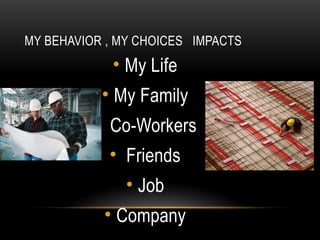
• We have the choice in our safety behavior;
• This decision impacts our ability to be safe and it also
impacts the people that work with or around us.