Navigating digital landscapes to
foster creativity and innovation
Gráinne Conole, University of Leicester
15th August 2013
Creating Knowledge Conference
Lund, Sweden
National
Teaching
Fellow 2012 Ascilite fellow 2012EDEN fellow 2013
About me…
• Irish but living in England
• PhD in Chemistry
• Two girls (14 and 18)
• Professor of Learning
Innovation at the
University of Leicester
Institute of Learning Innovation
• Mission
– To research and apply learning
innovations to inform policy and
shape practice
• Vision
– To enable creativity, quality and
innovation in learning and
teaching to enhance the
learner experience
Areas of activity
• Research
• Teaching
• Supervision
• Consultancy
• Visiting scholars
• Institutional advice
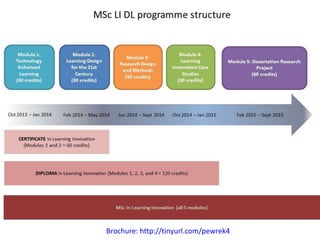
Brochure: http://tinyurl.com/pewrek4
Outline
• Why e-learning?
• E-learning timeline and digital
landscapes
• Emergent technologies
• A pedagogical meta-model
• Pedagogical approaches
• Learning design and digital
literacies
• Future challenges
Why e-learning?
• For learning
– Potential to support interaction, communication
and collaboration
– Developing digital literacy skills
– Promoting different pedagogical approaches
– Fostering creativity and innovation
– Connecting students beyond the formal course
• For life
– Preparing students for an uncertain future
– Improving employability opportunities
– Increased importance of technology in society
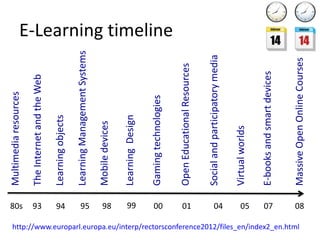
E-Learning timeline
Multimediaresources
80s
TheInternetandtheWeb
93
LearningManagementSystems
95
OpenEducationalResources
01
Mobiledevices
98
Gamingtechnologies
00
Socialandparticipatorymedia
04
Virtualworlds
05
E-booksandsmartdevices
MassiveOpenOnlineCourses
07 08
LearningDesign
99
Learningobjects
94
http://www.europarl.europa.eu/interp/rectorsconference2012/files_en/index2_en.html
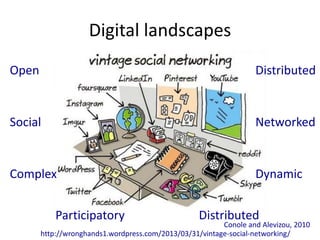
Digital landscapes
http://wronghands1.wordpress.com/2013/03/31/vintage-social-networking/
Open
Social
Distributed
Participatory Distributed
Networked
Complex Dynamic
Conole and Alevizou, 2010
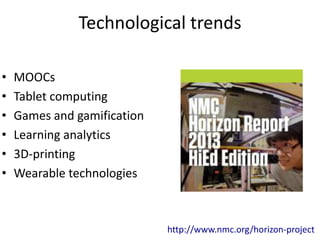
Technological trends
• MOOCs
• Tablet computing
• Games and gamification
• Learning analytics
• 3D-printing
• Wearable technologies
http://www.nmc.org/horizon-project
The MATEL study
• Productivity and creativity
• Networked collaboration
• Content creation
• Visualisation and simulation
• Learning Management Systems
• Learning environment
• Games
• Devices, interfaces and connectivity
http://www.menon.org/matel/
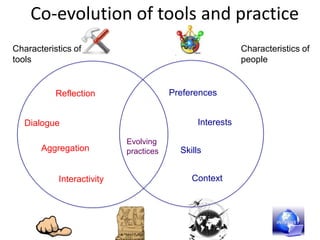
Co-evolution of tools and practice
Evolving
practices
Characteristics of
tools
Reflection
Dialogue
Aggregation
Interactivity
Characteristics of
people
Preferences
Skills
Interests
Context
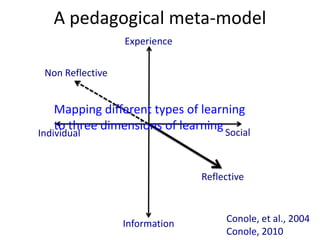
Individual Social
Information
Experience
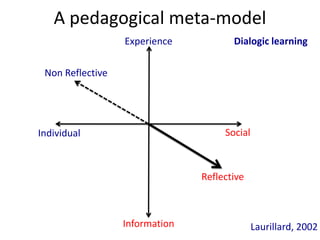
A pedagogical meta-model
Conole, et al., 2004
Conole, 2010
Non Reflective
Reflective
Mapping different types of learning
to three dimensions of learning
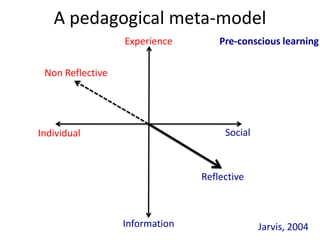
Individual Social
Information
Experience
A pedagogical meta-model
Jarvis, 2004
Non Reflective
Reflective
Pre-conscious learning
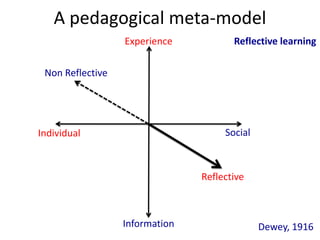
Individual Social
Information
Experience
A pedagogical meta-model
Dewey, 1916
Non Reflective
Reflective
Reflective learning
Individual Social
Information
Experience
A pedagogical meta-model
Laurillard, 2002
Non Reflective
Reflective
Dialogic learning
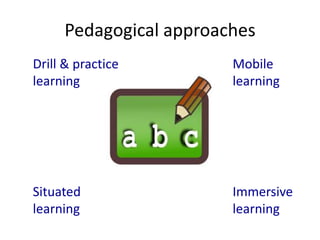
Pedagogical approaches
Drill & practice
learning
Mobile
learning
Situated
learning
Immersive
learning
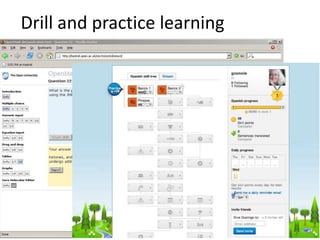
Drill and practice learning
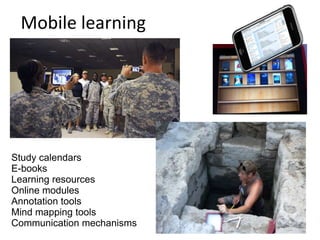
Study calendars
E-books
Learning resources
Online modules
Annotation tools
Mind mapping tools
Communication mechanisms
Mobile learning
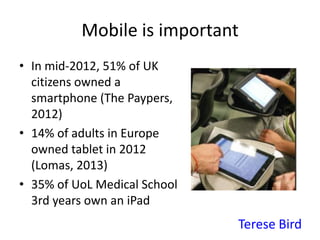
Mobile is important
• In mid-2012, 51% of UK
citizens owned a
smartphone (The Paypers,
2012)
• 14% of adults in Europe
owned tablet in 2012
(Lomas, 2013)
• 35% of UoL Medical School
3rd years own an iPad
Terese Bird
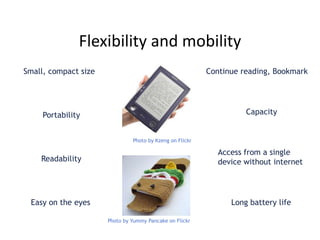
Flexibility and mobility
Small, compact size
Readability
Easy on the eyes
Access from a single
device without internet
Portability Capacity
Long battery life
Continue reading, Bookmark
Photo by Kzeng on Flickr
Photo by Yummy Pancake on Flickr
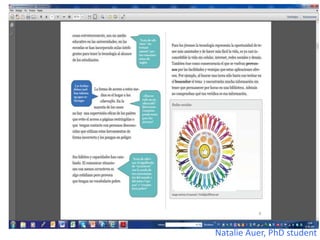
Natalie Auer, PhD student
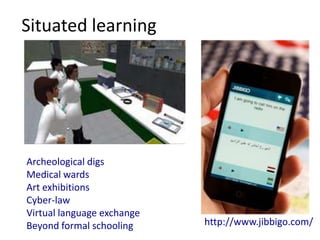
Situated learning
Archeological digs
Medical wards
Art exhibitions
Cyber-law
Virtual language exchange
Beyond formal schooling http://www.jibbigo.com/
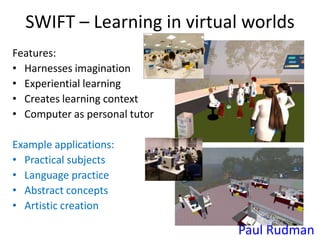
SWIFT – Learning in virtual worlds
Features:
• Harnesses imagination
• Experiential learning
• Creates learning context
• Computer as personal tutor
Example applications:
• Practical subjects
• Language practice
• Abstract concepts
• Artistic creation
Paul Rudman
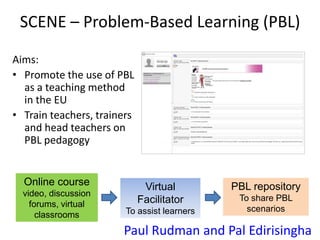
SCENE – Problem-Based Learning (PBL)
Aims:
• Promote the use of PBL
as a teaching method
in the EU
• Train teachers, trainers
and head teachers on
PBL pedagogy
Online course
video, discussion
forums, virtual
classrooms
PBL repository
To share PBL
scenarios
Virtual
Facilitator
To assist learners
Paul Rudman and Pal Edirisingha
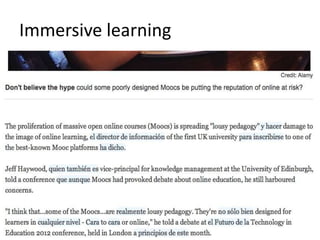
Immersive learning
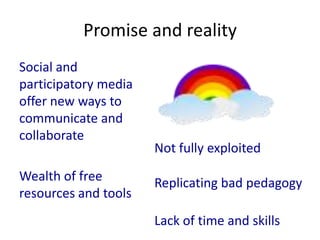
Promise and reality
Social and
participatory media
offer new ways to
communicate and
collaborate
Wealth of free
resources and tools
Not fully exploited
Replicating bad pedagogy
Lack of time and skills
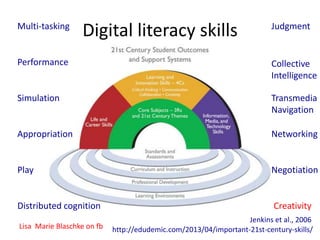
Digital literacy skills
http://edudemic.com/2013/04/important-21st-century-skills/
Creativity
Multi-tasking
Performance
Simulation
Appropriation
Play
Distributed cognition
Judgment
Collective
Intelligence
Transmedia
Navigation
Networking
Negotiation
Jenkins et al., 2006
Lisa Marie Blaschke on fb
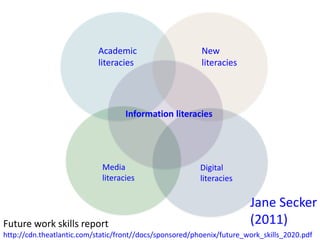
Academic
literacies
New
literacies
Media
literacies
Digital
literacies
Information literacies
Jane Secker
(2011)Future work skills report
http://cdn.theatlantic.com/static/front//docs/sponsored/phoenix/future_work_skills_2020.pdf
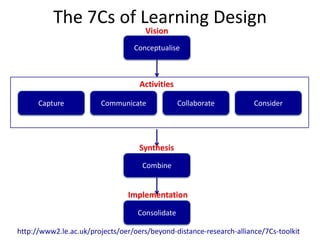
The 7Cs of Learning Design
Conceptualise
Vision
CommunicateCapture ConsiderCollaborate
Activities
Combine
Synthesis
Consolidate
Implementation
http://www2.le.ac.uk/projects/oer/oers/beyond-distance-research-alliance/7Cs-toolkit
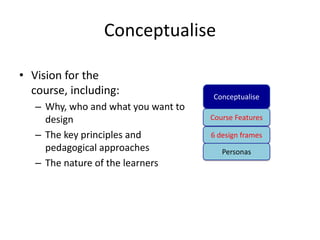
Conceptualise
• Vision for the
course, including:
– Why, who and what you want to
design
– The key principles and
pedagogical approaches
– The nature of the learners
Conceptualise
Course Features
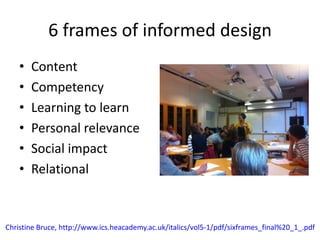
6 design frames
Personas
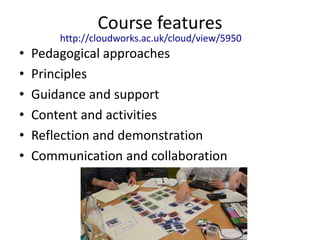
Course features
• Pedagogical approaches
• Principles
• Guidance and support
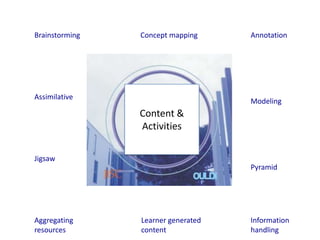
• Content and activities
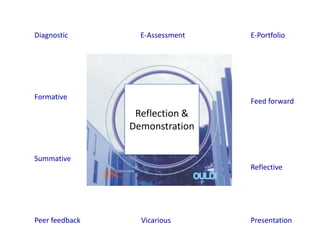
• Reflection and demonstration
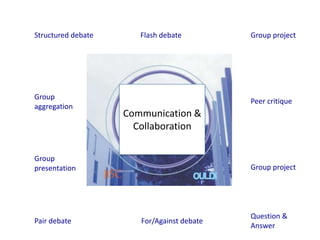
• Communication and collaboration
http://cloudworks.ac.uk/cloud/view/5950
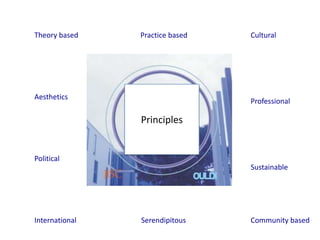
Principles
Theory based Practice based Cultural
Aesthetics
Political
International Serendipitous Community based
Sustainable
Professional
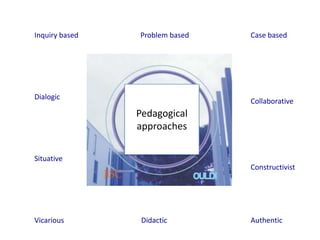
Pedagogical
approaches
Inquiry based Problem based Case based
Dialogic
Situative
Vicarious Didactic Authentic
Constructivist
Collaborative
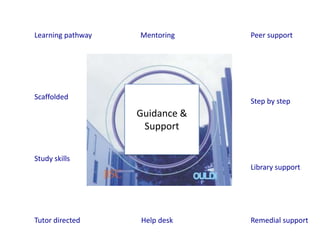
Guidance &
Support
Learning pathway Mentoring Peer support
Scaffolded
Study skills
Tutor directed Help desk Remedial support
Library support
Step by step
Content &
Activities
Brainstorming Concept mapping Annotation
Assimilative
Jigsaw
Aggregating
resources
Learner generated
content
Information
handling
Pyramid
Modeling
Reflection &
Demonstration
Diagnostic E-Assessment E-Portfolio
Formative
Summative
Peer feedback Vicarious Presentation
Reflective
Feed forward
Communication &
Collaboration
Structured debate Flash debate Group project
Group
aggregation
Group
presentation
Pair debate For/Against debate
Question &
Answer
Group project
Peer critique
6 frames of informed design
• Content
• Competency
• Learning to learn
• Personal relevance
• Social impact
• Relational
Christine Bruce, http://www.ics.heacademy.ac.uk/italics/vol5-1/pdf/sixframes_final%20_1_.pdf
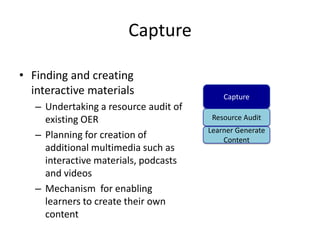
Capture
• Finding and creating
interactive materials
– Undertaking a resource audit of
existing OER
– Planning for creation of
additional multimedia such as
interactive materials, podcasts
and videos
– Mechanism for enabling
learners to create their own
content
Capture
Resource Audit
Learner Generate
Content
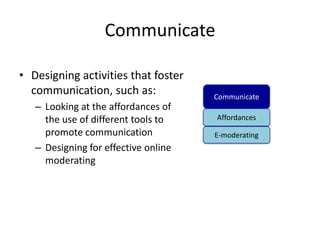
Communicate
• Designing activities that foster
communication, such as:
– Looking at the affordances of
the use of different tools to
promote communication
– Designing for effective online
moderating
Communicate
Affordances
E-moderating
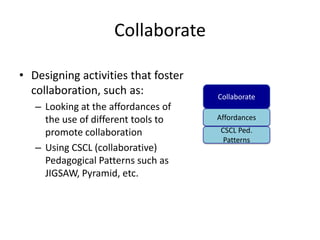
Collaborate
• Designing activities that foster
collaboration, such as:
– Looking at the affordances of
the use of different tools to
promote collaboration
– Using CSCL (collaborative)
Pedagogical Patterns such as
JIGSAW, Pyramid, etc.
Collaborate
Affordances
CSCL Ped.
Patterns
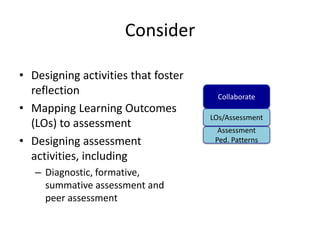
Consider
• Designing activities that foster
reflection
• Mapping Learning Outcomes
(LOs) to assessment
• Designing assessment
activities, including
– Diagnostic, formative,
summative assessment and
peer assessment
Collaborate
LOs/Assessment
Assessment
Ped. Patterns
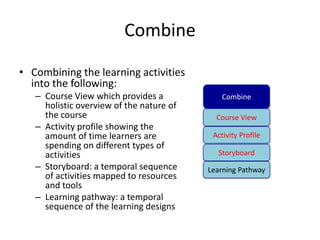
Combine
• Combining the learning activities
into the following:
– Course View which provides a
holistic overview of the nature of
the course
– Activity profile showing the
amount of time learners are
spending on different types of
activities
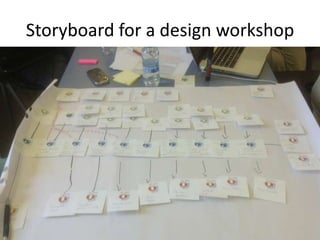
– Storyboard: a temporal sequence
of activities mapped to resources
and tools
– Learning pathway: a temporal
sequence of the learning designs
Combine
Course View
Activity Profile
Storyboard
Learning Pathway
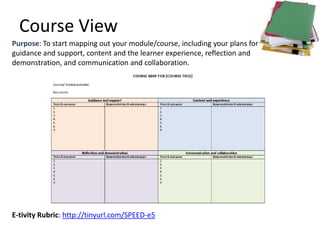
Course View
E-tivity Rubric: http://tinyurl.com/SPEED-e5
Purpose: To start mapping out your module/course, including your plans for
guidance and support, content and the learner experience, reflection and
demonstration, and communication and collaboration.
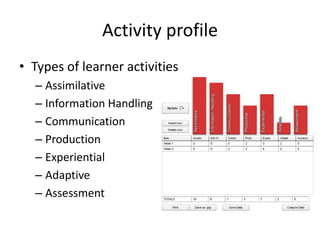
Activity profile
• Types of learner activities
– Assimilative
– Information Handling
– Communication
– Production
– Experiential
– Adaptive
– Assessment
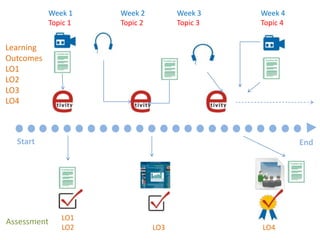
Start End
Learning
Outcomes
LO1
LO2
LO3
LO4
Assessment LO1
LO2 LO3 LO4
Week 1
Topic 1
Week 2
Topic 2
Week 3
Topic 3
Week 4
Topic 4
Storyboard for a design workshop
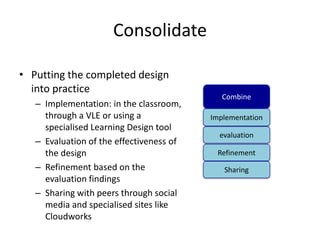
Consolidate
• Putting the completed design
into practice
– Implementation: in the classroom,
through a VLE or using a
specialised Learning Design tool
– Evaluation of the effectiveness of
the design
– Refinement based on the
evaluation findings
– Sharing with peers through social
media and specialised sites like
Cloudworks
Combine
Implementation
evaluation
Refinement
Sharing
http://www.larnacadeclaration.org/
• Definition of Learning Design
• Teachers need guidance to make informed
design decisions that are pedagogically
effective and make appropriate use of
technologies
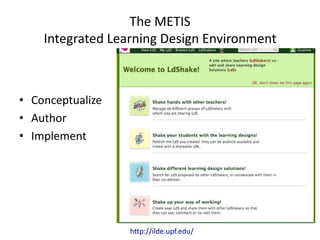
The METIS
Integrated Learning Design Environment
• Conceptualize
• Author
• Implement
http://ilde.upf.edu/
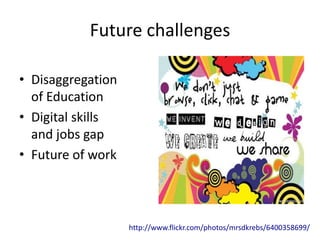
Future challenges
• Disaggregation
of Education
• Digital skills
and jobs gap
• Future of work
http://www.flickr.com/photos/mrsdkrebs/6400358699/
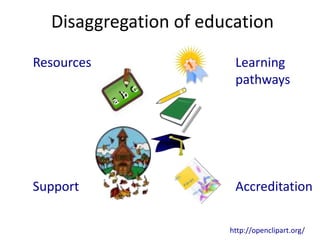
Resources Learning
pathways
Support Accreditation
Disaggregation of education
http://openclipart.org/
Resources
• Over ten years of the Open
Educational Resource (OER)
movement
• Hundreds of OER
repositories worldwide
• Presence on iTunesU
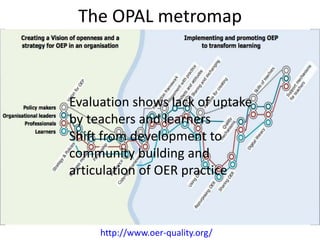
The OPAL metromap
http://www.oer-quality.org/
Evaluation shows lack of uptake
by teachers and learners
Shift from development to
community building and
articulation of OER practice
POERUP outputs
• An inventory of more than 100 OER initiatives
http://poerup.referata.com/wiki/Countries_with_OER_initiatives
• 11 country reports and 13 mini-reports
http://poerup.referata.com/wiki/Countries
• 7 in-depth case studies
• 3 EU-wide policy papers
OER community case studies
• 7 case studies
– Futurelearn
– OER University
– MOOC UVA
– BC Campus
– Wikiwijs
– HwB
– Book in progress
• Data collection
– Survey
– Interviews
• Methodology
– Social Network Analysis
to identify the nature of
the interactions and key
players
POERUP outputs
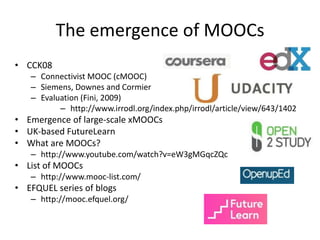
The emergence of MOOCs
• CCK08
– Connectivist MOOC (cMOOC)
– Siemens, Downes and Cormier
– Evaluation (Fini, 2009)
– http://www.irrodl.org/index.php/irrodl/article/view/643/1402
• Emergence of large-scale xMOOCs
• UK-based FutureLearn
• What are MOOCs?
– http://www.youtube.com/watch?v=eW3gMGqcZQc
• List of MOOCs
– http://www.mooc-list.com/
• EFQUEL series of blogs
– http://mooc.efquel.org/
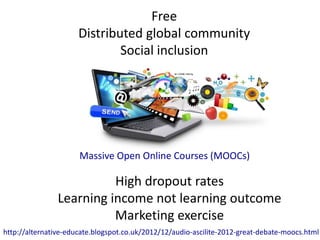
Massive Open Online Courses (MOOCs)
Free
Distributed global community
Social inclusion
High dropout rates
Learning income not learning outcome
Marketing exercise
http://alternative-educate.blogspot.co.uk/2012/12/audio-ascilite-2012-great-debate-moocs.html
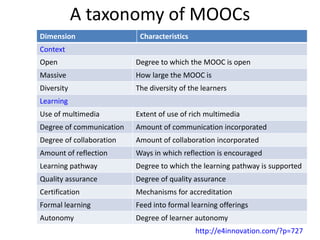
Dimension Characteristics
Context
Open Degree to which the MOOC is open
Massive How large the MOOC is
Diversity The diversity of the learners
Learning
Use of multimedia Extent of use of rich multimedia
Degree of communication Amount of communication incorporated
Degree of collaboration Amount of collaboration incorporated
Amount of reflection Ways in which reflection is encouraged
Learning pathway Degree to which the learning pathway is supported
Quality assurance Degree of quality assurance
Certification Mechanisms for accreditation
Formal learning Feed into formal learning offerings
Autonomy Degree of learner autonomy
A taxonomy of MOOCs
http://e4innovation.com/?p=727
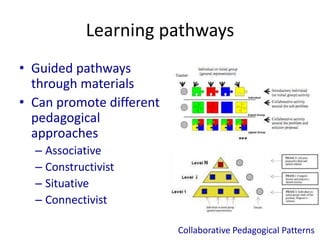
Learning pathways
• Guided pathways
through materials
• Can promote different
pedagogical
approaches
– Associative
– Constructivist
– Situative
– Connectivist
Collaborative Pedagogical Patterns
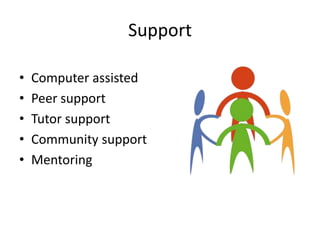
Support
• Computer assisted
• Peer support
• Tutor support
• Community support
• Mentoring
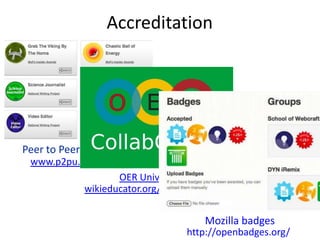
Accreditation
www.p2pu.org/en/
Peer to Peer University
wikieducator.org/OER_university/
OER University
http://openbadges.org/
Mozilla badges
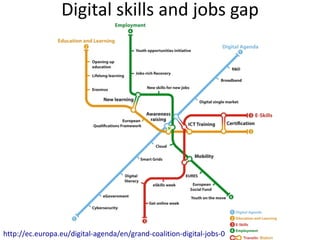
Digital skills and jobs gap
http://ec.europa.eu/digital-agenda/en/grand-coalition-digital-jobs-0
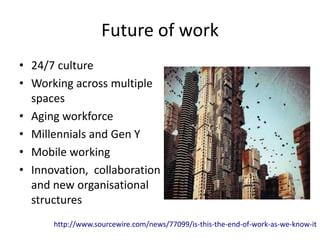
Future of work
• 24/7 culture
• Working across multiple
spaces
• Aging workforce
• Millennials and Gen Y
• Mobile working
• Innovation, collaboration
and new organisational
structures
http://www.sourcewire.com/news/77099/is-this-the-end-of-work-as-we-know-it
Conclusion
• Nature of learning, teaching
and research is changing
• Changing roles
• Technology Enhanced
Learning spaces
• It’s about
– Harnessing new media
– Adopting open practices
• New business models are
emerging
http://www.slideshare.net/GrainneConole
http://www2.le.ac.uk/departments/beyond-distance-research-alliance
grainne.conole@le.ac.uk
http://e4innovation.com
References
• Conole, G. (2010) Review of pedagogical frameworks and models
and their use in e-learning,
http://cloudworks.ac.uk/cloud/view/2982.
• Conole, G. and P. Alevizou (2010) Review of the use(s) of Web 2.0 in
Higher Education.
• Conole, G., M. Dyke, et al. (2004). "Mapping pedagogy and tools for
effective learning design." Computers and Education 43(1-2): 17-33.
• Dewey, J. (1916). Experience and Nature. New York, Dover.
• Jarvis, P. (2004). Adult education and lifelong learning. London,
RoutledgeFalmer.
• Laurillard, D. (2002). Rethinking university teaching, Routledge %@
0415256798, 9780415256797.
• Secker, J.(2011), http://www.slideshare.net/seckerj/information-
literacy-e-learning-and-the-changing-role-of-the-librarian
• Learning Design workshop resources http://tinyurl.com/LD-
workshop

Conole lund final

  • 1.
    Navigating digital landscapesto foster creativity and innovation Gráinne Conole, University of Leicester 15th August 2013 Creating Knowledge Conference Lund, Sweden National Teaching Fellow 2012 Ascilite fellow 2012EDEN fellow 2013
  • 2.
    About me… • Irishbut living in England • PhD in Chemistry • Two girls (14 and 18) • Professor of Learning Innovation at the University of Leicester
  • 3.
    Institute of LearningInnovation • Mission – To research and apply learning innovations to inform policy and shape practice • Vision – To enable creativity, quality and innovation in learning and teaching to enhance the learner experience
  • 4.
    Areas of activity •Research • Teaching • Supervision • Consultancy • Visiting scholars • Institutional advice
  • 5.
  • 6.
    Outline • Why e-learning? •E-learning timeline and digital landscapes • Emergent technologies • A pedagogical meta-model • Pedagogical approaches • Learning design and digital literacies • Future challenges
  • 7.
    Why e-learning? • Forlearning – Potential to support interaction, communication and collaboration – Developing digital literacy skills – Promoting different pedagogical approaches – Fostering creativity and innovation – Connecting students beyond the formal course • For life – Preparing students for an uncertain future – Improving employability opportunities – Increased importance of technology in society
  • 8.
  • 9.
  • 10.
    Technological trends • MOOCs •Tablet computing • Games and gamification • Learning analytics • 3D-printing • Wearable technologies http://www.nmc.org/horizon-project
  • 11.
    The MATEL study •Productivity and creativity • Networked collaboration • Content creation • Visualisation and simulation • Learning Management Systems • Learning environment • Games • Devices, interfaces and connectivity http://www.menon.org/matel/
  • 12.
    Co-evolution of toolsand practice Evolving practices Characteristics of tools Reflection Dialogue Aggregation Interactivity Characteristics of people Preferences Skills Interests Context
  • 13.
    Individual Social Information Experience A pedagogicalmeta-model Conole, et al., 2004 Conole, 2010 Non Reflective Reflective Mapping different types of learning to three dimensions of learning
  • 14.
    Individual Social Information Experience A pedagogicalmeta-model Jarvis, 2004 Non Reflective Reflective Pre-conscious learning
  • 15.
    Individual Social Information Experience A pedagogicalmeta-model Dewey, 1916 Non Reflective Reflective Reflective learning
  • 16.
    Individual Social Information Experience A pedagogicalmeta-model Laurillard, 2002 Non Reflective Reflective Dialogic learning
  • 17.
    Pedagogical approaches Drill &practice learning Mobile learning Situated learning Immersive learning
  • 18.
  • 19.
    Study calendars E-books Learning resources Onlinemodules Annotation tools Mind mapping tools Communication mechanisms Mobile learning
  • 20.
    Mobile is important •In mid-2012, 51% of UK citizens owned a smartphone (The Paypers, 2012) • 14% of adults in Europe owned tablet in 2012 (Lomas, 2013) • 35% of UoL Medical School 3rd years own an iPad Terese Bird
  • 21.
    Flexibility and mobility Small,compact size Readability Easy on the eyes Access from a single device without internet Portability Capacity Long battery life Continue reading, Bookmark Photo by Kzeng on Flickr Photo by Yummy Pancake on Flickr
  • 22.
  • 23.
    Situated learning Archeological digs Medicalwards Art exhibitions Cyber-law Virtual language exchange Beyond formal schooling http://www.jibbigo.com/
  • 24.
    SWIFT – Learningin virtual worlds Features: • Harnesses imagination • Experiential learning • Creates learning context • Computer as personal tutor Example applications: • Practical subjects • Language practice • Abstract concepts • Artistic creation Paul Rudman
  • 25.
    SCENE – Problem-BasedLearning (PBL) Aims: • Promote the use of PBL as a teaching method in the EU • Train teachers, trainers and head teachers on PBL pedagogy Online course video, discussion forums, virtual classrooms PBL repository To share PBL scenarios Virtual Facilitator To assist learners Paul Rudman and Pal Edirisingha
  • 26.
  • 27.
    Promise and reality Socialand participatory media offer new ways to communicate and collaborate Wealth of free resources and tools Not fully exploited Replicating bad pedagogy Lack of time and skills
  • 28.
    Digital literacy skills http://edudemic.com/2013/04/important-21st-century-skills/ Creativity Multi-tasking Performance Simulation Appropriation Play Distributedcognition Judgment Collective Intelligence Transmedia Navigation Networking Negotiation Jenkins et al., 2006 Lisa Marie Blaschke on fb
  • 29.
    Academic literacies New literacies Media literacies Digital literacies Information literacies Jane Secker (2011)Futurework skills report http://cdn.theatlantic.com/static/front//docs/sponsored/phoenix/future_work_skills_2020.pdf
  • 30.
    The 7Cs ofLearning Design Conceptualise Vision CommunicateCapture ConsiderCollaborate Activities Combine Synthesis Consolidate Implementation http://www2.le.ac.uk/projects/oer/oers/beyond-distance-research-alliance/7Cs-toolkit
  • 31.
    Conceptualise • Vision forthe course, including: – Why, who and what you want to design – The key principles and pedagogical approaches – The nature of the learners Conceptualise Course Features 6 design frames Personas
  • 32.
    Course features • Pedagogicalapproaches • Principles • Guidance and support • Content and activities • Reflection and demonstration • Communication and collaboration http://cloudworks.ac.uk/cloud/view/5950
  • 33.
    Principles Theory based Practicebased Cultural Aesthetics Political International Serendipitous Community based Sustainable Professional
  • 34.
    Pedagogical approaches Inquiry based Problembased Case based Dialogic Situative Vicarious Didactic Authentic Constructivist Collaborative
  • 35.
    Guidance & Support Learning pathwayMentoring Peer support Scaffolded Study skills Tutor directed Help desk Remedial support Library support Step by step
  • 36.
    Content & Activities Brainstorming Conceptmapping Annotation Assimilative Jigsaw Aggregating resources Learner generated content Information handling Pyramid Modeling
  • 37.
    Reflection & Demonstration Diagnostic E-AssessmentE-Portfolio Formative Summative Peer feedback Vicarious Presentation Reflective Feed forward
  • 38.
    Communication & Collaboration Structured debateFlash debate Group project Group aggregation Group presentation Pair debate For/Against debate Question & Answer Group project Peer critique
  • 39.
    6 frames ofinformed design • Content • Competency • Learning to learn • Personal relevance • Social impact • Relational Christine Bruce, http://www.ics.heacademy.ac.uk/italics/vol5-1/pdf/sixframes_final%20_1_.pdf
  • 40.
    Capture • Finding andcreating interactive materials – Undertaking a resource audit of existing OER – Planning for creation of additional multimedia such as interactive materials, podcasts and videos – Mechanism for enabling learners to create their own content Capture Resource Audit Learner Generate Content
  • 41.
    Communicate • Designing activitiesthat foster communication, such as: – Looking at the affordances of the use of different tools to promote communication – Designing for effective online moderating Communicate Affordances E-moderating
  • 42.
    Collaborate • Designing activitiesthat foster collaboration, such as: – Looking at the affordances of the use of different tools to promote collaboration – Using CSCL (collaborative) Pedagogical Patterns such as JIGSAW, Pyramid, etc. Collaborate Affordances CSCL Ped. Patterns
  • 43.
    Consider • Designing activitiesthat foster reflection • Mapping Learning Outcomes (LOs) to assessment • Designing assessment activities, including – Diagnostic, formative, summative assessment and peer assessment Collaborate LOs/Assessment Assessment Ped. Patterns
  • 44.
    Combine • Combining thelearning activities into the following: – Course View which provides a holistic overview of the nature of the course – Activity profile showing the amount of time learners are spending on different types of activities – Storyboard: a temporal sequence of activities mapped to resources and tools – Learning pathway: a temporal sequence of the learning designs Combine Course View Activity Profile Storyboard Learning Pathway
  • 45.
    Course View E-tivity Rubric:http://tinyurl.com/SPEED-e5 Purpose: To start mapping out your module/course, including your plans for guidance and support, content and the learner experience, reflection and demonstration, and communication and collaboration.
  • 46.
    Activity profile • Typesof learner activities – Assimilative – Information Handling – Communication – Production – Experiential – Adaptive – Assessment
  • 47.
    Start End Learning Outcomes LO1 LO2 LO3 LO4 Assessment LO1 LO2LO3 LO4 Week 1 Topic 1 Week 2 Topic 2 Week 3 Topic 3 Week 4 Topic 4
  • 48.
    Storyboard for adesign workshop
  • 49.
    Consolidate • Putting thecompleted design into practice – Implementation: in the classroom, through a VLE or using a specialised Learning Design tool – Evaluation of the effectiveness of the design – Refinement based on the evaluation findings – Sharing with peers through social media and specialised sites like Cloudworks Combine Implementation evaluation Refinement Sharing
  • 50.
    http://www.larnacadeclaration.org/ • Definition ofLearning Design • Teachers need guidance to make informed design decisions that are pedagogically effective and make appropriate use of technologies
  • 51.
    The METIS Integrated LearningDesign Environment • Conceptualize • Author • Implement http://ilde.upf.edu/
  • 52.
    Future challenges • Disaggregation ofEducation • Digital skills and jobs gap • Future of work http://www.flickr.com/photos/mrsdkrebs/6400358699/
  • 53.
  • 54.
    Resources • Over tenyears of the Open Educational Resource (OER) movement • Hundreds of OER repositories worldwide • Presence on iTunesU
  • 55.
    The OPAL metromap http://www.oer-quality.org/ Evaluationshows lack of uptake by teachers and learners Shift from development to community building and articulation of OER practice
  • 56.
    POERUP outputs • Aninventory of more than 100 OER initiatives http://poerup.referata.com/wiki/Countries_with_OER_initiatives • 11 country reports and 13 mini-reports http://poerup.referata.com/wiki/Countries • 7 in-depth case studies • 3 EU-wide policy papers
  • 57.
    OER community casestudies • 7 case studies – Futurelearn – OER University – MOOC UVA – BC Campus – Wikiwijs – HwB – Book in progress • Data collection – Survey – Interviews • Methodology – Social Network Analysis to identify the nature of the interactions and key players POERUP outputs
  • 58.
    The emergence ofMOOCs • CCK08 – Connectivist MOOC (cMOOC) – Siemens, Downes and Cormier – Evaluation (Fini, 2009) – http://www.irrodl.org/index.php/irrodl/article/view/643/1402 • Emergence of large-scale xMOOCs • UK-based FutureLearn • What are MOOCs? – http://www.youtube.com/watch?v=eW3gMGqcZQc • List of MOOCs – http://www.mooc-list.com/ • EFQUEL series of blogs – http://mooc.efquel.org/
  • 59.
    Massive Open OnlineCourses (MOOCs) Free Distributed global community Social inclusion High dropout rates Learning income not learning outcome Marketing exercise http://alternative-educate.blogspot.co.uk/2012/12/audio-ascilite-2012-great-debate-moocs.html
  • 60.
    Dimension Characteristics Context Open Degreeto which the MOOC is open Massive How large the MOOC is Diversity The diversity of the learners Learning Use of multimedia Extent of use of rich multimedia Degree of communication Amount of communication incorporated Degree of collaboration Amount of collaboration incorporated Amount of reflection Ways in which reflection is encouraged Learning pathway Degree to which the learning pathway is supported Quality assurance Degree of quality assurance Certification Mechanisms for accreditation Formal learning Feed into formal learning offerings Autonomy Degree of learner autonomy A taxonomy of MOOCs http://e4innovation.com/?p=727
  • 61.
    Learning pathways • Guidedpathways through materials • Can promote different pedagogical approaches – Associative – Constructivist – Situative – Connectivist Collaborative Pedagogical Patterns
  • 62.
    Support • Computer assisted •Peer support • Tutor support • Community support • Mentoring
  • 63.
    Accreditation www.p2pu.org/en/ Peer to PeerUniversity wikieducator.org/OER_university/ OER University http://openbadges.org/ Mozilla badges
  • 64.
    Digital skills andjobs gap http://ec.europa.eu/digital-agenda/en/grand-coalition-digital-jobs-0
  • 65.
    Future of work •24/7 culture • Working across multiple spaces • Aging workforce • Millennials and Gen Y • Mobile working • Innovation, collaboration and new organisational structures http://www.sourcewire.com/news/77099/is-this-the-end-of-work-as-we-know-it
  • 66.
    Conclusion • Nature oflearning, teaching and research is changing • Changing roles • Technology Enhanced Learning spaces • It’s about – Harnessing new media – Adopting open practices • New business models are emerging
  • 67.
  • 68.
    References • Conole, G.(2010) Review of pedagogical frameworks and models and their use in e-learning, http://cloudworks.ac.uk/cloud/view/2982. • Conole, G. and P. Alevizou (2010) Review of the use(s) of Web 2.0 in Higher Education. • Conole, G., M. Dyke, et al. (2004). "Mapping pedagogy and tools for effective learning design." Computers and Education 43(1-2): 17-33. • Dewey, J. (1916). Experience and Nature. New York, Dover. • Jarvis, P. (2004). Adult education and lifelong learning. London, RoutledgeFalmer. • Laurillard, D. (2002). Rethinking university teaching, Routledge %@ 0415256798, 9780415256797. • Secker, J.(2011), http://www.slideshare.net/seckerj/information- literacy-e-learning-and-the-changing-role-of-the-librarian • Learning Design workshop resources http://tinyurl.com/LD- workshop

Editor's Notes

  • #9 §
  • #25 VW: 3D space; represented by avatarCreate any context in which to learnSimulation – real, imagined, impossibleDemo: SWIFT Genetics lab (experiential; computer as tutor)Demo: Language-learning in context / with nativesDemo: SWIFT XP3 (Abstract)Demo: Artistic (Castle)SL; OpenSim; HTML5
  • #26 PBL:Constructivist approach to learningLearner focusedLearners develop problem-solving, self regulated learning and team based learning skillsGeared toward “real world” tasks; projects or problems have more than one approachEmphasis on authentic, performance based assessmentContext: EU-funded;10 partner organisations ; 6 languages; adapted for each culture (GR,RO,IT,TU,PG,EN)Theoretical andpracticalelements - participants work alone &in groups  engaging and interactiveEmploysSalmon’s (2002) E-tivity model:Stage 1 - Access and motivationStage 2 - On-line socializationStage 3 - Information exchangeStage 4 - Knowledge constructionStage 5 - DevelopmentVirtual Facilitator: expert system to guide learners in designing PBL sessions by asking questions/offering suggestions.An open access area for participants to share their own PBL scenarios / designPBL repository: An open access area for participants to share their own PBL scenarios / design
  • #30 Academic literacies learning development, study skills and academic writing, New literacies multimodal learning, transliterciesMedia literacies critical use of non textual communication formats, critical skillsDigital literacies Ethics and e-safetly; computer literacy and functional skills, search skills