
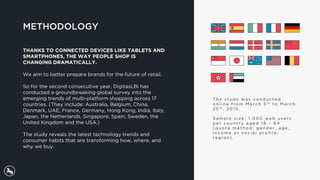

THANKS TO CONNECTED DEVICES LIKE TABLETS AND
SMARTPHONES, THE WAY PEOPLE SHOP IS
CHANGING DRAMATICALLY.
We aim to better prepare brands for the future of retail.
So for the second consecutive year, DigitasLBi has
conducted a groundbreaking global survey into the
emerging trends of multi-platform shopping across 17
countries. (They include: Australia, Belgium, China,
Denmark, UAE, France, Germany, Hong Kong, India, Italy,
Japan, the Netherlands, Singapore, Spain, Sweden, the
United Kingdom and the USA.)
The study reveals the latest technology trends and
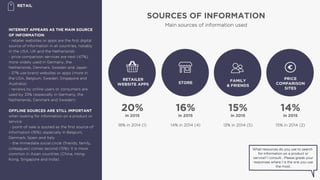
consumer habits that are transforming how, where, and
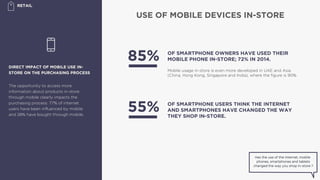
why we buy.
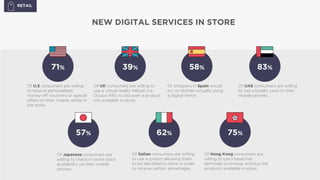
METHODOLOGY
T h e s t u d y w a s c o n d u c t e d
o n l i n e f r o m M a r c h 5 t h t o M a r c h
2 5 t h , 2 0 1 5 .
S a m p l e s i z e : 1 , 0 0 0 w e b u s e r s
p e r c o u n t r y a g e d 1 8 – 6 4
( q u o t a m e t h o d : g e n d e r , a g e ,
i n c o m e o r s o c i a l p r o f i l e ,
r e g i o n ) .
USAGE
SMARTPHONES ARE INCREASINGLY IMPORTANT
DURING ALL STAGES OF THE CUSTOMER JOURNEY.
What devices do people own and
how do they use them?
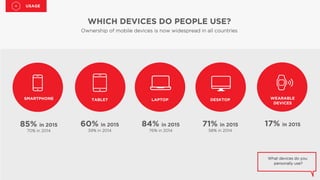
WHICH DEVICES DO PEOPLE USE?
Ownership of mobile devices is now widespread in all countries
USAGE
SMARTPHONE
85% in 2015
70% in 2014
60% in 2015
39% in 2014
84% in 2015
76% in 2014
71% in 2015
58% in 2014
TABLET LAPTOP DESKTOP
17% in 2015
WEARABLE
DEVICES
What devices do you
personally use?
TABLETS AND SMARTPHONES
Penetration rate of total population
TABLET
SMARTPHONE
BASES:
GLOBAL IN %
50
60
70
80
90
100
30 40 50 60 70 80
USAGE
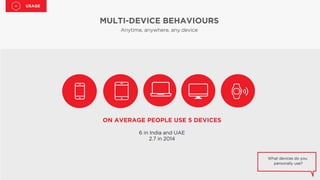
MULTI-DEVICE BEHAVIOURS
Anytime, anywhere, any device
ON AVERAGE PEOPLE USE 5 DEVICES
6 in India and UAE
2.7 in 2014
What devices do you
personally use?
USAGE
E-COMMERCE
WHENEVER, WHEREVER, HOWEVER.
This is the way new connected consumers shop.
In the last 30 DAYS, have you
bought an item online using
one of these devices?
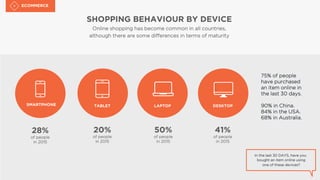
SHOPPING BEHAVIOUR BY DEVICE
Online shopping has become common in all countries,
although there are some differences in terms of maturity
ECOMMERCE
75% of people
have purchased
an item online in
the last 30 days.
90% in China.
84% in the USA.
68% in Australia.
SMARTPHONE
28%
of people
in 2015
20%
of people
in 2015
50%
of people
in 2015
41%
of people
in 2015
TABLET LAPTOP DESKTOP
PERSONALISATION
When shopping online, 86% of
shoppers expect special offers
or discounts – and they’re
important for 39% of all
shoppers. For 65% of shoppers,
offers tailored to their previous
purchases or to their user
profile are important. (for 20%
of e-shoppers, very important)
Overall, 57% of e-shoppers find
personalised recommendations
important, and 18% very
important.
INTEREST IN PERSONALISATION
Impact of personalized experience through a personal account
87%
of people who log in an e-commerce websites in order to
have personalized offer, says that they buy more.
78% buy more often, 76% buy more products.
Do you always log in to your e-commerce
account when shopping online (on the
regular website you use, as Amazon,
Baidu, Alibaba, etc.)?
ECOMMERCE
MAIN REASONS FOR
NOT LOGGING IN:
Those who purposefully don’t
log in / log off believe it is
‘militant’ behaviour. They don’t
want to give their data to e-
commerce websites or they
consider it annoying to register
each time.
NORMALLY LOG IN TO THEIR
E-COMMERCE ACCOUNT WHEN SHOPPING ONLINE.
21% always do.
40%
‘I want to be able to
check what I have
seen during my
previous visits’
I want to receive
personalised marketing
and promotional offers’
37% 34%
‘I do not want to re-
enter my bank account
and personal data
every time’
Why do you log in when
shopping online?
E-COMMERCE LOG-IN HABITS
Personalization is a key driver of performance
75%
ECOMMERCE
AND AMONG THEM :
RETAIL
THE BRICKS AND MORTAR STORE IS BACK.
But it needs to evolve; be more agile, more digital, and more
connected to consumers’ lives.
SOURCES OF INFORMATION
Main sources of information used
RETAIL
What resources do you use to search
for information on a product or
service? I consult... Please grade your
responses where 1 is the one you use
the most.
INTERNET APPEARS AS THE MAIN SOURCE
OF INFORMATION:
- retailer websites or apps are the first digital
source of information in all countries, notably
in the USA, UK and the Netherlands
- price comparison services are next (47%),
more widely used in Germany, the
Netherlands, Denmark, Sweden and Japan
- 37% use brand websites or apps (more in
the USA, Belgium, Sweden, Singapore and
Australia)
- reviews by online users or consumers are
used by 33% (especially in Germany, the
Netherlands, Denmark and Sweden)
OFFLINE SOURCES ARE STILL IMPORTANT
when looking for information on a product or
service:
- point-of-sale is quoted as the first source of
information (16%), especially in Belgium,
Denmark, Spain and Italy
- the immediate social circle (friends, family,
colleagues) comes second (15%); it is more
common in Asian countries (China, Hong-
Kong, Singapore and India).
20%
in 2015
18% in 2014 (1)
RETAILER
WEBSITE APPS
16%
in 2015
14% in 2014 (4)
STORE
15%
in 2015
13% in 2014 (5)
FAMILY
& FRIENDS
14%
in 2015
15% in 2014 (2)
PRICE
COMPARISON
SITES
DIRECT IMPACT OF MOBILE USE IN-
STORE ON THE PURCHASING PROCESS
The opportunity to access more
information about products in-store
through mobile clearly impacts the
purchasing process: 77% of internet
users have been influenced by mobile
and 28% have bought through mobile.
USE OF MOBILE DEVICES IN-STORE
Has the use of the Internet, mobile
phones, smartphones and tablets
changed the way you shop in-store ?
RETAIL
OF SMARTPHONE OWNERS HAVE USED THEIR
MOBILE PHONE IN-STORE; 72% IN 2014.
Mobile usage in-store is even more developed in UAE and Asia
(China, Hong Kong, Singapore and India), where the figure is 90%.
85%
OF SMARTPHONE USERS THINK THE INTERNET
AND SMARTPHONES HAVE CHANGED THE WAY
THEY SHOP IN-STORE.
55%
71%
Of U.S consumers are willing
to receive personalised
money-off vouchers or special
offers on their mobile whilst in
the store.
58%
Of shoppers in Spain would
try on clothes virtually using
a digital mirror.
83%
Of UAE consumers are willing
to use a loyalty card on their
mobile phones.
57%
Of Japanese consumers are
willing to check in-store stock
availability via their mobile
phones.
39%
62% 75%
Of Italian consumers are willing
to use a system allowing them
to be identified in-store in order
to receive certain advantages.
Of UK consumers are willing to
use a virtual reality helmet (i.e.:
Oculus Rift) to discover a product
not available in-store.
.
Of Hong Kong consumers are
willing to use interactive
terminals to browse and buy the
products available in-store.
RETAIL
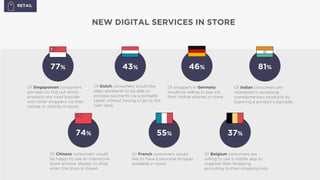
NEW DIGITAL SERVICES IN STORE
77%
Of Singaporean consumers
are keen to find out which
products are most popular
with other shoppers via their
mobile or directly in-store.
46%
Of shoppers in Germany
would be willing to pay via
their mobile phones in-store.
81%
Of Indian consumers are
interested in accessing
complementary products by
scanning a product’s barcode.
74%
Of Chinese consumers would
be happy to use an interactive
store window display to shop
when the store is closed.
43%
55% 37%
Of French consumers would
like to have a personal shopper
available in-store.
Of Dutch consumers would like
sales assistants to be able to
process payments via a portable
tablet without having to go to the
cash desk.
Of Belgium consumers are
willing to use a mobile app to
organise their shopping
according to their shopping lists.
RETAIL
NEW DIGITAL SERVICES IN STORE
MOBILE
MOBILE IS STILL DRIVING CHANGE.
Being the personal shopping assistant for consumers.
MOB
In the last 3 months, have you used your
mobile Internet? (to read your emails, use
an app, download something, search for
information, etc.) ?
MOBILE
SMARTPHONE ADDICTS
77%
of smartphone users use their smartphones to connect to
the internet at least once a day.
What resources do you use to search for
information on a product or service? I
consult... Please grade your responses
where 1 is the one you use most ?
MOBMOBILE
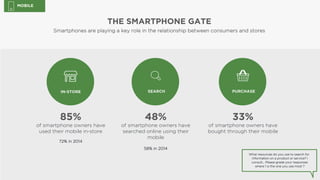
33%
of smartphone owners have
bought through their mobile
PURCHASE
85%
of smartphone owners have
used their mobile in-store
72% in 2014
IN-STORE
THE SMARTPHONE GATE
Smartphones are playing a key role in the relationship between consumers and stores
48%
of smartphone owners have
searched online using their
mobile
58% in 2014
SEARCH
MOB
In the last 30 days, have
you purchased an item… ?
MOBILE
33%
of smartphone users have bought through
their mobile in the last 30 days
Mobile shopping is more developed in UAE (39%) and the
USA (44%) than in Europe and Australia, where the figure
is around 20% on average.
MOBILE PAYMENTS
Mobile purchasing has increased, but is still far behind
in terms of total online purchasing (80%)
62%
of smartphone users would be ready to use
their device to pay in-store
21% have already done it; 49% in India, 34% in USA
SOCIAL
SOCIAL MEDIA IS INFLUENCING AN INCREASING
NUMBER OF PURCHASES ON AND OFFLINE.
SOCIAL
STRONG USAGE AND
INFLUENCE ON PURCHASE
-> KEY PLAYERS
MEDIUM INFLUENCE ON PURCHASE
AND GROWING USAGE
-> NEW LEADERS?
MEDIUM INFLUENCE ON PURCHASE
AND LOW USAGE
-> CHALLENGERS
LOW USAGE AND LOW
INFLUENCE ON PURCHASE
-> UNSUITABLE FOR E-SHOPPING?
PENETRATION RATE
TOTAL USAGE AMONG
POPULATION
INFLUENCE ON PURCHASE AMONG USERS
PER SOCIAL NETWORK USED
SOCIAL MEDIA INFLUENCE
Across all 17 countries
Which of the following social media
platforms do you think influence
you-make you want to buy
certain products ?
52% of
Facebook
users claim to
be influenced
by Facebook
43% of
Instragram
users claim to
be influenced
by Instagram
36% of Twitter
users claim to be
influenced by Twitter
46% of Pinterest
users claim to
be influenced by
Pinterest
53% of Sina
Weibo users
claim to be
influenced by
Sina Weibo
SOCIAL
INFLUENCE OF SOCIAL NETWORKS
ON THE PURCHASING PROCESS
Facebook and Sina Weibo in China are the social networks most likely to influence purchases
OF SOCIAL NETWORK USERS SAY THAT, WHEN
IN-STORE, THEY BUY MORE PRODUCTS OF BRANDS
THEY FOLLOW ON SOCIAL MEDIA NETWORKS.
60% in China, 18% in The Netherlands.
35%
MARKET MATURITY DIFFERS COUNTRY
BY COUNTRY, ESPECIALLY IN ASIA VS
THE REST OF THE WORLD.
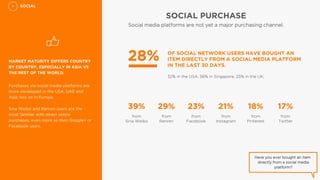
Purchases via social media platforms are
more developed in the USA, UAE and
Asia; less so in Europe.
Sina Weibo and Renren users are the
most familiar with direct online
purchases, even more so than Google+ or
Facebook users.
SOCIAL PURCHASE
Social media platforms are not yet a major purchasing channel.
SOCIAL
Have you ever bought an item
directly from a social media
platform?
OF SOCIAL NETWORK USERS HAVE BOUGHT AN
ITEM DIRECTLY FROM A SOCIAL MEDIA PLATFORM
IN THE LAST 30 DAYS.
32% in the USA, 56% in Singapore, 25% in the UK.
28%
39%
from
Sina Weibo
29%
from
Renren
23%
from
Facebook
21%
from
Instagram
18%
from
Pinterest
17%
from
Twitter

Connected commerce 2015 / IFOP

  • 2.
    THANKS TO CONNECTEDDEVICES LIKE TABLETS AND SMARTPHONES, THE WAY PEOPLE SHOP IS CHANGING DRAMATICALLY. We aim to better prepare brands for the future of retail. So for the second consecutive year, DigitasLBi has conducted a groundbreaking global survey into the emerging trends of multi-platform shopping across 17 countries. (They include: Australia, Belgium, China, Denmark, UAE, France, Germany, Hong Kong, India, Italy, Japan, the Netherlands, Singapore, Spain, Sweden, the United Kingdom and the USA.) The study reveals the latest technology trends and consumer habits that are transforming how, where, and why we buy. METHODOLOGY T h e s t u d y w a s c o n d u c t e d o n l i n e f r o m M a r c h 5 t h t o M a r c h 2 5 t h , 2 0 1 5 . S a m p l e s i z e : 1 , 0 0 0 w e b u s e r s p e r c o u n t r y a g e d 1 8 – 6 4 ( q u o t a m e t h o d : g e n d e r , a g e , i n c o m e o r s o c i a l p r o f i l e , r e g i o n ) .
  • 3.
    USAGE SMARTPHONES ARE INCREASINGLYIMPORTANT DURING ALL STAGES OF THE CUSTOMER JOURNEY. What devices do people own and how do they use them?
  • 4.
    WHICH DEVICES DOPEOPLE USE? Ownership of mobile devices is now widespread in all countries USAGE SMARTPHONE 85% in 2015 70% in 2014 60% in 2015 39% in 2014 84% in 2015 76% in 2014 71% in 2015 58% in 2014 TABLET LAPTOP DESKTOP 17% in 2015 WEARABLE DEVICES What devices do you personally use?
  • 5.
    TABLETS AND SMARTPHONES Penetrationrate of total population TABLET SMARTPHONE BASES: GLOBAL IN % 50 60 70 80 90 100 30 40 50 60 70 80 USAGE
  • 6.
    MULTI-DEVICE BEHAVIOURS Anytime, anywhere,any device ON AVERAGE PEOPLE USE 5 DEVICES 6 in India and UAE 2.7 in 2014 What devices do you personally use? USAGE
  • 7.
    E-COMMERCE WHENEVER, WHEREVER, HOWEVER. Thisis the way new connected consumers shop.
  • 8.
    In the last30 DAYS, have you bought an item online using one of these devices? SHOPPING BEHAVIOUR BY DEVICE Online shopping has become common in all countries, although there are some differences in terms of maturity ECOMMERCE 75% of people have purchased an item online in the last 30 days. 90% in China. 84% in the USA. 68% in Australia. SMARTPHONE 28% of people in 2015 20% of people in 2015 50% of people in 2015 41% of people in 2015 TABLET LAPTOP DESKTOP
  • 9.
    PERSONALISATION When shopping online,86% of shoppers expect special offers or discounts – and they’re important for 39% of all shoppers. For 65% of shoppers, offers tailored to their previous purchases or to their user profile are important. (for 20% of e-shoppers, very important) Overall, 57% of e-shoppers find personalised recommendations important, and 18% very important. INTEREST IN PERSONALISATION Impact of personalized experience through a personal account 87% of people who log in an e-commerce websites in order to have personalized offer, says that they buy more. 78% buy more often, 76% buy more products. Do you always log in to your e-commerce account when shopping online (on the regular website you use, as Amazon, Baidu, Alibaba, etc.)? ECOMMERCE
  • 10.
    MAIN REASONS FOR NOTLOGGING IN: Those who purposefully don’t log in / log off believe it is ‘militant’ behaviour. They don’t want to give their data to e- commerce websites or they consider it annoying to register each time. NORMALLY LOG IN TO THEIR E-COMMERCE ACCOUNT WHEN SHOPPING ONLINE. 21% always do. 40% ‘I want to be able to check what I have seen during my previous visits’ I want to receive personalised marketing and promotional offers’ 37% 34% ‘I do not want to re- enter my bank account and personal data every time’ Why do you log in when shopping online? E-COMMERCE LOG-IN HABITS Personalization is a key driver of performance 75% ECOMMERCE AND AMONG THEM :
  • 11.
    RETAIL THE BRICKS ANDMORTAR STORE IS BACK. But it needs to evolve; be more agile, more digital, and more connected to consumers’ lives.
  • 12.
    SOURCES OF INFORMATION Mainsources of information used RETAIL What resources do you use to search for information on a product or service? I consult... Please grade your responses where 1 is the one you use the most. INTERNET APPEARS AS THE MAIN SOURCE OF INFORMATION: - retailer websites or apps are the first digital source of information in all countries, notably in the USA, UK and the Netherlands - price comparison services are next (47%), more widely used in Germany, the Netherlands, Denmark, Sweden and Japan - 37% use brand websites or apps (more in the USA, Belgium, Sweden, Singapore and Australia) - reviews by online users or consumers are used by 33% (especially in Germany, the Netherlands, Denmark and Sweden) OFFLINE SOURCES ARE STILL IMPORTANT when looking for information on a product or service: - point-of-sale is quoted as the first source of information (16%), especially in Belgium, Denmark, Spain and Italy - the immediate social circle (friends, family, colleagues) comes second (15%); it is more common in Asian countries (China, Hong- Kong, Singapore and India). 20% in 2015 18% in 2014 (1) RETAILER WEBSITE APPS 16% in 2015 14% in 2014 (4) STORE 15% in 2015 13% in 2014 (5) FAMILY & FRIENDS 14% in 2015 15% in 2014 (2) PRICE COMPARISON SITES
  • 13.
    DIRECT IMPACT OFMOBILE USE IN- STORE ON THE PURCHASING PROCESS The opportunity to access more information about products in-store through mobile clearly impacts the purchasing process: 77% of internet users have been influenced by mobile and 28% have bought through mobile. USE OF MOBILE DEVICES IN-STORE Has the use of the Internet, mobile phones, smartphones and tablets changed the way you shop in-store ? RETAIL OF SMARTPHONE OWNERS HAVE USED THEIR MOBILE PHONE IN-STORE; 72% IN 2014. Mobile usage in-store is even more developed in UAE and Asia (China, Hong Kong, Singapore and India), where the figure is 90%. 85% OF SMARTPHONE USERS THINK THE INTERNET AND SMARTPHONES HAVE CHANGED THE WAY THEY SHOP IN-STORE. 55%
  • 14.
    71% Of U.S consumersare willing to receive personalised money-off vouchers or special offers on their mobile whilst in the store. 58% Of shoppers in Spain would try on clothes virtually using a digital mirror. 83% Of UAE consumers are willing to use a loyalty card on their mobile phones. 57% Of Japanese consumers are willing to check in-store stock availability via their mobile phones. 39% 62% 75% Of Italian consumers are willing to use a system allowing them to be identified in-store in order to receive certain advantages. Of UK consumers are willing to use a virtual reality helmet (i.e.: Oculus Rift) to discover a product not available in-store. . Of Hong Kong consumers are willing to use interactive terminals to browse and buy the products available in-store. RETAIL NEW DIGITAL SERVICES IN STORE
  • 15.
    77% Of Singaporean consumers arekeen to find out which products are most popular with other shoppers via their mobile or directly in-store. 46% Of shoppers in Germany would be willing to pay via their mobile phones in-store. 81% Of Indian consumers are interested in accessing complementary products by scanning a product’s barcode. 74% Of Chinese consumers would be happy to use an interactive store window display to shop when the store is closed. 43% 55% 37% Of French consumers would like to have a personal shopper available in-store. Of Dutch consumers would like sales assistants to be able to process payments via a portable tablet without having to go to the cash desk. Of Belgium consumers are willing to use a mobile app to organise their shopping according to their shopping lists. RETAIL NEW DIGITAL SERVICES IN STORE
  • 16.
    MOBILE MOBILE IS STILLDRIVING CHANGE. Being the personal shopping assistant for consumers.
  • 17.
    MOB In the last3 months, have you used your mobile Internet? (to read your emails, use an app, download something, search for information, etc.) ? MOBILE SMARTPHONE ADDICTS 77% of smartphone users use their smartphones to connect to the internet at least once a day.
  • 18.
    What resources doyou use to search for information on a product or service? I consult... Please grade your responses where 1 is the one you use most ? MOBMOBILE 33% of smartphone owners have bought through their mobile PURCHASE 85% of smartphone owners have used their mobile in-store 72% in 2014 IN-STORE THE SMARTPHONE GATE Smartphones are playing a key role in the relationship between consumers and stores 48% of smartphone owners have searched online using their mobile 58% in 2014 SEARCH
  • 19.
    MOB In the last30 days, have you purchased an item… ? MOBILE 33% of smartphone users have bought through their mobile in the last 30 days Mobile shopping is more developed in UAE (39%) and the USA (44%) than in Europe and Australia, where the figure is around 20% on average. MOBILE PAYMENTS Mobile purchasing has increased, but is still far behind in terms of total online purchasing (80%) 62% of smartphone users would be ready to use their device to pay in-store 21% have already done it; 49% in India, 34% in USA
  • 20.
    SOCIAL SOCIAL MEDIA ISINFLUENCING AN INCREASING NUMBER OF PURCHASES ON AND OFFLINE.
  • 21.
    SOCIAL STRONG USAGE AND INFLUENCEON PURCHASE -> KEY PLAYERS MEDIUM INFLUENCE ON PURCHASE AND GROWING USAGE -> NEW LEADERS? MEDIUM INFLUENCE ON PURCHASE AND LOW USAGE -> CHALLENGERS LOW USAGE AND LOW INFLUENCE ON PURCHASE -> UNSUITABLE FOR E-SHOPPING? PENETRATION RATE TOTAL USAGE AMONG POPULATION INFLUENCE ON PURCHASE AMONG USERS PER SOCIAL NETWORK USED SOCIAL MEDIA INFLUENCE Across all 17 countries
  • 22.
    Which of thefollowing social media platforms do you think influence you-make you want to buy certain products ? 52% of Facebook users claim to be influenced by Facebook 43% of Instragram users claim to be influenced by Instagram 36% of Twitter users claim to be influenced by Twitter 46% of Pinterest users claim to be influenced by Pinterest 53% of Sina Weibo users claim to be influenced by Sina Weibo SOCIAL INFLUENCE OF SOCIAL NETWORKS ON THE PURCHASING PROCESS Facebook and Sina Weibo in China are the social networks most likely to influence purchases OF SOCIAL NETWORK USERS SAY THAT, WHEN IN-STORE, THEY BUY MORE PRODUCTS OF BRANDS THEY FOLLOW ON SOCIAL MEDIA NETWORKS. 60% in China, 18% in The Netherlands. 35%
  • 23.
    MARKET MATURITY DIFFERSCOUNTRY BY COUNTRY, ESPECIALLY IN ASIA VS THE REST OF THE WORLD. Purchases via social media platforms are more developed in the USA, UAE and Asia; less so in Europe. Sina Weibo and Renren users are the most familiar with direct online purchases, even more so than Google+ or Facebook users. SOCIAL PURCHASE Social media platforms are not yet a major purchasing channel. SOCIAL Have you ever bought an item directly from a social media platform? OF SOCIAL NETWORK USERS HAVE BOUGHT AN ITEM DIRECTLY FROM A SOCIAL MEDIA PLATFORM IN THE LAST 30 DAYS. 32% in the USA, 56% in Singapore, 25% in the UK. 28% 39% from Sina Weibo 29% from Renren 23% from Facebook 21% from Instagram 18% from Pinterest 17% from Twitter